1 Samuel 20:24

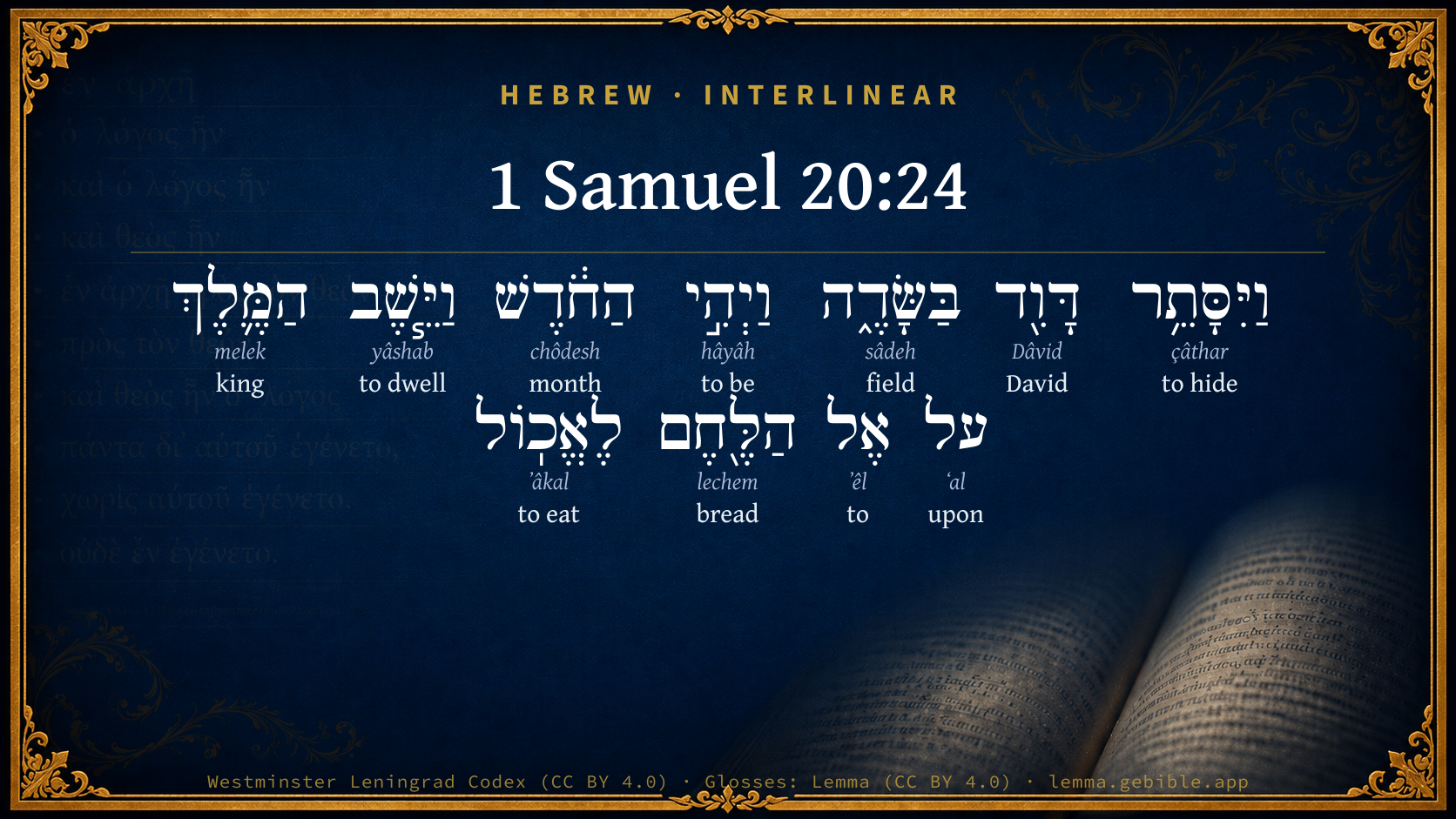
Hebrew (Westminster Leningrad Codex) 1 Samuel 20:24 appears in the Hebrew Old Testament. The text above is from the Westminster Leningrad Codex. Each word links to its Strong’s number, a concise gloss, and parsing drawn from the Open Scriptures Hebrew Bible morphology. Click any word for its full Brown-Driver-Briggs (BDB) entry.
Download image
Cite this verse

1 Samuel 20:24 (World English Bible). Public Domain. Lemma interlinear Bible study tool, https://lemma.gebible.app/v/1-samuel/20/24.

Show BibTeX & RIS
BibTeX
RIS
English Translation
So David hid himself in the field: and when the new moon was come, the king sat him down to eat food.
World English Bible · Public Domain
Download a study sheet

One document with this verse’s original text, its word-by-word gloss line, the meaning frame, cross-references with their text, attributed commentary, and full source and license credits — printable, and it pastes into notes with its structure intact.

This verse Autodidact and up

Study sheet (.html) Plain text (.txt)

A passage Seminary Student

Up to 50 verses in one chapter. A passage sheet keeps up to 6 commentary sources and 12 cross-references per verse, in the order this page ranks them, and says so on the sheet whenever that leaves anything out. Ask for a single verse and you get the Autodidact verse sheet above.

Everything on this page stays free to read, with no account — the sheet is a download of what is already on screen, not access to it.

Want to remove ads? Support Godless Engineer
Compare translations 3

The same verse in 3 English versions, stacked beneath the original-language interlinear above. Click any original word for its lexicon entry.

Each is an independent rendering of the whole verse — the interlinear is not word-aligned to these translations.

Highlighted words mark where these versions differ — a whole-verse word diff, not a word-by-word alignment.

  • World English Bible Public Domain
    So David hid himself in the field: and when the new moon was come, the king sat him down to eat food.
  • King James Version Public Domain
    So David hid himself in the field: and when the new moon was come, the king sat him down to eat meat.
  • unfoldingWord Literal Text CC BY-SA 4.0
    And David hid himself in the field, and it was the new moon, and the king sat down at the food to eat.

unfoldingWord Literal Text — © unfoldingWord, licensed CC BY-SA 4.0. Word-aligned USFM3 via Door43 (git.door43.org/unfoldingWord/en_ult).

Versions to compare (up to 4)

3 of 4 selected

Show all 18 translations

Every available English version of this verse, each an independent rendering of the whole verse.

  • World English Bible Public Domain
    So David hid himself in the field: and when the new moon was come, the king sat him down to eat food.
  • Berean Standard Bible Public Domain
    So David hid in the field, and when the New Moon had come, the king sat down to eat.
  • Majority Standard Bible Public Domain
    So David hid in the field, and when the New Moon had come, the king sat down to eat.
  • King James Version Public Domain
    So David hid himself in the field: and when the new moon was come, the king sat him down to eat meat.
  • American Standard Version (1901) Public Domain
    So David hid himself in the field: and when the new moon was come, the king sat him down to eat food.
  • Revised Version (1885) Public Domain
    So David hid himself in the field: and when the new moon was come, the king sat him down to eat meat.
  • Geneva Bible (1599) Public Domain
    So Dauid hid him selfe in the field: and when the first day of the moneth came, the King sate to eate meate.
  • Douay-Rheims (1899) Public Domain
    So David was hid in the field, and the new moon came, and the king sat down to eat bread.
  • Young's Literal Translation Public Domain
    And David is hidden in the field, and it is the new moon, and the king sitteth down by the food to eat,
  • Literal Standard Version CC BY-SA 4.0
    And David is hidden in the field, and it is the new moon, and the king sits down by the food to eat,
  • Unlocked Literal Bible CC BY-SA 4.0
    So David hid himself in the field. When the new moon came, the king sat down to eat food.
  • unfoldingWord Literal Text CC BY-SA 4.0
    And David hid himself in the field, and it was the new moon, and the king sat down at the food to eat.
  • Darby Bible Public Domain
    And David hid himself in the field; and it was the new moon, and the king sat at table to eat.
  • World Messianic Bible Public Domain
    So David hid himself in the field. When the new moon had come, the king sat himself down to eat food.
  • Webster's Bible Public Domain
    So David hid himself in the field: and when the new-moon had come, the king sat down to eat food.
  • Free Bible Version CC BY-SA 4.0
    So David hid himself in the field. When the New Moon festival arrived, the king sat down to eat.
  • Bible in Basic English Public Domain
    So David went to a secret place in the country: and when the new moon came, the king took his place at the feast.
  • JPS Tanakh (1917) Public Domain
    So David hid himself in the field; and when the new moon was come, the king sat him down to the meal to eat.

Literal Standard Version (2020), Covenant Press — licensed CC BY-SA 4.0. Text via the HelloAO Bible API (eBible.org). Unlocked Literal Bible (unfoldingWord) — licensed CC BY-SA 4.0. Text via the HelloAO Bible API (eBible.org). unfoldingWord Literal Text — © unfoldingWord, licensed CC BY-SA 4.0. Word-aligned USFM3 via Door43 (git.door43.org/unfoldingWord/en_ult). Free Bible Version, Dr. Jonathan Gallagher — licensed CC BY-SA 4.0. Text via the HelloAO Bible API (eBible.org).

Word by word

More ways to search: Search by grammar → Find every occurrence → Compare this word →

Practice this passage: Drill this verse → Learn its vocabulary →

וַיִּסָּתֵ֥ר
çâthar
H5641
“and · to hide”
Conjunction + Verb, Niphal, Sequential Imperfect, 3rd Person, Masculine, Singular
Part of Speech
Conjunction + Verb
Stem
Niphal
Form
Sequential Imperfect
Person
3rd Person
Gender
Masculine
Number
Singular
Full BDB Definition

Origin: a primitive root

TWOT: 1551

to hide, conceal - (Niphal) - to hide oneself - to be hidden, be concealed - (Piel) to hide carefully - (Pual) to be hidden carefully, be concealed - (Hiphil) to conceal, hide - (Hithpael) to hide oneself carefully
  1. דָּוִ֖ד Dâvid H1732 “David” Noun, Proper
  2. בַּשָּׂדֶ֑ה sâdeh H7704 “in/at the · field” Preposition, Determined + Noun, Common, Masculine, Singular, Absolute
  3. וַיְהִ֣י hâyâh H1961 “and · to be” Conjunction + Verb, Qal, Sequential Imperfect, 3rd Person, Masculine, Singular
  4. הַחֹ֔דֶשׁ chôdesh H2320 “the · month” Particle, Definite Article + Noun, Common, Masculine, Singular, Absolute
  5. וַיֵּ֧שֶׁב yâshab H3427 “and · to dwell” Conjunction + Verb, Qal, Sequential Imperfect, 3rd Person, Masculine, Singular
  6. הַמֶּ֛לֶךְ melek H4428 “the · king” Particle, Definite Article + Noun, Common, Masculine, Singular, Absolute
  7. על ʻal H5921 “upon” Preposition
  8. אֶל ʼêl H413 “to” Preposition
  9. הַלֶּ֖חֶם lechem H3899 “the · bread” Particle, Definite Article + Noun, Common, Both, Singular, Absolute
  10. לֶאֱכֽוֹל ʼâkal H398 “to eat” Preposition + Verb, Qal, Infinitive Construct

About this verse

These counts appear in no published source. They are computed here, from the morphology-tagged text and Lemma’s own curated glosses. What Lemma adds →

11
words
11
distinct lemmas
Historical
section

Grammatical profile

  • 4 verbs
  • 5 nouns
  • 2 prepositions

Verb forms

  • וַיִּסָּתֵ֥ר Niphal · Sequential Imperfect
  • וַיְהִ֣י Qal · Sequential Imperfect
  • וַיֵּ֧שֶׁב Qal · Sequential Imperfect
  • לֶאֱכֽוֹל Qal · Infinitive Construct

Hebrew & Septuagint length

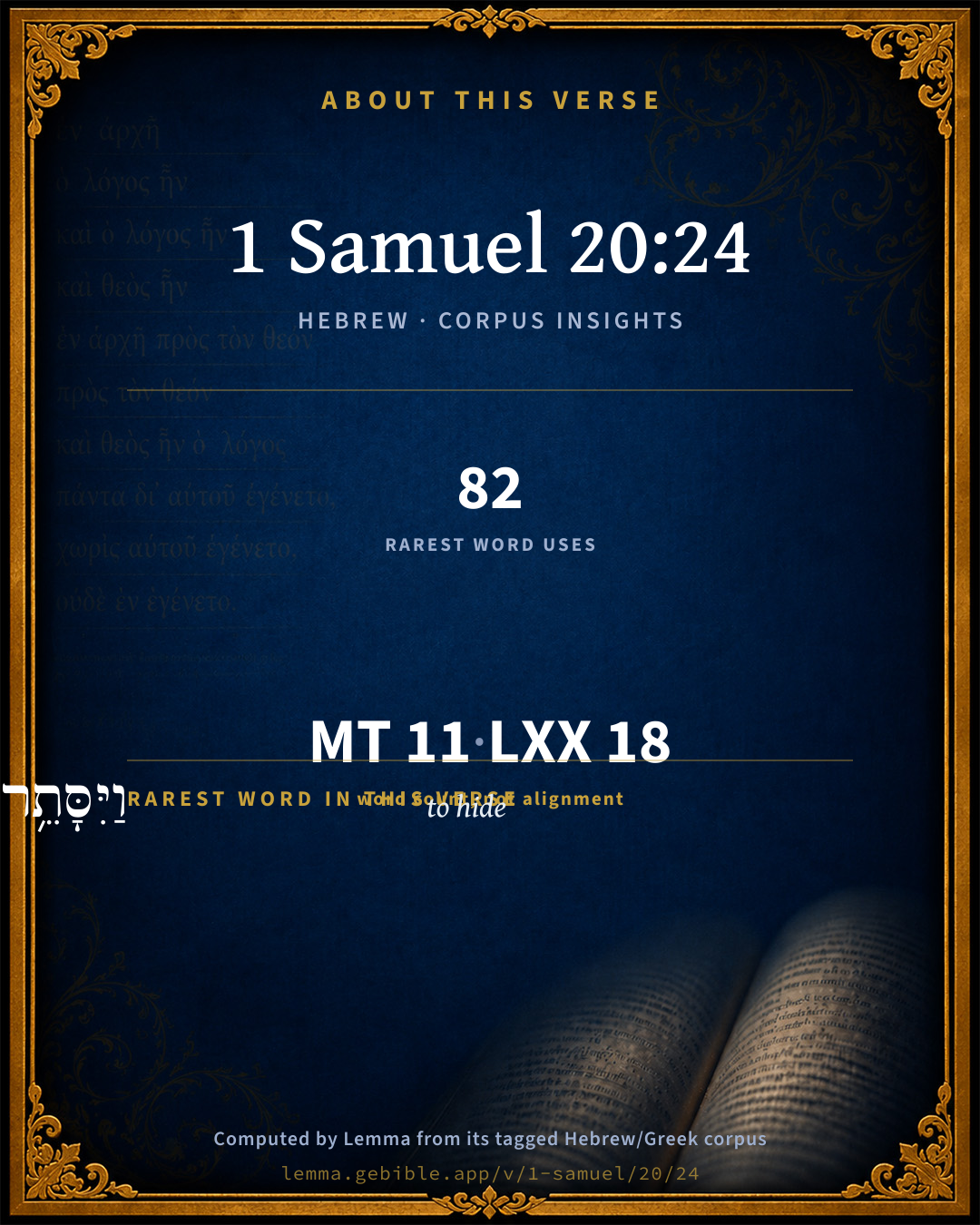
In English translation the verse runs 22 words from the Hebrew and 21 from the Septuagint (LXX English) — closely comparable.

A rough comparison of the two English renderings, which tokenize alike — not a word-level alignment.

Word counts can differ between the Hebrew and the Greek without any difference in meaning — e.g. the Hebrew direct-object marker אֵת has no separate Greek word, and Greek often adds the article ὁ.

In the original languages it is 11 Hebrew tokens and 18 Greek tokens — but the two are counted differently (Hebrew bundles its prefixes and suffixes into one token; the Greek is in lemma form), so that isn’t a like-for-like length.

Cross-references

9

Topical passages linked to 1 Samuel 20:24 in the Treasury of Scripture Knowledge — connected by theme and wording, ordered by reader-vote popularity; previews shown in the World English Bible.

  • Psalms 50:16–21 But to the wicked God says, "What right do you have to declare my statutes, That you have taken my covenant on your lips,
  • Proverbs 4:17 For they eat the bread of wickedness, And drink the wine of violence.
  • Proverbs 15:17 Better is a dinner of herbs, where love is, Than a fattened calf with hatred.
  • Proverbs 17:1 Better is a dry morsel with quietness, Than a house full of feasting with strife.
  • Proverbs 21:3 To do righteousness and justice Is more acceptable to Yahweh than sacrifice.
  • Isaiah 1:11–15 "What are the multitude of your sacrifices to me?," says Yahweh. "I have had enough of the burnt offerings of rams, And the fat of fed animals. I don't delight in the blood of bulls, Or of lambs, Or of male goats.
  • Proverbs 21:27 The sacrifice of the wicked is an abomination: How much more, when he brings it with a wicked mind!
  • Zechariah 7:6 When you eat, and when you drink, don't you eat for yourselves, and drink for yourselves?
  • John 18:28 They led Jesus therefore from Caiaphas into the Praetorium. It was early, and they themselves didn't enter into the Praetorium, that they might not be defiled, but might eat the Passover.

Cross-references courtesy of OpenBible.info (CC BY 4.0).

Hebrew and Greek witnesses Masoretic Hebrew ↔ Greek Septuagint

The same verse in the two great witnesses to the Old Testament, shown verse-for-verse.

These are two independent witnesses, not word-aligned to each other, and the Septuagint is shown in lemma (dictionary) form.

Hebrew 1 Samuel 20:24 Masoretic · Westminster Leningrad Codex

וַיִּסָּתֵ֥ר דָּוִ֖ד בַּשָּׂדֶ֑ה וַיְהִ֣י הַחֹ֔דֶשׁ וַיֵּ֧שֶׁב הַמֶּ֛לֶךְ על אֶל הַלֶּ֖חֶם לֶאֱכֽוֹל

So David hid himself in the field: and when the new moon was come, the king sat him down to eat food.

World English Bible · Public Domain

Greek LXX 1 Samuel 20:24 Septuagint · lemma form

καί κρύπτω δαυίδ ἐν ἀγρός καί παραγίγνομαι ὁ μήν καί ἔρχομαι ὁ βασιλεύς ἐπί ὁ τράπεζα ὁ ἐσθίω

So David hides himself in the field, and the new month arrives, and the king comes to the table to eat.

LXX2012 (modern English Septuagint) · Public Domain

On this verse, Keil & Delitzsch discusses the Septuagint’s reading. Read the note in Commentary ↓

Hebrew: Westminster Leningrad Codex (CC BY 4.0). Greek: Septuagint (public domain); English from LXX2012 (modern English Septuagint) (Public Domain). How the Septuagint differs from the Hebrew →

Targum (Aramaic paraphrase)

1

The Targum is the ancient Jewish Aramaic paraphrase of the Hebrew Scriptures — an interpretive translation, not the Hebrew text itself. Onkelos (literal) and Pseudo-Jonathan (expansive) render the Torah, and Jonathan the Prophets. Coverage is partial: where no permissively-licensed English translation exists for a verse, only the Aramaic is shown. This is verse-level text, not a word-by-word alignment to the Hebrew.

  1. Targum Jonathan Prophets (Joshua–Malachi)
    וְאִטַמַר דָוִד בְּחַקְלָא וַהֲוָה יַרְחָא וְאַסְחַר מַלְכָּא עַל לַחְמָא לְמֵיכָל:

    (no public-domain English translation for this verse)

    Targum Jonathan — Aramaic: “Mikraot Gedolot” (public domain). English: “Sefaria Community Translation” (CC0 1.0 (public-domain dedication)); “London "Chaldee Paraphrase," 1871” (public domain). Text via Sefaria.

Commentary

Notes on 1 Samuel 20:24 from classic Christian and Jewish commentators (each source and its license shown beneath its notes). The classic Christian expositions comment on the surrounding passage and are grouped to its opening verse, so a note may address several verses; the Jewish commentaries on the Tanakh (Rashi and others) are per-verse, so they appear only where the commentator wrote on this verse.

Lemma curates 59 commentaries, every one of them public domain or Creative Commons licensed, each selected and text-cleaned for this edition rather than reprinted as found. About our sources →

Trapp's Complete Commentary

John Trapp

1Sa 20:24 So David hid himself in the field: and when the new moon was come, the king sat him down to eat meat.

Ver. 24. The king sat him down to eat meat.] At the feast of the new moon, which Saul, as bad as he was, yet was careful to keep, and to have his chief princes keep it with him.

John Trapp, A Commentary or Exposition upon All the Books of the Old and New Testament (1647–1656) — public domain. Text from a community e-Sword module.

Joseph Benson's Commentary

1Sa 20:24-26. David hid himself in the field — Namely, at the time appointed: for it seems probable that he went first to Beth-lehem, and thence returned to the field, when the occasion required. Jonathan arose — He rose from his seat where he had sat next the king, and stood up at Abner’s coming, to do honour to him, who was his father’s cousin, and the general of the army. Something hath befallen him — Some accident, which has rendered him unclean, and so unfit to partake of this feast, which consisted in part of the remainders of the peace-offerings, according to the law; (Lev 7:20;) unfit also to come into any company, much more, into the king’s company, lest he should pollute them also.

Joseph Benson's Commentary on the Old and New Testaments (1811–1818) — public domain. Text from a community e-Sword module.

The Pulpit Commentary

CHAPTER 20:24-42

OPEN HATRED OF SAUL AGAINST DAVID (vers. 24-34).

Vers. 24-26. The king sat him down to eat meat. Hebrew, "the king sat down at the bread to eat." On sitting at table see 1Sa_16:11. And Jonathan arose. When the king had taken his usual place, that of honour, next the wall, and therefore farthest from the door, Jonathan arose and took his place on one side of the king, while Abner sat on the other. David"s place below them was left empty. The omission of the statement that Jonathan sat down makes the passage obscure, and the versions bungle in rendering it, but there can be little doubt that these words ought to be supplied. He is not clean. Saul supposed that some ceremonial defilement (Lev_15:2-16) had befallen David, and as the new moon was a religious festival, this would necessarily prevent his attendance.

HOMILETICS.

Vers. 24-34.

Wasted influences, muffed thoughts, and conflicting interests.

The facts are

1. While David lies hidden, Saul notices his absence from the feast on thefirst day, and refers it to some ceremonial defilement.

2. On the second day he calls Jonathan"s attention to the fact, and inquiresthe cause.

3. On his explaining the reason, Saul, in a fit of anger, accuses him offriendship with David, and points out the injury which he thinks will arise therefrom.

4. On Jonathan reasoning against the command to fetch David that he maybe slain, Saul, in his rage, casts a javelin at him.

5. Jonathan, indignant at the injustice and cruelty of his father, leaves thecourt and spends the day in fasting and sorrow. The chief interest of this section turns on the conduct of Jonathan and Saul in the absence of David. The event proved the sagacity of David in keeping at a safe distance from his declared enemy. The facts of this narrative may be best dealt with as furnishing suggestions of realities common even in modern life.

I THE COMMINGLED CHARACTERS OF LIFE. Here was a festive board, a court banquet, and a blending in it of characters most dissimilar. First there was Saul, sullen, morose, charged to the full with envy and malice, ready for deeds of blood, and fearful of a doom of which he dared not speak. Then there was Jonathan, pure, bright, the very soul of chivalry and honour, carrying on his heart a tender secret, and bound by holy bonds to the interests of a coming king. By him was Abner in a seat of honour, just coming into distinction, a warrior destined to play an important part in the future affairs of Israel. Others, not named, were there men of influence, varying in temper and diversely influenced by the strange events of the age. And, in spirit, holding his right to a vacant place, David, who in sympathy sustained the heart of his beloved friend in face of a perilous undertaking. A motley assembly in a moral point of view! Representative of many a banquet and social gathering! Society is strangely formed. The necessities of life, sustained by custom, bring into contact elements most dissimilar, each being toned down by the presence of the other, and the powers that lie in the heart being systematically repressed out of deference to the proprieties of life. The contending forces of sin and holiness, modified by diversities in education and association, issue in shades of character in endless variety. Take any assembly, around the festive board or in a wider circle; what passions, hopes, fears, terrors, joys, aspirations, motives, designs lie concealed in each breast! Each one there is a distinct world; carries in himself a special destiny; is a sepulchre of buried joys, or a garden of germinating seeds. How little we know of those sitting by our side! What tragedies are to be wrought out by some we meet! (Mat_10:26; 1Co_2:11)

II WASTED INFLUENCES. Saul"s spirit and conduct at this time were evidence that all the efforts to bring him to a right state of mind were in vain. During his career Providence had wrought through trouble and joy, prophet and people, threatening and encouragement, and lately through the wise and gentle persuasions of his eldest son and the awe-inspiring presence of the prophetic company. (1Sa_19:21-24) But it all proved to be as the "morning cloud and early dew." Indeed, the coarse language and foul abuse and increased violence on this occasion remind us of the unclean spirit returning with other spirits to make the last state worse than the first. (Mat_12:45) This necessarily raises the thought of the extent and lessons of the wasted influences of life. That vast and varied influences are brought to bear on human beings, which, so far as we can trace in this life, do not issue in their legitimate results is obvious. "Seed on stony ground" is a fact in the moral as in the physical world. "How often would I have gathered thee!" is repeated by hundreds of parents and teachers after the example of the sorrowing Lord. The hitter tears of broken hearted parents and the lamentations of our true Jeremiahs over degenerate nationalities raise the question of Why such wasted energy for good? It does not, indeed, follow that all is lost which seems to be lost on the immediate object. The waste of life which Butler refers to in his "Analogy" is, we know, not really such in the economy of the universe. And so even the fruitless expenditure of moral influence on our reckless souls is wrought up into useful expenditure, for moral instruction and maintenance of justice, in the whole circle of moral existence. Our Saviour"s appeals issued in rejection by the Pharisees, but the two together will form an element in the discipline and instruction of untold ages which will be highly useful. It suggests thought as to the mystery of the human will, and the relation of present to future existence. It suggests inquiries for all Christian workers whether their methods are wisest, are sustained in a right spirit, and are sufficiently varied in kind. It brings grave questions to the conscience of those who enjoy privileges as to what account they will render, and whether they shall ever be more than awful monuments in the universe for the warning of other beings.

III MUFFLED THOUGHTS. "Saul spake not anything that day: for he thought (ver. 26). As the monarch sat at the head of his table the guests saw his stately form and heard his voice when he conversed on the ordinary topics of the day; but also he thought thoughts of David, his past honours, his possible future, his absence today, and his appearance on the morrow, and then his speedy death, passed swifter than lightning through the dark mind, indicating their existence in the low, muffled tones which only the ear of God could discern. Thought is constantly tending to expression in words, and there are gradations in its movement. From simple definiteness of existence up to loud exclamations, Saul"s thoughts, like muffled bells, were ringing within in subdued tones, their language being distinct to himself and to God. It is often forgotten that thought is language in the world of mind; and it is a solemn fact that our real life lies in the thoughts we allow to pass through our mind. Many are under the delusion that what is said audibly and done visibly constitutes the material of which character is built and on which judgment will one day be pronounced. We are spiritual, invisible beings. And while thus our thoughts are the real forms of our life, it is worthy of remark that not one thousandth part of what we think ever finds expression in distinct, audible tones. The vast preponderance of our thoughts beat in muffled tones because we dare not or cannot utter them. What God must hear beating in the hearts of men daily! It was muffled thought which Christ detected saying, "This man blasphemeth" (Mat_9:3; Luk_6:7, Luk_6:8) and which said, "There is no God." The same is true of the "groaning of the prisoner" which cometh up before God, and the dumb prayers of the children of God all over the earth. Keep thy heart with all diligence.

IV CONFLICTING INTERESTS. Jonathan appears to have been an authority with his father in all matters pertaining to the court and government (vers. 2, 27). The muffled thoughts which all along had muttered vengeance against David now found audible and violent expression in the abuse poured on Jonathan and the villanous attempt on his life. He set before Jonathan as conflicting interests, between which he was to make a choice, his friendship for David and his succession to the kingdom. If Jonathan kept the one he must lose the other. Saul assumed that policy and prudence would dictate the choice of the succession, for, with the swift logic of the cruel, he wound up his argument by, "Therefore now send and fetch him unto me, for he shall surely die" (ver. 31). It is easy to show that Saul"s logic, like that of all the wicked, was faulty; for if David was really the "neighbour" to whom God had decreed to give the kingdom, (1Sa_15:28) no breaking of friendship would prevent his having it; and if David was a friend of Jonathan he would never rob him of his right should the friendship be maintained. Jonathan"s love and spiritual insight enabled him to see through the fallacy and to make his choice. There are alternatives open to most men in the course of years which bring material and spiritual considerations into sharp contrast. Here it was selfish grasping at power versus joy in God"s purposes for Israel and mankind. Moses had to say whether the probability of becoming prime minister of Egypt was more attractive than identifying himself with the despised slaves in prosecution of a spiritual enterprise. The same contrast arose, though the choice was different, when the young rich man was required to evince his supreme love for God and all that that implies by giving up the wealth on which his heart was set. (Mat_19:20-22) The possession of wealth and acquisition of honour in public life are not inconsistent with true piety, but it makes all the difference when parents say to young men, "Give up your religion if you are to make your way in the world;" "Surrender the Greater than David, and grasp the honours of this life." Every one is called on to decide between Christ and the supremacy of material, earthly interests. In which lies wisdom is evident. (Mat_10:37 Mat_19:27-29)

V VIRTUE VICTORIOUS. Jonathan was proof against parental influence, material considerations delusively presented, and even threatening of death. He pleaded for right and innocence. He mourned the debasement of a father. He was indignant at the base insinuations against the noblest and purest of men. He dared to let the court know his preference for the spiritual over the material (ver. 34). This is heroism requiring far more courage than to go amidst the cheers of men and the pageantry of war to the cannon"s mouth. Here is the power of faith, the sufficiency of God"s grace, the victory that overcometh the world. (Heb_11:32-38) The world is short sighted. Jonathan now wears a crown which will never fade (2Ti_2:12 2Ti_4:7, 2Ti_4:8; Rev_3:21)

General lessons:

1. Seeing that such varied characters are around us, let us be in every place as the "salt of the earth" and "light of the world.

2. It is our duty to exercise the holiest influence and to work unweariedly, whatever be the issue. (Ecc_11:6)

3. We should cultivate such an inner life that if all our thoughts foundaudible expression we need not be ashamed. (Psa_51:6, Psa_51:10)

4. Everyone is tempted to reject Christ, and so every one has to determinehis own destiny.

5. Fidelity in seasons of great trial depends much on previously cultivatedfriendship with Christ.

HOMILIES BY B. DALE. Vers. 24-34. (GIBEAH)

Anger.

anger was kindled against Jonathan" (ver. 30). "And Jonathan arose from the table in fierce anger" (ver. 34). Anger is not necessarily sinful. "It is in itself, and in its original, no more than indignation against injury and wickedness" (Butler, on "Resentment"). But it is too frequently sinful because of the manner in which it is indulged. How different was the anger of Saul now from what it was on a former occasion. (1Sa_11:6) Consider that

I IT MAY BE UNINTENTIONALLY EXCITED (vers. 24-29). The reason which Jonathan gave why "David"s place was empty" was doubtless a mere pretext (ver. 12), harmless as he thought, and not designed to provoke wrath; but Saul saw through it at once, and his anger was kindled against Jonathan on account of it and his taking part with one whom he regarded as his enemy. Care should be exercised, even when no harm is meant, to furnish no occasion for offence, especially in intercourse with those who are of an irritable and passionate temper, and to avoid "all appearance (every kind) of evil." Deception practised for a good end is not good, and sometimes produces much mischief.

II IT IS OFTEN UNRIGHTEOUSLY INDULGED (vers. 30-33), as

1. When it springs from selfishness and pride, and is associated with malice and revenge. Saul"s anger against Jonathan was the offspring of the envy toward "the son of Jesse" which slumbered in his breast, if indeed he had not now formed the deliberate purpose of putting him to death at the first opportunity. It is not said that "the evil spirit from Jehovah came upon him" again. Hatred of David had become the pervading spirit of his life, and it gave a colouring to everything. "Anger is an agitation of the mind that proceeds to the resolution of a revenge, the mind assenting to it" (Seneca, on "Anger").

2. When it is felt without just or adequate cause. The questions of Jonathan (ver. 32) did not, any more than the reason he had previously given, justify his father"s wrath, and his jealousy of David was groundless and wicked. "Whosoever is angry with his brother without a cause," etc. (Mat_5:22)

1. When it becomes excessive, and ceases to be under the control of right reason. "Be master of thine anger.

2. When it issues in bitter words, and violent and unjust acts. "Whosoever hateth his brother is a murderer," etc.. (1Jn_3:15) He has within him the principle of murder, the germ from which the outward act naturally grows. "Cease from anger and forsake wrath". (Psa_37:8) "Where envy and strife are there is confusion and every evil work". (Jam_3:16) "Sinful anger destroys our own peace of mind, hurts the unity of spirit among brethren, blocks up the way to the Divine throne, exposes us to danger, makes work for bitter repentance, fires the minds of others, makes us unlike the meek and lowly Jesus, causes us to resemble madmen and devils, and is cruel and murderous" (Fawcett, "Essay on Anger".).

III IT CAN BE UNBLAMABLY ENTERTAINED (ver. 34). It may in certain circumstances be a Christian virtue. But in order to this

1. It must be directed, out of love to righteousness, against the wrong which is done or intended rather than against the wrong doer, and be associated with sorrow for him and good will toward him. "Resentment is not inconsistent with good will. These contrary passions, though they may lessen, do not necessarily destroy each other. We may therefore love our enemy and yet have resentment against him for his injurious behaviour toward us" (Butler, on "Forgiveness of Injuries"). "And when he had looked round about on them with anger, being grieved for the hardness of their hearts," etc.. (Mar_3:5)

2. It must be felt from love to others rather than ourselves, especially to those who love God, and from zeal for his honour. "He was grieved for David, because his father had done him shame.

3. It must be kept under proper control. Jonathan did not retaliate. He "arose from the table," and went out; to fast, not to raise a rebellion against his father, as Absalom did at a subsequent period.

4. It must not be suffered to continue too long. "Wise anger is like fire from flint; there, is a great ado to bring it out; and when it does come, it is out again immediately" (M. Henry). "Be ye angry and sin not; let not the sun go down upon your wrath, neither give place to the devil.

IV IT MUST BE UNCEASINGLY GUARDED AGAINST and duly suppressed by the use of proper means, such as consideration of the effects of sinful anger on others and on ourselves, of the allowance which ought to be made for others, of our own faults, and of the patience and gentleness of Christ; the realisation of the presence and love of God; the cultivation of the opposite principles of humility, charity, and meekness; and continual prayer for the Holy Spirit. D.

The Pulpit Commentary (1880–1919), ed. H.D.M. Spence-Jones & Joseph S. Exell — public domain. Text from a community e-Sword module.

Keil & Delitzsch

C. F. Keil & F. Delitzsch

David thereupon concealed himself in the field, whilst Jonathan, as agreed upon, endeavoured to apologize for his absence from the king's table.

Sa1 20:24-25

On the new moon's day Saul sat at table, and as always, at his seat by the wall, i.e., at the top, just as, in eastern lands at the present day, the place of honour is the seat in the corner (see Harmar Beobachtungen ii. pp. 66ff.). "And Jonathan rose up, and Abner seated himself by the side of Saul, and David's place remained empty." The difficult passage, "And Jonathan rose up," etc., can hardly be understood in any other way than as signifying that, when Abner entered, Jonathan rose from his seat by the side of Saul, and gave up the place to Abner, in which case all that is wanting is an account of the place to which Jonathan moved. Every other attempted explanation is exposed to much graver difficulties. The suggestion made by Gesenius, that the cop. ו should be supplied before אבנר, and ויּשׁב referred to Jonathan ("and Jonathan rose up and sat down, and Abner [sat down] by the side of Saul"), as in the Syriac, is open to this objection, that in addition to the necessity of supplying ו, it is impossible to see why Jonathan should have risen up for the purpose of sitting down again. The rendering "and Jonathan came," which is the one adopted by Maurer and De Wette, cannot be philologically sustained; inasmuch as, although קוּם is used to signify rise up, in the sense of the occurrence of important events, or the appearance of celebrated of persons, it never means simply "to come." And lastly, the conjecture of Thenius, that ויּקם should be altered into ויקדּם, according to the senseless rendering of the lxx, προέφθασε τὸν Ἰονάθαν, is overthrown by the fact, that whilst קדּם does indeed mean to anticipate or come to meet, it never means to sit in front of, i.e., opposite to a person.

Sa1 20:26

On this (first) day Saul said nothing, sc., about David's absenting himself, "for he thought there has (something) happened to him, that he is not clean; surely (כּי) he is not clean" (vid., Lev 15:16.; Deu 23:11).

Sa1 20:27-29

But on the second day, the day after the new moon (lit., the morrow after the new moon, the second day: השּׁני is a nominative, and to be joined to ויהי, and not a genitive belonging to החדשׁ), when David was absent from table again, Saul said to Jonathan, "Why is the son of Jesse not come to meat, neither yesterday nor to-day?" Whereupon Jonathan answered, as arranged with David (compare Sa1 20:28 and Sa1 20:29 with Sa1 20:6). "And my brother, he hath commanded me," i.e., ordered me to come. צוּה as in Exo 6:13, and אחי, the elder brother, who was then at the head of the family, and arranged the sacrificial meal.

Sa1 20:30-31

Saul was greatly enraged at this, and said to Jonathan, "Son of a perverse woman (נעות is a participle, Niph. fem. from עוה) of rebellion," - i.e., son of a perverse and rebellious woman (an insult offered to the mother, and therefore so much the greater to the son), hence the meaning really is, "Thou perverse, rebellious fellow," - "do I not know that thou hast chosen the son of Jesse to thine own shame, and to the shame of thy mother's nakedness?" בּחר, to choose a person out of love, to take pleasure in a person; generally construed with בּ pers., here with ל, although many Codd. have בּ here also. "For as long as the son of Jesse liveth upon the earth, thou and thy kingdom (kingship, throne) will not stand." Thus Saul evidently suspected David as his rival, who would either wrest the government from him, or at any rate after his death from his son. "Now send and fetch him to me, for he is a child of death," i.e., he has deserved to die, and shall be put to death.

Sa1 20:32-34

When Jonathan replied, "My father, why shall he die? what has he done?" Saul was so enraged that he hurled his javelin at Jonathan (cf. Sa1 18:11). Thus Jonathan saw that his father had firmly resolved to put David to death, and rose up from the table in fierce anger, and did not eat that day; for he was grieved concerning David, because his father had done him shame. כּלה is a substantive in the sense of unalterable resolution, like the verb in Sa1 20:9. השּׁני בּיום־החדשׁ, on the second day of the new moon or month.

Keil & Delitzsch — Biblical Commentary on the Old Testament (1861–1891) — public domain (CC PDM 1.0). Text via the HelloAO Bible API. (Old Testament only.)

Matthew Henry's Commentary

Jonathan is here effectually convinced of that which he was so loth to believe, that his father had an implacable enmity to David, and would certainly be the death of him if it were in his power; and he had like to have paid very dearly himself for the conviction.

I. David is missed from the feast on the first day, but nothing is said of him. The king sat upon his seat, to feast upon the peace-offerings as at other times (Sa1 20:25), and yet had his heart as full of envy and malice against David as it could hold. He should first have been reconciled to him, and then have come and offered his gift; but, instead of that, he hoped, at this feast, to drink the blood of David. What an abomination was that sacrifice which was brought with such a wicked mind as this! Pro 21:27. When the king came to take his seat Jonathan arose, in reverence to him both as a father and as his sovereign; every one knew his place, but David's was empty. It did not use to be so. None more content than he in attending holy duties; nor had he been absent now but that he must have come at the peril of his life; self-preservation obliged him to withdraw. In imminent peril present opportunities may be waived, nay, we ought not to throw ourselves into the mouth of danger. Christ himself absconded often, till he knew that his hour had come. But that day Saul took no notice that he missed David, but said within himself, "Surely he is not clean, Sa1 20:26. Some ceremonial pollution has befallen him, which forbids him to eat of the holy things till he has washed his clothes, and bathed his flesh in water, and been unclean until the evening." Saul knew what conscience David made of the law, and that he would rather keep away from the holy feast than come in his uncleanness. Blessed be God, no uncleanness is now a restraint upon us, but what we may by faith and repentance be washed from in the fountain opened, Psa 26:6.

II. He is enquired for the second day, Sa1 20:27. Saul asked Jonathan, who he knew was his confidant, Wherefore cometh not the son of Jesse to meat? He was his own son by marriage, but he calls him in disdain, the son of Jesse. He asks for him as if he were not pleased that he should be absent from a religious feast; and so it should be example to masters of families to see to it that those under their charge be not absent from the worship of God, either in public or in the family. It is a bad thing for us, except in case of necessity, to omit an opportunity of statedly attending on God in solemn ordinances. Thomas lost a sight of Christ by being once absent from a meeting of the disciples. But that which displeased Saul was that hereby he missed the opportunity he expected of doing David a mischief.

III. Jonathan makes his excuse, Sa1 20:28, Sa1 20:29. 1. That he was absent upon a good occasion, keeping the feast in another place, though not here, sent for by his elder brother, who was now more respectful to him than he had been (Sa1 17:28), and that he had gone to pay his respects to his relations, for the keeping up of brotherly love; and no master would deny a servant liberty to do that in due time. He pleads, 2. That he did not go without leave humbly asked and obtained from Jonathan, who, as his superior officer, was proper to be applied to for it. Thus he represents David as not wanting in any instance of respect and duty to the government.

IV. Saul hereupon breaks out into a most extravagant passion, and rages like a lion disappointed of his prey. David was out of his reach, but he falls upon Jonathan for his sake (Sa1 20:30, Sa1 20:31), gives him base language, not fit for a gentleman, a prince, to give to any man, especially his own son, heir apparent to his crown, a son that served him, the greatest stay and ornament of his family, before a great deal of company, at a feast, when all should be in good humour, at a sacred feast, by which all irregular passions should be mortified and subdued; yet he does in effect call him, 1. A bastard: Thou son of the perverse rebellious woman; that is, according to the foolish filthy language of men's brutish passion now a day, "Thou son of a whore." He tells him he was born to the confusion of his mother, that is, he had given the world cause to suspect that he was not the legitimate son of Saul, because he loved him whom Saul hated and supported him who would be the destruction of their family. 2. A traitor: Thou son of a perverse rebellion (so the word is), that is, "thou perverse rebel." At other times he reckoned no counsellor or commander that he had more trusty and well-beloved than Jonathan; yet now in this passion he represents him as dangerous to his crown and life. 3. A fool: Thou hast chosen the son of Jesse for thy friend to thy own confusion, for while he lives thou shalt never be established. Jonathan indeed did wisely and well for himself and family to secure an interest in David, whom Heaven had destined to the throne, yet, for this, he is branded as most impolitic. It is good taking God's people for our people and going with those that have him with them. It will prove to our advantage at last, however for the present it may be thought a disparagement, and a prejudice to our secular interest. It is probable Saul knew that David was anointed to the kingdom by the same hand that anointed him, and then not Jonathan, but himself, was the fool, to think to defeat the counsels of God. Yet nothing will serve him but David must die, and Jonathan must fetch him to execution. See how ill Saul's passion looks, and let it warn us against the indulgence of any thing like it in ourselves. Anger is madness, and he that hates his brother is a murderer.

V. Jonathan is sorely grieved and put into disorder by his father's barbarous passion, and the more because he had hoped better things, Sa1 20:2. He was troubled for his father, that he should be such a brute, troubled for his friend, whom he knew to be a friend of God, that he should be so basely abused; he was grieved for David (Sa1 20:34), and troubled for himself too, because his father had done him shame, and, though most unjustly, yet he must submit to it. One would pity Jonathan to see how he was put, 1. Into the peril of sin. Much ado that wise and good man had to keep his temper, upon such a provocation as this. His father's reflections upon himself made no return to; it becomes inferiors to bear with meekness and silence the contempts put upon them in wrath and passion. When thou art the anvil lie thou still. But his dooming David to die he could not bear: to that he replied with some heat (Sa1 20:32), Wherefore shall he be slain? What has he done? Generous spirits can much more easily bear to be abused themselves than to hear their friends abused. 2. Into the peril of death. Saul was now so outrageous that he threw his javelin at Jonathan, Sa1 20:33. He seemed to be in great care (Sa1 20:31) than Jonathan should be established in his kingdom, and yet now he himself aims at his life. What fools, what savage beasts and worse does anger make men! How necessary it is to put a hook in its nose and a bridle in its jaws! Jonathan was fully satisfied that evil was determined against David, which put him out of frame exceedingly: he rose from table, thinking it high time when his life was struck at, and would eat no meat, for they were not to eat of the holy things in their mourning. All the guests, we may suppose, were discomposed, and the mirth of the feast was spoiled. He that is cruel troubles his own flesh, Pro 11:17.

Matthew Henry's Commentary on the Whole Bible (1708–1710) — public domain (CC PDM 1.0). Text via the HelloAO Bible API.

Ellicott's Commentary for English Readers

(24) Sat him down.—The LXX. paraphrases here, “came to the table.”

A Bible Commentary for English Readers, edited by Charles John Ellicott (1878–1897) — public domain. Text from a community e-Sword module.

The Cambridge Bible for Schools and Colleges

gen. ed. J. J. S. Perowne

24–34. Saul’s intention tested by Jonathan

24. meat] Lit. bread. “Meat” in the E. V. signifies food in general, and is nowhere limited to the modem meaning flesh. This usage survives in some provincial dialects.

The Cambridge Bible for Schools and Colleges (gen. ed. J. J. S. Perowne; Cambridge University Press, 1878–1918) — public domain. Text from a community e-Sword module.

John Gill's Exposition

So David hid himself in the field,.... Not directly, but at the time appointed; for he went to Bethlehem, and returned from thence before that time:

and when the new moon was come; the first clay of the month, which was a solemn festival:

the king sat him down to eat meat; Saul sat down at his table to eat of the provisions that were set upon it; which it is very probable were the peace offerings for that day, which he, his family, and nobles, feasted on together; it is in the Hebrew, "he sat down at the bread" (b), which is put for all the food on the table, and the provisions of it.

(b) "ad vel juxta panem", Pagninus, Montanus.

John Gill's Exposition of the Whole Bible (1746–1763) — public domain (CC PDM 1.0). Text via the HelloAO Bible API.

Haydock's Catholic Bible Commentary

CHAPTER XX.

Field, on the third day, having gone in the mean time to Bethlehem, ver. 6.

George Leo Haydock (1774–1849), Haydock's Catholic Family Bible and Commentary, 1859 edition — public domain. Excludes Psalms (Douay-Rheims chapter numbering differs from Protestant) and Deuterocanonical books (Catholic canon only).

Matthew Poole's English Annotations

David hid himself, to wit, at the time appointed; for it seems probable that he went first to Bethlehem, as he bade Jonathan tell his father, 1Sa 20:6, and thence returned to the field, when the occasion required; else we must charge him with a downright lie, which ought not to be imagined (without any apparent cause) concerning so good a man, especially in so distressed and dangerous a condition. And why should he hide himself there so long before the time when Jonathan was to come thither to inform him? Nor were there any need of appointing a certain time to meet, if David were there all the while.

Matthew Poole's English Annotations on the Holy Bible (1683–1685) — public domain. Text from a community e-Sword/MySword module.

John Wesley's Explanatory Notes

Hid himself - Namely, at the time appointed: for it seems probable, that he went first to Bethlehem, and thence returned to the field, when the occasion required.

John Wesley, Explanatory Notes Upon the Whole Bible (1754–1765) — public domain. Text via the GEBible commentary corpus.

Kretzmann's Popular Commentary

Paul E. Kretzmann

Jonathan’s Information to David

v. 24. So David hid himself in the field; and when the new moon was come, the king sat him down to eat meat, at the head of the table, the place of honor.

v. 25. And the king sat upon his seat, as at other times, even upon a seat by the wall; and Jonathan arose, and Abner sat by Saul’s side, and David’s place was empty. It seems that Jonathan arose from his place next to Saul and gave his seat to Abner, his uncle, while he himself took the place ordinarily occupied by David, in order to avert suspicion.

v. 26. Nevertheless Saul spake not anything that day, made no remark concerning the peculiar absence of David; for he thought, Something hath befallen him, he is not clean; surely he is not clean, that is, Levitically clean, a condition which kept a person away from sacrificial meals, Lev 15:16 ff. ; Deu 23:11.

v. 27. And it came to pass on the morrow, which was the second day of the month, that David’s place was empty, literally, "on the morrow after the new moon," the second day; and Saul said unto Jonathan, his son, Wherefore cometh not the son of Jesse to meat, neither yesterday nor today?

v. 28. And Jonathan answered Saul, David earnestly asked leave of me to go to Bethlehem;

v. 29. and he said, Let me go, I pray thee; for our family hath a sacrifice in the city; and my brother, the oldest brother, as the head of the family, he hath commanded me to be there; and now, if I have found favor in thine eyes, let me get away, take myself off, I pray thee, and see my brethren. Therefore he cometh not unto the king’s table. The report of Jonathan is entirely in keeping with the cordial relation existing between friends.

v. 30. Then Saul’s anger was kindled against Jonathan, and he said unto him, Thou son of the perverse, rebellious woman, literally, "of perversity, of rebelliousness," a common expression for a man of obstinate and unruly disposition, do not I know that thou hast chosen the son of Jesse to thine own confusion, disgrace, and unto the confusion of thy mother’s nakedness, to thy shame and to the shame of thy mother’s nakedness, who would be ashamed of having given birth to such a rebellious son?

v. 31. For as long as the son of Jesse liveth upon the ground, as long as David was alive and was, in the opinion of Saul, making rebellious attempts to possess the royal throne, thou shalt not be established, nor thy kingdom; David was standing in the way of making the kingdom hereditary in Saul’s family. Wherefore, now, send and fetch him unto me, for he shall surely die; Saul considered him a son, a candidate, of death.

v. 32. And Jonathan, by way of gentle remonstrance, in order to set forth David’s innocence, answered Saul, his father, and said unto him, Wherefore shall he be slain? What hath he done?

v. 33. And Saul cast a javelin at him to smite him, he brandished and probably even hurled the small spear which he used as a scepter; whereby Jonathan knew that it was determined, firmly settled, of his father to slay David.

v. 34. So Jonathan arose from the table in fierce anger and did eat no meat, did not partake of food, the second day of the month; for he was grieved for David, on account of the shame heaped upon his friend by Saul, which his generous nature deeply resented, while he overlooked the insult offered to himself, because his father had done him shame.

v. 35. And it came to pass in the morning that Jonathan went out into the field at the time appointed with David, and a little lad with him. He was careful to keep the agreement with David in every detail.

v. 36. And he said unto his lad, Run, find out now the arrows which I shoot, gathering them up from the ground as Jonathan practiced with his bow. And as the lad ran, he shot an arrow beyond him, farther than the boy had passed on.

v. 37. And when the lad was come to the place of the arrow which Jonathan had shot, where it had flown, Jonathan cried after the lad and said, Is not the arrow beyond thee?

v. 38. And Jonathan cried after the lad, Make speed, haste, stay not, lest in looking about in a leisurely fashion he might espy David behind the rock. And Jonathan’s lad gathered up the arrows and came to his master, bringing the arrow, as he probably did in the next two cases.

v. 39. But the lad knew not anything; only Jonathan and David knew the matter.

v. 40. And Jonathan gave his artillery, bow, quiver, and arrows, unto his lad and said unto him, Go, carry them to the city, this giving him an opportunity to be alone with David.

v. 41. And as soon as the lad was gone, David arose out of a place toward the south, for on that side of the rock he had concealed himself, and fell on his face to the ground, and bowed himself three times, both to do Jonathan honor and gratefully to acknowledge his efforts in his behalf; and they kissed one another, and wept one with another, until David exceeded, until David broke out in loud weeping.

v. 42. And Jonathan said to David, Go in peace, forasmuch as we have sworn, both of us, in the name of the Lord, saying, The Lord be between me and thee, and between my seed and thy seed forever. This oath they wanted to keep with all firmness; nothing should ever persuade them to break it. And he, David, arose and departed; and Jonathan went into the city. Thus true love and friendship demonstrates its sincerity when one friend warns the other against harm and danger. And it is true in general that we should weep with those who mourn and comfort those who are in trouble, encouraging them with reference to Jehovah’s mercy.

Paul E. Kretzmann, Popular Commentary of the Bible (1921–1924) — public domain. Text from a community e-Sword module.

unfoldingWord translationNotes

Door43 World Missions Community

Jonathan stood up

Some ancient copies have "Jonathan sat across from him." (See: Original Manuscripts)

translationWords

David

new moon

king

Jonathan

Abner

unfoldingWord translationNotes — © Distant Shores Media and the Door43 World Missions Community, licensed CC BY-SA 4.0. Source: git.door43.org/Door43/en_tn.

Lesson kit

Teaching starters — assembled from the data on this page, not authored interpretation. Every prompt links to the verse data it draws on. Edit before teaching.

1 Samuel, in the Historical, opens this verse with 11 words (11 distinct Hebrew lemmas). Its most distinctive word is çâthar (“to hide”). A historical commentator’s framing appears above. Read the whole chapter for the surrounding context.

Discussion questions

  1. How does “to hide” (çâthar) shape what this verse is saying?
  2. Psalms 50:16–21 shares this passage’s theme. How do the two illuminate each other?
  3. These translations render this verse differently; the difference is in the English rendering, not the original. What questions does that raise?
  4. The verb «וַיִּסָּתֵ֥ר» is Niphal Sequential Imperfect. How does its form color the action?
  5. Reading how Trapp's Complete Commentary and Joseph Benson's Commentary read this verse, where do the two commentators agree and where do they part?

Things to notice

Reading settings

Reading text

Shown beneath each verse's original-language words.

Old Testament
Old Testament edition

Read the OT as the Masoretic Hebrew (MT) or the Greek Septuagint (LXX).

English shown for the Greek Septuagint (in the Hebrew ↔ Greek comparison).

Comparing translations? Open the Compare panel on any verse page to stack up to four side by side.