
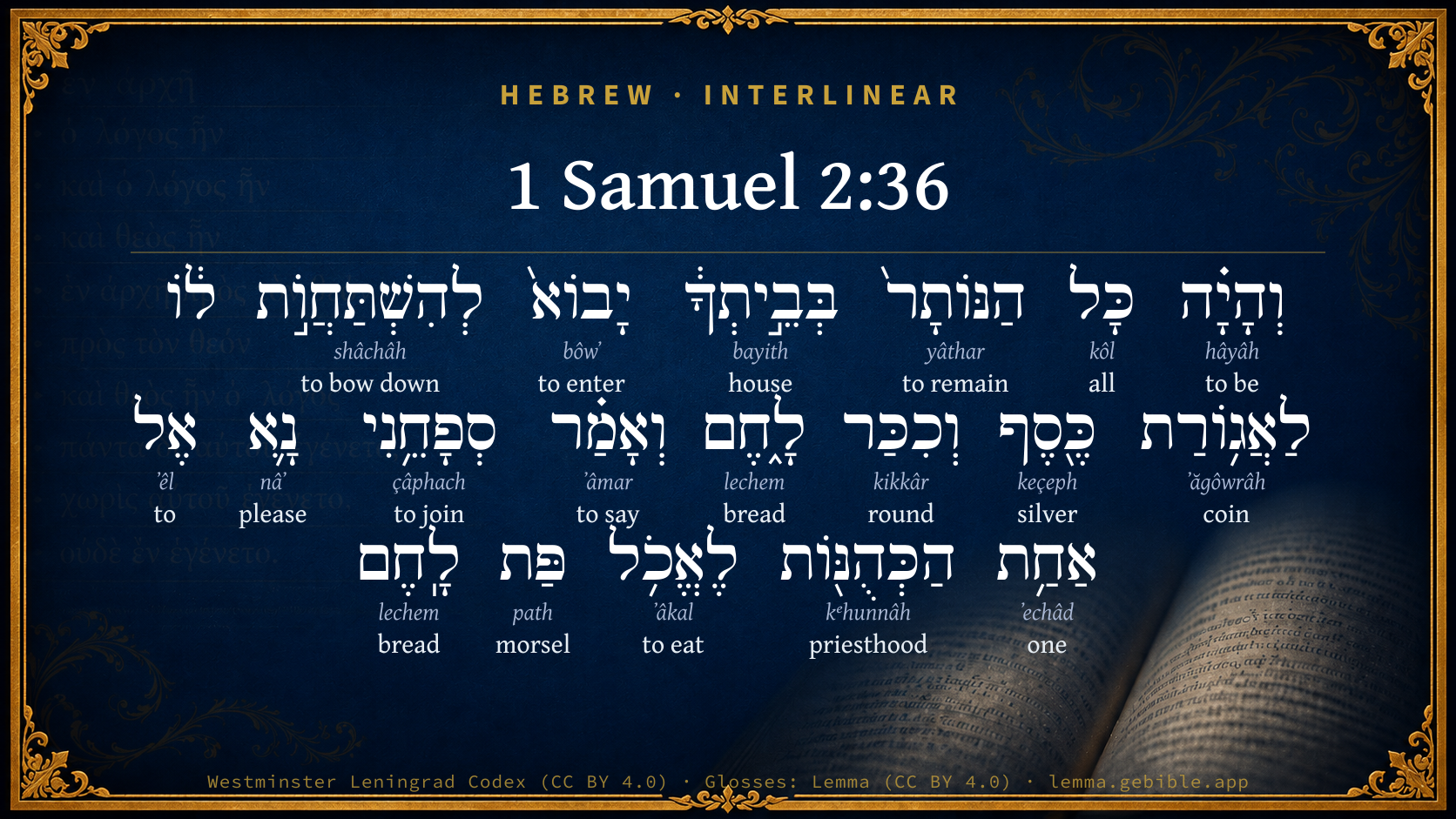
1 Samuel 2:36

Hebrew (Westminster Leningrad Codex) 1 Samuel 2:36 appears in the Hebrew Old Testament. The text above is from the Westminster Leningrad Codex. Each word links to its Strong’s number, a concise gloss, and parsing drawn from the Open Scriptures Hebrew Bible morphology. Click any word for its full Brown-Driver-Briggs (BDB) entry.
Download image
Cite this verse

1 Samuel 2:36 (World English Bible). Public Domain. Lemma interlinear Bible study tool, https://lemma.gebible.app/v/1-samuel/2/36.

Show BibTeX & RIS
BibTeX
RIS
English Translation
It shall happen, that everyone who is left in your house shall come and bow down to him for a piece of silver and a loaf of bread, and shall say, Please put me into one of the priests' offices, that I may eat a morsel of bread.
World English Bible · Public Domain
Highlights
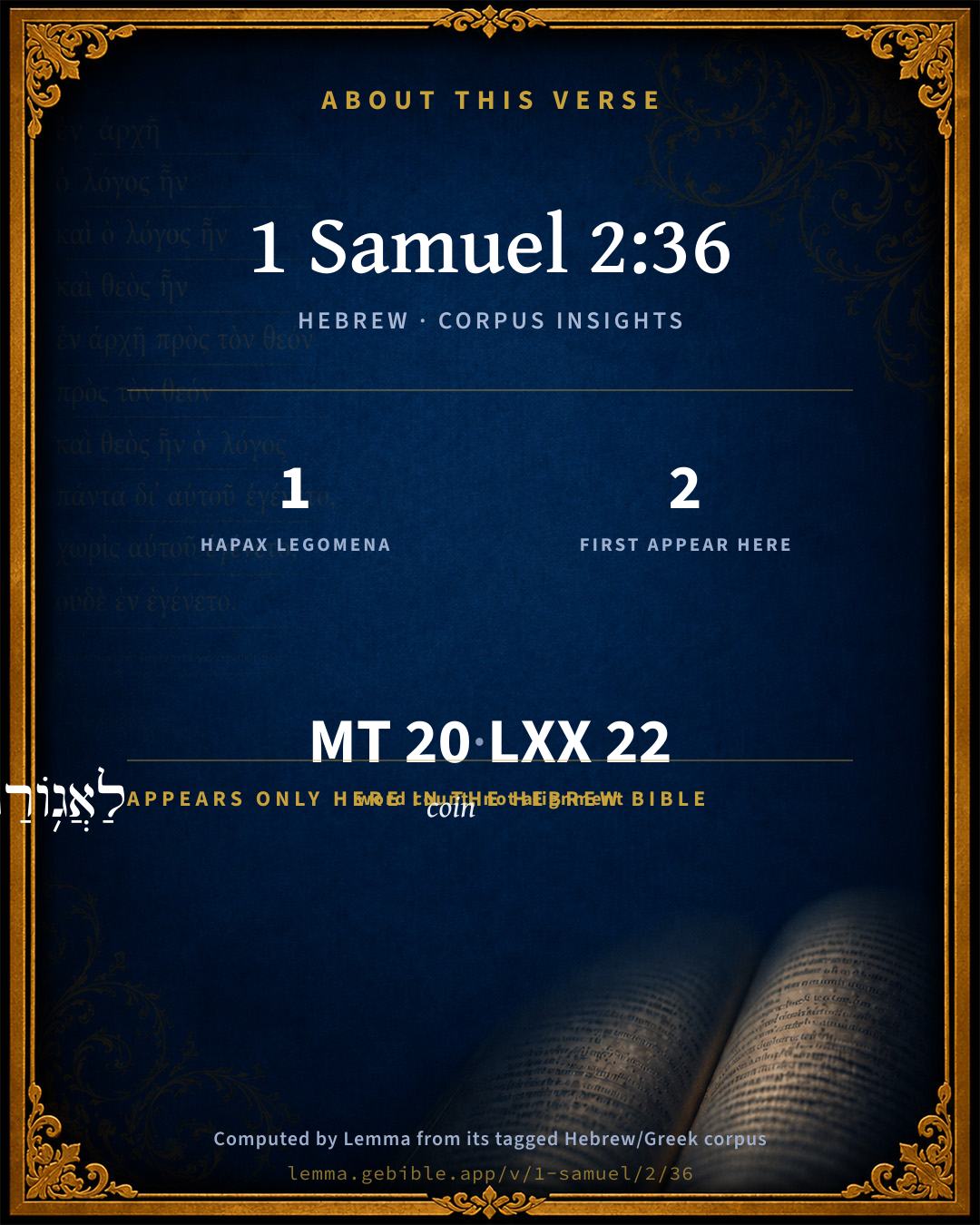
  • 1 hapax legomenon — only here in the Hebrew Bible
  • 2 first appearances in the Hebrew Bible
Full analysis ↓
Download a study sheet

One document with this verse’s original text, its word-by-word gloss line, the meaning frame, cross-references with their text, attributed commentary, and full source and license credits — printable, and it pastes into notes with its structure intact.

This verse Autodidact and up

Study sheet (.html) Plain text (.txt)

A passage Seminary Student

Up to 50 verses in one chapter. A passage sheet keeps up to 6 commentary sources and 12 cross-references per verse, in the order this page ranks them, and says so on the sheet whenever that leaves anything out. Ask for a single verse and you get the Autodidact verse sheet above.

Everything on this page stays free to read, with no account — the sheet is a download of what is already on screen, not access to it.

Want to remove ads? Support Godless Engineer
Compare translations 3

The same verse in 3 English versions, stacked beneath the original-language interlinear above. Click any original word for its lexicon entry.

Each is an independent rendering of the whole verse — the interlinear is not word-aligned to these translations.

Highlighted words mark where these versions differ — a whole-verse word diff, not a word-by-word alignment.

  • World English Bible Public Domain
    It shall happen, that everyone who is left in your house shall come and bow down to him for a piece of silver and a loaf of bread, and shall say, Please put me into one of the priests' offices, that I may eat a morsel of bread.
  • King James Version Public Domain
    And it shall come to pass, that every one that is left in thine house shall come and crouch to him for a piece of silver and a morsel of bread, and shall say, Put me, I pray thee, into one of the priests' offices, that I may eat a piece of bread.
  • unfoldingWord Literal Text CC BY-SA 4.0
    And it will happen that every remaining one in your house will come to bow down to him for a piece of silver and a loaf of bread, and he will say, “Please assign me to one of the priestly positions to eat a piece of bread.”’”

unfoldingWord Literal Text — © unfoldingWord, licensed CC BY-SA 4.0. Word-aligned USFM3 via Door43 (git.door43.org/unfoldingWord/en_ult).

Versions to compare (up to 4)

3 of 4 selected

Show all 18 translations

Every available English version of this verse, each an independent rendering of the whole verse.

  • World English Bible Public Domain
    It shall happen, that everyone who is left in your house shall come and bow down to him for a piece of silver and a loaf of bread, and shall say, Please put me into one of the priests' offices, that I may eat a morsel of bread.
  • Berean Standard Bible Public Domain
    And everyone left in your house will come and bow down to him for a piece of silver or a morsel of bread, pleading, “Please appoint me to some priestly office so that I can eat a piece of bread.”’”
  • Majority Standard Bible Public Domain
    And everyone left in your house will come and bow down to him for a piece of silver or a morsel of bread, pleading, “Please appoint me to some priestly office so that I can eat a piece of bread.”’”
  • King James Version Public Domain
    And it shall come to pass, that every one that is left in thine house shall come and crouch to him for a piece of silver and a morsel of bread, and shall say, Put me, I pray thee, into one of the priests' offices, that I may eat a piece of bread.
  • American Standard Version (1901) Public Domain
    And it shall come to pass, that every one that is left in thy house shall come and bow down to him for a piece of silver and a loaf of bread, and shall say, Put me, I pray thee, into one of the priests' offices, that I may eat a morsel of bread.
  • Revised Version (1885) Public Domain
    And it shall come to pass, that every one that is left in thine house shall come and bow down to him for a piece of silver and a loaf of bread, and shall say, Put me, I pray thee, into one of the priests’ offices, that I may eat a morsel of bread.
  • Geneva Bible (1599) Public Domain
    And all that are left in thine house, shall come and bowe downe to him for a piece of siluer and a morsell of bread, and shall say, Appoint me, I pray thee, to one of the priestes offices, that I may eate a morsell of bread.
  • Douay-Rheims (1899) Public Domain
    And it shall come to pass, that whosoever shall remain in thy house, shall come that he may be prayed for, and shall offer a piece of silver, and a roll of bread, and shall say: Put me, I beseech thee, to somewhat of the priestly office, that I may eat a morsel of bread.
  • Young's Literal Translation Public Domain
    and it hath been, every one who is left in thy house doth come in to bow himself to him, for a wage of silver, and a cake of bread, and hath said, Admit me, I pray thee, unto one of the priest's offices, to eat a morsel of bread.'
  • Literal Standard Version CC BY-SA 4.0
    and it has been, everyone who is left in your house comes to bow himself to him for a wage of silver and a cake of bread, and has said, Please admit me to one of the priest’s offices, to eat a morsel of bread.”
  • Unlocked Literal Bible CC BY-SA 4.0
    Everyone who is left in your house will come and bow down to him, asking for a piece of silver and a loaf of bread, and will say, “Please assign me to one of the priests' positions so I can eat a piece of bread.”'”
  • unfoldingWord Literal Text CC BY-SA 4.0
    And it will happen that every remaining one in your house will come to bow down to him for a piece of silver and a loaf of bread, and he will say, “Please assign me to one of the priestly positions to eat a piece of bread.”’”
  • Darby Bible Public Domain
    And it shall come to pass [that] every one that is left of thy house shall come to crouch to him for a small piece of silver and for a cake of bread, and shall say, Put me, I pray thee, into one of the priestly offices, that I may eat a morsel of bread.
  • World Messianic Bible Public Domain
    It will happen that everyone who is left in your house will come and bow down to him for a piece of silver and a loaf of bread, and will say, “Please put me into one of the priests’ offices, that I may eat a morsel of bread.”’”
  • Webster's Bible Public Domain
    And it shall come to pass, that every one that is left in thy house, shall come and crouch to him for a piece of silver and a morsel of bread, and shall say, Put me, I pray thee, into one of the priest's offices, that I may eat a piece of bread.
  • Free Bible Version CC BY-SA 4.0
    Every one of your descendants who is left will come and bow down to him, asking for money and food, saying, ‘Please give me work as a priest so that I can have food to eat.’”
  • Bible in Basic English Public Domain
    Then it will be that the rest of your family, anyone who has not been cut off, will go down on his knees to him for a bit of silver or a bit of bread, and say, Be pleased to put me into one of the priest's places so that I may have a little food.
  • JPS Tanakh (1917) Public Domain
    And it shall come to pass, that every one that is left in thy house shall come and bow down to him for a piece of silver and a loaf of bread, and shall say: Put me, I pray thee, into one of the priests' offices, that I may eat a morsel of bread.'

Literal Standard Version (2020), Covenant Press — licensed CC BY-SA 4.0. Text via the HelloAO Bible API (eBible.org). Unlocked Literal Bible (unfoldingWord) — licensed CC BY-SA 4.0. Text via the HelloAO Bible API (eBible.org). unfoldingWord Literal Text — © unfoldingWord, licensed CC BY-SA 4.0. Word-aligned USFM3 via Door43 (git.door43.org/unfoldingWord/en_ult). Free Bible Version, Dr. Jonathan Gallagher — licensed CC BY-SA 4.0. Text via the HelloAO Bible API (eBible.org).

Word by word

More ways to search: Search by grammar → Find every occurrence → Compare this word →

Practice this passage: Drill this verse → Learn its vocabulary →

לַאֲג֥וֹרַת
ʼăgôwrâh
H95
“to/for · coin of”
Preposition + Noun, Common, Feminine, Singular, Construct
Part of Speech
Preposition + Noun
Type
Common
Gender
Feminine
Number
Singular
State
Construct
Full BDB Definition

Origin: from the same as H94

TWOT: 23a

payment, piece, coin
  1. וְהָיָ֗ה hâyâh H1961 “and · to be” Conjunction + Verb, Qal, Sequential Perfect, 3rd Person, Masculine, Singular
  2. כָּל kôl H3605 “all of” Noun, Common, Masculine, Singular, Construct
  3. הַנּוֹתָר֙ yâthar H3498 “the · remaining” Particle, Definite Article + Verb, Niphal, Participle Active, Masculine, Singular, Absolute
  4. בְּבֵ֣יתְךָ֔ bayith H1004 “in/at · house · your” Preposition + Noun, Common, Masculine, Singular, Construct + Suffix, Personal, 2nd Person, Masculine, Singular
  5. יָבוֹא֙ bôwʼ H935 “to enter” Verb, Qal, Imperfect, 3rd Person, Masculine, Singular
  6. לְהִשְׁתַּחֲוֺ֣ת shâchâh H7812 “to bow down” Preposition + Verb, Hithpael, Infinitive Construct
  7. כֶּ֖סֶף keçeph H3701 “silver” Noun, Common, Masculine, Singular, Absolute
  8. וְכִכַּר kikkâr H3603 “and · round of” Conjunction + Noun, Common, Both, Singular, Construct
  9. לָ֑חֶם lechem H3899 “bread” Noun, Common, Both, Singular, Absolute
  10. וְאָמַ֗ר ʼâmar H559 “and · to say” Conjunction + Verb, Qal, Sequential Perfect, 3rd Person, Masculine, Singular
  11. סְפָחֵ֥נִי çâphach H5596 “join · me” Verb, Qal, Imperative, 2nd Person, Masculine, Singular + Suffix, Personal, 1st Person, Common, Singular
  12. נָ֛א nâʼ H4994 “please” Particle, Exhortation
  13. אֶל ʼêl H413 “to” Preposition
  14. אַחַ֥ת ʼechâd H259 “one” Adjective, Cardinal number, Feminine, Singular, Absolute
  15. הַכְּהֻנּ֖וֹת kᵉhunnâh H3550 “the · priesthood” Particle, Definite Article + Noun, Common, Feminine, Plural, Absolute
  16. לֶאֱכֹ֥ל ʼâkal H398 “to eat” Preposition + Verb, Qal, Infinitive Construct
  17. פַּת path H6595 “morsel of” Noun, Common, Feminine, Singular, Construct
  18. לָֽחֶם lechem H3899 “bread” Noun, Common, Both, Singular, Absolute

About this verse

These counts appear in no published source. They are computed here, from the morphology-tagged text and Lemma’s own curated glosses. What Lemma adds →

20
words
18
distinct lemmas
Historical
section

Notable vocabulary

1 hapax legomenon — a word that appears only here in the entire Hebrew Bible:

  • לַאֲג֥וֹרַת coin H95

First appearance in Scripture

These words make their first canonical appearance in the Hebrew Bible here:

  • לַאֲג֥וֹרַת coin H95
  • סְפָחֵ֥נִי to join H5596

Shared distinctive vocabulary

סְפָחֵ֥נִי to join H5596 occurs in 6 verses of the Hebrew Bible. Also found in:

Grammatical profile

  • 7 verbs
  • 9 nouns
  • 1 adjective
  • 2 prepositions
  • 1 particle

Verb forms

  • וְהָיָ֗ה Qal · Sequential Perfect
  • הַנּוֹתָר֙ Niphal · Participle Active
  • יָבוֹא֙ Qal · Imperfect
  • לְהִשְׁתַּחֲוֺ֣ת Hithpael · Infinitive Construct
  • וְאָמַ֗ר Qal · Sequential Perfect
  • סְפָחֵ֥נִי Qal · Imperative
  • לֶאֱכֹ֥ל Qal · Infinitive Construct

Repetition

A word recurs within this verse — often emphatic in Hebrew:

  • לָ֑חֶם bread H3899 ×2

Hebrew & Septuagint length

In English translation the verse runs 48 words from the Hebrew and 38 from the Septuagint (LXX English) — closely comparable.

A rough comparison of the two English renderings, which tokenize alike — not a word-level alignment.

Word counts can differ between the Hebrew and the Greek without any difference in meaning — e.g. the Hebrew direct-object marker אֵת has no separate Greek word, and Greek often adds the article ὁ.

In the original languages it is 20 Hebrew tokens and 22 Greek tokens — but the two are counted differently (Hebrew bundles its prefixes and suffixes into one token; the Greek is in lemma form), so that isn’t a like-for-like length.

Cross-references

4

Topical passages linked to 1 Samuel 2:36 in the Treasury of Scripture Knowledge — connected by theme and wording, ordered by reader-vote popularity; previews shown in the World English Bible.

  • 1 Kings 2:27 So Solomon thrust out Abiathar from being priest to Yahweh, that he might fulfill the word of Yahweh, which he spoke concerning the house of Eli in Shiloh.
  • 1 Samuel 2:29–30 Why kick you at my sacrifice and at my offering, which I have commanded in [my] habitation, and honor your sons above me, to make yourselves fat with the best of all the offerings of Israel my people?
  • Ezekiel 44:10–12 But the Levites who went far from me, when Israel went astray, who went astray from me after their idols, they shall bear their iniquity.
  • Malachi 1:13 You say also, 'Behold, what a weariness it is!' and you have sniffed at it," says Yahweh of Hosts; "and you have brought that which was taken by violence, the lame, and the sick; thus you bring the offering. Should I accept this at your hand?" says Yahweh.

Cross-references courtesy of OpenBible.info (CC BY 4.0).

Hebrew and Greek witnesses Masoretic Hebrew ↔ Greek Septuagint

The same verse in the two great witnesses to the Old Testament, shown verse-for-verse.

These are two independent witnesses, not word-aligned to each other, and the Septuagint is shown in lemma (dictionary) form.

Hebrew 1 Samuel 2:36 Masoretic · Westminster Leningrad Codex

וְהָיָ֗ה כָּל הַנּוֹתָר֙ בְּבֵ֣יתְךָ֔ יָבוֹא֙ לְהִשְׁתַּחֲוֺ֣ת ל֔וֹ לַאֲג֥וֹרַת כֶּ֖סֶף וְכִכַּר לָ֑חֶם וְאָמַ֗ר סְפָחֵ֥נִי נָ֛א אֶל אַחַ֥ת הַכְּהֻנּ֖וֹת לֶאֱכֹ֥ל פַּת לָֽחֶם

It shall happen, that everyone who is left in your house shall come and bow down to him for a piece of silver and a loaf of bread, and shall say, Please put me into one of the priests' offices, that I may eat a morsel of bread.

World English Bible · Public Domain

Greek LXX 1 Samuel 2:36 Septuagint · lemma form

καί εἰμί ὁ περισσεύω ἐν οἶκος σύ ἥκω προςκυνέω αὐτός ὀβολός ἀργύριον λέγω παραῥίπτω ἐγώ ἐπί εἷς ὁ ἱερατεύς σύ ἐσθίω ἄρτος

And it shall come to pass that he that survives in your house, shall come to do obeisance before him for a little piece of silver, saying, Put me into one of your priest's offices to eat bread.

LXX2012 (modern English Septuagint) · Public Domain

On this verse, Adam Clarke's Commentary discusses the Septuagint’s reading. Read the note in Commentary ↓

Hebrew: Westminster Leningrad Codex (CC BY 4.0). Greek: Septuagint (public domain); English from LXX2012 (modern English Septuagint) (Public Domain). How the Septuagint differs from the Hebrew →

Targum (Aramaic paraphrase)

1

The Targum is the ancient Jewish Aramaic paraphrase of the Hebrew Scriptures — an interpretive translation, not the Hebrew text itself. Onkelos (literal) and Pseudo-Jonathan (expansive) render the Torah, and Jonathan the Prophets. Coverage is partial: where no permissively-licensed English translation exists for a verse, only the Aramaic is shown. This is verse-level text, not a word-by-word alignment to the Hebrew.

  1. Targum Jonathan Prophets (Joshua–Malachi)
    וִיהֵי כָּל דְיִשְׁתָּאֵר בְּבֵיתָךְ יֵיתֵי לְאִשְׁתַּפָּלָא לֵיהּ לְמָעָא דִכְסַף וּפִתָּא דְלַחְמָא וְיֵימַר מְנִינִי כְעַן לַחֲדָא מִמַטְרַת כַּהֲנַיָא לְמֵיכַל פִּתָּא דְלַחְמָא:

    (no public-domain English translation for this verse)

    Targum Jonathan — Aramaic: “Mikraot Gedolot” (public domain). English: “Sefaria Community Translation” (CC0 1.0 (public-domain dedication)); “London "Chaldee Paraphrase," 1871” (public domain). Text via Sefaria.

Commentary

Notes on 1 Samuel 2:36 from classic Christian and Jewish commentators (each source and its license shown beneath its notes). The classic Christian expositions comment on the surrounding passage and are grouped to its opening verse, so a note may address several verses; the Jewish commentaries on the Tanakh (Rashi and others) are per-verse, so they appear only where the commentator wrote on this verse.

Lemma curates 59 commentaries, every one of them public domain or Creative Commons licensed, each selected and text-cleaned for this edition rather than reprinted as found. About our sources →

Trapp's Complete Commentary

John Trapp

1Sa 2:36 And it shall come to pass, [that] every one that is left in thine house shall come [and] crouch to him for a piece of silver and a morsel of bread, and shall say, Put me, I pray thee, into one of the priests’ offices, that I may eat a piece of bread.

Ver. 36. Shall come and crouch to him for a piece of silver.] As Abiathar did, that officiperda, when banished to Anathoth, where he had not a maintenance. {1Ki 2:26} Let those that would shun poverty, and prevent it in posterity, take heed of snatching from others, and of pampering their paunches.

That I may eat.] We preach the gospel, saith an ingenuous Papist, tantum ut nos pascat et vestiat, for this end only, that we may pick a living out of it. So do too many amongst us.

John Trapp, A Commentary or Exposition upon All the Books of the Old and New Testament (1647–1656) — public domain. Text from a community e-Sword module.

Joseph Benson's Commentary

1Sa 2:36. Every one that is left in thy house — That remains of thy family, not being cut off; shall crouch to him for a piece of silver, &c. — Shall humble himself to Zadok, or the high-priests of his line, begging a small relief in the great poverty to which he shall be reduced. Put me, I pray thee, into one of the priests’ offices, &c. — Or, Put me into somewhat belonging to the priesthood, as it is in the Hebrew; that is, Give me the meanest pension that is allowed to those priests who are prohibited from officiating, or some part, of what belongs to the priests. See 2Ki 23:9; Eze 44:13. This was fulfilled in the days of Abiathar, who, for treason, was not only put out of his office, but sent to live upon his own farm in the country; and not suffered to enjoy the portion given to the priests at the temple, 1Ki 2:26-27. Through this, his posterity fell into extreme want, in which the just judgment of God may be observed, in that the children of those who were so wanton, that they would not be content unless they had the choicest parts of the sacrifices for their portion, should fall into so low a condition as to beg their bread!

Joseph Benson's Commentary on the Old and New Testaments (1811–1818) — public domain. Text from a community e-Sword module.

Geneva Bible (1599)

Geneva Bible translators

That is, shall be inferior unto him.

Geneva Bible (1599) marginal notes — public domain. Text via Bolls.life.

Adam Clarke's Commentary

Verse 36. Shall come and crouch to him] Shall prostrate himself before him in the most abject manner, begging to be employed even in the meanest offices about the tabernacle, in order to get even the most scanty means of support.

A piece of silver] אגורת כסף agorath keseph, translated by the Septuagint, οβολου αργυριου, an obolus of silver. The Targum translates it מעא mea, which is the same as the Hebrew gerah, and weighed about sixteen grains of barley.

A morsel of bread] A mouthful; what might be sufficient to keep body and soul together. See the sin and its punishment. They formerly pampered themselves, and fed to the full on the Lord's sacrifices; and now they are reduced to a morsel of bread. They fed themselves without fear; and now they have cleanness of teeth in all their dwellings. They wasted the Lord's heritage, and now they beg their bread!

IN religious establishments, vile persons, who have no higher motive, may and do get into the priest's office, that they may clothe themselves with the wool, and feed themselves with the fat, while they starve the flock. But where there is no law to back the claims of the worthless and the wicked, men of piety and solid merit only can find support; for they must live on the free-will offerings of the people. Where religion is established by law, the strictest ecclesiastical discipline should be kept up, and all hireling priests and ecclesiastical drones should be expelled from the Lord's vineyard. An established religion, where the foundation is good, as is ours, I consider a great blessing; but it is liable to this continual abuse, which nothing but careful and rigid ecclesiastical discipline can either cure or prevent. If our high priests, our archbishops and bishops, do not their duty, the whole body of the clergy may become corrupt or inefficient. If they be faithful, the establishment will be an honour to the kingdom, and a praise in the earth.

The words pillars of the earth, מצקי ארץ metsukey erets, Mr. Parkhurst translates and defends thus: "The compressors of the earth; i.e., the columns of the celestial fluid which compress or keep its parts together." This is all imaginary; we do not know this compressing celestial fluid; but there is one that answers the same end, which we do know, i.e., the AIR, the columns of which press upon the earth in all directions; above, below, around, with a weight of fifteen pounds to every square inch; so that a column of air of the height of the atmosphere, which on the surface of the globe measures one square inch, is known by the most accurate and indubitable experiments to weigh fifteen pounds. Now as a square foot contains one hundred and forty-four square inches, each foot must be compressed with a weight of incumbent atmospheric air equal to two thousand one hundred and sixty pounds. And as the earth is known to contain a surface of five thousand five hundred and seventy-five billions of square feet; hence, allowing two thousand one hundred and sixty pounds to each square foot, the whole surface of the globe must sustain a pressure of atmospheric air equal to twelve trillions and forty-one thousand billions of pounds; or six thousand and twenty-one billions of tons. This pressure, independently of what is called gravity, is sufficient to keep all the parts of the earth together, and perhaps to counteract all the influence of centrifugal force. But adding to this all the influence of gravity or attraction, by which every particle of matter tends to the centre, these compressors of the earth are sufficient to poise, balance, and preserve the whole terraqueous globe. These pillars or compressors are an astonishing provision made by the wisdom of God for the necessities of the globe. Without this, water could not rise in fountains, nor the sap in vegetables. Without this, there could be no respiration for man or beast, and no circulation of the blood in any animal. In short, both vegetable and animal life depend, under God, on these pillars or compressors of the earth; and were it not for this compressing power, the air contained in the vessels of all plants and animals would by its elasticity expand and instantly rupture all those vessels, and cause the destruction of all animal and vegetable life: but God in his wisdom has so balanced these two forces, that, while they appear to counteract and balance each other, they serve, by mutual dilations and compressions, to promote the circulation of the sap in vegetables, and the blood in animals.

Adam Clarke's Commentary on the Bible (1810–1826) — public domain. Text from a community e-Sword/MySword module.

The Cambridge Bible for Schools and Colleges

gen. ed. J. J. S. Perowne

36. crouch] Lit. bow himself down.

a piece of silver] The Heb. word means such a coin as beggars would receive.

a morsel of bread] Rather, a cake of bread. The same word is used in 1Sa_10:3 (E. V. loaves), and denotes a round flat cake or loaf.

The Cambridge Bible for Schools and Colleges (gen. ed. J. J. S. Perowne; Cambridge University Press, 1878–1918) — public domain. Text from a community e-Sword module.

Albert Barnes' Notes on the Bible

A piece - The word is only found here; but is thought to be connected in etymology and in meaning with the “Gerah,” the smallest Hebrew coin, being the twentieth part of the shekel. The smallness of the sum asked for shows the poverty of the asker.

Albert Barnes' Notes on the Bible (1834–1885) — public domain. Text from a community e-Sword/MySword module.

Haydock's Catholic Bible Commentary

Bread; like the poorest sort of people. (Menochius) --- Being degraded, they shall ask the other priests to offer sacrifice for them. Hebrew, "shall bend before him for a piece of silver, and for a morsel of bread." He shall humbly intreat to be employed as a priest, in order to get a livelihood. --- The piece of silver. Hebrew agorath, probably denotes the gerah, the smallest coin, or what was given for a day’s wages. Agor means to hire, in Chaldean, Syriac, &c. Hence the Greek, Greek: agorazo, "I purchase." --- Office. The priests served in their turns; (1 Paralipomenon xxiv.) so that the descendants of Heli must have been entitled to a subsistence. But whether God punished them, by requiring that they should ask the high priest for this, as for a favour, or this was required of all the inferior priests before they could be employed, or whether, in fine, the descendants of Abiathar were reduced to the condition of Levites, or wholly degraded, we know not. See 4 Kings xxiii. 9., and Ezechiel xliv. 10. (Calmet) --- They may petition for a part of the victims which fell to the share of the priests, (Menochius) and might be eaten by any that was not defiled. (Haydock)

George Leo Haydock (1774–1849), Haydock's Catholic Family Bible and Commentary, 1859 edition — public domain. Excludes Psalms (Douay-Rheims chapter numbering differs from Protestant) and Deuterocanonical books (Catholic canon only).

Matthew Poole's English Annotations

Crouch to him, in way of humble supplication. See 1Ki 2:26;

A morsel of bread; whereas before they were so nice and delicate, that my liberal allowance could not satisfy them, but they must have their meat raw and fat, &c., above, 1Sa 2:13-16; so the punishment is suited to the nature of their sin.

Into one of the priests’ offices; into the meanest office belonging to it. See Eze 44:10,11, &c.

Quest. How could they be reduced to so great straits, seeing, though they lost the high priesthood, they still were inferior priests, and had a right to those plentiful provisions which belonged to that order?

Answ. First, They might be degraded, not only from the office of the high priest, but also from that of the inferior priests, and consequently might forfeit and lose all the privileges belonging to their office. Secondly, This might be from the tyranny and violence of some of the succeeding priests of Eleazar’s line towards that other line, which had long stood in competition with them, and had for a season got away the priesthood from them; for this text only relates the matter of fact, but doth not express an approbation of it.

Matthew Poole's English Annotations on the Holy Bible (1683–1685) — public domain. Text from a community e-Sword/MySword module.

Whedon's Commentary on the Bible

Daniel D. Whedon

36. Every one that is left in thine house — Eli’s posterity should not be utterly cut off; but even after the deposition of Abiathar they would linger as mendicants around the faithful priest, and beg of him a pittance of money and of bread, or petition for some work pertaining to the priesthood, that would yield them food. Even after the seventy years’ exile we find descendants of Ithamar among the priests who returned with Ezra from Babylon. Ezr_8:2. “See,” says Dr. A. Clarke, “the sin and its punishment. They formerly pampered themselves, and fed to the full on the Lord’s sacrifices; and now they are reduced to a morsel of bread. They led themselves without fear; and now they have cleanness of teeth in all their dwellings. They wasted the Lord’s heritage; and now they beg their bread!”

Daniel D. Whedon (gen. ed.), Commentary on the Old and New Testaments (1874–1909) — public domain. Text from a community e-Sword module.

The Pulpit Commentary

Piece of silver is lit. a small silver coin got by begging and the word marks the extreme penury into which the race of Eli fell Gathered round the sanctuary at Shiloh, they were the chief sufferers by its ruin, and we have noticed how for a time they fall entirely out of view. During the miserable period of Philistine domination which followed, Samuel became to the oppressed nation a centre of hope, and by wise government he first reformed the people internally, and then gave them freedom from foreign rule. During this period we may be sure that he did much to raise from their misery the descendants of Eli, and finally Ahiah, Eli"s grandson, ministers as high priest before Saul. Though his grandson, Abiathar, was deposed from the office by Solomon, there is no reason for imagining that the family ever again fell into distress, nor do the terms of the prophecy warrant such a supposition.

The Pulpit Commentary (1880–1919), ed. H.D.M. Spence-Jones & Joseph S. Exell — public domain. Text from a community e-Sword module.

unfoldingWord translationNotes

Door43 World Missions Community

him

the faithful priest whom God will raise up

so I can eat a piece of bread

Here "piece of bread" is used for "food. "AT: "so I can have something to eat" (See: Synecdoche)

translationWords

bow

silver

bread

unfoldingWord translationNotes — © Distant Shores Media and the Door43 World Missions Community, licensed CC BY-SA 4.0. Source: git.door43.org/Door43/en_tn.

Rashi

Rabbi Shlomo Yitzchaki (Rashi)

For a silver coin. In order to earn a מָעָה silver coin.

Silver coin. with a weight of twenty gerah.

Let me be included. Let me to join.

Rashi on the Tanakh — English translations: “The Judaica Press complete Tanach with Rashi, translated by A. J. Rosenberg” (CC BY 4.0); “Pentateuch with Rashi's commentary by M. Rosenbaum and A.M. Silbermann, 1929-1934” (public domain); “The Metsudah Tanach series, Lakewood, N.J” (CC BY 4.0); and “The Book of Joshua, Metsudah Publications, 1997” (CC BY 4.0). Text via Sefaria.

Lesson kit

Teaching starters — assembled from the data on this page, not authored interpretation. Every prompt links to the verse data it draws on. Edit before teaching.

1 Samuel, in the Historical, opens this verse with 20 words (18 distinct Hebrew lemmas). Its most distinctive word is ʼăgôwrâh (“coin”). A historical commentator’s framing appears above. Read the whole chapter for the surrounding context.

Discussion questions

  1. What does “coin” (ʼăgôwrâh) contribute to the verse as a whole?
  2. 1 word here appears nowhere else in the Hebrew Bible. Why might the author reach for such rare wording?
  3. 2 words make their first appearance in Scripture here. What does this debut establish?
  4. How does 1 Samuel 26:19, which shares the word «to join», read alongside this verse?
  5. What does the repetition of “bread” (2× in this one verse) do in this verse?
  6. The translations on this page render this verse differently — a whole-verse word diff, not a word-by-word alignment. What might account for the different wordings?
  7. «וְהָיָ֗ה» is a Qal Sequential Perfect verb. How does that grammatical form shape the action described?
  8. Compare how Trapp's Complete Commentary and Joseph Benson's Commentary read this verse. Where do they agree or differ?

Things to notice

  • 1 word in this verse appears nowhere else in the Hebrew Bible.
  • 2 words make their first canonical appearance in Scripture here.
  • This verse counts 20 Hebrew ↔ 22 Greek words.
  • These translations choose different wording for 25 words in this verse.
  • “bread” occurs 2× in this single verse.

Reading settings

Reading text

Shown beneath each verse's original-language words.

Old Testament
Old Testament edition

Read the OT as the Masoretic Hebrew (MT) or the Greek Septuagint (LXX).

English shown for the Greek Septuagint (in the Hebrew ↔ Greek comparison).

Comparing translations? Open the Compare panel on any verse page to stack up to four side by side.