
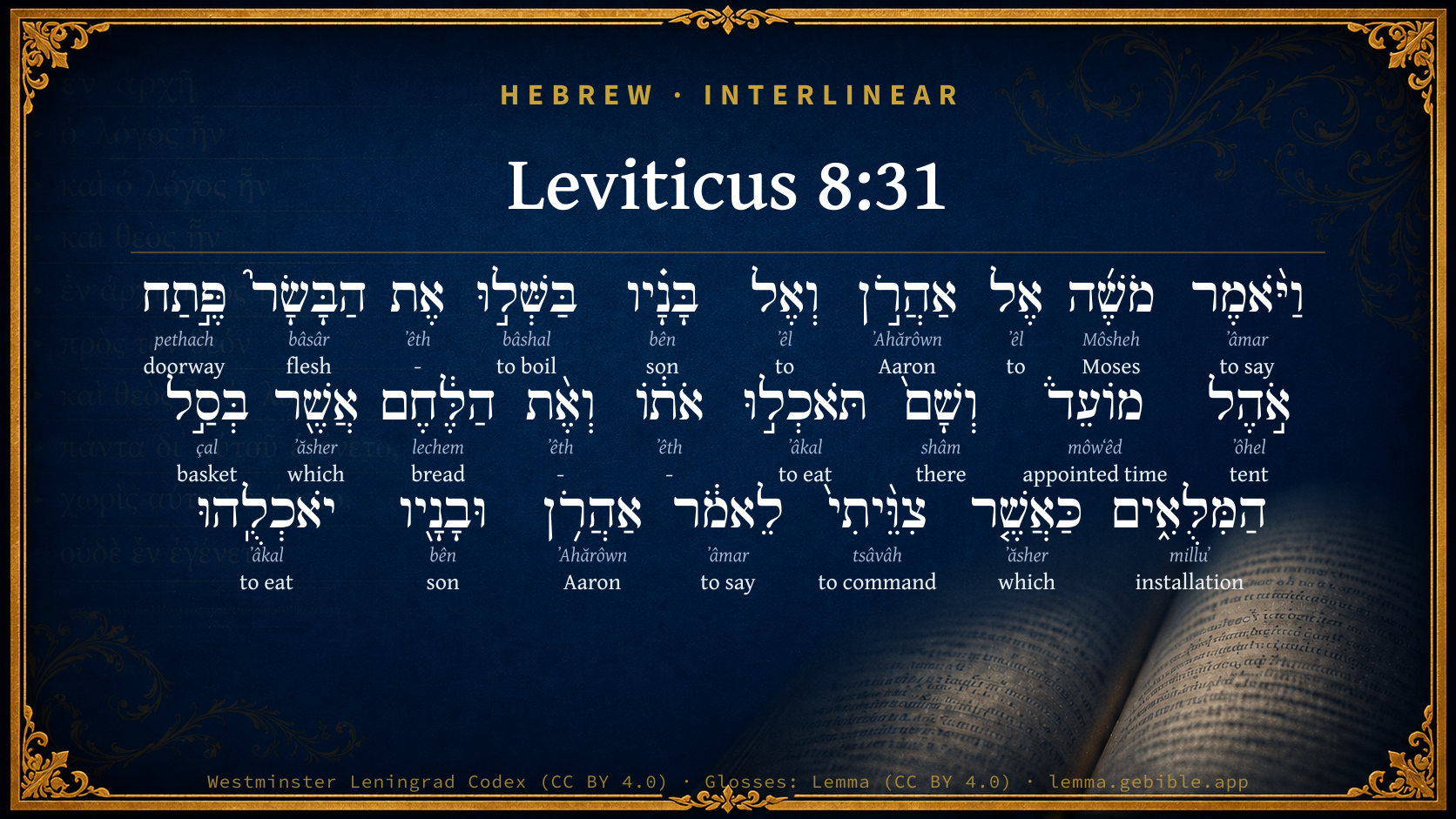
Leviticus 8:31

Hebrew (Westminster Leningrad Codex) Leviticus 8:31 appears in the Hebrew Old Testament. The text above is from the Westminster Leningrad Codex. Each word links to its Strong’s number, a concise gloss, and parsing drawn from the Open Scriptures Hebrew Bible morphology. Click any word for its full Brown-Driver-Briggs (BDB) entry.
Download image
Cite this verse

Leviticus 8:31 (World English Bible). Public Domain. Lemma interlinear Bible study tool, https://lemma.gebible.app/v/leviticus/8/31.

Show BibTeX & RIS
BibTeX
RIS
English Translation
Moses said to Aaron and to his sons, "Boil the flesh at the door of the Tent of Meeting, and there eat it and the bread that is in the basket of consecration, as I commanded, saying, 'Aaron and his sons shall eat it.'
World English Bible · Public Domain
Download a study sheet

One document with this verse’s original text, its word-by-word gloss line, the meaning frame, cross-references with their text, attributed commentary, and full source and license credits — printable, and it pastes into notes with its structure intact.

This verse Autodidact and up

Study sheet (.html) Plain text (.txt)

A passage Seminary Student

Up to 50 verses in one chapter. A passage sheet keeps up to 6 commentary sources and 12 cross-references per verse, in the order this page ranks them, and says so on the sheet whenever that leaves anything out. Ask for a single verse and you get the Autodidact verse sheet above.

Everything on this page stays free to read, with no account — the sheet is a download of what is already on screen, not access to it.

Want to remove ads? Support Godless Engineer
Compare translations 3

The same verse in 3 English versions, stacked beneath the original-language interlinear above. Click any original word for its lexicon entry.

Each is an independent rendering of the whole verse — the interlinear is not word-aligned to these translations.

Highlighted words mark where these versions differ — a whole-verse word diff, not a word-by-word alignment.

  • World English Bible Public Domain
    Moses said to Aaron and to his sons, "Boil the flesh at the door of the Tent of Meeting, and there eat it and the bread that is in the basket of consecration, as I commanded, saying, 'Aaron and his sons shall eat it.'
  • King James Version Public Domain
    And Moses said unto Aaron and to his sons, Boil the flesh at the door of the tabernacle of the congregation: and there eat it with the bread that is in the basket of consecrations, as I commanded, saying, Aaron and his sons shall eat it.
  • unfoldingWord Literal Text CC BY-SA 4.0
    And Moses said to Aaron and to his sons, “Boil the meat at the entrance of the tent of meeting, and there you shall eat it and the bread that in the basket of the ordination offering, just as I commanded, saying, ‘Aaron and his sons shall eat it.’

unfoldingWord Literal Text — © unfoldingWord, licensed CC BY-SA 4.0. Word-aligned USFM3 via Door43 (git.door43.org/unfoldingWord/en_ult).

Versions to compare (up to 4)

3 of 4 selected

Show all 18 translations

Every available English version of this verse, each an independent rendering of the whole verse.

  • World English Bible Public Domain
    Moses said to Aaron and to his sons, "Boil the flesh at the door of the Tent of Meeting, and there eat it and the bread that is in the basket of consecration, as I commanded, saying, 'Aaron and his sons shall eat it.'
  • Berean Standard Bible Public Domain
    And Moses said to Aaron and his sons, “Boil the meat at the entrance to the Tent of Meeting and eat it there with the bread that is in the basket of ordination offerings, as I commanded, saying, ‘Aaron and his sons are to eat it.’
  • Majority Standard Bible Public Domain
    And Moses said to Aaron and his sons, “Boil the meat at the entrance to the Tent of Meeting and eat it there with the bread that is in the basket of ordination offerings, as I commanded, saying, ‘Aaron and his sons are to eat it.’
  • King James Version Public Domain
    And Moses said unto Aaron and to his sons, Boil the flesh at the door of the tabernacle of the congregation: and there eat it with the bread that is in the basket of consecrations, as I commanded, saying, Aaron and his sons shall eat it.
  • American Standard Version (1901) Public Domain
    And Moses said unto Aaron and to his sons, Boil the flesh at the door of the tent of meeting: and there eat it and the bread that is in the basket of consecration, as I commanded, saying, Aaron and his sons shall eat it.
  • Revised Version (1885) Public Domain
    And Moses said unto Aaron and to his sons, Boil the flesh at the door of the tent of meeting: and there eat it and the bread that is in the basket of consecration, as I commanded, saying, Aaron and his sons shall eat it.
  • Geneva Bible (1599) Public Domain
    Afterward Moses saide vnto Aaron and his sonnes, Seethe the flesh at the doore of the Tabernacle of the Congregation, and there eate it with the bread that is in the basket of consecrations, as I commanded, saying, Aaron and his sonnes shall eate it,
  • Douay-Rheims (1899) Public Domain
    And when he had sanctified them in their vestments, he commanded them, saying: Boil the flesh before the door of the tabernacle, and there eat it. Eat ye also the loaves of consecration, that are laid in the basket, as the Lord commanded me, saying: Aaron and his sons shall eat them:
  • Young's Literal Translation Public Domain
    And Moses saith unto Aaron, and unto his sons, `Boil ye the flesh at the opening of the tent of meeting, and there ye do eat it and the bread which `is' in the basket of the consecrations, as I have commanded, saying, Aaron and his sons do eat it.
  • Literal Standard Version CC BY-SA 4.0
    And Moses says to Aaron and to his sons, “Boil the flesh at the opening of the Tent of Meeting, and there you eat it and the bread which [is] in the basket of the consecrations, as I have commanded, saying, Aaron and his sons eat it.
  • Unlocked Literal Bible CC BY-SA 4.0
    So Moses said to Aaron and to his sons, “Boil the meat at the entrance to the tent of meeting, and there eat it and the bread that is in the basket of consecration, as I commanded, saying, 'Aaron and his sons will eat it.'
  • unfoldingWord Literal Text CC BY-SA 4.0
    And Moses said to Aaron and to his sons, “Boil the meat at the entrance of the tent of meeting, and there you shall eat it and the bread that in the basket of the ordination offering, just as I commanded, saying, ‘Aaron and his sons shall eat it.’
  • Darby Bible Public Domain
    And Moses spoke to Aaron and to his sons, Boil the flesh at the entrance of the tent of meeting; and there eat it and the bread that is in the basket of the consecration-offering, as I commanded, saying, Aaron and his sons shall eat it.
  • World Messianic Bible Public Domain
    Moses said to Aaron and to his sons, “Boil the meat at the door of the Tent of Meeting, and there eat it and the bread that is in the basket of consecration, as I commanded, saying, ‘Aaron and his sons shall eat it.’
  • Webster's Bible Public Domain
    And Moses said to Aaron and to his sons, Boil the flesh at the door of the tabernacle of the congregation; and there eat it with the bread that is in the basket of consecrations, as I commanded, saying, Aaron and his sons shall eat it.
  • Free Bible Version CC BY-SA 4.0
    Moses told Aaron and his sons, “You are to boil the meat at the entrance to the Tent of Meeting, and then eat it there with the bread that is in the basket of offerings for the ordination, as I ordered: ‘It is for Aaron and his sons to eat.’
  • Bible in Basic English Public Domain
    And Moses said to Aaron and to his sons, The flesh is to be cooked in water at the door of the Tent of meeting, and there you are to take it as food, together with the bread in the basket, as I have given orders, saying, It is the food of Aaron and his sons.
  • JPS Tanakh (1917) Public Domain
    And Moses said unto Aaron and to his sons: 'Boil the flesh at the door of the tent of meeting; and there eat it and the bread that is in the basket of consecration, as I commanded, saying: Aaron and his sons shall eat it.

Literal Standard Version (2020), Covenant Press — licensed CC BY-SA 4.0. Text via the HelloAO Bible API (eBible.org). Unlocked Literal Bible (unfoldingWord) — licensed CC BY-SA 4.0. Text via the HelloAO Bible API (eBible.org). unfoldingWord Literal Text — © unfoldingWord, licensed CC BY-SA 4.0. Word-aligned USFM3 via Door43 (git.door43.org/unfoldingWord/en_ult). Free Bible Version, Dr. Jonathan Gallagher — licensed CC BY-SA 4.0. Text via the HelloAO Bible API (eBible.org).

Word by word

More ways to search: Search by grammar → Find every occurrence → Compare this word →

Practice this passage: Drill this verse → Learn its vocabulary →

בְּסַ֣ל
çal
H5536
“in/at · basket of”
Preposition + Noun, Common, Masculine, Singular, Construct
Part of Speech
Preposition + Noun
Type
Common
Gender
Masculine
Number
Singular
State
Construct
Full BDB Definition

Origin: from H5549

TWOT: 1507a

basket
  1. וַיֹּ֨אמֶר ʼâmar H559 “and · to say” Conjunction + Verb, Qal, Sequential Imperfect, 3rd Person, Masculine, Singular
  2. מֹשֶׁ֜ה Môsheh H4872 “Moses” Noun, Proper
  3. אֶל ʼêl H413 “to” Preposition
  4. אַהֲרֹ֣ן ʼAhărôwn H175 “Aaron” Noun, Proper
  5. וְאֶל ʼêl H413 “and · to” Conjunction + Preposition
  6. בָּנָ֗יו bên H1121 “sons · his” Noun, Common, Masculine, Plural, Construct + Suffix, Personal, 3rd Person, Masculine, Singular
  7. בַּשְּׁל֣וּ bâshal H1310 “boil” Verb, Piel, Imperative, 2nd Person, Masculine, Plural
  8. אֶת ʼêth H853 “-” Particle, Direct Object
  9. הַבָּשָׂר֮ bâsâr H1320 “the · flesh” Particle, Definite Article + Noun, Common, Masculine, Singular, Absolute
  10. פֶּ֣תַח pethach H6607 “doorway of” Noun, Common, Masculine, Singular, Construct
  11. אֹ֣הֶל ʼôhel H168 “tent of” Noun, Common, Masculine, Singular, Construct
  12. מוֹעֵד֒ môwʻêd H4150 “appointed time” Noun, Common, Masculine, Singular, Absolute
  13. וְשָׁם֙ shâm H8033 “and · there” Conjunction + Adverb
  14. תֹּאכְל֣וּ ʼâkal H398 “to eat” Verb, Qal, Imperfect, 2nd Person, Masculine, Plural
  15. אֹת֔וֹ ʼêth H853 “- · him” Particle, Direct Object + Suffix, Personal, 3rd Person, Masculine, Singular
  16. וְאֶ֨ת ʼêth H853 “and · -” Conjunction + Particle, Direct Object
  17. הַלֶּ֔חֶם lechem H3899 “the · bread” Particle, Definite Article + Noun, Common, Both, Singular, Absolute
  18. אֲשֶׁ֖ר ʼăsher H834 “which” Particle, Relative
  19. הַמִּלֻּאִ֑ים milluʼ H4394 “the · installations” Particle, Definite Article + Noun, Common, Masculine, Plural, Absolute
  20. כַּאֲשֶׁ֤ר ʼăsher H834 “like/as · which” Preposition + Particle, Relative
  21. צִוֵּ֨יתִי֙ tsâvâh H6680 “to command” Verb, Piel, Perfect, 1st Person, Common, Singular
  22. לֵאמֹ֔ר ʼâmar H559 “to say” Preposition + Verb, Qal, Infinitive Construct
  23. אַהֲרֹ֥ן ʼAhărôwn H175 “Aaron” Noun, Proper
  24. וּבָנָ֖יו bên H1121 “and · sons · his” Conjunction + Noun, Common, Masculine, Plural, Construct + Suffix, Personal, 3rd Person, Masculine, Singular
  25. יֹאכְלֻֽהוּ ʼâkal H398 “to eat · him” Verb, Qal, Imperfect, 3rd Person, Masculine, Plural + Suffix, Personal, 3rd Person, Masculine, Singular

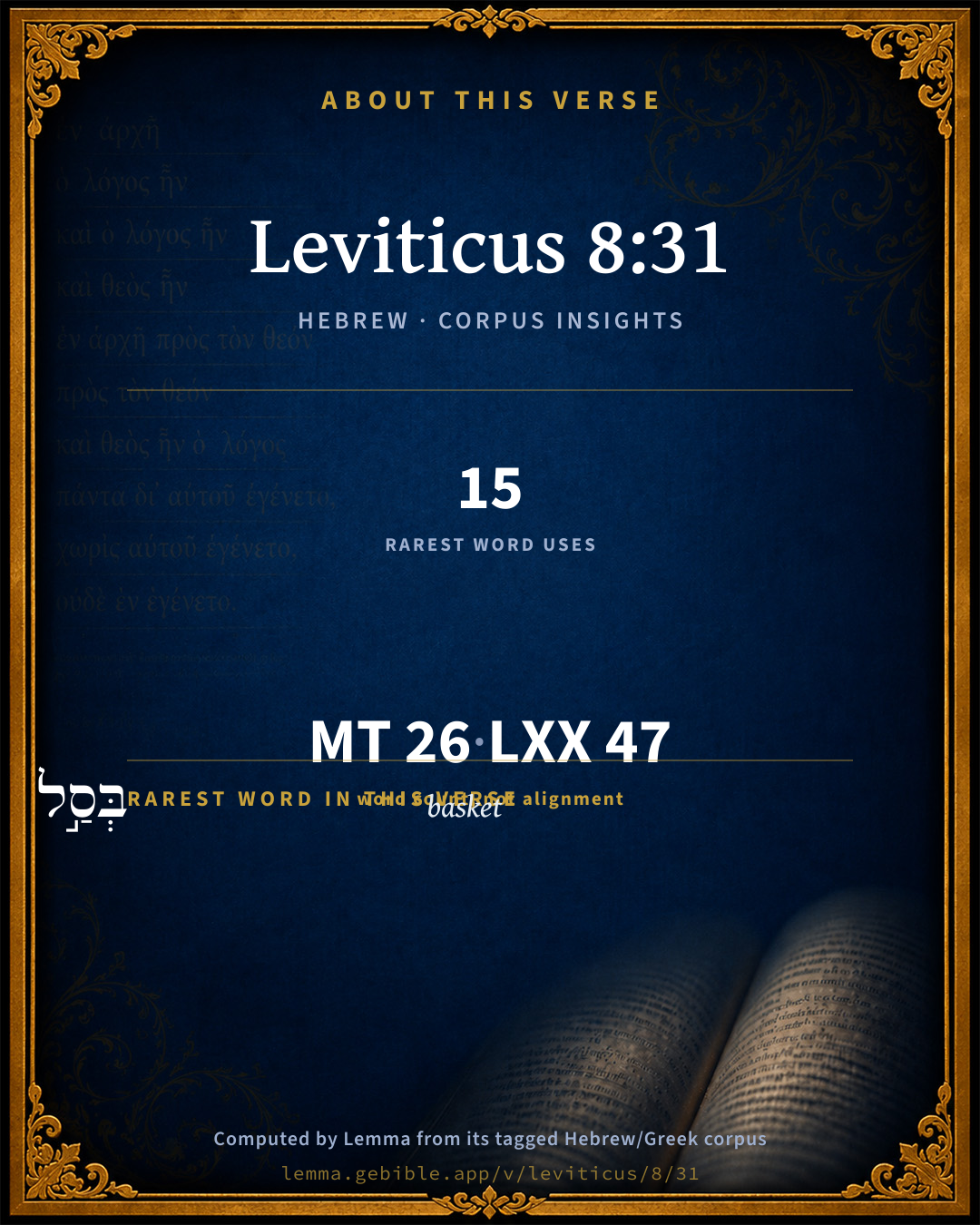
About this verse

These counts appear in no published source. They are computed here, from the morphology-tagged text and Lemma’s own curated glosses. What Lemma adds →

26
words
18
distinct lemmas
Pentateuch
section

Notable vocabulary

The rarest word here is בְּסַ֣ל basket H5536 — appearing just 15 times in the whole Hebrew Bible.

Shared distinctive vocabulary

בְּסַ֣ל basket H5536 occurs in 13 verses of the Hebrew Bible. Also found in:

Grammatical profile

  • 6 verbs
  • 12 nouns
  • 2 prepositions
  • 1 adverb
  • 5 particles

Verb forms

  • וַיֹּ֨אמֶר Qal · Sequential Imperfect
  • בַּשְּׁל֣וּ Piel · Imperative
  • תֹּאכְל֣וּ Qal · Imperfect
  • צִוֵּ֨יתִי֙ Piel · Perfect
  • לֵאמֹ֔ר Qal · Infinitive Construct
  • יֹאכְלֻֽהוּ Qal · Imperfect

Repetition

Words recur within this verse — often emphatic in Hebrew:

  • וַיֹּ֨אמֶר to say H559 ×2
  • אַהֲרֹ֣ן Aaron H175 ×2
  • בָּנָ֗יו son H1121 ×2
  • תֹּאכְל֣וּ to eat H398 ×2
  • אֶל to H413 ×2
  • אֲשֶׁ֖ר which H834 ×2

Hebrew & Septuagint length

In English translation the verse runs 44 words from the Hebrew and 54 from the Septuagint (LXX English) — closely comparable.

A rough comparison of the two English renderings, which tokenize alike — not a word-level alignment.

Word counts can differ between the Hebrew and the Greek without any difference in meaning — e.g. the Hebrew direct-object marker אֵת has no separate Greek word, and Greek often adds the article ὁ.

In the original languages it is 26 Hebrew tokens and 47 Greek tokens — but the two are counted differently (Hebrew bundles its prefixes and suffixes into one token; the Greek is in lemma form), so that isn’t a like-for-like length.

Cross-references

12

Topical passages linked to Leviticus 8:31 in the Treasury of Scripture Knowledge — connected by theme and wording, ordered by reader-vote popularity; previews shown in the World English Bible.

  • Exodus 29:31–32 "You shall take the ram of consecration, and boil its flesh in a holy place.
  • Leviticus 6:28 But the earthen vessel in which it is boiled shall be broken; and if it is boiled in a brazen vessel, it shall be scoured, and rinsed in water.
  • Leviticus 7:15 The flesh of the sacrifice of his peace offerings for thanksgiving shall be eaten on the day of his offering. He shall not leave any of it until the morning.
  • Leviticus 10:17 "Why haven't you eaten the sin offering in the place of the sanctuary, seeing it is most holy, and he has given it you to bear the iniquity of the congregation, to make atonement for them before Yahweh?
  • Deuteronomy 12:6–7 and there you shall bring your burnt offerings, and your sacrifices, and your tithes, and the heave-offering of your hand, and your vows, and your freewill-offerings, and the firstborn of your herd and of your flock:
  • 1 Samuel 2:13–17 The custom of the priests with the people was that when any man offered sacrifice, the priest's servant came, while the flesh was boiling, with a flesh-hook of three teeth in his hand;
  • Ezekiel 46:20–24 He said to me, This is the place where the priests shall boil the trespass-offering and the sin-offering, [and] where they shall bake the meal-offering; that they not bring them forth into the outer court, to sanctify the people.
  • John 6:33 For the bread of God is that which comes down out of heaven, and gives life to the world."
  • John 6:35 Jesus said to them, "I am the bread of life. He who comes to me will not be hungry, and he who believes in me will never be thirsty.
  • John 6:51 I am the living bread which came down out of heaven. If anyone eats of this bread, he will live forever. Yes, the bread which I will give for the life of the world is my flesh."
  • John 6:53–56 Jesus therefore said to them, "Most assuredly I tell you, unless you eat the flesh of the Son of Man and drink his blood, you don't have life in yourselves.
  • Galatians 2:20 I have been crucified with Christ, and it is no longer I that live, but Christ living in me. That life which I now live in the flesh, I live by faith in the Son of God, who loved me, and gave himself up for me.

Cross-references courtesy of OpenBible.info (CC BY 4.0).

Hebrew and Greek witnesses Masoretic Hebrew ↔ Greek Septuagint

The same verse in the two great witnesses to the Old Testament, shown verse-for-verse.

These are two independent witnesses, not word-aligned to each other, and the Septuagint is shown in lemma (dictionary) form.

Hebrew Leviticus 8:31 Masoretic · Westminster Leningrad Codex

וַיֹּ֨אמֶר מֹשֶׁ֜ה אֶל אַהֲרֹ֣ן וְאֶל בָּנָ֗יו בַּשְּׁל֣וּ אֶת הַבָּשָׂר֮ פֶּ֣תַח אֹ֣הֶל מוֹעֵד֒ וְשָׁם֙ תֹּאכְל֣וּ אֹת֔וֹ וְאֶ֨ת הַלֶּ֔חֶם אֲשֶׁ֖ר בְּסַ֣ל הַמִּלֻּאִ֑ים כַּאֲשֶׁ֤ר צִוֵּ֨יתִי֙ לֵאמֹ֔ר אַהֲרֹ֥ן וּבָנָ֖יו יֹאכְלֻֽהוּ

Moses said to Aaron and to his sons, "Boil the flesh at the door of the Tent of Meeting, and there eat it and the bread that is in the basket of consecration, as I commanded, saying, 'Aaron and his sons shall eat it.'

World English Bible · Public Domain

Greek LXX Leviticus 8:31 Septuagint · lemma form

καί εἶπον μωυσῆς πρός ἀαρών καί ὁ υἱός αὐτός ἕψω ὁ κρέας ἐν ὁ αὐλή ὁ σκηνή ὁ μαρτύριον ἐν τόπος ἅγιος καί ἐκεῖ ἐσθίω αὐτός καί ὁ ἄρτος ὁ ἐν ὁ κανοῦν ὁ τελείωσις ὅς τρόπος συντάσσω ἐγώ λέγω ἀαρών καί ὁ υἱός αὐτός ἐσθίω αὐτός

And Moses said to Aaron and to his sons, Boil the flesh in the tent of the tabernacle of witness in the holy place; and there you⌃ shall eat it and the loaves in the basket of consecration, as it has been appointed me, the Lord saying, Aaron and his sons shall eat them.

LXX2012 (modern English Septuagint) · Public Domain

Hebrew: Westminster Leningrad Codex (CC BY 4.0). Greek: Septuagint (public domain); English from LXX2012 (modern English Septuagint) (Public Domain). How the Septuagint differs from the Hebrew →

Targum (Aramaic paraphrase)

2

The Targum is the ancient Jewish Aramaic paraphrase of the Hebrew Scriptures — an interpretive translation, not the Hebrew text itself. Onkelos (literal) and Pseudo-Jonathan (expansive) render the Torah, and Jonathan the Prophets. Coverage is partial: where no permissively-licensed English translation exists for a verse, only the Aramaic is shown. This is verse-level text, not a word-by-word alignment to the Hebrew.

  1. Targum Onkelos Torah (Genesis–Deuteronomy)
    וַאֲמַר מֹשֶׁה לְאַהֲרֹן וְלִבְנוֹהִי בַּשִׁילוּ יָת בִּסְרָא בִּתְרַע מַשְׁכַּן זִמְנָא וְתַמָן תֵּיכְלוּן יָתֵהּ וְיָת לַחְמָא דִי בְּסַל קוּרְבָּנַיָא כְּמָא דִי פַקֵדִית לְמֵימָר אַהֲרֹן וּבְנוֹהִי יֵיכְלוּנֵהּ

    (no public-domain English translation for this verse)

    Targum Onkelos — Aramaic: “Onkelos Genesis” (public domain); “Onkelos Exodus” (public domain); “Onkelos Leviticus” (public domain); “Onkelos Numbers” (public domain); “Onkelos Deuteronomy” (public domain). English: “Sefaria Community Translation” (CC0 1.0 (public-domain dedication)); “J.W. Etheridge. The Targums of Onkelos and Jonathan Ben Uzziel on the Pentateuch. London: Longmans, Green, 1862” (public domain). Text via Sefaria.

  2. Targum Pseudo-Jonathan Torah (Genesis–Deuteronomy)
    וַאֲמַר משֶׁה לְאַהֲרן וְלִבְנוֹי בְּשִׁילוּ יַת בְּשַר קוּרְבָּנַיָא בְּדוֹדְוָותַיָא בִּתְרַע מַשְׁכַּן זִימְנָא וְתַמָן תֵיכְלוּן יָתֵיהּ וְיַת לַחְמָא דִבְסַל קוּרְבָּנַיָא הֵי כְמָא דְפַקֵידִית לְמֵימָר אַהֲרן וּבְנוֹהִי יֵיכְלוּנֵיהּ

    And Mosheh said to Aharon and to his sons, Boil the flesh of the oblations in pots at the door of the tabernacle of ordinance, and there shall you eat it with the bread which is in the basket of oblation, according to the precept which was spoken; Aharon and his sons shall eat it.

    Targum Pseudo-Jonathan — Aramaic: “Targum Jonathan on Genesis” (public domain); “Targum Jonathan on Exodus” (public domain); “Targum Jonathan on Leviticus” (public domain); “Targum Jonathan on Numbers” (public domain); “Targum Jonathan on Deuteronomy” (public domain). English: “The Targum of Jonathan ben Uzziel, trans. J. W. Etheridge, London, 1862” (public domain). Text via Sefaria.

Commentary

Notes on Leviticus 8:31 from classic Christian and Jewish commentators (each source and its license shown beneath its notes). The classic Christian expositions comment on the surrounding passage and are grouped to its opening verse, so a note may address several verses; the Jewish commentaries on the Tanakh (Rashi and others) are per-verse, so they appear only where the commentator wrote on this verse.

Lemma curates 59 commentaries, every one of them public domain or Creative Commons licensed, each selected and text-cleaned for this edition rather than reprinted as found. About our sources →

Matthew Henry's Commentary

Moses, having done his part of the ceremony, now leaves Aaron and his sons to do theirs.

I. They must boil the flesh of their peace-offering, and eat it in the court of the tabernacle, and what remained they must burn with fire, Lev 8:31, Lev 8:32. This signified their thankful consent to the consecration: when God gave Ezekiel his commission, he told him to eat the roll, Eze 3:1, Eze 3:2.

II. They must not stir out of the court of the tabernacle for seven days, Lev 8:33. The priesthood being a good warfare, they must thus learn to endure hardness, and to disentangle themselves from the affairs of this life, Ti2 2:3, Ti2 2:4. Being consecrated to their service, they must give themselves wholly to it, and attend continually to this very thing. Thus Christ's apostles were appointed to wait for the promise of the Father, Act 1:4. During this time appointed for their consecration, they were daily to repeat the same sacrifices which were offered the first day, Lev 8:34. This shows the imperfection of the legal sacrifices, which, because they could not take away sin, were often repeated (Heb 10:1, Heb 10:2), but were here repeated seven times (a number of perfection), because they typified that one offering, which perfected for ever those that were sanctified. The work lasted seven days; for it was a kind of creation: and this time was appointed in honour of the sabbath, which, probably, was the last day of the seven, for which they were to prepare during the six days. Thus the time of our life, like the six days, must be our preparation for the perfection of our consecration to God in the everlasting sabbath: they attended day and night (Lev 8:35), and so constant should we be in our meditation on God's law, Psa 1:2. They attended to keep the charge of the Lord: we have every one of us a charge to keep, an eternal God to glorify, an immortal soul to provide for, needful duty to be done, our generation to serve; and it must be our daily care to keep this charge, for it is the charge of the Lord our Master, who will shortly call us to an account about it, and it is at our utmost peril if we neglect it. Keep it that you die not; it is death, eternal death, to betray the trust we are charged with; by the consideration of this we must be kept in awe. Lastly, We are told (Lev 8:36) that Aaron and his sons did all that was commanded. Thus their consecration was completed; and thus they set an example before the people of an exact obedience to the laws of sacrifices now newly given, and then they could with the better grace teach them. Thus the covenant of peace (Num 25:12), of life and peace (Mal 2:5), was made with Aaron and his sons; but after all the ceremonies that were used in their consecration there was one point of ratification which was reserved to be the honour and establishment of Christ's priesthood, which was this, that they were made priests without an oath, but Christ with an oath (Heb 7:21), for neither such priests nor their priesthood could continue, but Christ's is a perpetual and unchangeable priesthood.

Gospel ministers are compared to those who served at the altar, for they minister about holy things (Co1 9:13), they are God's mouth to the people and the people's to God, the pastors and teachers Christ has appointed to continue in the church to the end of the world: they seem to be meant in that promise which points at gospel times (Isa 66:21), I will take of them for priests and for Levites. No man may take this honour to himself, but he who upon trial is found to be clothed and anointed by the Spirit of God with gifts and graces to qualify him for it, and who with purpose of heart devotes himself entirely to the service, and is then by the word and prayer (for so every thing is sanctified), and the imposition of the hands of those that give themselves to the word and prayer, set apart to the office, and recommended to Christ as a servant and to the church as a steward and guide. And those that are thus solemnly dedicated to God ought not to depart from his service, but faithfully to abide in it all their days; and those that do so, and continue labouring in the word and doctrine, are to be accounted worthy of double honour, double to that of the Old Testament priests.

Matthew Henry's Commentary on the Whole Bible (1708–1710) — public domain (CC PDM 1.0). Text via the HelloAO Bible API.

Tyndale Open Study Notes

Tyndale Open Resources

8:31 The ordination offering was a variation of the peace offering (Exod 29:28). It was a meal (Lev 7:11-18, 28-34) shared between God (the parts burned on the altar) and the priests. The command to boil . . . and eat the ordination offering first appears in Exod 29:32.

Tyndale Open Study Notes — © Tyndale Open Resources, licensed CC BY-SA 4.0. Text via the HelloAO Bible API.

Geneva Bible (1599)

Geneva Bible translators

At the door of the court.

Geneva Bible (1599) marginal notes — public domain. Text via Bolls.life.

Ellicott's Commentary for English Readers

(31) And Moses said . . . boil the flesh.—That is, of the ram of consecration; with the exception of the fat parts and the right shoulder, which were burnt upon the altar, and the wave-breast, which was awarded to Moses as the officiating priest on the occasion (see Lev_8:8, and Exo_29:31-32), the flesh of the victim is to be prepared by Aaron and his sons for the sacrificial meal (see Lev_7:11, &c.). From the peculiar nature of this offering, however, it is ordained that the flesh is to be boiled at the entrance of the tent of meeting, not at the door of the tabernacle of the congregation, as the Authorised Version has it. According to Exo_29:31, this is to take place “at the holy place,” that is, in the court, and is to be eaten with unleavened bread, thus distinguishing it from the ordinary sacrificial meal of the peace offering.

Aaron and his sons shall eat it.—This is another distinguishing feature of the sacrifice in question. Whilst to the ordinary sacrificial feasts the offerer could invite his family and strangers (see Lev_7:15), in this no layman or non-priest could partake of the meal, because the flesh and the bread were peculiarly holy (see Exo_29:33), as this sacrifice had the same atoning virtue as the burnt offering. (See Lev_1:4.)

A Bible Commentary for English Readers, edited by Charles John Ellicott (1878–1897) — public domain. Text from a community e-Sword module.

The Cambridge Bible for Schools and Colleges

gen. ed. J. J. S. Perowne

31. Anyone who was not unclean might eat the portions of the Peace-Offering which remained when the parts for sacrifice and for the priests were taken. On this occasion the flesh is eaten by Aaron and his sons only, and at the door of the tent of meeting. The ceremonies of the first day are repeated on each of the following six days. What remains from the sacrifice of each day must be burnt, as ordered in Lev_7:15.

as I commanded] See R.V.’s marginal note above.

The Cambridge Bible for Schools and Colleges (gen. ed. J. J. S. Perowne; Cambridge University Press, 1878–1918) — public domain. Text from a community e-Sword module.

John Gill's Exposition

And Moses said unto Aaron, and to his sons,.... After he had offered the bullock, the two rams, and cakes of unleavened bread for the consecration of them:

boil the flesh at the door of the tabernacle of the congregation; the remainder of the flesh of the ram of consecration, which was all but the fat, the shoulder, and the breast:

and there eat it with the bread that is in the basket of consecration; what was left of that, there being one cake of a sort taken out of it and burnt:

as I commanded, saying, Aaron and his sons shall eat it; see Exo 29:32.

John Gill's Exposition of the Whole Bible (1746–1763) — public domain (CC PDM 1.0). Text via the HelloAO Bible API.

Matthew Poole's English Annotations

Boil the flesh, that which was left of the ram, and particularly the breast, which was said to be Moses’s part, Lev 8:29, and by him was given to Aaron, that he and his sons might eat of it, in token that they, and only they, should have the right to do so for the future.

Matthew Poole's English Annotations on the Holy Bible (1683–1685) — public domain. Text from a community e-Sword/MySword module.

Whedon's Commentary on the Bible

Daniel D. Whedon

31, 32. Boil the flesh… eat… burn — In the peace offering the offerer and his friends were permitted to eat in a sacred banquet, and to burn with fire that which remained. Lev_7:15, note.

Daniel D. Whedon (gen. ed.), Commentary on the Old and New Testaments (1874–1909) — public domain. Text from a community e-Sword module.

The Pulpit Commentary

Vers. 31, 32. The flesh of the peace offering is given to Aaron and his sons to eat, not in the capacity of priests (for the peace offerings were not eaten by the priests), but as the offerers of the sacrifice.

The Pulpit Commentary (1880–1919), ed. H.D.M. Spence-Jones & Joseph S. Exell — public domain. Text from a community e-Sword module.

John Wesley's Explanatory Notes

The flesh - That which was left of the ram, and particularly the breast, which was said to be Moses's part, ver. 29, and by him was given to Aaron, that he and his sons might eat of it, in token that they and only they should have the right to do so for the future.

John Wesley, Explanatory Notes Upon the Whole Bible (1754–1765) — public domain. Text via the GEBible commentary corpus.

Kretzmann's Popular Commentary

Paul E. Kretzmann

Final Instructions

v. 31. And Moses said unto Aaron and to his sons, Boil the flesh at the door of the Tabernacle of the Congregation, in a holy place in the court, Exo 29:31; and there eat it with the bread that is in the basket of consecrations, as I commanded, saying, Aaron and his sons shall eat it. No lay person was permitted to partake of this sacrificial meal, for the food was holy, having served for the expiation and consecration of the priests.

v. 32. And that which remaineth of the flesh and of the bread shall ye burn with fire. Cf Lev 7:17.

v. 33. And ye shall not go out of the door of the Tabernacle of the Congregation, out of the great entrance which led to the Sanctuary, in seven days, until the days of your consecration be at an end; for seven days shall he consecrate you.

v. 34. As he hath done this day, so the Lord hath commanded to do, to make an atonement for you. On each one of the seven days the same rite was performed, at least so far as the sacrifices were concerned.

v. 35. Therefore shall ye abide at the door of the Tabernacle of the Congregation day and night seven days, and keep the charge of the Lord, observe His precept, that ye die not; for so I am commanded.

v. 36. So Aaron and his sons did all things which the Lord commanded by the hand of Moses. Seven days they passed in holy seclusion in the court, seven days they brought the appointed sacrifices and lived on the sacrifice of consecration; what remained of it they did not devote to common or profane use, but they took care to burn it. For seven days they kept holy match, the watch of Jehovah, in the court of the Tabernacle, under the penalty of death. Moses made particularly prominent the symbolic force of this divine watch: it was Jehovah’s express commandment.

Paul E. Kretzmann, Popular Commentary of the Bible (1921–1924) — public domain. Text from a community e-Sword module.

unfoldingWord translationNotes

Door43 World Missions Community

the basket of consecration

This means the basket contains offerings used while consecrating Aaron and his sons. AT: "the basket"

as I commanded, saying, 'Aaron and his sons will eat it.'

This has a quotation within a quotation. A direct quotation can be stated as an indirect quotation. AT: "as I commanded you to do" (See:Quotes Within Quotes and Direct and Indirect Quotations)

until the days of your ordination are fulfilled

This can be translated in active form. AT: "until you fulfill the days of your ordination" (See: Active or Passive)

ordination

This is an official ceremony that makes someone a priest. See how you translated this in Leviticus 8:29.

translationWords

Moses

Aaron

son

tent of meeting

bread

basket

consecrate

command

ordinance

day

fulfill

Yahweh

unfoldingWord translationNotes — © Distant Shores Media and the Door43 World Missions Community, licensed CC BY-SA 4.0. Source: git.door43.org/Door43/en_tn.

Lesson kit

Teaching starters — assembled from the data on this page, not authored interpretation. Every prompt links to the verse data it draws on. Edit before teaching.

Leviticus, in the Pentateuch, opens this verse with 26 words (18 distinct Hebrew lemmas). Its most distinctive word is çal (“basket”). A historical commentator’s framing appears above. Read the whole chapter for the surrounding context.

Discussion questions

  1. How does “basket” (çal) shape what this verse is saying?
  2. Genesis 40:16 shares the word «basket» with this verse. How do the two illuminate each other?
  3. “to say” occurs 2× in this one verse. What is the effect of the repetition?
  4. These translations render this verse differently; the difference is in the English rendering, not the original. What questions does that raise?
  5. The verb «וַיֹּ֨אמֶר» is Qal Sequential Imperfect. How does its form color the action?
  6. Reading how Matthew Henry's Commentary and Tyndale Open Study Notes read this verse, where do the two commentators agree and where do they part?

Things to notice

Reading settings

Reading text

Shown beneath each verse's original-language words.

Old Testament
Old Testament edition

Read the OT as the Masoretic Hebrew (MT) or the Greek Septuagint (LXX).

English shown for the Greek Septuagint (in the Hebrew ↔ Greek comparison).

Comparing translations? Open the Compare panel on any verse page to stack up to four side by side.