
Deuteronomy 8:9

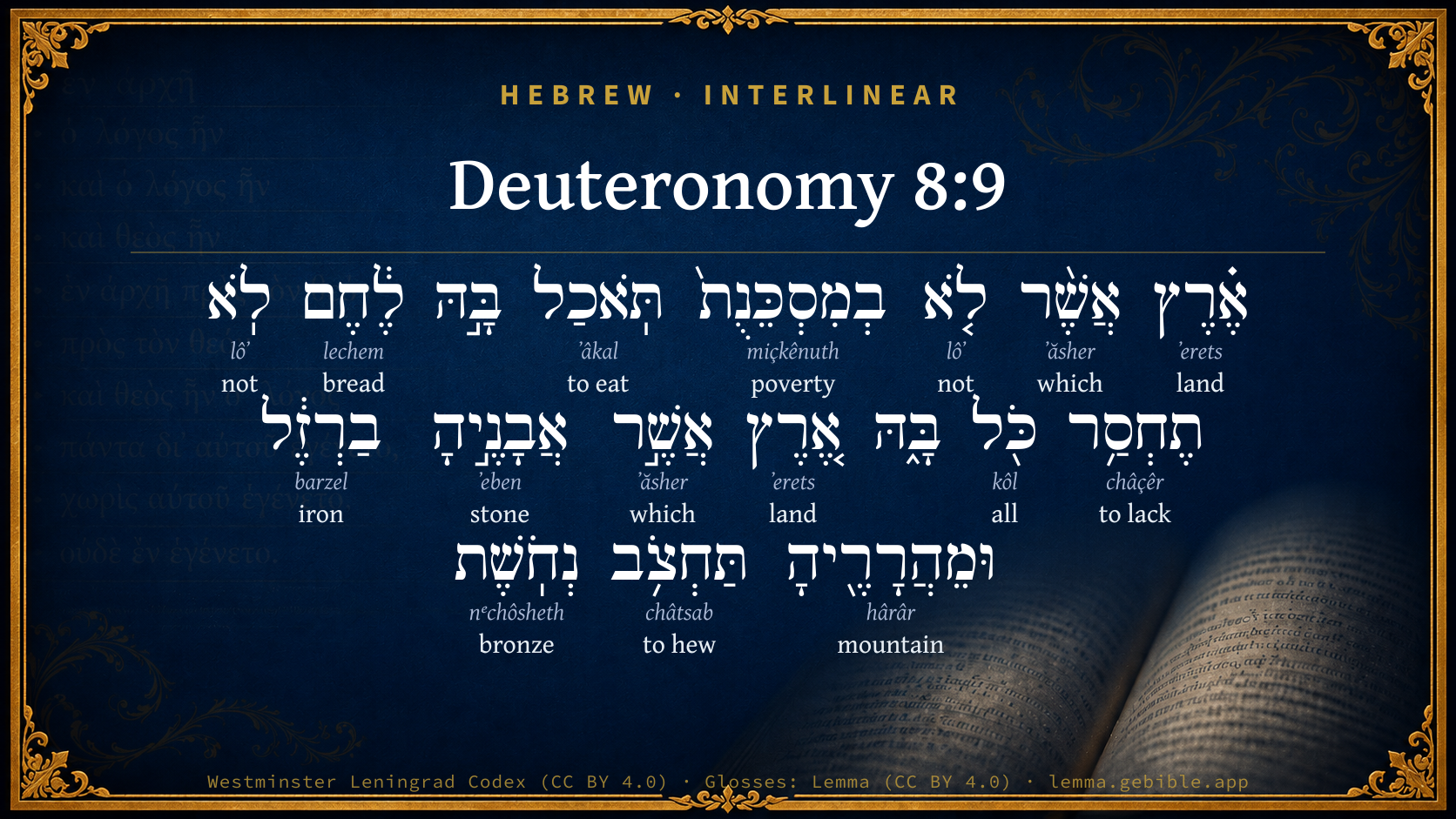
Hebrew (Westminster Leningrad Codex) Deuteronomy 8:9 appears in the Hebrew Old Testament. The text above is from the Westminster Leningrad Codex. Each word links to its Strong’s number, a concise gloss, and parsing drawn from the Open Scriptures Hebrew Bible morphology. Click any word for its full Brown-Driver-Briggs (BDB) entry.
Download image
Cite this verse

Deuteronomy 8:9 (World English Bible). Public Domain. Lemma interlinear Bible study tool, https://lemma.gebible.app/v/deuteronomy/8/9.

Show BibTeX & RIS
BibTeX
RIS
English Translation
a land in which you shall eat bread without scarceness, you shall not lack anything in it; a land whose stones are iron, and out of whose hills you may dig copper.
World English Bible · Public Domain
Highlights
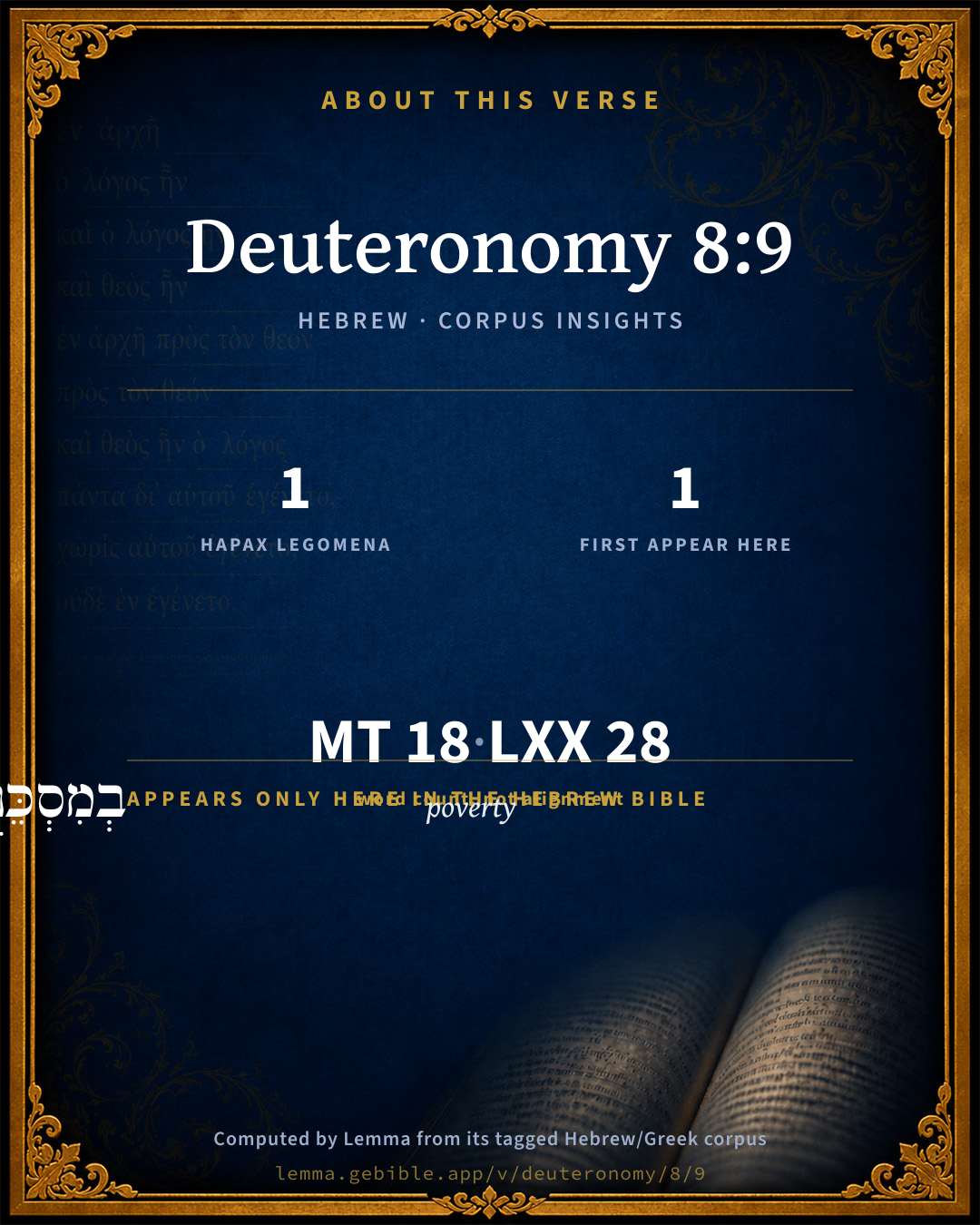
  • 1 hapax legomenon — only here in the Hebrew Bible
  • 1 first appearance in the Hebrew Bible
Full analysis ↓
Download a study sheet

One document with this verse’s original text, its word-by-word gloss line, the meaning frame, cross-references with their text, attributed commentary, and full source and license credits — printable, and it pastes into notes with its structure intact.

This verse Autodidact and up

Study sheet (.html) Plain text (.txt)

A passage Seminary Student

Up to 50 verses in one chapter. A passage sheet keeps up to 6 commentary sources and 12 cross-references per verse, in the order this page ranks them, and says so on the sheet whenever that leaves anything out. Ask for a single verse and you get the Autodidact verse sheet above.

Everything on this page stays free to read, with no account — the sheet is a download of what is already on screen, not access to it.

Want to remove ads? Support Godless Engineer
Compare translations 3

The same verse in 3 English versions, stacked beneath the original-language interlinear above. Click any original word for its lexicon entry.

Each is an independent rendering of the whole verse — the interlinear is not word-aligned to these translations.

Highlighted words mark where these versions differ — a whole-verse word diff, not a word-by-word alignment.

  • World English Bible Public Domain
    a land in which you shall eat bread without scarceness, you shall not lack anything in it; a land whose stones are iron, and out of whose hills you may dig copper.
  • King James Version Public Domain
    A land wherein thou shalt eat bread without scarceness, thou shalt not lack any thing in it; a land whose stones are iron, and out of whose hills thou mayest dig brass.
  • unfoldingWord Literal Text CC BY-SA 4.0
    a land where you will eat bread in it not with poverty, you will not lack anything in it; a land where its stones iron, and from the hills you may dig copper.

unfoldingWord Literal Text — © unfoldingWord, licensed CC BY-SA 4.0. Word-aligned USFM3 via Door43 (git.door43.org/unfoldingWord/en_ult).

Versions to compare (up to 4)

3 of 4 selected

Show all 18 translations

Every available English version of this verse, each an independent rendering of the whole verse.

  • World English Bible Public Domain
    a land in which you shall eat bread without scarceness, you shall not lack anything in it; a land whose stones are iron, and out of whose hills you may dig copper.
  • Berean Standard Bible Public Domain
    a land where you will eat food without scarcity, where you will lack nothing; a land whose rocks are iron and whose hills are ready to be mined for copper.
  • Majority Standard Bible Public Domain
    a land where you will eat food without scarcity, where you will lack nothing; a land whose rocks are iron and whose hills are ready to be mined for copper.
  • King James Version Public Domain
    A land wherein thou shalt eat bread without scarceness, thou shalt not lack any thing in it; a land whose stones are iron, and out of whose hills thou mayest dig brass.
  • American Standard Version (1901) Public Domain
    a land wherein thou shalt eat bread without scarceness, thou shalt not lack anything in it; a land whose stones are iron, and out of whose hills thou mayest dig copper.
  • Revised Version (1885) Public Domain
    a land wherein thou shalt eat bread without scarceness, thou shalt not lack any thing in it; a land whose stones are iron, and out of whose hills thou mayest dig brass.
  • Geneva Bible (1599) Public Domain
    A land wherein thou shalt eate bread without scarcitie, neither shalt thou lacke any thing therein: a land whose stones are yron, and out of whose mountaines thou shalt digge brasse.
  • Douay-Rheims (1899) Public Domain
    Where without any want thou shalt eat thy bread, and enjoy abundance of all things: where the stones are iron, and out of its hills are dug mines of brass:
  • Young's Literal Translation Public Domain
    a land in which without scarcity thou dost eat bread, thou dost not lack anything in it; a land whose stones `are' iron, and out of its mountains thou dost dig brass;
  • Literal Standard Version CC BY-SA 4.0
    a land in which you eat bread without scarcity—you do not lack anything in it; a land whose stones [are] iron, and you dig bronze out of its mountains.
  • Unlocked Literal Bible CC BY-SA 4.0
    It is a land in which you will eat bread without lack, and where you will not go without anything; a land whose stones are made of iron, and out of whose hills you may dig copper.
  • unfoldingWord Literal Text CC BY-SA 4.0
    a land where you will eat bread in it not with poverty, you will not lack anything in it; a land where its stones iron, and from the hills you may dig copper.
  • Darby Bible Public Domain
    a land wherein thou shalt eat bread without scarceness, where thou shalt lack nothing; a land whose stones are iron, and out of whose mountains thou wilt dig copper.
  • World Messianic Bible Public Domain
    a land in which you shall eat bread without scarcity, you shall not lack anything in it; a land whose stones are iron, and out of whose hills you may dig copper.
  • Webster's Bible Public Domain
    A land in which thou shalt eat bread without scarceness, thou shalt not lack any thing in it, a land whose stones are iron, and out of whose hills thou mayest dig brass.
  • Free Bible Version CC BY-SA 4.0
    It's a land where you won't run out of food, where you will have everything you need; a land whose rocks contain iron ore and whose hills can be mined for copper.
  • Bible in Basic English Public Domain
    Where there will be bread for you in full measure and you will be in need of nothing; a land where the very stones are iron and from whose hills you may get copper.
  • JPS Tanakh (1917) Public Domain
    a land wherein thou shalt eat bread without scarceness, thou shalt not lack any thing in it; a land whose stones are iron, and out of whose hills thou mayest dig brass.

Literal Standard Version (2020), Covenant Press — licensed CC BY-SA 4.0. Text via the HelloAO Bible API (eBible.org). Unlocked Literal Bible (unfoldingWord) — licensed CC BY-SA 4.0. Text via the HelloAO Bible API (eBible.org). unfoldingWord Literal Text — © unfoldingWord, licensed CC BY-SA 4.0. Word-aligned USFM3 via Door43 (git.door43.org/unfoldingWord/en_ult). Free Bible Version, Dr. Jonathan Gallagher — licensed CC BY-SA 4.0. Text via the HelloAO Bible API (eBible.org).

Word by word

More ways to search: Search by grammar → Find every occurrence → Compare this word →

Practice this passage: Drill this verse → Learn its vocabulary →

בְמִסְכֵּנֻת֙
miçkênuth
H4544
“in/at · poverty”
Preposition + Noun, Common, Feminine, Singular, Absolute
Part of Speech
Preposition + Noun
Type
Common
Gender
Feminine
Number
Singular
State
Absolute
Full BDB Definition

Origin: from H4542

TWOT: 1222

poverty, scarcity
  1. אֶ֗רֶץ ʼerets H776 “land” Noun, Common, Both, Singular, Absolute
  2. אֲשֶׁ֨ר ʼăsher H834 “which” Particle, Relative
  3. לֹ֤א lôʼ H3808 “not” Particle, Negative
  4. תֹּֽאכַל ʼâkal H398 “to eat” Verb, Qal, Imperfect, 2nd Person, Masculine, Singular
  5. לֶ֔חֶם lechem H3899 “bread” Noun, Common, Both, Singular, Absolute
  6. לֹֽא lôʼ H3808 “not” Particle, Negative
  7. תֶחְסַ֥ר châçêr H2637 “to lack” Verb, Qal, Imperfect, 2nd Person, Masculine, Singular
  8. כֹּ֖ל kôl H3605 “all” Noun, Common, Masculine, Singular, Absolute
  9. אֶ֚רֶץ ʼerets H776 “land” Noun, Common, Both, Singular, Absolute
  10. אֲשֶׁ֣ר ʼăsher H834 “which” Particle, Relative
  11. אֲבָנֶ֣יהָ ʼeben H68 “stones · her” Noun, Common, Feminine, Plural, Construct + Suffix, Personal, 3rd Person, Feminine, Singular
  12. בַרְזֶ֔ל barzel H1270 “iron” Noun, Common, Masculine, Singular, Absolute
  13. וּמֵהֲרָרֶ֖יהָ hârâr H2042 “and · from · mountains · her” Conjunction + Preposition + Noun, Common, Masculine, Plural, Construct + Suffix, Personal, 3rd Person, Feminine, Singular
  14. תַּחְצֹ֥ב châtsab H2672 “to hew” Verb, Qal, Imperfect, 2nd Person, Masculine, Singular
  15. נְחֹֽשֶׁת nᵉchôsheth H5178 “bronze” Noun, Common, Feminine, Singular, Absolute

About this verse

These counts appear in no published source. They are computed here, from the morphology-tagged text and Lemma’s own curated glosses. What Lemma adds →

18
words
13
distinct lemmas
Pentateuch
section

Notable vocabulary

1 hapax legomenon — a word that appears only here in the entire Hebrew Bible:

  • בְמִסְכֵּנֻת֙ poverty H4544

First appearance in Scripture

This word makes its first canonical appearance in the Hebrew Bible here:

  • בְמִסְכֵּנֻת֙ poverty H4544

Shared distinctive vocabulary

וּמֵהֲרָרֶ֖יהָ mountain H2042 occurs in 12 verses of the Hebrew Bible. Also found in:

Grammatical profile

  • 3 verbs
  • 9 nouns
  • 2 prepositions
  • 4 particles

Verb forms

  • תֹּֽאכַל Qal · Imperfect
  • תֶחְסַ֥ר Qal · Imperfect
  • תַּחְצֹ֥ב Qal · Imperfect

Repetition

Words recur within this verse — often emphatic in Hebrew:

  • אֶ֗רֶץ land H776 ×2
  • אֲשֶׁ֨ר which H834 ×2
  • לֹ֤א not H3808 ×2

Hebrew & Septuagint length

In English translation the verse runs 32 words from the Hebrew and 36 from the Septuagint (LXX English) — closely comparable.

A rough comparison of the two English renderings, which tokenize alike — not a word-level alignment.

Word counts can differ between the Hebrew and the Greek without any difference in meaning — e.g. the Hebrew direct-object marker אֵת has no separate Greek word, and Greek often adds the article ὁ.

In the original languages it is 18 Hebrew tokens and 28 Greek tokens — but the two are counted differently (Hebrew bundles its prefixes and suffixes into one token; the Greek is in lemma form), so that isn’t a like-for-like length.

Cross-references

4

Topical passages linked to Deuteronomy 8:9 in the Treasury of Scripture Knowledge — connected by theme and wording, ordered by reader-vote popularity; previews shown in the World English Bible.

  • 1 Chronicles 22:14 Now, behold, in my affliction I have prepared for the house of Yahweh one hundred thousand talents of gold, and one thousand thousand talents of silver, and of brass and iron without weight; for it is in abundance: timber also and stone have I prepared; and you may add to them.
  • Deuteronomy 33:25 Your bars shall be iron and brass; As your days, so shall your strength be.
  • Joshua 22:8 and spoke to them, saying, Return with much wealth to your tents, and with very much cattle, with silver, and with gold, and with brass, and with iron, and with very much clothing: divide the spoil of your enemies with your brothers.
  • Job 28:2 Iron is taken out of the earth, And copper is smelted out of the ore.

Cross-references courtesy of OpenBible.info (CC BY 4.0).

Hebrew and Greek witnesses Masoretic Hebrew ↔ Greek Septuagint

The same verse in the two great witnesses to the Old Testament, shown verse-for-verse.

These are two independent witnesses, not word-aligned to each other, and the Septuagint is shown in lemma (dictionary) form.

Hebrew Deuteronomy 8:9 Masoretic · Westminster Leningrad Codex

אֶ֗רֶץ אֲשֶׁ֨ר לֹ֤א בְמִסְכֵּנֻת֙ תֹּֽאכַל בָּ֣הּ לֶ֔חֶם לֹֽא תֶחְסַ֥ר כֹּ֖ל בָּ֑הּ אֶ֚רֶץ אֲשֶׁ֣ר אֲבָנֶ֣יהָ בַרְזֶ֔ל וּמֵהֲרָרֶ֖יהָ תַּחְצֹ֥ב נְחֹֽשֶׁת

a land in which you shall eat bread without scarceness, you shall not lack anything in it; a land whose stones are iron, and out of whose hills you may dig copper.

World English Bible · Public Domain

Greek LXX Deuteronomy 8:9 Septuagint · lemma form

γῆ ἐπί ὅς οὐ μετά πτωχεία ἐσθίω ὁ ἄρτος σύ καί οὐ ἐνδέω οὐδείς ἐπί αὐτός γῆ ὅς ὁ λίθος σίδηρος καί ἐκ ὁ ὄρος αὐτός μεταλλεύω χαλκός

a land on which you shall not eat your bread with poverty, and you shall not lack any thing upon it; a land whose stones are iron, and out of its mountains you shall dig brass.

LXX2012 (modern English Septuagint) · Public Domain

Hebrew: Westminster Leningrad Codex (CC BY 4.0). Greek: Septuagint (public domain); English from LXX2012 (modern English Septuagint) (Public Domain). How the Septuagint differs from the Hebrew →

Targum (Aramaic paraphrase)

2

The Targum is the ancient Jewish Aramaic paraphrase of the Hebrew Scriptures — an interpretive translation, not the Hebrew text itself. Onkelos (literal) and Pseudo-Jonathan (expansive) render the Torah, and Jonathan the Prophets. Coverage is partial: where no permissively-licensed English translation exists for a verse, only the Aramaic is shown. This is verse-level text, not a word-by-word alignment to the Hebrew.

  1. Targum Onkelos Torah (Genesis–Deuteronomy)
    אַרְעָא דִי לָא בְעִצוּרִין (נ''א בְמִסְכֵּנוּ) תֵּיכוּל בַּהּ לַחֲמָא לָא תֶחְסַר כָּל מִדַעַם בַּהּ אַרְעָא דִי אַבְנָהָא פַרְזְלָא וּמִטוּרָהָא תִּפְסוּל נְחָשָׁא

    (no public-domain English translation for this verse)

    Targum Onkelos — Aramaic: “Onkelos Genesis” (public domain); “Onkelos Exodus” (public domain); “Onkelos Leviticus” (public domain); “Onkelos Numbers” (public domain); “Onkelos Deuteronomy” (public domain). English: “Sefaria Community Translation” (CC0 1.0 (public-domain dedication)); “J.W. Etheridge. The Targums of Onkelos and Jonathan Ben Uzziel on the Pentateuch. London: Longmans, Green, 1862” (public domain). Text via Sefaria.

  2. Targum Pseudo-Jonathan Torah (Genesis–Deuteronomy)
    אַרְעָא דְלָא בְחוּסְרָנָא תֵיכְלוּן בָּהּ לַחֲמָא לָא תֶחְסַר כָּל מִדַּעַם בָּהּ אַרְעָא דִי חַכִּימָהָא גָזְרִין גְּזֵרַן בְּרִירַן הֵי כְּפַרְזְלָא וְתַלְמִידָהָא שַׁאֲלִין שְׁאִילִין מְסִימָן כִּנְחָשָׁא

    a land where, without poverty, you may eat bread and want nothing; a land whose sages will enact decrees unalloyed as iron, and whose disciples will propound questions weighty as brass.

    Targum Pseudo-Jonathan — Aramaic: “Targum Jonathan on Genesis” (public domain); “Targum Jonathan on Exodus” (public domain); “Targum Jonathan on Leviticus” (public domain); “Targum Jonathan on Numbers” (public domain); “Targum Jonathan on Deuteronomy” (public domain). English: “The Targum of Jonathan ben Uzziel, trans. J. W. Etheridge, London, 1862” (public domain). Text via Sefaria.

Commentary

Notes on Deuteronomy 8:9 from classic Christian and Jewish commentators (each source and its license shown beneath its notes). The classic Christian expositions comment on the surrounding passage and are grouped to its opening verse, so a note may address several verses; the Jewish commentaries on the Tanakh (Rashi and others) are per-verse, so they appear only where the commentator wrote on this verse.

Lemma curates 59 commentaries, every one of them public domain or Creative Commons licensed, each selected and text-cleaned for this edition rather than reprinted as found. About our sources →

Trapp's Complete Commentary

John Trapp

Deu 8:9 A land wherein thou shalt eat bread without scarceness, thou shalt not lack any [thing] in it; a land whose stones [are] iron, and out of whose hills thou mayest dig brass.

Ver. 9. Thou shalt not lack anything in it.] Of the Island of Cyprus it is said, that it sendeth forth great abundance of commodities to other countries, of whom it craveth no help again. {a} It was anciently called Macaria, the Blessed. Marcellinus, to show the fertility of it, saith that Cyprus aboundeth with such plenty of all things, that without the help of any other foreign country, it is, of itself, able to build a tall ship from the keel to the topsail, and so put it to sea, furnished of all things needful. Of Egypt also it is reported, that it is so fruitful a country, Ut cunctos mortales pascere, deos ipsos excipere hospitio salva re posse gloriaretur. It was anciently called publicum orbis horreum, the world’s great barn; as some foreign writers have termed our country the court of Queen Ceres, the granary of the western world, the Fortunate Island, the Paradise of Pleasure, and Garden of God. The worst is, that as Aristotle was wont to tax his Athenians, that whereas they were famous for two things, the best land, and the best laws, frumentis uterentur, legibus nequaquam, they abused their plenty, and lived lawlessly; {b} so it may be said of us, that we live in God’s good land, but not by God’s good laws.

{a} Turk. Hist.

{b} Laert, lib. v. cap. 1.

John Trapp, A Commentary or Exposition upon All the Books of the Old and New Testament (1647–1656) — public domain. Text from a community e-Sword module.

Tyndale Open Study Notes

Tyndale Open Resources

8:9 Iron was not widely used in this period of the Bronze Age because the process of smelting and working it was known to only a few cultures (see 1 Sam 13:19-21). The time would come when Israel would exploit this vastly superior metal (see Josh 17:16-18; 1 Kgs 6:7; 2 Kgs 6:5; 1 Chr 22:3).

Tyndale Open Study Notes — © Tyndale Open Resources, licensed CC BY-SA 4.0. Text via the HelloAO Bible API.

Geneva Bible (1599)

Geneva Bible translators

Where there are mines of metal.

Geneva Bible (1599) marginal notes — public domain. Text via Bolls.life.

Jamieson, Fausset & Brown

Robert Jamieson, A. R. Fausset & David Brown

a land whose stones are iron--The abundance of this metal in Palestine, especially among the mountains of Lebanon, those of Kesraoun, and elsewhere, is attested not only by JOSEPHUS, but by Volney, Buckingham, and other travellers.

brass--not the alloy brass, but the ore of copper. Although the mines may now be exhausted or neglected, they yielded plenty of those metals anciently (Ch1 22:3; Ch1 29:2-7; Isa 60:17).

Jamieson, Fausset & Brown — Commentary Critical and Explanatory on the Whole Bible (1871) — public domain (CC PDM 1.0). Text via the HelloAO Bible API.

Adam Clarke's Commentary

Verse 9. A land whose stones are iron] Not only meaning that there were iron mines throughout the land, but that the loose stones were strongly impregnated with iron, ores of this metal (the most useful of all the products of the mineral kingdom) being every where in great plenty.

Out of whose hills thou mayest dig brass.] As there is no such thing in nature as a brass mine, the word נחשת nechosheth should be translated copper; of which, by the addition of the lapis calaminaris, brass is made. See Clarke on Ex 25:3.

Adam Clarke's Commentary on the Bible (1810–1826) — public domain. Text from a community e-Sword/MySword module.

Ellicott's Commentary for English Readers

(9) Whose stones are iron, and out of whose hills thou mayest dig brass.—We do not hear of mining operations in Palestine from sacred history. “Brass,” i.e., copper; and so in all passages.

A Bible Commentary for English Readers, edited by Charles John Ellicott (1878–1897) — public domain. Text from a community e-Sword module.

The Cambridge Bible for Schools and Colleges

gen. ed. J. J. S. Perowne

9. without scarceness] The noun is found only here, and its adj. thrice only in the late Ecc_4:13; Ecc_9:15 f.; cp. Isa_40:20. Scarcity of bread is a great curse of the desert nomads: some tribes taste it but once a month, others not so often, and it is regarded as a luxury (Robinson, Bib. Res. ii. 497, cp. i. 197 f., Musil, Arabia Petr. iii. ‘Ethnolog. Reisebericht,’ 148). Their hunger for it is a frequent cause of their raids on the fellahin (for an instance see von Oppenheim, Vom Mittelmeer zum Pers. Golf, i. 269).

whose stones are iron] Whether iron here means basalt as in Deu_3:11 (q.v.) is doubtful, for basalt is not confined to fertile lands, but is also found in the desert. More probably it is iron proper: not introduced to Palestine till the arrival of Israel or perhaps later. Like copper it came from the North (Jer_15:12), where the Phoenicians and Arameans seem to have moulded and worked it in the Lebanons (Ramman-Nirari III of Assyria records it as tribute from Aram-Damascus; and Idrisi, see ZDPV, viii. 134, mentions a mine above Beyrout). Josephus speaks of the Iron Mountain running as far as Moabitis (IV. B.J. Deu_8:2) and the Letter of Aristeas says that both iron and copper were brought before the Persian period from the Mts of Arabia. ‘Some have denied that the promise to Israel of iron in the rocks of their own land is justified by the geological facts. But ancient sources of the ore have been discovered at Ikzim on Mt Carmel, and near Burme, N. of the Jabbok’ (Jerus. i. 332). Some of the hot springs of Palestine are impregnated with iron (Driver quoting Burckhardt, 33 f.). The excess of the references to iron and to furnaces in Jer. and Deut. over those in previous writers points to an increase of the metal in Israel before 650 b.c.

brass] ‘In the O.T. this never refers to the alloy of zinc to which the term is now confined’ (J. H. Gladstone, PEFQ, 1898, 253 n.) but means either bronze, copper with alloy of tin, or pure copper. In W. Asia no source of tin has been certainly identified. But in a paper on ‘Copper and its Alloys in Antiquity’ (reported in Athenaeum, Feb. 3, 1906) the President of the Anthropological Institute gives his opinion that bronze was made directly from a copper ore containing tin long before the two metals were artificially mixed. The sources of copper for Palestine were Cyprus, the Lebanons (‘the land of Nuḥashshi’ or bronze), Edom, and N. Arabia (Tell-el-Amarna Letters (Winckler’s ed.), 25, 27, 31 ff.; see the present writer’s article ‘Trade, etc.’ in Enc. Bibl. § 7; and for the copper-mines and smelting furnaces of N. Edom at Fênân, the Phainôn of antiquity, see Musil, Edom, i. 156 f., 287, 298, 323, ii. 7 f.).

The Cambridge Bible for Schools and Colleges (gen. ed. J. J. S. Perowne; Cambridge University Press, 1878–1918) — public domain. Text from a community e-Sword module.

John Gill's Exposition

When thou hast eaten and art full, then thou shalt bless the Lord thy God,.... For as the Lord would furnish them with plenty of food, they might eat of it liberally, provided they did not indulge to intemperance, as everyone may whom God has blessed with a fulness of good things; and this shows that we are to return thanks to God for a plentiful meal, as well as to ask a blessing on it:

for the good land which he hath given thee; which supplied them with such plenty, that they enjoyed full meals every day.

John Gill's Exposition of the Whole Bible (1746–1763) — public domain (CC PDM 1.0). Text via the HelloAO Bible API.

Haydock's Catholic Bible Commentary

Iron, equal in hardness, and used to cut things, in the same manner as we use iron or steel, Isaias lx. 17. --- Brass. There were mines of both in Mount Libanus; and David collected great quantities of such metals from Cœlosyria, 3 Kings xviii. 8., and 1 Paralipomenon xxii. 3, 14. Sidon was noted for its brass. (Homer, Odyssey xv. 425.) Sarepta probably took its name from the "foundry" established there. Dan and Aser had abundance of iron and brass, chap. xxxiii. 25., and Ezechiel xxvii. 19. Cadmus brought from this country the art of melting gold, &c., into Greece. (Pliny, [Natural History?] vii. 56. In latter ages, many Christians were condemned to work in the mines of Palestine. (Eusebius)

George Leo Haydock (1774–1849), Haydock's Catholic Family Bible and Commentary, 1859 edition — public domain. Excludes Psalms (Douay-Rheims chapter numbering differs from Protestant) and Deuterocanonical books (Catholic canon only).

Matthew Poole's English Annotations

Where are mines of iron in a manner as plentiful as stones, and upon which travellers must tread, as in other parts they do upon stones;

and out of whose hills thou mayest dig brass, to wit, in great plenty. These are mentioned, because they had none such in Egypt whence they came.

Matthew Poole's English Annotations on the Holy Bible (1683–1685) — public domain. Text from a community e-Sword/MySword module.

The Pulpit Commentary

A land whose stones are iron. Minerals do not abound in Palestine; the hills are for the most part calcareous; but by the side of the limestone in the north of Canaan ferruginous basalt appears in largo masses, and on Lebanon ironstone abounds. Near Tiberius are springs largely impregnated with iron, as are also those at Has-beija, on the Hermon range, as well as the soil around that place. Traces of extinct copper works are also to be found on Lebanon (cf. art. "Metals," in Kitto and Smith; Ritter, "Geography of Palestine," 1:248). The Israelites, however, do not seem to have carried on mining operations themselves, but to have been content to obtain supplies of the useful metals from their neighbors. (2Sa_8:8; 1Ch_18:8 1Ch_22:3, 1Ch_22:14)

The Pulpit Commentary (1880–1919), ed. H.D.M. Spence-Jones & Joseph S. Exell — public domain. Text from a community e-Sword module.

John Wesley's Explanatory Notes

Whose stones are iron - Where are mines of iron in a manner as plentiful as stones, and upon which travelers must tread, as in other parts they do upon stones.

John Wesley, Explanatory Notes Upon the Whole Bible (1754–1765) — public domain. Text via the GEBible commentary corpus.

unfoldingWord translationNotes

Door43 World Missions Community

General Information:

Moses continues to speak to the Israelites as if they are one person. (See: Forms of You)

a land in which you will eat bread without lack

This litotes can be translated positively. AT: "a land where there will be plenty of food for you" (See: Litotes)

where you will not go without anything

This can be stated in positive form. AT: "where you will have everything you need" (See: Double Negatives)

stones are made of iron

The stones are full of iron ore. Iron is a very hard metal useful for swords and plows.

dig copper

"mine copper." Copper is a soft metal useful for making household utensils.

You will eat and be full

"You will have enough food to eat until you are full"

you will bless

"you will praise" or "you will give thanks to"

translationWords

bread

bless

unfoldingWord translationNotes — © Distant Shores Media and the Door43 World Missions Community, licensed CC BY-SA 4.0. Source: git.door43.org/Door43/en_tn.

Ramban (Nachmanides)

Rabbi Moshe ben Nachman (Ramban / Nachmanides)

A LAND WHOSE STONES ARE IRON. The meaning thereof is that in the place where you expect stones, you will find iron, for it will be mined from the dust thereof. He thus brought them the joyful message that in the Land of Israel there is a quarry of copper and iron which are a great necessity for the inhabitants of the Land, and thou shalt not lack any thing in it. But [the absence of] a source of silver and gold, Verse 1. is no deficiency in a land. And in the Targum Yerushalmi I have seen it rendered: “a Land whose stones are as bright as iron,” meaning to say that Scripture is praising the Land because in it there will be found quarries of great stones, costly stones, hewn stones with which to build houses, walls, and towers, unlike the land of Egypt and many lands where people dwell in houses of clay and their houses may become their graves [from excessive rains].

Ramban (Nachmanides) on the Tanakh — English translation: “Commentary on the Torah by Ramban (Nachmanides). Translated and annotated by Charles B. Chavel. New York, Shilo Pub. House, 1971-1976” (CC BY 4.0). Text via Sefaria.

Lesson kit

Teaching starters — assembled from the data on this page, not authored interpretation. Every prompt links to the verse data it draws on. Edit before teaching.

Deuteronomy, in the Pentateuch, opens this verse with 18 words (13 distinct Hebrew lemmas). Its most distinctive word is miçkênuth (“poverty”). A historical commentator’s framing appears above. Read the whole chapter for the surrounding context.

Discussion questions

  1. How does “poverty” (miçkênuth) shape what this verse is saying?
  2. This verse holds 1 word here found nowhere else in the Hebrew Bible. What might the rare word draw attention to?
  3. The word “poverty” first appears here in Scripture. What is being introduced at this debut?
  4. Numbers 23:7 shares the word «mountain» with this verse. How do the two illuminate each other?
  5. “land” occurs 2× in this one verse. What is the effect of the repetition?
  6. These translations render this verse differently; the difference is in the English rendering, not the original. What questions does that raise?
  7. The verb «תֹּֽאכַל» is Qal Imperfect. How does its form color the action?
  8. Reading how Trapp's Complete Commentary and Tyndale Open Study Notes read this verse, where do the two commentators agree and where do they part?

Things to notice

  • 1 word in this verse appears nowhere else in the Hebrew Bible.
  • 1 word makes its first canonical appearance in Scripture here.
  • This verse counts 18 Hebrew ↔ 28 Greek words.
  • These translations choose different wording for 18 words in this verse.
  • “land” occurs 2× in this single verse.

Reading settings

Reading text

Shown beneath each verse's original-language words.

Old Testament
Old Testament edition

Read the OT as the Masoretic Hebrew (MT) or the Greek Septuagint (LXX).

English shown for the Greek Septuagint (in the Hebrew ↔ Greek comparison).

Comparing translations? Open the Compare panel on any verse page to stack up to four side by side.