
Ezekiel 16:19

Hebrew (Westminster Leningrad Codex) Ezekiel 16:19 appears in the Hebrew Old Testament. The text above is from the Westminster Leningrad Codex. Each word links to its Strong’s number, a concise gloss, and parsing drawn from the Open Scriptures Hebrew Bible morphology. Click any word for its full Brown-Driver-Briggs (BDB) entry.
Download image
Cite this verse

Ezekiel 16:19 (World English Bible). Public Domain. Lemma interlinear Bible study tool, https://lemma.gebible.app/v/ezekiel/16/19.

Show BibTeX & RIS
BibTeX
RIS
English Translation
My bread also which I gave you, fine flour, and oil, and honey, with which I fed you, you did even set it before them for a sweet savor; and [thus] it was, says the Lord Yahweh.
World English Bible · Public Domain
Download a study sheet

One document with this verse’s original text, its word-by-word gloss line, the meaning frame, cross-references with their text, attributed commentary, and full source and license credits — printable, and it pastes into notes with its structure intact.

This verse Autodidact and up

Study sheet (.html) Plain text (.txt)

A passage Seminary Student

Up to 50 verses in one chapter. A passage sheet keeps up to 6 commentary sources and 12 cross-references per verse, in the order this page ranks them, and says so on the sheet whenever that leaves anything out. Ask for a single verse and you get the Autodidact verse sheet above.

Everything on this page stays free to read, with no account — the sheet is a download of what is already on screen, not access to it.

Want to remove ads? Support Godless Engineer
Compare translations 3

The same verse in 3 English versions, stacked beneath the original-language interlinear above. Click any original word for its lexicon entry.

Each is an independent rendering of the whole verse — the interlinear is not word-aligned to these translations.

Highlighted words mark where these versions differ — a whole-verse word diff, not a word-by-word alignment.

  • World English Bible Public Domain
    My bread also which I gave you, fine flour, and oil, and honey, with which I fed you, you did even set it before them for a sweet savor; and [thus] it was, says the Lord Yahweh.
  • King James Version Public Domain
    My meat also which I gave thee, fine flour, and oil, and honey, wherewith I fed thee, thou hast even set it before them for a sweet savour: and thus it was, saith the Lord GOD.
  • unfoldingWord Literal Text CC BY-SA 4.0
    My bread I gave you—made with fine flour, oil, and honey—you set before them for a fragrant aroma, for this is what happened—this is the Lord Yahweh’s declaration.

unfoldingWord Literal Text — © unfoldingWord, licensed CC BY-SA 4.0. Word-aligned USFM3 via Door43 (git.door43.org/unfoldingWord/en_ult).

Versions to compare (up to 4)

3 of 4 selected

Show all 18 translations

Every available English version of this verse, each an independent rendering of the whole verse.

  • World English Bible Public Domain
    My bread also which I gave you, fine flour, and oil, and honey, with which I fed you, you did even set it before them for a sweet savor; and [thus] it was, says the Lord Yahweh.
  • Berean Standard Bible Public Domain
    And you set before them as a pleasing aroma the food I had given you—the fine flour, oil, and honey that I had fed you. That is what happened, declares the Lord GOD.
  • Majority Standard Bible Public Domain
    And you set before them as a pleasing aroma the food I had given you—the fine flour, oil, and honey that I had fed you. That is what happened, declares the Lord GOD.
  • King James Version Public Domain
    My meat also which I gave thee, fine flour, and oil, and honey, wherewith I fed thee, thou hast even set it before them for a sweet savour: and thus it was, saith the Lord GOD.
  • American Standard Version (1901) Public Domain
    My bread also which I gave thee, fine flour, and oil, and honey, wherewith I fed thee, thou didst even set it before them for a sweet savor; and `thus' it was, saith the Lord Jehovah.
  • Revised Version (1885) Public Domain
    My bread also which I gave thee, fine flour, and oil, and honey, wherewith I fed thee, thou didst even set it before them for a sweet savour, and thus it was; saith the Lord GOD.
  • Geneva Bible (1599) Public Domain
    My meate also, which I gaue thee, as fine floure, oyle, and honie, wherewith I fedde thee, thou hast euen set it before them for a sweete sauour: thus it was, saith the Lord God.
  • Douay-Rheims (1899) Public Domain
    And my bread which I gave thee, the fine flour, and oil, and honey, wherewith I fed thee, thou hast set before them for a sweet odour; and it was done, saith the Lord God.
  • Young's Literal Translation Public Domain
    And My bread, that I gave to thee, Fine flour, and oil, and honey, that I caused thee to eat. Thou hast even set it before them, For a sweet fragrance -- thus it is, An affirmation of the Lord Jehovah.
  • Literal Standard Version CC BY-SA 4.0
    And My bread, that I gave to you, || Fine flour, and oil, and honey, that I caused you to eat. You have even set it before them, || For a refreshing fragrance—thus it is, || A declaration of Lord YHWH.
  • Unlocked Literal Bible CC BY-SA 4.0
    My bread I gave you—made with fine flour, oil, and honey—you set before them for a fragrant aroma, for this is what happened—this is the Lord Yahweh's declaration.
  • unfoldingWord Literal Text CC BY-SA 4.0
    My bread I gave you—made with fine flour, oil, and honey—you set before them for a fragrant aroma, for this is what happened—this is the Lord Yahweh’s declaration.
  • Darby Bible Public Domain
    And my bread which I had given thee, the fine flour and the oil and the honey wherewith I fed thee, thou didst even set it before them for a sweet savour: thus it was, saith the Lord Jehovah.
  • World Messianic Bible Public Domain
    My bread also which I gave you, fine flour, oil, and honey, with which I fed you, you even set it before them for a pleasant aroma; and so it was,” says the Lord GOD.
  • Webster's Bible Public Domain
    My provisions also which I gave thee, fine flour, and oil, and honey, with which I fed thee, thou hast even set before them for a sweet savor: and thus it was, saith the Lord GOD.
  • Free Bible Version CC BY-SA 4.0
    You presented the food I had given you as an offering for them to accept —bread made from the best flour, olive oil, and honey that I had provided for you to eat. That's exactly what you did, declares the Lord God.
  • Bible in Basic English Public Domain
    And my bread which I gave you, the best meal and oil and honey which I gave you for your food, you put it before them for a sweet smell, says the Lord.
  • JPS Tanakh (1917) Public Domain
    My bread also which I gave thee, fine flour, and oil, and honey, wherewith I fed thee, thou didst even set it before them for a sweet savour, and thus it was; saith the Lord GOD.

Literal Standard Version (2020), Covenant Press — licensed CC BY-SA 4.0. Text via the HelloAO Bible API (eBible.org). Unlocked Literal Bible (unfoldingWord) — licensed CC BY-SA 4.0. Text via the HelloAO Bible API (eBible.org). unfoldingWord Literal Text — © unfoldingWord, licensed CC BY-SA 4.0. Word-aligned USFM3 via Door43 (git.door43.org/unfoldingWord/en_ult). Free Bible Version, Dr. Jonathan Gallagher — licensed CC BY-SA 4.0. Text via the HelloAO Bible API (eBible.org).

Word by word

More ways to search: Search by grammar → Find every occurrence → Compare this word →

Practice this passage: Drill this verse → Learn its vocabulary →

נִיחֹ֖חַ
nîychôwach
H5207
“soothing”
Noun, Common, Masculine, Singular, Absolute
Part of Speech
Noun
Type
Common
Gender
Masculine
Number
Singular
State
Absolute
Full BDB Definition

Origin: from H5117

TWOT: 1323c

soothing, quieting, tranquillising
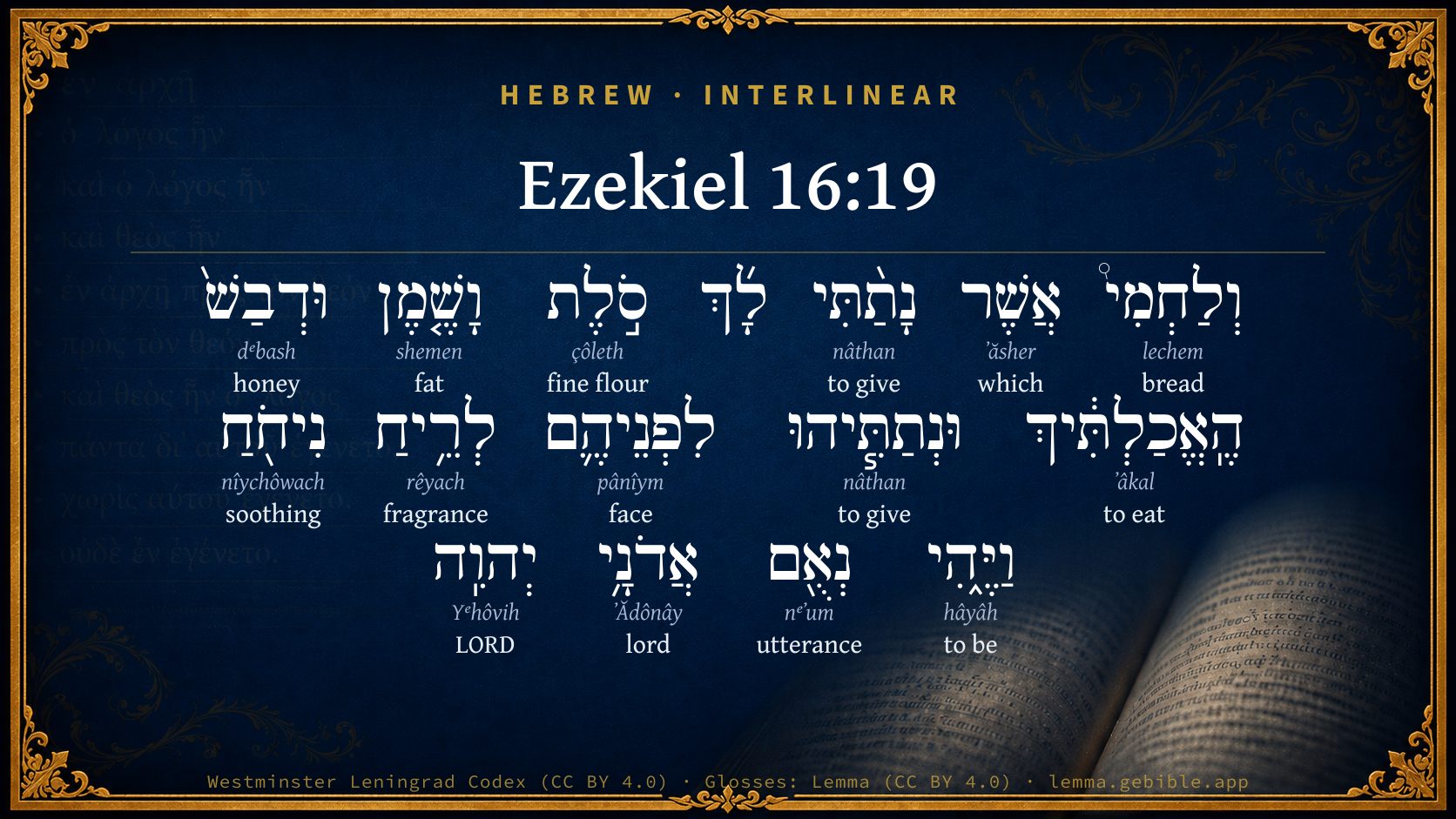
  1. וְלַחְמִי֩ lechem H3899 “and · bread · my” Conjunction + Noun, Common, Both, Singular, Construct + Suffix, Personal, 1st Person, Common, Singular
  2. אֲשֶׁר ʼăsher H834 “which” Particle, Relative
  3. נָתַ֨תִּי nâthan H5414 “to give” Verb, Qal, Perfect, 1st Person, Common, Singular
  4. סֹ֣לֶת çôleth H5560 “fine flour” Noun, Common, Feminine, Singular, Absolute
  5. וָשֶׁ֤מֶן shemen H8081 “and · fat” Conjunction + Noun, Common, Masculine, Singular, Absolute
  6. וּדְבַשׁ֙ dᵉbash H1706 “and · honey” Conjunction + Noun, Common, Masculine, Singular, Absolute
  7. הֶֽאֱכַלְתִּ֔יךְ ʼâkal H398 “to eat · you” Verb, Hiphil, Perfect, 1st Person, Common, Singular + Suffix, Personal, 2nd Person, Feminine, Singular
  8. וּנְתַתִּ֧יהוּ nâthan H5414 “and · to give · him” Conjunction + Verb, Qal, Sequential Perfect, 2nd Person, Feminine, Singular + Suffix, Personal, 3rd Person, Masculine, Singular
  9. לִפְנֵיהֶ֛ם pânîym H6440 “to/for · face(s) · their” Preposition + Noun, Common, Both, Plural, Construct + Suffix, Personal, 3rd Person, Masculine, Plural
  10. לְרֵ֥יחַ rêyach H7381 “to/for · fragrance of” Preposition + Noun, Common, Masculine, Singular, Construct
  11. וַיֶּ֑הִי hâyâh H1961 “and · to be” Conjunction + Verb, Qal, Sequential Imperfect, 3rd Person, Masculine, Singular
  12. נְאֻ֖ם nᵉʼum H5002 “utterance of” Noun, Common, Masculine, Singular, Construct
  13. אֲדֹנָ֥י ʼĂdônây H136 “Lord · my” Noun, Common, Masculine, Plural, Construct + Suffix, Personal, 1st Person, Common, Singular
  14. יְהוִֽה Yᵉhôvih H3069 “LORD” Noun, Proper

About this verse

These counts appear in no published source. They are computed here, from the morphology-tagged text and Lemma’s own curated glosses. What Lemma adds →

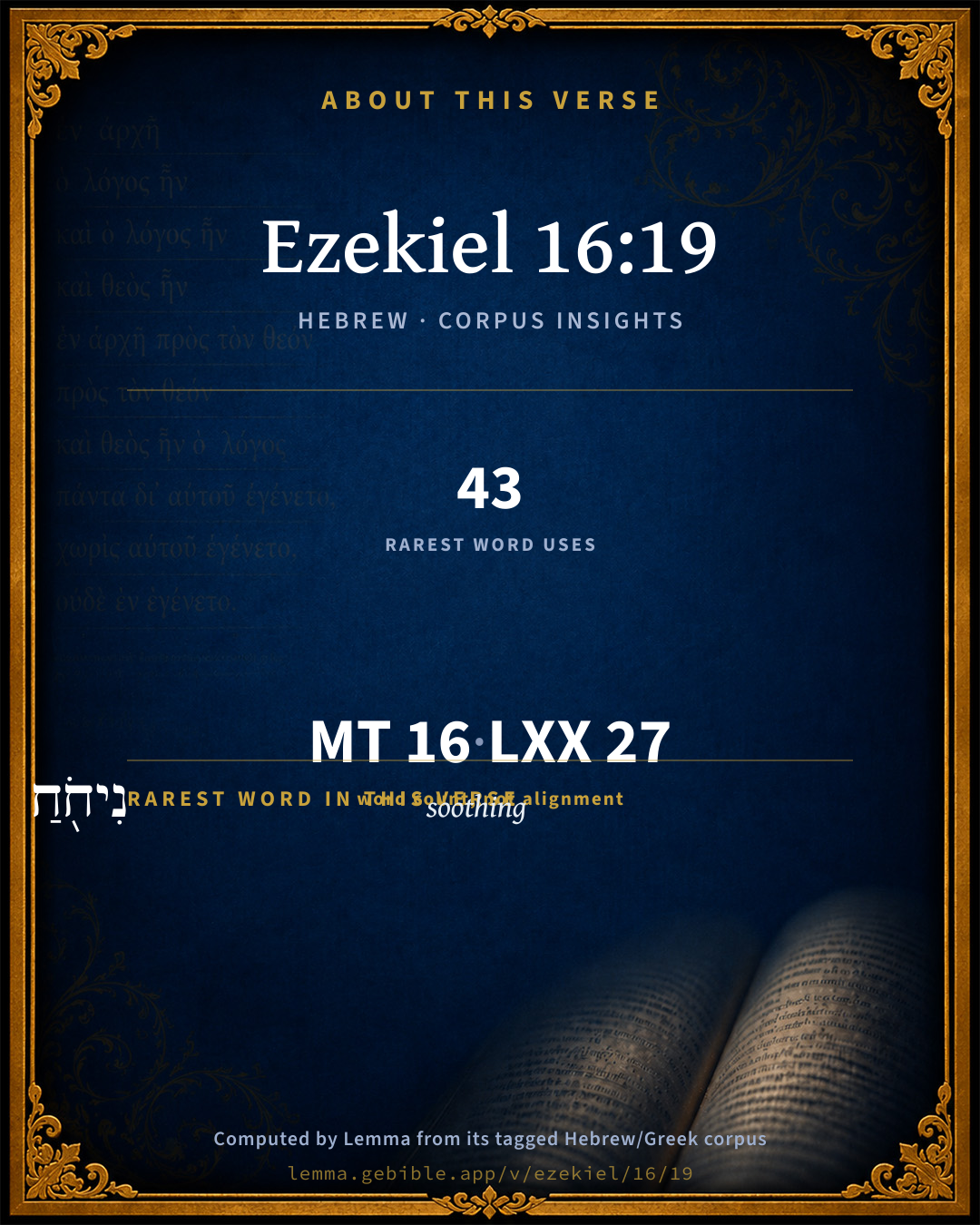
16
words
14
distinct lemmas
Prophets
section

Shared distinctive vocabulary

נִיחֹ֖חַ soothing H5207 occurs in 43 verses of the Hebrew Bible. Also found in:

Grammatical profile

  • 4 verbs
  • 10 nouns
  • 1 preposition
  • 1 particle

Verb forms

  • נָתַ֨תִּי Qal · Perfect
  • הֶֽאֱכַלְתִּ֔יךְ Hiphil · Perfect
  • וּנְתַתִּ֧יהוּ Qal · Sequential Perfect
  • וַיֶּ֑הִי Qal · Sequential Imperfect

Repetition

A word recurs within this verse — often emphatic in Hebrew:

  • נָתַ֨תִּי to give H5414 ×2

Hebrew & Septuagint length

In English translation the verse runs 37 words from the Hebrew and 38 from the Septuagint (LXX English) — closely comparable.

A rough comparison of the two English renderings, which tokenize alike — not a word-level alignment.

Word counts can differ between the Hebrew and the Greek without any difference in meaning — e.g. the Hebrew direct-object marker אֵת has no separate Greek word, and Greek often adds the article ὁ.

In the original languages it is 16 Hebrew tokens and 27 Greek tokens — but the two are counted differently (Hebrew bundles its prefixes and suffixes into one token; the Greek is in lemma form), so that isn’t a like-for-like length.

Cross-references

4

Topical passages linked to Ezekiel 16:19 in the Treasury of Scripture Knowledge — connected by theme and wording, ordered by reader-vote popularity; previews shown in the World English Bible.

  • Ezekiel 16:13 Thus was you decked with gold and silver; and your clothing was of fine linen, and silk, and embroidered work; you ate fine flour, and honey, and oil; and you were exceeding beautiful, and you did prosper to royal estate.
  • Genesis 8:21 Yahweh smelled the sweet savor. Yahweh said in his heart, "I will not again curse the ground any more for man's sake, because the imagination of man's heart is evil from his youth; neither will I ever again strike everything living, as I have done.
  • Deuteronomy 32:14–17 Butter of the herd, and milk of the flock, With fat of lambs, Rams of the breed of Bashan, and goats, With the finest of the wheat; Of the blood of the grape you drank wine.
  • Hosea 2:8–13 For she did not know that I gave her the grain, the new wine, and the oil, And multiplied to her silver and gold, which they used for Baal.

Cross-references courtesy of OpenBible.info (CC BY 4.0).

Hebrew and Greek witnesses Masoretic Hebrew ↔ Greek Septuagint

The same verse in the two great witnesses to the Old Testament, shown verse-for-verse.

These are two independent witnesses, not word-aligned to each other, and the Septuagint is shown in lemma (dictionary) form.

Hebrew Ezekiel 16:19 Masoretic · Westminster Leningrad Codex

וְלַחְמִי֩ אֲשֶׁר נָתַ֨תִּי לָ֜ךְ סֹ֣לֶת וָשֶׁ֤מֶן וּדְבַשׁ֙ הֶֽאֱכַלְתִּ֔יךְ וּנְתַתִּ֧יהוּ לִפְנֵיהֶ֛ם לְרֵ֥יחַ נִיחֹ֖חַ וַיֶּ֑הִי נְאֻ֖ם אֲדֹנָ֥י יְהוִֽה

My bread also which I gave you, fine flour, and oil, and honey, with which I fed you, you did even set it before them for a sweet savor; and [thus] it was, says the Lord Yahweh.

World English Bible · Public Domain

Greek LXX Ezekiel 16:19 Septuagint · lemma form

καί ὁ ἄρτος ἐγώ ὅς δίδωμι σύ σεμίδαλις καί ἔλαιον καί μέλι ψωμίζω σύ καί τίθημι αὐτός πρό πρόσωπον αὐτός εἰς ὀσμή εὐωδία καί γίγνομαι λέγω κύριος

And you took my bread which I gave you, (yes I fed you with fine flour and oil and honey) and did set them before them for a sweet smelling savor: yes, it was so, says the Lord.

LXX2012 (modern English Septuagint) · Public Domain

Hebrew: Westminster Leningrad Codex (CC BY 4.0). Greek: Septuagint (public domain); English from LXX2012 (modern English Septuagint) (Public Domain). How the Septuagint differs from the Hebrew →

Targum (Aramaic paraphrase)

1

The Targum is the ancient Jewish Aramaic paraphrase of the Hebrew Scriptures — an interpretive translation, not the Hebrew text itself. Onkelos (literal) and Pseudo-Jonathan (expansive) render the Torah, and Jonathan the Prophets. Coverage is partial: where no permissively-licensed English translation exists for a verse, only the Aramaic is shown. This is verse-level text, not a word-by-word alignment to the Hebrew.

  1. Targum Jonathan Prophets (Joshua–Malachi)
    וְטוּבִי דִיהָבִית לִיךְ סוּלְתָּא וּמְשַׁח וּדְבַשׁ אוֹכֵילְתִּיךְ יְהַבְתִּינוּן קֳדָמֵיהוֹן קוּרְבָּנִין לְפוּלְחַן הֲלָא הֲוָאָה כָּל אִלֵין אֲמַר יְיָ אֱלֹהִים:

    (no public-domain English translation for this verse)

    Targum Jonathan — Aramaic: “Mikraot Gedolot” (public domain). English: “Sefaria Community Translation” (CC0 1.0 (public-domain dedication)); “London "Chaldee Paraphrase," 1871” (public domain). Text via Sefaria.

Commentary

Notes on Ezekiel 16:19 from classic Christian and Jewish commentators (each source and its license shown beneath its notes). The classic Christian expositions comment on the surrounding passage and are grouped to its opening verse, so a note may address several verses; the Jewish commentaries on the Tanakh (Rashi and others) are per-verse, so they appear only where the commentator wrote on this verse.

Lemma curates 59 commentaries, every one of them public domain or Creative Commons licensed, each selected and text-cleaned for this edition rather than reprinted as found. About our sources →

Trapp's Complete Commentary

John Trapp

Eze 16:19 My meat also which I gave thee, fine flour, and oil, and honey, [wherewith] I fed thee, thou hast even set it before them for a sweet savour: and [thus] it was, saith the Lord GOD.

Ver. 19. My meat also … thou hast even set it before them.] Either as consecrated to them, or otherwise to be consecrated by them, which made Daniel so scrupulous of meddling with the king’s meat. {Eze 1:8}

Thus it was.] Just so, and no otherwise, however thou would palliate the business, and art ready to put me to my proofs. {as Jer 2:35}

John Trapp, A Commentary or Exposition upon All the Books of the Old and New Testament (1647–1656) — public domain. Text from a community e-Sword module.

Jamieson, Fausset & Brown

Robert Jamieson, A. R. Fausset & David Brown

My meat . . . I gave-- (Hos 2:8).

set it before them--as a minchah or "meat offering" (Lev 2:1).

a sweet savour--literally "a savor of rest," that is, whereby they might be propitiated, and be at peace ("rest") with you; how ridiculous to seek to propitiate gods of wood!

thus it was--The fact cannot be denied, for I saw it, and say it was so, saith Jehovah.

Jamieson, Fausset & Brown — Commentary Critical and Explanatory on the Whole Bible (1871) — public domain (CC PDM 1.0). Text via the HelloAO Bible API.

The Cambridge Bible for Schools and Colleges

gen. ed. J. J. S. Perowne

19. a sweet savour] See on ch. Eze_6:13. The words “and thus it was” emphasize what was done, with a tone of reprobation.

The Cambridge Bible for Schools and Colleges (gen. ed. J. J. S. Perowne; Cambridge University Press, 1878–1918) — public domain. Text from a community e-Sword module.

John Gill's Exposition

Moreover thou hast taken thy sons and thy daughters,.... Their own flesh and blood; which were more than to take their clothes, and cover their idols with them, and their food, and set it before them to part with them was much, but to part with these, and that in such a shocking manner as after mentioned, was so irrational and unnatural, as well as impious and wicked, as is not to be paralleled; and what increased their wickedness was, that these were not only their own, but the Lord's:

whom thou hast borne unto me; for, though they were born of them, they were born unto the Lord, the Creator of them, the Father of their spirits, and God of their lives, and who had the sole right to dispose of them; nor was it in the power of their parents to take away their life at pleasure; for the Lord only has the sovereign power of life and death:

and these hast thou sacrificed unto them: the male images before mentioned; one of which was Molech, who is here particularly designed:

to be devoured; in the arms of that image; or to be consumed by fire, in which they were burnt, when sacrificed unto it. The Targum is,

"for oblation and worship;''

is this of thy whoredoms a small matter; which was so dreadfully heinous and inhuman, yet by some reckoned a small matter; this was not the least of their idolatries, but, of all, the most shocking, and the most aggravated: or the sense is, is it a small thing that thou shouldest play the harlot, or worship idols? is it not enough for thee to do so, but thou must sacrifice thy children also to them? and which are not only thine, but mine, as follows:

John Gill's Exposition of the Whole Bible (1746–1763) — public domain (CC PDM 1.0). Text via the HelloAO Bible API.

Albert Barnes' Notes on the Bible

Allusion is here made to some rite like the Roman “Lectisternia,” in which public tables were set forth for feasts in honor of idols.

Albert Barnes' Notes on the Bible (1834–1885) — public domain. Text from a community e-Sword/MySword module.

Matthew Poole's English Annotations

My meat also; the bread, all that was necessary and proper for thy sustentation in general, which I gave thee, thou hast fed thy paramours withal.

Fine flour, & c: here are particularly recounted the things God gave, and this adulteress misemployed, both literally and mystically; for I doubt not the Jews were lavish of the fruits of the Divine bounty, bestowing them both on adulterers and on idols.

For a sweet savour; to reconcile the idol, or to prolong the favour of the idol, or to give a pleasing entertainment to their adulterers, or to provide for the idolatrous priests and their families, which could spend all this, though the idol knew not of it.

Thus it was; all which is self-evident, plain, and needs no proof; it is undeniable.

Matthew Poole's English Annotations on the Holy Bible (1683–1685) — public domain. Text from a community e-Sword/MySword module.

Whedon's Commentary on the Bible

Daniel D. Whedon

19. Meat — Literally, food, or bread (Lev_21:6). Even the sacred sacrificial food had been used for idolatrous purposes.

Honey — This may have been a heathen offering; it was not used in the later Israelitish ritual (Lev_2:11). — Polychrome Bible.

Daniel D. Whedon (gen. ed.), Commentary on the Old and New Testaments (1874–1909) — public domain. Text from a community e-Sword module.

John Wesley's Explanatory Notes

For a sweet savour - To gain the favour of the idol. Thus it was - All which is undeniable.

John Wesley, Explanatory Notes Upon the Whole Bible (1754–1765) — public domain. Text via the GEBible commentary corpus.

Rashi

Rabbi Shlomo Yitzchaki (Rashi)

And My bread that I gave you The day they made the Calf, the manna descended for them and they placed some of it before the Calf. Nonetheless, ‘so it was’ on the morrow, and it did not cease. Even this is delineated in the Book of Ezra (Neh. 9:18ff.): “Even when they made for themselves a molten calf, etc. And You, with Your manifold mercies, did not forsake them, etc., and You did not withhold Your manna from their mouth.” It was fitting to withhold it from them, yet You did not withhold it. [Scripture writes] here, too, “so it was, says the Lord God” the bread was, and it did not stop falling on the next day. So did Rabbi Tanchuma expound on it (Buber, Re’eh 13a).

Rashi on the Tanakh — English translations: “The Judaica Press complete Tanach with Rashi, translated by A. J. Rosenberg” (CC BY 4.0); “Pentateuch with Rashi's commentary by M. Rosenbaum and A.M. Silbermann, 1929-1934” (public domain); “The Metsudah Tanach series, Lakewood, N.J” (CC BY 4.0); and “The Book of Joshua, Metsudah Publications, 1997” (CC BY 4.0). Text via Sefaria.

Lesson kit

Teaching starters — assembled from the data on this page, not authored interpretation. Every prompt links to the verse data it draws on. Edit before teaching.

Ezekiel, in the Prophets, opens this verse with 16 words (14 distinct Hebrew lemmas). Its most distinctive word is nîychôwach (“soothing”). A historical commentator’s framing appears above. Read the whole chapter for the surrounding context.

Discussion questions

  1. What does “soothing” (nîychôwach) contribute to the verse as a whole?
  2. Genesis 8:21 shares the word «soothing» with this verse. How do the two illuminate each other?
  3. “to give” occurs 2× in this one verse. What is the effect of the repetition?
  4. The translations on this page render this verse differently — a whole-verse word diff, not a word-by-word alignment. What might account for the different wordings?
  5. The verb «נָתַ֨תִּי» is Qal Perfect. How does its form color the action?
  6. Reading how Trapp's Complete Commentary and Jamieson, Fausset & Brown read this verse, where do the two commentators agree and where do they part?

Things to notice

Reading settings

Reading text

Shown beneath each verse's original-language words.

Old Testament
Old Testament edition

Read the OT as the Masoretic Hebrew (MT) or the Greek Septuagint (LXX).

English shown for the Greek Septuagint (in the Hebrew ↔ Greek comparison).

Comparing translations? Open the Compare panel on any verse page to stack up to four side by side.