1 Kings 13:23

Hebrew (Westminster Leningrad Codex) 1 Kings 13:23 appears in the Hebrew Old Testament. The text above is from the Westminster Leningrad Codex. Each word links to its Strong’s number, a concise gloss, and parsing drawn from the Open Scriptures Hebrew Bible morphology. Click any word for its full Brown-Driver-Briggs (BDB) entry.
Download image
Cite this verse

1 Kings 13:23 (World English Bible). Public Domain. Lemma interlinear Bible study tool, https://lemma.gebible.app/v/1-kings/13/23.

Show BibTeX & RIS
BibTeX
RIS
English Translation
It happened, after he had eaten bread, and after he had drunk, that he saddled for him the donkey, [to wit], for the prophet whom he had brought back.
World English Bible · Public Domain
Download a study sheet

One document with this verse’s original text, its word-by-word gloss line, the meaning frame, cross-references with their text, attributed commentary, and full source and license credits — printable, and it pastes into notes with its structure intact.

This verse Autodidact and up

Study sheet (.html) Plain text (.txt)

A passage Seminary Student

Up to 50 verses in one chapter. A passage sheet keeps up to 6 commentary sources and 12 cross-references per verse, in the order this page ranks them, and says so on the sheet whenever that leaves anything out. Ask for a single verse and you get the Autodidact verse sheet above.

Everything on this page stays free to read, with no account — the sheet is a download of what is already on screen, not access to it.

Want to remove ads? Support Godless Engineer
Compare translations 3

The same verse in 3 English versions, stacked beneath the original-language interlinear above. Click any original word for its lexicon entry.

Each is an independent rendering of the whole verse — the interlinear is not word-aligned to these translations.

Highlighted words mark where these versions differ — a whole-verse word diff, not a word-by-word alignment.

  • World English Bible Public Domain
    It happened, after he had eaten bread, and after he had drunk, that he saddled for him the donkey, [to wit], for the prophet whom he had brought back.
  • King James Version Public Domain
    And it came to pass, after he had eaten bread, and after he had drunk, that he saddled for him the ass, to wit, for the prophet whom he had brought back.
  • unfoldingWord Literal Text CC BY-SA 4.0
    And it happened after his eating bread and after his drinking that he saddled the donkey for him, for the prophet, him whom he had brought back.

unfoldingWord Literal Text — © unfoldingWord, licensed CC BY-SA 4.0. Word-aligned USFM3 via Door43 (git.door43.org/unfoldingWord/en_ult).

Versions to compare (up to 4)

3 of 4 selected

Show all 18 translations

Every available English version of this verse, each an independent rendering of the whole verse.

  • World English Bible Public Domain
    It happened, after he had eaten bread, and after he had drunk, that he saddled for him the donkey, [to wit], for the prophet whom he had brought back.
  • Berean Standard Bible Public Domain
    And after the man of God had finished eating and drinking, the old prophet who had brought him back saddled the donkey for him.
  • Majority Standard Bible Public Domain
    And after the man of God had finished eating and drinking, the old prophet who had brought him back saddled the donkey for him.
  • King James Version Public Domain
    And it came to pass, after he had eaten bread, and after he had drunk, that he saddled for him the ass, to wit, for the prophet whom he had brought back.
  • American Standard Version (1901) Public Domain
    And it came to pass, after he had eaten bread, and after he had drunk, that he saddled for him the ass, `to wit', for the prophet whom he had brought back.
  • Revised Version (1885) Public Domain
    And it came to pass, after he had eaten bread, and after he had drunk, that he saddled for him the ass, to wit, for the prophet whom he had brought back.
  • Geneva Bible (1599) Public Domain
    And when he had eaten bread and drunke, he sadled him the asse, to wit, to the Prophet whome he had brought againe.
  • Douay-Rheims (1899) Public Domain
    And when he had eaten and drunk, he saddled his ass for the prophet, whom he had brought back.
  • Young's Literal Translation Public Domain
    And it cometh to pass, after his eating bread, and after his drinking, that he saddleth for him the ass, for the prophet whom he had brought back,
  • Literal Standard Version CC BY-SA 4.0
    And it comes to pass, after his eating bread, and after his drinking, that he saddles the donkey for him, for the prophet whom he had brought back,
  • Unlocked Literal Bible CC BY-SA 4.0
    After he had eaten food and after he had drunk, the prophet saddled the donkey of the man of God, the man who had come back with him.
  • unfoldingWord Literal Text CC BY-SA 4.0
    And it happened after his eating bread and after his drinking that he saddled the donkey for him, for the prophet, him whom he had brought back.
  • Darby Bible Public Domain
    And it came to pass, after he had eaten bread, and after he had drunk, that he saddled the ass for him, for the prophet that he had brought back;
  • World Messianic Bible Public Domain
    After he had eaten bread and after he drank, he saddled the donkey for the prophet whom he had brought back.
  • Webster's Bible Public Domain
    And it came to pass, after he had eaten bread, and after he had drank, that he saddled for him the ass, to wit, for the prophet whom he had brought back.
  • Free Bible Version CC BY-SA 4.0
    After the man of God had finished eating and drinking, the prophet who had brought him back saddled his own donkey for him.
  • Bible in Basic English Public Domain
    Now after the meal he made ready the ass for him, for the prophet whom he had taken back.
  • JPS Tanakh (1917) Public Domain
    And it came to pass, after he had eaten bread, and after he had drunk, that he saddled for him the ass, namely, for the prophet whom he had brought back.

Literal Standard Version (2020), Covenant Press — licensed CC BY-SA 4.0. Text via the HelloAO Bible API (eBible.org). Unlocked Literal Bible (unfoldingWord) — licensed CC BY-SA 4.0. Text via the HelloAO Bible API (eBible.org). unfoldingWord Literal Text — © unfoldingWord, licensed CC BY-SA 4.0. Word-aligned USFM3 via Door43 (git.door43.org/unfoldingWord/en_ult). Free Bible Version, Dr. Jonathan Gallagher — licensed CC BY-SA 4.0. Text via the HelloAO Bible API (eBible.org).

Word by word

More ways to search: Search by grammar → Find every occurrence → Compare this word →

Practice this passage: Drill this verse → Learn its vocabulary →

וַיַּחֲבָשׁ
châbash
H2280
“and · to bind”
Conjunction + Verb, Qal, Sequential Imperfect, 3rd Person, Masculine, Singular
Part of Speech
Conjunction + Verb
Stem
Qal
Form
Sequential Imperfect
Person
3rd Person
Gender
Masculine
Number
Singular
Full BDB Definition

Origin: a primitive root

TWOT: 599

to tie, bind, bind on, bind up, saddle, restrain, bandage, govern - (Qal) - to bind, bind on - to bind up - (Piel) to bind, restrain - (Pual) to be bound up
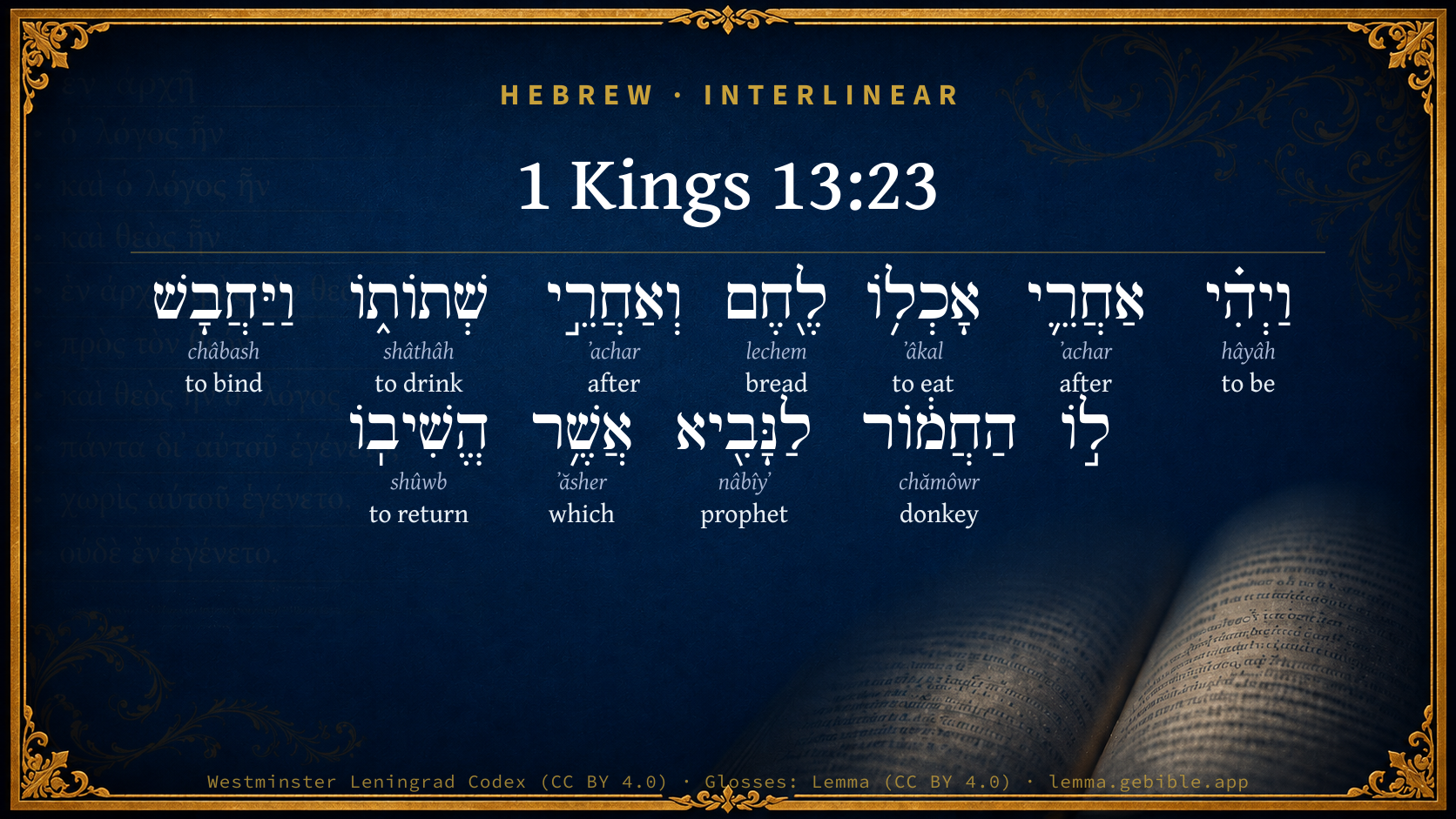
  1. וַיְהִ֗י hâyâh H1961 “and · to be” Conjunction + Verb, Qal, Sequential Imperfect, 3rd Person, Masculine, Singular
  2. אַחֲרֵ֛י ʼachar H310 “after” Preposition
  3. אָכְל֥וֹ ʼâkal H398 “to eat · him” Verb, Qal, Infinitive Construct + Suffix, Personal, 3rd Person, Masculine, Singular
  4. לֶ֖חֶם lechem H3899 “bread” Noun, Common, Both, Singular, Absolute
  5. וְאַחֲרֵ֣י ʼachar H310 “and · after” Conjunction + Preposition
  6. שְׁתוֹת֑וֹ shâthâh H8354 “to drink · him” Verb, Qal, Infinitive Construct + Suffix, Personal, 3rd Person, Masculine, Singular
  7. הַחֲמ֔וֹר chămôwr H2543 “the · donkey” Particle, Definite Article + Noun, Common, Both, Singular, Absolute
  8. לַנָּבִ֖יא nâbîyʼ H5030 “to/for the · prophet” Preposition, Determined + Noun, Common, Masculine, Singular, Absolute
  9. אֲשֶׁ֥ר ʼăsher H834 “which” Particle, Relative
  10. הֱשִׁיבֽוֹ shûwb H7725 “to return · him” Verb, Hiphil, Perfect, 3rd Person, Masculine, Singular + Suffix, Personal, 3rd Person, Masculine, Singular

About this verse

These counts appear in no published source. They are computed here, from the morphology-tagged text and Lemma’s own curated glosses. What Lemma adds →

12
words
10
distinct lemmas
Historical
section

Shared distinctive vocabulary

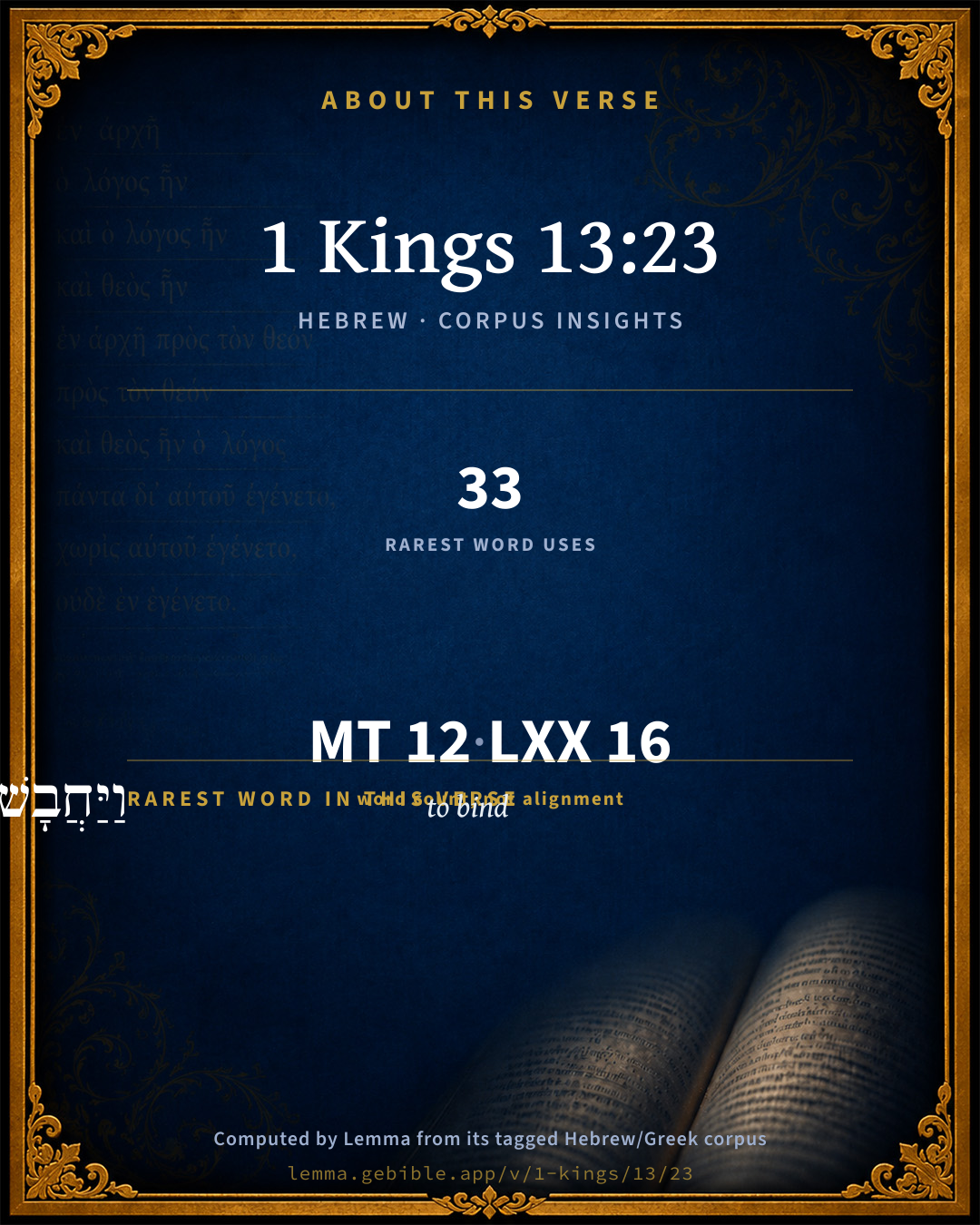
וַיַּחֲבָשׁ to bind H2280 occurs in 30 verses of the Hebrew Bible. Also found in:

Grammatical profile

  • 5 verbs
  • 3 nouns
  • 3 prepositions
  • 1 particle

Verb forms

  • וַיְהִ֗י Qal · Sequential Imperfect
  • אָכְל֥וֹ Qal · Infinitive Construct
  • שְׁתוֹת֑וֹ Qal · Infinitive Construct
  • וַיַּחֲבָשׁ Qal · Sequential Imperfect
  • הֱשִׁיבֽוֹ Hiphil · Perfect

Repetition

A word recurs within this verse — often emphatic in Hebrew:

  • אַחֲרֵ֛י after H310 ×2

Hebrew & Septuagint length

In English translation the verse runs 29 words from the Hebrew and 25 from the Septuagint (LXX English) — closely comparable.

A rough comparison of the two English renderings, which tokenize alike — not a word-level alignment.

Word counts can differ between the Hebrew and the Greek without any difference in meaning — e.g. the Hebrew direct-object marker אֵת has no separate Greek word, and Greek often adds the article ὁ.

In the original languages it is 12 Hebrew tokens and 16 Greek tokens — but the two are counted differently (Hebrew bundles its prefixes and suffixes into one token; the Greek is in lemma form), so that isn’t a like-for-like length.

Hebrew and Greek witnesses Masoretic Hebrew ↔ Greek Septuagint

The same verse in the two great witnesses to the Old Testament, shown verse-for-verse.

These are two independent witnesses, not word-aligned to each other, and the Septuagint is shown in lemma (dictionary) form.

Hebrew 1 Kings 13:23 Masoretic · Westminster Leningrad Codex

וַיְהִ֗י אַחֲרֵ֛י אָכְל֥וֹ לֶ֖חֶם וְאַחֲרֵ֣י שְׁתוֹת֑וֹ וַיַּחֲבָשׁ ל֣וֹ הַחֲמ֔וֹר לַנָּבִ֖יא אֲשֶׁ֥ר הֱשִׁיבֽוֹ

It happened, after he had eaten bread, and after he had drunk, that he saddled for him the donkey, [to wit], for the prophet whom he had brought back.

World English Bible · Public Domain

Greek LXX 1 Kings 13:23 Septuagint · lemma form

καί γίγνομαι μετά ὁ ἐσθίω ἄρτος καί πίνω ὕδωρ καί ἐπισάττω αὐτός ὁ ὄνος καί ἐπιστρέφω

And it came to pass after he had eaten bread and drunk water, that he saddled the ass for him, and he turned and departed.

LXX2012 (modern English Septuagint) · Public Domain

On this verse, The Cambridge Bible for Schools and Colleges discusses the Septuagint’s reading. Read the note in Commentary ↓

Hebrew: Westminster Leningrad Codex (CC BY 4.0). Greek: Septuagint (public domain); English from LXX2012 (modern English Septuagint) (Public Domain). How the Septuagint differs from the Hebrew →

Targum (Aramaic paraphrase)

1

The Targum is the ancient Jewish Aramaic paraphrase of the Hebrew Scriptures — an interpretive translation, not the Hebrew text itself. Onkelos (literal) and Pseudo-Jonathan (expansive) render the Torah, and Jonathan the Prophets. Coverage is partial: where no permissively-licensed English translation exists for a verse, only the Aramaic is shown. This is verse-level text, not a word-by-word alignment to the Hebrew.

  1. Targum Jonathan Prophets (Joshua–Malachi)
    וַהֲוָה בָּתַר דַאֲכַלוּ לַחְמָא וּבָתַר דִשְׁתִיאוּ וְזָרַז לֵיהּ חֲמָרָא לִנְבִיָא דַאֲתָבֵיהּ:

    (no public-domain English translation for this verse)

    Targum Jonathan — Aramaic: “Mikraot Gedolot” (public domain). English: “Sefaria Community Translation” (CC0 1.0 (public-domain dedication)); “London "Chaldee Paraphrase," 1871” (public domain). Text via Sefaria.

Commentary

Notes on 1 Kings 13:23 from classic Christian and Jewish commentators (each source and its license shown beneath its notes). The classic Christian expositions comment on the surrounding passage and are grouped to its opening verse, so a note may address several verses; the Jewish commentaries on the Tanakh (Rashi and others) are per-verse, so they appear only where the commentator wrote on this verse.

Lemma curates 59 commentaries, every one of them public domain or Creative Commons licensed, each selected and text-cleaned for this edition rather than reprinted as found. About our sources →

Matthew Henry's Commentary

Here is, I. The death of the deceived disobedient prophet. The old prophet that had deluded him, as if he would make him some amends for the wrong he had done him or help to prevent the mischief threatened him, furnished him with an ass to ride home on; but by the way a lion set upon him, and killed him, Kg1 13:23, Kg1 13:24. He did but return back to refresh himself when he was hungry, and behold he must die for it; see Sa1 14:43. But we must consider, 1. That his offence was great, and it would by no means justify him that he was drawn into it by a lie; he could not be so certain of the countermand sent by another as he was of the command given to himself, nor had he any ground to think that the command would be recalled, when the reason of it remained in force, which was that he might testify his detestation of the wickedness of that place. He had great reason to suspect the honesty of this old prophet, who did not himself bear his testimony, nor did God think fit to make use of him as a witness against the idolatry of the city he lived in. However, he should have taken time to beg direction from God, and not have complied so soon. Did he think this old prophet's house safer to eat in than other houses at Beth-el, when God had forbidden him to eat in any? That was to refine upon the command, and make himself wiser than God. Did he think to excuse himself that he was hungry? Had he never read that man lives not by bread alone? 2. That his death was for the glory of God; for by this it appeared, (1.) That nothing is more provoking to him than disobedience to an express command, though in a small matter, which makes his proceedings against our first parents, for eating the forbidden fruit, the easier to be accounted for. (2.) That God is displeased at the sins of his own people, and no man shall be protected in disobedience by the sanctity of his profession, the dignity of his office, his nearness to God, or any good services he has done for him. Perhaps God by this intended, in a way of righteous judgment, to harden Jeroboam's heart, since he was not reformed by the withering of his hand; for he would be apt to make a bad use of it, and to say that the prophet was well enough served for meddling with his altar, he had better have staid at home; any, he would say that Providence had punished him for his insolence, and the lion had done that which his withered hand might not do. However, by this God intended to warn all those whom he employs strictly to observe their orders, at their peril.

II. The wonderful preservation of his dead body, which was a token of God's mercy remembered in the midst of wrath. The lion that gently strangled him, or tore him, did not devour his dead body, nor so much as tear the ass, Kg1 13:24, Kg1 13:25, Kg1 13:26. Nay, what was more, he did not set upon the travellers that passed by and saw it, nor upon the old prophet (who had reason enough to fear it) when he came to take up the corpse. His commission was to kill the prophet; hitherto he should go, but no further. Thus God showed that, though he was angry with him, his anger was turned away, and the punishment went no further than death.

III. The care which the old prophet took of his burial. When he heard of this unusual accident, he concluded it was the man of God, who was disobedient to his Master (and whose fault was that?), therefore the Lord has delivered him to the lion, Kg1 13:26. It would well have become him to ask why the lion was not sent against him and his house, rather than against the good man whom he had cheated. He took up the corpse, Kg1 13:29. If there by any truth in the vulgar opinion, surely the corpse bled afresh when he touched it, for he was in effect the murderer, and it was but a poor reparation for the injury to inter the dead body. Perhaps when he cheated him into his ruin he intended to laugh at him; yet now his conscience so far relents that he weeps over him, and, like Joab at Abner's funeral, is compelled to be a mourner for him whom he had been the death of. They said, Alas! my brother, Kg1 13:30. The case was indeed very lamentable that so good a man, a prophet so faithful, and so bold in God's cause, should, for one offence, die as a criminal, while an old lying prophet lives at ease and an idolatrous prince in pomp and power. Thy way, O God! is in the sea, and thy path in the great waters. We cannot judge of men by their sufferings, nor of sins by their present punishments; with some the flesh is destroyed that the spirit may be saved, while with others the flesh is pampered that the soul may ripen for hell.

IV. The charge which the old prophet gave his sons concerning his own burial, that they should be sure to bury him in the same grave where the man of God was buried (Kg1 13:3): "Lay my bones beside his bones, close by them, as near as may be, so that my dust may mingle with his." Though he was a lying prophet, yet he desired to die the death of a true prophet. "Gather not my soul with the sinners of Beth-el, but with the man of God." The reason he gives is because what he cried against the altar of Beth-el, that men's bones should be burnt upon it, shall surely come to pass, Kg1 13:32. Thus, 1. He ratifies the prediction, that out of the mouth of two witnesses (and one of them such a one as St. Paul quotes, Tit 1:12, one of themselves, even a prophet of their own) the word might be established, if possible to convince and reclaim Jeroboam. 2. He does honour to the deceased prophet, as one whose word would not fall to the ground, though he did. Ministers die, die prematurely it may be; but the word of the Lord endures for ever, and does not die with them. 3. He consults his own interest. It was foretold that men's bones should be burnt upon Jeroboam's altar: "Lay mine (says he) close to his, and then they will not be disturbed;" and it was, accordingly, their security, as we find, Kg2 23:18. Sleeping and waking, living and dying, it is safe being in good company. No mention is made here of the inscription on the prophet's tomb; but it is spoken of Kg2 23:17, where Josiah asks, What title is that? and is told, It is the sepulchre of the man of God that came from Judah, who proclaimed these things which thou hast done; so that the epitaph upon the prophet's grave preserved the remembrance of his prophecy, and was a standing testimony against the idolatries of Beth-el, which it would not have been so remarkably if he had died and been buried elsewhere. The cities of Israel are here called cities of Samaria, though that name was not yet known; for, however the old prophet spoke, the inspired historian wrote in the language of his own time.

V. The obstinacy of Jeroboam in his idolatry (Kg1 13:33): He returned not from his evil way; some hand was found that durst repair the altar God had rent, and then Jeroboam offered sacrifice on it again, and the more boldly because the prophet who disturbed him before was in his grave (Rev 11:10) and because the prophecy was for a great while to come. Various methods had been used to reclaim him, but neither threats nor signs, neither judgments nor mercies, wrought upon him, so strangely was he wedded to his calves. He did not reform, no, not his priesthood, but whoever would, he filled his hand, and made him priest, though ever so illiterate or immoral, and of what tribe soever; and this became sin, that is, a snare first, and then a ruin, to Jeroboam's house, to cut if off, Kg1 13:34. Note, The diminution, disquiet, and desolation of families, are the fruit of sin; he promised himself that the calves would secure the crown to his family, but it proved they lost it, and sunk his family. Those betray themselves that think by any sin to support themselves.

Matthew Henry's Commentary on the Whole Bible (1708–1710) — public domain (CC PDM 1.0). Text via the HelloAO Bible API.

Trapp's Complete Commentary

John Trapp

1Ki 13:23 And it came to pass, after he had eaten bread, and after he had drunk, that he saddled for him the ass, [to wit], for the prophet whom he had brought back.

Ver. 23. That he saddled for him the ass.] So courteous he was and officious now to him; whom before he had betrayed into the hands of divine justice: so thinking to make him some amends. But why did he not go back with him, whom he had fetched back? Surely for fear he should taste of the same whip with him. Thus the mischievous guides of wickedness leave a man when they have led him to his bane; as familiar devils forsake their witches, when they have brought them once into fetters. {a}

{a} Dr Hall.

John Trapp, A Commentary or Exposition upon All the Books of the Old and New Testament (1647–1656) — public domain. Text from a community e-Sword module.

Joseph Benson's Commentary

1Ki 13:23-24. He saddled for him the ass — But it is observable, he does not accompany him: his guilty conscience making him fear to be involved in the same judgment with him. A lion met him by the way, and slew him — There was a wood not far from Bethel, out of which the two she-bears came, mentioned 2Ki 2:24; and, it is not unlikely, that out of the same wood came the lion that slew this prophet. His carcass was cast in the way — His dead body fell to the ground, and lay in the place where the soul left it. The lion also stood by the carcass — Which plainly showed that he was sent by God to execute only what God had threatened, and not to move one step beyond that commission, otherwise, agreeable to his nature and fierceness, he would certainly have devoured the carcass and torn the ass. “Some have thought,” says Dr. Dodd, “that this prophet’s was a small offence to have met with so severe a punishment: but the true state of the case is this: the prophet from Judah had sufficient evidence of the truth of his own revelation; had sufficient cause to suspect some corrupt ends in the prophet who came to recall him; and had sufficient reason to expect, an interposition of the same power that gave him the injunction to repeal it; and, therefore, his crime was an easy credulity, a complying with an offer merely to gratify a petulant appetite, which he knew was repugnant to a divine command. It argued a great levity, if not infidelity, of his own revelation, to listen to the pretended one of another man.” It must be acknowledged, however, to be strange, that the lying prophet should escape, while he, who, notwithstanding this error, was truly a man of God, is so severely punished. But judgment must begin at the house of God: God must correct his own children first. And there is a judgment to come, when these things shall be called over again, and when those who sinned most and suffered least in this world, will receive according to their works. This punishment of the prophet was a very striking admonition to Jeroboam of what he might expect, since God spared not a less guilty offender. And we may all learn from God’s severity, in this instance, 1st, Not to suffer our faith to be perverted by any suggestions made against a revelation of uncontested divine authority; and, 2d, Always to pay a strict regard and obedience to all the known commands of God.

Joseph Benson's Commentary on the Old and New Testaments (1811–1818) — public domain. Text from a community e-Sword module.

Tyndale Open Study Notes

Tyndale Open Resources

13:23-26 The donkey did not run away and the lion did not eat the man’s body, a supernatural event. The old prophet immediately understood that God had clearly fulfilled his word (13:21-22) by judging disobedience.

Tyndale Open Study Notes — © Tyndale Open Resources, licensed CC BY-SA 4.0. Text via the HelloAO Bible API.

The Cambridge Bible for Schools and Colleges

gen. ed. J. J. S. Perowne

23–32. The prophet of Judah is slain. He is buried, and his words confirmed, by the old prophet (Not in Chronicles)

23. he saddled for him the ass] There has been no mention before of an ass belonging to the prophet of Judah, but as travelling was ordinarily performed in this way, we may suppose that he had ridden from Jerusalem, and had been riding back. Instead of the concluding words of this verse ‘to wit, for &c. the LXX. has ‘and he turned and went away.’

Because the word ‘prophet’ נביא is not used elsewhere in the story for the Judæan prophet, who is always called ‘a man of God,’ some have rendered the last part of this verse ‘he saddled for him the ass, the ass belonging to the prophet who had brought him back.’ But it seems far more natural to take the לו = for him, as in close relation to the לנביא = for the prophet, as they are both introduced by the same preposition.

The Cambridge Bible for Schools and Colleges (gen. ed. J. J. S. Perowne; Cambridge University Press, 1878–1918) — public domain. Text from a community e-Sword module.

John Gill's Exposition

And, behold, men passed by,.... Travellers on the road; nor did the lion offer to seize on them, nor desert the carcass upon their approach:

and saw the carcass cast in the way, and the lion standing by the carcass; as before described:

and they came and told it in the city where the old prophet dwelt; which was Bethel, by which means he came to have knowledge of it.

John Gill's Exposition of the Whole Bible (1746–1763) — public domain (CC PDM 1.0). Text via the HelloAO Bible API.

Haydock's Catholic Bible Commentary

For. Some Latin manuscripts read propheta, as if the prophet saddled his own ass. But he probably came on foot, and the man of Bethel lent him one. (Calmet)

George Leo Haydock (1774–1849), Haydock's Catholic Family Bible and Commentary, 1859 edition — public domain. Excludes Psalms (Douay-Rheims chapter numbering differs from Protestant) and Deuterocanonical books (Catholic canon only).

Matthew Poole's English Annotations

That he might sooner come to his home, and, if possible, escape the judgment threatened. But it is observable, he doth not accompany him; his guilty conscience making him to expect and fear to be involved in the same judgment with him.

Matthew Poole's English Annotations on the Holy Bible (1683–1685) — public domain. Text from a community e-Sword/MySword module.

Whedon's Commentary on the Bible

Daniel D. Whedon

23. To wit, for the prophet whom he had brought back — Here is a mistake of our translators. לנביא is not in apposition with לו, but is rather used in the sense of a genitive of possession. The verse should be translated thus: He (the man of God from Judah) saddled for himself the ass of the prophet who had brought him back. It seems that the man of God from Judah had no beast at all, but had pursued all his journey thus far on foot. Now, however, a fearful sense of coming judgment comes over his spirit, and, unhindered, he takes the ass belonging to the old prophet who had been instrumental in his ruin, and sets out to meet his fate.

Daniel D. Whedon (gen. ed.), Commentary on the Old and New Testaments (1874–1909) — public domain. Text from a community e-Sword module.

The Pulpit Commentary

And it came to pass, after he had eaten bread, and after he had drunk, that he saddled i.e. , the prophet of Bethel; the "man of God" would seem to have come on foot. See below for him the ass, to wit, for the prophet whom he had brought back. This translation is inadmissible. For not only is the term "prophet" throughout this narrative restricted to the prophet of Bethel (the prophet of Judah being always spoken of as "the man of God,") but the expression here used h a aybiNh is also twice used (vers. 20, 26) of the same prophet. He is characterized there, that is to say, as "the prophet which brought him back;" it is hardly likely, therefore, that the same words are here to be interpreted, "the prophet whom he brought back." The mistake has arisen from the proximity of wOl ("for him") to aYbiNl ("to" or "for the prophet"). But the wOlis here indicative of possession (the dative of the possessor), as in 1Sa_14:16, "the watchmen to," i.e., of, "Saul," and 1Sa_16:18, "a son to Jesse" (cf. Gen_14:18 Heb.; 1Ki 5:28 Heb.; Rth_2:3 Heb.) We must therefore render "He (the old prophet, but this is not absolutely certain; the "man of God" may be understood) saddled for him (the man of God) the ass of the prophet which brought him back." The man of God had been delayed by his return to Bethel, and the prophet, out of pity, lends or gives him his ass. Not merely, it is probable, for the sake of speeding him on his way, but that he might have some living thing with him on a journey which he had so much cause to dread.

Vers. 23-34.

Judgment and its result.

I MERCY DISPLAYED IN THE MIDST OF JUDGMENT. The sin may have been forgiven though the chastisement fell.

1. His body was preserved from dishonour. The lion"s ferocity was bridled; the prophet"s body was neither eaten nor torn; he guarded the remains from the fowls of the air and the beasts of the field.

(1) Though God chastises His erring people, He will not utterly cast them away.

(2) The fiercest instruments of His vengeance can go only so far as He permits them.

1. The message he had borne received added weight by his punishment. In his humiliation God was exalted. The circumstances showed that the blow was from the hand of God, and the question was no doubt raised in many a heart, if the Lord has so punished His servant"s error, what will Israel"s judgment be?

2. He still preached in his grave. He was buried near the altar, and over his tomb was graven the story of his mission and his fate. (2Ki_23:17)

II THE PUNISHMENT OF UNFAITHFULNESS. When all has been said that can be of the attendant mercy, the judgment still stands out in terribleness. The prophet still preached, but the cry came up from the dark pathway of death. Its place was not among the vessels of mercy, but among the vessels of wrath. If we eat in idolatrous Bethel, even though it be in ignorance, God"s hand will find us. He punishes now in spiritual leanness, and that again leads to deeper judgment; in the falling away of our children into indifference and worldliness and sin, and will not God demand their blood at our hand? God will have perfect compliance in regard to the conduct of His own worship; He demands "a pure offering." Are we making His word our only law? Whose altar are we serving, Jehovah"s or Jeroboam"s?

III BETHEL"S ANSWER TO GOD"S WARNINGS.

1. The prophet"s fear.

(1) He owned God"s servant. He cared for his body, mourned over him with the cry, "Alas my brother!" placed him in his own tomb and had his own bones laid beside those of the man of God.

(2) He lifted up again God"s testimony (ver. 32). The beginning of a better thing in Bethel is ever after this fashion: the honouring God"s servants, cleaving to them, and continuing their work.

2. The king"s unconcern. We are not told that he did anything worse than he had done before; he simply returned not from his evil way." And this became sin to his house, to cut it off and to destroy it, etc. To bring upon ourselves God"s judgments we need do no more than turn a deaf ear to His warnings. J.U.

The Pulpit Commentary (1880–1919), ed. H.D.M. Spence-Jones & Joseph S. Exell — public domain. Text from a community e-Sword module.

John Wesley's Explanatory Notes

Saddled for him - But, it is observable, he doth not accompany him; his guilty conscience making him fear to be involved in the same judgment with him.

John Wesley, Explanatory Notes Upon the Whole Bible (1754–1765) — public domain. Text via the GEBible commentary corpus.

Keil & Delitzsch

C. F. Keil & F. Delitzsch

After he had eaten he saddled the ass for him, i.e., for the prophet whom he had fetched back, and the latter (the prophet from Judah) departed upon it. On the road a lion met him and slew him; "and his corpse was cast in the road, but the ass stood by it, and the lion stood by the corpse." The lion, contrary to its nature, had neither consumed the prophet whom it had slain, nor torn in pieces and devoured the ass upon which he rode, but had remained standing by the corpse and by the ass, that the slaying of the prophet might not be regarded as a misfortune that had befallen him by accident, but that the hand of the Lord might be manifest therein, so that passers-by saw this marvel and related it in Bethel.

Keil & Delitzsch — Biblical Commentary on the Old Testament (1861–1891) — public domain (CC PDM 1.0). Text via the HelloAO Bible API. (Old Testament only.)

unfoldingWord translationNotes

Door43 World Missions Community

the prophet saddled the donkey

This means he placed a seat on the back of the donkey so the man of God could ride on it. See how you translated this in 1 Kings 13:13.

his body was left on the road

This can be stated in active form. AT: "left his body on the road" (See: Active or Passive)

his body

"his dead body"

they came and told it

Here "it" refers to what they had seen on the road. AT: "they came and told about what they had seen"

translationWords

donkey

God

lions

life

unfoldingWord translationNotes — © Distant Shores Media and the Door43 World Missions Community, licensed CC BY-SA 4.0. Source: git.door43.org/Door43/en_tn.

Rashi

Rabbi Shlomo Yitzchaki (Rashi)

For the prophet that he brought back. Whom this one [had brought] there, for the man of God to ride upon.

Rashi on the Tanakh — English translations: “The Judaica Press complete Tanach with Rashi, translated by A. J. Rosenberg” (CC BY 4.0); “Pentateuch with Rashi's commentary by M. Rosenbaum and A.M. Silbermann, 1929-1934” (public domain); “The Metsudah Tanach series, Lakewood, N.J” (CC BY 4.0); and “The Book of Joshua, Metsudah Publications, 1997” (CC BY 4.0). Text via Sefaria.

Lesson kit

Teaching starters — assembled from the data on this page, not authored interpretation. Every prompt links to the verse data it draws on. Edit before teaching.

1 Kings, in the Historical, opens this verse with 12 words (10 distinct Hebrew lemmas). Its most distinctive word is châbash (“to bind”). A historical commentator’s framing appears above. Read the whole chapter for the surrounding context.

Discussion questions

  1. The word châbash carries the sense “to bind.” How does it shape the verse?
  2. Genesis 22:3 shares the word «to bind» with this verse. How do the two illuminate each other?
  3. “after” occurs 2× in this one verse. What is the effect of the repetition?
  4. The translations on this page render this verse differently — a whole-verse word diff, not a word-by-word alignment. What might account for the different wordings?
  5. The verb «וַיְהִ֗י» is Qal Sequential Imperfect. How does its form color the action?
  6. Reading how Matthew Henry's Commentary and Trapp's Complete Commentary read this verse, where do the two commentators agree and where do they part?

Things to notice

Reading settings

Reading text

Shown beneath each verse's original-language words.

Old Testament
Old Testament edition

Read the OT as the Masoretic Hebrew (MT) or the Greek Septuagint (LXX).

English shown for the Greek Septuagint (in the Hebrew ↔ Greek comparison).

Comparing translations? Open the Compare panel on any verse page to stack up to four side by side.