Psalms 78:20

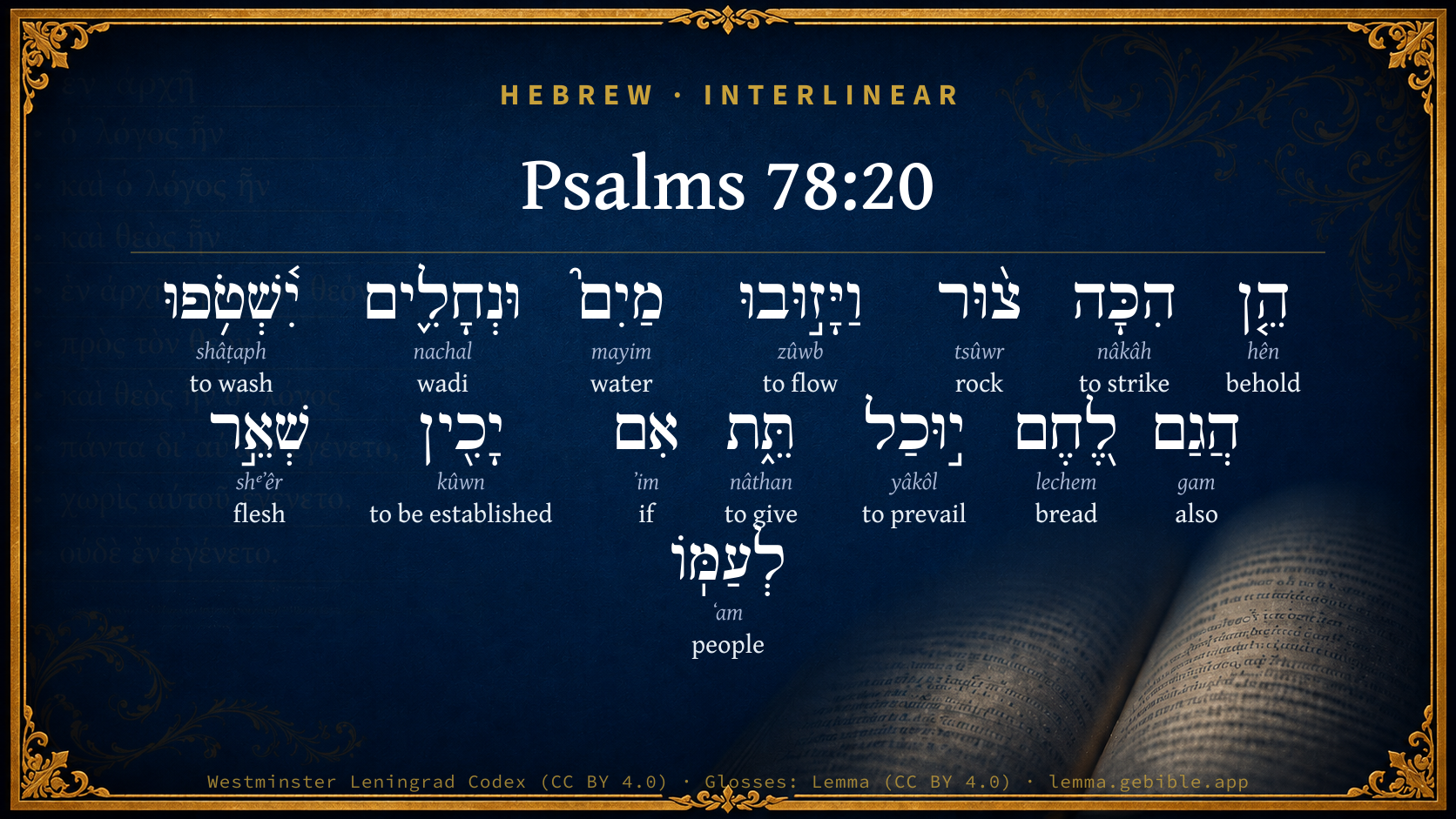
Hebrew (Westminster Leningrad Codex) Psalms 78:20 appears in the Hebrew Old Testament. The text above is from the Westminster Leningrad Codex. Each word links to its Strong’s number, a concise gloss, and parsing drawn from the Open Scriptures Hebrew Bible morphology. Click any word for its full Brown-Driver-Briggs (BDB) entry.
Download image
Cite this verse

Psalms 78:20 (World English Bible). Public Domain. Lemma interlinear Bible study tool, https://lemma.gebible.app/v/psalms/78/20.

Show BibTeX & RIS
BibTeX
RIS
English Translation
Behold, he struck the rock, so that waters gushed out, Streams overflowed. Can he give bread also? Will he provide flesh for his people?"
World English Bible · Public Domain
Download a study sheet

One document with this verse’s original text, its word-by-word gloss line, the meaning frame, cross-references with their text, attributed commentary, and full source and license credits — printable, and it pastes into notes with its structure intact.

This verse Autodidact and up

Study sheet (.html) Plain text (.txt)

A passage Seminary Student

Up to 50 verses in one chapter. A passage sheet keeps up to 6 commentary sources and 12 cross-references per verse, in the order this page ranks them, and says so on the sheet whenever that leaves anything out. Ask for a single verse and you get the Autodidact verse sheet above.

Everything on this page stays free to read, with no account — the sheet is a download of what is already on screen, not access to it.

Want to remove ads? Support Godless Engineer
Compare translations 3

The same verse in 3 English versions, stacked beneath the original-language interlinear above. Click any original word for its lexicon entry.

Each is an independent rendering of the whole verse — the interlinear is not word-aligned to these translations.

Highlighted words mark where these versions differ — a whole-verse word diff, not a word-by-word alignment.

  • World English Bible Public Domain
    Behold, he struck the rock, so that waters gushed out, Streams overflowed. Can he give bread also? Will he provide flesh for his people?"
  • King James Version Public Domain
    Behold, he smote the rock, that the waters gushed out, and the streams overflowed; can he give bread also? can he provide flesh for his people?
  • unfoldingWord Literal Text CC BY-SA 4.0
    Behold, he struck the rock and waters gushed out and streams overflowed. Is he able to give bread also? Or can he provide meat for his people?”

unfoldingWord Literal Text — © unfoldingWord, licensed CC BY-SA 4.0. Word-aligned USFM3 via Door43 (git.door43.org/unfoldingWord/en_ult).

Versions to compare (up to 4)

3 of 4 selected

Show all 18 translations

Every available English version of this verse, each an independent rendering of the whole verse.

  • World English Bible Public Domain
    Behold, he struck the rock, so that waters gushed out, Streams overflowed. Can he give bread also? Will he provide flesh for his people?"
  • Berean Standard Bible Public Domain
    When He struck the rock, water gushed out and torrents raged. But can He also give bread or supply His people with meat?”
  • Majority Standard Bible Public Domain
    When He struck the rock, water gushed out and torrents raged. But can He also give bread or supply His people with meat?”
  • King James Version Public Domain
    Behold, he smote the rock, that the waters gushed out, and the streams overflowed; can he give bread also? can he provide flesh for his people?
  • American Standard Version (1901) Public Domain
    Behold, he smote the rock, so that waters gushed out, And streams overflowed; Can he give bread also? Will he provide flesh for his people?
  • Revised Version (1885) Public Domain
    Behold, he smote the rock, that waters gushed out, and streams overflowed; can he give bread also? will he provide flesh for his people?
  • Geneva Bible (1599) Public Domain
    Behold, he smote the rocke, that the water gushed out, and the streames ouerflowed: can hee giue bread also? or prepare flesh for his people?
  • Douay-Rheims (1899) Public Domain
    Because he struck the rock, and the waters gushed out, and the streams overflowed. Can he also give bread, or provide a table for his people?
  • Young's Literal Translation Public Domain
    Lo, He hath smitten a rock, And waters flow, yea, streams overflow. `Also -- bread `is' He able to give? Doth He prepare flesh for His people?'
  • Literal Standard Version CC BY-SA 4.0
    Behold, He has struck a rock, || And waters flow, indeed, streams overflow. “Also, [is] He able to give bread? Does He prepare flesh for His people?”
  • Unlocked Literal Bible CC BY-SA 4.0
    See, when he struck the rock, waters gushed out and streams overflowed. But can he give bread also? Will he provide meat for his people?”
  • unfoldingWord Literal Text CC BY-SA 4.0
    Behold, he struck the rock and waters gushed out and streams overflowed. Is he able to give bread also? Or can he provide meat for his people?”
  • Darby Bible Public Domain
    Behold, he smote the rock, and waters gushed out, and streams overflowed; is he able to give bread also, or provide flesh for his people?
  • World Messianic Bible Public Domain
    Behold, he struck the rock, so that waters gushed out, and streams overflowed. Can he give bread also? Will he provide meat for his people?”
  • Webster's Bible Public Domain
    Behold, he smote the rock, that the waters gushed out, and the streams overflowed; can he give bread also? can he provide flesh for his people?
  • Free Bible Version CC BY-SA 4.0
    Yes, he can strike a rock so that water gushes out like flowing rivers, but can he give us bread? Can he supply his people with meat?”
  • Bible in Basic English Public Domain
    See, the rock was cut open by his power, so that the water came rushing out, and overflowing streams; is he able to give us bread? is he able to get meat for his people?
  • JPS Tanakh (1917) Public Domain
    Behold, He smote the rock, that waters gushed out, and streams overflowed; can He give bread also? or will He provide flesh for His people?'

Literal Standard Version (2020), Covenant Press — licensed CC BY-SA 4.0. Text via the HelloAO Bible API (eBible.org). Unlocked Literal Bible (unfoldingWord) — licensed CC BY-SA 4.0. Text via the HelloAO Bible API (eBible.org). unfoldingWord Literal Text — © unfoldingWord, licensed CC BY-SA 4.0. Word-aligned USFM3 via Door43 (git.door43.org/unfoldingWord/en_ult). Free Bible Version, Dr. Jonathan Gallagher — licensed CC BY-SA 4.0. Text via the HelloAO Bible API (eBible.org).

Word by word

More ways to search: Search by grammar → Find every occurrence → Compare this word →

Practice this passage: Drill this verse → Learn its vocabulary →

שְׁאֵ֣ר
shᵉʼêr
H7607
“flesh”
Noun, Common, Masculine, Singular, Absolute
Part of Speech
Noun
Type
Common
Gender
Masculine
Number
Singular
State
Absolute
Full BDB Definition

Origin: from H7604

TWOT: 2308a

flesh, food, body, near kin, near kinswoman - flesh - as food - for physical power (figuratively) - flesh relation, blood relation - self
  1. הֵ֤ן hên H2005 “behold” Particle, Demonstrative
  2. הִכָּה nâkâh H5221 “to strike” Verb, Hiphil, Perfect, 3rd Person, Masculine, Singular
  3. צ֨וּר tsûwr H6697 “rock” Noun, Common, Masculine, Singular, Absolute
  4. וַיָּז֣וּבוּ zûwb H2100 “and · to flow” Conjunction + Verb, Qal, Sequential Imperfect, 3rd Person, Masculine, Plural
  5. מַיִם֮ mayim H4325 “water(s)” Noun, Common, Masculine, Plural, Absolute
  6. וּנְחָלִ֪ים nachal H5158 “and · wadis” Conjunction + Noun, Common, Masculine, Plural, Absolute
  7. יִ֫שְׁטֹ֥פוּ shâṭaph H7857 “to wash” Verb, Qal, Imperfect, 3rd Person, Masculine, Plural
  8. הֲגַם gam H1571 “also” Particle, Interrogative + Adverb
  9. לֶ֭חֶם lechem H3899 “bread” Noun, Common, Both, Singular, Absolute
  10. י֣וּכַל yâkôl H3201 “to prevail” Verb, Qal, Imperfect, 3rd Person, Masculine, Singular
  11. תֵּ֑ת nâthan H5414 “to give” Verb, Qal, Infinitive Construct
  12. אִם ʼim H518 “if” Conjunction
  13. יָכִ֖ין kûwn H3559 “to be established” Verb, Hiphil, Imperfect, 3rd Person, Masculine, Singular
  14. לְעַמּֽוֹ ʻam H5971 “to/for · people · his” Preposition + Noun, Common, Masculine, Singular, Construct + Suffix, Personal, 3rd Person, Masculine, Singular

About this verse

These counts appear in no published source. They are computed here, from the morphology-tagged text and Lemma’s own curated glosses. What Lemma adds →

15
words
15
distinct lemmas
Wisdom
section

Notable vocabulary

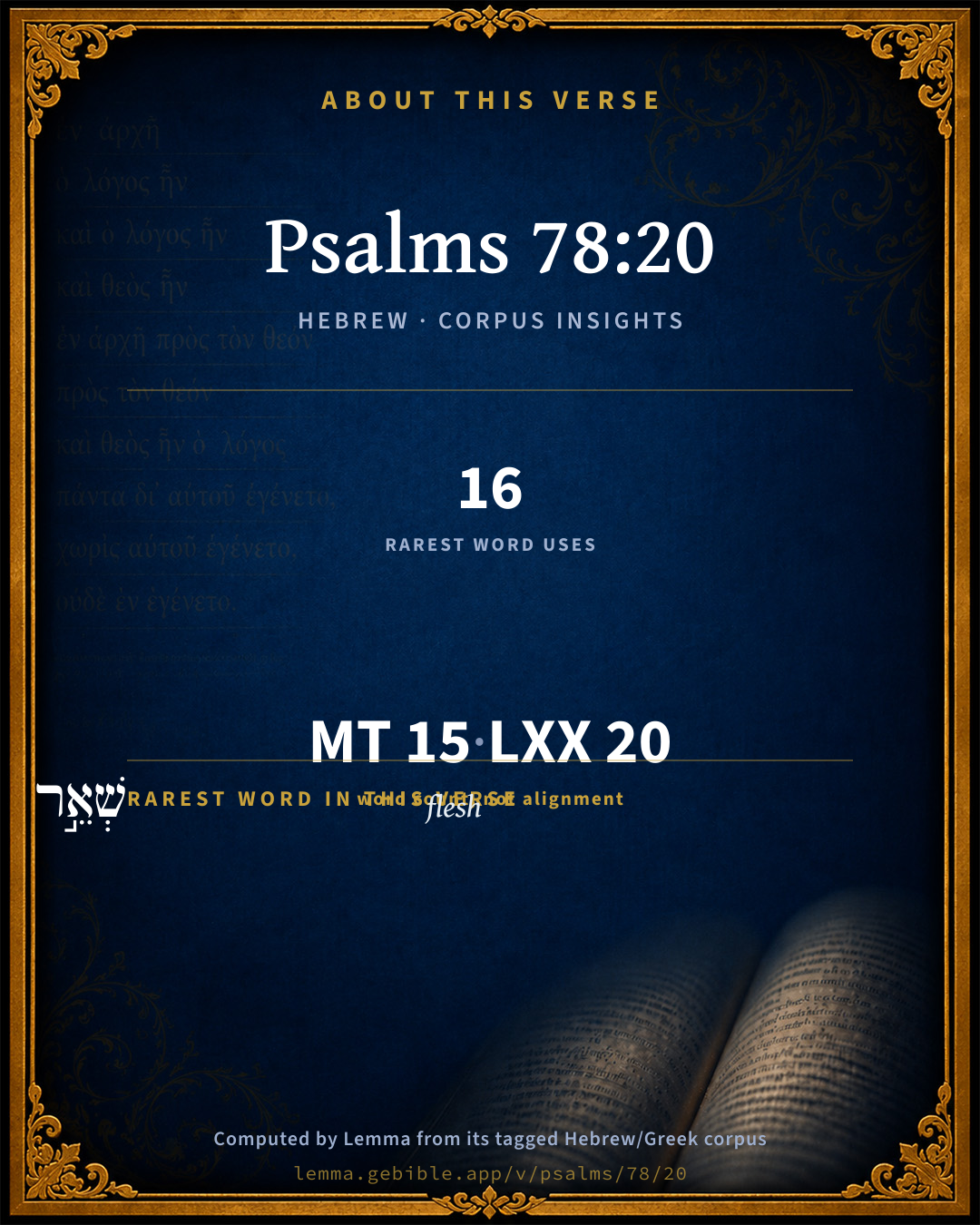
The rarest word here is שְׁאֵ֣ר flesh H7607 — appearing just 16 times in the whole Hebrew Bible.

Shared distinctive vocabulary

שְׁאֵ֣ר flesh H7607 occurs in 16 verses of the Hebrew Bible. Also found in:

Grammatical profile

  • 6 verbs
  • 6 nouns
  • 1 conjunction
  • 1 adverb
  • 1 particle

Verb forms

  • הִכָּה Hiphil · Perfect
  • וַיָּז֣וּבוּ Qal · Sequential Imperfect
  • יִ֫שְׁטֹ֥פוּ Qal · Imperfect
  • י֣וּכַל Qal · Imperfect
  • תֵּ֑ת Qal · Infinitive Construct
  • יָכִ֖ין Hiphil · Imperfect

Hebrew & Septuagint length

In English translation the verse runs 24 words from the Hebrew and 30 from the Septuagint (LXX English) — closely comparable.

A rough comparison of the two English renderings, which tokenize alike — not a word-level alignment.

Word counts can differ between the Hebrew and the Greek without any difference in meaning — e.g. the Hebrew direct-object marker אֵת has no separate Greek word, and Greek often adds the article ὁ.

In the original languages it is 15 Hebrew tokens and 20 Greek tokens — but the two are counted differently (Hebrew bundles its prefixes and suffixes into one token; the Greek is in lemma form), so that isn’t a like-for-like length.

Cross-references

6

Topical passages linked to Psalms 78:20 in the Treasury of Scripture Knowledge — connected by theme and wording, ordered by reader-vote popularity; previews shown in the World English Bible.

  • Numbers 20:11 Moses lifted up his hand, and struck the rock with his rod twice: and water came forth abundantly, and the congregation drank, and their cattle.
  • Numbers 11:21–23 Moses said, The people, among whom I am, are six hundred thousand footmen; and you have said, I will give them flesh, that they may eat a whole month.
  • Genesis 18:12–14 Sarah laughed within herself, saying, "After I have grown old will I have pleasure, my lord being old also?"
  • Psalms 78:41 They turned again and tempted God, And provoked the Holy One of Israel.
  • Exodus 17:6–7 Behold, I will stand before you there on the rock in Horeb. You shall strike the rock, and water will come out of it, that the people may drink." Moses did so in the sight of the elders of Israel.
  • Numbers 11:18 Say you to the people, Sanctify yourselves against tomorrow, and you shall eat flesh; for you have wept in the ears of Yahweh, saying, Who shall give us flesh to eat? for it was well with us in Egypt: therefore Yahweh will give you flesh, and you shall eat.

Cross-references courtesy of OpenBible.info (CC BY 4.0).

Hebrew and Greek witnesses Masoretic Hebrew ↔ Greek Septuagint

The same verse in the two great witnesses to the Old Testament, shown verse-for-verse.

You’re reading Greek Psalm 77 (Hebrew Psalm 78). The Septuagint counts the superscription, so verse numbers can differ from the Hebrew — chapter-level alignment, not verse-by-verse. Numbering follows Rahlfs.

These are two independent witnesses, not word-aligned to each other, and the Septuagint is shown in lemma (dictionary) form.

Hebrew Psalms 78:20 Masoretic · Westminster Leningrad Codex

הֵ֤ן הִכָּה צ֨וּר וַיָּז֣וּבוּ מַיִם֮ וּנְחָלִ֪ים יִ֫שְׁטֹ֥פוּ הֲגַם לֶ֭חֶם י֣וּכַל תֵּ֑ת אִם יָכִ֖ין שְׁאֵ֣ר לְעַמּֽוֹ

Behold, he struck the rock, so that waters gushed out, Streams overflowed. Can he give bread also? Will he provide flesh for his people?"

World English Bible · Public Domain

Greek LXX Greek Psalm 77:20 Septuagint · lemma form

ἐπεί πατάσσω πέτρα καί ῥέω ὕδωρ καί χειμάρρους κατακλύζω μή καί ἄρτος δύναμαι δίδωμι ἤ ἑτοιμάζω τράπεζα ὁ λαός αὐτός

Forasmuch as he struck the rock, and the waters flowed, and the torrents ran abundantly; will he be able also to give bread, or prepare a table for his people?

LXX2012 (modern English Septuagint) · Public Domain

Hebrew: Westminster Leningrad Codex (CC BY 4.0). Greek: Septuagint (public domain); English from LXX2012 (modern English Septuagint) (Public Domain). How the Septuagint differs from the Hebrew →

Commentary

Notes on Psalms 78:20 from classic Christian and Jewish commentators (each source and its license shown beneath its notes). The classic Christian expositions comment on the surrounding passage and are grouped to its opening verse, so a note may address several verses; the Jewish commentaries on the Tanakh (Rashi and others) are per-verse, so they appear only where the commentator wrote on this verse.

Lemma curates 59 commentaries, every one of them public domain or Creative Commons licensed, each selected and text-cleaned for this edition rather than reprinted as found. About our sources →

Trapp's Complete Commentary

John Trapp

Psa 78:20 Behold, he smote the rock, that the waters gushed out, and the streams overflowed; can he give bread also? can he provide flesh for his people?

Ver. 20. Behold, he smote the rock, &c.] And so showed his power; we cannot deny it; but now for his will.

Can he give bread also?] They should have said, Will he serve our lusts? but that they were ashamed to say.

Can he provide flesh for his people?] i.e. Dainty and delicate flesh, such as is that of quails, meat for a king; for they carried their cattle out of Egypt with them; and so they could not be without ordinary flesh, too good for such unthankful miscreants.

John Trapp, A Commentary or Exposition upon All the Books of the Old and New Testament (1647–1656) — public domain. Text from a community e-Sword module.

The Biblical Illustrator

Joseph S. Exell

Psa_78:20

Can He give bread also?

can He provide flesh for His people?

The cry of unbelief and presumption

I. The cry of unbelief. The question presupposes a negative; they practically said, We do not believe that He can do any more than He has done. The whole nation missed the meaning of history, and thus lacked all stimulus to hope and confidence. How often that is the case! It is most important that our children should learn history, and learn it as those grand inspired historians of the Old Testament wrote it, and as the father of each Jewish family taught it. They should learn not to see a human Colossus, astride all time, but to see God in every great development of history, in every change and every transition, and thus working out His purposes in all. What we need is simplicity of trust in God. God delivers just at a time when man cannot deliver himself. When, therefore, you are brought to trouble, look in the one direction where there is deliverance. You will never find God to fail you; and when once you have been delivered, do not forget it.

II. The cry of presumption. Why should they dictate to God what He was to do? Why should they stake the honour of God upon the mere coincidence whether He thought the same as they did or not?--that is, whether He considered that the best thing that could happen to them was that they should have an abundant supply of bread and meat, and taste of the flavour of the old flesh-pots of Egypt for which they longed? In connection with this, read Exo_13:17-18. Oh, how many of us are like them! We seem to presume upon what God has already done. I have heard many a man say before now, I was born in a good family, and here are poor people, who were born in cots, getting on, while of late I have had nothing but disappointments and losses. I do not see why the Lord should permit all this. What would you have the Lord do? Is there any special reason why you should be free from all trouble? Why, some men have trouble from their cradles to the grave. God never made a special arrangement with your parents that you should go through your life without any anxiety, or sorrow, or disappointment. If He had, I am afraid it would have been the greatest curse you could have had in your life. God never sends sorrow to any of us more than we need. It is not only wrong, but also foolish, to dictate to God what He shall do with us. Leave it to Him. If many prayers we uttered in bygone days were but written up to-day on a tablet, we should each say, Ah, me, I must have been mad when I uttered that prayer. If God had granted me that, it would have been my ruin. He did not grant it, and I was disappointed; but now I see that was the greatest mercy He has ever shown me. (D. Davies.)

Can He provide flesh for His people?

This is an instance of mans attitude towards God in the presence of miracles. Miracles have either marked distinct starting-points in the history of revelation, or have been given as Divine adaptations to the peculiar needs of the people to whom they were granted. They have been necessary as special proofs, but not as continuous manifestations.

1. This is an instance of the misuse man can make of a glorious history. The first part of the verse seems to prepare us for something sublime. Could a people who could relate such a history, who could record such facts of Divine intervention as these, finish up with anything but a hallelujah of praise? And yet these people who had a great history, and a history in which Gods power ever flashed forth in deeds of exceptional love, missed the meaning of all, were caught by the splendour, and only sufficiently caught by the splendour to yearn for other manifestations still more startling, and more gratifying to their animal passions. The love and patience of God revealed in the miraculous provisions of the past were lost upon them.

2. Thus, too, this is an instance of the misuse men can make of miracles. This was not peculiar to the ancient people. Look at the New Testament. There is one striking instance in Joh_11:37. Thus these words, in common with the words of our text, reveal another fact.

3. That miracles thus misused by men not only failed to satisfy, or to ennoble their hearts, but also that they made men more exacting in their demands and more shameless in their requests.

4. Thus God, in dealing with men, has given miracles to convince them of His power only as the occasion demanded, and as the nature of the revelation which He gave required. He has never given miracles of which there has not been supreme need. There has been a Divine economy in miracles throughout the ages. It was necessary that they should cease, or they would cease to be miracles. God now works in another way, not less Divine or even less mysterious. The Kingdom of God cometh not with observation. (D. Davies.)

Divine sufficiency ample for all our needs

God is a spring, this day and tomorrow. The God of Isaac is not like Isaac, that had one blessing and no more. A believers harvest for present mercies is his seedtime for more. Gods mercies when full-blown seed again and come up thicker. Can the creature want more than the everlasting fountain can supply? What an irrational way of arguing was that! He smote the rock that the waters gushed out; can He give bread also? As if He that filled their cup could not spread their table; as if He who had a hidden cellar for their drink had not a secret and as full a cupboard for their meat. (S. Charnock.)

The Biblical Illustrator, edited by Joseph S. Exell (c. 1880s–1900s) — public domain. Text from a community e-Sword module.

J. A. Alexander on Psalms

Joseph Addison Alexander

20. (Psa 78:20) Lo, he smote the rock, and waters flow, and streams gush out; (but) can he also give bread or provide flesh for his people? The same thing is now proved by an appeal to what he had done. The question is reduced to an absurdity by introducing as a kind of preamble, what ought to have prevented its being asked at all. The doubters are described in these two verses as virtually reasoning thus: God is almighty; but is he able to supply our wants? He has given us water; but can he give us bread or meat?

Joseph Addison Alexander, The Psalms Translated and Explained (1850) — public domain. Text from a community e-Sword module.

The Cambridge Bible for Schools and Colleges

gen. ed. J. J. S. Perowne

20. can he provide] R.V., Will he provide? The narrative is thrown into a graphic poetical form. Unbelief reaches its climax in the words for his people. If, as He says, we are His people, let Him provide, and provide liberally, for our wants. Bread … flesh, as in Exo_16:8; Exo_16:12.

The Cambridge Bible for Schools and Colleges (gen. ed. J. J. S. Perowne; Cambridge University Press, 1878–1918) — public domain. Text from a community e-Sword module.

John Gill's Exposition

Therefore the Lord heard this,.... What they said in their hearts, and what they expressed with their mouths, all their murmurings against him, their distrust of his power and providence, and disbelief of his promises; see Num 11:1, and was wroth; exceeding wroth; he was highly displeased; there was an overflow of his indignation, as the word (a) signifies; it was running upon him, upon the thick bosses of his buckler, to arraign his perfections, call in question any of his attributes, and disbelieve his word; this must greatly exasperate him, and provoke the eyes of his glory:

so a fire was kindled against Jacob; the posterity of Jacob; or in Jacob (b), in the camp of Israel; which was literally true, because of the murmurings of the people against the Lord fire came down from heaven, and burnt among them, and consumed the uttermost parts of the camp; wherefore the name of the place was called Taberah, which signifies a burning, Num 11:1, or it may be taken figuratively for the wrath of God, which is oftentimes compared to fire; see Nah 1:6 hence it follows,

and anger also came up against Israel; the people of Israel, the same with Jacob before; the allusion is to men when angry, in whose breasts anger burns, and from thence it rises up, and shows itself in their countenance, in their eyes, and by the words of their mouth.

(a) "transiit in hithpael de transitu vel exundatione bilis solet usurpari", Gejerus. (b) "in Jahacob", Pagninus, Montanus, Musculus.

John Gill's Exposition of the Whole Bible (1746–1763) — public domain (CC PDM 1.0). Text via the HelloAO Bible API.

Albert Barnes' Notes on the Bible

Behold, he smote the rock ... - See the notes at Psa 78:15. The smiting of the rock the first time occurred “before” the complaining about the food. The fact that the rock had been smitten could not be doubted. They had thus had abundant evidence that God was able to do that, and to furnish “water” for them in the desert. It was unreasonable, therefore, to doubt whether he could provide “food” for them - for this in itself was no more difficult than to furnish water. Yet they are represented as affirming that this was far more difficult, and that, although it was admitted that God had provided “water,” yet that to provide “food” was wholly beyond his power. Their special sin, therefore, was, that they doubted the power of God in one case, when, in another, equally difficult, they had had abundant proof of it. The spirit of complaining had not been put down by one surprising and undoubted miracle performed in their behalf - a miracle which proved that God had all the power necessary to meet their needs.

Can he give bread also? - Does the ability to cause water to flow from a rock prove that there is also ability to produce bread when necessary? They doubted it, and thus complained against God.

Can he provide flesh for his people? - They supposed that this required greater power than the providing of water, or even of bread, and that if it were admitted that God could furnish the two former, it would by no means follow that he could provide the latter. It was this, as the next verse shows, which was the immediate occasion of the special anger of the Lord.

Albert Barnes' Notes on the Bible (1834–1885) — public domain. Text from a community e-Sword/MySword module.

Matthew Poole's English Annotations

The waters gushed out; which, all things consider seems not so wonderful, since fountains of water something break forth unexpectedly from or through rocks. But it is far more difficult to give us bread and flesh, which we know not whether he can do. Or at least we have just cause to doubt of his good will to us, who hath made a a penurious provision for us, and denies us these common blessings of bread and flesh, which he gives to the was of men.

Matthew Poole's English Annotations on the Holy Bible (1683–1685) — public domain. Text from a community e-Sword/MySword module.

The Treasury of David

Charles H. Spurgeon

Ver. 20. Behold, he smote the rock, that the waters gushed out, and the streams overflowed. They admit what he had done, and yet, with superabundant folly and insolence, demand further proofs of his omnipotence.

Can he give bread also? can he provide flesh for his people? As if the manna were nothing, as if animal food alone was true nourishment for men. If they had argued, "can he not give flesh?" the argument would have been reasonable, but they ran into insanity; when, having seen many marvels of omnipotence, they dared to insinuate that other things were beyond the divine power. Yet, in this also, we have imitated their senseless conduct. Each new difficulty has excited fresh incredulity. We are still fools and slow of heart to believe our God, and this is a fault to be bemoaned with deepest penitence. For this cause the Lord is often wroth with us and chastens us sorely; for unbelief has in it a degree of provocation of the highest kind.

Ver. 20. Can he give bread also? They should have said, "Will he serve our lusts?" but that they were ashamed to say. John Trapp.

Ver. 20. Who will say that a man is thankful to his friend for a past kindness, if he nourishes an ill opinion of him for the future? This was all that ungrateful Israel returned to God, for his miraculous broaching of the rock to quench their thirst: Behold, he smote the rock, --Can he give bread also? This, indeed, was their trade all the time they were in the wilderness. Wherefore, God gives them their character, not by what they seemed to be while his mercies were before them; then they could say, "God was their rock, and the High God their Redeemer; "but by their temper and carriage in straits; when the cloth was drawn, and the feast taken out of their sight, what opinion then had they of God? Could they satisfy his name so far as to trust him for their dinner tomorrow who had feasted them yesterday? Truly no, as soon as they feel their hunger return, like froward children, they are crying, as if God meant to starve them. Wherefore God rejects their praises, and owns not their hypocritical acknowledgments, but sets their ingratitude upon record; they forgot his works, and waited not for his counsel. O how sad is this, that after God had entertained a soul at his table with choice mercies and deliverances, these should be so ill husbanded, that not a bit of them should be left to give faith a meal, to keep the heart from fainting, when God comes not so fast to deliver as desired. He is the most thankful man that treasures up the mercies of God in his memory, and can feed his faith with what God hath done for him, so as to walk in the strength thereof in present straits. William Gurnall.

Charles H. Spurgeon's The Treasury of David (1869–1885) — public domain. Psalms only. Text from a community e-Sword/MySword module.

Whedon's Commentary on the Bible

Daniel D. Whedon

20. Instead of gratitude and faith, as the fruit of former mercies, they doubtingly and complainingly challenge the power of God to further miracles.

Psa_78:23-25 are a description of the abundance, suitableness, and miraculous method of their former supplies, and the ingratitude and causelessness of their complaints.

Daniel D. Whedon (gen. ed.), Commentary on the Old and New Testaments (1874–1909) — public domain. Text from a community e-Sword module.

Rashi

Rabbi Shlomo Yitzchaki (Rashi)

flesh Heb. שְׁאֵר, flesh.

Rashi on the Tanakh — English translations: “The Judaica Press complete Tanach with Rashi, translated by A. J. Rosenberg” (CC BY 4.0); “Pentateuch with Rashi's commentary by M. Rosenbaum and A.M. Silbermann, 1929-1934” (public domain); “The Metsudah Tanach series, Lakewood, N.J” (CC BY 4.0); and “The Book of Joshua, Metsudah Publications, 1997” (CC BY 4.0). Text via Sefaria.

Lesson kit

Teaching starters — assembled from the data on this page, not authored interpretation. Every prompt links to the verse data it draws on. Edit before teaching.

Psalms, in the Wisdom, opens this verse with 15 words (15 distinct Hebrew lemmas). Its most distinctive word is shᵉʼêr (“flesh”). A historical commentator’s framing appears above. Read the whole chapter for the surrounding context.

Discussion questions

  1. What does “flesh” (shᵉʼêr) contribute to the verse as a whole?
  2. How does Exodus 21:10, which shares the word «flesh», read alongside this verse?
  3. These translations render this verse differently; the difference is in the English rendering, not the original. What questions does that raise?
  4. «הִכָּה» is a Hiphil Perfect verb. How does that grammatical form shape the action described?
  5. Compare how Trapp's Complete Commentary and The Biblical Illustrator read this verse. Where do they agree or differ?

Things to notice

Reading settings

Reading text

Shown beneath each verse's original-language words.

Old Testament
Old Testament edition

Read the OT as the Masoretic Hebrew (MT) or the Greek Septuagint (LXX).

English shown for the Greek Septuagint (in the Hebrew ↔ Greek comparison).

Comparing translations? Open the Compare panel on any verse page to stack up to four side by side.