Leviticus 21:17

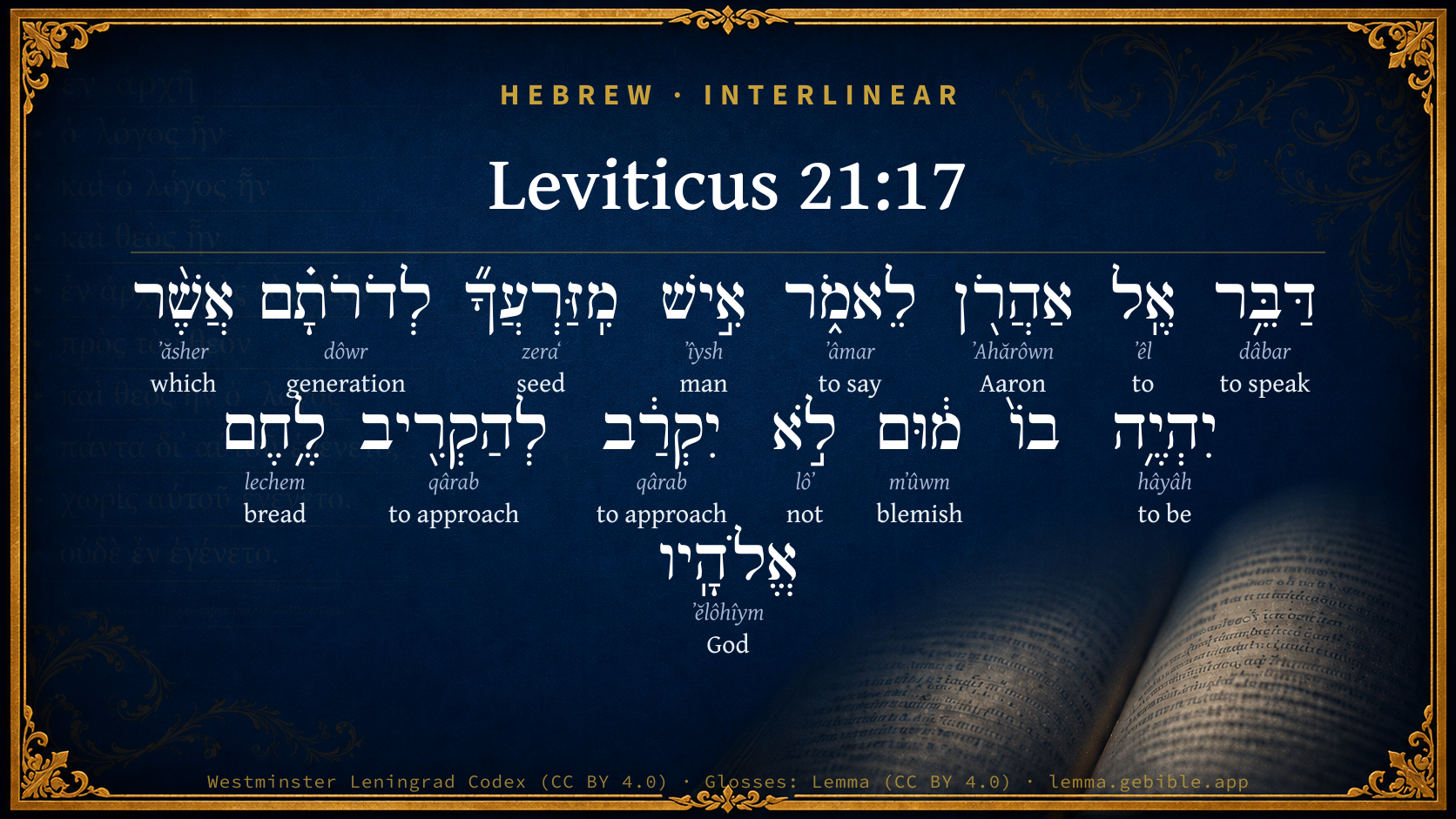
Hebrew (Westminster Leningrad Codex) Leviticus 21:17 appears in the Hebrew Old Testament. The text above is from the Westminster Leningrad Codex. Each word links to its Strong’s number, a concise gloss, and parsing drawn from the Open Scriptures Hebrew Bible morphology. Click any word for its full Brown-Driver-Briggs (BDB) entry.
Download image
Cite this verse

Leviticus 21:17 (World English Bible). Public Domain. Lemma interlinear Bible study tool, https://lemma.gebible.app/v/leviticus/21/17.

Show BibTeX & RIS
BibTeX
RIS
English Translation
"Say to Aaron, 'None of your seed throughout their generations who has a blemish, may approach to offer the bread of his God.
World English Bible · Public Domain
Highlights
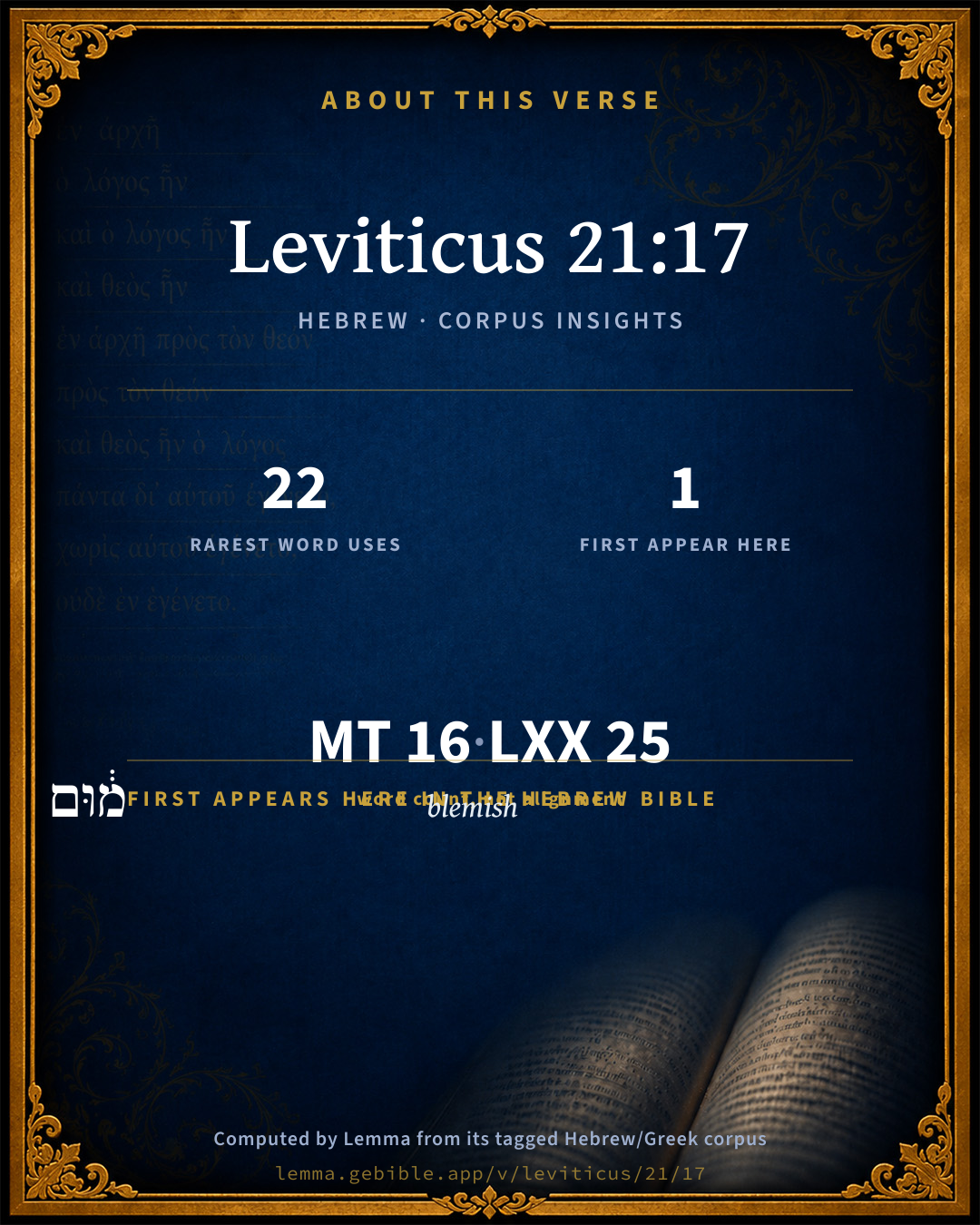
  • 1 first appearance in the Hebrew Bible
Full analysis ↓
Download a study sheet

One document with this verse’s original text, its word-by-word gloss line, the meaning frame, cross-references with their text, attributed commentary, and full source and license credits — printable, and it pastes into notes with its structure intact.

This verse Autodidact and up

Study sheet (.html) Plain text (.txt)

A passage Seminary Student

Up to 50 verses in one chapter. A passage sheet keeps up to 6 commentary sources and 12 cross-references per verse, in the order this page ranks them, and says so on the sheet whenever that leaves anything out. Ask for a single verse and you get the Autodidact verse sheet above.

Everything on this page stays free to read, with no account — the sheet is a download of what is already on screen, not access to it.

Want to remove ads? Support Godless Engineer
Compare translations 3

The same verse in 3 English versions, stacked beneath the original-language interlinear above. Click any original word for its lexicon entry.

Each is an independent rendering of the whole verse — the interlinear is not word-aligned to these translations.

Highlighted words mark where these versions differ — a whole-verse word diff, not a word-by-word alignment.

  • World English Bible Public Domain
    "Say to Aaron, 'None of your seed throughout their generations who has a blemish, may approach to offer the bread of his God.
  • King James Version Public Domain
    Speak unto Aaron, saying, Whosoever he be of thy seed in their generations that hath any blemish, let him not approach to offer the bread of his God.
  • unfoldingWord Literal Text CC BY-SA 4.0
    “Speak to Aaron, saying, ‘A man from your seed to their generations on whom is a blemish shall not draw near to present the bread of his God.

unfoldingWord Literal Text — © unfoldingWord, licensed CC BY-SA 4.0. Word-aligned USFM3 via Door43 (git.door43.org/unfoldingWord/en_ult).

Versions to compare (up to 4)

3 of 4 selected

Show all 18 translations

Every available English version of this verse, each an independent rendering of the whole verse.

  • World English Bible Public Domain
    "Say to Aaron, 'None of your seed throughout their generations who has a blemish, may approach to offer the bread of his God.
  • Berean Standard Bible Public Domain
    “Say to Aaron, ‘For the generations to come, none of your descendants who has a physical defect may approach to offer the food of his God.
  • Majority Standard Bible Public Domain
    “Say to Aaron, ‘For the generations to come, none of your descendants who has a physical defect may approach to offer the food of his God.
  • King James Version Public Domain
    Speak unto Aaron, saying, Whosoever he be of thy seed in their generations that hath any blemish, let him not approach to offer the bread of his God.
  • American Standard Version (1901) Public Domain
    Speak unto Aaron, saying, Whosoever he be of thy seed throughout their generations that hath a blemish, let him not approach to offer the bread of his God.
  • Revised Version (1885) Public Domain
    Speak unto Aaron, saying, Whosoever he be of thy seed throughout their generations that hath a blemish, let him not approach to offer the bread of his God.
  • Geneva Bible (1599) Public Domain
    Speake vnto Aaron, and say, Whosoeuer of thy seede in their generations hath any blemishes, shall not prease to offer the bread of his God:
  • Douay-Rheims (1899) Public Domain
    Say to Aaron: Whosoever of thy seed throughout their families, hath a blemish, he shall not offer bread to his God.
  • Young's Literal Translation Public Domain
    `Speak unto Aaron, saying, No man of thy seed to their generations in whom there is blemish doth draw near to bring near the bread of his God,
  • Literal Standard Version CC BY-SA 4.0
    “Speak to Aaron, saying, No man of your seed throughout their generations in whom there is blemish draws near to bring the bread of his God near,
  • Unlocked Literal Bible CC BY-SA 4.0
    “Speak to Aaron and tell him, 'Whoever of your descendants throughout their generations has a bodily defect, he must not approach to offer the food to his God.
  • unfoldingWord Literal Text CC BY-SA 4.0
    “Speak to Aaron, saying, ‘A man from your seed to their generations on whom is a blemish shall not draw near to present the bread of his God.
  • Darby Bible Public Domain
    Speak unto Aaron, saying, Any of thy seed throughout their generations that hath any defect, shall not approach to present the bread of his God;
  • World Messianic Bible Public Domain
    “Say to Aaron, ‘None of your offspring throughout their generations who has a defect may approach to offer the bread of his God.
  • Webster's Bible Public Domain
    Speak to Aaron, saying, whoever he may be of thy seed in their generations that hath any blemish, let him not approach to offer the bread of his God:
  • Free Bible Version CC BY-SA 4.0
    “Tell Aaron: These rules apply for all future generations. If any of your descendants has a physical defect, he is not allowed to come and present the food offerings of his God.
  • Bible in Basic English Public Domain
    Say to Aaron, If a man of your family, in any generation, is damaged in body, let him not come near to make the offering of the bread of his God.
  • JPS Tanakh (1917) Public Domain
    Speak unto Aaron, saying: Whosoever he be of thy seed throughout their generations that hath a blemish, let him not approach to offer the bread of his God.

Literal Standard Version (2020), Covenant Press — licensed CC BY-SA 4.0. Text via the HelloAO Bible API (eBible.org). Unlocked Literal Bible (unfoldingWord) — licensed CC BY-SA 4.0. Text via the HelloAO Bible API (eBible.org). unfoldingWord Literal Text — © unfoldingWord, licensed CC BY-SA 4.0. Word-aligned USFM3 via Door43 (git.door43.org/unfoldingWord/en_ult). Free Bible Version, Dr. Jonathan Gallagher — licensed CC BY-SA 4.0. Text via the HelloAO Bible API (eBible.org).

Word by word

More ways to search: Search by grammar → Find every occurrence → Compare this word →

Practice this passage: Drill this verse → Learn its vocabulary →

מ֔וּם
mʼûwm
H3971
“blemish”
Noun, Common, Masculine, Singular, Absolute
Part of Speech
Noun
Type
Common
Gender
Masculine
Number
Singular
State
Absolute
Full BDB Definition

Origin: as if passive participle from an unused root

TWOT: 1137a

blemish, spot, defect - of physical defect - of moral stain
  1. דַּבֵּ֥ר dâbar H1696 “speak” Verb, Piel, Imperative, 2nd Person, Masculine, Singular
  2. אֶֽל ʼêl H413 “to” Preposition
  3. אַהֲרֹ֖ן ʼAhărôwn H175 “Aaron” Noun, Proper
  4. לֵאמֹ֑ר ʼâmar H559 “to say” Preposition + Verb, Qal, Infinitive Construct
  5. אִ֣ישׁ ʼîysh H376 “man” Noun, Common, Masculine, Singular, Absolute
  6. מִֽזַּרְעֲךָ֞ zeraʻ H2233 “from · seed · your” Preposition + Noun, Common, Masculine, Singular, Construct + Suffix, Personal, 2nd Person, Masculine, Singular
  7. לְדֹרֹתָ֗ם dôwr H1755 “to/for · generations · their” Preposition + Noun, Common, Masculine, Plural, Construct + Suffix, Personal, 3rd Person, Masculine, Plural
  8. אֲשֶׁ֨ר ʼăsher H834 “which” Particle, Relative
  9. יִהְיֶ֥ה hâyâh H1961 “to be” Verb, Qal, Imperfect, 3rd Person, Masculine, Singular
  10. לֹ֣א lôʼ H3808 “not” Particle, Negative
  11. יִקְרַ֔ב qârab H7126 “to approach” Verb, Qal, Imperfect, 3rd Person, Masculine, Singular
  12. לְהַקְרִ֖יב qârab H7126 “to approach” Preposition + Verb, Hiphil, Infinitive Construct
  13. לֶ֥חֶם lechem H3899 “bread of” Noun, Common, Both, Singular, Construct
  14. אֱלֹהָֽיו ʼĕlôhîym H430 “God(s) · his” Noun, Common, Masculine, Plural, Construct + Suffix, Personal, 3rd Person, Masculine, Singular

About this verse

These counts appear in no published source. They are computed here, from the morphology-tagged text and Lemma’s own curated glosses. What Lemma adds →

16
words
14
distinct lemmas
Pentateuch
section

Notable vocabulary

The rarest word here is מ֔וּם blemish H3971 — appearing just 22 times in the whole Hebrew Bible.

First appearance in Scripture

This word makes its first canonical appearance in the Hebrew Bible here:

  • מ֔וּם blemish H3971

Shared distinctive vocabulary

מ֔וּם blemish H3971 occurs in 19 verses of the Hebrew Bible. Also found in:

Grammatical profile

  • 5 verbs
  • 7 nouns
  • 2 prepositions
  • 2 particles

Verb forms

  • דַּבֵּ֥ר Piel · Imperative
  • לֵאמֹ֑ר Qal · Infinitive Construct
  • יִהְיֶ֥ה Qal · Imperfect
  • יִקְרַ֔ב Qal · Imperfect
  • לְהַקְרִ֖יב Hiphil · Infinitive Construct

Repetition

A word recurs within this verse — often emphatic in Hebrew:

  • יִקְרַ֔ב to approach H7126 ×2

Hebrew & Septuagint length

In English translation the verse runs 23 words from the Hebrew and 29 from the Septuagint (LXX English) — closely comparable.

A rough comparison of the two English renderings, which tokenize alike — not a word-level alignment.

Word counts can differ between the Hebrew and the Greek without any difference in meaning — e.g. the Hebrew direct-object marker אֵת has no separate Greek word, and Greek often adds the article ὁ.

In the original languages it is 16 Hebrew tokens and 25 Greek tokens — but the two are counted differently (Hebrew bundles its prefixes and suffixes into one token; the Greek is in lemma form), so that isn’t a like-for-like length.

Cross-references

11

Topical passages linked to Leviticus 21:17 in the Treasury of Scripture Knowledge — connected by theme and wording, ordered by reader-vote popularity; previews shown in the World English Bible.

  • Leviticus 10:3 Then Moses said to Aaron, "This is what Yahweh spoke of, saying, "'I will show myself holy to those who come near me, And before all the people I will be glorified.'" Aaron held his peace.
  • Numbers 16:5 and he spoke to Korah and to all his company, saying, In the morning Yahweh will show who are his, and who is holy, and will cause him to come near to him: even him whom he shall choose will he cause to come near to him.
  • Psalms 65:4 Blessed is one whom you choose, and cause to come near, That he may live in your courts. We will be filled with the goodness of your house, Your holy temple.
  • Leviticus 3:11 The priest shall burn it on the altar: it is the food of the offering made by fire to Yahweh.
  • Leviticus 3:16 The priest shall burn them on the altar: it is the food of the offering made by fire, for a sweet savor; all the fat is Yahweh's.
  • Leviticus 21:6 They shall be holy to their God, and not profane the name of their God; for they offer the offerings of Yahweh made by fire, the bread of their God; therefore they shall be holy.
  • Leviticus 21:21 no man of the seed of Aaron the priest, who has a blemish, shall come near to offer the offerings of Yahweh made by fire. Since has a blemish, he shall not come near to offer the bread of his God.
  • Leviticus 22:20–25 But whatever has a blemish, that you shall not offer: for it shall not be acceptable for you.
  • 1 Thessalonians 2:10 You are witnesses with God, how holy, righteously, and blamelessly we behaved ourselves toward you who believe.
  • 1 Timothy 3:2 The overseer therefore must be without reproach, the husband of one wife, temperate, sensible, modest, hospitable, good at teaching;
  • Hebrews 7:26 For such a high priest was fitting for us: holy, guiltless, undefiled, separated from sinners, and made higher than the heavens;

Cross-references courtesy of OpenBible.info (CC BY 4.0).

Hebrew and Greek witnesses Masoretic Hebrew ↔ Greek Septuagint

The same verse in the two great witnesses to the Old Testament, shown verse-for-verse.

These are two independent witnesses, not word-aligned to each other, and the Septuagint is shown in lemma (dictionary) form.

Hebrew Leviticus 21:17 Masoretic · Westminster Leningrad Codex

דַּבֵּ֥ר אֶֽל אַהֲרֹ֖ן לֵאמֹ֑ר אִ֣ישׁ מִֽזַּרְעֲךָ֞ לְדֹרֹתָ֗ם אֲשֶׁ֨ר יִהְיֶ֥ה בוֹ֙ מ֔וּם לֹ֣א יִקְרַ֔ב לְהַקְרִ֖יב לֶ֥חֶם אֱלֹהָֽיו

"Say to Aaron, 'None of your seed throughout their generations who has a blemish, may approach to offer the bread of his God.

World English Bible · Public Domain

Greek LXX Leviticus 21:17 Septuagint · lemma form

εἶπον ἀαρών ἄνθρωπος ἐκ ὁ γένος σύ εἰς ὁ γενεά σύ τίς ἐάν εἰμί ἐν αὐτός μῶμος οὐ προςἔρχομαι προςφέρω ὁ δῶρον ὁ θεός αὐτός

Say to Aaron, A man of your tribe throughout your generations, who shall have a blemish on him, shall not draw near to offer the gifts of his God.

LXX2012 (modern English Septuagint) · Public Domain

Hebrew: Westminster Leningrad Codex (CC BY 4.0). Greek: Septuagint (public domain); English from LXX2012 (modern English Septuagint) (Public Domain). How the Septuagint differs from the Hebrew →

Targum (Aramaic paraphrase)

2

The Targum is the ancient Jewish Aramaic paraphrase of the Hebrew Scriptures — an interpretive translation, not the Hebrew text itself. Onkelos (literal) and Pseudo-Jonathan (expansive) render the Torah, and Jonathan the Prophets. Coverage is partial: where no permissively-licensed English translation exists for a verse, only the Aramaic is shown. This is verse-level text, not a word-by-word alignment to the Hebrew.

  1. Targum Onkelos Torah (Genesis–Deuteronomy)
    מַלֵל עִם אַהֲרֹן לְמֵימָר גְבַר מִבְּנָיִךְ לְדָרֵיהוֹן דִי יְהֵּי בֵהּ מוּמָא לָא יִקְרַב לְקָרָבָא קֻרְבָּנָא קֳדָם אֱלָהֵהּ

    (no public-domain English translation for this verse)

    Targum Onkelos — Aramaic: “Onkelos Genesis” (public domain); “Onkelos Exodus” (public domain); “Onkelos Leviticus” (public domain); “Onkelos Numbers” (public domain); “Onkelos Deuteronomy” (public domain). English: “Sefaria Community Translation” (CC0 1.0 (public-domain dedication)); “J.W. Etheridge. The Targums of Onkelos and Jonathan Ben Uzziel on the Pentateuch. London: Longmans, Green, 1862” (public domain). Text via Sefaria.

  2. Targum Pseudo-Jonathan Torah (Genesis–Deuteronomy)
    מַלֵיל עִם אַהֲרן לְמֵימָר גְבַר מִבְּנָךְ לְזַרְעֲיַית דָרֵיהוֹן דִיהֵי בֵיהּ מוּמָא לָא יִתְכְּשַׁר לְקָרְבָא קוּרְבַּן אֱלָהֵיהּ

    Speak with Aharon, saying: No man of thy sons in the families of their generations who hath a blemish in him shall be qualified to offer the oblation of his God:

    Targum Pseudo-Jonathan — Aramaic: “Targum Jonathan on Genesis” (public domain); “Targum Jonathan on Exodus” (public domain); “Targum Jonathan on Leviticus” (public domain); “Targum Jonathan on Numbers” (public domain); “Targum Jonathan on Deuteronomy” (public domain). English: “The Targum of Jonathan ben Uzziel, trans. J. W. Etheridge, London, 1862” (public domain). Text via Sefaria.

Commentary

Notes on Leviticus 21:17 from classic Christian and Jewish commentators (each source and its license shown beneath its notes). The classic Christian expositions comment on the surrounding passage and are grouped to its opening verse, so a note may address several verses; the Jewish commentaries on the Tanakh (Rashi and others) are per-verse, so they appear only where the commentator wrote on this verse.

Lemma curates 59 commentaries, every one of them public domain or Creative Commons licensed, each selected and text-cleaned for this edition rather than reprinted as found. About our sources →

Trapp's Complete Commentary

John Trapp

Lev 21:17 Speak unto Aaron, saying, Whosoever [he be] of thy seed in their generations that hath [any] blemish, let him not approach to offer the bread of his God.

Ver. 17. That hath any blemish.] Christ was without blemish: so should all the saints be, but especially ministers, of whom it should be said as of Absalom, that from top to toe there was no blemish in him. {2Sa 14:25}

John Trapp, A Commentary or Exposition upon All the Books of the Old and New Testament (1647–1656) — public domain. Text from a community e-Sword module.

Joseph Benson's Commentary

Lev 21:17. Of thy seed — Whether the high-priest, or the inferior ones. That hath — In all successive ages, any defect or excess of parts, any notorious deformity or imperfection in his body. The reason hereof is partly typical, that he might more fully represent Christ, the great High-Priest, who was typified both by the priest and sacrifice, and therefore both were to be without blemish; partly moral, to teach all Christians, and especially ministers of holy things, what purity and perfection of heart and life they should labour after, and that notorious blemishes in the mind or conversation render a man unfit for the ministry of the gospel; and partly prudential, because such blemishes were apt to breed contempt of the person; and consequently of his function, and of the holy things wherein he ministered. For which reason, such persons as have notorious defects or deformities, are still unfit for the ministry, except where there are eminent gifts and graces, which vindicate a man from the contemptibleness of his bodily presence.

Joseph Benson's Commentary on the Old and New Testaments (1811–1818) — public domain. Text from a community e-Sword module.

Whedon's Commentary on the Bible

Daniel D. Whedon

PERSONAL DISABILITIES FOR THE PRIESTHOOD, Lev_21:17-24.

The arduous labours demanded of the priests required that they should be able-bodied men. Moreover, it was necessary that there should be a correspondence between the perfect physique of the priests and the unblemished victims offered to the perfect God. The incongruity of a blind man, a dwarf, or a cripple, figuring in the solemn and majestic ritual of the altar, would have exposed the service to ridicule. Since the service of the altar was minutely prescribed, neither genius nor high intellectual qualities were requisite, but an unblemished form with mind enough to follow the directions of the law. Thus it is found that ceremonial religions always repress genius, while those forms of religion which depend more upon the inculcation and intellectual and spiritual apprehension of the truth give scope to the development of mental power in the office of the prophet, the teacher, and the preacher.

Daniel D. Whedon (gen. ed.), Commentary on the Old and New Testaments (1874–1909) — public domain. Text from a community e-Sword module.

Adam Clarke's Commentary

Verse 17. Whosoever - hath any blemish, let him not approach to offer the bread of his God.] Never was a wiser, a more rational, and a more expedient law enacted relative to sacred matters. The man who ministers in holy things, who professes to be the interpreter of the will of God, should have nothing in his person nor in his manner which cannot contribute to render him respectable in the eyes of those to whom he ministers. If, on the contrary, he has any personal defect, any thing that may render him contemptible or despicable, his usefulness will be greatly injured, if not entirely prevented. If however a man have received any damage in the work of God, by persecution or otherwise, his scars are honourable, and will add to his respectability. But if he be received into the ministry with any of the blemishes specified here, he never will and never can have that respect which is essentially necessary to secure his usefulness. Let no man say this is a part of the Mosaic law, and we are not bound by it. It is an eternal law, founded on reason, propriety, common sense, and absolute necessity. The priest, the prophet, the Christian minister, is the representative of Jesus Christ; let nothing in his person, carriage, or doctrine, be unworthy of the personage he represents. A deformed person, though consummate in diplomatic wisdom, would never be employed as an ambassador by any enlightened court, if any fit person, unblemished, could possibly be procured.

Adam Clarke's Commentary on the Bible (1810–1826) — public domain. Text from a community e-Sword/MySword module.

Ellicott's Commentary for English Readers

(17) Whosoever he be of thy seed.—Better, any man of thy seed throughout their generations; that is, any of the descendants, to all future times, who have not been disqualified for service in the sanctuary by their parents contracting illegal alliances, are yet to be subject to the following regulations.

To offer the bread of his God.—That is, shall not officiate at the sacrifices. (See Lev_21:6 -Lev_3:2.)

A Bible Commentary for English Readers, edited by Charles John Ellicott (1878–1897) — public domain. Text from a community e-Sword module.

The Cambridge Bible for Schools and Colleges

gen. ed. J. J. S. Perowne

17. throughout their generations] See end of introd. note to ch. the bread of his God] See on Lev_21:6.

The Cambridge Bible for Schools and Colleges (gen. ed. J. J. S. Perowne; Cambridge University Press, 1878–1918) — public domain. Text from a community e-Sword module.

John Gill's Exposition

Speak unto Aaron, saying,.... Who being the high priest, it was incumbent on him, at least at this time, to see that the laws and rules relating to the priesthood were observed; and particularly to examine carefully who were and who were not to be admitted to serve in it:

whosoever he be of thy seed in their generations; or, "a man of thy seed" (w), for this only respected his male seed, females of his seed had no concern in the following laws; but his sons, in all successive ages and generations, to the coming of the Messiah, had, whether high priests or common priests:

that hath any blemish; in any part of his body, particularly such as are after mentioned:

let him not approach to offer the bread of his God; neither go into the holy place, to set the shewbread in order there, nor to offer any sacrifice upon the altar; so Josephus (x) explains this law; that a priest should be perfect, and if he laboured under any defect, should not ascend the altar, nor enter into the temple: this was imitated by the Heathens: Romulus ordered that such as were weak and feeble in any part of the body should not be made priests (y): the Jewish priests were types of Christ, who is holy, harmless, without spot and blemish; and through whose blood and righteousness all who are made priests by him are unblamable, without spot or wrinkle, or any such thing; and a Gospel minister, bishop, or pastor, ought to be unblemished in his life and conversation, Tit 1:6; and there are some who think that the blemishes of the mind and of the life are rather here meant than those of the body.

(w) "vir de semine tuo", Pagninus, Montanus, &c. (x) Antiqu. l. 3. c. 12. sect. 2. (y) Pompon. Laet. de Sacerdot. c. 6. de Vestalibus.

John Gill's Exposition of the Whole Bible (1746–1763) — public domain (CC PDM 1.0). Text via the HelloAO Bible API.

Haydock's Catholic Bible Commentary

A blemish. These corporal defects or deformities, which disqualified the priests from officiating in the old law, were figures of the vices which priests are to beware of in the new law. (St. Gregory, Cura pastorum.) (Challoner) --- The Rabbins reckon 140 blemishes on which the Sanhedrim had to pass sentence. They also require in the high priest superior beauty, strength, riches, and wisdom.

George Leo Haydock (1774–1849), Haydock's Catholic Family Bible and Commentary, 1859 edition — public domain. Excludes Psalms (Douay-Rheims chapter numbering differs from Protestant) and Deuterocanonical books (Catholic canon only).

Matthew Poole's English Annotations

Whosoever he be of thy seed, whether the high priest or the inferior ones.

In their generations; in all successive ages, as long as your priesthood and policy endures.

Any blemish, i.e. any defect or excess of parts, any notorious deformity, or imperfection in his body. The reason hereof is partly typical, that he might more fully represent Christ, the great High Priest, who was typified both by the priest and sacrifice, and therefore both were to be without blemish; partly moral, to teach all Christians, and especially ministers of holy things, what purity and perfection of heart and life they should labour after, and that notorious blemishes in the mind or conversation render a man unfit for the ministry of the gospel; and partly prudential, because such blemishes were apt to breed contempt of the person, and consequently of his function, and of the holy things wherein he ministered. For which reason, some conceive, that still such persons as have notorious defects or deformities, which render them contemptible, are not fit for the ministry; which may be true in the general, except where there are eminent gifts and graces, which are sufficient to vindicate a man from the contemptibleness of his bodily presence. The particular defects here mentioned I shall not enlarge upon, because some of the Hebrew words are diversely interpreted, and because the use of these things being abolished, the knowledge of them is not very necessary.

The bread; either the shew-bread, one eminent part being named for the whole; or, the food, i.e. all the oblations. See Poole "Lev 21:6".

Matthew Poole's English Annotations on the Holy Bible (1683–1685) — public domain. Text from a community e-Sword/MySword module.

John Wesley's Explanatory Notes

Of thy seed - Whether the high priest, or the inferior ones. That hath - In all successive ages, any defect or excess of parts, any notorious deformity or imperfection in his body. The reason hereof is partly typical, that he, might more fully represent Christ, the great high-priest, who was typified both by the priest and sacrifice, and therefore both were to be without blemish; partly moral, to teach all Christians and especially ministers of holy things, what purity and perfection of heart and life they should labour after, and that notorious blemishes in the mind or conversation, render a man unfit for the ministry of the gospel; and partly prudential, because such blemishes were apt to breed contempt of the person; and consequently, of his function, and of the holy things wherein he ministered. For which reason, such persons as have notorious defects or deformities, are still unfit for the ministry except where there are eminent gifts and graces, which vindicate a man from the contemptibleness of his bodily presence. The particular defect's here mentioned, I shall not enlarge upon because some of the Hebrew words are diversely interpreted, and because the use of these things being abolished, the knowledge of them is not necessary.

John Wesley, Explanatory Notes Upon the Whole Bible (1754–1765) — public domain. Text via the GEBible commentary corpus.

Rashi

Rabbi Shlomo Yitzchaki (Rashi)

לחם אלהיו THE BREAD OF HIS GOD — This means, any food of his God (not “bread” only); any meal is termed לחם, as e. g., (Daniel 5:1) “he made a great banquet (לְחַם)” (cf. Rashi on Genesis 31:54).

Rashi on the Tanakh — English translations: “The Judaica Press complete Tanach with Rashi, translated by A. J. Rosenberg” (CC BY 4.0); “Pentateuch with Rashi's commentary by M. Rosenbaum and A.M. Silbermann, 1929-1934” (public domain); “The Metsudah Tanach series, Lakewood, N.J” (CC BY 4.0); and “The Book of Joshua, Metsudah Publications, 1997” (CC BY 4.0). Text via Sefaria.

Ramban (Nachmanides)

Rabbi Moshe ben Nachman (Ramban / Nachmanides)

SPEAK UNTO AARON, SAYING: WHOSOEVER HE BE OF THY SEED THROUGHOUT THEIR GENERATIONS. He does not state here “speak unto Aaron and his sons” as He does in all [other] sections, because there in the Scriptural portions He commanded the laws of the offerings: This is the law of the burnt-offering; This is the law of the sin-offering, 6:18. and of the guilt-offering, 7:1. and so on [and these laws apply to all priests — Aaron and his sons alike]. But here, if He were to have said “Speak unto Aaron and his sons,” He would have had to continue by saying: “Whosoever of you be throughout your generations” [which would have included Aaron among priests that might have a blemish, which this section discusses], and He did not want to warn Aaron himself about the law of blemishes, because Aaron the holy one of the Eternal is all fair. and there shall be no blemish in him. Instead He admonished him concerning his seed, that he is to teach them these laws and warn them throughout their generations. In the section on impurity immediately following, however, He does say: Speak unto Aaron and to his sons, that they separate themselves from the holy things of the children of Israel, because it is possible that even Aaron might happen to become impure by touching a corpse or a dead swarming thing. But when He comes to mention the impurity of leprosy or a flux, He again says, What man soever of the seed of Aaron, because this would not happen to the body [of Aaron], for he is the messenger of the Eternal of hosts. At the end of this section He states, So Moses spoke unto Aaron, and to his sons, and unto all the children of Israel, [although Moses had been told, Speak unto Aaron, saying, etc.], because Moses wanted to warn Aaron’s sons as well in order that they should receive the instruction directly from his mouth. He also said so to the children of Israel, which means that he warned the court of Israel on this matter.Now in the Torath Kohanim I have found this text: 3:5. “Whatsoever man he be that hath a blemish. Why is this said [since it has already been mentioned in the preceding verse]? But because it says the seed of Aaron,. Also in Verse 21: of the seed of Aaron. I would only know that this law [of blemishes] applies to Aaron’s offspring. How do I know that it applies to Aaron himself? From the verse which states, For whatsoever man he be that hath a blemish.” Similarly it has been taught there: 4:1. “The seed of Aaron.. Also in Verse 21: of the seed of Aaron. I would only know that this law [of blemishes] applies to Aaron’s offspring. How do I know that it applies to Aaron himself? From the verse which states, For whatsoever man he be that hath a blemish. ” Similarly it has been taught there: 4:1. “The seed of Aaron.. Also in Verse 21: of the seed of Aaron. I would only know that this law applies to Aaron’s seed. How do I know that it applies to Aaron himself? From the verse and he is a leper, or hath an issue.” Now [that which the Torath Kohanim states] “Aaron himself,” means [any] High Priest that shall be in his stead among his sons, [but it does not mean Aaron personally, since, as explained above, Scripture does not mention Aaron’s name with reference to having a blemish or suffering from leprosy or an issue. It did, however, have to include the High Priest in the law of blemishes], because having permitted the High Priest [to officiate] whilst he is an onen, one might perhaps think that it also permits him [to officiate] although he has a blemish or leprosy. For this reason it became necessary to include him in this law. Or it may be that [the Torath Kohanim] is alluding to the law about Aaron himself, for the Torah in its prohibitions does not rely on a miracle. However, it concealed it [the prohibition] in connection with Aaron, in his honor, thus hinting that this would [in fact] not happen to him.

Ramban (Nachmanides) on the Tanakh — English translation: “Commentary on the Torah by Ramban (Nachmanides). Translated and annotated by Charles B. Chavel. New York, Shilo Pub. House, 1971-1976” (CC BY 4.0). Text via Sefaria.

Lesson kit

Teaching starters — assembled from the data on this page, not authored interpretation. Every prompt links to the verse data it draws on. Edit before teaching.

Leviticus, in the Pentateuch, opens this verse with 16 words (14 distinct Hebrew lemmas). Its most distinctive word is mʼûwm (“blemish”). A historical commentator’s framing appears above. Read the whole chapter for the surrounding context.

Discussion questions

  1. The word mʼûwm carries the sense “blemish.” How does it shape the verse?
  2. This is the first place “blemish” appears in Scripture (first appears here). What does its debut here establish?
  3. How does Leviticus 21:18, which shares the word «blemish», read alongside this verse?
  4. What does the repetition of “to approach” (2× in this one verse) do in this verse?
  5. The translations on this page render this verse differently — a whole-verse word diff, not a word-by-word alignment. What might account for the different wordings?
  6. «דַּבֵּ֥ר» is a Piel Imperative verb. How does that grammatical form shape the action described?
  7. Compare how Trapp's Complete Commentary and Joseph Benson's Commentary read this verse. Where do they agree or differ?

Things to notice

Reading settings

Reading text

Shown beneath each verse's original-language words.

Old Testament
Old Testament edition

Read the OT as the Masoretic Hebrew (MT) or the Greek Septuagint (LXX).

English shown for the Greek Septuagint (in the Hebrew ↔ Greek comparison).

Comparing translations? Open the Compare panel on any verse page to stack up to four side by side.