
Judges 13:16

Hebrew (Westminster Leningrad Codex) Judges 13:16 appears in the Hebrew Old Testament. The text above is from the Westminster Leningrad Codex. Each word links to its Strong’s number, a concise gloss, and parsing drawn from the Open Scriptures Hebrew Bible morphology. Click any word for its full Brown-Driver-Briggs (BDB) entry.
Download image
Cite this verse

Judges 13:16 (World English Bible). Public Domain. Lemma interlinear Bible study tool, https://lemma.gebible.app/v/judges/13/16.

Show BibTeX & RIS
BibTeX
RIS
English Translation
The angel of Yahweh said to Manoah, Though you detain me, I won't eat of your bread; and if you will make ready a burnt offering, you must offer it to Yahweh. For Manoah didn't know that he was the angel of Yahweh.
World English Bible · Public Domain
Download a study sheet

One document with this verse’s original text, its word-by-word gloss line, the meaning frame, cross-references with their text, attributed commentary, and full source and license credits — printable, and it pastes into notes with its structure intact.

This verse Autodidact and up

Study sheet (.html) Plain text (.txt)

A passage Seminary Student

Up to 50 verses in one chapter. A passage sheet keeps up to 6 commentary sources and 12 cross-references per verse, in the order this page ranks them, and says so on the sheet whenever that leaves anything out. Ask for a single verse and you get the Autodidact verse sheet above.

Everything on this page stays free to read, with no account — the sheet is a download of what is already on screen, not access to it.

Want to remove ads? Support Godless Engineer
Compare translations 3

The same verse in 3 English versions, stacked beneath the original-language interlinear above. Click any original word for its lexicon entry.

Each is an independent rendering of the whole verse — the interlinear is not word-aligned to these translations.

Highlighted words mark where these versions differ — a whole-verse word diff, not a word-by-word alignment.

  • World English Bible Public Domain
    The angel of Yahweh said to Manoah, Though you detain me, I won't eat of your bread; and if you will make ready a burnt offering, you must offer it to Yahweh. For Manoah didn't know that he was the angel of Yahweh.
  • King James Version Public Domain
    And the angel of the LORD said unto Manoah, Though thou detain me, I will not eat of thy bread: and if thou wilt offer a burnt offering, thou must offer it unto the LORD. For Manoah knew not that he was an angel of the LORD.
  • unfoldingWord Literal Text CC BY-SA 4.0
    And the angel of Yahweh said to Manoah, “If you detain me, I will not eat of your bread. But if you prepare a burnt offering, to Yahweh you shall offer it.” For Manoah did not know that he the angel of Yahweh.

unfoldingWord Literal Text — © unfoldingWord, licensed CC BY-SA 4.0. Word-aligned USFM3 via Door43 (git.door43.org/unfoldingWord/en_ult).

Versions to compare (up to 4)

3 of 4 selected

Show all 18 translations

Every available English version of this verse, each an independent rendering of the whole verse.

  • World English Bible Public Domain
    The angel of Yahweh said to Manoah, Though you detain me, I won't eat of your bread; and if you will make ready a burnt offering, you must offer it to Yahweh. For Manoah didn't know that he was the angel of Yahweh.
  • Berean Standard Bible Public Domain
    And the angel of the LORD replied, “Even if I stay, I will not eat your food. But if you prepare a burnt offering, offer it to the LORD.” For Manoah did not know that it was the angel of the LORD.
  • Majority Standard Bible Public Domain
    And the angel of the LORD replied, “Even if I stay, I will not eat your food. But if you prepare a burnt offering, offer it to the LORD.” For Manoah did not know that it was the angel of the LORD.
  • King James Version Public Domain
    And the angel of the LORD said unto Manoah, Though thou detain me, I will not eat of thy bread: and if thou wilt offer a burnt offering, thou must offer it unto the LORD. For Manoah knew not that he was an angel of the LORD.
  • American Standard Version (1901) Public Domain
    And the angel of Jehovah said unto Manoah, Though thou detain me, I will not eat of thy bread; and if thou wilt make ready a burnt-offering, thou must offer it unto Jehovah. For Manoah knew not that he was the angel of Jehovah.
  • Revised Version (1885) Public Domain
    And the angel of the LORD said unto Manoah, Though thou detain me, I will not eat of thy bread: and if thou wilt make ready a burnt offering, thou must offer it onto the LORD. For Manoah knew not that he was the angel of the LORD.
  • Geneva Bible (1599) Public Domain
    And the Angel of the Lord said vnto Manoah, Though thou make me abide, I will not eate of thy bread, and if thou wilt make a burnt offring, offer it vnto the Lord: for Manoah knewe not that it was an Angel of the Lord.
  • Douay-Rheims (1899) Public Domain
    And the angel answered him: If thou press me, I will not eat of thy bread: but if thou wilt offer a holocaust, offer it to the Lord. And Manue knew not it was the angel of the Lord.
  • Young's Literal Translation Public Domain
    And the messenger of Jehovah saith unto Manoah, `If thou detain me -- I do not eat of thy bread; and if thou prepare a burnt-offering -- to Jehovah thou dost offer it;' for Manoah hath not known that He `is' a messenger of Jehovah.
  • Literal Standard Version CC BY-SA 4.0
    And the Messenger of YHWH says to Manoah, “If you detain Me—I do not eat of your bread; and if you prepare a burnt-offering—offer it to YHWH”; for Manoah has not known that He [is] the Messenger of YHWH.
  • Unlocked Literal Bible CC BY-SA 4.0
    The angel of Yahweh said to Manoah, “Even if I stay, I will not eat your food. But if you prepare a burnt offering, offer it to Yahweh.” (Manoah did not know that he was the angel of Yahweh.)
  • unfoldingWord Literal Text CC BY-SA 4.0
    And the angel of Yahweh said to Manoah, “If you detain me, I will not eat of your bread. But if you prepare a burnt offering, to Yahweh you shall offer it.” For Manoah did not know that he the angel of Yahweh.
  • Darby Bible Public Domain
    And the angel of the LORD said to Mano'ah, "If you detain me, I will not eat of your food; but if you make ready a burnt offering, then offer it to the LORD." (For Mano'ah did not know that he was the angel of the LORD.)
  • World Messianic Bible Public Domain
    The LORD’s angel said to Manoah, “Though you detain me, I won’t eat your bread. If you will prepare a burnt offering, you must offer it to the LORD.” For Manoah didn’t know that he was the LORD’s angel.
  • Webster's Bible Public Domain
    And the angel of the LORD said to Manoah, Though thou shouldst detain me, I will not eat of thy bread: and if thou wilt offer a burnt-offering, thou must offer it to the LORD. For Manoah knew not that he was an angel of the LORD.
  • Free Bible Version CC BY-SA 4.0
    The angel of the Lord replied, “I'll stay, but I won't eat your food. However, if you prepare a burnt offering, you can present it to the Lord.” (Manoah didn't know he was the angel of the Lord.)
  • Bible in Basic English Public Domain
    And the angel of the Lord said to Manoah, Though you keep me I will not take of your food; but if you will make a burned offering, let it be offered to the Lord. For it had not come into Manoah's mind that he was the angel of the Lord.
  • JPS Tanakh (1917) Public Domain
    And the angel of the LORD said unto Manoah: 'Though thou detain me, I will not eat of thy bread; and if thou wilt make ready a burnt-offering, thou must offer it unto the LORD.' For Manoah knew not that he was the angel of the LORD.

Literal Standard Version (2020), Covenant Press — licensed CC BY-SA 4.0. Text via the HelloAO Bible API (eBible.org). Unlocked Literal Bible (unfoldingWord) — licensed CC BY-SA 4.0. Text via the HelloAO Bible API (eBible.org). unfoldingWord Literal Text — © unfoldingWord, licensed CC BY-SA 4.0. Word-aligned USFM3 via Door43 (git.door43.org/unfoldingWord/en_ult). Free Bible Version, Dr. Jonathan Gallagher — licensed CC BY-SA 4.0. Text via the HelloAO Bible API (eBible.org).

Word by word

More ways to search: Search by grammar → Find every occurrence → Compare this word →

Practice this passage: Drill this verse → Learn its vocabulary →

מָנ֗וֹחַ
Mânôwach
H4495
“Manoah”
Noun, Proper
Part of Speech
Noun
Type
Proper
Full BDB Definition

Origin: the same as H4494

TWOT: None

Manoah = "rest" - a Danite, father of the judge Samson and inhabitant of Zorah
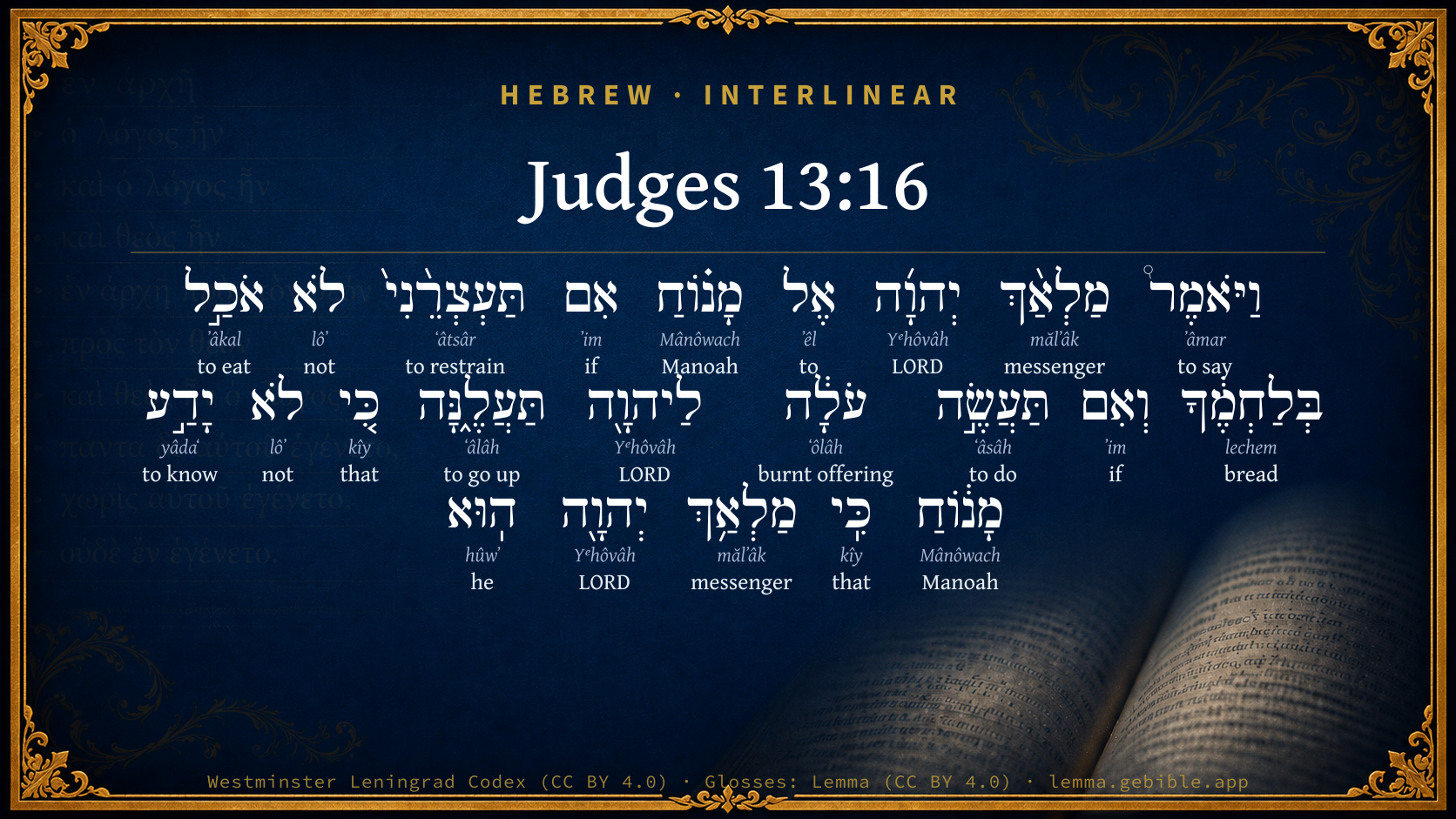
  1. וַיֹּאמֶר֩ ʼâmar H559 “and · to say” Conjunction + Verb, Qal, Sequential Imperfect, 3rd Person, Masculine, Singular
  2. מַלְאַ֨ךְ mălʼâk H4397 “messenger of” Noun, Common, Masculine, Singular, Construct
  3. יְהוָ֜ה Yᵉhôvâh H3068 “LORD” Noun, Proper
  4. אֶל ʼêl H413 “to” Preposition
  5. אִם ʼim H518 “if” Conjunction
  6. תַּעְצְרֵ֨נִי֙ ʻâtsâr H6113 “to restrain · me” Verb, Qal, Imperfect, 2nd Person, Masculine, Singular + Suffix, Personal, 1st Person, Common, Singular
  7. לֹא lôʼ H3808 “not” Particle, Negative
  8. אֹכַ֣ל ʼâkal H398 “to eat” Verb, Qal, Imperfect, 1st Person, Common, Singular
  9. בְּלַחְמֶ֔ךָ lechem H3899 “in/at · bread · your” Preposition + Noun, Common, Both, Singular, Construct + Suffix, Personal, 2nd Person, Masculine, Singular
  10. וְאִם ʼim H518 “and · if” Conjunction + Conjunction
  11. תַּעֲשֶׂ֣ה ʻâsâh H6213 “to do” Verb, Qal, Imperfect, 2nd Person, Masculine, Singular
  12. עֹלָ֔ה ʻôlâh H5930 “burnt offering” Noun, Common, Feminine, Singular, Absolute
  13. לַיהוָ֖ה Yᵉhôvâh H3068 “to/for · LORD” Preposition + Noun, Proper
  14. תַּעֲלֶ֑נָּה ʻâlâh H5927 “to go up · her” Verb, Hiphil, Imperfect, 2nd Person, Masculine, Singular + Suffix, Personal, 3rd Person, Feminine, Singular
  15. כִּ֚י kîy H3588 “that” Conjunction
  16. לֹא lôʼ H3808 “not” Particle, Negative
  17. יָדַ֣ע yâdaʻ H3045 “to know” Verb, Qal, Perfect, 3rd Person, Masculine, Singular
  18. מָנ֔וֹחַ Mânôwach H4495 “Manoah” Noun, Proper
  19. כִּֽי kîy H3588 “that” Conjunction
  20. מַלְאַ֥ךְ mălʼâk H4397 “messenger of” Noun, Common, Masculine, Singular, Construct
  21. יְהוָ֖ה Yᵉhôvâh H3068 “LORD” Noun, Proper
  22. הֽוּא hûwʼ H1931 “he” Pronoun, Personal, 3rd Person, Masculine, Singular

About this verse

These counts appear in no published source. They are computed here, from the morphology-tagged text and Lemma’s own curated glosses. What Lemma adds →

23
words
16
distinct lemmas
Historical
section

Notable vocabulary

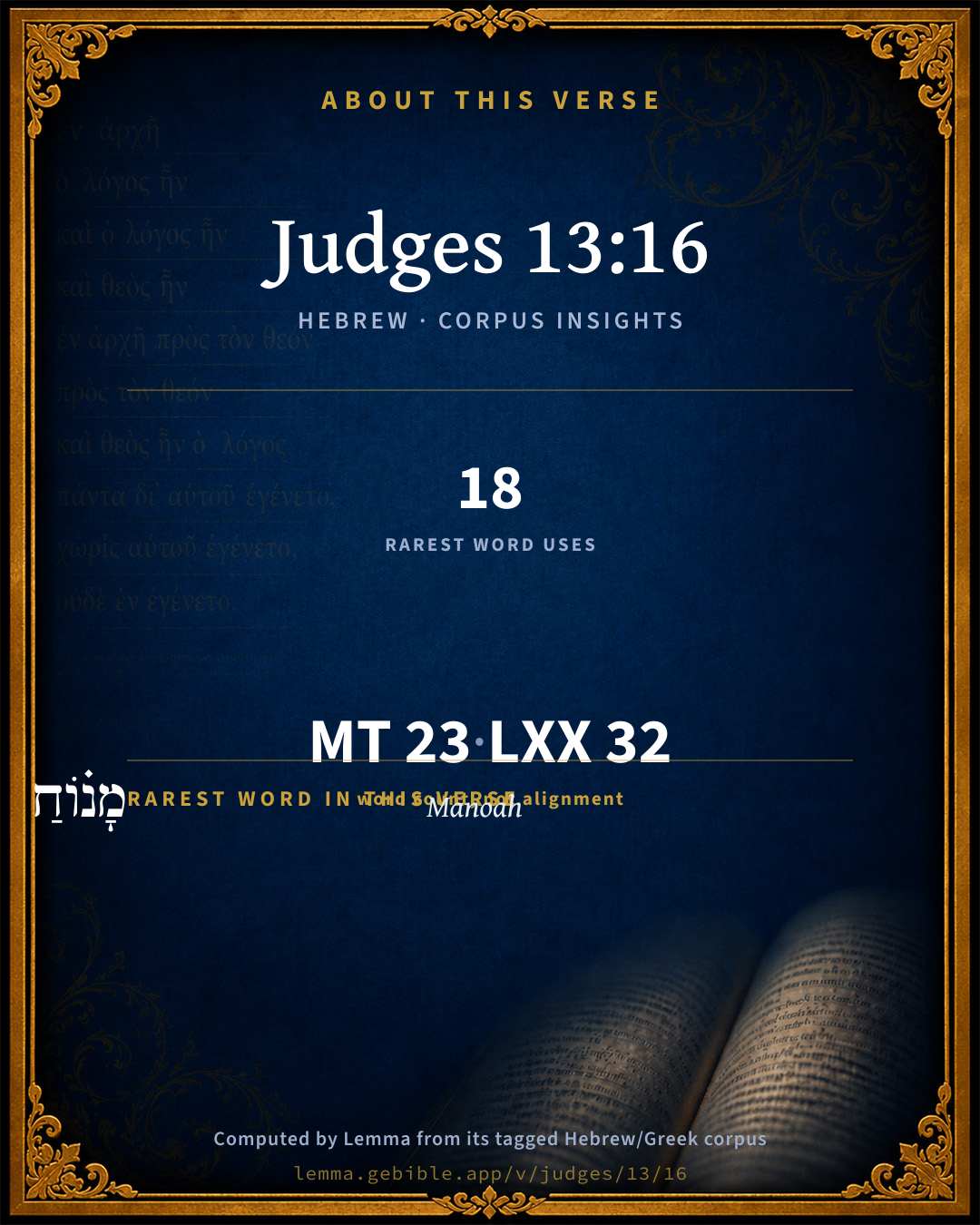
The rarest word here is מָנ֗וֹחַ Manoah H4495 — appearing just 18 times in the whole Hebrew Bible.

Shared distinctive vocabulary

מָנ֗וֹחַ Manoah H4495 occurs in 14 verses of the Hebrew Bible. Also found in:

Grammatical profile

  • 6 verbs
  • 9 nouns
  • 1 pronoun
  • 1 preposition
  • 4 conjunctions
  • 2 particles

Verb forms

  • וַיֹּאמֶר֩ Qal · Sequential Imperfect
  • תַּעְצְרֵ֨נִי֙ Qal · Imperfect
  • אֹכַ֣ל Qal · Imperfect
  • תַּעֲשֶׂ֣ה Qal · Imperfect
  • תַּעֲלֶ֑נָּה Hiphil · Imperfect
  • יָדַ֣ע Qal · Perfect

Repetition

Words recur within this verse — often emphatic in Hebrew:

  • יְהוָ֜ה LORD H3068 ×3
  • מַלְאַ֨ךְ messenger H4397 ×2
  • מָנ֗וֹחַ Manoah H4495 ×2
  • אִם if H518 ×2
  • לֹא not H3808 ×2
  • כִּ֚י that H3588 ×2

Hebrew & Septuagint length

In English translation the verse runs 43 words from the Hebrew and 49 from the Septuagint (LXX English) — closely comparable.

A rough comparison of the two English renderings, which tokenize alike — not a word-level alignment.

Word counts can differ between the Hebrew and the Greek without any difference in meaning — e.g. the Hebrew direct-object marker אֵת has no separate Greek word, and Greek often adds the article ὁ.

In the original languages it is 23 Hebrew tokens and 32 Greek tokens — but the two are counted differently (Hebrew bundles its prefixes and suffixes into one token; the Greek is in lemma form), so that isn’t a like-for-like length.

Cross-references

3

Topical passages linked to Judges 13:16 in the Treasury of Scripture Knowledge — connected by theme and wording, ordered by reader-vote popularity; previews shown in the World English Bible.

  • Judges 13:23 But his wife said to him, If Yahweh were pleased to kill us, he wouldn't have received a burnt offering and a meal-offering at our hand, neither would he have shown us all these things, nor would at this time have told such things as these.
  • Judges 6:20 The angel of God said to him, Take the flesh and the unleavened cakes, and lay them on this rock, and pour out the broth. He did so.
  • Judges 6:26 and build an altar to Yahweh your God on the top of this stronghold, in the orderly manner, and take the second bull, and offer a burnt offering with the wood of the Asherah which you shall cut down.

Cross-references courtesy of OpenBible.info (CC BY 4.0).

Hebrew and Greek witnesses Masoretic Hebrew ↔ Greek Septuagint

The same verse in the two great witnesses to the Old Testament, shown verse-for-verse.

These are two independent witnesses, not word-aligned to each other, and the Septuagint is shown in lemma (dictionary) form.

Hebrew Judges 13:16 Masoretic · Westminster Leningrad Codex

וַיֹּאמֶר֩ מַלְאַ֨ךְ יְהוָ֜ה אֶל מָנ֗וֹחַ אִם תַּעְצְרֵ֨נִי֙ לֹא אֹכַ֣ל בְּלַחְמֶ֔ךָ וְאִם תַּעֲשֶׂ֣ה עֹלָ֔ה לַיהוָ֖ה תַּעֲלֶ֑נָּה כִּ֚י לֹא יָדַ֣ע מָנ֔וֹחַ כִּֽי מַלְאַ֥ךְ יְהוָ֖ה הֽוּא

The angel of Yahweh said to Manoah, Though you detain me, I won't eat of your bread; and if you will make ready a burnt offering, you must offer it to Yahweh. For Manoah didn't know that he was the angel of Yahweh.

World English Bible · Public Domain

Greek LXX Judges 13:16 Septuagint · lemma form

καί εἶπον ὁ ἄγγελος κύριος πρός μανωε ἐάν καταἔχω ἐγώ οὐ ἐσθίω ἀπό ὁ ἄρτος σύ καί ἐάν ποιέω ὁλοκαύτωμα ὁ κύριος ἀναφέρω αὐτός ὅτι οὐ γιγνώσκω μανωε ὅτι ἄγγελος κύριος αὐτός

And the angel of the Lord said to Manoe, If you should detain me, I will not eat of your bread; and if you would offer a whole burnt offering, to the Lord you shall offer it: for Manoe knew not that he was an angel of the Lord.

LXX2012 (modern English Septuagint) · Public Domain

Hebrew: Westminster Leningrad Codex (CC BY 4.0). Greek: Septuagint (public domain); English from LXX2012 (modern English Septuagint) (Public Domain). How the Septuagint differs from the Hebrew →

Targum (Aramaic paraphrase)

1

The Targum is the ancient Jewish Aramaic paraphrase of the Hebrew Scriptures — an interpretive translation, not the Hebrew text itself. Onkelos (literal) and Pseudo-Jonathan (expansive) render the Torah, and Jonathan the Prophets. Coverage is partial: where no permissively-licensed English translation exists for a verse, only the Aramaic is shown. This is verse-level text, not a word-by-word alignment to the Hebrew.

  1. Targum Jonathan Prophets (Joshua–Malachi)
    וַאֲמַר מַלְאָכָא דַייָ לְמָנוֹחַ אִם תַּחֲדִינַנִי לָא אֵיכוּל בְּלַחְמָךְ וְאִם תַּעְבֵּיד עֲלָתָא קֳדָם יְיָ תַּסְקִינָהּ אֲרֵי לָא יְדַע מָנוֹחַ אֲרֵי מַלְאָכָא דַייָ הוּא:

    (no public-domain English translation for this verse)

    Targum Jonathan — Aramaic: “Mikraot Gedolot” (public domain). English: “Sefaria Community Translation” (CC0 1.0 (public-domain dedication)); “London "Chaldee Paraphrase," 1871” (public domain). Text via Sefaria.

Commentary

Notes on Judges 13:16 from classic Christian and Jewish commentators (each source and its license shown beneath its notes). The classic Christian expositions comment on the surrounding passage and are grouped to its opening verse, so a note may address several verses; the Jewish commentaries on the Tanakh (Rashi and others) are per-verse, so they appear only where the commentator wrote on this verse.

Lemma curates 59 commentaries, every one of them public domain or Creative Commons licensed, each selected and text-cleaned for this edition rather than reprinted as found. About our sources →

Trapp's Complete Commentary

John Trapp

Jdg 13:16 And the angel of the LORD said unto Manoah, Though thou detain me, I will not eat of thy bread: and if thou wilt offer a burnt offering, thou must offer it unto the LORD. For Manoah knew not that he [was] an angel of the LORD.

Ver. 16. I will not eat of thy bread.] I need it not, as you mortal wights do, since Animantis cuiusque vita in fuga est, your life must be upheld by food, but not so mine: I am more than a creature. It is by degrees that Christ revealeth himself.

And if thou wilt offer a burnt offering.] Thou must be a willing offerer: God straineth upon no man. Virtus nolentium nulla est.

Thou must offer it unto the Lord.] And therefore to me, who am Aυτοθεος, very God.

John Trapp, A Commentary or Exposition upon All the Books of the Old and New Testament (1647–1656) — public domain. Text from a community e-Sword module.

Geneva Bible (1599)

Geneva Bible translators

Showing, that he sought not his own honor but God’s, whose messenger he was.

Geneva Bible (1599) marginal notes — public domain. Text via Bolls.life.

Adam Clarke's Commentary

Verse 16. I will not eat of thy bread] As I am a spiritual being, I subsist not by earthly food.

And if thou wilt offer a burnt-offering] Neither shall I receive that homage which belongs to God; thou must therefore offer thy burnt-offering to Jehovah.

Adam Clarke's Commentary on the Bible (1810–1826) — public domain. Text from a community e-Sword/MySword module.

Ellicott's Commentary for English Readers

(16) Thou must offer it unto the Lord.—Rather, a burnt offering unto the Lord thou mayest offer it. (Comp. Jdg_6:20.) Angels invariably discourage and reprove that “worship of angels” (Col_2:18), which was the tendency of early Gnostic sects (Daniel 10; Rev_19:10; Rev_22:8). The angel might have partaken of earthly food, as we see from Gen_18:8; Gen_19:3. Hence Milton says:—

“Food alike these pure

Intelligential substances require,

As doth your rational.”—Par. Lost, 5:418.

A Bible Commentary for English Readers, edited by Charles John Ellicott (1878–1897) — public domain. Text from a community e-Sword module.

The Cambridge Bible for Schools and Colleges

gen. ed. J. J. S. Perowne

16. I will not eat of thy bread] in the general sense of food; cf. Gen_3:19; Gen_47:12, 1Sa_14:24, Psa_136:25. Note the advance in religious ideas: in Gen_18:8 the Angels eat the meal which Abraham provides; in ch. Jdg_6:18 ff. Gideon is allowed to prepare and cook a meal, but it is consumed by fire, not by the Angel; here the very notion of a meal is repelled (cf. Tob_12:19); if anything is to be presented it must be a burnt offering, and offered to Jehovah. The clause For M. knew not etc. would come more suitably at the end of Jdg_13:15.

The Cambridge Bible for Schools and Colleges (gen. ed. J. J. S. Perowne; Cambridge University Press, 1878–1918) — public domain. Text from a community e-Sword module.

John Gill's Exposition

And the angel of the Lord said unto Manoah,.... In answer to his request:

though thou detain me, I will not eat of thy bread; that is, should he be prevailed upon to stay awhile with him, until an entertainment should be got ready, he would not eat of any of his provisions; for "bread" is put for all eatables, or whatsoever he might provide for the entertainment:

and if, or "but if" (n).

thou wilt offer a burnt offering, thou must offer it unto the Lord; if he meant to provide not a festival entertainment, but a sacrifice, then he should take care that he did not offer it to strange gods, as was now very much the custom with Israel in this their time of apostasy, Jdg 13:1 but to the true Jehovah, and not to a servant of his, a prophet or an angel, but to himself:

for Manoah knew not that he was an angel of the Lord; he took him to be a man, a prophet sent of God, and not an angel; and much less the uncreated one, to whom as such only the sacrifice could be offered.

(n) "si autem", V. L. "quod si", Tigurine version; "sin autem", Junius & Tremellius; "si vero", Piscator.

John Gill's Exposition of the Whole Bible (1746–1763) — public domain (CC PDM 1.0). Text via the HelloAO Bible API.

Haydock's Catholic Bible Commentary

Bread is put for all sorts of food. Angels eat none, Tobias xii. 19. (Menochius)

George Leo Haydock (1774–1849), Haydock's Catholic Family Bible and Commentary, 1859 edition — public domain. Excludes Psalms (Douay-Rheims chapter numbering differs from Protestant) and Deuterocanonical books (Catholic canon only).

Matthew Poole's English Annotations

Bread, i.e. meat, as bread is commonly taken in Scripture.

Unto the Lord; not unto a man, as now thou apprehendest me to be; but unto the Lord, as thou wilt by and by perceive me to be.

Matthew Poole's English Annotations on the Holy Bible (1683–1685) — public domain. Text from a community e-Sword/MySword module.

Whedon's Commentary on the Bible

Daniel D. Whedon

16. I will not eat of thy bread — But the same Angel did eat of the food (Gen_18:8) which Abraham prepared; why not do the same with Manoah? Abraham, we may answer, was “heir of the world,” (Rom_4:13,) and a far more important person in the history of the Old Covenant than Manoah, and so with him the Jehovah-Angel might well come into closer fellowship than with other saints.

For Manoah knew not — This statement is given as a reason for the Angel’s suggestion that Manoah might, perhaps, now appropriately offer a burnt offering to Jehovah. He does not tell him that he is the Angel Jehovah, but he powerfully suggests that thought to the mind of Manoah, and thus leads the latter to inquire after his name.

Daniel D. Whedon (gen. ed.), Commentary on the Old and New Testaments (1874–1909) — public domain. Text from a community e-Sword module.

The Pulpit Commentary

I will not eat of thy bread, etc. The angel refuses to eat of his meat, but suggests that if he would offer the kid as a burnt offering, he must offer it to the Lord. The angel, perhaps perceiving that Manoah was in doubt as to who he might be, had a holy dread lest he might offer the kid to him, just as the angel whom St. John was about to worship said, "See thou do it not"; (Rev_22:9) and Barnabas and Paul ran in among the people of Lycaonia to restrain them from offering sacrifice to them. (Act_14:14-18) The order of the words, which is rightly given in the A.V, makes it a clear direction to offer the sacrifice to no one but the Lord.

The Pulpit Commentary (1880–1919), ed. H.D.M. Spence-Jones & Joseph S. Exell — public domain. Text from a community e-Sword module.

John Wesley's Explanatory Notes

Bread - That is, meat, as bread is commonly taken in scripture. To the Lord - Not unto a man, as thou apprehendest me to be; but unto the Lord, as thou wilt by and by perceive me to be.

John Wesley, Explanatory Notes Upon the Whole Bible (1754–1765) — public domain. Text via the GEBible commentary corpus.

Keil & Delitzsch

C. F. Keil & F. Delitzsch

The angel of the Lord replied, "If thou wilt detain me (sc., that I may eat), I will not eat of thy food (אכל with בּ, to eat thereat, i.e., thereof, as in Exo 12:43; Lev 22:11); but if thou wilt prepare a burnt-offering for Jehovah, then offer it."

Keil & Delitzsch — Biblical Commentary on the Old Testament (1861–1891) — public domain (CC PDM 1.0). Text via the HelloAO Bible API. (Old Testament only.)

Lesson kit

Teaching starters — assembled from the data on this page, not authored interpretation. Every prompt links to the verse data it draws on. Edit before teaching.

Judges, in the Historical, opens this verse with 23 words (16 distinct Hebrew lemmas). Its most distinctive word is Mânôwach (“Manoah”). A historical commentator’s framing appears above. Read the whole chapter for the surrounding context.

Discussion questions

  1. What does “Manoah” (Mânôwach) contribute to the verse as a whole?
  2. How does Judges 13:2, which shares the word «Manoah», read alongside this verse?
  3. What does the repetition of “LORD” (3× in this one verse) do in this verse?
  4. The translations on this page render this verse differently — a whole-verse word diff, not a word-by-word alignment. What might account for the different wordings?
  5. «וַיֹּאמֶר֩» is a Qal Sequential Imperfect verb. How does that grammatical form shape the action described?
  6. Compare how Trapp's Complete Commentary and Geneva Bible (1599) read this verse. Where do they agree or differ?

Things to notice

Reading settings

Reading text

Shown beneath each verse's original-language words.

Old Testament
Old Testament edition

Read the OT as the Masoretic Hebrew (MT) or the Greek Septuagint (LXX).

English shown for the Greek Septuagint (in the Hebrew ↔ Greek comparison).

Comparing translations? Open the Compare panel on any verse page to stack up to four side by side.