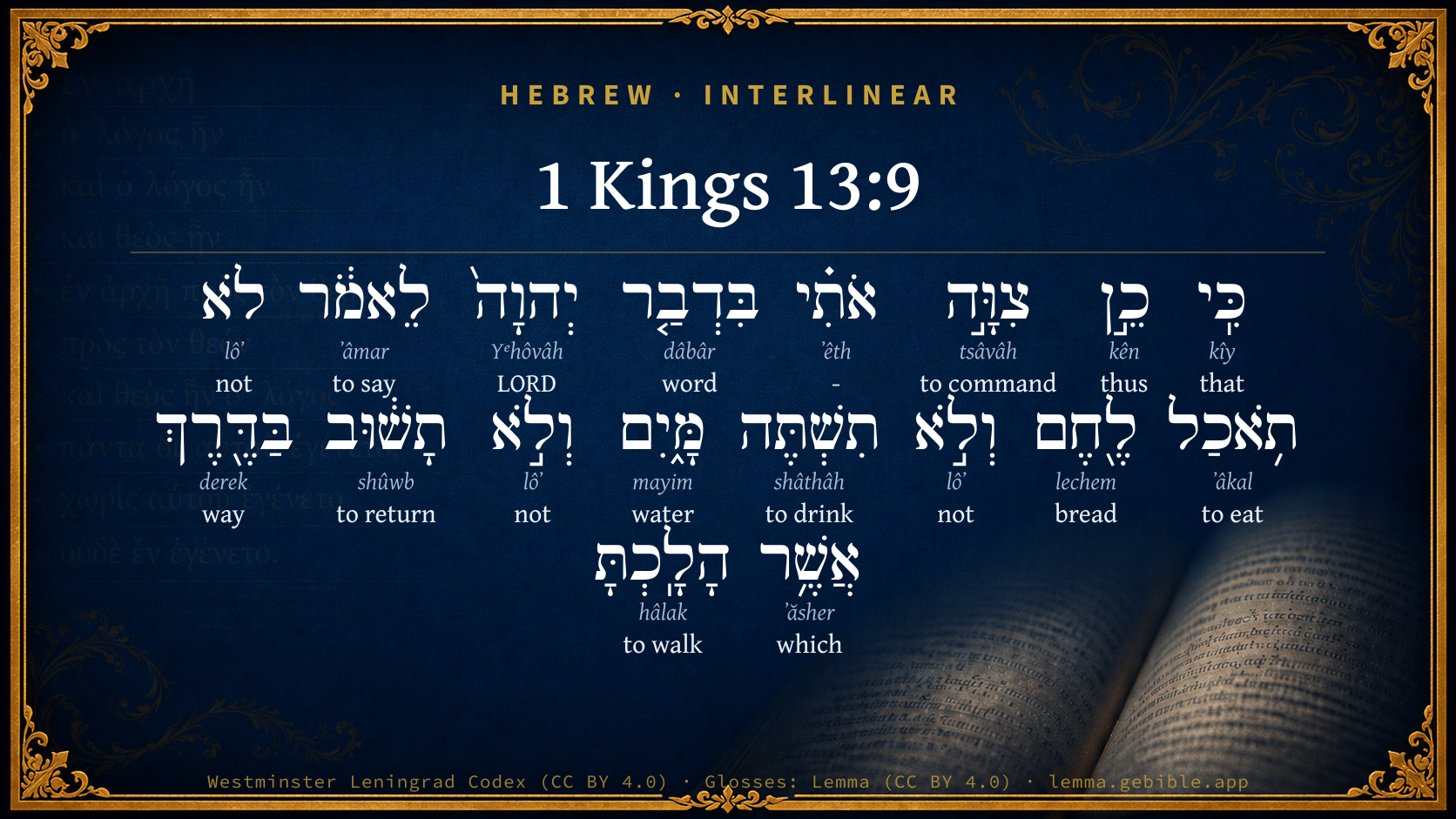
1 Kings 13:9

Hebrew (Westminster Leningrad Codex) 1 Kings 13:9 appears in the Hebrew Old Testament. The text above is from the Westminster Leningrad Codex. Each word links to its Strong’s number, a concise gloss, and parsing drawn from the Open Scriptures Hebrew Bible morphology. Click any word for its full Brown-Driver-Briggs (BDB) entry.
Download image
Cite this verse

1 Kings 13:9 (World English Bible). Public Domain. Lemma interlinear Bible study tool, https://lemma.gebible.app/v/1-kings/13/9.

Show BibTeX & RIS
BibTeX
RIS
English Translation
for so was it charged me by the word of Yahweh, saying, You shall eat no bread, nor drink water, neither return by the way that you came.
World English Bible · Public Domain
Download a study sheet

One document with this verse’s original text, its word-by-word gloss line, the meaning frame, cross-references with their text, attributed commentary, and full source and license credits — printable, and it pastes into notes with its structure intact.

This verse Autodidact and up

Study sheet (.html) Plain text (.txt)

A passage Seminary Student

Up to 50 verses in one chapter. A passage sheet keeps up to 6 commentary sources and 12 cross-references per verse, in the order this page ranks them, and says so on the sheet whenever that leaves anything out. Ask for a single verse and you get the Autodidact verse sheet above.

Everything on this page stays free to read, with no account — the sheet is a download of what is already on screen, not access to it.

Want to remove ads? Support Godless Engineer
Compare translations 3

The same verse in 3 English versions, stacked beneath the original-language interlinear above. Click any original word for its lexicon entry.

Each is an independent rendering of the whole verse — the interlinear is not word-aligned to these translations.

Highlighted words mark where these versions differ — a whole-verse word diff, not a word-by-word alignment.

  • World English Bible Public Domain
    for so was it charged me by the word of Yahweh, saying, You shall eat no bread, nor drink water, neither return by the way that you came.
  • King James Version Public Domain
    For so was it charged me by the word of the LORD, saying, Eat no bread, nor drink water, nor turn again by the same way that thou camest.
  • unfoldingWord Literal Text CC BY-SA 4.0
    For thus he has commanded me by the word of Yahweh, saying, ‘You shall not eat bread, and you shall not drink water, and you shall not return by the road which you went.’”

unfoldingWord Literal Text — © unfoldingWord, licensed CC BY-SA 4.0. Word-aligned USFM3 via Door43 (git.door43.org/unfoldingWord/en_ult).

Versions to compare (up to 4)

3 of 4 selected

Show all 18 translations

Every available English version of this verse, each an independent rendering of the whole verse.

  • World English Bible Public Domain
    for so was it charged me by the word of Yahweh, saying, You shall eat no bread, nor drink water, neither return by the way that you came.
  • Berean Standard Bible Public Domain
    For this is what I was commanded by the word of the LORD: ‘You must not eat bread or drink water or return by the way you came.’”
  • Majority Standard Bible Public Domain
    For this is what I was commanded by the word of the LORD: ‘You must not eat bread or drink water or return by the way you came.’”
  • King James Version Public Domain
    For so was it charged me by the word of the LORD, saying, Eat no bread, nor drink water, nor turn again by the same way that thou camest.
  • American Standard Version (1901) Public Domain
    for so was it charged me by the word of Jehovah, saying, Thou shalt eat no bread, nor drink water, neither return by the way that thou camest.
  • Revised Version (1885) Public Domain
    for so was it charged me by the word of the LORD, saying, Thou shalt eat no bread, nor drink water, neither return by the way that thou camest.
  • Geneva Bible (1599) Public Domain
    For so was it charged mee by the worde of the Lord, saying, Eate no bread nor drinke water, nor turne againe by the same way that thou camest.
  • Douay-Rheims (1899) Public Domain
    For so it was enjoined me by the word of the Lord commanding me: Thou shalt not eat bread nor drink water, nor return by the same way that thou camest.
  • Young's Literal Translation Public Domain
    for so He commanded me by the word of Jehovah, saying, Thou dost not eat bread nor drink water, nor turn back in the way that thou hast come.'
  • Literal Standard Version CC BY-SA 4.0
    for so He commanded me by the word of YHWH, saying, You do not eat bread nor drink water, nor return in the way that you have come.”
  • Unlocked Literal Bible CC BY-SA 4.0
    because Yahweh commanded me by his word, 'You will eat no bread nor drink water, nor return by the way that you came.'”
  • unfoldingWord Literal Text CC BY-SA 4.0
    For thus he has commanded me by the word of Yahweh, saying, ‘You shall not eat bread, and you shall not drink water, and you shall not return by the road which you went.’”
  • Darby Bible Public Domain
    for so was it charged me by the word of Jehovah, saying, Thou shalt eat no bread, nor drink water, nor return by the way that thou shalt go.
  • World Messianic Bible Public Domain
    for so was it commanded me by the LORD’s word, saying, ‘You shall eat no bread, drink no water, and don’t return by the way that you came.’”
  • Webster's Bible Public Domain
    For so was it charged me by the word of the LORD, saying, Eat no bread, nor drink water, nor turn again by the same way that thou camest.
  • Free Bible Version CC BY-SA 4.0
    The Lord ordered me not to eat or drink anything, and not to return by the way I came.”
  • Bible in Basic English Public Domain
    For so I was ordered by the word of the Lord, who said, You are not to take food or a drink of water, and you are not to go back the way you came.
  • JPS Tanakh (1917) Public Domain
    For it so was charged me by the word of the LORD, saying: Thou shalt eat no bread, nor drink water, neither return by the way that thou camest.'

Literal Standard Version (2020), Covenant Press — licensed CC BY-SA 4.0. Text via the HelloAO Bible API (eBible.org). Unlocked Literal Bible (unfoldingWord) — licensed CC BY-SA 4.0. Text via the HelloAO Bible API (eBible.org). unfoldingWord Literal Text — © unfoldingWord, licensed CC BY-SA 4.0. Word-aligned USFM3 via Door43 (git.door43.org/unfoldingWord/en_ult). Free Bible Version, Dr. Jonathan Gallagher — licensed CC BY-SA 4.0. Text via the HelloAO Bible API (eBible.org).

Word by word

More ways to search: Search by grammar → Find every occurrence → Compare this word →

Practice this passage: Drill this verse → Learn its vocabulary →

תִשְׁתֶּה
shâthâh
H8354
“to drink”
Verb, Qal, Imperfect, 2nd Person, Masculine, Singular
Part of Speech
Verb
Stem
Qal
Form
Imperfect
Person
2nd Person
Gender
Masculine
Number
Singular
Full BDB Definition

Origin: a primitive root

TWOT: 2477

to drink - (Qal) - to drink - of drinking cup of God's wrath, of slaughter, of wicked deeds (figuratively) - to feast - (Niphal) to be drunk
  1. כִּֽי kîy H3588 “that” Conjunction
  2. כֵ֣ן kên H3651 “thus” Adverb
  3. צִוָּ֣ה tsâvâh H6680 “to command” Verb, Piel, Perfect, 3rd Person, Masculine, Singular
  4. אֹתִ֗י ʼêth H853 “- · me” Particle, Direct Object + Suffix, Personal, 1st Person, Common, Singular
  5. בִּדְבַ֤ר dâbâr H1697 “in/at · word of” Preposition + Noun, Common, Masculine, Singular, Construct
  6. יְהוָה֙ Yᵉhôvâh H3068 “LORD” Noun, Proper
  7. לֵאמֹ֔ר ʼâmar H559 “to say” Preposition + Verb, Qal, Infinitive Construct
  8. לֹא lôʼ H3808 “not” Particle, Negative
  9. תֹ֥אכַל ʼâkal H398 “to eat” Verb, Qal, Imperfect, 2nd Person, Masculine, Singular
  10. לֶ֖חֶם lechem H3899 “bread” Noun, Common, Both, Singular, Absolute
  11. וְלֹ֣א lôʼ H3808 “and · not” Conjunction + Particle, Negative
  12. מָּ֑יִם mayim H4325 “water(s)” Noun, Common, Masculine, Plural, Absolute
  13. וְלֹ֣א lôʼ H3808 “and · not” Conjunction + Particle, Negative
  14. תָשׁ֔וּב shûwb H7725 “to return” Verb, Qal, Imperfect, 2nd Person, Masculine, Singular
  15. בַּדֶּ֖רֶךְ derek H1870 “in/at the · way” Preposition, Determined + Noun, Common, Both, Singular, Absolute
  16. אֲשֶׁ֥ר ʼăsher H834 “which” Particle, Relative
  17. הָלָֽכְתָּ hâlak H1980 “to walk” Verb, Qal, Perfect, 2nd Person, Masculine, Singular

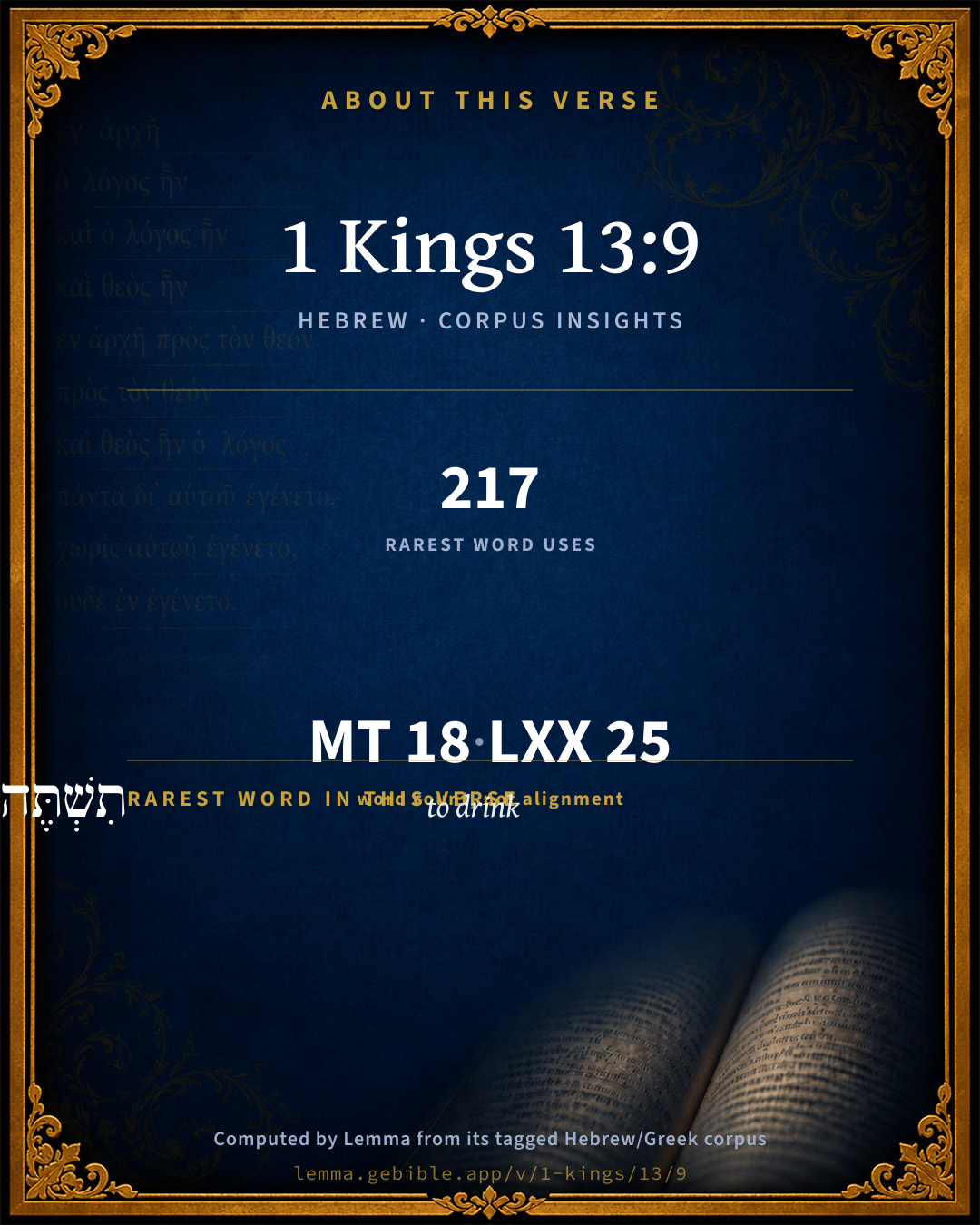
About this verse

These counts appear in no published source. They are computed here, from the morphology-tagged text and Lemma’s own curated glosses. What Lemma adds →

18
words
16
distinct lemmas
Historical
section

Grammatical profile

  • 6 verbs
  • 5 nouns
  • 1 conjunction
  • 1 adverb
  • 5 particles

Verb forms

  • צִוָּ֣ה Piel · Perfect
  • לֵאמֹ֔ר Qal · Infinitive Construct
  • תֹ֥אכַל Qal · Imperfect
  • תִשְׁתֶּה Qal · Imperfect
  • תָשׁ֔וּב Qal · Imperfect
  • הָלָֽכְתָּ Qal · Perfect

Repetition

A word recurs within this verse — often emphatic in Hebrew:

Hebrew & Septuagint length

In English translation the verse runs 28 words from the Hebrew and 17 from the Septuagint (LXX English) — the Septuagint runs noticeably shorter here. See the side-by-side →

A rough comparison of the two English renderings, which tokenize alike — not a word-level alignment.

Word counts can differ between the Hebrew and the Greek without any difference in meaning — e.g. the Hebrew direct-object marker אֵת has no separate Greek word, and Greek often adds the article ὁ.

In the original languages it is 18 Hebrew tokens and 25 Greek tokens — but the two are counted differently (Hebrew bundles its prefixes and suffixes into one token; the Greek is in lemma form), so that isn’t a like-for-like length.

Cross-references

15

Topical passages linked to 1 Kings 13:9 in the Treasury of Scripture Knowledge — connected by theme and wording, ordered by reader-vote popularity; previews shown in the World English Bible.

  • Job 23:12 I haven't gone back from the commandment of his lips. I have treasured up the words of his mouth more than my necessary food.
  • John 13:17 If you know these things, blessed are you if you do them.
  • John 15:9–10 Even as the Father has loved me, I also have loved you. Remain in my love.
  • John 15:14 You are my friends, if you do whatever I command you.
  • Romans 16:17 Now I beg you, brothers, look out for those who are causing the divisions and occasions of stumbling, contrary to the doctrine which you learned, and turn away from them.
  • Numbers 16:26 He spoke to the congregation, saying, Depart, I pray you, from the tents of these wicked men, and touch nothing of theirs, lest you be consumed in all their sins.
  • Deuteronomy 13:13–18 Certain base fellows are gone out from the midst of you, and have drawn away the inhabitants of their city, saying, Let us go and serve other gods, which you have not known;
  • 1 Samuel 15:22 Samuel said, Has Yahweh as great delight in burnt offerings and sacrifices, as in obeying the voice of Yahweh? Behold, to obey is better than sacrifice, and to listen than the fat of rams.
  • 1 Kings 13:1 Behold, there came a man of God out of Judah by the word of Yahweh to Beth El: and Jeroboam was standing by the altar to burn incense.
  • 1 Kings 13:21–22 and he cried to the man of God who came from Judah, saying, Thus says Yahweh, Because you have been disobedient to the mouth of Yahweh, and have not kept the commandment which Yahweh your God commanded you,
  • Psalms 141:4 Don't incline my heart to any evil thing, To practice deeds of wickedness with men who work iniquity. Don't let me eat of their delicacies.
  • 1 Corinthians 5:11 But as it is, I wrote to you not to associate with anyone who is called a brother who is a sexual sinner, or covetous, or an idolater, or a slanderer, or a drunkard, or an extortioner. Don't even eat with such a person.
  • Ephesians 5:11 Have no fellowship with the unfruitful works of darkness, but rather even reprove them.
  • 2 John 1:10–11 If anyone comes to you, and doesn't bring this teaching, don't receive him into your house, and don't welcome him,
  • Revelation 18:4 I heard another voice from heaven, saying, "Come out of her, my people, that you have no participation in her sins, and that you don't receive of her plagues,

Cross-references courtesy of OpenBible.info (CC BY 4.0).

Hebrew and Greek witnesses Masoretic Hebrew ↔ Greek Septuagint

The same verse in the two great witnesses to the Old Testament, shown verse-for-verse.

Here the Septuagint runs noticeably shorter than the Hebrew — LXX2012 (modern English Septuagint) 17 words vs World English Bible 28. A rough length comparison of the two English translations, not a word-level alignment — read both below.

These are two independent witnesses, not word-aligned to each other, and the Septuagint is shown in lemma (dictionary) form.

Hebrew 1 Kings 13:9 Masoretic · Westminster Leningrad Codex

כִּֽי כֵ֣ן צִוָּ֣ה אֹתִ֗י בִּדְבַ֤ר יְהוָה֙ לֵאמֹ֔ר לֹא תֹ֥אכַל לֶ֖חֶם וְלֹ֣א תִשְׁתֶּה מָּ֑יִם וְלֹ֣א תָשׁ֔וּב בַּדֶּ֖רֶךְ אֲשֶׁ֥ר הָלָֽכְתָּ

for so was it charged me by the word of Yahweh, saying, You shall eat no bread, nor drink water, neither return by the way that you came.

World English Bible · Public Domain

Greek LXX 1 Kings 13:9 Septuagint · lemma form

ὅτι οὕτως ἐντέλλομαι ἐγώ ἐν λόγος κύριος λέγω μή ἐσθίω ἄρτος καί μή πίνω ὕδωρ καί μή ἐπιστρέφω ἐν ὁ ὁδός ὅς πορεύομαι ἐν αὐτός

Eat no bread, and drink no water, and return not by the way by which you came.

LXX2012 (modern English Septuagint) · Public Domain

Hebrew: Westminster Leningrad Codex (CC BY 4.0). Greek: Septuagint (public domain); English from LXX2012 (modern English Septuagint) (Public Domain). How the Septuagint differs from the Hebrew →

Targum (Aramaic paraphrase)

1

The Targum is the ancient Jewish Aramaic paraphrase of the Hebrew Scriptures — an interpretive translation, not the Hebrew text itself. Onkelos (literal) and Pseudo-Jonathan (expansive) render the Torah, and Jonathan the Prophets. Coverage is partial: where no permissively-licensed English translation exists for a verse, only the Aramaic is shown. This is verse-level text, not a word-by-word alignment to the Hebrew.

  1. Targum Jonathan Prophets (Joshua–Malachi)
    אֲרֵי כֵן פַקֵיד יָתִי בְּפִתְגָמָא דַייָ לְמֵימַר לָא תֵיכוּל לַחְמָא וְלָא תִשְׁתֵּי תַמָן מַיָא וְלָא תְתוּב בְּאוֹרְחָא דַאֲזַלְתָּא:

    (no public-domain English translation for this verse)

    Targum Jonathan — Aramaic: “Mikraot Gedolot” (public domain). English: “Sefaria Community Translation” (CC0 1.0 (public-domain dedication)); “London "Chaldee Paraphrase," 1871” (public domain). Text via Sefaria.

Commentary

Notes on 1 Kings 13:9 from classic Christian and Jewish commentators (each source and its license shown beneath its notes). The classic Christian expositions comment on the surrounding passage and are grouped to its opening verse, so a note may address several verses; the Jewish commentaries on the Tanakh (Rashi and others) are per-verse, so they appear only where the commentator wrote on this verse.

Lemma curates 59 commentaries, every one of them public domain or Creative Commons licensed, each selected and text-cleaned for this edition rather than reprinted as found. About our sources →

Trapp's Complete Commentary

John Trapp

1Ki 13:9 For so was it charged me by the word of the LORD, saying, Eat no bread, nor drink water, nor turn again by the same way that thou camest.

Ver. 9. Eat no bread, nor drink water.] Figura haec erat Ecclesiasticae censurae et excommunicationis, say Cyprian and Rupert; this figured out the censure of the Church against heretics, and other foul offenders, {1Co 5:11} "with such a one, no, not to eat" or consort, "that they may be ashamed." {2Th 3:14}

Nor turn again by the same way.] God thought the worse of the way to that wicked place, where Satan’s throne was.

John Trapp, A Commentary or Exposition upon All the Books of the Old and New Testament (1647–1656) — public domain. Text from a community e-Sword module.

Geneva Bible (1599)

Geneva Bible translators

Seeing he had the express word of God, he ought not to have declined therefrom neither for the persuasion of man nor Angel.

Or, he charged me: to wit, an Angel.

Geneva Bible (1599) marginal notes — public domain. Text via Bolls.life.

Adam Clarke's Commentary

Verse 9. For so it was charged me - Eat no bread, c.] That is, Have no kind of communication with those idolaters. He was charged also not to return by the way that he came probably lest the account of what was done should have reached the ears of any of the people through whom he had passed, and he suffer inconveniences on the account, either by persecution from the idolaters, or from curious people delaying him, in order to cause him to give an account of the transactions which took place at Beth-el. This is a reason why he should not return by the same way; but what the reason of this part of the charge was, if not the above, is not easy to see.

Adam Clarke's Commentary on the Bible (1810–1826) — public domain. Text from a community e-Sword/MySword module.

Ellicott's Commentary for English Readers

(9) Nor turn again . . .—The significance of this command is less obvious. It may have meant that he should not suffer the way of his return (which would clearly not be the obvious way) to be known, but should vanish swiftly, like the messenger of Elisha to Jehu (2Ki_9:3; 2Ki_9:10), when his work was done. If so, his neglect of the spirit of the command was the first step in the way of his destruction.

A Bible Commentary for English Readers, edited by Charles John Ellicott (1878–1897) — public domain. Text from a community e-Sword module.

The Cambridge Bible for Schools and Colleges

gen. ed. J. J. S. Perowne

9. nor turn again by the same way] There is nothing in the original for ‘same’. Therefore the R.V. is more close to the text, in giving neither return by the way as in the following verse in A. V. The injunction to go back by another way was given lest after what happened in Bethel those who had seen him coming might try to detain him and he be thus tempted to lessen the effect of his mission. The refusal to eat and the hurried departure were to shew how the Lord was grieved at the national sin.

The Cambridge Bible for Schools and Colleges (gen. ed. J. J. S. Perowne; Cambridge University Press, 1878–1918) — public domain. Text from a community e-Sword module.

John Gill's Exposition

For so it was charged me by the word of the Lord,.... The command of the Lord, by which he came to Bethel, and cried against the altar there, Kg1 13:1.

saying, eat no bread, nor drink water, nor turn again by the same way that thou camest: signifying that no communion was to be had with idolaters, nor any example to be set and followed; but the way to them, and to their idolatry, was to be shunned and avoided.

John Gill's Exposition of the Whole Bible (1746–1763) — public domain (CC PDM 1.0). Text via the HelloAO Bible API.

Albert Barnes' Notes on the Bible

Eat no bread, nor drink water - The reason of the command is evident. The man of God was not to accept the hospitality of any dweller at Bethel, in order to show in a marked way, which men generally could appreciate, God’s abhorrence of the system which Jeroboam had “devised of his own heart.”

Nor turn again by the same way that thou camest - This command seems to have been given simply to test the obedience of the prophet by laying him under a positive as well as a moral obligation.

Albert Barnes' Notes on the Bible (1834–1885) — public domain. Text from a community e-Sword/MySword module.

Matthew Poole's English Annotations

My refusal of thy favour is not from any contempt or hatred of thy person, but in obedience to the just command of my God, who hath forbidden me all further converse or communication with thee.

Eat no bread, nor drink water, to wit, in that place, or with that people; whereby God declares how detestable they were in God’s eyes; not because their idolatry was so bad as that of the heathens, but because they were vile apostates from the true God, and embraced this idolworship against the light of their own consciences, merely to comply with the king’s humour and command; and because their vicinity and relation to the tribe of Judah made this more dangerous, as to their infection by it.

Nor turn again by the same way that thou camest; that by thy avoiding the way that led thee to Beth-el as execrable, although thou wentest by my special command, thou mightest teach all others how much they should abhor that way, and all thoughts of going to that place, or to such people, upon any trivial and unnecessary occasion.

Matthew Poole's English Annotations on the Holy Bible (1683–1685) — public domain. Text from a community e-Sword/MySword module.

Whedon's Commentary on the Bible

Daniel D. Whedon

9. Eat no bread… nor turn again by the same way — He must have no fellowship or communion with their works of darkness, not so much as even to eat and drink with them. Then he must also “deliver his message, as it were, in transitu — as he passes along. He shall not seem to be sent on purpose, but as if he only called by the way, his spirit being stirred, like Paul’s at Athens, as he passed and saw their devotions. God would, by this command, try his prophet, as he did Ezekiel, whether he would not be rebellious like that rebellious house.” Eze_2:8. — Henry.

Daniel D. Whedon (gen. ed.), Commentary on the Old and New Testaments (1874–1909) — public domain. Text from a community e-Sword module.

The Pulpit Commentary

For so was it charged Heb. he, sc. the Lord, charged me me by Heb. in the word of the Lord, saying, Fat no bread, nor drinkwater Participation in food the "eating salt is in the East a token of friendship and affinity; a sign of close communion and fellowship. The prophet"s refusal to participate was consequently a practical and forcible disclaimer of all fellowship, a virtual excommunication, a public repudiation of the calf worshippers. 1Co_5:11," With such a one, no, not to eat." As Corn. a Lapide," (Ut ipso facto ostenderet, Bethelitas idololatras adeo esse detestabiles, et a Deo quasi excommunicates, ut nullum fidelium cum iis cibi vel potus communionem habere velit ) nor turn again by the same way that thou camest. the object of this command was not "simply to test the obedience of the prophet" (Rawlinson), nor yet that no one might "force him to a delay which was irreconcilable with his commission" (Keil), for that was practically executed, but to avoid as far as possible what, indeed, happened in spite of these precautions his being traced and followed. Because of this provision, the old prophet (ver. 10) was reduced to ask, "What way went he?" But the charge, we can hardly doubt,was also designed to serve another purpose, viz., to warn the prophet against doing what he did presently against returning to Bethel. When he was followed, and when he was told of a revelation commanding his return, he should have remembered, among other things, that it had clearly been part of God"s purpose, as evidenced by the explicit instructions given him, that he should not be followed. This alone should have led him to suspect this old prophet of deceit.

The Pulpit Commentary (1880–1919), ed. H.D.M. Spence-Jones & Joseph S. Exell — public domain. Text from a community e-Sword module.

John Wesley's Explanatory Notes

For so, &c. - My refusal of thy favour, is not from any contempt, or hatred of thy person; but in obedience to the just command of my God, who hath forbidden me all father converse or communication with thee. Eat nor drink - In that place, or with that people. Whereby God declares, how detestable they were in God's eyes; because they were vile apostates from the true God, and embraced this idol-worship, against the light of their own consciences, merely to comply with the king's humour and command. Nor turn - That by thy avoiding the way that led thee to Beth-el as execrable, although thou wentest by my special command, thou mightest teach all others, how much they should abhor that way, and all thoughts of going to that place, or to such people, upon any unnecessary occasion.

John Wesley, Explanatory Notes Upon the Whole Bible (1754–1765) — public domain. Text via the GEBible commentary corpus.

Lesson kit

Teaching starters — assembled from the data on this page, not authored interpretation. Every prompt links to the verse data it draws on. Edit before teaching.

1 Kings, in the Historical, opens this verse with 18 words (16 distinct Hebrew lemmas). Its most distinctive word is shâthâh (“to drink”). The Greek Septuagint runs shorter here. A historical commentator’s framing appears above. Read the whole chapter for the surrounding context.

Discussion questions

  1. The word shâthâh carries the sense “to drink.” How does it shape the verse?
  2. Job 23:12 shares this passage’s theme. How do the two illuminate each other?
  3. “not” occurs 3× in this one verse. What is the effect of the repetition?
  4. Compared with the Hebrew, the Septuagint runs shorter here. What questions does that raise?
  5. The translations on this page render this verse differently — a whole-verse word diff, not a word-by-word alignment. What might account for the different wordings?
  6. The verb «צִוָּ֣ה» is Piel Perfect. How does its form color the action?
  7. Reading how Trapp's Complete Commentary and Geneva Bible (1599) read this verse, where do the two commentators agree and where do they part?

Things to notice

Reading settings

Reading text

Shown beneath each verse's original-language words.

Old Testament
Old Testament edition

Read the OT as the Masoretic Hebrew (MT) or the Greek Septuagint (LXX).

English shown for the Greek Septuagint (in the Hebrew ↔ Greek comparison).

Comparing translations? Open the Compare panel on any verse page to stack up to four side by side.