
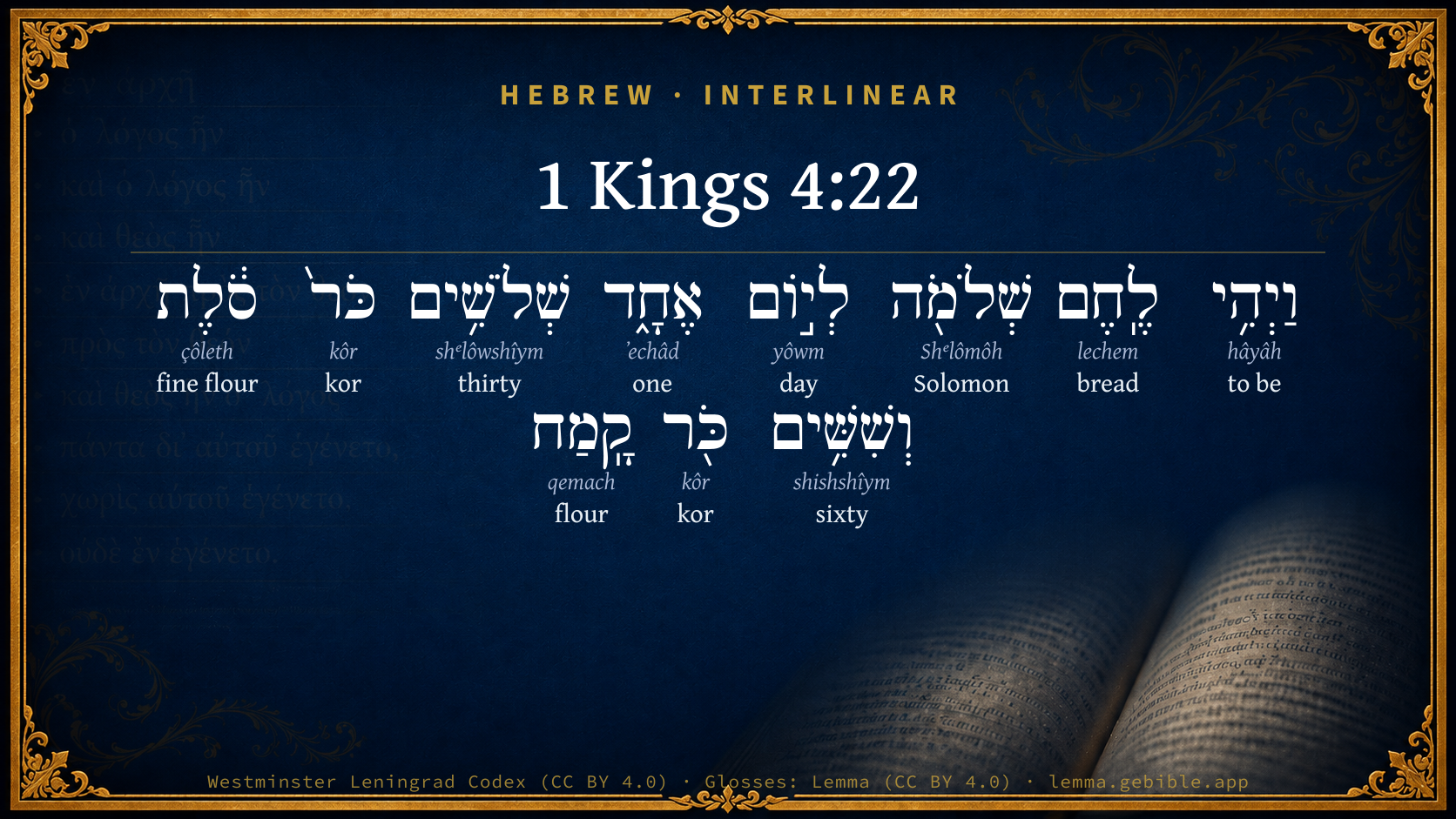
1 Kings 4:22

Hebrew (Westminster Leningrad Codex) 1 Kings 4:22 appears in the Hebrew Old Testament. The text above is from the Westminster Leningrad Codex. Each word links to its Strong’s number, a concise gloss, and parsing drawn from the Open Scriptures Hebrew Bible morphology. Click any word for its full Brown-Driver-Briggs (BDB) entry.
Download image
Cite this verse

1 Kings 4:22 (World English Bible). Public Domain. Lemma interlinear Bible study tool, https://lemma.gebible.app/v/1-kings/4/22.

Show BibTeX & RIS
BibTeX
RIS
English Translation
Solomon's provision for one day was thirty measures of fine flour, and sixty measures of meal,
World English Bible · Public Domain
Highlights Full analysis ↓
Download a study sheet

One document with this verse’s original text, its word-by-word gloss line, the meaning frame, cross-references with their text, attributed commentary, and full source and license credits — printable, and it pastes into notes with its structure intact.

This verse Autodidact and up

Study sheet (.html) Plain text (.txt)

A passage Seminary Student

Up to 50 verses in one chapter. A passage sheet keeps up to 6 commentary sources and 12 cross-references per verse, in the order this page ranks them, and says so on the sheet whenever that leaves anything out. Ask for a single verse and you get the Autodidact verse sheet above.

Everything on this page stays free to read, with no account — the sheet is a download of what is already on screen, not access to it.

Want to remove ads? Support Godless Engineer
Compare translations 3

The same verse in 3 English versions, stacked beneath the original-language interlinear above. Click any original word for its lexicon entry.

Each is an independent rendering of the whole verse — the interlinear is not word-aligned to these translations.

Highlighted words mark where these versions differ — a whole-verse word diff, not a word-by-word alignment.

  • World English Bible Public Domain
    Solomon's provision for one day was thirty measures of fine flour, and sixty measures of meal,
  • King James Version Public Domain
    And Solomon's provision for one day was thirty measures of fine flour, and threescore measures of meal,
  • unfoldingWord Literal Text CC BY-SA 4.0
    And the bread of Solomon for one day was 30 cors of fine flour and 60 cors of flour,

unfoldingWord Literal Text — © unfoldingWord, licensed CC BY-SA 4.0. Word-aligned USFM3 via Door43 (git.door43.org/unfoldingWord/en_ult).

Versions to compare (up to 4)

3 of 4 selected

Show all 18 translations

Every available English version of this verse, each an independent rendering of the whole verse.

  • World English Bible Public Domain
    Solomon's provision for one day was thirty measures of fine flour, and sixty measures of meal,
  • Berean Standard Bible Public Domain
    Solomon’s provisions for a single day were thirty cors of fine flour, sixty cors of meal,
  • Majority Standard Bible Public Domain
    Solomon’s provisions for a single day were thirty cors of fine flour, sixty cors of meal,
  • King James Version Public Domain
    And Solomon's provision for one day was thirty measures of fine flour, and threescore measures of meal,
  • American Standard Version (1901) Public Domain
    And Solomon's provision for one day was thirty measures of fine flour, and threescore measures of meal,
  • Revised Version (1885) Public Domain
    And Solomon’s provision for one day was thirty measures of fine flour, and threescore measures of meal;
  • Geneva Bible (1599) Public Domain
    And Salomons vitailes for one day were thirtie measures of fine floure, and threescore measures of meale:
  • Douay-Rheims (1899) Public Domain
    And the provision of Solomon for each day was thirty measures of fine flour, and threescore measures of meal,
  • Young's Literal Translation Public Domain
    And the provision of Solomon for one day is thirty cors of flour, and sixty cors of meal;
  • Literal Standard Version CC BY-SA 4.0
    And the provision of Solomon for one day is thirty cors of flour, and sixty cors of meal,
  • Unlocked Literal Bible CC BY-SA 4.0
    Solomon's provision for one day was thirty cors of fine flour and sixty cors of meal,
  • unfoldingWord Literal Text CC BY-SA 4.0
    And the bread of Solomon for one day was 30 cors of fine flour and 60 cors of flour,
  • Darby Bible Public Domain
    And Solomon's provision for one day was thirty measures of fine flour, and sixty measures of meal,
  • World Messianic Bible Public Domain
    Solomon’s provision for one day was thirty cors of fine flour, sixty measures of meal,
  • Webster's Bible Public Domain
    And Solomon's provision for one day was thirty measures of fine flour, and sixty measures of meal.
  • Free Bible Version CC BY-SA 4.0
    The food required every day for Solomon's court was thirty cors of the best flour and sixty cors of meal;
  • Bible in Basic English Public Domain
    And the amount of Solomon's food for one day was thirty measures of crushed grain and sixty measures of meal;
  • JPS Tanakh (1917) Public Domain
    (5-2) And Solomon's provision for one day was thirty measures of fine flour, and threescore measures of meal;

Literal Standard Version (2020), Covenant Press — licensed CC BY-SA 4.0. Text via the HelloAO Bible API (eBible.org). Unlocked Literal Bible (unfoldingWord) — licensed CC BY-SA 4.0. Text via the HelloAO Bible API (eBible.org). unfoldingWord Literal Text — © unfoldingWord, licensed CC BY-SA 4.0. Word-aligned USFM3 via Door43 (git.door43.org/unfoldingWord/en_ult). Free Bible Version, Dr. Jonathan Gallagher — licensed CC BY-SA 4.0. Text via the HelloAO Bible API (eBible.org).

Word by word

More ways to search: Search by grammar → Find every occurrence → Compare this word →

Practice this passage: Drill this verse → Learn its vocabulary →

כֹּר֙
kôr
H3734
“kor of”
Noun, Common, Masculine, Singular, Construct
Part of Speech
Noun
Type
Common
Gender
Masculine
Number
Singular
State
Construct
Full BDB Definition

Origin: from the same as H3564

TWOT: 1031

kor, a measure (usually dry) - a dry or liquid measure equal to 10 ephahs or baths - a dry measure containing 6.25 bushels (220 liters) - a liquid measure of 58 gallons (263 liters)
  1. וַיְהִ֥י hâyâh H1961 “and · to be” Conjunction + Verb, Qal, Sequential Imperfect, 3rd Person, Masculine, Singular
  2. לֶֽחֶם lechem H3899 “bread of” Noun, Common, Both, Singular, Construct
  3. שְׁלֹמֹ֖ה Shᵉlômôh H8010 “Solomon” Noun, Proper
  4. לְי֣וֹם yôwm H3117 “to/for · day” Preposition + Noun, Common, Masculine, Singular, Absolute
  5. אֶחָ֑ד ʼechâd H259 “one” Adjective, Cardinal number, Masculine, Singular, Absolute
  6. שְׁלֹשִׁ֥ים shᵉlôwshîym H7970 “thirty” Adjective, Cardinal number, Both, Plural, Absolute
  7. סֹ֔לֶת çôleth H5560 “fine flour” Noun, Common, Feminine, Singular, Absolute
  8. וְשִׁשִּׁ֥ים shishshîym H8346 “and · sixty” Conjunction + Adjective, Cardinal number, Both, Plural, Absolute
  9. כֹּ֖ר kôr H3734 “kor of” Noun, Common, Masculine, Singular, Construct
  10. קָֽמַח qemach H7058 “flour” Noun, Common, Masculine, Singular, Absolute

About this verse

These counts appear in no published source. They are computed here, from the morphology-tagged text and Lemma’s own curated glosses. What Lemma adds →

11
words
10
distinct lemmas
Historical
section

Notable vocabulary

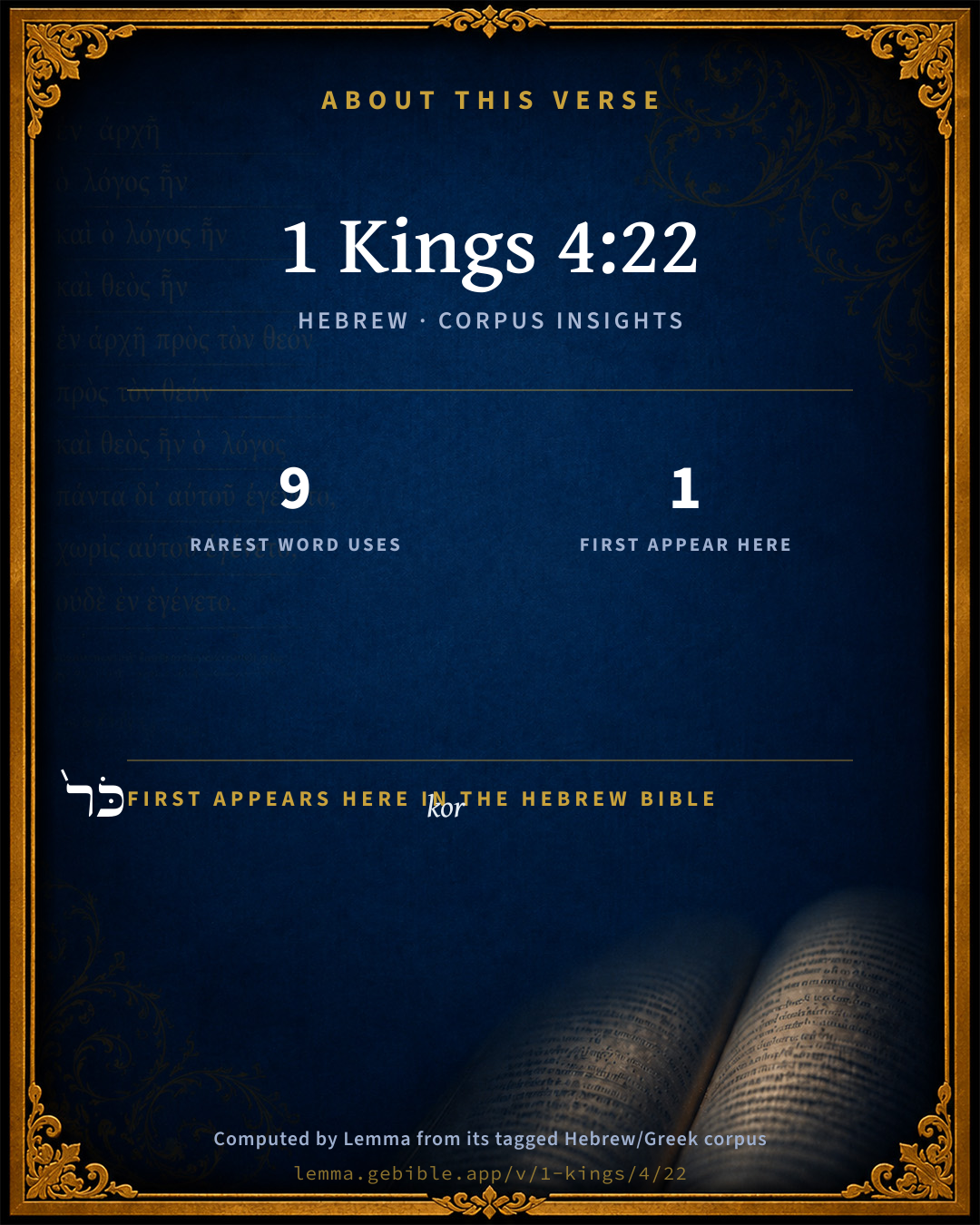
The rarest word here is כֹּר֙ kor H3734 — appearing just 9 times in the whole Hebrew Bible.

First appearance in Scripture

This word makes its first canonical appearance in the Hebrew Bible here:

Shared distinctive vocabulary

כֹּר֙ kor H3734 occurs in 6 verses of the Hebrew Bible. Also found in:

Grammatical profile

  • 1 verb
  • 7 nouns
  • 3 adjectives

Verb forms

  • וַיְהִ֥י Qal · Sequential Imperfect

Repetition

A word recurs within this verse — often emphatic in Hebrew:

  • כֹּר֙ kor H3734 ×2

Hebrew & Septuagint length

In English translation the verse runs 16 words from the Hebrew and 23 from the Septuagint (LXX English) — the Septuagint runs noticeably longer here. See the side-by-side →

A rough comparison of the two English renderings, which tokenize alike — not a word-level alignment.

Word counts can differ between the Hebrew and the Greek without any difference in meaning — e.g. the Hebrew direct-object marker אֵת has no separate Greek word, and Greek often adds the article ὁ.

Hebrew and Greek witnesses Masoretic Hebrew ↔ Greek Septuagint

The same verse in the two great witnesses to the Old Testament, shown verse-for-verse.

Here the Septuagint runs noticeably longer than the Hebrew — LXX2012 (modern English Septuagint) 23 words vs World English Bible 16. A rough length comparison of the two English translations, not a word-level alignment — read both below.

These are two independent witnesses, not word-aligned to each other, and the Septuagint is shown in lemma (dictionary) form.

Hebrew 1 Kings 4:22 Masoretic · Westminster Leningrad Codex

וַיְהִ֥י לֶֽחֶם שְׁלֹמֹ֖ה לְי֣וֹם אֶחָ֑ד שְׁלֹשִׁ֥ים כֹּר֙ סֹ֔לֶת וְשִׁשִּׁ֥ים כֹּ֖ר קָֽמַח

Solomon's provision for one day was thirty measures of fine flour, and sixty measures of meal,

World English Bible · Public Domain

Greek LXX 1 Kings 4:22 Septuagint · lemma form
And these were the requisite supplies for Solomon: in one day thirty measures of fine flour, and sixty measures of fine pounded meal,

LXX2012 (modern English Septuagint) · Public Domain

Hebrew: Westminster Leningrad Codex (CC BY 4.0). Greek: Septuagint (public domain); English from LXX2012 (modern English Septuagint) (Public Domain). How the Septuagint differs from the Hebrew →

Commentary

Notes on 1 Kings 4:22 from classic Christian and Jewish commentators (each source and its license shown beneath its notes). The classic Christian expositions comment on the surrounding passage and are grouped to its opening verse, so a note may address several verses; the Jewish commentaries on the Tanakh (Rashi and others) are per-verse, so they appear only where the commentator wrote on this verse.

Lemma curates 59 commentaries, every one of them public domain or Creative Commons licensed, each selected and text-cleaned for this edition rather than reprinted as found. About our sources →

Trapp's Complete Commentary

John Trapp

1Ki 4:22 And Solomon’s provision for one day was thirty measures of fine flour, and threescore measures of meal,

Ver. 22. Thirty measures of fine flour.] Heb., Cors or homers, the greatest measure mentioned in Scripture. And for fine flour,

“ Non poteris similae dotes numerare nec usus. ” - Martial, lib. xiii.

John Trapp, A Commentary or Exposition upon All the Books of the Old and New Testament (1647–1656) — public domain. Text from a community e-Sword module.

The Biblical Illustrator

Joseph S. Exell

1Ki_4:22-23; 1Ki_4:27-28

Solomons provisions for one day.

--

Solomons feast

This would seem to be part of the Parable of the Prodigal Son before its time. This typical feast of Solomons has no reference to gluttony. We have read of Caligula, who would never eat bread unless it was gilded--had a coating of gold over the crust; but we are not commending such men in representing Solomons feast as the feast of fat things and wine upon the lees well refined, as being part of the viands and provision of the table of God, which is so abundantly--yea, lavishly--spread. When did God give just enough? When was there less at the end than there was at the beginning? When He had five loaves and fed five thousand, how many basketfuls of fragments took ye up? Let God be judged by the fragments, whoever found the loaves; let God be judged by the harvest, whoever lent the seed out of which it sprang. (J. Parker, D. D.)

The Biblical Illustrator, edited by Joseph S. Exell (c. 1880s–1900s) — public domain. Text from a community e-Sword module.

Joseph Benson's Commentary

1Ki 4:22-23. Thirty measures of fine flour — Hebrew, cors; each of which contained ten ephahs. So this provision was sufficient for near three thousand persons. Meal — Of a coarser sort for common use. Ten fat oxen — Fatted in stalls. Out of pastures — Well fleshed, tender, and good, though not so fat as the former.

Joseph Benson's Commentary on the Old and New Testaments (1811–1818) — public domain. Text from a community e-Sword module.

Tyndale Open Study Notes

Tyndale Open Resources

4:22-23 Solomon’s court was enormous and splendid, as indicated by its daily food requirements.

Tyndale Open Study Notes — © Tyndale Open Resources, licensed CC BY-SA 4.0. Text via the HelloAO Bible API.

Geneva Bible (1599)

Geneva Bible translators

Hebrew, Kors.

Geneva Bible (1599) marginal notes — public domain. Text via Bolls.life.

Jamieson, Fausset & Brown

Robert Jamieson, A. R. Fausset & David Brown

Solomon's provision for one day--not for the king's table only, but for all connected with the court, including, besides the royal establishment, those of his royal consorts, his principal officers, his bodyguards, his foreign visitors, &c. The quantity of fine floor used is estimated at two hundred forty bushels; that of meal or common flour at four hundred eighty. The number of cattle required for consumption, besides poultry and several kinds of game (which were abundant on the mountains) did not exceed in proportion what is needed in other courts of the East.

Jamieson, Fausset & Brown — Commentary Critical and Explanatory on the Whole Bible (1871) — public domain (CC PDM 1.0). Text via the HelloAO Bible API.

Adam Clarke's Commentary

Verse 22. Solomon's provision for one day: -

Of fine flour . . . . . . 30 measures, or cors.

Of meal . . . . . . . . . 60 ditto.

Stall-fed oxen. . . . . . 10

Ditto from the pasture. . 20

Sheep . . . . . . . . . . 100; with harts, roebucks, fallow deer, and fat fowls.

The כר cor was the same as the homer, and contained nearly seventy-six gallons, wine measure, according to Bishop Cumberland.

Sheep] צאן tson, comprehending both sheep and goats.

Harts] מאיל meaiyal, the deer.

Roebucks] צבי tsebi, the gazal, antelope, or wild goat.

Fallow deer] יחמור yachmur, the buffalo. See the notes on De 12:15; De 14:5.

Fatted fowl.] ברברים אבוסים barburim abusim, I suppose, means all the wild fowls in season during each month. Michaelis derives barburim from ברא bara, which in Chaldee, Syriac, and Arabic, signifies a field, a desert; all that is without the cities and habitations of men: hence חיות ברא cheyvath bara, wild beasts, Da 2:38, תור בר tor bar, wild bull; and therefore barburim may signify creatures living in the fields, woods, and deserts, which are taken by hunting, and opposed to those which are domesticated; and, consequently, may include beasts as well as fowls. Many have translated the word capons; but, query, was any such thing known among the ancient Jews? Solomon's table, therefore, was spread with all the necessaries and delicacies which the house or the field could afford.

But how immense must the number of men have been who were fed daily at the palace of the Israelitish king! Vilalpandus computes the number to be not less than forty-eight thousand, six hundred; and Calvisius makes, by estimation from the consumption of food, fifty-four thousand! These must have included all his guards, each of whom received a ration from the king's store.

Adam Clarke's Commentary on the Bible (1810–1826) — public domain. Text from a community e-Sword/MySword module.

Ellicott's Commentary for English Readers

(22) Measures.—The “measure” (cor) is variously estimated (from 86 to 42 gallons). In any case the quantity is very large, and, like the other notices of provisions supplied, indicates a vast number, probably several thousands, belonging to the royal household, court, and body-guard. The “harts, roebucks, &c.,” whatever the exact meaning of each word may be, evidently denote the wild game, as distinct from the herds and flocks; the “fatted fowl” apparently signifies “dainty food” generally, as distinct from the staple of ordinary meat.

A Bible Commentary for English Readers, edited by Charles John Ellicott (1878–1897) — public domain. Text from a community e-Sword module.

The Cambridge Bible for Schools and Colleges

gen. ed. J. J. S. Perowne

22. measures] The Hebrew word is cor. It is of the same capacity as the homer, and is used both as a liquid and a dry measure (see 1Ki_5:11). It contained 10 ephahs in dry, and 10 baths in liquid measure. According to the Rabbins the cor contained nearly 45 gallons, but Josephus gives a different value and makes it to be equal to nearly 87 gallons. According to one estimate Solomon’s dependants consumed about 1350 gallons of fine flour per day, according to the other about 2510 gallons, and twice as much meal. Bunsen (Bibelwerk) reckons 28000 lbs. of baked bread and concludes that the number of persons provided for was 15000.

The Cambridge Bible for Schools and Colleges (gen. ed. J. J. S. Perowne; Cambridge University Press, 1878–1918) — public domain. Text from a community e-Sword module.

John Gill's Exposition

And Judah and Israel dwelt safely,.... Without fear of any injury done to their persons or properties by any enemy; which is, and will be, more abundantly fulfilled in Christ, the antitype of Solomon, Jer 23:5;

every man under his vine, and under his fig tree; which were principal trees in the land of Judea, put for all the rest; and the phrase denotes the happy, safe, quiet, full, and peaceable enjoyment of all outward blessings, and is used of the times of the Messiah, Mic 4:4;

from Dan even to Beersheba; which were the two extremities of the land of Israel, north and south:

all the days of Solomon; so long this peace and safety continued, there being no wars in his time.

John Gill's Exposition of the Whole Bible (1746–1763) — public domain (CC PDM 1.0). Text via the HelloAO Bible API.

Albert Barnes' Notes on the Bible

Thirty measures - (margin, cors) The cor, which was the same measure as the homer, is computed, on the authority of Josephus, at 86 English gallons, on the authority of the rabbinical writers at 44. Thirty cors, even at the lower estimate, would equal 1,320 gallons, or 33 of our “sacks;” and the 90 cors of fine and coarse flour would altogether equal 99 sacks. From the quantity of flour consumed, it has been conjectured that the number of those who fed at the royal board was 14,000.

Albert Barnes' Notes on the Bible (1834–1885) — public domain. Text from a community e-Sword/MySword module.

Haydock's Catholic Bible Commentary

Measures, (cori.) Each of which contained little less than 300 pints. (Calmet) --- A corus is equivalent to 30 modii, and would support as many men a day; so that the family of Solomon would contain 2,700 people. (Cornelius a Lapide) (Menochius) --- Villalpand calculates 48,600, and Calvisius 54,000.

George Leo Haydock (1774–1849), Haydock's Catholic Family Bible and Commentary, 1859 edition — public domain. Excludes Psalms (Douay-Rheims chapter numbering differs from Protestant) and Deuterocanonical books (Catholic canon only).

Matthew Poole's English Annotations

Thirty measures, Heb. cors; each of which contained ten ephahs, Exo 16:36. So this provision was sufficient for near three thousand persons.

Meal, of a coarser sort, for common use, and for the inferior sort.

Matthew Poole's English Annotations on the Holy Bible (1683–1685) — public domain. Text from a community e-Sword/MySword module.

Whedon's Commentary on the Bible

Daniel D. Whedon

22. Thirty measures of fine flour — Or thirty cors, about three hundred and forty bushels.

Threescore measures of meal — About seven hundred bushels.

Daniel D. Whedon (gen. ed.), Commentary on the Old and New Testaments (1874–1909) — public domain. Text from a community e-Sword module.

The Pulpit Commentary

And Solomon"s provision marg. bread, but strictly signifies any kind of food for one day was thirty measures Heb. cots. The rKo was both a liquid and a dry measure (ch. 5:11) and was the equivalent to the homer, (Eze_45:14) but its precise capacity is doubtful. According to Josephus, it contained eighty-six gallons; according to the Rabbins, forty-four of fine flour and threescore measures of meal. Thenius calculates that this amount of flour would yield 28, 000 lbs. of bread, which (allowing 2 lbs. to each person) would give 14, 000 as the number of Solomon"s retainers. This computation, however, could have but little value did not his calculations, based on the consumption of flesh, mentioned presently (allowing 1.5 lbs. per head), lead to the same result.

The Pulpit Commentary (1880–1919), ed. H.D.M. Spence-Jones & Joseph S. Exell — public domain. Text from a community e-Sword module.

John Wesley's Explanatory Notes

Measures - Hebrew. Cors: each of which contained ten ephahs. So this provision was sufficient for near three thousand persons. Meal - Of a coarser sort for common use.

John Wesley, Explanatory Notes Upon the Whole Bible (1754–1765) — public domain. Text via the GEBible commentary corpus.

Lesson kit

Teaching starters — assembled from the data on this page, not authored interpretation. Every prompt links to the verse data it draws on. Edit before teaching.

1 Kings, in the Historical, opens this verse with 11 words (10 distinct Hebrew lemmas). Its most distinctive word is kôr (“kor”). The Greek Septuagint runs longer here. A historical commentator’s framing appears above. Read the whole chapter for the surrounding context.

Discussion questions

  1. The word kôr carries the sense “kor.” How does it shape the verse?
  2. This is the first place “kor” appears in Scripture (first appears here). What does its debut here establish?
  3. How does 1 Kings 5:11, which shares the word «kor», read alongside this verse?
  4. What does the repetition of “kor” (2× in this one verse) do in this verse?
  5. The Septuagint runs longer here than the Hebrew. What might account for the difference?
  6. These translations render this verse differently. What is at stake in choosing one wording over another?
  7. «וַיְהִ֥י» is a Qal Sequential Imperfect verb. How does that grammatical form shape the action described?
  8. Compare how Trapp's Complete Commentary and The Biblical Illustrator read this verse. Where do they agree or differ?

Things to notice

  • 1 word makes its first canonical appearance in Scripture here.
  • These translations choose different wording for 12 words in this verse.
  • “kor” occurs 2× in this single verse.
  • 10 distinct Hebrew lemmas span 11 words in this verse.

Reading settings

Reading text

Shown beneath each verse's original-language words.

Old Testament
Old Testament edition

Read the OT as the Masoretic Hebrew (MT) or the Greek Septuagint (LXX).

English shown for the Greek Septuagint (in the Hebrew ↔ Greek comparison).

Comparing translations? Open the Compare panel on any verse page to stack up to four side by side.