Psalms 104:15

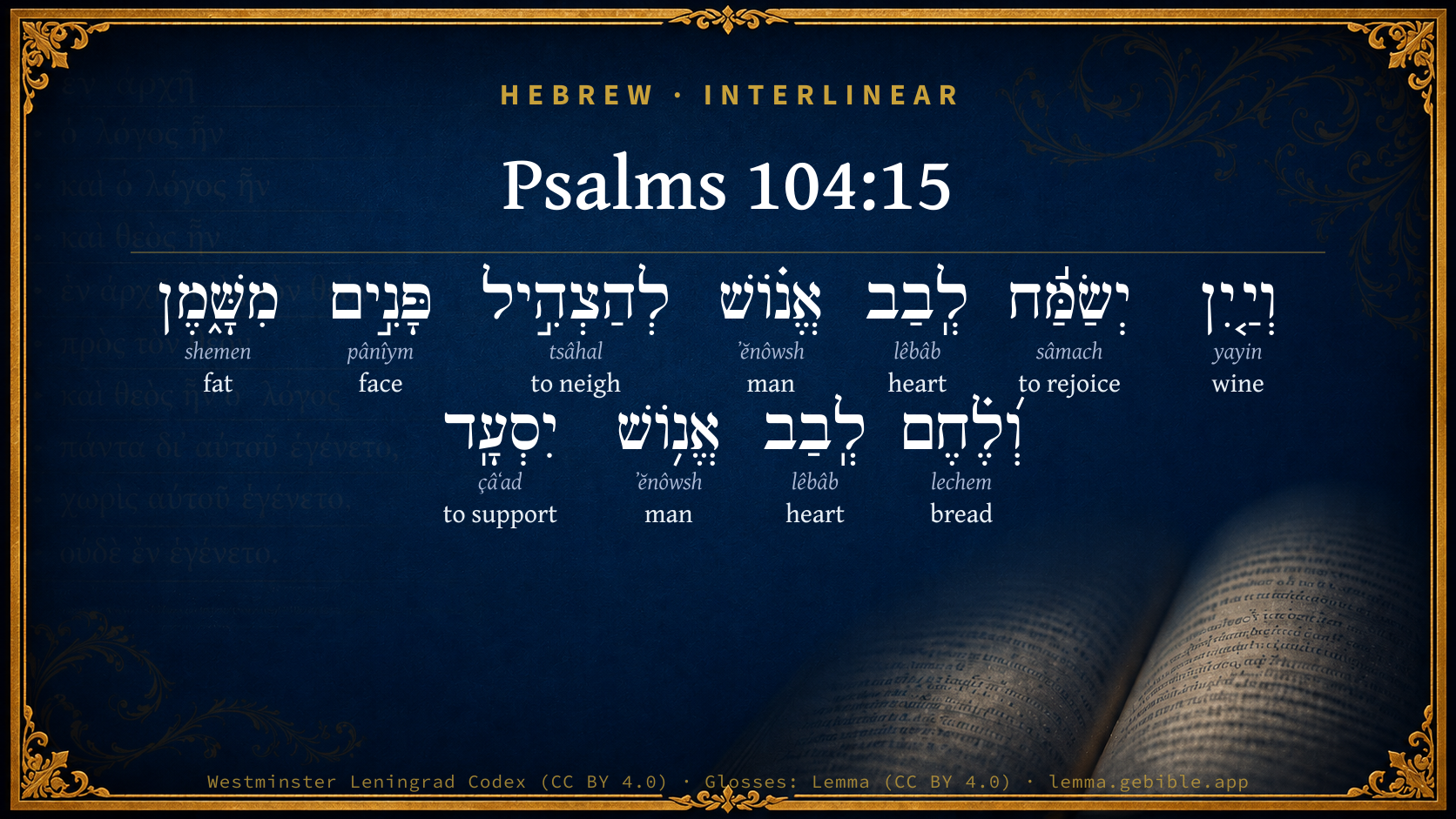
Hebrew (Westminster Leningrad Codex) Psalms 104:15 appears in the Hebrew Old Testament. The text above is from the Westminster Leningrad Codex. Each word links to its Strong’s number, a concise gloss, and parsing drawn from the Open Scriptures Hebrew Bible morphology. Click any word for its full Brown-Driver-Briggs (BDB) entry.
Download image
Cite this verse

Psalms 104:15 (World English Bible). Public Domain. Lemma interlinear Bible study tool, https://lemma.gebible.app/v/psalms/104/15.

Show BibTeX & RIS
BibTeX
RIS
English Translation
Wine that makes glad the heart of man, Oil to make his face to shine, And bread that strengthens man's heart.
World English Bible · Public Domain
Download a study sheet

One document with this verse’s original text, its word-by-word gloss line, the meaning frame, cross-references with their text, attributed commentary, and full source and license credits — printable, and it pastes into notes with its structure intact.

This verse Autodidact and up

Study sheet (.html) Plain text (.txt)

A passage Seminary Student

Up to 50 verses in one chapter. A passage sheet keeps up to 6 commentary sources and 12 cross-references per verse, in the order this page ranks them, and says so on the sheet whenever that leaves anything out. Ask for a single verse and you get the Autodidact verse sheet above.

Everything on this page stays free to read, with no account — the sheet is a download of what is already on screen, not access to it.

Want to remove ads? Support Godless Engineer
Compare translations 3

The same verse in 3 English versions, stacked beneath the original-language interlinear above. Click any original word for its lexicon entry.

Each is an independent rendering of the whole verse — the interlinear is not word-aligned to these translations.

Highlighted words mark where these versions differ — a whole-verse word diff, not a word-by-word alignment.

  • World English Bible Public Domain
    Wine that makes glad the heart of man, Oil to make his face to shine, And bread that strengthens man's heart.
  • King James Version Public Domain
    And wine that maketh glad the heart of man, and oil to make his face to shine, and bread which strengtheneth man's heart.
  • unfoldingWord Literal Text CC BY-SA 4.0
    And wine—he gladdens the heart of man, to make the face shine from oil, and bread—he sustains the heart of man.

unfoldingWord Literal Text — © unfoldingWord, licensed CC BY-SA 4.0. Word-aligned USFM3 via Door43 (git.door43.org/unfoldingWord/en_ult).

Versions to compare (up to 4)

3 of 4 selected

Show all 18 translations

Every available English version of this verse, each an independent rendering of the whole verse.

  • World English Bible Public Domain
    Wine that makes glad the heart of man, Oil to make his face to shine, And bread that strengthens man's heart.
  • Berean Standard Bible Public Domain
    wine that gladdens the heart of man, oil that makes his face to shine, and bread that sustains his heart.
  • Majority Standard Bible Public Domain
    wine that gladdens the heart of man, oil that makes his face to shine, and bread that sustains his heart.
  • King James Version Public Domain
    And wine that maketh glad the heart of man, and oil to make his face to shine, and bread which strengtheneth man's heart.
  • American Standard Version (1901) Public Domain
    And wine that maketh glad the heart of man, `And' oil to make his face to shine, And bread that strengtheneth man's heart.
  • Revised Version (1885) Public Domain
    And wine that maketh glad the heart of man, and oil to make his face to shine, and bread that strengtheneth man’s heart.
  • Geneva Bible (1599) Public Domain
    And wine that maketh glad the heart of man, and oyle to make the face to shine, and bread that strengtheneth mans heart.
  • Douay-Rheims (1899) Public Domain
    and that wine may cheer the heart of man. That he may make the face cheerful with oil: and that bread may strengthen man's heart.
  • Young's Literal Translation Public Domain
    And wine -- it rejoiceth the heart of man, To cause the face to shine from oil, And bread -- the heart of man it supporteth.
  • Literal Standard Version CC BY-SA 4.0
    And wine—it makes the heart of man glad, || To cause the face to shine from oil, || And bread—it supports the heart of man.
  • Unlocked Literal Bible CC BY-SA 4.0
    He makes wine to make man happy, oil to make his face shine, and food to sustain his life.
  • unfoldingWord Literal Text CC BY-SA 4.0
    And wine—he gladdens the heart of man, to make the face shine from oil, and bread—he sustains the heart of man.
  • Darby Bible Public Domain
    And wine which gladdeneth the heart of man; making [his] face shine with oil; and with bread he strengtheneth man's heart.
  • World Messianic Bible Public Domain
    wine that makes the heart of man glad, oil to make his face to shine, and bread that strengthens man’s heart.
  • Webster's Bible Public Domain
    And wine that maketh glad the heart of man, and oil to make his face to shine, and bread which strengtheneth man's heart.
  • Free Bible Version CC BY-SA 4.0
    and wine to make them happy, olive oil to make their faces shine, and bread to make them strong.
  • Bible in Basic English Public Domain
    And wine to make glad the heart of man, and oil to make his face shining, and bread giving strength to his heart.
  • JPS Tanakh (1917) Public Domain
    And wine that maketh glad the heart of man, making the face brighter than oil, and bread that stayeth man's heart.

Literal Standard Version (2020), Covenant Press — licensed CC BY-SA 4.0. Text via the HelloAO Bible API (eBible.org). Unlocked Literal Bible (unfoldingWord) — licensed CC BY-SA 4.0. Text via the HelloAO Bible API (eBible.org). unfoldingWord Literal Text — © unfoldingWord, licensed CC BY-SA 4.0. Word-aligned USFM3 via Door43 (git.door43.org/unfoldingWord/en_ult). Free Bible Version, Dr. Jonathan Gallagher — licensed CC BY-SA 4.0. Text via the HelloAO Bible API (eBible.org).

Word by word

More ways to search: Search by grammar → Find every occurrence → Compare this word →

Practice this passage: Drill this verse → Learn its vocabulary →

לְהַצְהִ֣יל
tsâhal
H6670
“to neigh”
Preposition + Verb, Hiphil, Infinitive Construct
Part of Speech
Preposition + Verb
Stem
Hiphil
Form
Infinitive Construct
Full BDB Definition

Origin: a primitive root

TWOT: 1881 , 1882

to neigh, cry shrilly - (Qal) - to neigh (of men as stallions - figuratively) - (Piel) to cry shrilly (in distress) - (Hiphil) to make shining
  1. וְיַ֤יִן yayin H3196 “and · wine” Conjunction + Noun, Common, Masculine, Singular, Absolute
  2. יְשַׂמַּ֬ח sâmach H8055 “to rejoice” Verb, Piel, Imperfect, 3rd Person, Masculine, Singular
  3. לְֽבַב lêbâb H3824 “heart of” Noun, Common, Masculine, Singular, Construct
  4. אֱנ֗וֹשׁ ʼĕnôwsh H582 “man” Noun, Common, Masculine, Singular, Absolute
  5. פָּנִ֣ים pânîym H6440 “face(s)” Noun, Common, Both, Plural, Absolute
  6. מִשָּׁ֑מֶן shemen H8081 “from · fat” Preposition + Noun, Common, Masculine, Singular, Absolute
  7. וְ֝לֶ֗חֶם lechem H3899 “and · bread” Conjunction + Noun, Common, Both, Singular, Absolute
  8. לְֽבַב lêbâb H3824 “heart of” Noun, Common, Masculine, Singular, Construct
  9. אֱנ֥וֹשׁ ʼĕnôwsh H582 “man” Noun, Common, Masculine, Singular, Absolute
  10. יִסְעָֽד çâʻad H5582 “to support” Verb, Qal, Imperfect, 3rd Person, Masculine, Singular

About this verse

These counts appear in no published source. They are computed here, from the morphology-tagged text and Lemma’s own curated glosses. What Lemma adds →

11
words
9
distinct lemmas
Wisdom
section

Notable vocabulary

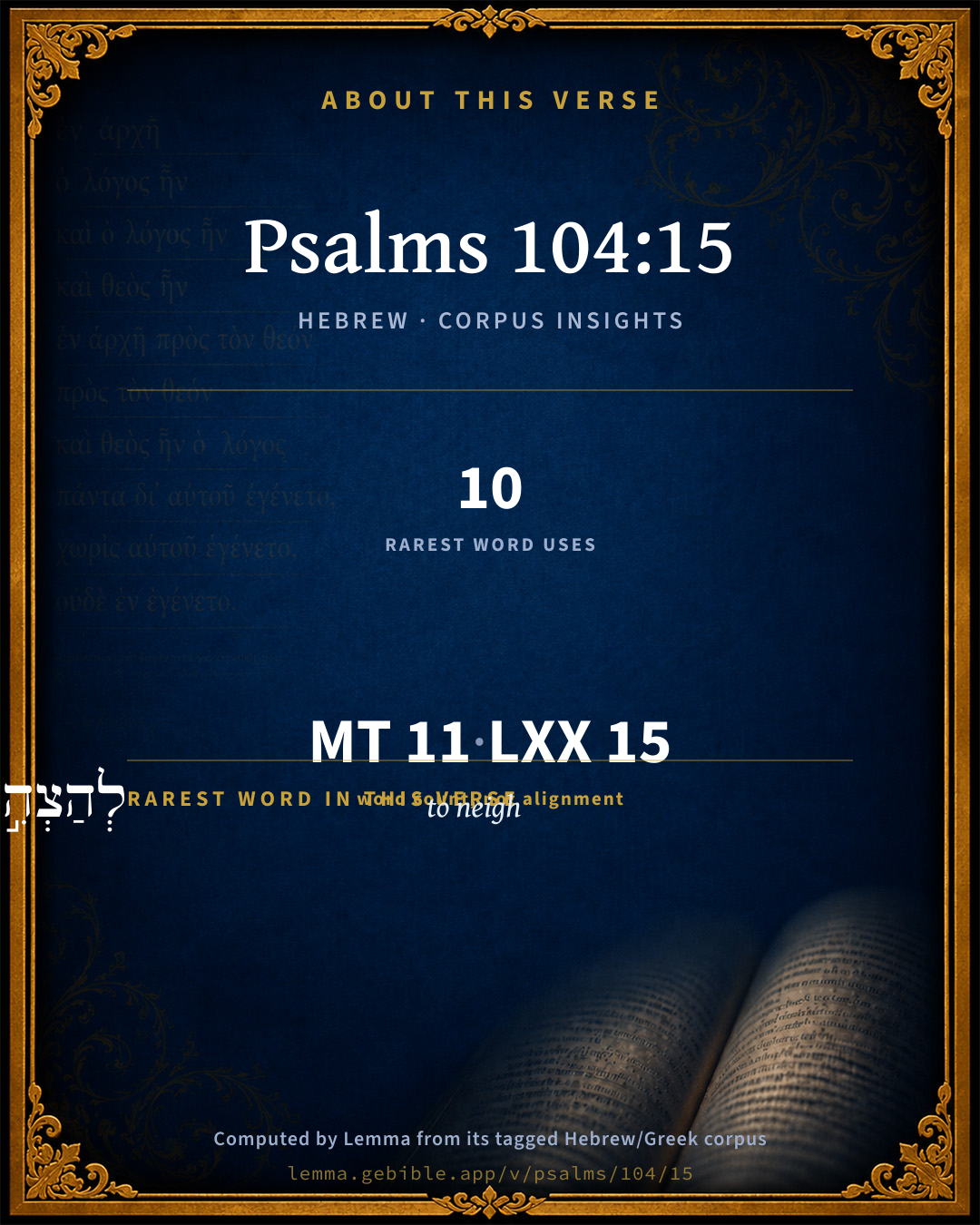
The rarest word here is לְהַצְהִ֣יל to neigh H6670 — appearing just 10 times in the whole Hebrew Bible.

Shared distinctive vocabulary

לְהַצְהִ֣יל to neigh H6670 occurs in 9 verses of the Hebrew Bible. Also found in:

Grammatical profile

  • 3 verbs
  • 8 nouns

Verb forms

  • יְשַׂמַּ֬ח Piel · Imperfect
  • לְהַצְהִ֣יל Hiphil · Infinitive Construct
  • יִסְעָֽד Qal · Imperfect

Repetition

Words recur within this verse — often emphatic in Hebrew:

  • לְֽבַב heart H3824 ×2
  • אֱנ֗וֹשׁ man H582 ×2

Hebrew & Septuagint length

In English translation the verse runs 21 words from the Hebrew and 20 from the Septuagint (LXX English) — closely comparable.

A rough comparison of the two English renderings, which tokenize alike — not a word-level alignment.

Word counts can differ between the Hebrew and the Greek without any difference in meaning — e.g. the Hebrew direct-object marker אֵת has no separate Greek word, and Greek often adds the article ὁ.

In the original languages it is 11 Hebrew tokens and 15 Greek tokens — but the two are counted differently (Hebrew bundles its prefixes and suffixes into one token; the Greek is in lemma form), so that isn’t a like-for-like length.

Cross-references

25

Topical passages linked to Psalms 104:15 in the Treasury of Scripture Knowledge — connected by theme and wording, ordered by reader-vote popularity; previews shown in the World English Bible.

  • Psalms 23:5 You prepare a table before me in the presence of my enemies. You anoint my head with oil. My cup runs over.
  • Ecclesiastes 9:7 Go your way--eat your bread with joy, and drink your wine with a merry heart; for God has already accepted your works.
  • Ecclesiastes 10:19 A feast is made for laughter, And wine makes the life glad; And money is the answer for all things.
  • Judges 9:13 The vine said to them, Should I leave my new wine, which cheers God and man, and go to wave back and forth over the trees?
  • Psalms 92:10 But you have exalted my horn like that of the wild ox. I am anointed with fresh oil.
  • Ephesians 5:18 Don't be drunken with wine, in which is dissipation, but be filled with the Spirit,
  • Hebrews 1:9 You have loved righteousness, and hated iniquity; Therefore God, your God, has anointed you with the oil of gladness above your fellows."
  • Judges 9:9 But the olive tree said to them, Should I leave my fatness, with which by me they honor God and man, and go to wave back and forth over the trees?
  • Jeremiah 31:12 They shall come and sing in the height of Zion, and shall flow to the goodness of Yahweh, to the grain, and to the new wine, and to the oil, and to the young of the flock and of the herd: and their soul shall be as a watered garden; and they shall not sorrow any more at all.
  • Ezekiel 4:16 Moreover he said to me, Son of man, behold, I will break the staff of bread in Jerusalem: and they shall eat bread by weight, and with fearfulness; and they shall drink water by measure, and in dismay:
  • Zechariah 9:15–17 Yahweh of Hosts will defend them; And they will destroy and overcome with sling-stones; And they will drink, and roar as through wine; And they will be filled like bowls, Like the corners of the altar.
  • 1 John 2:20 You have an anointing from the Holy One, and you know the truth.
  • Leviticus 26:26 When I break your staff of bread, ten women shall bake your bread in one oven, and they shall deliver your bread again by weight: and you shall eat, and not be satisfied.
  • Deuteronomy 8:3 He humbled you, and allowed you to hunger, and fed you with manna, which you didn't know, neither did your fathers know; that he might make you know that man does not live by bread only, but by everything that proceeds out of the mouth of Yahweh does man live.
  • Deuteronomy 28:40 You shall have olive trees throughout all your borders, but you shall not anoint yourself with the oil; for your olive shall cast [its fruit].
  • Psalms 105:16 He called for a famine on the land. He destroyed the food supplies.
  • Proverbs 31:6 Give strong drink to him who is ready to perish; And wine to the bitter in soul:
  • Ecclesiastes 8:1 Who is like the wise man? And who knows the interpretation of a thing? A man's wisdom makes his face shine, and the hardness of his face is changed.
  • Song of Solomon 1:2–4 Let him kiss me with the kisses of his mouth; For your love is better than wine.
  • Isaiah 3:1 For, behold, the Lord, Yahweh of Hosts, takes away from Jerusalem and from Judah supply and support, The whole supply of bread, And the whole supply of water;
  • Luke 7:46 You didn't anoint my head with oil, but she has anointed my feet with ointment.
  • Genesis 18:5 I will get a morsel of bread so you can refresh your heart. After that you may go your way, now that you have come to your servant." They said, "Very well, do as you have said."
  • Ezekiel 5:16 when I shall send on them the evil arrows of famine, that are for destruction, which I will send to destroy you: and I will increase the famine on you, and will break your staff of bread;
  • Ezekiel 14:13 Son of man, when a land sins against me by committing a trespass, and I stretch out my hand on it, and break the staff of the bread of it, and send famine on it, and cut off from it man and animal;
  • Mark 14:23 He took the cup, and when he had given thanks, he gave to them. They all drank of it.

Cross-references courtesy of OpenBible.info (CC BY 4.0).

Hebrew and Greek witnesses Masoretic Hebrew ↔ Greek Septuagint

The same verse in the two great witnesses to the Old Testament, shown verse-for-verse.

You’re reading Greek Psalm 103 (Hebrew Psalm 104). The Septuagint counts the superscription, so verse numbers can differ from the Hebrew — chapter-level alignment, not verse-by-verse. Numbering follows Rahlfs.

These are two independent witnesses, not word-aligned to each other, and the Septuagint is shown in lemma (dictionary) form.

Hebrew Psalms 104:15 Masoretic · Westminster Leningrad Codex

וְיַ֤יִן יְשַׂמַּ֬ח לְֽבַב אֱנ֗וֹשׁ לְהַצְהִ֣יל פָּנִ֣ים מִשָּׁ֑מֶן וְ֝לֶ֗חֶם לְֽבַב אֱנ֥וֹשׁ יִסְעָֽד

Wine that makes glad the heart of man, Oil to make his face to shine, And bread that strengthens man's heart.

World English Bible · Public Domain

Greek LXX Greek Psalm 103:15 Septuagint · lemma form

καί οἶνος εὐφραίνω καρδία ἄνθρωπος ὁ ἱλαρύνω πρόσωπον ἐν ἔλαιον καί ἄρτος καρδία ἄνθρωπος στηρίζω

and wine makes glad the heart of man, to make his face cheerful with oil: and bread strengthens man's heart.

LXX2012 (modern English Septuagint) · Public Domain

On this verse, Ellicott's Commentary for English Readers discusses the Septuagint’s reading. Read the note in Commentary ↓

Hebrew: Westminster Leningrad Codex (CC BY 4.0). Greek: Septuagint (public domain); English from LXX2012 (modern English Septuagint) (Public Domain). How the Septuagint differs from the Hebrew →

Commentary

Notes on Psalms 104:15 from classic Christian and Jewish commentators (each source and its license shown beneath its notes). The classic Christian expositions comment on the surrounding passage and are grouped to its opening verse, so a note may address several verses; the Jewish commentaries on the Tanakh (Rashi and others) are per-verse, so they appear only where the commentator wrote on this verse.

Lemma curates 59 commentaries, every one of them public domain or Creative Commons licensed, each selected and text-cleaned for this edition rather than reprinted as found. About our sources →

Trapp's Complete Commentary

John Trapp

Psa 104:15 And wine [that] maketh glad the heart of man, [and] oil to make [his] face to shine, and bread [which] strengtheneth man’s heart.

Ver. 15. And wine that maketh glad] That he may the more cheerfully serve his Maker, his heart being lifted up, as Jehoshaphat’s was, in the ways of obedience, Jdg 9:13 Pro 31:6-7.

And oil to make his face to shine] The word signifieth ointments of all sorts, whereof see Pliny, lib. 12, 13. These man might want and subsist; but God is bountiful.

And bread which strengtheneth, &c.] In nature, Animantis cuiusque vita est fuga; were it not for the repair of nutrition the natural life would be extinguished. The Latins call bread panis , of the Greek παν; because it is the chief nourishment.

John Trapp, A Commentary or Exposition upon All the Books of the Old and New Testament (1647–1656) — public domain. Text from a community e-Sword module.

The Treasury of David

Charles H. Spurgeon

Ver. 15. And wine that maketh glad the heart of man. By the aid of genial showers the earth produces not merely necessaries but luxuries, that which furnishes a feast as well as that which makes a meal. O that man were wise enough to know how to use this gladdening product of the vine; but, alas, he full often turns it to ill account, and debases himself therewith. Of this he must himself bear the blame; he deserves to be miserable who turns even blessings into curses.

And oil to make his face to shine. The easterns use oil more than we do, and probably are wiser in this respect than we are: they delight in anointing with perfumed oils, and regard the shining of the face as a choice emblem of joy. God is to be praised for all the products of the soil, not one of which could come to us were it not that he causeth it to grow.

And bread which strengtheneth man's heart. Men have more courage after they are fed: many a depressed spirit has been comforted by a good substantial meal. We ought to bless God for strength of heart as well as force of limb, since if we possess them they are both the bounties of his kindness.

Ver. 15. When thou wert taken out of the womb, what a stately palace did he bring thee into, the world, which thou foundest prepared and ready furnished with all things for thy maintenance, as Canaan was to the children of Israel; a stately house thou buildest not, trees thou plantedst not, a rich canopy spangled, spread as a curtain over thy head; he sets up a taper for thee to work by, the sun, till thou art weary (Ps 104:23), and then it goes down without thy bidding, for it "knows its going down" (Ps 104:19); then he draws a curtain over half the world, that men may go to rest: "Thou causest darkness, and it is night" (Ps 104:20). As an house this world is, so curiously contrived that to every room of it, even to every poor village, springs do come as pipes to find thee water (Ps 104:11). The pavement of which house you tread on and it brings forth thy food (Ps 104:14), "Bread for strength, wine to cheer thy heart, oil to make thy face to shine" (Ps 104:15). Which three are there synecdochically put for all things needful to strength, ornament, and delight. Thomas Goodwin.

Ver. 15. Wine that maketh glad the heart of man. The wine mentioned had the quality of fermented liquors; it gladdened the heart. Thus, if taken to excess, it would have led to intoxication. The Hebrew term is "yayin", answering to the Greek oinos, and including every form which the juice of the grape might be made to assume as a beverage. It was this of which Noah partook when he became drunken (Ge 9:21, 24). Melchizedek brought it forth to Abraham (Ge 14:18). Lot's daughters gave it to their father and made him drunk (Ge 14:35). From this the Nazarite was to separate himself (Nu 6:3-20). This is the highly intoxicating drink so often mentioned by Isaiah (Isa 5:11-22 12:13 28: 1-7); but just because of this, it might become to man one of those mercies in connection with the use of which he was to exercise constant self control. Taken to excess it was a curse; enjoyed as from God, it was something for which man was called to be thankful. John Duns.

Ver. 15. And oil to make his face to shine. Observe, after the mention of wine, he speaks of oil or ointment, because at the banquets among the Jews and other Eastern people, as afterwards among the Greeks and Romans, there was a frequent use of ointments. The reasons why ointment was poured upon the head were: To avoid intoxication: To improve the health: To contribute to pleasure and delight. Homer often refers to this custom, and there is an allusion to it by Solomon, Ec 9:8, "Let thy garments be always white; and let thy head lack no ointment". See also Ps 23:5. Le Blanc.

Ver. 15. The ancients made much use of oil to beautify their persons. We read of "oil to make man's face to shine". Ruth anointed herself for decoration (Ru 3:3), and the woman of Tekoah and the prophet Daniel omitted the use of oil for the contrary reason (2Sa 14:3 Da 10:3). The custom is also mentioned in Mt 6:17 Lu 7:46. Ambrose Serle in "Horae Solitariae", 1815.

Ver. 15. Bread which strengtheneth man's heart. In hunger not only the strength is prostrated, but the natural courage is also abated. Hunger has no enterprise, emulation, nor courage. But when in such circumstances, a little bread is received into the stomach, even before concoction can have time to prepare it for nutriment, the strength is restored, and the spirits revived. This is a surprising effect, and it has not yet been satisfactorily accounted for. Adam Clarke.

Ver. 15. Bread which strengtheneth man's heart. In Homer's Odyssey we meet with the expression "Bread, the marrow of men."

Ver. 15. Man's heart. It is not without reason that instead of the word Mdah, of Adam, which was used in Ps 104:14, there is here employed the word vwba, an infirm and feeble man, because he mentions those nourishments of which there was no need before the fall, and which are specially suitable to nourish and exhilarate feeble man. Venema.

Ver. 15. If the transitory earth is so full of the good things of God, what will we have when we come to the land of the living? Starke, in Lange's Commentary.

Psalms 104:16*

Charles H. Spurgeon's The Treasury of David (1869–1885) — public domain. Psalms only. Text from a community e-Sword/MySword module.

J. A. Alexander on Psalms

Joseph Addison Alexander

15. (Psa 104:15) And wine gladdens the heart of man—(so as) to make his face shine more than oil—and bread the heart of man sustains. The general expression at the end of ver. 14 (Psa 104:14) is now rendered more specific by distinctly mentioning the great staples of production and subsistence in the Holy Land. The only doubt is whether two or three are mentioned. The text of the English Bible makes oil a distinct item in the catalogue, and oil to make his face to shine. But this is an impossible construction of the Hebrew, in which the infinitive (to make shine) bears the same relation to what goes before as the infinitive (to bring forth) in the verse preceding, and is therefore expressive, not of a distinct cause and effect, but of a consequence resulting from the one just mentioned. The true construction is given in the margin of the English Bible, to make his face shine with oil or more than oil. To the first of these alternative translations it may be objected that wine cannot make men's faces shine with oil, unless there is allusion to the festive unctions of the ancients, which, however, were restricted to the head. The other, therefore, seems to be the true sense, in which oil is merely mentioned as a shining Substance. The description of food as sustaining the heart is very ancient. See Gen 18:5, Jdg 19:8.

Joseph Addison Alexander, The Psalms Translated and Explained (1850) — public domain. Text from a community e-Sword module.

Tyndale Open Study Notes

Tyndale Open Resources

104:15 While both can be misused (cp. Prov 21:17), the Lord provides wine and olive oil as gifts to enhance life. Life is sustained by basic food, represented by bread.

Tyndale Open Study Notes — © Tyndale Open Resources, licensed CC BY-SA 4.0. Text via the HelloAO Bible API.

Adam Clarke's Commentary

Verse 15. And wine] Wine, in moderate quantity, has a wondrous tendency to revive and invigorate the human being. Ardent spirits exhilarate, but they exhaust the strength; and every dose leaves man the worse. Unadulterated wine, on the contrary, exhilarates and invigorates: it makes him cheerful, and provides for the continuance of that cheerfulness by strengthening the muscles, and bracing the nerves. This is its use. Those who continue drinking till wine inflames them, abuse this mercy of God.

Oil to make his face to shine] That is, to anoint the body; and particularly those parts most exposed to the sun and weather. This is of high importance in all arid lands and sultry climates. By it the pores are kept open, and perspiration maintained.

Bread which strengtheneth man's heart.] In hunger not only the strength is prostrated, but the natural courage is also abated. Hunger has no enterprise, emulation, nor courage. But when, in such circumstances, a little bread is received into the stomach, even before concoction can have time to prepare it for nutriment, the strength is restored, and the spirits revived. This is a surprising effect; and it has not yet been satisfactorily accounted for.

Three of the choicest and most important articles of life are here mentioned: WINE, for the support of the vital and intellectual spirits; BREAD, for the support of the nervous and muscular system; and OIL, as a seasoner of food, and for those unctions so necessary for the maintenance of health. Where wine, oil, and bread can be had in sufficient quantities, there animal food, ardent spirits, and all high-seasoned aliments, may be well dispensed with. Heavy taxes on these necessaries of life are taxes on life, itself; and infallibly lead to adulteration of the articles themselves; especially wine and oil, which, in countries where they are highly taxed, are no longer to be found pure.

Adam Clarke's Commentary on the Bible (1810–1826) — public domain. Text from a community e-Sword/MySword module.

John Calvin's Commentaries

15. And wine that cheereth the heart of man In these words we are taught, that God not only provides for men’s necessity, and bestows upon them as much as is sufficient for the ordinary purposes of life, but that in his goodness he deals still more bountifully with them by cheering their hearts with wine and oil. Nature would certainly be satisfied with water to drink; and therefore the addition of wine is owing to God’s superabundant liberality. The expression, and oil to make his face to shine, has been explained in different ways. As sadness spreads a gloom over the countenance, some give this exposition, That when men enjoy the commodities of wine and oil, their faces shine with gladness. Some with more refinement of interpretation, but without foundation, refer this to lamps. Others, considering the letter מ, mem to be the sign of the comparative degree, take the meaning to be, that wine makes men’s faces shine more than if they were anointed with oil. But the prophet, I have no doubt, speaks of unguents, intimating that God not only bestows upon men what is sufficient for their moderate use, but that he goes beyond this, giving them even their delicacies.

The words in the last clause, and bread that sustains man’s heart, I interpret thus: Bread would be sufficient to support the life of man, but God over and above, to use a common expression, bestows upon them wine and oil. The repetition then of the purpose which bread serves is not superfluous: it is employed to commend to us the goodness of God in his tenderly and abundantly nourishing men as a kind-hearted father does his children. For this reason, it is here stated again, that as God shows himself a foster-father sufficiently bountiful in providing bread, his liberality appears still more conspicuous in giving us dainties.

But as there is nothing to which we are more prone, than to abuse God’s benefits by giving way to excess, the more bountiful he is towards men, the more ought they to take care not to pollute, by their intemperance, the abundance which is presented before them. Paul had therefore good reason for giving that prohibition, (Romans 13:14)

“Make not provision for the flesh, to fulfill the lusts thereof;”

for if we give full scope to the desires of the flesh, there will be no bounds. As God bountifully provides for us, so he has appointed a law of temperance, that each may voluntarily restrain himself in his abundance. He sends out oxen and asses into pastures, and they content themselves with a sufficiency; but while furnishing us with more than we need, he enjoins upon us an observance of the rules of moderation, that we may not voraciously devour his benefits; and in lavishing upon us a more abundant supply of good things than our necessities require, he puts our moderation to the test. The proper rule with respect to the use of bodily sustenance, is to partake of it that it may sustain, but not oppress us. The mutual communication of the things needful for the support of the body, which God has enjoined upon us, is a very good check to intemperance; for the condition upon which the rich are favored with their abundance is, that they should relieve the wants of their brethren. As the prophet in this account of the divine goodness in providence makes no reference to the excesses of men, we gather from his words that it is lawful to use wine not only in cases of necessity, but also thereby to make us merry. This mirth must however be tempered with sobriety, first, that men may not forget themselves, drown their senses, and destroy their strength, but rejoice before their God, according to the injunction of Moses, (Leviticus 23:40;) and, secondly, that they may exhilarate their minds under a sense of gratitude, so as to be rendered more active in the service of God. He who rejoices in this way will also be always prepared to endure sadness, whenever God is pleased to send it. That rule of Paul ought to be kept in mind, (Philippians 4:12,)

“I have learned to abound, — I have learned to suffer want.”

If some token of the divine anger is manifest, even he who has an overflowing abundance of all kinds of dainty food, will restrict himself in his diet knowing that he is called to put on sackcloth, and to sit among ashes. Much more ought he whom poverty compels to be temperate and sober, to abstain from such delicacies. In short, if one man is constrained to abstain from wine by sickness, if another has only vapid wine, and a third nothing but water, let each be content with his own lot, and willingly and submissively wean himself from those gratifications which God denies him.

The same remarks apply to oil. We see from this passage that ointments were much in use among the Jews, as well as among the other eastern nations. At the present day, it is different with us, who rather keep ointments for medicinal purposes, than use them as articles of luxury. The prophet, however, says, that oil also is given to men, that they may anoint themselves therewith. But as men are too prone to pleasure, it is to be observed, that the law of temperance ought not to be separated from the beneficence of God, lest they abuse their liberty by indulging in luxurious excess. This exception must always be added, that no person may take encouragement from this doctrine to licentiousness.

Moreover, when men have been carefully taught to bridle their lust, it is important for them to know, that God permits them to enjoy pleasures in moderation, where there is the ability to provide them; else they will never partake even of bread and wine with a tranquil conscience; yea, they will begin to scruple about the tasting of water, at least they will never come to the table but in fearfulness. Meanwhile, the greater part of the world will wallow in pleasures without discrimination, because they do not consider what God permits them; for his fatherly kindness should be to us the best mistress to teach us moderation.

John Calvin's Commentaries (1540-1563) — public domain. Text from the Calvin Translation Society English edition (1840s-50s) via the Christian Classics Ethereal Library (ccel.org). Calvin's coverage is partial (roughly two-thirds of the Bible); uncommented books and verses are honest gaps, never fabricated. The 19th-century editor's footnotes and remarks are omitted so the notes are faithfully Calvin's own voice.

Ellicott's Commentary for English Readers

(15) And wine that . . .—Better, and wine gladdens man’s heart, making his face shine more than oil (see-margin. The alternative follows the LXX. and Vulg., and suggests the anointing with oil at a banquet), and bread man’s heart sustains.

Oil.—For oil and its uses see Psa_133:2; Psa_141:5.

Strengtheneth.—Properly, props or supports. (Comp. “the staff of bread,” Psa_105:16), and our “staff of life,” and for the same phrase Gen_18:5; Jdg_19:5).

A Bible Commentary for English Readers, edited by Charles John Ellicott (1878–1897) — public domain. Text from a community e-Sword module.

John Gill's Exposition

And wine that maketh glad the heart of man,.... That is, by means of rain watering the earth, vines are caused to grow out of it; which produce wine, that has such a virtue in it, as to cheer the heart of man, even of a miserable, distressed, and afflicted man, as the word (p) is supposed to signify, Jdg 9:13. Of this nature are (and therefore are compared to wine, or expressed by it) the love of God and Christ; the blessings of grace, the doctrines of the Gospel, the ordinances of it; particularly that of the Lord's supper, and even the joys of heaven.

And oil to make his face to shine: or, "to make his face shine more than oil" (q); and so it continues the account of the virtue of wine, which not only cheers the heart, but makes the countenance brisk and lively, and even shine again: but, according to our version, and others, this is a distinct effect of the rain, causing olive trees to grow out of the earth, productive of oil; which being eaten, fattens, and so makes the face to shine; as it also does by anointing with it, which was much in use for that purpose in the eastern countries, as well as for cheering and refreshing; see Rut 3:3. Pliny (r) says, oil purifies or clears; and particularly of oil of almonds, he says, that it makes clean, makes bodies soft, smooths the skin, procures gracefulness; and, with honey, takes spots or specks out of the face. Kimchi makes mention of another use of oil, in lighting lamps; by which the face of man is enlightened, or light is given him. So the Targum,

"to enlighten the face with oil.''

To this the grace of the Spirit is often compared in Scripture, with which both Christ and his members are said to be anointed, Act 10:38. This not only cheers and refreshes them, and is therefore called the oil of joy and gladness, Psa 45:7, but beautifies and adorns them, and even makes them fat and flourishing, and so their faces to shine; as well as causes their lamps of profession to burn clearly, and the light of their good works to shine before men to the glory of God.

And bread which strengthens man's heart: the earth being watered with rain, causes the wheat sown in it to grow up; of which bread is made for the support of man's life, and is the chief sustenance of it; and is therefore commonly called "the staff of life", and, by the prophet, "the whole stay of bread", Isa 3:1, by which human nature is invigorated, and the strength of man is kept up and increased; for the phrase, see Gen 18:5. Of this nature are the provisions of God's house, which go by the same name, the word and ordinances; and especially Christ Jesus himself, the true and living bread; by which the Christian's spiritual life is supported and maintained, and he is comforted and refreshed, and strengthened for every good work.

(p) "mortalis", Junius & Tremellius, Piscator; "sorry man", Ainsworth. (q) "prae oleo", Vatablus, Gejerus; "magis quam oleum", Piscator. (r) Nat. Hist. l. 23. c. 4.

John Gill's Exposition of the Whole Bible (1746–1763) — public domain (CC PDM 1.0). Text via the HelloAO Bible API.

Albert Barnes' Notes on the Bible

And wine that maketh glad the heart of man ... - literally, “And wine (it) gladdens the heart of man to make his face to shine more than oil.” Margin, “to make his face shine with oil, or more than oil.” The latter expresses the idea most accurately. So DeWette renders it. The meaning is, that the earth is made to produce wine (or grapes which produce wine), and this exhilarates the heart, so that the effect is seen on the countenance, making it more bright and cheerful than it is when anointed with oil. On the use of oil, see the notes at Psa 23:5. The reference here, in the original, is not to wine and oil as produced by the earth, as would seem to be implied in our translation, but to wine that makes the heart glad, and the face brighter than if anointed with oil. The psalmist here states a fact about the use of wine - a wellknown fact that it exhilarates the heart, and brightens the countenance; and he states it merely as a fact. He says nothing on the question whether the use of wine as a beverage is, or is not, proper and safe. Compare the notes at Joh 2:10.

And bread which strengtheneth man’s heart - That is, Which sustains the heart - that being regarded as the seat of life. Compare Gen 18:5.

Albert Barnes' Notes on the Bible (1834–1885) — public domain. Text from a community e-Sword/MySword module.

Matthew Poole's English Annotations

Wine; he also bringeth out of the earth the vines which yield wine.

Oil to make his face to shine: he alludes to the custom of those times and places, which was upon solemn and festival occasions to anoint their faces with oil. See Psa 23:5. But these words with the former are by divers learned interpreters rendered otherwise, which seems more agreeable to the order and contexture of the Hebrew text,

And (he giveth) wine that maketh glad the heart of man, to make (or, that he may make, i.e. that thereby he may also make) his face to shine more than oil, i.e. more than it shineth when it is anointed with oil; or, as with oil. So he speaks only of the wine, which he commends from two qualities, that it makes the heart cheerful, and the countenance pleasant.

Bread, i.e. bread corn, by a metonymy.

Which strengtheneth man’s heart; which hath a singular faculty to preserve or renew our strength and rigour; whence it is called the staff of life.

Matthew Poole's English Annotations on the Holy Bible (1683–1685) — public domain. Text from a community e-Sword/MySword module.

Whedon's Commentary on the Bible

Daniel D. Whedon

15. And wine that maketh glad the heart of man—The “wine,” here, יין, (yayin,) is the same as was offered to God in the daily sacrifice, (Exo_29:40-41,) the offering of first fruits, (Lev_23:13,) and on other occasions. Num_15:5; Num_15:7; Num_15:10. it was the same, also, as is mentioned 1Sa_25:37; 2Sa_13:28; Pro_23:20; Pro_23:30-31; Isa_5:11-12; Isa_5:22; Isa_28:1; Isa_28:7; Hos_6:5, etc. The mention of “wine,” oil, and bread in the same connexion, the characteristic products of the country, (Deu_12:17; Jer_31:12,) would indicate a blessing in some form, but the predicate, “maketh glad,” or merry, “the heart,” carries with it a significant admonition as to wine. See Ecc_10:19. The Hebrew of the text simply says, Wine will make the heart of man merry, stating it merely as a fact, without either approving or condemning its use. But the making “glad the heart of man,” may be affirmed of unfermented wine not less than fermented.

Daniel D. Whedon (gen. ed.), Commentary on the Old and New Testaments (1874–1909) — public domain. Text from a community e-Sword module.

The Pulpit Commentary

And wine that maketh glad the heart of man. The food suitable to man consists, first, of wine, which gladdens his heart; (comp. Jud_1:9:13) secondly, of oil to make his face to shine, or give him a cheerful countenance; and thirdly, of bread, which strengtheneth man"s heart, which is "the staff of life," and the main sustenance of the entire body. It was the glory of the promised land to produce in abundance these three essentials. (Deu_8:8 Deu_11:14 2Ki_18:32)

The Pulpit Commentary (1880–1919), ed. H.D.M. Spence-Jones & Joseph S. Exell — public domain. Text from a community e-Sword module.

John Wesley's Explanatory Notes

Oil - He alludes to the custom of those times and places, which was upon festival occasions to anoint their faces with oil. Bread - Which preserves or renews our strength and vigour.

John Wesley, Explanatory Notes Upon the Whole Bible (1754–1765) — public domain. Text via the GEBible commentary corpus.

Rashi

Rabbi Shlomo Yitzchaki (Rashi)

And wine which cheers man’s heart, that too He brings forth from the earth, and oil to cause the face to radiate.

and bread which sustains man’s heart.

Rashi on the Tanakh — English translations: “The Judaica Press complete Tanach with Rashi, translated by A. J. Rosenberg” (CC BY 4.0); “Pentateuch with Rashi's commentary by M. Rosenbaum and A.M. Silbermann, 1929-1934” (public domain); “The Metsudah Tanach series, Lakewood, N.J” (CC BY 4.0); and “The Book of Joshua, Metsudah Publications, 1997” (CC BY 4.0). Text via Sefaria.

Lesson kit

Teaching starters — assembled from the data on this page, not authored interpretation. Every prompt links to the verse data it draws on. Edit before teaching.

Psalms, in the Wisdom, opens this verse with 11 words (9 distinct Hebrew lemmas). Its most distinctive word is tsâhal (“to neigh”). A historical commentator’s framing appears above. Read the whole chapter for the surrounding context.

Discussion questions

  1. The word tsâhal carries the sense “to neigh.” How does it shape the verse?
  2. How does Esther 8:15, which shares the word «to neigh», read alongside this verse?
  3. What does the repetition of “heart” (2× in this one verse) do in this verse?
  4. These translations render this verse differently; the difference is in the English rendering, not the original. What questions does that raise?
  5. «יְשַׂמַּ֬ח» is a Piel Imperfect verb. How does that grammatical form shape the action described?
  6. Compare how Trapp's Complete Commentary and The Treasury of David read this verse. Where do they agree or differ?

Things to notice

Reading settings

Reading text

Shown beneath each verse's original-language words.

Old Testament
Old Testament edition

Read the OT as the Masoretic Hebrew (MT) or the Greek Septuagint (LXX).

English shown for the Greek Septuagint (in the Hebrew ↔ Greek comparison).

Comparing translations? Open the Compare panel on any verse page to stack up to four side by side.