Genesis 31:54

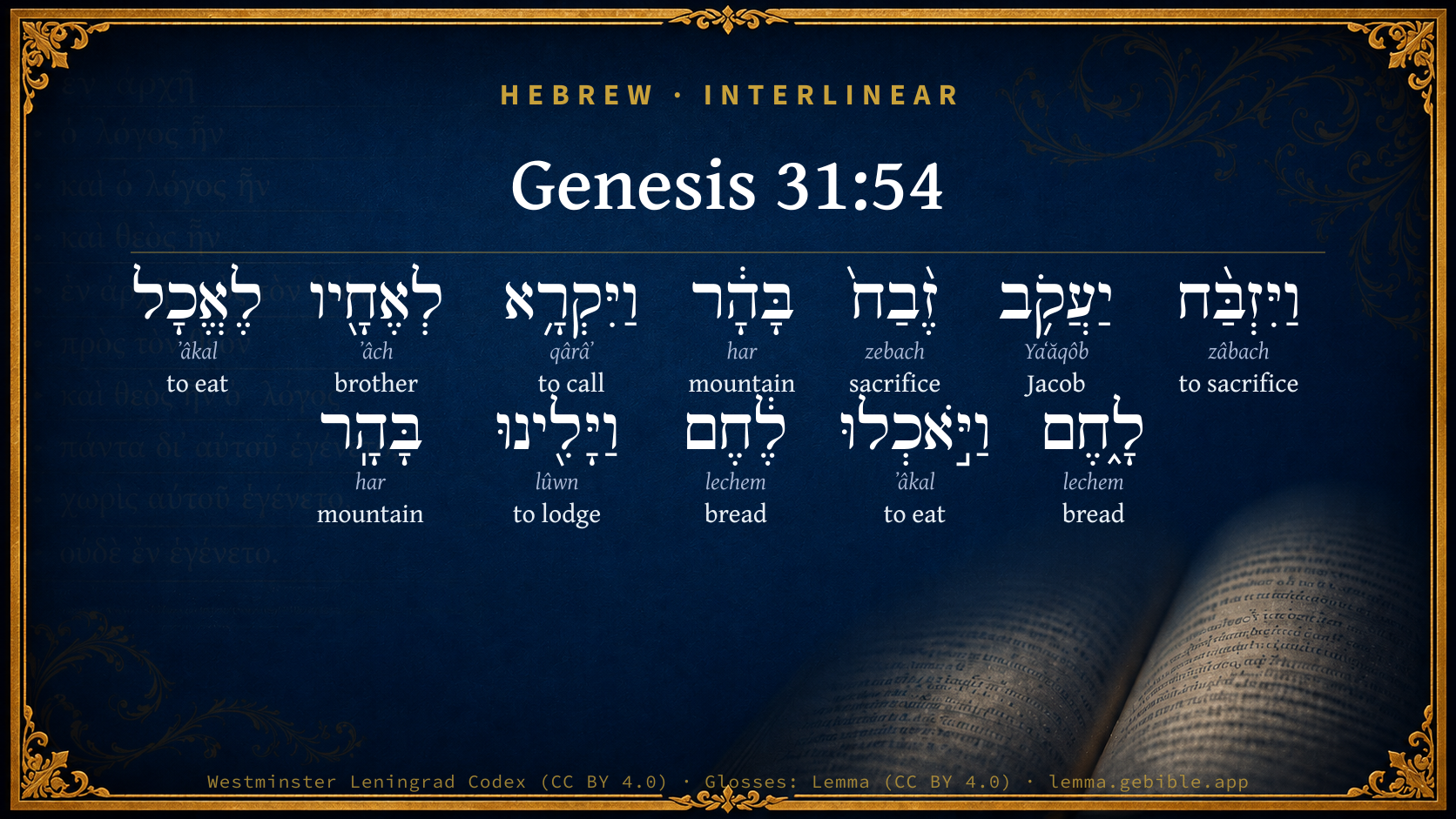
Hebrew (Westminster Leningrad Codex) Genesis 31:54 appears in the Hebrew Old Testament. The text above is from the Westminster Leningrad Codex. Each word links to its Strong’s number, a concise gloss, and parsing drawn from the Open Scriptures Hebrew Bible morphology. Click any word for its full Brown-Driver-Briggs (BDB) entry.
Download image
Cite this verse

Genesis 31:54 (World English Bible). Public Domain. Lemma interlinear Bible study tool, https://lemma.gebible.app/v/genesis/31/54.

Show BibTeX & RIS
BibTeX
RIS
English Translation
Jacob offered a sacrifice in the mountain, and called his relatives to eat bread. They ate bread, and stayed all night in the mountain.
World English Bible · Public Domain
Highlights
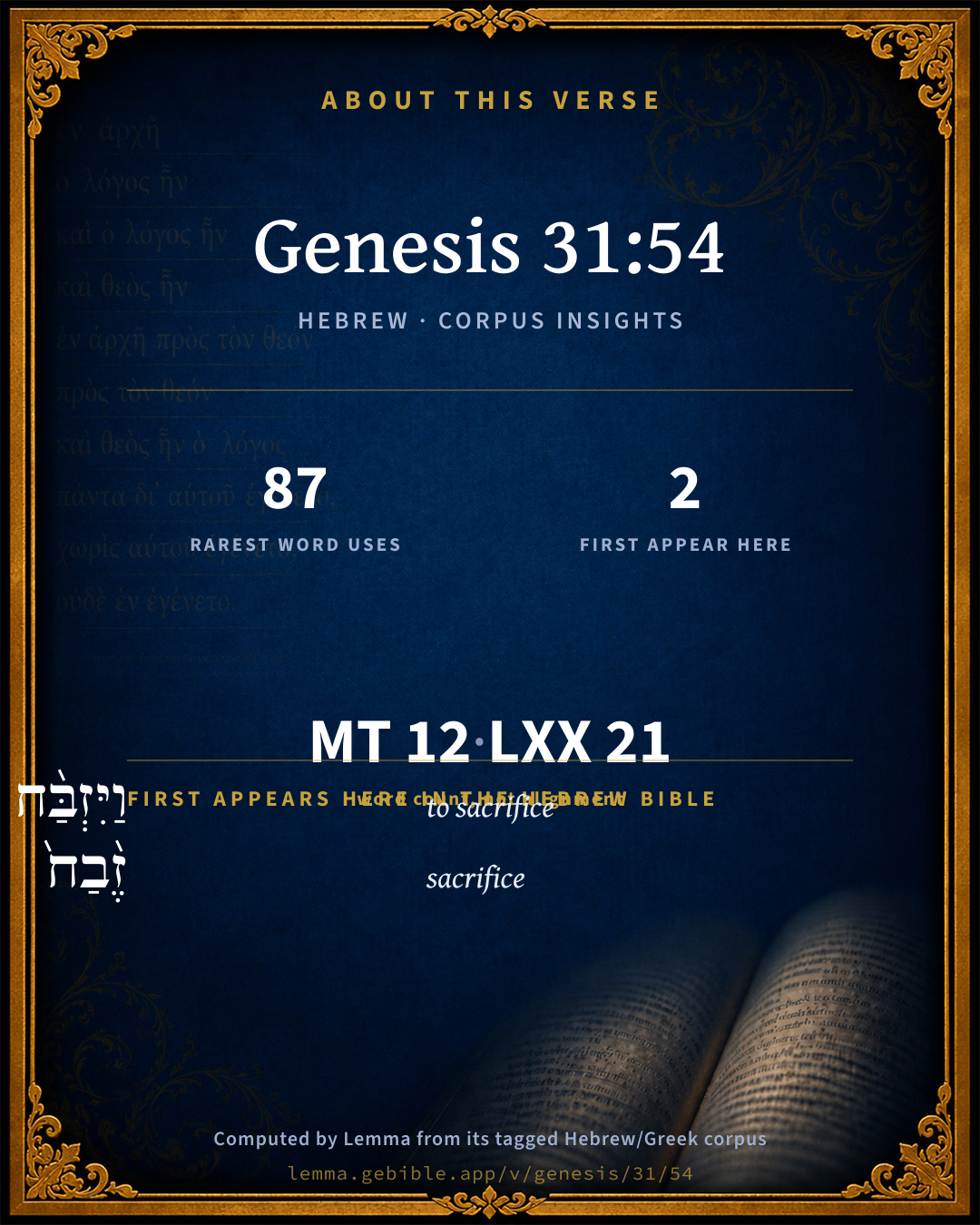
  • 2 first appearances in the Hebrew Bible
Full analysis ↓
Download a study sheet

One document with this verse’s original text, its word-by-word gloss line, the meaning frame, cross-references with their text, attributed commentary, and full source and license credits — printable, and it pastes into notes with its structure intact.

This verse Autodidact and up

Study sheet (.html) Plain text (.txt)

A passage Seminary Student

Up to 50 verses in one chapter. A passage sheet keeps up to 6 commentary sources and 12 cross-references per verse, in the order this page ranks them, and says so on the sheet whenever that leaves anything out. Ask for a single verse and you get the Autodidact verse sheet above.

Everything on this page stays free to read, with no account — the sheet is a download of what is already on screen, not access to it.

Want to remove ads? Support Godless Engineer
Compare translations 3

The same verse in 3 English versions, stacked beneath the original-language interlinear above. Click any original word for its lexicon entry.

Each is an independent rendering of the whole verse — the interlinear is not word-aligned to these translations.

Highlighted words mark where these versions differ — a whole-verse word diff, not a word-by-word alignment.

  • World English Bible Public Domain
    Jacob offered a sacrifice in the mountain, and called his relatives to eat bread. They ate bread, and stayed all night in the mountain.
  • King James Version Public Domain
    Then Jacob offered sacrifice upon the mount, and called his brethren to eat bread: and they did eat bread, and tarried all night in the mount.
  • unfoldingWord Literal Text CC BY-SA 4.0
    and Jacob sacrificed a sacrifice on the mountain. Then he called his relatives to eat bread. Then they ate bread and spent the night on the mountain.

unfoldingWord Literal Text — © unfoldingWord, licensed CC BY-SA 4.0. Word-aligned USFM3 via Door43 (git.door43.org/unfoldingWord/en_ult).

Versions to compare (up to 4)

3 of 4 selected

Show all 18 translations

Every available English version of this verse, each an independent rendering of the whole verse.

  • World English Bible Public Domain
    Jacob offered a sacrifice in the mountain, and called his relatives to eat bread. They ate bread, and stayed all night in the mountain.
  • Berean Standard Bible Public Domain
    Then Jacob offered a sacrifice on the mountain and invited his relatives to eat a meal. And after they had eaten, they spent the night on the mountain.
  • Majority Standard Bible Public Domain
    Then Jacob offered a sacrifice on the mountain and invited his relatives to eat a meal. And after they had eaten, they spent the night on the mountain.
  • King James Version Public Domain
    Then Jacob offered sacrifice upon the mount, and called his brethren to eat bread: and they did eat bread, and tarried all night in the mount.
  • American Standard Version (1901) Public Domain
    And Jacob offered a sacrifice in the mountain, and called his brethren to eat bread: and they did eat bread, and tarried all night in the mountain.
  • Revised Version (1885) Public Domain
    And Jacob offered a sacrifice in the mountain, and called his brethren to eat bread: and they did eat bread, and tarried all night in the mountain.
  • Geneva Bible (1599) Public Domain
    Then Iaakob did offer a sacrifice vpon the mount, and called his brethren to eate bread. and they did eate bread, and taried all night in the mount.
  • Douay-Rheims (1899) Public Domain
    And after he had offered sacrifices in the mountain, he called his brethren to eat bread. And when they had eaten, they lodged there:
  • Young's Literal Translation Public Domain
    And Jacob sacrificeth a sacrifice in the mount, and calleth to his brethren to eat bread, and they eat bread, and lodge in the mount;
  • Literal Standard Version CC BY-SA 4.0
    And Jacob sacrifices a sacrifice on the mountain, and calls to his brothers to eat bread, and they eat bread, and lodge on the mountain;
  • Unlocked Literal Bible CC BY-SA 4.0
    Jacob offered a sacrifice on the mountain and called his relatives to eat a meal. They ate and spent the entire night on the mountain.
  • unfoldingWord Literal Text CC BY-SA 4.0
    and Jacob sacrificed a sacrifice on the mountain. Then he called his relatives to eat bread. Then they ate bread and spent the night on the mountain.
  • Darby Bible Public Domain
    And Jacob offered a sacrifice upon the mountain, and invited his brethren to eat bread: and they ate bread, and lodged on the mountain.
  • World Messianic Bible Public Domain
    Jacob offered a sacrifice in the mountain, and called his relatives to eat bread. They ate bread, and stayed all night in the mountain.
  • Webster's Bible Public Domain
    Then Jacob offered sacrifice upon the mount, and called his brethren to eat bread: and they ate bread, and tarried all night in the mount.
  • Free Bible Version CC BY-SA 4.0
    Then he offered a sacrifice on the mountain and invited all his relatives to eat a meal there. They spent the night on the mountain.
  • Bible in Basic English Public Domain
    And Jacob made an offering on the mountain, and gave orders to his people to take food: so they had a meal and took their rest that night on the mountain.
  • JPS Tanakh (1917) Public Domain
    And Jacob offered a sacrifice in the mountain, and called his brethren to eat bread; and they did eat bread, and tarried all night in the mountain.

Literal Standard Version (2020), Covenant Press — licensed CC BY-SA 4.0. Text via the HelloAO Bible API (eBible.org). Unlocked Literal Bible (unfoldingWord) — licensed CC BY-SA 4.0. Text via the HelloAO Bible API (eBible.org). unfoldingWord Literal Text — © unfoldingWord, licensed CC BY-SA 4.0. Word-aligned USFM3 via Door43 (git.door43.org/unfoldingWord/en_ult). Free Bible Version, Dr. Jonathan Gallagher — licensed CC BY-SA 4.0. Text via the HelloAO Bible API (eBible.org).

Word by word

More ways to search: Search by grammar → Find every occurrence → Compare this word →

Practice this passage: Drill this verse → Learn its vocabulary →

וַיָּלִ֖ינוּ
lûwn
H3885
“and · to lodge”
Conjunction + Verb, Qal, Sequential Imperfect, 3rd Person, Masculine, Plural
Part of Speech
Conjunction + Verb
Stem
Qal
Form
Sequential Imperfect
Person
3rd Person
Gender
Masculine
Number
Plural
Full BDB Definition

Origin: a primitive root

TWOT: 1096 , 1097

to lodge, stop over, pass the night, abide - (Qal) - to lodge, pass the night - to abide, remain (figuratively) - (Hiphil) to cause to rest or lodge - (Hithpalpel) to dwell, abide - to grumble, complain, murmur - (Niphal) to grumble - (Hiphil) to complain, cause to grumble
  1. וַיִּזְבַּ֨ח zâbach H2076 “and · to sacrifice” Conjunction + Verb, Qal, Sequential Imperfect, 3rd Person, Masculine, Singular
  2. יַעֲקֹ֥ב Yaʻăqôb H3290 “Jacob” Noun, Proper
  3. זֶ֨בַח֙ zebach H2077 “sacrifice” Noun, Common, Masculine, Singular, Absolute
  4. בָּהָ֔ר har H2022 “in/at the · mountain” Preposition, Determined + Noun, Common, Masculine, Singular, Absolute
  5. וַיִּקְרָ֥א qârâʼ H7121 “and · to call” Conjunction + Verb, Qal, Sequential Imperfect, 3rd Person, Masculine, Singular
  6. לְאֶחָ֖יו ʼâch H251 “to/for · brothers · his” Preposition + Noun, Common, Masculine, Plural, Construct + Suffix, Personal, 3rd Person, Masculine, Singular
  7. לֶאֱכָל ʼâkal H398 “to eat” Preposition + Verb, Qal, Infinitive Construct
  8. לָ֑חֶם lechem H3899 “bread” Noun, Common, Both, Singular, Absolute
  9. וַיֹּ֣אכְלוּ ʼâkal H398 “and · to eat” Conjunction + Verb, Qal, Sequential Imperfect, 3rd Person, Masculine, Plural
  10. לֶ֔חֶם lechem H3899 “bread” Noun, Common, Both, Singular, Absolute
  11. בָּהָֽר har H2022 “in/at the · mountain” Preposition, Determined + Noun, Common, Masculine, Singular, Absolute

About this verse

These counts appear in no published source. They are computed here, from the morphology-tagged text and Lemma’s own curated glosses. What Lemma adds →

12
words
9
distinct lemmas
Pentateuch
section

First appearance in Scripture

These words make their first canonical appearance in the Hebrew Bible here:

  • וַיִּזְבַּ֨ח to sacrifice H2076
  • זֶ֨בַח֙ sacrifice H2077

Grammatical profile

  • 5 verbs
  • 7 nouns

Verb forms

  • וַיִּזְבַּ֨ח Qal · Sequential Imperfect
  • וַיִּקְרָ֥א Qal · Sequential Imperfect
  • לֶאֱכָל Qal · Infinitive Construct
  • וַיֹּ֣אכְלוּ Qal · Sequential Imperfect
  • וַיָּלִ֖ינוּ Qal · Sequential Imperfect

Repetition

Words recur within this verse — often emphatic in Hebrew:

  • בָּהָ֔ר mountain H2022 ×2
  • לֶאֱכָל to eat H398 ×2
  • לָ֑חֶם bread H3899 ×2

Hebrew & Septuagint length

In English translation the verse runs 24 words from the Hebrew and 22 from the Septuagint (LXX English) — closely comparable.

A rough comparison of the two English renderings, which tokenize alike — not a word-level alignment.

Word counts can differ between the Hebrew and the Greek without any difference in meaning — e.g. the Hebrew direct-object marker אֵת has no separate Greek word, and Greek often adds the article ὁ.

In the original languages it is 12 Hebrew tokens and 21 Greek tokens — but the two are counted differently (Hebrew bundles its prefixes and suffixes into one token; the Greek is in lemma form), so that isn’t a like-for-like length.

Cross-references

5

Topical passages linked to Genesis 31:54 in the Treasury of Scripture Knowledge — connected by theme and wording, ordered by reader-vote popularity; previews shown in the World English Bible.

  • Exodus 18:12 Jethro, Moses' father-in-law, took a burnt offering and sacrifices for God. Aaron came with all of the elders of Israel, to eat bread with Moses' father-in-law before God.
  • Genesis 21:8 The child grew, and was weaned. Abraham made a great feast on the day that Isaac was weaned.
  • Genesis 26:30 He made them a feast, and they ate and drink.
  • Genesis 37:25 They sat down to eat bread, and they lifted up their eyes and looked, and saw a caravan of Ishmaelites was coming from Gilead, with their camels bearing spices and balm and myrrh, going to carry it down to Egypt.
  • 2 Samuel 3:20–21 So Abner came to David to Hebron, and twenty men with him. David made Abner and the men who were with him a feast.

Cross-references courtesy of OpenBible.info (CC BY 4.0).

Hebrew and Greek witnesses Masoretic Hebrew ↔ Greek Septuagint

The same verse in the two great witnesses to the Old Testament, shown verse-for-verse.

These are two independent witnesses, not word-aligned to each other, and the Septuagint is shown in lemma (dictionary) form.

Hebrew Genesis 31:54 Masoretic · Westminster Leningrad Codex

וַיִּזְבַּ֨ח יַעֲקֹ֥ב זֶ֨בַח֙ בָּהָ֔ר וַיִּקְרָ֥א לְאֶחָ֖יו לֶאֱכָל לָ֑חֶם וַיֹּ֣אכְלוּ לֶ֔חֶם וַיָּלִ֖ינוּ בָּהָֽר

Jacob offered a sacrifice in the mountain, and called his relatives to eat bread. They ate bread, and stayed all night in the mountain.

World English Bible · Public Domain

Greek LXX Genesis 31:54 Septuagint · lemma form

καί θύω ἰακώβ θυσία ἐν ὁ ὄρος καί καλέω ὁ ἀδελφός αὐτός καί ἐσθίω καί πίνω καί κοιμάω ἐν ὁ ὄρος

And he offered a sacrifice in the mountain, and called his brethren, and they ate and drank, and slept in the mountain.

LXX2012 (modern English Septuagint) · Public Domain

Hebrew: Westminster Leningrad Codex (CC BY 4.0). Greek: Septuagint (public domain); English from LXX2012 (modern English Septuagint) (Public Domain). How the Septuagint differs from the Hebrew →

Targum (Aramaic paraphrase)

2

The Targum is the ancient Jewish Aramaic paraphrase of the Hebrew Scriptures — an interpretive translation, not the Hebrew text itself. Onkelos (literal) and Pseudo-Jonathan (expansive) render the Torah, and Jonathan the Prophets. Coverage is partial: where no permissively-licensed English translation exists for a verse, only the Aramaic is shown. This is verse-level text, not a word-by-word alignment to the Hebrew.

  1. Targum Onkelos Torah (Genesis–Deuteronomy)
    וּנְכֵס יַעֲקֹב נִכְסָתָא בְּטּוּרָא וּקְרָא לַאֲחוֹהִי לְמֵיכַל לַחְמָא וַאֲכָלוּ לַחְמָא וּבִיתוּ בְּטוּרָא

    (no public-domain English translation for this verse)

    Targum Onkelos — Aramaic: “Onkelos Genesis” (public domain); “Onkelos Exodus” (public domain); “Onkelos Leviticus” (public domain); “Onkelos Numbers” (public domain); “Onkelos Deuteronomy” (public domain). English: “Sefaria Community Translation” (CC0 1.0 (public-domain dedication)); “J.W. Etheridge. The Targums of Onkelos and Jonathan Ben Uzziel on the Pentateuch. London: Longmans, Green, 1862” (public domain). Text via Sefaria.

  2. Targum Pseudo-Jonathan Torah (Genesis–Deuteronomy)
    וּנְכַס יַעֲקב נִכְסְתָא בְּטַוְורָא וְזַמֵן לְקָרִיבוֹי דְאָתוּ עִם לָבָן לְמִסְעוֹד לַחֲמָא וּסְעָדוּ וּבָתוּ בְּטַוְורָא

    And Jakob slew sacrifices in the mount, and invited his kinsmen who came with Laban to help themselves to bread, (or strengthen themselves with bread,) and they helped themselves to bread, and lodged in the mount.

    Targum Pseudo-Jonathan — Aramaic: “Targum Jonathan on Genesis” (public domain); “Targum Jonathan on Exodus” (public domain); “Targum Jonathan on Leviticus” (public domain); “Targum Jonathan on Numbers” (public domain); “Targum Jonathan on Deuteronomy” (public domain). English: “The Targum of Jonathan ben Uzziel, trans. J. W. Etheridge, London, 1862” (public domain). Text via Sefaria.

Commentary

Notes on Genesis 31:54 from classic Christian and Jewish commentators (each source and its license shown beneath its notes). The classic Christian expositions comment on the surrounding passage and are grouped to its opening verse, so a note may address several verses; the Jewish commentaries on the Tanakh (Rashi and others) are per-verse, so they appear only where the commentator wrote on this verse.

Lemma curates 59 commentaries, every one of them public domain or Creative Commons licensed, each selected and text-cleaned for this edition rather than reprinted as found. About our sources →

Trapp's Complete Commentary

John Trapp

Gen 31:54 Then Jacob offered sacrifice upon the mount, and called his brethren to eat bread: and they did eat bread, and tarried all night in the mount.

Ver. 54. Called his brethren to eat bread.] And so overcame evil with good; which is the noblest of all victories. God cannot but love in us this imitation of his mercy; and that love is never fruitless.

John Trapp, A Commentary or Exposition upon All the Books of the Old and New Testament (1647–1656) — public domain. Text from a community e-Sword module.

Geneva Bible (1599)

Geneva Bible translators

Or, meat.

Geneva Bible (1599) marginal notes — public domain. Text via Bolls.life.

Adam Clarke's Commentary

Verse 54. Offered sacrifice upon the mount] It is very likely that Laban joined in this solemn religious rite, and that, having offered the blood and fat to God, they feasted upon the sacrifice.

Adam Clarke's Commentary on the Bible (1810–1826) — public domain. Text from a community e-Sword/MySword module.

John Calvin's Commentaries

54. And called his brethren to eat bread. In courteously receiving his kindred, by whom he had been ill-treated, as his guests, Jacob showed his kindness. Moses also intimates that it was by the special favor of God that, after the most dreadful storm which threatened the holy man with destruction, a placid serenity suddenly shone forth. To the same cause is to be assigned what immediately follows, that Laban departed in a friendly manner: for by this method the Lord openly manifested himself as the guardian of his servant, seeing that he wonderfully delivered him as a lost sheep out of the jaws of the wolf. And truly, not only was the fury of Laban appeased; but he put on paternal affection, as if he had been changed into a new man.

John Calvin's Commentaries (1540-1563) — public domain. Text from the Calvin Translation Society English edition (1840s-50s) via the Christian Classics Ethereal Library (ccel.org). Calvin's coverage is partial (roughly two-thirds of the Bible); uncommented books and verses are honest gaps, never fabricated. The 19th-century editor's footnotes and remarks are omitted so the notes are faithfully Calvin's own voice.

Ellicott's Commentary for English Readers

(54) Jacob offered sacrifice.—The meaning is, that Jacob slaughtered cattle, and made a feast: but as animals originally were killed only for sacrifice, and flesh was eaten on no other occasion, the Hebrew language has no means of distinguishing the two acts.

A Bible Commentary for English Readers, edited by Charles John Ellicott (1878–1897) — public domain. Text from a community e-Sword module.

The Cambridge Bible for Schools and Colleges

gen. ed. J. J. S. Perowne

54. offered a sacrifice] Lit. “killed a sacrifice.” The killing of an animal for sacrifice was the occasion of a feast. The sacrifice consisted not only in an offering to the Deity, but also in the eating of portions of the sacrificial victim by both the contracting parties of the covenant; cf. Gen_26:30.

eat bread] i.e. to take a meal. To partake of food together was the sign of restored friendship and trust between disputing parties.

The Cambridge Bible for Schools and Colleges (gen. ed. J. J. S. Perowne; Cambridge University Press, 1878–1918) — public domain. Text from a community e-Sword module.

Matthew Poole's English Annotations

Then Jacob offered sacrifice; either to give God thanks for the great mercies and deliverances vouchsafed to him, or to beg God’s blessing upon the present treaty, and upon their whole family. But it is not so probable that Jacob would choose that time for the offering of sacrifices when Laban was present, whom he could neither honestly admit to them, nor conveniently exclude from them. And therefore, seeing the same Hebrew word signifies killing as well as sacrificing, as appears from Num 22:40; 1Sa 28:24; 1Ki 1:9; 2Ch 18:2, &c., I rather understand it of his killing of beasts, in order to a feast which he made for his brethren, whom he called, as it here follows, to eat bread, & c., under which phrase all meats are usually comprehended in Scripture, as hath been already noted, and will appear hereafter. And this practice was usual in those times, to confirm covenants by a feast. See Gen 26:30.

Matthew Poole's English Annotations on the Holy Bible (1683–1685) — public domain. Text from a community e-Sword/MySword module.

Whedon's Commentary on the Bible

Daniel D. Whedon

54. Jacob offered sacrifice — He slew of the lambs of his flock, offered a solemn offering to his God, and made a sacrificial meal, and called his brethren to eat. It was the solemn evening of the last separation and farewell between the chosen seed and their “fathers on the other side of the flood.” Jos_24:14. Henceforth they diverge more and more widely, and none of Jacob’s sons go back to take wives in that eastern land.

Daniel D. Whedon (gen. ed.), Commentary on the Old and New Testaments (1874–1909) — public domain. Text from a community e-Sword module.

The Pulpit Commentary

Then Jacob offered sacrifice literally, slew a slaying, in ratification of the covenantupon the mount, and called his brethren (Laban"s followers, who may have withdrawn to a distance during the interview) to eat bread. The sacrificial meal afterwards became an integral part of the Hebrew ritual (Exo_14:3-8 Exo_29:27, Exo_29:28; Lev_10:14, Lev_10:15) And they did eat bread, and tarried all night in the mount.

The Pulpit Commentary (1880–1919), ed. H.D.M. Spence-Jones & Joseph S. Exell — public domain. Text from a community e-Sword module.

John Wesley's Explanatory Notes

And Jacob swear by the fear of his father Isaac - The God whom his father Isaac feared, who had never served other gods, as Abraham and Nahor had done.

John Wesley, Explanatory Notes Upon the Whole Bible (1754–1765) — public domain. Text via the GEBible commentary corpus.

unfoldingWord translationNotes

Door43 World Missions Community

called his relatives to eat a meal

Eating a meal together was part of making the covenant with one another. The full meaning of this may be made explicit. (See: Assumed Knowledge and Implicit Information)

Early in the morning ... returned home

Verse 55 is the first verse of chapter 32 in the original Hebrew text, but the last verse of chapter 31 in most modern Bibles. We suggest that you follow the numbering of Bibles in your national language.

blessed

This means expressing a desire for positive and beneficial things to happen to someone.

translationWords

sacrifice

Laban

kiss

bless

unfoldingWord translationNotes — © Distant Shores Media and the Door43 World Missions Community, licensed CC BY-SA 4.0. Source: git.door43.org/Door43/en_tn.

Rashi

Rabbi Shlomo Yitzchaki (Rashi)

ויזבח יעקב זבח AND JACOB OFFERED A SACRIFICE — he slaughtered cattle for the feast

לאחיו HIS BRETHREN — those of his friends who were with Laban (cf Targum Jonathan)

לאכל לחם TO EAT BREAD — Any article of food is termed לחם bread, as (Daniel 5:1) “made a great feast (לחם רב)”, and (Jeremiah 11:19) “Let us destroy the tree with the fruit thereof (בלחמו)".

Rashi on the Tanakh — English translations: “The Judaica Press complete Tanach with Rashi, translated by A. J. Rosenberg” (CC BY 4.0); “Pentateuch with Rashi's commentary by M. Rosenbaum and A.M. Silbermann, 1929-1934” (public domain); “The Metsudah Tanach series, Lakewood, N.J” (CC BY 4.0); and “The Book of Joshua, Metsudah Publications, 1997” (CC BY 4.0). Text via Sefaria.

Radak

Rabbi David Kimhi (Radak)

ויזבח, he prepared a festive meal so that they would eat together before taking leave of each other. This was in honour of the covenant just concluded.

לאחיו, Lavan and the men with him. Now that they had concluded a peace treaty they considered themselves all as brothers.

Radak on the Tanakh — English translations: “Sefaria Community Translation” (CC0 1.0 (public-domain dedication)); “Eliyahu Munk, HaChut Hameshulash” (CC BY 4.0); “Rabbi Mike Feuer, Jerusalem Anthology” (CC BY 4.0); and “R. David Kimhi on the first book of Psalms, Translated by R.G. Finch, London, 1919” (public domain). Text via Sefaria.

Lesson kit

Teaching starters — assembled from the data on this page, not authored interpretation. Every prompt links to the verse data it draws on. Edit before teaching.

Genesis, in the Pentateuch, opens this verse with 12 words (9 distinct Hebrew lemmas). Its most distinctive word is lûwn (“to lodge”). A historical commentator’s framing appears above. Read the whole chapter for the surrounding context.

Discussion questions

  1. What does “to lodge” (lûwn) contribute to the verse as a whole?
  2. 2 words make their first appearance in Scripture here. What does this debut establish?
  3. How does Exodus 18:12, which shares this passage’s theme, read alongside this verse?
  4. What does the repetition of “mountain” (2× in this one verse) do in this verse?
  5. These translations render this verse differently; the difference is in the English rendering, not the original. What questions does that raise?
  6. «וַיִּזְבַּ֨ח» is a Qal Sequential Imperfect verb. How does that grammatical form shape the action described?
  7. Compare how Trapp's Complete Commentary and Geneva Bible (1599) read this verse. Where do they agree or differ?

Things to notice

Reading settings

Reading text

Shown beneath each verse's original-language words.

Old Testament
Old Testament edition

Read the OT as the Masoretic Hebrew (MT) or the Greek Septuagint (LXX).

English shown for the Greek Septuagint (in the Hebrew ↔ Greek comparison).

Comparing translations? Open the Compare panel on any verse page to stack up to four side by side.