
1 Samuel 21:6

Hebrew (Westminster Leningrad Codex) 1 Samuel 21:6 appears in the Hebrew Old Testament. The text above is from the Westminster Leningrad Codex. Each word links to its Strong’s number, a concise gloss, and parsing drawn from the Open Scriptures Hebrew Bible morphology. Click any word for its full Brown-Driver-Briggs (BDB) entry.
Download image
Cite this verse

1 Samuel 21:6 (World English Bible). Public Domain. Lemma interlinear Bible study tool, https://lemma.gebible.app/v/1-samuel/21/6.

Show BibTeX & RIS
BibTeX
RIS
English Translation
So the priest gave him holy [bread]; for there was no bread there but the show bread, that was taken from before Yahweh, to put hot bread in the day when it was taken away.
World English Bible · Public Domain
Download a study sheet

One document with this verse’s original text, its word-by-word gloss line, the meaning frame, cross-references with their text, attributed commentary, and full source and license credits — printable, and it pastes into notes with its structure intact.

This verse Autodidact and up

Study sheet (.html) Plain text (.txt)

A passage Seminary Student

Up to 50 verses in one chapter. A passage sheet keeps up to 6 commentary sources and 12 cross-references per verse, in the order this page ranks them, and says so on the sheet whenever that leaves anything out. Ask for a single verse and you get the Autodidact verse sheet above.

Everything on this page stays free to read, with no account — the sheet is a download of what is already on screen, not access to it.

Want to remove ads? Support Godless Engineer
Compare translations 3

The same verse in 3 English versions, stacked beneath the original-language interlinear above. Click any original word for its lexicon entry.

Each is an independent rendering of the whole verse — the interlinear is not word-aligned to these translations.

Highlighted words mark where these versions differ — a whole-verse word diff, not a word-by-word alignment.

  • World English Bible Public Domain
    So the priest gave him holy [bread]; for there was no bread there but the show bread, that was taken from before Yahweh, to put hot bread in the day when it was taken away.
  • King James Version Public Domain
    So the priest gave him hallowed bread: for there was no bread there but the showbread, that was taken from before the LORD, to put hot bread in the day when it was taken away.
  • unfoldingWord Literal Text CC BY-SA 4.0
    So the priest gave to him the holy. For no bread was there except the bread of the face having been removed from to the face of Yahweh to put hot bread on the day of its being taken away.

unfoldingWord Literal Text — © unfoldingWord, licensed CC BY-SA 4.0. Word-aligned USFM3 via Door43 (git.door43.org/unfoldingWord/en_ult).

Versions to compare (up to 4)

3 of 4 selected

Show all 18 translations

Every available English version of this verse, each an independent rendering of the whole verse.

  • World English Bible Public Domain
    So the priest gave him holy [bread]; for there was no bread there but the show bread, that was taken from before Yahweh, to put hot bread in the day when it was taken away.
  • Berean Standard Bible Public Domain
    So the priest gave him the consecrated bread, since there was no bread there but the Bread of the Presence, which had been removed from before the LORD and replaced with hot bread on the day it was taken away.
  • Majority Standard Bible Public Domain
    So the priest gave him the consecrated bread, since there was no bread there but the Bread of the Presence, which had been removed from before the LORD and replaced with hot bread on the day it was taken away.
  • King James Version Public Domain
    So the priest gave him hallowed bread: for there was no bread there but the showbread, that was taken from before the LORD, to put hot bread in the day when it was taken away.
  • American Standard Version (1901) Public Domain
    So the priest gave him holy `bread'; for there was no bread there but the showbread, that was taken from before Jehovah, to put hot bread in the day when it was taken away.
  • Revised Version (1885) Public Domain
    So the priest gave him holy bread: for there was no bread there but the shewbread, that was taken from before the LORD, to put hot bread in the day when it was taken away.
  • Geneva Bible (1599) Public Domain
    So the Priest gaue him halowed bread: for there was no bread there, saue the shewe bread that was taken from before the Lord, to put hote bread there, the day that it was taken away.
  • Douay-Rheims (1899) Public Domain
    The priest therefore gave him hallowed bread: for there was no bread there, but only the loaves of proposition, which had been taken away from before the face of the Lord, that hot loaves might be set up.
  • Young's Literal Translation Public Domain
    And the priest giveth to him the holy thing, for there was no bread there except the bread of the Presence which is turned aside from the presence of Jehovah to put hot bread in the day of its being taken away.
  • Literal Standard Version CC BY-SA 4.0
    And the priest gives the holy thing to him, for there was no bread there except the Bread of the Presentation, which is turned aside from the presence of YHWH to put hot bread [there] in the day of its being taken away.
  • Unlocked Literal Bible CC BY-SA 4.0
    So the priest gave him the bread that was set apart. For there was no bread there except the bread of the presence, which was removed from before Yahweh, in order to put hot bread in its place on the day it was taken away.
  • unfoldingWord Literal Text CC BY-SA 4.0
    So the priest gave to him the holy. For no bread was there except the bread of the face having been removed from to the face of Yahweh to put hot bread on the day of its being taken away.
  • Darby Bible Public Domain
    And the priest gave him holy [bread]; for there was no bread there but the shew-loaves that were taken from before Jehovah, to put on hot bread in the day when they were taken away.
  • World Messianic Bible Public Domain
    So the priest gave him holy bread; for there was no bread there but the show bread that was taken from before the LORD, to be replaced with hot bread in the day when it was taken away.
  • Webster's Bible Public Domain
    So the priest gave him hallowed bread: for there was no bread there but the show-bread, that was taken from before the LORD, to put hot bread in the day when it was taken away.
  • Free Bible Version CC BY-SA 4.0
    So the priest gave him the holy bread as they didn't have any other bread there except this “Bread of the Presence,” which had been removed from the presence of the Lord that day and replaced with fresh bread.
  • Bible in Basic English Public Domain
    So the priest gave him the holy bread: there was no other, only the holy bread which had been taken from before the Lord, so that new bread might be put in its place on the day when it was taken away.
  • JPS Tanakh (1917) Public Domain
    (21-7) So the priest gave him holy bread; for there was no bread there but the showbread, that was taken from before the LORD, to put hot bread in the day when it was taken away. —

Literal Standard Version (2020), Covenant Press — licensed CC BY-SA 4.0. Text via the HelloAO Bible API (eBible.org). Unlocked Literal Bible (unfoldingWord) — licensed CC BY-SA 4.0. Text via the HelloAO Bible API (eBible.org). unfoldingWord Literal Text — © unfoldingWord, licensed CC BY-SA 4.0. Word-aligned USFM3 via Door43 (git.door43.org/unfoldingWord/en_ult). Free Bible Version, Dr. Jonathan Gallagher — licensed CC BY-SA 4.0. Text via the HelloAO Bible API (eBible.org).

Word by word

More ways to search: Search by grammar → Find every occurrence → Compare this word →

Practice this passage: Drill this verse → Learn its vocabulary →

חֹ֔ם
chôm
H2527
“heat”
Noun, Common, Masculine, Singular, Absolute
Part of Speech
Noun
Type
Common
Gender
Masculine
Number
Singular
State
Absolute
Full BDB Definition

Origin: from H2552

TWOT: 677a

heat, hot
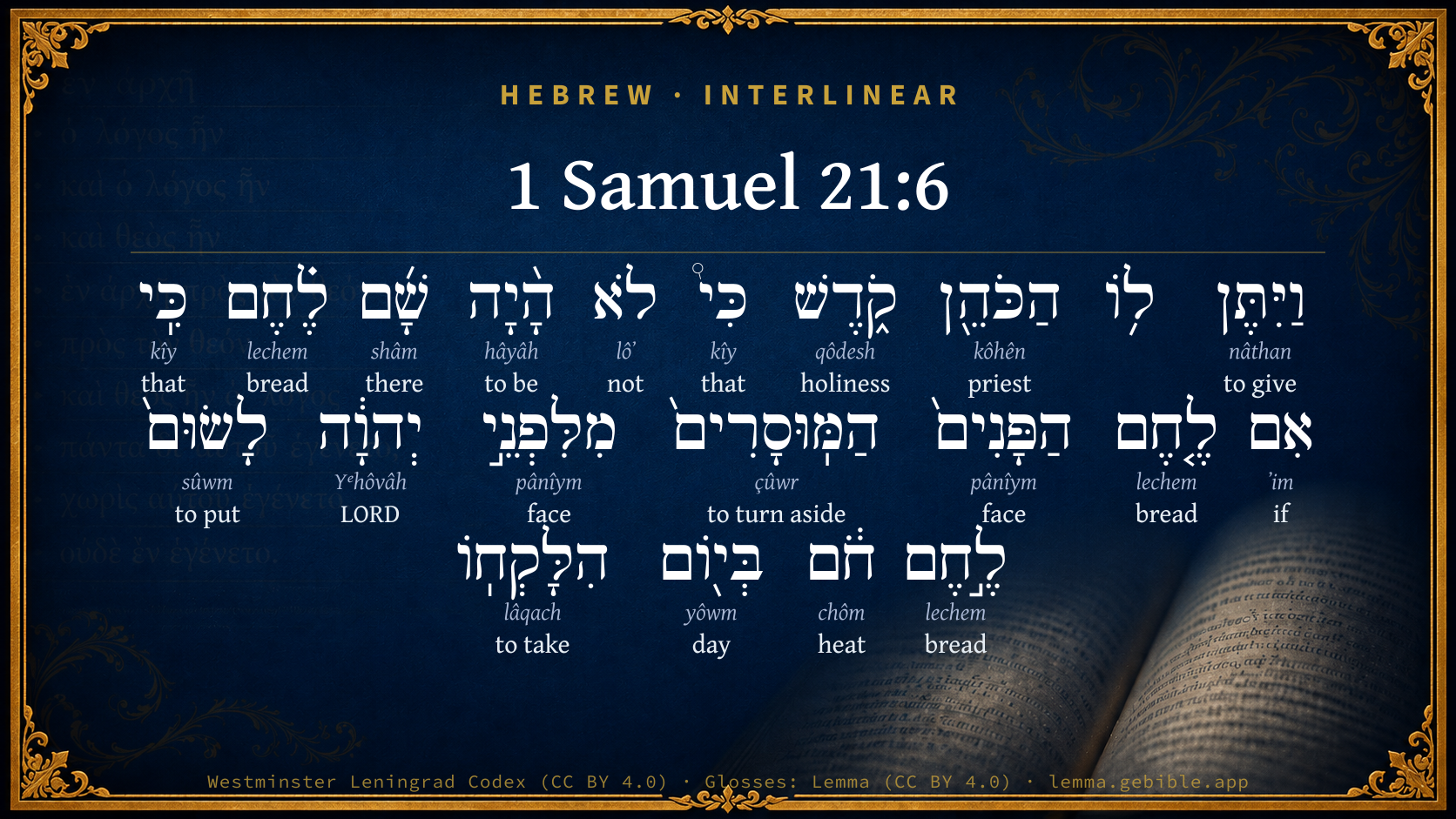
  1. וַיִּתֶּן nâthan H5414 “and · to give” Conjunction + Verb, Qal, Sequential Imperfect, 3rd Person, Masculine, Singular
  2. הַכֹּהֵ֖ן kôhên H3548 “the · priest” Particle, Definite Article + Noun, Common, Masculine, Singular, Absolute
  3. קֹ֑דֶשׁ qôdesh H6944 “holiness” Noun, Common, Masculine, Singular, Absolute
  4. כִּי֩ kîy H3588 “that” Conjunction
  5. לֹא lôʼ H3808 “not” Particle, Negative
  6. הָ֨יָה hâyâh H1961 “to be” Verb, Qal, Perfect, 3rd Person, Masculine, Singular
  7. שָׁ֜ם shâm H8033 “there” Adverb
  8. לֶ֗חֶם lechem H3899 “bread” Noun, Common, Both, Singular, Absolute
  9. כִּֽי kîy H3588 “that” Conjunction
  10. אִם ʼim H518 “if” Conjunction
  11. לֶ֤חֶם lechem H3899 “bread of” Noun, Common, Both, Singular, Construct
  12. הַפָּנִים֙ pânîym H6440 “the · face(s)” Particle, Definite Article + Noun, Common, Both, Plural, Absolute
  13. הַמּֽוּסָרִים֙ çûwr H5493 “the · turned aside” Particle, Definite Article + Verb, Hophal, Participle Passive, Masculine, Plural, Absolute
  14. מִלִּפְנֵ֣י pânîym H6440 “from · to/for · face(s) of” Preposition + Preposition + Noun, Common, Both, Plural, Construct
  15. יְהוָ֔ה Yᵉhôvâh H3068 “LORD” Noun, Proper
  16. לָשׂוּם֙ sûwm H7760 “to put” Preposition + Verb, Qal, Infinitive Construct
  17. לֶ֣חֶם lechem H3899 “bread of” Noun, Common, Both, Singular, Construct
  18. בְּי֖וֹם yôwm H3117 “in/at · day of” Preposition + Noun, Common, Masculine, Singular, Construct
  19. הִלָּקְחֽוֹ lâqach H3947 “to take · him” Verb, Niphal, Infinitive Construct + Suffix, Personal, 3rd Person, Masculine, Singular

About this verse

These counts appear in no published source. They are computed here, from the morphology-tagged text and Lemma’s own curated glosses. What Lemma adds →

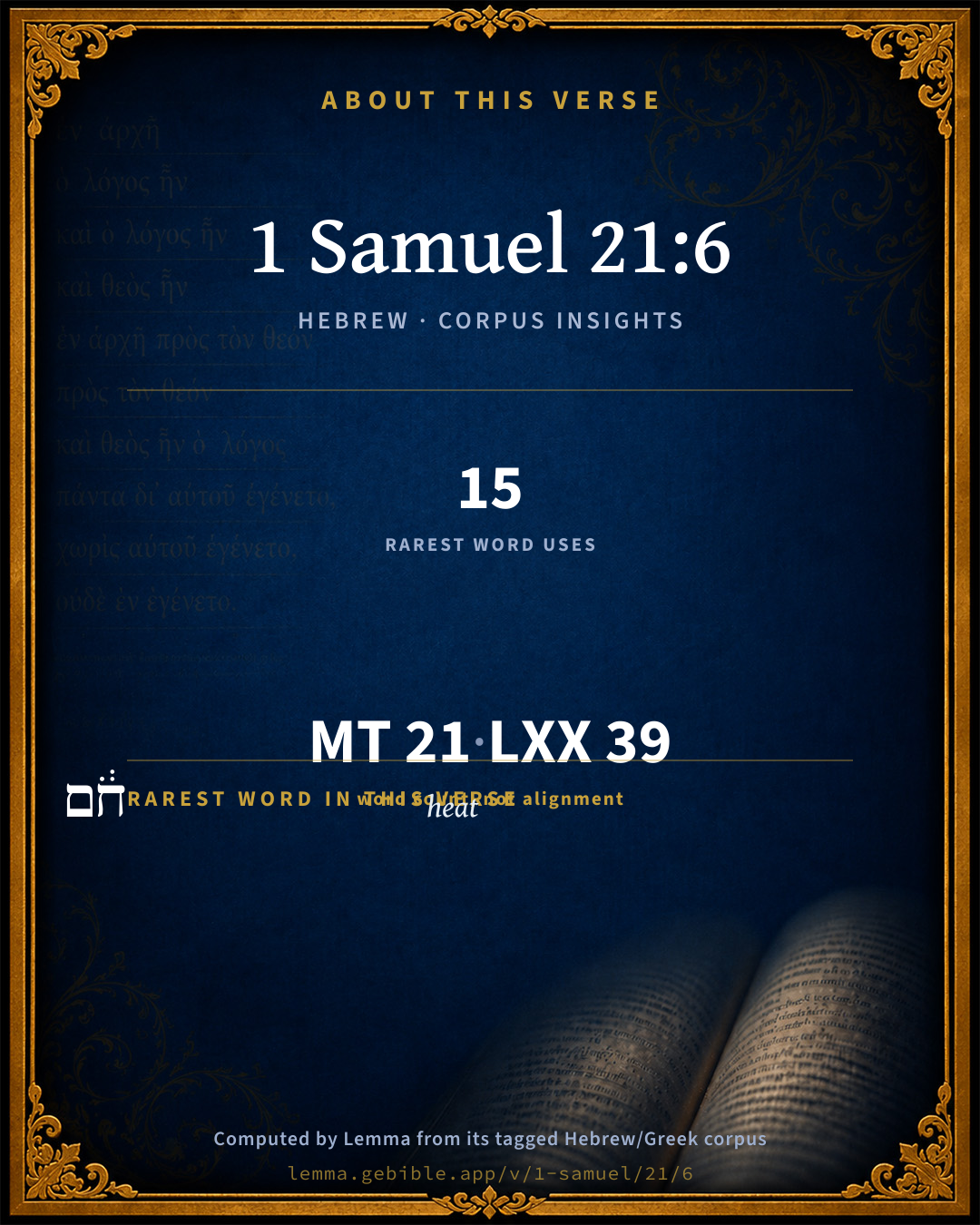
21
words
16
distinct lemmas
Historical
section

Notable vocabulary

The rarest word here is חֹ֔ם heat H2527 — appearing just 15 times in the whole Hebrew Bible.

Shared distinctive vocabulary

חֹ֔ם heat H2527 occurs in 13 verses of the Hebrew Bible. Also found in:

Grammatical profile

  • 5 verbs
  • 10 nouns
  • 1 preposition
  • 3 conjunctions
  • 1 adverb
  • 1 particle

Verb forms

  • וַיִּתֶּן Qal · Sequential Imperfect
  • הָ֨יָה Qal · Perfect
  • הַמּֽוּסָרִים֙ Hophal · Participle Passive
  • לָשׂוּם֙ Qal · Infinitive Construct
  • הִלָּקְחֽוֹ Niphal · Infinitive Construct

Repetition

Words recur within this verse — often emphatic in Hebrew:

  • לֶ֗חֶם bread H3899 ×3
  • הַפָּנִים֙ face H6440 ×2
  • כִּי֩ that H3588 ×2

Hebrew & Septuagint length

In English translation the verse runs 35 words from the Hebrew and 47 from the Septuagint (LXX English) — closely comparable.

A rough comparison of the two English renderings, which tokenize alike — not a word-level alignment.

Word counts can differ between the Hebrew and the Greek without any difference in meaning — e.g. the Hebrew direct-object marker אֵת has no separate Greek word, and Greek often adds the article ὁ.

In the original languages it is 21 Hebrew tokens and 39 Greek tokens — but the two are counted differently (Hebrew bundles its prefixes and suffixes into one token; the Greek is in lemma form), so that isn’t a like-for-like length.

Cross-references

4

Topical passages linked to 1 Samuel 21:6 in the Treasury of Scripture Knowledge — connected by theme and wording, ordered by reader-vote popularity; previews shown in the World English Bible.

  • Luke 6:3–4 Jesus, answering them, said, "Haven't you read what David did when he was hungry, he, and those who were with him;
  • Leviticus 24:5–9 "You shall take fine flour, and bake twelve cakes of it: two tenth parts of an ephah shall be in one cake.
  • Matthew 12:3–4 But he said to them, "Haven't you read what David did, when he was hungry, and those who were with him;
  • Mark 2:25–27 He said to them, "Did you never read what David did, when he had need, and was hungry--he, and they who were with him?

Cross-references courtesy of OpenBible.info (CC BY 4.0).

Hebrew and Greek witnesses Masoretic Hebrew ↔ Greek Septuagint

The same verse in the two great witnesses to the Old Testament, shown verse-for-verse.

These are two independent witnesses, not word-aligned to each other, and the Septuagint is shown in lemma (dictionary) form.

Hebrew 1 Samuel 21:6 Masoretic · Westminster Leningrad Codex

וַיִּתֶּן ל֥וֹ הַכֹּהֵ֖ן קֹ֑דֶשׁ כִּי֩ לֹא הָ֨יָה שָׁ֜ם לֶ֗חֶם כִּֽי אִם לֶ֤חֶם הַפָּנִים֙ הַמּֽוּסָרִים֙ מִלִּפְנֵ֣י יְהוָ֔ה לָשׂוּם֙ לֶ֣חֶם חֹ֔ם בְּי֖וֹם הִלָּקְחֽוֹ

So the priest gave him holy [bread]; for there was no bread there but the show bread, that was taken from before Yahweh, to put hot bread in the day when it was taken away.

World English Bible · Public Domain

Greek LXX 1 Samuel 21:6 Septuagint · lemma form

καί ἀποκρίνω δαυίδ ὁ ἱερεύς καί εἶπον αὐτός ἀλλά ἀπό γυνή ἀποἔχω ἐχθές καί τρίτος ἡμέρα ἐν ὁ ἐκἔρχομαι ἐγώ εἰς ὁδός γίγνομαι πᾶς ὁ παιδάριον ἁγνίζω καί αὐτός ὁ ὁδός βέβηλος διότι ἁγιάζω σήμερον διά ὁ σκεῦος ἐγώ

So Abimelech the priest gave him the show bread; for there were no loaves there, but only the presence loaves which had been removed from the presence of the Lord, in order that hot bread should be set on, on the day on which he took them.

LXX2012 (modern English Septuagint) · Public Domain

Hebrew: Westminster Leningrad Codex (CC BY 4.0). Greek: Septuagint (public domain); English from LXX2012 (modern English Septuagint) (Public Domain). How the Septuagint differs from the Hebrew →

Targum (Aramaic paraphrase)

1

The Targum is the ancient Jewish Aramaic paraphrase of the Hebrew Scriptures — an interpretive translation, not the Hebrew text itself. Onkelos (literal) and Pseudo-Jonathan (expansive) render the Torah, and Jonathan the Prophets. Coverage is partial: where no permissively-licensed English translation exists for a verse, only the Aramaic is shown. This is verse-level text, not a word-by-word alignment to the Hebrew.

  1. Targum Jonathan Prophets (Joshua–Malachi)
    וַאֲתֵיב דָוִד יַת כַּהֲנָא וַאֲמַר לֵיהּ בְּקֻשְׁטָא אִתְּתָא מְרַחֲקָא לָנָא כְּמֵאִתְמָלֵי וּמִדְקֳדָמוֹהִי בְּמִפְקִי וַהֲוָה מָנֵיהוֹן לְעוּלֵימַיָא דְכָן לְקֻדְשָׁא וְהוּא בְּאוֹרַח חוֹלָא הֲוָה אָזֵיל וְיוֹמָא דֵין הֲוָה מִתְאֲכֵיל וְלָא מִתְפְּסַל בְּמָנָא:

    (no public-domain English translation for this verse)

    Targum Jonathan — Aramaic: “Mikraot Gedolot” (public domain). English: “Sefaria Community Translation” (CC0 1.0 (public-domain dedication)); “London "Chaldee Paraphrase," 1871” (public domain). Text via Sefaria.

Commentary

Notes on 1 Samuel 21:6 from classic Christian and Jewish commentators (each source and its license shown beneath its notes). The classic Christian expositions comment on the surrounding passage and are grouped to its opening verse, so a note may address several verses; the Jewish commentaries on the Tanakh (Rashi and others) are per-verse, so they appear only where the commentator wrote on this verse.

Lemma curates 59 commentaries, every one of them public domain or Creative Commons licensed, each selected and text-cleaned for this edition rather than reprinted as found. About our sources →

Tyndale Open Study Notes

Tyndale Open Resources

21:6 gave him the holy bread: Jesus referred to this incident to teach that meeting people’s physical needs takes precedence over rigid adherence to sacred institutions (see Matt 12:1-8; Mark 2:23-28; Luke 6:1-5). • The Bread of the Presence consisted of twelve loaves (possibly one representing each tribe) that were laid out on a table in the Holy Place. They were replaced every Sabbath (see Exod 25:30; Lev 24:5-9).

Tyndale Open Study Notes — © Tyndale Open Resources, licensed CC BY-SA 4.0. Text via the HelloAO Bible API.

Jamieson, Fausset & Brown

Robert Jamieson, A. R. Fausset & David Brown

there was no bread there--in the tabernacle. The removal of the old and the substitution of the new bread was done on the Sabbath (Lev 24:8), the loaves being kept warm in an oven heated the previous day.

Jamieson, Fausset & Brown — Commentary Critical and Explanatory on the Whole Bible (1871) — public domain (CC PDM 1.0). Text via the HelloAO Bible API.

Adam Clarke's Commentary

Verse 6. So the priest gave him hallowed bread] To this history our Lord alludes, Mr 2:25, in order to show that in cases of absolute necessity a breach of the ritual law was no sin. It was lawful for the priests only to eat the shew-bread; but David and his companions were starving, no other bread could be had at the time, and therefore he and his companions ate of it without sin.

Adam Clarke's Commentary on the Bible (1810–1826) — public domain. Text from a community e-Sword/MySword module.

The Cambridge Bible for Schools and Colleges

gen. ed. J. J. S. Perowne

6. the shewbread] Lit. “the bread of the Presence” (Sept. ἄρτοι τοῦ προσώπου), so called because it was solemnly placed as an offering in the Presence of Jehovah. The mention of it implies that the Tabernacle with its furniture was at Nob. The directions for making the Table of Shewbread are given in Exo_25:23-30; and the form of the table, as it existed in Herod’s Temple, is preserved in the sculptures on the Arch of Titus at Rome. For the instructions concerning the bread itself, see Lev_24:5-9. It was to be renewed every Sabbath, and the loaves then removed were to be eaten by the priests in the Holy Place.

Our Lord refers to this as an instance of the great principle that where moral and ceremonial obligations come into conflict, it is the latter which must give way, because the rite is only the means and the moral duty the end. The high priest was bound to preserve David’s life, even at the expense of a ceremonial rule. See Mat_12:3-4; Mar_2:25-26; Luk_6:3-5. In St Mark the high priest is called Abiathar, perhaps by an accidental error; perhaps because he was associated with his father as Hophni and Phinehas were with Eli.

from before the Lord] From the table on which they had lain in the Presence of Jehovah in the Tabernacle. It seems probable that the shewbread had just been renewed and consequently that the day was the Sabbath; otherwise there would have been no difficulty in preparing ordinary bread for David’s use.

The Cambridge Bible for Schools and Colleges (gen. ed. J. J. S. Perowne; Cambridge University Press, 1878–1918) — public domain. Text from a community e-Sword module.

John Gill's Exposition

So the priest gave him hallowed bread,.... Being satisfied with the account he gave of himself, and his young men, and of the lawfulness of it in case of necessity, acts of mercy being to be preferred to ritual services. Whether he gave him five loaves, as he desired, is not said; but the reason of his giving him such sort of bread is observed:

for there was no bread there; in the tabernacle, whatever might be in the house of the priest:

but the shewbread that was taken from before the Lord; from off of the shewbread table; and it seems to have been just taken off, it being sabbath day, and not as yet carried to the house of the priest, and divided among the other priests as usual; and which was then removed, to put hot bread, in the day that it was taken away; that is, new bread, twelve fresh cakes; for when the twelve, that had stood a week on the shewbread table were removed, twelve more were immediately put in their room, and it seems by this they were put hot there; but here arises a difficulty, how they could be put hot there, when it was not lawful to bake on a sabbath day. About this the Jews are divided; some say they were baked on the sabbath day, but the greater part say that baking did not drive away the sabbath, or it was lawful on the sabbath day; but others say that they were baked on the evening of the sabbath, and kept in the oven until the time of their being set upon the table (h); and, as Abarbinel observes, the mouth of the oven might be stopped up till that time to keep in the heat; but others say (i) this heat was miraculous, or that a miracle was wrought for the sake of it; which is not probable.

(h) T. Bab. Menachot, fol. 95. 2. (i) T. Bab. Yoma, fol. 2l. 1. Menachot, fol. 96. 2.

John Gill's Exposition of the Whole Bible (1746–1763) — public domain (CC PDM 1.0). Text via the HelloAO Bible API.

Matthew Poole's English Annotations

There was no bread there, to wit, in the tabernacle, where David and the priest now were.

In the day when it was taken away, which was done upon the sabbath day, Lev 24:8; for though they might not then kindle a fire to heat the bread in, yet they might and did keep it hot in an oven that had been heated before the sabbath.

Matthew Poole's English Annotations on the Holy Bible (1683–1685) — public domain. Text from a community e-Sword/MySword module.

Whedon's Commentary on the Bible

Daniel D. Whedon

6. That was taken from before the Lord, to put hot bread in the day when it was taken away — This was done every sabbath day, (Lev_24:8-9,) and it is therefore probable that this incident of David’s life occurred on the sabbath. On this supposition our Lord’s appeal to this incident, as a vindication of his plucking the ears of corn on the sabbath, has double force. See Mat_12:1-4. Kitto remarks: “As it was not lawful to travel on the sabbath day, it seems to us that, seeing it was not safe for him to remain at Gibeah, and that the little time which remained before the commencement of the sabbath would preclude further travelling, he had concluded to go to Nob as a place of safety, till the termination of the holy day should enable him to resume his journey.”

Daniel D. Whedon (gen. ed.), Commentary on the Old and New Testaments (1874–1909) — public domain. Text from a community e-Sword module.

The Pulpit Commentary

HOMILIES BY D. FRASER Ver. 6.

The letter of the law violated.

How did David, being neither priest nor Levite, venture to eat the presence bread from the sanctuary? How did Ahimelech venture to give it to him?

I THERE WAS THE PLEA OF NECESSITY. An ox or an ass which had fallen into a pit might be lifted out on the sabbath, notwithstanding the commandment to do no manner of work on the seventh day. The need of the poor animal, and the mercy due to it in its mishap, were justification enough for a breach of the letter of the law. When the disciples of Christ, walking with him along the edge of a cornfield, pulled some ears to relieve their hunger, they were blameless, for what they did was expressly permitted by the Mosaic law. (Deu_23:25) But they did it on the sabbath, and this the Pharisees challenged as unlawful. The Lord Jesus, however, held it quite lawful. It was necessary that his followers should relieve their hunger and recruit their strength, and the greater object must be put above the less. "The sabbath was made for man, and not man for the sabbath." Our Lord brought out this truth into stronger relief than any other Jewish teacher had done; but it was not new doctrine. We see that while the Mosaic ritual was in the full force of its obligation the priest at Nob felt warranted to suspend one of its most minute regulations in order to relieve pressing human want. Perhaps the tendency in modem Churches is to take too much liberty with rules and ordinances of religion under pleas of necessity which are little more than pleas of convenience or self-will. But there is a golden mean between rigidity and laxity; and it must be left to the judgment and conscience of those who fear the Lord to determine for their own guidance what does or does not constitute a sufficient ground for setting aside regulations or restrictions which are ordinarily entitled to respect. Yet it is only the letter of the law, or the minutioe of religious observance, that may be thus dealt with. There are supreme obligations which not even a question of life and death may overrule. Nehemiah would not flee into the temple to save his life when his duty was to build up Jerusalem. Shadrach, Meshach, and Abednego would not worship the golden image at Babylon to save their bodies from the furnace; nor would Daniel desist from prayer to Jehovah to escape the lions" den. Paul insisted on his right of protection as a Roman citizen, hut he would not for a moment compromise or conceal the gospel to evade persecution. No bonds or afflictions moved him; neither did he count his life dear to himself, so that he might finish his course with joy. It is true that not all the followers of Christ have had such fortitude. In days of persecution some faltered and apostatised, excusing themselves under a plea of necessity. They could not suffer; they dared not to die. But the noble army of martyrs consists of those who felt it the supreme necessity to be true to conscience, to the truth of the gospel, and the Christ of God. Not everything, then, must yield to necessity. David thought his hunger a sufficient warrant for taking from the priest"s hand the sacred bread; but when Goliath blasphemed the God of Israel and defied his army, David had shown that his own life was not so dear to him as the glory of God and the honour and safety of his people.

II THERE WAS A PROFOUND INSIGHT INTO THE TRUE MEANING OF PRIESTHOOD IN ISRAEL. No doubt the priests formed a hereditary order, wearing a distinctive dress, and having special provision made by statute for their position and maintenance. But they were never intended to be a caste of holy intercessors standing between God and an unholy nation. Neither they nor the Levites, their assistants, were isolated from the common life of their countrymen, as by separate charter of privilege or vows of celibacy. They were just the concentrated expression of the truth that all Israel was called to be "a kingdom of priests and a holy nation." The rule was that the priests only should eat the bread which was withdrawn weekly from the table in the sanctuary; but it was no breach of the essence and spirit of the law if other Israelites, faithful to God, should on an emergency eat of this bread. David was as truly a servant of Jehovah as Ahimelech. Though all the Lord"s people never were prophets, they always were, and now are, priests. Knowing this, David took and ate; not at all in a wilful mood, like Esau in his ravenous hunger eating Jacob"s pottage, but with reverential feeling and a good conscience, under sanction of the fact that he was one of a priestly nation, and with confidence that God would not condemn him for exceeding in such a strait the letter of the law, so long as he honoured and obeyed its spirit. The leaders and rulers of the Church, according to the New Testament, are not sacerdots invested with a mystic sanctity and intrusted with a religious monopoly. They are simply the intensified expression of the holy calling of all the members of Christ, all the children of God. All these have a right to worship in the holiest; and as all of them may offer spiritual sacrifices, so all may "eat of the holy things." Order, indeed, is needful in the Church, and no man may assume a leading place or charge therein until duly called and appointed to the same. If David had for a light cause, or frequently, taken the presence bread, it would have been a sign of irreverence or arrogance. And in like manner if a Christian not intrusted with office in any constituted Church pushes forward when there is no emergency, and assumes to lead the Divine service, or to appoint or conduct the observance of the Lord"s Supper, he steps out of his place, and may be designated "unruly." But there are places and occasions which do not admit of the usual regulations being observed; and in such cases a private or unofficial Christian may take upon himself any religious function rather than that any soul should suffer damage, and this under the general principle that all Christians form a "royal priesthood." The teaching of this passage is against religious pedantry and ecclesiastical hauteur. Count form subordinate to life. Value order, and reverence ordinances that are really of God. Play no "fantastic tricks" with sacred things "before high heaven;" but do not reduce religion to a question of meats and drinks, and do not count any one a serious offender who in a strait has violated prescription or usage. One who breaks the letter of the law may keep the law itself better than another who knows nothing but the letter. We are called to liberty; not licence, indeed, but order and liberty. If we are true to God and to our consciences we need not dread that, for a formality or an informality, Christ will cast us off. The Son of man is Lord of the sabbath and of the table, "Minister of the sanctuary and the true tabernacle," Lord of all the ordinances that are binding on his followers. And there is a freedom not from order, but in God"s order with which the Son of man, being Son of God, has made his people free. F.

The Pulpit Commentary (1880–1919), ed. H.D.M. Spence-Jones & Joseph S. Exell — public domain. Text from a community e-Sword module.

Scofield Reference Notes

C. I. Scofield

shewbread

(See Scofield "Exo 25:30").

The Scofield Reference Bible (1917 edition), notes by C. I. Scofield — public domain. Text from a community e-Sword module.

Rashi

Rabbi Shlomo Yitzchaki (Rashi)

Have been kept from us. Withheld from us.

The garments of the youths were pure. [Literally 'holy'] pure.

Even though it is an ordinary mission. And the bread, once it has been removed from the table, and they have burned the spoonfuls [of frankincense], it is almost common, because it has been excluded from [the prohibition of] מְעִילָה as soon as it becomes permitted for the kohanim [to eat].

Even more so today it will remain sacred in the vessel. Even if today were the beginning of its sanctity on the table, I would be obliged to take it from there and feed ourselves, for a ravenous hunger has seized us, and our lives are in danger. Thus it is explained in [Maseches] Menachos.

Rashi on the Tanakh — English translations: “The Judaica Press complete Tanach with Rashi, translated by A. J. Rosenberg” (CC BY 4.0); “Pentateuch with Rashi's commentary by M. Rosenbaum and A.M. Silbermann, 1929-1934” (public domain); “The Metsudah Tanach series, Lakewood, N.J” (CC BY 4.0); and “The Book of Joshua, Metsudah Publications, 1997” (CC BY 4.0). Text via Sefaria.

Lesson kit

Teaching starters — assembled from the data on this page, not authored interpretation. Every prompt links to the verse data it draws on. Edit before teaching.

1 Samuel, in the Historical, opens this verse with 21 words (16 distinct Hebrew lemmas). Its most distinctive word is chôm (“heat”). A historical commentator’s framing appears above. Read the whole chapter for the surrounding context.

Discussion questions

  1. How does “heat” (chôm) shape what this verse is saying?
  2. How does Genesis 8:22, which shares the word «heat», read alongside this verse?
  3. What does the repetition of “bread” (3× in this one verse) do in this verse?
  4. These translations render this verse differently. What is at stake in choosing one wording over another?
  5. «וַיִּתֶּן» is a Qal Sequential Imperfect verb. How does that grammatical form shape the action described?
  6. Compare how Tyndale Open Study Notes and Jamieson, Fausset & Brown read this verse. Where do they agree or differ?

Things to notice

Reading settings

Reading text

Shown beneath each verse's original-language words.

Old Testament
Old Testament edition

Read the OT as the Masoretic Hebrew (MT) or the Greek Septuagint (LXX).

English shown for the Greek Septuagint (in the Hebrew ↔ Greek comparison).

Comparing translations? Open the Compare panel on any verse page to stack up to four side by side.