2 Chronicles 4:19

Hebrew (Westminster Leningrad Codex) 2 Chronicles 4:19 appears in the Hebrew Old Testament. The text above is from the Westminster Leningrad Codex. Each word links to its Strong’s number, a concise gloss, and parsing drawn from the Open Scriptures Hebrew Bible morphology. Click any word for its full Brown-Driver-Briggs (BDB) entry.
Download image
Cite this verse

2 Chronicles 4:19 (World English Bible). Public Domain. Lemma interlinear Bible study tool, https://lemma.gebible.app/v/2-chronicles/4/19.

Show BibTeX & RIS
BibTeX
RIS
English Translation
Solomon made all the vessels that were in the house of God, the golden altar also, and the tables whereon was the show bread;
World English Bible · Public Domain
Download a study sheet

One document with this verse’s original text, its word-by-word gloss line, the meaning frame, cross-references with their text, attributed commentary, and full source and license credits — printable, and it pastes into notes with its structure intact.

This verse Autodidact and up

Study sheet (.html) Plain text (.txt)

A passage Seminary Student

Up to 50 verses in one chapter. A passage sheet keeps up to 6 commentary sources and 12 cross-references per verse, in the order this page ranks them, and says so on the sheet whenever that leaves anything out. Ask for a single verse and you get the Autodidact verse sheet above.

Everything on this page stays free to read, with no account — the sheet is a download of what is already on screen, not access to it.

Want to remove ads? Support Godless Engineer
Compare translations 3

The same verse in 3 English versions, stacked beneath the original-language interlinear above. Click any original word for its lexicon entry.

Each is an independent rendering of the whole verse — the interlinear is not word-aligned to these translations.

Highlighted words mark where these versions differ — a whole-verse word diff, not a word-by-word alignment.

  • World English Bible Public Domain
    Solomon made all the vessels that were in the house of God, the golden altar also, and the tables whereon was the show bread;
  • King James Version Public Domain
    And Solomon made all the vessels that were for the house of God, the golden altar also, and the tables whereon the shewbread was set;
  • unfoldingWord Literal Text CC BY-SA 4.0
    And Solomon made all the items that were in the house of God, and the altar of gold, and the tables and on them the bread of the presence;

unfoldingWord Literal Text — © unfoldingWord, licensed CC BY-SA 4.0. Word-aligned USFM3 via Door43 (git.door43.org/unfoldingWord/en_ult).

Versions to compare (up to 4)

3 of 4 selected

Show all 18 translations

Every available English version of this verse, each an independent rendering of the whole verse.

  • World English Bible Public Domain
    Solomon made all the vessels that were in the house of God, the golden altar also, and the tables whereon was the show bread;
  • Berean Standard Bible Public Domain
    Solomon also made all the furnishings for the house of God: the golden altar; the tables on which was placed the Bread of the Presence;
  • Majority Standard Bible Public Domain
    Solomon also made all the furnishings for the house of God: the golden altar; the tables on which was placed the Bread of the Presence;
  • King James Version Public Domain
    And Solomon made all the vessels that were for the house of God, the golden altar also, and the tables whereon the shewbread was set;
  • American Standard Version (1901) Public Domain
    And Solomon made all the vessels that were in the house of God, the golden altar also, and the tables whereon was the showbread;
  • Revised Version (1885) Public Domain
    And Solomon made all the vessels that were in the house of God, the golden altar also, and the tables whereon was the shewbread;
  • Geneva Bible (1599) Public Domain
    And Salomon made al the vessels that were for the house of God: the golden altar also and the tables, whereon the shewbread stoode.
  • Douay-Rheims (1899) Public Domain
    And the multitude of vessels was innumerable, so that the weight of the brass was not known.
  • Young's Literal Translation Public Domain
    And Solomon maketh all the vessels that `are for' the house of God, and the altar of gold, and the tables, and on them `is' bread of the presence;
  • Literal Standard Version CC BY-SA 4.0
    And Solomon makes all the vessels that [are for] the house of God, and the altar of gold, and the tables, and on them [is] Bread of the Presentation;
  • Unlocked Literal Bible CC BY-SA 4.0
    Solomon made all the furnishings that were in the house of God, the golden altar also, and the tables on which the bread of the presence was to be placed;
  • unfoldingWord Literal Text CC BY-SA 4.0
    And Solomon made all the items that were in the house of God, and the altar of gold, and the tables and on them the bread of the presence;
  • Darby Bible Public Domain
    And Solomon made all the vessels that were [in] the house of God: the golden altar; and the tables whereon was the shewbread;
  • World Messianic Bible Public Domain
    Solomon made all the vessels that were in God’s house: the golden altar, the tables with the show bread on them,
  • Webster's Bible Public Domain
    And Solomon made all the vessels that were for the house of God, the golden altar also, and the tables on which the show-bread was set;
  • Free Bible Version CC BY-SA 4.0
    Solomon also made everything used in the Temple of God: the golden altar; the tables where the Bread of the Presence was displayed;
  • Bible in Basic English Public Domain
    And Solomon made all the vessels used in the house of God, the gold altar and the tables on which the holy bread was placed,
  • JPS Tanakh (1917) Public Domain
    And Solomon made all the vessels that were in the house of God, the golden altar also, and the tables whereon was the showbread;

Literal Standard Version (2020), Covenant Press — licensed CC BY-SA 4.0. Text via the HelloAO Bible API (eBible.org). Unlocked Literal Bible (unfoldingWord) — licensed CC BY-SA 4.0. Text via the HelloAO Bible API (eBible.org). unfoldingWord Literal Text — © unfoldingWord, licensed CC BY-SA 4.0. Word-aligned USFM3 via Door43 (git.door43.org/unfoldingWord/en_ult). Free Bible Version, Dr. Jonathan Gallagher — licensed CC BY-SA 4.0. Text via the HelloAO Bible API (eBible.org).

Word by word

More ways to search: Search by grammar → Find every occurrence → Compare this word →

Practice this passage: Drill this verse → Learn its vocabulary →

הַשֻּׁלְחָנ֔וֹת
shulchân
H7979
“the · tables”
Particle, Definite Article + Noun, Common, Masculine, Plural, Absolute
Part of Speech
Particle + Noun
Type
Common
Gender
Masculine
Number
Plural
State
Absolute
Full BDB Definition

Origin: from H7971

TWOT: 2395a

table - table - of king's table, private use, sacred uses
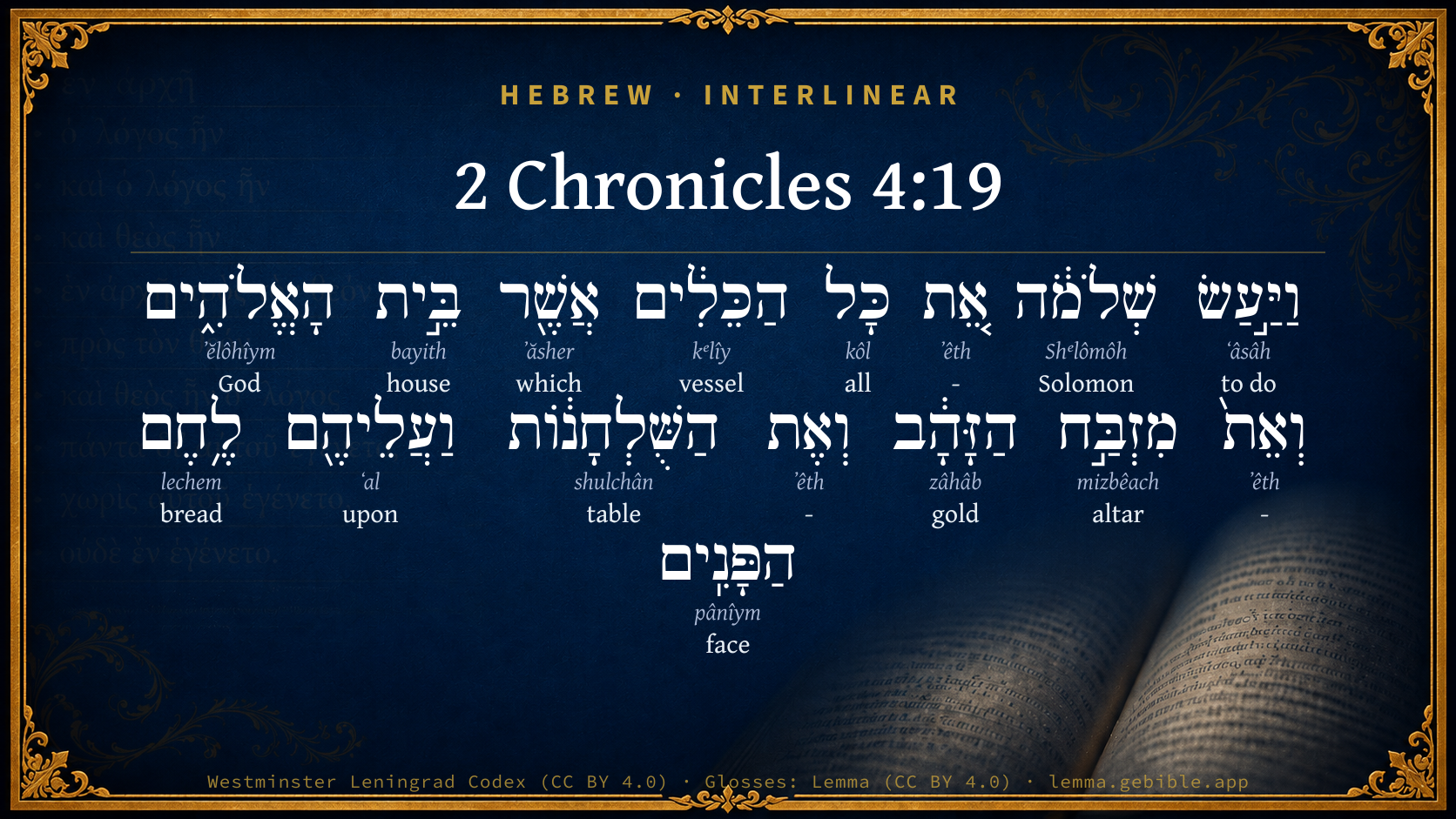
  1. וַיַּ֣עַשׂ ʻâsâh H6213 “and · to do” Conjunction + Verb, Qal, Sequential Imperfect, 3rd Person, Masculine, Singular
  2. שְׁלֹמֹ֔ה Shᵉlômôh H8010 “Solomon” Noun, Proper
  3. אֵ֚ת ʼêth H853 “-” Particle, Direct Object
  4. כָּל kôl H3605 “all of” Noun, Common, Masculine, Singular, Construct
  5. הַכֵּלִ֔ים kᵉlîy H3627 “the · vessels” Particle, Definite Article + Noun, Common, Masculine, Plural, Absolute
  6. אֲשֶׁ֖ר ʼăsher H834 “which” Particle, Relative
  7. בֵּ֣ית bayith H1004 “house of” Noun, Common, Masculine, Singular, Construct
  8. הָאֱלֹהִ֑ים ʼĕlôhîym H430 “the · God(s)” Particle, Definite Article + Noun, Common, Masculine, Plural, Absolute
  9. וְאֵת֙ ʼêth H853 “and · -” Conjunction + Particle, Direct Object
  10. מִזְבַּ֣ח mizbêach H4196 “altar of” Noun, Common, Masculine, Singular, Construct
  11. הַזָּהָ֔ב zâhâb H2091 “the · gold” Particle, Definite Article + Noun, Common, Masculine, Singular, Absolute
  12. וְאֶת ʼêth H853 “and · -” Conjunction + Particle, Direct Object
  13. וַעֲלֵיהֶ֖ם ʻal H5921 “and · upon · them” Conjunction + Preposition + Suffix, Personal, 3rd Person, Masculine, Plural
  14. לֶ֥חֶם lechem H3899 “bread of” Noun, Common, Both, Singular, Construct
  15. הַפָּנִֽים pânîym H6440 “the · face(s)” Particle, Definite Article + Noun, Common, Both, Plural, Absolute

About this verse

These counts appear in no published source. They are computed here, from the morphology-tagged text and Lemma’s own curated glosses. What Lemma adds →

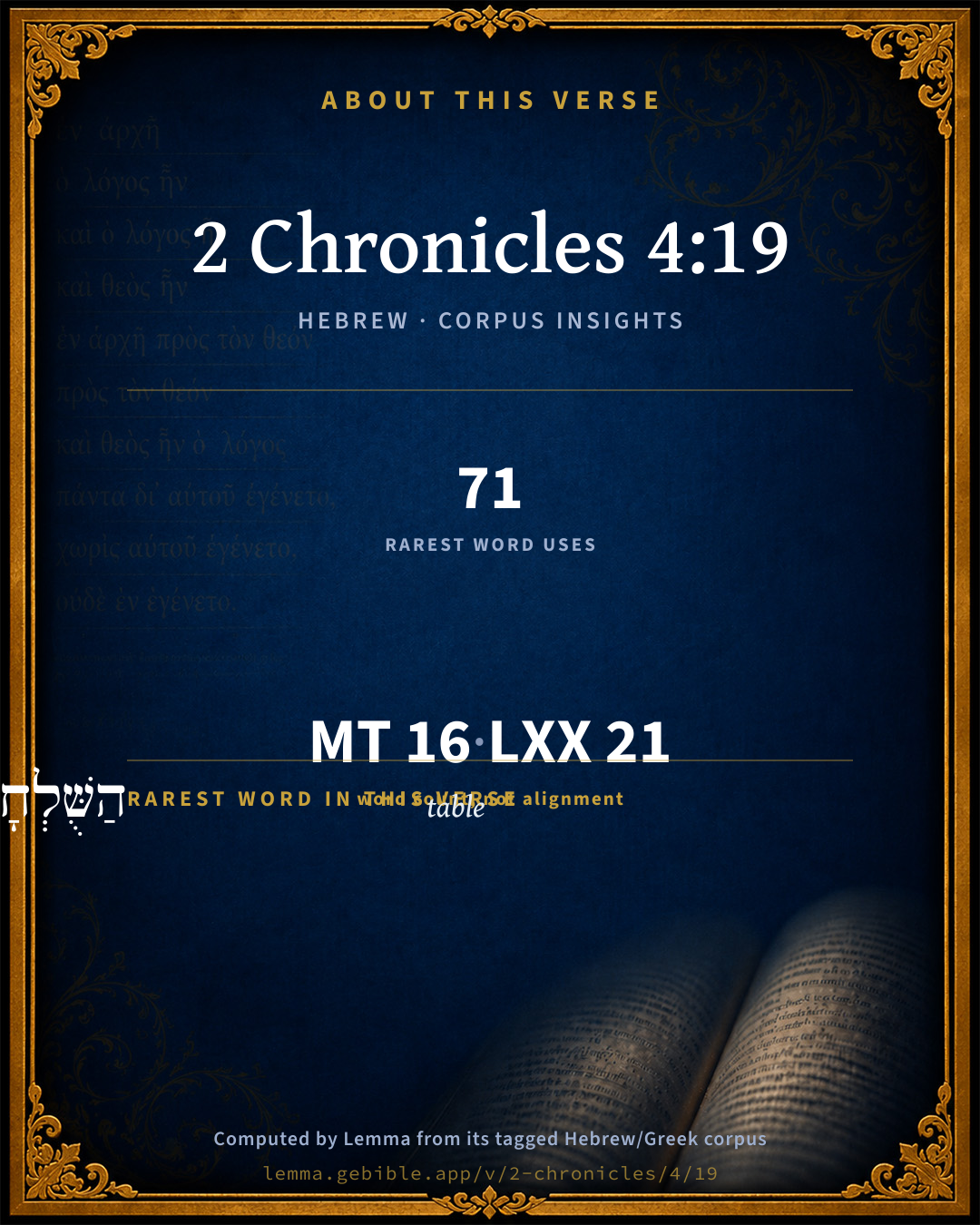
16
words
14
distinct lemmas
Historical
section

Grammatical profile

  • 1 verb
  • 10 nouns
  • 1 preposition
  • 4 particles

Verb forms

  • וַיַּ֣עַשׂ Qal · Sequential Imperfect

Hebrew & Septuagint length

In English translation the verse runs 24 words from the Hebrew and 30 from the Septuagint (LXX English) — closely comparable.

A rough comparison of the two English renderings, which tokenize alike — not a word-level alignment.

Word counts can differ between the Hebrew and the Greek without any difference in meaning — e.g. the Hebrew direct-object marker אֵת has no separate Greek word, and Greek often adds the article ὁ.

In the original languages it is 16 Hebrew tokens and 21 Greek tokens — but the two are counted differently (Hebrew bundles its prefixes and suffixes into one token; the Greek is in lemma form), so that isn’t a like-for-like length.

Cross-references

19

Topical passages linked to 2 Chronicles 4:19 in the Treasury of Scripture Knowledge — connected by theme and wording, ordered by reader-vote popularity; previews shown in the World English Bible.

  • Revelation 9:13 The sixth angel sounded. I heard a voice from the horns of the golden altar which is before God,
  • Exodus 25:23–30 "You shall make a table of acacia wood. Two cubits shall be its length, and a cubit its breadth, and one and a half cubits its height.
  • Exodus 30:1–10 "You shall make an altar to burn incense on. You shall make it of acacia wood.
  • Exodus 37:25–29 He made the altar of incense of acacia wood. It was square: its length was a cubit, and its breadth a cubit. Its height was two cubits. Its horns were of one piece with it.
  • Leviticus 24:5–8 "You shall take fine flour, and bake twelve cakes of it: two tenth parts of an ephah shall be in one cake.
  • 1 Kings 7:48–50 Solomon made all the vessels that were in the house of Yahweh: the golden altar, and the table whereupon the show bread was, of gold;
  • 2 Kings 24:13 He carried out there all the treasures of the house of Yahweh, and the treasures of the king's house, and cut in pieces all the vessels of gold, which Solomon king of Israel had made in the temple of Yahweh, as Yahweh had said.
  • 2 Kings 25:13–15 The pillars of brass that were in the house of Yahweh, and the bases and the brazen sea that were in the house of Yahweh, did the Chaldeans break in pieces, and carried the brass of them to Babylon.
  • 1 Chronicles 28:16 and the gold by weight for the tables of show bread, for every table; and silver for the tables of silver;
  • 2 Chronicles 4:8 He made also ten tables, and placed them in the temple, five on the right side, and five on the left. He made one hundred basins of gold.
  • 2 Chronicles 26:16–18 But when he was strong, his heart was lifted up, so that he did corruptly, and he trespassed against Yahweh his God; for he went into the temple of Yahweh to burn incense on the altar of incense.
  • 2 Chronicles 36:10 At the return of the year king Nebuchadnezzar sent, and brought him to Babylon, with the goodly vessels of the house of Yahweh, and made Zedekiah his brother king over Judah and Jerusalem.
  • 2 Chronicles 36:18 All the vessels of the house of God, great and small, and the treasures of the house of Yahweh, and the treasures of the king, and of his princes, all these he brought to Babylon.
  • Ezra 1:7–11 Also Cyrus the king brought forth the vessels of the house of Yahweh, which Nebuchadnezzar had brought forth out of Jerusalem, and had put in the house of his gods;
  • Jeremiah 28:3 Within two full years will I bring again into this place all the vessels of Yahweh's house, that Nebuchadnezzar king of Babylon took away from this place, and carried to Babylon:
  • Jeremiah 52:18–19 The pots also, and the shovels, and the snuffers, and the basins, and the spoons, and all the vessels of brass with which they ministered, took they away.
  • Daniel 5:2–3 Belshazzar, while he tasted the wine, commanded to bring the golden and silver vessels which Nebuchadnezzar his father had taken out of the temple which was in Jerusalem; that the king and his lords, his wives and his concubines, might drink from it.
  • Daniel 5:23 but have lifted up yourself against the Lord of heaven; and they have brought the vessels of his house before you, and you and your lords, your wives and your concubines, have drunk wine from them; and you have praised the gods of silver and gold, of brass, iron, wood, and stone, which don't see, nor hear, nor know; and the God in whose hand your breath is, and whose are all your ways, you have not glorified.
  • Revelation 8:3 Another angel came and stood over the altar, having a golden censer. Much incense was given to him, that he should add it to the prayers of all the saints on the golden altar which was before the throne.

Cross-references courtesy of OpenBible.info (CC BY 4.0).

Hebrew and Greek witnesses Masoretic Hebrew ↔ Greek Septuagint

The same verse in the two great witnesses to the Old Testament, shown verse-for-verse.

These are two independent witnesses, not word-aligned to each other, and the Septuagint is shown in lemma (dictionary) form.

Hebrew 2 Chronicles 4:19 Masoretic · Westminster Leningrad Codex

וַיַּ֣עַשׂ שְׁלֹמֹ֔ה אֵ֚ת כָּל הַכֵּלִ֔ים אֲשֶׁ֖ר בֵּ֣ית הָאֱלֹהִ֑ים וְאֵת֙ מִזְבַּ֣ח הַזָּהָ֔ב וְאֶת הַשֻּׁלְחָנ֔וֹת וַעֲלֵיהֶ֖ם לֶ֥חֶם הַפָּנִֽים

Solomon made all the vessels that were in the house of God, the golden altar also, and the tables whereon was the show bread;

World English Bible · Public Domain

Greek LXX 2 Chronicles 4:19 Septuagint · lemma form

καί ποιέω σαλωμών πᾶς ὁ σκεῦος οἶκος κύριος καί ὁ θυσιαστήριον ὁ χρυσοῦς καί ὁ τράπεζα καί ἐπί αὐτός ἄρτος πρόθεσις

And Solomon made all the vessels of the house of the Lord, and the golden altar, and the tables, and upon them were to be the loaves of show bread;

LXX2012 (modern English Septuagint) · Public Domain

On this verse, Ellicott's Commentary for English Readers discusses the Septuagint’s reading. Read the note in Commentary ↓

Hebrew: Westminster Leningrad Codex (CC BY 4.0). Greek: Septuagint (public domain); English from LXX2012 (modern English Septuagint) (Public Domain). How the Septuagint differs from the Hebrew →

Commentary

Notes on 2 Chronicles 4:19 from classic Christian and Jewish commentators (each source and its license shown beneath its notes). The classic Christian expositions comment on the surrounding passage and are grouped to its opening verse, so a note may address several verses; the Jewish commentaries on the Tanakh (Rashi and others) are per-verse, so they appear only where the commentator wrote on this verse.

Lemma curates 59 commentaries, every one of them public domain or Creative Commons licensed, each selected and text-cleaned for this edition rather than reprinted as found. About our sources →

Ellicott's Commentary for English Readers

(c) CATALOGUE OF OBJECTS IN GOLD—CONCLUSION

(2Ch_4:19 -2Ch_5:1). 1Ki_7:48-50.

The narrative still coincides in the main with that of Kings, allowing for one or two remarkable alterations.

(19) For the house.—In the houses (without proposition, comp. 2Ch_4:11).

The golden altar also.—Literally, both the golden altar and the tables, and upon them the Presence bread. So LXX. and Vulg. The parallel passage, 1Ki_7:48, says, and the table on which (was) the Presence bread (in) gold. (See Note on 2Ch_4:8, supr., and 1Ch_28:16.) On the one hand, the chronicler in these three passages consistently speaks of tables, although the book of Kings mentions one table only; and, on the other hand, elsewhere he actually speaks himself of “the Pure Table,” and “the Table of the Pile,” as if there were only one such table (2Ch_13:11; 2Ch_29:18).

The difficulty cannot be solved with certainty; but it seems likely that, finding mention of a number of tables in one of his sources, the chronicler has grouped them all together with the Table of Shewbread. thus gaining brevity at the cost of accuracy. In Eze_40:39 eight tables of hewn stone are mentioned, whereon they slew the sacrificial victims.

A Bible Commentary for English Readers, edited by Charles John Ellicott (1878–1897) — public domain. Text from a community e-Sword module.

Keil & Delitzsch

C. F. Keil & F. Delitzsch

The golden furniture of the holy place and the gilded doors of the temple. This section is found also in Kg1 7:40-50. The enumeration of the things wrought in brass coincides to a word, with the exception of trifling linguistic differences and some defects in the text, with Kg1 7:40-47. In Ch2 4:12 והכּתרות הגּלּות is the true reading, and we should so read in Kg1 7:41 also, since the גּלּות, circumvolutions, are to be distinguished from the כּתרות, crowns; see on Ch2 3:16. In Ch2 4:14 the first עשׂה is a mistake for עשׂר, the second for עשׂרה, Kg1 7:43; for the verb עשׂה is not required nor expected, as the accusative depends upon לעשׂות, Ch2 4:11, while the number cannot be omitted, since it is always given with the other things. In Ch2 4:16 מזלנות is an orthographic error for מזרקות; cf. Ch2 4:11 and Kg1 7:44. ואת־כּל־כּליחם is surprising, for there is no meaning in speaking of the utensils of the utensils enumerated in Ch2 4:12-16. According to Kg1 7:45, we should read האלּה כּל־הכּלים את. As to אביו, see on Ch2 2:12. מרוּק נחשׁת is accusative of the material, of polished brass; and so also ממרט נח, Kg1 7:45, with a similar signification. In reference to the rest, see the commentary on Kg1 7:40.

Ch2 4:19-21

In the enumeration of the golden furniture of the holy place, our text diverges somewhat more from Kg1 7:48-50. On the difference in respect to the tables of the shew-bread, see on Kg1 7:48. In Ch2 4:20 the number and position of the candlesticks in the holy place are not stated as they are in Kg1 7:49, both having been already given in Ch2 4:7. Instead of that, their use is emphasized: to light them, according to the right, before the most holy place (כּמּשׁפּט as in Ch2 4:7). As to the decorations and subordinate utensils of the candlesticks, see on Kg1 7:49. To זהב, Ch2 4:21 (accus. of the material), is added זהב מכלות הוּא, "that is perfect gold." מכלה, which occurs only here, is synonymous with מכלל, perfection. This addition seems superfluous, because before and afterwards it is remarked of these vessels that they were of precious gold (סגוּר זהב), and it is consequently omitted by the lxx, perhaps also because מכלות was not intelligible to them. The words, probably, are meant to indicate that even the decorations and the subordinate utensils of the candlesticks (lamps, snuffers, etc.) were of solid gold, and not merely gilded.

Ch2 4:22

מזמּרות, knives, probably used along with the snuffers for the cleansing and trimming of the candlesticks and lamps, are not met with among the utensils of the tabernacle, but are here mentioned (Chr. and Kings), and in Kg2 12:14 and Jer 52:18, among the temple utensils. Along with the מזרקות, sacrificial vessels (see on Ch2 4:8), in Ch1 28:17 מזלנות, forks of gold, are also mentioned, which are not elsewhere spoken of. Among the utensils of the tabernacle we find only מזלגות of brass, flesh-forks, as an appurtenance of the altar of burnt-offering (Exo 27:3; Exo 38:3; Num 4:14; cf. Sa1 2:13.), which, however, cannot be intended here, because all the utensils here enumerated belonged to the holy place. What purpose the golden forks served cannot be determined, but the mention of golden knives might lead us to presuppose that there would be golden forks as well. That the forks are not mentioned in our verse does not render their existence doubtful, for the enumeration is not complete: e.g., the ספּות, Kg1 7:50, are also omitted. כּפּות, vessels for the incense, and מחתּות, extinguishers, as in Kg1 7:50. Instead of דּלתותיו הבּית וּפּתח הבּית , "and as regards the opening (door) of the house, its door-leaves," in Kg1 7:50 we have הבּית לדלתות והפּתת, "and the hinges of the door-leaves of the house." This suggests that פתח is only an orthographical error for פּתת; but then if we take it to be so, we must alter דּלתותיו into לדלתותיו. And, moreover, the expression הבּית פּתת, door-hinges of the house, is strange, as פּות properly denotes a recess or space between, and which renders the above-mentioned conjecture improbable. The author of the Chronicle seems rather himself to have generalized the expression, and emphasizes merely the fact that even the leaves of the doors in the most holy place and on the holy place were of gold; - of course not of solid gold; but they were, as we learn from Ch2 3:7, overlaid with gold. This interpretation is favoured by the simple זהב being used without the predicate סגוּר. To the sing. פּתח no objection can be made, for the word in its fundamental signification, "opening," may easily be taken collectively.

Keil & Delitzsch — Biblical Commentary on the Old Testament (1861–1891) — public domain (CC PDM 1.0). Text via the HelloAO Bible API. (Old Testament only.)

Tyndale Open Study Notes

Tyndale Open Resources

4:19 The Bread of the Presence symbolized God’s provision for his people. It was placed before God on the tables (4:8) as a type of offering, demonstrating that it belonged to God and that Israel’s provision came from God’s “table.” Some of the bread was eaten by the priests (Lev 24:5-9), and the rest was burned; this meal symbolized the covenant meal of fellowship between God and his people (see Exod 24:9-11).

Tyndale Open Study Notes — © Tyndale Open Resources, licensed CC BY-SA 4.0. Text via the HelloAO Bible API.

Geneva Bible (1599)

Geneva Bible translators

In Hebrew, the bread of the faces, because they were set before the Ark, where the Lord showed his presence.

Geneva Bible (1599) marginal notes — public domain. Text via Bolls.life.

The Cambridge Bible for Schools and Colleges

gen. ed. J. J. S. Perowne

19–5:1 (= 1Ki_7:48-51). The Vessels of Gold. The Completion of the Work

19. that were for the house] R.V. that were in the house.

the tables whereon the shewbread was set] R.V. the tables whereon was the shewbread. In 1Ki_7:48 (parallel passage), the table (sing.); a reading probably to be accepted here also; cp. note on 2Ch_4:8.

The Cambridge Bible for Schools and Colleges (gen. ed. J. J. S. Perowne; Cambridge University Press, 1878–1918) — public domain. Text from a community e-Sword module.

Albert Barnes' Notes on the Bible

The tables - A single table only is mentioned in 1Ki 7:48; 2Ch 29:18. It is supposed that Solomon made ten similar tables, any one of which might be used for the showbread; but that the bread was never placed on more than one table at a time.

Albert Barnes' Notes on the Bible (1834–1885) — public domain. Text from a community e-Sword/MySword module.

Matthew Poole's English Annotations

Which were of gold; and so are distinguished from those ten tables mentioned 2Ch 4:8, which seems to have been made of silver. Compare 1Ch 28:16.

Matthew Poole's English Annotations on the Holy Bible (1683–1685) — public domain. Text from a community e-Sword/MySword module.

Scofield Reference Notes

C. I. Scofield

shewbread

(See Scofield "Exo 25:30").

The Scofield Reference Bible (1917 edition), notes by C. I. Scofield — public domain. Text from a community e-Sword module.

unfoldingWord translationNotes

Door43 World Missions Community

Solomon made

The readers should understand that Solomon probably commanded other people to do the actual work. AT: "Solomon's workers made" (See: Metonymy)

all the furnishings

This refers to all of the bowls and tools that were used in the house of God.

the tables on which the bread of the presence was to be placed

This can be stated in active form. AT: "the tables on which the priests were to place the bread of the presence" (See: Active or Passive)

the bread of the presence

This is a reference to the 12 loaves of bread that were placed in front of the altar. See how you translated this in 2 Chronicles 2:4.

that were designed to burn before the inner room

This can be stated in active form. AT: "to burn before the inner room" or "in which the priests put oil to burn in front of the inner room" (See: Active or Passive)

the inner room

This is another name for "the holy of holies" or "the very holy place."

the flowers, the lamps

The "flowers" and "lamps" were part of the lampstands.

the tongs

This is a tool made from two sticks of wood or metal connected at one end and used for picking up objects.

translationWords

gold

altar

bread

lampstand

lamp

unfoldingWord translationNotes — © Distant Shores Media and the Door43 World Missions Community, licensed CC BY-SA 4.0. Source: git.door43.org/Door43/en_tn.

Lesson kit

Teaching starters — assembled from the data on this page, not authored interpretation. Every prompt links to the verse data it draws on. Edit before teaching.

2 Chronicles, in the Historical, opens this verse with 16 words (14 distinct Hebrew lemmas). Its most distinctive word is shulchân (“table”). A historical commentator’s framing appears above. Read the whole chapter for the surrounding context.

Discussion questions

  1. The word shulchân carries the sense “table.” How does it shape the verse?
  2. Revelation 9:13 shares this passage’s theme. How do the two illuminate each other?
  3. These translations render this verse differently; the difference is in the English rendering, not the original. What questions does that raise?
  4. The verb «וַיַּ֣עַשׂ» is Qal Sequential Imperfect. How does its form color the action?
  5. Reading how Ellicott's Commentary for English Readers and Keil & Delitzsch read this verse, where do the two commentators agree and where do they part?

Things to notice

Reading settings

Reading text

Shown beneath each verse's original-language words.

Old Testament
Old Testament edition

Read the OT as the Masoretic Hebrew (MT) or the Greek Septuagint (LXX).

English shown for the Greek Septuagint (in the Hebrew ↔ Greek comparison).

Comparing translations? Open the Compare panel on any verse page to stack up to four side by side.