
Proverbs 9:17

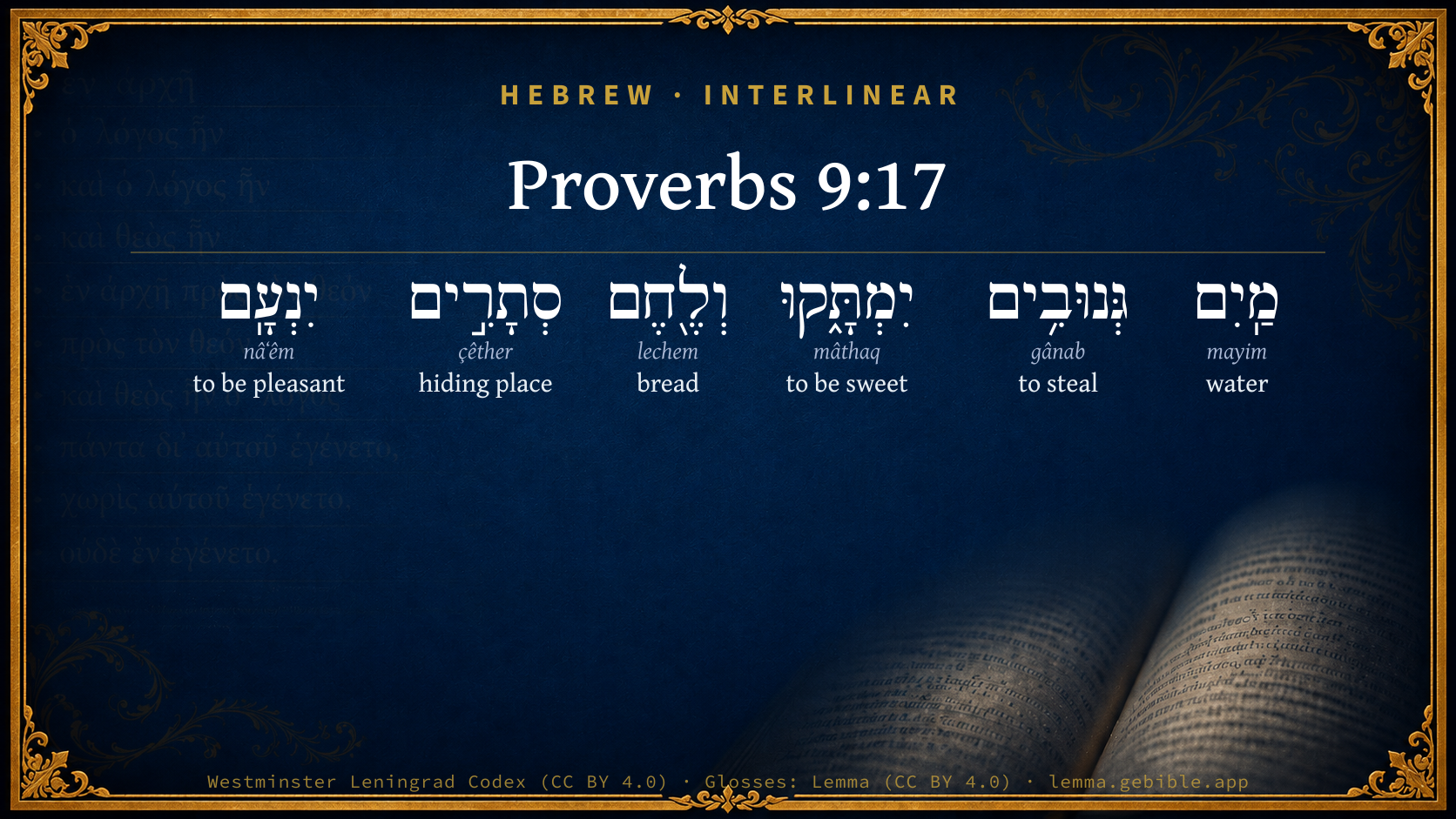
Hebrew (Westminster Leningrad Codex) Proverbs 9:17 appears in the Hebrew Old Testament. The text above is from the Westminster Leningrad Codex. Each word links to its Strong’s number, a concise gloss, and parsing drawn from the Open Scriptures Hebrew Bible morphology. Click any word for its full Brown-Driver-Briggs (BDB) entry.
Download image
Cite this verse

Proverbs 9:17 (World English Bible). Public Domain. Lemma interlinear Bible study tool, https://lemma.gebible.app/v/proverbs/9/17.

Show BibTeX & RIS
BibTeX
RIS
English Translation
"Stolen water is sweet. Food eaten in secret is pleasant."
World English Bible · Public Domain
Download a study sheet

One document with this verse’s original text, its word-by-word gloss line, the meaning frame, cross-references with their text, attributed commentary, and full source and license credits — printable, and it pastes into notes with its structure intact.

This verse Autodidact and up

Study sheet (.html) Plain text (.txt)

A passage Seminary Student

Up to 50 verses in one chapter. A passage sheet keeps up to 6 commentary sources and 12 cross-references per verse, in the order this page ranks them, and says so on the sheet whenever that leaves anything out. Ask for a single verse and you get the Autodidact verse sheet above.

Everything on this page stays free to read, with no account — the sheet is a download of what is already on screen, not access to it.

Want to remove ads? Support Godless Engineer
Compare translations 3

The same verse in 3 English versions, stacked beneath the original-language interlinear above. Click any original word for its lexicon entry.

Each is an independent rendering of the whole verse — the interlinear is not word-aligned to these translations.

Highlighted words mark where these versions differ — a whole-verse word diff, not a word-by-word alignment.

  • World English Bible Public Domain
    "Stolen water is sweet. Food eaten in secret is pleasant."
  • King James Version Public Domain
    Stolen waters are sweet, and bread eaten in secret is pleasant.
  • unfoldingWord Literal Text CC BY-SA 4.0
    “Stolen waters are sweet, and bread of secrecies is pleasant.”

unfoldingWord Literal Text — © unfoldingWord, licensed CC BY-SA 4.0. Word-aligned USFM3 via Door43 (git.door43.org/unfoldingWord/en_ult).

Versions to compare (up to 4)

3 of 4 selected

Show all 18 translations

Every available English version of this verse, each an independent rendering of the whole verse.

  • World English Bible Public Domain
    "Stolen water is sweet. Food eaten in secret is pleasant."
  • Berean Standard Bible Public Domain
    “Stolen water is sweet, and bread eaten in secret is tasty!”
  • Majority Standard Bible Public Domain
    “Stolen water is sweet, and bread eaten in secret is tasty!”
  • King James Version Public Domain
    Stolen waters are sweet, and bread eaten in secret is pleasant.
  • American Standard Version (1901) Public Domain
    Stolen waters are sweet, And bread `eaten' in secret is pleasant.
  • Revised Version (1885) Public Domain
    Stolen waters are sweet, and bread eaten in secret is pleasant.
  • Geneva Bible (1599) Public Domain
    Stollen waters are sweete, and hid bread is pleasant.
  • Douay-Rheims (1899) Public Domain
    Stolen waters are sweeter, and hid den bread is more pleasant.
  • Young's Literal Translation Public Domain
    `Stolen waters are sweet, And hidden bread is pleasant.'
  • Literal Standard Version CC BY-SA 4.0
    “Stolen waters are sweet, || And hidden bread is pleasant.”
  • Unlocked Literal Bible CC BY-SA 4.0
    “Stolen waters are sweet, and bread of secrecy is delicious.”
  • unfoldingWord Literal Text CC BY-SA 4.0
    “Stolen waters are sweet, and bread of secrecies is pleasant.”
  • Darby Bible Public Domain
    Stolen waters are sweet, and the bread of secrecy is pleasant.
  • World Messianic Bible Public Domain
    “Stolen water is sweet. Food eaten in secret is pleasant.”
  • Webster's Bible Public Domain
    Stolen waters are sweet, and bread eaten in secret is pleasant.
  • Free Bible Version CC BY-SA 4.0
    “Stolen water is sweet, and food eaten in secret tastes good!”
  • Bible in Basic English Public Domain
    Drink taken without right is sweet, and food in secret is pleasing.
  • JPS Tanakh (1917) Public Domain
    'Stolen waters are sweet, and bread eaten in secret is pleasant.'

Literal Standard Version (2020), Covenant Press — licensed CC BY-SA 4.0. Text via the HelloAO Bible API (eBible.org). Unlocked Literal Bible (unfoldingWord) — licensed CC BY-SA 4.0. Text via the HelloAO Bible API (eBible.org). unfoldingWord Literal Text — © unfoldingWord, licensed CC BY-SA 4.0. Word-aligned USFM3 via Door43 (git.door43.org/unfoldingWord/en_ult). Free Bible Version, Dr. Jonathan Gallagher — licensed CC BY-SA 4.0. Text via the HelloAO Bible API (eBible.org).

Word by word

More ways to search: Search by grammar → Find every occurrence → Compare this word →

Practice this passage: Drill this verse → Learn its vocabulary →

About this verse

These counts appear in no published source. They are computed here, from the morphology-tagged text and Lemma’s own curated glosses. What Lemma adds →

6
words
6
distinct lemmas
Wisdom
section

Notable vocabulary

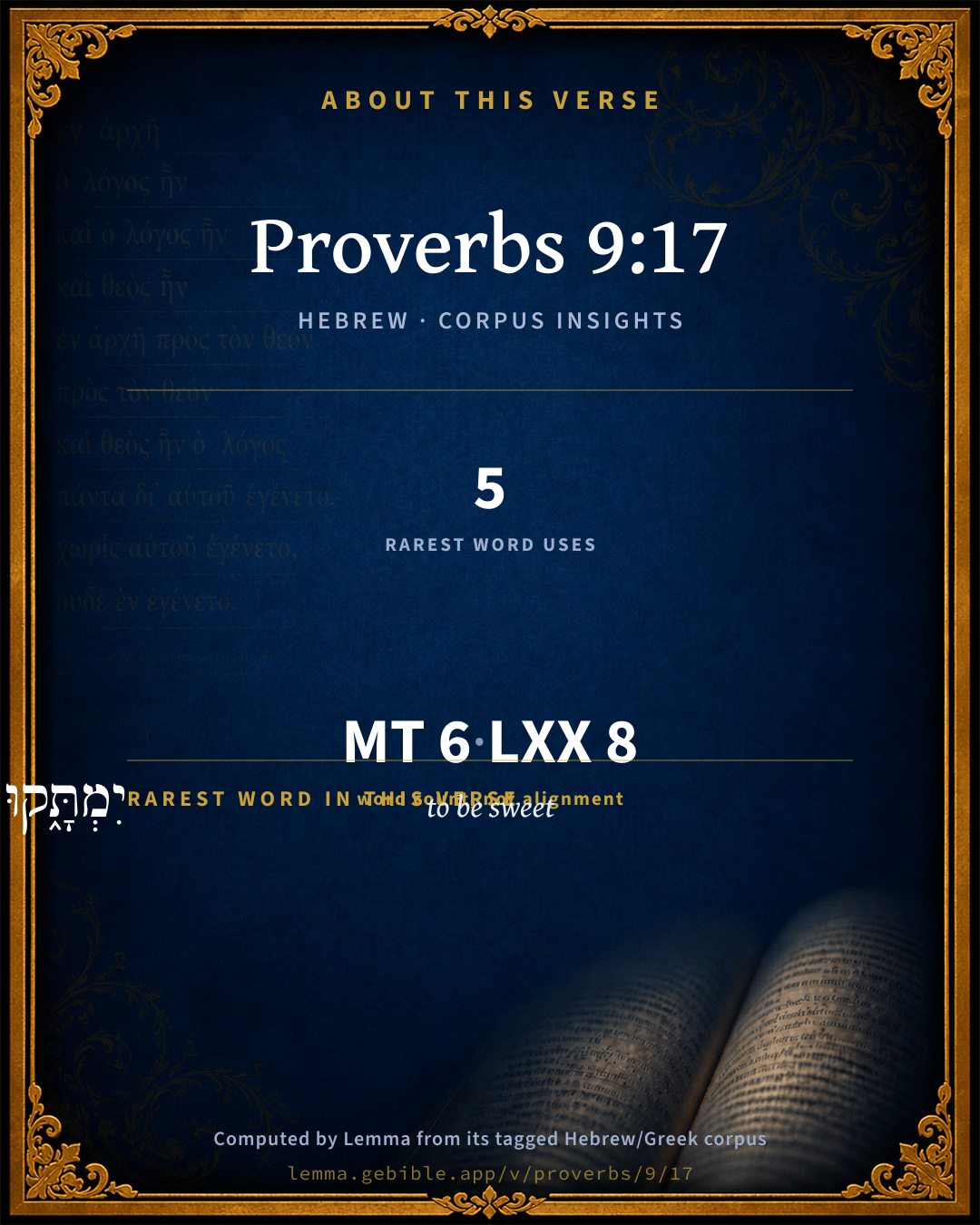
The rarest word here is יִמְתָּ֑קוּ to be sweet H4985 — appearing just 5 times in the whole Hebrew Bible.

Shared distinctive vocabulary

יִמְתָּ֑קוּ to be sweet H4985 occurs in 5 verses of the Hebrew Bible. Also found in:

Grammatical profile

  • 3 verbs
  • 3 nouns

Verb forms

  • גְּנוּבִ֥ים Qal · Participle Passive
  • יִמְתָּ֑קוּ Qal · Imperfect
  • יִנְעָֽם Qal · Imperfect

Hebrew & Septuagint length

In English translation the verse runs 10 words from the Hebrew and 11 from the Septuagint (LXX English) — closely comparable.

A rough comparison of the two English renderings, which tokenize alike — not a word-level alignment.

Word counts can differ between the Hebrew and the Greek without any difference in meaning — e.g. the Hebrew direct-object marker אֵת has no separate Greek word, and Greek often adds the article ὁ.

In the original languages it is 6 Hebrew tokens and 8 Greek tokens — but the two are counted differently (Hebrew bundles its prefixes and suffixes into one token; the Greek is in lemma form), so that isn’t a like-for-like length.

Cross-references

9

Topical passages linked to Proverbs 9:17 in the Treasury of Scripture Knowledge — connected by theme and wording, ordered by reader-vote popularity; previews shown in the World English Bible.

  • Proverbs 20:17 Fraudulent food is sweet to a man, But afterwards his mouth is filled with gravel.
  • Proverbs 23:31–32 Don't look at the wine when it is red, When it sparkles in the cup, When it goes down smoothly:
  • Proverbs 30:20 So is the way of an adulterous woman: She eats and wipes her mouth, And says, 'I have done nothing wrong.'
  • James 1:14–15 But each one is tempted, when he is drawn away by his own lust, and enticed.
  • Genesis 3:6 When the woman saw that the tree was good for food, and that it was a delight to the eyes, and that the tree was to be desired to make one wise, she took of the fruit of it, and ate; and she gave some to her husband with her, and he ate.
  • 2 Kings 5:24–27 When he came to the hill, he took them from their hand, and bestowed them in the house; and he let the men go, and they departed.
  • Proverbs 7:18–20 Come, let's take our fill of loving until the morning. Let's solace ourselves with loving.
  • Romans 7:8 But sin, finding occasion through the commandment, produced in me all kinds of coveting. For apart from the law, sin is dead.
  • Ephesians 5:12 For the things which are done by them in secret, it is a shame even to speak of.

Cross-references courtesy of OpenBible.info (CC BY 4.0).

Hebrew and Greek witnesses Masoretic Hebrew ↔ Greek Septuagint

The same verse in the two great witnesses to the Old Testament, shown verse-for-verse.

These are two independent witnesses, not word-aligned to each other, and the Septuagint is shown in lemma (dictionary) form.

Hebrew Proverbs 9:17 Masoretic · Westminster Leningrad Codex

מַֽיִם גְּנוּבִ֥ים יִמְתָּ֑קוּ וְלֶ֖חֶם סְתָרִ֣ים יִנְעָֽם

"Stolen water is sweet. Food eaten in secret is pleasant."

World English Bible · Public Domain

Greek LXX Proverbs 9:17 Septuagint · lemma form

ἄρτος κρύφιος ἡδέως ἅπτομαι καί ὕδωρ κλοπή γλυκερός

Take and enjoy secret bread, and the sweet water of theft.

LXX2012 (modern English Septuagint) · Public Domain

On this verse, The Pulpit Commentary discusses the Septuagint’s reading. Read the note in Commentary ↓

Hebrew: Westminster Leningrad Codex (CC BY 4.0). Greek: Septuagint (public domain); English from LXX2012 (modern English Septuagint) (Public Domain). How the Septuagint differs from the Hebrew →

Commentary

Notes on Proverbs 9:17 from classic Christian and Jewish commentators (each source and its license shown beneath its notes). The classic Christian expositions comment on the surrounding passage and are grouped to its opening verse, so a note may address several verses; the Jewish commentaries on the Tanakh (Rashi and others) are per-verse, so they appear only where the commentator wrote on this verse.

Lemma curates 59 commentaries, every one of them public domain or Creative Commons licensed, each selected and text-cleaned for this edition rather than reprinted as found. About our sources →

Trapp's Complete Commentary

John Trapp

Pro 9:17 Stolen waters are sweet, and bread [eaten] in secret is pleasant.

Ver. 17. Stolen waters are sweet.] Forbidden pleasures are most pleasing to sensualists, who count no mirth but madness; no pleasure, unless they may have the devil to their playfellow. Venison is nothing so sweet, they say, as when it is stolen.

“ Quod licet ingratum est; quod non licet, acrius urit:

Sic interdictis imminet aeger aquis. ” - Ovid.

Men long to be meddling with the murdering morsels of sin, which nourish not, but rent and consume the belly that receives them. Many eat on earth that which they digest in hell. {a}

{a} In terris manducant quod apud inferos digerant. - Augustine.

John Trapp, A Commentary or Exposition upon All the Books of the Old and New Testament (1647–1656) — public domain. Text from a community e-Sword module.

The Biblical Illustrator

Joseph S. Exell

Pro_9:17-18

But he knoweth not that the dead are there.

The fatal banquet

Here two texts. Preach concerning a couple of preachers; one by usurpation, the other by assignation: the worlds chaplain, and the Lords prophet. First, the delightfulness of sin; second, converted Solomon. The text of the one is from hells scriotum est. The text of the other is the word of eternal truth. We are here presented with a banquet. The inviter is a degenerate woman, representing sin--such as ambition, pride, engrossing, bribery, faction, riot, oppression. The cheer is presented in several dishes--waters, stolen, secret; bread, eaten in secret, pleasant. Sins may be in some sense likened to waters.

1. Water is an enemy to digestion.

2. Water dulls the brain.

3. Grace is compared to fire, gracelessness to water.

4. Water is a baser element, as it were, sophisticate with transfusion.

5. Physicians say that water is a binder.

On the other hand--

(1) Waters mundify and cleanse; but these soil and infect.

(2) Waters quench the thirst, and cool the heat of the body; but these rather fire the heart and inflame the affections.

(3) We say of water, It is a good servant, though an ill master; but we cannot apply this to sin. It is not good at all; indeed, less ill when it serves than when it reigns. The nature of these waters is not more pernicious than their number is numerous. The first course of these waters are such sins as more immediately rob God. Atheism is the highest theft against God, because it would steal from Him, not His goods, but Himself. Heresy soon tickles the brain, and makes a man drunk. This sin robs God of His truth. Sacrilege robs God of His goods. Faction robs God of His order and peace. Profaneness robs God of His glory. The second sort of stolen waters are those sins which mediately rob God, immediately our brethren, depriving them of some comfort or right which the inviolable law of God hath interested them to--such as irreverence, murder, adultery, thievery, slander, flattery. The third sort of stolen waters--sins which immediately rob ourselves--such as pride, epicurism, idleness, envy, drunkenness, covetousness. Stolen--in this consists the approbation of their sweetness, that they come by stealth, and are compassed by dangerous and forbidden pains. A second argument of their sweetness is their cheapness. What a man gets by robbery comes without cost. A third argument is derived from our corrupt affections. Sin pleaseth the flesh. The other service at this banquet is bread; bread of secrecies, bread of pleasure. Bread implies much health, great comforts, fulness of all requisite good things. Since the devil will put the form of bread upon his tempting wickedness, let us examine what kind of bread it is. The seed is corruption; the influences that ripen the seed are temptations; when ripe it is cut down by the sickle of the devils subtlety; it is threshed out with the flail of his strength; the flood of concupiscence drives the mill that grinds it. The mill consists of two stones--pleasure and profit. The leaven is the colourable and fallacious arguments that persuade the sweetness of this bread. The oven that bakes it is our own evil affections. It is called bread of secrecy. Unjust things love privacy. But God sees. Satans guests unhappily come from the end of a feast to the beginning of a fray. All sinful joys are dammed up with a but. The devil does but cozen the wicked with his cates. The punishments of the wicked are most usually in the like; proper and proportional to their offences. The perdition that follows the feast of sin destroys a man in his goods, in his good name, in his health, in his soul. The tempted are called the dead. There are three kinds of death--corporal, spiritual, eternal. Corporal, when the body leaves this life spiritual, when the soul forsakes and is forsaken of grace; eternal, when both shall be thrown into hell. The text has also the attempted, the new guest whom sin strives to bring in to the rest. He is described by his ignorance: Knoweth not. Five kinds of ignorance: human, natural, affected, invincible, proud. The place of the banquet is the depths of hell. This amplifies the misery of the guests in three circumstances.

1. Their weakness: they are soon in.

2. The place: hell.

3. The unrecoverableness of it: the depth of hell.

By hell is meant the deep bondage of wicked souls, Satan having by sin a full dominion over their consciences. (T. Adams.)

The Biblical Illustrator, edited by Joseph S. Exell (c. 1880s–1900s) — public domain. Text from a community e-Sword module.

Tyndale Open Study Notes

Tyndale Open Resources

9:17 Like Wisdom, Folly has prepared a banquet for her guests (cp. 9:2-5). However, this meal is dishonest and perverse.

Tyndale Open Study Notes — © Tyndale Open Resources, licensed CC BY-SA 4.0. Text via the HelloAO Bible API.

Jamieson, Fausset & Brown

Robert Jamieson, A. R. Fausset & David Brown

The language of a proverb, meaning that forbidden delights are sweet and pleasant, as fruits of risk and danger.

Jamieson, Fausset & Brown — Commentary Critical and Explanatory on the Whole Bible (1871) — public domain (CC PDM 1.0). Text via the HelloAO Bible API.

Adam Clarke's Commentary

Verse 17. Stolen waters are sweet] I suppose this to be a proverbial mode of expression, importing that illicit pleasures are sweeter than those which are legal. The meaning is easy to be discerned; and the conduct of multitudes shows that they are ruled by this adage. On it are built all the adulterous intercourses in the land.

Adam Clarke's Commentary on the Bible (1810–1826) — public domain. Text from a community e-Sword/MySword module.

Ellicott's Commentary for English Readers

(17) Stolen waters are sweet.—See above, on Pro_5:15.

Bread eaten in secret.—The same figure is used in Pro_30:20.

A Bible Commentary for English Readers, edited by Charles John Ellicott (1878–1897) — public domain. Text from a community e-Sword module.

The Cambridge Bible for Schools and Colleges

gen. ed. J. J. S. Perowne

17. stolen waters] Maurer compares what he calls “tristissimum illud Ovidii,”

“Nitimur in vetitum semper, cupimusque negata.”

The Cambridge Bible for Schools and Colleges (gen. ed. J. J. S. Perowne; Cambridge University Press, 1878–1918) — public domain. Text from a community e-Sword module.

John Gill's Exposition

But he knoweth not that the dead are there,.... In the house of this foolish and wicked woman, into which she invites passengers to turn; the simple, that is persuaded by her, does not consider that there are none there to be his companions, but such who are dead in a moral or spiritual sense; that, though they live in pleasure, they are dead while they live. Aben Ezra refers this to "hell" in the next clause; where her guests are, and where those that are slain by her have their everlasting abode; and where the giants are, as the Vulgate Latin and Syriac versions; or the mighty ones she has cast down there, as the Targum; so the word "rephaim" sometimes signifies: and some think that reference is had to the giants of the old world, that corrupted their way on earth, and brought a deluge on it; see Pro 7:26;

and that her guests are in the depths of hell; not only in the way to it, and on the brink of it, but in the very midst of it: there are many in hell she has invited into her house, and persuaded to turn in there, and commit fornication with her; and all that worship the beast, or commit spiritual adultery with the whore of Rome, will go down to perdition with her, and have their portion in hell fire, in the lake which burns with fire and brimstone; which they do not consider that are drawn into her idolatrous practices, Rev 14:9.

Next: Proverbs Chapter 10

John Gill's Exposition of the Whole Bible (1746–1763) — public domain (CC PDM 1.0). Text via the HelloAO Bible API.

Albert Barnes' Notes on the Bible

The besetting sin of all times and countries, the one great proof of the inherent corruption of man’s nature. Pleasures are attractive because they are forbidden (compare Rom 7:7).

Albert Barnes' Notes on the Bible (1834–1885) — public domain. Text from a community e-Sword/MySword module.

Haydock's Catholic Bible Commentary

Pleasant. Impure pleasures are more delightful (Calmet) to sensual men. (Haydock) --- The prohibition increases appetite. (Menochius)

George Leo Haydock (1774–1849), Haydock's Catholic Family Bible and Commentary, 1859 edition — public domain. Excludes Psalms (Douay-Rheims chapter numbering differs from Protestant) and Deuterocanonical books (Catholic canon only).

Matthew Poole's English Annotations

Stolen waters; by which he understandeth, either,

1. Idolatry, or other wickednesses, which in Solomon’s time before his fall were publicly forbidden and punished, but privately practised; or rather,

2. Adultery.

Are sweet; partly, from the difficulty of obtaining them; partly, from the art which men use in contriving such secret sins; and partly, because the very prohibition renders it more grateful to corrupt nature.

Matthew Poole's English Annotations on the Holy Bible (1683–1685) — public domain. Text from a community e-Sword/MySword module.

Whedon's Commentary on the Bible

Daniel D. Whedon

17. Stolen waters — This verse, expressive of the above idea, was, probably, a proverb which the woman of vice turns to her own purposes.

Bread eaten in secret — Literally, bread of secrecies. Both allude to unlawful pleasures.

Daniel D. Whedon (gen. ed.), Commentary on the Old and New Testaments (1874–1909) — public domain. Text from a community e-Sword module.

The Pulpit Commentary

This is what she says: Stolen waters are sweet, and bread eaten in secret is pleasant. The metaphor of "stolen waters" refers primarily to adulterous intercourse, as to "drink waters out of one"s own cistern" (Pro_5:15, where see note) signifies the chaste connection of lawful wedlock. Wisdom offered flesh and wine to her guests; Folly offers bread and water. Wisdom invites openly to a well furnished table; Folly calls to a secret meal of barest victuals. What the former offers is rich and satisfying and comforting; what Vice gives is poor and mean and insipid. Yet this latter has the charm of being forbidden; it is attractive because it is unlawful. This is a trait of corrupt human nature, which is recognized universally. Thus Ovid, "Amor.," 3:4, 17"Nitimur in vetitum semper, cupimusque negata; Sic interdictis imminet aeger aquis.

Things easily attained, the possession of which is gotten without effort or danger or breach of restraint, soon pall and cease to charm. To some minds the astuteness and secrecy required for success have an irresistible attraction. Thus St. Augustine relates ("Conf.," 2:4) how he and some companions committed a theft, not from want and poverty, nor even from the wish to enjoy what was stolen, but simply for the pleasure of thieving and the sin. They robbed a pear tree by night, carried off great loads, which they flung to the pigs, and their only satisfaction was that they were doing what they ought not ("dum tamen fieret a nobis, quod eo liberet quo non liceret"). Septuagint, "Taste ye to your pleasure secret bread, and sweet water of theft." Where water is a precious commodity, as in many pets of Palestine, doubtless thefts were often committed, and persons made free with their neighbor"s tank when they could do so undetected, thus sparing their own resources and felicitating themselves on their cleverness. On the metaphorical use of "waters" in Holy Scripture, St. Gregory says, "Waters are sometimes wont to denote the Holy Spirit, sometimes sacred knowledge, sometimes calamity, sometimes drifting peoples, sometimes the minds of those following the faith." He refers to these texts respectively: Joh_7:38, etc.; Ecc 15:3; Psa_69:1 Rev_17:15 ("the waters are peoples"); Isa_22:20; and he adds, "By water likewise bad knowledge is wont to be designated, as when the woman in Solomon, who bears the type of heresy, charms with crafty persuasion, saying, "Stolen waters are sweet ("Moral.," 19:9).

"Stolen waters.

A fatal fascination, arising out of its very lawlessness, attaches itself to sin. Illicit pleasures are doubly attractive just because they are illicit. Let us consider the secret of these evil charms.

I THE PROVOCATION OF RESTRAINTS. There are many things which we do not care to have so long as they are within our reach, but which are clothed with a sudden attractiveness directly they are shut out from us. If we see a notice, "Trespassers will be prosecuted," we feel an irritating restraint, although we have had no previous desire to enter the path that it blocks. Innumerable fruits grew in Eden, but the one forbidden fruit excited the greatest longing of appetite. Advertisers sometimes head their placards with the words, "Don"t read this! judging that to be the best way to call attention to them. If you say, "Don"t look!" everybody is most anxious to look. To put a book in an index expurgatorius is the surest means of advertising it.

II THE VALUE GIVEN BY DIFFICULTY OF ACQUISITION. We value little what we can buy cheaply. Rarity raises prices. If we have been to great labour and have run heavy risks in obtaining anything, we are inclined to measure the worth of it by what it has cost us. Many designs of sin are only achieved with great difficulty. They involve terrible dangers. When once accomplished, they are the more valued for this. The pleasures of adventure, the Englishman"s peculiar delights of the chase, are enlisted in the cause of wickedness. "All things that are, Are with more spirit chased than enjoyed.

III THE SENSE OF POWER AND LIBERTY. If you have gained your end in spite of law and authority, there is a natural elation of triumph about it. When you have succeeded in breaking bounds, you taste the sweets of an illicit liberty.

IV THE ENJOYMENT OF SECRECY. To some minds there is a peculiar charm about this. To them especially "bread eaten in secret is pleasant." Let it be all open and above board, let it he of such a nature that one would have no objection to the world knowing it, and the pleasure loses its most pungent element. The air of mystery, the sense of superiority in doing what those about one little suspect, become elements in the pleasures of sin. But surely the highest natures must be too simple and frank to feel the force of such inducements to sin!

V THE FASCINATION OF WICKEDNESS. Pure, naked evil will attract on its own account. There is a charm in absolute ugliness. Some men really seem to love sin for its own sake. A wild intoxication, a mad passion of conscious guilt, instils a fatal sweetness into stolen waters. But it is the sweetness of a deadly poison, the euthanasia of crime.

All these horrible charms of sin need to be guarded against. We must not trust to our own integrity; it is not proof against the fatal fascinations of temptation. To resist them we must be fortified with the love of higher joys, fed with the wholesome food of the banquet of wisdom (see vers. 15), attracted by the beauty of holiness, and above all, led to the pure and nourishing delights of the gospel feast by faith in the Lord Jesus Christ.

The Pulpit Commentary (1880–1919), ed. H.D.M. Spence-Jones & Joseph S. Exell — public domain. Text from a community e-Sword module.

John Wesley's Explanatory Notes

Sweet - From the difficulty of obtaining them; and because the very prohibition renders them more grateful to corrupt nature.

John Wesley, Explanatory Notes Upon the Whole Bible (1754–1765) — public domain. Text via the GEBible commentary corpus.

Rashi

Rabbi Shlomo Yitzchaki (Rashi)

Stolen water is sweet The pleasure afforded by intimacy with a single woman does not equal that afforded by intimacy with a married woman. Also, regarding the commandments (other editions: sectarianism), stolen water is sweet, for they were afraid to do it in public, but did it in secret.

Rashi on the Tanakh — English translations: “The Judaica Press complete Tanach with Rashi, translated by A. J. Rosenberg” (CC BY 4.0); “Pentateuch with Rashi's commentary by M. Rosenbaum and A.M. Silbermann, 1929-1934” (public domain); “The Metsudah Tanach series, Lakewood, N.J” (CC BY 4.0); and “The Book of Joshua, Metsudah Publications, 1997” (CC BY 4.0). Text via Sefaria.

Lesson kit

Teaching starters — assembled from the data on this page, not authored interpretation. Every prompt links to the verse data it draws on. Edit before teaching.

Proverbs, in the Wisdom, opens this verse with 6 words (6 distinct Hebrew lemmas). Its most distinctive word is mâthaq (“to be sweet”). A historical commentator’s framing appears above. Read the whole chapter for the surrounding context.

Discussion questions

  1. What does “to be sweet” (mâthaq) contribute to the verse as a whole?
  2. Exodus 15:25 shares the word «to be sweet» with this verse. How do the two illuminate each other?
  3. These translations render this verse differently; the difference is in the English rendering, not the original. What questions does that raise?
  4. The verb «גְּנוּבִ֥ים» is Qal Participle Passive. How does its form color the action?
  5. Reading how Trapp's Complete Commentary and The Biblical Illustrator read this verse, where do the two commentators agree and where do they part?

Things to notice

Reading settings

Reading text

Shown beneath each verse's original-language words.

Old Testament
Old Testament edition

Read the OT as the Masoretic Hebrew (MT) or the Greek Septuagint (LXX).

English shown for the Greek Septuagint (in the Hebrew ↔ Greek comparison).

Comparing translations? Open the Compare panel on any verse page to stack up to four side by side.