
Leviticus 21:22

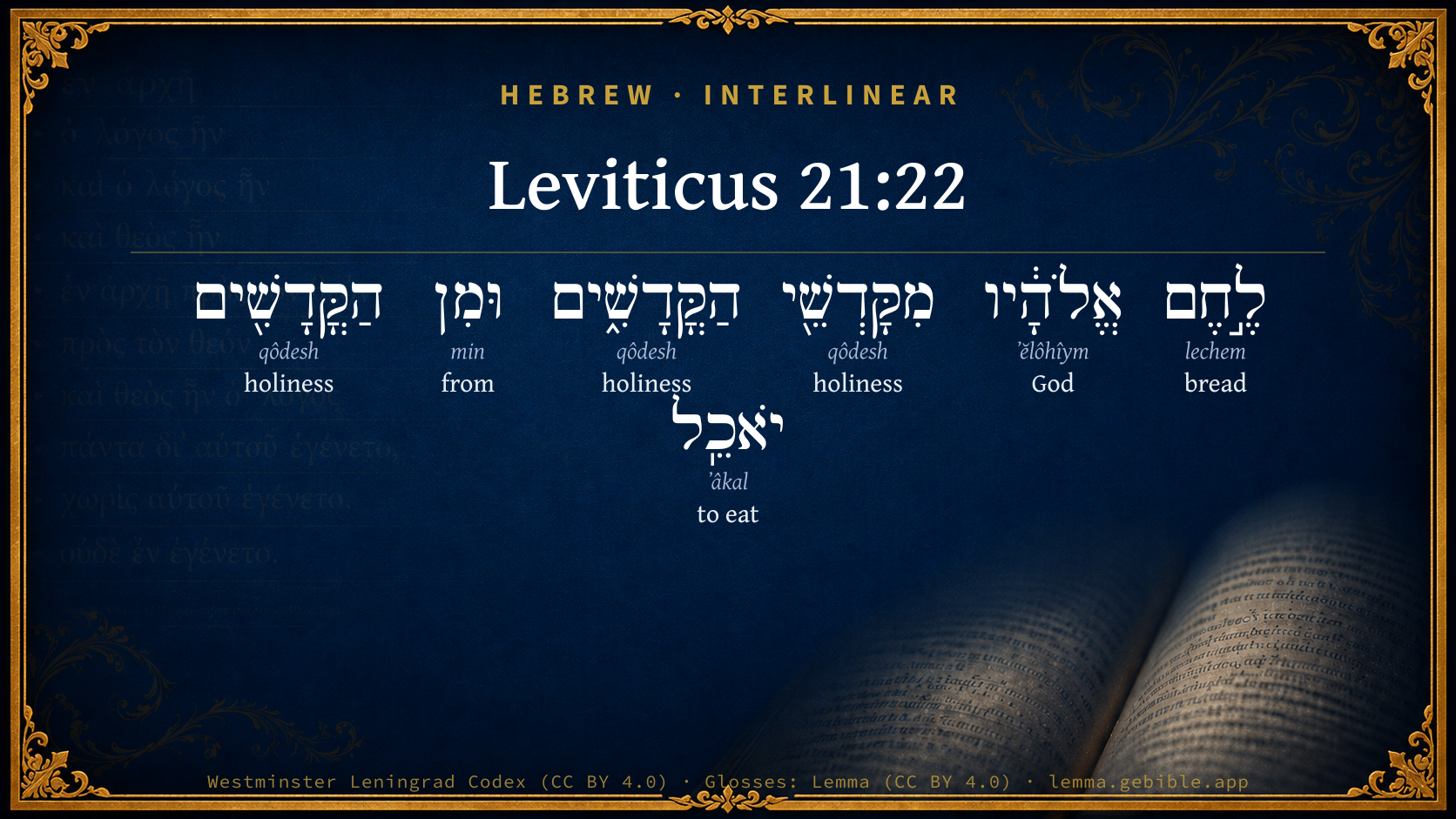
Hebrew (Westminster Leningrad Codex) Leviticus 21:22 appears in the Hebrew Old Testament. The text above is from the Westminster Leningrad Codex. Each word links to its Strong’s number, a concise gloss, and parsing drawn from the Open Scriptures Hebrew Bible morphology. Click any word for its full Brown-Driver-Briggs (BDB) entry.
Download image
Cite this verse

Leviticus 21:22 (World English Bible). Public Domain. Lemma interlinear Bible study tool, https://lemma.gebible.app/v/leviticus/21/22.

Show BibTeX & RIS
BibTeX
RIS
English Translation
He shall eat the bread of his God, both of the most holy, and of the holy.
World English Bible · Public Domain
Download a study sheet

One document with this verse’s original text, its word-by-word gloss line, the meaning frame, cross-references with their text, attributed commentary, and full source and license credits — printable, and it pastes into notes with its structure intact.

This verse Autodidact and up

Study sheet (.html) Plain text (.txt)

A passage Seminary Student

Up to 50 verses in one chapter. A passage sheet keeps up to 6 commentary sources and 12 cross-references per verse, in the order this page ranks them, and says so on the sheet whenever that leaves anything out. Ask for a single verse and you get the Autodidact verse sheet above.

Everything on this page stays free to read, with no account — the sheet is a download of what is already on screen, not access to it.

Want to remove ads? Support Godless Engineer
Compare translations 3

The same verse in 3 English versions, stacked beneath the original-language interlinear above. Click any original word for its lexicon entry.

Each is an independent rendering of the whole verse — the interlinear is not word-aligned to these translations.

Highlighted words mark where these versions differ — a whole-verse word diff, not a word-by-word alignment.

  • World English Bible Public Domain
    He shall eat the bread of his God, both of the most holy, and of the holy.
  • King James Version Public Domain
    He shall eat the bread of his God, both of the most holy, and of the holy.
  • unfoldingWord Literal Text CC BY-SA 4.0
    The bread of his God, from the holy things of the holy things and from the holy things, he may eat.

unfoldingWord Literal Text — © unfoldingWord, licensed CC BY-SA 4.0. Word-aligned USFM3 via Door43 (git.door43.org/unfoldingWord/en_ult).

Versions to compare (up to 4)

3 of 4 selected

Show all 18 translations

Every available English version of this verse, each an independent rendering of the whole verse.

  • World English Bible Public Domain
    He shall eat the bread of his God, both of the most holy, and of the holy.
  • Berean Standard Bible Public Domain
    He may eat the most holy food of his God as well as the holy food,
  • Majority Standard Bible Public Domain
    He may eat the most holy food of his God as well as the holy food,
  • King James Version Public Domain
    He shall eat the bread of his God, both of the most holy, and of the holy.
  • American Standard Version (1901) Public Domain
    He shall eat the bread of his God, both of the most holy, and of the holy:
  • Revised Version (1885) Public Domain
    He shall eat the bread of his God, both of the most holy, and of the holy.
  • Geneva Bible (1599) Public Domain
    The bread of his God, euen of the most holie, and of the holy shall he eate:
  • Douay-Rheims (1899) Public Domain
    He shall eat nevertheless of the loaves, that are offered in the sanctuary,
  • Young's Literal Translation Public Domain
    `Bread of his God -- of the most holy things, and of the holy things -- he doth eat;
  • Literal Standard Version CC BY-SA 4.0
    Bread of his God—from the most holy things and from the holy things—he eats;
  • Unlocked Literal Bible CC BY-SA 4.0
    He may eat the food of his God, whether some of the most holy or some of the holy.
  • unfoldingWord Literal Text CC BY-SA 4.0
    The bread of his God, from the holy things of the holy things and from the holy things, he may eat.
  • Darby Bible Public Domain
    The bread of his God, of the most holy and of the holy, shall he eat;
  • World Messianic Bible Public Domain
    He shall eat the bread of his God, both of the most holy, and of the holy.
  • Webster's Bible Public Domain
    He shall eat the bread of his God, both of the most holy, and of the holy.
  • Free Bible Version CC BY-SA 4.0
    He is still allowed to eat the food from the Most Holy Place of his God and also from the sanctuary,
  • Bible in Basic English Public Domain
    He may take of the bread of God, the holy and the most holy;
  • JPS Tanakh (1917) Public Domain
    He may eat the bread of his God, both of the most holy, and of the holy.

Literal Standard Version (2020), Covenant Press — licensed CC BY-SA 4.0. Text via the HelloAO Bible API (eBible.org). Unlocked Literal Bible (unfoldingWord) — licensed CC BY-SA 4.0. Text via the HelloAO Bible API (eBible.org). unfoldingWord Literal Text — © unfoldingWord, licensed CC BY-SA 4.0. Word-aligned USFM3 via Door43 (git.door43.org/unfoldingWord/en_ult). Free Bible Version, Dr. Jonathan Gallagher — licensed CC BY-SA 4.0. Text via the HelloAO Bible API (eBible.org).

Word by word

More ways to search: Search by grammar → Find every occurrence → Compare this word →

Practice this passage: Drill this verse → Learn its vocabulary →

About this verse

These counts appear in no published source. They are computed here, from the morphology-tagged text and Lemma’s own curated glosses. What Lemma adds →

7
words
5
distinct lemmas
Pentateuch
section

Grammatical profile

  • 1 verb
  • 5 nouns
  • 1 preposition

Verb forms

  • יֹאכֵֽל Qal · Imperfect

Repetition

A word recurs within this verse — often emphatic in Hebrew:

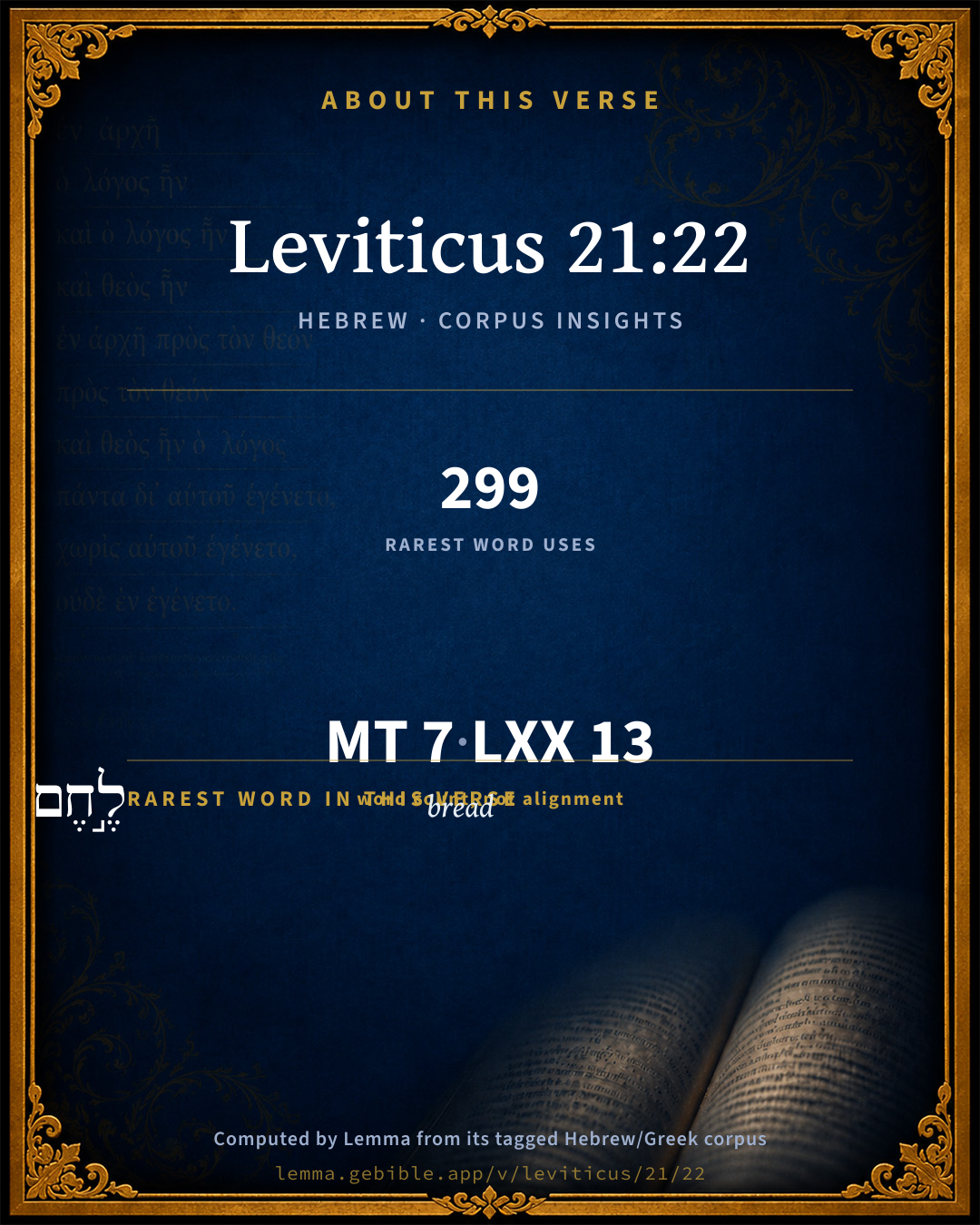
  • מִקָּדְשֵׁ֖י holiness H6944 ×3

Hebrew & Septuagint length

In English translation the verse runs 17 words from the Hebrew and 15 from the Septuagint (LXX English) — closely comparable.

A rough comparison of the two English renderings, which tokenize alike — not a word-level alignment.

Word counts can differ between the Hebrew and the Greek without any difference in meaning — e.g. the Hebrew direct-object marker אֵת has no separate Greek word, and Greek often adds the article ὁ.

In the original languages it is 7 Hebrew tokens and 13 Greek tokens — but the two are counted differently (Hebrew bundles its prefixes and suffixes into one token; the Greek is in lemma form), so that isn’t a like-for-like length.

Cross-references

10

Topical passages linked to Leviticus 21:22 in the Treasury of Scripture Knowledge — connected by theme and wording, ordered by reader-vote popularity; previews shown in the World English Bible.

  • Leviticus 2:3 That which is left of the meal offering shall be Aaron's and his sons'. It is a most holy thing of the offerings of Yahweh made by fire.
  • Leviticus 2:10 That which is left of the meal offering shall be Aaron's and his sons'. It is a thing most holy of the offerings of Yahweh made by fire.
  • Leviticus 6:16–17 That which is left of it Aaron and his sons shall eat. It shall be eaten without yeast in a holy place. They shall eat it in the court of the Tent of Meeting
  • Leviticus 7:1 "'This is the law of the trespass offering. It is most holy.
  • Leviticus 22:10–13 "'No stranger shall eat of the holy thing: a foreigner living with the priests, or a hired servant, shall not eat of the holy thing.
  • Leviticus 24:8–9 Every Sabbath day he shall set it in order before Yahweh continually. It is on the behalf of the children of Israel an everlasting covenant.
  • Numbers 18:9–10 This shall be your of the most holy things, [reserved] from the fire: every offering of theirs, even every meal-offering of theirs, and every sin-offering of theirs, and every trespass-offering of theirs, which they shall render to me, shall be most holy for you and for your sons.
  • Numbers 18:19 All the heave-offerings of the holy things, which the children of Israel offer to Yahweh, have I given you, and your sons and your daughters with you, as a portion forever: it is a covenant of salt forever before Yahweh to you and to your seed with you.
  • 1 Corinthians 9:13 Don't you know that those who serve around sacred things eat from the things of the temple, and those who wait on the altar have their portion with the altar?
  • Leviticus 6:29 Every male among the priests shall eat of it: it is most holy.

Cross-references courtesy of OpenBible.info (CC BY 4.0).

Hebrew and Greek witnesses Masoretic Hebrew ↔ Greek Septuagint

The same verse in the two great witnesses to the Old Testament, shown verse-for-verse.

These are two independent witnesses, not word-aligned to each other, and the Septuagint is shown in lemma (dictionary) form.

Hebrew Leviticus 21:22 Masoretic · Westminster Leningrad Codex

לֶ֣חֶם אֱלֹהָ֔יו מִקָּדְשֵׁ֖י הַקֳּדָשִׁ֑ים וּמִן הַקֳּדָשִׁ֖ים יֹאכֵֽל

He shall eat the bread of his God, both of the most holy, and of the holy.

World English Bible · Public Domain

Greek LXX Leviticus 21:22 Septuagint · lemma form

ὁ δῶρον ὁ θεός ὁ ἅγιος ὁ ἅγιος καί ἀπό ὁ ἅγιος ἐσθίω

The gifts of God are most holy, and he shall eat of the holy things.

LXX2012 (modern English Septuagint) · Public Domain

Hebrew: Westminster Leningrad Codex (CC BY 4.0). Greek: Septuagint (public domain); English from LXX2012 (modern English Septuagint) (Public Domain). How the Septuagint differs from the Hebrew →

Targum (Aramaic paraphrase)

2

The Targum is the ancient Jewish Aramaic paraphrase of the Hebrew Scriptures — an interpretive translation, not the Hebrew text itself. Onkelos (literal) and Pseudo-Jonathan (expansive) render the Torah, and Jonathan the Prophets. Coverage is partial: where no permissively-licensed English translation exists for a verse, only the Aramaic is shown. This is verse-level text, not a word-by-word alignment to the Hebrew.

  1. Targum Onkelos Torah (Genesis–Deuteronomy)
    קֻרְבַּן אֱלָהֵהּ מִקֹדֶשׁ קוּדְשַׁיָא וּמִן קוּדְשַׁיָא יֵיכוּל

    (no public-domain English translation for this verse)

    Targum Onkelos — Aramaic: “Onkelos Genesis” (public domain); “Onkelos Exodus” (public domain); “Onkelos Leviticus” (public domain); “Onkelos Numbers” (public domain); “Onkelos Deuteronomy” (public domain). English: “Sefaria Community Translation” (CC0 1.0 (public-domain dedication)); “J.W. Etheridge. The Targums of Onkelos and Jonathan Ben Uzziel on the Pentateuch. London: Longmans, Green, 1862” (public domain). Text via Sefaria.

  2. Targum Pseudo-Jonathan Torah (Genesis–Deuteronomy)
    בְּרַם מוֹתְרֵי קָרְבָּנַיָא דֶאֱלָהֵיהּ מַה דְמִשְׁתַּיֵיר מִן קוּדְשֵׁי קוּדְשַׁיָא וּמִן קוּדְשַׁיָא יִתְפַּרְנֵס

    Nevertheless he may support himself with the residue of the oblations of his God which remaineth of the most holy and of the holy (offerings);

    Targum Pseudo-Jonathan — Aramaic: “Targum Jonathan on Genesis” (public domain); “Targum Jonathan on Exodus” (public domain); “Targum Jonathan on Leviticus” (public domain); “Targum Jonathan on Numbers” (public domain); “Targum Jonathan on Deuteronomy” (public domain). English: “The Targum of Jonathan ben Uzziel, trans. J. W. Etheridge, London, 1862” (public domain). Text via Sefaria.

Commentary

Notes on Leviticus 21:22 from classic Christian and Jewish commentators (each source and its license shown beneath its notes). The classic Christian expositions comment on the surrounding passage and are grouped to its opening verse, so a note may address several verses; the Jewish commentaries on the Tanakh (Rashi and others) are per-verse, so they appear only where the commentator wrote on this verse.

Lemma curates 59 commentaries, every one of them public domain or Creative Commons licensed, each selected and text-cleaned for this edition rather than reprinted as found. About our sources →

John Gill's Exposition

Only he shall not go in unto the vail,.... So far as to the vail, which divided between the holy and the holy of holies; that is, he shall not go into the holy place which was before the vail; not to set the shewbread upon the table there, nor to light and him the lamps in the candlestick, nor to offer incense on the altar of incense, which stood in it: some render it "within the vail" (h), where only the high priest might enter once a year; but if he had any blemish on him he might not, nor might such an one be an high priest; Aben Ezra seems to have some respect to this in his note,"to the vail he shall not come, that he may be an high priest:"

nor come nigh unto the altar; as not to the altar of incense in the holy place, so neither to the altar of burnt offering in the court of the tabernacle, that is, so as to officiate there: but though they might not be employed in such sacred service, the Jews in later times have found business for them to employ them in, and that was worming the wood, or searching the wood for worms, which was used in the burning of the sacrifices; for we are told (i), that at the northeast corner (of the court of the women) was the wood room, where the priests that had blemishes wormed the wood; and whatsoever wood in which a worm was found, was rejected from being laid upon the altar: the reason why he might not go into either place before mentioned is repeated:

because he hath a blemish; either fixed or transient; one of those particularly expressed, or any other; for the Jews suppose there are others implied besides those expressed, which disqualified for service:

that he profane not my sanctuaries; if an high priest, the holy of holies, if a common priest, the holy place, and the court of the tabernacle:

for I the Lord do sanctify them; the vail, to which blemished priests might not go: and the altar, to which they might not come nigh: or rather, the sanctuaries or holy places, where they might not officiate, which God had separated and devoted for sacred uses, and were not to be defiled by any; though Ben Gersom observes, that this has no respect to the sanctuary, for if it had it would have been said, "I am the Lord, that sanctify it"; but since a plural word is used before, I see not but that with great propriety it is expressed, and with reference thereunto, "sanctify them"; which he would have understood of holy things, but what he means is not easy to say, unless the holy things such persons might eat of, Lev 21:22, which is fetched.

(h) "intra velum", V. L. (i) Misn. Middot, c. 2. sect. 5.

John Gill's Exposition of the Whole Bible (1746–1763) — public domain (CC PDM 1.0). Text via the HelloAO Bible API.

Trapp's Complete Commentary

John Trapp

Lev 21:22 He shall eat the bread of his God, [both] of the most holy, and of the holy.

Ver. 22. He shall eat the bread.] So might not the unclean priests. {Lev 22:3} Our involuntary weaknesses shall not debar us from benefit by Christ.

John Trapp, A Commentary or Exposition upon All the Books of the Old and New Testament (1647–1656) — public domain. Text from a community e-Sword module.

The Biblical Illustrator

Joseph S. Exell

Lev_21:22

He shall eat the bread of his God.

The Divine banquet

It is not easy to say whether the words, bread of his God, refer generally to the sacrifices and offerings, or specially to the shewbread. We take them as pointing to the latter; as, indeed, in any interpretation of the expression, the shewbread must be included, if not mainly intended. It was called the shewbread; or, more properly, the bread of the presence; the bread that stood on the Kings table, and in the Kings presence; the bread which was therefore intimately connected with Him who is called the Angel of the Presence (Isa_62:9); the bread which was associated with Him whose presence went with Israel whithersoever they went (Exo_33:14).

I. It is provided by God. As in carrying out His purpose in the old creation, He provided every fruit-bearing tree for man, so, in accomplishing the new creation, He has supplied the food convenient. He has made the provision for His house; and He has also blessed it. For the sustaining the life which He imparts, He provides the food required.

II. It is prepared by God himself. Moses, as representing God, prepared the twelve loaves; and God Himself has prepared the better bread, the flesh of the Son of Man. A body hast Thou prepared Me. In the history of the birth, the life, the sorrows, the hardships, the blood-shedding, the death of the incarnate Son of God, we have a description of the way it, which the shewbread or presence-bread of the Church was prepared, according to Gods own method, for our everlasting food.

III. It is given to us by God. God causes it to be provided for us; nay, He prepares it Himself; and then having thus provided and prepared it, He gives it: God so loved the world that He gave His only-begotten Son (Joh_3:16); The bread that I will give is My flesh, which I will give, &c.

IV. Who they are who feast on it. Perhaps the answer to such a question will be--Gods priesthood, His Church. Nor would this be incorrect; yet it would be defective. No doubt this heavenly bread is for them, just as the tree of life was for Adam, or the Temple shewbread was for the sons of Aaron. But it is so specially called the bread of our God; and the table on which it is set is so specially Gods own table; and the place where it is to be eaten is so manifestly the royal banquet-hall of heaven, that we come to the conclusion that God Himself is partaker of this feast as well as we. The King, sitting at His own table, in His own festal chamber, not only feeds His guests, bat Himself partakes of that which is set before them. Israels various sacrifices and offerings of all kinds were the various dishes set upon the great Temple table; each of them full of meaning; each of them containing that which would satisfy and comfort; every one of them setting forth some part of the glorious fulness of the God-man, as the true food of souls; and all of them together representing that complete and blessed feast of fat things partaken of by God and His redeemed, in some measure now, but hereafter to be more fully enjoyed at the great marriage-supper in the New Jerusalem, when that shall be fulfilled, so long realised but in parts and fragments, I will come in to him, and will sup with him, and he with Me (Rev_3:20). (H. Bonar, D. D.)

The bread of God

It was an ancient heathen notion that in sacrifice food was provided for the deity in order thus to show him honour. And, doubtless, in Israel, ever prone to idolatry, there were many who rose no higher than this gross conception of the meaning of such words. Thus, in Psa_50:8-15, God sharply rebukes Israel for so unworthy thoughts of Himself, using language at the same time which teaches the spiritual meaning of the sacrifice, regarded as the food or bread of God . . . Of which language the plain teaching is this. If the sacrifices are called in the law the bread of God, God asks not this bread from Israel in any material sense, or for any material need. He asks that which the offerings symbolise; thanksgiving, loyal fulfilment of covenant engagements to Him, and that loving trust which will call on Him in the day of trouble. Even sol Gratitude, loyalty, trust! this is the food of God, this the bread which He desires that we should offer, the bread which those Levitical sacrifices symbolised. For even as man, when hungry, craves food, and cannot be satisfied without it, so God, who is Himself Love, desires our love, and delights in seeing its expression in all those offices of self-forgetting and self-sacrificing service in which love manifests itself. This is to God even as is food to us. Love cannot be satisfied except with love returned; and we may say, with deepest humility and reverence, the God of love cannot be satisfied without love returned. Hence it is that the sacrifices, which in various ways symbolize the self-offerings of love and the fellowship of love, are called by the Holy Ghost the food or bread of God. And yet we must, on no account, hasten to the conclusion, as many do, that therefore the Levitical sacrifices were only intended to express and symbolise the self-offering of the worshipper, and that this exhausts their significance. On the contrary, the need of infinite love for this bread of God cannot be adequately met and satisfied by the self-offering of any creature, and, least of all, by the self-offering of a sinful creature, whose very sin lies just in this, that he has fallen away from perfect love. The symbolism of the sacrifice as the food of God, therefore, by this very phrase, points toward the self-offering in love of the eternal Son to the Father, and in behalf of sinners for the Fathers sake. It was the sacrifice on Calvary which first became, in innermost reality, that bread of God, which the ancient sacrifices were only in symbol. It was this, not regarded as satisfying Divine justice (though it did this), but as satisfying the Divine love; because it was the supreme expression of the perfect love of the incarnate Son of God to the Father, in His becoming obedient unto death, even the death of the Cross. (S. H. Kellogg, D. D.)

.

The Biblical Illustrator, edited by Joseph S. Exell (c. 1880s–1900s) — public domain. Text from a community e-Sword module.

Joseph Benson's Commentary

Lev 21:22. He shall eat — Which a priest having any uncleanness might not do: whereby God would show the great difference between natural infirmities sent upon a man by God, and moral defilements which a man brought upon himself.

Joseph Benson's Commentary on the Old and New Testaments (1811–1818) — public domain. Text from a community e-Sword module.

Tyndale Open Study Notes

Tyndale Open Resources

21:22 he may eat: Although a mutilation or defect (see 21:18-20) disqualified a descendant of Aaron from representing the people, it did not compromise his priestly lineage. He was eligible to eat the priest’s share of the offerings (see 2:3, 10; 6:17-18).

Tyndale Open Study Notes — © Tyndale Open Resources, licensed CC BY-SA 4.0. Text via the HelloAO Bible API.

Geneva Bible (1599)

Geneva Bible translators

As of the tenths and firstfruits.

As of sacrifice for sin.

Geneva Bible (1599) marginal notes — public domain. Text via Bolls.life.

Ellicott's Commentary for English Readers

(22) He shall eat the bread of his God.—But though unfit for serving at the altar, and reduced to do the menial work connected with the sanctuary, he was not only allowed to partake of the less holy sacrificial gifts, such as the peace shoulder, the tithes, and the first-fruits, but also to eat what remained of the meat-offerings, the sin-offerings, and the trespass-offerings, which were most holy. (See Lev_2:3.)

A Bible Commentary for English Readers, edited by Charles John Ellicott (1878–1897) — public domain. Text from a community e-Sword module.

The Cambridge Bible for Schools and Colleges

gen. ed. J. J. S. Perowne

22. both of the most holy, and of the holy] This distinction is not recognised elsewhere. In Lev_22:1-16, where there is ample opportunity for the distinction, the offerings are spoken of in general terms as holy things. It is therefore probably the insertion of a later reviser.

The Cambridge Bible for Schools and Colleges (gen. ed. J. J. S. Perowne; Cambridge University Press, 1878–1918) — public domain. Text from a community e-Sword module.

Matthew Poole's English Annotations

Which a priest having any uncleanness upon him might not do; whereby God would show the great difference between natural infirmities sent upon a man by God, and moral defilements which a man brought upon himself. What was

holy, and what

most holy, was declared before. See Lev 2:3; 6:17; 7:1; 14:13; 22:10.

Matthew Poole's English Annotations on the Holy Bible (1683–1685) — public domain. Text from a community e-Sword/MySword module.

Whedon's Commentary on the Bible

Daniel D. Whedon

22. He shall eat — The blemishes exclude only from the activities of the priest’s office, not from its emoluments. Hence no injustice was suffered.

Of the most holy — See Lev_2:3, note.

Daniel D. Whedon (gen. ed.), Commentary on the Old and New Testaments (1874–1909) — public domain. Text from a community e-Sword module.

John Wesley's Explanatory Notes

He shall eat - Which a priest having any uncleanness might not do whereby God would shew the great difference between natural infirmities sent upon a man by God, and moral defilements which a man brought upon himself.

John Wesley, Explanatory Notes Upon the Whole Bible (1754–1765) — public domain. Text via the GEBible commentary corpus.

Keil & Delitzsch

C. F. Keil & F. Delitzsch

Persons afflicted in the manner described might eat the bread of their God, however, the sacrificial gifts, the most holy and the holy, i.e., the wave-offerings, the first-fruits, the firstlings, tithes and things laid under a ban (Num 18:11-19 and Num 18:26-29), - that is to say, they might eat them like the rest of the priests; but they were not allowed to perform any priestly duty, that they might not desecrate the sanctuary of the Lord (Lev 21:23, cf. Lev 21:12).

Keil & Delitzsch — Biblical Commentary on the Old Testament (1861–1891) — public domain (CC PDM 1.0). Text via the HelloAO Bible API. (Old Testament only.)

unfoldingWord translationNotes

Door43 World Missions Community

He may

Here "he" refers to the priest with the bodily defect.

eat the food of his God

"eat the food offering of his God." Parts of the sacrifices belonged to the priests and could be eaten.

some of the most holy or some of the holy

This also refers to the food that was sacrificed. The full meaning of this statement can be made clear. AT: "some of the sacrifices offered in the most holy place or some of the sacrifices offered in the holy place" (See: Assumed Knowledge and Implicit Information)

to his sons

"to Aaron's sons"

translationWords

holy

curtain

altar

defile

holy place

Yahweh

holy

Moses

word

Aaron

Israel

unfoldingWord translationNotes — © Distant Shores Media and the Door43 World Missions Community, licensed CC BY-SA 4.0. Source: git.door43.org/Door43/en_tn.

Rashi

Rabbi Shlomo Yitzchaki (Rashi)

מקדשי הקדשים OF THE MOST HOLY — These are what are technically known as קדשי קדשים — of them he may eat.

ומן הקדשים יאכל AND OF THE HOLY HE MAY EAT — these are what are technically known as קדשים קלים. But if קדשי קדשים are mentioned as being permitted to him as food, why are קדשים קלים also mentioned? Could this not be inferred by a conclusion a fortiori? But the explanation is as follows: If קדשים קלים were not expressly mentioned as being permitted, I might have said: of the sacrifices holy in the highest degree the priest with a bodily blemish may eat — because we find that these had on one occasion been permitted to be eaten even by a non-priest, for Moses (who was not a priest) ate the flesh of the installation offering (cf. Leviticus 8:29; and this was holy in the highest degree since Scripture continues there: “Seethe the flesh at the entrance of the appointed tent… etc., a law that only applies to קדשי קדשים) — but he (a priest who is בעל מום) must not eat of the breast and the shoulder of sacrifices holy in a minor degree, since we do not find that a non-priest ever took a share in them. On this account sacrifices holy in a minor degree are expressly stated as permitted to be eaten. Thus it is explained in Treatise Zevachim 101b (cf. also Sifra, Emor, Chapter 3 8-9).

Rashi on the Tanakh — English translations: “The Judaica Press complete Tanach with Rashi, translated by A. J. Rosenberg” (CC BY 4.0); “Pentateuch with Rashi's commentary by M. Rosenbaum and A.M. Silbermann, 1929-1934” (public domain); “The Metsudah Tanach series, Lakewood, N.J” (CC BY 4.0); and “The Book of Joshua, Metsudah Publications, 1997” (CC BY 4.0). Text via Sefaria.

Lesson kit

Teaching starters — assembled from the data on this page, not authored interpretation. Every prompt links to the verse data it draws on. Edit before teaching.

Leviticus, in the Pentateuch, opens this verse with 7 words (5 distinct Hebrew lemmas). Its most distinctive word is lechem (“bread”). A historical commentator’s framing appears above. Read the whole chapter for the surrounding context.

Discussion questions

  1. The word lechem carries the sense “bread.” How does it shape the verse?
  2. How does Leviticus 2:3, which shares this passage’s theme, read alongside this verse?
  3. What does the repetition of “holiness” (3× in this one verse) do in this verse?
  4. These translations render this verse differently; the difference is in the English rendering, not the original. What questions does that raise?
  5. «יֹאכֵֽל» is a Qal Imperfect verb. How does that grammatical form shape the action described?
  6. Compare how John Gill's Exposition and Trapp's Complete Commentary read this verse. Where do they agree or differ?

Things to notice

Reading settings

Reading text

Shown beneath each verse's original-language words.

Old Testament
Old Testament edition

Read the OT as the Masoretic Hebrew (MT) or the Greek Septuagint (LXX).

English shown for the Greek Septuagint (in the Hebrew ↔ Greek comparison).

Comparing translations? Open the Compare panel on any verse page to stack up to four side by side.