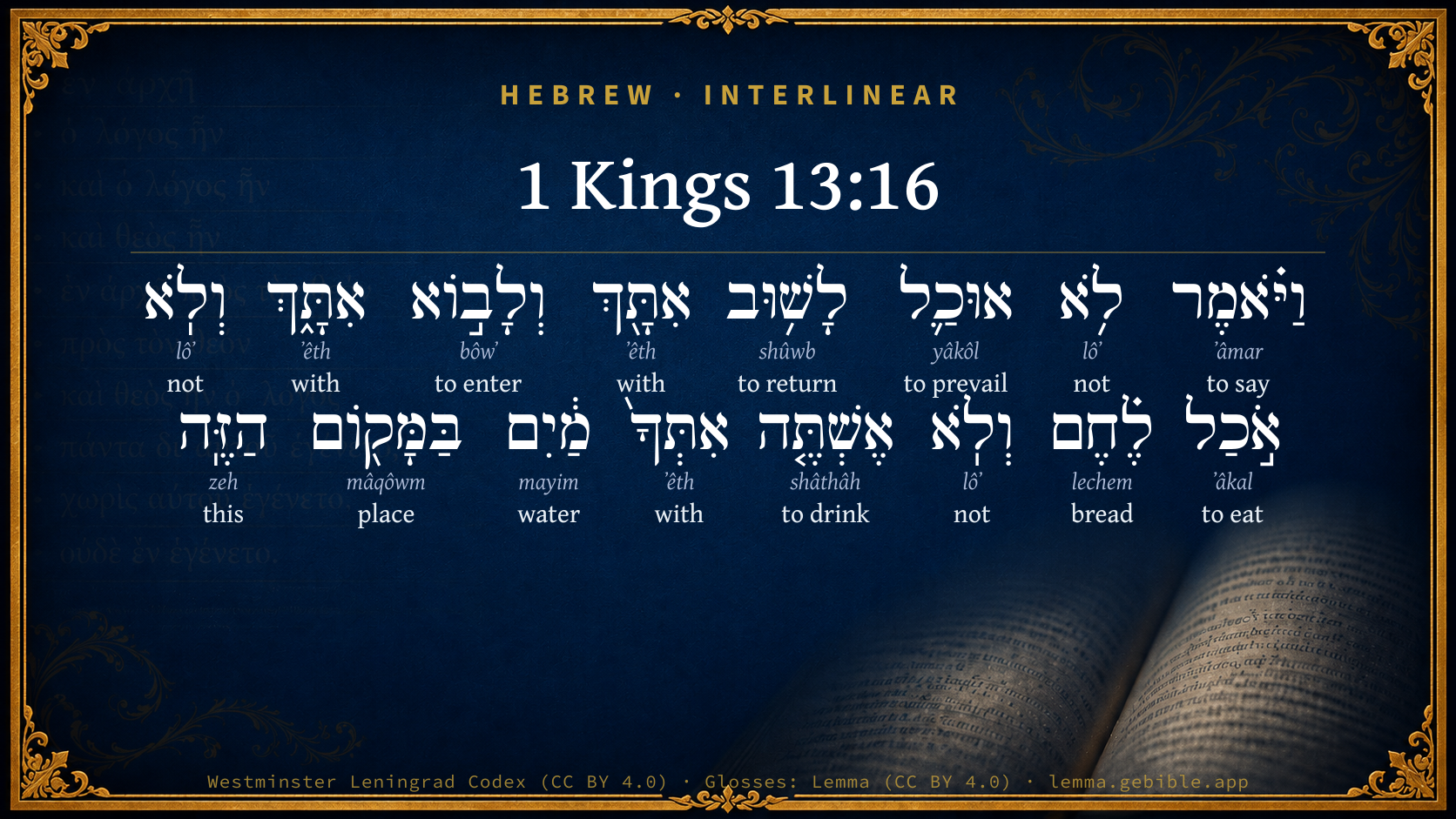
1 Kings 13:16

Hebrew (Westminster Leningrad Codex) 1 Kings 13:16 appears in the Hebrew Old Testament. The text above is from the Westminster Leningrad Codex. Each word links to its Strong’s number, a concise gloss, and parsing drawn from the Open Scriptures Hebrew Bible morphology. Click any word for its full Brown-Driver-Briggs (BDB) entry.
Download image
Cite this verse

1 Kings 13:16 (World English Bible). Public Domain. Lemma interlinear Bible study tool, https://lemma.gebible.app/v/1-kings/13/16.

Show BibTeX & RIS
BibTeX
RIS
English Translation
He said, I may not return with you, nor go in with you; neither will I eat bread nor drink water with you in this place:
World English Bible · Public Domain
Download a study sheet

One document with this verse’s original text, its word-by-word gloss line, the meaning frame, cross-references with their text, attributed commentary, and full source and license credits — printable, and it pastes into notes with its structure intact.

This verse Autodidact and up

Study sheet (.html) Plain text (.txt)

A passage Seminary Student

Up to 50 verses in one chapter. A passage sheet keeps up to 6 commentary sources and 12 cross-references per verse, in the order this page ranks them, and says so on the sheet whenever that leaves anything out. Ask for a single verse and you get the Autodidact verse sheet above.

Everything on this page stays free to read, with no account — the sheet is a download of what is already on screen, not access to it.

Want to remove ads? Support Godless Engineer
Compare translations 3

The same verse in 3 English versions, stacked beneath the original-language interlinear above. Click any original word for its lexicon entry.

Each is an independent rendering of the whole verse — the interlinear is not word-aligned to these translations.

Highlighted words mark where these versions differ — a whole-verse word diff, not a word-by-word alignment.

  • World English Bible Public Domain
    He said, I may not return with you, nor go in with you; neither will I eat bread nor drink water with you in this place:
  • King James Version Public Domain
    And he said, I may not return with thee, nor go in with thee: neither will I eat bread nor drink water with thee in this place:
  • unfoldingWord Literal Text CC BY-SA 4.0
    And he said, “I am not able to return with you or to come with you. And I will not eat bread and I will not drink water with you in this place.

unfoldingWord Literal Text — © unfoldingWord, licensed CC BY-SA 4.0. Word-aligned USFM3 via Door43 (git.door43.org/unfoldingWord/en_ult).

Versions to compare (up to 4)

3 of 4 selected

Show all 18 translations

Every available English version of this verse, each an independent rendering of the whole verse.

  • World English Bible Public Domain
    He said, I may not return with you, nor go in with you; neither will I eat bread nor drink water with you in this place:
  • Berean Standard Bible Public Domain
    But the man replied, “I cannot return with you or eat bread or drink water with you in this place.
  • Majority Standard Bible Public Domain
    But the man replied, “I cannot go home with you, and I will not eat bread or drink water with you in this place.
  • King James Version Public Domain
    And he said, I may not return with thee, nor go in with thee: neither will I eat bread nor drink water with thee in this place:
  • American Standard Version (1901) Public Domain
    And he said, I may not return with thee, nor go in with thee; neither will I eat bread nor drink water with thee in this place:
  • Revised Version (1885) Public Domain
    And he said, I may not return with thee, nor go in with thee: neither will I eat bread nor drink water with thee in this place:
  • Geneva Bible (1599) Public Domain
    But he answered, I may not returne with thee, nor go in with thee, neither wil I eate bread nor drinke water with thee in this place.
  • Douay-Rheims (1899) Public Domain
    But he said: I must not return, nor go with thee, neither will I eat bread, nor drink water in this place:
  • Young's Literal Translation Public Domain
    And he saith, `I am not able to turn back with thee, and to go in with thee, nor do I eat bread or drink with thee water in this place,
  • Literal Standard Version CC BY-SA 4.0
    And he says, “I am not able to return with you, and to go in with you, nor do I eat bread or drink water with you in this place,
  • Unlocked Literal Bible CC BY-SA 4.0
    The man of God answered, “I may not return with you nor go in with you, neither will I eat food nor drink water with you in this place,
  • unfoldingWord Literal Text CC BY-SA 4.0
    And he said, “I am not able to return with you or to come with you. And I will not eat bread and I will not drink water with you in this place.
  • Darby Bible Public Domain
    And he said, I cannot return with thee, nor go in with thee; neither will I eat bread nor drink water with thee in this place.
  • World Messianic Bible Public Domain
    He said, “I may not return with you, nor go in with you. I will not eat bread or drink water with you in this place.
  • Webster's Bible Public Domain
    And he said, I may not return with thee, nor go in with thee: neither will I eat bread nor drink water with thee in this place:
  • Free Bible Version CC BY-SA 4.0
    “I can't turn around and go with you, and I won't eat or drink with you in this place,” the man of God replied.
  • Bible in Basic English Public Domain
    But he said, I may not go back with you or go into your house; and I will not take food or a drink of water with you in this place;
  • JPS Tanakh (1917) Public Domain
    And he said: 'I may not return with thee, nor go in with thee; neither will I eat bread nor drink water with thee in this place.

Literal Standard Version (2020), Covenant Press — licensed CC BY-SA 4.0. Text via the HelloAO Bible API (eBible.org). Unlocked Literal Bible (unfoldingWord) — licensed CC BY-SA 4.0. Text via the HelloAO Bible API (eBible.org). unfoldingWord Literal Text — © unfoldingWord, licensed CC BY-SA 4.0. Word-aligned USFM3 via Door43 (git.door43.org/unfoldingWord/en_ult). Free Bible Version, Dr. Jonathan Gallagher — licensed CC BY-SA 4.0. Text via the HelloAO Bible API (eBible.org).

Word by word

More ways to search: Search by grammar → Find every occurrence → Compare this word →

Practice this passage: Drill this verse → Learn its vocabulary →

אוּכַ֛ל
yâkôl
H3201
“to prevail”
Verb, Qal, Imperfect, 1st Person, Common, Singular
Part of Speech
Verb
Stem
Qal
Form
Imperfect
Person
1st Person
Gender
Common
Number
Singular
Full BDB Definition

Origin: a primitive root

TWOT: 866

to prevail, overcome, endure, have power, be able - (Qal) - to be able, be able to gain or accomplish, be able to endure, be able to reach - to prevail, prevail over or against, overcome, be victor - to have ability, have strength
  1. וַיֹּ֗אמֶר ʼâmar H559 “and · to say” Conjunction + Verb, Qal, Sequential Imperfect, 3rd Person, Masculine, Singular
  2. לֹ֥א lôʼ H3808 “not” Particle, Negative
  3. לָשׁ֥וּב shûwb H7725 “to return” Preposition + Verb, Qal, Infinitive Construct
  4. אִתָּ֖ךְ ʼêth H854 “with · you” Preposition + Suffix, Personal, 2nd Person, Feminine, Singular
  5. וְלָב֣וֹא bôwʼ H935 “and · to enter” Conjunction + Preposition + Verb, Qal, Infinitive Construct
  6. אִתָּ֑ךְ ʼêth H854 “with · you” Preposition + Suffix, Personal, 2nd Person, Feminine, Singular
  7. וְלֹֽא lôʼ H3808 “and · not” Conjunction + Particle, Negative
  8. אֹ֣כַל ʼâkal H398 “to eat” Verb, Qal, Imperfect, 1st Person, Common, Singular
  9. לֶ֗חֶם lechem H3899 “bread” Noun, Common, Both, Singular, Absolute
  10. וְלֹֽא lôʼ H3808 “and · not” Conjunction + Particle, Negative
  11. אֶשְׁתֶּ֤ה shâthâh H8354 “to drink” Verb, Qal, Imperfect, 1st Person, Common, Singular
  12. אִתְּךָ֙ ʼêth H854 “with · you” Preposition + Suffix, Personal, 2nd Person, Masculine, Singular
  13. מַ֔יִם mayim H4325 “water(s)” Noun, Common, Masculine, Plural, Absolute
  14. בַּמָּק֖וֹם mâqôwm H4725 “in/at the · place” Preposition, Determined + Noun, Common, Masculine, Singular, Absolute
  15. הַזֶּֽה zeh H2088 “the · this” Particle, Definite Article + Pronoun, Demonstrative, Masculine, Singular

About this verse

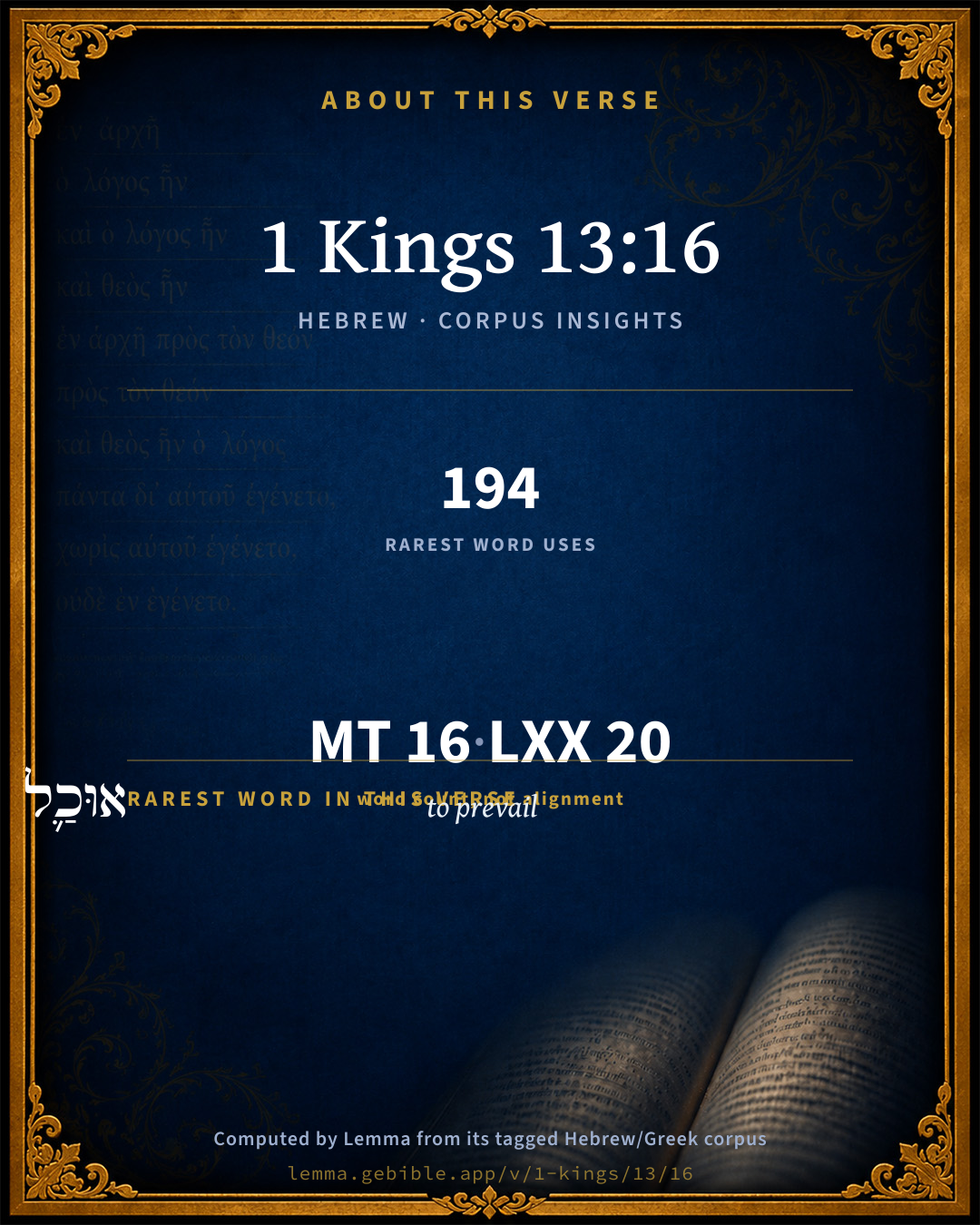
These counts appear in no published source. They are computed here, from the morphology-tagged text and Lemma’s own curated glosses. What Lemma adds →

16
words
12
distinct lemmas
Historical
section

Grammatical profile

  • 6 verbs
  • 3 nouns
  • 1 pronoun
  • 3 prepositions
  • 3 particles

Verb forms

  • וַיֹּ֗אמֶר Qal · Sequential Imperfect
  • אוּכַ֛ל Qal · Imperfect
  • לָשׁ֥וּב Qal · Infinitive Construct
  • וְלָב֣וֹא Qal · Infinitive Construct
  • אֹ֣כַל Qal · Imperfect
  • אֶשְׁתֶּ֤ה Qal · Imperfect

Repetition

Words recur within this verse — often emphatic in Hebrew:

  • לֹ֥א not H3808 ×3
  • אִתָּ֖ךְ with H854 ×3

Hebrew & Septuagint length

In English translation the verse runs 26 words from the Hebrew and 28 from the Septuagint (LXX English) — closely comparable.

A rough comparison of the two English renderings, which tokenize alike — not a word-level alignment.

Word counts can differ between the Hebrew and the Greek without any difference in meaning — e.g. the Hebrew direct-object marker אֵת has no separate Greek word, and Greek often adds the article ὁ.

In the original languages it is 16 Hebrew tokens and 20 Greek tokens — but the two are counted differently (Hebrew bundles its prefixes and suffixes into one token; the Greek is in lemma form), so that isn’t a like-for-like length.

Cross-references

6

Topical passages linked to 1 Kings 13:16 in the Treasury of Scripture Knowledge — connected by theme and wording, ordered by reader-vote popularity; previews shown in the World English Bible.

  • 1 Kings 13:8–9 The man of God said to the king, If you will give me half your house, I will not go in with you, neither will I eat bread nor drink water in this place;
  • Genesis 3:1–3 Now the serpent was more subtle than any animal of the field which Yahweh God had made. He said to the woman, "Yes, has God said, 'You shall not eat of any tree of the garden?'"
  • Numbers 22:13 Balaam rose up in the morning, and said to the princes of Balak, Get you into your land; for Yahweh refuses to give me leave to go with you.
  • Numbers 22:19 Now therefore, please wait also here this night, that I may know what Yahweh will speak to me more.
  • Matthew 4:10 Then Jesus said to him, "Get behind me, Satan! For it is written, 'You shall worship the Lord your God, and him only shall you serve.'"
  • Matthew 16:23 But he turned, and said to Peter, "Get behind me, Satan! You are a stumbling-block to me, for you are not setting your mind on the things of God, but on the things of men."

Cross-references courtesy of OpenBible.info (CC BY 4.0).

Hebrew and Greek witnesses Masoretic Hebrew ↔ Greek Septuagint

The same verse in the two great witnesses to the Old Testament, shown verse-for-verse.

These are two independent witnesses, not word-aligned to each other, and the Septuagint is shown in lemma (dictionary) form.

Hebrew 1 Kings 13:16 Masoretic · Westminster Leningrad Codex

וַיֹּ֗אמֶר לֹ֥א אוּכַ֛ל לָשׁ֥וּב אִתָּ֖ךְ וְלָב֣וֹא אִתָּ֑ךְ וְלֹֽא אֹ֣כַל לֶ֗חֶם וְלֹֽא אֶשְׁתֶּ֤ה אִתְּךָ֙ מַ֔יִם בַּמָּק֖וֹם הַזֶּֽה

He said, I may not return with you, nor go in with you; neither will I eat bread nor drink water with you in this place:

World English Bible · Public Domain

Greek LXX 1 Kings 13:16 Septuagint · lemma form

καί εἶπον οὐ μή δύναμαι ὁ ἐπιστρέφω μετά σύ οὐδέ μή ἐσθίω ἄρτος οὐδέ πίνω ὕδωρ ἐν ὁ τόπος οὗτος

And he said, I shall not by any means be able to return with you, neither will I eat bread, neither will I drink water in this place.

LXX2012 (modern English Septuagint) · Public Domain

Hebrew: Westminster Leningrad Codex (CC BY 4.0). Greek: Septuagint (public domain); English from LXX2012 (modern English Septuagint) (Public Domain). How the Septuagint differs from the Hebrew →

Targum (Aramaic paraphrase)

1

The Targum is the ancient Jewish Aramaic paraphrase of the Hebrew Scriptures — an interpretive translation, not the Hebrew text itself. Onkelos (literal) and Pseudo-Jonathan (expansive) render the Torah, and Jonathan the Prophets. Coverage is partial: where no permissively-licensed English translation exists for a verse, only the Aramaic is shown. This is verse-level text, not a word-by-word alignment to the Hebrew.

  1. Targum Jonathan Prophets (Joshua–Malachi)
    וַאֲמַר לָא אִיכוּל לְמֵיתַב עִמָךְ וּלְמֵיעַל עִמָךְ וְלָא אֵיכוּל לַחְמָא וְלָא אֶשְׁתֵּי עִמָךְ מַיָא בְּאַתְרָא הָדֵין:

    (no public-domain English translation for this verse)

    Targum Jonathan — Aramaic: “Mikraot Gedolot” (public domain). English: “Sefaria Community Translation” (CC0 1.0 (public-domain dedication)); “London "Chaldee Paraphrase," 1871” (public domain). Text via Sefaria.

Commentary

Notes on 1 Kings 13:16 from classic Christian and Jewish commentators (each source and its license shown beneath its notes). The classic Christian expositions comment on the surrounding passage and are grouped to its opening verse, so a note may address several verses; the Jewish commentaries on the Tanakh (Rashi and others) are per-verse, so they appear only where the commentator wrote on this verse.

Lemma curates 59 commentaries, every one of them public domain or Creative Commons licensed, each selected and text-cleaned for this edition rather than reprinted as found. About our sources →

Trapp's Complete Commentary

John Trapp

1Ki 13:16 And he said, I may not return with thee, nor go in with thee: neither will I eat bread nor drink water with thee in this place:

Ver. 16. Neither will I eat bread.] Though I have need enough, yet I must be resolute, because God’s charge was absolute.

John Trapp, A Commentary or Exposition upon All the Books of the Old and New Testament (1647–1656) — public domain. Text from a community e-Sword module.

The Cambridge Bible for Schools and Colleges

gen. ed. J. J. S. Perowne

16. in this place] The prophet had not gone far from Bethel before he sat down to rest. The events of the day had been such as to ask for it.

The Cambridge Bible for Schools and Colleges (gen. ed. J. J. S. Perowne; Cambridge University Press, 1878–1918) — public domain. Text from a community e-Sword module.

John Gill's Exposition

And he said unto him,.... That is, the old prophet said to the man of God:

I am a prophet also as thou art; meaning, that he was a prophet of the true God, and not of any idol deity; that he not only believed in him, and was a worshipper of him, but had revelations from him, and of the same things this man of God had, and that he believed that what he had prophesied of would certainly come to pass:

and an angel spoke unto me by the word of the Lord; was sent and dispatched by the order of the Lord with the following message:

saying, bring him back with thee into thine house, that he may eat bread and drink water; and so be refreshed, and be fit to proceed on in his journey:

but he lied unto him; no messenger nor message being sent to him by the Lord, but was wholly a device and stratagem of his own to persuade the man of God to return with him, that he might have his company and conversation.

John Gill's Exposition of the Whole Bible (1746–1763) — public domain (CC PDM 1.0). Text via the HelloAO Bible API.

Matthew Poole's English Annotations

i.e. In Beth-el, where thou desirest me to do it.

Matthew Poole's English Annotations on the Holy Bible (1683–1685) — public domain. Text from a community e-Sword/MySword module.

The Pulpit Commentary

And he said, I may not Heb. am not able to return with thee, nor go in with thee: neither will I eat bread nor drink water with thee in this place. The translation in that place" adopted by Wordsworth (after the Vulgate, in loco isto) does not agree with the Hebrew. And it is not required by the context. The tree was probably at no great distance from the town.

The Pulpit Commentary (1880–1919), ed. H.D.M. Spence-Jones & Joseph S. Exell — public domain. Text from a community e-Sword module.

Lesson kit

Teaching starters — assembled from the data on this page, not authored interpretation. Every prompt links to the verse data it draws on. Edit before teaching.

1 Kings, in the Historical, opens this verse with 16 words (12 distinct Hebrew lemmas). Its most distinctive word is yâkôl (“to prevail”). A historical commentator’s framing appears above. Read the whole chapter for the surrounding context.

Discussion questions

  1. The word yâkôl carries the sense “to prevail.” How does it shape the verse?
  2. 1 Kings 13:8–9 shares this passage’s theme. How do the two illuminate each other?
  3. “not” occurs 3× in this one verse. What is the effect of the repetition?
  4. These translations render this verse differently; the difference is in the English rendering, not the original. What questions does that raise?
  5. The verb «וַיֹּ֗אמֶר» is Qal Sequential Imperfect. How does its form color the action?
  6. Reading how Trapp's Complete Commentary and The Cambridge Bible for Schools and Colleges read this verse, where do the two commentators agree and where do they part?

Things to notice

Reading settings

Reading text

Shown beneath each verse's original-language words.

Old Testament
Old Testament edition

Read the OT as the Masoretic Hebrew (MT) or the Greek Septuagint (LXX).

English shown for the Greek Septuagint (in the Hebrew ↔ Greek comparison).

Comparing translations? Open the Compare panel on any verse page to stack up to four side by side.