
Nehemiah 10:33

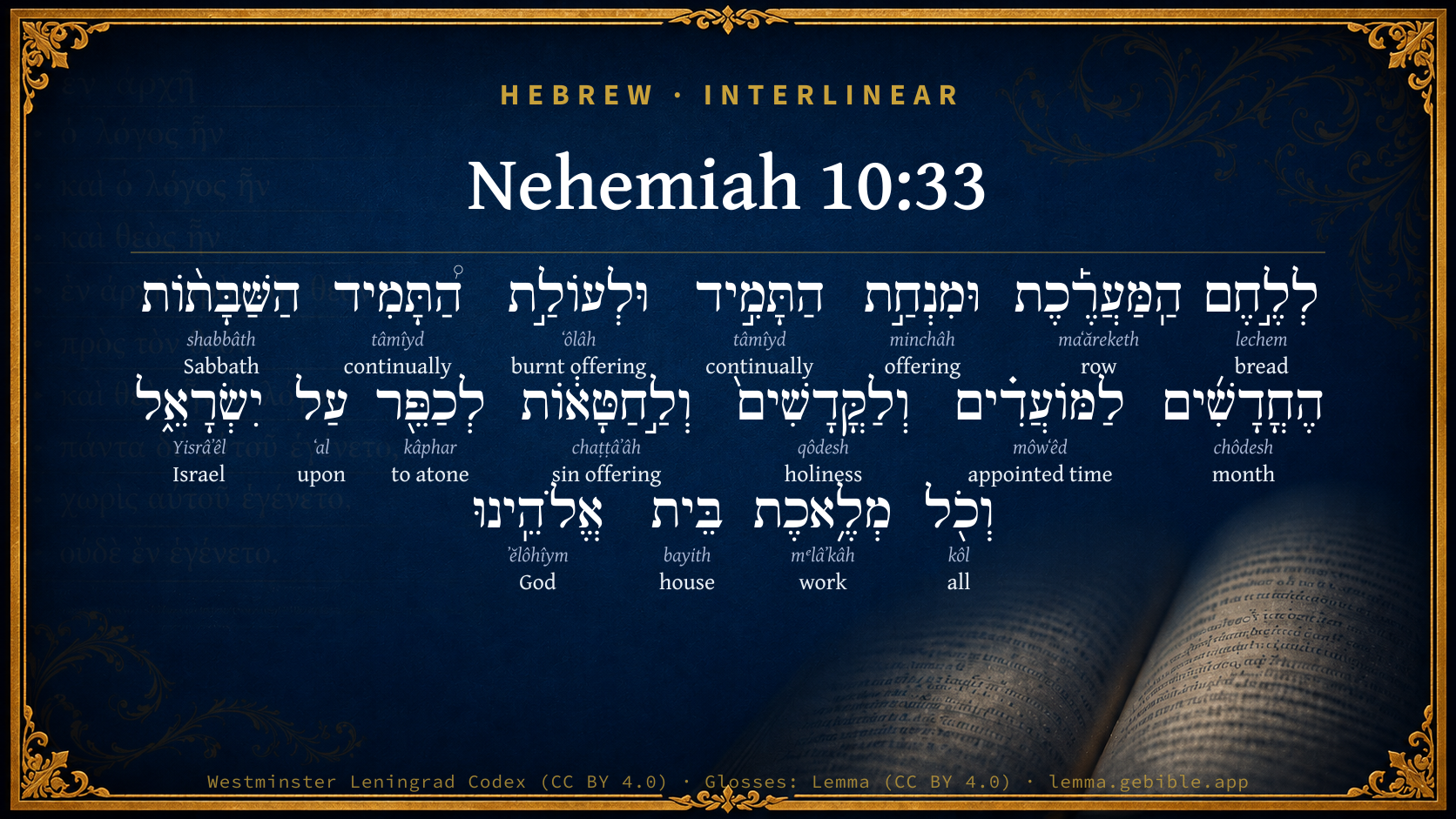
Hebrew (Westminster Leningrad Codex) Nehemiah 10:33 appears in the Hebrew Old Testament. The text above is from the Westminster Leningrad Codex. Each word links to its Strong’s number, a concise gloss, and parsing drawn from the Open Scriptures Hebrew Bible morphology. Click any word for its full Brown-Driver-Briggs (BDB) entry.
Download image
Cite this verse

Nehemiah 10:33 (World English Bible). Public Domain. Lemma interlinear Bible study tool, https://lemma.gebible.app/v/nehemiah/10/33.

Show BibTeX & RIS
BibTeX
RIS
English Translation
for the show bread, and for the continual meal-offering, and for the continual burnt-offering, for the Sabbaths, for the new moons, for the set feasts, and for the holy things, and for the sin-offerings to make atonement for Israel, and for all the work of the house of our God.
World English Bible · Public Domain
Download a study sheet

One document with this verse’s original text, its word-by-word gloss line, the meaning frame, cross-references with their text, attributed commentary, and full source and license credits — printable, and it pastes into notes with its structure intact.

This verse Autodidact and up

Study sheet (.html) Plain text (.txt)

A passage Seminary Student

Up to 50 verses in one chapter. A passage sheet keeps up to 6 commentary sources and 12 cross-references per verse, in the order this page ranks them, and says so on the sheet whenever that leaves anything out. Ask for a single verse and you get the Autodidact verse sheet above.

Everything on this page stays free to read, with no account — the sheet is a download of what is already on screen, not access to it.

Want to remove ads? Support Godless Engineer
Compare translations 3

The same verse in 3 English versions, stacked beneath the original-language interlinear above. Click any original word for its lexicon entry.

Each is an independent rendering of the whole verse — the interlinear is not word-aligned to these translations.

Highlighted words mark where these versions differ — a whole-verse word diff, not a word-by-word alignment.

  • World English Bible Public Domain
    for the show bread, and for the continual meal-offering, and for the continual burnt-offering, for the Sabbaths, for the new moons, for the set feasts, and for the holy things, and for the sin-offerings to make atonement for Israel, and for all the work of the house of our God.
  • King James Version Public Domain
    For the shewbread, and for the continual meat offering, and for the continual burnt offering, of the sabbaths, of the new moons, for the set feasts, and for the holy things, and for the sin offerings to make an atonement for Israel, and for all the work of the house of our God.
  • unfoldingWord Literal Text CC BY-SA 4.0
    for the bread in rows and the continual offering, and for the continual burnt offering, the sabbaths, the new moons, for the appointed times, and for the holy things, and for the sin offerings to cover over for Israel, and all the work of the house of our God.

unfoldingWord Literal Text — © unfoldingWord, licensed CC BY-SA 4.0. Word-aligned USFM3 via Door43 (git.door43.org/unfoldingWord/en_ult).

Versions to compare (up to 4)

3 of 4 selected

Show all 18 translations

Every available English version of this verse, each an independent rendering of the whole verse.

  • World English Bible Public Domain
    for the show bread, and for the continual meal-offering, and for the continual burnt-offering, for the Sabbaths, for the new moons, for the set feasts, and for the holy things, and for the sin-offerings to make atonement for Israel, and for all the work of the house of our God.
  • Berean Standard Bible Public Domain
    for the showbread, for the regular grain offerings and burnt offerings, for the Sabbath offerings, for the New Moons and appointed feasts, for the holy offerings, for the sin offerings to make atonement for Israel, and for all the duties of the house of our God.
  • Majority Standard Bible Public Domain
    for the showbread, for the regular grain offerings and burnt offerings, for the Sabbath offerings, for the New Moons and appointed feasts, for the holy offerings, for the sin offerings to make atonement for Israel, and for all the duties of the house of our God.
  • King James Version Public Domain
    For the shewbread, and for the continual meat offering, and for the continual burnt offering, of the sabbaths, of the new moons, for the set feasts, and for the holy things, and for the sin offerings to make an atonement for Israel, and for all the work of the house of our God.
  • American Standard Version (1901) Public Domain
    for the showbread, and for the continual meal-offering, and for the continual burnt-offering, for the sabbaths, for the new moons, for the set feasts, and for the holy things, and for the sin-offerings to make atonement for Israel, and for all the work of the house of our God.
  • Revised Version (1885) Public Domain
    for the shewbread, and for the continual meal offering, and for the continual burnt offering, of the sabbaths, of the new moons, for the set feasts, and for the holy things, and for the sin offerings to make atonement for Israel, and for all the work of the house of our God.
  • Geneva Bible (1599) Public Domain
    For the shewbread, and for the daily offring, and for the daily burnt offring, the Sabbaths, the newe moones, for the solemne feastes, and for the thinges that were sanctified, and for the sinne offrings to make an atonement for Israel, and for all the worke of the house of our God.
  • Douay-Rheims (1899) Public Domain
    For the leaves of proposition, and for the continual sacrifice, and for a continual holocaust on the sabbaths, on the new moons, on the set feasts, and for the holy things, and for the sin offering: that atonement might be made for Israel, and for every use of the house of our God.
  • Young's Literal Translation Public Domain
    for bread of the arrangement, and the continual present, and the continual burnt-offering of the sabbaths, of the new moons, for appointed seasons, and for holy things, and for sin-offerings, to make atonement for Israel, even all the work of the house of our God.
  • Literal Standard Version CC BY-SA 4.0
    for bread of the arrangement, and the continual present, and the continual burnt-offering of the Sabbaths, of the new moons, for appointed times, and for holy things, and for sin-offerings, to make atonement for Israel, even all the work of the house of our God.
  • Unlocked Literal Bible CC BY-SA 4.0
    to provide for the bread of the presence, and for the regular grain offering, the burnt offerings on the Sabbaths, the new moon festivals and appointed feasts, and for the holy offerings, and for the sin offerings to make atonement for Israel, as well as for all the work of the house of our God.
  • unfoldingWord Literal Text CC BY-SA 4.0
    for the bread in rows and the continual offering, and for the continual burnt offering, the sabbaths, the new moons, for the appointed times, and for the holy things, and for the sin offerings to cover over for Israel, and all the work of the house of our God.
  • Darby Bible Public Domain
    for the bread to be set in rows, and for the continual oblation, and for the continual burnt-offering, [for that] of the sabbaths [and] of the new moons, for the set feasts and for the holy [things], and for the sin-offerings to make an atonement for Israel, and [for] all the work of the house of our God.
  • World Messianic Bible Public Domain
    for the show bread, for the continual meal offering, for the continual burnt offering, for the Sabbaths, for the new moons, for the set feasts, for the holy things, for the sin offerings to make atonement for Israel, and for all the work of the house of our God.
  • Webster's Bible Public Domain
    For the show-bread, and for the continual meat-offering, and for the continual burnt-offering, of the sabbaths, of the new moons, for the set feasts, and for the holy things, and for the sin-offerings to make an atonement for Israel, and for all the work of the house of our God.
  • Free Bible Version CC BY-SA 4.0
    for the showbread, for the regular grain offerings and burnt offerings, for the Sabbath offerings, for the new moon and yearly festivals, for the holy offerings, for the sin offerings to make atonement for Israel, in short all that takes place in the Temple of our God.
  • Bible in Basic English Public Domain
    For the holy bread, and for the regular meal offering and the regular burned offering on the Sabbaths and at the new moon and the fixed feasts, and for the sin-offerings to take away the sin of Israel, and for all the work of the house of our God.
  • JPS Tanakh (1917) Public Domain
    (10-34) for the showbread, and for the continual meal-offering, and for the continual burnt-offering, of the sabbaths, of the new moons, for the appointed seasons, and for the holy things, and for the sin-offerings to make atonement for Israel, and for all the work of the house of our God.

Literal Standard Version (2020), Covenant Press — licensed CC BY-SA 4.0. Text via the HelloAO Bible API (eBible.org). Unlocked Literal Bible (unfoldingWord) — licensed CC BY-SA 4.0. Text via the HelloAO Bible API (eBible.org). unfoldingWord Literal Text — © unfoldingWord, licensed CC BY-SA 4.0. Word-aligned USFM3 via Door43 (git.door43.org/unfoldingWord/en_ult). Free Bible Version, Dr. Jonathan Gallagher — licensed CC BY-SA 4.0. Text via the HelloAO Bible API (eBible.org).

Word by word

More ways to search: Search by grammar → Find every occurrence → Compare this word →

Practice this passage: Drill this verse → Learn its vocabulary →

הַֽמַּעֲרֶ֡כֶת
maʻăreketh
H4635
“the · row”
Particle, Definite Article + Noun, Common, Feminine, Singular, Absolute
Part of Speech
Particle + Noun
Type
Common
Gender
Feminine
Number
Singular
State
Absolute
Full BDB Definition

Origin: from H6186

TWOT: 1694e

row, line
  1. לְלֶ֣חֶם lechem H3899 “to/for · bread of” Preposition + Noun, Common, Both, Singular, Construct
  2. וּמִנְחַ֣ת minchâh H4503 “and · offering of” Conjunction + Noun, Common, Feminine, Singular, Construct
  3. הַתָּמִ֣יד tâmîyd H8548 “the · continually” Particle, Definite Article + Noun, Common, Masculine, Singular, Absolute
  4. וּלְעוֹלַ֣ת ʻôlâh H5930 “and · to/for · burnt offering of” Conjunction + Preposition + Noun, Common, Feminine, Singular, Construct
  5. הַ֠תָּמִיד tâmîyd H8548 “the · continually” Particle, Definite Article + Noun, Common, Masculine, Singular, Absolute
  6. הַשַּׁבָּת֨וֹת shabbâth H7676 “the · Sabbaths” Particle, Definite Article + Noun, Common, Both, Plural, Absolute
  7. הֶחֳדָשִׁ֜ים chôdesh H2320 “the · months” Particle, Definite Article + Noun, Common, Masculine, Plural, Absolute
  8. לַמּוֹעֲדִ֗ים môwʻêd H4150 “to/for the · appointed times” Preposition, Determined + Noun, Common, Masculine, Plural, Absolute
  9. וְלַקֳּדָשִׁים֙ qôdesh H6944 “and · to/for the · holy things” Conjunction + Preposition, Determined + Noun, Common, Masculine, Plural, Absolute
  10. וְלַ֣חַטָּא֔וֹת chaṭṭâʼâh H2403 “and · to/for the · sin offerings” Conjunction + Preposition, Determined + Noun, Common, Feminine, Plural, Absolute
  11. לְכַפֵּ֖ר kâphar H3722 “to atone” Preposition + Verb, Piel, Infinitive Construct
  12. עַל ʻal H5921 “upon” Preposition
  13. יִשְׂרָאֵ֑ל Yisrâʼêl H3478 “Israel” Noun, Proper
  14. וְכֹ֖ל kôl H3605 “and · all of” Conjunction + Noun, Common, Masculine, Singular, Construct
  15. מְלֶ֥אכֶת mᵉlâʼkâh H4399 “work of” Noun, Common, Feminine, Singular, Construct
  16. בֵּית bayith H1004 “house of” Noun, Common, Masculine, Singular, Construct
  17. אֱלֹהֵֽינוּ ʼĕlôhîym H430 “God(s) · our” Noun, Common, Masculine, Plural, Construct + Suffix, Personal, 1st Person, Common, Plural

About this verse

These counts appear in no published source. They are computed here, from the morphology-tagged text and Lemma’s own curated glosses. What Lemma adds →

18
words
17
distinct lemmas
Historical
section

Notable vocabulary

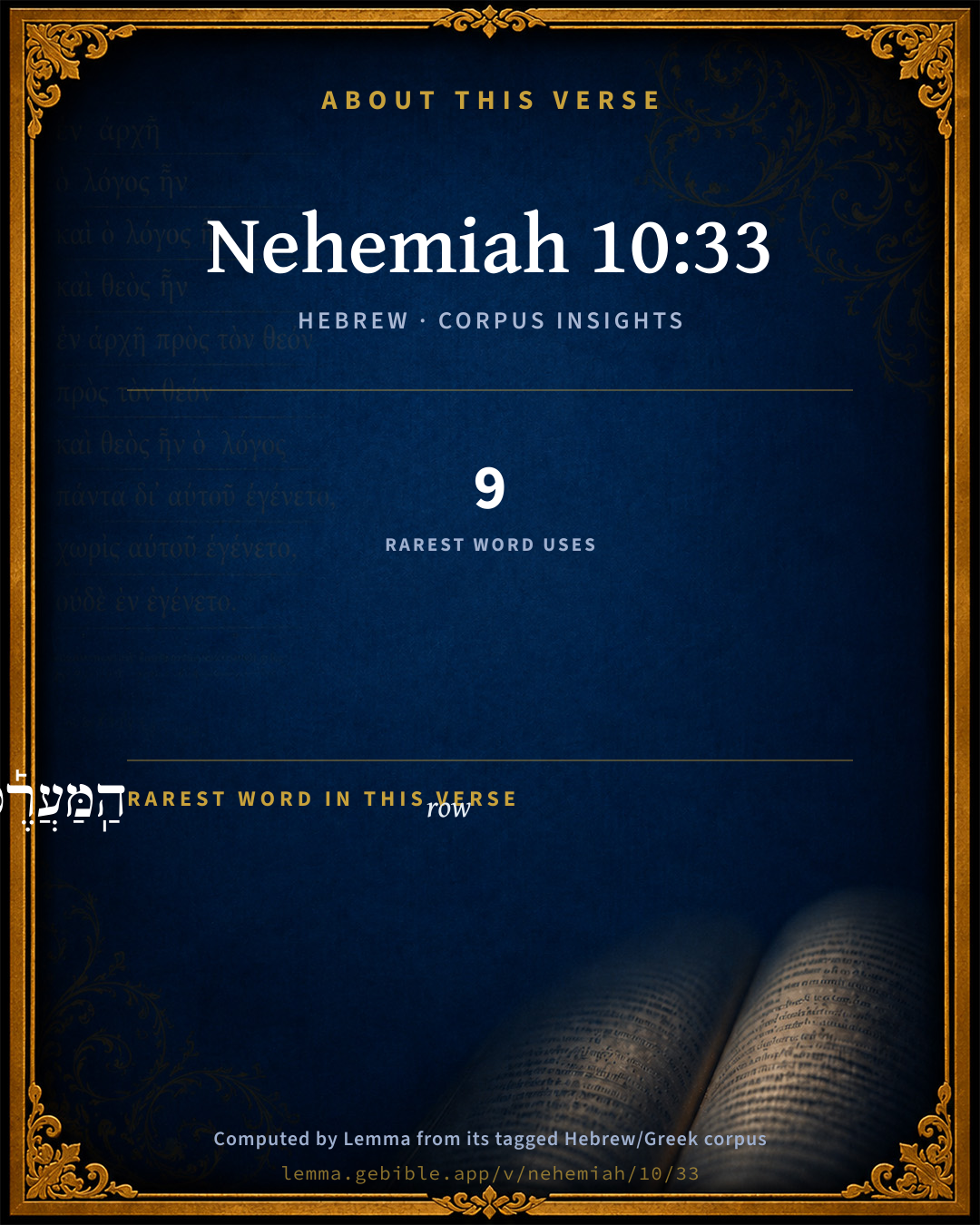
The rarest word here is הַֽמַּעֲרֶ֡כֶת row H4635 — appearing just 9 times in the whole Hebrew Bible.

Shared distinctive vocabulary

הַֽמַּעֲרֶ֡כֶת row H4635 occurs in 9 verses of the Hebrew Bible. Also found in:

Grammatical profile

  • 1 verb
  • 16 nouns
  • 1 preposition

Verb forms

  • לְכַפֵּ֖ר Piel · Infinitive Construct

Repetition

A word recurs within this verse — often emphatic in Hebrew:

  • הַתָּמִ֣יד continually H8548 ×2

Cross-references

5

Topical passages linked to Nehemiah 10:33 in the Treasury of Scripture Knowledge — connected by theme and wording, ordered by reader-vote popularity; previews shown in the World English Bible.

  • 2 Chronicles 2:4 Behold, I am about to build a house for the name of Yahweh my God, to dedicate it to him, and to burn before him incense of sweet spices, and for the continual show bread, and for the burnt offerings morning and evening, on the Sabbaths, and on the new moons, and on the set feasts of Yahweh our God. This is [an ordinance] forever to Israel.
  • Leviticus 24:5–6 "You shall take fine flour, and bake twelve cakes of it: two tenth parts of an ephah shall be in one cake.
  • Numbers 28:1–29 Yahweh spoke to Moses, saying,
  • 2 Chronicles 24:5–14 He gathered together the priests and the Levites, and said to them, Go out to the cities of Judah, and gather of all Israel money to repair the house of your God from year to year; and see that you hasten the matter. However the Levites didn't hurry.
  • Hebrews 10:11 Every priest indeed stands day by day ministering and often offering the same sacrifices, which can never take away sins,

Cross-references courtesy of OpenBible.info (CC BY 4.0).

Hebrew and Greek witnesses Masoretic Hebrew ↔ Greek Septuagint

The same verse in the two great witnesses to the Old Testament, shown verse-for-verse.

These are two independent witnesses, not word-aligned to each other, and the Septuagint is shown in lemma (dictionary) form.

Hebrew Nehemiah 10:33 Masoretic · Westminster Leningrad Codex

לְלֶ֣חֶם הַֽמַּעֲרֶ֡כֶת וּמִנְחַ֣ת הַתָּמִ֣יד וּלְעוֹלַ֣ת הַ֠תָּמִיד הַשַּׁבָּת֨וֹת הֶחֳדָשִׁ֜ים לַמּוֹעֲדִ֗ים וְלַקֳּדָשִׁים֙ וְלַ֣חַטָּא֔וֹת לְכַפֵּ֖ר עַל יִשְׂרָאֵ֑ל וְכֹ֖ל מְלֶ֥אכֶת בֵּית אֱלֹהֵֽינוּ

for the show bread, and for the continual meal-offering, and for the continual burnt-offering, for the Sabbaths, for the new moons, for the set feasts, and for the holy things, and for the sin-offerings to make atonement for Israel, and for all the work of the house of our God.

World English Bible · Public Domain

Greek LXX Structure differs

The Septuagint has no separate book of Nehemiah. Its Greek text is the second half of Esdras B (2 Esdras), chapters 11–23; Ezra is the first half (1–10).

A verse-for-verse comparison isn’t shown here because the chapters and verses don’t line up. Switch to the LXX edition with the MT / LXX toggle above to read the Greek directly.

On this verse, Keil & Delitzsch discusses the Septuagint’s reading. Read the note in Commentary ↓

Hebrew: Westminster Leningrad Codex (CC BY 4.0). Greek: Septuagint (public domain); English from a public-domain English Septuagint. How the Septuagint differs from the Hebrew →

Commentary

Notes on Nehemiah 10:33 from classic Christian and Jewish commentators (each source and its license shown beneath its notes). The classic Christian expositions comment on the surrounding passage and are grouped to its opening verse, so a note may address several verses; the Jewish commentaries on the Tanakh (Rashi and others) are per-verse, so they appear only where the commentator wrote on this verse.

Lemma curates 59 commentaries, every one of them public domain or Creative Commons licensed, each selected and text-cleaned for this edition rather than reprinted as found. About our sources →

Trapp's Complete Commentary

John Trapp

Neh 10:33 For the shewbread, and for the continual meat offering, and for the continual burnt offering, of the sabbaths, of the new moons, for the set feasts, and for the holy [things], and for the sin offerings to make an atonement for Israel, and [for] all the work of the house of our God.

Ver. 33. For the shewbread] Here are recited the several uses whereunto that tribute or impost was put; the half shekel enjoined by the law being not enough, by reason the people were as yet so few. This, though Junius denieth, yet the Hebrews all consent about it.

To make an atonement] That is, an agreement; Heb. To cover or expiate; to purge away, or take away uncleanness; to satisfy for sin, and to pacify wrath. By the priests making atonement legally was typified Christ’s making reconciliation between God and man; for he alone is the propitiation for our sins, 1Jn 2:2. But how much mistaken were our ancestors in times of Popery, who built religions houses, and gave large maintenance to them to buy off their sins, to deliver their souls from hell, to fetch their friends out of purgatory! &c.

John Trapp, A Commentary or Exposition upon All the Books of the Old and New Testament (1647–1656) — public domain. Text from a community e-Sword module.

Keil & Delitzsch

C. F. Keil & F. Delitzsch

Agreement to provide for the expenses of the temple and its ministers. - If the community seriously intended to walk by the rule of God's law, they must take care that the temple service, as the public worship of the community, should be provided for according to the law and a firm footing and due solemnity thus given to religion. For this purpose, it was indispensable to guarantee the contributions prescribed for the necessary expenses of the temple worship, and the support of its ministers. Hence this entering into a solemn agreement to observe the law was regarded as a suitable occasion for regulating the services prescribed by the law with respect to the temple and its ministers, and mutually binding themselves to their observance.

Neh 10:33-34

We ordained for ourselves (עלינוּ, upon us, inasmuch as such things are spoken of as are taken upon one). עלינוּ לתת, to lay upon ourselves the third part of a shekel yearly for the service of the house of our God. It is not said who were to be bound to furnish this contribution, but it is assumed that it was a well-known custom. This appointed payment is evidently only a revival of the Mosaic precept, Exo 30:13, that every man of twenty years of age and upwards should give half a shekel as a תּרוּמה to the Lord, - a tribute which was still paid in Christ's days, Mat 17:24. In consideration, however, of the poverty of the greater portion of the community, it was now lowered to a third of a shekel. The view of Aben Ezra, that a third of a shekel was to be paid in addition to the half shekel levied in conformity with the law, is unsupported by the text. העבודה, the service of the house of God, is not the building and repairs of the temple, but the regular worship. For, according to Neh 10:34, the tax was to be applied to defraying the expenses of worship, to supplying the shew-bread, the continual meat and burnt offerings (Num 28:3-8), the sacrifices for the Sabbaths, new moons (Num 28:9-15), and festivals (Num 28:16-29, 38), - for the קדשׁים, holy gifts, by which, from their position between the burnt-offering and the sin-offering, we may understand the thank-offerings, which were offered in the name of the congregation, as e.g., the two lambs at Pentecost, Lev 23:19, and the offerings brought at feasts of dedication, comp. Exo 24:5; Ezr 6:17, - for the sin-offerings which were sacrificed at every great festival; and finally for all the work of the house of our God, i.e., whatever else was needful for worship (ל must be supplied from the context before כּל־מלאכת). The establishment of such a tax for the expenses of worship, does not justify the view that the contributions promised by Artaxerxes in his edict, Ezr 7:20., of things necessary to worship had ceased, and that the congregation had now to defray the expenses from their own resources. For it may readily be supposed, that besides the assistance afforded by the king, the congregation might also esteem it needful to furnish a contribution, to meet the increased requirements of worship, and thus to augment the revenues of the temple, - the royal alms being limited to a certain amount (see Ezr 7:22).

Neh 10:35

"And we cast lots among the priests, the Levites, and the people for the wood-offering, to bring it into the house of our God, after our houses, at times appointed, year by year, to burn upon the altar of the Lord our God, as it is written in the law." In the law we merely find it prescribed that wood should be constantly burning on the altar, and that the priest should burn wood on it every morning, and burn thereon the burnt-offering (Lev 6:12.). The law gave no directions concerning the procuring of the wood; yet the rulers of the people must, at all events, have always provided for the regular delivery of the necessary quantity. Nehemiah now gives orders, as he himself tells us, Neh 13:31, which make this matter the business of the congregation, and the several houses have successively to furnish a contribution, in the order decided by casting lots. The words, "at times appointed, year by year," justify the conclusion that the order was settled for several years, and not that all the different houses contributed in each year.

(Note: Josephus (bello Jud. ii. 17. 6) speaks of a τῶν ξυλοφορίων ἑορτή, which he places on the fourteenth day of the month Λῶος, i.e., Ab, the fifth month of the Jewish year. From this Bertheau infers that the plural מזמּנים עתּים, here and Neh 13:31, denotes the one season or day of delivery in each year. But though the name of this festival is derived from the present verse, the lxx translating העצים קרבּן העצי על, πιρὶ κλήρον ξυλοφορίας, it appears even from what Josephus says of this feast, ἐν ᾗ πᾶσιν ἕθος ὕλην τῷ βωμῷ προσφέρειν, that the feast of wood-carrying does not designate that one day of the year on which the wood was delivered for the service of the altar. According to Mishna Taanit, ch. 4 (in Lightfoot's horae hebraicae in Matth. i. 1), nine days in the year were appointed for the delivery of wood, viz., 1st Nisan, 20th Tammuz, 5th, 7th, and 10th Ab, etc. Further particulars are given in Lundius, jd. Heiligtmer, p. 1067f. The feast of wood-carrying may be compared with our harvest festival; and Bertheau's inference is not more conclusive than would be the inference that our harvest festival denotes the one day in the year on which the harvest is gathered in.)

Neh 10:36-38

It was also arranged to contribute the first-fruits prescribed in the law. The infinitive להביא depends on העמדנוּ, and is co-ordinate with לתת, Neh 10:33. The first-fruits of the ground, comp. Exo 23:19; Exo 34:26; Deu 26:2; the first-fruits of all fruit trees, comp. Num 18:13; Lev 19:23; the first-born of our sons who were redeemed according to the estimation of the priest, Num 18:16, and of our cattle (i.e., in the case of the unclean, the required redemption, Exo 13:12., Num 18:15), and the firstlings of the herds and of the flocks, the fat of which was consumed on the altar, the flesh becoming the share of the priests, Num 18:17. In Neh 10:38 the construction is altered, the first person of the imperfect taking the place of the infinitive: and we will bring the first-fruits. ערסות, probably groats or ground flour; see rem. on Num 15:20, etc. תרוּמות, heave-offerings, the offering in this connection, is probably that of wheat and barley, Eze 45:13, or of the fruits of the field, which are suitably followed by the "fruit of all manner of trees." On "the first of the wine and oil," comp. Num 18:12. These offerings of first-fruits were to be brought into the chambers of the house of God, where they were to be kept in store, and distributed to the priests for their support. "And the tithes of our ground (will we bring) to the Levites; and they, the Levites, receive the tithes in all our country towns. (Neh 10:39) And a priest, a son of Aaron, shall be with the Levites when the Levites take tithes; and the Levites shall bring the tithe of the tithes to the house of our God, into the chambers of the treasury." The parenthetical sentences in these verses, המעשׂרים הלויּם והם and הלויּם בּעשׂר, have been variously understood. עשׂר in the Piel and Hiphil meaning elsewhere to pay tithe, comp. Deu 14:22; Deu 26:12; Gen 28:22, many expositors adhere to this meaning in these passages also, and translate Neh 10:38 : for they, the Levites, must give again the tenth (to the priests); and Neh 10:39 : when the Levites give the tenth; while the lxx, Vulgate, Syriac, Rashi, Aben Ezra, Clericus, Bertheau, and others, take עשּׂר and העשׂיר in these sentences as signifying to collect tithe. We prefer the latter view, as giving a more suitable sense. For the remark that the Levites must give back the tenth (Neh 10:38) does not present so appropriate a motive for the demand that the tithes should be paid, as that the tithes are due to the Levites. Still less does the addition, in our agricultural towns, suit the sentence: the Levites must give back the tithe to the priests. Again, the fact that it is not said till Neh 10:39 that the Levites have to give the tenth of the tenth to the priests, speaks still more against this view. A priest is to be present when the Levites take the tenth, so that the share of the priests may not be lessened. On "the tenth of the tenth," comp. Num 18:26. Hezekiah had provided store-chambers in the temple, in which to deposit the tithes, Ch2 31:11.

Neh 10:39

Neh 10:39 is confirmatory of the preceding clause: the Levites were to bring the tithe of the tithes for the priests into the chambers of the temple; for thither are both the children of Israel and the Levites, to bring all heave-offerings of corn, new wine, and oil: for there are the holy vessels for the service of the altar (comp. Num 4:15), and the priests that minister, and the doorkeepers and the singers, for whose maintenance these gifts provide. "And we will not forsake the house of our God," i.e., we will take care that the service of God's house shall be provided for; comp. Neh 13:11-14.

Keil & Delitzsch — Biblical Commentary on the Old Testament (1861–1891) — public domain (CC PDM 1.0). Text via the HelloAO Bible API. (Old Testament only.)

Tyndale Open Study Notes

Tyndale Open Resources

10:33 Bread of the Presence: See Lev 24:5-9; Num 28:1-8. • everything necessary: With the money from the annual tax, priests could purchase the animals for daily sacrifices and maintain the Temple complex (cp. 2 Kgs 12:11-12; see also Exod 30:11-16).

Tyndale Open Study Notes — © Tyndale Open Resources, licensed CC BY-SA 4.0. Text via the HelloAO Bible API.

Geneva Bible (1599)

Geneva Bible translators

This declareth wherefore they gave this third part of the shekel, which was besides the half shekel that they were bound to pay, Exod. 30:13.

Geneva Bible (1599) marginal notes — public domain. Text via Bolls.life.

The Cambridge Bible for Schools and Colleges

gen. ed. J. J. S. Perowne

33. This verse gives in detail ‘the service of the house of God.’ (Neh_10:31).

the shewbread] See Exo_25:23-30; Exo_37:10-16; Lev_24:5-9. The shewbread consisted of 12 unleavened cakes of fine meal, which were laid fresh every Sabbath in two rows of six upon the table in the Holy Place. Their preparation fell to the duty of the Kohathite Levites (1Ch_9:32). The antiquity of this rite is shown by the story of David. 1Sa_21:2-7. The name by which ‘the shewbread’ is here designated is ‘bread of arrangement,’ ‘lekhem hammaa-reketh’ (Vulg. ‘panes propositionis). The LXX. renders εἰς ἄρτους τοῦ προσώπου, ‘bread of the face,’ which is the translation of the other Hebrew name by which it was known, ‘lekhem happânîm:’ we should have expected εἰς ἄρτους προθέσεως.

for the continual meat (R.V. meal) offering, and for the continual burnt offering] We have mention of ‘the continual meal offering’ or ‘minkhah,’ which was offered every evening, in 1Ki_18:29; 1Ki_18:36; 2Ki_16:15; Ezr_9:4; Dan_9:21. In 2Ki_16:15 we find ‘the morning burnt offering (olah),’ as well as ‘the evening meal offering,’ spoken of. Now in the Priestly Laws (Exo_29:38-42; Num_28:3-8) we find the regulations for a burnt offering, with a meal offering, morning and evening. This is what is probably intended in the present passage, in Ezr_3:3; Ezr_3:5, and in the Books of Chronicles, e.g. 2Ch_31:3. We need not expect to find so full a ritual in practice before, as there was after, the influence of Ezra’s work made itself felt: nor can we hope to find in the historical narrative full illustration of all the details of worship required by the ideal of the Priestly Law.

Sacrifices were ‘continual’ (tamidh) in the sense of being regular and at stated times, as distinct from occasional, voluntary, and irregular offerings. Thus the ‘shew-bread’ is ‘continual bread,’ ‘lekhem hattamidh’ (Num_4:7).

of the sabbaths, of the new moons] i.e. for the ‘continual offering’ of the sabbath and of the new moon, and for the special offerings required for those days, as recorded in Num_28:9-10 (Sabbath), 11–15 (new moon), from which the rule in Eze_46:4; Eze_46:6 differs considerably.

for the set feasts] A description of these ‘days of holy convocation’ is found in Num_28:16 to Num_29:38.

for the holy things] Such, for instance, as ‘the thankofferings’ of the community. Cf. 2Ch_29:33, ‘And the consecrated things were six hundred oxen and three thousand sheep,’ 2Ch_35:13, ‘the holy offerings.’

the sin offerings] i.e. Those offered for the community, (a) regularly, along with the burnt offerings, Numbers 28, 29, (b) on exceptional occasions of national transgression, Lev_4:13.

for all the work, &c.] The preposition ‘for’ is carried on from the beginning of the verse. This general expression ‘all the work’ completes the list of objects upon which the ⅓ shekel tax was expended. LXX. εἰς ἔργα. Vulg. ‘in omnem usum.’

The Cambridge Bible for Schools and Colleges (gen. ed. J. J. S. Perowne; Cambridge University Press, 1878–1918) — public domain. Text from a community e-Sword module.

John Gill's Exposition

And we cast the lots among the priests, the Levites, and the people,.... The priests and Levites were in one lot, and the people in another, as Aben Ezra:

for the wood offering; for providing wood to burn upon the altar continually, concerning which Maimonides (c) thus writes:"what is the wood offering? there was a time fixed for families to go out unto the forests, and bring in wood of disposition (to be laid in order on the altar); and the day when it came to the turn of a family to bring the wood, they offered up freewill burnt offerings, which were called a wood offering; and it was to them as a good day (or festival), and they were forbid to mourn, fast, or do any work on it;''and he observes, that if a single person brought wood of his own free will, he was obliged to the same; and Josephus (d) speaks of a feast called when it was customary for all to bring wood to the altar, to keep alive the sacred fire, that it might not go out, which, according to him, was on the fourteenth of the month Lois, or August; but this was not the business of all the people, lots were cast, as here said, who should do it, and when:

to bring it into the house of our God; the temple, where there was a place called the "wood room", into which the wood was brought after it had been wormed by the priests (e).

after the houses of our fathers; or families on whom the lot fell to do it: some render it:

into the house of our fathers, meaning the same as before; the temple so called, because they built it, and worshipped God in it; so Jarchi and Aben Ezra:

at times appointed, year by year; as the lot directed; these, according to the Jewish doctors (f), were nine times in the year; on the first of Nisan (or March), the sons of Arach, of the tribe of Judah, brought the wood; on the twentieth of Tammuz (or June), the posterity of David, of the tribe of Judah; on the fifth of Ab (or July), the children of Parosh, of the tribe of Judah; on the seventh of the same month, the sons of Jonadab the son of Rechab; on the tenth of the same month, the posterity of Senaah, of the tribe of Benjamin; on the fifteenth of the same month, the children of Zattu, and with them the priests and Levites, and all who were of an uncertain tribe, &c. on the twentieth of the same month, the posterity of Pahathmoab, of the tribe of Judah; on the twentieth of Elul (or August), the children of Adin, of the tribe of Judah; on the first of Tebeth (or December), the posterity of Parosh again brought the wood:

to burn upon the altar of the Lord our God, as it is written in the law; the wood should be burnt upon it, and fire kept on it continually, Lev 6:12, for this refers only to that, the wood offering is nowhere spoken of in the law.

(c) Hilchot Cele Hamikdash, c. 6. sect. 9, 10. Vid. Maimon. & Bartenora in Misn. Taanith, c. 4. sect. 5. (d) De Bello Jud. l. 2. c. 17. sect. 6. (e) See Lightfoot's Prospect of the Temple, ch. 25. (f) Misn. Taanith, c. 4. sect. 5.

John Gill's Exposition of the Whole Bible (1746–1763) — public domain (CC PDM 1.0). Text via the HelloAO Bible API.

Matthew Poole's English Annotations

Formerly

the shew-bread, and the continual meat-offering, and

the continual burnt-offering, were provided out of the treasuries of the temple, 1Ch 26:20; and when those failed, out of the king’s treasure, 2Ch 31:3. But now, both these failing, provision is here made for them another way.

For the holy things, i.e. for the sacrifices, all which were holy.

The sin-offerings; which are particularly mentioned, as most necessary and suitable to their present state, which was exceeding sinful, and therefore miserable, and calling aloud for atoning sacrifices.

Matthew Poole's English Annotations on the Holy Bible (1683–1685) — public domain. Text from a community e-Sword/MySword module.

Whedon's Commentary on the Bible

Daniel D. Whedon

33. The showbread — Which was to be prepared of fine flour, and set in two rows in the holy place of the house of God. See Lev_24:5-9.

The continual meat offering, and… burnt offering — Two lambs a day, one in the morning, and the other at evening. Num_28:3-8.

Of the sabbaths — The burnt offering prescribed for every sabbath. See Num_28:9-10.

Of the new moons — See Num_28:11-14.

The set feasts — The passover, the feasts of trumpets, and the feast of tabernacles. Numbers 28:16-29, 28:39.

For the holy things — The holy or consecrated gifts, such as oxen and sheep, which were to be used in sacrifice, (compare 2Ch_29:33,) and also other offerings that might be used in the holy services.

For the sin offerings — Especially on the great day of atonement. Lev_16:29-34; Lev_23:27-32.

All the work — All the divine service. They provided for all that was necessary to insure the regular performance of the temple service according to the law. When Ezra first went up from Babylon to Jerusalem, Artaxerxes decreed that provision for the house of God should be made from the royal treasure-house, (Ezr_7:20-23;) but it is probable that this arrangement had ceased, and the service of the temple had become much neglected. Hence Nehemiah’s reforms.

Daniel D. Whedon (gen. ed.), Commentary on the Old and New Testaments (1874–1909) — public domain. Text from a community e-Sword module.

The Pulpit Commentary

For the shew-bread. See Lev_24:5-8. Small as the cost of the shew-bread was, consisting, as it did, of no more than twelve cakes of fine flour weekly, it is yet placed first on account of its importance, being the bread of God"s presence, the type of the sacramental bread of the new covenant. The continual meat offering is that offering of flour mingled with fine olive oil which God had required to be offered twice a day, at morning and at evening, in conjunction with the two lambs, which constituted the continual burnt offering. (Num_28:5) Of the sabbaths. i.e. "for the offering of the sabbath days," which consisted of two lambs with appropriate meat and drink offerings, in addition to the offering of every day. (Num_28:9, Num_28:10) Of the new moons. Two bullocks, one ram, seven lambs, with appropriate meat and drink offerings (ibid. vers. 11-14). For the set feasts. The passover, the feast of Pentecost, the feast of trumpets, and the feast of tabernacles. The offerings required at each are given with great exactness in Numbers 28, and 29. The holy things. "Wave-offerings" and "peace-offerings" (Lev_23:10, Lev_23:17, Lev_23:19) are probably intended. They were "holy to the Lord for the priest" (ibid. ver. 20). The sin offerings are those commanded in Num_28:15, Num_28:22, 30 29:5, 11, 16, 19, etc. And for all the work of the house. The internal "work" of cleansing and keeping in proper order the apparatus of worship is probably intended, not external repairs.

The Pulpit Commentary (1880–1919), ed. H.D.M. Spence-Jones & Joseph S. Exell — public domain. Text from a community e-Sword module.

Scofield Reference Notes

C. I. Scofield

shewbread (See Scofield "Exo 25:30").

atonement (See Scofield "Exo 29:33").

The Scofield Reference Bible (1917 edition), notes by C. I. Scofield — public domain. Text from a community e-Sword module.

Lesson kit

Teaching starters — assembled from the data on this page, not authored interpretation. Every prompt links to the verse data it draws on. Edit before teaching.

Nehemiah, in the Historical, opens this verse with 18 words (17 distinct Hebrew lemmas). Its most distinctive word is maʻăreketh (“row”). A historical commentator’s framing appears above. Read the whole chapter for the surrounding context.

Discussion questions

  1. What does “row” (maʻăreketh) contribute to the verse as a whole?
  2. Leviticus 24:6 shares the word «row» with this verse. How do the two illuminate each other?
  3. “continually” occurs 2× in this one verse. What is the effect of the repetition?
  4. The translations on this page render this verse differently — a whole-verse word diff, not a word-by-word alignment. What might account for the different wordings?
  5. The verb «לְכַפֵּ֖ר» is Piel Infinitive Construct. How does its form color the action?
  6. Reading how Trapp's Complete Commentary and Keil & Delitzsch read this verse, where do the two commentators agree and where do they part?

Things to notice

Reading settings

Reading text

Shown beneath each verse's original-language words.

Old Testament
Old Testament edition

Read the OT as the Masoretic Hebrew (MT) or the Greek Septuagint (LXX).

English shown for the Greek Septuagint (in the Hebrew ↔ Greek comparison).

Comparing translations? Open the Compare panel on any verse page to stack up to four side by side.