
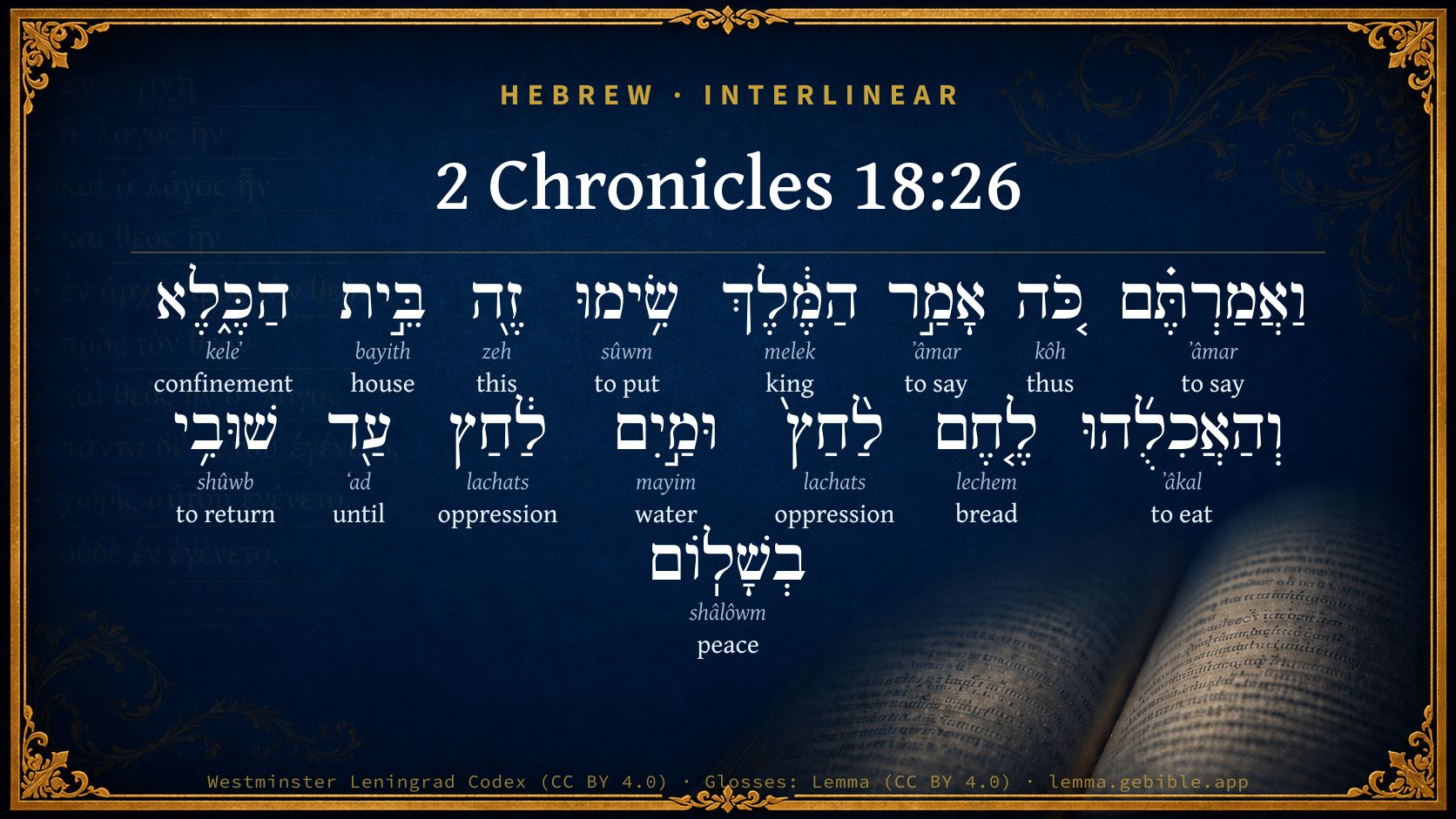
2 Chronicles 18:26

Hebrew (Westminster Leningrad Codex) 2 Chronicles 18:26 appears in the Hebrew Old Testament. The text above is from the Westminster Leningrad Codex. Each word links to its Strong’s number, a concise gloss, and parsing drawn from the Open Scriptures Hebrew Bible morphology. Click any word for its full Brown-Driver-Briggs (BDB) entry.
Download image
Cite this verse

2 Chronicles 18:26 (World English Bible). Public Domain. Lemma interlinear Bible study tool, https://lemma.gebible.app/v/2-chronicles/18/26.

Show BibTeX & RIS
BibTeX
RIS
English Translation
and say, Thus says the king, Put this fellow in the prison, and feed him with bread of affliction and with water of affliction, until I return in peace.
World English Bible · Public Domain
Download a study sheet

One document with this verse’s original text, its word-by-word gloss line, the meaning frame, cross-references with their text, attributed commentary, and full source and license credits — printable, and it pastes into notes with its structure intact.

This verse Autodidact and up

Study sheet (.html) Plain text (.txt)

A passage Seminary Student

Up to 50 verses in one chapter. A passage sheet keeps up to 6 commentary sources and 12 cross-references per verse, in the order this page ranks them, and says so on the sheet whenever that leaves anything out. Ask for a single verse and you get the Autodidact verse sheet above.

Everything on this page stays free to read, with no account — the sheet is a download of what is already on screen, not access to it.

Want to remove ads? Support Godless Engineer
Compare translations 3

The same verse in 3 English versions, stacked beneath the original-language interlinear above. Click any original word for its lexicon entry.

Each is an independent rendering of the whole verse — the interlinear is not word-aligned to these translations.

Highlighted words mark where these versions differ — a whole-verse word diff, not a word-by-word alignment.

  • World English Bible Public Domain
    and say, Thus says the king, Put this fellow in the prison, and feed him with bread of affliction and with water of affliction, until I return in peace.
  • King James Version Public Domain
    And say, Thus saith the king, Put this fellow in the prison, and feed him with bread of affliction and with water of affliction, until I return in peace.
  • unfoldingWord Literal Text CC BY-SA 4.0
    and say, ‘Thus says the king: Put this in the house of imprisonment and feed him bread of oppression and water of oppression, until my returning in peace.’”

unfoldingWord Literal Text — © unfoldingWord, licensed CC BY-SA 4.0. Word-aligned USFM3 via Door43 (git.door43.org/unfoldingWord/en_ult).

Versions to compare (up to 4)

3 of 4 selected

Show all 18 translations

Every available English version of this verse, each an independent rendering of the whole verse.

  • World English Bible Public Domain
    and say, Thus says the king, Put this fellow in the prison, and feed him with bread of affliction and with water of affliction, until I return in peace.
  • Berean Standard Bible Public Domain
    and tell them that this is what the king says: ‘Put this man in prison and feed him only bread and water until I return safely.’”
  • Majority Standard Bible Public Domain
    and tell them that this is what the king says: ‘Put this man in prison and feed him only bread and water until I return safely.’”
  • King James Version Public Domain
    And say, Thus saith the king, Put this fellow in the prison, and feed him with bread of affliction and with water of affliction, until I return in peace.
  • American Standard Version (1901) Public Domain
    and say, Thus saith the king, Put this fellow in the prison, and feed him with bread of affliction and with water of affliction, until I return in peace.
  • Revised Version (1885) Public Domain
    and say, Thus saith the king, Put this fellow in the prison, and feed him with bread of affliction and with water of affliction, until I return in peace.
  • Geneva Bible (1599) Public Domain
    And say, Thus saith the King, Put this man in the prison house, and feede him with bread of affliction and with water of affliction vntil I returne in peace.
  • Douay-Rheims (1899) Public Domain
    And say: Thus saith the king: Put this fellow in prison, and give him bread and water in a small quantity till I return in peace.
  • Young's Literal Translation Public Domain
    and ye have said, Thus said the king, Put ye this `one' in the house of restraint, and cause him to eat bread of oppression, and water of oppression, till my return in peace.'
  • Literal Standard Version CC BY-SA 4.0
    and you have said, Thus said the king: Put this [one] in the house of restraint, and cause him to eat bread of oppression, and water of oppression, until my return in peace.”
  • Unlocked Literal Bible CC BY-SA 4.0
    You people will say to him, 'The king says: Put this man in prison and feed him with only a little bread and only a little water, until I return safely.'”
  • unfoldingWord Literal Text CC BY-SA 4.0
    and say, ‘Thus says the king: Put this in the house of imprisonment and feed him bread of oppression and water of oppression, until my returning in peace.’”
  • Darby Bible Public Domain
    and ye shall say, Thus says the king: Put this [man] in the prison, and feed him with bread of affliction and with water of affliction, until I return in peace.
  • World Messianic Bible Public Domain
    and say, ‘The king says, “Put this fellow in the prison, and feed him with bread of affliction and with water of affliction, until I return in peace.”’”
  • Webster's Bible Public Domain
    And say, Thus saith the king, Put this man in the prison, and feed him with bread of affliction and with water of affliction, until I return in peace.
  • Free Bible Version CC BY-SA 4.0
    Tell them these are the king's instructions: ‘Put this man in jail. Give him only bread and water until my safe return.’”
  • Bible in Basic English Public Domain
    And say, By the king's order this man is to be put in prison, and given prison food till I come back in peace.
  • JPS Tanakh (1917) Public Domain
    and say: Thus saith the king: Put this fellow in the prison, and feed him with scant bread and with scant water, until I return in peace.'

Literal Standard Version (2020), Covenant Press — licensed CC BY-SA 4.0. Text via the HelloAO Bible API (eBible.org). Unlocked Literal Bible (unfoldingWord) — licensed CC BY-SA 4.0. Text via the HelloAO Bible API (eBible.org). unfoldingWord Literal Text — © unfoldingWord, licensed CC BY-SA 4.0. Word-aligned USFM3 via Door43 (git.door43.org/unfoldingWord/en_ult). Free Bible Version, Dr. Jonathan Gallagher — licensed CC BY-SA 4.0. Text via the HelloAO Bible API (eBible.org).

Word by word

More ways to search: Search by grammar → Find every occurrence → Compare this word →

Practice this passage: Drill this verse → Learn its vocabulary →

הַכֶּ֑לֶא
keleʼ
H3608
“the · confinement”
Particle, Definite Article + Noun, Common, Masculine, Singular, Absolute
Part of Speech
Particle + Noun
Type
Common
Gender
Masculine
Number
Singular
State
Absolute
Full BDB Definition

Origin: from H3607

TWOT: 980a

imprisonment, confinement, restraint
  1. וַאֲמַרְתֶּ֗ם ʼâmar H559 “and · to say” Conjunction + Verb, Qal, Sequential Perfect, 2nd Person, Masculine, Plural
  2. כֹּ֚ה kôh H3541 “thus” Adverb
  3. אָמַ֣ר ʼâmar H559 “to say” Verb, Qal, Perfect, 3rd Person, Masculine, Singular
  4. הַמֶּ֔לֶךְ melek H4428 “the · king” Particle, Definite Article + Noun, Common, Masculine, Singular, Absolute
  5. שִׂ֥ימוּ sûwm H7760 “put” Verb, Qal, Imperative, 2nd Person, Masculine, Plural
  6. זֶ֖ה zeh H2088 “this” Pronoun, Demonstrative, Masculine, Singular
  7. בֵּ֣ית bayith H1004 “house of” Noun, Common, Masculine, Singular, Construct
  8. וְהַאֲכִלֻ֜הוּ ʼâkal H398 “and · eat · him” Conjunction + Verb, Hiphil, Imperative, 2nd Person, Masculine, Plural + Suffix, Personal, 3rd Person, Masculine, Singular
  9. לֶ֤חֶם lechem H3899 “bread” Noun, Common, Both, Singular, Absolute
  10. לַ֨חַץ֙ lachats H3906 “oppression” Noun, Common, Masculine, Singular, Absolute
  11. וּמַ֣יִם mayim H4325 “and · water(s)” Conjunction + Noun, Common, Masculine, Plural, Absolute
  12. לַ֔חַץ lachats H3906 “oppression” Noun, Common, Masculine, Singular, Absolute
  13. עַ֖ד ʻad H5704 “until” Preposition
  14. שׁוּבִ֥י shûwb H7725 “to return · me” Verb, Qal, Infinitive Construct + Suffix, Personal, 1st Person, Common, Singular
  15. בְשָׁלֽוֹם shâlôwm H7965 “in/at · peace” Preposition + Noun, Common, Masculine, Singular, Absolute

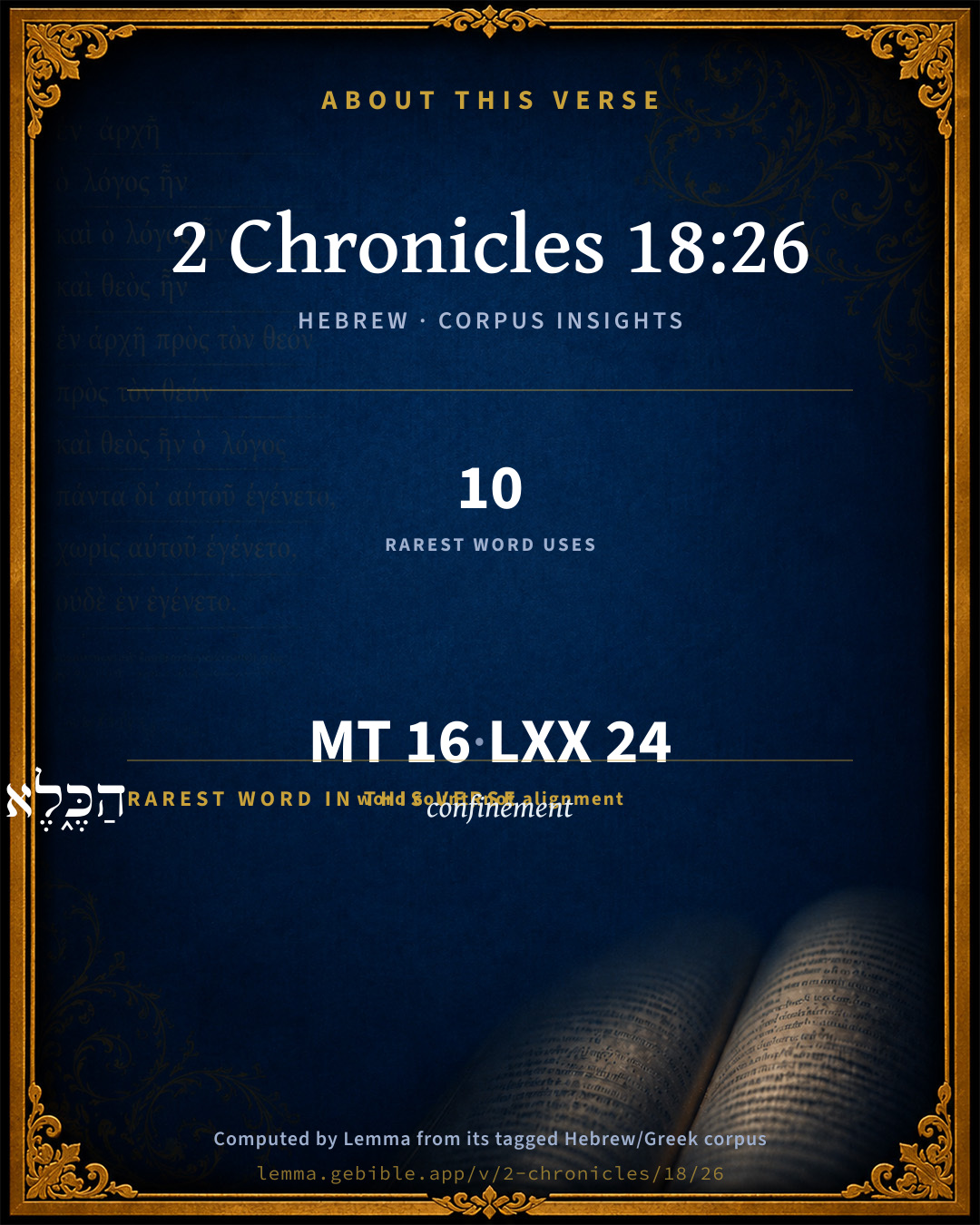
About this verse

These counts appear in no published source. They are computed here, from the morphology-tagged text and Lemma’s own curated glosses. What Lemma adds →

16
words
14
distinct lemmas
Historical
section

Notable vocabulary

The rarest word here is הַכֶּ֑לֶא confinement H3608 — appearing just 10 times in the whole Hebrew Bible.

Shared distinctive vocabulary

הַכֶּ֑לֶא confinement H3608 occurs in 10 verses of the Hebrew Bible. Also found in:

Grammatical profile

  • 5 verbs
  • 8 nouns
  • 1 pronoun
  • 1 preposition
  • 1 adverb

Verb forms

  • וַאֲמַרְתֶּ֗ם Qal · Sequential Perfect
  • אָמַ֣ר Qal · Perfect
  • שִׂ֥ימוּ Qal · Imperative
  • וְהַאֲכִלֻ֜הוּ Hiphil · Imperative
  • שׁוּבִ֥י Qal · Infinitive Construct

Repetition

Words recur within this verse — often emphatic in Hebrew:

  • וַאֲמַרְתֶּ֗ם to say H559 ×2
  • לַ֨חַץ֙ oppression H3906 ×2

Hebrew & Septuagint length

In English translation the verse runs 29 words from the Hebrew and 34 from the Septuagint (LXX English) — closely comparable.

A rough comparison of the two English renderings, which tokenize alike — not a word-level alignment.

Word counts can differ between the Hebrew and the Greek without any difference in meaning — e.g. the Hebrew direct-object marker אֵת has no separate Greek word, and Greek often adds the article ὁ.

In the original languages it is 16 Hebrew tokens and 24 Greek tokens — but the two are counted differently (Hebrew bundles its prefixes and suffixes into one token; the Greek is in lemma form), so that isn’t a like-for-like length.

Cross-references

20

Topical passages linked to 2 Chronicles 18:26 in the Treasury of Scripture Knowledge — connected by theme and wording, ordered by reader-vote popularity; previews shown in the World English Bible.

  • 2 Chronicles 16:10 Then Asa was angry with the seer, and put him in the prison-house; for he was in a rage with him because of this thing. Asa oppressed some of the people at the same time.
  • Deuteronomy 29:19 and it happen, when he hears the words of this curse, that he bless himself in his heart, saying, I shall have peace, though I walk in the stubbornness of my heart, to destroy the moist with the dry.
  • 1 Samuel 25:21 Now David had said, Surely in vain have I kept all that this fellow has in the wilderness, so that nothing was missed of all that pertained to him: and he has returned me evil for good.
  • 1 Kings 22:26–28 The king of Israel said, Take Micaiah, and carry him back to Amon the governor of the city, and to Joash the king's son;
  • 2 Chronicles 18:15 The king said to him, How many times shall I adjure you that you speak to me nothing but the truth in the name of Yahweh?
  • Psalms 10:5 His ways are prosperous at all times; He is haughty, and your laws are far from his sight: As for all his adversaries, he sneers at them.
  • Psalms 80:5 You have fed them with the bread of tears, And given them tears to drink in large measure.
  • Psalms 102:9 For I have eaten ashes like bread, And mixed my drink with tears,
  • Proverbs 14:16 A wise man fears, and shuns evil, But the fool is hotheaded and reckless.
  • Isaiah 30:20 Though the Lord give you the bread of adversity and the water of affliction, yet shall not your teachers be hidden anymore, but your eyes shall see your teachers;
  • Jeremiah 20:2–3 Then Pashhur struck Jeremiah the prophet, and put him in the stocks that were in the upper gate of Benjamin, which was in the house of Yahweh.
  • Matthew 5:12 Rejoice, and be exceedingly glad, for great is your reward in heaven. For that is how they persecuted the prophets who were before you.
  • Matthew 12:24 But when the Pharisees heard it, they said, "This man does not cast out demons, except by Beelzebul, the prince of the demons."
  • Luke 3:19–20 but Herod the tetrarch, being reproved by him for Herodias, his brother's wife, and for all the evil things which Herod had done,
  • Luke 23:2 They began to accuse him, saying, "We found this man perverting the nation, forbidding paying taxes to Caesar, and saying that he himself is Christ, a king."
  • Acts 5:18 and laid hands on the apostles, and put them in public custody.
  • Acts 22:22 They listened to him until he said that; then they lifted up their voice, and said, "Rid the earth of this fellow, for he isn't fit to live!"
  • 2 Corinthians 11:23 Are they servants of Christ? (I speak as one beside himself) I am more so; in labors more abundantly, in prisons more abundantly, in stripes above measure, in deaths often.
  • 1 Thessalonians 5:2–3 For you yourselves know well that the day of the Lord comes like a thief in the night.
  • Revelation 11:10 Those who dwell on the earth rejoice over them, and they will be glad. They will give gifts to one another, because these two prophets tormented those who dwell on the earth.

Cross-references courtesy of OpenBible.info (CC BY 4.0).

Hebrew and Greek witnesses Masoretic Hebrew ↔ Greek Septuagint

The same verse in the two great witnesses to the Old Testament, shown verse-for-verse.

These are two independent witnesses, not word-aligned to each other, and the Septuagint is shown in lemma (dictionary) form.

Hebrew 2 Chronicles 18:26 Masoretic · Westminster Leningrad Codex

וַאֲמַרְתֶּ֗ם כֹּ֚ה אָמַ֣ר הַמֶּ֔לֶךְ שִׂ֥ימוּ זֶ֖ה בֵּ֣ית הַכֶּ֑לֶא וְהַאֲכִלֻ֜הוּ לֶ֤חֶם לַ֨חַץ֙ וּמַ֣יִם לַ֔חַץ עַ֖ד שׁוּבִ֥י בְשָׁלֽוֹם

and say, Thus says the king, Put this fellow in the prison, and feed him with bread of affliction and with water of affliction, until I return in peace.

World English Bible · Public Domain

Greek LXX 2 Chronicles 18:26 Septuagint · lemma form

καί εἶπον οὕτως εἶπον ὁ βασιλεύς ἀποτίθημι οὗτος εἰς οἶκος φυλακή καί ἐσθίω ἄρτος θλῖψις καί ὕδωρ θλῖψις ἕως ὁ ἐπιστρέφω ἐγώ ἐν εἰρήνη

and you⌃ shall say, Thus said the king, Put this fellow into the prison house, and let him eat the bread of affliction, and drink the water of affliction, until I return in peace.

LXX2012 (modern English Septuagint) · Public Domain

Hebrew: Westminster Leningrad Codex (CC BY 4.0). Greek: Septuagint (public domain); English from LXX2012 (modern English Septuagint) (Public Domain). How the Septuagint differs from the Hebrew →

Commentary

Notes on 2 Chronicles 18:26 from classic Christian and Jewish commentators (each source and its license shown beneath its notes). The classic Christian expositions comment on the surrounding passage and are grouped to its opening verse, so a note may address several verses; the Jewish commentaries on the Tanakh (Rashi and others) are per-verse, so they appear only where the commentator wrote on this verse.

Lemma curates 59 commentaries, every one of them public domain or Creative Commons licensed, each selected and text-cleaned for this edition rather than reprinted as found. About our sources →

Geneva Bible (1599)

Geneva Bible translators

Keep him straitly in prison, and let him feel hunger and thirst.

Geneva Bible (1599) marginal notes — public domain. Text via Bolls.life.

Ellicott's Commentary for English Readers

(26) Bread of affliction, and with water of affliction.—In the Hebrew the second word (làhats) is not a genitive but an accusative, “bread with stint,” “water with stint.” Literally, squeezing. Vulg., “panis modicum et aquae pauxillum.” Syriac, “bread (enough) to keep life, and water (enough) to keep life.” (Comp. Isa_30:20.)

Until I return.—A correction of until I come (Kings).

A Bible Commentary for English Readers, edited by Charles John Ellicott (1878–1897) — public domain. Text from a community e-Sword module.

The Cambridge Bible for Schools and Colleges

gen. ed. J. J. S. Perowne

26. bread of affliction … water of affliction] Cp. Eze_4:9-11.

The Cambridge Bible for Schools and Colleges (gen. ed. J. J. S. Perowne; Cambridge University Press, 1878–1918) — public domain. Text from a community e-Sword module.

The Pulpit Commentary

verse and the parallel, this latter using the sign of the objective case (which in this instance would probably lend some contemptuousness of expression), and using the word "come" instead of return.

The Pulpit Commentary (1880–1919), ed. H.D.M. Spence-Jones & Joseph S. Exell — public domain. Text from a community e-Sword module.

John Wesley's Explanatory Notes

This fellow, &c. - How frequently has this been the lot of faithful ministers, to be hated and ill treated, merely for being true to God: and just and kind to the souls of men! But that day will declare who is in the right, and who is in the wrong, when Christ appears to the unspeakable consolation of the persecuted, and the everlasting confusion of their persecutors.

John Wesley, Explanatory Notes Upon the Whole Bible (1754–1765) — public domain. Text via the GEBible commentary corpus.

Rashi

Rabbi Shlomo Yitzchaki (Rashi)

Place this person in prison We did not see that he incarcerated him in prison previously, but since he says, “and return him,” you may say that he had placed him in prison beforehand. If, however, you wish to say that they had never placed him in prison prior to this, “and return him” should not cause you any difficulty, because this is the style of the Scriptures, like (Ps. 9:18): “May the wicked return to the grave,” and many similar other cases.

a scant amount of bread, etc. An example of this is (Isa. 30: 20): “scant bread and water of oppression.”

Rashi on the Tanakh — English translations: “The Judaica Press complete Tanach with Rashi, translated by A. J. Rosenberg” (CC BY 4.0); “Pentateuch with Rashi's commentary by M. Rosenbaum and A.M. Silbermann, 1929-1934” (public domain); “The Metsudah Tanach series, Lakewood, N.J” (CC BY 4.0); and “The Book of Joshua, Metsudah Publications, 1997” (CC BY 4.0). Text via Sefaria.

Lesson kit

Teaching starters — assembled from the data on this page, not authored interpretation. Every prompt links to the verse data it draws on. Edit before teaching.

2 Chronicles, in the Historical, opens this verse with 16 words (14 distinct Hebrew lemmas). Its most distinctive word is keleʼ (“confinement”). A historical commentator’s framing appears above. Read the whole chapter for the surrounding context.

Discussion questions

  1. How does “confinement” (keleʼ) shape what this verse is saying?
  2. How does 1 Kings 22:27, which shares the word «confinement», read alongside this verse?
  3. What does the repetition of “to say” (2× in this one verse) do in this verse?
  4. These translations render this verse differently. What is at stake in choosing one wording over another?
  5. «וַאֲמַרְתֶּ֗ם» is a Qal Sequential Perfect verb. How does that grammatical form shape the action described?
  6. Compare how Geneva Bible (1599) and Ellicott's Commentary for English Readers read this verse. Where do they agree or differ?

Things to notice

Reading settings

Reading text

Shown beneath each verse's original-language words.

Old Testament
Old Testament edition

Read the OT as the Masoretic Hebrew (MT) or the Greek Septuagint (LXX).

English shown for the Greek Septuagint (in the Hebrew ↔ Greek comparison).

Comparing translations? Open the Compare panel on any verse page to stack up to four side by side.