Deuteronomy 10:18

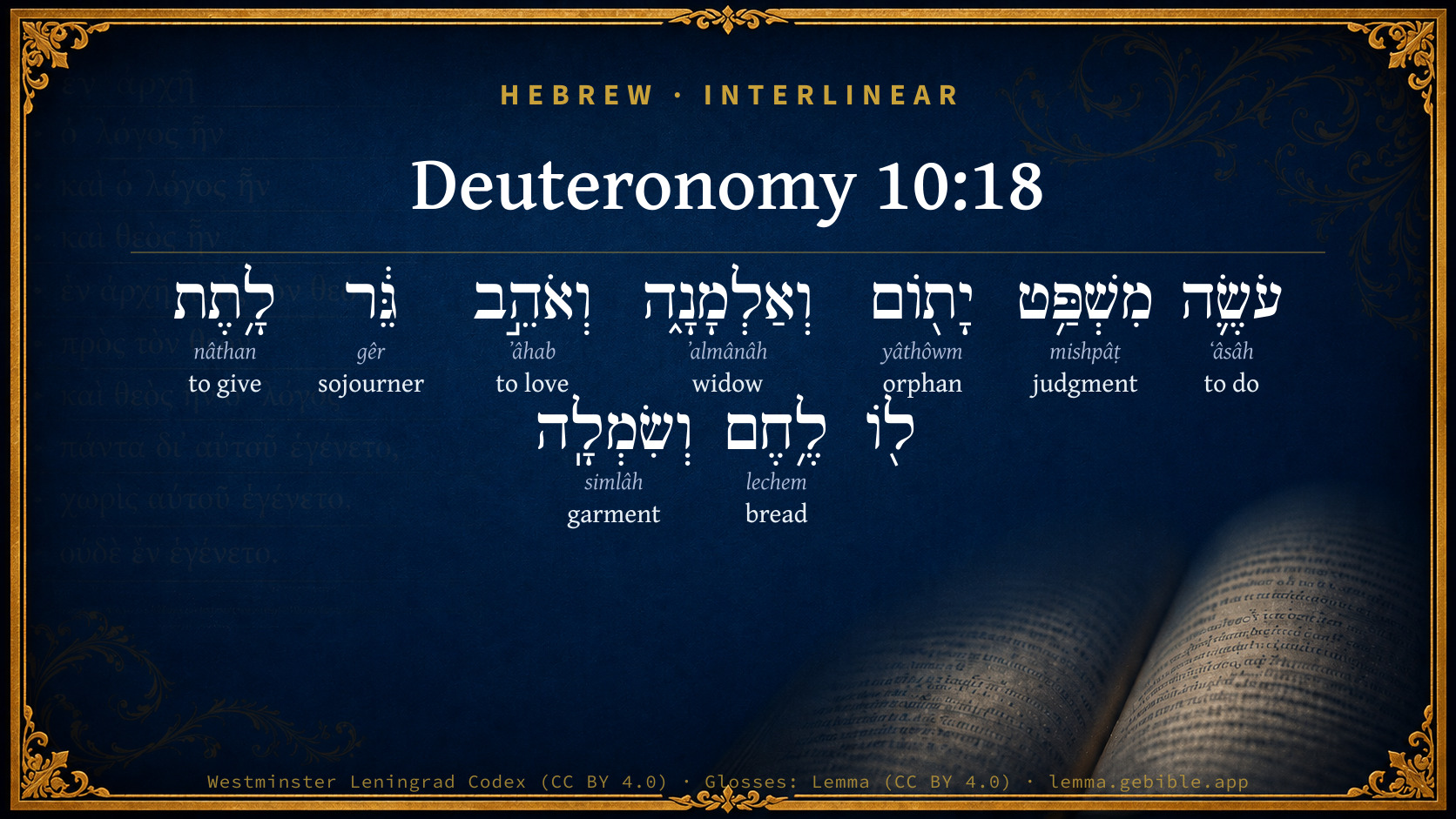
Hebrew (Westminster Leningrad Codex) Deuteronomy 10:18 appears in the Hebrew Old Testament. The text above is from the Westminster Leningrad Codex. Each word links to its Strong’s number, a concise gloss, and parsing drawn from the Open Scriptures Hebrew Bible morphology. Click any word for its full Brown-Driver-Briggs (BDB) entry.
Download image
Cite this verse

Deuteronomy 10:18 (World English Bible). Public Domain. Lemma interlinear Bible study tool, https://lemma.gebible.app/v/deuteronomy/10/18.

Show BibTeX & RIS
BibTeX
RIS
English Translation
He does execute justice for the fatherless and widow, and loves the foreigner, in giving him food and clothing.
World English Bible · Public Domain
Download a study sheet

One document with this verse’s original text, its word-by-word gloss line, the meaning frame, cross-references with their text, attributed commentary, and full source and license credits — printable, and it pastes into notes with its structure intact.

This verse Autodidact and up

Study sheet (.html) Plain text (.txt)

A passage Seminary Student

Up to 50 verses in one chapter. A passage sheet keeps up to 6 commentary sources and 12 cross-references per verse, in the order this page ranks them, and says so on the sheet whenever that leaves anything out. Ask for a single verse and you get the Autodidact verse sheet above.

Everything on this page stays free to read, with no account — the sheet is a download of what is already on screen, not access to it.

Want to remove ads? Support Godless Engineer
Compare translations 3

The same verse in 3 English versions, stacked beneath the original-language interlinear above. Click any original word for its lexicon entry.

Each is an independent rendering of the whole verse — the interlinear is not word-aligned to these translations.

Highlighted words mark where these versions differ — a whole-verse word diff, not a word-by-word alignment.

  • World English Bible Public Domain
    He does execute justice for the fatherless and widow, and loves the foreigner, in giving him food and clothing.
  • King James Version Public Domain
    He doth execute the judgment of the fatherless and widow, and loveth the stranger, in giving him food and raiment.
  • unfoldingWord Literal Text CC BY-SA 4.0
    He makes a judgment the fatherless and widow, and he loves a foreigner, giving to him bread and clothing.

unfoldingWord Literal Text — © unfoldingWord, licensed CC BY-SA 4.0. Word-aligned USFM3 via Door43 (git.door43.org/unfoldingWord/en_ult).

Versions to compare (up to 4)

3 of 4 selected

Show all 18 translations

Every available English version of this verse, each an independent rendering of the whole verse.

  • World English Bible Public Domain
    He does execute justice for the fatherless and widow, and loves the foreigner, in giving him food and clothing.
  • Berean Standard Bible Public Domain
    He executes justice for the fatherless and widow, and He loves the foreigner, giving him food and clothing.
  • Majority Standard Bible Public Domain
    He executes justice for the fatherless and widow, and He loves the foreigner, giving him food and clothing.
  • King James Version Public Domain
    He doth execute the judgment of the fatherless and widow, and loveth the stranger, in giving him food and raiment.
  • American Standard Version (1901) Public Domain
    He doth execute justice for the fatherless and widow, and loveth the sojourner, in giving him food and raiment.
  • Revised Version (1885) Public Domain
    He doth execute the judgment of the fatherless and widow, and loveth the stranger, in giving him food and raiment.
  • Geneva Bible (1599) Public Domain
    Who doeth right vnto the fatherlesse and widowe, and loueth the stranger, giuing him foode and rayment.
  • Douay-Rheims (1899) Public Domain
    He doth judgment to the fatherless and the widow, loveth the stranger, and giveth him food and raiment.
  • Young's Literal Translation Public Domain
    He is doing the judgment of fatherless and widow, and loving the sojourner, to give to him bread and raiment.
  • Literal Standard Version CC BY-SA 4.0
    He is doing the judgment of fatherless and widow, and loving the sojourner, to give bread and raiment to him.
  • Unlocked Literal Bible CC BY-SA 4.0
    He executes justice for the fatherless and widow, and he shows love for the foreigner by giving him food and clothing.
  • unfoldingWord Literal Text CC BY-SA 4.0
    He makes a judgment the fatherless and widow, and he loves a foreigner, giving to him bread and clothing.
  • Darby Bible Public Domain
    who executeth the judgment of the fatherless and the widow, and loveth the stranger, to give him food and clothing.
  • World Messianic Bible Public Domain
    He executes justice for the fatherless and widow and loves the foreigner in giving him food and clothing.
  • Webster's Bible Public Domain
    He executeth the judgment of the fatherless and widow, and loveth the stranger, in giving him food and raiment.
  • Free Bible Version CC BY-SA 4.0
    He makes sure that orphans and widows receive justice, and he loves the foreigners, providing them with food and clothing.
  • Bible in Basic English Public Domain
    Judging uprightly in the cause of the widow and of the child who has no father, and giving food and clothing in his mercy to the man from a strange country.
  • JPS Tanakh (1917) Public Domain
    He doth execute justice for the fatherless and widow, and loveth the stranger, in giving him food and raiment.

Literal Standard Version (2020), Covenant Press — licensed CC BY-SA 4.0. Text via the HelloAO Bible API (eBible.org). Unlocked Literal Bible (unfoldingWord) — licensed CC BY-SA 4.0. Text via the HelloAO Bible API (eBible.org). unfoldingWord Literal Text — © unfoldingWord, licensed CC BY-SA 4.0. Word-aligned USFM3 via Door43 (git.door43.org/unfoldingWord/en_ult). Free Bible Version, Dr. Jonathan Gallagher — licensed CC BY-SA 4.0. Text via the HelloAO Bible API (eBible.org).

Word by word

More ways to search: Search by grammar → Find every occurrence → Compare this word →

Practice this passage: Drill this verse → Learn its vocabulary →

וְשִׂמְלָֽה
simlâh
H8071
“and · garment”
Conjunction + Noun, Common, Feminine, Singular, Absolute
Part of Speech
Conjunction + Noun
Type
Common
Gender
Feminine
Number
Singular
State
Absolute
Full BDB Definition

Origin: perhaps by permutation for the fem. of H5566 (through the idea of a cover assuming the shape of the object beneath)

TWOT: 2270a

wrapper, mantle, covering garment, garments, clothes, raiment, a cloth
  1. עֹשֶׂ֛ה ʻâsâh H6213 “doing” Verb, Qal, Participle Active, Masculine, Singular, Absolute
  2. מִשְׁפַּ֥ט mishpâṭ H4941 “judgment of” Noun, Common, Masculine, Singular, Construct
  3. יָת֖וֹם yâthôwm H3490 “orphan” Noun, Common, Masculine, Singular, Absolute
  4. וְאַלְמָנָ֑ה ʼalmânâh H490 “and · widow” Conjunction + Noun, Common, Feminine, Singular, Absolute
  5. וְאֹהֵ֣ב ʼâhab H157 “and · loving” Conjunction + Verb, Qal, Participle Active, Masculine, Singular, Absolute
  6. גֵּ֔ר gêr H1616 “sojourner” Noun, Common, Masculine, Singular, Absolute
  7. לָ֥תֶת nâthan H5414 “to give” Preposition + Verb, Qal, Infinitive Construct
  8. לֶ֥חֶם lechem H3899 “bread” Noun, Common, Both, Singular, Absolute

About this verse

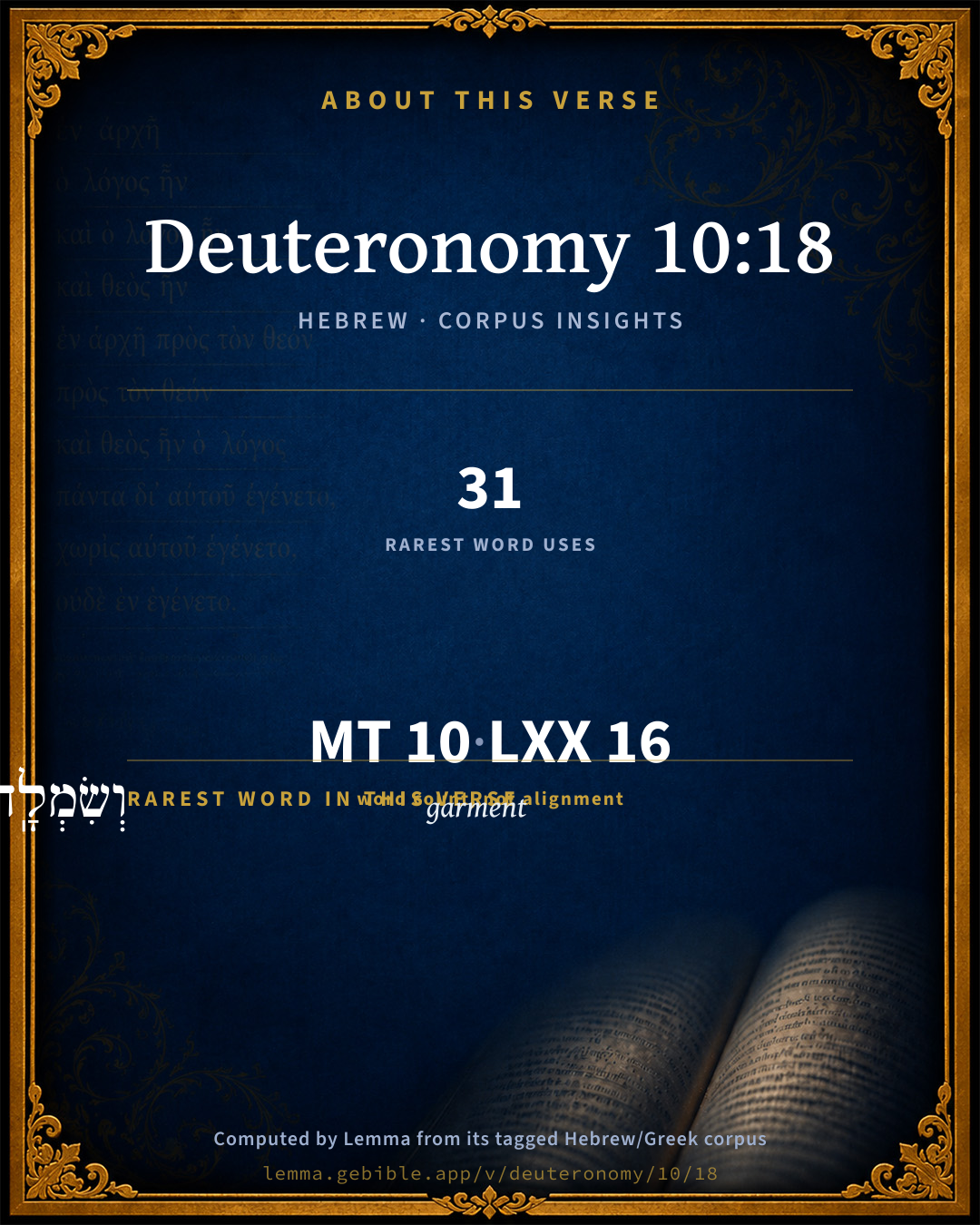
These counts appear in no published source. They are computed here, from the morphology-tagged text and Lemma’s own curated glosses. What Lemma adds →

10
words
9
distinct lemmas
Pentateuch
section

Shared distinctive vocabulary

וְשִׂמְלָֽה garment H8071 occurs in 28 verses of the Hebrew Bible. Also found in:

Grammatical profile

  • 3 verbs
  • 6 nouns
  • 1 preposition

Verb forms

  • עֹשֶׂ֛ה Qal · Participle Active
  • וְאֹהֵ֣ב Qal · Participle Active
  • לָ֥תֶת Qal · Infinitive Construct

Hebrew & Septuagint length

In English translation the verse runs 19 words from the Hebrew and 20 from the Septuagint (LXX English) — closely comparable.

A rough comparison of the two English renderings, which tokenize alike — not a word-level alignment.

Word counts can differ between the Hebrew and the Greek without any difference in meaning — e.g. the Hebrew direct-object marker אֵת has no separate Greek word, and Greek often adds the article ὁ.

In the original languages it is 10 Hebrew tokens and 16 Greek tokens — but the two are counted differently (Hebrew bundles its prefixes and suffixes into one token; the Greek is in lemma form), so that isn’t a like-for-like length.

Cross-references

10

Topical passages linked to Deuteronomy 10:18 in the Treasury of Scripture Knowledge — connected by theme and wording, ordered by reader-vote popularity; previews shown in the World English Bible.

  • Psalms 146:9 Yahweh preserves the foreigners. He upholds the fatherless and widow, But the way of the wicked he turns upside down.
  • Psalms 68:5 A father of the fatherless, and a defender of the widows, Is God in his holy habitation.
  • Jeremiah 49:11 Leave your fatherless children, I will preserve them alive; and let your widows trust in me.
  • Psalms 145:9 Yahweh is good to all. His tender mercies are over all his works.
  • Isaiah 1:17 Learn to do well. Seek justice, Relieve the oppressed, Judge the fatherless, Plead for the widow."
  • Psalms 103:6 Yahweh executes righteous acts, And justice for all who are oppressed.
  • Exodus 22:22 "You shall not take advantage of any widow or fatherless child.
  • Hosea 14:3 Assyria can't save us. We won't ride on horses; Neither will we say any more to the work of our hands, 'Our gods!' For in you the fatherless finds mercy."
  • Matthew 5:45 that you may be children of your Father who is in heaven. For he makes his sun to rise on the evil and the good, and sends rain on the just and the unjust.
  • Acts 14:17 Yet he didn't leave himself without witness, in that he did good and gave you rains from the sky and fruitful seasons, filling our hearts with food and gladness."

Cross-references courtesy of OpenBible.info (CC BY 4.0).

Hebrew and Greek witnesses Masoretic Hebrew ↔ Greek Septuagint

The same verse in the two great witnesses to the Old Testament, shown verse-for-verse.

These are two independent witnesses, not word-aligned to each other, and the Septuagint is shown in lemma (dictionary) form.

Hebrew Deuteronomy 10:18 Masoretic · Westminster Leningrad Codex

עֹשֶׂ֛ה מִשְׁפַּ֥ט יָת֖וֹם וְאַלְמָנָ֑ה וְאֹהֵ֣ב גֵּ֔ר לָ֥תֶת ל֖וֹ לֶ֥חֶם וְשִׂמְלָֽה

He does execute justice for the fatherless and widow, and loves the foreigner, in giving him food and clothing.

World English Bible · Public Domain

Greek LXX Deuteronomy 10:18 Septuagint · lemma form

ποιέω κρίσις προσήλυτος καί ὀρφανός καί χήρα καί ἀγαπάω ὁ προσήλυτος δίδωμι αὐτός ἄρτος καί ἱμάτιον

executing judgment for the stranger and orphan and widow, and he loves the stranger to give him food and raiment.

LXX2012 (modern English Septuagint) · Public Domain

Hebrew: Westminster Leningrad Codex (CC BY 4.0). Greek: Septuagint (public domain); English from LXX2012 (modern English Septuagint) (Public Domain). How the Septuagint differs from the Hebrew →

Targum (Aramaic paraphrase)

2

The Targum is the ancient Jewish Aramaic paraphrase of the Hebrew Scriptures — an interpretive translation, not the Hebrew text itself. Onkelos (literal) and Pseudo-Jonathan (expansive) render the Torah, and Jonathan the Prophets. Coverage is partial: where no permissively-licensed English translation exists for a verse, only the Aramaic is shown. This is verse-level text, not a word-by-word alignment to the Hebrew.

  1. Targum Onkelos Torah (Genesis–Deuteronomy)
    עָבֵד דִין יִתַּם וְאַרְמְלָא וְרָחֵם גִיוֹרָא לְמִתַּן לֵהּ מְזוֹנָא וּכְסוּ

    (no public-domain English translation for this verse)

    Targum Onkelos — Aramaic: “Onkelos Genesis” (public domain); “Onkelos Exodus” (public domain); “Onkelos Leviticus” (public domain); “Onkelos Numbers” (public domain); “Onkelos Deuteronomy” (public domain). English: “Sefaria Community Translation” (CC0 1.0 (public-domain dedication)); “J.W. Etheridge. The Targums of Onkelos and Jonathan Ben Uzziel on the Pentateuch. London: Longmans, Green, 1862” (public domain). Text via Sefaria.

  2. Targum Pseudo-Jonathan Torah (Genesis–Deuteronomy)
    עִבַּד דִּין יִיתָם וְאַרְמַלְתָּא וּרְחֵים גִּיוֹרָא לְמִתַּן לֵיהּ מָזוֹן וְאִסְטוֹלָא

    He doeth judgment for the orphan and widow, and hath compassion upon the stranger to give him food and raiment.

    Targum Pseudo-Jonathan — Aramaic: “Targum Jonathan on Genesis” (public domain); “Targum Jonathan on Exodus” (public domain); “Targum Jonathan on Leviticus” (public domain); “Targum Jonathan on Numbers” (public domain); “Targum Jonathan on Deuteronomy” (public domain). English: “The Targum of Jonathan ben Uzziel, trans. J. W. Etheridge, London, 1862” (public domain). Text via Sefaria.

Commentary

Notes on Deuteronomy 10:18 from classic Christian and Jewish commentators (each source and its license shown beneath its notes). The classic Christian expositions comment on the surrounding passage and are grouped to its opening verse, so a note may address several verses; the Jewish commentaries on the Tanakh (Rashi and others) are per-verse, so they appear only where the commentator wrote on this verse.

Lemma curates 59 commentaries, every one of them public domain or Creative Commons licensed, each selected and text-cleaned for this edition rather than reprinted as found. About our sources →

The Biblical Illustrator

Joseph S. Exell

Deu_10:12; Deu_10:18

What doth the Lord thy God require of thee.

The true life of man

The true life of man is the life of practical conformity to Divine claims. All is summed up and expressed here.

I. Loving reverence.

1. Fear of not acting worthily of the object of love.

2. Fear of offending the object of love.

II. Practical obedience.

1. God has ways, that is methods of action--

(1) In material nature. Acquaintance with these is what is called science.

(2) In moral mind. Acquaintance with these is the highest knowledge. Embodied in the life of Christ.

2. To walk in Gods ways is--

(1) The only righteous walk.

(2) The only secure walk.

(3) The only elevating walk.

III. Hearty service.

1. Perfect freedom.

2. Sunny cheerfulness.

3. Thorough completeness. All the powers fully employed. (Homilist.)

Educated towards spirituality

That was the Divine intention from the very beginning. God does not disclose His purpose all at once, but out of consideration for our capacities and our opportunities and our necessities He leads us one step at a time, as the wise teacher leads the young scholar. What wise teacher thrusts a whole library upon the dawning mind of childhood? A picture, a toy, a tempting prize, a handful to be going on with, and all the rest covered by a genial smile: so the young scholar passes from page to page until the genius of the revelation seizes him, and life becomes a sacred Pentecost. This thought supplies a standard by which to measure progress. What are we? To what have we attained? Are we still among the beggarly elements? Do we still cry out for a kind of teaching that is infantile and that ought to be from our age altogether profitless? Or do we sigh to see the finer lines and hear the lower tones and enter into the mystery of silent worship--so highly strung in all holy sensibilities that even a word jars upon us and is out of place under circumstances so charged with the Divine presence? Still keeping by this same line of thought, notice how the promises were adapted to the mental condition of Israel. What promises could Israel understand? Only promises of the most substantial kind. Moses addresses himself to this necessity with infinite skill (Deu_10:22; Deu_11:11-12). Still preserving the marvellous consistency of the whole economy, we cannot fail to notice how beautifully the sacrifices were adapted to the religious condition of the people. This explains the sacrifices indeed. What was the religious condition of the people? Hardly religious at all. It was an infantile condition; it was a condition in which appeal could only lie with effect along the line of vision. So God will institute a worship accordingly; He will say to Israel, Bring beasts in great numbers, and kill them upon the altar; take censers, put fire thereon; spare nothing of your herds and flocks and corn and wine; have a continual burnt offering, and add to the continual burnt offering other offerings great in number and in value. Israel must be kept busy; leisure will be destruction. There must be seven Sabbaths in the week, and seven of those seven must be specialised by fast or festival or sacred observance. Give Israel no time to rest. When he has brought one bullock, send him for another; when he has killed a ram, call for a thousand more; this will be instructive to him. We must weary him to a higher aspiration; to begin this aspiration would be to beat the air, or to speak an unknown language, or to propound a series of spiritual impossibilities. Men must be trained according to their capacity and their quality. The whole ceremonial system of Moses constitutes in itself--in its wisdom so rich, its marvellous adaptation to the character and temper of the times,--an unanswerable argument for the inspiration of the Bible. So far the line has been consistent from its beginning, what wonder, then, if it culminate in one splendid word? That word is introduced here and there. For example, in Deu_10:12, the word occurs; in Deu_11:1, it is repeated. What is that culminating word? How long it has been kept back! Now that it is set down we see it and acknowledge it; it comes at the right time, and is put in the right place:--To love Him. (J. Parker, D. D.)

Exhortation to serve the Lord

Who obeys this command? A part of my hearers obey it in some degree. They esteem God above every other object. They consider His glory as their highest interest, and communion with Him as their supreme happiness. It is their greatest grief that their treacherous hearts are so prone to wander from Him. Their most fervent desires pant after Him. And when in a favoured hour they find Him whom their soul loveth, they hold Him fast and will not let Him go. I have no reproaches for these. But are all such? Would to God all were. But there is no service without love. Love is the fulfilling of the law. Supreme love to God will certainly produce self-denial for His sake. It will habitually avoid everything which He has forbidden, and obey, not a part, but all He commands. Supreme love will seek communion with its object more than any worldly pleasure. It will pant after Him and after greater conformity to Him; it will seek His glory as the highest interest; it will renounce the world and idols and cultivate a heavenly mind. Unless we have that which will produce all these effects, we have no supreme love to God; and if we have no supreme love, we have no love at all; and if we have no love, as there is no neutral state, we are His enemies. It was God that made you what you are, and put you into a world which He had richly furnished for your use. Have you nothing to do with Him, or He with you? Do you imagine that He created you and raised you so much above the brutes, and put you into a world on which He had expended so much labour, that you might wander from Him in the regions of darkness? that you might seek your happiness out of Him, and live in rebellion against Him? that you might spend your life only in preparing to live in this transitory state? or that you might live only to eat and drink? As God is true, He sent you into His world for the same end that a master sends a servant into his vineyard--to labour for Him. He has sent you into the field abundantly furnished with powers and means to serve Him, and has strictly commanded you to use these talents in His service. Say not that He is too far above you to be apprehended. He has brought Himself down, and spread Himself out before you in His works and word, and it is only to unbelief that He is invisible. Having sent you into His vineyard, He looks after you to see whether you are faithful or not. Has He nothing to do with you? His eyes are upon you every moment--upon the very bottom of your heart. Did your Creator turn you loose into the world, to run wild in pursuit of your own imaginations, without law or restraint, intending to look no further after you, but to throw you out from His care? Woe to you if He had done this; though this, I fear, you have often wished. But He did no such thing. His intention was still to follow you with His care, as beloved creatures, whom His own hands had formed--to exercise government over you--to establish eternal communion with you--to lead your desires up to Him--to fill you with His own sublime happiness, and to make you a part of an harmonious, blessed, and glorious kingdom. To accomplish these ends He put you under law--a law admirably calculated to unite you to Him and to consummate your happiness. The unreasonable will complain of anything, and murmurs have filled the world because this law requires the heart. But were it otherwise--were God to relinquish His claims on the heart and compound for outward service only, would it be better then? Could they be happy here, could they be happy in heaven, without a holy heart? They had better never been born than be excused from loving God. Should God give up His law, still they are wretches to eternity without love to Him. The law enjoins nothing but what in the nature of things is essential to happiness. From this moment you must either renounce your Bible, or understand that God accounts you rebels for not loving and serving Him with all the heart and soul. He admits no excuse. Your plea that you cannot, is only pleading guilty. A heart that refuses to love the Creator and Redeemer of the world, is the very thing for which God condemns you--is the vilest rebel in the universe. (E. Griffin, D. D.)

Gods requirements

Gods exactions, if we be Christians, are our own free-will offerings. What God demands is what thankful hearts should gladly give.

1. First of all to fear Him. Not to be terrified, that is the natural mans religion. Unless taught of God men look upon Him with alarm. Hence religion is a sepulchral and gloomy thing to them. To the Christian all is reverse. He has no alarm; he courts Gods presence and feels that presence to be the inspiration of hope and joy.

2. Next to walk in all His ways. All the ways proceed from one source and terminate in the same again. There are varieties of expression, but one religion. A way of righteousness, a way of truth, a way of peace, and a way of pleasantness.

3. Then to love Him. If the fear enjoined were terror, it would be impossible to love. Love is the germ in the heart that blossoms and bursts into all the fragrant fruits demanded by Gods holy law. The law, like the imperious taskmaster, says, Give me fruit, and you cannot; but love softly, progressively, originates and develops all the fruits of the Spirit. The absence of this love is the absence of Christianity. This love, lost in the Fall, regained by the Cross, is the result of seeing Gods love for us. The measure and extent is all your hearts. Not cold, calculating preference; but warm, cordial attachment--attachment not blind and unintelligible, but with all the soul.

4. Also to serve Him, service in the sense of worship. The word liturgy strictly means service; here service means adore, pray, and praise; worship outwardly, publicly, and privately with all the heart. We learn the essence of all true acceptable worship before God. Not material glory, ritual splendour; but depth of sincerity, intensity of love, the supremacy of God in the heart.

5. What is the end of all this? First, God asks this, not for His benefit, but for our good. Is there no benefit in meeting together in the house of God, in unloading the thankful heart in praise? When you give the greatest glory, worship, and homage to God, the reaction of it is showers of blessings, mercies, and privileges upon yourselves. God requires this in His Word, in seasons of affliction and prosperity. He requires it that holy effects may be seen, and that men may feel that religion purifies. It is also good for the world. The best evidence that you are Christians is in what you feel, suffer, sacrifice, and do; not as servants obeying for reward, but as sons serving God out of affection. (J. Cumming, D. D.)

An imperative demand

Yea, and what does the Lord require of us?

1. Reverence--But to fear the Lord thy God.

2. Obedience To walk in all His ways. To go when He tells us, and to take the way He has prepared for us. Matthew Henry says, It ought to be the care of every one of us to follow the Lord fully. We must, in a course of obedience to Gods will, and service to His honour, follow Him universally, without dividing; uprightly, without dissembling; cheerfully, without disputing; and constantly, without declining: and this is following Him fully.

3. Love--And to love Him. This exhortation comes in beautifully to prevent the possibility of reverence becoming a terror, and obedience servility.

4. Service--And to serve the Lord thy God with all thy heart and with all thy soul. Conviction, principle, truth, sentiment, and emotion find their level in service, as the waters of the river do in the sea. Life, of every kind, is energy from within towards an outward object.

5. Diligence--To keep the commandments of the Lord and His statutes, which I command thee this day for thy good. (T. Davies.)

The Biblical Illustrator, edited by Joseph S. Exell (c. 1880s–1900s) — public domain. Text from a community e-Sword module.

Joseph Benson's Commentary

Deu 10:18. The judgment of the fatherless — He is so far from disregarding those who are unbefriended, that he regards them the more on that account, takes their case under his special cognizance, and is particularly displeased with those who injure and oppress them. Nay, he executes their judgment, pleads their cause, and maintains their right against their potent adversaries, and therefore he expects that you should do so too. Even the compassion which he has implanted in the human breast for the oppressed and destitute, and which is his voice to men, calling upon them to protect the orphan, to assist the widow, and to relieve the necessitous, is one evidence, among many others, that he espouses their cause.

Joseph Benson's Commentary on the Old and New Testaments (1811–1818) — public domain. Text from a community e-Sword module.

Tyndale Open Study Notes

Tyndale Open Resources

10:18 foreigners (literally sojourners): “A rabble of non-Israelites” (Exod 12:38) came out of Egypt with the Israelites, and others later took up residence in Israel for various reasons. Some of these non-Israelites had no intention of becoming part of the covenant nation, but other foreigners, while not citizens of Israel, were God-fearers or potential proselytes. They lacked full equality with the Israelites and thus were often victims of neglect and discrimination.

Tyndale Open Study Notes — © Tyndale Open Resources, licensed CC BY-SA 4.0. Text via the HelloAO Bible API.

Ellicott's Commentary for English Readers

(18) And loveth the stranger, in giving him food and raiment.—An inclusive expression. The whole substance of Jacob our father was included in the prayer for this. “If God will . . . give me bread to eat and raiment to put on” (Rashi).

A Bible Commentary for English Readers, edited by Charles John Ellicott (1878–1897) — public domain. Text from a community e-Sword module.

The Cambridge Bible for Schools and Colleges

gen. ed. J. J. S. Perowne

18. fatherless, widow, and stranger] i.e. the foreigner sojourning in Israel. See on Deu_24:17. The three are combined there and in Deu_24:19-21, also in Exo_22:21-22.

The Cambridge Bible for Schools and Colleges (gen. ed. J. J. S. Perowne; Cambridge University Press, 1878–1918) — public domain. Text from a community e-Sword module.

John Gill's Exposition

He doth execute the judgment of the fatherless and widow,.... Who have none to help them, and whose patron and defender he is, and will do them justice himself, and take care that it is done them by others, or avenge their injuries, for he is a Father of the fatherless, and a judge of the widow, in his holy habitation; Psa 68:5.

and loveth the stranger, in giving him food and raiment; one that is in a foreign country, at a distance from his native land, and destitute of friends; such God in his providence takes care of, and expresses his love and kindness to, by giving them the necessaries of life, food, and raiment.

John Gill's Exposition of the Whole Bible (1746–1763) — public domain (CC PDM 1.0). Text via the HelloAO Bible API.

Haydock's Catholic Bible Commentary

Widow. God resents the injuries done to such, Exodus xxii. 22.

George Leo Haydock (1774–1849), Haydock's Catholic Family Bible and Commentary, 1859 edition — public domain. Excludes Psalms (Douay-Rheims chapter numbering differs from Protestant) and Deuterocanonical books (Catholic canon only).

Matthew Poole's English Annotations

Execute the judgment, i.e. plead their cause, and give them right against their more potent adversaries, and therefore he expects you should do so too.

Matthew Poole's English Annotations on the Holy Bible (1683–1685) — public domain. Text from a community e-Sword/MySword module.

The Pulpit Commentary

Vers. 18, 19. As the impartial and incorruptible Judge, God executes the judgment of the fatherless and widow, vindicates the right of the defenseless; (Psa_68:6 Psa_146:9) and as the God of the whole earth, he loveth the stranger, helpless, and it may be oppressed, and giveth him food and raiment. Following him, Israel, as his people, were to be benevolent to the stranger, inasmuch as they themselves had been strangers in Egypt, and knew by experience what it was to be a stranger (cf. Exo_22:20; Lev_19:33, Lev_19:34) They were to love the stranger as God loves him, by relieving his necessities (cf. Jam_2:15, Jam_2:16)

The Pulpit Commentary (1880–1919), ed. H.D.M. Spence-Jones & Joseph S. Exell — public domain. Text from a community e-Sword module.

John Wesley's Explanatory Notes

He doth execute - That is, plead their cause, and give them right against their potent adversaries, and therefore he expects you should do so too.

John Wesley, Explanatory Notes Upon the Whole Bible (1754–1765) — public domain. Text via the GEBible commentary corpus.

Keil & Delitzsch

C. F. Keil & F. Delitzsch

As such, Jehovah does justice to the defenceless (orphan and widow), and exercises a loving care towards the stranger in his oppression. For this reason the Israelites were not to close their hearts egotistically against the stranger (cf. Exo 22:20). This would show whether they possessed any love to God, and had circumcised their hearts (cf. Jo1 3:10, Jo1 3:17).

Keil & Delitzsch — Biblical Commentary on the Old Testament (1861–1891) — public domain (CC PDM 1.0). Text via the HelloAO Bible API. (Old Testament only.)

unfoldingWord translationNotes

Door43 World Missions Community

General Information:

Moses continues speaking to the people of Israel.

He executes justice for the fatherless

"Yahweh makes sure that people treat the fatherless justly"

fatherless

These are children whose parents have both died and do not have relatives to care for them.

widow

A true widow is a woman whose husband has died and has no children to care for her in her old age.

Therefore

"Because of this"

translationWords

just

love

alien

Egypt

unfoldingWord translationNotes — © Distant Shores Media and the Door43 World Missions Community, licensed CC BY-SA 4.0. Source: git.door43.org/Door43/en_tn.

Rashi

Rabbi Shlomo Yitzchaki (Rashi)

עשה משפט יתום ואלמנה HE EXECUTETH JUDGMENT OF THE FATHERLESS AND THE WIDOW — You have mention of His power (in the preceding verse) and together with His power you find mention of His humility here (“He executeth judgment of the fatherless and the widow”) (Megillah 31a).

ואהב גר לתת לו לחם ושמלה AND HE LOVETH THE STRANGER IN GIVING HIM BREAD AND RAIMENT — and this (bread and raiment) is a matter of importance, for the very self of (all the energies of) Jacob, our ancestor, was to pray for this, (Genesis 28:20) “Let Him give me bread to eat and raiment to put on” (Genesis Rabbah 70:5).

Rashi on the Tanakh — English translations: “The Judaica Press complete Tanach with Rashi, translated by A. J. Rosenberg” (CC BY 4.0); “Pentateuch with Rashi's commentary by M. Rosenbaum and A.M. Silbermann, 1929-1934” (public domain); “The Metsudah Tanach series, Lakewood, N.J” (CC BY 4.0); and “The Book of Joshua, Metsudah Publications, 1997” (CC BY 4.0). Text via Sefaria.

Lesson kit

Teaching starters — assembled from the data on this page, not authored interpretation. Every prompt links to the verse data it draws on. Edit before teaching.

Deuteronomy, in the Pentateuch, opens this verse with 10 words (9 distinct Hebrew lemmas). Its most distinctive word is simlâh (“garment”). A historical commentator’s framing appears above. Read the whole chapter for the surrounding context.

Discussion questions

  1. The word simlâh carries the sense “garment.” How does it shape the verse?
  2. How does Genesis 9:23, which shares the word «garment», read alongside this verse?
  3. These translations render this verse differently; the difference is in the English rendering, not the original. What questions does that raise?
  4. «עֹשֶׂ֛ה» is a Qal Participle Active verb. How does that grammatical form shape the action described?
  5. Compare how The Biblical Illustrator and Joseph Benson's Commentary read this verse. Where do they agree or differ?

Things to notice

Reading settings

Reading text

Shown beneath each verse's original-language words.

Old Testament
Old Testament edition

Read the OT as the Masoretic Hebrew (MT) or the Greek Septuagint (LXX).

English shown for the Greek Septuagint (in the Hebrew ↔ Greek comparison).

Comparing translations? Open the Compare panel on any verse page to stack up to four side by side.