
1 Samuel 20:34

Hebrew (Westminster Leningrad Codex) 1 Samuel 20:34 appears in the Hebrew Old Testament. The text above is from the Westminster Leningrad Codex. Each word links to its Strong’s number, a concise gloss, and parsing drawn from the Open Scriptures Hebrew Bible morphology. Click any word for its full Brown-Driver-Briggs (BDB) entry.
Download image
Cite this verse

1 Samuel 20:34 (World English Bible). Public Domain. Lemma interlinear Bible study tool, https://lemma.gebible.app/v/1-samuel/20/34.

Show BibTeX & RIS
BibTeX
RIS
English Translation
So Jonathan arose from the table in fierce anger, and ate no food the second day of the month; for he was grieved for David, because his father had done him shame.
World English Bible · Public Domain
Download a study sheet

One document with this verse’s original text, its word-by-word gloss line, the meaning frame, cross-references with their text, attributed commentary, and full source and license credits — printable, and it pastes into notes with its structure intact.

This verse Autodidact and up

Study sheet (.html) Plain text (.txt)

A passage Seminary Student

Up to 50 verses in one chapter. A passage sheet keeps up to 6 commentary sources and 12 cross-references per verse, in the order this page ranks them, and says so on the sheet whenever that leaves anything out. Ask for a single verse and you get the Autodidact verse sheet above.

Everything on this page stays free to read, with no account — the sheet is a download of what is already on screen, not access to it.

Want to remove ads? Support Godless Engineer
Compare translations 3

The same verse in 3 English versions, stacked beneath the original-language interlinear above. Click any original word for its lexicon entry.

Each is an independent rendering of the whole verse — the interlinear is not word-aligned to these translations.

Highlighted words mark where these versions differ — a whole-verse word diff, not a word-by-word alignment.

  • World English Bible Public Domain
    So Jonathan arose from the table in fierce anger, and ate no food the second day of the month; for he was grieved for David, because his father had done him shame.
  • King James Version Public Domain
    So Jonathan arose from the table in fierce anger, and did eat no meat the second day of the month: for he was grieved for David, because his father had done him shame.
  • unfoldingWord Literal Text CC BY-SA 4.0
    And Jonathan arose from the table with burning of nose. And he did not eat bread on the second day of the new moon, for he was grieved for David, because his father had dishonored him.

unfoldingWord Literal Text — © unfoldingWord, licensed CC BY-SA 4.0. Word-aligned USFM3 via Door43 (git.door43.org/unfoldingWord/en_ult).

Versions to compare (up to 4)

3 of 4 selected

Show all 18 translations

Every available English version of this verse, each an independent rendering of the whole verse.

  • World English Bible Public Domain
    So Jonathan arose from the table in fierce anger, and ate no food the second day of the month; for he was grieved for David, because his father had done him shame.
  • Berean Standard Bible Public Domain
    Jonathan got up from the table in fierce anger and did not eat any food that second day of the month, for he was grieved by his father’s shameful treatment of David.
  • Majority Standard Bible Public Domain
    Jonathan got up from the table in fierce anger and did not eat any food that second day of the month, for he was grieved by his father’s shameful treatment of David.
  • King James Version Public Domain
    So Jonathan arose from the table in fierce anger, and did eat no meat the second day of the month: for he was grieved for David, because his father had done him shame.
  • American Standard Version (1901) Public Domain
    So Jonathan arose from the table in fierce anger, and did eat no food the second day of the month; for he was grieved for David, because his father had done him shame.
  • Revised Version (1885) Public Domain
    So Jonathan arose from the table in fierce anger, and did eat no meat the second day of the month: for he was grieved for David, because his father had done him shame.
  • Geneva Bible (1599) Public Domain
    So Ionathan arose from the table in a great anger, and did eate no meate the seconde day of the moneth: for he was sorie for Dauid, and because his father had reuiled him.
  • Douay-Rheims (1899) Public Domain
    So Jonathan rose from the table in great anger, and did not eat bread on the second day after the new moon. For he was grieved for David, because his father had put him to confusion.
  • Young's Literal Translation Public Domain
    And Jonathan riseth from the table in the heat of anger, and hath not eaten food on the second day of the new moon, for he hath been grieved for David, for his father put him to shame.
  • Literal Standard Version CC BY-SA 4.0
    And Jonathan rises from the table in the heat of anger, and has not eaten food on the second day of the new moon, for he has been grieved for David, for his father put him to shame.
  • Unlocked Literal Bible CC BY-SA 4.0
    Jonathan got up from the table in fierce anger and ate no food the second day of the month, for he was grieved over David, because his father had dishonored him.
  • unfoldingWord Literal Text CC BY-SA 4.0
    And Jonathan arose from the table with burning of nose. And he did not eat bread on the second day of the new moon, for he was grieved for David, because his father had dishonored him.
  • Darby Bible Public Domain
    And Jonathan arose from the table in fierce anger, and ate no meat the second day of the new moon; for he was grieved for David, because his father had done him shame.
  • World Messianic Bible Public Domain
    So Jonathan arose from the table in fierce anger, and ate no food the second day of the month; for he was grieved for David, because his father had treated him shamefully.
  • Webster's Bible Public Domain
    So Jonathan arose from the table in fierce anger, and ate no food the second day of the month: for he was grieved for David, because his father had done him shame.
  • Free Bible Version CC BY-SA 4.0
    Jonathan left the table absolutely furious. He would not eat anything on the second day of the festival, for he was so upset by the shameful way his father had treated David.
  • Bible in Basic English Public Domain
    So Jonathan got up from the table, burning with wrath, and took no part in the feast the second day of the month, being full of grief for David because his father had put shame on him.
  • JPS Tanakh (1917) Public Domain
    So Jonathan arose from the table in fierce anger, and did eat no food the second day of the month; for he was grieved for David, and because his father had put him to shame.

Literal Standard Version (2020), Covenant Press — licensed CC BY-SA 4.0. Text via the HelloAO Bible API (eBible.org). Unlocked Literal Bible (unfoldingWord) — licensed CC BY-SA 4.0. Text via the HelloAO Bible API (eBible.org). unfoldingWord Literal Text — © unfoldingWord, licensed CC BY-SA 4.0. Word-aligned USFM3 via Door43 (git.door43.org/unfoldingWord/en_ult). Free Bible Version, Dr. Jonathan Gallagher — licensed CC BY-SA 4.0. Text via the HelloAO Bible API (eBible.org).

Word by word

More ways to search: Search by grammar → Find every occurrence → Compare this word →

Practice this passage: Drill this verse → Learn its vocabulary →

בָּחֳרִי
chŏrîy
H2750
“in/at · heat of anger of”
Preposition + Noun, Common, Masculine, Singular, Construct
Part of Speech
Preposition + Noun
Type
Common
Gender
Masculine
Number
Singular
State
Construct
Full BDB Definition

Origin: from H2734

TWOT: 736b

heat (of anger), burning (of anger)
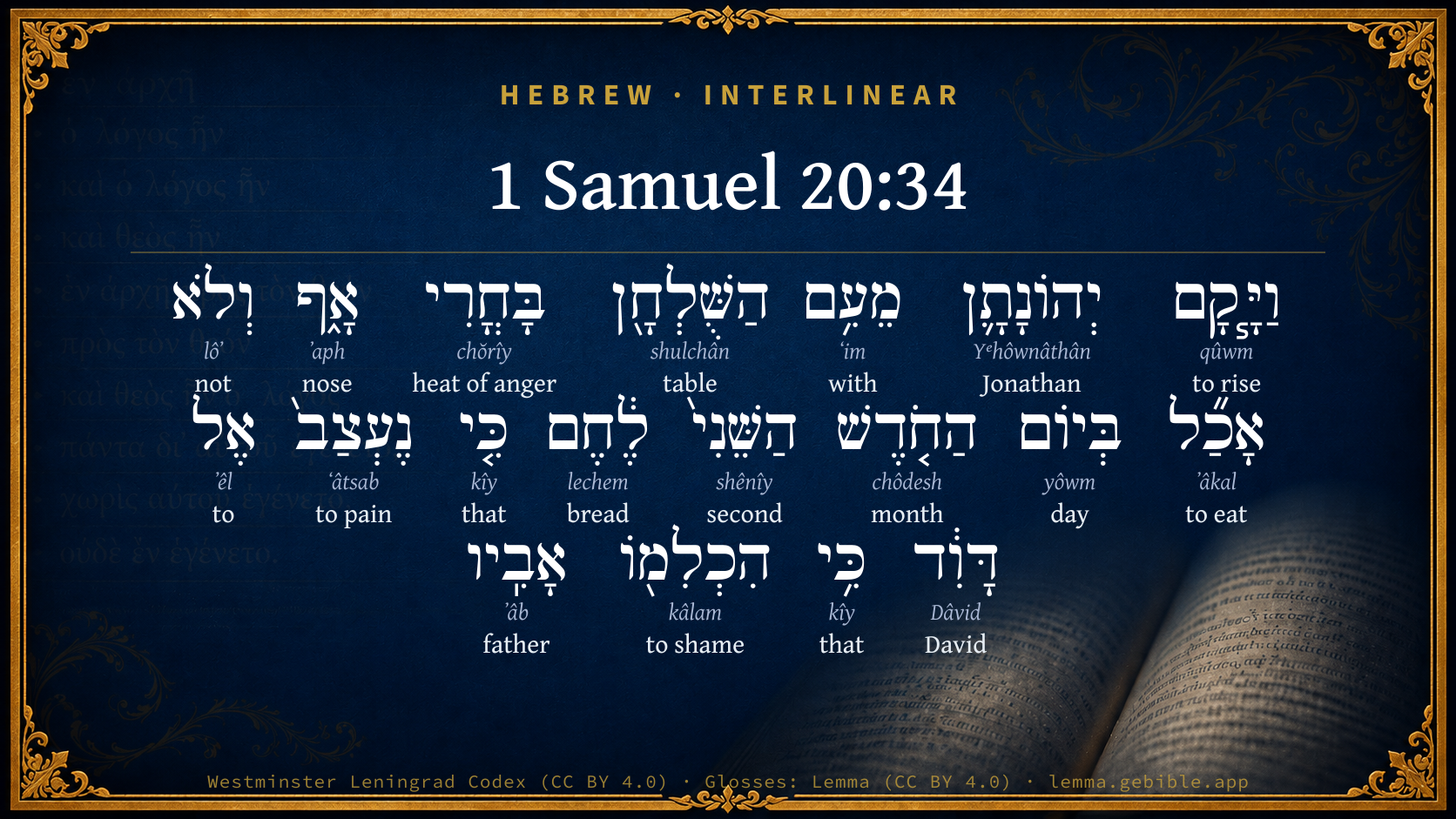
  1. וַיָּ֧קָם qûwm H6965 “and · to rise” Conjunction + Verb, Qal, Sequential Imperfect, 3rd Person, Masculine, Singular
  2. יְהוֹנָתָ֛ן Yᵉhôwnâthân H3083 “Jonathan” Noun, Proper
  3. מֵעִ֥ם ʻim H5973 “from · with” Preposition + Preposition
  4. הַשֻּׁלְחָ֖ן shulchân H7979 “the · table” Particle, Definite Article + Noun, Common, Masculine, Singular, Absolute
  5. אָ֑ף ʼaph H639 “nose” Noun, Common, Masculine, Singular, Absolute
  6. וְלֹא lôʼ H3808 “and · not” Conjunction + Particle, Negative
  7. אָכַ֞ל ʼâkal H398 “to eat” Verb, Qal, Perfect, 3rd Person, Masculine, Singular
  8. בְּיוֹם yôwm H3117 “in/at · day of” Preposition + Noun, Common, Masculine, Singular, Construct
  9. הַחֹ֤דֶשׁ chôdesh H2320 “the · month” Particle, Definite Article + Noun, Common, Masculine, Singular, Absolute
  10. הַשֵּׁנִי֙ shênîy H8145 “the · second” Particle, Definite Article + Adjective, Ordinal number, Masculine, Singular, Absolute
  11. לֶ֔חֶם lechem H3899 “bread” Noun, Common, Both, Singular, Absolute
  12. כִּ֤י kîy H3588 “that” Conjunction
  13. נֶעְצַב֙ ʻâtsab H6087 “to pain” Verb, Niphal, Perfect, 3rd Person, Masculine, Singular
  14. אֶל ʼêl H413 “to” Preposition
  15. דָּוִ֔ד Dâvid H1732 “David” Noun, Proper
  16. כִּ֥י kîy H3588 “that” Conjunction
  17. הִכְלִמ֖וֹ kâlam H3637 “to shame · him” Verb, Hiphil, Perfect, 3rd Person, Masculine, Singular + Suffix, Personal, 3rd Person, Masculine, Singular
  18. אָבִֽיו ʼâb H1 “father · his” Noun, Common, Masculine, Singular, Construct + Suffix, Personal, 3rd Person, Masculine, Singular

About this verse

These counts appear in no published source. They are computed here, from the morphology-tagged text and Lemma’s own curated glosses. What Lemma adds →

19
words
18
distinct lemmas
Historical
section

Notable vocabulary

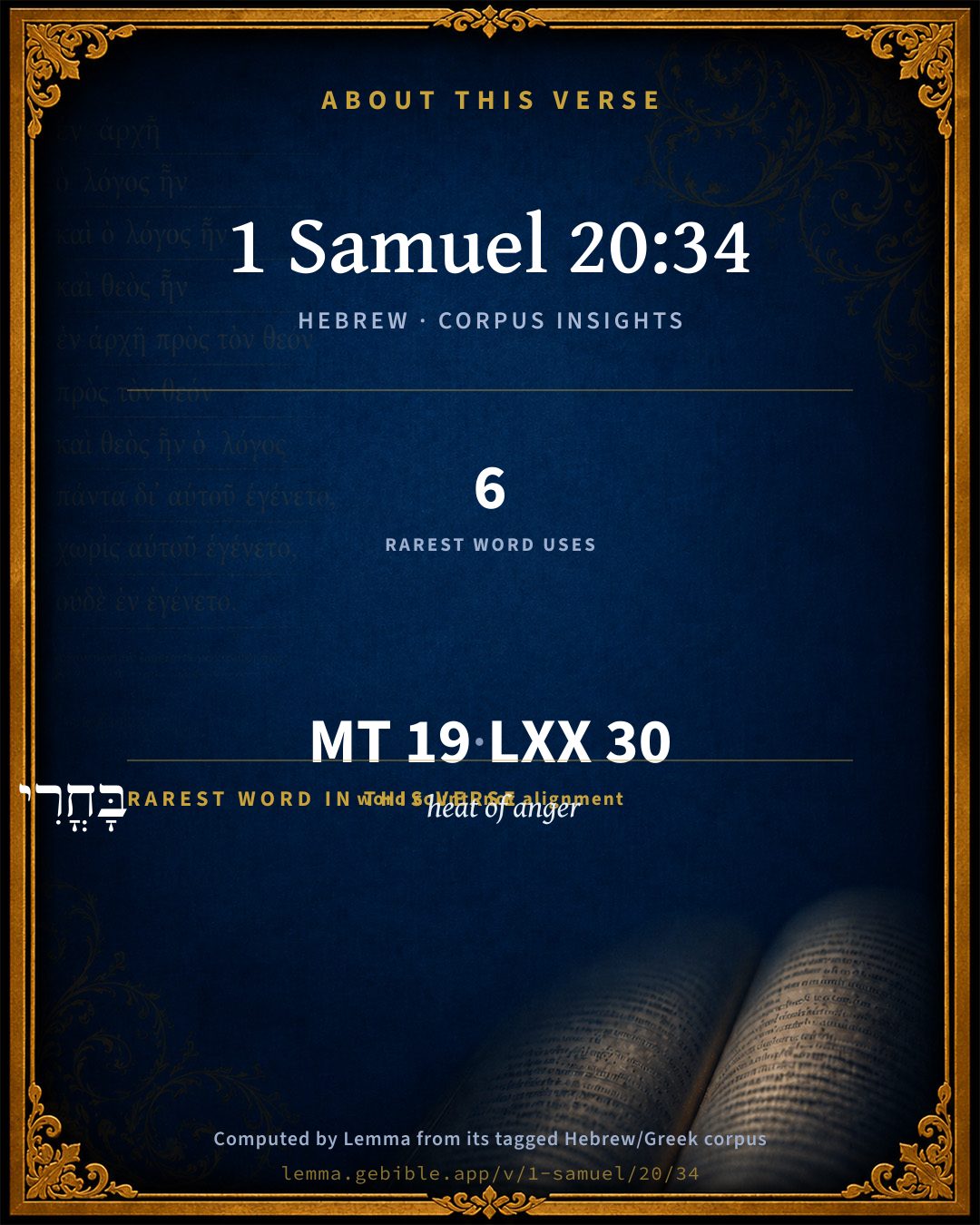
The rarest word here is בָּחֳרִי heat of anger H2750 — appearing just 6 times in the whole Hebrew Bible.

Shared distinctive vocabulary

בָּחֳרִי heat of anger H2750 occurs in 6 verses of the Hebrew Bible. Also found in:

Grammatical profile

  • 4 verbs
  • 9 nouns
  • 1 adjective
  • 2 prepositions
  • 2 conjunctions
  • 1 particle

Verb forms

  • וַיָּ֧קָם Qal · Sequential Imperfect
  • אָכַ֞ל Qal · Perfect
  • נֶעְצַב֙ Niphal · Perfect
  • הִכְלִמ֖וֹ Hiphil · Perfect

Repetition

A word recurs within this verse — often emphatic in Hebrew:

  • כִּ֤י that H3588 ×2

Hebrew & Septuagint length

In English translation the verse runs 32 words from the Hebrew and 36 from the Septuagint (LXX English) — closely comparable.

A rough comparison of the two English renderings, which tokenize alike — not a word-level alignment.

Word counts can differ between the Hebrew and the Greek without any difference in meaning — e.g. the Hebrew direct-object marker אֵת has no separate Greek word, and Greek often adds the article ὁ.

In the original languages it is 19 Hebrew tokens and 30 Greek tokens — but the two are counted differently (Hebrew bundles its prefixes and suffixes into one token; the Greek is in lemma form), so that isn’t a like-for-like length.

Cross-references

3

Topical passages linked to 1 Samuel 20:34 in the Treasury of Scripture Knowledge — connected by theme and wording, ordered by reader-vote popularity; previews shown in the World English Bible.

  • Ecclesiastes 7:20 Surely there is not a righteous man on earth, who does good and doesn't sin.
  • Mark 3:5 When he had looked around at them with anger, being grieved at the hardening of their hearts, he said to the man, "Stretch out your hand." He stretched it out, and his hand was restored as healthy as the other.
  • Ephesians 4:26 "Be angry, and don't sin." Don't let the sun go down on your wrath,

Cross-references courtesy of OpenBible.info (CC BY 4.0).

Hebrew and Greek witnesses Masoretic Hebrew ↔ Greek Septuagint

The same verse in the two great witnesses to the Old Testament, shown verse-for-verse.

These are two independent witnesses, not word-aligned to each other, and the Septuagint is shown in lemma (dictionary) form.

Hebrew 1 Samuel 20:34 Masoretic · Westminster Leningrad Codex

וַיָּ֧קָם יְהוֹנָתָ֛ן מֵעִ֥ם הַשֻּׁלְחָ֖ן בָּחֳרִי אָ֑ף וְלֹא אָכַ֞ל בְּיוֹם הַחֹ֤דֶשׁ הַשֵּׁנִי֙ לֶ֔חֶם כִּ֤י נֶעְצַב֙ אֶל דָּוִ֔ד כִּ֥י הִכְלִמ֖וֹ אָבִֽיו

So Jonathan arose from the table in fierce anger, and ate no food the second day of the month; for he was grieved for David, because his father had done him shame.

World English Bible · Public Domain

Greek LXX 1 Samuel 20:34 Septuagint · lemma form

καί ἀναπηδάω ιωναθαν ἀπό ὁ τράπεζα ἐν ὀργή θυμός καί οὐ ἐσθίω ἐν ὁ δεύτερος ὁ μήν ἄρτος ὅτι θραύω ἐπί ὁ δαυίδ ὅτι συντελέω ἐπί αὐτός ὁ πατήρ αὐτός

And Jonathan sprang up from the table in great anger, and did not eat bread on the second day of the month, for he grieved bitterly for David, because his father determined on mischief against him.

LXX2012 (modern English Septuagint) · Public Domain

On this verse, Haydock's Catholic Bible Commentary discusses the Septuagint’s reading. Read the note in Commentary ↓

Hebrew: Westminster Leningrad Codex (CC BY 4.0). Greek: Septuagint (public domain); English from LXX2012 (modern English Septuagint) (Public Domain). How the Septuagint differs from the Hebrew →

Targum (Aramaic paraphrase)

1

The Targum is the ancient Jewish Aramaic paraphrase of the Hebrew Scriptures — an interpretive translation, not the Hebrew text itself. Onkelos (literal) and Pseudo-Jonathan (expansive) render the Torah, and Jonathan the Prophets. Coverage is partial: where no permissively-licensed English translation exists for a verse, only the Aramaic is shown. This is verse-level text, not a word-by-word alignment to the Hebrew.

  1. Targum Jonathan Prophets (Joshua–Malachi)
    וְקַם יְהוֹנָתָן מֵעִם פְּתוֹרָא בִתְקֵיף רוּגְזָא וְלָא אֲכַל בְּיוֹם עִבּוּר יַרְחָא תִּנְיָנָא לַחְמָא אֲרֵי אִתְנְסִיס עַל דָוִד אֲרֵי אַכְלִימֵיהּ אֲבוּהִי:

    (no public-domain English translation for this verse)

    Targum Jonathan — Aramaic: “Mikraot Gedolot” (public domain). English: “Sefaria Community Translation” (CC0 1.0 (public-domain dedication)); “London "Chaldee Paraphrase," 1871” (public domain). Text via Sefaria.

Commentary

Notes on 1 Samuel 20:34 from classic Christian and Jewish commentators (each source and its license shown beneath its notes). The classic Christian expositions comment on the surrounding passage and are grouped to its opening verse, so a note may address several verses; the Jewish commentaries on the Tanakh (Rashi and others) are per-verse, so they appear only where the commentator wrote on this verse.

Lemma curates 59 commentaries, every one of them public domain or Creative Commons licensed, each selected and text-cleaned for this edition rather than reprinted as found. About our sources →

Trapp's Complete Commentary

John Trapp

1Sa 20:34 So Jonathan arose from the table in fierce anger, and did eat no meat the second day of the month: for he was grieved for David, because his father had done him shame.

Ver. 34. Because his father had done him shame.] Traducing him for a rebel and a traitor on so public a theatre. This went to good Jonathan’s heart, which bled in David’s wounds, and ached for his miseries.

John Trapp, A Commentary or Exposition upon All the Books of the Old and New Testament (1647–1656) — public domain. Text from a community e-Sword module.

The Biblical Illustrator

Joseph S. Exell

1Sa_20:34

And Jonathan arose from the table in fierce anger.

Jonathans moral courage

I propose to enquire into the moral meaning of this incident; to see whether there is anything in it that applies to our own circumstances. I think it impossible to read this story without having the mind arrested as several points of unusual interest.

I. Here is the saddest of all sights--man arrayed against man. Not man against a savage beast; but man against his own kind.

II. Here we have the rupture of the most sacred bonds. Who is it that is offended in this case? It is not a stranger; it is the son that rose in fierce anger, being grieved for David and ashamed of his own father. When fathers occupy their right positions, sons, in ninety-nine cases out of a hundred, will be likely to occupy theirs. A good example is never lost.

III. Here, too, is the assertion of the highest instinct. What is it that asserts itself in this case? It is the spirit of right. Men that get up from dinner tables and say, Not I am ashamed of your evil doing; and I will not taste your bread! We, poor hounds, tarry at the trough and satisfy our appetites, and slake our thirst, but the man that is going out will save the world!

IV. Here we have a disproof of a familiar proverb. The familiar proverb is, Blood is thicker than water. Jonathan says, Right is thicker than blood.

V. Here we have the espousal on a noble policy. What was the policy of Jonathan? He espoused the cause of right against might. David had no resources. (J. Parker, D. D.)

The Biblical Illustrator, edited by Joseph S. Exell (c. 1880s–1900s) — public domain. Text from a community e-Sword module.

Adam Clarke's Commentary

Verse 34. Jonathan arose - in fierce anger] We should probably understand this rather of Jonathan's grief than of his anger, the latter clause explaining the former: for he was grieved for David. He was grieved for his father-he was grieved for his friend.

Adam Clarke's Commentary on the Bible (1810–1826) — public domain. Text from a community e-Sword/MySword module.

Ellicott's Commentary for English Readers

(34) So Jonathan arose.—“In fierce anger,” so runs the too true record. The son of Saul left the presence, and appeared no more at that fatal feast. The hot anger was stirred up, first, no doubt, by the terrible insult offered him, the prince and heir to the throne, before the assembled great ones of Israel. The great spear uplifted to strike, following the harsh and bitter words spoken, was an act not likely soon to be forgotten by the spectators. And secondly, by the determined and relentless enmity of Saul against David, of whose stainless integrity and perfect loyalty Jonathan was firmly convinced. The bitter wrong done to David his friend no doubt affected Jonathan most.

A Bible Commentary for English Readers, edited by Charles John Ellicott (1878–1897) — public domain. Text from a community e-Sword module.

The Cambridge Bible for Schools and Colleges

gen. ed. J. J. S. Perowne

34. had done him shame] Saul had insulted and wronged David by publicly charging him with treasonable intentions (1Sa_20:31). “The generosity of Jonathan’s character is very apparent. He did not resent the injury and insult offered to himself so much as the wrong done to his friend.” Speaker’s Comm.

The Cambridge Bible for Schools and Colleges (gen. ed. J. J. S. Perowne; Cambridge University Press, 1878–1918) — public domain. Text from a community e-Sword module.

John Gill's Exposition

So Jonathan arose from the table in fierce anger,.... Resenting his father's attempt to smite him, and his resolution to slay David:

and did eat no meat the second day of the month; not then at that meal he was just sat down to, nor at another time that day, his stomach was so full through indignation at his father, and grief for his friend David; and besides, being a mourner on the above accounts, he might not eat of the sacrifices:

for he was grieved for David; that his death should be determined upon by his father, and he in so much danger of it; as also that he himself must be parted from and lose so dear a friend, which was one reason he ate no meat that day: and another follows:

because his father had done him shame; the copulative "and" being wanting; and this he did by calling him a perverse and rebellious son, and representing him as an arrant fool, and particularly by casting a javelin at him to smite him.

John Gill's Exposition of the Whole Bible (1746–1763) — public domain (CC PDM 1.0). Text via the HelloAO Bible API.

Haydock's Catholic Bible Commentary

Great. Literally, in the anger of fury." (Haydock) --- Him, either David or Jonathan. (Calmet) --- Indeed the crime of rebellion had been imputed to both. (Haydock) --- Jonathan was grieved on account of the affront and danger (Menochius) to which he had been publicly exposed, as well as for his friend, upon whose destruction he perceived that his father was now deliberately bent, and not merely during his fits of madness. --- Confusion. Septuagint, "because his father had completed his malice against him;" (Haydock) or, "had resolved to make an end of him." (Calmet)

George Leo Haydock (1774–1849), Haydock's Catholic Family Bible and Commentary, 1859 edition — public domain. Excludes Psalms (Douay-Rheims chapter numbering differs from Protestant) and Deuterocanonical books (Catholic canon only).

Matthew Poole's English Annotations

Or, and because; for this is a second cause of his grief. The conjunction and is ofttimes omitted, and to be supplied; as Psa 33:2; 144:9; Hab 3:11.

Matthew Poole's English Annotations on the Holy Bible (1683–1685) — public domain. Text from a community e-Sword/MySword module.

Rashi

Rabbi Shlomo Yitzchaki (Rashi)

He was saddened over Dovid. Concerning Dovid.

Because his father had humiliated him. Concerning Dovid.

Rashi on the Tanakh — English translations: “The Judaica Press complete Tanach with Rashi, translated by A. J. Rosenberg” (CC BY 4.0); “Pentateuch with Rashi's commentary by M. Rosenbaum and A.M. Silbermann, 1929-1934” (public domain); “The Metsudah Tanach series, Lakewood, N.J” (CC BY 4.0); and “The Book of Joshua, Metsudah Publications, 1997” (CC BY 4.0). Text via Sefaria.

Lesson kit

Teaching starters — assembled from the data on this page, not authored interpretation. Every prompt links to the verse data it draws on. Edit before teaching.

1 Samuel, in the Historical, opens this verse with 19 words (18 distinct Hebrew lemmas). Its most distinctive word is chŏrîy (“heat of anger”). A historical commentator’s framing appears above. Read the whole chapter for the surrounding context.

Discussion questions

  1. The word chŏrîy carries the sense “heat of anger.” How does it shape the verse?
  2. How does Exodus 11:8, which shares the word «heat of anger», read alongside this verse?
  3. What does the repetition of “that” (2× in this one verse) do in this verse?
  4. These translations render this verse differently. What is at stake in choosing one wording over another?
  5. «וַיָּ֧קָם» is a Qal Sequential Imperfect verb. How does that grammatical form shape the action described?
  6. Compare how Trapp's Complete Commentary and The Biblical Illustrator read this verse. Where do they agree or differ?

Things to notice

Reading settings

Reading text

Shown beneath each verse's original-language words.

Old Testament
Old Testament edition

Read the OT as the Masoretic Hebrew (MT) or the Greek Septuagint (LXX).

English shown for the Greek Septuagint (in the Hebrew ↔ Greek comparison).

Comparing translations? Open the Compare panel on any verse page to stack up to four side by side.