
Joshua 9:12

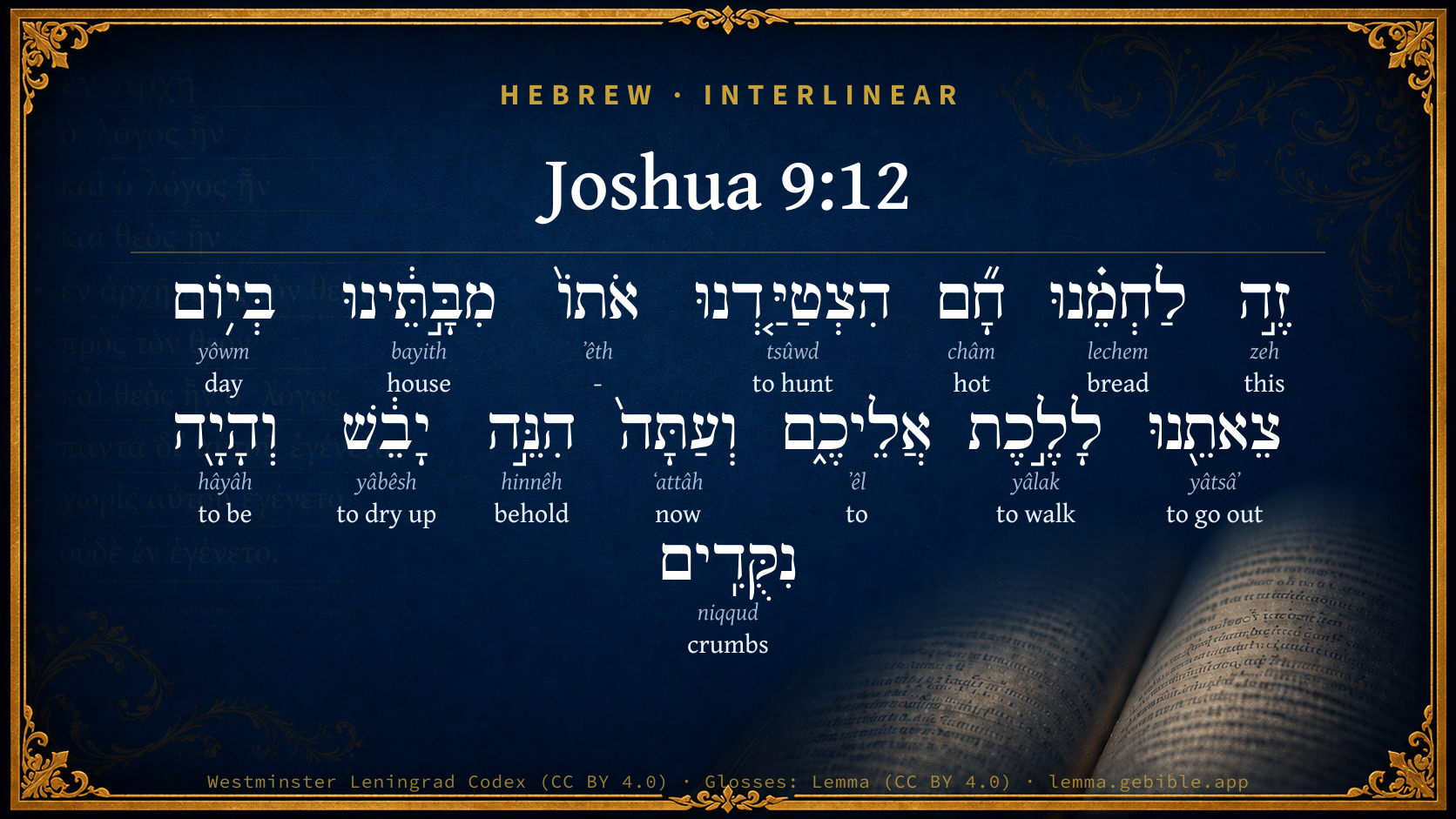
Hebrew (Westminster Leningrad Codex) Joshua 9:12 appears in the Hebrew Old Testament. The text above is from the Westminster Leningrad Codex. Each word links to its Strong’s number, a concise gloss, and parsing drawn from the Open Scriptures Hebrew Bible morphology. Click any word for its full Brown-Driver-Briggs (BDB) entry.
Download image
Cite this verse

Joshua 9:12 (World English Bible). Public Domain. Lemma interlinear Bible study tool, https://lemma.gebible.app/v/joshua/9/12.

Show BibTeX & RIS
BibTeX
RIS
English Translation
This our bread we took hot for our provision out of our houses on the day we came forth to go to you; but now, behold, it is dry, and is become moldy:
World English Bible · Public Domain
Highlights
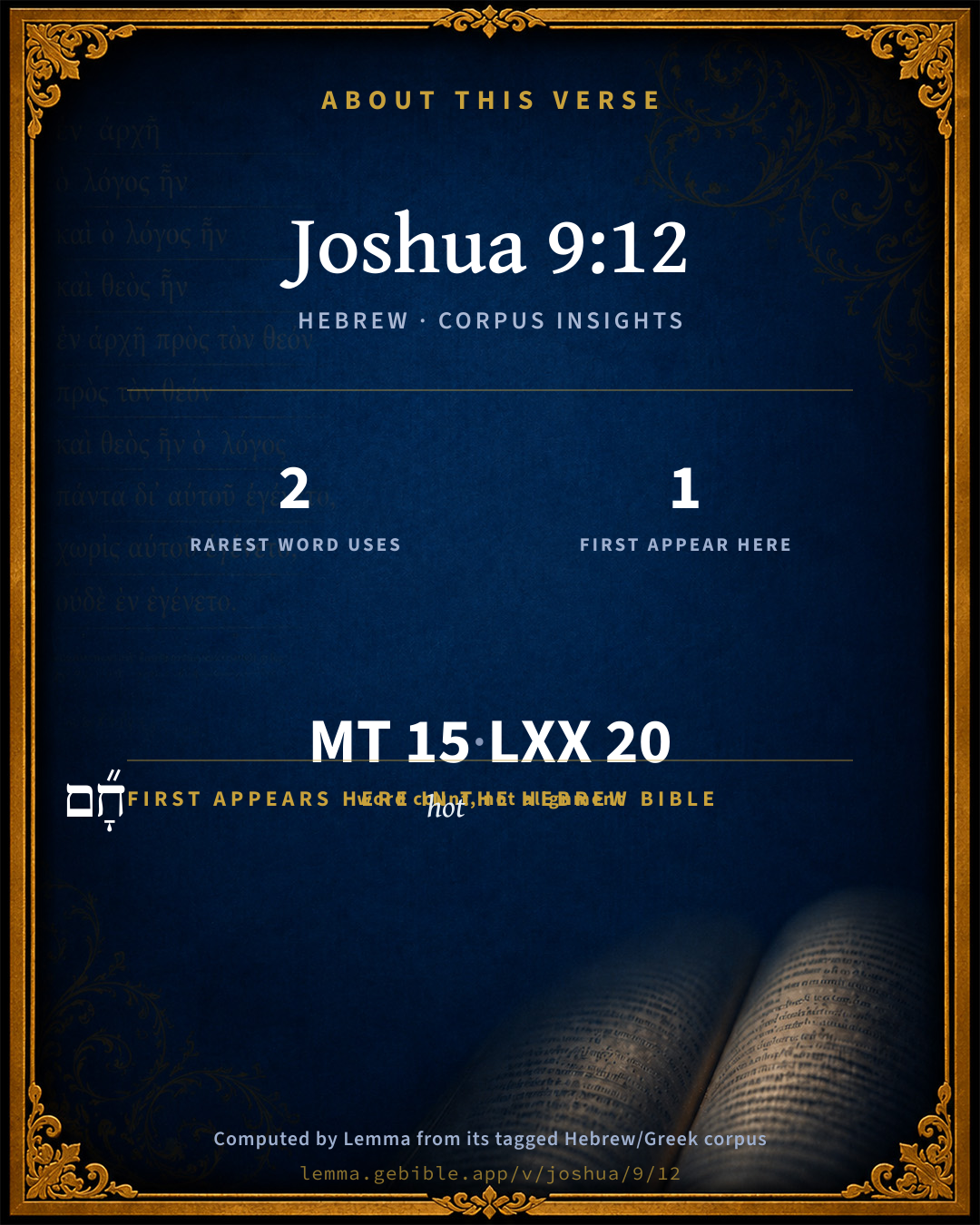
  • 1 first appearance in the Hebrew Bible
Full analysis ↓
Download a study sheet

One document with this verse’s original text, its word-by-word gloss line, the meaning frame, cross-references with their text, attributed commentary, and full source and license credits — printable, and it pastes into notes with its structure intact.

This verse Autodidact and up

Study sheet (.html) Plain text (.txt)

A passage Seminary Student

Up to 50 verses in one chapter. A passage sheet keeps up to 6 commentary sources and 12 cross-references per verse, in the order this page ranks them, and says so on the sheet whenever that leaves anything out. Ask for a single verse and you get the Autodidact verse sheet above.

Everything on this page stays free to read, with no account — the sheet is a download of what is already on screen, not access to it.

Want to remove ads? Support Godless Engineer
Compare translations 3

The same verse in 3 English versions, stacked beneath the original-language interlinear above. Click any original word for its lexicon entry.

Each is an independent rendering of the whole verse — the interlinear is not word-aligned to these translations.

Highlighted words mark where these versions differ — a whole-verse word diff, not a word-by-word alignment.

  • World English Bible Public Domain
    This our bread we took hot for our provision out of our houses on the day we came forth to go to you; but now, behold, it is dry, and is become moldy:
  • King James Version Public Domain
    This our bread we took hot for our provision out of our houses on the day we came forth to go unto you; but now, behold, it is dry, and it is mouldy:
  • unfoldingWord Literal Text CC BY-SA 4.0
    This bread of ours, we took it as provision hot from our houses on the day of our going out to come to you. And now, behold, it is dry and has become crumbs.

unfoldingWord Literal Text — © unfoldingWord, licensed CC BY-SA 4.0. Word-aligned USFM3 via Door43 (git.door43.org/unfoldingWord/en_ult).

Versions to compare (up to 4)

3 of 4 selected

Show all 18 translations

Every available English version of this verse, each an independent rendering of the whole verse.

  • World English Bible Public Domain
    This our bread we took hot for our provision out of our houses on the day we came forth to go to you; but now, behold, it is dry, and is become moldy:
  • Berean Standard Bible Public Domain
    This bread of ours was warm when we packed it at home on the day we left to come to you. But take a look, it is now dry and moldy.
  • Majority Standard Bible Public Domain
    This bread of ours was warm when we packed it at home on the day we left to come to you. But look, it is now dry and moldy.
  • King James Version Public Domain
    This our bread we took hot for our provision out of our houses on the day we came forth to go unto you; but now, behold, it is dry, and it is mouldy:
  • American Standard Version (1901) Public Domain
    This our bread we took hot for our provision out of our houses on the day we came forth to go unto you; but now, behold, it is dry, and is become mouldy:
  • Revised Version (1885) Public Domain
    This our bread we took hot for our provision out of our houses on the day we came forth to go unto you; but now, behold, it is dry, and is become mouldy:
  • Geneva Bible (1599) Public Domain
    This our bread we tooke it hote with vs for vittailes out of our houses, the day we departed to come vnto you: but nowe beholde, it is dried, and it is mouled.
  • Douay-Rheims (1899) Public Domain
    Behold, these leaves we took hot, when we set out from our houses to come to you, now they are become dry, and broken in pieces, by being exceeding old.
  • Young's Literal Translation Public Domain
    this our bread -- hot we provided ourselves with it out of our houses, on the day of our coming out to go unto you, and now, lo, it is dry, and hath been crumbs;
  • Literal Standard Version CC BY-SA 4.0
    this bread of ours—we provided ourselves with it hot out of our houses, on the day of our coming out to go to you, and now, behold, it is dry, and has been crumbs;
  • Unlocked Literal Bible CC BY-SA 4.0
    This is our bread, it was still warm when we took it from our houses on the day we set out to come to you. But now, see, it is dry and moldy.
  • unfoldingWord Literal Text CC BY-SA 4.0
    This bread of ours, we took it as provision hot from our houses on the day of our going out to come to you. And now, behold, it is dry and has become crumbs.
  • Darby Bible Public Domain
    This our bread we took warm for our provision out of our houses on the day we came forth to go unto you; and now, behold, it is dry, and is become mouldy.
  • World Messianic Bible Public Domain
    This our bread we took hot for our supplies out of our houses on the day we went out to go to you; but now, behold, it is dry, and has become moldy.
  • Webster's Bible Public Domain
    This our bread we took hot for our provision out of our houses on the day we came forth to go to you; but now, behold, it is dry, and it is moldy:
  • Free Bible Version CC BY-SA 4.0
    Look at this bread. It was warm when we took it from our houses on the day we set out to come here. But now it's dry and moldy, as you can see.
  • Bible in Basic English Public Domain
    This bread which we have with us for our food, we took warm and new from our houses when starting on our journey to you; but now see, it has become dry and broken up.
  • JPS Tanakh (1917) Public Domain
    This our bread we took hot for our provision out of our houses on the day we came forth to go unto you; but now, behold, it is dry, and is become crumbs.

Literal Standard Version (2020), Covenant Press — licensed CC BY-SA 4.0. Text via the HelloAO Bible API (eBible.org). Unlocked Literal Bible (unfoldingWord) — licensed CC BY-SA 4.0. Text via the HelloAO Bible API (eBible.org). unfoldingWord Literal Text — © unfoldingWord, licensed CC BY-SA 4.0. Word-aligned USFM3 via Door43 (git.door43.org/unfoldingWord/en_ult). Free Bible Version, Dr. Jonathan Gallagher — licensed CC BY-SA 4.0. Text via the HelloAO Bible API (eBible.org).

Word by word

More ways to search: Search by grammar → Find every occurrence → Compare this word →

Practice this passage: Drill this verse → Learn its vocabulary →

חָ֞ם
châm
H2525
“hot”
Adjective, Adjective, Masculine, Singular, Absolute
Part of Speech
Adjective
Type
Adjective
Gender
Masculine
Number
Singular
State
Absolute
Full BDB Definition

Origin: from H2552

TWOT: 677b

hot, warm
  1. זֶ֣ה zeh H2088 “this” Pronoun, Demonstrative, Masculine, Singular
  2. לַחְמֵ֗נוּ lechem H3899 “bread · our” Noun, Common, Both, Singular, Construct + Suffix, Personal, 1st Person, Common, Plural
  3. הִצְטַיַּ֤דְנוּ tsûwd H6679 “to hunt” Verb, Hithpael, Perfect, 1st Person, Common, Plural
  4. אֹתוֹ֙ ʼêth H853 “- · him” Particle, Direct Object + Suffix, Personal, 3rd Person, Masculine, Singular
  5. מִבָּ֣תֵּ֔ינוּ bayith H1004 “from · houses · our” Preposition + Noun, Common, Masculine, Plural, Construct + Suffix, Personal, 1st Person, Common, Plural
  6. בְּי֥וֹם yôwm H3117 “in/at · day of” Preposition + Noun, Common, Masculine, Singular, Construct
  7. צֵאתֵ֖נוּ yâtsâʼ H3318 “to go out · us” Verb, Qal, Infinitive Construct + Suffix, Personal, 1st Person, Common, Plural
  8. לָלֶ֣כֶת yâlak H3212 “to walk” Preposition + Verb, Qal, Infinitive Construct
  9. אֲלֵיכֶ֑ם ʼêl H413 “to · you” Preposition + Suffix, Personal, 2nd Person, Masculine, Singular
  10. וְעַתָּה֙ ʻattâh H6258 “and · now” Conjunction + Adverb
  11. הִנֵּ֣ה hinnêh H2009 “behold” Particle, Demonstrative
  12. יָבֵ֔שׁ yâbêsh H3001 “to dry up” Verb, Qal, Perfect, 3rd Person, Masculine, Singular
  13. וְהָיָ֖ה hâyâh H1961 “and · to be” Conjunction + Verb, Qal, Perfect, 3rd Person, Masculine, Singular
  14. נִקֻּדִֽים niqqud H5350 “crumbs” Noun, Common, Masculine, Plural, Absolute

About this verse

These counts appear in no published source. They are computed here, from the morphology-tagged text and Lemma’s own curated glosses. What Lemma adds →

15
words
15
distinct lemmas
Historical
section

Notable vocabulary

The rarest word here is חָ֞ם hot H2525 — appearing just 2 times in the whole Hebrew Bible.

First appearance in Scripture

This word makes its first canonical appearance in the Hebrew Bible here:

Shared distinctive vocabulary

חָ֞ם hot H2525 occurs in 2 verses of the Hebrew Bible. Also found in:

Grammatical profile

  • 5 verbs
  • 4 nouns
  • 1 adjective
  • 1 pronoun
  • 1 preposition
  • 1 adverb
  • 2 particles

Verb forms

  • הִצְטַיַּ֤דְנוּ Hithpael · Perfect
  • צֵאתֵ֖נוּ Qal · Infinitive Construct
  • לָלֶ֣כֶת Qal · Infinitive Construct
  • יָבֵ֔שׁ Qal · Perfect
  • וְהָיָ֖ה Qal · Perfect

Hebrew & Septuagint length

In English translation the verse runs 33 words from the Hebrew and 30 from the Septuagint (LXX English) — closely comparable.

A rough comparison of the two English renderings, which tokenize alike — not a word-level alignment.

Word counts can differ between the Hebrew and the Greek without any difference in meaning — e.g. the Hebrew direct-object marker אֵת has no separate Greek word, and Greek often adds the article ὁ.

In the original languages it is 15 Hebrew tokens and 20 Greek tokens — but the two are counted differently (Hebrew bundles its prefixes and suffixes into one token; the Greek is in lemma form), so that isn’t a like-for-like length.

Cross-references

1

Topical passages linked to Joshua 9:12 in the Treasury of Scripture Knowledge — connected by theme and wording, ordered by reader-vote popularity; previews shown in the World English Bible.

  • Joshua 9:4–5 they also resorted to a ruse, and went and made as if they had been ambassadors, and took old sacks on their donkeys, and wine-skins, old and torn and bound up,

Cross-references courtesy of OpenBible.info (CC BY 4.0).

Hebrew and Greek witnesses Masoretic Hebrew ↔ Greek Septuagint

The same verse in the two great witnesses to the Old Testament, shown verse-for-verse.

These are two independent witnesses, not word-aligned to each other, and the Septuagint is shown in lemma (dictionary) form.

Hebrew Joshua 9:12 Masoretic · Westminster Leningrad Codex

זֶ֣ה לַחְמֵ֗נוּ חָ֞ם הִצְטַיַּ֤דְנוּ אֹתוֹ֙ מִבָּ֣תֵּ֔ינוּ בְּי֥וֹם צֵאתֵ֖נוּ לָלֶ֣כֶת אֲלֵיכֶ֑ם וְעַתָּה֙ הִנֵּ֣ה יָבֵ֔שׁ וְהָיָ֖ה נִקֻּדִֽים

This our bread we took hot for our provision out of our houses on the day we came forth to go to you; but now, behold, it is dry, and is become moldy:

World English Bible · Public Domain

Greek LXX Joshua 9:12 Septuagint · lemma form

οὗτος ὁ ἄρτος θερμός ἐπιὀδιάζω αὐτός ἐν ὁ ἡμέρα ὅς ἐκἔρχομαι παραγίγνομαι πρός σύ νῦν δέ ξηραίνω καί γίγνομαι βιβρώσκω

These are the loaves—we took them hot for our journey on the day on which we came out to come to you; and now they are dried and become mouldy.

LXX2012 (modern English Septuagint) · Public Domain

Hebrew: Westminster Leningrad Codex (CC BY 4.0). Greek: Septuagint (public domain); English from LXX2012 (modern English Septuagint) (Public Domain). How the Septuagint differs from the Hebrew →

Targum (Aramaic paraphrase)

1

The Targum is the ancient Jewish Aramaic paraphrase of the Hebrew Scriptures — an interpretive translation, not the Hebrew text itself. Onkelos (literal) and Pseudo-Jonathan (expansive) render the Torah, and Jonathan the Prophets. Coverage is partial: where no permissively-licensed English translation exists for a verse, only the Aramaic is shown. This is verse-level text, not a word-by-word alignment to the Hebrew.

  1. Targum Jonathan Prophets (Joshua–Malachi)
    דֵין לַחְמָנָא כַּד חַמִים אִזְדְוָדְנָא יָתֵיהּ מִבָּתָּנָא בְּיוֹם מִפְקָנָא לְמֵיתֵי לְוַתְכוֹן וּכְעַן הָא יָבֵשׁ וַהֲוָה כִסְנִין:

    (no public-domain English translation for this verse)

    Targum Jonathan — Aramaic: “Mikraot Gedolot” (public domain). English: “Sefaria Community Translation” (CC0 1.0 (public-domain dedication)); “London "Chaldee Paraphrase," 1871” (public domain). Text via Sefaria.

Commentary

Notes on Joshua 9:12 from classic Christian and Jewish commentators (each source and its license shown beneath its notes). The classic Christian expositions comment on the surrounding passage and are grouped to its opening verse, so a note may address several verses; the Jewish commentaries on the Tanakh (Rashi and others) are per-verse, so they appear only where the commentator wrote on this verse.

Lemma curates 59 commentaries, every one of them public domain or Creative Commons licensed, each selected and text-cleaned for this edition rather than reprinted as found. About our sources →

Trapp's Complete Commentary

John Trapp

Jos 9:12 This our bread we took hot [for] our provision out of our houses on the day we came forth to go unto you; but now, behold, it is dry, and it is mouldy:

Ver. 12. This is our bread, &c.] See Jos 9:5-6; Jos 9:9.

John Trapp, A Commentary or Exposition upon All the Books of the Old and New Testament (1647–1656) — public domain. Text from a community e-Sword module.

Geneva Bible (1599)

Geneva Bible translators

The wicked lack no art, nor spare no lies to set forth their policy, when they will deceive the servants of God.

Geneva Bible (1599) marginal notes — public domain. Text via Bolls.life.

John Gill's Exposition

This our bread we took hot for our provision out of our houses,.... These are not the words of the elders to the messengers they sent, continued, but of the ambassadors to the Israelites, pointing to the bread they brought with them, which they pretended was newly baked and took hot out of the oven:

on the day we came forth to go unto you, but now, behold, it is dry,

and it is mouldy: See Gill on Jos 9:5; which they gave as a demonstration and proof that they were come from a far country, as they had asserted.

John Gill's Exposition of the Whole Bible (1746–1763) — public domain (CC PDM 1.0). Text via the HelloAO Bible API.

Whedon's Commentary on the Bible

Daniel D. Whedon

12. This our bread — To confirm their statements they exhibit their dry, crumbled bread, wine skins and apparel sadly the worse for wear, knowing well the influence which such ocular proofs have over the human mind.

Daniel D. Whedon (gen. ed.), Commentary on the Old and New Testaments (1874–1909) — public domain. Text from a community e-Sword module.

Rashi

Rabbi Shlomo Yitzchaki (Rashi)

We prepared. The word הִצְטַיַדְנוּ is from צֵדָה provision. When we took [the bread] as provisions for our journey.

Rashi on the Tanakh — English translations: “The Judaica Press complete Tanach with Rashi, translated by A. J. Rosenberg” (CC BY 4.0); “Pentateuch with Rashi's commentary by M. Rosenbaum and A.M. Silbermann, 1929-1934” (public domain); “The Metsudah Tanach series, Lakewood, N.J” (CC BY 4.0); and “The Book of Joshua, Metsudah Publications, 1997” (CC BY 4.0). Text via Sefaria.

Lesson kit

Teaching starters — assembled from the data on this page, not authored interpretation. Every prompt links to the verse data it draws on. Edit before teaching.

Joshua, in the Historical, opens this verse with 15 words (15 distinct Hebrew lemmas). Its most distinctive word is châm (“hot”). A historical commentator’s framing appears above. Read the whole chapter for the surrounding context.

Discussion questions

  1. What does “hot” (châm) contribute to the verse as a whole?
  2. The word “hot” first appears here in Scripture. What is being introduced at this debut?
  3. Job 37:17 shares the word «hot» with this verse. How do the two illuminate each other?
  4. These translations render this verse differently. What is at stake in choosing one wording over another?
  5. The verb «הִצְטַיַּ֤דְנוּ» is Hithpael Perfect. How does its form color the action?
  6. Reading how Trapp's Complete Commentary and Geneva Bible (1599) read this verse, where do the two commentators agree and where do they part?

Things to notice

Reading settings

Reading text

Shown beneath each verse's original-language words.

Old Testament
Old Testament edition

Read the OT as the Masoretic Hebrew (MT) or the Greek Septuagint (LXX).

English shown for the Greek Septuagint (in the Hebrew ↔ Greek comparison).

Comparing translations? Open the Compare panel on any verse page to stack up to four side by side.