
1 Samuel 30:12

Hebrew (Westminster Leningrad Codex) 1 Samuel 30:12 appears in the Hebrew Old Testament. The text above is from the Westminster Leningrad Codex. Each word links to its Strong’s number, a concise gloss, and parsing drawn from the Open Scriptures Hebrew Bible morphology. Click any word for its full Brown-Driver-Briggs (BDB) entry.
Download image
Cite this verse

1 Samuel 30:12 (World English Bible). Public Domain. Lemma interlinear Bible study tool, https://lemma.gebible.app/v/1-samuel/30/12.

Show BibTeX & RIS
BibTeX
RIS
English Translation
They gave him a piece of a cake of figs, and two clusters of raisins: and when he had eaten, his spirit came again to him; for he had eaten no bread, nor drunk any water, three days and three nights.
World English Bible · Public Domain
Download a study sheet

One document with this verse’s original text, its word-by-word gloss line, the meaning frame, cross-references with their text, attributed commentary, and full source and license credits — printable, and it pastes into notes with its structure intact.

This verse Autodidact and up

Study sheet (.html) Plain text (.txt)

A passage Seminary Student

Up to 50 verses in one chapter. A passage sheet keeps up to 6 commentary sources and 12 cross-references per verse, in the order this page ranks them, and says so on the sheet whenever that leaves anything out. Ask for a single verse and you get the Autodidact verse sheet above.

Everything on this page stays free to read, with no account — the sheet is a download of what is already on screen, not access to it.

Want to remove ads? Support Godless Engineer
Compare translations 3

The same verse in 3 English versions, stacked beneath the original-language interlinear above. Click any original word for its lexicon entry.

Each is an independent rendering of the whole verse — the interlinear is not word-aligned to these translations.

Highlighted words mark where these versions differ — a whole-verse word diff, not a word-by-word alignment.

  • World English Bible Public Domain
    They gave him a piece of a cake of figs, and two clusters of raisins: and when he had eaten, his spirit came again to him; for he had eaten no bread, nor drunk any water, three days and three nights.
  • King James Version Public Domain
    And they gave him a piece of a cake of figs, and two clusters of raisins: and when he had eaten, his spirit came again to him: for he had eaten no bread, nor drunk any water, three days and three nights.
  • unfoldingWord Literal Text CC BY-SA 4.0
    And they gave to him a piece of a fig cake and two raisin clusters, and he ate, and his spirit returned to him. For he had not eaten bread and had not drunk water three days and three nights.

unfoldingWord Literal Text — © unfoldingWord, licensed CC BY-SA 4.0. Word-aligned USFM3 via Door43 (git.door43.org/unfoldingWord/en_ult).

Versions to compare (up to 4)

3 of 4 selected

Show all 18 translations

Every available English version of this verse, each an independent rendering of the whole verse.

  • World English Bible Public Domain
    They gave him a piece of a cake of figs, and two clusters of raisins: and when he had eaten, his spirit came again to him; for he had eaten no bread, nor drunk any water, three days and three nights.
  • Berean Standard Bible Public Domain
    a piece of a fig cake and two clusters of raisins. So he ate and was revived, for he had not had any food or water for three days and three nights.
  • Majority Standard Bible Public Domain
    a piece of a fig cake and two clusters of raisins. So he ate and was revived, for he had not had any food or water for three days and three nights.
  • King James Version Public Domain
    And they gave him a piece of a cake of figs, and two clusters of raisins: and when he had eaten, his spirit came again to him: for he had eaten no bread, nor drunk any water, three days and three nights.
  • American Standard Version (1901) Public Domain
    And they gave him a piece of a cake of figs, and two clusters of raisins: and when he had eaten, his spirit came again to him; for he had eaten no bread, nor drunk any water, three days and three nights.
  • Revised Version (1885) Public Domain
    And they gave him a piece of a cake of figs, and two clusters of raisins; and when he had eaten, his spirit came again to him: for he had eaten no bread, nor drunk any water, three days and three nights.
  • Geneva Bible (1599) Public Domain
    Also they gaue him a fewe figges, and two clusters of raisins: and when he had eaten, his spirite came againe to him: for he had eaten no bread, nor drunke any water in three dayes, and three nightes.
  • Douay-Rheims (1899) Public Domain
    As also a piece of a cake of figs, and two bunches of raisins. And when he had eaten them his spirit returned, and he was refreshed: for he had not eaten bread, nor drunk water three days, and three nights.
  • Young's Literal Translation Public Domain
    and give to him a piece of a bunch of dried figs, and two bunches of raisins, and he eateth, and his spirit returneth unto him, for he hath not eaten bread nor drunk water three days and three nights.
  • Literal Standard Version CC BY-SA 4.0
    and give to him a piece of a bunch of dried figs, and two bunches of raisins, and he eats, and his spirit returns to him, for he has not eaten bread nor drunk water [for] three days and three nights.
  • Unlocked Literal Bible CC BY-SA 4.0
    and they gave him a piece of a cake of figs and two clusters of raisins. When he had eaten, he gained strength again, for he had eaten no bread nor drunk any water for three days and three nights.
  • unfoldingWord Literal Text CC BY-SA 4.0
    And they gave to him a piece of a fig cake and two raisin clusters, and he ate, and his spirit returned to him. For he had not eaten bread and had not drunk water three days and three nights.
  • Darby Bible Public Domain
    and gave him a piece of fig-cake and two raisin-cakes, and he ate, and his spirit came again to him; for he had eaten no bread, nor drunk any water, for three days and three nights.
  • World Messianic Bible Public Domain
    They gave him a piece of a cake of figs and two clusters of raisins. When he had eaten, his spirit came again to him; for he had eaten no bread, and drank no water for three days and three nights.
  • Webster's Bible Public Domain
    And they gave him a piece of a cake of figs, and two clusters of raisins: and when he had eaten, his spirit came again to him: for he had eaten no bread, nor drank any water, three days and three nights.
  • Free Bible Version CC BY-SA 4.0
    They also gave him a piece of a fig cake and two raisin cakes. He ate them and recovered, because he hadn't had any food or water for three days and nights.
  • Bible in Basic English Public Domain
    And they gave him part of a cake of figs and some dry grapes; and after the food, his spirit came back to him, for he had had no food or drink for three days and nights.
  • JPS Tanakh (1917) Public Domain
    and they gave him a piece of a cake of figs, and two clusters of raisins; and when he had eaten, his spirit came back to him; for he had eaten no bread, nor drunk any water, three days and three nights.

Literal Standard Version (2020), Covenant Press — licensed CC BY-SA 4.0. Text via the HelloAO Bible API (eBible.org). Unlocked Literal Bible (unfoldingWord) — licensed CC BY-SA 4.0. Text via the HelloAO Bible API (eBible.org). unfoldingWord Literal Text — © unfoldingWord, licensed CC BY-SA 4.0. Word-aligned USFM3 via Door43 (git.door43.org/unfoldingWord/en_ult). Free Bible Version, Dr. Jonathan Gallagher — licensed CC BY-SA 4.0. Text via the HelloAO Bible API (eBible.org).

Word by word

More ways to search: Search by grammar → Find every occurrence → Compare this word →

Practice this passage: Drill this verse → Learn its vocabulary →

צִמֻּקִים֙
tsammûwq
H6778
“bunches of raisins”
Noun, Common, Masculine, Plural, Absolute
Part of Speech
Noun
Type
Common
Gender
Masculine
Number
Plural
State
Absolute
Full BDB Definition

Origin: from H6784

TWOT: 1930a

bunch of raisins, raisin-bunch
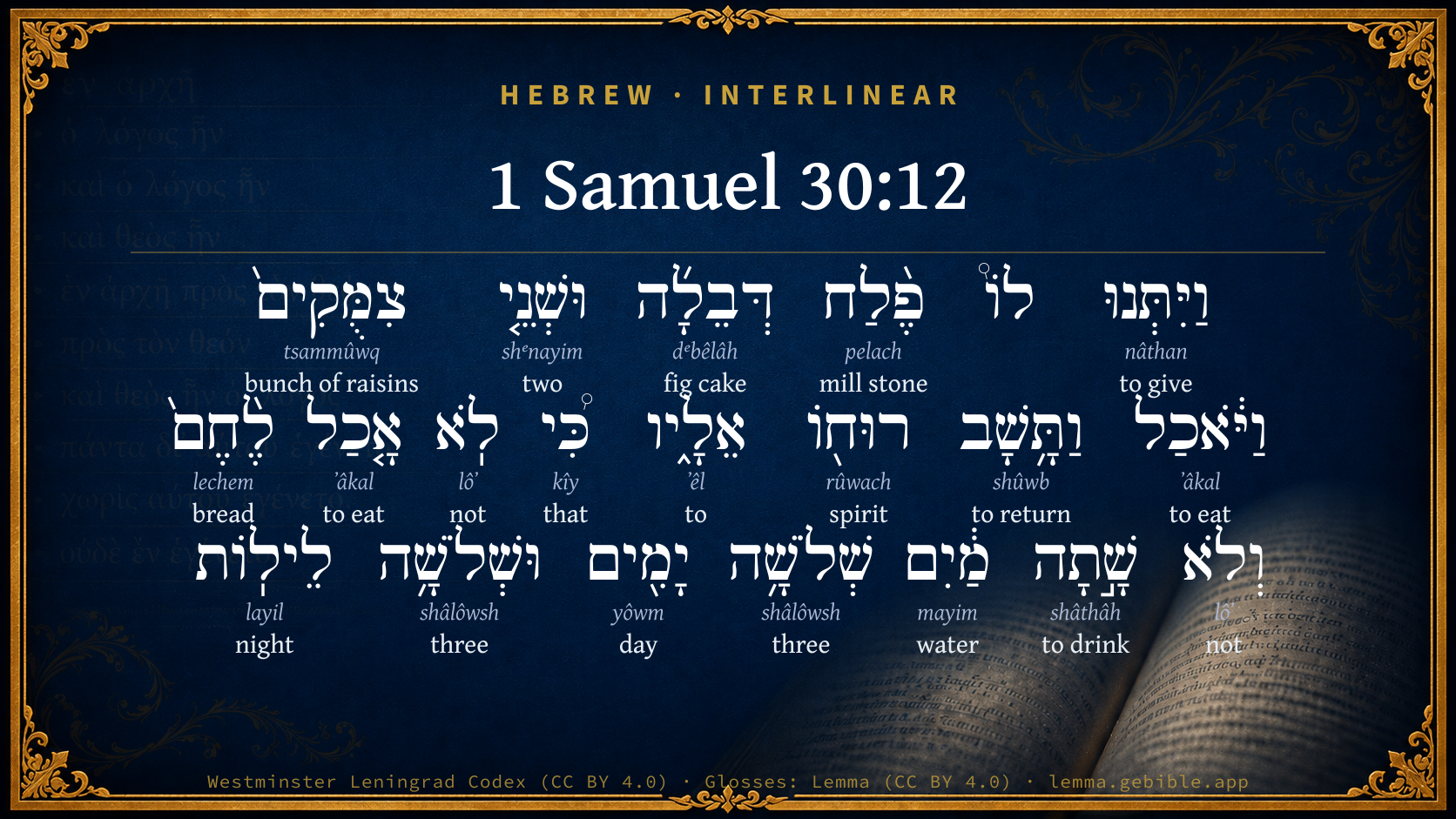
  1. וַיִּתְּנוּ nâthan H5414 “and · to give” Conjunction + Verb, Qal, Sequential Imperfect, 3rd Person, Masculine, Plural
  2. פֶ֨לַח pelach H6400 “mill stone of” Noun, Common, Feminine, Singular, Construct
  3. דְּבֵלָ֜ה dᵉbêlâh H1690 “fig cake” Noun, Common, Feminine, Singular, Absolute
  4. וּשְׁנֵ֤י shᵉnayim H8147 “and · two” Conjunction + Adjective, Cardinal number, Masculine, Dual, Construct
  5. וַיֹּ֔אכַל ʼâkal H398 “and · to eat” Conjunction + Verb, Qal, Sequential Imperfect, 3rd Person, Masculine, Singular
  6. וַתָּ֥שָׁב shûwb H7725 “and · to return” Conjunction + Verb, Qal, Sequential Imperfect, 3rd Person, Feminine, Singular
  7. רוּח֖וֹ rûwach H7307 “spirit · his” Noun, Common, Both, Singular, Construct + Suffix, Personal, 3rd Person, Masculine, Singular
  8. אֵלָ֑יו ʼêl H413 “to · him” Preposition + Suffix, Personal, 3rd Person, Masculine, Singular
  9. כִּ֠י kîy H3588 “that” Conjunction
  10. לֹֽא lôʼ H3808 “not” Particle, Negative
  11. אָ֤כַל ʼâkal H398 “to eat” Verb, Qal, Perfect, 3rd Person, Masculine, Singular
  12. לֶ֨חֶם֙ lechem H3899 “bread” Noun, Common, Both, Singular, Absolute
  13. וְלֹא lôʼ H3808 “and · not” Conjunction + Particle, Negative
  14. שָׁ֣תָה shâthâh H8354 “to drink” Verb, Qal, Perfect, 3rd Person, Masculine, Singular
  15. מַ֔יִם mayim H4325 “water(s)” Noun, Common, Masculine, Plural, Absolute
  16. שְׁלֹשָׁ֥ה shâlôwsh H7969 “three” Adjective, Cardinal number, Masculine, Singular, Absolute
  17. יָמִ֖ים yôwm H3117 “days” Noun, Common, Masculine, Plural, Absolute
  18. וּשְׁלֹשָׁ֥ה shâlôwsh H7969 “and · three” Conjunction + Adjective, Cardinal number, Masculine, Singular, Absolute
  19. לֵילֽוֹת layil H3915 “nights” Noun, Common, Masculine, Plural, Absolute

About this verse

These counts appear in no published source. They are computed here, from the morphology-tagged text and Lemma’s own curated glosses. What Lemma adds →

21
words
17
distinct lemmas
Historical
section

Notable vocabulary

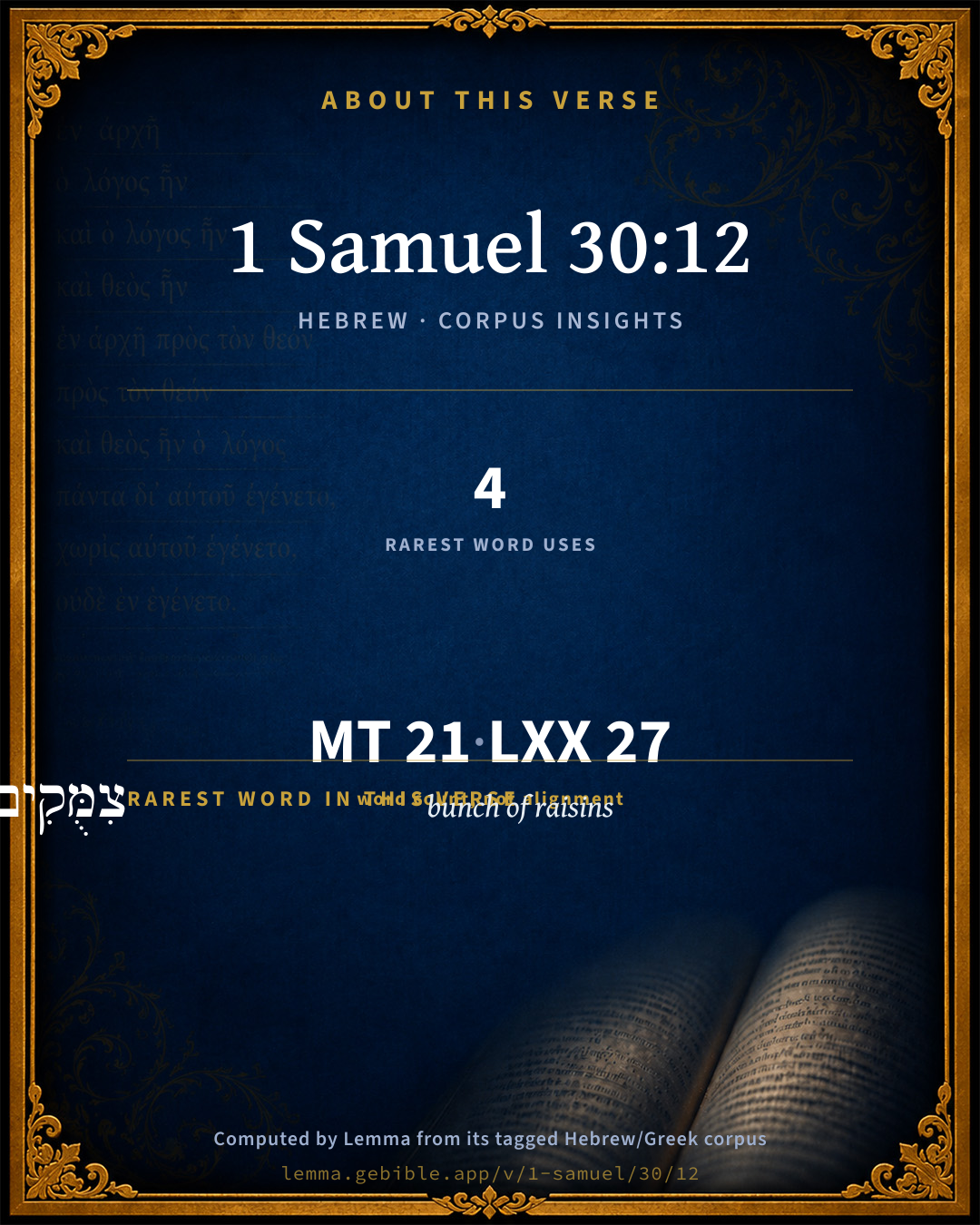
The rarest word here is צִמֻּקִים֙ bunch of raisins H6778 — appearing just 4 times in the whole Hebrew Bible.

Shared distinctive vocabulary

צִמֻּקִים֙ bunch of raisins H6778 occurs in 4 verses of the Hebrew Bible. Also found in:

Grammatical profile

  • 5 verbs
  • 8 nouns
  • 3 adjectives
  • 2 prepositions
  • 1 conjunction
  • 2 particles

Verb forms

  • וַיִּתְּנוּ Qal · Sequential Imperfect
  • וַיֹּ֔אכַל Qal · Sequential Imperfect
  • וַתָּ֥שָׁב Qal · Sequential Imperfect
  • אָ֤כַל Qal · Perfect
  • שָׁ֣תָה Qal · Perfect

Repetition

Words recur within this verse — often emphatic in Hebrew:

  • וַיֹּ֔אכַל to eat H398 ×2
  • שְׁלֹשָׁ֥ה three H7969 ×2
  • לֹֽא not H3808 ×2

Hebrew & Septuagint length

In English translation the verse runs 41 words from the Hebrew and 37 from the Septuagint (LXX English) — closely comparable.

A rough comparison of the two English renderings, which tokenize alike — not a word-level alignment.

Word counts can differ between the Hebrew and the Greek without any difference in meaning — e.g. the Hebrew direct-object marker אֵת has no separate Greek word, and Greek often adds the article ὁ.

In the original languages it is 21 Hebrew tokens and 27 Greek tokens — but the two are counted differently (Hebrew bundles its prefixes and suffixes into one token; the Greek is in lemma form), so that isn’t a like-for-like length.

Cross-references

7

Topical passages linked to 1 Samuel 30:12 in the Treasury of Scripture Knowledge — connected by theme and wording, ordered by reader-vote popularity; previews shown in the World English Bible.

  • Judges 15:19 But God split the hollow place that is in Lehi, and water came out of it. When he had drunk, his spirit came again, and he revived: therefore the name of it was called En Hakkore, which is in Lehi, to this day.
  • 1 Samuel 14:27 But Jonathan didn't hear when his father charged the people with the oath: therefore he put forth the end of the rod who was in his hand, and dipped it in the honeycomb, and put his hand to his mouth; and his eyes were enlightened.
  • 1 Samuel 30:13 David said to him, To whom belong you? and whence are you? He said, I am a young man of Egypt, servant to an Amalekite; and my master left me, because three days ago I fell sick.
  • Esther 4:16 Go, gather together all the Jews who are present in Shushan, and fast you for me, and neither eat nor drink three days, night or day: I also and my maidens will fast in like manner; and so will I go in to the king, which is not according to the law: and if I perish, I perish.
  • Isaiah 40:29–31 He gives power to the faint; and to him who has no might he increases strength.
  • Jonah 1:17 Yahweh prepared a great fish to swallow up Jonah, and Jonah was in the belly of the fish three days and three nights.
  • Matthew 27:63 saying, "Sir, we remember what that deceiver said while he was still alive: 'After three days I will rise again.'

Cross-references courtesy of OpenBible.info (CC BY 4.0).

Hebrew and Greek witnesses Masoretic Hebrew ↔ Greek Septuagint

The same verse in the two great witnesses to the Old Testament, shown verse-for-verse.

These are two independent witnesses, not word-aligned to each other, and the Septuagint is shown in lemma (dictionary) form.

Hebrew 1 Samuel 30:12 Masoretic · Westminster Leningrad Codex

וַיִּתְּנוּ לוֹ֩ פֶ֨לַח דְּבֵלָ֜ה וּשְׁנֵ֤י צִמֻּקִים֙ וַיֹּ֔אכַל וַתָּ֥שָׁב רוּח֖וֹ אֵלָ֑יו כִּ֠י לֹֽא אָ֤כַל לֶ֨חֶם֙ וְלֹא שָׁ֣תָה מַ֔יִם שְׁלֹשָׁ֥ה יָמִ֖ים וּשְׁלֹשָׁ֥ה לֵילֽוֹת

They gave him a piece of a cake of figs, and two clusters of raisins: and when he had eaten, his spirit came again to him; for he had eaten no bread, nor drunk any water, three days and three nights.

World English Bible · Public Domain

Greek LXX 1 Samuel 30:12 Septuagint · lemma form

καί δίδωμι αὐτός κλάσμα παλάθης καί ἐσθίω καί καταἵστημι ὁ πνεῦμα αὐτός ἐν αὐτός ὅτι οὐ βιβρώσκω ἄρτος καί οὐ πίνω ὕδωρ τρεῖς ἡμέρα καί τρεῖς νύξ

And they gave him a piece of a cake of figs, and he ate, and his spirit was restored in him; for he had not eaten bread, and had not drunk water three days and three nights.

LXX2012 (modern English Septuagint) · Public Domain

Hebrew: Westminster Leningrad Codex (CC BY 4.0). Greek: Septuagint (public domain); English from LXX2012 (modern English Septuagint) (Public Domain). How the Septuagint differs from the Hebrew →

Targum (Aramaic paraphrase)

1

The Targum is the ancient Jewish Aramaic paraphrase of the Hebrew Scriptures — an interpretive translation, not the Hebrew text itself. Onkelos (literal) and Pseudo-Jonathan (expansive) render the Torah, and Jonathan the Prophets. Coverage is partial: where no permissively-licensed English translation exists for a verse, only the Aramaic is shown. This is verse-level text, not a word-by-word alignment to the Hebrew.

  1. Targum Jonathan Prophets (Joshua–Malachi)
    וִיהָבוּ לֵיהּ פִּילַס דְבֵלְתָּא וּתְרֵין אִיתְכְּלִין דְעִינְבִין יַבִּישִׁין וְאָכַל וְתָבַת רוּחֵיהּ לֵיהּ אֲרֵי לָא אֲכַל לַחְמָא וְלָא שָׁתָא מַיָא תְּלָתָא יְמָמִין וּתְלָתָא לֵילַוָן:

    (no public-domain English translation for this verse)

    Targum Jonathan — Aramaic: “Mikraot Gedolot” (public domain). English: “Sefaria Community Translation” (CC0 1.0 (public-domain dedication)); “London "Chaldee Paraphrase," 1871” (public domain). Text via Sefaria.

Commentary

Notes on 1 Samuel 30:12 from classic Christian and Jewish commentators (each source and its license shown beneath its notes). The classic Christian expositions comment on the surrounding passage and are grouped to its opening verse, so a note may address several verses; the Jewish commentaries on the Tanakh (Rashi and others) are per-verse, so they appear only where the commentator wrote on this verse.

Lemma curates 59 commentaries, every one of them public domain or Creative Commons licensed, each selected and text-cleaned for this edition rather than reprinted as found. About our sources →

Trapp's Complete Commentary

John Trapp

1Sa 30:12 And they gave him a piece of a cake of figs, and two clusters of raisins: and when he had eaten, his spirit came again to him: for he had eaten no bread, nor drunk [any] water, three days and three nights.

Ver. 12. And they gave him a piece of a cake of figs.] All this they did for him out of their humanity and charity, before they knew whether he could or would do them any service.

His spirit came again to him.] For in nature were it not for nutrition, the natural life would be soon extinguished.

John Trapp, A Commentary or Exposition upon All the Books of the Old and New Testament (1647–1656) — public domain. Text from a community e-Sword module.

Joseph Benson's Commentary

1Sa 30:12-13. Three days and nights — One whole day, and part of two others, as appears from the next verse, where he says, Three days ago I fell sick; but in the Hebrew it is, This is the third day since I fell sick. A young man of Egypt — God of his providence so ordering it that he was not one of the race of the Amalekites, devoted to destruction, but an Egyptian, that might be spared. And my master left me — In this place and condition; a barbarous act this, to leave him there to perish, when they had good store of camels for the carriage of men, as well as of their spoil, 1Sa 30:17. But this inhumanity cost them dear; for, through it, they lost their own lives, and David recovered what they had taken at Ziklag. Such is the wonderful providence of God, ordering or overruling every thing for his own glory and the good of those that trust in him, even the thoughts and desires, the counsels, works, and ways of men, both the good and the bad! So that there is no fighting against him, who can make the smallest actions serviceable to the production of the greatest effects.

Joseph Benson's Commentary on the Old and New Testaments (1811–1818) — public domain. Text from a community e-Sword module.

Adam Clarke's Commentary

Verse 12. A cake of figs] See on 1Sa 25:18.

Adam Clarke's Commentary on the Bible (1810–1826) — public domain. Text from a community e-Sword/MySword module.

Ellicott's Commentary for English Readers

(12) Three days and three nights.—This was a note of time as to the amount of start the Amalekite leader with the plunder had. It may well be conceived there was no time to lose. The cruelty of the Amalekites to their slaves was the cause of their ultimate discomfiture, for with the very considerable start they already had, if David had not been quite certain, through the information of the Egyptian, of their route, the pursuit would have been utterly hopeless.

A Bible Commentary for English Readers, edited by Charles John Ellicott (1878–1897) — public domain. Text from a community e-Sword module.

The Cambridge Bible for Schools and Colleges

gen. ed. J. J. S. Perowne

12. his spirit came again to him] He revived. Cp. Jdg_15:19.

The Cambridge Bible for Schools and Colleges (gen. ed. J. J. S. Perowne; Cambridge University Press, 1878–1918) — public domain. Text from a community e-Sword module.

John Gill's Exposition

And they gave him a piece of cake of figs,.... That were dried and pressed together, and made into cakes:

and two clusters of raisins; or dried grapes, as the Targum:

and when he had eaten, his spirit came again to him; he seemed to be quite dispirited, almost lifeless, but upon eating some food he was refreshed, and his spirits revived, and he was capable of conversing:

for he had eaten no bread, nor drank any water, three days and three nights; that is, one whole day, and part of two days, as appears from Sa1 30:13.

John Gill's Exposition of the Whole Bible (1746–1763) — public domain (CC PDM 1.0). Text via the HelloAO Bible API.

Albert Barnes' Notes on the Bible

Three days and three nights - Indicating that at least so long a time had elapsed since the sack of Ziklag.

Albert Barnes' Notes on the Bible (1834–1885) — public domain. Text from a community e-Sword/MySword module.

Haydock's Catholic Bible Commentary

Raisins. Hebrew tsimmukim. See chap. xxv. 18. (Calmet) --- The soldiers very prudently took some provisions with them, as they were going into a desert country. (Menochius)

George Leo Haydock (1774–1849), Haydock's Catholic Family Bible and Commentary, 1859 edition — public domain. Excludes Psalms (Douay-Rheims chapter numbering differs from Protestant) and Deuterocanonical books (Catholic canon only).

Matthew Poole's English Annotations

Which is to be understood synecdochically of one whole day, and part of two others, as the same phrase is taken Mat 12:40, as appears from the next verse, where he saith, three days agone I fell sick, but in the Hebrew it this is the third day since I fell sick.

Matthew Poole's English Annotations on the Holy Bible (1683–1685) — public domain. Text from a community e-Sword/MySword module.

Whedon's Commentary on the Bible

Daniel D. Whedon

12. His spirit came again to him — That is, he revived from the half-unconscious and dreamlike state into which, through anxiety and lack of food, he had fallen.

Daniel D. Whedon (gen. ed.), Commentary on the Old and New Testaments (1874–1909) — public domain. Text from a community e-Sword module.

John Wesley's Explanatory Notes

Three days and nights - One whole day and part of two others, as appears from the next verse, where he saith, three days ago I fell sick, but in the Hebrew it is, this is the third day since I fell sick.

John Wesley, Explanatory Notes Upon the Whole Bible (1754–1765) — public domain. Text via the GEBible commentary corpus.

Lesson kit

Teaching starters — assembled from the data on this page, not authored interpretation. Every prompt links to the verse data it draws on. Edit before teaching.

1 Samuel, in the Historical, opens this verse with 21 words (17 distinct Hebrew lemmas). Its most distinctive word is tsammûwq (“bunch of raisins”). A historical commentator’s framing appears above. Read the whole chapter for the surrounding context.

Discussion questions

  1. How does “bunch of raisins” (tsammûwq) shape what this verse is saying?
  2. 1 Samuel 25:18 shares the word «bunch of raisins» with this verse. How do the two illuminate each other?
  3. “to eat” occurs 2× in this one verse. What is the effect of the repetition?
  4. The translations on this page render this verse differently — a whole-verse word diff, not a word-by-word alignment. What might account for the different wordings?
  5. The verb «וַיִּתְּנוּ» is Qal Sequential Imperfect. How does its form color the action?
  6. Reading how Trapp's Complete Commentary and Joseph Benson's Commentary read this verse, where do the two commentators agree and where do they part?

Things to notice

Reading settings

Reading text

Shown beneath each verse's original-language words.

Old Testament
Old Testament edition

Read the OT as the Masoretic Hebrew (MT) or the Greek Septuagint (LXX).

English shown for the Greek Septuagint (in the Hebrew ↔ Greek comparison).

Comparing translations? Open the Compare panel on any verse page to stack up to four side by side.