1 Kings 7:48

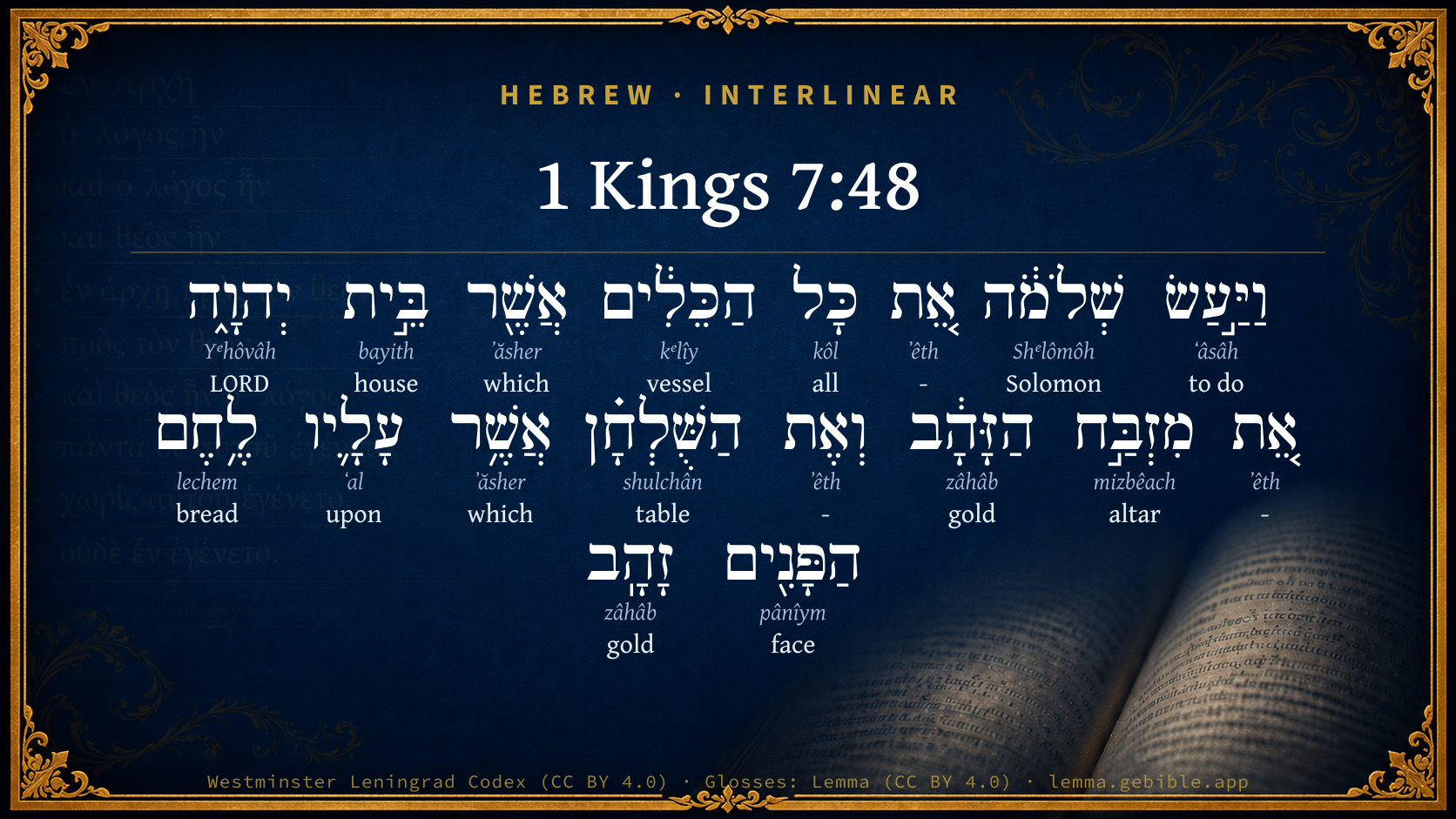
Hebrew (Westminster Leningrad Codex) 1 Kings 7:48 appears in the Hebrew Old Testament. The text above is from the Westminster Leningrad Codex. Each word links to its Strong’s number, a concise gloss, and parsing drawn from the Open Scriptures Hebrew Bible morphology. Click any word for its full Brown-Driver-Briggs (BDB) entry.
Download image
Cite this verse

1 Kings 7:48 (World English Bible). Public Domain. Lemma interlinear Bible study tool, https://lemma.gebible.app/v/1-kings/7/48.

Show BibTeX & RIS
BibTeX
RIS
English Translation
Solomon made all the vessels that were in the house of Yahweh: the golden altar, and the table whereupon the show bread was, of gold;
World English Bible · Public Domain
Download a study sheet

One document with this verse’s original text, its word-by-word gloss line, the meaning frame, cross-references with their text, attributed commentary, and full source and license credits — printable, and it pastes into notes with its structure intact.

This verse Autodidact and up

Study sheet (.html) Plain text (.txt)

A passage Seminary Student

Up to 50 verses in one chapter. A passage sheet keeps up to 6 commentary sources and 12 cross-references per verse, in the order this page ranks them, and says so on the sheet whenever that leaves anything out. Ask for a single verse and you get the Autodidact verse sheet above.

Everything on this page stays free to read, with no account — the sheet is a download of what is already on screen, not access to it.

Want to remove ads? Support Godless Engineer
Compare translations 3

The same verse in 3 English versions, stacked beneath the original-language interlinear above. Click any original word for its lexicon entry.

Each is an independent rendering of the whole verse — the interlinear is not word-aligned to these translations.

Highlighted words mark where these versions differ — a whole-verse word diff, not a word-by-word alignment.

  • World English Bible Public Domain
    Solomon made all the vessels that were in the house of Yahweh: the golden altar, and the table whereupon the show bread was, of gold;
  • King James Version Public Domain
    And Solomon made all the vessels that pertained unto the house of the LORD: the altar of gold, and the table of gold, whereupon the shewbread was,
  • unfoldingWord Literal Text CC BY-SA 4.0
    And Solomon made all of the vessels that in the house of Yahweh: the altar of gold, and the table that on it the bread of the face, gold,

unfoldingWord Literal Text — © unfoldingWord, licensed CC BY-SA 4.0. Word-aligned USFM3 via Door43 (git.door43.org/unfoldingWord/en_ult).

Versions to compare (up to 4)

3 of 4 selected

Show all 18 translations

Every available English version of this verse, each an independent rendering of the whole verse.

  • World English Bible Public Domain
    Solomon made all the vessels that were in the house of Yahweh: the golden altar, and the table whereupon the show bread was, of gold;
  • Berean Standard Bible Public Domain
    Solomon also made all the furnishings for the house of the LORD: the golden altar; the golden table on which was placed the Bread of the Presence;
  • Majority Standard Bible Public Domain
    Solomon also made all the furnishings for the house of the LORD: the golden altar; the golden table on which was placed the Bread of the Presence;
  • King James Version Public Domain
    And Solomon made all the vessels that pertained unto the house of the LORD: the altar of gold, and the table of gold, whereupon the shewbread was,
  • American Standard Version (1901) Public Domain
    And Solomon made all the vessels that were in the house of Jehovah: the golden altar, and the table whereupon the showbread was, of gold;
  • Revised Version (1885) Public Domain
    And Solomon made all the vessels that were in the house of the LORD: the golden altar, and the table whereupon the shewbread was, of gold;
  • Geneva Bible (1599) Public Domain
    So Salomon made all the vessels that perteyned vnto the house of the Lord, the golden altar, and the golden table, whereon the shewbread was,
  • Douay-Rheims (1899) Public Domain
    And Solomon made all the vessels for the house of the Lord: the altar of gold, and the table of gold, upon which the leaves of proposition should be set:
  • Young's Literal Translation Public Domain
    And Solomon maketh all the vessels that `are' in the house of Jehovah: the altar of gold, and the table -- on which `is' the bread of the Presence -- of gold,
  • Literal Standard Version CC BY-SA 4.0
    And Solomon makes all the vessels that [are] in the house of YHWH: the altar of gold, and the table of gold (on which [is] the Bread of the Presentation),
  • Unlocked Literal Bible CC BY-SA 4.0
    Solomon had made all the furnishings that were in the temple of Yahweh out of gold: the golden altar and the table on which the bread of the presence was to be placed;
  • unfoldingWord Literal Text CC BY-SA 4.0
    And Solomon made all of the vessels that in the house of Yahweh: the altar of gold, and the table that on it the bread of the face, gold,
  • Darby Bible Public Domain
    And Solomon made all the vessels that were [in] the house of Jehovah: the golden altar; and the table of gold, whereon was the shewbread;
  • World Messianic Bible Public Domain
    Solomon made all the vessels that were in the LORD’s house: the golden altar and the table that the show bread was on, of gold;
  • Webster's Bible Public Domain
    And Solomon made all the vessels that pertained to the house of the LORD: the altar of gold, and the table of gold, upon which was the show-bread,
  • Free Bible Version CC BY-SA 4.0
    Solomon also had made all the items for the Temple of the Lord: the golden altar; the golden table where the Bread of the Presence was placed;
  • Bible in Basic English Public Domain
    And Solomon had all the vessels made for use in the house of the Lord: the altar of gold and the gold table on which the holy bread was placed;
  • JPS Tanakh (1917) Public Domain
    And Solomon made all the vessels that were in the house of the LORD: the golden altar, and the table whereupon the showbread was, of gold;

Literal Standard Version (2020), Covenant Press — licensed CC BY-SA 4.0. Text via the HelloAO Bible API (eBible.org). Unlocked Literal Bible (unfoldingWord) — licensed CC BY-SA 4.0. Text via the HelloAO Bible API (eBible.org). unfoldingWord Literal Text — © unfoldingWord, licensed CC BY-SA 4.0. Word-aligned USFM3 via Door43 (git.door43.org/unfoldingWord/en_ult). Free Bible Version, Dr. Jonathan Gallagher — licensed CC BY-SA 4.0. Text via the HelloAO Bible API (eBible.org).

Word by word

More ways to search: Search by grammar → Find every occurrence → Compare this word →

Practice this passage: Drill this verse → Learn its vocabulary →

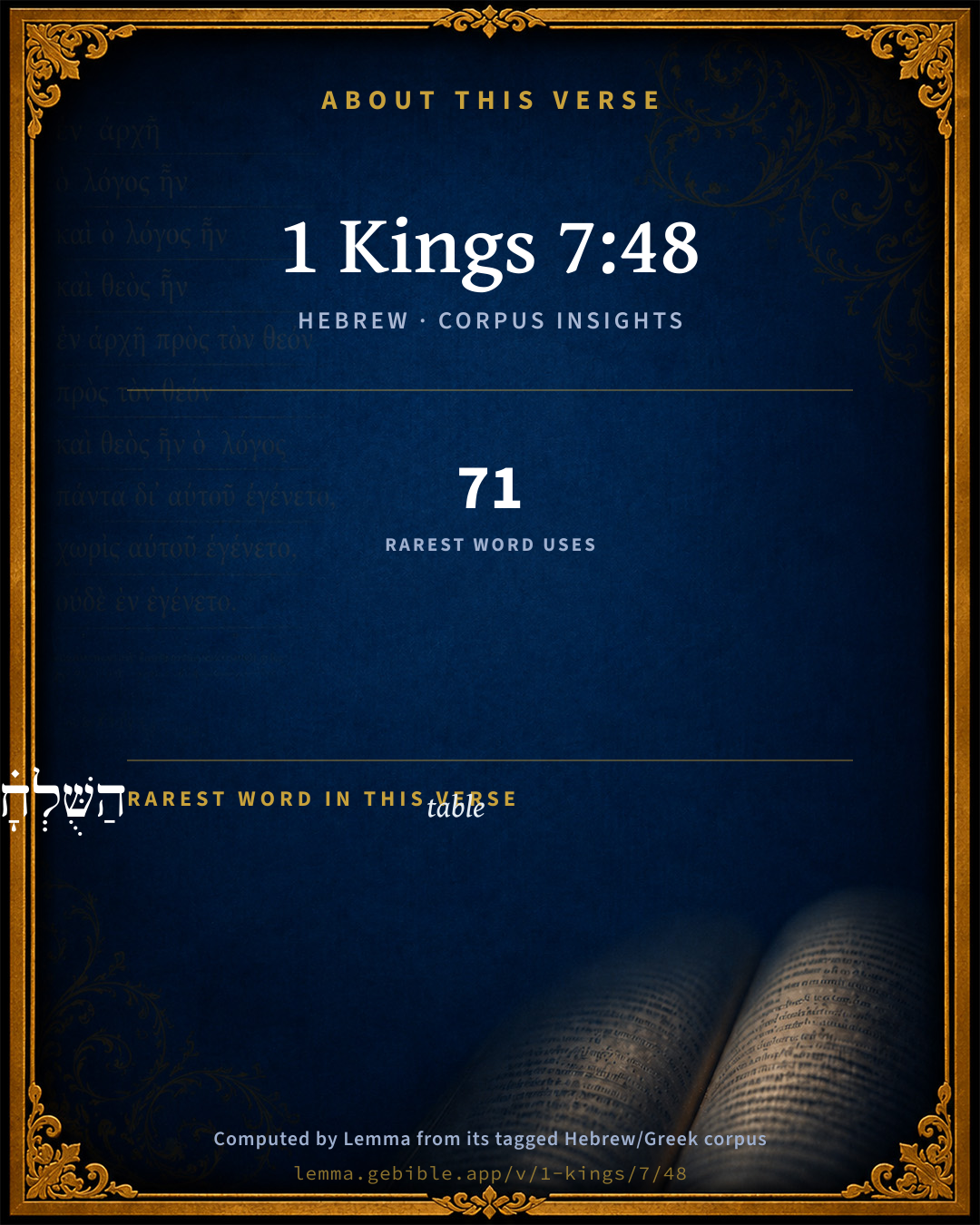
הַשֻּׁלְחָ֗ן
shulchân
H7979
“the · table”
Particle, Definite Article + Noun, Common, Masculine, Singular, Absolute
Part of Speech
Particle + Noun
Type
Common
Gender
Masculine
Number
Singular
State
Absolute
Full BDB Definition

Origin: from H7971

TWOT: 2395a

table - table - of king's table, private use, sacred uses
  1. וַיַּ֣עַשׂ ʻâsâh H6213 “and · to do” Conjunction + Verb, Qal, Sequential Imperfect, 3rd Person, Masculine, Singular
  2. שְׁלֹמֹ֔ה Shᵉlômôh H8010 “Solomon” Noun, Proper
  3. אֵ֚ת ʼêth H853 “-” Particle, Direct Object
  4. כָּל kôl H3605 “all of” Noun, Common, Masculine, Singular, Construct
  5. הַכֵּלִ֔ים kᵉlîy H3627 “the · vessels” Particle, Definite Article + Noun, Common, Masculine, Plural, Absolute
  6. אֲשֶׁ֖ר ʼăsher H834 “which” Particle, Relative
  7. בֵּ֣ית bayith H1004 “house of” Noun, Common, Masculine, Singular, Construct
  8. יְהוָ֑ה Yᵉhôvâh H3068 “LORD” Noun, Proper
  9. אֵ֚ת ʼêth H853 “-” Particle, Direct Object
  10. מִזְבַּ֣ח mizbêach H4196 “altar of” Noun, Common, Masculine, Singular, Construct
  11. הַזָּהָ֔ב zâhâb H2091 “the · gold” Particle, Definite Article + Noun, Common, Masculine, Singular, Absolute
  12. וְאֶת ʼêth H853 “and · -” Conjunction + Particle, Direct Object
  13. אֲשֶׁ֥ר ʼăsher H834 “which” Particle, Relative
  14. עָלָ֛יו ʻal H5921 “upon · him” Preposition + Suffix, Personal, 3rd Person, Masculine, Singular
  15. לֶ֥חֶם lechem H3899 “bread of” Noun, Common, Both, Singular, Construct
  16. הַפָּנִ֖ים pânîym H6440 “the · face(s)” Particle, Definite Article + Noun, Common, Both, Plural, Absolute
  17. זָהָֽב zâhâb H2091 “gold” Noun, Common, Masculine, Singular, Absolute

About this verse

These counts appear in no published source. They are computed here, from the morphology-tagged text and Lemma’s own curated glosses. What Lemma adds →

18
words
14
distinct lemmas
Historical
section

Grammatical profile

  • 1 verb
  • 11 nouns
  • 1 preposition
  • 5 particles

Verb forms

  • וַיַּ֣עַשׂ Qal · Sequential Imperfect

Repetition

Words recur within this verse — often emphatic in Hebrew:

  • הַזָּהָ֔ב gold H2091 ×2
  • אֲשֶׁ֖ר which H834 ×2

Hebrew & Septuagint length

In English translation the verse runs 25 words from the Hebrew and 25 from the Septuagint (LXX English) — the same length.

A rough comparison of the two English renderings, which tokenize alike — not a word-level alignment.

Word counts can differ between the Hebrew and the Greek without any difference in meaning — e.g. the Hebrew direct-object marker אֵת has no separate Greek word, and Greek often adds the article ὁ.

Cross-references

17

Topical passages linked to 1 Kings 7:48 in the Treasury of Scripture Knowledge — connected by theme and wording, ordered by reader-vote popularity; previews shown in the World English Bible.

  • Exodus 37:10–16 He made the table of acacia wood. Its length was two cubits, and its breadth was a cubit, and its height was a cubit and a half.
  • Exodus 39:36 the table, all its vessels, the show bread,
  • 2 Chronicles 4:8 He made also ten tables, and placed them in the temple, five on the right side, and five on the left. He made one hundred basins of gold.
  • Exodus 25:23–30 "You shall make a table of acacia wood. Two cubits shall be its length, and a cubit its breadth, and one and a half cubits its height.
  • Exodus 30:1–5 "You shall make an altar to burn incense on. You shall make it of acacia wood.
  • Exodus 37:25–29 He made the altar of incense of acacia wood. It was square: its length was a cubit, and its breadth a cubit. Its height was two cubits. Its horns were of one piece with it.
  • Exodus 39:38 the golden altar, the anointing oil, the sweet incense, the screen for the door of the Tent,
  • Exodus 40:22–23 He put the table in the tent of meeting, on the side of the tent northward, outside of the veil.
  • Exodus 40:26 He put the golden altar in the tent of meeting before the veil;
  • Leviticus 24:5–9 "You shall take fine flour, and bake twelve cakes of it: two tenth parts of an ephah shall be in one cake.
  • 2 Chronicles 4:19 Solomon made all the vessels that were in the house of God, the golden altar also, and the tables whereon was the show bread;
  • Ezekiel 40:39 In the porch of the gate were two tables on this side, and two tables on that side, to kill thereon the burnt offering and the sin-offering and the trespass-offering.
  • Ezekiel 40:42 There were four tables for the burnt offering, of hewn stone, a cubit and a half long, and a cubit and a half broad, and one cubit high; whereupon they laid the instruments with which they killed the burnt offering and the sacrifice.
  • Ezekiel 41:22 The altar was of wood, three cubits high, and the length of it two cubits; and the corners of it, and the length of it, and the walls of it, were of wood: and he said to me, This is the table that is before Yahweh.
  • Malachi 1:12 "But you profane it, in that you say, 'Yahweh's table is polluted, and its fruit, even its food, is contemptible.'
  • 1 Corinthians 10:21 You can't both drink the cup of the Lord and the cup of demons. You can't both partake of the table of the Lord, and of the table of demons.
  • Ezekiel 44:16 they shall enter into my sanctuary, and they shall come near to my table, to minister to me, and they shall keep my charge.

Cross-references courtesy of OpenBible.info (CC BY 4.0).

Hebrew and Greek witnesses Masoretic Hebrew ↔ Greek Septuagint

The same verse in the two great witnesses to the Old Testament, shown verse-for-verse.

These are two independent witnesses, not word-aligned to each other, and the Septuagint is shown in lemma (dictionary) form.

Hebrew 1 Kings 7:48 Masoretic · Westminster Leningrad Codex

וַיַּ֣עַשׂ שְׁלֹמֹ֔ה אֵ֚ת כָּל הַכֵּלִ֔ים אֲשֶׁ֖ר בֵּ֣ית יְהוָ֑ה אֵ֚ת מִזְבַּ֣ח הַזָּהָ֔ב וְאֶת הַשֻּׁלְחָ֗ן אֲשֶׁ֥ר עָלָ֛יו לֶ֥חֶם הַפָּנִ֖ים זָהָֽב

Solomon made all the vessels that were in the house of Yahweh: the golden altar, and the table whereupon the show bread was, of gold;

World English Bible · Public Domain

Greek LXX 1 Kings 7:48 Septuagint · lemma form

καί ἐπάνωθεν τίμιος κατά ὁ μέτρον ἀπολέγω καί κέδρος

And king Solomon took the furniture which Chiram made for the house of the Lord, the golden altar, and the golden table of show bread.

LXX2012 (modern English Septuagint) · Public Domain

On this verse, Ellicott's Commentary for English Readers discusses the Septuagint’s reading. Read the note in Commentary ↓

Hebrew: Westminster Leningrad Codex (CC BY 4.0). Greek: Septuagint (public domain); English from LXX2012 (modern English Septuagint) (Public Domain). How the Septuagint differs from the Hebrew →

Targum (Aramaic paraphrase)

1

The Targum is the ancient Jewish Aramaic paraphrase of the Hebrew Scriptures — an interpretive translation, not the Hebrew text itself. Onkelos (literal) and Pseudo-Jonathan (expansive) render the Torah, and Jonathan the Prophets. Coverage is partial: where no permissively-licensed English translation exists for a verse, only the Aramaic is shown. This is verse-level text, not a word-by-word alignment to the Hebrew.

  1. Targum Jonathan Prophets (Joshua–Malachi)
    וַעֲבַד שְׁלֹמֹה יַת כָּל מָנַיָא דִי בְּבֵית מַקְדְשָׁא דַייָ יַת מַדְבְּחָא דְדַהֲבָא וְיַת פָּתוֹרָא דִי עֲלוֹהִי לְחַם אַפַּיָא דַהֲבָא:

    (no public-domain English translation for this verse)

    Targum Jonathan — Aramaic: “Mikraot Gedolot” (public domain). English: “Sefaria Community Translation” (CC0 1.0 (public-domain dedication)); “London "Chaldee Paraphrase," 1871” (public domain). Text via Sefaria.

Commentary

Notes on 1 Kings 7:48 from classic Christian and Jewish commentators (each source and its license shown beneath its notes). The classic Christian expositions comment on the surrounding passage and are grouped to its opening verse, so a note may address several verses; the Jewish commentaries on the Tanakh (Rashi and others) are per-verse, so they appear only where the commentator wrote on this verse.

Lemma curates 59 commentaries, every one of them public domain or Creative Commons licensed, each selected and text-cleaned for this edition rather than reprinted as found. About our sources →

Matthew Henry's Commentary

Here is, 1. The making of the gold work of the temple, which it seems was done last, for with it the work of the house of God ended. All within doors was gold, and all made new (except the ark, with its mercy-seat and cherubim), the old being either melted down or laid by - the golden altar, table, and candlestick, with all their appurtenances. The altar of incense was still one, for Christ and his intercession are so: but he made ten golden tables, Ch2 4:8 (though here mention is made of that one only on which the show-bread was, Kg1 7:48, which we may suppose was larger than the rest and to which the rest were as side-boards), and ten golden candlesticks (Kg1 7:49), intimating the much greater plenty both of spiritual food and heavenly light which the gospel blesses us with than the law of Moses did our could afford. Even the hinges of the door were of gold (Kg1 7:50), that every thing might be alike magnificent, and bespeak Solomon's generosity. Some suggest that every thing was made thus splendid in God's temple to keep the people from idolatry, for none of the idol-temples were so rich and fine as this: but how little the expedient availed the event showed. 2. The bringing in of the dedicated things, which David had devoted to the honour of God, Kg1 7:51. What was not expended in the building and furniture was laid up in the treasury, for repairs, exigencies, and the constant charge of the temple-service. What the parents have dedicated to God the children ought by no means to alienate or recall, but should cheerfully devote what was intended for pious and charitable uses, that they may, with their estates, inherit the blessing.

Matthew Henry's Commentary on the Whole Bible (1708–1710) — public domain (CC PDM 1.0). Text via the HelloAO Bible API.

Trapp's Complete Commentary

John Trapp

1Ki 7:48 And Solomon made all the vessels that [pertained] unto the house of the LORD: the altar of gold, and the table of gold, whereupon the shewbread [was],

Ver. 48. The altar of gold, and the table of gold.] Yea, tables, as it is in 2Ch 4:19, ten tables for one made by Moses; to set forth the superabundant grace under Christ, figured by Solomon.

John Trapp, A Commentary or Exposition upon All the Books of the Old and New Testament (1647–1656) — public domain. Text from a community e-Sword module.

Joseph Benson's Commentary

1Ki 7:48. All the vessels that pertained to the house of the Lord — Such as God, by the mouth of Moses, had commanded to be made for his house and service, and such as Moses had made for the tabernacle; only these for the temple were larger, richer, and more in number; according to the difference, as to size and splendour, between the temple and the tabernacle, and between Solomon’s vast riches and the poverty of Moses and the Israelites in the wilderness. The altar of gold — That is, overlaid with gold. For it was made of cedar, as that of Moses was of shittim-wood, and it was only covered with gold, 1Ki 6:20. This was the altar of incense which stood in the holy place, and is mentioned 1Ch 28:18, as one of the holy things for which David left gold. And the table of show- bread — Under which, by a synecdoche, are comprehended, both all the utensils belonging to it, and the other ten tables, which were made at the same time, 2Ch 4:7-8.

Joseph Benson's Commentary on the Old and New Testaments (1811–1818) — public domain. Text from a community e-Sword module.

Tyndale Open Study Notes

Tyndale Open Resources

7:48-49 The gold altar replaced the altar for burning incense used in the Tabernacle (Exod 30:1-10). The one table and one lampstand used in the Tabernacle (Exod 25:23-40) were replaced by ten such sets in the Temple. Although the author lists a single gold table for the Bread of the Presence, the Chronicler reports ten tables, five on each side of the Temple’s main room (cp. 2 Chr 4:8), along with ten lampstands of solid gold. The bread represented God’s provision for his people, and the lampstand characterized God as the source of life and truth. Both symbols pointed to Christ, the bread of life (John 6:35) and the light of the world (John 8:12).

Tyndale Open Study Notes — © Tyndale Open Resources, licensed CC BY-SA 4.0. Text via the HelloAO Bible API.

Geneva Bible (1599)

Geneva Bible translators

This was done according to the form that the Lord prescribed unto Moses in Exodus.

Geneva Bible (1599) marginal notes — public domain. Text via Bolls.life.

Jamieson, Fausset & Brown

Robert Jamieson, A. R. Fausset & David Brown

the altar of gold--that is, the altar of incense.

Jamieson, Fausset & Brown — Commentary Critical and Explanatory on the Whole Bible (1871) — public domain (CC PDM 1.0). Text via the HelloAO Bible API.

Ellicott's Commentary for English Readers

(48) The altar of gold.—The altar of gold (1Ki_6:20; 1Ki_6:22) is the altar of incense. On it (see Exo_30:1-10) incense was to be burnt morning and evening. The horns of the altar were to be touched with the blood of the sin offering (Lev_4:7; Lev_4:18) offered for the priests or the people; and it was to be solemnly purified by the blood of the sacrifice on the great Day of Atonement (Lev_16:18-19). The offering of incense, therefore, pre-supposed sacrifice already offered, and atonement made for sin. To the Israelites it clearly symbolised the offering of an acceptable worship by man, as restored to the love and communion of God. (See Psa_141:2.) The priest, as a mediator between God and man, alone entered the Holy Place and offered the incense; the people “stood praying without” (Luk_1:10). To us it symbolises the intercession of the One Mediator, offered for us in the Most Holy Place of heaven, by whom alone our worship ascends to God. (See Heb_9:11-12; Heb_9:24; Heb_10:19-22; Rev_8:3.)

For the table of shewbread, see Exo_25:23-28; Exo_37:10-15; for the shewbread itself, see Lev_24:5-9. The “shewbread”—properly “bread of the face” (or presence) of God, translated in the LXX. Version as “bread of offering” or “of presentation”—was clearly of the nature of an Eucharistic offering to God of His own gift of bread—a kind of first-fruits, acknowledging that the whole sustenance of life comes from Him, and possibly also implying the truth more closely symbolised by the pot of manna, that “man doth not live by bread alone, but by every word proceeding out of the mouth of God.”

A Bible Commentary for English Readers, edited by Charles John Ellicott (1878–1897) — public domain. Text from a community e-Sword module.

The Cambridge Bible for Schools and Colleges

gen. ed. J. J. S. Perowne

48. that pertained unto the house of the Lord] The construction is like that in 1Ki_7:45. Hence R.V. has ‘that were in the house of the Lord.’

the altar of gold] R.V. the golden altar, i.e. the altar of incense made of cedar wood and overlaid with gold.

The Cambridge Bible for Schools and Colleges (gen. ed. J. J. S. Perowne; Cambridge University Press, 1878–1918) — public domain. Text from a community e-Sword module.

John Gill's Exposition

And the candlesticks of pure gold, five on the right side, and five on the left, before the oracle,.... These stood in the holy place, where the shewbread tables did, right before the holy of holies; there were ten of these as of them, which were placed, as the same Jewish writers say, not on the right and left of the temple, but on the right and left of Moses's candlestick, which stood on the south side, Exo 40:24, these may denote the greater degree of spiritual light in the church of Christ under the Gospel dispensation than under the law:

with the flowers; the figures of flowers, such as were wrought on the candlestick of Moses:

and the lamps; which were seven to each candlestick, and so must be in all seventy; which may put us in mind of the seventy disciples of Christ, some of the first lights of the Gospel church:

and the tongues of gold; which were used to take the wicks out of the oil, and put into the lamps.

John Gill's Exposition of the Whole Bible (1746–1763) — public domain (CC PDM 1.0). Text via the HelloAO Bible API.

Albert Barnes' Notes on the Bible

See the note to 1Ki 6:20 and notes at 2Ch 4:19-22.

Albert Barnes' Notes on the Bible (1834–1885) — public domain. Text from a community e-Sword/MySword module.

Haydock's Catholic Bible Commentary

Altar, not that on which the ark was placed, (chap. vi. 20.; Calmet) though some are of that opinion; (Menochius, &c.) but perhaps the altar of incense. The one which Moses had made was probably too small, (Calmet) and reposited in the treasury. (Rabbins) --- Table. In 1 Paralipomenon iv. 8., we find ten specified, one between each candlestick, in the holy place. Josephus ([Antiquities?] viii. 2.) mentions an incredible number of gold and silver utensils, which are not found in Scripture; and the Rabbins are not sparing in miracles, to promote a respect for the temple. No venomous creature, they say, was ever seen in Jerusalem; nor did man seek for lodgings in vain, &c. The priests were so numerous, that the same person had never to offer the perpetual sacrifice or incense twice in his life. No one durst spit in the temple, nor turn his back on the altar, &c. (Calmet)

George Leo Haydock (1774–1849), Haydock's Catholic Family Bible and Commentary, 1859 edition — public domain. Excludes Psalms (Douay-Rheims chapter numbering differs from Protestant) and Deuterocanonical books (Catholic canon only).

Matthew Poole's English Annotations

All the vessels that pertained unto the house of the Lord; such as God by the mouth of Moses had commanded to be made for his house and service, and such as Moses had made; only these were larger, and richer, and more, according to the difference of the temple and tabernacle, and Solomon’s vast riches, and the poverty of Moses and the Israelites at that time.

The altar of gold, to wit, of incense, as appears from 1Ch 28:18, where this is mentioned amongst the things for which David left gold, and Solomon is here said to build it; and therefore this cannot be that altar made by Moses, Exo 25:23,24; Exo 30:1,3, which also was of shittim wood, whereas this was made of cedar, and covered with gold, 1Ki 6:20.

The table of gold, whereupon the shewbread was; under which, by a synecdoche, are comprehended both all the utensils belonging to it, and the other ten tables which he made together with it, 2Ch 4:7,8.

Matthew Poole's English Annotations on the Holy Bible (1683–1685) — public domain. Text from a community e-Sword/MySword module.

Whedon's Commentary on the Bible

Daniel D. Whedon

48. The altar of gold — Overlaid with gold. See on 1Ki_6:20. This altar in the temple was doubtless of the same form as that of the tabernacle. See on Exo_30:1-5; Exo_37:25-28. The great brazen altar of burnt offerings in the court is not mentioned in this chapter, and only referred to incidentally in 1Ki_8:64.

Table of gold — Like that of the tabernacle. See on Exo_25:23-30. In 2Ch_4:8 mention is made of ten tables, and they were all probably of this same form, and placed five on each side of the holy place. Among the spoils taken from Jerusalem by Titus, as appears sculptured in relief on his triumphal arch at Rome, were the table and candlestick of the Herodian temple. These are shown in the annexed cuts, and were probably, in the main, like those of the more ancient temple of Solomon.

Daniel D. Whedon (gen. ed.), Commentary on the Old and New Testaments (1874–1909) — public domain. Text from a community e-Sword module.

The Pulpit Commentary

And Solomon made all the vessels which pertained unto neither word in Heb. the house of the Lord: the altar of gold the altar of incense. (See on 1Ki_6:20, 1Ki_6:22) and the table of gold The Heb. shows the meaning to be, He made the table out of gold, not "He made the golden table," as Keil. 2Ch_4:8 (cf. ver. 19 and 1Ch_28:16) speaks of ten tables whereupon the shewbread was.

The Pulpit Commentary (1880–1919), ed. H.D.M. Spence-Jones & Joseph S. Exell — public domain. Text from a community e-Sword module.

John Wesley's Explanatory Notes

Vessels - Such as Moses had made only these were larger, and richer, and more. Table of gold - Under which, are comprehended both all the utensils belonging to it, and the other ten tables which he made together with it.

John Wesley, Explanatory Notes Upon the Whole Bible (1754–1765) — public domain. Text via the GEBible commentary corpus.

Scofield Reference Notes

C. I. Scofield

shewbread (See Scofield "Exo 25:30")

The Scofield Reference Bible (1917 edition), notes by C. I. Scofield — public domain. Text from a community e-Sword module.

unfoldingWord translationNotes

Door43 World Missions Community

Solomon had made

Solomon would have commanded his workers to do this work. AT: "Solomon's workers had made" (See: Metonymy)

on which the bread of the presence was to be placed

This can be stated in active form. AT: "on which the priests were to place the bread of the presence" (See: Active or Passive)

the flowers, the lamps

The "flowers" and "lamps" were part of the lampstands.

translationWords

Solomon

temple

Yahweh

gold

altar

bread

lampstand

pure

unfoldingWord translationNotes — © Distant Shores Media and the Door43 World Missions Community, licensed CC BY-SA 4.0. Source: git.door43.org/Door43/en_tn.

Lesson kit

Teaching starters — assembled from the data on this page, not authored interpretation. Every prompt links to the verse data it draws on. Edit before teaching.

1 Kings, in the Historical, opens this verse with 18 words (14 distinct Hebrew lemmas). Its most distinctive word is shulchân (“table”). A historical commentator’s framing appears above. Read the whole chapter for the surrounding context.

Discussion questions

  1. How does “table” (shulchân) shape what this verse is saying?
  2. Exodus 37:10–16 shares this passage’s theme. How do the two illuminate each other?
  3. “gold” occurs 2× in this one verse. What is the effect of the repetition?
  4. The translations on this page render this verse differently — a whole-verse word diff, not a word-by-word alignment. What might account for the different wordings?
  5. The verb «וַיַּ֣עַשׂ» is Qal Sequential Imperfect. How does its form color the action?
  6. Reading how Matthew Henry's Commentary and Trapp's Complete Commentary read this verse, where do the two commentators agree and where do they part?

Things to notice

Reading settings

Reading text

Shown beneath each verse's original-language words.

Old Testament
Old Testament edition

Read the OT as the Masoretic Hebrew (MT) or the Greek Septuagint (LXX).

English shown for the Greek Septuagint (in the Hebrew ↔ Greek comparison).

Comparing translations? Open the Compare panel on any verse page to stack up to four side by side.