Exodus 29:32

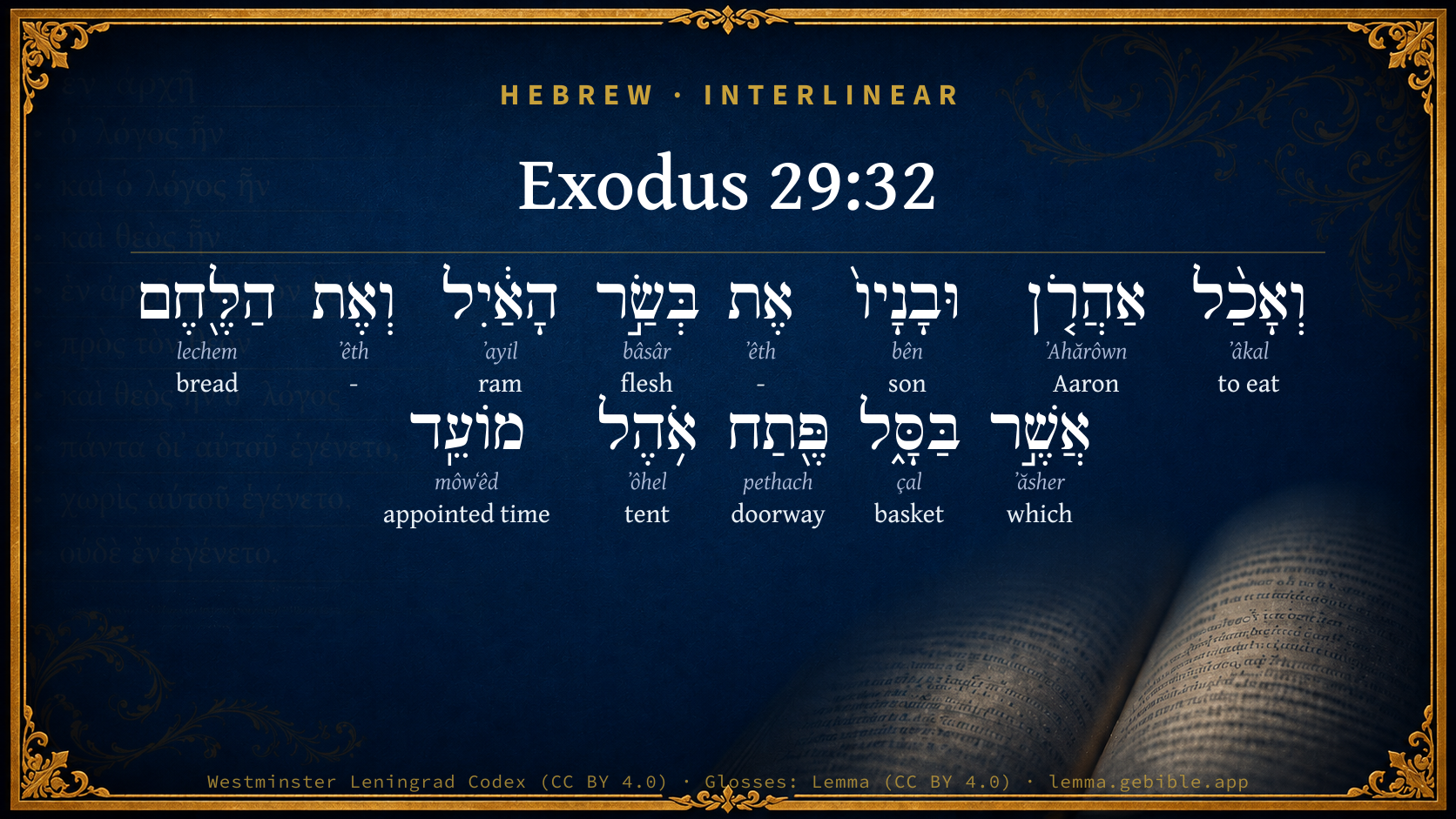
Hebrew (Westminster Leningrad Codex) Exodus 29:32 appears in the Hebrew Old Testament. The text above is from the Westminster Leningrad Codex. Each word links to its Strong’s number, a concise gloss, and parsing drawn from the Open Scriptures Hebrew Bible morphology. Click any word for its full Brown-Driver-Briggs (BDB) entry.
Download image
Cite this verse

Exodus 29:32 (World English Bible). Public Domain. Lemma interlinear Bible study tool, https://lemma.gebible.app/v/exodus/29/32.

Show BibTeX & RIS
BibTeX
RIS
English Translation
Aaron and his sons shall eat the flesh of the ram, and the bread that is in the basket, at the door of the tent of meeting.
World English Bible · Public Domain
Download a study sheet

One document with this verse’s original text, its word-by-word gloss line, the meaning frame, cross-references with their text, attributed commentary, and full source and license credits — printable, and it pastes into notes with its structure intact.

This verse Autodidact and up

Study sheet (.html) Plain text (.txt)

A passage Seminary Student

Up to 50 verses in one chapter. A passage sheet keeps up to 6 commentary sources and 12 cross-references per verse, in the order this page ranks them, and says so on the sheet whenever that leaves anything out. Ask for a single verse and you get the Autodidact verse sheet above.

Everything on this page stays free to read, with no account — the sheet is a download of what is already on screen, not access to it.

Want to remove ads? Support Godless Engineer
Compare translations 3

The same verse in 3 English versions, stacked beneath the original-language interlinear above. Click any original word for its lexicon entry.

Each is an independent rendering of the whole verse — the interlinear is not word-aligned to these translations.

Highlighted words mark where these versions differ — a whole-verse word diff, not a word-by-word alignment.

  • World English Bible Public Domain
    Aaron and his sons shall eat the flesh of the ram, and the bread that is in the basket, at the door of the tent of meeting.
  • King James Version Public Domain
    And Aaron and his sons shall eat the flesh of the ram, and the bread that is in the basket by the door of the tabernacle of the congregation.
  • unfoldingWord Literal Text CC BY-SA 4.0
    And Aaron and his sons shall eat the meat of the ram and the bread that is in the basket at the entrance to the tent of meeting.

unfoldingWord Literal Text — © unfoldingWord, licensed CC BY-SA 4.0. Word-aligned USFM3 via Door43 (git.door43.org/unfoldingWord/en_ult).

Versions to compare (up to 4)

3 of 4 selected

Show all 18 translations

Every available English version of this verse, each an independent rendering of the whole verse.

  • World English Bible Public Domain
    Aaron and his sons shall eat the flesh of the ram, and the bread that is in the basket, at the door of the tent of meeting.
  • Berean Standard Bible Public Domain
    At the entrance to the Tent of Meeting, Aaron and his sons are to eat the meat of the ram and the bread that is in the basket.
  • Majority Standard Bible Public Domain
    At the entrance to the Tent of Meeting, Aaron and his sons are to eat the meat of the ram and the bread that is in the basket.
  • King James Version Public Domain
    And Aaron and his sons shall eat the flesh of the ram, and the bread that is in the basket by the door of the tabernacle of the congregation.
  • American Standard Version (1901) Public Domain
    And Aaron and his sons shall eat the flesh of the ram, and the bread that is in the basket, at the door of the tent of meeting.
  • Revised Version (1885) Public Domain
    And Aaron and his sons shall eat the flesh of the ram, and the bread that is in the basket, at the door of the tent of meeting.
  • Geneva Bible (1599) Public Domain
    And Aaron and his sonnes shall eate the flesh of the ram, and the bread that is in the basket, at the doore of ye Tabernacle of ye Congregation.
  • Douay-Rheims (1899) Public Domain
    And Aaron and his sons shall eat it. The loaves also, that are in the basket, they shall eat in the entry of the tabernacle of the testimony,
  • Young's Literal Translation Public Domain
    and Aaron hath eaten -- his sons also -- the flesh of the ram, and the bread which `is' in the basket, at the opening of the tent of meeting;
  • Literal Standard Version CC BY-SA 4.0
    and Aaron has eaten—his sons also—the flesh of the ram, and the bread which [is] in the basket, at the opening of the Tent of Meeting;
  • Unlocked Literal Bible CC BY-SA 4.0
    Aaron and his sons must eat the ram's meat and the bread that is in the basket at the entrance to the tent of meeting.
  • unfoldingWord Literal Text CC BY-SA 4.0
    And Aaron and his sons shall eat the meat of the ram and the bread that is in the basket at the entrance to the tent of meeting.
  • Darby Bible Public Domain
    And Aaron and his sons shall eat the flesh of the ram, and the bread that is in the basket, at the entrance of the tent of meeting.
  • World Messianic Bible Public Domain
    Aaron and his sons shall eat the meat of the ram, and the bread that is in the basket, at the door of the Tent of Meeting.
  • Webster's Bible Public Domain
    And Aaron and his sons shall eat the flesh of the ram, and the bread that is in the basket, by the door of the tabernacle of the congregation.
  • Free Bible Version CC BY-SA 4.0
    Aaron and his sons are to eat the ram's meat, and the bread that is in the basket, at the entrance to the Tent of Meeting.
  • Bible in Basic English Public Domain
    And let Aaron and his sons make a meal of it, with the bread in the basket, at the door of the Tent of meeting.
  • JPS Tanakh (1917) Public Domain
    And Aaron and his sons shall eat the flesh of the ram, and the bread that is in the basket, at the door of the tent of meeting.

Literal Standard Version (2020), Covenant Press — licensed CC BY-SA 4.0. Text via the HelloAO Bible API (eBible.org). Unlocked Literal Bible (unfoldingWord) — licensed CC BY-SA 4.0. Text via the HelloAO Bible API (eBible.org). unfoldingWord Literal Text — © unfoldingWord, licensed CC BY-SA 4.0. Word-aligned USFM3 via Door43 (git.door43.org/unfoldingWord/en_ult). Free Bible Version, Dr. Jonathan Gallagher — licensed CC BY-SA 4.0. Text via the HelloAO Bible API (eBible.org).

Word by word

More ways to search: Search by grammar → Find every occurrence → Compare this word →

Practice this passage: Drill this verse → Learn its vocabulary →

בַּסָּ֑ל
çal
H5536
“in/at the · basket”
Preposition, Determined + Noun, Common, Masculine, Singular, Absolute
Part of Speech
Preposition + Noun
Type
Common
Gender
Masculine
Number
Singular
State
Absolute
Full BDB Definition

Origin: from H5549

TWOT: 1507a

basket
  1. וְאָכַ֨ל ʼâkal H398 “and · to eat” Conjunction + Verb, Qal, Sequential Perfect, 3rd Person, Masculine, Singular
  2. אַהֲרֹ֤ן ʼAhărôwn H175 “Aaron” Noun, Proper
  3. וּבָנָיו֙ bên H1121 “and · sons · his” Conjunction + Noun, Common, Masculine, Plural, Construct + Suffix, Personal, 3rd Person, Masculine, Singular
  4. אֶת ʼêth H853 “-” Particle, Direct Object
  5. בְּשַׂ֣ר bâsâr H1320 “flesh of” Noun, Common, Masculine, Singular, Construct
  6. הָאַ֔יִל ʼayil H352 “the · ram” Particle, Definite Article + Noun, Common, Masculine, Singular, Absolute
  7. וְאֶת ʼêth H853 “and · -” Conjunction + Particle, Direct Object
  8. הַלֶּ֖חֶם lechem H3899 “the · bread” Particle, Definite Article + Noun, Common, Both, Singular, Absolute
  9. אֲשֶׁ֣ר ʼăsher H834 “which” Particle, Relative
  10. פֶּ֖תַח pethach H6607 “doorway of” Noun, Common, Masculine, Singular, Construct
  11. אֹ֥הֶל ʼôhel H168 “tent of” Noun, Common, Masculine, Singular, Construct
  12. מוֹעֵֽד môwʻêd H4150 “appointed time” Noun, Common, Masculine, Singular, Absolute

About this verse

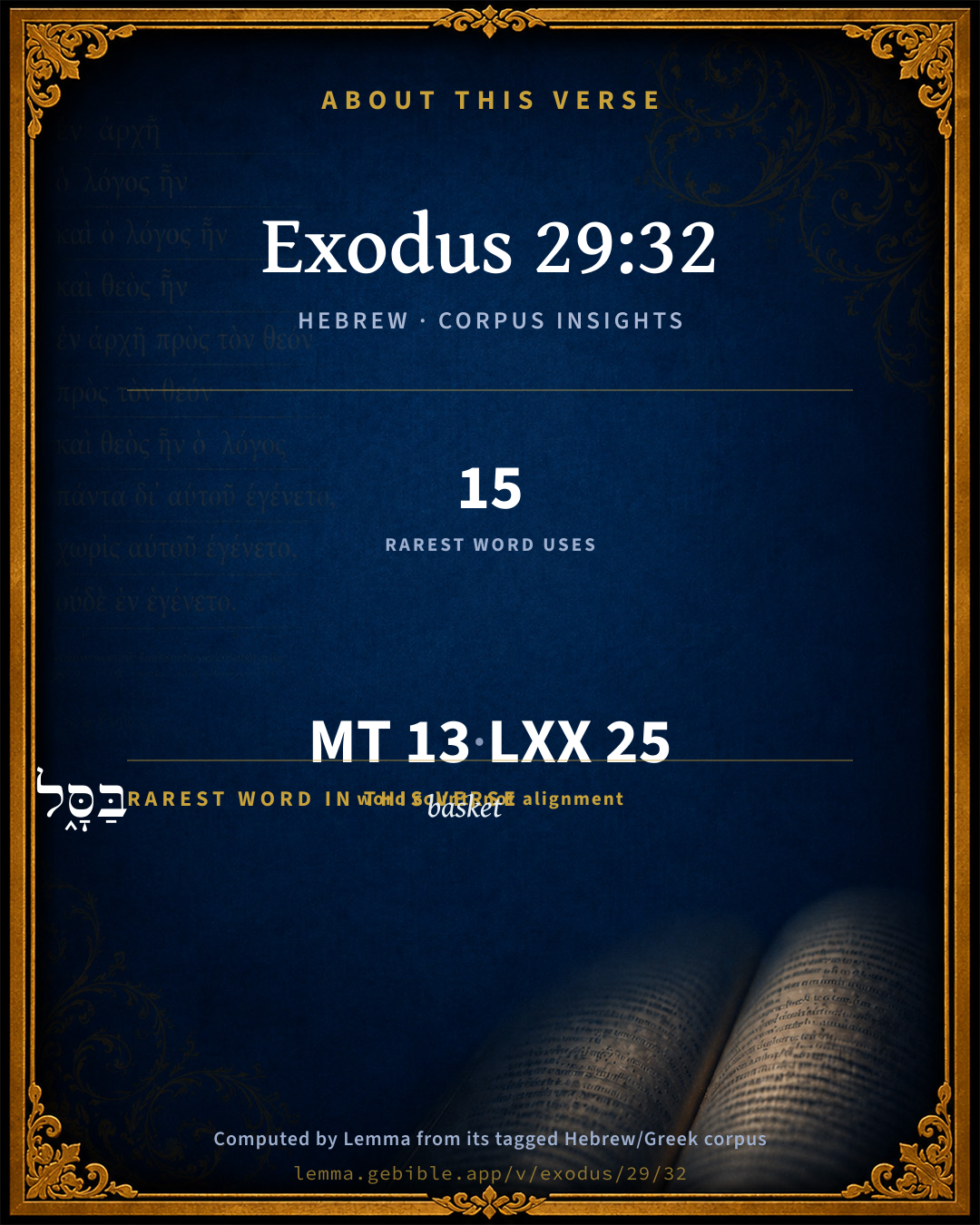
These counts appear in no published source. They are computed here, from the morphology-tagged text and Lemma’s own curated glosses. What Lemma adds →

13
words
12
distinct lemmas
Pentateuch
section

Notable vocabulary

The rarest word here is בַּסָּ֑ל basket H5536 — appearing just 15 times in the whole Hebrew Bible.

Shared distinctive vocabulary

בַּסָּ֑ל basket H5536 occurs in 13 verses of the Hebrew Bible. Also found in:

Grammatical profile

  • 1 verb
  • 9 nouns
  • 3 particles

Verb forms

  • וְאָכַ֨ל Qal · Sequential Perfect

Hebrew & Septuagint length

In English translation the verse runs 27 words from the Hebrew and 26 from the Septuagint (LXX English) — closely comparable.

A rough comparison of the two English renderings, which tokenize alike — not a word-level alignment.

Word counts can differ between the Hebrew and the Greek without any difference in meaning — e.g. the Hebrew direct-object marker אֵת has no separate Greek word, and Greek often adds the article ὁ.

In the original languages it is 13 Hebrew tokens and 25 Greek tokens — but the two are counted differently (Hebrew bundles its prefixes and suffixes into one token; the Greek is in lemma form), so that isn’t a like-for-like length.

Cross-references

5

Topical passages linked to Exodus 29:32 in the Treasury of Scripture Knowledge — connected by theme and wording, ordered by reader-vote popularity; previews shown in the World English Bible.

  • Matthew 12:4 how he entered into the house of God, and ate the show bread, which was not lawful for him to eat, neither for those who were with him, but only for the priests?
  • Exodus 24:9–11 Then Moses, Aaron, Nadab, Abihu, and seventy of the elders of Israel went up.
  • Exodus 29:2–3 unleavened bread, unleavened cakes mixed with oil, and unleavened wafers anointed with oil: you shall make them of fine wheat flour.
  • Exodus 29:23 and one loaf of bread, one cake of oiled bread, and one wafer out of the basket of unleavened bread that is before Yahweh.
  • Leviticus 10:12–14 Moses spoke to Aaron, and to Eleazar and to Ithamar, his sons who were left, "Take the meal offering that remains of the offerings of Yahweh made by fire, and eat it without yeast beside the altar; for it is most holy;

Cross-references courtesy of OpenBible.info (CC BY 4.0).

Hebrew and Greek witnesses Masoretic Hebrew ↔ Greek Septuagint

The same verse in the two great witnesses to the Old Testament, shown verse-for-verse.

These are two independent witnesses, not word-aligned to each other, and the Septuagint is shown in lemma (dictionary) form.

Hebrew Exodus 29:32 Masoretic · Westminster Leningrad Codex

וְאָכַ֨ל אַהֲרֹ֤ן וּבָנָיו֙ אֶת בְּשַׂ֣ר הָאַ֔יִל וְאֶת הַלֶּ֖חֶם אֲשֶׁ֣ר בַּסָּ֑ל פֶּ֖תַח אֹ֥הֶל מוֹעֵֽד

Aaron and his sons shall eat the flesh of the ram, and the bread that is in the basket, at the door of the tent of meeting.

World English Bible · Public Domain

Greek LXX Exodus 29:32 Septuagint · lemma form

καί ἐσθίω ααρων καί ὁ υἱός αὐτός ὁ κρέας ὁ κριός καί ὁ ἄρτος ὁ ἐν ὁ κανοῦν παρά ὁ θύρα ὁ σκηνή ὁ μαρτύριον

And Aaron and his sons shall eat the flesh of the ram, and the loaves in the basket, by the doors of the tabernacle of witness.

LXX2012 (modern English Septuagint) · Public Domain

Hebrew: Westminster Leningrad Codex (CC BY 4.0). Greek: Septuagint (public domain); English from LXX2012 (modern English Septuagint) (Public Domain). How the Septuagint differs from the Hebrew →

Targum (Aramaic paraphrase)

2

The Targum is the ancient Jewish Aramaic paraphrase of the Hebrew Scriptures — an interpretive translation, not the Hebrew text itself. Onkelos (literal) and Pseudo-Jonathan (expansive) render the Torah, and Jonathan the Prophets. Coverage is partial: where no permissively-licensed English translation exists for a verse, only the Aramaic is shown. This is verse-level text, not a word-by-word alignment to the Hebrew.

  1. Targum Onkelos Torah (Genesis–Deuteronomy)
    וְיֵכוּל אַהֲרֹן וּבְנוֹהִי יָת בְּסַר דִכְרָא וְיָת לַחְמָא דִי בְסַלָא לִתְרַע מַשְׁכַּן זִמְנָא:

    (no public-domain English translation for this verse)

    Targum Onkelos — Aramaic: “Onkelos Genesis” (public domain); “Onkelos Exodus” (public domain); “Onkelos Leviticus” (public domain); “Onkelos Numbers” (public domain); “Onkelos Deuteronomy” (public domain). English: “Sefaria Community Translation” (CC0 1.0 (public-domain dedication)); “J.W. Etheridge. The Targums of Onkelos and Jonathan Ben Uzziel on the Pentateuch. London: Longmans, Green, 1862” (public domain). Text via Sefaria.

  2. Targum Pseudo-Jonathan Torah (Genesis–Deuteronomy)
    וְיֵיכוֹל אַהֲרן וּבְנוֹי יַת בִּישְרָא דְדִיכְרָא וְיַת לַחֲמָא דִי בְסַלָא בִּתְרַע מַשְׁכַּן זִימְנָא

    and Aharon and his sons shall eat the flesh of the ram, and the bread that is in the basket at the door of the tabernacle of ordinance.

    Targum Pseudo-Jonathan — Aramaic: “Targum Jonathan on Genesis” (public domain); “Targum Jonathan on Exodus” (public domain); “Targum Jonathan on Leviticus” (public domain); “Targum Jonathan on Numbers” (public domain); “Targum Jonathan on Deuteronomy” (public domain). English: “The Targum of Jonathan ben Uzziel, trans. J. W. Etheridge, London, 1862” (public domain). Text via Sefaria.

Commentary

Notes on Exodus 29:32 from classic Christian and Jewish commentators (each source and its license shown beneath its notes). The classic Christian expositions comment on the surrounding passage and are grouped to its opening verse, so a note may address several verses; the Jewish commentaries on the Tanakh (Rashi and others) are per-verse, so they appear only where the commentator wrote on this verse.

Lemma curates 59 commentaries, every one of them public domain or Creative Commons licensed, each selected and text-cleaned for this edition rather than reprinted as found. About our sources →

Tyndale Open Study Notes

Tyndale Open Resources

29:32-34 Eating in the presence of the Lord signified an intimate relationship with him (as in 24:9-11).

Tyndale Open Study Notes — © Tyndale Open Resources, licensed CC BY-SA 4.0. Text via the HelloAO Bible API.

The Cambridge Bible for Schools and Colleges

gen. ed. J. J. S. Perowne

32. that is in, &c.] that remains in it after the things mentioned in v. 23 have been taken from it.

The Cambridge Bible for Schools and Colleges (gen. ed. J. J. S. Perowne; Cambridge University Press, 1878–1918) — public domain. Text from a community e-Sword module.

John Gill's Exposition

And Aaron and his sons shall eat of the flesh of the ram,.... Typical of the flesh of Christ, whose flesh is meat indeed, and to be eaten by faith, whereby it becomes spiritual food, savoury and nourishing, as it is to all the Lord's priests, or who are made so to God:

and the bread that is in the basket; the unleavened bread, cakes, and wafers, Exo 29:2, what was left of them, one loaf, one cake, and one wafer, having been put into the hands of Aaron and his sons, and received from them and burnt, Exo 29:23 this may figure Christ the bread of life, held forth in the ministry of the word, for believers in him to feed upon; which basket of bread was

by the door of the tabernacle of the congregation; the whole court, Jarchi says, was so called, where the people in common assembled, and the Lord met with them; and so may point at the public ordinances, where Christ is set forth as food for souls.

John Gill's Exposition of the Whole Bible (1746–1763) — public domain (CC PDM 1.0). Text via the HelloAO Bible API.

The Pulpit Commentary

The bread that is in the basketi.e. , the loaf, cake, and wafer which still remained in the basket after one of each had been subtracted (see ver. 23, and compare vers. 2, 3).

The Pulpit Commentary (1880–1919), ed. H.D.M. Spence-Jones & Joseph S. Exell — public domain. Text from a community e-Sword module.

Rashi

Rabbi Shlomo Yitzchaki (Rashi)

פתח אהל מועד BY THE ENTRANCE OF THE APPOINTED TENT — the whole court is thus named (cf. Rashi on Exodus 29:11).

Rashi on the Tanakh — English translations: “The Judaica Press complete Tanach with Rashi, translated by A. J. Rosenberg” (CC BY 4.0); “Pentateuch with Rashi's commentary by M. Rosenbaum and A.M. Silbermann, 1929-1934” (public domain); “The Metsudah Tanach series, Lakewood, N.J” (CC BY 4.0); and “The Book of Joshua, Metsudah Publications, 1997” (CC BY 4.0). Text via Sefaria.

Lesson kit

Teaching starters — assembled from the data on this page, not authored interpretation. Every prompt links to the verse data it draws on. Edit before teaching.

Exodus, in the Pentateuch, opens this verse with 13 words (12 distinct Hebrew lemmas). Its most distinctive word is çal (“basket”). A historical commentator’s framing appears above. Read the whole chapter for the surrounding context.

Discussion questions

  1. The word çal carries the sense “basket.” How does it shape the verse?
  2. Genesis 40:16 shares the word «basket» with this verse. How do the two illuminate each other?
  3. These translations render this verse differently; the difference is in the English rendering, not the original. What questions does that raise?
  4. The verb «וְאָכַ֨ל» is Qal Sequential Perfect. How does its form color the action?
  5. Reading how Tyndale Open Study Notes and The Cambridge Bible for Schools and Colleges read this verse, where do the two commentators agree and where do they part?

Things to notice

Reading settings

Reading text

Shown beneath each verse's original-language words.

Old Testament
Old Testament edition

Read the OT as the Masoretic Hebrew (MT) or the Greek Septuagint (LXX).

English shown for the Greek Septuagint (in the Hebrew ↔ Greek comparison).

Comparing translations? Open the Compare panel on any verse page to stack up to four side by side.