
Zephaniah 1:17

Hebrew (Westminster Leningrad Codex) Zephaniah 1:17 appears in the Hebrew Old Testament. The text above is from the Westminster Leningrad Codex. Each word links to its Strong’s number, a concise gloss, and parsing drawn from the Open Scriptures Hebrew Bible morphology. Click any word for its full Brown-Driver-Briggs (BDB) entry.
Download image
Cite this verse

Zephaniah 1:17 (World English Bible). Public Domain. Lemma interlinear Bible study tool, https://lemma.gebible.app/v/zephaniah/1/17.

Show BibTeX & RIS
BibTeX
RIS
English Translation
I will bring distress on men, that they will walk like blind men, because they have sinned against Yahweh, and their blood will be poured out like dust, and their flesh like dung.
World English Bible · Public Domain
Download a study sheet

One document with this verse’s original text, its word-by-word gloss line, the meaning frame, cross-references with their text, attributed commentary, and full source and license credits — printable, and it pastes into notes with its structure intact.

This verse Autodidact and up

Study sheet (.html) Plain text (.txt)

A passage Seminary Student

Up to 50 verses in one chapter. A passage sheet keeps up to 6 commentary sources and 12 cross-references per verse, in the order this page ranks them, and says so on the sheet whenever that leaves anything out. Ask for a single verse and you get the Autodidact verse sheet above.

Everything on this page stays free to read, with no account — the sheet is a download of what is already on screen, not access to it.

Want to remove ads? Support Godless Engineer
Compare translations 3

The same verse in 3 English versions, stacked beneath the original-language interlinear above. Click any original word for its lexicon entry.

Each is an independent rendering of the whole verse — the interlinear is not word-aligned to these translations.

Highlighted words mark where these versions differ — a whole-verse word diff, not a word-by-word alignment.

  • World English Bible Public Domain
    I will bring distress on men, that they will walk like blind men, because they have sinned against Yahweh, and their blood will be poured out like dust, and their flesh like dung.
  • King James Version Public Domain
    And I will bring distress upon men, that they shall walk like blind men, because they have sinned against the LORD: and their blood shall be poured out as dust, and their flesh as the dung.
  • unfoldingWord Literal Text CC BY-SA 4.0
    For I will bring distress to man, and they will walk like the blind, for they have sinned against Yahweh. And their blood will be poured out like dust, and their innards like dung.

unfoldingWord Literal Text — © unfoldingWord, licensed CC BY-SA 4.0. Word-aligned USFM3 via Door43 (git.door43.org/unfoldingWord/en_ult).

Versions to compare (up to 4)

3 of 4 selected

Show all 18 translations

Every available English version of this verse, each an independent rendering of the whole verse.

  • World English Bible Public Domain
    I will bring distress on men, that they will walk like blind men, because they have sinned against Yahweh, and their blood will be poured out like dust, and their flesh like dung.
  • Berean Standard Bible Public Domain
    I will bring such distress on mankind that they will walk like the blind, because they have sinned against the LORD. Their blood will be poured out like dust and their flesh like dung.
  • Majority Standard Bible Public Domain
    I will bring such distress on mankind that they will walk like the blind, because they have sinned against the LORD. Their blood will be poured out like dust and their flesh like dung.
  • King James Version Public Domain
    And I will bring distress upon men, that they shall walk like blind men, because they have sinned against the LORD: and their blood shall be poured out as dust, and their flesh as the dung.
  • American Standard Version (1901) Public Domain
    And I will bring distress upon men, that they shall walk like blind men, because they have sinned against Jehovah; and their blood shall be poured out as dust, and their flesh as dung.
  • Revised Version (1885) Public Domain
    And I will bring distress upon men, that they shall walk like blind men, because they have sinned against the LORD: and their blood shall be poured out as dust, and their flesh as dung.
  • Geneva Bible (1599) Public Domain
    And I will bring distresse vpon men, that they shall walke like blind men, because they haue sinned against the Lord, and their blood shall be powred out as dust, and their flesh as the dongue.
  • Douay-Rheims (1899) Public Domain
    And I will distress men, and they shall walk like blind men, because they have sinned against the Lord: and their blood shall be poured out as earth, and their bodies as dung.
  • Young's Literal Translation Public Domain
    And I have sent distress to men, And they have walked as the blind, For against Jehovah they have sinned, And poured out is their blood as dust, And their flesh `is' as dung.
  • Literal Standard Version CC BY-SA 4.0
    “And I have sent distress to men, || And they have walked as the blind, || For against YHWH they have sinned, || And poured out is their blood as dust, || And their flesh [is] as dung.”
  • Unlocked Literal Bible CC BY-SA 4.0
    For I will bring distress upon mankind, so that they will walk about like blind men since they have sinned against Yahweh. Their blood will be poured out like dust, and their inner parts like dung.
  • unfoldingWord Literal Text CC BY-SA 4.0
    For I will bring distress to man, and they will walk like the blind, for they have sinned against Yahweh. And their blood will be poured out like dust, and their innards like dung.
  • Darby Bible Public Domain
    And I will bring distress upon men, and they shall walk like blind men; for they have sinned against Jehovah; and their blood shall be poured out as dust, and their flesh as dung:
  • World Messianic Bible Public Domain
    I will bring such distress on men that they will walk like blind men because they have sinned against the LORD. Their blood will be poured out like dust and their flesh like dung.
  • Webster's Bible Public Domain
    And I will bring distress upon men, that they shall walk like blind men, because they have sinned against the LORD: and their blood shall be poured out as dust, and their flesh as the dung.
  • Free Bible Version CC BY-SA 4.0
    I will bring trouble on humanity, making them walk like blind people because they have sinned against the Lord. Their blood will be spilled like so much dust; their intestines like dung.
  • Bible in Basic English Public Domain
    And I will send trouble on men so that they will go about like the blind, because they have done evil against the Lord: and their blood will be drained out like dust, and their strength like waste.
  • JPS Tanakh (1917) Public Domain
    And I will bring distress upon men, that they shall walk like the blind, because they have sinned against the LORD; and their blood shall be poured out as dust, and their flesh as dung.

Literal Standard Version (2020), Covenant Press — licensed CC BY-SA 4.0. Text via the HelloAO Bible API (eBible.org). Unlocked Literal Bible (unfoldingWord) — licensed CC BY-SA 4.0. Text via the HelloAO Bible API (eBible.org). unfoldingWord Literal Text — © unfoldingWord, licensed CC BY-SA 4.0. Word-aligned USFM3 via Door43 (git.door43.org/unfoldingWord/en_ult). Free Bible Version, Dr. Jonathan Gallagher — licensed CC BY-SA 4.0. Text via the HelloAO Bible API (eBible.org).

Word by word

More ways to search: Search by grammar → Find every occurrence → Compare this word →

Practice this passage: Drill this verse → Learn its vocabulary →

וּלְחֻמָ֖ם
lâchûwm
H3894
“and · bowels · their”
Conjunction + Noun, Common, Masculine, Singular, Construct + Suffix, Personal, 3rd Person, Masculine, Plural
Part of Speech
Conjunction + Noun
Type
Common
Gender
Masculine
Number
Singular
State
Construct
Full BDB Definition

Origin: passive participle of H3898

TWOT: 1104b

intestines, bowels - meaning uncertain - (CLBL) food, something eaten
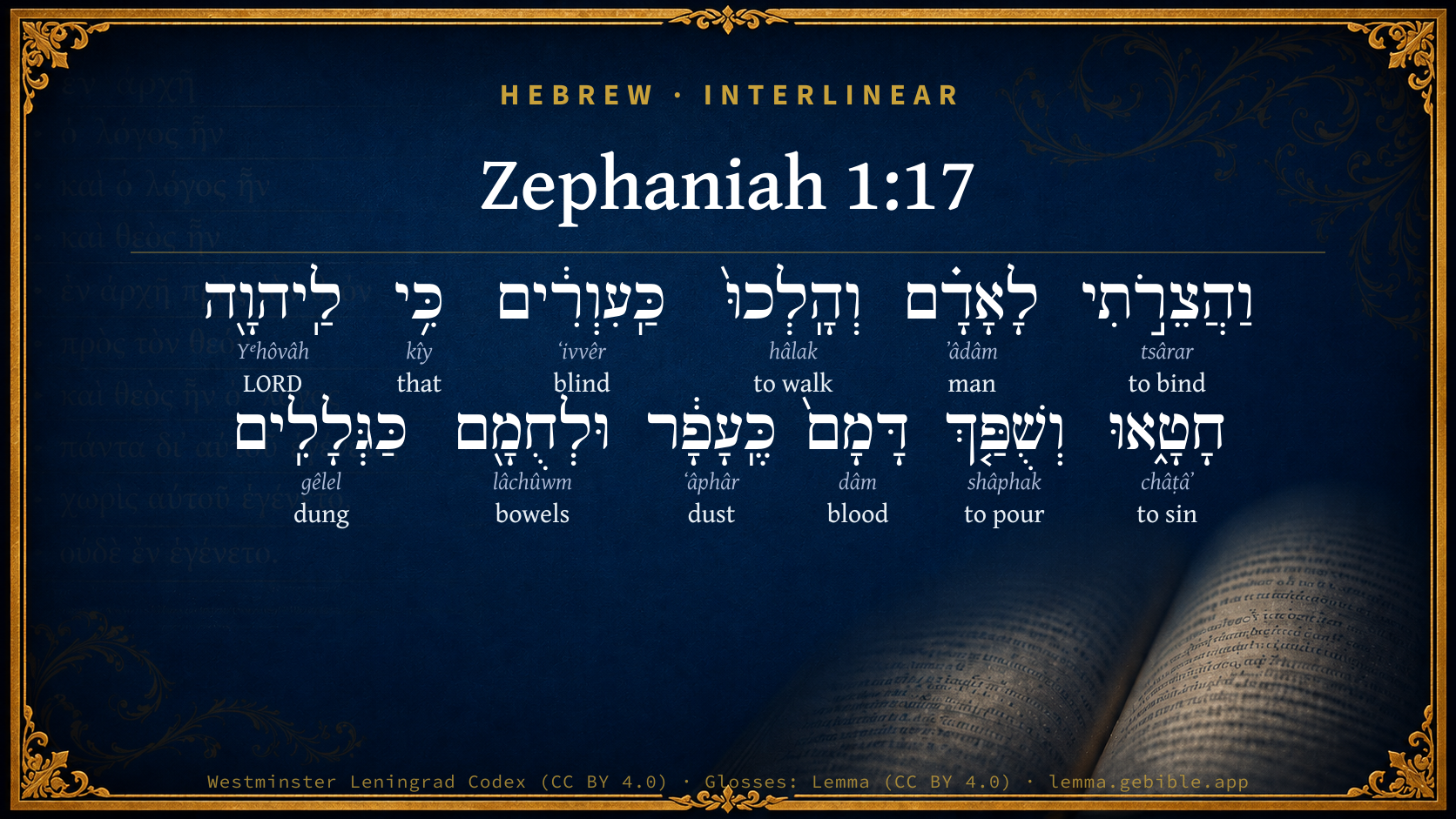
  1. וַהֲצֵרֹ֣תִי tsârar H6887 “and · to bind” Conjunction + Verb, Hiphil, Sequential Perfect, 1st Person, Common, Singular
  2. לָאָדָ֗ם ʼâdâm H120 “to/for the · man” Preposition, Determined + Noun, Common, Masculine, Singular, Absolute
  3. וְהָֽלְכוּ֙ hâlak H1980 “and · to walk” Conjunction + Verb, Qal, Sequential Perfect, 3rd Person, Common, Plural
  4. כַּֽעִוְרִ֔ים ʻivvêr H5787 “like/as the · blind” Preposition, Determined + Adjective, Adjective, Masculine, Plural, Absolute
  5. כִּ֥י kîy H3588 “that” Conjunction
  6. לַֽיהוָ֖ה Yᵉhôvâh H3068 “to/for · LORD” Preposition + Noun, Proper
  7. חָטָ֑אוּ châṭâʼ H2398 “to sin” Verb, Qal, Perfect, 3rd Person, Common, Plural
  8. וְשֻׁפַּ֤ךְ shâphak H8210 “and · to pour” Conjunction + Verb, Qal Passive, Sequential Perfect, 3rd Person, Masculine, Singular
  9. דָּמָם֙ dâm H1818 “blood · their” Noun, Common, Masculine, Singular, Construct + Suffix, Personal, 3rd Person, Masculine, Plural
  10. כֶּֽעָפָ֔ר ʻâphâr H6083 “like/as the · dust” Preposition, Determined + Noun, Common, Masculine, Singular, Absolute
  11. כַּגְּלָלִֽים gêlel H1561 “like/as the · dung” Preposition, Determined + Noun, Common, Masculine, Plural, Absolute

About this verse

These counts appear in no published source. They are computed here, from the morphology-tagged text and Lemma’s own curated glosses. What Lemma adds →

12
words
12
distinct lemmas
Prophets
section

Notable vocabulary

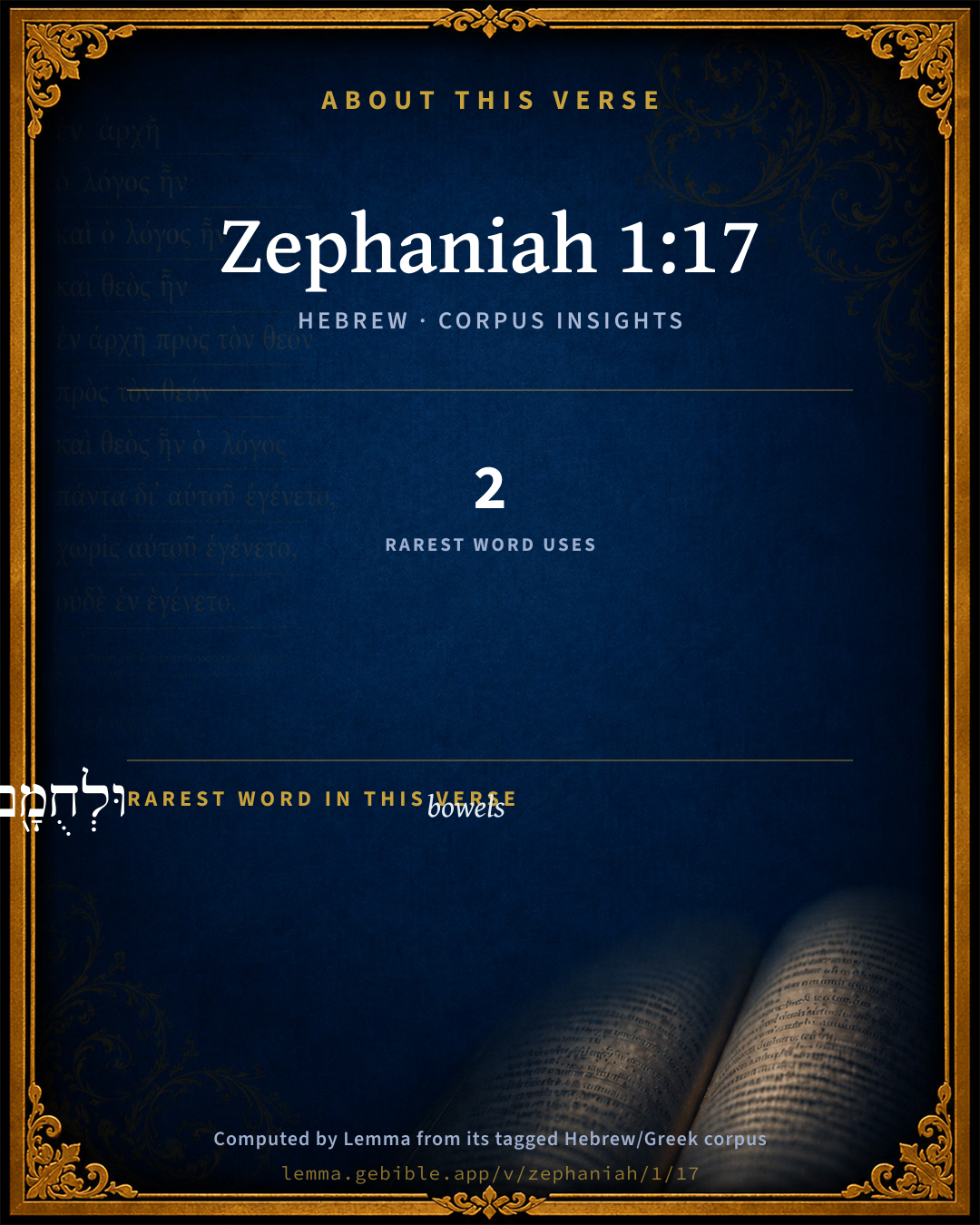
The rarest word here is וּלְחֻמָ֖ם bowels H3894 — appearing just 2 times in the whole Hebrew Bible.

Shared distinctive vocabulary

וּלְחֻמָ֖ם bowels H3894 occurs in 2 verses of the Hebrew Bible. Also found in:

Grammatical profile

  • 4 verbs
  • 6 nouns
  • 1 adjective
  • 1 conjunction

Verb forms

  • וַהֲצֵרֹ֣תִי Hiphil · Sequential Perfect
  • וְהָֽלְכוּ֙ Qal · Sequential Perfect
  • חָטָ֑אוּ Qal · Perfect
  • וְשֻׁפַּ֤ךְ Qal Passive · Sequential Perfect

Hebrew & Septuagint length

In English translation the verse runs 33 words from the Hebrew and 35 from the Septuagint (LXX English) — closely comparable.

A rough comparison of the two English renderings, which tokenize alike — not a word-level alignment.

Word counts can differ between the Hebrew and the Greek without any difference in meaning — e.g. the Hebrew direct-object marker אֵת has no separate Greek word, and Greek often adds the article ὁ.

Cross-references

12

Topical passages linked to Zephaniah 1:17 in the Treasury of Scripture Knowledge — connected by theme and wording, ordered by reader-vote popularity; previews shown in the World English Bible.

  • Psalms 83:10 Who perished at Endor, Who became as dung for the earth.
  • Revelation 3:17 Because you say, 'I am rich, and have gotten riches, and have need of nothing;' and don't know that you are the wretched one, miserable, poor, blind, and naked;
  • Jeremiah 2:17 Haven't you procured this to yourself, in that you have forsaken Yahweh your God, when he led you by the way?
  • Jeremiah 10:18 For thus says Yahweh, Behold, I will sling out the inhabitants of the land at this time, and will distress them, that they may feel [it].
  • Micah 7:13 Yet the land will be desolate because of those who dwell therein, For the fruit of their doings.
  • Matthew 15:14 Leave them alone. They are blind guides of the blind. If the blind guide the blind, both will fall into a pit."
  • 2 Peter 1:9 For he who lacks these things is blind, seeing only what is near, having forgotten the cleansing from his old sins.
  • Isaiah 29:10 For Yahweh has poured out on you the spirit of deep sleep, and has closed your eyes, the prophets; and your heads, the seers, has he covered.
  • Jeremiah 4:18 Your way and your doings have procured these things to you; this is your wickedness; for it is bitter, for it reaches to your heart.
  • Lamentations 5:16–17 The crown is fallen from our head: Woe to us! for we have sinned.
  • Romans 11:7 What then? That which Israel seeks for, that he didn't obtain, but the chosen ones obtained it, and the rest were hardened.
  • 1 John 2:11 But he who hates his brother is in the darkness, and walks in the darkness, and doesn't know where he is going, because the darkness has blinded his eyes.

Cross-references courtesy of OpenBible.info (CC BY 4.0).

Hebrew and Greek witnesses Masoretic Hebrew ↔ Greek Septuagint

The same verse in the two great witnesses to the Old Testament, shown verse-for-verse.

These are two independent witnesses, not word-aligned to each other, and the Septuagint is shown in lemma (dictionary) form.

Hebrew Zephaniah 1:17 Masoretic · Westminster Leningrad Codex

וַהֲצֵרֹ֣תִי לָאָדָ֗ם וְהָֽלְכוּ֙ כַּֽעִוְרִ֔ים כִּ֥י לַֽיהוָ֖ה חָטָ֑אוּ וְשֻׁפַּ֤ךְ דָּמָם֙ כֶּֽעָפָ֔ר וּלְחֻמָ֖ם כַּגְּלָלִֽים

I will bring distress on men, that they will walk like blind men, because they have sinned against Yahweh, and their blood will be poured out like dust, and their flesh like dung.

World English Bible · Public Domain

Greek LXX Zephaniah 1:17 Septuagint · lemma form

καί ἐκθλίβω ὁ ἄνθρωπος καί πορεύομαι ὡς τυφλός ὅτι ὁ κύριος ἐκἁμαρτάνω καί ἐκχέω ὁ αἷμα αὐτός ὡς χοῦς καί ὁ σάρξ αὐτός ὡς βόλβιτον

And I will greatly afflict the men, and they shall walk as blind men, because they have sinned against the Lord; therefore he shall pour out their blood as dust, and their flesh as dung.

LXX2012 (modern English Septuagint) · Public Domain

Hebrew: Westminster Leningrad Codex (CC BY 4.0). Greek: Septuagint (public domain); English from LXX2012 (modern English Septuagint) (Public Domain). How the Septuagint differs from the Hebrew →

Targum (Aramaic paraphrase)

1

The Targum is the ancient Jewish Aramaic paraphrase of the Hebrew Scriptures — an interpretive translation, not the Hebrew text itself. Onkelos (literal) and Pseudo-Jonathan (expansive) render the Torah, and Jonathan the Prophets. Coverage is partial: where no permissively-licensed English translation exists for a verse, only the Aramaic is shown. This is verse-level text, not a word-by-word alignment to the Hebrew.

  1. Targum Jonathan Prophets (Joshua–Malachi)
    וְאָעִיק לִבְנֵי אֱנָשָׁא וְיַהֲכוֹן כְּסָמָן אֲרֵי קֳדָם יְיָ חָבוּ וְיִשְׁתְּפַךְ דִמְהוֹן לְעַפְרָא וּנְבַלְתְּהוֹן כְּסָחִיתָא:

    (no public-domain English translation for this verse)

    Targum Jonathan — Aramaic: “Mikraot Gedolot” (public domain). English: “Sefaria Community Translation” (CC0 1.0 (public-domain dedication)); “London "Chaldee Paraphrase," 1871” (public domain). Text via Sefaria.

Commentary

Notes on Zephaniah 1:17 from classic Christian and Jewish commentators (each source and its license shown beneath its notes). The classic Christian expositions comment on the surrounding passage and are grouped to its opening verse, so a note may address several verses; the Jewish commentaries on the Tanakh (Rashi and others) are per-verse, so they appear only where the commentator wrote on this verse.

Lemma curates 59 commentaries, every one of them public domain or Creative Commons licensed, each selected and text-cleaned for this edition rather than reprinted as found. About our sources →

Trapp's Complete Commentary

John Trapp

Zep 1:17 And I will bring distress upon men, that they shall walk like blind men, because they have sinned against the LORD: and their blood shall be poured out as dust, and their flesh as the dung.

Ver. 17. And I will bring distress upon men, that they shall walk like blind men] The Dutch have a proverb, God puts out the eyes of him whom he intendeth to destroy; i.e. he besots and infatuates them, they shall be consilii et auxilii inopes: in rebus liquidis aqua haerebit: they grope for the wall like the blind, they grope as if they had no eyes: they stumble at noon day as in the night; they are in desolate places as dead men, Isa 59:10. This was long before threatened, Deu 28:28-29.

Because they have sinned against the Lord] Sin is the mother of misery. See my Lovetokens.

And their blood shall be poured out as dust] Than which nothing is more vile and abject; the enemy shall make no more of spilling their blood than of sprinkling a little dust, Copiosissime et abiectissime most richly and lowly. (Turner.)

And their flesh as dung] Spread upon the land to manure it. The Hebrew word for flesh here may seem to signify worms’ meat. Our bodies are no better, why then do we pamper and pink them up?

John Trapp, A Commentary or Exposition upon All the Books of the Old and New Testament (1647–1656) — public domain. Text from a community e-Sword module.

The Biblical Illustrator

Joseph S. Exell

Zep_1:17

They shall walk like blind men.

The sinner a blind traveller

The sinner is on a journey, step by step he is moving on to a destination. But how does he walk? The text tells us as a blind man. How does the blind man walk?

I. Unnaturally. Though a few men may be born blind, vision is one of the chief attributes of humanity. Without the human eye all the beauties of nature would go for nothing. Blindness is unnatural. So is sin. The life of sin is a life of unnaturalness.

II. Privationally. What does the blind lose? The great world of beauty and sublimity, the great firmament of burning worlds, and all the exquisite and exhilarating sensations of vision are excluded from him. What does the sinner lose? Peace of conscience--harmony of feeling--fellowship with the Infinite--power over death--a blessed hope of heaven, etc.

III. Servilely. The blind man must slavishly depend on others to guide him on his way. We have seen him feeling his way with a stick, led by a little child, and sometimes dependent even on a dog. The sinner, however he may boast of his independence, is a slave to the world. He is the servant of sin, a tyrant. He has no true independence.

IV. Perilously. The blind man always feels himself in danger when alone. The sinners walk is perilous indeed. His danger is great--ever accumulating, and ever approaching. Such then is the walk of the sinner. But moral blindness is worse far than corporeal.

1. The one is a calamity, the other is a crime.

2. The one is to be pitied, the other is to be condemned.

3. The one can be turned to a good account, the other cannot. (Homilist.)

.

The Biblical Illustrator, edited by Joseph S. Exell (c. 1880s–1900s) — public domain. Text from a community e-Sword module.

Joseph Benson's Commentary

Zep 1:17-18. I will bring distress, &c., that they shall walk as blind men — I will bring them into such straits that they shall no more know whither to turn themselves, or which way to go for safety, than if they were blind: compare Deu 28:29, and Isa 59:10; in both which places the image is heightened by the circumstance of groping, or stumbling, like the blind, even at noon-day. And their blood shall be poured out as dust — That is, as if it were of no value at all; and their flesh as dung — The inhabitants of Jerusalem shall be slain in the streets of the city, and their carcasses left there to rot and putrefy. Neither their silver nor gold shall deliver them — This is spoken of the merchants, and other rich citizens. The whole land shall be devoured by the fire of his jealousy — God’s vengeance is frequently compared to fire: see Nah 1:6. This, it is here threatened, should consume the land and its inhabitants for their heinous offences, and chiefly for their idolatry; because that sin gives that honour which is only due to the one living and true God, to images, or fictitious gods, and therefore, in a peculiar manner, intrenches on God’s glory; is so contrary in its nature to the truth and fitness of things, and to all that is reasonable, just, and proper; has so great a tendency to corrupt and debase men’s minds, and the practice of it is so unfit in every point of view, that the Scriptures, to give men some idea how odious it is, and what a great provocation to the Most High, represent him as jealous of having that honour which is only due to him, given to another.

Joseph Benson's Commentary on the Old and New Testaments (1811–1818) — public domain. Text from a community e-Sword module.

Keil & Delitzsch

C. F. Keil & F. Delitzsch

In the midst of this tribulation the sinners will perish without counsel or help. Zep 1:17. "And I make it strait for men, and they will walk like blind men, because they have sinned against Jehovah; and their blood will be poured out like dust, and their flesh like dung. Zep 1:18. Even their silver, even their gold, will not be able to save them on the day of Jehovah's fury, and in the fire of His wrath will the whole earth be devoured; for He will make an end, yea a sudden one, to all the inhabitants of the earth." והצרתי reminds of the threat of Moses in Deu 28:52, to which Zephaniah alluded in Zep 1:16. And in הלכוּ כּעורים the allusion to Deu 28:29 is also unmistakeable. To walk like the blind, i.e., to seek a way out of the trouble without finding one. This distress God sends, because they have sinned against Him, by falling away from Him through idolatry and the transgression of His commandments, as already shown in Zep 1:4-12. But the punishment will be terrible. Their blood will be poured out like dust. The point of comparison is not the quantity, as in Gen 13:16 and others, but the worthlessness of dust, as in Kg2 13:7 and Isa 49:23. The blood is thought as little of as the dust which is trodden under foot. Lechūm, which occurs again in Job 20:23, means flesh (as in the Arabic), not food. The verb shâphakh, to pour out, is also to be taken per zeugma in connection with this clause, though without there being any necessity to associate it with Sa2 20:10, and regard lechūm as referring to the bowels. For the fact itself, compare Kg1 14:10 and Jer 9:21. In order to cut off all hope on deliverance from the rich and distinguished sinners, the prophet adds in Zep 1:18 : Even with silver and gold will they not be able to save their lives. The enemy will give no heed to this (cf. Isa 13:17; Jer 4:30; Eze 7:19) in the day that the Lord will pour out His fury upon the ungodly, to destroy the whole earth with the fire of His wrathful jealousy (cf. Deu 4:24). By kol-hâ'ârets we might understand the whole of the land of Judah, if we looked at what immediately precedes it. But if we bear in mind that the threat commenced with judgment upon the whole earth (Zep 1:2, Zep 1:3), and that it here returns to its starting-point, to round off the picture, there can be no doubt that the whole earth is intended. The reason assigned for this threat in Zep 1:18 is formed after Isa 10:23; but the expression is strengthened by the use of אך־נבהלה instead of ונחרצה, the word round in Isaiah. Kâlâh: the finishing stroke, as in Isaiah l.c. (see at Nah 1:8). אך, only, equivalent to "not otherwise than," i.e., assuredly. נבהלה is used as a substantive, and is synonymous with behâlâh, sudden destruction, in Isa 65:23. The construction with 'ēth accus. as in Nah 1:8.

Keil & Delitzsch — Biblical Commentary on the Old Testament (1861–1891) — public domain (CC PDM 1.0). Text via the HelloAO Bible API. (Old Testament only.)

Tyndale Open Study Notes

Tyndale Open Resources

1:17 grope around like the blind: An example of God’s justice (see also Rom 1:21-32). Because God’s people were blind ethically and spiritually (see Exod 23:8; Rom 2:19; 1 Jn 2:11) and had sinned against the Lord and his commandments, they would incur the just penalties specified in God’s covenant with them (Deut 28:28-29).

Tyndale Open Study Notes — © Tyndale Open Resources, licensed CC BY-SA 4.0. Text via the HelloAO Bible API.

unfoldingWord translationNotes

Door43 World Missions Community

General Information:

Verses Zep 1:2-18 refer to Yahweh's judgment. Verses Zep 1:17-18 describe Yahweh's final judgment of every sinner in the future.

they will walk about like blind men

The result of Yahweh's judgment is that people will be so confused and dazed when they walk about that people will think they are blind. AT: "they will walk around as confused and dazed as blind men" (See: Simile)

Their blood will be poured out like dust

Their blood that is shed will be as worthless as dust. This can be stated in active form. AT: "Their enemies will pour out their blood and consider it to be worthless" (See: Simile)

their inner parts like dung

The verb "poured out" is understood here. This can be stated in active form. AT: "their enemies will cut open their bodies and leave them to rot like dung" (See: Simile)

the fire of his jealousy

Here "fire" refers to the intensity of Yahweh's anger. This can be stated as a simile. AT: "his jealousy is as intense as a fire" (See: Metaphor and Simile)

all the inhabitants of the earth

It is understood that this refers to the wicked people. This can be stated explicitly. AT: "all the wicked people who live on the earth" (See: Assumed Knowledge and Implicit Information)

translationWords

sin

blood

dung

gold

save

fire

wrath

terror

unfoldingWord translationNotes — © Distant Shores Media and the Door43 World Missions Community, licensed CC BY-SA 4.0. Source: git.door43.org/Door43/en_tn.

Jamieson, Fausset & Brown

Robert Jamieson, A. R. Fausset & David Brown

like blind men--unable to see whither to turn themselves so as to find an escape from existing evils.

flesh--Hebrew, "bread"; so the Arabic term for "bread" is used for "flesh" (Mat 26:26).

Jamieson, Fausset & Brown — Commentary Critical and Explanatory on the Whole Bible (1871) — public domain (CC PDM 1.0). Text via the HelloAO Bible API.

Adam Clarke's Commentary

Verse 17. They shall walk like blind men] Be in the most perplexing doubt and uncertainty; and while in this state, have their blood poured out by the sword of their enemies, and their flesh trodden under foot.

Adam Clarke's Commentary on the Bible (1810–1826) — public domain. Text from a community e-Sword/MySword module.

John Calvin's Commentaries

He confirms what I have already stated—that though other enemies, the Assyrians or Chaldeans, attacked the Jews, yet God would be the principal leader of the war. God then claims here for himself what the Jews transferred to their earthly enemies: and the Prophet has already often called it the day of Jehovah; for God would then make known his power, which had been a sport to them. He therefore declares in this place, that he would reduce man to distress, so that the whole nation would walk like the blind —that, being void of counsel, they would stumble and fall, and not be able to proceed in their course: for they are said to go astray like the blind, who see no end to their evils, who find no means to escape ruin, but are held as it were fast bound. And we must ever bear in mind what I have already said—that the Jews were inflated with such pride, that they heedlessly despised all the Prophets. Since then they were thus wise in themselves, God denounces blindness on them.

He subjoins the reason, Because they had acted impiously towards Jehovah By these words he confirms what I have already explained—that the intermediate causes are not to be considered, though the Chaldeans took vengeance on the Jews; for there is a higher principle, and another cause of this evil, even the contempt of God and of his celestial truth; for they had acted impiously towards God. And by these words the Prophet reminds the Jews, that no alleviation was to be expected, as they had not only men hostile to them, but God himself, whom they had extremely provoked.

Hence he adds, Poured forth shall be your blood as dust They whom God delivered up to extreme reproach were deserving of this, because he had been despised by them. Their flesh, he says, shall be as dung. Now, we know how much the Jews boasted of their preeminence; and God had certainly given them occasion to boast, had they made a right and legitimate use of his benefits; but as they had despised him, they deserved in their turn to be exposed to every ignominy and reproach. Hence the Prophet here lays prostrate all their false boastings by which they were inflated; for they wished to be honorable, while God was despised by them. At last he adds—

John Calvin's Commentaries (1540-1563) — public domain. Text from the Calvin Translation Society English edition (1840s-50s) via the Christian Classics Ethereal Library (ccel.org). Calvin's coverage is partial (roughly two-thirds of the Bible); uncommented books and verses are honest gaps, never fabricated. The 19th-century editor's footnotes and remarks are omitted so the notes are faithfully Calvin's own voice.

Ellicott's Commentary for English Readers

(17) Walk like blind men.—i.e., groping about in fancied insecurity. The metaphor is taken from Deu_28:29. Their blood shall be poured out as recklessly as dust, and their flesh cast aside like the vilest refuse. Compare the sentence on Jehoiakim (Jer_22:19): “He shall be buried with the burial of an ass,” &c.

A Bible Commentary for English Readers, edited by Charles John Ellicott (1878–1897) — public domain. Text from a community e-Sword module.

The Cambridge Bible for Schools and Colleges

gen. ed. J. J. S. Perowne

17. The distress, though at first outward, leads to inward perplexity, when men can find no outlet or way, and grope like the blind. The comparison is a frequent one to express perplexity and helplessness: Deu_28:29 “thou shalt grope at noonday, as the blind gropeth in darkness;” Isa_59:10. Here the perplexity is secondary, due to the paralysing calamities of the judgment; but in other cases by moral laws that operate invisibly moral confusion and perplexity invade the mind through sin. On the last part of the verse comp. Psa_79:3; Psa_83:10; Jer_9:22; Jer_16:4. The word translated flesh (again only Job_20:23) has been rendered by others, inwards, bowels (Frd. Delitzsch, Prolegomena, p. 193), but this sense is less probable.

The Cambridge Bible for Schools and Colleges (gen. ed. J. J. S. Perowne; Cambridge University Press, 1878–1918) — public domain. Text from a community e-Sword module.

John Gill's Exposition

And I will bring distress upon men Not upon men in general, but particularly on the men of Judea, and inhabitants of Jerusalem; and especially those that were in the fenced cities and high towers; and who might think themselves safe and secure; but, being besieged, should be distressed with famine and pestilence, and with the enemy; and more especially when stormed, and a breach made, and the enemy just entering: that they shall walk like blind men; not knowing which way to go, where to turn themselves, what methods to take, or course to steer, no more than a blind man. The phrase is expressive of their being at their wits' ends, void of all thought and consultation: because they have sinned against the Lord; and therefore he gives them up, not only into the hand of the enemy, but unto an infatuation of spirit, and a judicial blindness of mind: and their blood shall be poured out as dust; in great quantities, like that, without any regard to it, without showing any mercy, and as if it was of no more value than the dust of the earth. The Targum is, ``their blood shall be poured out into the dust;'' or on it, and be drunk up by it: and their flesh as the dung; or their carcasses, as the same paraphrase; that is, their dead bodies shall lie unburied, and rot, and putrefy, and shall be cast upon fields like dung, to fatten them. The word for "flesh", in the Hebrew language, signifies bread or food; because dead bodies are food for worms; but in the Arabic language, as Aben Ezra and Jarchi observe, it signifies "flesh".

John Gill's Exposition of the Whole Bible (1746–1763) — public domain (CC PDM 1.0). Text via the HelloAO Bible API.

Albert Barnes' Notes on the Bible

I will bring distress upon men - I will hem them in, in anguish on all sides. God Himself shall meet them with His terrors, wherever they turn. “I will hem them in, that they may find it so” .

That they shall walk like blind men - Utterly bereft of counsel, seeing no more than the blind which way to turn, grasping blindly and franticly at anything, and going on headlong to their own destruction. So God forewarned them in the law; “Thou shalt grope at noon day, as the blind gropeth in darkness” Jer. 10:29; and Job, of the wicked generally, “They meet with the darkness in the day-time, and grope in the noon-day as in the night” Job 5:14; and, “They grope in the dark without light, and He maketh them to stagger like a drunken man” Job 12:25; and Isaiah foretelling of those times, “We grope for the wall, as the blind; and we grope, as if we had no eyes; we stumble in the noon-day as in the night. Because they have sinned against the Lord” Isa 59:10, and so He hath turned their wisdom into foolishness, and since they have despised Him, He hath made them objects of contempt. “Their blood shall be poured out like dust” 1Sa 2:30, as abundant and as valueless; utterly disregarded by Him, as Asaph complains, “their blood have they shed like water” Psa 79:3; contemptible and disgusting as what is vilest; “their flesh as the dung,” refuse, decayed, putrefied, offensive, enriching by its decay the land, which had been the scene of their luxuries and oppressions. Yet, the most offensive disgusting physical corruption is but a faint image of the defilement of sin. This punishment, in which the carrion remains should be entombed only in the bowels of vultures and dogs, was especially threatened to Jehoiakim; “He shall be buried with the burial of an ass, dragged and cast forth beyond the gates of Jerusalem” Jer 22:19.

Albert Barnes' Notes on the Bible (1834–1885) — public domain. Text from a community e-Sword/MySword module.

Haydock's Catholic Bible Commentary

Blind. Not knowing what course to take, Deuteronomy xxviii. 29., and Isaias lix. 10. (Calmet) --- Such will be the horror preceding judgment. (Haydock)

George Leo Haydock (1774–1849), Haydock's Catholic Family Bible and Commentary, 1859 edition — public domain. Excludes Psalms (Douay-Rheims chapter numbering differs from Protestant) and Deuterocanonical books (Catholic canon only).

Matthew Poole's English Annotations

I will bring distress; cast them into, and surround or besiege them with distress, calamities which shall greatly trouble and perplex.

Upon men; the chiefest among them, the richest, and who think themselves safest; the mighty men, as Zep 1:10,

like blind men, shall neither know what to do nor where to flee, neither be fit for counsel nor action.

Because they have sinned against the Lord; all this for their great sins against the Lord; these men of note have been as much greater in sin as in state above others, and shall be as much deeper in distress.

Their blood shall be poured out as dust; as freely, abundantly, and as contemptibly, as dust in the highway.

And their flesh as the dung; shall be spread as dung on the face of the earth to fatten and improve it; their life shall be of no more value than dust, their honour no more regarded than dung, and they shall be so used after death.

Matthew Poole's English Annotations on the Holy Bible (1683–1685) — public domain. Text from a community e-Sword/MySword module.

Whedon's Commentary on the Bible

Daniel D. Whedon

17. The awfulness and suddenness of the calamity will throw the inhabitants into helpless confusion.

Distress — Anxiety, terror, perplexity.

Walk like blind men — They will look for a way out of the tribulation, but in their perplexity they grope around like blind men, unable to find one (compare Deu_28:29).

Because they have sinned — The judgment is the result of the sins described in Zep_1:4-13.

Their blood shall be poured out as dust — The point of comparison is worthlessness. Human blood will be considered of no more value than the dust trodden under foot; hence it will be poured out wantonly. The last clause expresses a similar thought.

Their flesh as the dung — The word translated “flesh” occurs again only in Job_20:23; its meaning is not certain, but the ancient versions favor the English translation. Some have suggested the translation “intestines” or “bowels,” which would be very appropriate here, but that translation has little support. Others render it “sap” (blood), in parallelism with “blood” in the preceding clause, while some change the Hebrew word to get this meaning. A very ingenious emendation is that of Bachmann, who reads the last clause, “and they shall lick water like camels.” In the absence of conclusive evidence to the contrary, it may be best to retain the meaning given to the word by the English translators, which gives acceptable sense. The bodies of the slain will be cast forth like dung (compare Amo_8:3).

Daniel D. Whedon (gen. ed.), Commentary on the Old and New Testaments (1874–1909) — public domain. Text from a community e-Sword module.

The Pulpit Commentary

In this storming of cities and universal ruin, sinners shall perish without hope. I will bring distress upon men. I will drive them into the utmost straits. (comp. Deu_28:52, Deu_28:53) They shall walk like blind men. Not knowing where they go in their terror and confusion, seeking a way of escape and finding none. (see Deu_28:29, on which this passage is founded; comp. Job_5:14 Isa_59:10) Because they have sinned, as shown in vers. 4-12. Their blood shall be poured out as dust. The point of comparison is rather in the worthlessness than in the abundance of dust. Bloodshed is as little regarded as dust that is trodden under foot. (comp. 2Ki_13:7) The comparison with water is found elsewhere. (cf. Psa_79:3) Their flesh as the dung. The verb from the preceding clause may be taken by zeuguna with this clause; then the meaning is that their dead bodies are left unburied to rot on the ground. (Jer_9:22) Or the substantive verb may be supplied. (comp. Job_20:7)

The Pulpit Commentary (1880–1919), ed. H.D.M. Spence-Jones & Joseph S. Exell — public domain. Text from a community e-Sword module.

John Wesley's Explanatory Notes

Like blind men - Not knowing where to go. As dust - As abundantly, and as carelessly as dust in the highway.

John Wesley, Explanatory Notes Upon the Whole Bible (1754–1765) — public domain. Text via the GEBible commentary corpus.

Rashi

Rabbi Shlomo Yitzchaki (Rashi)

And I will bring distress upon men Upon Israel, who is called “man.”

and their flesh their flesh. In Arabic, flesh is called al laham.

like dung dung.

Rashi on the Tanakh — English translations: “The Judaica Press complete Tanach with Rashi, translated by A. J. Rosenberg” (CC BY 4.0); “Pentateuch with Rashi's commentary by M. Rosenbaum and A.M. Silbermann, 1929-1934” (public domain); “The Metsudah Tanach series, Lakewood, N.J” (CC BY 4.0); and “The Book of Joshua, Metsudah Publications, 1997” (CC BY 4.0). Text via Sefaria.

Lesson kit

Teaching starters — assembled from the data on this page, not authored interpretation. Every prompt links to the verse data it draws on. Edit before teaching.

Zephaniah, in the Prophets, opens this verse with 12 words (12 distinct Hebrew lemmas). Its most distinctive word is lâchûwm (“bowels”). A historical commentator’s framing appears above. Read the whole chapter for the surrounding context.

Discussion questions

  1. The word lâchûwm carries the sense “bowels.” How does it shape the verse?
  2. How does Job 20:23, which shares the word «bowels», read alongside this verse?
  3. These translations render this verse differently. What is at stake in choosing one wording over another?
  4. «וַהֲצֵרֹ֣תִי» is a Hiphil Sequential Perfect verb. How does that grammatical form shape the action described?
  5. Compare how Trapp's Complete Commentary and The Biblical Illustrator read this verse. Where do they agree or differ?

Things to notice

Reading settings

Reading text

Shown beneath each verse's original-language words.

Old Testament
Old Testament edition

Read the OT as the Masoretic Hebrew (MT) or the Greek Septuagint (LXX).

English shown for the Greek Septuagint (in the Hebrew ↔ Greek comparison).

Comparing translations? Open the Compare panel on any verse page to stack up to four side by side.