
1 Kings 22:27

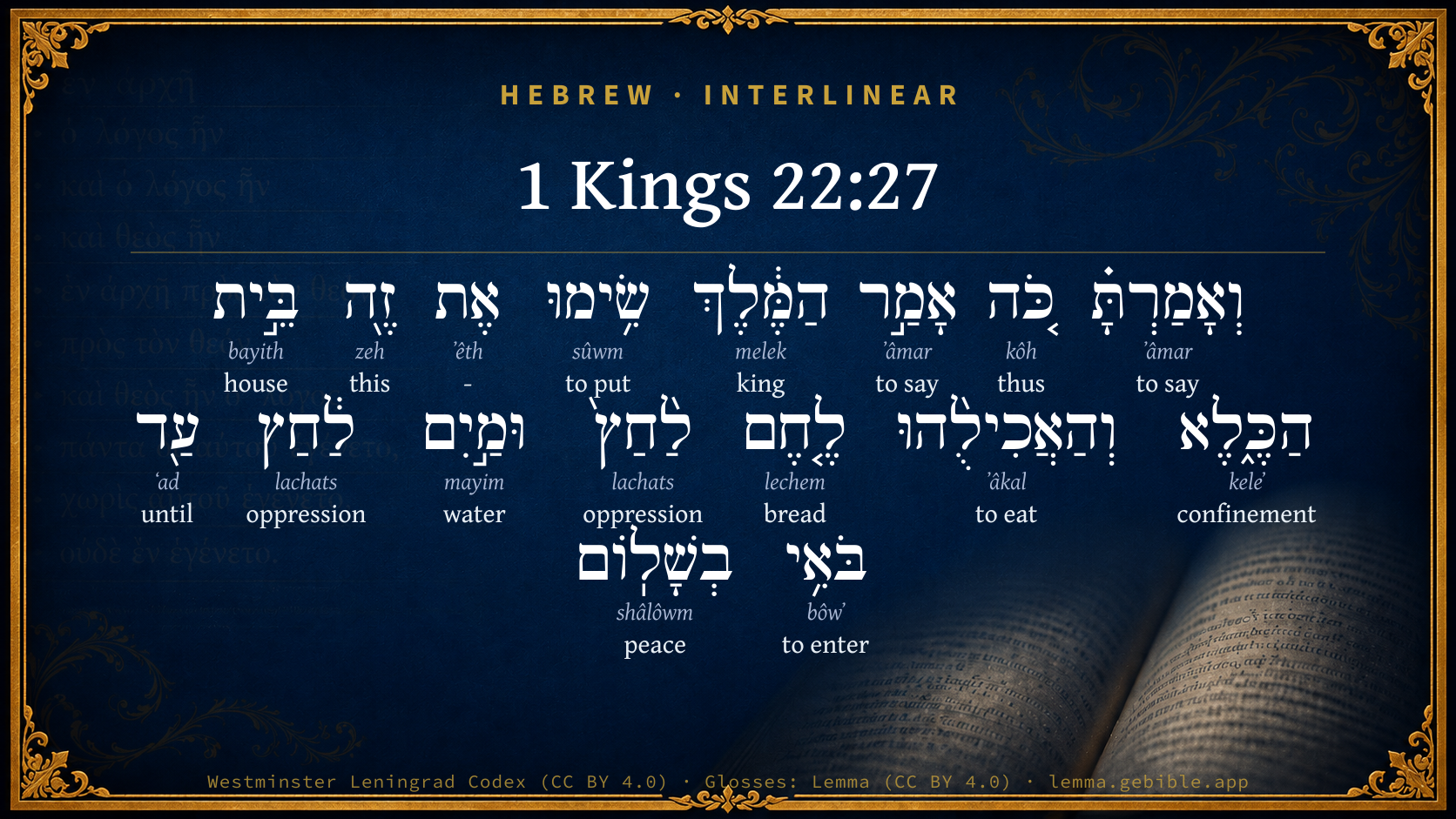
Hebrew (Westminster Leningrad Codex) 1 Kings 22:27 appears in the Hebrew Old Testament. The text above is from the Westminster Leningrad Codex. Each word links to its Strong’s number, a concise gloss, and parsing drawn from the Open Scriptures Hebrew Bible morphology. Click any word for its full Brown-Driver-Briggs (BDB) entry.
Download image
Cite this verse

1 Kings 22:27 (World English Bible). Public Domain. Lemma interlinear Bible study tool, https://lemma.gebible.app/v/1-kings/22/27.

Show BibTeX & RIS
BibTeX
RIS
English Translation
and say, Thus says the king, Put this fellow in the prison, and feed him with bread of affliction and with water of affliction, until I come in peace.
World English Bible · Public Domain
Highlights
  • 1 first appearance in the Hebrew Bible
Full analysis ↓
Download a study sheet

One document with this verse’s original text, its word-by-word gloss line, the meaning frame, cross-references with their text, attributed commentary, and full source and license credits — printable, and it pastes into notes with its structure intact.

This verse Autodidact and up

Study sheet (.html) Plain text (.txt)

A passage Seminary Student

Up to 50 verses in one chapter. A passage sheet keeps up to 6 commentary sources and 12 cross-references per verse, in the order this page ranks them, and says so on the sheet whenever that leaves anything out. Ask for a single verse and you get the Autodidact verse sheet above.

Everything on this page stays free to read, with no account — the sheet is a download of what is already on screen, not access to it.

Want to remove ads? Support Godless Engineer
Compare translations 3

The same verse in 3 English versions, stacked beneath the original-language interlinear above. Click any original word for its lexicon entry.

Each is an independent rendering of the whole verse — the interlinear is not word-aligned to these translations.

Highlighted words mark where these versions differ — a whole-verse word diff, not a word-by-word alignment.

  • World English Bible Public Domain
    and say, Thus says the king, Put this fellow in the prison, and feed him with bread of affliction and with water of affliction, until I come in peace.
  • King James Version Public Domain
    And say, Thus saith the king, Put this fellow in the prison, and feed him with bread of affliction and with water of affliction, until I come in peace.
  • unfoldingWord Literal Text CC BY-SA 4.0
    And you shall say, ‘Thus says the king, “Put this in the house of imprisonment and feed him bread of affliction and water of affliction until my coming in peace.”’”

unfoldingWord Literal Text — © unfoldingWord, licensed CC BY-SA 4.0. Word-aligned USFM3 via Door43 (git.door43.org/unfoldingWord/en_ult).

Versions to compare (up to 4)

3 of 4 selected

Show all 18 translations

Every available English version of this verse, each an independent rendering of the whole verse.

  • World English Bible Public Domain
    and say, Thus says the king, Put this fellow in the prison, and feed him with bread of affliction and with water of affliction, until I come in peace.
  • Berean Standard Bible Public Domain
    and tell them that this is what the king says: ‘Put this man in prison and feed him only bread and water until I return safely.’”
  • Majority Standard Bible Public Domain
    and tell them that this is what the king says: ‘Put this man in prison and feed him only bread and water until I return safely.’”
  • King James Version Public Domain
    And say, Thus saith the king, Put this fellow in the prison, and feed him with bread of affliction and with water of affliction, until I come in peace.
  • American Standard Version (1901) Public Domain
    and say, Thus saith the king, Put this fellow in the prison, and feed him with bread of affliction and with water of affliction, until I come in peace.
  • Revised Version (1885) Public Domain
    and say, Thus saith the king, Put this fellow in the prison, and feed him with bread of affliction and with water of affliction, until I come in peace.
  • Geneva Bible (1599) Public Domain
    And say, Thus saith the King, Put this man in the prison house, and feede him with bread of affliction, and with water of affliction, vntill I returne in peace.
  • Douay-Rheims (1899) Public Domain
    And tell them: Thus saith the king: Put this man in prison, and feed him with bread of affliction, and water of distress, till I return in peace.
  • Young's Literal Translation Public Domain
    and thou hast said, Thus said the king, Place ye this one in the house of restraint, and cause him to eat bread of oppression, and water of oppression, till my coming in peace.'
  • Literal Standard Version CC BY-SA 4.0
    and you have said, Thus said the king: Place this one in the house of restraint, and cause him to eat bread of oppression, and water of oppression, until my coming in peace.”
  • Unlocked Literal Bible CC BY-SA 4.0
    Say to him, 'The king says, Put this man in prison and feed him with only a little bread and only a little water, until I come safely.'”
  • unfoldingWord Literal Text CC BY-SA 4.0
    And you shall say, ‘Thus says the king, “Put this in the house of imprisonment and feed him bread of affliction and water of affliction until my coming in peace.”’”
  • Darby Bible Public Domain
    and thou shalt say, Thus says the king: Put this [man] in the prison, and feed him with bread of affliction and with water of affliction, until I come in peace.
  • World Messianic Bible Public Domain
    Say, ‘The king says, “Put this fellow in the prison, and feed him with bread of affliction and with water of affliction, until I come in peace.”’”
  • Webster's Bible Public Domain
    And say, Thus saith the king, Put this man in the prison, and feed him with bread of affliction, and with water of affliction, until I come in peace.
  • Free Bible Version CC BY-SA 4.0
    Tell them these are the king's instructions: ‘Put this man in jail. Give him only bread and water until my safe return.’”
  • Bible in Basic English Public Domain
    And say, It is the king's order that this man is to be put in prison and given prison food till I come again in peace.
  • JPS Tanakh (1917) Public Domain
    and say: Thus saith the king: Put this fellow in the prison, and feed him with scant bread and with scant water, until I come in peace.'

Literal Standard Version (2020), Covenant Press — licensed CC BY-SA 4.0. Text via the HelloAO Bible API (eBible.org). Unlocked Literal Bible (unfoldingWord) — licensed CC BY-SA 4.0. Text via the HelloAO Bible API (eBible.org). unfoldingWord Literal Text — © unfoldingWord, licensed CC BY-SA 4.0. Word-aligned USFM3 via Door43 (git.door43.org/unfoldingWord/en_ult). Free Bible Version, Dr. Jonathan Gallagher — licensed CC BY-SA 4.0. Text via the HelloAO Bible API (eBible.org).

Word by word

More ways to search: Search by grammar → Find every occurrence → Compare this word →

Practice this passage: Drill this verse → Learn its vocabulary →

הַכֶּ֑לֶא
keleʼ
H3608
“the · confinement”
Particle, Definite Article + Noun, Common, Masculine, Singular, Absolute
Part of Speech
Particle + Noun
Type
Common
Gender
Masculine
Number
Singular
State
Absolute
Full BDB Definition

Origin: from H3607

TWOT: 980a

imprisonment, confinement, restraint
  1. וְאָמַרְתָּ֗ ʼâmar H559 “and · to say” Conjunction + Verb, Qal, Perfect, 2nd Person, Masculine, Singular
  2. כֹּ֚ה kôh H3541 “thus” Adverb
  3. אָמַ֣ר ʼâmar H559 “to say” Verb, Qal, Perfect, 3rd Person, Masculine, Singular
  4. הַמֶּ֔לֶךְ melek H4428 “the · king” Particle, Definite Article + Noun, Common, Masculine, Singular, Absolute
  5. שִׂ֥ימוּ sûwm H7760 “put” Verb, Qal, Imperative, 2nd Person, Masculine, Plural
  6. אֶת ʼêth H853 “-” Particle, Direct Object
  7. זֶ֖ה zeh H2088 “this” Pronoun, Demonstrative, Masculine, Singular
  8. בֵּ֣ית bayith H1004 “house of” Noun, Common, Masculine, Singular, Construct
  9. וְהַאֲכִילֻ֨הוּ ʼâkal H398 “and · eat · him” Conjunction + Verb, Hiphil, Imperative, 2nd Person, Masculine, Plural + Suffix, Personal, 3rd Person, Masculine, Singular
  10. לֶ֤חֶם lechem H3899 “bread” Noun, Common, Both, Singular, Absolute
  11. לַ֨חַץ֙ lachats H3906 “oppression” Noun, Common, Masculine, Singular, Absolute
  12. וּמַ֣יִם mayim H4325 “and · water(s)” Conjunction + Noun, Common, Masculine, Plural, Absolute
  13. לַ֔חַץ lachats H3906 “oppression” Noun, Common, Masculine, Singular, Absolute
  14. עַ֖ד ʻad H5704 “until” Preposition
  15. בֹּאִ֥י bôwʼ H935 “to enter · me” Verb, Qal, Infinitive Construct + Suffix, Personal, 1st Person, Common, Singular
  16. בְשָׁלֽוֹם shâlôwm H7965 “in/at · peace” Preposition + Noun, Common, Masculine, Singular, Absolute

About this verse

These counts appear in no published source. They are computed here, from the morphology-tagged text and Lemma’s own curated glosses. What Lemma adds →

17
words
15
distinct lemmas
Historical
section

Notable vocabulary

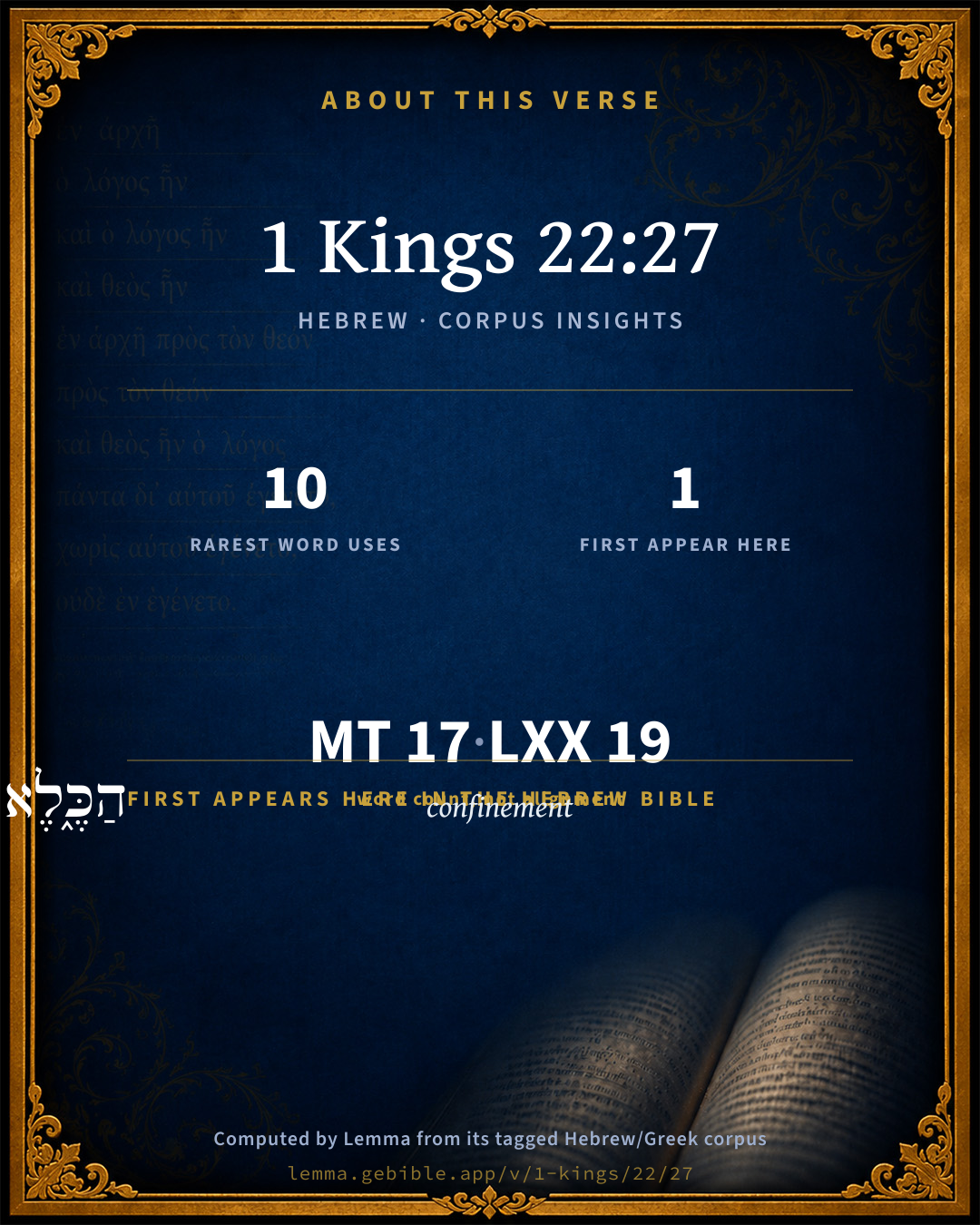
The rarest word here is הַכֶּ֑לֶא confinement H3608 — appearing just 10 times in the whole Hebrew Bible.

First appearance in Scripture

This word makes its first canonical appearance in the Hebrew Bible here:

  • הַכֶּ֑לֶא confinement H3608

Shared distinctive vocabulary

הַכֶּ֑לֶא confinement H3608 occurs in 10 verses of the Hebrew Bible. Also found in:

Grammatical profile

  • 5 verbs
  • 8 nouns
  • 1 pronoun
  • 1 preposition
  • 1 adverb
  • 1 particle

Verb forms

  • וְאָמַרְתָּ֗ Qal · Perfect
  • אָמַ֣ר Qal · Perfect
  • שִׂ֥ימוּ Qal · Imperative
  • וְהַאֲכִילֻ֨הוּ Hiphil · Imperative
  • בֹּאִ֥י Qal · Infinitive Construct

Repetition

Words recur within this verse — often emphatic in Hebrew:

  • וְאָמַרְתָּ֗ to say H559 ×2
  • לַ֨חַץ֙ oppression H3906 ×2

Hebrew & Septuagint length

In English translation the verse runs 29 words from the Hebrew and 29 from the Septuagint (LXX English) — the same length.

A rough comparison of the two English renderings, which tokenize alike — not a word-level alignment.

Word counts can differ between the Hebrew and the Greek without any difference in meaning — e.g. the Hebrew direct-object marker אֵת has no separate Greek word, and Greek often adds the article ὁ.

In the original languages it is 17 Hebrew tokens and 19 Greek tokens — but the two are counted differently (Hebrew bundles its prefixes and suffixes into one token; the Greek is in lemma form), so that isn’t a like-for-like length.

Cross-references

23

Topical passages linked to 1 Kings 22:27 in the Treasury of Scripture Knowledge — connected by theme and wording, ordered by reader-vote popularity; previews shown in the World English Bible.

  • 2 Chronicles 16:10 Then Asa was angry with the seer, and put him in the prison-house; for he was in a rage with him because of this thing. Asa oppressed some of the people at the same time.
  • 2 Chronicles 18:25–27 The king of Israel said, Take Micaiah, and carry him back to Amon the governor of the city, and to Joash the king's son;
  • Revelation 2:10 Don't be afraid of the things which you are about to suffer. Behold, the devil is about to throw some of you into prison, that you may be tested; and you will have oppression for ten days. Be faithful to death, and I will give you the crown of life.
  • Deuteronomy 16:3 You shall eat no leavened bread with it; seven days shall you eat unleavened bread therewith, even the bread of affliction; for you came forth out of the land of Egypt in haste: that you may remember the day when you came forth out of the land of Egypt all the days of your life.
  • Psalms 80:5 You have fed them with the bread of tears, And given them tears to drink in large measure.
  • Psalms 102:9 For I have eaten ashes like bread, And mixed my drink with tears,
  • Psalms 127:2 It is vain for you to rise up early, To stay up late, Eating the bread of toil; For he gives sleep to his loved ones.
  • Isaiah 30:20 Though the Lord give you the bread of adversity and the water of affliction, yet shall not your teachers be hidden anymore, but your eyes shall see your teachers;
  • Jeremiah 20:2 Then Pashhur struck Jeremiah the prophet, and put him in the stocks that were in the upper gate of Benjamin, which was in the house of Yahweh.
  • Jeremiah 29:26 Yahweh has made you priest in the place of Jehoiada the priest, that there may be officers in the house of Yahweh, for every man who is mad, and makes himself a prophet, that you should put him in the stocks and in shackles.
  • Jeremiah 37:15 The princes were angry with Jeremiah, and struck him, and put him in prison in the house of Jonathan the scribe; for they had made that the prison.
  • Jeremiah 38:6 Then took they Jeremiah, and cast him into the dungeon of Malchijah the king's son, that was in the court of the guard: and they let down Jeremiah with cords. In the dungeon there was no water, but mire; and Jeremiah sank in the mire.
  • Lamentations 3:53–55 They have cut off my life in the dungeon, and have cast a stone on me.
  • Mark 6:17–28 For Herod himself had sent out and arrested John, and bound him in prison for the sake of Herodias, his brother Philip's wife, for he had married her.
  • Luke 3:20 added this also to them all, that he shut up John in prison.
  • Luke 12:45–46 But if that servant says in his heart, 'My lord delays his coming,' and begins to beat the menservants and the maidservants, and to eat and drink, and to be drunken,
  • Acts 5:18 and laid hands on the apostles, and put them in public custody.
  • Acts 16:23–24 When they had laid many stripes on them, they threw them into prison, charging the jailer to keep them safely,
  • Acts 26:10 This I also did in Jerusalem. I both shut up many of the saints in prisons, having received authority from the chief priests, and when they were put to death I gave my vote against them.
  • Ephesians 3:1 For this cause I, Paul, am the prisoner of Christ Jesus on behalf of you Gentiles,
  • 1 Thessalonians 5:2–3 For you yourselves know well that the day of the Lord comes like a thief in the night.
  • James 4:13–14 Come now, you who say, "Today or tomorrow let's go into this city, and spend a year there, trade, and make a profit."
  • Acts 24:25–27 As he reasoned about righteousness, self-control, and the judgment to come, Felix was terrified, and answered, "Go your way for this time, and when it is convenient for me, I will summon you."

Cross-references courtesy of OpenBible.info (CC BY 4.0).

Hebrew and Greek witnesses Masoretic Hebrew ↔ Greek Septuagint

The same verse in the two great witnesses to the Old Testament, shown verse-for-verse.

These are two independent witnesses, not word-aligned to each other, and the Septuagint is shown in lemma (dictionary) form.

Hebrew 1 Kings 22:27 Masoretic · Westminster Leningrad Codex

וְאָמַרְתָּ֗ כֹּ֚ה אָמַ֣ר הַמֶּ֔לֶךְ שִׂ֥ימוּ אֶת זֶ֖ה בֵּ֣ית הַכֶּ֑לֶא וְהַאֲכִילֻ֨הוּ לֶ֤חֶם לַ֨חַץ֙ וּמַ֣יִם לַ֔חַץ עַ֖ד בֹּאִ֥י בְשָׁלֽוֹם

and say, Thus says the king, Put this fellow in the prison, and feed him with bread of affliction and with water of affliction, until I come in peace.

World English Bible · Public Domain

Greek LXX 1 Kings 22:27 Septuagint · lemma form

εἶπον τίθημι οὗτος ἐν φυλακή καί ἐσθίω αὐτός ἄρτος θλῖψις καί ὕδωρ θλῖψις ἕως ὁ ἐπιστρέφω ἐγώ ἐν εἰρήνη

and tell Joas the king's son to put this fellow in prison, and to feed him with bread of affliction and water of affliction until I return in peace.

LXX2012 (modern English Septuagint) · Public Domain

Hebrew: Westminster Leningrad Codex (CC BY 4.0). Greek: Septuagint (public domain); English from LXX2012 (modern English Septuagint) (Public Domain). How the Septuagint differs from the Hebrew →

Targum (Aramaic paraphrase)

1

The Targum is the ancient Jewish Aramaic paraphrase of the Hebrew Scriptures — an interpretive translation, not the Hebrew text itself. Onkelos (literal) and Pseudo-Jonathan (expansive) render the Torah, and Jonathan the Prophets. Coverage is partial: where no permissively-licensed English translation exists for a verse, only the Aramaic is shown. This is verse-level text, not a word-by-word alignment to the Hebrew.

  1. Targum Jonathan Prophets (Joshua–Malachi)
    וְתֵימַר כִּדְנַן אֲמַר מַלְכָּא שַׁווּ יַת דֵין בְּבֵית אֲסִירַי וַאֲכִילוּהִי לַחְמָא בִּדְחוֹק וּמַיָא בִּדְחוֹק עַד מֵיתָאִי בִּשְׁלָם:

    (no public-domain English translation for this verse)

    Targum Jonathan — Aramaic: “Mikraot Gedolot” (public domain). English: “Sefaria Community Translation” (CC0 1.0 (public-domain dedication)); “London "Chaldee Paraphrase," 1871” (public domain). Text via Sefaria.

Commentary

Notes on 1 Kings 22:27 from classic Christian and Jewish commentators (each source and its license shown beneath its notes). The classic Christian expositions comment on the surrounding passage and are grouped to its opening verse, so a note may address several verses; the Jewish commentaries on the Tanakh (Rashi and others) are per-verse, so they appear only where the commentator wrote on this verse.

Lemma curates 59 commentaries, every one of them public domain or Creative Commons licensed, each selected and text-cleaned for this edition rather than reprinted as found. About our sources →

Trapp's Complete Commentary

John Trapp

1Ki 22:27 And say, Thus saith the king, Put this [fellow] in the prison, and feed him with bread of affliction and with water of affliction, until I come in peace.

Ver. 27. Put this fellow in the prison.] So Savanarola was served for his plain dealing with the Pope; but Mancinell much worse; who, for reproving Pope Alexander VI in a sermon at Rome, had first his hands cut off and then his tongue cut out; of which wound he died. {a} Livy {b} boasteth of the ancient Romans, that no nation had more gentle punishments for offenders than they; and that for the first seventy years, till the reign of Ancus Martius, they were without a prison. But the modern Romists, as they are noted for their cruelty - witness the bloody inquisition - so it is said to be a like difficult thing amongst them to find a wicked man in their prisons, or a good man out of them.

And feed him with bread of affliction.] With prisoners’ pittance; such as may keep him alive only, for further punishment at my return. The martyrs in the Marian times were fed, many of them, with bread made most part with sawdust; this was bread of affliction, worse than that in Deu 16:3. Bonner allowed William Hunter a half penny a day in bread and drink in prison. {c} Dr Martin bid the keeper give Elizabeth Young one day bread, and another day water. {d} The Bishop of Norwich kept Robert Samuel without meat and drink, whereby he was unmercifully vexed, saving that he had every day allowed two or three morsels of bread, and three spoonfuls of water. How oft would he have drunk his own water! but his body was so dried up with long emptiness, that he was not able to make one drop of water. {e}

{a} Jac. Revius.

{b} Lib. i.

{c} Act. and Mon., 1397.

{d} Ibid., 1872.

{e} Ibid., 1547.

John Trapp, A Commentary or Exposition upon All the Books of the Old and New Testament (1647–1656) — public domain. Text from a community e-Sword module.

The Biblical Illustrator

Joseph S. Exell

1Ki_22:27

Put this fellow in the prison.

Persecuting the truth-teller

One evening, at a small literary gathering, a lady, famous for her muslin theology, was bewailing the wickedness of the Jews in not receiving our Saviour, and ended a diatribe by expressing regret that He had not appeared in our own time. How delighted, said she, we should all be to throw our doors open to Him, and listen to His Divine precepts! Dont you think so, Mr. Carlyle? The sturdy philosopher thus appealed to, said, in his broad Scotch, No, madam, I dont. I think that, had He come very fashionably dressed, with plenty of money, and preaching doctrines palatable to the higher orders, I might have had the honour of receiving from you a card of invitation, on the back of which would be written, To meet our Saviour; but if He had come uttering His sublime precepts, and denouncing the Pharisees, and associating with publicans and lower orders, as He did, you would have treated Him much as the Jews did, and would have cried out, Take Him to Newgate and hang Him!

Imprisoned conscience

Do we not all know that honest friends have sometimes fallen out of favour, perhaps with ourselves, because they have persistently kept telling us what our consciences and common sense knew to be true, that if we go on that road we shall be suffocated in a bog? A man makes up his mind to a course of conduct. He has a shrewd suspicion that his honest friend will condemn, and that the condemnation will be right. What does he do, therefore? He never tells his friend, and if, by chance, that friend may say what was expected of him, he gets angry with his adviser and goes his road. I suppose we all know what it is to treat our consciences in the style in which Ahab treated Micaiah. We do not listen to them because we know what they will say before they have said it. And we call ourselves sensible people! Martin Luther once said: It is neither safe nor wise to do anything against conscience. But Ahab puts Micaiah in prison, and we shut up our consciences in a dungeon, and put a gag in their mouths, and a muffler over the gag, that we may hear them say no word, because we know what we are doing, and we are doggedly determined to do, is wrong. (A. Maclaren, D. D.)

The Biblical Illustrator, edited by Joseph S. Exell (c. 1880s–1900s) — public domain. Text from a community e-Sword module.

Geneva Bible (1599)

Geneva Bible translators

Let him be pined away with hunger, and be fed with a small portion of bread and water.

Geneva Bible (1599) marginal notes — public domain. Text via Bolls.life.

Jamieson, Fausset & Brown

Robert Jamieson, A. R. Fausset & David Brown

bread of affliction, water of affliction--that is, the poorest prison fare. Micaiah submitted, but reiterated aloud, in the presence of all, that the issue of the war would be fatal to Ahab.

Jamieson, Fausset & Brown — Commentary Critical and Explanatory on the Whole Bible (1871) — public domain (CC PDM 1.0). Text via the HelloAO Bible API.

Adam Clarke's Commentary

Verse 27. Feed him with bread of affliction.] Deprive him of all the conveniences and comforts of life; treat him severely; just keep him alive, that he may see my triumph.

Adam Clarke's Commentary on the Bible (1810–1826) — public domain. Text from a community e-Sword/MySword module.

Ellicott's Commentary for English Readers

(27) Bread of affliction . . .—Comp. Isa_30:20. This is a command of severe treatment, as well as scanty fare. Ahab’s affectation of disbelief—which his subsequent conduct shows to be but affectation—simply draws down a plainer and sterner prediction, accompanied moreover, if our text be correct by an appeal to the whole assembly to bear witness of it. Of Micaiah’s fate we know nothing; but it is hard to suppose that his bold and defiant testimony could escape the extreme penalty of death, when Ahab’s fall gave opportunity of revival to the ruthlessness of Jezebel.

A Bible Commentary for English Readers, edited by Charles John Ellicott (1878–1897) — public domain. Text from a community e-Sword module.

The Cambridge Bible for Schools and Colleges

gen. ed. J. J. S. Perowne

27. bread of affliction] Prison fare. The expression is found in Isa_30:20, of the suffering of Israel in captivity. Hence it indicates the food which would be procurable in a time of siege, or by prisoners in captivity.

The Cambridge Bible for Schools and Colleges (gen. ed. J. J. S. Perowne; Cambridge University Press, 1878–1918) — public domain. Text from a community e-Sword module.

John Gill's Exposition

But the king of Syria commanded his thirty and two captains that had the rule over his chariots,.... This was the number of his kings in the first battle with Israel, and of his captains in the second, Kg1 20:1, and the same number he had now, being very probably not only the number of his chariots, but the division of his army was into so many battalions, under the command of these captains of chariots:

saying, fight neither with small nor great; of those that belonged to Jehoshaphat:

save only with the king of Israel; and his men; for it can hardly be thought that his orders were to fight with none, nor kill any in the battle but Ahab personally; though it is very probable he might give them directions to aim at him chiefly, knowing that, if he was killed or taken, his army would flee or surrender; and he might be desirous of getting him into his hands, as he had been in his; and the rather his spite was against him, as he was the mover of the war.

John Gill's Exposition of the Whole Bible (1746–1763) — public domain (CC PDM 1.0). Text via the HelloAO Bible API.

Albert Barnes' Notes on the Bible

Feed him with bread of affliction ... - Micaiah is to be once more put in prison, but, in order to punish him for his uncomplying spirit, upon a poorer and scantier diet than he had been previously allowed. This is to continue until Ahab returns in peace. Ahab introduces this expression purposely, in order to show his entire disbelief of Micaiah’s prophecy.

Albert Barnes' Notes on the Bible (1834–1885) — public domain. Text from a community e-Sword/MySword module.

Haydock's Catholic Bible Commentary

Distress, both "in small quantity," (Paralipomenon) and very bad. (Grotius) (Tirinus) (Isaias xxx. 20.) --- Peace, when I will punish thee, as an impostor. (Menochius) --- How grating must this have been to the good king Josaphat; and still he does not abandon the company of such infatuated people! (Ver. 29.) (Haydock)

George Leo Haydock (1774–1849), Haydock's Catholic Family Bible and Commentary, 1859 edition — public domain. Excludes Psalms (Douay-Rheims chapter numbering differs from Protestant) and Deuterocanonical books (Catholic canon only).

Matthew Poole's English Annotations

i. e. With a very coarse and sparing diet, whereby he may be only supported to endure his torment. See Deu 16:3; 2Ch 18:26; Isa 30:20.

Until I come in peace; until I return in triumph, which I doubt not I shall do in spite of all his malicious suggestions to the contrary, and then I shall call him to an account for all his lies and impudence.

Matthew Poole's English Annotations on the Holy Bible (1683–1685) — public domain. Text from a community e-Sword/MySword module.

Whedon's Commentary on the Bible

Daniel D. Whedon

27. Bread of affliction — Scanty prison fare, causing pain and sorrow, and ever reminding him of cruelty and want.

Daniel D. Whedon (gen. ed.), Commentary on the Old and New Testaments (1874–1909) — public domain. Text from a community e-Sword module.

The Pulpit Commentary

And say Heb. thou shalt say, Thus saith the king, Put this fellow in the prison Heb. house of the prison. Bahr thinks that Micaiah had formerly been in arrest under Amon"s charge, and now was to be committed to the prison proper. But more probably the words mean, "put him in the prison again." His superadded punishment was to be in the shape of prison diet. It is probable that it was owing to the presence of Jehoshaphat that Micaiah escaped with no severer sentence, and feed him with bread of affliction or oppression, jl pressit; (cf. Exo_3:9; Num_22:25; 2Ki_6:32) and with water of affliction Josephus (Ant. 8:15. 4) relates that after Micaiah"s prediction the king was in great suspense and fear, until Zedekiah deliberately smote him, in order to show that he was powerless to avenge an injury as the man of God did, (1Ki_13:4) and therefore no true prophet. This may be an "empty Rabbinical tradition" (Bahr), but we may be sure that Ahab did not hear Micaiah"s words unmoved. He had had such convincing proofs of the foresight and powers of the Lord"s prophets that he may well have trembled, even as he put on a bold front, and sent Micaiah back to the prison house, until I come in peace. This looks like an effort to encourage himself and those around him. But it almost betrays his misgivings. He would have them think he had no fears.

The Pulpit Commentary (1880–1919), ed. H.D.M. Spence-Jones & Joseph S. Exell — public domain. Text from a community e-Sword module.

John Wesley's Explanatory Notes

Bread, &c. - With a very course and sparing diet, whereby he may be only supported to endure his torment.

John Wesley, Explanatory Notes Upon the Whole Bible (1754–1765) — public domain. Text via the GEBible commentary corpus.

Lesson kit

Teaching starters — assembled from the data on this page, not authored interpretation. Every prompt links to the verse data it draws on. Edit before teaching.

1 Kings, in the Historical, opens this verse with 17 words (15 distinct Hebrew lemmas). Its most distinctive word is keleʼ (“confinement”). A historical commentator’s framing appears above. Read the whole chapter for the surrounding context.

Discussion questions

  1. How does “confinement” (keleʼ) shape what this verse is saying?
  2. The word “confinement” first appears here in Scripture. What is being introduced at this debut?
  3. 2 Kings 17:4 shares the word «confinement» with this verse. How do the two illuminate each other?
  4. “to say” occurs 2× in this one verse. What is the effect of the repetition?
  5. The translations on this page render this verse differently — a whole-verse word diff, not a word-by-word alignment. What might account for the different wordings?
  6. The verb «וְאָמַרְתָּ֗» is Qal Perfect. How does its form color the action?
  7. Reading how Trapp's Complete Commentary and The Biblical Illustrator read this verse, where do the two commentators agree and where do they part?

Things to notice

Reading settings

Reading text

Shown beneath each verse's original-language words.

Old Testament
Old Testament edition

Read the OT as the Masoretic Hebrew (MT) or the Greek Septuagint (LXX).

English shown for the Greek Septuagint (in the Hebrew ↔ Greek comparison).

Comparing translations? Open the Compare panel on any verse page to stack up to four side by side.