
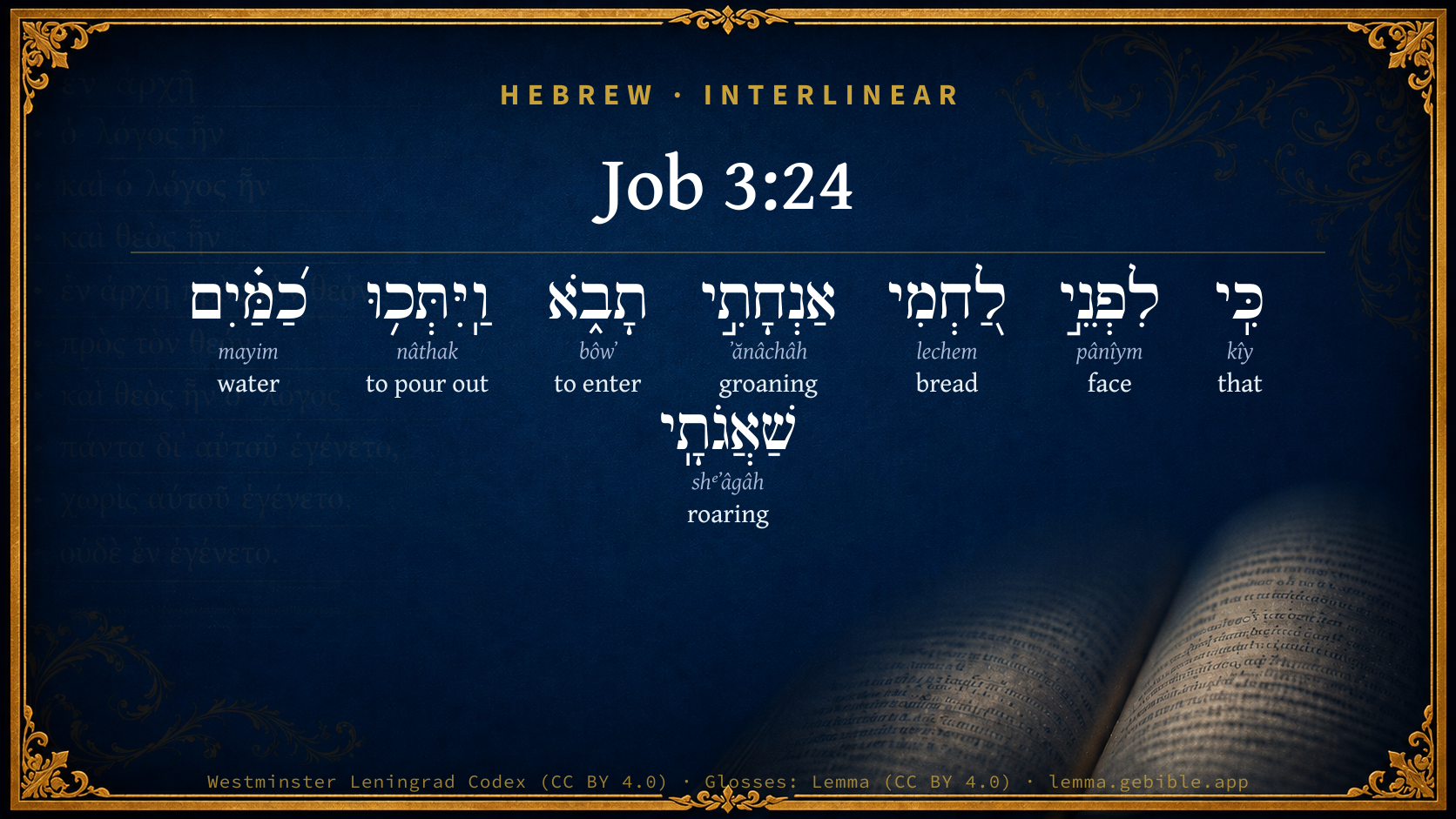
Job 3:24

Hebrew (Westminster Leningrad Codex) Job 3:24 appears in the Hebrew Old Testament. The text above is from the Westminster Leningrad Codex. Each word links to its Strong’s number, a concise gloss, and parsing drawn from the Open Scriptures Hebrew Bible morphology. Click any word for its full Brown-Driver-Briggs (BDB) entry.
Download image
Cite this verse

Job 3:24 (World English Bible). Public Domain. Lemma interlinear Bible study tool, https://lemma.gebible.app/v/job/3/24.

Show BibTeX & RIS
BibTeX
RIS
English Translation
For my sighing comes before I eat, My groanings are poured out like water.
World English Bible · Public Domain
Highlights
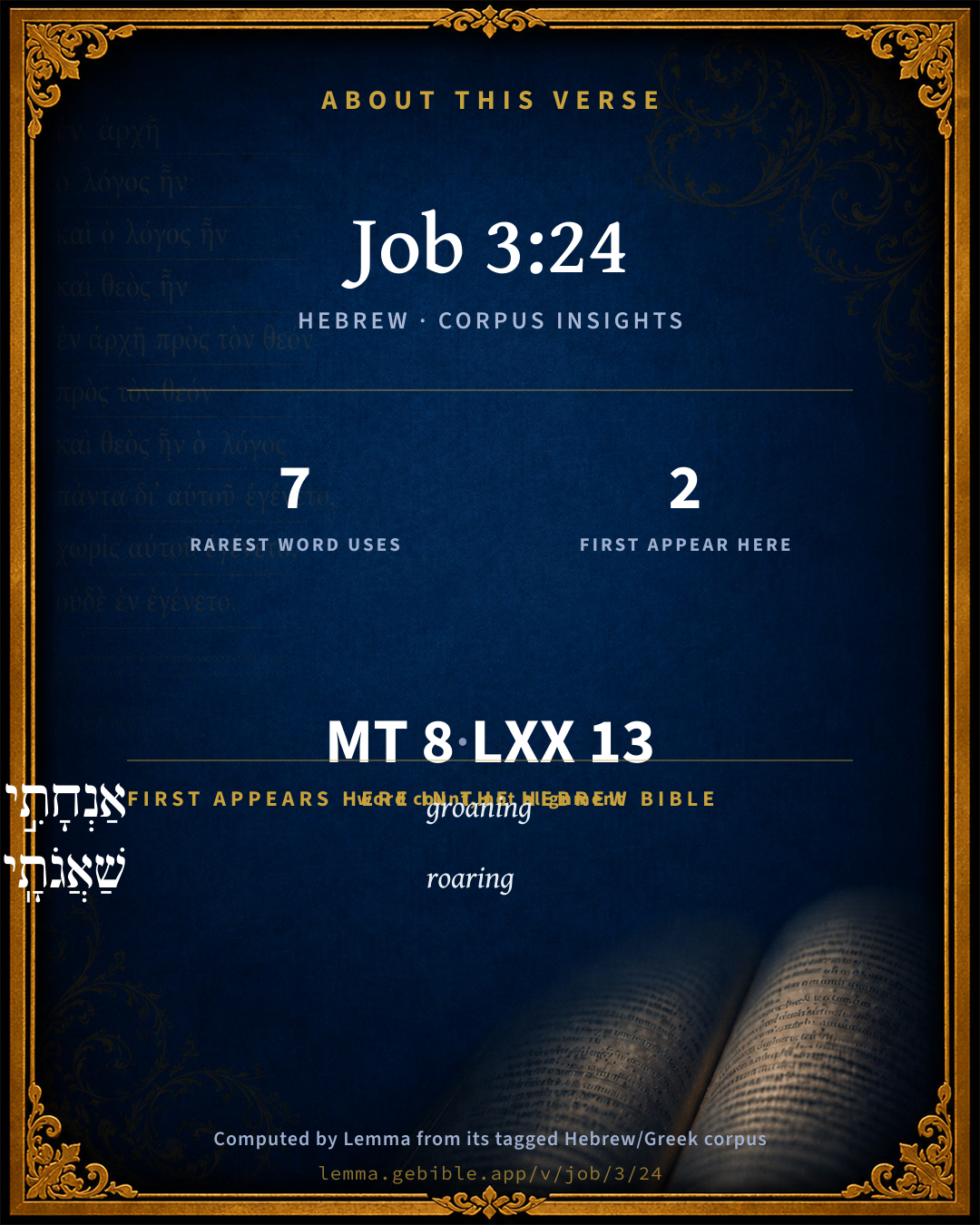
  • 2 first appearances in the Hebrew Bible
Full analysis ↓
Download a study sheet

One document with this verse’s original text, its word-by-word gloss line, the meaning frame, cross-references with their text, attributed commentary, and full source and license credits — printable, and it pastes into notes with its structure intact.

This verse Autodidact and up

Study sheet (.html) Plain text (.txt)

A passage Seminary Student

Up to 50 verses in one chapter. A passage sheet keeps up to 6 commentary sources and 12 cross-references per verse, in the order this page ranks them, and says so on the sheet whenever that leaves anything out. Ask for a single verse and you get the Autodidact verse sheet above.

Everything on this page stays free to read, with no account — the sheet is a download of what is already on screen, not access to it.

Want to remove ads? Support Godless Engineer
Compare translations 3

The same verse in 3 English versions, stacked beneath the original-language interlinear above. Click any original word for its lexicon entry.

Each is an independent rendering of the whole verse — the interlinear is not word-aligned to these translations.

Highlighted words mark where these versions differ — a whole-verse word diff, not a word-by-word alignment.

  • World English Bible Public Domain
    For my sighing comes before I eat, My groanings are poured out like water.
  • King James Version Public Domain
    For my sighing cometh before I eat, and my roarings are poured out like the waters.
  • unfoldingWord Literal Text CC BY-SA 4.0
    For my sighing comes before my food, my groaning flows out like waters.

unfoldingWord Literal Text — © unfoldingWord, licensed CC BY-SA 4.0. Word-aligned USFM3 via Door43 (git.door43.org/unfoldingWord/en_ult).

Versions to compare (up to 4)

3 of 4 selected

Show all 18 translations

Every available English version of this verse, each an independent rendering of the whole verse.

  • World English Bible Public Domain
    For my sighing comes before I eat, My groanings are poured out like water.
  • Berean Standard Bible Public Domain
    I sigh when food is put before me, and my groans pour out like water.
  • Majority Standard Bible Public Domain
    I sigh when food is put before me, and my groans pour out like water.
  • King James Version Public Domain
    For my sighing cometh before I eat, and my roarings are poured out like the waters.
  • American Standard Version (1901) Public Domain
    For my sighing cometh before I eat, And my groanings are poured out like water.
  • Revised Version (1885) Public Domain
    For my sighing cometh before I eat, and my roarings are poured out like water.
  • Geneva Bible (1599) Public Domain
    For my sighing commeth before I eate, and my roarings are powred out like the water.
  • Douay-Rheims (1899) Public Domain
    Before I eat I sigh: and as overflowing waters, so is my roaring:
  • Young's Literal Translation Public Domain
    For before my food, my sighing cometh, And poured out as waters `are' my roarings.
  • Literal Standard Version CC BY-SA 4.0
    For before my food, my sighing comes, || And my roarings [are] poured out as waters.
  • Unlocked Literal Bible CC BY-SA 4.0
    For my sighing happens instead of eating; my groaning is poured out like water.
  • unfoldingWord Literal Text CC BY-SA 4.0
    For my sighing comes before my food, my groaning flows out like waters.
  • Darby Bible Public Domain
    For my sighing cometh before my bread, and my groanings are poured out like the waters.
  • World Messianic Bible Public Domain
    For my sighing comes before I eat. My groanings are poured out like water.
  • Webster's Bible Public Domain
    For my sighing cometh before I eat, and my roarings are poured out like the waters.
  • Free Bible Version CC BY-SA 4.0
    My groans are the bread I eat; my raging tears are the water I drink.
  • Bible in Basic English Public Domain
    In place of my food I have grief, and cries of sorrow come from me like water.
  • JPS Tanakh (1917) Public Domain
    For my sighing cometh instead of my food, and my roarings are poured out like water.

Literal Standard Version (2020), Covenant Press — licensed CC BY-SA 4.0. Text via the HelloAO Bible API (eBible.org). Unlocked Literal Bible (unfoldingWord) — licensed CC BY-SA 4.0. Text via the HelloAO Bible API (eBible.org). unfoldingWord Literal Text — © unfoldingWord, licensed CC BY-SA 4.0. Word-aligned USFM3 via Door43 (git.door43.org/unfoldingWord/en_ult). Free Bible Version, Dr. Jonathan Gallagher — licensed CC BY-SA 4.0. Text via the HelloAO Bible API (eBible.org).

Word by word

More ways to search: Search by grammar → Find every occurrence → Compare this word →

Practice this passage: Drill this verse → Learn its vocabulary →

About this verse

These counts appear in no published source. They are computed here, from the morphology-tagged text and Lemma’s own curated glosses. What Lemma adds →

8
words
8
distinct lemmas
Wisdom
section

Notable vocabulary

The rarest word here is שַׁאֲגֹתָֽי roaring H7581 — appearing just 7 times in the whole Hebrew Bible.

First appearance in Scripture

These words make their first canonical appearance in the Hebrew Bible here:

  • אַנְחָתִ֣י groaning H585
  • שַׁאֲגֹתָֽי roaring H7581

Shared distinctive vocabulary

שַׁאֲגֹתָֽי roaring H7581 occurs in 7 verses of the Hebrew Bible. Also found in:

Grammatical profile

  • 2 verbs
  • 5 nouns
  • 1 conjunction

Verb forms

  • תָבֹ֑א Qal · Imperfect
  • וַֽיִּתְּכ֥וּ Qal · Sequential Imperfect

Hebrew & Septuagint length

In English translation the verse runs 14 words from the Hebrew and 14 from the Septuagint (LXX English) — the same length.

A rough comparison of the two English renderings, which tokenize alike — not a word-level alignment.

Word counts can differ between the Hebrew and the Greek without any difference in meaning — e.g. the Hebrew direct-object marker אֵת has no separate Greek word, and Greek often adds the article ὁ.

In the original languages it is 8 Hebrew tokens and 13 Greek tokens — but the two are counted differently (Hebrew bundles its prefixes and suffixes into one token; the Greek is in lemma form), so that isn’t a like-for-like length.

Cross-references

11

Topical passages linked to Job 3:24 in the Treasury of Scripture Knowledge — connected by theme and wording, ordered by reader-vote popularity; previews shown in the World English Bible.

  • Psalms 102:9 For I have eaten ashes like bread, And mixed my drink with tears,
  • Psalms 42:3–4 My tears have been my food day and night, While they continually ask me, "Where is your God?"
  • Psalms 80:5 You have fed them with the bread of tears, And given them tears to drink in large measure.
  • Psalms 38:8 I am faint and severely bruised. I have groaned by reason of the anguish of my heart.
  • Job 6:7 My soul refuses to touch them; They are as loathsome food to me.
  • Job 7:19 How long will you not look away from me, Nor leave me alone until I swallow down my spittle?
  • Job 33:20 So that his life abhors bread, And his soul dainty food.
  • Psalms 22:1–2 My God, my God, why have you forsaken me? Why are you so far from helping me, and from the words of my groaning?
  • Psalms 32:3 When I kept silence, my bones wasted away through my groaning all day long.
  • Isaiah 59:11 We roar all like bears, and moan sore like doves: we look for justice, but there is none; for salvation, but it is far off from us.
  • Lamentations 3:8 Yes, when I cry, and call for help, he shuts out my prayer.

Cross-references courtesy of OpenBible.info (CC BY 4.0).

Hebrew and Greek witnesses Masoretic Hebrew ↔ Greek Septuagint

The same verse in the two great witnesses to the Old Testament, shown verse-for-verse.

These are two independent witnesses, not word-aligned to each other, and the Septuagint is shown in lemma (dictionary) form.

Hebrew Job 3:24 Masoretic · Westminster Leningrad Codex

כִּֽי לִפְנֵ֣י לַ֭חְמִי אַנְחָתִ֣י תָבֹ֑א וַֽיִּתְּכ֥וּ כַ֝מַּ֗יִם שַׁאֲגֹתָֽי

For my sighing comes before I eat, My groanings are poured out like water.

World English Bible · Public Domain

Greek LXX Job 3:24 Septuagint · lemma form

πρό γάρ ὁ σῖτος ἐγώ στεναγμός ἐγώ ἥκω δακρύω δέ ἐγώ συνἔχω φόβος

For my groaning comes before my food, and I weep being beset with terror.

LXX2012 (modern English Septuagint) · Public Domain

Hebrew: Westminster Leningrad Codex (CC BY 4.0). Greek: Septuagint (public domain); English from LXX2012 (modern English Septuagint) (Public Domain). How the Septuagint differs from the Hebrew →

Commentary

Notes on Job 3:24 from classic Christian and Jewish commentators (each source and its license shown beneath its notes). The classic Christian expositions comment on the surrounding passage and are grouped to its opening verse, so a note may address several verses; the Jewish commentaries on the Tanakh (Rashi and others) are per-verse, so they appear only where the commentator wrote on this verse.

Lemma curates 59 commentaries, every one of them public domain or Creative Commons licensed, each selected and text-cleaned for this edition rather than reprinted as found. About our sources →

Trapp's Complete Commentary

John Trapp

Job 3:24 For my sighing cometh before I eat, and my roarings are poured out like the waters.

Ver. 24. For my sighing cometh before I eat] It cometh unsent for, as evil weather useth to do, and most unseasonably surpriseth me at my repast. I mingle my meat with my tears, with every bit of bread I have a morsel of sorrows; and I mingle my drink with weeping, Psa 102:9, though indeed Job’s was not so much a shower of tears as a storm of sighs, and a volley of roarings, betokening extremity of grief, such as was beyond tears, and vented itself as the noise of many waters; for my roarings, saith he, are poured out like water. I am as hungry as a lion roaring on his prey, and as violent as the torrents ranging the fields; and yet I neither have leisure nor list to eat my bread; as loth to prolong such a troublesome life, but that I must, or be guilty of self murder. Mr Fox reports of Mr John Glover, that not long after his conversion, upon a mistake of the sense of that text, Heb 6:5-6, he was strongly concerned that he had fallen into the unpardonable sin, and must necessarily therefore be damned; and in that intolerable grief of mind, although he neither had nor could have any joy of his meat, yet was he compelled to eat against his appetite, to the end to defer the time of his damnation so long as he might (Acts & Mon. 1 552). Now who can tell how near Job’s case might come to this, since the devil was both author and actor in a great part of both these tragic comedies?

John Trapp, A Commentary or Exposition upon All the Books of the Old and New Testament (1647–1656) — public domain. Text from a community e-Sword module.

Joseph Benson's Commentary

Job 3:24. For my sighing cometh before I eat — Hebrew, before the face of my bread. Instead of enjoying the satisfaction of being refreshed with the common necessaries that are afforded us, and taking any pleasure in eating and drinking, which are granted for comfort as well as sustenance, my cries and tears are my meat and drink. And my roarings are poured out like the waters — So severe is my pain, and so great my anguish, that the agonies and outcries, which are extorted from me, are of no common sort: they are deep and noisy; hideous and frightful, and such as may be compared to the loud roarings of a lion. And though I strive, and take much pains, to check and silence them, yet I find it is to no purpose; for they force their way with irresistible violence and incessant continuance, in great abundance; like so many sudden and impetuous streams of waters, when a river breaks its banks and overflows the adjacent grounds.

Joseph Benson's Commentary on the Old and New Testaments (1811–1818) — public domain. Text from a community e-Sword module.

Jamieson, Fausset & Brown

Robert Jamieson, A. R. Fausset & David Brown

my sighing cometh before I eat--that is, prevents my eating [UMBREIT]; or, conscious that the effort to eat brought on the disease, Job must sigh before eating [ROSENMULLER]; or, sighing takes the place of good (Psa 42:3) [GOOD]. But the first explanation accords best with the text.

my roarings are poured out like the waters--an image from the rushing sound of water streaming.

Jamieson, Fausset & Brown — Commentary Critical and Explanatory on the Whole Bible (1871) — public domain (CC PDM 1.0). Text via the HelloAO Bible API.

Adam Clarke's Commentary

Verse 24. For my sighing cometh] Some think that this refers to the ulcerated state of Job's body, mouth, hands, c. He longed for food, but was not able to lift it to his mouth with his hands, nor masticate it when brought thither. This is the sense in which Origen has taken the words. But perhaps it is most natural to suppose that he means his sighing took away all appetite, and served him in place of meat. There is the same thought in Ps 42:3: My tears have been my meat day and night which place is not an imitation of Job, but more likely Job an imitation of it, or, rather, both an imitation of nature.

My roarings are poured out] My lamentations are like the noise of the murmuring stream, or the dashings of the overswollen torrent.

Adam Clarke's Commentary on the Bible (1810–1826) — public domain. Text from a community e-Sword/MySword module.

The Cambridge Bible for Schools and Colleges

gen. ed. J. J. S. Perowne

24. before I eat] lit. before my meat, as margin. The temporal meaning of before gives no sense here. In 1Sa_1:16 the same expression occurs, “Count not thine handmaid for a daughter of Belial.” Therefore render, my sighing cometh for (instead of, or, like) my meat; it is his constant, daily food.

like the waters] Rather, like water, i. e. a broad, unbroken stream.

25, 26, the thing which I feared] These two verses read thus,

For let me fear an evil, and it cometh upon me,

And whatsoever I dread, it overtakes me;

I have no ease, neither quiet nor rest,

But trouble cometh.

The whole passage from Job_3:20 describes Job’s present condition. The speaker says, if he but imagines an evil, if he but “fears a fear,” it is immediately upon him. The words are put hypothetically in the past tense: Have I feared a fear, it cometh upon me; but the reference cannot be to the real past, as in the English Version, because it would be contrary to the idea of the poem to suppose that Job even in the days of his golden prime was haunted with indefinite fears of coming misfortune. On the contrary the picture he gives of himself, ch. 29, shews that his piety reflected itself in a full and trustful peace of mind; see his own words ch. Job_16:12, Job_29:18 seq.

Job_3:26 means that Job has no pause between the waves of his affliction, no time to recover from one before another overwhelms him.

“Trouble” here is the fit or paroxysm of trouble.

Job’s three friends sat silent before him seven days. Then Job spake and cursed his day. His speech opened his friends’ mouths and probably also their eyes. Job’s language and demeanour were not what they would have looked for from one in his condition. His violent complaints and his indirect allusions to Heaven were not only unbecoming in themselves, but cast an unwelcome light upon his past life. Job speaks no doubt with the passion of despair and in the bitterness of his misery, and his indirect allusions to God betray impatience and are uttered with a tone of resentment, though there is as yet no direct charge of injustice against God, only an impatient demand why He continues life to one in such misery. His tone of mind is very different from that exhibited when his trials had newly befallen him or when he replied to the suggestions of his wife. And it is this tone, suggesting so much more than it expressed, that the three friends lay hold of and attach their exhortations to, and which is thus the point out of which the whole succeeding debate developes itself.

The Cambridge Bible for Schools and Colleges (gen. ed. J. J. S. Perowne; Cambridge University Press, 1878–1918) — public domain. Text from a community e-Sword module.

John Gill's Exposition

For my sighing cometh before I eat,.... Or, "before my bread", or "food" (g); before he sat down to eat, or had tasted of his food, there were nothing but sighing and sobbing, so that he had no appetite for his food, and could take no delight in it; and, while he was eating, his tears mingled with it, so that these were his meat and his drink continually, and he was fed with the bread and water of affliction; and therefore what were light and life to such a person, who could not have the pleasure of one comfortable meal?

and my roarings are poured out like the waters; he not only wept privately and in secret, and cried more publicly both to God and in the presence of men, but such was the force and weight of his affliction, that he even roared out, and that like a lion; and his afflictions, which were the cause of these roarings, are compared to waters and the pouring of them out; for the noise these waterspouts made, and for the great abundance of them, and for their quick and frequent returns, and long continuance, one wave and billow rolling upon another.

(g) "ante cibum meum", Junius & Tremellius, Piscator; "ante panem meum", Cocceius, Schmidt, Michaelis.

John Gill's Exposition of the Whole Bible (1746–1763) — public domain (CC PDM 1.0). Text via the HelloAO Bible API.

Albert Barnes' Notes on the Bible

For my sighing cometh before I eat - Margin, “My meat.” Dr. Good renders this,” Behold! my sighing takes the place of my daily food, and refers to Psa 42:3, as an illustration:

My tears are my meat day and night.

So substantially Schultens renders it, and explains it as meaning, “My sighing comes in the manner of my food,” “Suspirium ad modum panis veniens” - and supposes it to mean that his sighs and groans were like his daily food; or were constant and unceasing. Dr. Noyes explains it as meaning, “My sighing comes on when I begin to eat, and prevents my taking my daily nourishment;” and appeals to a similar expression in Juvenal. Sat. xiii. 211:

Perpetua anxietas, nec mensae tempore cessat.

Rosenmuller gives substantially the same explanation, and remarks, also, that some suppose that the mouth, hands, and tongue of Job were so affected with disease, that the effort to eat increased his sufferings, and brought on a renewal of his sorrows. The same view is given by Origen; and this is probably the correct sense.

And my roarings - My deep and heavy groans.

Are poured out like the waters - That is,

(1) “in number” - they were like rolling billows, or like the heaving deep.

(2) Perhaps also in “sound” like them. His groans were like the troubled ocean, that can be heard afar. Perhaps, also,

(3.) he means to say that his groans were attended with “a flood of tears,” or that his tears were like the waves of the sea.

There is some hyperbole in the figure, in whichever way it is understood; but we are to remember that his feelings were deeply excited, and that the Orientals were in the habit of expressing themselves in a mode, which to us, of more phlegmatic temperament, may seem extravagant in the extreme. We have, however, a similar expression when we say of one that “he burst into a “flood of tears.””

Albert Barnes' Notes on the Bible (1834–1885) — public domain. Text from a community e-Sword/MySword module.

Haydock's Catholic Bible Commentary

Sigh, through difficulty of swallowing, (Pineda) or sense of misery. (Haydock)

George Leo Haydock (1774–1849), Haydock's Catholic Family Bible and Commentary, 1859 edition — public domain. Excludes Psalms (Douay-Rheims chapter numbering differs from Protestant) and Deuterocanonical books (Catholic canon only).

Matthew Poole's English Annotations

Before I eat, Heb. before the face of my bread, i.e. either when I am going to eat, or rather, all the time whilst I am eating, (for so this phrase is used Psa 72:5, before the face of the sun, &c.; that is, as we translate it, as long as the sun endureth,) I fall into bitter passions of sighing and weeping; partly because my necessity and duty obligeth me to eat, and so to support this wretched life, which I long to lose; and principally because of my uninterrupted pains of body, and horrors of my mind, which mix themselves with my very meat, and do not afford me one quiet moment. Compare Psa 102:9.

My roarings, i.e. my loud outcries, more befitting a lion than a man, which yet extremity of grief forceth from me. Compare Psa 22:1; 32:3.

Like the waters, i.e. with great abundance, and irresistible violence, and incessant continuance, as waters flow in a river, or when they break the banks, and overflow the ground.

Matthew Poole's English Annotations on the Holy Bible (1683–1685) — public domain. Text from a community e-Sword/MySword module.

Whedon's Commentary on the Bible

Daniel D. Whedon

24. Before I eat — Literally, In presence of my bread; that is, at the same time of my eating; or, “instead of my bread.” — Hitzig. In either case the meaning is, “Sighing is my bread.” Juvenal attributes to the successful sinner “a perpetual anxiety, nor does it cease even at his hour of meal.” (Perpetua anxietas, nec mensae tempore cessat.) — Satires, 13. 211.

Roarings — Roarings, as of a lion; or since מים, waters, is sometimes used for the great deep, Job may possibly have had in mind the roaring of the sea. The figure is no stronger than ours — “a flood of tears.”

Like the waters — In an uninterrupted flow, like water poured forth.

Daniel D. Whedon (gen. ed.), Commentary on the Old and New Testaments (1874–1909) — public domain. Text from a community e-Sword module.

The Pulpit Commentary

For my sighing cometh before I eat literally, before my meat; i.e. "more early and more constantly than my food" (Professor Lee). And my roarings are poured out. The word translated "roaring" is used primarily of the roar of a lion; (Zec_11:3; comp. Amo_3:8) secondarily, of the loud cries uttered by men who suffer pain. (see Psa_22:1 Psa_32:4) (On the loud cries of Orientals when suffering from grief or pain, see the comment on Job_2:12) Like the waters; i.e. freely and copiously, without let or stint. Perhaps the loud sound of rushing water is also alluded to.

The Pulpit Commentary (1880–1919), ed. H.D.M. Spence-Jones & Joseph S. Exell — public domain. Text from a community e-Sword module.

John Wesley's Explanatory Notes

Before, &c. - Hebrew. before the face of my bread, all the time I am eating, I fall into sighing and weeping, because I am obliged to eat, and to support this wretched life, and because of my uninterrupted pains of body and of mind, which do not afford me one quiet moment. Roarings - My loud outcries, more befitting a lion than a man. Poured out - With great abundance, and irresistible violence, and incessant continuance, as waters flow in a river, or as they break the banks, and overflow the ground.

John Wesley, Explanatory Notes Upon the Whole Bible (1754–1765) — public domain. Text via the GEBible commentary corpus.

Keil & Delitzsch

C. F. Keil & F. Delitzsch

24 For instead of my food my sighing cometh,

And my roarings pour themselves forth as water.

25 For I fear something terrible, and it cometh upon me,

And that before which I shudder cometh to me.

26 I dwelt not in security, nor rested, nor refreshed myself:

Then trouble cometh.

That לפני may pass over from the local signification to the substitutionary, like the Lat. pro (e.g., pro praemio est), is seen from Job 4:19 (comp. Sa1 1:16): the parallelism, which is less favourable to the interpretation, before my bread (Hahn, Schlottm., and others), favours the signification pro here. The fut. consec. ויּתּכוּ (Kal of נתך) is to be translated, according to Ges. 129, 3, a, se effundunt (not effuderunt): it denotes, by close connection with the preceding, that which has hitherto happened. Just so v. 25a: I fear something terrible; forthwith it comes over me (this terrible, most dreadful thing). אתה is conjugated by the ה passing into the original א of the root (vid., Ges. 74, rem. 4). And just so the conclusion: then also forthwith רגן (i.e., suffering which disorders, rages and ransacks furiously) comes again. Schlottm. translates tamely and wrongly: then comes - oppression. Hahn, better: Nevertheless fresh trouble always comes; but the "nevertheless" is incorrect, for the fut. consec. indicates a close connection, not contrast. The praett., Job 3:26, give the details of the principal fact, which follows in the fut. consec.: only a short cessation, which is no real cessation; then the suffering rages afresh.

Why - one is inclined to ask respecting this first speech of Job, which gives rise to the following controversy - why does the writer allow Job, who but a short time before, in opposition to his wife, has manifested such wise submission to God's dealings, all at once to break forth in such despair? Does it not seem as though the assertion of Satan were about to be confirmed? Much depends upon one's forming a correct and just judgment respecting the state of mind from which this first speech proceeds. To this purpose, consider (1) That the speech contains no trace of what the writer means by את־האלהים ברך: Job nowhere says that he will have nothing more to do with God; he does not renounce his former faithfulness: (2) That, however, in the mind of the writer, as may be gathered from Job 2:10, this speech is to be regarded as the beginning of Job's sinning. If a man, on account of his sufferings, wishes to die early, or not to have been born at all, he has lost his confidence that God, even in the severest suffering, designs his highest good; and this want of confidence is sin.

There is, however, a great difference between a man who has in general no trust in God, and in whom suffering only makes this manifest in a terrible manner, and the man with whom trust in God is a habit of his soul, and is only momentarily repressed, and, as it were, paralysed. Such interruption of the habitual state may result from the first pressure of unaccustomed suffering; it may then seem as though trust in God were overwhelmed, whereas it has only given way to rally itself again. It is, however, not the greatness of the affliction in itself which shakes his sincere trust in God, but a change of disposition on the part of God which seems to be at work in the affliction. The sufferer considers himself as forgotten, forsaken, and rejected of God, as many passages in the Psalms and Lamentations show: therefore he sinks into despair: and in this despair expression is given to the profound truth (although with regard to the individual it is a sinful weakness), that it is better never to have been born, or to be annihilated, than to be rejected of God (comp. Mat 26:24, καλὸν ἦ αὐτῷ ει ̓ οὐκ ἐγεννήθη ὁ ἄνθρωπος ἐκεῖνος). In such a condition of spiritual, and, as we know from the prologue, of Satanic temptation (Luk 22:31; Eph 6:16), is Job. He does not despair when he contemplates his affliction, but when he looks at God through it, who, as though He were become his enemy, has surrounded him with this affliction as with a rampart. He calls himself a man whose way is hidden, as Zion laments, Isa 40:27, "My way is hidden from Jehovah;" a man whom Eloah has hedged round, as Jeremiah laments over the ruins of Jerusalem, Lam 3:1-13 (in some measure a comment on Job 3:23), "I am the man who has seen affliction by the rod of His wrath ... . He has hedged me round that I cannot get out, and made my chain heavy."

In this condition of entire deprivation of every taste of divine goodness, Job breaks forth in curses. He has lost wealth and children, and has praised God; he has even begun to bear an incurable disease with submission to the providence of God. Now, however, when not only the affliction, but God himself, seems to him to be hostile (nunc autem occultato patre, as Brentius expresses it),

(Note: Fries, in his discussion of this portion of the book of Job, Jahrbb. fr Deutsche Theologie, 1859, S. 790ff., is quite right that the real affliction of Job consists in this, that the inward feeling of being forsaken of God, which was hitherto strange to him, is come upon him. But the remark directed against me, that the feeling of being forsaken of God does not always stand in connection with other affliction, but may come on the favoured of God even in the midst of uninterrupted outward prosperity, does not concern me, since it is manifestly by the dispensations which deprive him of all his possessions, and at last affect him corporeally and individually, that Job is led to regard himself as one forsaken of God, and still more than that, one hated by God; and since, on the other hand also, this view of the tempted does not appear to be absolutely subjective, God has really withdrawn from Job the external proof, and at the same time the feeling, of His abiding love, in order to try the fidelity of His servant's love, and prove its absoluteness.)

we hear from his mouth neither words of praise (the highest excellence in affliction) nor words of resignation (duty in affliction), but words of despair: his trust in God is not destroyed, but overcast by thick clouds of melancholy and doubt.

It is indeed inconceivable that a New Testament believer, even under the strongest temptation, should utter such imprecations, or especially such a question of doubt as in Job 3:20 : Wherefore is light given to the miserable? But that an Old Testament believer might very easily become involved in such conflicts of belief, may be accounted for by the absence of any express divine revelation to carry his mind beyond the bounds of the present. Concerning the future at the period when the book of Job was composed, and the hero of the book lived, there were longings, inferences, and forebodings of the soul; but there was no clear, consoling word of God on which to rely, - no θεῖος λόγος which, to speak as Plato (Phaedo, p. 85, D), could serve as a rescuing plank in the shipwreck of this life. Therefore the πανταχοῦ θρυλλούμενον extends through all the glory and joy of the Greek life from the very beginning throughout. The best thing is never to have been born; the second best, as soon as possible thereafter, to die. The truth, that the suffering of this present time is not worthy of the glory which shall be revealed in us, was still silent. The proper disposition of mind, under such veiling of the future, was then indeed more absolute, as faith committed itself blindfold to the guidance of God. But how near at hand was the temptation to regard a troublous life as an indication of the divine anger, and doubtingly to ask, Why God should send the light of life to such! They knew not that the present lot of man forms but the one half of his history: they saw only in the one scale misery and wrath, and not in the other the heaven of love and blessedness to be revealed hereafter, by which these are outweighed; they longed for a present solution of the mystery of life, because they knew nothing of the possibility of a future solution. Thus it is to be explained, that not only Job in this poem, but also Jeremiah in the book of his prophecy, Job 20:14-18, curses the day of his birth. He curses the man who brought his father the joyous tidings of the birth of a son, and wishes him the fate of Sodom and Gomorrha. He wishes for himself that his mother might have been his grave, and asks, like Job, "Wherefore came I forth out of the womb to see labour and sorrow, and that my days should be consumed in shame?" Hitzig remarks on this, that it may be inferred from the contents and form of this passage, there was a certain brief disturbance of spirit, a result of the general indescribable distress of the troublous last days of Zedekiah, to which the spirit of the prophet also succumbed. And it is certainly a kind of delirium in which Jeremiah so speaks, but there is no physical disorder of mind with it: the understanding of the prophet is so slightly and only momentarily disturbed, that he has the rather gained power over his faith, and is himself become one of its disturbing forces.

Without applying to this lyric piece either the standard of pedantic moralizing, or of minute criticism as poetry, the intense melancholy of this extremely plaintive prophet may have proceeded from the following reasoning: After I have lived ten long years of fidelity and sacrifice to my prophetic calling, I see that it has totally failed in its aim: all my hopes are blighted; all my exhortations to repentance, and my prayers, have not availed to draw Judah back from the abyss into which he is now cast, nor to avert the wrath of Jehovah which is now poured forth: therefore it had been better for me never to have been born. This thought affects the prophet so much the more, since in every fibre of his being he is an Israelite, and identifies the weal and woe of his people with his own; just as Moses would rather himself be blotted out form the book of life than that Israel should perish, and Paul was willing to be separated from Christ as anathema if he could thereby save Israel. What wonder that this thought should disburden itself in such imprecations! Had Jeremiah not been born, he would not have had occasion to sit on the ruins of Jerusalem. But his outburst of feeling is notwithstanding a paroxysm of excitement, for, though reason might drive him to despair, faith would teach him to hope even in the midst of downfall; and in reality, this small lyric piece in the collective prophecy of Jeremiah is only as a detached rock, over which, as a stream of clear living water, the prophecy flows on more joyous in faith, more certain of the future. In the book of Job it is otherwise; for what in Jeremiah and several of the psalms is compressed into a small compass, - the darkness of temptation and its clearing up, - is here the substance of a long entanglement dramatically presented, which first of all becomes progressively more and more involved, and to which this outburst of feeling gives the impulse. As Jeremiah, had he not been born, would not have sat on the ruins of Jerusalem; so Job, had he not been born, would not have found himself in this abyss of wrath. Neither of them knows anything of the future solution of every present mystery of life; they know nothing of the future life and the heavenly crown. This it is which, while it justifies their despair, casts greater glory round their struggling faith.

The first speaker among the friends, who now comes forward, is Eliphaz, probably the eldest of them. In the main, they all represent one view, but each with his individual peculiarity: Eliphaz with the self-confident pathos of age, and the mien of a prophet;

(Note: A. B. Davidson thinks Eliphaz is characterized as "the oldest, the most dignified, the calmest, and most considerate of Job's friends.")

Bildad with the moderation and caution befitting one poorer in thought; Zophar with an excitable vehemence, neither skilled nor disposed for a lasting contest. The skill of the writer, as we may here at the outset remark, is manifested in this, that what the friends say, considered in itself, is true: the error lies only in the inadequacy and inapplicability of what is said to the case before them.

Keil & Delitzsch — Biblical Commentary on the Old Testament (1861–1891) — public domain (CC PDM 1.0). Text via the HelloAO Bible API. (Old Testament only.)

Rashi

Rabbi Shlomo Yitzchaki (Rashi)

comes Heb. תבא, lit. shall come.

pour An expression of (Exod. 9:33) “pour (נתך) to the ground.” They run and descend like water. The word ויתכו may also be interpreted as an expression denoting abundance.

Rashi on the Tanakh — English translations: “The Judaica Press complete Tanach with Rashi, translated by A. J. Rosenberg” (CC BY 4.0); “Pentateuch with Rashi's commentary by M. Rosenbaum and A.M. Silbermann, 1929-1934” (public domain); “The Metsudah Tanach series, Lakewood, N.J” (CC BY 4.0); and “The Book of Joshua, Metsudah Publications, 1997” (CC BY 4.0). Text via Sefaria.

Lesson kit

Teaching starters — assembled from the data on this page, not authored interpretation. Every prompt links to the verse data it draws on. Edit before teaching.

Job, in the Wisdom, opens this verse with 8 words (8 distinct Hebrew lemmas). Its most distinctive word is shᵉʼâgâh (“roaring”). A historical commentator’s framing appears above. Read the whole chapter for the surrounding context.

Discussion questions

  1. The word shᵉʼâgâh carries the sense “roaring.” How does it shape the verse?
  2. 2 words here appear for the first time in Scripture. What is being introduced at this debut?
  3. Job 4:10 shares the word «roaring» with this verse. How do the two illuminate each other?
  4. These translations render this verse differently. What is at stake in choosing one wording over another?
  5. The verb «תָבֹ֑א» is Qal Imperfect. How does its form color the action?
  6. Reading how Trapp's Complete Commentary and Joseph Benson's Commentary read this verse, where do the two commentators agree and where do they part?

Things to notice

Reading settings

Reading text

Shown beneath each verse's original-language words.

Old Testament
Old Testament edition

Read the OT as the Masoretic Hebrew (MT) or the Greek Septuagint (LXX).

English shown for the Greek Septuagint (in the Hebrew ↔ Greek comparison).

Comparing translations? Open the Compare panel on any verse page to stack up to four side by side.