1 Kings 14:3

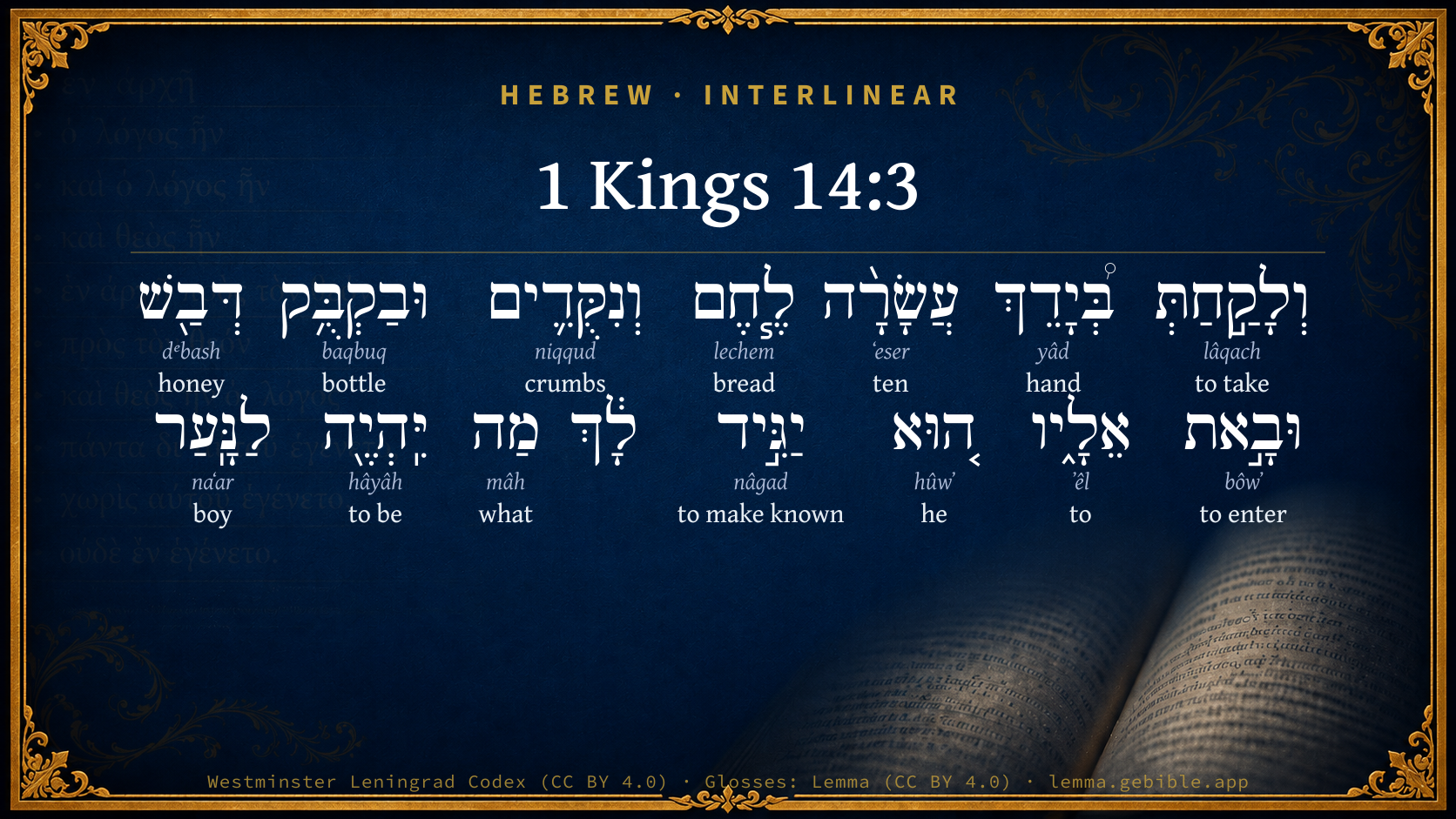
Hebrew (Westminster Leningrad Codex) 1 Kings 14:3 appears in the Hebrew Old Testament. The text above is from the Westminster Leningrad Codex. Each word links to its Strong’s number, a concise gloss, and parsing drawn from the Open Scriptures Hebrew Bible morphology. Click any word for its full Brown-Driver-Briggs (BDB) entry.
Download image
Cite this verse

1 Kings 14:3 (World English Bible). Public Domain. Lemma interlinear Bible study tool, https://lemma.gebible.app/v/1-kings/14/3.

Show BibTeX & RIS
BibTeX
RIS
English Translation
Take with you ten loaves, and cakes, and a jar of honey, and go to him: he will tell you what shall become of the child.
World English Bible · Public Domain
Highlights
  • 1 first appearance in the Hebrew Bible
Full analysis ↓
Download a study sheet

One document with this verse’s original text, its word-by-word gloss line, the meaning frame, cross-references with their text, attributed commentary, and full source and license credits — printable, and it pastes into notes with its structure intact.

This verse Autodidact and up

Study sheet (.html) Plain text (.txt)

A passage Seminary Student

Up to 50 verses in one chapter. A passage sheet keeps up to 6 commentary sources and 12 cross-references per verse, in the order this page ranks them, and says so on the sheet whenever that leaves anything out. Ask for a single verse and you get the Autodidact verse sheet above.

Everything on this page stays free to read, with no account — the sheet is a download of what is already on screen, not access to it.

Want to remove ads? Support Godless Engineer
Compare translations 3

The same verse in 3 English versions, stacked beneath the original-language interlinear above. Click any original word for its lexicon entry.

Each is an independent rendering of the whole verse — the interlinear is not word-aligned to these translations.

Highlighted words mark where these versions differ — a whole-verse word diff, not a word-by-word alignment.

  • World English Bible Public Domain
    Take with you ten loaves, and cakes, and a jar of honey, and go to him: he will tell you what shall become of the child.
  • King James Version Public Domain
    And take with thee ten loaves, and cracknels, and a cruse of honey, and go to him: he shall tell thee what shall become of the child.
  • unfoldingWord Literal Text CC BY-SA 4.0
    And you shall take in your hand ten bread and cakes and a jar of honey, and you shall go to him. He, he will declare to you what will happen to the boy.”

unfoldingWord Literal Text — © unfoldingWord, licensed CC BY-SA 4.0. Word-aligned USFM3 via Door43 (git.door43.org/unfoldingWord/en_ult).

Versions to compare (up to 4)

3 of 4 selected

Show all 18 translations

Every available English version of this verse, each an independent rendering of the whole verse.

  • World English Bible Public Domain
    Take with you ten loaves, and cakes, and a jar of honey, and go to him: he will tell you what shall become of the child.
  • Berean Standard Bible Public Domain
    Take with you ten loaves of bread, some cakes, and a jar of honey, and go to him. He will tell you what will become of the boy.”
  • Majority Standard Bible Public Domain
    Take with you ten loaves of bread, some cakes, and a jar of honey, and go to him. He will tell you what will become of the boy.”
  • King James Version Public Domain
    And take with thee ten loaves, and cracknels, and a cruse of honey, and go to him: he shall tell thee what shall become of the child.
  • American Standard Version (1901) Public Domain
    And take with thee ten loaves, and cakes, and a cruse of honey, and go to him: he will tell thee what shall become of the child.
  • Revised Version (1885) Public Domain
    And take with thee ten loaves, and cracknels, and a cruse of honey, and go to him: he shall tell thee what shall become of the child.
  • Geneva Bible (1599) Public Domain
    And take with thee tenne loaues and craknels, and a bottell of honie, and go to him: hee shall tell thee what shall become of the yong man.
  • Douay-Rheims (1899) Public Domain
    Take also with thee ten leaves, and cracknels, and a pot of honey, and go to him: for he will tell thee what shall become of this child.
  • Young's Literal Translation Public Domain
    and thou hast taken in thy hand ten loaves, and crumbs, and a bottle of honey, and hast gone in unto him; he doth declare to thee what becometh of the youth.'
  • Literal Standard Version CC BY-SA 4.0
    and you have taken in your hand ten loaves, and crumbs, and a bottle of honey, and have gone to him; he declares to you what becomes of the youth.”
  • Unlocked Literal Bible CC BY-SA 4.0
    Take with you ten loaves, some cakes, and a jar of honey, and go to Ahijah. He will tell you what will happen to the child.”
  • unfoldingWord Literal Text CC BY-SA 4.0
    And you shall take in your hand ten bread and cakes and a jar of honey, and you shall go to him. He, he will declare to you what will happen to the boy.”
  • Darby Bible Public Domain
    And take with thee ten loaves, and cakes, and a cruse of honey, and go to him: he will tell thee what shall become of the lad.
  • World Messianic Bible Public Domain
    Take with you ten loaves of bread, some cakes, and a jar of honey, and go to him. He will tell you what will become of the child.”
  • Webster's Bible Public Domain
    And take with thee ten loaves, and cracknels, and a cruse of honey, and go to him: he will tell thee what shall become of the child.
  • Free Bible Version CC BY-SA 4.0
    Take with you ten loaves of bread, some cakes, and a jar of honey for him. He will explain to you what will happen to the boy.”
  • Bible in Basic English Public Domain
    And take with you ten cakes of bread and dry cakes and a pot of honey, and go to him: he will give you word of what is to become of the child.
  • JPS Tanakh (1917) Public Domain
    And take with thee ten loaves, and biscuits, and a cruse of honey, and go to him; he will tell thee what shall become of the child.'

Literal Standard Version (2020), Covenant Press — licensed CC BY-SA 4.0. Text via the HelloAO Bible API (eBible.org). Unlocked Literal Bible (unfoldingWord) — licensed CC BY-SA 4.0. Text via the HelloAO Bible API (eBible.org). unfoldingWord Literal Text — © unfoldingWord, licensed CC BY-SA 4.0. Word-aligned USFM3 via Door43 (git.door43.org/unfoldingWord/en_ult). Free Bible Version, Dr. Jonathan Gallagher — licensed CC BY-SA 4.0. Text via the HelloAO Bible API (eBible.org).

Word by word

More ways to search: Search by grammar → Find every occurrence → Compare this word →

Practice this passage: Drill this verse → Learn its vocabulary →

וְנִקֻּדִ֛ים
niqqud
H5350
“and · crumbs”
Conjunction + Noun, Common, Masculine, Plural, Absolute
Part of Speech
Conjunction + Noun
Type
Common
Gender
Masculine
Number
Plural
State
Absolute
Full BDB Definition

Origin: from the same as H5348

TWOT: 1410b

crumbled thing, thing easily crumbled, crumbs - crumbs - apparently a kind of hard biscuit or cake
  1. וְלָקַ֣חַתְּ lâqach H3947 “and · to take” Conjunction + Verb, Qal, Perfect, 2nd Person, Feminine, Singular
  2. בְּ֠יָדֵךְ yâd H3027 “in/at · hand · your” Preposition + Noun, Common, Both, Singular, Construct + Suffix, Personal, 2nd Person, Feminine, Singular
  3. עֲשָׂרָ֨ה ʻeser H6235 “ten” Adjective, Cardinal number, Masculine, Singular, Absolute
  4. לֶ֧חֶם lechem H3899 “bread” Noun, Common, Both, Singular, Absolute
  5. וּבַקְבֻּ֥ק baqbuq H1228 “and · bottle of” Conjunction + Noun, Common, Masculine, Singular, Construct
  6. דְּבַ֖שׁ dᵉbash H1706 “honey” Noun, Common, Masculine, Singular, Absolute
  7. וּבָ֣את bôwʼ H935 “and · to enter” Conjunction + Verb, Qal, Sequential Perfect, 2nd Person, Feminine, Singular
  8. אֵלָ֑יו ʼêl H413 “to · him” Preposition + Suffix, Personal, 3rd Person, Masculine, Singular
  9. ה֚וּא hûwʼ H1931 “he” Pronoun, Personal, 3rd Person, Masculine, Singular
  10. יַגִּ֣יד nâgad H5046 “to make known” Verb, Hiphil, Imperfect, 3rd Person, Masculine, Singular
  11. מַה mâh H4100 “what” Particle, Interrogative
  12. יִּֽהְיֶ֖ה hâyâh H1961 “to be” Verb, Qal, Imperfect, 3rd Person, Masculine, Singular
  13. לַנָּֽעַר naʻar H5288 “to/for the · boy” Preposition, Determined + Noun, Common, Masculine, Singular, Absolute

About this verse

These counts appear in no published source. They are computed here, from the morphology-tagged text and Lemma’s own curated glosses. What Lemma adds →

15
words
14
distinct lemmas
Historical
section

Notable vocabulary

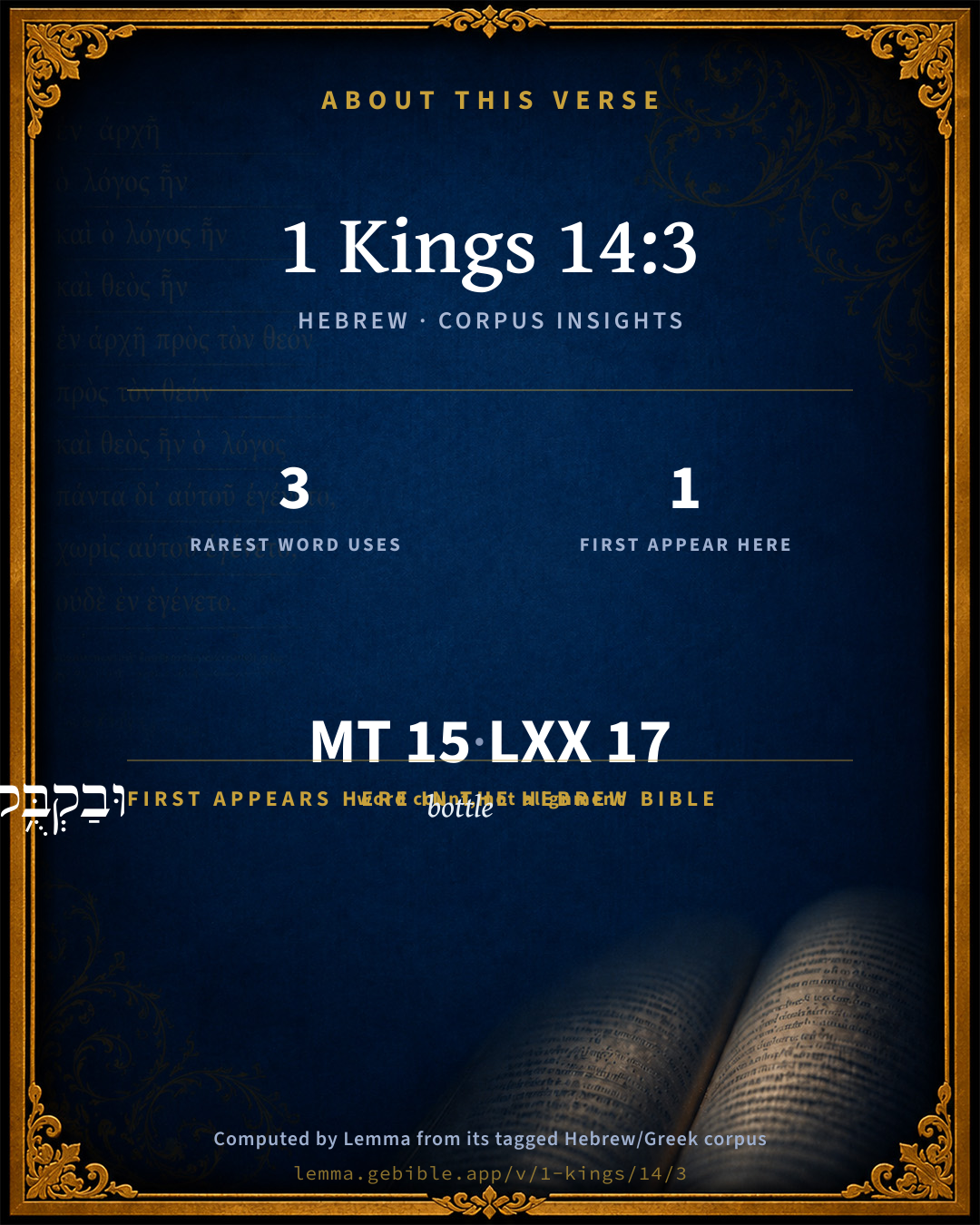
The rarest word here is וְנִקֻּדִ֛ים crumbs H5350 — appearing just 3 times in the whole Hebrew Bible.

First appearance in Scripture

This word makes its first canonical appearance in the Hebrew Bible here:

  • וּבַקְבֻּ֥ק bottle H1228

Shared distinctive vocabulary

וְנִקֻּדִ֛ים crumbs H5350 occurs in 3 verses of the Hebrew Bible. Also found in:

Grammatical profile

  • 4 verbs
  • 6 nouns
  • 1 adjective
  • 1 pronoun
  • 2 prepositions
  • 1 particle

Verb forms

  • וְלָקַ֣חַתְּ Qal · Perfect
  • וּבָ֣את Qal · Sequential Perfect
  • יַגִּ֣יד Hiphil · Imperfect
  • יִּֽהְיֶ֖ה Qal · Imperfect

Hebrew & Septuagint length

In the original languages it is 15 Hebrew tokens and 17 Greek tokens — but the two are counted differently (Hebrew bundles its prefixes and suffixes into one token; the Greek is in lemma form), so that isn’t a like-for-like length.

Cross-references

10

Topical passages linked to 1 Kings 14:3 in the Treasury of Scripture Knowledge — connected by theme and wording, ordered by reader-vote popularity; previews shown in the World English Bible.

  • 1 Samuel 9:7–8 Then said Saul to his servant, But, behold, if we go, what shall we bring the man? for the bread is spent in our vessels, and there is not a present to bring to the man of God: what have we?
  • 1 Kings 13:7 The king said to the man of God, Come home with me, and refresh yourself, and I will give you a reward.
  • 2 Kings 4:42 There came a man from Baal Shalishah, and brought the man of God bread of the first fruits, twenty loaves of barley, and fresh ears of grain in his sack. He said, Give to the people, that they may eat.
  • 2 Kings 1:2 Ahaziah fell down through the lattice in his upper chamber that was in Samaria, and was sick: and he sent messengers, and said to them, Go, inquire of Baal Zebub, the god of Ekron, whether I shall recover of this sickness.
  • 2 Kings 5:5 The king of Syria said, Go now, and I will send a letter to the king of Israel. He departed, and took with him ten talents of silver, and six thousand [pieces] of gold, and ten changes of clothing.
  • 2 Kings 5:15 He returned to the man of God, he and all his company, and came, and stood before him; and he said, See now, I know that there is no God in all the earth, but in Israel: now therefore, please take a present from your servant.
  • 2 Kings 8:7–9 Elisha came to Damascus; and Benhadad the king of Syria was sick; and it was told him, saying, The man of God is come here.
  • Luke 7:2–3 A certain centurion's servant, who was dear to him, was sick and at the point of death.
  • John 4:47–48 When he heard that Jesus had come out of Judea into Galilee, he went to him, and begged him that he would come down and heal his son, for he was at the point of death.
  • John 11:3 The sisters therefore sent to him, saying, "Lord, behold, he for whom you have great affection is sick."

Cross-references courtesy of OpenBible.info (CC BY 4.0).

Hebrew and Greek witnesses Masoretic Hebrew ↔ Greek Septuagint

The same verse in the two great witnesses to the Old Testament, shown verse-for-verse.

These are two independent witnesses, not word-aligned to each other, and the Septuagint is shown in lemma (dictionary) form.

Hebrew 1 Kings 14:3 Masoretic · Westminster Leningrad Codex

וְלָקַ֣חַתְּ בְּ֠יָדֵךְ עֲשָׂרָ֨ה לֶ֧חֶם וְנִקֻּדִ֛ים וּבַקְבֻּ֥ק דְּבַ֖שׁ וּבָ֣את אֵלָ֑יו ה֚וּא יַגִּ֣יד לָ֔ךְ מַה יִּֽהְיֶ֖ה לַנָּֽעַר

Take with you ten loaves, and cakes, and a jar of honey, and go to him: he will tell you what shall become of the child.

World English Bible · Public Domain

Greek LXX 1 Kings 14:3 Septuagint · lemma form

καί οἰκοδομέω ἑαυτοῦ ὑψηλός καί στήλη καί ἄλσος ἐπί πᾶς βουνός ὑψηλός καί ὑποκάτω πᾶς ξύλον σύσκιος

No English rendering of this Greek verse — the small residue in the structurally divergent books.

On this verse, The Cambridge Bible for Schools and Colleges discusses the Septuagint’s reading. Read the note in Commentary ↓

Hebrew: Westminster Leningrad Codex (CC BY 4.0). Greek: Septuagint (public domain); English from a public-domain English Septuagint. How the Septuagint differs from the Hebrew →

Targum (Aramaic paraphrase)

1

The Targum is the ancient Jewish Aramaic paraphrase of the Hebrew Scriptures — an interpretive translation, not the Hebrew text itself. Onkelos (literal) and Pseudo-Jonathan (expansive) render the Torah, and Jonathan the Prophets. Coverage is partial: where no permissively-licensed English translation exists for a verse, only the Aramaic is shown. This is verse-level text, not a word-by-word alignment to the Hebrew.

  1. Targum Jonathan Prophets (Joshua–Malachi)
    וְתִסְבִין בִּידָךְ עֲסַר טוּלְמִין דִלְחֵם וְכִסְנִין וְזִלוּעַ דִדְבַשׁ וְתַהֲכִין לְוָתֵיהּ הוּא יְחַוֵי לִיךְ מָא יְהֵי לְרַבְיָא:

    (no public-domain English translation for this verse)

    Targum Jonathan — Aramaic: “Mikraot Gedolot” (public domain). English: “Sefaria Community Translation” (CC0 1.0 (public-domain dedication)); “London "Chaldee Paraphrase," 1871” (public domain). Text via Sefaria.

Commentary

Notes on 1 Kings 14:3 from classic Christian and Jewish commentators (each source and its license shown beneath its notes). The classic Christian expositions comment on the surrounding passage and are grouped to its opening verse, so a note may address several verses; the Jewish commentaries on the Tanakh (Rashi and others) are per-verse, so they appear only where the commentator wrote on this verse.

Lemma curates 59 commentaries, every one of them public domain or Creative Commons licensed, each selected and text-cleaned for this edition rather than reprinted as found. About our sources →

Trapp's Complete Commentary

John Trapp

1Ki 14:3 And take with thee ten loaves, and cracknels, and a cruse of honey, and go to him: he shall tell thee what shall become of the child.

Ver. 3. And take with thee ten loaves.] A poor country present, that she might seem none other than a plain country woman, yet willing to show her thankfulness.

And cracknels.] Or, Plain cakes; Heb., Punctata, tenues placentulas punctis respersas.

And a cruse of honey.] Or, Bottle, a narrow mouthed vessel, that when it is emptied soundeth bakbuk, that is the Hebrew word here used. See the like in Job 39:30, where the vultures are said to glut glut blood, by an onomatopoeia.

John Trapp, A Commentary or Exposition upon All the Books of the Old and New Testament (1647–1656) — public domain. Text from a community e-Sword module.

Joseph Benson's Commentary

1Ki 14:3. Take with thee ten loaves, &c. — It was usual for those that went to inquire of a prophet to make him some present as a token of their respect for him, 1Sa 9:7. The present which she was here directed to take, was of such things as suited the disguise in which she was to go, and were calculated to make Ahijah think her a country woman rather than a queen. And go to him — To inquire the event of this sickness, as the following words imply. It would have been more pious to have inquired why God contended with him; to have desired the prophet to pray for him, and to have cast away his idols; then the child might have been restored to him, as his hand was: “but most people,” says Henry, “would rather be told their fortune, than told their faults, or their duty.”

Joseph Benson's Commentary on the Old and New Testaments (1811–1818) — public domain. Text from a community e-Sword module.

Tyndale Open Study Notes

Tyndale Open Resources

14:3 It was customary to take a gift to a prophet when seeking his counsel (2 Kgs 5:5; 8:8). King Jeroboam’s wife took everyday commodities to supplement her disguise.

Tyndale Open Study Notes — © Tyndale Open Resources, licensed CC BY-SA 4.0. Text via the HelloAO Bible API.

Geneva Bible (1599)

Geneva Bible translators

Hebrew, in thine hand.

Or, wafers.

According to the custom when they went to ask counsel of Prophets, 1 Sam. 9:7.

Geneva Bible (1599) marginal notes — public domain. Text via Bolls.life.

Jamieson, Fausset & Brown

Robert Jamieson, A. R. Fausset & David Brown

And take with thee ten loaves, and cracknels, and a cruse of honey, and go to him--This was a present in unison with the peasant character she assumed. Cracknels are a kind of sweet seed-cake. The prophet was blind, but having received divine premonition of the pretended countrywoman's coming, he addressed her as the queen the moment she appeared, apprised her of the calamities which, in consequence of the ingratitude of Jeroboam, his apostasy, and outrageous misgovernment of Israel, impended over their house, as well as over the nation which too readily followed his idolatrous innovations.

Jamieson, Fausset & Brown — Commentary Critical and Explanatory on the Whole Bible (1871) — public domain (CC PDM 1.0). Text via the HelloAO Bible API.

Adam Clarke's Commentary

Verse 3. Ten loaves] Probably common or household bread.

Cracknels] נקדים nikkuddim, spotted, or perforated bread; thin cakes, pierced through with many holes, the same as is called Jews' bread to the present day, and used by them at the passover. It was customary to give presents to all great personages; and no person consulted a prophet without bringing something in his hand.

Adam Clarke's Commentary on the Bible (1810–1826) — public domain. Text from a community e-Sword/MySword module.

Ellicott's Commentary for English Readers

(3) And take.—The presentation of this offering, designedly simple and rustic in character, accords with the custom (1Sa_9:7-8) of approaching the prophet at all times with some present, however trifling. In itself an act simply of homage, it would easily degenerate into the treatment of the prophetic function as a mere matter of merchandise. (See above, 1Ki_13:7.)

A Bible Commentary for English Readers, edited by Charles John Ellicott (1878–1897) — public domain. Text from a community e-Sword module.

The Cambridge Bible for Schools and Colleges

gen. ed. J. J. S. Perowne

3. cracknels] The word so rendered is found only here and in Jos_9:5, of the bread of the Gibeonites, which became mouldy. Some take the word there in the sense of crumbling, so dry that it crumbled into bits. In the present passage however it must mean a sort of cake, perhaps dry baked. The whole of the present which the queen was to take with her was such as a woman of humble position would bring. The traditional interpretation of the Talmud makes the word to mean small cakes about the size of half an egg. The LXX. (Alex.) adds as explanatory, that they were for the prophet’s children.

and a cruse] The word only occurs here and in Jer_19:1; Jer_19:10, where it is rendered ‘bottle’.

he shall tell thee what shall become of the child] It reveals to us a singular condition of mind, when we see the king confident in the prophet’s power of foretelling the future even in the case of an individual life, and yet thinking that the queen could go to him with her question and he not know who was making the inquiry.

The Cambridge Bible for Schools and Colleges (gen. ed. J. J. S. Perowne; Cambridge University Press, 1878–1918) — public domain. Text from a community e-Sword module.

John Gill's Exposition

And Jeroboam's wife did so, and went to Shiloh, and came to the house of Abijah,.... Disguised herself, and took this long journey, and found the prophet's house; which she did partly in obedience to her husband, and partly from affection to her child: but Abijah could not see; her or anybody else that came into the room to him:

for his eyes were set by reason of his age; or "stood" fixed and immovable, as the eyes of blind men are; or the nerves and muscles of his eyes stood within the holes thereof, so that he could not see objects.

John Gill's Exposition of the Whole Bible (1746–1763) — public domain (CC PDM 1.0). Text via the HelloAO Bible API.

Albert Barnes' Notes on the Bible

See the marginal reference The presents here were selected for the purpose of deception, being such as a poor country person would have been likely to bring. Jeroboam counted also on Ahijah’s blindness 1Ki 14:4 as favoring his plan of deception (compare Gen 27:1, Gen 27:22).

Cracknels - See the margin. The Hebrew word is thought to mean a kind of cake which crumbled easily.

Albert Barnes' Notes on the Bible (1834–1885) — public domain. Text from a community e-Sword/MySword module.

Haydock's Catholic Bible Commentary

Cracknels. Hebrew nikkudim, "cakes full of holes," &c., Josue ix. 12. (Calmet) --- Septuagint give a double translation, "cakes and raisins." Arabic, "fruits." Syriac adds "dried." It was customary to make presents to the prophets, 1 Kings ix. 7. (Calmet) --- But these were mean, that the woman might not be known. (Du Hamel) --- It is not said that Ahias deigned to receive them. (St. Jerome in Mic. iii.)

George Leo Haydock (1774–1849), Haydock's Catholic Family Bible and Commentary, 1859 edition — public domain. Excludes Psalms (Douay-Rheims chapter numbering differs from Protestant) and Deuterocanonical books (Catholic canon only).

Matthew Poole's English Annotations

A cruse of honey; a present, after the manner, Jdg 13:17; 1Sa 9:7,8; 2Ki 5:15; 8:8; but mean, as became an ordinary country woman, which she personated.

And go to him, to inquire the event of this sickness, as the following words imply.

Matthew Poole's English Annotations on the Holy Bible (1683–1685) — public domain. Text from a community e-Sword/MySword module.

Whedon's Commentary on the Bible

Daniel D. Whedon

3. Cracknels — נקדים, seems to denote a small sprinkled or punctured cake, baked hard for the purpose of keeping well during a long journey. Such small hard-baked biscuit are still used by the common people in the East. Compare Jos_9:5, where the word is erroneously rendered mouldy. The bread, the cracknels, and the honey were to be used as honorary presents for the prophet, according to the customs of the times. See note on 1Sa_9:7.

What shall become of the child — Henry well calls attention to the “notion of fatality” evinced in this inquiry of Jeroboam, and also in that of Ahaziah, (2Ki_1:2,) and that of Ben-hadad. 2Ki_8:8. They inquire simply what the end will be, not what means they should use for recovery.

Daniel D. Whedon (gen. ed.), Commentary on the Old and New Testaments (1874–1909) — public domain. Text from a community e-Sword module.

The Pulpit Commentary

And take with thee Heb. in thine hand ten loaves Ten would seem to have been a usual number. (1Sa_17:18) On the subject of gifts or fees to prophets, judges, etc., see on Jos_9:5, Jos_9:12, where Gesenius would render "crumbs." Mouldy bread would hardly be taken as a present. These cakes, according to the LXX, Cod. Alex., were for the prophet"s children and a cruse i.e. , leather bottle, qBuqB Bakbuk, is clearly an onomatopoetic word, suggested by the bubbling noise of liquids in emptying of honey Spices and other delicacies were often given as presents, and honey was a special product of the country. (Exo_3:8; Deu_8:8; 2Sa_17:29) The honey sent by Jacob to Joseph was probably "honey of grapes". The present was purposely a poor one, for the sake of maintaining the deception; i.e., it was a part of the disguise, and go to him: he shall tell thee what shall become of Heb. be to the child . At first it strikes us as strange that Jeroboam merely asks what the result will be. He does not petition, that is to say, as in 1Ki_13:6, for a cure. But we find the same peculiarity, which some would explain by the fatalism of the East, in 2Ki_1:2, and ch. 8:9, In the present instance, however, no such explanation is needed. For

(1) Jeroboam could hardly ask a favour of a prophet of Jehovah, or hope that it would be granted if he did, and

(2) if, as he feared, the sickness was judicial, it would be useless to ask for healing. The infatuation which insisted on a disguise for the purpose of deceiving the prophet, who nevertheless was believed to be able to divine the issue of the sickness, is very characteristic, and has had many parallels since.

The Pulpit Commentary (1880–1919), ed. H.D.M. Spence-Jones & Joseph S. Exell — public domain. Text from a community e-Sword module.

John Wesley's Explanatory Notes

And take - A present, after the manner, but mean, as became an ordinary country woman, which she personated. It had been more pious to inquire, why God contended with him.

John Wesley, Explanatory Notes Upon the Whole Bible (1754–1765) — public domain. Text via the GEBible commentary corpus.

Rashi

Rabbi Shlomo Yitzchaki (Rashi)

Biscuits. A type of parched grain, dried in an oven, and they make flour from it to make it into a dish called שתיתא, in the language of the Gemara.

Rashi on the Tanakh — English translations: “The Judaica Press complete Tanach with Rashi, translated by A. J. Rosenberg” (CC BY 4.0); “Pentateuch with Rashi's commentary by M. Rosenbaum and A.M. Silbermann, 1929-1934” (public domain); “The Metsudah Tanach series, Lakewood, N.J” (CC BY 4.0); and “The Book of Joshua, Metsudah Publications, 1997” (CC BY 4.0). Text via Sefaria.

Lesson kit

Teaching starters — assembled from the data on this page, not authored interpretation. Every prompt links to the verse data it draws on. Edit before teaching.

1 Kings, in the Historical, opens this verse with 15 words (14 distinct Hebrew lemmas). Its most distinctive word is niqqud (“crumbs”). A historical commentator’s framing appears above. Read the whole chapter for the surrounding context.

Discussion questions

  1. What does “crumbs” (niqqud) contribute to the verse as a whole?
  2. This is the first place “bottle” appears in Scripture (first appears here). What does its debut here establish?
  3. How does Joshua 9:5, which shares the word «crumbs», read alongside this verse?
  4. The translations on this page render this verse differently — a whole-verse word diff, not a word-by-word alignment. What might account for the different wordings?
  5. «וְלָקַ֣חַתְּ» is a Qal Perfect verb. How does that grammatical form shape the action described?
  6. Compare how Trapp's Complete Commentary and Joseph Benson's Commentary read this verse. Where do they agree or differ?

Things to notice

Reading settings

Reading text

Shown beneath each verse's original-language words.

Old Testament
Old Testament edition

Read the OT as the Masoretic Hebrew (MT) or the Greek Septuagint (LXX).

English shown for the Greek Septuagint (in the Hebrew ↔ Greek comparison).

Comparing translations? Open the Compare panel on any verse page to stack up to four side by side.