
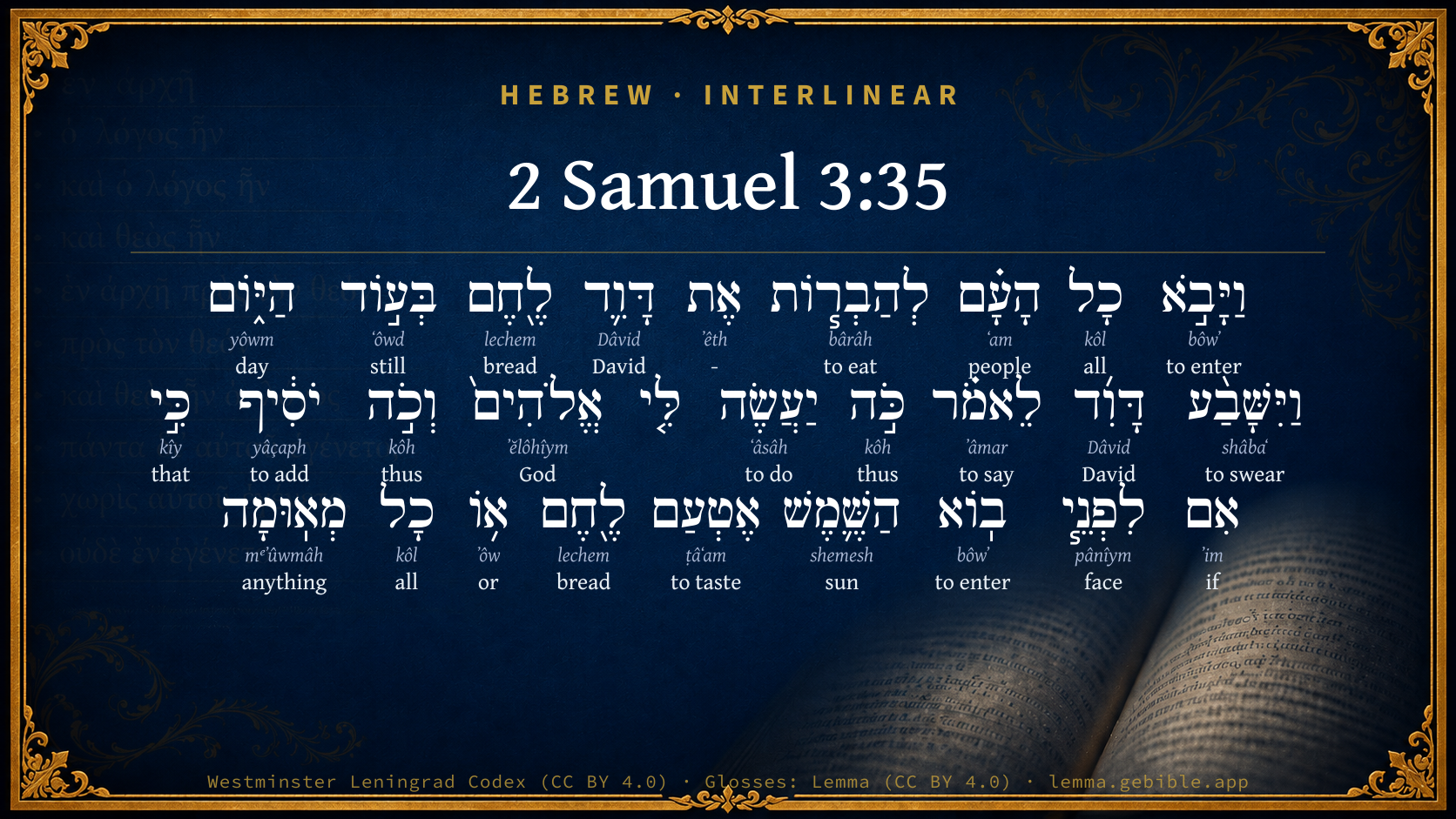
2 Samuel 3:35

Hebrew (Westminster Leningrad Codex) 2 Samuel 3:35 appears in the Hebrew Old Testament. The text above is from the Westminster Leningrad Codex. Each word links to its Strong’s number, a concise gloss, and parsing drawn from the Open Scriptures Hebrew Bible morphology. Click any word for its full Brown-Driver-Briggs (BDB) entry.
Download image
Cite this verse

2 Samuel 3:35 (World English Bible). Public Domain. Lemma interlinear Bible study tool, https://lemma.gebible.app/v/2-samuel/3/35.

Show BibTeX & RIS
BibTeX
RIS
English Translation
All the people came to cause David to eat bread while it was yet day; but David swore, saying, God do so to me, and more also, if I taste bread, or anything else, until the sun be down.
World English Bible · Public Domain
Download a study sheet

One document with this verse’s original text, its word-by-word gloss line, the meaning frame, cross-references with their text, attributed commentary, and full source and license credits — printable, and it pastes into notes with its structure intact.

This verse Autodidact and up

Study sheet (.html) Plain text (.txt)

A passage Seminary Student

Up to 50 verses in one chapter. A passage sheet keeps up to 6 commentary sources and 12 cross-references per verse, in the order this page ranks them, and says so on the sheet whenever that leaves anything out. Ask for a single verse and you get the Autodidact verse sheet above.

Everything on this page stays free to read, with no account — the sheet is a download of what is already on screen, not access to it.

Want to remove ads? Support Godless Engineer
Compare translations 3

The same verse in 3 English versions, stacked beneath the original-language interlinear above. Click any original word for its lexicon entry.

Each is an independent rendering of the whole verse — the interlinear is not word-aligned to these translations.

Highlighted words mark where these versions differ — a whole-verse word diff, not a word-by-word alignment.

  • World English Bible Public Domain
    All the people came to cause David to eat bread while it was yet day; but David swore, saying, God do so to me, and more also, if I taste bread, or anything else, until the sun be down.
  • King James Version Public Domain
    And when all the people came to cause David to eat meat while it was yet day, David sware, saying, So do God to me, and more also, if I taste bread, or ought else, till the sun be down.
  • unfoldingWord Literal Text CC BY-SA 4.0
    Then all of the people came to make David eat bread while still day, but David swore, saying, “Thus may God do to me, and thus may he add, that if to the face of the coming in of the sun I taste bread or any of a thing.”

unfoldingWord Literal Text — © unfoldingWord, licensed CC BY-SA 4.0. Word-aligned USFM3 via Door43 (git.door43.org/unfoldingWord/en_ult).

Versions to compare (up to 4)

3 of 4 selected

Show all 18 translations

Every available English version of this verse, each an independent rendering of the whole verse.

  • World English Bible Public Domain
    All the people came to cause David to eat bread while it was yet day; but David swore, saying, God do so to me, and more also, if I taste bread, or anything else, until the sun be down.
  • Berean Standard Bible Public Domain
    Then all the people came and urged David to eat something while it was still day, but David took an oath, saying, “May God punish me, and ever so severely, if I taste bread or anything else before the sun sets!”
  • Majority Standard Bible Public Domain
    Then all the people came and urged David to eat something while it was still day, but David took an oath, saying, “May God punish me, and ever so severely, if I taste bread or anything else before the sun sets!”
  • King James Version Public Domain
    And when all the people came to cause David to eat meat while it was yet day, David sware, saying, So do God to me, and more also, if I taste bread, or ought else, till the sun be down.
  • American Standard Version (1901) Public Domain
    And all the people came to cause David to eat bread while it was yet day; but David sware, saying, God do so to me, and more also, if I taste bread, or aught else, till the sun be down.
  • Revised Version (1885) Public Domain
    And all the people came to cause David to eat bread while it was yet day; but David sware, saying, God do so to me, and more also, if I taste bread, or aught else, till the sun be down.
  • Geneva Bible (1599) Public Domain
    Afterwarde all the people came to cause Dauid eate meate while it was yet day, but Dauid sware, saying, So doe God to me and more also, if I taste bread, or ought els till the sunne be downe.
  • Douay-Rheims (1899) Public Domain
    And when all the people came to take meat with David, while it was yet broad day, David swore, saying: So do God to me, and more also, if I taste bread or any thing else before sunset.
  • Young's Literal Translation Public Domain
    And all the people come to cause David to eat bread while yet day, and David sweareth, saying, `Thus doth God to me, and thus He doth add, for -- before the going in of the sun, I taste no bread or any other thing.'
  • Literal Standard Version CC BY-SA 4.0
    And all the people come to cause David to eat bread while yet day, and David swears, saying, “Thus God does to me, and thus He adds, for—before the going in of the sun, I taste no bread or any other thing.”
  • Unlocked Literal Bible CC BY-SA 4.0
    All the people came to make David eat while it was still day, but David swore, “May God do so to me, and more also, if I taste bread or anything else before the sun goes down.”
  • unfoldingWord Literal Text CC BY-SA 4.0
    Then all of the people came to make David eat bread while still day, but David swore, saying, “Thus may God do to me, and thus may he add, that if to the face of the coming in of the sun I taste bread or any of a thing.”
  • Darby Bible Public Domain
    And all the people came to cause David to eat bread while it was yet day; but David swore, saying, So do God to me, and more also, if I taste bread or aught else till the sun be down!
  • World Messianic Bible Public Domain
    All the people came to urge David to eat bread while it was yet day; but David swore, saying, “God do so to me, and more also, if I taste bread or anything else, until the sun goes down.”
  • Webster's Bible Public Domain
    And when all the people came to cause David to eat food while it was yet day, David swore, saying, So do God to me, and more also, If I taste bread or aught else, till the sun is down.
  • Free Bible Version CC BY-SA 4.0
    Then people came to David and tried to persuade him to have something to eat during the day. But David swore an oath, saying, “May God punish me severely if I eat bread or anything else before sunset!”
  • Bible in Basic English Public Domain
    And the people came to make David take food, while it was still day, but David with an oath said, May God's punishment be on me if I take a taste of bread or any other thing till the sun has gone down!
  • JPS Tanakh (1917) Public Domain
    And all the people came to cause David to eat bread while it was yet day; but David swore, saying: 'God do so to me, and more also, if I taste bread, or aught else, till the sun be down.'

Literal Standard Version (2020), Covenant Press — licensed CC BY-SA 4.0. Text via the HelloAO Bible API (eBible.org). Unlocked Literal Bible (unfoldingWord) — licensed CC BY-SA 4.0. Text via the HelloAO Bible API (eBible.org). unfoldingWord Literal Text — © unfoldingWord, licensed CC BY-SA 4.0. Word-aligned USFM3 via Door43 (git.door43.org/unfoldingWord/en_ult). Free Bible Version, Dr. Jonathan Gallagher — licensed CC BY-SA 4.0. Text via the HelloAO Bible API (eBible.org).

Word by word

More ways to search: Search by grammar → Find every occurrence → Compare this word →

Practice this passage: Drill this verse → Learn its vocabulary →

לְהַבְר֧וֹת
bârâh
H1262
“to eat”
Preposition + Verb, Hiphil, Infinitive Construct
Part of Speech
Preposition + Verb
Stem
Hiphil
Form
Infinitive Construct
Full BDB Definition

Origin: a primitive root

TWOT: 281

to eat, consume - (Qal) to eat - (Piel) for eating, devouring - (Hiphil) to cause to eat
  1. וַיָּבֹ֣א bôwʼ H935 “and · to enter” Conjunction + Verb, Qal, Sequential Imperfect, 3rd Person, Masculine, Singular
  2. כָל kôl H3605 “all of” Noun, Common, Masculine, Singular, Construct
  3. הָעָ֗ם ʻam H5971 “the · people” Particle, Definite Article + Noun, Common, Masculine, Singular, Absolute
  4. אֶת ʼêth H853 “-” Particle, Direct Object
  5. דָּוִ֛ד Dâvid H1732 “David” Noun, Proper
  6. לֶ֖חֶם lechem H3899 “bread” Noun, Common, Both, Singular, Absolute
  7. בְּע֣וֹד ʻôwd H5750 “in/at · still” Preposition + Adverb
  8. הַיּ֑וֹם yôwm H3117 “the · day” Particle, Definite Article + Noun, Common, Masculine, Singular, Absolute
  9. וַיִּשָּׁבַ֨ע shâbaʻ H7650 “and · to swear” Conjunction + Verb, Niphal, Sequential Imperfect, 3rd Person, Masculine, Singular
  10. דָּוִ֜ד Dâvid H1732 “David” Noun, Proper
  11. לֵאמֹ֗ר ʼâmar H559 “to say” Preposition + Verb, Qal, Infinitive Construct
  12. כֹּ֣ה kôh H3541 “thus” Adverb
  13. יַעֲשֶׂה ʻâsâh H6213 “to do” Verb, Qal, Jussive, 3rd Person, Masculine, Singular
  14. אֱלֹהִים֙ ʼĕlôhîym H430 “God(s)” Noun, Common, Masculine, Plural, Absolute
  15. וְכֹ֣ה kôh H3541 “and · thus” Conjunction + Adverb
  16. יֹסִ֔יף yâçaph H3254 “to add” Verb, Hiphil, Jussive, 3rd Person, Masculine, Singular
  17. כִּ֣י kîy H3588 “that” Conjunction
  18. אִם ʼim H518 “if” Conjunction
  19. לִפְנֵ֧י pânîym H6440 “to/for · face(s) of” Preposition + Noun, Common, Both, Plural, Construct
  20. בֽוֹא bôwʼ H935 “to enter” Verb, Qal, Infinitive Construct
  21. הַשֶּׁ֛מֶשׁ shemesh H8121 “the · sun” Particle, Definite Article + Noun, Common, Both, Singular, Absolute
  22. אֶטְעַם ṭâʻam H2938 “to taste” Verb, Qal, Imperfect, 1st Person, Common, Singular
  23. לֶ֖חֶם lechem H3899 “bread” Noun, Common, Both, Singular, Absolute
  24. א֥וֹ ʼôw H176 “or” Conjunction
  25. כָל kôl H3605 “all of” Noun, Common, Masculine, Singular, Construct
  26. מְאֽוּמָה mᵉʼûwmâh H3972 “anything” Noun, Common, Feminine, Singular, Absolute

About this verse

These counts appear in no published source. They are computed here, from the morphology-tagged text and Lemma’s own curated glosses. What Lemma adds →

28
words
22
distinct lemmas
Historical
section

Notable vocabulary

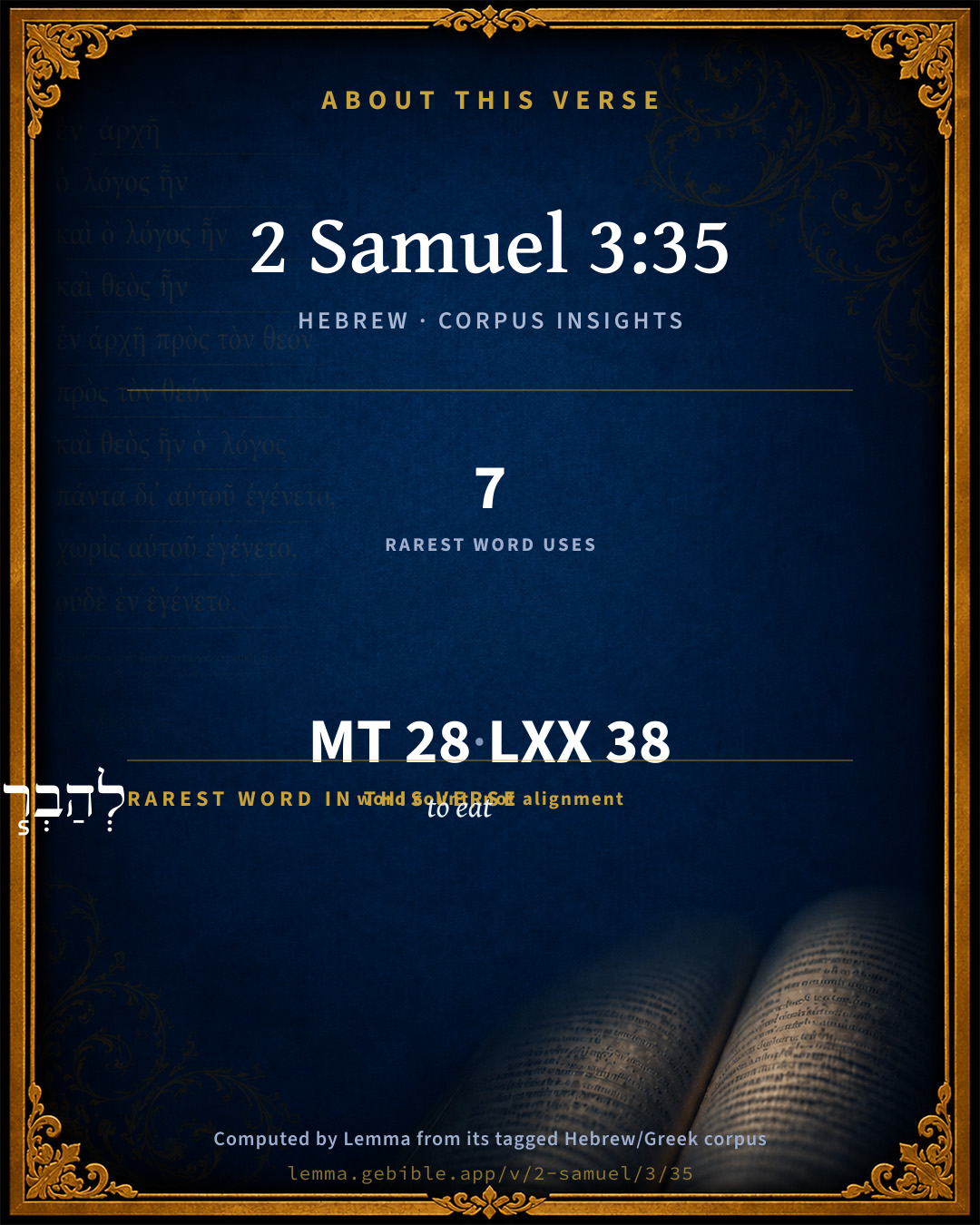
The rarest word here is לְהַבְר֧וֹת to eat H1262 — appearing just 7 times in the whole Hebrew Bible.

Shared distinctive vocabulary

לְהַבְר֧וֹת to eat H1262 occurs in 7 verses of the Hebrew Bible. Also found in:

Grammatical profile

  • 8 verbs
  • 12 nouns
  • 1 preposition
  • 3 conjunctions
  • 3 adverbs
  • 1 particle

Verb forms

  • וַיָּבֹ֣א Qal · Sequential Imperfect
  • לְהַבְר֧וֹת Hiphil · Infinitive Construct
  • וַיִּשָּׁבַ֨ע Niphal · Sequential Imperfect
  • לֵאמֹ֗ר Qal · Infinitive Construct
  • יַעֲשֶׂה Qal · Jussive
  • יֹסִ֔יף Hiphil · Jussive
  • בֽוֹא Qal · Infinitive Construct
  • אֶטְעַם Qal · Imperfect

Repetition

Words recur within this verse — often emphatic in Hebrew:

  • וַיָּבֹ֣א to enter H935 ×2
  • כָל all H3605 ×2
  • דָּוִ֛ד David H1732 ×2
  • לֶ֖חֶם bread H3899 ×2
  • כֹּ֣ה thus H3541 ×2

Hebrew & Septuagint length

In English translation the verse runs 39 words from the Hebrew and 50 from the Septuagint (LXX English) — closely comparable.

A rough comparison of the two English renderings, which tokenize alike — not a word-level alignment.

Word counts can differ between the Hebrew and the Greek without any difference in meaning — e.g. the Hebrew direct-object marker אֵת has no separate Greek word, and Greek often adds the article ὁ.

In the original languages it is 28 Hebrew tokens and 38 Greek tokens — but the two are counted differently (Hebrew bundles its prefixes and suffixes into one token; the Greek is in lemma form), so that isn’t a like-for-like length.

Cross-references

9

Topical passages linked to 2 Samuel 3:35 in the Treasury of Scripture Knowledge — connected by theme and wording, ordered by reader-vote popularity; previews shown in the World English Bible.

  • 2 Samuel 1:12 and they mourned, and wept, and fasted until even, for Saul, and for Jonathan his son, and for the people of Yahweh, and for the house of Israel; because they were fallen by the sword.
  • 2 Samuel 12:17 The elders of his house arose, [and stood] beside him, to raise him up from the earth: but he would not, neither did he eat bread with them.
  • Ruth 1:17 where you die, will I die, and there will I be buried: Yahweh do so to me, and more also, if anything but death part you and me."
  • Jeremiah 16:7 neither shall men break [bread] for them in mourning, to comfort them for the dead; neither shall men give them the cup of consolation to drink for their father or for their mother.
  • Judges 20:26 Then all the children of Israel, and all the people, went up, and came to Bethel, and wept, and sat there before Yahweh, and fasted that day until even; and they offered burnt-offerings and peace-offerings before Yahweh.
  • Ezekiel 24:17 Sigh, but not aloud, make no mourning for the dead; bind your headdress on you, and put your shoes on your feet, and don't cover your lips, and don't eat men's bread.
  • 1 Samuel 3:17 He said, "What is the thing that [Yahweh] has spoken to you? Please don't hide it from me. God do so to you, and more also, if you hide anything from me of all the things that he spoke to you."
  • 2 Samuel 3:9 God do so to Abner, and more also, if, as Yahweh has sworn to David, I don't do even so to him;
  • Ezekiel 24:22 You shall do as I have done: you shall not cover your lips, nor eat the bread of men.

Cross-references courtesy of OpenBible.info (CC BY 4.0).

Hebrew and Greek witnesses Masoretic Hebrew ↔ Greek Septuagint

The same verse in the two great witnesses to the Old Testament, shown verse-for-verse.

These are two independent witnesses, not word-aligned to each other, and the Septuagint is shown in lemma (dictionary) form.

Hebrew 2 Samuel 3:35 Masoretic · Westminster Leningrad Codex

וַיָּבֹ֣א כָל הָעָ֗ם לְהַבְר֧וֹת אֶת דָּוִ֛ד לֶ֖חֶם בְּע֣וֹד הַיּ֑וֹם וַיִּשָּׁבַ֨ע דָּוִ֜ד לֵאמֹ֗ר כֹּ֣ה יַעֲשֶׂה לִּ֤י אֱלֹהִים֙ וְכֹ֣ה יֹסִ֔יף כִּ֣י אִם לִפְנֵ֧י בֽוֹא הַשֶּׁ֛מֶשׁ אֶטְעַם לֶ֖חֶם א֥וֹ כָל מְאֽוּמָה

All the people came to cause David to eat bread while it was yet day; but David swore, saying, God do so to me, and more also, if I taste bread, or anything else, until the sun be down.

World English Bible · Public Domain

Greek LXX 2 Samuel 3:35 Septuagint · lemma form

καί ἔρχομαι πᾶς ὁ λαός περιδειπνέω ὁ δαυίδ ἄρτος ἔτι εἰμί ἡμέρα καί ὄμνυμι δαυίδ λέγω ὅδε ποιέω ἐγώ ὁ θεός καί ὅδε προςτίθημι ὅτι ἐάν μή δύω ὁ ἥλιος οὐ μή γεύω ἄρτος ἤ ἀπό πᾶς τις

And all the people assembled to weep for him. And all the people came to cause David to eat bread while it was yet day: and David swore, saying, God do so to me, and more also, if I eat bread or any thing else before the sun goes down.

LXX2012 (modern English Septuagint) · Public Domain

Hebrew: Westminster Leningrad Codex (CC BY 4.0). Greek: Septuagint (public domain); English from LXX2012 (modern English Septuagint) (Public Domain). How the Septuagint differs from the Hebrew →

Targum (Aramaic paraphrase)

1

The Targum is the ancient Jewish Aramaic paraphrase of the Hebrew Scriptures — an interpretive translation, not the Hebrew text itself. Onkelos (literal) and Pseudo-Jonathan (expansive) render the Torah, and Jonathan the Prophets. Coverage is partial: where no permissively-licensed English translation exists for a verse, only the Aramaic is shown. This is verse-level text, not a word-by-word alignment to the Hebrew.

  1. Targum Jonathan Prophets (Joshua–Malachi)
    וַאֲתָא כָל עַמָא לְאוֹכָלָא יַת דָוִד לַחֲמָא עַד דְיוֹמָא קַיָם וְקַיֵם דָוִד לְמֵימַר כְּדֵין יַעְבֵּיד לִי יְיָ וּכְדֵין יוֹסִיף אֱלָהֵין קֳדָם מֵיעַל שִׁמְשָׁא אֶטְעוֹם לַחְמָא אוֹ כָּל מִדָעַם:

    (no public-domain English translation for this verse)

    Targum Jonathan — Aramaic: “Mikraot Gedolot” (public domain). English: “Sefaria Community Translation” (CC0 1.0 (public-domain dedication)); “London "Chaldee Paraphrase," 1871” (public domain). Text via Sefaria.

Commentary

Notes on 2 Samuel 3:35 from classic Christian and Jewish commentators (each source and its license shown beneath its notes). The classic Christian expositions comment on the surrounding passage and are grouped to its opening verse, so a note may address several verses; the Jewish commentaries on the Tanakh (Rashi and others) are per-verse, so they appear only where the commentator wrote on this verse.

Lemma curates 59 commentaries, every one of them public domain or Creative Commons licensed, each selected and text-cleaned for this edition rather than reprinted as found. About our sources →

Trapp's Complete Commentary

John Trapp

2Sa 3:35 And when all the people came to cause David to eat meat while it was yet day, David sware, saying, So do God to me, and more also, if I taste bread, or ought else, till the sun be down.

Ver. 35. To cause David to eat meat.] They had feasts at funerals, and cups of consolation. {Jer 16:7 Eze 24:17}

If I taste bread.] He not only mourned, but fasted; to testify his unfeigned grief. This was a point of prudence.

John Trapp, A Commentary or Exposition upon All the Books of the Old and New Testament (1647–1656) — public domain. Text from a community e-Sword module.

Joseph Benson's Commentary

2Sa 3:35. All the people came to cause David to eat — This was agreeable to the usage of the Jews; for when any one died among them, “it was customary with the friends of the family to resort to the house immediately after the funeral, and bring the best provisions they had along with them to support and refresh their friends in affliction, to the utmost of their power. And surely a more humane and benevolent usage never obtained in any country. The presumption was, that people in affliction forgot, or, it may be, neglected, their proper refreshment at a time when they most needed it; and therefore it was the business of friendship, and one of its kindest offices, to supply that care.” David sware, saying, God do so to me, &c. — He absolutely refused to touch a morsel, and confirmed the refusal by an oath, that he would taste nothing till the sun went down. “He was resolved to clear his innocence by all the tests of real sorrow, and to satisfy the people that this was a just occasion of grief, he put them in mind of his dignity to whom he paid it.” See 2Sa 3:38, Delaney.

Joseph Benson's Commentary on the Old and New Testaments (1811–1818) — public domain. Text from a community e-Sword module.

Tyndale Open Study Notes

Tyndale Open Resources

3:35 begged him to eat: See also 12:17.

Tyndale Open Study Notes — © Tyndale Open Resources, licensed CC BY-SA 4.0. Text via the HelloAO Bible API.

Geneva Bible (1599)

Geneva Bible translators

According to their custom, which was to banquet at burials.

Geneva Bible (1599) marginal notes — public domain. Text via Bolls.life.

Ellicott's Commentary for English Readers

(35) To eat meat.—The fasting of David in his grief had already attracted attention, so that the people came to urge him to take food; but he utterly refused “till the sun be down,” the usual time of ending a fast. David’s conduct had a good effect upon the people, and, indeed, they were generally disposed to look favourably upon whatever the king did.

A Bible Commentary for English Readers, edited by Charles John Ellicott (1878–1897) — public domain. Text from a community e-Sword module.

The Cambridge Bible for Schools and Colleges

gen. ed. J. J. S. Perowne

35. to cause David to eat meat] Fasting was the usual accompaniment of mourning. To shew his grief and his respect for Abner David refused to eat until sunset, the regular time for terminating a fast. Cp. ch. 2Sa_1:12.

meat] Lit. bread. In Biblical English the word denotes food in general, and is never restricted to its modern meaning flesh.

The Cambridge Bible for Schools and Colleges (gen. ed. J. J. S. Perowne; Cambridge University Press, 1878–1918) — public domain. Text from a community e-Sword module.

John Gill's Exposition

And when all the people came to cause David to eat meat while it was yet day,.... The custom was to bury in the daytime, and after the funeral was over to provide and send in food to the relations of the deceased, and come and eat with them; as was also the usage with the Greeks and Romans (w); See Gill on Jer 16:5 and See Gill on Jer 16:7; and kings themselves used to attend those feasts; for the Jews say (x),"when they cause him (the king) to eat, all the people sit upon the ground, and he sits upon the bed;''but in this case David refused to eat with them:

David sware, saying, so do God to me, and more also; may the greatest evils, and such as I care not to mention, befall me; and even more and worse than I can think of and express:

if I taste bread, or ought else, till the sun be down; perhaps the funeral was in the morning, as funerals with the Jews generally now are; for otherwise if it was now towards evening, his abstinence from food till that time would not have seemed so much, nor required much notice, and still less an oath.

(w) Vid. Kirchman. de Funer. Roman, l. 4. c. 5. & 6. (x) Misn. ut supra. (Sanhedrin, c. 2. sect. 3.) David de Pomis ut supra. (Lexic. fol. 119. 4.)

John Gill's Exposition of the Whole Bible (1746–1763) — public domain (CC PDM 1.0). Text via the HelloAO Bible API.

Albert Barnes' Notes on the Bible

To eat meat ... - Fasting was a sign of the deepest mourning 2Sa 1:12. The fast lasted until the sun was set.

Albert Barnes' Notes on the Bible (1834–1885) — public domain. Text from a community e-Sword/MySword module.

Haydock's Catholic Bible Commentary

David. Hebrew, "to cause David to eat meat" (Haydock) at the feast, which usually accompanied funerals, Genesis l, 3. (Calmet)

George Leo Haydock (1774–1849), Haydock's Catholic Family Bible and Commentary, 1859 edition — public domain. Excludes Psalms (Douay-Rheims chapter numbering differs from Protestant) and Deuterocanonical books (Catholic canon only).

Matthew Poole's English Annotations

To eat meat; to refresh and cheer up his depressed spirits, as they used to do at funerals. See Jer 16:5; Eze 24:17.

Till the sun be down, i.e. till evening; for then fasting days ended of course.

Matthew Poole's English Annotations on the Holy Bible (1683–1685) — public domain. Text from a community e-Sword/MySword module.

The Pulpit Commentary

The people came to cause David to eat meat. The Jewish commentators, Philippson, Cahen, etc., consider that the occasion for this was given by the custom of taking food after a funeral (Jer_16:7; Eze_24:17) which in time degenerated into the giving of a costly banquet (Josephus, "Bell. Jud:," 2:1). To this day, at a Jewish funeral in Germany, the bearers are regaled with eggs, broad, and wine. While, then, others were partaking of the food that had been provided, David remained apart, and when urged by the assembled multitude to join them in their meal, he protested that he would continue fasting until sunset. He thus proved that his sorrow was genuine, and the people were convinced of his innocence, and pleased at the honour which he thus did to the fallen soldier.

The Pulpit Commentary (1880–1919), ed. H.D.M. Spence-Jones & Joseph S. Exell — public domain. Text from a community e-Sword module.

unfoldingWord translationNotes

Door43 World Missions Community

All the people came

This deliberate exaggeration is used to show that the nation of Israel wanted to take care of David in his grief. AT: "Many people came" (See: Hyperbole and Generalization)

May God do so to me, and more also, if

This is the form of a solemn vow in that time. David is asking God to judge him severely if he eats anything before sunset. Your language many have a way of expressing vows. AT: "I am asking God to punish me if"

translationWords

people group

David

God

bread

unfoldingWord translationNotes — © Distant Shores Media and the Door43 World Missions Community, licensed CC BY-SA 4.0. Source: git.door43.org/Door43/en_tn.

Rashi

Rabbi Shlomo Yitzchaki (Rashi)

To feed. [This is] language [denoting] a meal.

Rashi on the Tanakh — English translations: “The Judaica Press complete Tanach with Rashi, translated by A. J. Rosenberg” (CC BY 4.0); “Pentateuch with Rashi's commentary by M. Rosenbaum and A.M. Silbermann, 1929-1934” (public domain); “The Metsudah Tanach series, Lakewood, N.J” (CC BY 4.0); and “The Book of Joshua, Metsudah Publications, 1997” (CC BY 4.0). Text via Sefaria.

Lesson kit

Teaching starters — assembled from the data on this page, not authored interpretation. Every prompt links to the verse data it draws on. Edit before teaching.

2 Samuel, in the Historical, opens this verse with 28 words (22 distinct Hebrew lemmas). Its most distinctive word is bârâh (“to eat”). A historical commentator’s framing appears above. Read the whole chapter for the surrounding context.

Discussion questions

  1. What does “to eat” (bârâh) contribute to the verse as a whole?
  2. 1 Samuel 17:8 shares the word «to eat» with this verse. How do the two illuminate each other?
  3. “to enter” occurs 2× in this one verse. What is the effect of the repetition?
  4. These translations render this verse differently; the difference is in the English rendering, not the original. What questions does that raise?
  5. The verb «וַיָּבֹ֣א» is Qal Sequential Imperfect. How does its form color the action?
  6. Reading how Trapp's Complete Commentary and Joseph Benson's Commentary read this verse, where do the two commentators agree and where do they part?

Things to notice

Reading settings

Reading text

Shown beneath each verse's original-language words.

Old Testament
Old Testament edition

Read the OT as the Masoretic Hebrew (MT) or the Greek Septuagint (LXX).

English shown for the Greek Septuagint (in the Hebrew ↔ Greek comparison).

Comparing translations? Open the Compare panel on any verse page to stack up to four side by side.