
Ezekiel 44:7

Hebrew (Westminster Leningrad Codex) Ezekiel 44:7 appears in the Hebrew Old Testament. The text above is from the Westminster Leningrad Codex. Each word links to its Strong’s number, a concise gloss, and parsing drawn from the Open Scriptures Hebrew Bible morphology. Click any word for its full Brown-Driver-Briggs (BDB) entry.
Download image
Cite this verse

Ezekiel 44:7 (World English Bible). Public Domain. Lemma interlinear Bible study tool, https://lemma.gebible.app/v/ezekiel/44/7.

Show BibTeX & RIS
BibTeX
RIS
English Translation
in that you have brought in foreigners, uncircumcised in heart and uncircumcised in flesh, to be in my sanctuary, to profane it, even my house, when you offer my bread, the fat and the blood, and they have broken my covenant, [to add] to all your abominations.
World English Bible · Public Domain
Download a study sheet

One document with this verse’s original text, its word-by-word gloss line, the meaning frame, cross-references with their text, attributed commentary, and full source and license credits — printable, and it pastes into notes with its structure intact.

This verse Autodidact and up

Study sheet (.html) Plain text (.txt)

A passage Seminary Student

Up to 50 verses in one chapter. A passage sheet keeps up to 6 commentary sources and 12 cross-references per verse, in the order this page ranks them, and says so on the sheet whenever that leaves anything out. Ask for a single verse and you get the Autodidact verse sheet above.

Everything on this page stays free to read, with no account — the sheet is a download of what is already on screen, not access to it.

Want to remove ads? Support Godless Engineer
Compare translations 3

The same verse in 3 English versions, stacked beneath the original-language interlinear above. Click any original word for its lexicon entry.

Each is an independent rendering of the whole verse — the interlinear is not word-aligned to these translations.

Highlighted words mark where these versions differ — a whole-verse word diff, not a word-by-word alignment.

  • World English Bible Public Domain
    in that you have brought in foreigners, uncircumcised in heart and uncircumcised in flesh, to be in my sanctuary, to profane it, even my house, when you offer my bread, the fat and the blood, and they have broken my covenant, [to add] to all your abominations.
  • King James Version Public Domain
    In that ye have brought into my sanctuary strangers, uncircumcised in heart, and uncircumcised in flesh, to be in my sanctuary, to pollute it, even my house, when ye offer my bread, the fat and the blood, and they have broken my covenant because of all your abominations.
  • unfoldingWord Literal Text CC BY-SA 4.0
    that you brought foreigners with uncircumcised hearts and uncircumcised flesh to be in my sanctuary, profaning my house, while you were offering me food, fat and blood—you have broken my covenant by all your disgusting actions.

unfoldingWord Literal Text — © unfoldingWord, licensed CC BY-SA 4.0. Word-aligned USFM3 via Door43 (git.door43.org/unfoldingWord/en_ult).

Versions to compare (up to 4)

3 of 4 selected

Show all 18 translations

Every available English version of this verse, each an independent rendering of the whole verse.

  • World English Bible Public Domain
    in that you have brought in foreigners, uncircumcised in heart and uncircumcised in flesh, to be in my sanctuary, to profane it, even my house, when you offer my bread, the fat and the blood, and they have broken my covenant, [to add] to all your abominations.
  • Berean Standard Bible Public Domain
    In addition to all your other abominations, you brought in foreigners uncircumcised in both heart and flesh to occupy My sanctuary; you defiled My temple when you offered My food—the fat and the blood; you broke My covenant.
  • Majority Standard Bible Public Domain
    In addition to all your other abominations, you brought in foreigners uncircumcised in both heart and flesh to occupy My sanctuary; you defiled My temple when you offered My food—the fat and the blood; you broke My covenant.
  • King James Version Public Domain
    In that ye have brought into my sanctuary strangers, uncircumcised in heart, and uncircumcised in flesh, to be in my sanctuary, to pollute it, even my house, when ye offer my bread, the fat and the blood, and they have broken my covenant because of all your abominations.
  • American Standard Version (1901) Public Domain
    in that ye have brought in foreigners, uncircumcised in heart and uncircumcised in flesh, to be in my sanctuary, to profane it, even my house, when ye offer my bread, the fat and the blood, and they have broken my covenant, `to add' unto all your abominations.
  • Revised Version (1885) Public Domain
    in that ye have brought in aliens, uncircumcised in heart and uncircumcised in flesh, to be in my sanctuary, to profane it, even my house, when ye offer my bread, the fat and the blood, and they have broken my covenant, to add unto all your abominations.
  • Geneva Bible (1599) Public Domain
    Seeing that yee haue brought into my Sanctuarie strangers, vncircumcised in heart, and vncircumcised in flesh, to bee in my Sanctuarie, to pollute mine house, when yee offer my bread, euen fat, and blood: and they haue broken my couenant, because of all your abominations.
  • Douay-Rheims (1899) Public Domain
    In that you have brought in strangers uncircumcised in heart, and uncircumcised in flesh, to be in my sanctuary, and to defile my house: and you offer my bread, the fat, and the blood: and you have broken my covenant by all your wicked doings.
  • Young's Literal Translation Public Domain
    In your bringing in sons of a stranger, uncircumcised of heart, and uncircumcised of flesh, to be in My sanctuary, to pollute it, even My house, in your bringing near My bread, fat, and blood, and they break My covenant by all your abominations,
  • Literal Standard Version CC BY-SA 4.0
    In your bringing in sons of a stranger, uncircumcised of heart, and uncircumcised of flesh, to be in My sanctuary, to defile it, even My house, in your bringing near My bread, fat, and blood, and they break My covenant by all your abominations,
  • Unlocked Literal Bible CC BY-SA 4.0
    that you brought foreigners with uncircumcised hearts and uncircumcised flesh to be in my sanctuary, profaning my house, while you were offering me food, fat and blood—you have broken my covenant by all your disgusting actions.
  • unfoldingWord Literal Text CC BY-SA 4.0
    that you brought foreigners with uncircumcised hearts and uncircumcised flesh to be in my sanctuary, profaning my house, while you were offering me food, fat and blood—you have broken my covenant by all your disgusting actions.
  • Darby Bible Public Domain
    in that ye have brought strangers, uncircumcised in heart and uncircumcised in flesh, to be in my sanctuary, to profane it, [even] my house, when ye offered my bread, the fat and the blood; and they have broken my covenant besides all your abominations.
  • World Messianic Bible Public Domain
    in that you have brought in foreigners, uncircumcised in heart and uncircumcised in flesh, to be in my sanctuary, to profane it, even my house, when you offer my bread, the fat and the blood; and they have broken my covenant, to add to all your abominations.
  • Webster's Bible Public Domain
    In that ye have brought into my sanctuary strangers, uncircumcised in heart, and uncircumcised in flesh, to be in my sanctuary, to pollute it, even my house, when ye offer my bread, the fat and the blood, and they have broken my covenant because of all your abominations.
  • Free Bible Version CC BY-SA 4.0
    As well as all your other offensive practices, you invited unconverted, pagan foreigners to come into my sanctuary. You made my Temple unclean even while you offered food to me, the fat and the blood. You broke my agreement.
  • Bible in Basic English Public Domain
    To have let men from strange lands, without circumcision of heart or flesh, come into my holy place, making my house unclean; and to have made the offering of my food, even the fat and the blood; and in addition to all your disgusting ways, you have let my agreement be broken.
  • JPS Tanakh (1917) Public Domain
    in that ye have brought in aliens, uncircumcised in heart and uncircumcised in flesh, to be in My sanctuary, to profane it, even My house, when ye offer My bread, the fat and the blood, and they have broken My covenant, to add unto all your abominations.

Literal Standard Version (2020), Covenant Press — licensed CC BY-SA 4.0. Text via the HelloAO Bible API (eBible.org). Unlocked Literal Bible (unfoldingWord) — licensed CC BY-SA 4.0. Text via the HelloAO Bible API (eBible.org). unfoldingWord Literal Text — © unfoldingWord, licensed CC BY-SA 4.0. Word-aligned USFM3 via Door43 (git.door43.org/unfoldingWord/en_ult). Free Bible Version, Dr. Jonathan Gallagher — licensed CC BY-SA 4.0. Text via the HelloAO Bible API (eBible.org).

Word by word

More ways to search: Search by grammar → Find every occurrence → Compare this word →

Practice this passage: Drill this verse → Learn its vocabulary →

עַרְלֵי
ʻârêl
H6189
“uncircumcised of”
Adjective, Adjective, Masculine, Plural, Construct
Part of Speech
Adjective
Type
Adjective
Gender
Masculine
Number
Plural
State
Construct
Full BDB Definition

Origin: from H6188

TWOT: 1695b

uncircumcised, having foreskin
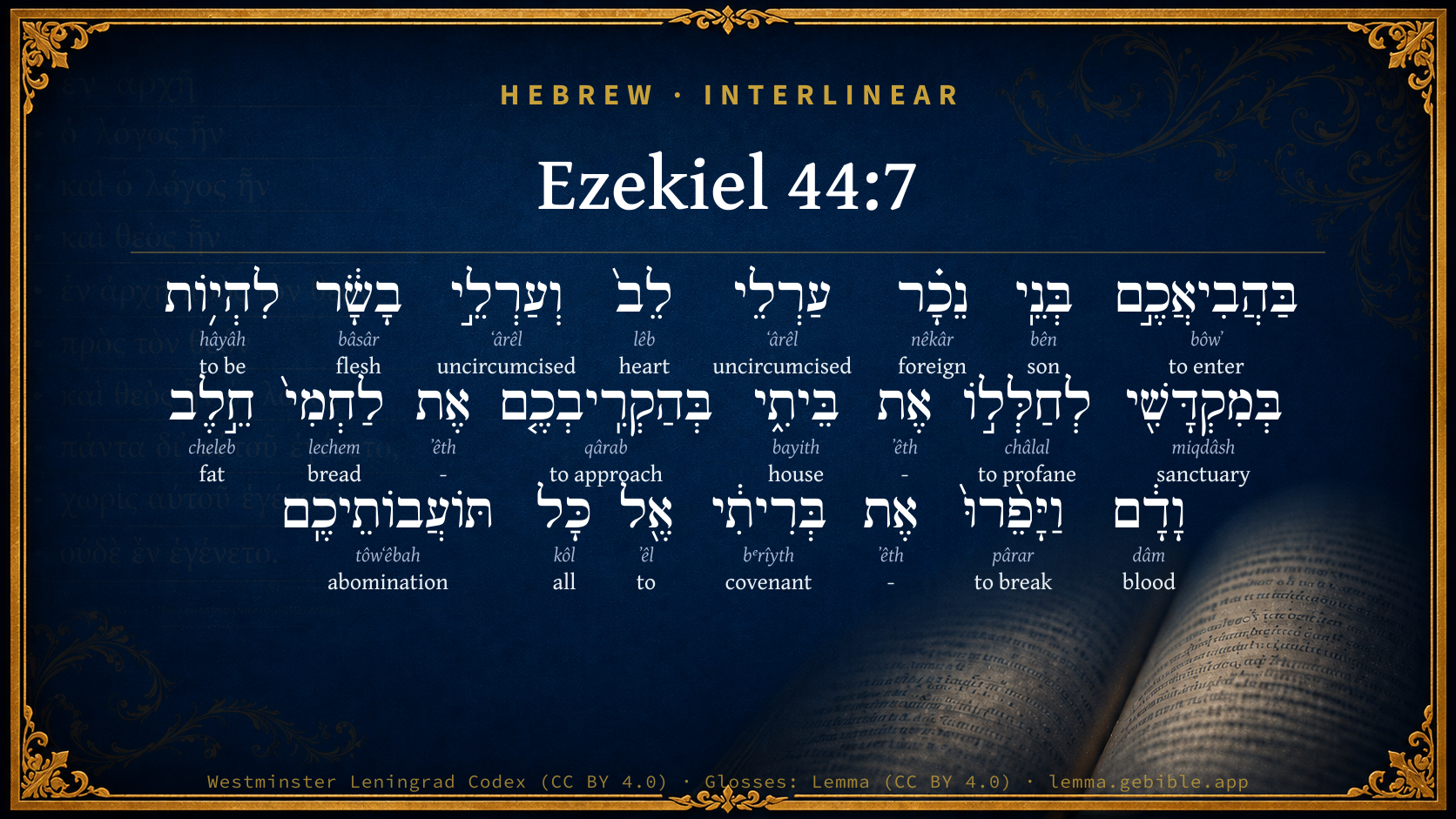
  1. בַּהֲבִיאֲכֶ֣ם bôwʼ H935 “in/at · to enter · you” Preposition + Verb, Hiphil, Infinitive Construct + Suffix, Personal, 2nd Person, Masculine, Plural
  2. בְּנֵֽי bên H1121 “sons of” Noun, Common, Masculine, Plural, Construct
  3. נֵכָ֗ר nêkâr H5236 “foreign” Noun, Common, Masculine, Singular, Absolute
  4. לֵב֙ lêb H3820 “heart” Noun, Common, Masculine, Singular, Absolute
  5. וְעַרְלֵ֣י ʻârêl H6189 “and · uncircumcised of” Conjunction + Adjective, Adjective, Masculine, Plural, Construct
  6. בָשָׂ֔ר bâsâr H1320 “flesh” Noun, Common, Masculine, Singular, Absolute
  7. לִהְי֥וֹת hâyâh H1961 “to be” Preposition + Verb, Qal, Infinitive Construct
  8. בְּמִקְדָּשִׁ֖י miqdâsh H4720 “in/at · sanctuary · my” Preposition + Noun, Common, Masculine, Singular, Construct + Suffix, Personal, 1st Person, Common, Singular
  9. לְחַלְּל֣וֹ châlal H2490 “to profane · him” Preposition + Verb, Piel, Infinitive Construct + Suffix, Personal, 3rd Person, Masculine, Singular
  10. אֶת ʼêth H853 “-” Particle, Direct Object
  11. בֵּיתִ֑י bayith H1004 “house · my” Noun, Common, Masculine, Singular, Construct + Suffix, Personal, 1st Person, Common, Singular
  12. בְּהַקְרִֽיבְכֶ֤ם qârab H7126 “in/at · to approach · you” Preposition + Verb, Hiphil, Infinitive Construct + Suffix, Personal, 2nd Person, Masculine, Plural
  13. אֶת ʼêth H853 “-” Particle, Direct Object
  14. לַחְמִי֙ lechem H3899 “bread · my” Noun, Common, Both, Singular, Construct + Suffix, Personal, 1st Person, Common, Singular
  15. חֵ֣לֶב cheleb H2459 “fat” Noun, Common, Masculine, Singular, Absolute
  16. וָדָ֔ם dâm H1818 “and · blood” Conjunction + Noun, Common, Masculine, Singular, Absolute
  17. וַיָּפֵ֨רוּ֙ pârar H6565 “and · to break” Conjunction + Verb, Hiphil, Sequential Imperfect, 3rd Person, Masculine, Plural
  18. אֶת ʼêth H853 “-” Particle, Direct Object
  19. בְּרִיתִ֔י bᵉrîyth H1285 “covenant · my” Noun, Common, Feminine, Singular, Construct + Suffix, Personal, 1st Person, Common, Singular
  20. אֶ֖ל ʼêl H413 “to” Preposition
  21. כָּל kôl H3605 “all of” Noun, Common, Masculine, Singular, Construct
  22. תּוֹעֲבוֹתֵיכֶֽם tôwʻêbah H8441 “abominations · your” Noun, Common, Feminine, Plural, Construct + Suffix, Personal, 2nd Person, Masculine, Plural

About this verse

These counts appear in no published source. They are computed here, from the morphology-tagged text and Lemma’s own curated glosses. What Lemma adds →

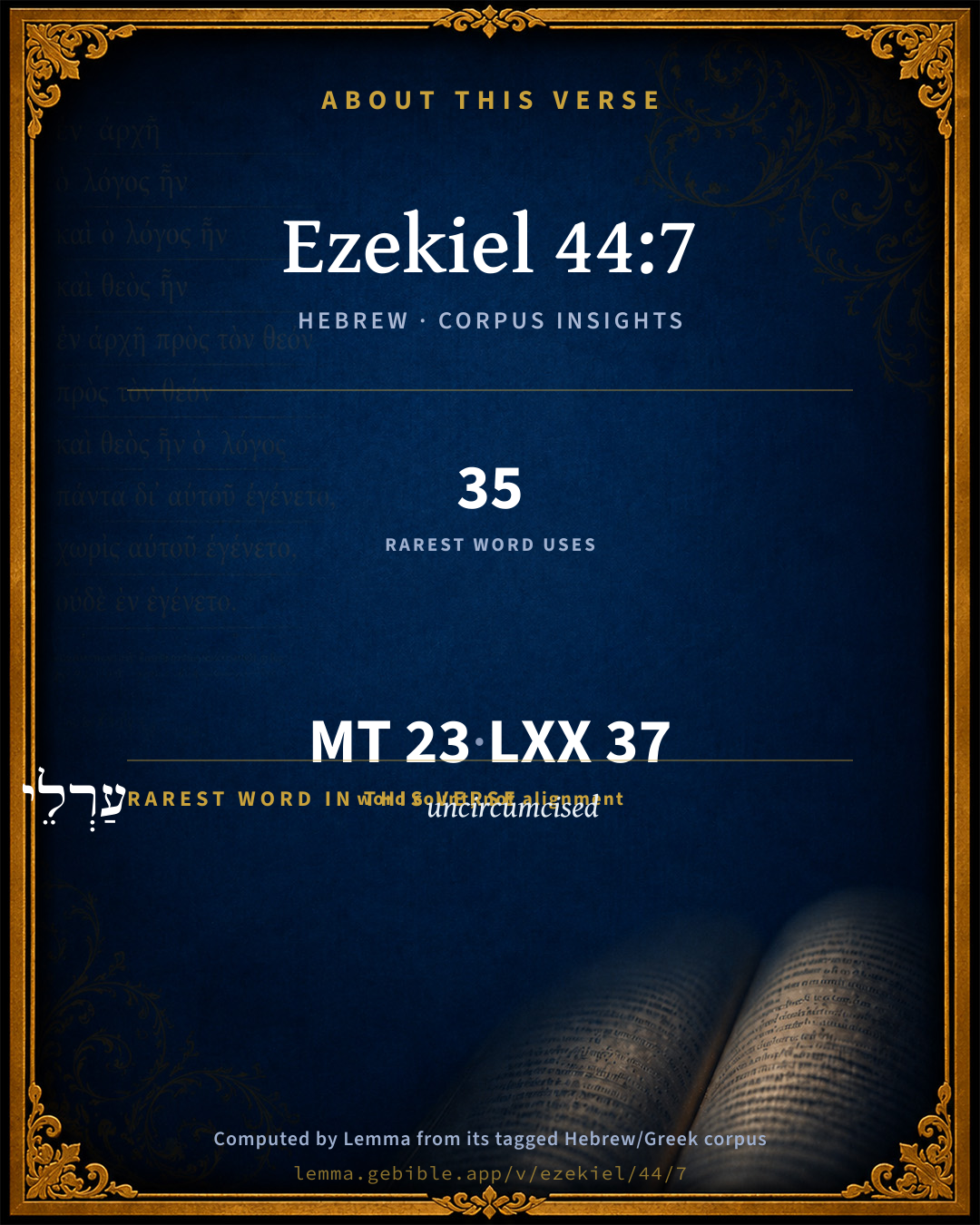
23
words
20
distinct lemmas
Prophets
section

Shared distinctive vocabulary

עַרְלֵי uncircumcised H6189 occurs in 32 verses of the Hebrew Bible. Also found in:

Grammatical profile

  • 5 verbs
  • 12 nouns
  • 2 adjectives
  • 1 preposition
  • 3 particles

Verb forms

  • בַּהֲבִיאֲכֶ֣ם Hiphil · Infinitive Construct
  • לִהְי֥וֹת Qal · Infinitive Construct
  • לְחַלְּל֣וֹ Piel · Infinitive Construct
  • בְּהַקְרִֽיבְכֶ֤ם Hiphil · Infinitive Construct
  • וַיָּפֵ֨רוּ֙ Hiphil · Sequential Imperfect

Repetition

A word recurs within this verse — often emphatic in Hebrew:

  • עַרְלֵי uncircumcised H6189 ×2

Hebrew & Septuagint length

In English translation the verse runs 47 words from the Hebrew and 38 from the Septuagint (LXX English) — closely comparable.

A rough comparison of the two English renderings, which tokenize alike — not a word-level alignment.

Word counts can differ between the Hebrew and the Greek without any difference in meaning — e.g. the Hebrew direct-object marker אֵת has no separate Greek word, and Greek often adds the article ὁ.

In the original languages it is 23 Hebrew tokens and 37 Greek tokens — but the two are counted differently (Hebrew bundles its prefixes and suffixes into one token; the Greek is in lemma form), so that isn’t a like-for-like length.

Cross-references

33

Topical passages linked to Ezekiel 44:7 in the Treasury of Scripture Knowledge — connected by theme and wording, ordered by reader-vote popularity; previews shown in the World English Bible.

  • Leviticus 22:25 Neither from the hand of a foreigner shall you offer the bread of your God of any of these; because their corruption is in them. There is a blemish in them. They shall not be accepted for you.'"
  • Jeremiah 9:26 Egypt, and Judah, and Edom, and the children of Ammon, and Moab, and all that have the corners [of their hair] cut off, who dwell in the wilderness; for all the nations are uncircumcised, and all the house of Israel are uncircumcised in heart.
  • Jeremiah 4:4 Circumcise yourselves to Yahweh, and take away the foreskins of your heart, you men of Judah and inhabitants of Jerusalem; lest my wrath go forth like fire, and burn so that none can quench it, because of the evil of your doings.
  • Genesis 17:14 The uncircumcised male who is not circumcised in the flesh of his foreskin, that soul shall be cut off from his people. He has broken my covenant."
  • Leviticus 26:41 I also walked contrary to them, and brought them into the land of their enemies: if then their uncircumcised heart is humbled, and they then accept the punishment of their iniquity;
  • Ezekiel 44:9 Thus says the Lord Yahweh, No foreigner, uncircumcised in heart and uncircumcised in flesh, shall enter into my sanctuary, of any foreigners who are among the children of Israel.
  • Deuteronomy 10:16 Circumcise therefore the foreskin of your heart, and be no more stiff-necked.
  • Malachi 1:12–14 "But you profane it, in that you say, 'Yahweh's table is polluted, and its fruit, even its food, is contemptible.'
  • Acts 7:51 "You stiff-necked and uncircumcised in heart and ears, you always resist the Holy Spirit! As your fathers did, so you do.
  • Acts 21:28 crying out, "Men of Israel, help! This is the man who teaches all men everywhere against the people, and the law, and this place. Moreover, he also brought Greeks into the temple, and has defiled this holy place!"
  • Exodus 12:48 When a stranger shall live as a foreigner with you, and will keep the Passover to Yahweh, let all his males be circumcised, and then let him come near and keep it; and he shall be as one who is born in the land: but no uncircumcised person shall eat of it.
  • Leviticus 3:13–17 and he shall lay his hand on its head, and kill it before the tent of meeting; and the sons of Aaron shall sprinkle its blood on the altar round about.
  • Leviticus 17:11 For the life of the flesh is in the blood; and I have given it to you on the altar to make atonement for your souls: for it is the blood that makes atonement by reason of the life.
  • Leviticus 21:6 They shall be holy to their God, and not profane the name of their God; for they offer the offerings of Yahweh made by fire, the bread of their God; therefore they shall be holy.
  • Leviticus 21:8 You shall sanctify him therefore; for he offers the bread of your God: he shall be holy to you: for I Yahweh, who sanctify you, am holy.
  • Leviticus 21:17 "Say to Aaron, 'None of your seed throughout their generations who has a blemish, may approach to offer the bread of his God.
  • Leviticus 21:21 no man of the seed of Aaron the priest, who has a blemish, shall come near to offer the offerings of Yahweh made by fire. Since has a blemish, he shall not come near to offer the bread of his God.
  • Leviticus 26:15 and if you shall reject my statutes, and if your soul abhors my ordinances, so that you will not do all my commandments, but break my covenant;
  • Deuteronomy 30:6 Yahweh your God will circumcise your heart, and the heart of your seed, to love Yahweh your God with all your heart, and with all your soul, that you may live.
  • Deuteronomy 31:16 Yahweh said to Moses, Behold, you shall sleep with your fathers; and this people will rise up, and play the prostitute after the strange gods of the land, where they go to be among them, and will forsake me, and break my covenant which I have made with them.
  • Deuteronomy 31:20 For when I shall have brought them into the land which I swore to their fathers, flowing with milk and honey, and they shall have eaten and filled themselves, and grown fat; then will they turn to other gods, and serve them, and despise me, and break my covenant.
  • Isaiah 24:5 The earth also is polluted under the inhabitants of it; because they have transgressed the laws, violated the statutes, broken the everlasting covenant.
  • Isaiah 56:6–7 Also the foreigners who join themselves to Yahweh, to minister to him, and to love the name of Yahweh, to be his servants, everyone who keeps the Sabbath from profaning it, and holds fast my covenant;
  • Jeremiah 11:10 They are turned back to the iniquities of their forefathers, who refused to hear my words; and they are gone after other gods to serve them: the house of Israel and the house of Judah have broken my covenant which I made with their fathers.
  • Jeremiah 31:32 not according to the covenant that I made with their fathers in the day that I took them by the hand to bring them out of the land of Egypt; which my covenant they broke, although I was a husband to them, says Yahweh.
  • Ezekiel 7:20 As for the beauty of his ornament, he set it in majesty; but they made the images of their abominations [and] their detestable things therein: therefore have I made it to them as an unclean thing.
  • Ezekiel 22:26 Her priests have done violence to my law, and have profaned my holy things: they have made no distinction between the holy and the common, neither have they caused men to discern between the unclean and the clean, and have hid their eyes from my Sabbaths, and I am profaned among them.
  • Ezekiel 43:7–8 He said to me, Son of man, [this is] the place of my throne, and the place of the soles of my feet, where I will dwell in the midst of the children of Israel forever. The house of Israel shall no more defile my holy name, neither they, nor their kings, by their prostitution, and by the dead bodies of their kings [in] their high places;
  • Malachi 1:7 You offer polluted bread on my altar. You say, 'How have we polluted you?' In that you say, 'Yahweh's table contemptible.'
  • John 6:52–58 The Jews therefore contended with one another, saying, "How can this man give us his flesh to eat?"
  • Romans 2:28–29 For he is not a Jew who is one outwardly, neither is that circumcision which is outward in the flesh;
  • Colossians 2:11–13 in whom you were also circumcised with a circumcision not made with hands, in the putting off of the body of the sins of the flesh, in the circumcision of Christ;
  • Hebrews 8:9 Not according to the covenant that I made with their fathers, In the day that I took them by the hand to lead them out of the land of Egypt; For they didn't continue in my covenant, And I disregarded them," says the Lord.

Cross-references courtesy of OpenBible.info (CC BY 4.0).

Hebrew and Greek witnesses Masoretic Hebrew ↔ Greek Septuagint

The same verse in the two great witnesses to the Old Testament, shown verse-for-verse.

These are two independent witnesses, not word-aligned to each other, and the Septuagint is shown in lemma (dictionary) form.

Hebrew Ezekiel 44:7 Masoretic · Westminster Leningrad Codex

בַּהֲבִיאֲכֶ֣ם בְּנֵֽי נֵכָ֗ר עַרְלֵי לֵב֙ וְעַרְלֵ֣י בָשָׂ֔ר לִהְי֥וֹת בְּמִקְדָּשִׁ֖י לְחַלְּל֣וֹ אֶת בֵּיתִ֑י בְּהַקְרִֽיבְכֶ֤ם אֶת לַחְמִי֙ חֵ֣לֶב וָדָ֔ם וַיָּפֵ֨רוּ֙ אֶת בְּרִיתִ֔י אֶ֖ל כָּל תּוֹעֲבוֹתֵיכֶֽם

in that you have brought in foreigners, uncircumcised in heart and uncircumcised in flesh, to be in my sanctuary, to profane it, even my house, when you offer my bread, the fat and the blood, and they have broken my covenant, [to add] to all your abominations.

World English Bible · Public Domain

Greek LXX Ezekiel 44:7 Septuagint · lemma form

ὁ εἰςἄγω σύ υἱός ἀλλογενής ἀπερίτμητος καρδία καί ἀπερίτμητος σάρξ ὁ γίγνομαι ἐν ὁ ἅγιος ἐγώ καί βεβηλόω αὐτός ἐν ὁ προςφέρω σύ ἄρτος στέαρ καί αἷμα καί παραβαίνω ὁ διαθήκη ἐγώ ἐν πᾶς ὁ ἀνομία σύ

that you⌃ have brought in aliens, uncircumcised in heart, and uncircumcised in flesh, to be in my sanctuary, and to profane it, when you⌃ offered bread, flesh, and blood; and you⌃ transgressed my covenant by all your iniquities;

LXX2012 (modern English Septuagint) · Public Domain

On this verse, The Cambridge Bible for Schools and Colleges discusses the Septuagint’s reading. Read the note in Commentary ↓

Hebrew: Westminster Leningrad Codex (CC BY 4.0). Greek: Septuagint (public domain); English from LXX2012 (modern English Septuagint) (Public Domain). How the Septuagint differs from the Hebrew →

Targum (Aramaic paraphrase)

1

The Targum is the ancient Jewish Aramaic paraphrase of the Hebrew Scriptures — an interpretive translation, not the Hebrew text itself. Onkelos (literal) and Pseudo-Jonathan (expansive) render the Torah, and Jonathan the Prophets. Coverage is partial: where no permissively-licensed English translation exists for a verse, only the Aramaic is shown. This is verse-level text, not a word-by-word alignment to the Hebrew.

  1. Targum Jonathan Prophets (Joshua–Malachi)
    בְּאַיְתָיוּתְכוֹן בְּנֵי עַמְמַיָא רַשִׁיעֵי לִבָּא וְעַרְלֵי בִסְרָא לְמֶהֱוֵי בְּמַקְדְשִׁי לְאַפָסָא יַת עֲזָרָתִי בְּקָרִיבְכוֹן יַת קוּרְבָּנִי תְּרַב וְדַם נִכְסַת קוּדְשִׁין וְאַשְׁנִיאוּ קְיָמִי עַל כָּל תּוֹעֲבָתְכוֹן:

    (no public-domain English translation for this verse)

    Targum Jonathan — Aramaic: “Mikraot Gedolot” (public domain). English: “Sefaria Community Translation” (CC0 1.0 (public-domain dedication)); “London "Chaldee Paraphrase," 1871” (public domain). Text via Sefaria.

Commentary

Notes on Ezekiel 44:7 from classic Christian and Jewish commentators (each source and its license shown beneath its notes). The classic Christian expositions comment on the surrounding passage and are grouped to its opening verse, so a note may address several verses; the Jewish commentaries on the Tanakh (Rashi and others) are per-verse, so they appear only where the commentator wrote on this verse.

Lemma curates 59 commentaries, every one of them public domain or Creative Commons licensed, each selected and text-cleaned for this edition rather than reprinted as found. About our sources →

Trapp's Complete Commentary

John Trapp

Eze 44:7 In that ye have brought [into my sanctuary] strangers, uncircumcised in heart, and uncircumcised in flesh, to be in my sanctuary, to pollute it, [even] my house, when ye offer my bread, the fat and the blood, and they have broken my covenant because of all your abominations.

Ver. 7. Strangers.] Yourselves are no better; {Amo 9:7} strangers from the covenants; {Eph 2:12} degenerate children, {Isa 1:4} alienated from the life of God through the ignorance that is in you, {Eph 4:18} and through your blind leaders of the blind, priests of your own making, &c.

Uncircumcised in heart.] Erroneous in judgment.

Uncircumcised in flesh.] Enormous in practice.

When ye offer my bread,] i.e., The fat and the blood, as it followeth, which I seem to feed upon as a man doth upon bread.

Because of all your abominations.] Or, Besides all your abominations mentioned. {Eze 44:6}

John Trapp, A Commentary or Exposition upon All the Books of the Old and New Testament (1647–1656) — public domain. Text from a community e-Sword module.

The Biblical Illustrator

Joseph S. Exell

Eze_44:7-8

In that ye have brought into My sanctuary strangers.

The relation of the stranger to the service of the temple

What is reprobated is not of course allowing foreigners to present sacrifices to Jehovah, which they might do (Lev_17:10; Lev_17:12), but allowing them to officiate in the offering, and in general in the ministry of the sanctuary. This is regarded by the prophet as a profanation of the house, and an infraction of the covenant between Jehovah and Israel. It is the latter from the nature of the case. Israel was the people of the Lord, and His service must be performed by Israel. These heathen were uncircumcised both in flesh and heart; their service was purely mercenary, and without religious reality. (A. B. Davidson, D. D.)

The Biblical Illustrator, edited by Joseph S. Exell (c. 1880s–1900s) — public domain. Text from a community e-Sword module.

Geneva Bible (1599)

Geneva Bible translators

For they had brought idolaters which were of other countries, to teach them their idolatry, Ezek. 23:40.

Geneva Bible (1599) marginal notes — public domain. Text via Bolls.life.

Jamieson, Fausset & Brown

Robert Jamieson, A. R. Fausset & David Brown

uncircumcised in heart--Israelites circumcised outwardly, but wanting the true circumcision of the heart (Deu 10:16; Act 7:51).

uncircumcised in flesh--not having even the outward badge of the covenant-people.

Jamieson, Fausset & Brown — Commentary Critical and Explanatory on the Whole Bible (1871) — public domain (CC PDM 1.0). Text via the HelloAO Bible API.

Adam Clarke's Commentary

Verse 7. The fat and the blood] These never went into common use; they were wholly offered to God. The blood was poured out; the fat consumed.

Because of all your abominations.] Several MSS. of Kennicott's and De Rossi's read their abominations, referring to the strangers mentioned before.

Adam Clarke's Commentary on the Bible (1810–1826) — public domain. Text from a community e-Sword/MySword module.

Ellicott's Commentary for English Readers

(7) Strangers, uncircumcised in heart.—The heathen living in Israel, or coining to worship at the Temple, were allowed, and even in some cases required, to offer sacrifices (Lev_17:10; Lev_17:12; Num_15:14; Num_15:26; Num_15:29). This seems also to have been recognised in Solomon’s prayer at the consecration of the Temple (1Ki_8:41-43); but the ground on which the Israelites are here censured for the licence given to strangers is, that they allowed those to draw near in worship who were uncircumcised in heart as well as in flesh, i.e., ungodly men who had no real purpose to worship God.

A Bible Commentary for English Readers, edited by Charles John Ellicott (1878–1897) — public domain. Text from a community e-Sword module.

The Cambridge Bible for Schools and Colleges

gen. ed. J. J. S. Perowne

7. into my sanctuary strangers] i.e. foreigners. What is reprobated is not of course allowing foreigners to present sacrifices to Jehovah, which they might do (Lev_17:10; Lev_17:12; Num_15:14), but allowing them to officiate in the offering, and in general in the ministry of the sanctuary. It is not ascertainable to what extent these uncircumcised heathen were permitted to fill the subordinate offices about the house, such as those of keepers of the gates and assistants to the priests, but just as the kings employed foreign mercenaries as guards (who were employed even in the temple, 2Ki_11:7), it appears that persons not Israelites and not incorporated in Israel by the necessary rites, were employed in the house. They were probably captives taken in war and the like (Jos_9:27; 1Sa_2:13; Zec_14:21; cf. Ezr_8:20; Ezr_2:58). This is regarded by the prophet as a profanation of the house and an infraction of the covenant between Jehovah and Israel. It is the latter from the nature of the case. Israel was the people of the Lord and his service must be performed by Israel. These heathen were uncircumcised both in flesh and heart, their service was purely mercenary, and without religious reality. For “and they have broken” LXX. reads, and ye have broken, which is more exact.

because of all] Perhaps: in addition to all your abominations.

The Cambridge Bible for Schools and Colleges (gen. ed. J. J. S. Perowne; Cambridge University Press, 1878–1918) — public domain. Text from a community e-Sword module.

John Gill's Exposition

In that ye have brought into my sanctuary strangers,.... Unregenerate men, who are in a state of alienation and estrangement to divine and spiritual things: strangers to God; to the true knowledge of him in Christ; to the fear and love of God; to the true grace of God in conversion; and to communion with him: strangers to Christ, to his person and offices; to the way of peace, life, and salvation by him; to his righteousness; to faith in him, love of him, and fellowship with him: strangers to the Spirit; to his person, to regeneration and sanctification by him; to the graces of the Spirit, faith, hope, love, humility, self-denial, &c.; to the things of the Spirit, which they neither know nor savour; and to the several offices he performs, as a comforter, the Spirit of adoption, an earnest and sealer: strangers to their own hearts, and the plague of them, and sin that dwells in them: strangers to the nature of sin, and the exceeding sinfulness of it; to the deceitfulness of sin, and the consequences of it; to true repentance for it, and to the right way of atonement of it, by the blood of Christ: strangers to the Gospel of Christ, and the truths of it; and to the saints and people of God:

and uncircumcised in heart; who never were pricked in the heart for sin, or felt any pain there on account of it; never had the hardness of their heart removed, or the impurity of it discovered to them; never were filled with shame and loathing because of it; or ever put off the body of sins in a course of conversation; or renounced their own righteousness:

and uncircumcised in flesh; carnal, as they were born; men in the flesh, in a state of nature, mind and savour the things of the flesh, and do the works of it; having never been taught by the grace of God to deny ungodliness, and worldly lusts, and to abstain from fleshly ones: or, who put their trust in the flesh, in outward things, in carnal privileges, and external righteousness: these the Lord complains were brought

to be in my sanctuary, to pollute it, even my house: either to be members here, and partake of all the ordinances and privileges of the Lord's house; or to officiate here as priests and ministers of the Lord:

when ye offer my bread, the fat and the blood; which, under the law, were the Lord's; and here signify the ministry of the word and ordinances, the goodness and fatness of the Lord's house; and especially the ordinance of the Lord's supper, that feast of fat things; in which Christ, the true and living bread of God, whose flesh is meat indeed, and whose blood is drink indeed, is represented to the faith of God's people:

and they have broken my covenant, because of all your abominations: that is, have broken the rule of the divine word and everlasting Gospel by such abominations; by admitting such ministers and members, the one to administer, the other to partake of, Gospel ordinances: this is the true state of the case of most of the reformed churches in our days; it is to be feared that there are multitudes of unregenerate ministers in them; that they are full of carnal professors; and notorious it is that the ordinance of the Lord's supper is prostituted to wicked persons, and to answer ends it never was designed for; which must be an abomination to the Lord.

John Gill's Exposition of the Whole Bible (1746–1763) — public domain (CC PDM 1.0). Text via the HelloAO Bible API.

Haydock's Catholic Bible Commentary

Flesh. People of this description were not to enter the temple, which is here called the sanctuary, even though they adored God. In some cases pagans were admitted into any part, except the most holy. Epiphanes (Calmet) and Pompey forced their passage thither, to the great sorrow of the Jews. (Josephus, Jewish Wars i. 5.) See Ecclesiasticus lii., and Acts xxi. 28. --- During the plundering of the city, the Chaldeans did the like; (Lamentations i. 10.; Haydock) and while idols were set up, all rules were neglected. --- Doings. You observe the exterior, and not the spirit of religion.

George Leo Haydock (1774–1849), Haydock's Catholic Family Bible and Commentary, 1859 edition — public domain. Excludes Psalms (Douay-Rheims chapter numbering differs from Protestant) and Deuterocanonical books (Catholic canon only).

Matthew Poole's English Annotations

Ye have brought; either by abusing your power you have licensed, or by conniving you have permitted, to come into my holy courts.

Strangers; foreigners and heathen, who had their idols in the very courts of the temple, and there worshipped their idols, as Eze 8:5,10,14,16.

Uncircumcised in heart; the worst of them, profane and impious.

Uncircumcised in flesh: no uncircumcised one should come into the court of the people, but you have brought them into the very sanctuary at the times of public worship, and when you have been offering my bread, &c. Some think that the profane carelessness of the Jewish rulers was such, that they suffered uncircumcised ones to be priests among them, and to approach to God’s altar. This was done in Solomon’s degenerate days, and in the days of Ahaz, Manasseh, Amon.

My bread; either the meat-offering, or first-fruits of corn and dough, and the show-bread.

The fat, which was taken off the sacrifices and burnt.

The blood, how let out, received into vessels, sprinkled and poured out, the priests and rulers of my house, through a sinful familiarity with heathens, have given them courage to ask, and you have not zeal and courage enough to refuse them, but you have satisfied their forbidden curiosity, and showed them all these things; or, as was said, have advanced some to be priests in my house, and suffered others to be priests of idols, standing and worshipped in my courts.

They, the whole nation of the Jews, the people of the land,

have broken my covenant; turned idolaters, mixed with heathens, forsaken me and my law, taking example from your practices, or complying with your superstitious and idolatrous inventions.

Matthew Poole's English Annotations on the Holy Bible (1683–1685) — public domain. Text from a community e-Sword/MySword module.

Whedon's Commentary on the Bible

Daniel D. Whedon

7, 8. Strangers, uncircumcised in heath and uncircumcised in flesh — These “aliens” (R.V.) were not excluded from entering the temple and offering sacrifices to Jehovah in their own behalf (Lev_17:8; Lev_17:10; Lev_17:12; Num_15:14; Num_15:29), but foreigners (probably slaves or captives in war), who had no sympathy whatever with the Israelitish religion, ought not to be permitted to take official positions in Jehovah’s house, as had sometimes been done (Jos_9:27; 1Sa_2:13; Zec_14:21; Ezr_2:58, Hebrews). Service with the lip or the hand only is an abomination to God. Even otherwise menial services become sacred when done for Jehovah, and it is an insult to him when such services are put upon ignorant and impure foreigners who have no heart loyalty to the lord of the house. (Compare W.R. Smith, Old Testament in the Jewish Church, pp. 260-266.) It was practically breaking covenant with Jehovah to set them as keepers of my charge in my sanctuary (Eze_44:8).

Daniel D. Whedon (gen. ed.), Commentary on the Old and New Testaments (1874–1909) — public domain. Text from a community e-Sword module.

The Pulpit Commentary

The special sin chargeable against Israel in the past had been the introduction into the sanctuary, while the priests were engaged in sacrifice, of strangersaliens (Revised Version); literally, sons of a stranger uncircumcised in heart and uncircumcised in flesh, in express contravention of Jehovah"s covenant. Ewald, Havernick, Hengstenberg, Schroder, and Currey restrict the designation "strangers" to unfaithful and unauthorized priests, who, as in the days of Israel"s apostasy, notoriously under Jeroboam (1Ki_12:31; 2Ch_11:15) may, in the confluence of idolatries that took place in Jerusalem during the reigns of (2Ki_16:3, 2Ki_16:4, 2Ki_16:10-15; 2Ch_28:2-4, 2Ch_28:23-25) and Manasseh. (2Ki_21:2-7, 2Ki_21:11, 2Ki_21:15; 2Ch_33:2-7) have been admitted to participate in the temple services; but Kliefoth, Delitzsch, Keil, Smend, and Plumptre, with better judgment, recognize in the "strangers" foreigners who had not incorporated themselves with Israel by submitting to circumcision, but, though dwelling in the midst of Israel, were still uncircumcised heathen in both heart and flesh. With regard to these foreigners, the Law of Moses (Lev_17:8, Lev_17:10) enacted that, by accepting circumcision, they might become members of the Israelitish commonwealth, but that without this they could not be permitted to partake of the Passover, the highest symbol of national and religious unity. (Exo_12:48, Exo_12:49) Nevertheless, it was open to them, on giving a certain measure of obedience to the Law (Exo_12:19 Exo_20:10; Lev_17:10, 12 18:26 20:2 24:16, 22) to enter the sanctuary and present all sorts of offerings to Jehovah. (Lev_17:8; Num_15:14, Num_15:29) Hence Israel"s offence had not been the admission of such "sons of the stranger" into the sanctuary, but the admission of them without insisting on the above specified conditions, in other words, the admission of such as not only lacked the bodily mark of circumcision which would not have excluded them but were destitute as well of the first elements of Hebrew piety, i.e. were as uncircumcised in heart as they were in the flesh. The sanctioning of such within the temple courts, while Jehovah"s bread, the fat and the blood, was being offered, i.e. while sacrificial worship was being performed, was not simply a desecration of the "house," but was an express violation of the covenant Jehovah had made with Israel with reference to these very "sons of the stranger."

The Pulpit Commentary (1880–1919), ed. H.D.M. Spence-Jones & Joseph S. Exell — public domain. Text from a community e-Sword module.

John Wesley's Explanatory Notes

Bread - Either the meal-offering or first-fruits of corn and dough, and the shew-bread. They - The whole nation of the Jews.

John Wesley, Explanatory Notes Upon the Whole Bible (1754–1765) — public domain. Text via the GEBible commentary corpus.

Rashi

Rabbi Shlomo Yitzchaki (Rashi)

aliens [lit. sons of an alien.] [Sons of] one whose deeds have become alienated from his Father in Heaven; this is an apostate who worships idols. They are the ones “of uncircumcised heart.”

and of uncircumcised flesh [a] priest whose brothers died because of circumcision.

Rashi on the Tanakh — English translations: “The Judaica Press complete Tanach with Rashi, translated by A. J. Rosenberg” (CC BY 4.0); “Pentateuch with Rashi's commentary by M. Rosenbaum and A.M. Silbermann, 1929-1934” (public domain); “The Metsudah Tanach series, Lakewood, N.J” (CC BY 4.0); and “The Book of Joshua, Metsudah Publications, 1997” (CC BY 4.0). Text via Sefaria.

Lesson kit

Teaching starters — assembled from the data on this page, not authored interpretation. Every prompt links to the verse data it draws on. Edit before teaching.

Ezekiel, in the Prophets, opens this verse with 23 words (20 distinct Hebrew lemmas). Its most distinctive word is ʻârêl (“uncircumcised”). A historical commentator’s framing appears above. Read the whole chapter for the surrounding context.

Discussion questions

  1. The word ʻârêl carries the sense “uncircumcised.” How does it shape the verse?
  2. Genesis 17:14 shares the word «uncircumcised» with this verse. How do the two illuminate each other?
  3. “uncircumcised” occurs 2× in this one verse. What is the effect of the repetition?
  4. These translations render this verse differently. What is at stake in choosing one wording over another?
  5. The verb «בַּהֲבִיאֲכֶ֣ם» is Hiphil Infinitive Construct. How does its form color the action?
  6. Reading how Trapp's Complete Commentary and The Biblical Illustrator read this verse, where do the two commentators agree and where do they part?

Things to notice

Reading settings

Reading text

Shown beneath each verse's original-language words.

Old Testament
Old Testament edition

Read the OT as the Masoretic Hebrew (MT) or the Greek Septuagint (LXX).

English shown for the Greek Septuagint (in the Hebrew ↔ Greek comparison).

Comparing translations? Open the Compare panel on any verse page to stack up to four side by side.