
Genesis 39:6

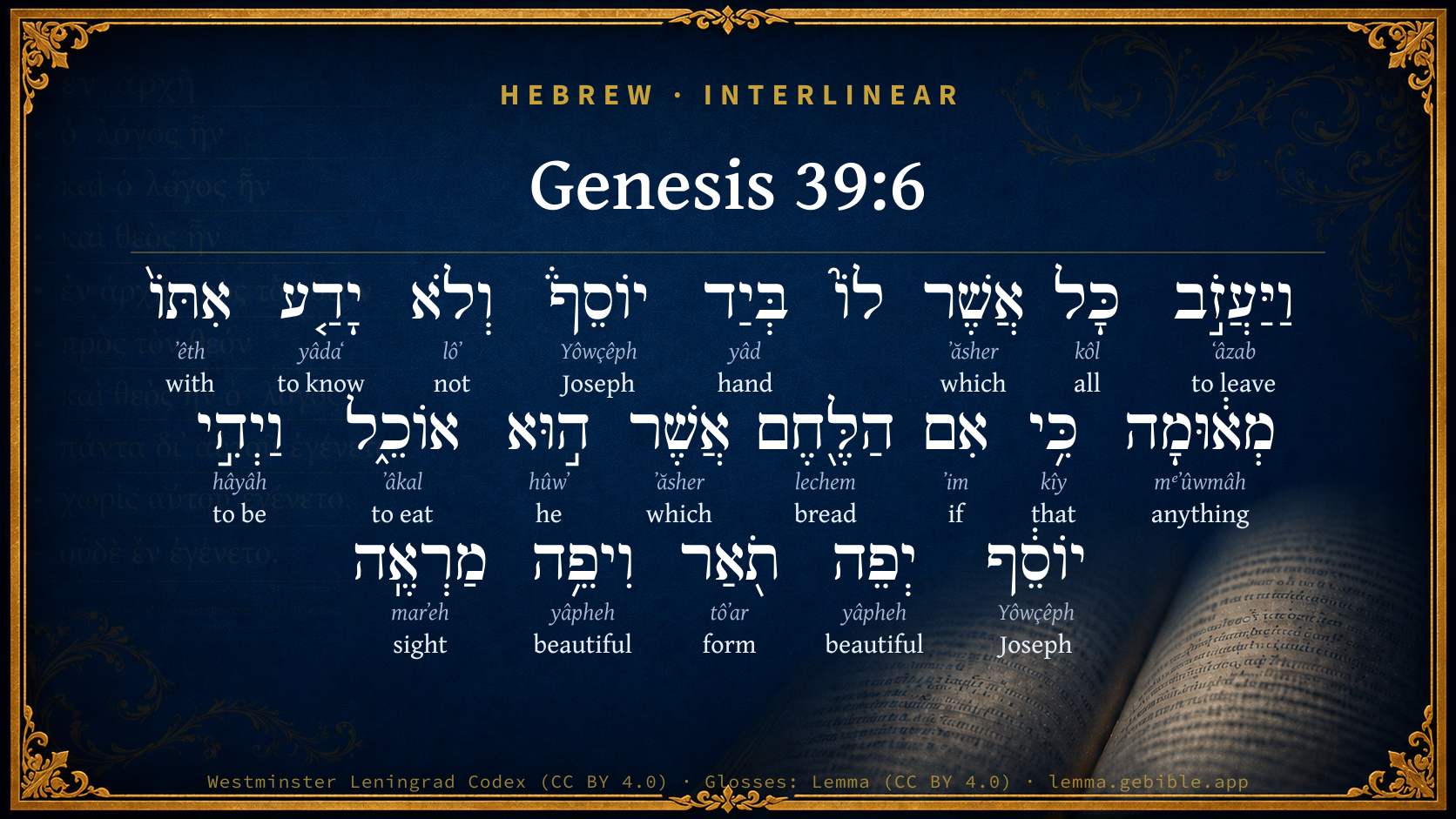
Hebrew (Westminster Leningrad Codex) Genesis 39:6 appears in the Hebrew Old Testament. The text above is from the Westminster Leningrad Codex. Each word links to its Strong’s number, a concise gloss, and parsing drawn from the Open Scriptures Hebrew Bible morphology. Click any word for its full Brown-Driver-Briggs (BDB) entry.
Download image
Cite this verse

Genesis 39:6 (World English Bible). Public Domain. Lemma interlinear Bible study tool, https://lemma.gebible.app/v/genesis/39/6.

Show BibTeX & RIS
BibTeX
RIS
English Translation
He left all that he had in Joseph's hand. He didn't concern himself with anything, except for the food which he ate. Joseph was well-built and handsome.
World English Bible · Public Domain
Download a study sheet

One document with this verse’s original text, its word-by-word gloss line, the meaning frame, cross-references with their text, attributed commentary, and full source and license credits — printable, and it pastes into notes with its structure intact.

This verse Autodidact and up

Study sheet (.html) Plain text (.txt)

A passage Seminary Student

Up to 50 verses in one chapter. A passage sheet keeps up to 6 commentary sources and 12 cross-references per verse, in the order this page ranks them, and says so on the sheet whenever that leaves anything out. Ask for a single verse and you get the Autodidact verse sheet above.

Everything on this page stays free to read, with no account — the sheet is a download of what is already on screen, not access to it.

Want to remove ads? Support Godless Engineer
Compare translations 3

The same verse in 3 English versions, stacked beneath the original-language interlinear above. Click any original word for its lexicon entry.

Each is an independent rendering of the whole verse — the interlinear is not word-aligned to these translations.

Highlighted words mark where these versions differ — a whole-verse word diff, not a word-by-word alignment.

  • World English Bible Public Domain
    He left all that he had in Joseph's hand. He didn't concern himself with anything, except for the food which he ate. Joseph was well-built and handsome.
  • King James Version Public Domain
    And he left all that he had in Joseph's hand; and he knew not ought he had, save the bread which he did eat. And Joseph was a goodly person, and well favored.
  • unfoldingWord Literal Text CC BY-SA 4.0
    And he left all that to him in the hand of Joseph, and he did not think to himself anything except for the bread that he ate. Now Joseph was handsome in form and handsome in appearance.

unfoldingWord Literal Text — © unfoldingWord, licensed CC BY-SA 4.0. Word-aligned USFM3 via Door43 (git.door43.org/unfoldingWord/en_ult).

Versions to compare (up to 4)

3 of 4 selected

Show all 17 translations

Every available English version of this verse, each an independent rendering of the whole verse.

  • World English Bible Public Domain
    He left all that he had in Joseph's hand. He didn't concern himself with anything, except for the food which he ate. Joseph was well-built and handsome.
  • Berean Standard Bible Public Domain
    So Potiphar left all that he owned in Joseph’s care; he did not concern himself with anything except the food he ate. Now Joseph was well-built and handsome,
  • Majority Standard Bible Public Domain
    So Potiphar left all that he owned in Joseph’s care; he did not concern himself with anything except the food he ate. Now Joseph was well-built and handsome,
  • King James Version Public Domain
    And he left all that he had in Joseph's hand; and he knew not ought he had, save the bread which he did eat. And Joseph was a goodly person, and well favored.
  • American Standard Version (1901) Public Domain
    And he left all that he had in Joseph's hand; and he knew not aught `that was' with him, save the bread which he did eat. And Joseph was comely, and well-favored.
  • Revised Version (1885) Public Domain
    And he left all that he had in Joseph’s hand; and he knew not aught that was with him, save the bread which he did eat. And Joseph was comely, and well favoured.
  • Geneva Bible (1599) Public Domain
    Therefore he left all that he had in Iosephs hand, and tooke accompt of nothing, that was with him, saue onely of the bread, which he did eate. And Ioseph was a faire person, and well fauoured.
  • Young's Literal Translation Public Domain
    and he leaveth all that he hath in the hand of Joseph, and he hath not known anything that he hath, except the bread which he is eating. And Joseph is of a fair form, and of a fair appearance.
  • Literal Standard Version CC BY-SA 4.0
    and he leaves all that he has in the hand of Joseph, and he has not known anything that he has, except the bread which he is eating. And Joseph is of a handsome form, and of a handsome appearance.
  • Unlocked Literal Bible CC BY-SA 4.0
    Potiphar put everything that he had under Joseph's care. He did not have to think about anything except the food that he ate. Now Joseph was handsome and attractive.
  • unfoldingWord Literal Text CC BY-SA 4.0
    And he left all that to him in the hand of Joseph, and he did not think to himself anything except for the bread that he ate. Now Joseph was handsome in form and handsome in appearance.
  • Darby Bible Public Domain
    And he left all that he had in Joseph's hand, and took cognizance of nothing with him, save the bread that he ate. And Joseph was of a beautiful form and of a beautiful countenance.
  • World Messianic Bible Public Domain
    He left all that he had in Joseph’s hand. He didn’t concern himself with anything, except for the food which he ate. Joseph was well-built and handsome.
  • Webster's Bible Public Domain
    And he left all that he had in Joseph's hand; and he knew not aught he had, save the bread which he ate; and Joseph was a goodly person, and well favored.
  • Free Bible Version CC BY-SA 4.0
    So Potiphar left Joseph to care for everything he owned. He didn't bother with anything except to decide what food he was going to eat. Now Joseph was handsome, having a good physique,
  • Bible in Basic English Public Domain
    And he gave Joseph control of all his property, keeping no account of anything, but only the food which was put before him. Now Joseph was very beautiful in form and face.
  • JPS Tanakh (1917) Public Domain
    And he left all that he had in Joseph's hand; and, having him, he knew not aught save the bread which he did eat. And Joseph was of beautiful form, and fair to look upon.

Literal Standard Version (2020), Covenant Press — licensed CC BY-SA 4.0. Text via the HelloAO Bible API (eBible.org). Unlocked Literal Bible (unfoldingWord) — licensed CC BY-SA 4.0. Text via the HelloAO Bible API (eBible.org). unfoldingWord Literal Text — © unfoldingWord, licensed CC BY-SA 4.0. Word-aligned USFM3 via Door43 (git.door43.org/unfoldingWord/en_ult). Free Bible Version, Dr. Jonathan Gallagher — licensed CC BY-SA 4.0. Text via the HelloAO Bible API (eBible.org).

Word by word

More ways to search: Search by grammar → Find every occurrence → Compare this word →

Practice this passage: Drill this verse → Learn its vocabulary →

תֹ֖אַר
tôʼar
H8389
“form”
Noun, Common, Masculine, Singular, Absolute
Part of Speech
Noun
Type
Common
Gender
Masculine
Number
Singular
State
Absolute
Full BDB Definition

Origin: from H8388

TWOT: 2491a

shape, form, outline, figure, appearance
  1. וַיַּעֲזֹ֣ב ʻâzab H5800 “and · to leave” Conjunction + Verb, Qal, Sequential Imperfect, 3rd Person, Masculine, Singular
  2. כָּל kôl H3605 “all of” Noun, Common, Masculine, Singular, Construct
  3. אֲשֶׁר ʼăsher H834 “which” Particle, Relative
  4. בְּיַד yâd H3027 “in/at · hand of” Preposition + Noun, Common, Both, Singular, Construct
  5. יוֹסֵף֒ Yôwçêph H3130 “Joseph” Noun, Proper
  6. וְלֹא lôʼ H3808 “and · not” Conjunction + Particle, Negative
  7. יָדַ֤ע yâdaʻ H3045 “to know” Verb, Qal, Perfect, 3rd Person, Masculine, Singular
  8. אִתּוֹ֙ ʼêth H854 “with · him” Preposition + Suffix, Personal, 3rd Person, Masculine, Singular
  9. מְא֔וּמָה mᵉʼûwmâh H3972 “anything” Noun, Common, Feminine, Singular, Absolute
  10. כִּ֥י kîy H3588 “that” Conjunction
  11. אִם ʼim H518 “if” Conjunction
  12. הַלֶּ֖חֶם lechem H3899 “the · bread” Particle, Definite Article + Noun, Common, Both, Singular, Absolute
  13. אֲשֶׁר ʼăsher H834 “which” Particle, Relative
  14. ה֣וּא hûwʼ H1931 “he” Pronoun, Personal, 3rd Person, Masculine, Singular
  15. אוֹכֵ֑ל ʼâkal H398 “eating” Verb, Qal, Participle Active, Masculine, Singular, Absolute
  16. וַיְהִ֣י hâyâh H1961 “and · to be” Conjunction + Verb, Qal, Sequential Imperfect, 3rd Person, Masculine, Singular
  17. יוֹסֵ֔ף Yôwçêph H3130 “Joseph” Noun, Proper
  18. יְפֵה yâpheh H3303 “beautiful of” Adjective, Adjective, Masculine, Singular, Construct
  19. וִיפֵ֥ה yâpheh H3303 “and · beautiful of” Conjunction + Adjective, Adjective, Masculine, Singular, Construct
  20. מַרְאֶֽה marʼeh H4758 “sight” Noun, Common, Masculine, Singular, Absolute

About this verse

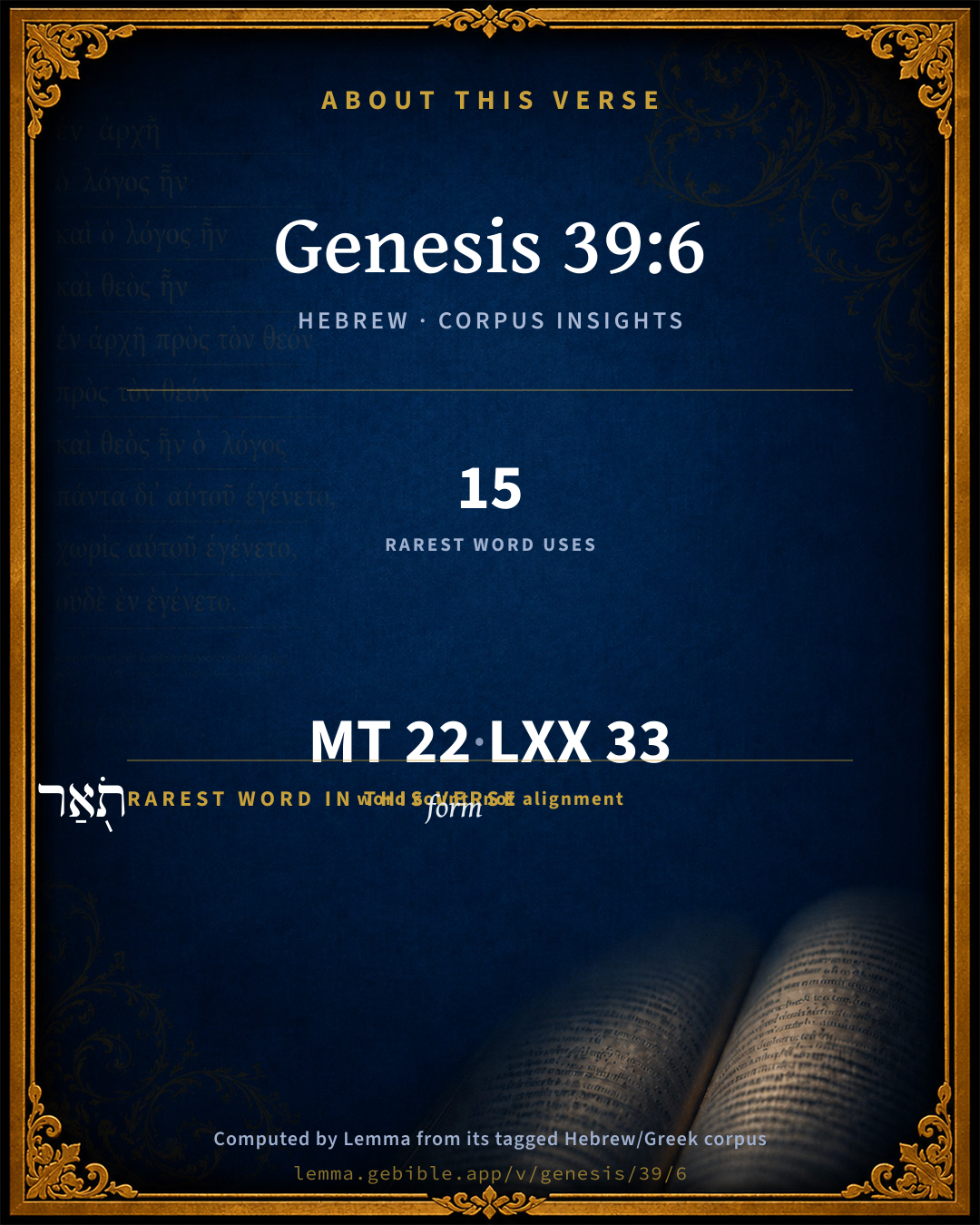
These counts appear in no published source. They are computed here, from the morphology-tagged text and Lemma’s own curated glosses. What Lemma adds →

22
words
18
distinct lemmas
Pentateuch
section

Notable vocabulary

The rarest word here is תֹ֖אַר form H8389 — appearing just 15 times in the whole Hebrew Bible.

Shared distinctive vocabulary

תֹ֖אַר form H8389 occurs in 15 verses of the Hebrew Bible. Also found in:

Grammatical profile

  • 4 verbs
  • 8 nouns
  • 2 adjectives
  • 1 pronoun
  • 2 prepositions
  • 2 conjunctions
  • 3 particles

Verb forms

  • וַיַּעֲזֹ֣ב Qal · Sequential Imperfect
  • יָדַ֤ע Qal · Perfect
  • אוֹכֵ֑ל Qal · Participle Active
  • וַיְהִ֣י Qal · Sequential Imperfect

Repetition

Words recur within this verse — often emphatic in Hebrew:

  • יוֹסֵף֒ Joseph H3130 ×2
  • יְפֵה beautiful H3303 ×2
  • אֲשֶׁר which H834 ×2

Hebrew & Septuagint length

In English translation the verse runs 27 words from the Hebrew and 40 from the Septuagint (LXX English) — the Septuagint runs noticeably longer here. See the side-by-side →

A rough comparison of the two English renderings, which tokenize alike — not a word-level alignment.

Word counts can differ between the Hebrew and the Greek without any difference in meaning — e.g. the Hebrew direct-object marker אֵת has no separate Greek word, and Greek often adds the article ὁ.

In the original languages it is 22 Hebrew tokens and 33 Greek tokens — but the two are counted differently (Hebrew bundles its prefixes and suffixes into one token; the Greek is in lemma form), so that isn’t a like-for-like length.

Cross-references

12

Topical passages linked to Genesis 39:6 in the Treasury of Scripture Knowledge — connected by theme and wording, ordered by reader-vote popularity; previews shown in the World English Bible.

  • Genesis 29:17 Leah's eyes were weak, but Rachel was beautiful and well favored.
  • 1 Samuel 16:12 He sent, and brought him in. Now he was ruddy, and withal of a beautiful face, and goodly to look on. Yahweh said, Arise, anoint him; for this is he.
  • Proverbs 31:11 The heart of her husband trusts in her. He shall have no lack of gain.
  • Luke 19:17 "He said to him, 'Well done, you good servant! Because you were found faithful with very little, you shall have authority over ten cities.'
  • Genesis 12:14–15 It happened that when Abram had come into Egypt, the Egyptians saw that the woman was very beautiful.
  • Genesis 39:4 Joseph found favor in his sight. He ministered to him, and he made him overseer over his house, and all that he had he put into his hand.
  • Genesis 39:8 But he refused, and said to his master's wife, "Behold, my master doesn't know what is with me in the house, and he has put all that he has into my hand.
  • Genesis 39:23 The keeper of the prison didn't look after anything that was under his hand, because Yahweh was with him; and that which he did, Yahweh made it prosper.
  • Genesis 43:32 They served him by himself, and them by themselves, and the Egyptians, that ate with him, by themselves, because the Egyptians don't eat bread with the Hebrews, for that is an abomination to the Egyptians.
  • Luke 16:10 He who is faithful in a very little is faithful also in much. He who is dishonest in a very little is also dishonest in much.
  • Acts 7:20 At that time Moses was born, and was exceedingly handsome. He was nourished three months in his father's house.
  • 1 Samuel 17:42 When the Philistine looked about, and saw David, he disdained him; for he was but a youth, and ruddy, and withal of a fair face.

Cross-references courtesy of OpenBible.info (CC BY 4.0).

Hebrew and Greek witnesses Masoretic Hebrew ↔ Greek Septuagint

The same verse in the two great witnesses to the Old Testament, shown verse-for-verse.

Here the Septuagint runs noticeably longer than the Hebrew — LXX2012 (modern English Septuagint) 40 words vs World English Bible 27. A rough length comparison of the two English translations, not a word-level alignment — read both below.

These are two independent witnesses, not word-aligned to each other, and the Septuagint is shown in lemma (dictionary) form.

Hebrew Genesis 39:6 Masoretic · Westminster Leningrad Codex

וַיַּעֲזֹ֣ב כָּל אֲשֶׁר לוֹ֮ בְּיַד יוֹסֵף֒ וְלֹא יָדַ֤ע אִתּוֹ֙ מְא֔וּמָה כִּ֥י אִם הַלֶּ֖חֶם אֲשֶׁר ה֣וּא אוֹכֵ֑ל וַיְהִ֣י יוֹסֵ֔ף יְפֵה תֹ֖אַר וִיפֵ֥ה מַרְאֶֽה

He left all that he had in Joseph's hand. He didn't concern himself with anything, except for the food which he ate. Joseph was well-built and handsome.

World English Bible · Public Domain

Greek LXX Genesis 39:6 Septuagint · lemma form

καί ἐπιτρέπω πᾶς ὅσος εἰμί αὐτός εἰς χείρ ιωσηφ καί οὐ οἶδα ὁ κατά ἑαυτοῦ οὐδείς πλήν ὁ ἄρτος ὅς ἐσθίω αὐτός καί εἰμί ιωσηφ καλός ὁ εἶδος καί ὡραῖος ὁ ὄψις σφόδρα

And he committed all that he had into the hands of Joseph; and he knew not of anything that belonged to him, save the bread which he himself ate. And Joseph was handsome in form, and exceedingly beautiful in countenance.

LXX2012 (modern English Septuagint) · Public Domain

Hebrew: Westminster Leningrad Codex (CC BY 4.0). Greek: Septuagint (public domain); English from LXX2012 (modern English Septuagint) (Public Domain). How the Septuagint differs from the Hebrew →

Targum (Aramaic paraphrase)

2

The Targum is the ancient Jewish Aramaic paraphrase of the Hebrew Scriptures — an interpretive translation, not the Hebrew text itself. Onkelos (literal) and Pseudo-Jonathan (expansive) render the Torah, and Jonathan the Prophets. Coverage is partial: where no permissively-licensed English translation exists for a verse, only the Aramaic is shown. This is verse-level text, not a word-by-word alignment to the Hebrew.

  1. Targum Onkelos Torah (Genesis–Deuteronomy)
    וּשְׁבַק כָּל דִּי לֵהּ בִּידָא דְיוֹסֵף וְלָא יְדַע עִמֵּהּ מִדַּעַם אֶלָּהֵן לַחְמָא דִּי הוּא אָכֵל וַהֲוָה יוֹסֵף שַׁפִּיר בְּרֵיוָא וְיָאֵי בְחֶזְוָא

    (no public-domain English translation for this verse)

    Targum Onkelos — Aramaic: “Onkelos Genesis” (public domain); “Onkelos Exodus” (public domain); “Onkelos Leviticus” (public domain); “Onkelos Numbers” (public domain); “Onkelos Deuteronomy” (public domain). English: “Sefaria Community Translation” (CC0 1.0 (public-domain dedication)); “J.W. Etheridge. The Targums of Onkelos and Jonathan Ben Uzziel on the Pentateuch. London: Longmans, Green, 1862” (public domain). Text via Sefaria.

  2. Targum Pseudo-Jonathan Torah (Genesis–Deuteronomy)
    וּשְׁבַק כָּל דְאִית לֵיהּ בִּידָא דְיוֹסֵף וְלָא יְדַע עִמֵיהּ מִדַעַם אֱלָהֵן אִנְתְּתֵיהּ דִשְׁכִיב גַבָּהּ וַהֲוָה יוֹסֵף שַׁפִּיר בְּרֵיוָא וְיָאִי בְּחֶזְוָא

    And he left all that he had in Joseph's hand, and took no knowledge of anything of his, except his wife with whom he lay. And Joseph was of goodly form and beautiful aspect.

    Targum Pseudo-Jonathan — Aramaic: “Targum Jonathan on Genesis” (public domain); “Targum Jonathan on Exodus” (public domain); “Targum Jonathan on Leviticus” (public domain); “Targum Jonathan on Numbers” (public domain); “Targum Jonathan on Deuteronomy” (public domain). English: “The Targum of Jonathan ben Uzziel, trans. J. W. Etheridge, London, 1862” (public domain). Text via Sefaria.

Commentary

Notes on Genesis 39:6 from classic Christian and Jewish commentators (each source and its license shown beneath its notes). The classic Christian expositions comment on the surrounding passage and are grouped to its opening verse, so a note may address several verses; the Jewish commentaries on the Tanakh (Rashi and others) are per-verse, so they appear only where the commentator wrote on this verse.

Lemma curates 59 commentaries, every one of them public domain or Creative Commons licensed, each selected and text-cleaned for this edition rather than reprinted as found. About our sources →

Trapp's Complete Commentary

John Trapp

Gen 39:6 And he left all that he had in Joseph’s hand; and he knew not ought he had, save the bread which he did eat. And Joseph was [a] goodly [person], and well favoured.

Ver. 6. And he knew not aught he had, &c.] Some expound this of Joseph, that he took nothing for all his pains, but the food he ate; did not feather his own nest, as many in his place would have done; nor embezzle his master’s goods committed to his trust. But without doubt the other is the better sense: Potiphar took what was provided for him, and cared for no more. This is few men’s happiness; for usually the master is the greatest servant in the house.

And Joseph was a goodly person.] But nothing so goodly on the outside as on the inside. {a} His brethren had stript him of his coat, but could not disrobe him of his graces. Still he retained his piety and fear of God, his integrity and faithfulness toward his master, his chastity and modesty toward his mistress, his spiritual prudence and watchfulness over himself. How stoutly did he resist the devil, despise the world, subdue the flesh! Many "archers shot at him, but his bow abode in strength, and the arms of his hands were made firm by the hands of the mighty God of Jacob." {Gen 49:23-24} Of bodily beauty, {See Trapp on "Gen 6:2"}

{a} Pulchrior in luce cordis quam facie corporis.

John Trapp, A Commentary or Exposition upon All the Books of the Old and New Testament (1647–1656) — public domain. Text from a community e-Sword module.

Joseph Benson's Commentary

Gen 39:6. He knew not aught he had — Persuaded of Joseph’s faithfulness and diligence, and relying on his care, he took no part in the management of his own affairs, but left them wholly to this young but trusty Hebrew. The servant had all the care and trouble of the estate, and the master only the enjoyment of it. In this Potiphar is an example not to be imitated by any master, unless he could be sure that he had one like Joseph for a servant.

Joseph Benson's Commentary on the Old and New Testaments (1811–1818) — public domain. Text from a community e-Sword module.

Tyndale Open Study Notes

Tyndale Open Resources

39:6-10 One of the major motifs of wisdom literature (see study note on 37:2–50:26) is to warn young people that immorality will lead them to disaster (cp. Prov 5–7). Joseph was able to resist temptation because he had godly wisdom—he was guided by the fear of the Lord (Prov 1:7; 9:10).

Tyndale Open Study Notes — © Tyndale Open Resources, licensed CC BY-SA 4.0. Text via the HelloAO Bible API.

Geneva Bible (1599)

Geneva Bible translators

For he was assured that all things should prosper well: therefore he ate and drank and took no care.

Geneva Bible (1599) marginal notes — public domain. Text via Bolls.life.

Adam Clarke's Commentary

Verse 6. Joseph was a goodly person, and well favoured.] יפה תאר ויפה מראה yepkeh thoar, vipheh mareh, beautiful in his person, and beautiful in his countenance. The same expressions are used relative to Rachel; see them explained Ge 29:17. The beauty of Joseph is celebrated over all the East, and the Persian poets vie with each other in descriptions of his comeliness. Mohammed spends the twelfth chapter of the Koran entirely on Joseph, and represents him as a perfect beauty, and the most accomplished of mortals. From his account, the passion of Zuleekha (for so the Asiatics call Potiphar's wife) being known to the ladles of the court, they cast the severest reflections upon her: in order to excuse herself, she invited forty of them to dine with her, put knives in their hands, and gave them oranges to cut, and caused Joseph to attend. When they saw him they were struck with admiration, and so confounded, that instead of cutting their oranges they cut and hacked their own hands, crying out, [Arabic] hasha lillahi ma hadha bashara in hadha illa malakon kareemon. "O God! this is not a human being, this is none other than a glorious angel!" - Surat xii., verse 32.

Two of the finest poems in the Persian language were written by the poets Jamy and Nizamy on the subject of Joseph and his mistress; they are both entitled Yusuf we Zuleekha. These poems represent Joseph as the most beautiful and pious of men; and Zuleekha the most chaste, virtuous, and excellent of women, previous to her having seen Joseph; but they state that when she saw him she was so deeply affected by his beauty that she lost all self-government, and became a slave to her passion. Hafiz expresses this, and apologizes for her conduct in the following elegant couplet: -

[Arabic]

[Arabic]

Men az an husn-i roz afzoon keh Yusuf dasht

danistam

Keh ishk az pardah-i ismat beroon arad Zuleekhara.

"I understand, from the daily increasing beauty

which Joseph possessed,

How love tore away the veil of chastity from

Zuleekha."

The Persian poets and eastern historians, however, contrive to carry on a sort of guiltless passion between them till the death of Potiphar, when Zuleekha, grown old, is restored to youth and beauty by the power of God, and becomes the wife of Joseph. What traditions they had beside the Mosaic text for what they say on this subject, are now unknown; but the whole story, with innumerable embellishments, is so generally current in the East that I thought it not amiss to take this notice of it. The twelfth chapter of the Koran, which celebrates the beauty, piety, and acts of this patriarch, is allowed to be one of the finest specimens of Arabic composition ever formed; and the history itself, as told by Moses, is one of the most simple, natural, affecting, and well-told narratives ever published. It is a master-piece of composition, and never fails of producing its intended effect on the mind of a careful reader. The Arab lawgiver saw and felt the beauties and excellences of his model; and he certainly put forth all the strength of his own language, and all the energy of his mind, in order to rival it.

Adam Clarke's Commentary on the Bible (1810–1826) — public domain. Text from a community e-Sword/MySword module.

John Calvin's Commentaries

6. And he left all that he had Joseph reaped this fruit of the divine love and kindness towards him, that he was cheered by some alleviation of his servitude, at least, for a short time. But a new temptation soon assailed him. For the favor which he had obtained was not only annihilated, but became the cause and origin of a harsher fortune. Joseph was governor over the whole house of Potiphar. From that post of honor he is hurried into prison, in order that he may be soon brought forth to the punishment of death. What then could enter into his mind, but that he was forsaken and abandoned by God, and was continually exposed to new dangers? He might even imagine that God had declared himself his enemy. This history, therefore, teaches us that the pious have need of peculiar discernment to enable them, with the eyes of faith, to consider those benefits of God by which he mitigates the severity of their crosses. For when he seems to stretch out his hand to them, for the sake of bringing them assistance, the light which had shone forth often vanishes in a moment, and denser darkness follows in its place. But here it is evident, that the Lord, though he often plunges his own people into the waves of adversity, yet does not deceive them; seeing that, by sometimes moderating their sufferings, he grants them time to breathe. So Joseph, though fallen from his office as governor of the house, was yet never deserted; nor had that relaxation of his sufferings proved in vain, by which his mind was raised, not to pride, but to the patient endurance of a new cross. And truly for this end, God meets with us in our difficulties, that then, with collected strength, as men refreshed, we may be the better prepared for other conflicts.

And Joseph was a goodly person, and well-favored. Whereas elegance of form was the occasion of great calamity to holy Joseph, let us learn not greatly to desire those graces of person which may conciliate the favor of the world; but rather let each be content with his own lot. We see to how many dangers they are exposed, who excel in beauty; for it is very difficult for such to restrain themselves from all lascivious desires. Although in Joseph religion so prevailed that he abhorred all impurity; yet Satan contrived a means of destruction for him, from another quarter, just as he is accustomed to turn the gifts of God into snares whereby to catch souls. Wherefore we must earnestly ask of God, that amid so many dangers, he would govern us by his Spirit, and preserve those gifts with which he has adorned us, pure from every stain. When it is said that Potiphar’s wife “cast her eyes upon Joseph,” the Holy Spirit, by this form of speech, admonishes all women, that if they have chastity in their heart, they must guard it by modesty of demeanor. For, on this account also, they bear a veil upon their heads, that they may restrain themselves from every sinful allurement: not that it is wrong for a woman to look at men; but Moses here describes an impure and dissolute look. She had often before looked upon Joseph without sin: but now, for the first time, she casts her eyes upon him, and contemplates his beauty more boldly and wantonly than became a modest woman. Thus we see that the eyes were as torches to inflame the heart to lust. By which example we are taught that nothing is more easy, than for all our senses to infect our minds with depraved desires, unless we are very earnestly on our guard. For Satan never ceases diligently to suggest those things which may incite us to sin. The senses both readily embrace the occasion of sin which is presented to them, and also eagerly and quickly convey it to the mind. Wherefore let every one endeavor sedulously to govern his eyes, and his ears, and the other members of his body, unless he wishes to open so many doors to Satan, into the innermost affections of his heart: and especially as the sense of the eyes is the most tender, no common care must be used in putting them under restraint.

John Calvin's Commentaries (1540-1563) — public domain. Text from the Calvin Translation Society English edition (1840s-50s) via the Christian Classics Ethereal Library (ccel.org). Calvin's coverage is partial (roughly two-thirds of the Bible); uncommented books and verses are honest gaps, never fabricated. The 19th-century editor's footnotes and remarks are omitted so the notes are faithfully Calvin's own voice.

The Cambridge Bible for Schools and Colleges

gen. ed. J. J. S. Perowne

6. he knew not … him] The R.V. marg., with him he knew not, gives the correct meaning. Joseph’s master trusted everything to him. Everything went on smoothly; and with Joseph as manager he had no need to think of a thing, except as regards food. It is also just possible that “save the bread, &c.,” implies that food, owing to the strictness of Egyptian scruples (cf. Gen_43:32), could not be committed to the care of a foreigner. Joseph was controller, or steward, of the household.

The Cambridge Bible for Schools and Colleges (gen. ed. J. J. S. Perowne; Cambridge University Press, 1878–1918) — public domain. Text from a community e-Sword module.

John Gill's Exposition

And he left all he had in Joseph's hand;.... His master took no care of anything, but committed all to him, trusted him with his money and with his accounts, and with the management of all his affairs; such confidence did he put in him:

and he knew not aught he had, save the bread which he did eat; some understand this of Joseph, that though he had all his master's substance in his hands, yet he made no use of it for himself, enjoyed nothing of it but the bread he ate; and it is the observation of a Jewish writer (p), that he ate nothing but dry bread, and yet, like Daniel and his companions, was well favoured and of a goodly countenance, as in the next clause: but it is better to interpret it of Joseph's master, who was so satisfied with Joseph's good management and fidelity, that he never concerned himself about his affairs, how they stood or what money he had in his house, or what effects he was possessed of; all that he regarded was his food, and perhaps he knew not what that would be till it came to his table; though some take the expression in this light, that he gave himself unto a luxurious life, regarding nothing but eating and drinking, and taking his pleasure, having so good and faithful a servant: but according to Aben Ezra the sense is, that Joseph had all committed to his care, excepting the bread, or making provision of that for him and his family, which he might not touch being an Hebrew, and had all things common with him but that, see Gen 43:32; which is a much better sense than what the Targum of Jonathan and Jarchi give, who interpret bread of his wife, whom only he reserved for himself of all things in his house:

and Joseph was a goodly person, and well favoured; being like his mother, as Aben Ezra observes, see Gen 29:17; this is remarked for the sake of what follows, and as leading on to that.

(p) R. Abraham Sepharadi apud Munster. in loc.

John Gill's Exposition of the Whole Bible (1746–1763) — public domain (CC PDM 1.0). Text via the HelloAO Bible API.

Haydock's Catholic Bible Commentary

Bread. A proverbial expression, to shew how entirely he reposed in Joseph’s fidelity and prudence. (Menochius) --- He was so rich, that he knew not the extent of his wealth. So Petronius says, Nescit quid habeat, adeo Zaplutus est. It may also be understood as a commendation of Joseph’s disinterestedness.

George Leo Haydock (1774–1849), Haydock's Catholic Family Bible and Commentary, 1859 edition — public domain. Excludes Psalms (Douay-Rheims chapter numbering differs from Protestant) and Deuterocanonical books (Catholic canon only).

Matthew Poole's English Annotations

He took care for nothing, but that he might eat, and drink, and fare deliciously. Nor did he indeed take any care for that, it being provided for him by other hands. Others thus, He took care for nothing, but committed all to Joseph, except his bread, which he would not have provided by a Hebrew hand,

because the Egyptians might not eat bread with the Hebrews, Gen 43:32. But that was no impediment, for neither did Joseph eat with his master, nor was he the cook to dress it for him. But he might provide food for him, as afterwards he did for all the Egyptians without any scruple on their side.

Matthew Poole's English Annotations on the Holy Bible (1683–1685) — public domain. Text from a community e-Sword/MySword module.

The Pulpit Commentary

And (accordingly, encouraged by the admirable success attending Joseph"s management) he left all that he had in Joseph"s hand (i.e. gave him unrestricted control over all his temporal affairs); and he knew not ought he had (literally, he knew not anything with him, i.e. he shared not the care of anything along with him), save the bread which he did eat. This was necessitated by the laws of caste which then prevailed among the Egyptians, and in particular" by the fact that the Egyptians might not eat with the Hebrews. (Gen_43:32) And Joseph was a goodly person, and well favored liteally, beautiful is form and beautiful in appearance, like his mother Rachel. (Gen_29:17)

The Pulpit Commentary (1880–1919), ed. H.D.M. Spence-Jones & Joseph S. Exell — public domain. Text from a community e-Sword module.

John Wesley's Explanatory Notes

He knew not ought he had, save the bread which he did eat - The servant had all the care and trouble of the estate, the master had only the enjoyment of it; an example not to be imitated by any master, unless he could be sure that he had one like Joseph for a servant.

John Wesley, Explanatory Notes Upon the Whole Bible (1754–1765) — public domain. Text via the GEBible commentary corpus.

Keil & Delitzsch

C. F. Keil & F. Delitzsch

Joseph was handsome in form and feature; and Potiphar's wife set her eyes upon the handsome young man, and tried to persuade him to lie with her. But Joseph resisted the adulterous proposal, referring to the unlimited confidence which his master had placed in him. He (Potiphar) was not greater in that house than he, and had given everything over to him except her, because she was his wife. "How could he so abuse this confidence, as to do this great wickedness and sin against God!"

Keil & Delitzsch — Biblical Commentary on the Old Testament (1861–1891) — public domain (CC PDM 1.0). Text via the HelloAO Bible API. (Old Testament only.)

Rashi

Rabbi Shlomo Yitzchaki (Rashi)

AND HE KNEW NOT AUGHT HE HAD — he paid no attention to anything.

כי אם הלחם SAVE THE BREAD — this means his wife, but Scripture uses here a euphemism (Genesis Rabbah 86:6) (cf. Joseph’s own words in Genesis 39:9).

ויהי יוסף יפה תאר AND JOSEPH WAS OF BEAUTIFUL FORM — As soon as he saw that he was ruler (in the house) he began to eat and drink and curl his hair. The Holy One, blessed be He, said to him, “Your father is mourning and you curl your hair! I will let a bear loose against you” (Midrash Tanchuma, Vayeshev 8). Immediately.

Rashi on the Tanakh — English translations: “The Judaica Press complete Tanach with Rashi, translated by A. J. Rosenberg” (CC BY 4.0); “Pentateuch with Rashi's commentary by M. Rosenbaum and A.M. Silbermann, 1929-1934” (public domain); “The Metsudah Tanach series, Lakewood, N.J” (CC BY 4.0); and “The Book of Joshua, Metsudah Publications, 1997” (CC BY 4.0). Text via Sefaria.

Ramban (Nachmanides)

Rabbi Moshe ben Nachman (Ramban / Nachmanides)

SAVE THE BREAD WHICH HE DID EAT. In the words of our Rabbis, this is a refined expression which refers to his wife. Rabbi Abraham ibn Ezra said in interpretation of the verse that whatever Potiphar possessed was left in the hands of Joseph excepting the bread which he ate. This he did not even permit him to touch since he was a Hebrew. It was the customary behavior of the Egyptians towards the Hebrews that they not permit the Hebrews to touch their food, because that is abhorrent to the Egyptians. Possibly this is so. Perhaps the interpretation of the verse is that his lord did not know of Joseph taking anything from him save only the bread which Joseph ate, but no other pleasures as young people are wont to do. Nor did he gather wealth and property, just as it is said of David, And I have found no fault in him since he fell unto me unto this day. Now the verse, Having me, he knoweth not what is in the house, expresses another matter, namely, that he [Joseph’s lord] did not trouble himself to know about anything inside the house. But the present verse, Having him, he knew not aught, is an expression of negation; he knew that nothing in the house is [taken by Joseph except the bread which he eats].

AND JOSEPH WAS HANDSOME AND GOOD-LOOKING. The verse mentions this here in order to indicate that it was on account of his good looks that his master’s wife cast her eyes upon him. And Rashi wrote that because he saw that he was ruler of the house, he began to eat and drink, and curl his hair, etc.

Ramban (Nachmanides) on the Tanakh — English translation: “Commentary on the Torah by Ramban (Nachmanides). Translated and annotated by Charles B. Chavel. New York, Shilo Pub. House, 1971-1976” (CC BY 4.0). Text via Sefaria.

Radak

Rabbi David Kimhi (Radak)

ולא ידע אתו מאומה, he did not involve himself in anything concerning the affairs of his household. Everything rested on Joseph’s shoulders. Everything that needed to be done in the household other than matters relating to the food served in the house. The reason why Joseph was not charged with this relatively minor task was the fact that he was from a different people. We know already from 43,32 that the family of Yaakov, loosely known as העברים, “the Hebrews,” (from the sticks, i.e. a culture beyond the Euphrates river) had such different eating habits that the Egyptians could not eat at the same table with them. Joseph had not changed his eating habits. Other commentators interpret the line כי אם הלחם אשר הוא אוכל, as a euphemism applying to Potiphar’s wife.

ויהי יוסף יפה תואר, the reason why the Torah mentions that Joseph was handsome is only to help us understand why a highly placed person such as Mrs Potiphar would try to get involved with a foreign-born slave. Joseph was so handsome in appearance. We already explained the nuances of the word יפה תואר and יפה מראה respectively in connection with Rachel (29,17).

Radak on the Tanakh — English translations: “Sefaria Community Translation” (CC0 1.0 (public-domain dedication)); “Eliyahu Munk, HaChut Hameshulash” (CC BY 4.0); “Rabbi Mike Feuer, Jerusalem Anthology” (CC BY 4.0); and “R. David Kimhi on the first book of Psalms, Translated by R.G. Finch, London, 1919” (public domain). Text via Sefaria.

Ibn Ezra

Rabbi Abraham ibn Ezra

Except for the bread he ate. He would not allow Yoseif to touch his bread because he was a Hebrew; see 43:32.

Ibn Ezra on the Tanakh — English translations: “Sefaria Community Translation” (CC0 1.0 (public-domain dedication)); “Yalkut, Sifsei Chachomim Chumash, Metsudah Publications, 2009” (CC BY 4.0); and “Commentary of Ibn Ezra on Isaiah - trans. by M. Friedlander, 1873” (public domain). Text via Sefaria.

Lesson kit

Teaching starters — assembled from the data on this page, not authored interpretation. Every prompt links to the verse data it draws on. Edit before teaching.

Genesis, in the Pentateuch, opens this verse with 22 words (18 distinct Hebrew lemmas). Its most distinctive word is tôʼar (“form”). The Greek Septuagint runs longer here. A historical commentator’s framing appears above. Read the whole chapter for the surrounding context.

Discussion questions

  1. What does “form” (tôʼar) contribute to the verse as a whole?
  2. Genesis 29:17 shares the word «form» with this verse. How do the two illuminate each other?
  3. “Joseph” occurs 2× in this one verse. What is the effect of the repetition?
  4. Compared with the Hebrew, the Septuagint runs longer here. What questions does that raise?
  5. The translations on this page render this verse differently — a whole-verse word diff, not a word-by-word alignment. What might account for the different wordings?
  6. The verb «וַיַּעֲזֹ֣ב» is Qal Sequential Imperfect. How does its form color the action?
  7. Reading how Trapp's Complete Commentary and Joseph Benson's Commentary read this verse, where do the two commentators agree and where do they part?

Things to notice

Reading settings

Reading text

Shown beneath each verse's original-language words.

Old Testament
Old Testament edition

Read the OT as the Masoretic Hebrew (MT) or the Greek Septuagint (LXX).

English shown for the Greek Septuagint (in the Hebrew ↔ Greek comparison).

Comparing translations? Open the Compare panel on any verse page to stack up to four side by side.