1 Samuel 16:20

Hebrew (Westminster Leningrad Codex) 1 Samuel 16:20 appears in the Hebrew Old Testament. The text above is from the Westminster Leningrad Codex. Each word links to its Strong’s number, a concise gloss, and parsing drawn from the Open Scriptures Hebrew Bible morphology. Click any word for its full Brown-Driver-Briggs (BDB) entry.
Download image
Cite this verse

1 Samuel 16:20 (World English Bible). Public Domain. Lemma interlinear Bible study tool, https://lemma.gebible.app/v/1-samuel/16/20.

Show BibTeX & RIS
BibTeX
RIS
English Translation
Jesse took a donkey loaded with bread, and a bottle of wine, and a kid, and sent them by David his son to Saul.
World English Bible · Public Domain
Download a study sheet

One document with this verse’s original text, its word-by-word gloss line, the meaning frame, cross-references with their text, attributed commentary, and full source and license credits — printable, and it pastes into notes with its structure intact.

This verse Autodidact and up

Study sheet (.html) Plain text (.txt)

A passage Seminary Student

Up to 50 verses in one chapter. A passage sheet keeps up to 6 commentary sources and 12 cross-references per verse, in the order this page ranks them, and says so on the sheet whenever that leaves anything out. Ask for a single verse and you get the Autodidact verse sheet above.

Everything on this page stays free to read, with no account — the sheet is a download of what is already on screen, not access to it.

Want to remove ads? Support Godless Engineer
Compare translations 3

The same verse in 3 English versions, stacked beneath the original-language interlinear above. Click any original word for its lexicon entry.

Each is an independent rendering of the whole verse — the interlinear is not word-aligned to these translations.

Highlighted words mark where these versions differ — a whole-verse word diff, not a word-by-word alignment.

  • World English Bible Public Domain
    Jesse took a donkey loaded with bread, and a bottle of wine, and a kid, and sent them by David his son to Saul.
  • King James Version Public Domain
    And Jesse took an ass laden with bread, and a bottle of wine, and a kid, and sent them by David his son unto Saul.
  • unfoldingWord Literal Text CC BY-SA 4.0
    So Jesse took a donkey, bread, and a skin of wine and one kid of goats, and he sent by the hand of David his son to Saul.

unfoldingWord Literal Text — © unfoldingWord, licensed CC BY-SA 4.0. Word-aligned USFM3 via Door43 (git.door43.org/unfoldingWord/en_ult).

Versions to compare (up to 4)

3 of 4 selected

Show all 18 translations

Every available English version of this verse, each an independent rendering of the whole verse.

  • World English Bible Public Domain
    Jesse took a donkey loaded with bread, and a bottle of wine, and a kid, and sent them by David his son to Saul.
  • Berean Standard Bible Public Domain
    And Jesse took a donkey loaded with bread, a skin of wine, and one young goat, and sent them to Saul with his son David.
  • Majority Standard Bible Public Domain
    And Jesse took a donkey loaded with bread, a skin of wine, and one young goat and sent them to Saul with his son David.
  • King James Version Public Domain
    And Jesse took an ass laden with bread, and a bottle of wine, and a kid, and sent them by David his son unto Saul.
  • American Standard Version (1901) Public Domain
    And Jesse took an ass `laden' with bread, and a bottle of wine, and a kid, and sent them by David his son unto Saul.
  • Revised Version (1885) Public Domain
    And Jesse took an ass laden with bread, and a bottle of wine, and a kid, and sent them by David his son unto Saul.
  • Geneva Bible (1599) Public Domain
    And Ishai tooke an asse laden with breade and a flagon of wine and a kidde, and sent them by the hand of Dauid his sonne vnto Saul.
  • Douay-Rheims (1899) Public Domain
    And Isai took an ass laden with bread, and a bottle of wine, and a kid of the flock, and sent them by the hand of David his son to Saul.
  • Young's Literal Translation Public Domain
    And Jesse taketh an ass, `with' bread, and a bottle of wine, and one kid of the goats, and sendeth by the hand of David his son unto Saul.
  • Literal Standard Version CC BY-SA 4.0
    And Jesse takes a donkey, bread, and a bottle of wine, and one kid of the goats, and sends [them] by the hand of his son David to Saul.
  • Unlocked Literal Bible CC BY-SA 4.0
    Jesse took a donkey loaded with bread, a container of wine, and a young goat, and sent them with his son David to Saul.
  • unfoldingWord Literal Text CC BY-SA 4.0
    So Jesse took a donkey, bread, and a skin of wine and one kid of goats, and he sent by the hand of David his son to Saul.
  • Darby Bible Public Domain
    And Jesse took an ass with bread, and a flask of wine, and a kid, and sent [them] by David his son to Saul.
  • World Messianic Bible Public Domain
    Jesse took a donkey loaded with bread, a container of wine, and a young goat, and sent them by David his son to Saul.
  • Webster's Bible Public Domain
    And Jesse took an ass laden with bread, and a bottle of wine, and a kid, and sent them by David his son to Saul.
  • Free Bible Version CC BY-SA 4.0
    So Jesse loaded a donkey with bread, a skin of wine, and a young goat and sent them with his son David to Saul.
  • Bible in Basic English Public Domain
    And Jesse took five cakes of bread and a skin of wine and a young goat and sent them to Saul by David.
  • JPS Tanakh (1917) Public Domain
    And Jesse took an ass laden with bread, and a bottle of wine, and a kid, and sent them by David his son unto Saul.

Literal Standard Version (2020), Covenant Press — licensed CC BY-SA 4.0. Text via the HelloAO Bible API (eBible.org). Unlocked Literal Bible (unfoldingWord) — licensed CC BY-SA 4.0. Text via the HelloAO Bible API (eBible.org). unfoldingWord Literal Text — © unfoldingWord, licensed CC BY-SA 4.0. Word-aligned USFM3 via Door43 (git.door43.org/unfoldingWord/en_ult). Free Bible Version, Dr. Jonathan Gallagher — licensed CC BY-SA 4.0. Text via the HelloAO Bible API (eBible.org).

Word by word

More ways to search: Search by grammar → Find every occurrence → Compare this word →

Practice this passage: Drill this verse → Learn its vocabulary →

וְנֹ֣אד
nôʼd
H4997
“and · skin bottle of”
Conjunction + Noun, Common, Masculine, Singular, Construct
Part of Speech
Conjunction + Noun
Type
Common
Gender
Masculine
Number
Singular
State
Construct
Full BDB Definition

Origin: from an unused root of uncertain signification

TWOT: 1270

skin, bottle, skin-bottle
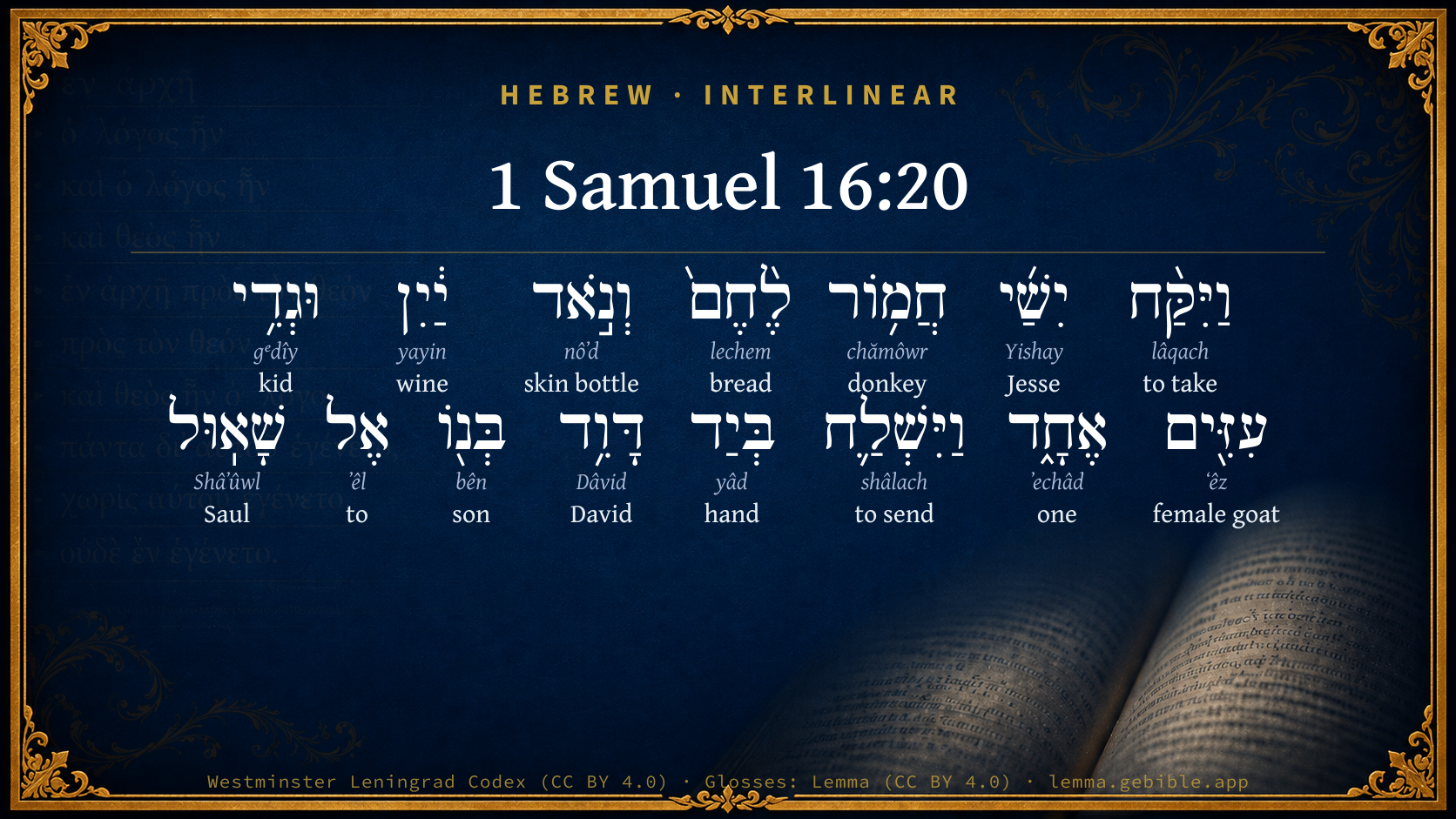
  1. וַיִּקַּ֨ח lâqach H3947 “and · to take” Conjunction + Verb, Qal, Sequential Imperfect, 3rd Person, Masculine, Singular
  2. יִשַׁ֜י Yishay H3448 “Jesse” Noun, Proper
  3. חֲמ֥וֹר chămôwr H2543 “donkey” Noun, Common, Both, Singular, Absolute
  4. לֶ֨חֶם֙ lechem H3899 “bread” Noun, Common, Both, Singular, Absolute
  5. יַ֔יִן yayin H3196 “wine” Noun, Common, Masculine, Singular, Absolute
  6. וּגְדִ֥י gᵉdîy H1423 “and · kid of” Conjunction + Noun, Common, Masculine, Singular, Construct
  7. עִזִּ֖ים ʻêz H5795 “female goats” Noun, Common, Feminine, Plural, Absolute
  8. אֶחָ֑ד ʼechâd H259 “one” Adjective, Cardinal number, Masculine, Singular, Absolute
  9. וַיִּשְׁלַ֛ח shâlach H7971 “and · to send” Conjunction + Verb, Qal, Sequential Imperfect, 3rd Person, Masculine, Singular
  10. בְּיַד yâd H3027 “in/at · hand of” Preposition + Noun, Common, Both, Singular, Construct
  11. דָּוִ֥ד Dâvid H1732 “David” Noun, Proper
  12. בְּנ֖וֹ bên H1121 “son · his” Noun, Common, Masculine, Singular, Construct + Suffix, Personal, 3rd Person, Masculine, Singular
  13. אֶל ʼêl H413 “to” Preposition
  14. שָׁאֽוּל Shâʼûwl H7586 “Saul” Noun, Proper

About this verse

These counts appear in no published source. They are computed here, from the morphology-tagged text and Lemma’s own curated glosses. What Lemma adds →

15
words
15
distinct lemmas
Historical
section

Notable vocabulary

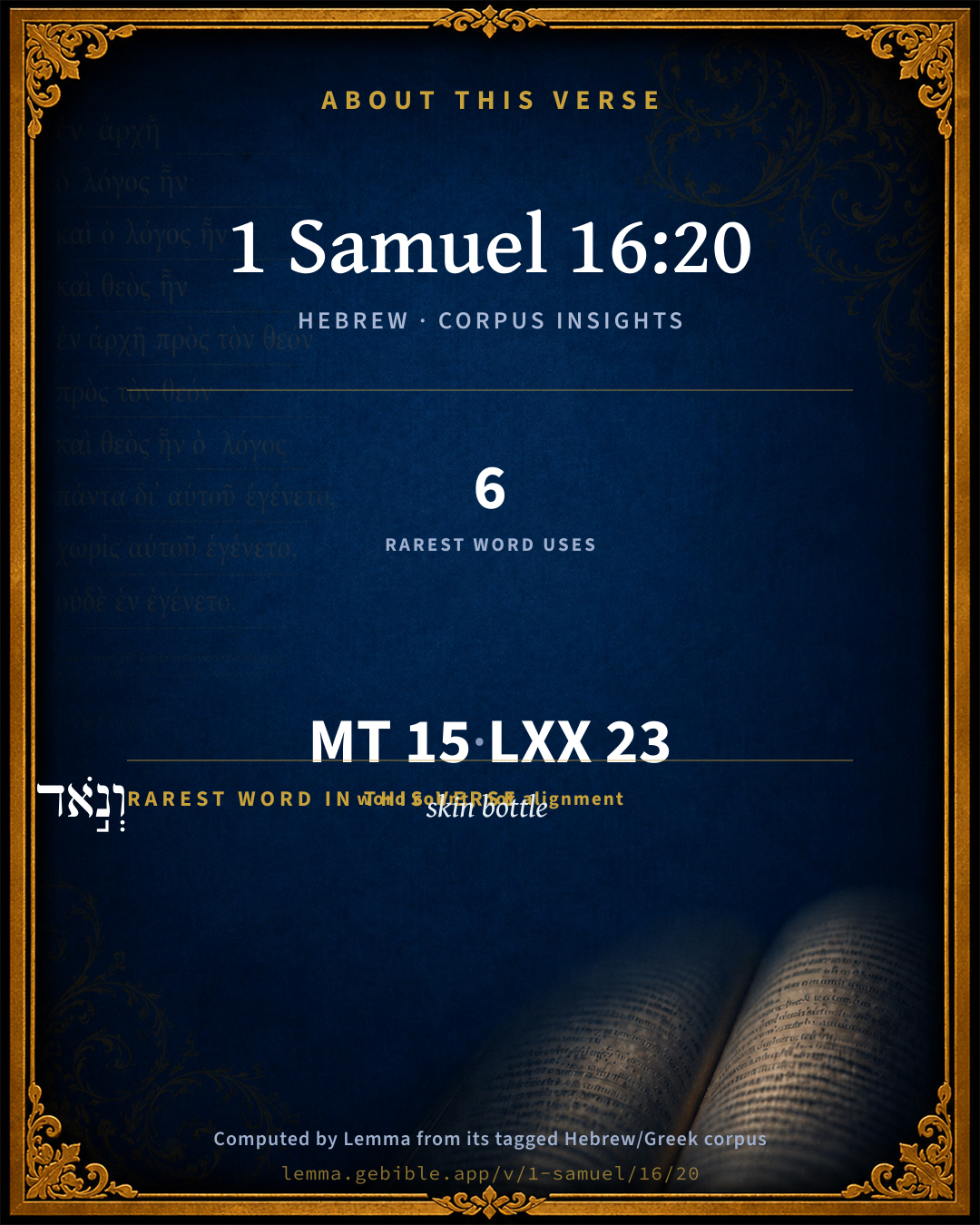
The rarest word here is וְנֹ֣אד skin bottle H4997 — appearing just 6 times in the whole Hebrew Bible.

Shared distinctive vocabulary

וְנֹ֣אד skin bottle H4997 occurs in 6 verses of the Hebrew Bible. Also found in:

Grammatical profile

  • 2 verbs
  • 11 nouns
  • 1 adjective
  • 1 preposition

Verb forms

  • וַיִּקַּ֨ח Qal · Sequential Imperfect
  • וַיִּשְׁלַ֛ח Qal · Sequential Imperfect

Hebrew & Septuagint length

In English translation the verse runs 24 words from the Hebrew and 30 from the Septuagint (LXX English) — closely comparable.

A rough comparison of the two English renderings, which tokenize alike — not a word-level alignment.

Word counts can differ between the Hebrew and the Greek without any difference in meaning — e.g. the Hebrew direct-object marker אֵת has no separate Greek word, and Greek often adds the article ὁ.

In the original languages it is 15 Hebrew tokens and 23 Greek tokens — but the two are counted differently (Hebrew bundles its prefixes and suffixes into one token; the Greek is in lemma form), so that isn’t a like-for-like length.

Cross-references

6

Topical passages linked to 1 Samuel 16:20 in the Treasury of Scripture Knowledge — connected by theme and wording, ordered by reader-vote popularity; previews shown in the World English Bible.

  • 1 Samuel 10:27 But certain worthless fellows said, How shall this man save us? They despised him, and brought him no present. But he held his peace.
  • Proverbs 18:16 A man's gift makes room for him, And brings him before great men.
  • 1 Samuel 17:18 and bring these ten cheeses to the captain of their thousand, and look how your brothers fare, and take their pledge.
  • Genesis 43:11 Their father, Israel, said to them, "If it be so now, do this. Take from the choice fruits of the land in your bags, and carry down a present for the man, a little balm, a little honey, spices and myrrh, nuts, and almonds;
  • 1 Samuel 25:18 Then Abigail made haste, and took two hundred loaves, and two bottles of wine, and five sheep ready dressed, and five measures of parched grain, and one hundred clusters of raisins, and two hundred cakes of figs, and laid them on donkeys.
  • 2 Samuel 16:1–2 When David was a little past the top [of the ascent], behold, Ziba the servant of Mephibosheth met him, with a couple of donkeys saddled, and on them two hundred loaves of bread, and one hundred clusters of raisins, and one hundred summer fruits, and a bottle of wine.

Cross-references courtesy of OpenBible.info (CC BY 4.0).

Hebrew and Greek witnesses Masoretic Hebrew ↔ Greek Septuagint

The same verse in the two great witnesses to the Old Testament, shown verse-for-verse.

These are two independent witnesses, not word-aligned to each other, and the Septuagint is shown in lemma (dictionary) form.

Hebrew 1 Samuel 16:20 Masoretic · Westminster Leningrad Codex

וַיִּקַּ֨ח יִשַׁ֜י חֲמ֥וֹר לֶ֨חֶם֙ וְנֹ֣אד יַ֔יִן וּגְדִ֥י עִזִּ֖ים אֶחָ֑ד וַיִּשְׁלַ֛ח בְּיַד דָּוִ֥ד בְּנ֖וֹ אֶל שָׁאֽוּל

Jesse took a donkey loaded with bread, and a bottle of wine, and a kid, and sent them by David his son to Saul.

World English Bible · Public Domain

Greek LXX 1 Samuel 16:20 Septuagint · lemma form

καί λαμβάνω ιεσσαι γομορ ἄρτος καί ἀσκός οἶνος καί ἔριφος αἴξ εἷς καί ἐκ ἀποστέλλω ἐν χείρ δαυίδ ὁ υἱός αὐτός πρός σαούλ

And Jessae took a homer of bread, and a bottle of wine, and one kid of the goats, and sent them by the hand of his son David to Saul.

LXX2012 (modern English Septuagint) · Public Domain

On this verse, John Gill's Exposition discusses the Septuagint’s reading. Read the note in Commentary ↓

Hebrew: Westminster Leningrad Codex (CC BY 4.0). Greek: Septuagint (public domain); English from LXX2012 (modern English Septuagint) (Public Domain). How the Septuagint differs from the Hebrew →

Targum (Aramaic paraphrase)

1

The Targum is the ancient Jewish Aramaic paraphrase of the Hebrew Scriptures — an interpretive translation, not the Hebrew text itself. Onkelos (literal) and Pseudo-Jonathan (expansive) render the Torah, and Jonathan the Prophets. Coverage is partial: where no permissively-licensed English translation exists for a verse, only the Aramaic is shown. This is verse-level text, not a word-by-word alignment to the Hebrew.

  1. Targum Jonathan Prophets (Joshua–Malachi)
    וּנְסִיב יִשַׁי טְעוּן חַמְרָא טְעוּן דְלַחְמָא וּגְרַב דַחֲמָר וְגַדְיָא בַר עִזֵי חַד וְשַׁדַר בְּיַד דָוִד בְּרֵיהּ לְוַת שָׁאוּל:

    (no public-domain English translation for this verse)

    Targum Jonathan — Aramaic: “Mikraot Gedolot” (public domain). English: “Sefaria Community Translation” (CC0 1.0 (public-domain dedication)); “London "Chaldee Paraphrase," 1871” (public domain). Text via Sefaria.

Commentary

Notes on 1 Samuel 16:20 from classic Christian and Jewish commentators (each source and its license shown beneath its notes). The classic Christian expositions comment on the surrounding passage and are grouped to its opening verse, so a note may address several verses; the Jewish commentaries on the Tanakh (Rashi and others) are per-verse, so they appear only where the commentator wrote on this verse.

Lemma curates 59 commentaries, every one of them public domain or Creative Commons licensed, each selected and text-cleaned for this edition rather than reprinted as found. About our sources →

Trapp's Complete Commentary

John Trapp

1Sa 16:20 And Jesse took an ass [laden] with bread, and a bottle of wine, and a kid, and sent [them] by David his son unto Saul.

Ver. 20. And Jesse took an ass laden with bread.] Great men love and look for presents, whereby men testify their respects unto them. Reges Parthos non potest quisquam salutare sine munere, saith Seneca. {a}

And sent them by David.] Whom he might well have feared to send to Saul; but he trusteth God with him, submitting to his good pleasure and providence.

{a} Epist. xvii.

John Trapp, A Commentary or Exposition upon All the Books of the Old and New Testament (1647–1656) — public domain. Text from a community e-Sword module.

Joseph Benson's Commentary

1Sa 16:20. Jesse took bread, a bottle of wine, and a kid, and sent them — This present, though in our times it would seem contemptible, yet was very agreeable to the usage of those ages, and to the condition of Jesse, which was but mean in the world. And it was usual in those days not to come before a prince without a present, as a token of respect.

Joseph Benson's Commentary on the Old and New Testaments (1811–1818) — public domain. Text from a community e-Sword module.

Jamieson, Fausset & Brown

Robert Jamieson, A. R. Fausset & David Brown

Jesse took an ass laden with bread, and a bottle of wine, and a kid, and sent them . . . unto Saul--as a token of homage and respect.

Jamieson, Fausset & Brown — Commentary Critical and Explanatory on the Whole Bible (1871) — public domain (CC PDM 1.0). Text via the HelloAO Bible API.

Adam Clarke's Commentary

Verse 20. Took an ass laden with bread] He must send a present to Saul to introduce his son, and this was probably the best he had. Dr. Warburton pleads still farther on the propriety of his rectification of the chronology in this place. David had at this time vanquished the Philistine, was become a favourite with the people, had excited Saul's jealousy, and retired to shun its effects. In the interim Saul was seized with the disorder in question, and is recommended by his servants to try the effects of music. They were acquainted with David's skill on the harp, and likewise with Saul's bad disposition towards him; the point was delicate, it required to be managed with address, and therefore they recommend David in this artful manner: "As you must have one constantly in attendance, both in court and on your military expeditions; to be always at hand on occasion, the son of Jesse will become both stations well; he will strengthen your camp and adorn your court, for he is a tried soldier and of a graceful presence. You have nothing to fear from his ambition, for you saw with what prudence he went into voluntary banishment when his popularity had incurred your displeasure." Accordingly Saul is prevailed on, David is sent for, and succeeds with his music; this dissipates all former umbrage, and, as one who is ever to be in attendance, he is made Saul's armour-bearer. This sunshine still continued till his great successes awakened Saul's jealousy afresh, and then the lifted javelin was to strike off all obligations. Thus we see what light is thrown upon the whole history by the supposition of an anticipation in the latter part of this chapter; an anticipation the most natural, proper, and necessary, for the purpose of the historian. Thus reasons Bishop Warburton, and with very considerable plausibility, though the intelligent reader may still have his doubts.

Adam Clarke's Commentary on the Bible (1810–1826) — public domain. Text from a community e-Sword/MySword module.

Ellicott's Commentary for English Readers

(20) And Jesse took an ass.—It was and is ever customary in the East to acknowledge obedience and subjection with a present. Jesse, the sheik of Bethlehem, would thus be expected on sending his son to the court of Saul to acknowledge his sovereign by some token of homage.

The nature of Jesse’s gifts shows how simple and primitive were the customs of the Hebrew people at that time.

A Bible Commentary for English Readers, edited by Charles John Ellicott (1878–1897) — public domain. Text from a community e-Sword module.

The Cambridge Bible for Schools and Colleges

gen. ed. J. J. S. Perowne

20. And Jesse took, &c.] Cp. 1Sa_10:4; 1Sa_10:27. The character of the presents offered to the King shews the simplicity of the manners of the age. They were “the natural produce of the well known vines, and corn-fields, and pastures of Bethlehem.”

The Cambridge Bible for Schools and Colleges (gen. ed. J. J. S. Perowne; Cambridge University Press, 1878–1918) — public domain. Text from a community e-Sword module.

John Gill's Exposition

And Jesse took an ass laden with bread,.... Laden with a load of bread, as the Targum; with as much as it could carry, or was used to carry; the Septuagint version is, an omer of bread, which was as much as a man could eat in one day; and, according to Kimchi and Ben Melech, it may be interpreted an heap of bread, agreeably to the use of the word in Jdg 15:16, and a bottle of wine; or a skin of wine, a leather bag or sack, which held more than our bottles; the Targum is, a flagon of wine:

and a kid; of the goats, as the same Targum:

and sent them by David his son unto Saul; some think that Jesse suspected that Saul had known the secret of David's being anointed, and was fearful that he had a design upon his life, and therefore sent this present by his son to pacify him, and ingratiate him unto him; but rather he sent it as a token of respect and subjection to his sovereign, and according to the custom of those times, when men used to carry presents when they waited upon princes, and indeed in their common visits; and do in the eastern countries to this day; See Gill on Sa1 9:7.

John Gill's Exposition of the Whole Bible (1746–1763) — public domain (CC PDM 1.0). Text via the HelloAO Bible API.

Haydock's Catholic Bible Commentary

Laden. So Chaldean. (Menochius) --- Literally, plenum, "full of." (Haydock) --- Septuagint, "a gomor," which they seem to have read instead of the Hebrew chamor, "an ass of bread," as Sosibius says, "he eats three asses’ of panniers of loaves." (Calmet) --- Protestants supply, "laden."

George Leo Haydock (1774–1849), Haydock's Catholic Family Bible and Commentary, 1859 edition — public domain. Excludes Psalms (Douay-Rheims chapter numbering differs from Protestant) and Deuterocanonical books (Catholic canon only).

Matthew Poole's English Annotations

This present, though in our times it would seem contemptible, yet was very agreeable to the usage of those times, and to the condition of Jesse, which was but mean in the world. And it seems to have been the custom of those times, as it is yet in the eastern countries (when they made their appearance before princes or great persons, to bring a present: see Gen 32:20; 43:25,26, and elsewhere); to which civil custom that religious precept seems consonant, Exo 23:15; Deu 16:16. None shall appear before me empty. And he might send it, partly as a testimony of his respect to his sovereign, and partly to gain David favour and acceptance with him, being sensible that he was going into a place and state of hazard; but knowing Saul’s furious temper, he durst not refuse to send him; and he sent him the more willingly, because this seemed a most likely means to accomplish God’s promise of the kingdom, and to prepare him for it.

Matthew Poole's English Annotations on the Holy Bible (1683–1685) — public domain. Text from a community e-Sword/MySword module.

Whedon's Commentary on the Bible

Daniel D. Whedon

20. An ass laden with bread… wine… kid — See note on 1Sa_9:7. The Hebrew is, literally, an ass of bread, and some have thought it to be the name of a weight or measure, but the English version conveys the better meaning. “It is a pleasant picture to conceive the future king of Israel stepping lightly along behind the animal, with his shepherd’s staff and scrip, and entertained as he went by the gambols of the kid. His light harp was, no doubt, slung to his back; and it is likely that he now and then rested under a tree and solaced his soul with its music.” — Kitto. The distance between Beth-lehem and Gibeah of Saul is about ten miles, and on this journey the youthful psalmist probably passed in sight of the stronghold of Zion, destined one day to fall before his conquering forces, and ever after to be known as “the city of David.” 2Sa_5:7.

Daniel D. Whedon (gen. ed.), Commentary on the Old and New Testaments (1874–1909) — public domain. Text from a community e-Sword module.

John Wesley's Explanatory Notes

Sent him - This present, though in our times it would seem contemptible, yet was very agreeable to the usage of those times, and to the condition of Jesse, which was but mean in the world. And it seems to have been the custom of those times, (as it is yet in the eastern countries) when they made their appearance before princes, or great persons, to bring a present.

John Wesley, Explanatory Notes Upon the Whole Bible (1754–1765) — public domain. Text via the GEBible commentary corpus.

unfoldingWord translationNotes

Door43 World Missions Community

David came to Saul

Here "came" can be translated as "went." (See: Go and Come)

entered his service

The abstract noun "service" can be stated as a verb. AT: "began to serve him" (See: Abstract Nouns)

he became his armor bearer

"David became Saul's armor bearer"

translationWords

Jesse

donkey

bread

wine

goat

David

Saul (OT)

love

armor

unfoldingWord translationNotes — © Distant Shores Media and the Door43 World Missions Community, licensed CC BY-SA 4.0. Source: git.door43.org/Door43/en_tn.

Lesson kit

Teaching starters — assembled from the data on this page, not authored interpretation. Every prompt links to the verse data it draws on. Edit before teaching.

1 Samuel, in the Historical, opens this verse with 15 words (15 distinct Hebrew lemmas). Its most distinctive word is nôʼd (“skin bottle”). A historical commentator’s framing appears above. Read the whole chapter for the surrounding context.

Discussion questions

  1. What does “skin bottle” (nôʼd) contribute to the verse as a whole?
  2. How does Joshua 9:4, which shares the word «skin bottle», read alongside this verse?
  3. These translations render this verse differently; the difference is in the English rendering, not the original. What questions does that raise?
  4. «וַיִּקַּ֨ח» is a Qal Sequential Imperfect verb. How does that grammatical form shape the action described?
  5. Compare how Trapp's Complete Commentary and Joseph Benson's Commentary read this verse. Where do they agree or differ?

Things to notice

Reading settings

Reading text

Shown beneath each verse's original-language words.

Old Testament
Old Testament edition

Read the OT as the Masoretic Hebrew (MT) or the Greek Septuagint (LXX).

English shown for the Greek Septuagint (in the Hebrew ↔ Greek comparison).

Comparing translations? Open the Compare panel on any verse page to stack up to four side by side.