
Deuteronomy 23:4

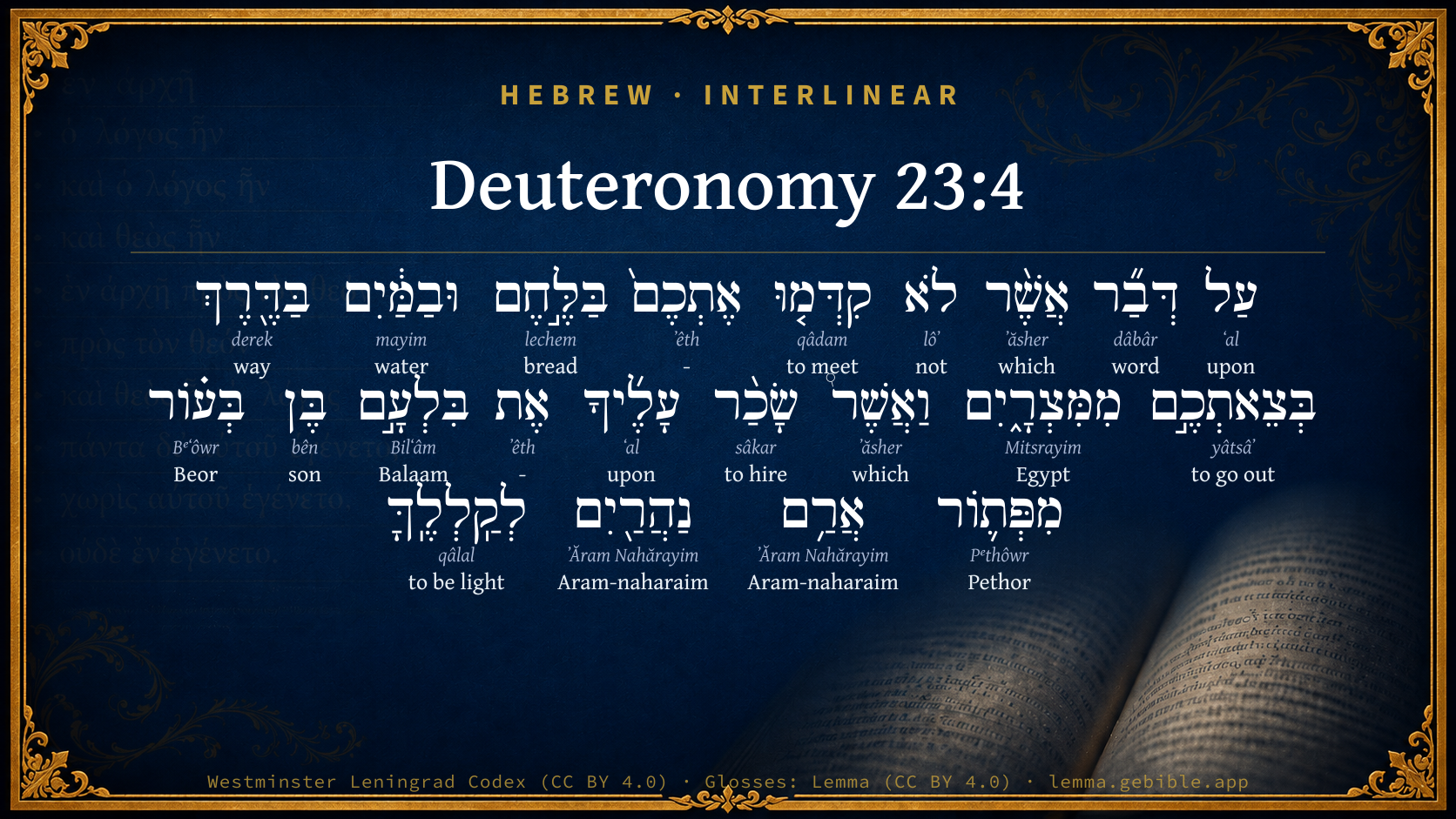
Hebrew (Westminster Leningrad Codex) Deuteronomy 23:4 appears in the Hebrew Old Testament. The text above is from the Westminster Leningrad Codex. Each word links to its Strong’s number, a concise gloss, and parsing drawn from the Open Scriptures Hebrew Bible morphology. Click any word for its full Brown-Driver-Briggs (BDB) entry.
Download image
Cite this verse

Deuteronomy 23:4 (World English Bible). Public Domain. Lemma interlinear Bible study tool, https://lemma.gebible.app/v/deuteronomy/23/4.

Show BibTeX & RIS
BibTeX
RIS
English Translation
because they didn't meet you with bread and with water in the way, when you came forth out of Egypt, and because they hired against you Balaam the son of Beor from Pethor of Mesopotamia, to curse you.
World English Bible · Public Domain
Highlights
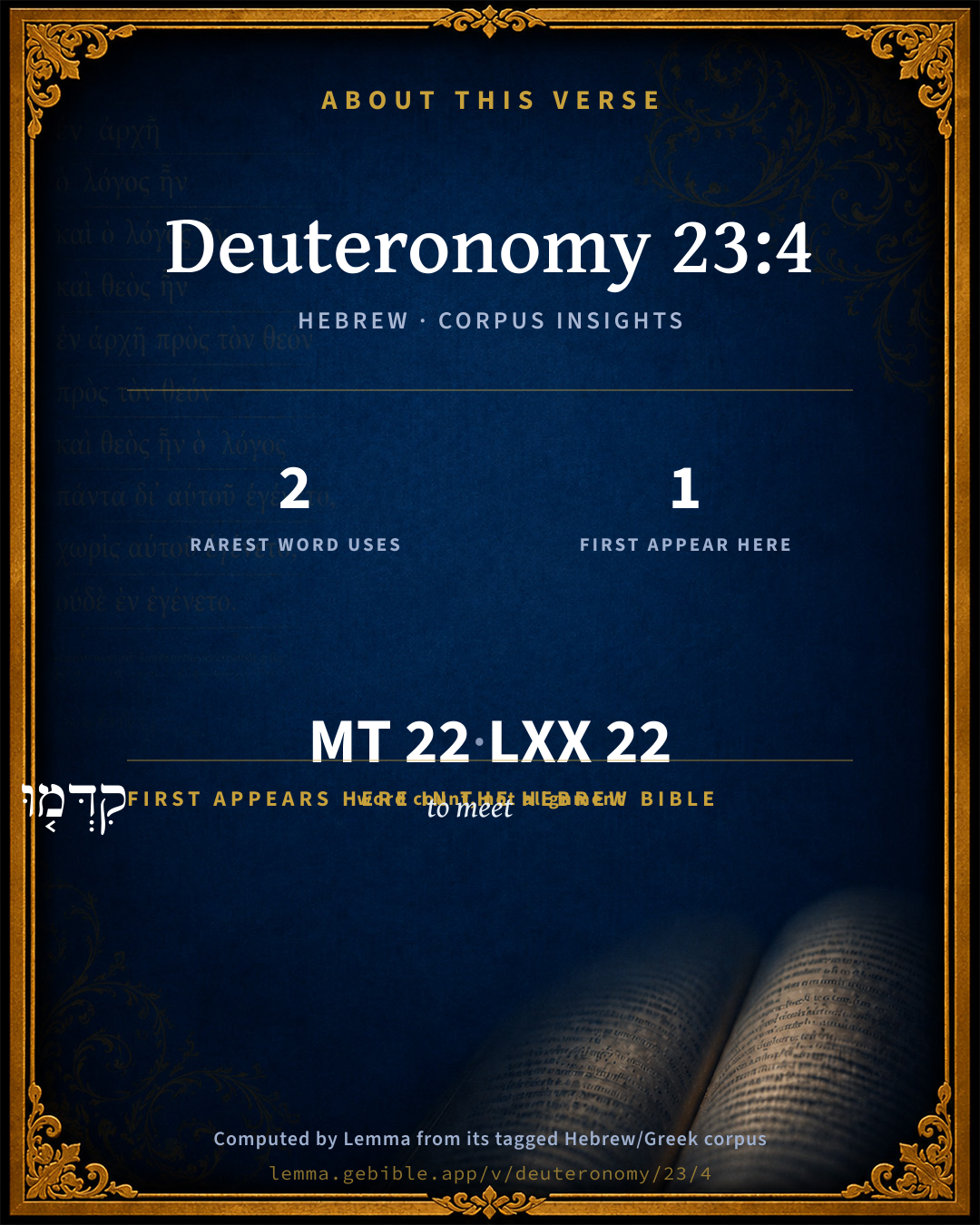
  • 1 first appearance in the Hebrew Bible
Full analysis ↓
Download a study sheet

One document with this verse’s original text, its word-by-word gloss line, the meaning frame, cross-references with their text, attributed commentary, and full source and license credits — printable, and it pastes into notes with its structure intact.

This verse Autodidact and up

Study sheet (.html) Plain text (.txt)

A passage Seminary Student

Up to 50 verses in one chapter. A passage sheet keeps up to 6 commentary sources and 12 cross-references per verse, in the order this page ranks them, and says so on the sheet whenever that leaves anything out. Ask for a single verse and you get the Autodidact verse sheet above.

Everything on this page stays free to read, with no account — the sheet is a download of what is already on screen, not access to it.

Want to remove ads? Support Godless Engineer
Compare translations 3

The same verse in 3 English versions, stacked beneath the original-language interlinear above. Click any original word for its lexicon entry.

Each is an independent rendering of the whole verse — the interlinear is not word-aligned to these translations.

Highlighted words mark where these versions differ — a whole-verse word diff, not a word-by-word alignment.

  • World English Bible Public Domain
    because they didn't meet you with bread and with water in the way, when you came forth out of Egypt, and because they hired against you Balaam the son of Beor from Pethor of Mesopotamia, to curse you.
  • King James Version Public Domain
    Because they met you not with bread and with water in the way, when ye came forth out of Egypt; and because they hired against thee Balaam the son of Beor of Pethor of Mesopotamia, to curse thee.
  • unfoldingWord Literal Text CC BY-SA 4.0
    on account of the matter that they did not meet you with bread and with water on the road when you had come out from Egypt, and that he hired against you Balaam, the son of Beor, from Pethor Aram Naharaim, to curse you.

unfoldingWord Literal Text — © unfoldingWord, licensed CC BY-SA 4.0. Word-aligned USFM3 via Door43 (git.door43.org/unfoldingWord/en_ult).

Versions to compare (up to 4)

3 of 4 selected

Show all 18 translations

Every available English version of this verse, each an independent rendering of the whole verse.

  • World English Bible Public Domain
    because they didn't meet you with bread and with water in the way, when you came forth out of Egypt, and because they hired against you Balaam the son of Beor from Pethor of Mesopotamia, to curse you.
  • Berean Standard Bible Public Domain
    For they did not meet you with food and water on your way out of Egypt, and they hired Balaam son of Beor from Pethor in Aram-naharaim to curse you.
  • Majority Standard Bible Public Domain
    For they did not meet you with food and water on your way out of Egypt, and they hired Balaam son of Beor from Pethor in Aram-naharaim to curse you.
  • King James Version Public Domain
    Because they met you not with bread and with water in the way, when ye came forth out of Egypt; and because they hired against thee Balaam the son of Beor of Pethor of Mesopotamia, to curse thee.
  • American Standard Version (1901) Public Domain
    because they met you not with bread and with water in the way, when ye came forth out of Egypt, and because they hired against thee Balaam the son of Beor from Pethor of Mesopotamia, to curse thee.
  • Revised Version (1885) Public Domain
    because they met you not with bread and with water in the way, when ye came forth out of Egypt; and because they hired against thee Balaam the son of Beor from Pethor of Mesopotamia, to curse thee.
  • Geneva Bible (1599) Public Domain
    Because they met you not with bread and water in the way, when yee came out of Egypt, and because they hyred against thee Balaam the sonne of Beor, of Pethor in Aram-naharaim, to curse thee.
  • Douay-Rheims (1899) Public Domain
    Because they would not meet you with bread and water in the way, when you came out of Egypt: hand because they hired against thee Balaam, the son of Beer, from Mesopotamia in Syria, to curse thee.
  • Young's Literal Translation Public Domain
    because that they have not come before you with bread and with water in the way, in your coming out from Egypt, and because he hath hired against thee Balaam son of Beor, of Pethor of Aram-Naharaim, to revile thee;
  • Literal Standard Version CC BY-SA 4.0
    because that they have not come before you with bread and with water in the way, in your coming out from Egypt, and because he has hired against you Balaam son of Beor, of Pethor of Aram-Naharaim, to revile you;
  • Unlocked Literal Bible CC BY-SA 4.0
    This is because they did not meet you with bread and with water on the road when you had come out of Egypt, and because they hired against you Balaam son of Beor from Pethor in Aram Naharaim, to curse you.
  • unfoldingWord Literal Text CC BY-SA 4.0
    on account of the matter that they did not meet you with bread and with water on the road when you had come out from Egypt, and that he hired against you Balaam, the son of Beor, from Pethor Aram Naharaim, to curse you.
  • Darby Bible Public Domain
    because they met you not with bread and with water on the way, when ye came forth out of Egypt, and because they hired against thee Balaam the son of Beor, of Pethor of Mesopotamia, to curse thee.
  • World Messianic Bible Public Domain
    because they didn’t meet you with bread and with water on the way when you came out of Egypt, and because they hired against you Balaam the son of Beor from Pethor of Mesopotamia, to curse you.
  • Webster's Bible Public Domain
    Because they met you not with bread and with water in the way, when ye came forth from Egypt; and because they hired against thee Balaam the son of Beor of Pethor of Mesopotamia, to curse thee.
  • Free Bible Version CC BY-SA 4.0
    For they did not come to meet you with food and water on your journey from Egypt, and they hired Balaam, son of Beor, from Pethor in Mesopotamia, to curse you.
  • Bible in Basic English Public Domain
    Because they gave you no bread or water on your way, when you came out of Egypt: and they got Balaam, the son of Peor, from Pethor in Aram-naharaim to put curses on you.
  • JPS Tanakh (1917) Public Domain
    (23-5) because they met you not with bread and with water in the way, when ye came forth out of Egypt; and because they hired against thee Balaam the son of Beor from Pethor of Aram-naharaim, to curse thee.

Literal Standard Version (2020), Covenant Press — licensed CC BY-SA 4.0. Text via the HelloAO Bible API (eBible.org). Unlocked Literal Bible (unfoldingWord) — licensed CC BY-SA 4.0. Text via the HelloAO Bible API (eBible.org). unfoldingWord Literal Text — © unfoldingWord, licensed CC BY-SA 4.0. Word-aligned USFM3 via Door43 (git.door43.org/unfoldingWord/en_ult). Free Bible Version, Dr. Jonathan Gallagher — licensed CC BY-SA 4.0. Text via the HelloAO Bible API (eBible.org).

Word by word

More ways to search: Search by grammar → Find every occurrence → Compare this word →

Practice this passage: Drill this verse → Learn its vocabulary →

מִפְּת֛וֹר
Pᵉthôwr
H6604
“from · Pethor”
Preposition + Noun, Proper
Part of Speech
Preposition + Noun
Type
Proper
Full BDB Definition

Origin: of foreign origin

TWOT: None

Pethor = "soothsayer" - a town of Mesopotamia and the home of Balaam; located on a river; site unknown
  1. עַל ʻal H5921 “upon” Preposition
  2. דְּבַ֞ר dâbâr H1697 “word of” Noun, Common, Masculine, Singular, Construct
  3. אֲשֶׁ֨ר ʼăsher H834 “which” Particle, Relative
  4. לֹא lôʼ H3808 “not” Particle, Negative
  5. קִדְּמ֤וּ qâdam H6923 “to meet” Verb, Piel, Perfect, 3rd Person, Common, Plural
  6. אֶתְכֶם֙ ʼêth H853 “- · you” Particle, Direct Object + Suffix, Personal, 2nd Person, Masculine, Plural
  7. בַּלֶּ֣חֶם lechem H3899 “in/at the · bread” Preposition, Determined + Noun, Common, Both, Singular, Absolute
  8. וּבַמַּ֔יִם mayim H4325 “and · in/at the · water(s)” Conjunction + Preposition, Determined + Noun, Common, Masculine, Plural, Absolute
  9. בַּדֶּ֖רֶךְ derek H1870 “in/at the · way” Preposition, Determined + Noun, Common, Both, Singular, Absolute
  10. בְּצֵאתְכֶ֣ם yâtsâʼ H3318 “in/at · to go out · you” Preposition + Verb, Qal, Infinitive Construct + Suffix, Personal, 2nd Person, Masculine, Plural
  11. מִמִּצְרָ֑יִם Mitsrayim H4714 “from · Egypt” Preposition + Noun, Proper
  12. וַאֲשֶׁר֩ ʼăsher H834 “and · which” Conjunction + Particle, Relative
  13. שָׂכַ֨ר sâkar H7936 “to hire” Verb, Qal, Perfect, 3rd Person, Masculine, Singular
  14. עָלֶ֜יךָ ʻal H5921 “upon · you” Preposition + Suffix, Personal, 2nd Person, Masculine, Singular
  15. אֶת ʼêth H853 “-” Particle, Direct Object
  16. בִּלְעָ֣ם Bilʻâm H1109 “Balaam” Noun, Proper
  17. בֶּן bên H1121 “son of” Noun, Common, Masculine, Singular, Construct
  18. בְּע֗וֹר Bᵉʻôwr H1160 “Beor” Noun, Proper
  19. אֲרַ֥ם ʼĂram Nahărayim H763 “Aram-naharaim” Noun, Proper
  20. נַהֲרַ֖יִם ʼĂram Nahărayim H763 “Aram-naharaim” Noun, Proper
  21. לְקַֽלְלֶֽךָּ qâlal H7043 “to be light · you” Preposition + Verb, Piel, Infinitive Construct + Suffix, Personal, 2nd Person, Masculine, Singular

About this verse

These counts appear in no published source. They are computed here, from the morphology-tagged text and Lemma’s own curated glosses. What Lemma adds →

22
words
18
distinct lemmas
Pentateuch
section

Notable vocabulary

The rarest word here is מִפְּת֛וֹר Pethor H6604 — appearing just 2 times in the whole Hebrew Bible.

First appearance in Scripture

This word makes its first canonical appearance in the Hebrew Bible here:

  • קִדְּמ֤וּ to meet H6923

Shared distinctive vocabulary

מִפְּת֛וֹר Pethor H6604 occurs in 2 verses of the Hebrew Bible. Also found in:

Grammatical profile

  • 4 verbs
  • 11 nouns
  • 2 prepositions
  • 5 particles

Verb forms

  • קִדְּמ֤וּ Piel · Perfect
  • בְּצֵאתְכֶ֣ם Qal · Infinitive Construct
  • שָׂכַ֨ר Qal · Perfect
  • לְקַֽלְלֶֽךָּ Piel · Infinitive Construct

Repetition

Words recur within this verse — often emphatic in Hebrew:

  • עַל upon H5921 ×2
  • אֲרַ֥ם Aram-naharaim H763 ×2
  • אֲשֶׁ֨ר which H834 ×2

Hebrew & Septuagint length

In English translation the verse runs 38 words from the Hebrew and 34 from the Septuagint (LXX English) — closely comparable.

A rough comparison of the two English renderings, which tokenize alike — not a word-level alignment.

Word counts can differ between the Hebrew and the Greek without any difference in meaning — e.g. the Hebrew direct-object marker אֵת has no separate Greek word, and Greek often adds the article ὁ.

In the original languages it is 22 Hebrew tokens and 22 Greek tokens — but the two are counted differently (Hebrew bundles its prefixes and suffixes into one token; the Greek is in lemma form), so that isn’t a like-for-like length.

Cross-references

13

Topical passages linked to Deuteronomy 23:4 in the Treasury of Scripture Knowledge — connected by theme and wording, ordered by reader-vote popularity; previews shown in the World English Bible.

  • Nehemiah 13:2 because they didn't meet the children of Israel with bread and with water, but hired Balaam against them, to curse them: however our God turned the curse into a blessing.
  • 2 Peter 2:15 forsaking the right way, they went astray, having followed the way of Balaam the son of Beor, who loved the wages of wrong-doing;
  • Deuteronomy 2:28–29 You shall sell me food for money, that I may eat; and give me water for money, that I may drink: only let me pass through on my feet,
  • 1 Kings 18:4 for it was so, when Jezebel cut off the prophets of Yahweh, that Obadiah took one hundred prophets, and hid them by fifty in a cave, and fed them with bread and water.)
  • Numbers 22:5–7 He sent messengers to Balaam the son of Beor, to Pethor, which is by the River, to the land of the children of his people, to call him, saying, Behold, there is a people come out from Egypt: behold, they cover the surface of the earth, and they abide over against me.
  • Numbers 22:17 for I will promote you to very great honor, and whatever you say to me I will do. Please come therefore, and curse this people for me.
  • Numbers 23:7 He took up his parable, and said, From Aram has Balak brought me, The king of Moab from the mountains of the East: Come, curse me Jacob, Come, defy Israel.
  • 1 Samuel 25:11 Shall I then take my bread, and my water, and my meat that I have killed for my shearers, and give it to men who I don't know where they come from?
  • Zechariah 2:8 For thus says Yahweh of hosts: 'For honor he has sent me to the nations which plundered you; for he who touches you touches the apple of his eye.
  • Matthew 25:40 "The King will answer them, 'Most assuredly I tell you, inasmuch as you did it to one of the least of these my brothers, you did it to me.'
  • Acts 9:4 He fell on the earth, and heard a voice saying to him, "Saul, Saul, why do you persecute me?"
  • Genesis 14:17–18 The king of Sodom went out to meet him, after his return from the slaughter of Chedorlaomer and the kings who were with him, at the valley of Shaveh (the same is the King's Valley).
  • Isaiah 63:9 In all their affliction he was afflicted, and the angel of his presence saved them: in his love and in his pity he redeemed them; and he bore them, and carried them all the days of old.

Cross-references courtesy of OpenBible.info (CC BY 4.0).

Hebrew and Greek witnesses Masoretic Hebrew ↔ Greek Septuagint

The same verse in the two great witnesses to the Old Testament, shown verse-for-verse.

These are two independent witnesses, not word-aligned to each other, and the Septuagint is shown in lemma (dictionary) form.

Hebrew Deuteronomy 23:4 Masoretic · Westminster Leningrad Codex

עַל דְּבַ֞ר אֲשֶׁ֨ר לֹא קִדְּמ֤וּ אֶתְכֶם֙ בַּלֶּ֣חֶם וּבַמַּ֔יִם בַּדֶּ֖רֶךְ בְּצֵאתְכֶ֣ם מִמִּצְרָ֑יִם וַאֲשֶׁר֩ שָׂכַ֨ר עָלֶ֜יךָ אֶת בִּלְעָ֣ם בֶּן בְּע֗וֹר מִפְּת֛וֹר אֲרַ֥ם נַהֲרַ֖יִם לְקַֽלְלֶֽךָּ

because they didn't meet you with bread and with water in the way, when you came forth out of Egypt, and because they hired against you Balaam the son of Beor from Pethor of Mesopotamia, to curse you.

World English Bible · Public Domain

Greek LXX Deuteronomy 23:4 Septuagint · lemma form

οὐ εἰςἔρχομαι αμμανίτης καί μωαβίτης εἰς ἐκκλησία κύριος καί ἕως δέκατος γενεά οὐ εἰςἔρχομαι εἰς ἐκκλησία κύριος καί ἕως εἰς ὁ αἰών

because they met you not with bread and water by the way, when you⌃ went out of Egypt; and because they hired against you Balaam the son of Beor of Mesopotamia to curse you.

LXX2012 (modern English Septuagint) · Public Domain

Hebrew: Westminster Leningrad Codex (CC BY 4.0). Greek: Septuagint (public domain); English from LXX2012 (modern English Septuagint) (Public Domain). How the Septuagint differs from the Hebrew →

Targum (Aramaic paraphrase)

2

The Targum is the ancient Jewish Aramaic paraphrase of the Hebrew Scriptures — an interpretive translation, not the Hebrew text itself. Onkelos (literal) and Pseudo-Jonathan (expansive) render the Torah, and Jonathan the Prophets. Coverage is partial: where no permissively-licensed English translation exists for a verse, only the Aramaic is shown. This is verse-level text, not a word-by-word alignment to the Hebrew.

  1. Targum Onkelos Torah (Genesis–Deuteronomy)
    לָא יִדְכּוּן עַמוֹנָאֵי וּמוֹאָבָאֵי לְמֵעַל בִּקְהָלָא דַיְיָ אַף דָרָא עֲשִׂירָאָה לָא יִדְכֵּי לְהוֹן לְמֵעַל בִּקְהָלָא דַיְיָ עַד עָלָם

    (no public-domain English translation for this verse)

    Targum Onkelos — Aramaic: “Onkelos Genesis” (public domain); “Onkelos Exodus” (public domain); “Onkelos Leviticus” (public domain); “Onkelos Numbers” (public domain); “Onkelos Deuteronomy” (public domain). English: “Sefaria Community Translation” (CC0 1.0 (public-domain dedication)); “J.W. Etheridge. The Targums of Onkelos and Jonathan Ben Uzziel on the Pentateuch. London: Longmans, Green, 1862” (public domain). Text via Sefaria.

  2. Targum Pseudo-Jonathan Torah (Genesis–Deuteronomy)
    לָא יִדְכּוּן דְּכוּרֵי עַמּוֹנָאֵי וּמוֹאֲבָאֵי לְמֵיסַב אִיתָא מִקְהַל עַמָּא דַיְיָ בְּרַם דַּר עֲשִירָאֵי לָא יִדְכֵּי לְמֵיסַב אִיתָא מִקְהַל עַמָּא דַיְיָ עַד עָלְמָא

    Neither an Ammonite nor a Moabite man is fit to take a wife from the congregation of the Lord’s people, nor unto the tenth generation shall they take a wife from the congregation of the people of the Lord,

    Targum Pseudo-Jonathan — Aramaic: “Targum Jonathan on Genesis” (public domain); “Targum Jonathan on Exodus” (public domain); “Targum Jonathan on Leviticus” (public domain); “Targum Jonathan on Numbers” (public domain); “Targum Jonathan on Deuteronomy” (public domain). English: “The Targum of Jonathan ben Uzziel, trans. J. W. Etheridge, London, 1862” (public domain). Text via Sefaria.

Commentary

Notes on Deuteronomy 23:4 from classic Christian and Jewish commentators (each source and its license shown beneath its notes). The classic Christian expositions comment on the surrounding passage and are grouped to its opening verse, so a note may address several verses; the Jewish commentaries on the Tanakh (Rashi and others) are per-verse, so they appear only where the commentator wrote on this verse.

Lemma curates 59 commentaries, every one of them public domain or Creative Commons licensed, each selected and text-cleaned for this edition rather than reprinted as found. About our sources →

Trapp's Complete Commentary

John Trapp

Deu 23:4 Because they met you not with bread and with water in the way, when ye came forth out of Egypt; and because they hired against thee Balaam the son of Beor of Pethor of Mesopotamia, to curse thee.

Ver. 4. Because they met you not.] As God takes notice of the least courtesy showed to his people, even to a cup of cold water, to requite it, so he doth of the least discourtesy, even to a frown or a frump {See Trapp on "Gen 4:6"} to revenge it.

And because they hired, &c.] {See Trapp on "Num 22:3"} {See Trapp on "Num 22:6"}

John Trapp, A Commentary or Exposition upon All the Books of the Old and New Testament (1647–1656) — public domain. Text from a community e-Sword module.

Joseph Benson's Commentary

Deu 23:4. They met you not with bread and water — That is, meat and drink; as the manner of those times and countries was, with respect to strangers and travellers, which was the more necessary because there were no public-houses of entertainment. Their fault, then, was unmercifulness to strangers and afflicted persons, which was aggravated both by their relation to the Israelites, as being the children of Lot, and by the special kindness of God and of the Israelites to them, in not fighting against them. Because they hired against thee Balaam — As the foregoing passage peculiarly refers to the Ammonites, so this doth to the Moabites, Num 22:5-7.

Joseph Benson's Commentary on the Old and New Testaments (1811–1818) — public domain. Text from a community e-Sword module.

Tyndale Open Study Notes

Tyndale Open Resources

23:4 Pethor is now identified with Pitru in Mesopotamia (see study note on Num 22:5-6). • Aram-naharaim (“Aram of the two rivers”) lies between the Euphrates and the Balih Rivers in upper Mesopotamia.

Tyndale Open Study Notes — © Tyndale Open Resources, licensed CC BY-SA 4.0. Text via the HelloAO Bible API.

Geneva Bible (1599)

Geneva Bible translators

Hereby he condemneth all that further not the children of God in their vocation.

Geneva Bible (1599) marginal notes — public domain. Text via Bolls.life.

Ellicott's Commentary for English Readers

(4) Because they met you not with bread and with water.—We learn incidentally from this passage how the Moabites and the Ammonites requited the forbearance shown them by the Israelites (Deu_2:9; Deu_2:19; Deu_2:29). No one not acquainted with the details of Israel’s intercourse with these people on their journey could have written thus.

Because they hired against thee Balaam.—See Numbers 22 and Num_31:16, and Numbers 25.

A Bible Commentary for English Readers, edited by Charles John Ellicott (1878–1897) — public domain. Text from a community e-Sword module.

John Gill's Exposition

Because they met you not with bread and with water,.... To supply them therewith, either as a gift, which was a piece of humanity to strangers and travellers, or rather to sell unto them, for on no other terms did the Israelites desire their bread and their water:

in the way when ye came forth out of Egypt; not as soon as they came forth from thence, for it was near forty years after; but it was while they were in the way from thence, as they were journeying to the land of Canaan, and so were travellers, and should have had kindness shown them as such; for though they needed not bread and water, God providing both for them, yet this does not excuse the inhumanity of these people: the words are to be understood by way of distribution; this charge here only belongs to the Ammonites, for it appears that the Moabites did give them bread and water for money, Deu 2:28 as what follows belongs peculiarly to the Moabites and not the Ammonites:

and because they hired against thee Balaam the son of Pethor of Mesopotamia, to curse thee; this the Moabites did in conjunction with the Midianites, but the Ammonites had no concern in it; see Num 22:7, it was not therefore because the Moabites and Ammonites were born in incest that they were forbidden entrance into the congregation of the Lord; which might have been thought to have been the reason of it, these instances following upon the former, had not these reasons been assigned.

John Gill's Exposition of the Whole Bible (1746–1763) — public domain (CC PDM 1.0). Text via the HelloAO Bible API.

Haydock's Catholic Bible Commentary

Water: the necessaries of life. This inhumanity is highly resented. --- Son. Hebrew, "of Beor, of Pethor, a city of Mesopotamia, to curse thee." (Haydock) (Numbers xxii. 5.)

George Leo Haydock (1774–1849), Haydock's Catholic Family Bible and Commentary, 1859 edition — public domain. Excludes Psalms (Douay-Rheims chapter numbering differs from Protestant) and Deuterocanonical books (Catholic canon only).

Matthew Poole's English Annotations

They met you not, as the manner of those times was to wait and provide for strangers and travellers; see Gen 14:17; 18:2,3; 19:1,2; Jdg 19:17-21; which was the more necessary, because in those times and countries there were no such public houses of entertainment, as now there are among us. Their fault then was unmercifulness to strangers and pilgrims, and afflicted persons, which was aggravated both by their relation to the Israelites, as being the children of Lot, and by the special kindness of God and of the Israelites to them, in not fighting against them, as they had just occasion to do, and as they did by others, Deu 2.

Object.

Quest. How doth this agree with Deu 2:28,29, where the Moabites which dwell in Ar are said to have sold them meat and drink?

Answ. 1. It is one thing voluntarily to meet them, and kindly to relieve them with bread and water, which they are here denied to have done, and a quite differing thing to sell them bread and water when they are upon their very borders, and their own interest forced them to do so.

2. It may seem that it was only those Moabites that dwelt in Ar did so, as is said Deu 2:29, and that all the rest of the people neglected or refused to do it; and therefore the sin being so general and national, no wonder if the punishment be so too.

3. These and the following words, both here and Neh 13:1, are to be taken distributively; and this first member of the verse belongs to the Ammonites, who did not

meet them with bread, &c., and the latter part to the Moabites, who, together with the Midianites, but not with the Ammonites, hired Balaam, &c.

Matthew Poole's English Annotations on the Holy Bible (1683–1685) — public domain. Text from a community e-Sword/MySword module.

John Wesley's Explanatory Notes

They met you not with bread and water - As the manner of those times was to wait and provide for strangers and travelers, which was the more necessary, because in those times and countries, there were no public houses of entertainment. Their fault then was unmercifulness to strangers and afflicted persons, which was aggravated both by their relation to the Israelites, as being the children of Lot, and by the special kindness of God, and of the Israelites to them, in not fighting against them.

John Wesley, Explanatory Notes Upon the Whole Bible (1754–1765) — public domain. Text via the GEBible commentary corpus.

Rashi

Rabbi Shlomo Yitzchaki (Rashi)

לא יבא עמוני AN AMONITE [OR MOABITE] SHALL NOT COME [INTO THE ASSEMBLY OF THE LORD] — i.e. he shall not marry an Israelite woman (Yevamot 77b).

Rashi on the Tanakh — English translations: “The Judaica Press complete Tanach with Rashi, translated by A. J. Rosenberg” (CC BY 4.0); “Pentateuch with Rashi's commentary by M. Rosenbaum and A.M. Silbermann, 1929-1934” (public domain); “The Metsudah Tanach series, Lakewood, N.J” (CC BY 4.0); and “The Book of Joshua, Metsudah Publications, 1997” (CC BY 4.0). Text via Sefaria.

Lesson kit

Teaching starters — assembled from the data on this page, not authored interpretation. Every prompt links to the verse data it draws on. Edit before teaching.

Deuteronomy, in the Pentateuch, opens this verse with 22 words (18 distinct Hebrew lemmas). Its most distinctive word is Pᵉthôwr (“Pethor”). A historical commentator’s framing appears above. Read the whole chapter for the surrounding context.

Discussion questions

  1. What does “Pethor” (Pᵉthôwr) contribute to the verse as a whole?
  2. The word “to meet” first appears here in Scripture. What is being introduced at this debut?
  3. Numbers 22:5 shares the word «Pethor» with this verse. How do the two illuminate each other?
  4. “upon” occurs 2× in this one verse. What is the effect of the repetition?
  5. These translations render this verse differently. What is at stake in choosing one wording over another?
  6. The verb «קִדְּמ֤וּ» is Piel Perfect. How does its form color the action?
  7. Reading how Trapp's Complete Commentary and Joseph Benson's Commentary read this verse, where do the two commentators agree and where do they part?

Things to notice

Reading settings

Reading text

Shown beneath each verse's original-language words.

Old Testament
Old Testament edition

Read the OT as the Masoretic Hebrew (MT) or the Greek Septuagint (LXX).

English shown for the Greek Septuagint (in the Hebrew ↔ Greek comparison).

Comparing translations? Open the Compare panel on any verse page to stack up to four side by side.