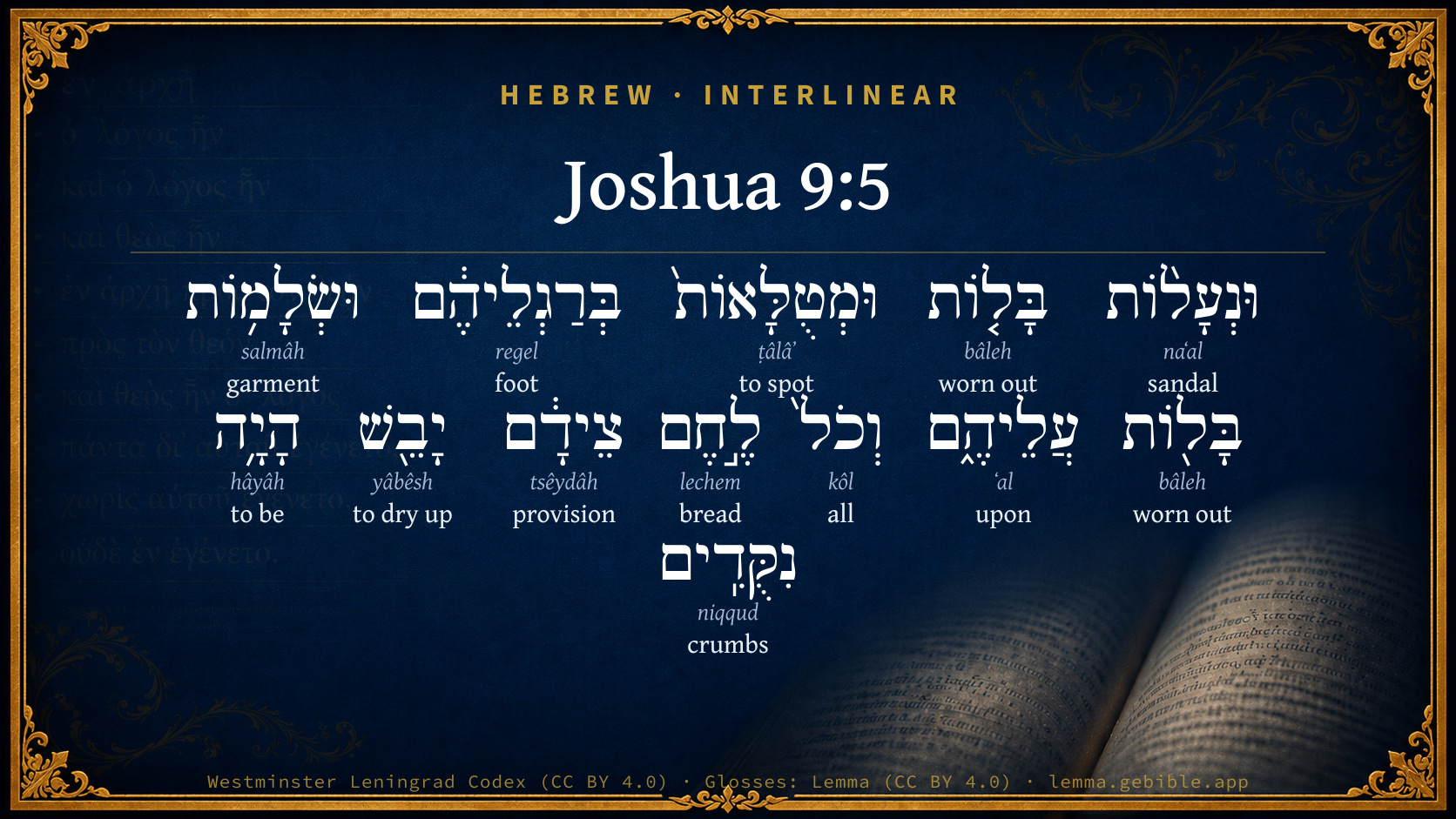
Joshua 9:5

Hebrew (Westminster Leningrad Codex) Joshua 9:5 appears in the Hebrew Old Testament. The text above is from the Westminster Leningrad Codex. Each word links to its Strong’s number, a concise gloss, and parsing drawn from the Open Scriptures Hebrew Bible morphology. Click any word for its full Brown-Driver-Briggs (BDB) entry.
Download image
Cite this verse

Joshua 9:5 (World English Bible). Public Domain. Lemma interlinear Bible study tool, https://lemma.gebible.app/v/joshua/9/5.

Show BibTeX & RIS
BibTeX
RIS
English Translation
and old and patched shoes on their feet, and old garments on them; and all the bread of their provision was dry and was become moldy.
World English Bible · Public Domain
Highlights
  • 1 first appearance in the Hebrew Bible
Full analysis ↓
Download a study sheet

One document with this verse’s original text, its word-by-word gloss line, the meaning frame, cross-references with their text, attributed commentary, and full source and license credits — printable, and it pastes into notes with its structure intact.

This verse Autodidact and up

Study sheet (.html) Plain text (.txt)

A passage Seminary Student

Up to 50 verses in one chapter. A passage sheet keeps up to 6 commentary sources and 12 cross-references per verse, in the order this page ranks them, and says so on the sheet whenever that leaves anything out. Ask for a single verse and you get the Autodidact verse sheet above.

Everything on this page stays free to read, with no account — the sheet is a download of what is already on screen, not access to it.

Want to remove ads? Support Godless Engineer
Compare translations 3

The same verse in 3 English versions, stacked beneath the original-language interlinear above. Click any original word for its lexicon entry.

Each is an independent rendering of the whole verse — the interlinear is not word-aligned to these translations.

Highlighted words mark where these versions differ — a whole-verse word diff, not a word-by-word alignment.

  • World English Bible Public Domain
    and old and patched shoes on their feet, and old garments on them; and all the bread of their provision was dry and was become moldy.
  • King James Version Public Domain
    And old shoes and clouted upon their feet, and old garments upon them; and all the bread of their provision was dry and mouldy.
  • unfoldingWord Literal Text CC BY-SA 4.0
    and worn-out and patched sandals on their feet, and worn-out garments on them, and all of the bread of their provisions was dry, it had become crumbs.

unfoldingWord Literal Text — © unfoldingWord, licensed CC BY-SA 4.0. Word-aligned USFM3 via Door43 (git.door43.org/unfoldingWord/en_ult).

Versions to compare (up to 4)

3 of 4 selected

Show all 18 translations

Every available English version of this verse, each an independent rendering of the whole verse.

  • World English Bible Public Domain
    and old and patched shoes on their feet, and old garments on them; and all the bread of their provision was dry and was become moldy.
  • Berean Standard Bible Public Domain
    They put worn, patched sandals on their feet and threadbare clothing on their bodies, and their whole supply of bread was dry and moldy.
  • Majority Standard Bible Public Domain
    They put worn, patched sandals on their feet and threadbare clothing on their bodies, and their whole supply of bread was dry and moldy.
  • King James Version Public Domain
    And old shoes and clouted upon their feet, and old garments upon them; and all the bread of their provision was dry and mouldy.
  • American Standard Version (1901) Public Domain
    and old and patched shoes upon their feet, and old garments upon them; and all the bread of their provision was dry and was become mouldy.
  • Revised Version (1885) Public Domain
    and old shoes and clouted upon their feet, and old garments upon them; and all the bread of their provision was dry and was become mouldy.
  • Geneva Bible (1599) Public Domain
    And olde shoes and clouted vpon their feete: also the raiment vpon them was old, and all their prouision of bread was dried, and mouled.
  • Douay-Rheims (1899) Public Domain
    And very old shoes, which for a show of age were clouted with patches, and old garments upon them: the leaves also, which they carried for provisions by the way, were hard, and broken into pieces:
  • Young's Literal Translation Public Domain
    and sandals, old and patched, on their feet, and old garments upon them, and all the bread of their provision is dry -- it was crumbs.
  • Literal Standard Version CC BY-SA 4.0
    and sandals, old and patched, on their feet, and old garments on them, and all the bread of their provision is dry—it was crumbs.
  • Unlocked Literal Bible CC BY-SA 4.0
    They put old and patched sandals on their feet, and dressed in old, worn-out clothing. All the bread in their food supply was dry and moldy.
  • unfoldingWord Literal Text CC BY-SA 4.0
    and worn-out and patched sandals on their feet, and worn-out garments on them, and all of the bread of their provisions was dry, it had become crumbs.
  • Darby Bible Public Domain
    and old and patched sandals upon their feet, and old garments upon them; and all the bread of their provision was dry [and] mouldy.
  • World Messianic Bible Public Domain
    and old and patched sandals on their feet, and wore old garments. All the bread of their food supply was dry and moldy.
  • Webster's Bible Public Domain
    And old shoes and patched upon their feet, and old garments upon them; and all the bread of their provision was dry and moldy.
  • Free Bible Version CC BY-SA 4.0
    They put on worn sandals that had been mended and wore old clothes. All their bread was dry and moldy.
  • Bible in Basic English Public Domain
    And put old stitched-up shoes on their feet, and old clothing on their backs; and all the food they had with them was dry and broken up.
  • JPS Tanakh (1917) Public Domain
    and worn shoes and clouted upon their feet, and worn garments upon them; and all the bread of their provision was dry and was become crumbs.

Literal Standard Version (2020), Covenant Press — licensed CC BY-SA 4.0. Text via the HelloAO Bible API (eBible.org). Unlocked Literal Bible (unfoldingWord) — licensed CC BY-SA 4.0. Text via the HelloAO Bible API (eBible.org). unfoldingWord Literal Text — © unfoldingWord, licensed CC BY-SA 4.0. Word-aligned USFM3 via Door43 (git.door43.org/unfoldingWord/en_ult). Free Bible Version, Dr. Jonathan Gallagher — licensed CC BY-SA 4.0. Text via the HelloAO Bible API (eBible.org).

Word by word

More ways to search: Search by grammar → Find every occurrence → Compare this word →

Practice this passage: Drill this verse → Learn its vocabulary →

נִקֻּדִֽים
niqqud
H5350
“crumbs”
Noun, Common, Masculine, Plural, Absolute
Part of Speech
Noun
Type
Common
Gender
Masculine
Number
Plural
State
Absolute
Full BDB Definition

Origin: from the same as H5348

TWOT: 1410b

crumbled thing, thing easily crumbled, crumbs - crumbs - apparently a kind of hard biscuit or cake
  1. וּנְעָל֨וֹת naʻal H5275 “and · sandals” Conjunction + Noun, Common, Feminine, Plural, Absolute
  2. בָּל֤וֹת bâleh H1087 “worn out” Adjective, Adjective, Feminine, Plural, Absolute
  3. וּמְטֻלָּאוֹת֙ ṭâlâʼ H2921 “and · spotted” Conjunction + Verb, Pual, Participle Passive, Feminine, Plural, Absolute
  4. בְּרַגְלֵיהֶ֔ם regel H7272 “in/at · feet · their” Preposition + Noun, Common, Feminine, Dual, Construct + Suffix, Personal, 3rd Person, Masculine, Plural
  5. וּשְׂלָמ֥וֹת salmâh H8008 “and · garments” Conjunction + Noun, Common, Feminine, Plural, Absolute
  6. בָּל֖וֹת bâleh H1087 “worn out” Adjective, Adjective, Feminine, Plural, Absolute
  7. עֲלֵיהֶ֑ם ʻal H5921 “upon · them” Preposition + Suffix, Personal, 3rd Person, Masculine, Plural
  8. וְכֹל֙ kôl H3605 “and · all of” Conjunction + Noun, Common, Masculine, Singular, Construct
  9. לֶ֣חֶם lechem H3899 “bread of” Noun, Common, Both, Singular, Construct
  10. צֵידָ֔ם tsêydâh H6720 “provision · their” Noun, Common, Both, Singular, Construct + Suffix, Personal, 3rd Person, Masculine, Plural
  11. יָבֵ֖שׁ yâbêsh H3001 “to dry up” Verb, Qal, Perfect, 3rd Person, Masculine, Singular
  12. הָיָ֥ה hâyâh H1961 “to be” Verb, Qal, Perfect, 3rd Person, Masculine, Singular

About this verse

These counts appear in no published source. They are computed here, from the morphology-tagged text and Lemma’s own curated glosses. What Lemma adds →

13
words
12
distinct lemmas
Historical
section

Notable vocabulary

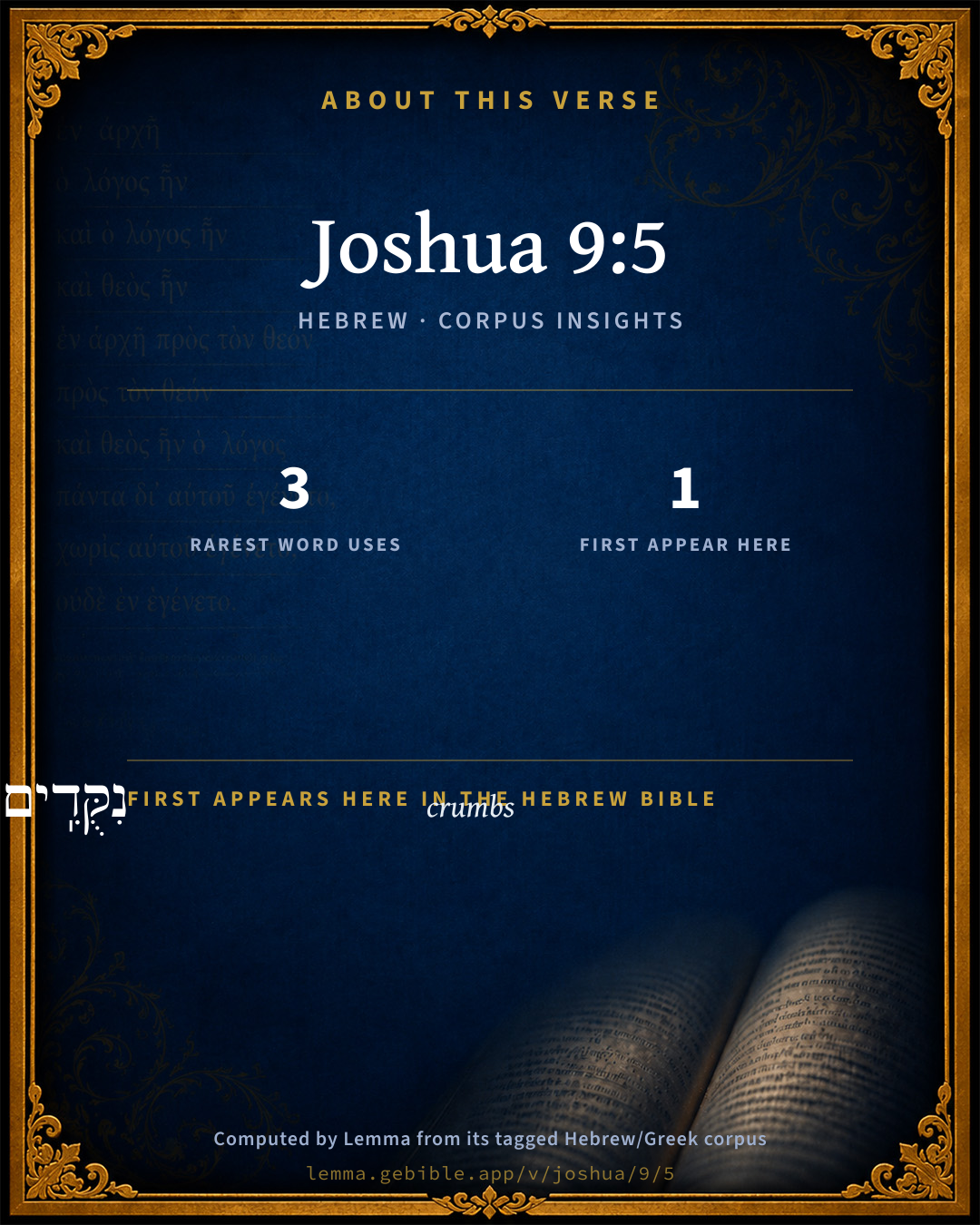
The rarest word here is נִקֻּדִֽים crumbs H5350 — appearing just 3 times in the whole Hebrew Bible.

First appearance in Scripture

This word makes its first canonical appearance in the Hebrew Bible here:

  • נִקֻּדִֽים crumbs H5350

Shared distinctive vocabulary

נִקֻּדִֽים crumbs H5350 occurs in 3 verses of the Hebrew Bible. Also found in:

Grammatical profile

  • 3 verbs
  • 7 nouns
  • 2 adjectives
  • 1 preposition

Verb forms

  • וּמְטֻלָּאוֹת֙ Pual · Participle Passive
  • יָבֵ֖שׁ Qal · Perfect
  • הָיָ֥ה Qal · Perfect

Repetition

A word recurs within this verse — often emphatic in Hebrew:

  • בָּל֤וֹת worn out H1087 ×2

Hebrew & Septuagint length

In English translation the verse runs 26 words from the Hebrew and 33 from the Septuagint (LXX English) — closely comparable.

A rough comparison of the two English renderings, which tokenize alike — not a word-level alignment.

Word counts can differ between the Hebrew and the Greek without any difference in meaning — e.g. the Hebrew direct-object marker אֵת has no separate Greek word, and Greek often adds the article ὁ.

Cross-references

4

Topical passages linked to Joshua 9:5 in the Treasury of Scripture Knowledge — connected by theme and wording, ordered by reader-vote popularity; previews shown in the World English Bible.

  • Luke 15:22 "But the father said to his servants, 'Bring out the best robe, and put it on him. Put a ring on his hand, and shoes on his feet.
  • Deuteronomy 29:5 I have led you forty years in the wilderness: your clothes have not grown old on you, and your shoe has not grown old on your foot.
  • Deuteronomy 33:25 Your bars shall be iron and brass; As your days, so shall your strength be.
  • Joshua 9:13 and these wine-skins, which we filled, were new; and, behold, they are torn: and these our garments and our shoes are become old by reason of the very long journey.

Cross-references courtesy of OpenBible.info (CC BY 4.0).

Hebrew and Greek witnesses Masoretic Hebrew ↔ Greek Septuagint

The same verse in the two great witnesses to the Old Testament, shown verse-for-verse.

These are two independent witnesses, not word-aligned to each other, and the Septuagint is shown in lemma (dictionary) form.

Hebrew Joshua 9:5 Masoretic · Westminster Leningrad Codex

וּנְעָל֨וֹת בָּל֤וֹת וּמְטֻלָּאוֹת֙ בְּרַגְלֵיהֶ֔ם וּשְׂלָמ֥וֹת בָּל֖וֹת עֲלֵיהֶ֑ם וְכֹל֙ לֶ֣חֶם צֵידָ֔ם יָבֵ֖שׁ הָיָ֥ה נִקֻּדִֽים

and old and patched shoes on their feet, and old garments on them; and all the bread of their provision was dry and was become moldy.

World English Bible · Public Domain

Greek LXX Joshua 9:5 Septuagint · lemma form

καί ὁ κοῖλος ὁ ὑπόδημα αὐτός καί ὁ σανδάλιον αὐτός παλαιός καί καταπελματόομαι ἐν ὁ πούς αὐτός καί ὁ ἱμάτιον αὐτός παλαιόω ἐπάνω αὐτός καί ὁ ἄρτος αὐτός ὁ ἐπισιτισμός ξηρός καί εὐρωτία καί βιβρώσκω

and the upper part of their shoes and their sandals old and clouted on their feet, and their garments old upon them—and the bread of their provision was dry and mouldy and corrupt.

LXX2012 (modern English Septuagint) · Public Domain

On this verse, Whedon's Commentary on the Bible discusses the Septuagint’s reading. Read the note in Commentary ↓

Hebrew: Westminster Leningrad Codex (CC BY 4.0). Greek: Septuagint (public domain); English from LXX2012 (modern English Septuagint) (Public Domain). How the Septuagint differs from the Hebrew →

Targum (Aramaic paraphrase)

1

The Targum is the ancient Jewish Aramaic paraphrase of the Hebrew Scriptures — an interpretive translation, not the Hebrew text itself. Onkelos (literal) and Pseudo-Jonathan (expansive) render the Torah, and Jonathan the Prophets. Coverage is partial: where no permissively-licensed English translation exists for a verse, only the Aramaic is shown. This is verse-level text, not a word-by-word alignment to the Hebrew.

  1. Targum Jonathan Prophets (Joshua–Malachi)
    וּמְסָנָן בָּלָן וּמְרַקְעִין בְּרִגְלֵיהוֹן וּכְסוּתָא בָלְיָא עֲלֵיהוֹן וְכָל לְחַם זְוָדֵיהוֹן יָבֵשׁ הֲוָה כִסְנִין:

    (no public-domain English translation for this verse)

    Targum Jonathan — Aramaic: “Mikraot Gedolot” (public domain). English: “Sefaria Community Translation” (CC0 1.0 (public-domain dedication)); “London "Chaldee Paraphrase," 1871” (public domain). Text via Sefaria.

Commentary

Notes on Joshua 9:5 from classic Christian and Jewish commentators (each source and its license shown beneath its notes). The classic Christian expositions comment on the surrounding passage and are grouped to its opening verse, so a note may address several verses; the Jewish commentaries on the Tanakh (Rashi and others) are per-verse, so they appear only where the commentator wrote on this verse.

Lemma curates 59 commentaries, every one of them public domain or Creative Commons licensed, each selected and text-cleaned for this edition rather than reprinted as found. About our sources →

Trapp's Complete Commentary

John Trapp

Jos 9:5 And old shoes and clouted upon their feet, and old garments upon them; and all the bread of their provision was dry [and] mouldy.

Ver. 5. And old shoes and clouted.] Papists, boasting so much of antiquity, are by one not unfitly compared to these Gibeonites with their old shoes and mouldy bread. Antiquity disjoined from verity is but filthy hoariness, and deserveth no more reverence than an old fornicator, who is so much the more odious because old. It is here at best, as in books, some of which are odorandae rubiginis, of greater antiquity than authority. Those were old things spoken of in 1Ch 4:22, but no whit the better for that.

John Trapp, A Commentary or Exposition upon All the Books of the Old and New Testament (1647–1656) — public domain. Text from a community e-Sword module.

Jamieson, Fausset & Brown

Robert Jamieson, A. R. Fausset & David Brown

old shoes and clouted--Those who have but one ass or mule for themselves and baggage frequently dismount and walk--a circumstance which may account for the worn shoes of the pretended travellers.

bread . . . dry and mouldy--This must have been that commonly used by travellers--a sort of biscuit made in the form of large rings, about an inch thick, and four or five inches in diameter. Not being so well baked as our biscuits, it becomes hard and mouldy from the moisture left in the dough. It is usually soaked in water previous to being used.

Jamieson, Fausset & Brown — Commentary Critical and Explanatory on the Whole Bible (1871) — public domain (CC PDM 1.0). Text via the HelloAO Bible API.

Adam Clarke's Commentary

Verse 5. Old shoes and clouted] Their sandals, they pretended had been worn out by long and difficult travelling, and they had been obliged to have them frequently patched during the way; their garments also were worn thin; and what remained of their bread was mouldy-spotted with age, or, as our old version has it, bored-pierced with many holes by the vermin which had bred in it, through the length of the time it had been in their sacks; and this is the most literal meaning of the original נקדים nikkudim, which means spotted or pierced with many holes.

The old and clouted shoes have been a subject of some controversy: the Hebrew word בלות baloth signifies worn out, from בלה balah, to wear away; and מטלאות metullaoth, from טלא tala, to spot or patch, i.e., spotted with patches. Our word clouted, in the Anglo-Saxon [A.S.] signifies seamed up, patched; from [A.S.] clout, rag, or small piece of cloth, used for piecing or patching. But some suppose the word here comes from clouet, the diminutive of clou, a small nail, with which the Gibeonites had fortified the soles of their shoes, to prevent them from wearing out in so long a journey; but this seems very unlikely; and our old English term clouted-seamed or patched - expresses the spirit of the Hebrew word.

Adam Clarke's Commentary on the Bible (1810–1826) — public domain. Text from a community e-Sword/MySword module.

Ellicott's Commentary for English Readers

(5) Clouted—i.e., patched.

A Bible Commentary for English Readers, edited by Charles John Ellicott (1878–1897) — public domain. Text from a community e-Sword module.

The Cambridge Bible for Schools and Colleges

gen. ed. J. J. S. Perowne

5. old shoes] “and ful olde shoon,” Wyclif, i.e. sandals, made of (1) hide, or (2) palm-leaves and papyrus stalks. Comp. Mar_6:9.

clouted] i.e. patched, “sowid with patchis,” Wyclif; from clout, A. S. cleot, clút, “a patch,” properly a swelling from a blow, connected with Du. klotsen, to strike, as “botch” with Du. botsen. Comp. Jer_38:11-12, “So Ebed-melech took … thence old cast clouts, and old rotten rags … and said unto Jeremiah, Put now these old cast clouts and rotten rags under thine armholes under the cords.” Shakespeare, II. Henry VI., iv:2,

“Spare none, but such as go in clouted shoon;”

and Latimer, Serm. p. 110, “Paul, yea and Peter too, had more skill in mending an old net, and in clouting an old tent, than to teach lawyers what diligence they should use in the expedition of matters.” Sandals were seldom mended, being of so little value, that they could easily be renewed when the worse for wear. “We have seen a man make himself a new pair out of a piece of skin in a few minutes. The mere fact, that articles so easily renewed, were patched in this instance, was well calculated to suggest the idea of a long journey, in which the convenience of purchasing new ones, or materials for making them, had not been found, for which reason they had been obliged to make their old ones serve by patching. It was a singular thing to see sandals clouted at all, and only a journey would explain the fact.” Kitto’s Bible Illustrations, 11. p. 288.

old garments] It behoved ambassadors to appear in clean and decent, if not in splendid, raiment. This was so essential, that the appearance of these Gibeonites with old and travel-stained clothes could only be explained, upon any common principle, by the assigned reason, that they had come direct from a long journey.

dry and mouldy] “Harde and brokun into gobetis,” Wyclif. The Hebrew word translated “mouldy” is the same which is rendered by “cracknels” in 1Ki_14:3. This word (nikuddim) denotes a kind of crisp cake. The ordinary bread, baked in thin cakes, is not made to keep more than a day or two, a fresh supply being baked daily. If kept longer it dries up, and becomes at last excessively hard. It was this kind of bread that the Gibeonites produced, and they indicated its hardness—hard as biscuits—in evidence of the length of the journey they had taken. Kitto’s Bible Illustrations, 11. p. 289.

The Cambridge Bible for Schools and Colleges (gen. ed. J. J. S. Perowne; Cambridge University Press, 1878–1918) — public domain. Text from a community e-Sword module.

John Gill's Exposition

And old shoes and clouted upon their feet,.... Which being worn out, were patched with various pieces of leather:

and old garments upon them; full of holes and rents, ragged and patched:

and the bread of their provision was dry and mouldy; having been kept a long time, and unfit for use; or like cakes over baked and burnt, as the Targum and Jarchi: the word for "mouldy" signifies pricked, pointed, spotted, as mouldy bread has in it spots of different colours, as white, red, green, and black, as Kimchi and Ben Melech interpret it; or it signifies bread so dry, as Ben Gersom notes, that it crumbles into pieces easily, with which the Vulgate Latin version agrees; or rather through being long kept, it was become dry and hard like crusts, so Noldius (i); or very hard, like bread twice baked, as Castell (k).

(i) P. 379. No. 1218. (k) Lex. col. 2395.

John Gill's Exposition of the Whole Bible (1746–1763) — public domain (CC PDM 1.0). Text via the HelloAO Bible API.

Haydock's Catholic Bible Commentary

Patches. Hebrew, "spotted," or of different colours, like shoes worn out and spoiled with dirt. --- Pieces. Hebrew, is translated, "dry, burnt, eaten, mouldy," &c. But it means fine thin bread, or wafers, (3 Kings xiv. 3,) full of holes. The Israelites partook of this bread, which they would hardly have done if it had been mouldy. (Calmet)

George Leo Haydock (1774–1849), Haydock's Catholic Family Bible and Commentary, 1859 edition — public domain. Excludes Psalms (Douay-Rheims chapter numbering differs from Protestant) and Deuterocanonical books (Catholic canon only).

Whedon's Commentary on the Bible

Daniel D. Whedon

5. Old shoes and clouted — Or, as the Hebrew, shoes fallen into pieces, and botched or cobbled. In long journeys the traveller walks up the hills that he may spare the heavily laden beast. These shoes in tatters and patches indicate many a walk, and hence a long journey. [The somewhat antiquated English word clouted, from the Anglo-Saxon clut, a little cloth or patch, accurately expresses the sense of the Hebrew שׂלא, to patch, to mend. It may be used of patching with cloth, leather, or other material.]

Old garments upon them — That is, upon themselves, and not upon their feet.

Dry and mouldy — The Vulgate says, instead of mouldy, broken up into crumbs, and this seems to be the true rendering. The Septuagint adds offensive to the smell. Ancient inns or caravanserais provided the sojourner with lodging only; hence he must carry his food. See note on Jos_2:1.

Daniel D. Whedon (gen. ed.), Commentary on the Old and New Testaments (1874–1909) — public domain. Text from a community e-Sword module.

The Pulpit Commentary

Shoes. Literally, things tied on; i.e., sandals, attached with straps to the sole of the foot. Clouted, i.e., patched. The intensive Pual suggests that they were very much patched. The participle Kal is translated "spotted" in Gen_30:32, Gen_30:33, Gen_30:35. Mouldy. literally, marked with points, i.e., mildewed, Provision "Proprie vendtionem" (Vatablus). "Panis enim mucidus punctis respersus est albis viridibus et nigris" (Rabbi David, in libro Radicum). So the LXX, Theodotion, and Luther. This gives a better sense and more according to the derivation than the interpretation crumbs of bread, given by Gesenius and Keil, after Aquila, Symmachus, and the Vulgate, which has in fustra comminuti. The cracknels (the same word in Hebrew as here) in 1Ki_14:3 were probably biscuits marked with points by a sharp pointed instrument, in the same way as the Jewish passover cakes are at the present day.

The Pulpit Commentary (1880–1919), ed. H.D.M. Spence-Jones & Joseph S. Exell — public domain. Text from a community e-Sword module.

Rashi

Rabbi Shlomo Yitzchaki (Rashi)

Moldy. “Arson” in old French is an expression of מוֹקֵד, fire or heat. Targum Yonasan also translates נִקֻדִים as כִּסְנִין.

Rashi on the Tanakh — English translations: “The Judaica Press complete Tanach with Rashi, translated by A. J. Rosenberg” (CC BY 4.0); “Pentateuch with Rashi's commentary by M. Rosenbaum and A.M. Silbermann, 1929-1934” (public domain); “The Metsudah Tanach series, Lakewood, N.J” (CC BY 4.0); and “The Book of Joshua, Metsudah Publications, 1997” (CC BY 4.0). Text via Sefaria.

Lesson kit

Teaching starters — assembled from the data on this page, not authored interpretation. Every prompt links to the verse data it draws on. Edit before teaching.

Joshua, in the Historical, opens this verse with 13 words (12 distinct Hebrew lemmas). Its most distinctive word is niqqud (“crumbs”). A historical commentator’s framing appears above. Read the whole chapter for the surrounding context.

Discussion questions

  1. What does “crumbs” (niqqud) contribute to the verse as a whole?
  2. The word “crumbs” first appears here in Scripture. What is being introduced at this debut?
  3. Joshua 9:12 shares the word «crumbs» with this verse. How do the two illuminate each other?
  4. “worn out” occurs 2× in this one verse. What is the effect of the repetition?
  5. These translations render this verse differently; the difference is in the English rendering, not the original. What questions does that raise?
  6. The verb «וּמְטֻלָּאוֹת֙» is Pual Participle Passive. How does its form color the action?
  7. Reading how Trapp's Complete Commentary and Jamieson, Fausset & Brown read this verse, where do the two commentators agree and where do they part?

Things to notice

  • 1 word makes its first canonical appearance in Scripture here.
  • These translations choose different wording for 14 words in this verse.
  • “worn out” occurs 2× in this single verse.
  • 12 distinct Hebrew lemmas span 13 words in this verse.

Reading settings

Reading text

Shown beneath each verse's original-language words.

Old Testament
Old Testament edition

Read the OT as the Masoretic Hebrew (MT) or the Greek Septuagint (LXX).

English shown for the Greek Septuagint (in the Hebrew ↔ Greek comparison).

Comparing translations? Open the Compare panel on any verse page to stack up to four side by side.