
2 Samuel 16:2

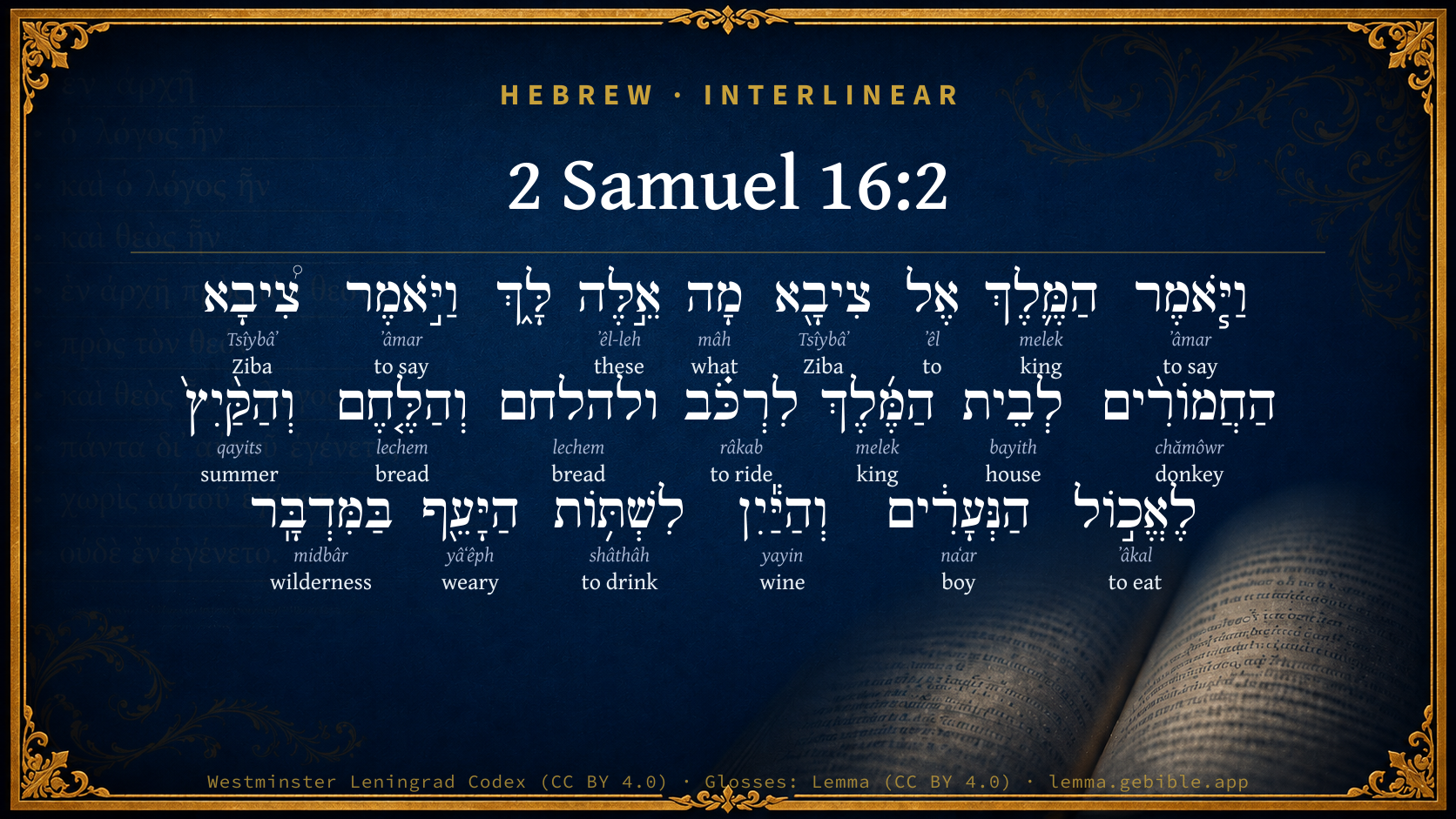
Hebrew (Westminster Leningrad Codex) 2 Samuel 16:2 appears in the Hebrew Old Testament. The text above is from the Westminster Leningrad Codex. Each word links to its Strong’s number, a concise gloss, and parsing drawn from the Open Scriptures Hebrew Bible morphology. Click any word for its full Brown-Driver-Briggs (BDB) entry.
Download image
Cite this verse

2 Samuel 16:2 (World English Bible). Public Domain. Lemma interlinear Bible study tool, https://lemma.gebible.app/v/2-samuel/16/2.

Show BibTeX & RIS
BibTeX
RIS
English Translation
The king said to Ziba, What do you mean by these? Ziba said, The donkeys are for the king's household to ride on; and the bread and summer fruit for the young men to eat; and the wine, that such as are faint in the wilderness may drink.
World English Bible · Public Domain
Highlights
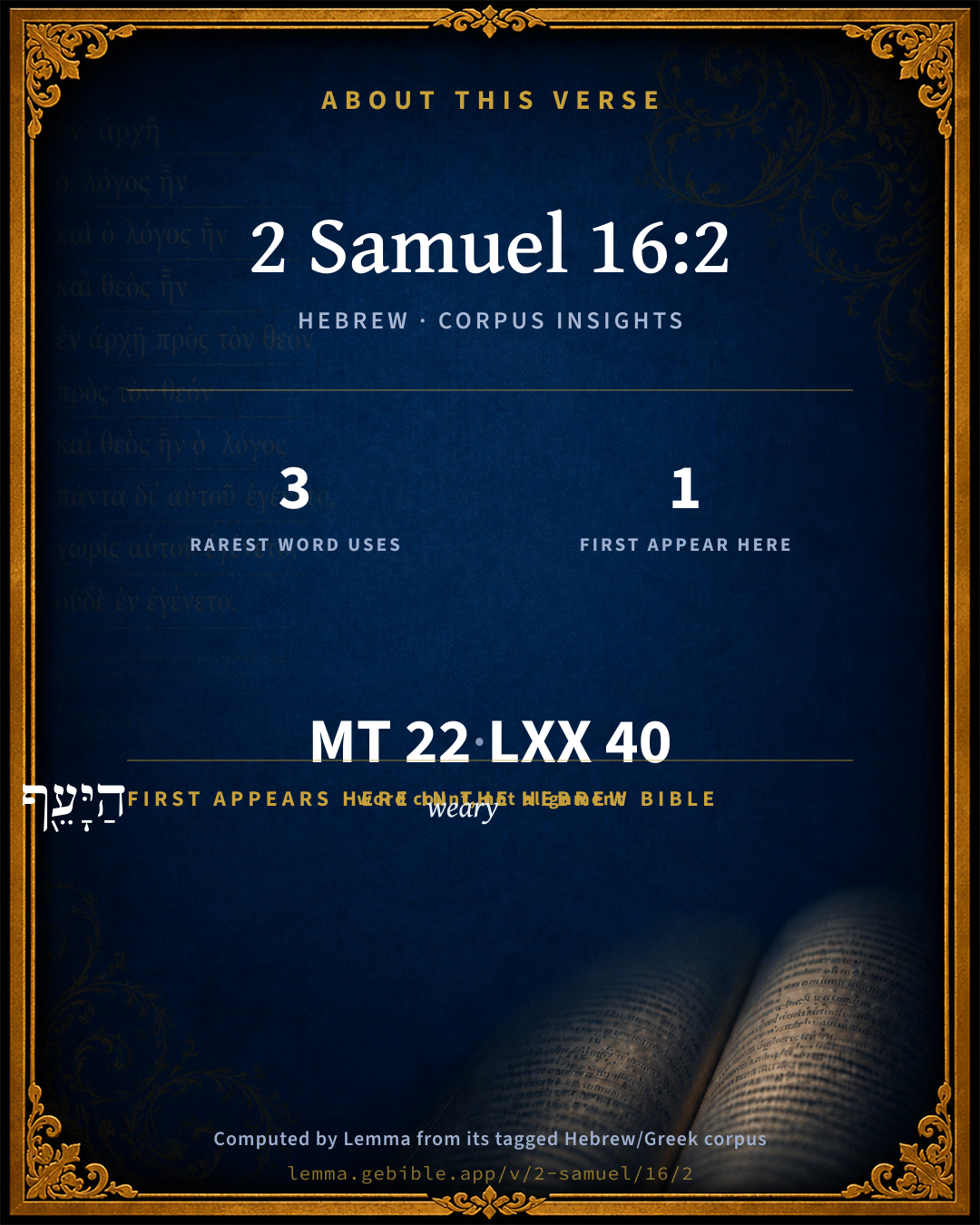
  • 1 first appearance in the Hebrew Bible
Full analysis ↓
Download a study sheet

One document with this verse’s original text, its word-by-word gloss line, the meaning frame, cross-references with their text, attributed commentary, and full source and license credits — printable, and it pastes into notes with its structure intact.

This verse Autodidact and up

Study sheet (.html) Plain text (.txt)

A passage Seminary Student

Up to 50 verses in one chapter. A passage sheet keeps up to 6 commentary sources and 12 cross-references per verse, in the order this page ranks them, and says so on the sheet whenever that leaves anything out. Ask for a single verse and you get the Autodidact verse sheet above.

Everything on this page stays free to read, with no account — the sheet is a download of what is already on screen, not access to it.

Want to remove ads? Support Godless Engineer
Compare translations 3

The same verse in 3 English versions, stacked beneath the original-language interlinear above. Click any original word for its lexicon entry.

Each is an independent rendering of the whole verse — the interlinear is not word-aligned to these translations.

Highlighted words mark where these versions differ — a whole-verse word diff, not a word-by-word alignment.

  • World English Bible Public Domain
    The king said to Ziba, What do you mean by these? Ziba said, The donkeys are for the king's household to ride on; and the bread and summer fruit for the young men to eat; and the wine, that such as are faint in the wilderness may drink.
  • King James Version Public Domain
    And the king said unto Ziba, What meanest thou by these? And Ziba said, The asses be for the king's household to ride on; and the bread and summer fruit for the young men to eat; and the wine, that such as be faint in the wilderness may drink.
  • unfoldingWord Literal Text CC BY-SA 4.0
    And the king said to Ziba, “What these to you?” And Ziba said, “The donkeys for the house of the king to ride, and the bread and the summer fruit the young men to eat, and the wine the faint in the wilderness to drink.”

unfoldingWord Literal Text — © unfoldingWord, licensed CC BY-SA 4.0. Word-aligned USFM3 via Door43 (git.door43.org/unfoldingWord/en_ult).

Versions to compare (up to 4)

3 of 4 selected

Show all 18 translations

Every available English version of this verse, each an independent rendering of the whole verse.

  • World English Bible Public Domain
    The king said to Ziba, What do you mean by these? Ziba said, The donkeys are for the king's household to ride on; and the bread and summer fruit for the young men to eat; and the wine, that such as are faint in the wilderness may drink.
  • Berean Standard Bible Public Domain
    “Why do you have these?” asked the king. Ziba replied, “The donkeys are for the king’s household to ride, the bread and summer fruit are for the young men to eat, and the wine is to refresh those who become exhausted in the wilderness.”
  • Majority Standard Bible Public Domain
    “Why do you have these?” asked the king. Ziba replied, “The donkeys are for the king’s household to ride, the bread and summer fruit are for the young men to eat, and the wine is to refresh those who become exhausted in the wilderness.”
  • King James Version Public Domain
    And the king said unto Ziba, What meanest thou by these? And Ziba said, The asses be for the king's household to ride on; and the bread and summer fruit for the young men to eat; and the wine, that such as be faint in the wilderness may drink.
  • American Standard Version (1901) Public Domain
    And the king said unto Ziba, What meanest thou by these? And Ziba said, The asses are for the king's household to ride on; and the bread and summer fruit for the young men to eat; and the wine, that such as are faint in the wilderness may drink.
  • Revised Version (1885) Public Domain
    And the king said unto Ziba, What meanest thou by these? And Ziba said, The asses be for the king’s household to ride on; and the bread and summer fruit for the young men to eat; and the wine, that such as be faint in the wilderness may drink.
  • Geneva Bible (1599) Public Domain
    And the King said vnto Ziba, What meanest thou by these? And Ziba said, They be asses for the kings housholde to ride on, and bread and dryed figges for the yong men to eate, and wine, that the faint may drinke in the wildernesse.
  • Douay-Rheims (1899) Public Domain
    And the king said to Siba: What mean these things? And Siba answered: The asses are for the king's household to sit on: and the loaves and the figs for thy servants to eat, and the wine to drink if any man be faint in the desert.
  • Young's Literal Translation Public Domain
    And the king saith unto Ziba, `What -- these to thee?' and Ziba saith, `The asses for the household of the king to ride on, and the bread and the summer-fruit for the young men to eat, and the wine for the wearied to drink in the wilderness.'
  • Literal Standard Version CC BY-SA 4.0
    And the king says to Ziba, “What [are] these to you?” And Ziba says, “The donkeys for the household of the king to ride on, and the bread and the summer-fruit for the young men to eat, and the wine for the wearied to drink in the wilderness.”
  • Unlocked Literal Bible CC BY-SA 4.0
    The king said to Ziba, “Why did you bring these things?” Ziba replied, “The donkeys are for the king's household to ride on, the bread and fig cakes are for your men to eat, and the wine is for anyone who is faint in the wilderness to drink.”
  • unfoldingWord Literal Text CC BY-SA 4.0
    And the king said to Ziba, “What these to you?” And Ziba said, “The donkeys for the house of the king to ride, and the bread and the summer fruit the young men to eat, and the wine the faint in the wilderness to drink.”
  • Darby Bible Public Domain
    And the king said to Ziba, What meanest thou by these? And Ziba said, The asses are for the king's household to ride on; and the bread and summer fruits for the young men to eat; and the wine, that such as are faint in the wilderness may drink.
  • World Messianic Bible Public Domain
    The king said to Ziba, “What do you mean by these?” Ziba said, “The donkeys are for the king’s household to ride on; and the bread and summer fruit for the young men to eat; and the wine, that those who are faint in the wilderness may drink.”
  • Webster's Bible Public Domain
    And the king said to Ziba, What meanest thou by these? And Ziba said, The asses are for the king's household to ride on; and the bread and summer fruit for the young men to eat; and the wine, that such as are faint in the wilderness may drink.
  • Free Bible Version CC BY-SA 4.0
    “What did you bring these for?” David asked Ziba. Ziba replied, “The donkeys are for the king's family to ride on, the bread and summer fruit are for the men to eat, and the wine is for those to drink who get worn out in the wilderness.”
  • Bible in Basic English Public Domain
    And David said to Ziba, What is your reason for this? And Ziba said, The asses are for the use of the king's people, and the bread and the fruit are food for the young men; and the wine is for drink for those who are overcome by weariness in the waste land.
  • JPS Tanakh (1917) Public Domain
    And the king said unto Ziba: 'What meanest thou by these?' And Ziba said: 'The asses are for the king's household to ride on; and the bread and summer fruit for the young men to eat; and the wine, that such as are faint in the wilderness may drink.'

Literal Standard Version (2020), Covenant Press — licensed CC BY-SA 4.0. Text via the HelloAO Bible API (eBible.org). Unlocked Literal Bible (unfoldingWord) — licensed CC BY-SA 4.0. Text via the HelloAO Bible API (eBible.org). unfoldingWord Literal Text — © unfoldingWord, licensed CC BY-SA 4.0. Word-aligned USFM3 via Door43 (git.door43.org/unfoldingWord/en_ult). Free Bible Version, Dr. Jonathan Gallagher — licensed CC BY-SA 4.0. Text via the HelloAO Bible API (eBible.org).

Word by word

More ways to search: Search by grammar → Find every occurrence → Compare this word →

Practice this passage: Drill this verse → Learn its vocabulary →

הַיָּעֵ֖ף
yâʻêph
H3287
“the · weary”
Particle, Definite Article + Adjective, Adjective, Masculine, Singular, Absolute
Part of Speech
Particle + Adjective
Type
Adjective
Gender
Masculine
Number
Singular
State
Absolute
Full BDB Definition

Origin: from H3286

TWOT: 885a

faint, weary, fatigued
  1. וַיֹּ֧אמֶר ʼâmar H559 “and · to say” Conjunction + Verb, Qal, Sequential Imperfect, 3rd Person, Masculine, Singular
  2. הַמֶּ֛לֶךְ melek H4428 “the · king” Particle, Definite Article + Noun, Common, Masculine, Singular, Absolute
  3. אֶל ʼêl H413 “to” Preposition
  4. צִיבָ֖א Tsîybâʼ H6717 “Ziba” Noun, Proper
  5. מָה mâh H4100 “what” Particle, Interrogative
  6. אֵ֣לֶּה ʼêl-leh H428 “these” Pronoun, Demonstrative, Common, Plural
  7. וַיֹּ֣אמֶר ʼâmar H559 “and · to say” Conjunction + Verb, Qal, Sequential Imperfect, 3rd Person, Masculine, Singular
  8. צִ֠יבָא Tsîybâʼ H6717 “Ziba” Noun, Proper
  9. הַחֲמוֹרִ֨ים chămôwr H2543 “the · donkeys” Particle, Definite Article + Noun, Common, Both, Plural, Absolute
  10. לְבֵית bayith H1004 “to/for · house of” Preposition + Noun, Common, Masculine, Singular, Construct
  11. הַמֶּ֜לֶךְ melek H4428 “the · king” Particle, Definite Article + Noun, Common, Masculine, Singular, Absolute
  12. לִרְכֹּ֗ב râkab H7392 “to ride” Preposition + Verb, Qal, Infinitive Construct
  13. ולהלחם lechem H3899 “and · to/for · the · bread” Conjunction + Preposition + Particle, Definite Article + Noun, Common, Both, Singular, Absolute
  14. וְהַלֶּ֤חֶם lechem H3899 “and · the · bread” Conjunction + Particle, Definite Article + Noun, Common, Both, Singular, Absolute
  15. וְהַקַּ֨יִץ֙ qayits H7019 “and · the · summer” Conjunction + Particle, Definite Article + Noun, Common, Masculine, Singular, Absolute
  16. לֶאֱכ֣וֹל ʼâkal H398 “to eat” Preposition + Verb, Qal, Infinitive Construct
  17. הַנְּעָרִ֔ים naʻar H5288 “the · boys” Particle, Definite Article + Noun, Common, Masculine, Plural, Absolute
  18. וְהַיַּ֕יִן yayin H3196 “and · the · wine” Conjunction + Particle, Definite Article + Noun, Common, Masculine, Singular, Absolute
  19. לִשְׁתּ֥וֹת shâthâh H8354 “to drink” Preposition + Verb, Qal, Infinitive Construct
  20. בַּמִּדְבָּֽר midbâr H4057 “in/at the · wilderness” Preposition, Determined + Noun, Common, Masculine, Singular, Absolute

About this verse

These counts appear in no published source. They are computed here, from the morphology-tagged text and Lemma’s own curated glosses. What Lemma adds →

22
words
17
distinct lemmas
Historical
section

Notable vocabulary

The rarest word here is הַיָּעֵ֖ף weary H3287 — appearing just 3 times in the whole Hebrew Bible.

First appearance in Scripture

This word makes its first canonical appearance in the Hebrew Bible here:

  • הַיָּעֵ֖ף weary H3287

Shared distinctive vocabulary

הַיָּעֵ֖ף weary H3287 occurs in 3 verses of the Hebrew Bible. Also found in:

Grammatical profile

  • 5 verbs
  • 12 nouns
  • 1 adjective
  • 1 pronoun
  • 2 prepositions
  • 1 particle

Verb forms

  • וַיֹּ֧אמֶר Qal · Sequential Imperfect
  • וַיֹּ֣אמֶר Qal · Sequential Imperfect
  • לִרְכֹּ֗ב Qal · Infinitive Construct
  • לֶאֱכ֣וֹל Qal · Infinitive Construct
  • לִשְׁתּ֥וֹת Qal · Infinitive Construct

Repetition

Words recur within this verse — often emphatic in Hebrew:

  • וַיֹּ֧אמֶר to say H559 ×2
  • הַמֶּ֛לֶךְ king H4428 ×2
  • צִיבָ֖א Ziba H6717 ×2
  • ולהלחם bread H3899 ×2

Hebrew & Septuagint length

In English translation the verse runs 48 words from the Hebrew and 53 from the Septuagint (LXX English) — closely comparable.

A rough comparison of the two English renderings, which tokenize alike — not a word-level alignment.

Word counts can differ between the Hebrew and the Greek without any difference in meaning — e.g. the Hebrew direct-object marker אֵת has no separate Greek word, and Greek often adds the article ὁ.

In the original languages it is 22 Hebrew tokens and 40 Greek tokens — but the two are counted differently (Hebrew bundles its prefixes and suffixes into one token; the Greek is in lemma form), so that isn’t a like-for-like length.

Cross-references

13

Topical passages linked to 2 Samuel 16:2 in the Treasury of Scripture Knowledge — connected by theme and wording, ordered by reader-vote popularity; previews shown in the World English Bible.

  • 2 Samuel 17:29 and honey, and butter, and sheep, and cheese of the herd, for David, and for the people who were with him, to eat: for they said, The people are hungry, and weary, and thirsty, in the wilderness.
  • Judges 10:4 He had thirty sons who rode on thirty donkey colts, and they had thirty cities, which are called Havvoth Jair to this day, which are in the land of Gilead.
  • Judges 5:10 Tell [of it], you who ride on white donkeys, You who sit on rich carpets, You who walk by the way.
  • Genesis 21:29 Abimelech said to Abraham, "What do these seven ewe lambs which you have set by themselves mean?"
  • Genesis 33:8 Esau said, "What do you mean by all this company which I met?" Jacob said, "To find favor in the sight of my lord."
  • Judges 8:4–5 Gideon came to the Jordan, [and] passed over, he, and the three hundred men who were with him, faint, yet pursuing.
  • 1 Samuel 14:28 Then answered one of the people, and said, Your father directly charged the people with an oath, saying, Cursed be the man who eats food this day. The people were faint.
  • 1 Samuel 25:27 Now this present which your servant has brought to my lord, let it be given to the young men who follow my lord.
  • 2 Samuel 15:1 It happened after this, that Absalom prepared him a chariot and horses, and fifty men to run before him.
  • 2 Samuel 15:23 All the country wept with a loud voice, and all the people passed over: the king also himself passed over the brook Kidron, and all the people passed over, toward the way of the wilderness.
  • 2 Samuel 19:26 He answered, My lord, O king, my servant deceived me: for your servant said, I will saddle me a donkey, that I may ride thereon, and go with the king; because your servant is lame.
  • Proverbs 31:6–7 Give strong drink to him who is ready to perish; And wine to the bitter in soul:
  • Ezekiel 37:18 When the children of your people shall speak to you, saying, Will you not show us what you mean by these?

Cross-references courtesy of OpenBible.info (CC BY 4.0).

Hebrew and Greek witnesses Masoretic Hebrew ↔ Greek Septuagint

The same verse in the two great witnesses to the Old Testament, shown verse-for-verse.

These are two independent witnesses, not word-aligned to each other, and the Septuagint is shown in lemma (dictionary) form.

Hebrew 2 Samuel 16:2 Masoretic · Westminster Leningrad Codex

וַיֹּ֧אמֶר הַמֶּ֛לֶךְ אֶל צִיבָ֖א מָה אֵ֣לֶּה לָּ֑ךְ וַיֹּ֣אמֶר צִ֠יבָא הַחֲמוֹרִ֨ים לְבֵית הַמֶּ֜לֶךְ לִרְכֹּ֗ב ולהלחם וְהַלֶּ֤חֶם וְהַקַּ֨יִץ֙ לֶאֱכ֣וֹל הַנְּעָרִ֔ים וְהַיַּ֕יִן לִשְׁתּ֥וֹת הַיָּעֵ֖ף בַּמִּדְבָּֽר

The king said to Ziba, What do you mean by these? Ziba said, The donkeys are for the king's household to ride on; and the bread and summer fruit for the young men to eat; and the wine, that such as are faint in the wilderness may drink.

World English Bible · Public Domain

Greek LXX 2 Samuel 16:2 Septuagint · lemma form

καί εἶπον ὁ βασιλεύς πρός σιβα τίς οὗτος σύ καί εἶπον σιβα ὁ ὑποζύγιον ὁ οἰκία ὁ βασιλεύς ὁ ἐπι καταἧμαι καί ὁ ἄρτος καί ὁ φοῖνιξ εἰς βρῶσις ὁ παιδάριον καί ὁ οἶνος πίνω ὁ ἐκλύω ἐν ὁ ἐρῆμος

And the king said to Siba, What meanest you by these? and Siba, said, The asses are for the household of the king to sit upon, and the loaves and the dates are for the young men to eat, and the wine is for them that are faint in the wilderness to drink.

LXX2012 (modern English Septuagint) · Public Domain

On this verse, Haydock's Catholic Bible Commentary discusses the Septuagint’s reading. Read the note in Commentary ↓

Hebrew: Westminster Leningrad Codex (CC BY 4.0). Greek: Septuagint (public domain); English from LXX2012 (modern English Septuagint) (Public Domain). How the Septuagint differs from the Hebrew →

Targum (Aramaic paraphrase)

1

The Targum is the ancient Jewish Aramaic paraphrase of the Hebrew Scriptures — an interpretive translation, not the Hebrew text itself. Onkelos (literal) and Pseudo-Jonathan (expansive) render the Torah, and Jonathan the Prophets. Coverage is partial: where no permissively-licensed English translation exists for a verse, only the Aramaic is shown. This is verse-level text, not a word-by-word alignment to the Hebrew.

  1. Targum Jonathan Prophets (Joshua–Malachi)
    וַאֲמַר מַלְכָּא לְצִיבָא מָה אִילֵין לָךְ וַאֲמַר צִיבָא חֲמָרַיָא לְבֵית מַלְכָּא לְמִרְכַּב וְלַחְמָא וּדְבֵילָתָא לְמֵיכַל עוּלֵימַיָא וְחַמְרָא לְמִשְׁתֵּי דִמְשִׁלְהֵי בְּמַדְבְּרָא:

    (no public-domain English translation for this verse)

    Targum Jonathan — Aramaic: “Mikraot Gedolot” (public domain). English: “Sefaria Community Translation” (CC0 1.0 (public-domain dedication)); “London "Chaldee Paraphrase," 1871” (public domain). Text via Sefaria.

Commentary

Notes on 2 Samuel 16:2 from classic Christian and Jewish commentators (each source and its license shown beneath its notes). The classic Christian expositions comment on the surrounding passage and are grouped to its opening verse, so a note may address several verses; the Jewish commentaries on the Tanakh (Rashi and others) are per-verse, so they appear only where the commentator wrote on this verse.

Lemma curates 59 commentaries, every one of them public domain or Creative Commons licensed, each selected and text-cleaned for this edition rather than reprinted as found. About our sources →

Trapp's Complete Commentary

John Trapp

2Sa 16:2 And the king said unto Ziba, What meanest thou by these? And Ziba said, The asses [be] for the king’s household to ride on; and the bread and summer fruit for the young men to eat; and the wine, that such as be faint in the wilderness may drink.

Ver. 2. What meanest thou by these?] Is it thy master’s doing, or thine own?

For the young men to eat.] A modesty not unlike that of Abigail, to see to, {1Sa 25:27} only that was real, this in semblance.

John Trapp, A Commentary or Exposition upon All the Books of the Old and New Testament (1647–1656) — public domain. Text from a community e-Sword module.

Joseph Benson's Commentary

2Sa 16:2. The asses be for the king’s household to ride on — Or, rather, some of his household, for they could not all ride on two asses, unless by turns, relieving each other, which perhaps Ziba intended; for he seems to have been very considerate in adapting his present to the wants of David and those that were with him. It appears, the king, and his wives and children, were all on foot: not because he had not, or could not procure, asses for them at Jerusalem; but because he chose they should go in this manner, as best becoming that state of penitence and humiliation in which they were.

Joseph Benson's Commentary on the Old and New Testaments (1811–1818) — public domain. Text from a community e-Sword module.

Geneva Bible (1599)

Geneva Bible translators

Commonly there are no viler traitors than they, which under pretence of friendship accuse others.

Geneva Bible (1599) marginal notes — public domain. Text via Bolls.life.

Jamieson, Fausset & Brown

Robert Jamieson, A. R. Fausset & David Brown

The asses be for the king's household to ride on--The royal fugitives were moving on foot, not from inability to procure conveyances, but as being suitable to their present state of humiliation and penitence.

Jamieson, Fausset & Brown — Commentary Critical and Explanatory on the Whole Bible (1871) — public domain (CC PDM 1.0). Text via the HelloAO Bible API.

Adam Clarke's Commentary

Verse 2. The asses be for the king's household] This is the Eastern method of speaking when any thing is presented to a great man: "This and this is for the slaves of the servants of your majesty," when at the same time the presents are intended for the sovereign himself, and are so understood. It is a high Eastern compliment: These presents are not worthy of your acceptance; they are only fit for the slaves of your slaves.

Adam Clarke's Commentary on the Bible (1810–1826) — public domain. Text from a community e-Sword/MySword module.

The Cambridge Bible for Schools and Colleges

gen. ed. J. J. S. Perowne

2. the wilderness] See note on ch. 2Sa_15:23.

The Cambridge Bible for Schools and Colleges (gen. ed. J. J. S. Perowne; Cambridge University Press, 1878–1918) — public domain. Text from a community e-Sword module.

John Gill's Exposition

And the king said unto Ziba, what meanest thou by these?.... Are they to be said, or are they presents?

and Ziba said, the asses be for the king's household to ride on; for himself, his wives, and children, his courtiers, and the principal officers of his house; it being usual in those times and countries for great personages to ride on asses, see Jdg 5:10,

and the bread and summer fruits for the young men to eat; the king's menial servants, his guards and his soldiers:

and the wine, that such as be faint in the wilderness may drink; where no water was to be had, that their fainting spirits might be revived, and they be able whether to fight or march.

John Gill's Exposition of the Whole Bible (1746–1763) — public domain (CC PDM 1.0). Text via the HelloAO Bible API.

Haydock's Catholic Bible Commentary

Loaves. Hebrew, "and to fight." But the Septuagint and the Masorets reject the letter l, which causes the difference. (Calmet)

George Leo Haydock (1774–1849), Haydock's Catholic Family Bible and Commentary, 1859 edition — public domain. Excludes Psalms (Douay-Rheims chapter numbering differs from Protestant) and Deuterocanonical books (Catholic canon only).

Matthew Poole's English Annotations

For the king’s household to ride on; for the king and his wives and children were all on foot; not that he had not or could not procure asses for them at Jerusalem, but because he chose it as best becoming that state of penitence and humiliation in which they were.

Matthew Poole's English Annotations on the Holy Bible (1683–1685) — public domain. Text from a community e-Sword/MySword module.

Lesson kit

Teaching starters — assembled from the data on this page, not authored interpretation. Every prompt links to the verse data it draws on. Edit before teaching.

2 Samuel, in the Historical, opens this verse with 22 words (17 distinct Hebrew lemmas). Its most distinctive word is yâʻêph (“weary”). A historical commentator’s framing appears above. Read the whole chapter for the surrounding context.

Discussion questions

  1. How does “weary” (yâʻêph) shape what this verse is saying?
  2. The word “weary” first appears here in Scripture. What is being introduced at this debut?
  3. Isaiah 40:29 shares the word «weary» with this verse. How do the two illuminate each other?
  4. “to say” occurs 2× in this one verse. What is the effect of the repetition?
  5. These translations render this verse differently. What is at stake in choosing one wording over another?
  6. The verb «וַיֹּ֧אמֶר» is Qal Sequential Imperfect. How does its form color the action?
  7. Reading how Trapp's Complete Commentary and Joseph Benson's Commentary read this verse, where do the two commentators agree and where do they part?

Things to notice

Reading settings

Reading text

Shown beneath each verse's original-language words.

Old Testament
Old Testament edition

Read the OT as the Masoretic Hebrew (MT) or the Greek Septuagint (LXX).

English shown for the Greek Septuagint (in the Hebrew ↔ Greek comparison).

Comparing translations? Open the Compare panel on any verse page to stack up to four side by side.