
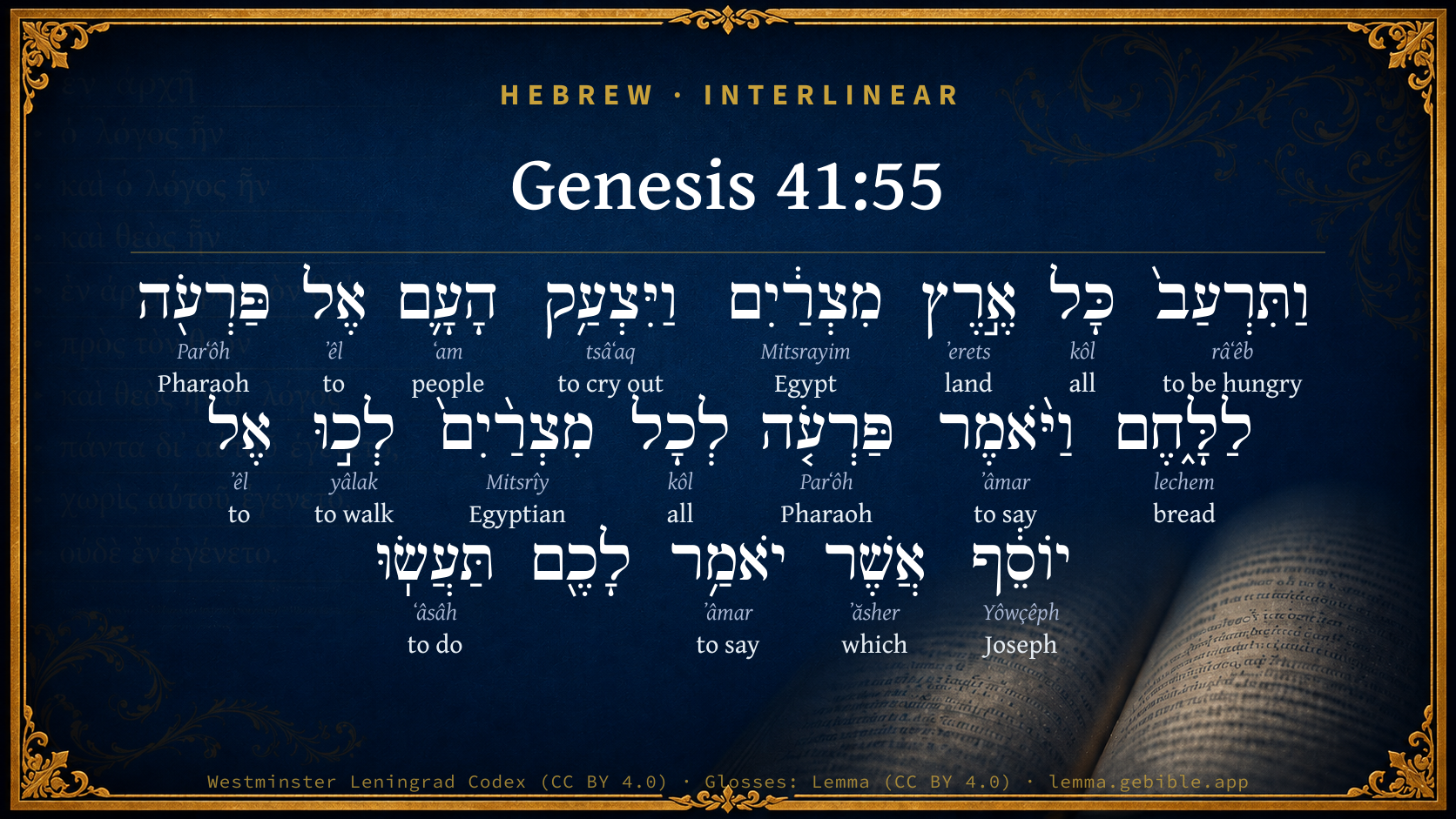
Genesis 41:55

Hebrew (Westminster Leningrad Codex) Genesis 41:55 appears in the Hebrew Old Testament. The text above is from the Westminster Leningrad Codex. Each word links to its Strong’s number, a concise gloss, and parsing drawn from the Open Scriptures Hebrew Bible morphology. Click any word for its full Brown-Driver-Briggs (BDB) entry.
Download image
Cite this verse

Genesis 41:55 (World English Bible). Public Domain. Lemma interlinear Bible study tool, https://lemma.gebible.app/v/genesis/41/55.

Show BibTeX & RIS
BibTeX
RIS
English Translation
When all the land of Egypt was famished, the people cried to Pharaoh for bread, and Pharaoh said to all the Egyptians, "Go to Joseph. What he says to you, do."
World English Bible · Public Domain
Highlights
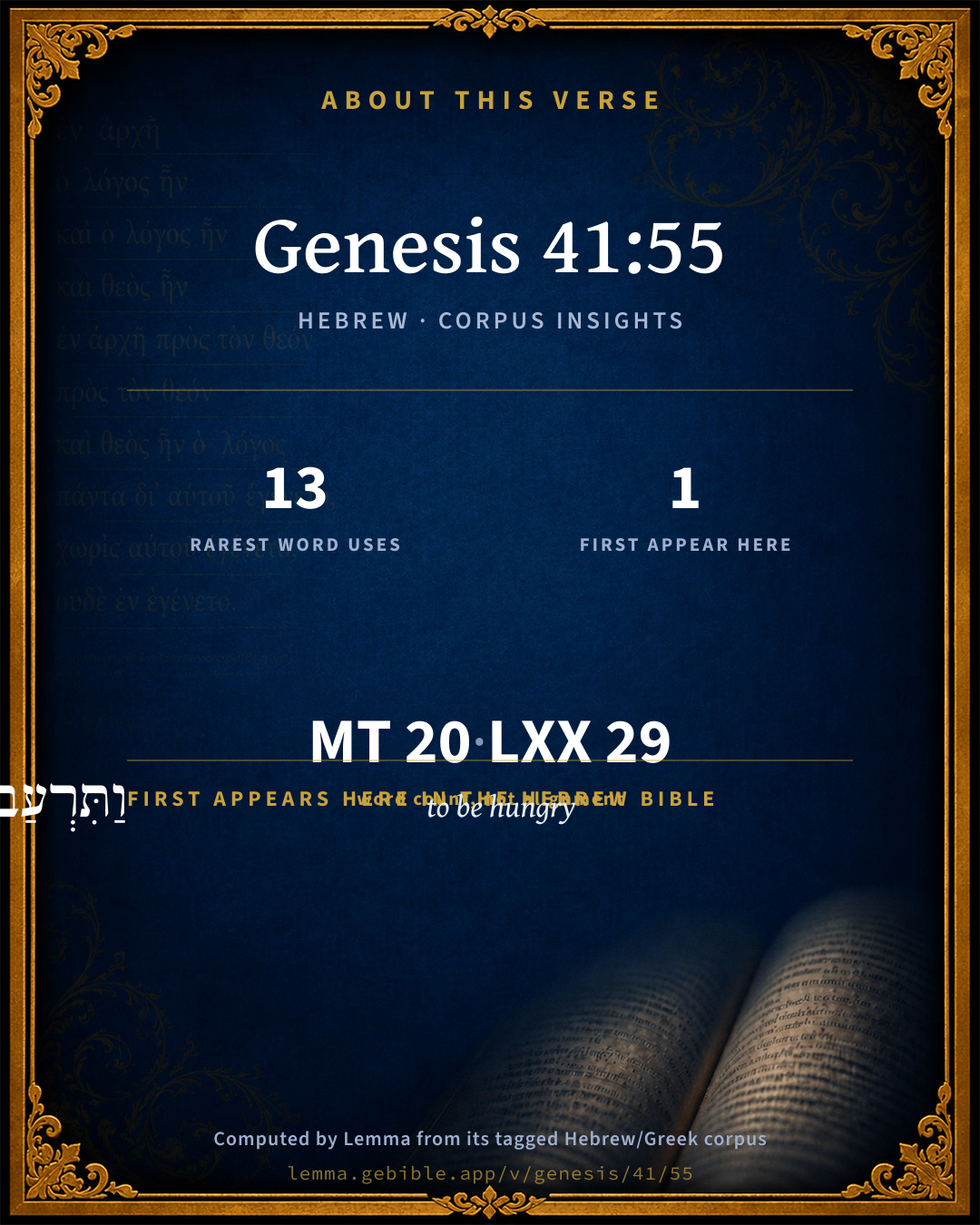
  • 1 first appearance in the Hebrew Bible
Full analysis ↓
Download a study sheet

One document with this verse’s original text, its word-by-word gloss line, the meaning frame, cross-references with their text, attributed commentary, and full source and license credits — printable, and it pastes into notes with its structure intact.

This verse Autodidact and up

Study sheet (.html) Plain text (.txt)

A passage Seminary Student

Up to 50 verses in one chapter. A passage sheet keeps up to 6 commentary sources and 12 cross-references per verse, in the order this page ranks them, and says so on the sheet whenever that leaves anything out. Ask for a single verse and you get the Autodidact verse sheet above.

Everything on this page stays free to read, with no account — the sheet is a download of what is already on screen, not access to it.

Want to remove ads? Support Godless Engineer
Compare translations 3

The same verse in 3 English versions, stacked beneath the original-language interlinear above. Click any original word for its lexicon entry.

Each is an independent rendering of the whole verse — the interlinear is not word-aligned to these translations.

Highlighted words mark where these versions differ — a whole-verse word diff, not a word-by-word alignment.

  • World English Bible Public Domain
    When all the land of Egypt was famished, the people cried to Pharaoh for bread, and Pharaoh said to all the Egyptians, "Go to Joseph. What he says to you, do."
  • King James Version Public Domain
    And when all the land of Egypt was famished, the people cried to Pharaoh for bread: and Pharaoh said unto all the Egyptians, Go unto Joseph; what he saith to you, do.
  • unfoldingWord Literal Text CC BY-SA 4.0
    Then all the land of Egypt became famished, and the people cried to Pharaoh for the bread. So Pharaoh said to all the Egyptians, “Go to Joseph. Whatever he says to you, do.”

unfoldingWord Literal Text — © unfoldingWord, licensed CC BY-SA 4.0. Word-aligned USFM3 via Door43 (git.door43.org/unfoldingWord/en_ult).

Versions to compare (up to 4)

3 of 4 selected

Show all 18 translations

Every available English version of this verse, each an independent rendering of the whole verse.

  • World English Bible Public Domain
    When all the land of Egypt was famished, the people cried to Pharaoh for bread, and Pharaoh said to all the Egyptians, "Go to Joseph. What he says to you, do."
  • Berean Standard Bible Public Domain
    When extreme hunger came to all the land of Egypt and the people cried out to Pharaoh for food, he told all the Egyptians, “Go to Joseph and do whatever he tells you.”
  • Majority Standard Bible Public Domain
    When extreme hunger came to all the land of Egypt and the people cried out to Pharaoh for food, he told all the Egyptians, “Go to Joseph and do whatever he tells you.”
  • King James Version Public Domain
    And when all the land of Egypt was famished, the people cried to Pharaoh for bread: and Pharaoh said unto all the Egyptians, Go unto Joseph; what he saith to you, do.
  • American Standard Version (1901) Public Domain
    And when all the land of Egypt was famished, the people cried to Pharaoh for bread: and Pharaoh said unto all the Egyptians, Go unto Joseph; what he saith to you, do.
  • Revised Version (1885) Public Domain
    And when all the land of Egypt was famished, the people cried to Pharaoh for bread: and Pharaoh said unto all the Egyptians, Go unto Joseph; what he saith to you, do.
  • Geneva Bible (1599) Public Domain
    At the length all the lande of Egypt was affamished, and the people cryed to Pharaoh for bread. And Pharaoh said vnto all the Egyptians, Goe to Ioseph: what he sayth to you, doe ye.
  • Douay-Rheims (1899) Public Domain
    Now when the seven years of the plenty that had been in Egypt were past:
  • Young's Literal Translation Public Domain
    and all the land of Egypt is famished, and the people crieth unto Pharaoh for bread, and Pharaoh saith to all the Egyptians, `Go unto Joseph; that which he saith to you -- do.'
  • Literal Standard Version CC BY-SA 4.0
    and all the land of Egypt is famished, and the people cry to Pharaoh for bread, and Pharaoh says to all the Egyptians, “Go to Joseph; that which he says to you—do.”
  • Unlocked Literal Bible CC BY-SA 4.0
    When all the land of Egypt was famished, the people loudly called on Pharaoh for food. Pharaoh said to all the Egyptians, “Go to Joseph and do what he says.”
  • unfoldingWord Literal Text CC BY-SA 4.0
    Then all the land of Egypt became famished, and the people cried to Pharaoh for the bread. So Pharaoh said to all the Egyptians, “Go to Joseph. Whatever he says to you, do.”
  • Darby Bible Public Domain
    And all the land of Egypt suffered from the dearth. And the people cried to Pharaoh for bread; and Pharaoh said to all the Egyptians, Go to Joseph: what he says to you, that do.
  • World Messianic Bible Public Domain
    When all the land of Egypt was famished, the people cried to Pharaoh for bread, and Pharaoh said to all the Egyptians, “Go to Joseph. What he says to you, do.”
  • Webster's Bible Public Domain
    And when all the land of Egypt was famished, the people cried to Pharaoh for bread: and Pharaoh said to all the Egyptians, Go to Joseph; what he saith to you, do.
  • Free Bible Version CC BY-SA 4.0
    When all of Egypt was hungry, the people cried out to Pharaoh for food, and he told everyone, “Go and see Joseph and do whatever he tells you.”
  • Bible in Basic English Public Domain
    And when all the land of Egypt was in need of food, the people came crying to Pharaoh for bread; and Pharaoh said to the people, Go to Joseph, and whatever he says to you, do it.
  • JPS Tanakh (1917) Public Domain
    And when all the land of Egypt was famished, the people cried to Pharaoh for bread; and Pharaoh said unto all the Egyptians: 'Go unto Joseph; what he saith to you, do.'

Literal Standard Version (2020), Covenant Press — licensed CC BY-SA 4.0. Text via the HelloAO Bible API (eBible.org). Unlocked Literal Bible (unfoldingWord) — licensed CC BY-SA 4.0. Text via the HelloAO Bible API (eBible.org). unfoldingWord Literal Text — © unfoldingWord, licensed CC BY-SA 4.0. Word-aligned USFM3 via Door43 (git.door43.org/unfoldingWord/en_ult). Free Bible Version, Dr. Jonathan Gallagher — licensed CC BY-SA 4.0. Text via the HelloAO Bible API (eBible.org).

Word by word

More ways to search: Search by grammar → Find every occurrence → Compare this word →

Practice this passage: Drill this verse → Learn its vocabulary →

וַתִּרְעַב֙
râʻêb
H7456
“and · to be hungry”
Conjunction + Verb, Qal, Sequential Imperfect, 3rd Person, Feminine, Singular
Part of Speech
Conjunction + Verb
Stem
Qal
Form
Sequential Imperfect
Person
3rd Person
Gender
Feminine
Number
Singular
Full BDB Definition

Origin: a primitive root

TWOT: 2183

to be hungry, be voracious - (Qal) to be hungry - (Hiphil) to allow one to be hungry, allow to hunger
  1. כָּל kôl H3605 “all of” Noun, Common, Masculine, Singular, Construct
  2. אֶ֣רֶץ ʼerets H776 “land of” Noun, Common, Both, Singular, Construct
  3. מִצְרַ֔יִם Mitsrayim H4714 “Egypt” Noun, Proper
  4. וַיִּצְעַ֥ק tsâʻaq H6817 “and · to cry out” Conjunction + Verb, Qal, Sequential Imperfect, 3rd Person, Masculine, Singular
  5. הָעָ֛ם ʻam H5971 “the · people” Particle, Definite Article + Noun, Common, Masculine, Singular, Absolute
  6. אֶל ʼêl H413 “to” Preposition
  7. פַּרְעֹ֖ה Parʻôh H6547 “Pharaoh” Noun, Proper
  8. לַלָּ֑חֶם lechem H3899 “to/for the · bread” Preposition, Determined + Noun, Common, Both, Singular, Absolute
  9. וַיֹּ֨אמֶר ʼâmar H559 “and · to say” Conjunction + Verb, Qal, Sequential Imperfect, 3rd Person, Masculine, Singular
  10. פַּרְעֹ֤ה Parʻôh H6547 “Pharaoh” Noun, Proper
  11. לְכָל kôl H3605 “to/for · all of” Preposition + Noun, Common, Masculine, Singular, Construct
  12. מִצְרַ֨יִם֙ Mitsrîy H4713 “Egyptian” Noun, Proper
  13. לְכ֣וּ yâlak H3212 “walk” Verb, Qal, Imperative, 2nd Person, Masculine, Plural
  14. אֶל ʼêl H413 “to” Preposition
  15. יוֹסֵ֔ף Yôwçêph H3130 “Joseph” Noun, Proper
  16. אֲשֶׁר ʼăsher H834 “which” Particle, Relative
  17. יֹאמַ֥ר ʼâmar H559 “to say” Verb, Qal, Imperfect, 3rd Person, Masculine, Singular
  18. תַּעֲשֽׂוּ ʻâsâh H6213 “to do” Verb, Qal, Imperfect, 2nd Person, Masculine, Plural

About this verse

These counts appear in no published source. They are computed here, from the morphology-tagged text and Lemma’s own curated glosses. What Lemma adds →

20
words
15
distinct lemmas
Pentateuch
section

Notable vocabulary

The rarest word here is וַתִּרְעַב֙ to be hungry H7456 — appearing just 13 times in the whole Hebrew Bible.

First appearance in Scripture

This word makes its first canonical appearance in the Hebrew Bible here:

  • וַתִּרְעַב֙ to be hungry H7456

Shared distinctive vocabulary

וַתִּרְעַב֙ to be hungry H7456 occurs in 13 verses of the Hebrew Bible. Also found in:

Grammatical profile

  • 6 verbs
  • 10 nouns
  • 3 prepositions
  • 1 particle

Verb forms

  • וַתִּרְעַב֙ Qal · Sequential Imperfect
  • וַיִּצְעַ֥ק Qal · Sequential Imperfect
  • וַיֹּ֨אמֶר Qal · Sequential Imperfect
  • לְכ֣וּ Qal · Imperative
  • יֹאמַ֥ר Qal · Imperfect
  • תַּעֲשֽׂוּ Qal · Imperfect

Repetition

Words recur within this verse — often emphatic in Hebrew:

  • כָּל all H3605 ×2
  • פַּרְעֹ֖ה Pharaoh H6547 ×2
  • וַיֹּ֨אמֶר to say H559 ×2
  • אֶל to H413 ×2

Hebrew & Septuagint length

In English translation the verse runs 31 words from the Hebrew and 33 from the Septuagint (LXX English) — closely comparable.

A rough comparison of the two English renderings, which tokenize alike — not a word-level alignment.

Word counts can differ between the Hebrew and the Greek without any difference in meaning — e.g. the Hebrew direct-object marker אֵת has no separate Greek word, and Greek often adds the article ὁ.

In the original languages it is 20 Hebrew tokens and 29 Greek tokens — but the two are counted differently (Hebrew bundles its prefixes and suffixes into one token; the Greek is in lemma form), so that isn’t a like-for-like length.

Cross-references

10

Topical passages linked to Genesis 41:55 in the Treasury of Scripture Knowledge — connected by theme and wording, ordered by reader-vote popularity; previews shown in the World English Bible.

  • Jeremiah 14:1–6 The word of Yahweh that came to Jeremiah concerning the drought.
  • Matthew 3:17 Behold, a voice out of the heavens said, "This is my beloved Son, with whom I am well pleased."
  • Matthew 17:5 While he was still speaking, behold, a bright cloud overshadowed them. Behold, a voice came out of the cloud, saying, "This is my beloved Son, in whom I am well pleased. Listen to him."
  • Genesis 41:40–41 You shall be over my house, and according to your word will all my people be ruled. Only in the throne I will be greater than you."
  • 2 Kings 6:25–29 There was a great famine in Samaria: and, behold, they besieged it, until a donkey's head was sold for eighty [pieces] of silver, and the fourth part of a kab of dove's dung for five [pieces] of silver.
  • Psalms 105:20–22 The king sent and freed him; Even the ruler of peoples, and let him go free.
  • Lamentations 4:3–10 Even the jackals draw out the breast, they give suck to their young ones: The daughter of my people is become cruel, like the ostriches in the wilderness.
  • John 1:14–16 The Word became flesh, and lived among us. We saw his glory, such glory as of the one and only Son of the Father, full of grace and truth.
  • Philippians 4:19 My God will supply every need of yours according to his riches in glory in Christ Jesus.
  • Colossians 1:19 For all the fullness was pleased to dwell in him;

Cross-references courtesy of OpenBible.info (CC BY 4.0).

Hebrew and Greek witnesses Masoretic Hebrew ↔ Greek Septuagint

The same verse in the two great witnesses to the Old Testament, shown verse-for-verse.

These are two independent witnesses, not word-aligned to each other, and the Septuagint is shown in lemma (dictionary) form.

Hebrew Genesis 41:55 Masoretic · Westminster Leningrad Codex

וַתִּרְעַב֙ כָּל אֶ֣רֶץ מִצְרַ֔יִם וַיִּצְעַ֥ק הָעָ֛ם אֶל פַּרְעֹ֖ה לַלָּ֑חֶם וַיֹּ֨אמֶר פַּרְעֹ֤ה לְכָל מִצְרַ֨יִם֙ לְכ֣וּ אֶל יוֹסֵ֔ף אֲשֶׁר יֹאמַ֥ר לָכֶ֖ם תַּעֲשֽׂוּ

When all the land of Egypt was famished, the people cried to Pharaoh for bread, and Pharaoh said to all the Egyptians, "Go to Joseph. What he says to you, do."

World English Bible · Public Domain

Greek LXX Genesis 41:55 Septuagint · lemma form

καί πεινάω πᾶς ὁ γῆ αἴγυπτος κράζω δέ ὁ λαός πρός φαραώ περί ἄρτος εἶπον δέ φαραώ πᾶς ὁ αἰγύπτιος πορεύομαι πρός ιωσηφ καί ὅς ἐάν εἶπον σύ ποιέω

And all the land of Egypt was hungry; and the people cried to Pharao for bread. And Pharao said to all the Egyptians, Go to Joseph, and do whatever he shall tell you.

LXX2012 (modern English Septuagint) · Public Domain

Hebrew: Westminster Leningrad Codex (CC BY 4.0). Greek: Septuagint (public domain); English from LXX2012 (modern English Septuagint) (Public Domain). How the Septuagint differs from the Hebrew →

Targum (Aramaic paraphrase)

2

The Targum is the ancient Jewish Aramaic paraphrase of the Hebrew Scriptures — an interpretive translation, not the Hebrew text itself. Onkelos (literal) and Pseudo-Jonathan (expansive) render the Torah, and Jonathan the Prophets. Coverage is partial: where no permissively-licensed English translation exists for a verse, only the Aramaic is shown. This is verse-level text, not a word-by-word alignment to the Hebrew.

  1. Targum Onkelos Torah (Genesis–Deuteronomy)
    וּכְפָנַת כָּל אַרְעָא דְמִצְרַיִם וּצְוַח עַמָּא קֳדָם לְפַרְעֹה עַל לַחְמָא וַאֲמַר פַּרְעֹה לְכָל מִצְרָאֵי אִיזִילוּ לְוַת יוֹסֵף דִּי יֵימַר לְכוֹן תַּעְבְּדוּן

    (no public-domain English translation for this verse)

    Targum Onkelos — Aramaic: “Onkelos Genesis” (public domain); “Onkelos Exodus” (public domain); “Onkelos Leviticus” (public domain); “Onkelos Numbers” (public domain); “Onkelos Deuteronomy” (public domain). English: “Sefaria Community Translation” (CC0 1.0 (public-domain dedication)); “J.W. Etheridge. The Targums of Onkelos and Jonathan Ben Uzziel on the Pentateuch. London: Longmans, Green, 1862” (public domain). Text via Sefaria.

  2. Targum Pseudo-Jonathan Torah (Genesis–Deuteronomy)
    וּכְפֵינַת כָּל אַרְעָא דְמִצְרַיִם דְלָא הֲוַת מַפְקָא בַּר זַרְעָא וּצְוַח עַמָא קֳדָם פַּרְעה בְּגִין לַחְמָא וַאֲמַר פַּרְעה לְכָל מִצְרָאֵי אִיזִילוּ לְוַת יוֹסֵף דְיֵימַר לְכוֹן תַּעֲבְדוּן

    And all the land of Mizraim had dearth; because the seed wheat bare no fruit, and the people cried before Pharoh for bread. And Pharoh said to all the Mizraee, Go to Joseph, and what he shall tell you do.

    Targum Pseudo-Jonathan — Aramaic: “Targum Jonathan on Genesis” (public domain); “Targum Jonathan on Exodus” (public domain); “Targum Jonathan on Leviticus” (public domain); “Targum Jonathan on Numbers” (public domain); “Targum Jonathan on Deuteronomy” (public domain). English: “The Targum of Jonathan ben Uzziel, trans. J. W. Etheridge, London, 1862” (public domain). Text via Sefaria.

Commentary

Notes on Genesis 41:55 from classic Christian and Jewish commentators (each source and its license shown beneath its notes). The classic Christian expositions comment on the surrounding passage and are grouped to its opening verse, so a note may address several verses; the Jewish commentaries on the Tanakh (Rashi and others) are per-verse, so they appear only where the commentator wrote on this verse.

Lemma curates 59 commentaries, every one of them public domain or Creative Commons licensed, each selected and text-cleaned for this edition rather than reprinted as found. About our sources →

Trapp's Complete Commentary

John Trapp

Gen 41:55 And when all the land of Egypt was famished, the people cried to Pharaoh for bread: and Pharaoh said unto all the Egyptians, Go unto Joseph; what he saith to you, do.

Ver. 55. Cried to Pharaoh.] Though they knew he had deputed Joseph: so 1Ki 6:27. Iσοθεοι ημεν; We should be as gods, if we had not businesses, cares, and fears, above any of our subjects, {a} said Augustus to his wife Livia.

{a} ει μη και πραγματα, και φροντιδας, και φοβους, υτερ παντας τους ιδιοτευοντας, ειχομεν - Dio.

John Trapp, A Commentary or Exposition upon All the Books of the Old and New Testament (1647–1656) — public domain. Text from a community e-Sword module.

Adam Clarke's Commentary

Verse 55. When all the land of Egypt was famished] As Pharaoh, by the advice of Joseph, had exacted a fifth part of all the grain during the seven years of plenty, it is very likely that no more was left than what was merely necessary to supply the ordinary demand both in the way of home consumption, and for the purpose of barter or sale to neighbouring countries.

Adam Clarke's Commentary on the Bible (1810–1826) — public domain. Text from a community e-Sword/MySword module.

John Calvin's Commentaries

55. Go unto Joseph. It is by no means unusual for kings, while their subjects are oppressed by extreme sufferings, to give themselves up to pleasures. But Moses here means something else; for Pharaoh does not exonerate himself from the trouble of distributing corn, because he wishes to enjoy a repose free from all inconvenience; but because he hassuch confidence in holy Joseph, that he willingly leaves all things to him, and does not allow him to be disturbed in the discharge of the office which he had undertaken.

John Calvin's Commentaries (1540-1563) — public domain. Text from the Calvin Translation Society English edition (1840s-50s) via the Christian Classics Ethereal Library (ccel.org). Calvin's coverage is partial (roughly two-thirds of the Bible); uncommented books and verses are honest gaps, never fabricated. The 19th-century editor's footnotes and remarks are omitted so the notes are faithfully Calvin's own voice.

Haydock's Catholic Bible Commentary

World. Round about Egypt; such as Chanaan, Syria, &c. (Menochius) --- There was. The Syriac and some Latin copies, read not, &c.: there was a famine. We must adhere to the Vulgate and Hebrew.

George Leo Haydock (1774–1849), Haydock's Catholic Family Bible and Commentary, 1859 edition — public domain. Excludes Psalms (Douay-Rheims chapter numbering differs from Protestant) and Deuterocanonical books (Catholic canon only).

Matthew Poole's English Annotations

The people cried to Pharaoh, as to their king and common father. Compare 2Ki 6:26.

Matthew Poole's English Annotations on the Holy Bible (1683–1685) — public domain. Text from a community e-Sword/MySword module.

The Pulpit Commentary

And when (literally, and) all the land of Egypt was famished (literally, and), the people cried to Pharaoh for bread: cf. the famine in Samaria (2Ki_6:26) and Pharaoh said unto all the Egyptians, Go unto Joseph; what he saith So you, do.

The Pulpit Commentary (1880–1919), ed. H.D.M. Spence-Jones & Joseph S. Exell — public domain. Text from a community e-Sword module.

unfoldingWord translationNotes

Door43 World Missions Community

When all the land of Egypt was famished

Here "land" stands for the people. AT: "When all the Egyptians were starving" (See: Metonymy)

The famine was over all the face of the whole land

The word "face" refers to the surface of the land. AT: "The famine had spread throughout the land" (See: Idiom)

Joseph opened all the storehouses and sold to the Egyptians

Here "Joseph" stands for Joseph's servants. AT: "Joseph had his servants open all the storehouses and sell grain to the Egyptians" (See: Synecdoche)

All the earth was coming to Egypt

Here "earth" stands for the people from all regions. AT: "People were coming to Egypt from all the surrounding regions" (See: Metonymy)

in all the earth

"throughout the land." It is likely that all the different trading partners and nations that were part of the Egyptian trading routes effected by the drought came to Egypt for grain.

translationWords

Egypt

people group

Pharaoh

Egypt

Joseph (OT)

famine

face

storehouse

grain

unfoldingWord translationNotes — © Distant Shores Media and the Door43 World Missions Community, licensed CC BY-SA 4.0. Source: git.door43.org/Door43/en_tn.

Rashi

Rabbi Shlomo Yitzchaki (Rashi)

ותרעב כל ארץ מצרים AND THE LAND OF EGYPT WAS FAMISHED — for all the grain they had stored up rotted except that of Joseph (cf. Genesis Rabbah 91:5)

אשר יאמר לכם תעשו WHAT HE SAITH TO YOU, DO — He gave them this order because Joseph had told them to be circumcised. When they came to Pharaoh and said, “Thus he bids us do otherwise he will give us no corn”, he asked them, “Why did you yourselves not lay up corn? Did he not publicly announce that years of famine were coming?” They answered him, “We gathered in much, but it has rotted”. He said to them, “If this be so — what he saith to you, do. See, he laid a decree upon the produce and it rotted; what will happen if he lays a decree upon us that we should die!” (cf. Genesis Rabbah 91:5)

Rashi on the Tanakh — English translations: “The Judaica Press complete Tanach with Rashi, translated by A. J. Rosenberg” (CC BY 4.0); “Pentateuch with Rashi's commentary by M. Rosenbaum and A.M. Silbermann, 1929-1934” (public domain); “The Metsudah Tanach series, Lakewood, N.J” (CC BY 4.0); and “The Book of Joshua, Metsudah Publications, 1997” (CC BY 4.0). Text via Sefaria.

Radak

Rabbi David Kimhi (Radak)

ותרעב, each one had used up his private hoard either by eating it or selling it. Besides, they could not store a great deal, having had to surrender twenty per cent of their annual harvests to Joseph’s officials.

ויצעק העם, they knew that Joseph had stored up their twenty percent contributions each year. They appealed to Pharaoh knowing that the food which had been stored was intended to be sold back to the people during the famine.

Radak on the Tanakh — English translations: “Sefaria Community Translation” (CC0 1.0 (public-domain dedication)); “Eliyahu Munk, HaChut Hameshulash” (CC BY 4.0); “Rabbi Mike Feuer, Jerusalem Anthology” (CC BY 4.0); and “R. David Kimhi on the first book of Psalms, Translated by R.G. Finch, London, 1919” (public domain). Text via Sefaria.

Lesson kit

Teaching starters — assembled from the data on this page, not authored interpretation. Every prompt links to the verse data it draws on. Edit before teaching.

Genesis, in the Pentateuch, opens this verse with 20 words (15 distinct Hebrew lemmas). Its most distinctive word is râʻêb (“to be hungry”). A historical commentator’s framing appears above. Read the whole chapter for the surrounding context.

Discussion questions

  1. How does “to be hungry” (râʻêb) shape what this verse is saying?
  2. This is the first place “to be hungry” appears in Scripture (first appears here). What does its debut here establish?
  3. How does Deuteronomy 8:3, which shares the word «to be hungry», read alongside this verse?
  4. What does the repetition of “all” (2× in this one verse) do in this verse?
  5. These translations render this verse differently; the difference is in the English rendering, not the original. What questions does that raise?
  6. «וַתִּרְעַב֙» is a Qal Sequential Imperfect verb. How does that grammatical form shape the action described?
  7. Compare how Trapp's Complete Commentary and Adam Clarke's Commentary read this verse. Where do they agree or differ?

Things to notice

Reading settings

Reading text

Shown beneath each verse's original-language words.

Old Testament
Old Testament edition

Read the OT as the Masoretic Hebrew (MT) or the Greek Septuagint (LXX).

English shown for the Greek Septuagint (in the Hebrew ↔ Greek comparison).

Comparing translations? Open the Compare panel on any verse page to stack up to four side by side.