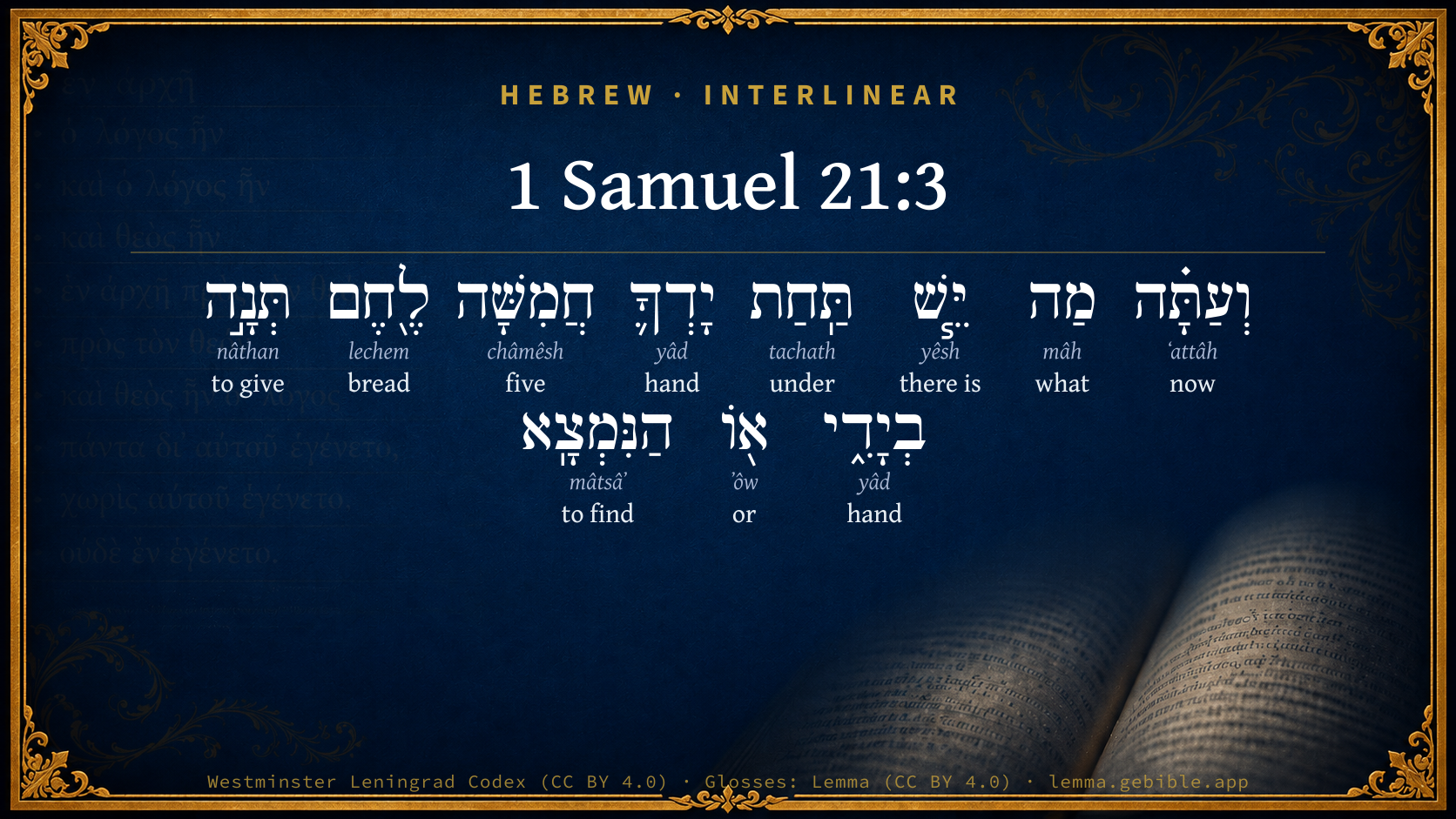
1 Samuel 21:3

Hebrew (Westminster Leningrad Codex) 1 Samuel 21:3 appears in the Hebrew Old Testament. The text above is from the Westminster Leningrad Codex. Each word links to its Strong’s number, a concise gloss, and parsing drawn from the Open Scriptures Hebrew Bible morphology. Click any word for its full Brown-Driver-Briggs (BDB) entry.
Download image
Cite this verse

1 Samuel 21:3 (World English Bible). Public Domain. Lemma interlinear Bible study tool, https://lemma.gebible.app/v/1-samuel/21/3.

Show BibTeX & RIS
BibTeX
RIS
English Translation
Now therefore what is under your hand? give me five loaves of bread in my hand, or whatever there is present.
World English Bible · Public Domain
Download a study sheet

One document with this verse’s original text, its word-by-word gloss line, the meaning frame, cross-references with their text, attributed commentary, and full source and license credits — printable, and it pastes into notes with its structure intact.

This verse Autodidact and up

Study sheet (.html) Plain text (.txt)

A passage Seminary Student

Up to 50 verses in one chapter. A passage sheet keeps up to 6 commentary sources and 12 cross-references per verse, in the order this page ranks them, and says so on the sheet whenever that leaves anything out. Ask for a single verse and you get the Autodidact verse sheet above.

Everything on this page stays free to read, with no account — the sheet is a download of what is already on screen, not access to it.

Want to remove ads? Support Godless Engineer
Compare translations 3

The same verse in 3 English versions, stacked beneath the original-language interlinear above. Click any original word for its lexicon entry.

Each is an independent rendering of the whole verse — the interlinear is not word-aligned to these translations.

Highlighted words mark where these versions differ — a whole-verse word diff, not a word-by-word alignment.

  • World English Bible Public Domain
    Now therefore what is under your hand? give me five loaves of bread in my hand, or whatever there is present.
  • King James Version Public Domain
    Now therefore what is under thine hand? give me five loaves of bread in mine hand, or what there is present.
  • unfoldingWord Literal Text CC BY-SA 4.0
    And now, what is there under your hand? Give five bread into my hand, or the being found.”

unfoldingWord Literal Text — © unfoldingWord, licensed CC BY-SA 4.0. Word-aligned USFM3 via Door43 (git.door43.org/unfoldingWord/en_ult).

Versions to compare (up to 4)

3 of 4 selected

Show all 18 translations

Every available English version of this verse, each an independent rendering of the whole verse.

  • World English Bible Public Domain
    Now therefore what is under your hand? give me five loaves of bread in my hand, or whatever there is present.
  • Berean Standard Bible Public Domain
    Now then, what do you have on hand? Give me five loaves of bread, or whatever can be found.”
  • Majority Standard Bible Public Domain
    Now then, what do you have on hand? Give me five loaves of bread, or whatever can be found.”
  • King James Version Public Domain
    Now therefore what is under thine hand? give me five loaves of bread in mine hand, or what there is present.
  • American Standard Version (1901) Public Domain
    Now therefore what is under thy hand? give me five loaves of bread in my hand, or whatsoever there is present.
  • Revised Version (1885) Public Domain
    Now therefore what is under thine hand? give me five loaves of bread in mine hand, or whatsoever there is present.
  • Geneva Bible (1599) Public Domain
    Nowe therefore if thou hast ought vnder thine hande, giue me fiue cakes of bread, or what commeth to hand.
  • Douay-Rheims (1899) Public Domain
    Now therefore if thou have any thing at hand, though it were but five loaves, give me, or whatsoever thou canst find.
  • Young's Literal Translation Public Domain
    and now, what is there under thy hand? five loaves give into my hand, or that which is found.'
  • Literal Standard Version CC BY-SA 4.0
    And now, what is there under your hand? Give five loaves into my hand, or that which is found.”
  • Unlocked Literal Bible CC BY-SA 4.0
    Now then what do you have on hand? Give me five loaves of bread, or whatever is here.”
  • unfoldingWord Literal Text CC BY-SA 4.0
    And now, what is there under your hand? Give five bread into my hand, or the being found.”
  • Darby Bible Public Domain
    And now what is under thy hand? give me five loaves in my hand, or what may be found.
  • World Messianic Bible Public Domain
    Now therefore what is under your hand? Please give me five loaves of bread in my hand, or whatever is available.”
  • Webster's Bible Public Domain
    Now therefore what is under thy hand? give me five loaves of bread in my hand, or what there is present.
  • Free Bible Version CC BY-SA 4.0
    So what do you have on hand to eat? Let me have five loaves of bread, or whatever you can find.”
  • Bible in Basic English Public Domain
    So now, if you have here five cakes of bread, give them into my hand, or whatever you have.
  • JPS Tanakh (1917) Public Domain
    (21-4) Now therefore what is under thy hand? five loaves of bread? give them in my hand, or whatsoever there is present.'

Literal Standard Version (2020), Covenant Press — licensed CC BY-SA 4.0. Text via the HelloAO Bible API (eBible.org). Unlocked Literal Bible (unfoldingWord) — licensed CC BY-SA 4.0. Text via the HelloAO Bible API (eBible.org). unfoldingWord Literal Text — © unfoldingWord, licensed CC BY-SA 4.0. Word-aligned USFM3 via Door43 (git.door43.org/unfoldingWord/en_ult). Free Bible Version, Dr. Jonathan Gallagher — licensed CC BY-SA 4.0. Text via the HelloAO Bible API (eBible.org).

Word by word

More ways to search: Search by grammar → Find every occurrence → Compare this word →

Practice this passage: Drill this verse → Learn its vocabulary →

יֵּ֧שׁ
yêsh
H3426
“there is”
Particle, Demonstrative
Part of Speech
Particle
Type
Demonstrative
Full BDB Definition

Origin: perhaps from an unused root meaning to stand out, or exist

TWOT: 921

being, existence, substance, there is or are - substance - existence - there is or are
  1. וְעַתָּ֗ה ʻattâh H6258 “and · now” Conjunction + Adverb
  2. מַה mâh H4100 “what” Particle, Interrogative
  3. תַּֽחַת tachath H8478 “under” Preposition
  4. יָדְךָ֛ yâd H3027 “hand · your” Noun, Common, Both, Singular, Construct + Suffix, Personal, 2nd Person, Masculine, Singular
  5. חֲמִשָּׁה châmêsh H2568 “five” Adjective, Cardinal number, Masculine, Singular, Absolute
  6. לֶ֖חֶם lechem H3899 “bread” Noun, Common, Both, Singular, Absolute
  7. תְּנָ֣ה nâthan H5414 “give” Verb, Qal, Imperative, 2nd Person, Masculine, Singular + Suffix, h
  8. בְיָדִ֑י yâd H3027 “in/at · hand · my” Preposition + Noun, Common, Both, Singular, Construct + Suffix, Personal, 1st Person, Common, Singular
  9. א֖וֹ ʼôw H176 “or” Conjunction
  10. הַנִּמְצָֽא mâtsâʼ H4672 “the · finding” Particle, Definite Article + Verb, Niphal, Participle Active, Masculine, Singular, Absolute

About this verse

These counts appear in no published source. They are computed here, from the morphology-tagged text and Lemma’s own curated glosses. What Lemma adds →

11
words
10
distinct lemmas
Historical
section

Grammatical profile

  • 2 verbs
  • 3 nouns
  • 1 adjective
  • 1 preposition
  • 1 conjunction
  • 1 adverb
  • 2 particles

Verb forms

  • תְּנָ֣ה Qal · Imperative
  • הַנִּמְצָֽא Niphal · Participle Active

Repetition

A word recurs within this verse — often emphatic in Hebrew:

  • יָדְךָ֛ hand H3027 ×2

Hebrew & Septuagint length

In English translation the verse runs 21 words from the Hebrew and 17 from the Septuagint (LXX English) — closely comparable.

A rough comparison of the two English renderings, which tokenize alike — not a word-level alignment.

Word counts can differ between the Hebrew and the Greek without any difference in meaning — e.g. the Hebrew direct-object marker אֵת has no separate Greek word, and Greek often adds the article ὁ.

Cross-references

3

Topical passages linked to 1 Samuel 21:3 in the Treasury of Scripture Knowledge — connected by theme and wording, ordered by reader-vote popularity; previews shown in the World English Bible.

  • Judges 9:29 Would that this people were under my hand! then would I remove Abimelech. He said to Abimelech, Increase your army, and come out.
  • 1 Samuel 21:4 The priest answered David, and said, There is no common bread under my hand, but there is holy bread; if only the young men have kept themselves from women.
  • Isaiah 3:6 Indeed a man shall take hold of his brother in the house of his father, saying, "You have clothing, you be our ruler, And let this ruin be under your hand."

Cross-references courtesy of OpenBible.info (CC BY 4.0).

Hebrew and Greek witnesses Masoretic Hebrew ↔ Greek Septuagint

The same verse in the two great witnesses to the Old Testament, shown verse-for-verse.

These are two independent witnesses, not word-aligned to each other, and the Septuagint is shown in lemma (dictionary) form.

Hebrew 1 Samuel 21:3 Masoretic · Westminster Leningrad Codex

וְעַתָּ֗ה מַה יֵּ֧שׁ תַּֽחַת יָדְךָ֛ חֲמִשָּׁה לֶ֖חֶם תְּנָ֣ה בְיָדִ֑י א֖וֹ הַנִּמְצָֽא

Now therefore what is under your hand? give me five loaves of bread in my hand, or whatever there is present.

World English Bible · Public Domain

Greek LXX 1 Samuel 21:3 Septuagint · lemma form

καί εἶπον δαυίδ ὁ ἱερεύς ὁ βασιλεύς ἐντέλλομαι ἐγώ ῥῆμα σήμερον καί εἶπον ἐγώ μηδείς γιγνώσκω ὁ ῥῆμα περί ὅς ἐγώ ἀποστέλλω σύ καί ὑπέρ ὅς ἐντέλλομαι σύ καί ὁ παιδάριον διαμαρτυρέω ἐν ὁ τόπος ὁ λέγω θεός πίστις φελλανι αλεμωνι

And now if there are under your hand five loaves, give into my hand what is ready.

LXX2012 (modern English Septuagint) · Public Domain

Hebrew: Westminster Leningrad Codex (CC BY 4.0). Greek: Septuagint (public domain); English from LXX2012 (modern English Septuagint) (Public Domain). How the Septuagint differs from the Hebrew →

Targum (Aramaic paraphrase)

1

The Targum is the ancient Jewish Aramaic paraphrase of the Hebrew Scriptures — an interpretive translation, not the Hebrew text itself. Onkelos (literal) and Pseudo-Jonathan (expansive) render the Torah, and Jonathan the Prophets. Coverage is partial: where no permissively-licensed English translation exists for a verse, only the Aramaic is shown. This is verse-level text, not a word-by-word alignment to the Hebrew.

  1. Targum Jonathan Prophets (Joshua–Malachi)
    וַאֲמַר דָוִד לַאֲחִימֶלֶךְ כַּהֲנָא מַלְכָּא פַּקְדַנִי פִּתְגָמָא וַאֲמַר לִי אֱנַשׁ לָא יֵדַע מִדַעַם יַת פִּתְגָמָא דַאֲנָא שְׁלַח לָךְ וּדְפַקִדְתָּךְ וְיַת עוּלֵימַיָא שְׁלָחִית קֳדָמַי לַאֲתַר כַּסִי וְטָמִיר:

    (no public-domain English translation for this verse)

    Targum Jonathan — Aramaic: “Mikraot Gedolot” (public domain). English: “Sefaria Community Translation” (CC0 1.0 (public-domain dedication)); “London "Chaldee Paraphrase," 1871” (public domain). Text via Sefaria.

Commentary

Notes on 1 Samuel 21:3 from classic Christian and Jewish commentators (each source and its license shown beneath its notes). The classic Christian expositions comment on the surrounding passage and are grouped to its opening verse, so a note may address several verses; the Jewish commentaries on the Tanakh (Rashi and others) are per-verse, so they appear only where the commentator wrote on this verse.

Lemma curates 59 commentaries, every one of them public domain or Creative Commons licensed, each selected and text-cleaned for this edition rather than reprinted as found. About our sources →

Trapp's Complete Commentary

John Trapp

1Sa 21:3 Now therefore what is under thine hand? give [me] five [loaves of] bread in mine hand, or what there is present.

Ver. 3. Or what there is present.] Heb., Found; anything to preserve life. Eat that which is set before you, {a} said our Saviour to his disciples. Eat to live; hunger is the best sauce, and can well season homely dainties.

{a} τα παρατιθεμενα. - Luke x. 8.

John Trapp, A Commentary or Exposition upon All the Books of the Old and New Testament (1647–1656) — public domain. Text from a community e-Sword module.

Joseph Benson's Commentary

1Sa 21:3-4. What is under thy hand? — He desires to know what he was able to do for him to supply his wants. And particularly he requests some bread for himself and servants. Or what there is present — That is, any other victuals. There is hallowed bread — Here in the tabernacle. Doubtless, Ahimelech had other provisions in his house; but David was in great haste, and in fear of Doeg, whom he saw and knew, and therefore would not stay till any thing could be fetched from thence. There seemed to be a double impediment to Ahimelech’s giving David and his servants this bread: 1st, Its sacredness in itself, which he intimates, and in answer to which David pleads his great necessity; an answer with which Ahimelech appears to have been satisfied. “Cases of necessity, as the Jews themselves allow, often superseded the observance of the ritual laws; and this compliance of Ahimelech is urged with great force by our Saviour, in vindication of a similar infringement, Mar 2:25.” — Dodd. 2d, It was requisite that all who ate of the holy bread, should have observed the same purity which was required of the priests, particularly in the instance of abstinence from all women; and Ahimelech suspected that David or his servants might possibly want this qualification, and therefore inquires concerning it. But out of respect to David he does not name him, but asks only concerning the young men. David’s answer, however, shows that he was intended to be included in the inquiry.

Joseph Benson's Commentary on the Old and New Testaments (1811–1818) — public domain. Text from a community e-Sword module.

John Gill's Exposition

Now therefore what is under thine hand?.... Meaning, what food had he in his house?

give me five loaves of bread in mine hand; to take with him, for him and his servants in such a place:

or what there is present; or to be found (g) in the tabernacle; if not five loaves, two, or three, or four, or what food soever he had by him.

(g) "quicquid inveneris", V. L, "inventum", Montanus; "quicquid inventum fuerit", Tigurine version.

John Gill's Exposition of the Whole Bible (1746–1763) — public domain (CC PDM 1.0). Text via the HelloAO Bible API.

Matthew Poole's English Annotations

Under thine hand, to wit, in thy power, and ready for thee to give, and for me to take, and eat.

Matthew Poole's English Annotations on the Holy Bible (1683–1685) — public domain. Text from a community e-Sword/MySword module.

Whedon's Commentary on the Bible

Daniel D. Whedon

3. What is under thine hand — What provision? what food hast thou ready made, or on hand?

Daniel D. Whedon (gen. ed.), Commentary on the Old and New Testaments (1874–1909) — public domain. Text from a community e-Sword module.

The Pulpit Commentary

Vers. 3, 4. What is under thine hand? This does not mean that Ahimelech was himself carrying the shewbread out of the tabernacle, but simply, "What hast thou? The sense of the whole verse is, "Now, therefore, what hast thou at hand? Give me five loaves, or whatever there may be." Ahimelech answers, "There is no common bread at hand." I have no ordinary food; there is only hallowed bread, that is, the shewbread, which, after remaining in Jehovah"s presence from sabbath to sabbath, was then to be eaten by the priests in the holy place. (Lev_24:8, Lev_24:9) As Ahimelech could not venture to refuse David"s request, he asks if his attendants are at least ceremonially clean, as in that case the urgency of the king"s business might excuse the breach of the letter of the commandment. Our Lord in Mat_12:3 cites this as a case in which the inward spirit of the law was kept, and the violation of its literal precept thereby justified.

Vers. 3-6. (Nor.)

The letter and the spirit.

the priest gave him hallowed bread" (ver. 6). More than half a century had elapsed since the destruction of Shiloh. The remaining members of the family of Eli had greatly increased, so that eighty-five priests now dwelt at Nob, where the tabernacle (and possibly the ark (1Sa_7:1) had been placed. But the condition of the priesthood was very different from what it once was. The spiritual power of the nation lay in the "company of the prophets;" and Saul, rejected of God and ruling according to his own will, "assumed the power of giving the high priest orders at all times through his messengers; (1Sa_21:2) so far had the theocracy sunk from that state in which the people used to stand before the tabernacle to receive the sole behests of Jehovah their King, through the prophet and priest" (Smith, "O.T. History"). Nevertheless Ahimelech (Ahiah, 1Sa_14:36) appears to have been a man of high character; (1Sa_22:14, 1Sa_22:15) and when David, in his necessity, requested "five loaves," he gave them to him from the shewbread which had just been removed from the holy place. He may have been influenced by sympathy with David"s character and position (of which he could not fail to know something), as well as by compassion for his need and by loyalty to the king, or by the advice of Abiathar (his son and successor, afterwards friend and companion of David 1Sa_22:20-23; 1Ki_2:26; and removed from the priesthood by Solomon, giving place to Zadok, of the elder branch of the Aaronic family. The shewbread (literally, "bread of the presence") "set forth Israel"s permanent consecration in obedience and in producing the fruit of good works" (see Fairbairn, "Typology," 2:324), and was permitted to be eaten only by the priests; (Lev_24:9) but he departed, with some reserve (ver. 4), from the strict letter in observance of the spirit of the law. And our Lord "selected this act of Ahimelech as the one incident in David"s life on which to bestow his especial commendation, because it contained however tremulously and guardedly expressed the great evangelical truth that the ceremonial law, however rigid, must give way before the claims of suffering humanity" (Stanley). Observe that

I THE LETTER IS DISTINCT FROM THE SPIRIT. To the former belong particular customs, maxims, rules, rites, and ceremonies; to the latter, general principles, and essential moral and spiritual obligations. As a simple illustration Christ said to his disciples, "Ye also ought to wash one another"s feet" (here is the rule); "Love one another (here is the principle).

1. The letter rests upon the spirit as its foundation. The whole Mosaic law, as law (moral, ceremonial, political), was a "letter" based upon great principles, springing directly out of the relation of God to men granite foundations on which more recent strata rest, and which often crop through them into distinct view. (Lev_18:18; Deu_6:5) "There is a "letter" and "spirit" in everything. Every statement, every law, every institution is the form of an essence, the body of a soul, the instrument of a power. These two things are quite distinct they may be quite different" (A.J. Morris, "Christ the Spirit of Christianity").

2. The letter is a means to an end, the spirit is the end itself. The shew bread was set apart for a particular purpose, and permitted to be eaten only by the priests, in order to represent and promote the consecration, good works, and true welfare of the whole people. So "the sabbath was made for. (Mar_2:27)

1. The letter is restricted in its application to certain persons, places, and times; the spirit is universal and abiding.

2. The letter (as such) is in its requirement outward, formal, mechanical, and in its effect conservative, constraining, and pre paratory; the spirit necessarily demands thoughtfulness, affection, moral choice, and is productive of liberty, energy, perfection. "The words that I speak unto you, they are spirit and they are life". (Joh_6:63)

II THE LETTER MAY BE CONTRARY TO THE SPIRIT. It is not essentially so; it is not always so when men imagine it to be, as, e.g., when it is a restraint only upon their selfish convenience and sinful propensities. The fact that it is such a restraint shows that they still need the discipline of the law and the letter. If they were truly spiritual and free it would not be felt. But generally

1. When it is applied to cases not contemplated by it, to inappropriate times and circumstances, and when it hinders rather than promotes its chief end.

2. More particularly when it prevents the meeting of the real and urgent necessities of men, and the accomplishment of their true welfare the satisfaction of hunger, the removal of sickness, the preservation of life, the salvation of the soul. (Mat_12:1, Mat_12:12) On this principle David "entered into the house of God, and did eat the shewbread," etc.

3. When it is opposed to the proper exercise of benevolence. On this principle Ahimelech gave him the bread, and our Lord acted. (Luk_6:10) "I desired mercy, and not sacrifice". (Hos_6:6)

4. When it hinders the highest service of God. In all such instances the strict observance of the letter "works mischief and misery, and not only kills, but kills the spirit itself from which it came". (2Co_3:6)

III THE LETTER MUST BE SUBORDINATED TO THE SPIRIT. It should not be despised or arbitrarily set aside; but the lower obligation (in so far as the "letter" is obligatory) ought to be secondary and subservient, and give place to the higher. And we learn that

1. In the order of God"s dealings with men it was necessary that the dispensation of the letter should be superseded by that of the spirit. This incident affords a glimpse of their predominant elements. "The law was like a book of first lessons lessons for children. Christianity is like a book for men.

2. In the Christian dispensation what is ceremonial, regulative, temporary (however important) must be deemed of less consequence than what is moral, essential, enduring; and devotion to the former should be surpassed by devotion to the latter. Unduly to exalt external rites or special forms of worship is to return to the bondage of the letter; whilst zealously to contend about them without brotherly love and charity is to lose the substance for the sake of shadows. "Redeemed and sanctified man stands no longer under the disciplinary form of the law, but stands above and controls the form of the requirement" (Erdmann). He is a king and priest. "Pure religion" (literally, outward ceremonial service), etc.. (Jam_1:27) It is charity and purity.

3. In the individual life renewed and sanctified the chief endeavour should ever be to "live in the spirit," and exhibit "charity out of a pure heart". (1Ti_1:5)

I"m apt to think the man That could surround the sum of things, and spy The heart of God and secrets of his empire, Would speak but love; with him the bright result Would change the hue of intermediate scenes And make one thing of all theology.

4. In everything Christ must be regarded as supreme, the perfect embodiment and only source of the spirit, Redeemer, Lord, "all and in all D. (Col_3:11; 2Co_3:17, 2Co_3:18)

The Pulpit Commentary (1880–1919), ed. H.D.M. Spence-Jones & Joseph S. Exell — public domain. Text from a community e-Sword module.

unfoldingWord translationNotes

Door43 World Missions Community

Now then

David is starting a new part of the conversation.

what do you have on hand?

Here "on hand" is a metonym meaning "available." AT: "What food do you have that you can give me?" (See: Metonymy)

Give me five loaves of bread

This is a polite request.

ordinary bread

bread that the priests have not used in worship

holy bread

bread that the priests have used in worship

if the young men have kept themselves from women

This can be translated as a complete sentence. AT: "Your men may eat it if they have not slept with women recently" (See: Ellipsis)

translationWords

bread

holy

unfoldingWord translationNotes — © Distant Shores Media and the Door43 World Missions Community, licensed CC BY-SA 4.0. Source: git.door43.org/Door43/en_tn.

Rashi

Rabbi Shlomo Yitzchaki (Rashi)

And as for the youths, I have sent them ahead. An expression of troubling; the young men who came out with me, I have troubled them to go before me to a secret, hidden place.

I have troubled. Similar to, 'And with them he broke [וַידַׁע] the men of Succos.'

Certain secret. [אַלְמֹנִי is derived from] 'אַלְמוֹן' [=widower], bereft of a name; for I do not want to mention it, because it is a secret matter.

Hidden. Similar to כִּי יִפָּלֵא [=will be concealed], will be hidden.

Rashi on the Tanakh — English translations: “The Judaica Press complete Tanach with Rashi, translated by A. J. Rosenberg” (CC BY 4.0); “Pentateuch with Rashi's commentary by M. Rosenbaum and A.M. Silbermann, 1929-1934” (public domain); “The Metsudah Tanach series, Lakewood, N.J” (CC BY 4.0); and “The Book of Joshua, Metsudah Publications, 1997” (CC BY 4.0). Text via Sefaria.

Lesson kit

Teaching starters — assembled from the data on this page, not authored interpretation. Every prompt links to the verse data it draws on. Edit before teaching.

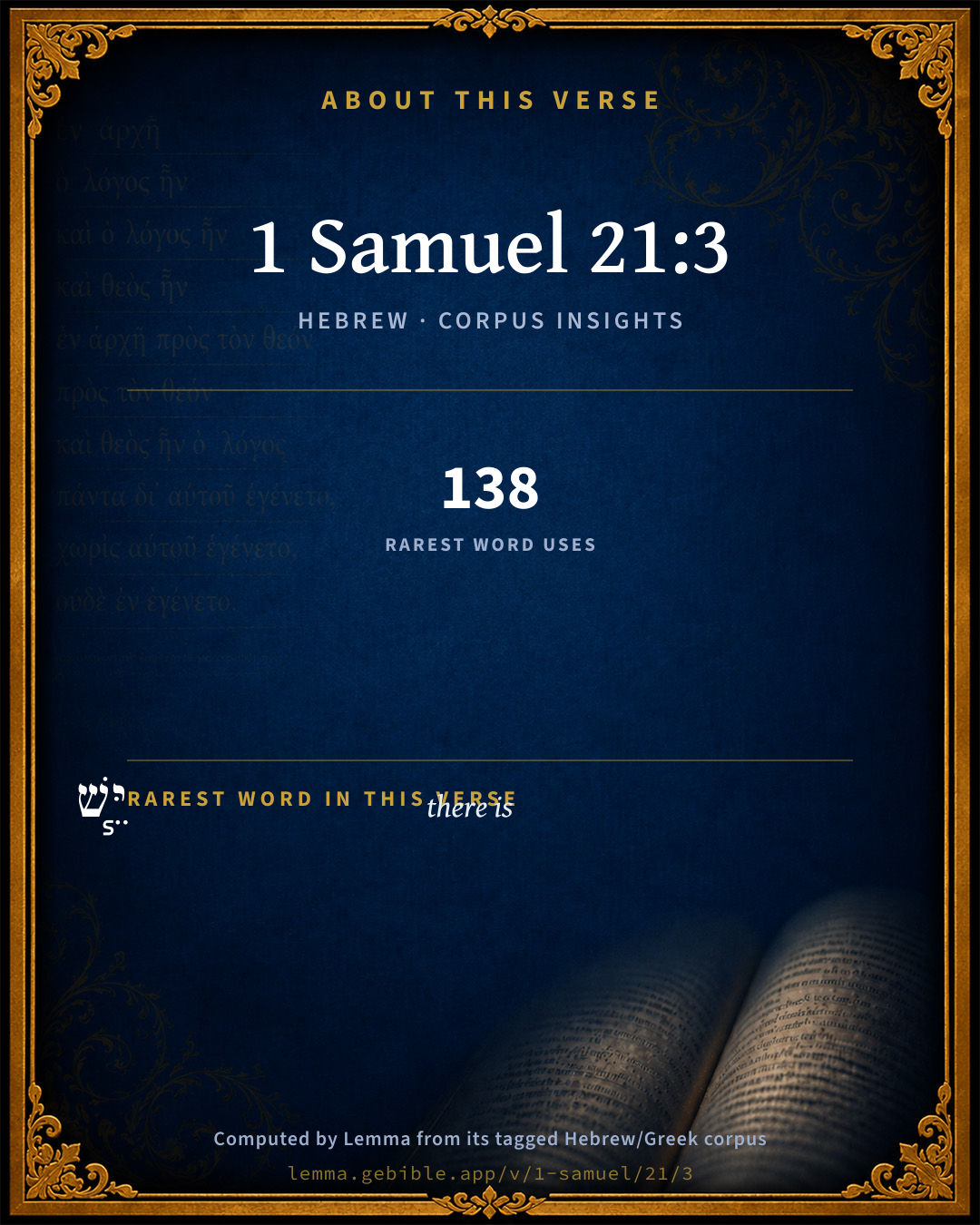
1 Samuel, in the Historical, opens this verse with 11 words (10 distinct Hebrew lemmas). Its most distinctive word is yêsh (“there is”). A historical commentator’s framing appears above. Read the whole chapter for the surrounding context.

Discussion questions

  1. The word yêsh carries the sense “there is.” How does it shape the verse?
  2. Judges 9:29 shares this passage’s theme. How do the two illuminate each other?
  3. “hand” occurs 2× in this one verse. What is the effect of the repetition?
  4. The translations on this page render this verse differently — a whole-verse word diff, not a word-by-word alignment. What might account for the different wordings?
  5. The verb «תְּנָ֣ה» is Qal Imperative. How does its form color the action?
  6. Reading how Trapp's Complete Commentary and Joseph Benson's Commentary read this verse, where do the two commentators agree and where do they part?

Things to notice

Reading settings

Reading text

Shown beneath each verse's original-language words.

Old Testament
Old Testament edition

Read the OT as the Masoretic Hebrew (MT) or the Greek Septuagint (LXX).

English shown for the Greek Septuagint (in the Hebrew ↔ Greek comparison).

Comparing translations? Open the Compare panel on any verse page to stack up to four side by side.