
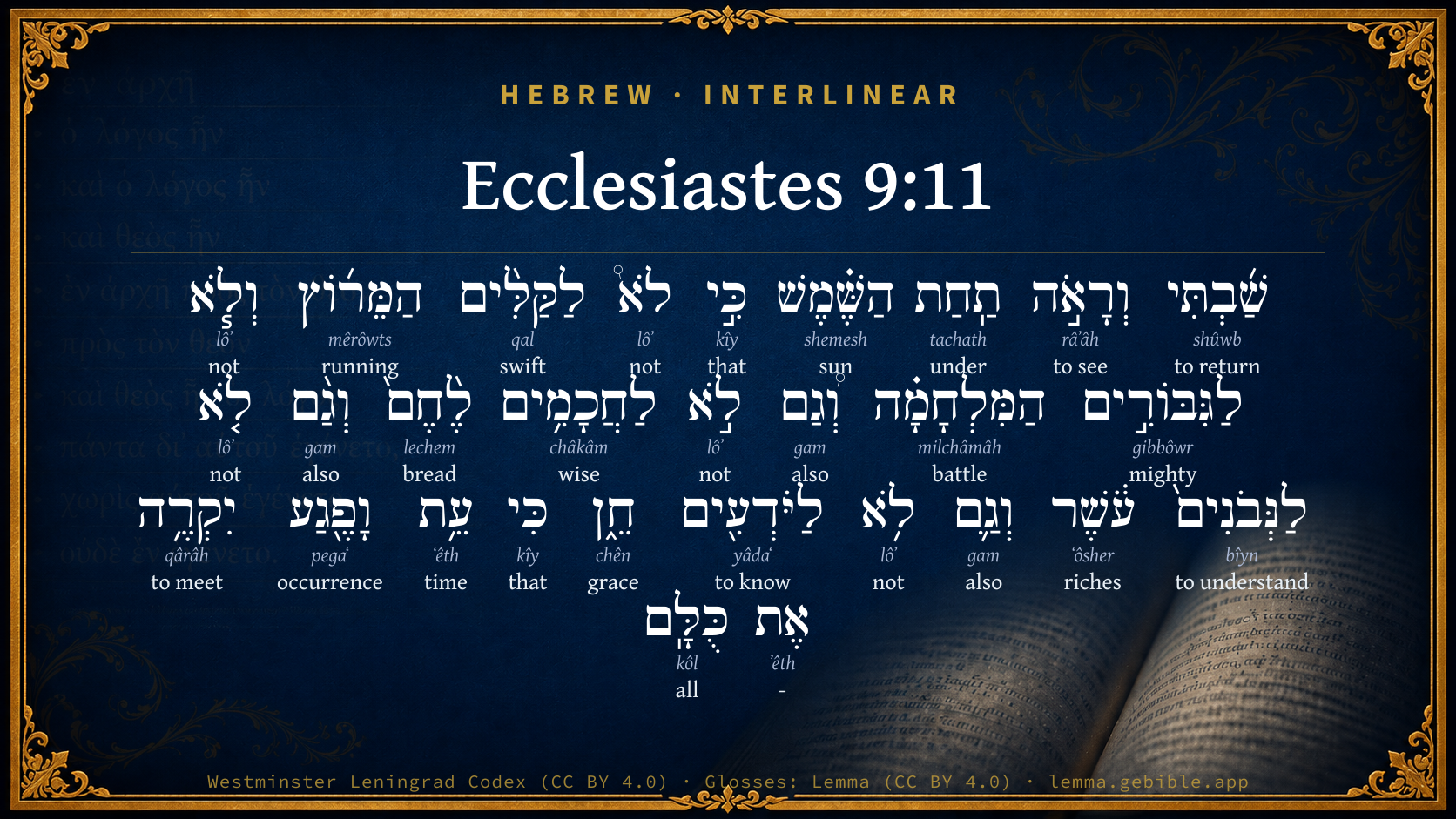
Ecclesiastes 9:11

Hebrew (Westminster Leningrad Codex) Ecclesiastes 9:11 appears in the Hebrew Old Testament. The text above is from the Westminster Leningrad Codex. Each word links to its Strong’s number, a concise gloss, and parsing drawn from the Open Scriptures Hebrew Bible morphology. Click any word for its full Brown-Driver-Briggs (BDB) entry.
Download image
Cite this verse

Ecclesiastes 9:11 (World English Bible). Public Domain. Lemma interlinear Bible study tool, https://lemma.gebible.app/v/ecclesiastes/9/11.

Show BibTeX & RIS
BibTeX
RIS
English Translation
I returned, and saw under the sun, that the race is not to the swift, nor the battle to the strong, neither yet bread to the wise, nor yet riches to men of understanding, nor yet favor to men of skill; but time and chance happen to them all.
World English Bible · Public Domain
Highlights
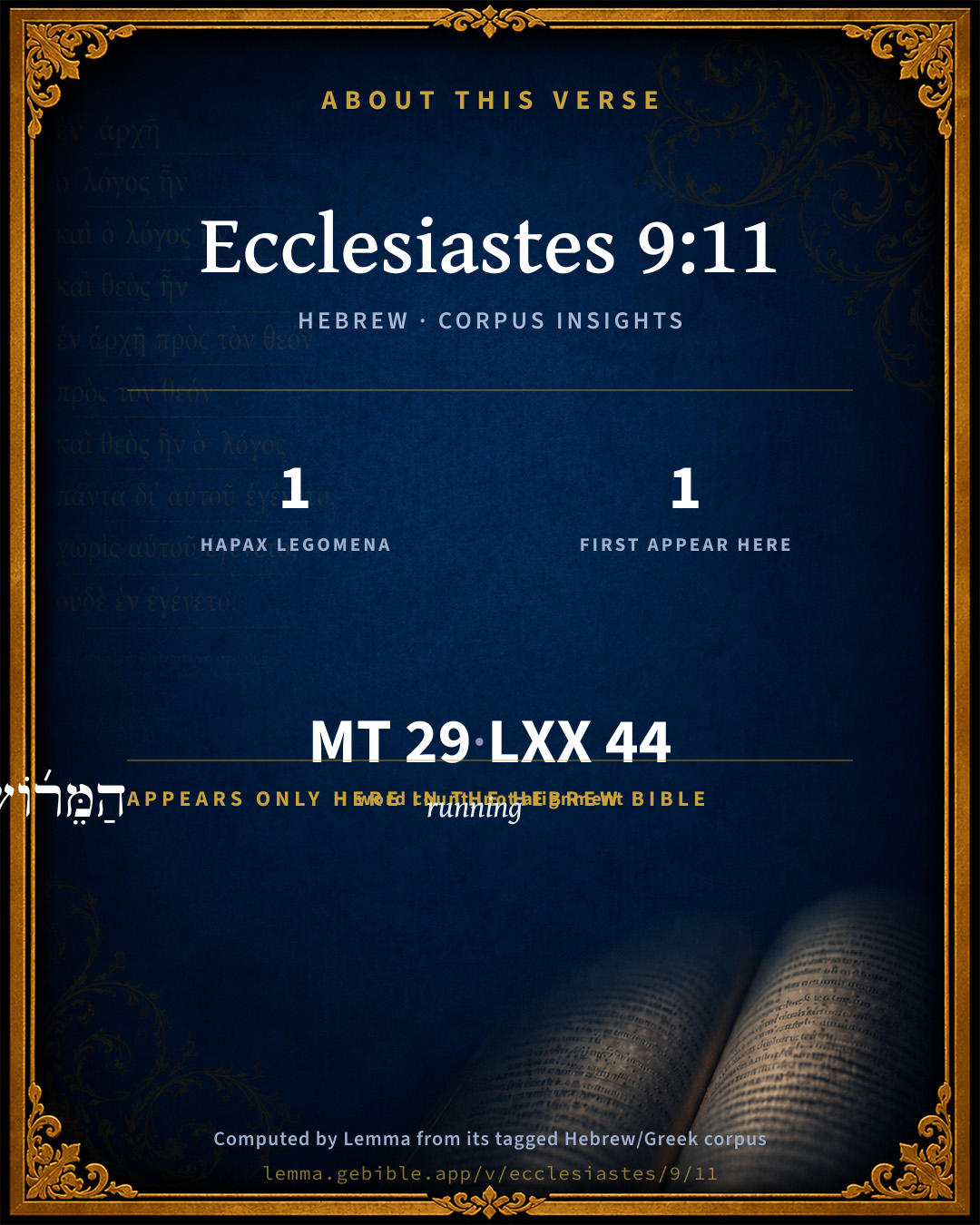
  • 1 hapax legomenon — only here in the Hebrew Bible
  • 1 first appearance in the Hebrew Bible
Full analysis ↓
Download a study sheet

One document with this verse’s original text, its word-by-word gloss line, the meaning frame, cross-references with their text, attributed commentary, and full source and license credits — printable, and it pastes into notes with its structure intact.

This verse Autodidact and up

Study sheet (.html) Plain text (.txt)

A passage Seminary Student

Up to 50 verses in one chapter. A passage sheet keeps up to 6 commentary sources and 12 cross-references per verse, in the order this page ranks them, and says so on the sheet whenever that leaves anything out. Ask for a single verse and you get the Autodidact verse sheet above.

Everything on this page stays free to read, with no account — the sheet is a download of what is already on screen, not access to it.

Want to remove ads? Support Godless Engineer
Compare translations 3

The same verse in 3 English versions, stacked beneath the original-language interlinear above. Click any original word for its lexicon entry.

Each is an independent rendering of the whole verse — the interlinear is not word-aligned to these translations.

Highlighted words mark where these versions differ — a whole-verse word diff, not a word-by-word alignment.

  • World English Bible Public Domain
    I returned, and saw under the sun, that the race is not to the swift, nor the battle to the strong, neither yet bread to the wise, nor yet riches to men of understanding, nor yet favor to men of skill; but time and chance happen to them all.
  • King James Version Public Domain
    I returned, and saw under the sun, that the race is not to the swift, nor the battle to the strong, neither yet bread to the wise, nor yet riches to men of understanding, nor yet favour to men of skill; but time and chance happeneth to them all.
  • unfoldingWord Literal Text CC BY-SA 4.0
    I again saw under the sun: That not to the swift the race, and not to the mighty the war, and even not to wise bread, and even not to discerning wealth, and even not to understanding favor, for a time and the occurrence will happen to all of them.

unfoldingWord Literal Text — © unfoldingWord, licensed CC BY-SA 4.0. Word-aligned USFM3 via Door43 (git.door43.org/unfoldingWord/en_ult).

Versions to compare (up to 4)

3 of 4 selected

Show all 18 translations

Every available English version of this verse, each an independent rendering of the whole verse.

  • World English Bible Public Domain
    I returned, and saw under the sun, that the race is not to the swift, nor the battle to the strong, neither yet bread to the wise, nor yet riches to men of understanding, nor yet favor to men of skill; but time and chance happen to them all.
  • Berean Standard Bible Public Domain
    I saw something else under the sun: The race is not to the swift, nor the battle to the strong; neither is the bread to the wise, nor the wealth to the intelligent, nor the favor to the skillful. For time and chance happen to all.
  • Majority Standard Bible Public Domain
    I saw something else under the sun: The race is not to the swift, nor the battle to the strong; neither is the bread to the wise, nor the wealth to the intelligent, nor the favor to the skillful. For time and chance happen to all.
  • King James Version Public Domain
    I returned, and saw under the sun, that the race is not to the swift, nor the battle to the strong, neither yet bread to the wise, nor yet riches to men of understanding, nor yet favour to men of skill; but time and chance happeneth to them all.
  • American Standard Version (1901) Public Domain
    I returned, and saw under the sun, that the race is not to the swift, nor the battle to the strong, neither yet bread to the wise, nor yet riches to men of understanding, nor yet favor to men of skill; but time and chance happeneth to them all.
  • Revised Version (1885) Public Domain
    I returned, and saw under the sun, that the race is not to the swift, nor the battle to the strong, neither yet bread to the wise, nor yet riches to men of understanding, nor yet favour to men of skill; but fame and chance happeneth to them all.
  • Geneva Bible (1599) Public Domain
    I returned, and I sawe vnder the sunne that the race is not to the swift, nor the battell to the strong, nor yet bread to the wise, nor also riches to men of vnderstanding, neither yet fauour to men of knowledge: but time and chance commeth to them all.
  • Douay-Rheims (1899) Public Domain
    I turned me to another thing, and I saw that under the sun, the race is not to the swift, nor the battle to the strong, nor bread to the wise, nor riches to the learned, nor favour to the skilful: but time and chance in all.
  • Young's Literal Translation Public Domain
    I have turned so as to see under the sun, that not to the swift `is' the race, nor to the mighty the battle, nor even to the wise bread, nor even to the intelligent wealth, nor even to the skilful grace, for time and chance happen with them all.
  • Literal Standard Version CC BY-SA 4.0
    I have turned so as to see under the sun, that not to the swift [is] the race, nor to the mighty the battle, nor even to the wise bread, nor even to the intelligent wealth, nor even to the skillful grace, for time and chance happen with them all.
  • Unlocked Literal Bible CC BY-SA 4.0
    I have seen some interesting things under the sun: The race does not belong to swift people. The battle does not belong to strong people. Bread does not belong to wise people. Riches do not belong to people of understanding. Favor does not belong to people of knowledge. Instead, time and chance affect them all.
  • unfoldingWord Literal Text CC BY-SA 4.0
    I again saw under the sun: That not to the swift the race, and not to the mighty the war, and even not to wise bread, and even not to discerning wealth, and even not to understanding favor, for a time and the occurrence will happen to all of them.
  • Darby Bible Public Domain
    I returned, and saw under the sun, that the race is not to the swift, nor the battle to the strong, neither yet bread to the wise, nor yet riches to the intelligent, nor yet favour to men of knowledge; but time and chance happeneth to them all.
  • World Messianic Bible Public Domain
    I returned and saw under the sun that the race is not to the swift, nor the battle to the strong, neither yet bread to the wise, nor yet riches to men of understanding, nor yet favor to men of skill; but time and chance happen to them all.
  • Webster's Bible Public Domain
    I returned, and saw under the sun, that the race is not to the swift, nor the battle to the strong, neither yet bread to the wise, nor yet riches to men of understanding, nor yet favor to men of skill; but time and chance happeneth to them all.
  • Free Bible Version CC BY-SA 4.0
    I thought about other things that happen here on earth. Races are not always won by the fastest runner. Battles are not always decided by the strongest warrior. Also, the wise do not always have food, intelligent people do not always make money, and those who are clever do not always win favor. Time and chance affect all of them.
  • Bible in Basic English Public Domain
    And again I saw under the sun that the reward goes not to him who is quick, or the fruits of war to the strong; and there is no bread for the wise, or wealth for men of learning, or respect for those who have knowledge; but time and chance come to all.
  • JPS Tanakh (1917) Public Domain
    I returned, and saw under the sun, that the race is not to the swift, nor the battle to the strong, neither yet bread to the wise, nor yet riches to men of understanding, nor yet favour to men of skill; but time and chance happeneth to them all.

Literal Standard Version (2020), Covenant Press — licensed CC BY-SA 4.0. Text via the HelloAO Bible API (eBible.org). Unlocked Literal Bible (unfoldingWord) — licensed CC BY-SA 4.0. Text via the HelloAO Bible API (eBible.org). unfoldingWord Literal Text — © unfoldingWord, licensed CC BY-SA 4.0. Word-aligned USFM3 via Door43 (git.door43.org/unfoldingWord/en_ult). Free Bible Version, Dr. Jonathan Gallagher — licensed CC BY-SA 4.0. Text via the HelloAO Bible API (eBible.org).

Word by word

More ways to search: Search by grammar → Find every occurrence → Compare this word →

Practice this passage: Drill this verse → Learn its vocabulary →

הַמֵּר֜וֹץ
mêrôwts
H4793
“the · running”
Particle, Definite Article + Noun, Common, Masculine, Singular, Absolute
Part of Speech
Particle + Noun
Type
Common
Gender
Masculine
Number
Singular
State
Absolute
Full BDB Definition

Origin: from H7323

TWOT: 2137a

running, race, course
  1. שַׁ֜בְתִּי shûwb H7725 “to return” Verb, Qal, Perfect, 1st Person, Common, Singular
  2. וְרָאֹ֣ה râʼâh H7200 “and · to see” Conjunction + Verb, Qal, Infinitive Absolute
  3. תַֽחַת tachath H8478 “under” Preposition
  4. הַשֶּׁ֗מֶשׁ shemesh H8121 “the · sun” Particle, Definite Article + Noun, Common, Both, Singular, Absolute
  5. כִּ֣י kîy H3588 “that” Conjunction
  6. לֹא֩ lôʼ H3808 “not” Particle, Negative
  7. לַקַּלִּ֨ים qal H7031 “to/for the · swift” Preposition, Determined + Adjective, Adjective, Masculine, Plural, Absolute
  8. וְלֹ֧א lôʼ H3808 “and · not” Conjunction + Particle, Negative
  9. לַגִּבּוֹרִ֣ים gibbôwr H1368 “to/for the · mighty” Preposition, Determined + Adjective, Adjective, Masculine, Plural, Absolute
  10. הַמִּלְחָמָ֗ה milchâmâh H4421 “the · battle” Particle, Definite Article + Noun, Common, Feminine, Singular, Absolute
  11. וְ֠גַם gam H1571 “and · also” Conjunction + Particle, Accusative
  12. לֹ֣א lôʼ H3808 “not” Particle, Negative
  13. לַחֲכָמִ֥ים châkâm H2450 “to/for the · wise” Preposition, Determined + Adjective, Adjective, Masculine, Plural, Absolute
  14. לֶ֨חֶם֙ lechem H3899 “bread” Noun, Common, Both, Singular, Absolute
  15. וְגַ֨ם gam H1571 “and · also” Conjunction + Particle, Accusative
  16. לֹ֤א lôʼ H3808 “not” Particle, Negative
  17. לַנְּבֹנִים֙ bîyn H995 “to/for the · understanding” Preposition, Determined + Verb, Niphal, Participle Active, Masculine, Plural, Absolute
  18. עֹ֔שֶׁר ʻôsher H6239 “riches” Noun, Common, Masculine, Singular, Absolute
  19. וְגַ֛ם gam H1571 “and · also” Conjunction + Particle, Accusative
  20. לֹ֥א lôʼ H3808 “not” Particle, Negative
  21. לַיֹּדְעִ֖ים yâdaʻ H3045 “to/for the · knowing” Preposition, Determined + Verb, Qal, Participle Active, Masculine, Plural, Absolute
  22. חֵ֑ן chên H2580 “grace” Noun, Common, Masculine, Singular, Absolute
  23. כִּי kîy H3588 “that” Conjunction
  24. עֵ֥ת ʻêth H6256 “time” Noun, Common, Both, Singular, Absolute
  25. וָפֶ֖גַע pegaʻ H6294 “and · occurrence” Conjunction + Noun, Common, Masculine, Singular, Absolute
  26. יִקְרֶ֥ה qârâh H7136 “to meet” Verb, Qal, Imperfect, 3rd Person, Masculine, Singular
  27. אֶת ʼêth H853 “-” Particle, Direct Object
  28. כֻּלָּֽם kôl H3605 “all · their” Noun, Common, Masculine, Singular, Construct + Suffix, Personal, 3rd Person, Masculine, Plural

About this verse

These counts appear in no published source. They are computed here, from the morphology-tagged text and Lemma’s own curated glosses. What Lemma adds →

29
words
22
distinct lemmas
Wisdom
section

Notable vocabulary

1 hapax legomenon — a word that appears only here in the entire Hebrew Bible:

  • הַמֵּר֜וֹץ running H4793

First appearance in Scripture

This word makes its first canonical appearance in the Hebrew Bible here:

  • הַמֵּר֜וֹץ running H4793

Shared distinctive vocabulary

וָפֶ֖גַע occurrence H6294 occurs in 2 verses of the Hebrew Bible. Also found in:

Grammatical profile

  • 5 verbs
  • 9 nouns
  • 3 adjectives
  • 1 preposition
  • 2 conjunctions
  • 9 particles

Verb forms

  • שַׁ֜בְתִּי Qal · Perfect
  • וְרָאֹ֣ה Qal · Infinitive Absolute
  • לַנְּבֹנִים֙ Niphal · Participle Active
  • לַיֹּדְעִ֖ים Qal · Participle Active
  • יִקְרֶ֥ה Qal · Imperfect

Repetition

Words recur within this verse — often emphatic in Hebrew:

  • וְ֠גַם also H1571 ×3
  • לֹא֩ not H3808 ×5
  • כִּ֣י that H3588 ×2

Hebrew & Septuagint length

In English translation the verse runs 49 words from the Hebrew and 50 from the Septuagint (LXX English) — closely comparable.

A rough comparison of the two English renderings, which tokenize alike — not a word-level alignment.

Word counts can differ between the Hebrew and the Greek without any difference in meaning — e.g. the Hebrew direct-object marker אֵת has no separate Greek word, and Greek often adds the article ὁ.

In the original languages it is 29 Hebrew tokens and 44 Greek tokens — but the two are counted differently (Hebrew bundles its prefixes and suffixes into one token; the Greek is in lemma form), so that isn’t a like-for-like length.

Cross-references

27

Topical passages linked to Ecclesiastes 9:11 in the Treasury of Scripture Knowledge — connected by theme and wording, ordered by reader-vote popularity; previews shown in the World English Bible.

  • Jeremiah 9:23 Thus says Yahweh, Don't let the wise man glory in his wisdom, neither let the mighty man glory in his might, don't let the rich man glory in his riches;
  • Proverbs 21:30–31 There is no wisdom nor understanding Nor counsel against Yahweh.
  • Job 5:11–14 So that he sets up on high those who are low, Those who mourn are exalted to safety.
  • Lamentations 3:37–38 Who is he who says, and it comes to pass, when the Lord doesn't command it?
  • Ecclesiastes 3:17 I said in my heart, "God will judge the righteous and the wicked; for there is a time there for every purpose and for every work."
  • Ecclesiastes 3:14 I know that whatever God does, it shall be forever. Nothing can be added to it, nor anything taken from it; and God has done it, that men should fear before him.
  • Amos 2:14–16 Flight will perish from the swift; And the strong won't strengthen his force; Neither shall the mighty deliver himself;
  • Psalms 147:10–11 He doesn't delight in the strength of the horse. He takes no pleasure in the legs of a man.
  • Ephesians 1:11 in whom also we were assigned an inheritance, having been foreordained according to the purpose of him who works all things after the counsel of his will;
  • 2 Chronicles 20:15 and he said, Listen you, all Judah, and you inhabitants of Jerusalem, and you king Jehoshaphat: Thus says Yahweh to you, Don't be afraid you, neither be dismayed by reason of this great multitude; for the battle is not yours, but God's.
  • Ecclesiastes 2:14–15 The wise man's eyes are in his head, and the fool walks in darkness--and yet I perceived that one event happens to them all.
  • Deuteronomy 8:18 But you shall remember Yahweh your God, for it is he who gives you power to get wealth; that he may establish his covenant which he swore to your fathers, as at this day.
  • Ecclesiastes 4:4 Then I saw all the labor and achievement that is the envy of a man's neighbor. This also is vanity and a striving after wind.
  • Jeremiah 46:6 Don't let the swift flee away, nor the mighty man escape; in the north by the river Euphrates have they stumbled and fallen.
  • 1 Samuel 2:3–10 Talk no more so exceeding proudly; Don't let arrogance come out of your mouth; For Yahweh is a God of knowledge, By him actions are weighed.
  • Ecclesiastes 7:13 Consider the work of God, for who can make that straight, which he has made crooked?
  • 2 Samuel 17:14 Absalom and all the men of Israel said, The counsel of Hushai the Archite is better than the counsel of Ahithophel. For Yahweh had ordained to defeat the good counsel of Ahithophel, to the intent that Yahweh might bring evil on Absalom.
  • Job 34:29 When he gives quietness, who then can condemn? When he hides his face, who then can see him? Alike whether to a nation, or to a man:
  • Psalms 33:16–17 There is no king saved by the multitude of a host. A mighty man is not delivered by great strength.
  • Psalms 73:6–7 Therefore pride is like a chain around their neck. Violence covers them like a garment.
  • Ecclesiastes 2:12 I turned myself to consider wisdom, madness, and folly: for what can the king's successor do? Just that which has been done long ago.
  • Ecclesiastes 4:1 Then I returned and saw all the oppressions that are done under the sun: and, behold, the tears of those who were oppressed, and they had no comforter; and on the side of their oppressors there was power; but they had no comforter.
  • 1 Samuel 17:50 So David prevailed over the Philistine with a sling and with a stone, and struck the Philistine, and killed him; but there was no sword in the hand of David.
  • Malachi 3:18 Then you shall return and discern between the righteous and the wicked, between him who serves God and him who doesn't serve him.
  • 2 Samuel 17:23 When Ahithophel saw that his counsel was not followed, he saddled his donkey, and arose, and got him home, to his city, and set his house in order, and hanged himself; and he died, and was buried in the tomb of his father.
  • Daniel 4:35 All the inhabitants of the earth are reputed as nothing; and he does according to his will in the army of heaven, and among the inhabitants of the earth; and none can stay his hand, or tell him, What do you?
  • 2 Samuel 2:18–23 The three sons of Zeruiah were there, Joab, and Abishai, and Asahel: and Asahel was as light of foot as a wild gazelle.

Cross-references courtesy of OpenBible.info (CC BY 4.0).

Hebrew and Greek witnesses Masoretic Hebrew ↔ Greek Septuagint

The same verse in the two great witnesses to the Old Testament, shown verse-for-verse.

These are two independent witnesses, not word-aligned to each other, and the Septuagint is shown in lemma (dictionary) form.

Hebrew Ecclesiastes 9:11 Masoretic · Westminster Leningrad Codex

שַׁ֜בְתִּי וְרָאֹ֣ה תַֽחַת הַשֶּׁ֗מֶשׁ כִּ֣י לֹא֩ לַקַּלִּ֨ים הַמֵּר֜וֹץ וְלֹ֧א לַגִּבּוֹרִ֣ים הַמִּלְחָמָ֗ה וְ֠גַם לֹ֣א לַחֲכָמִ֥ים לֶ֨חֶם֙ וְגַ֨ם לֹ֤א לַנְּבֹנִים֙ עֹ֔שֶׁר וְגַ֛ם לֹ֥א לַיֹּדְעִ֖ים חֵ֑ן כִּי עֵ֥ת וָפֶ֖גַע יִקְרֶ֥ה אֶת כֻּלָּֽם

I returned, and saw under the sun, that the race is not to the swift, nor the battle to the strong, neither yet bread to the wise, nor yet riches to men of understanding, nor yet favor to men of skill; but time and chance happen to them all.

World English Bible · Public Domain

Greek LXX Ecclesiastes 9:11 Septuagint · lemma form

ἐπιστρέφω καί ὁράω ὑπό ὁ ἥλιος ὅτι οὐ ὁ κοῦφος ὁ δρόμος καί οὐ ὁ δυνατός ὁ πόλεμος καί γέ οὐ ὁ σοφός ἄρτος καί γέ οὐ ὁ συνετός πλοῦτος καί γέ οὐ ὁ γιγνώσκω χάρις ὅτι καιρός καί ἀπάντημα συνἀντάω ὁ πᾶς αὐτός

I returned, and saw under the sun, that the race is not to the swift, nor the battle to the strong, nor yet bread to the wise, nor yet wealth to men of understanding, nor yet favor to men of knowledge; for time and chance will happen to them all.

LXX2012 (modern English Septuagint) · Public Domain

On this verse, John Gill's Exposition discusses the Septuagint’s reading. Read the note in Commentary ↓

Hebrew: Westminster Leningrad Codex (CC BY 4.0). Greek: Septuagint (public domain); English from LXX2012 (modern English Septuagint) (Public Domain). How the Septuagint differs from the Hebrew →

Commentary

Notes on Ecclesiastes 9:11 from classic Christian and Jewish commentators (each source and its license shown beneath its notes). The classic Christian expositions comment on the surrounding passage and are grouped to its opening verse, so a note may address several verses; the Jewish commentaries on the Tanakh (Rashi and others) are per-verse, so they appear only where the commentator wrote on this verse.

Lemma curates 59 commentaries, every one of them public domain or Creative Commons licensed, each selected and text-cleaned for this edition rather than reprinted as found. About our sources →

Matthew Henry's Commentary

The preacher here, for a further proof of the vanity of the world, and to convince us that all our works are in the hand of God, and not in our own hand, shows the uncertainty and contingency of future events, and how often they contradict the prospects we have of them. He had exhorted us (Ecc 9:10) to do what we have to do with all our might; but here he reminds us that, when we have done all, we must leave the issue with God, and not be confident of the success.

I. We are often disappointed of the good we had great hopes of, Ecc 9:11. Solomon had himself made the observation, and so has many a one since, that events, both in public and private affairs, do not always agree even with the most rational prospects and probabilities. Nulli fortuna tam dedita est ut multa tentanti ubique respondeat - Fortune surrenders herself to no one so as to ensure him success, however numerous his undertakings. Seneca. The issue of affairs is often unaccountably cross to every one's expectation, that the highest may not presume, nor the lowest despair, but all may live in a humble dependence upon God, from whom every man's judgment proceeds.

1. He gives instances of disappointment, even where means and instruments were most encouraging and promised fair. (1.) One would think that the lightest of foot should, in running, win the prize; and yet the race is not always to the swift; some accident happens to retard them, or they are too secure, and therefore remiss, and let those that are slower get the start of them. (2.) One would think that, in fighting, the most numerous and powerful army should be always victorious, and, in single combat, that the bold and mighty champion should win the laurel; but the battle is not always to the strong; a host of Philistines was once put to flight by Jonathan and his man; one of you shall chase a thousand; the goodness of the cause has often carried the day against the most formidable power. (3.) One would think that men of sense should always be men of substance, and that those who know how to live in the world should not only have a plentiful maintenance, but get great estates; and yet it does not always prove so; even bread is not always to the wise, much less riches always to men of understanding. Many ingenious men, and men of business, who were likely to thrive in the world, have strangely gone backward and come to nothing. (4.) One would think that those who understand men, and have the art of management, should always get preferment and obtain the smiles of great men; but many ingenious men have been disappointed, and have spent their days in obscurity, nay, have fallen into disgrace, and perhaps have ruined themselves by those very methods by which they hoped to raise themselves, for favour is not always to men of skill, but fools are favoured and wise men frowned upon.

2. He resolves all these disappointments into an over-ruling power and providence, the disposals of which to us seem casual, and we call them chance, but really they are according to the determinate counsel and foreknowledge of God, here called time, in the language of this book, Ecc 3:1; Psa 31:15. Time and chance happen to them all. A sovereign Providence breaks men's measures, and blasts their hopes, and teaches them that the way of man is not in himself, but subject to the divine will. We must use means, but not trust to them; if we succeed, we must give God the praise (Psa 44:3); if we be crossed, we must acquiesce in his will and take our lot.

II. We are often surprised with the evils we were in little fear of (Ecc 9:12): Man knows not his time, the time of his calamity, his fall, his death, which, in scripture, is called our day and our hour. 1. We know not what troubles are before us, which will take us off our business, and take us out of the world, what time and chance will happen to us, nor what one day, or a night, may bring forth. It is not for us to know the times, no, not our own time, when or how we shall die. God has, in wisdom, kept us in the dark, that we may be always ready. 2. Perhaps we may meet with trouble in that very thing wherein we promise ourselves the greatest satisfaction and advantage; as the fishes and the birds are drawn into the snare and net by the bait laid to allure them, which they greedily catch at, so are the sons of men often snared in an evil time, when it falls suddenly upon them, before they are aware. And these things too come alike to all. Men often find their bane where they sought their bless, and catch their death where they thought to find a prize. Let us therefore never be secure, but always ready for changes, that, though they may be sudden, they may be no surprise or terror to us.

Matthew Henry's Commentary on the Whole Bible (1708–1710) — public domain (CC PDM 1.0). Text via the HelloAO Bible API.

Trapp's Complete Commentary

John Trapp

Ecc 9:11 I returned, and saw under the sun, that the race [is] not to the swift, nor the battle to the strong, neither yet bread to the wise, nor yet riches to men of understanding, nor yet favour to men of skill; but time and chance happeneth to them all.

Ver. 11. That the race is not to the swift.] Here the Preacher proverb - what he had found true by experience - by the event of men’s endeavours, often frustrated, that nothing is in our power, but all carried on by a Providence, which oft crosseth our likeliest projects, that God may have the honour of all. Let a man be as swift as Asahel or Atalanta, yet he may not get the goal or escape the danger. The battle of Terwin, in France, fought by our Henry VIII, was called the ‘Battle of Spurs,’ because many fled for their lives, who yet fell (as the men of Ai did) into the midst of their enemies. {a} At Musselburgh Field, many of the Scots running away, so strained themselves in their race, that they fell down breathless and dead, whereby they seemed in running from their deaths to run to it, whereas two thousand of them that lay all day as dead, got away safely in the night. {b}

Nor the battle to the strong.] As we see in the examples of Gideon, Jonathan and his armourbearer, David in his encounter with Goliath, Leonidas, who with six hundred men worsted five hundred thousand of Xerxes’ host. "They shall be holpen with a little help." {Dan 11:34} And why a little? That through weaker means we may see God’s greater strength. "Not by might, nor by power, but by my Spirit, saith the Lord." {Zec 4:6} This Rabshakeh knew not, and therefore derided Hezekiah for trusting to his prayers. {Isa 36:5} What can Hezekiah say to embolden him to stand out? What? I say, saith Hezekiah, "I have words of my lips" - that is, prayer. Prayer! saith Rabshakeh, those are empty words, an airy thing; for "counsel and strength are for the war"; so some read the words, and not in a parenthesis, as our translation hath it.

Neither yet bread to the wise.] To the worldlywise. Those "young lions do lack and suffer hunger; but they that seek the Lord shall not want any good thing." {Psa 34:10} Their daily bread day by day, panem demensi, "food convenient for them," {Pro 30:8} they shall be sure of. "Dwell in the land, and do good, and verily thou shalt be fed," {Psa 37:5} by virtue of a promise, and not by a providence only, as the young ravens are.

Nor yet riches to men of understandlng.] Plutus is said by the poets to be blind, and fortune to favour fools. Of Pope Clement V the French chronicler saith, Papa hic ditior fuit quam sapientior, This pope was rather rich than wise. {c} Aristides was so poor, that he brought a slur upon Justice, saith Plutarch, as if she were not able to maintain her followers. Phocian also, Pelopidas, Lamachus, Ephialtes, Socrates, those Greek sages, were very poor. {d} Epaminondas had but one garment, and that a sorry one too. {e} Lactantius had scarce a subsistence. Many wise men have been hard put to it. Paupertas est philosophiae vernacula, saith Apuleius.

Nor yet favour to men of skill.] Rara ingeniorum praemia, rara item est merces, saith one, {f} Wit and skill is little set by, small regard or reward is given to it; whereas popular men should esteem it as silver, said Aeneas Sylvius, noblemen as gold, princes as pearls.

But time and chance happeneth to them all,] i.e., Everything is done in its own time, and as God by his providence ordereth it, not as men will; much less by haphazard, for that which to us is casual and contingent, is by God Almighty foreappointed and effected, who must therefore be seen and sought unto in the use of means and second causes. And if things succeed not to our minds, but that we "labour in the fire," yet we must "glorify God in the fire," and live by faith.

“ Vivere spe vidi qui moriturus erat. ”

{a} Speed.

{b} Life of Edward VI, by Sir John Heywood.

{c} Epit. Hist. Gallic.

{d} Aelian., lib. ii.

{e} Ibid., lib. v.

{f} Rhodigin, lib. xxix. cap. 10.

John Trapp, A Commentary or Exposition upon All the Books of the Old and New Testament (1647–1656) — public domain. Text from a community e-Sword module.

The Biblical Illustrator

Joseph S. Exell

Ecc_9:11

I returned, and saw under the sun that the race is not to the swift, nor the battle to the strong.

The client of things not always answerable to second causes

There are some persons so slothful in their own affairs, so hardly prevailed upon to undertake anything that requires labour, so easily discouraged by any appearance of ill success, or so heedless and inactive in the prosecution of whatever they are about; as if they were of opinion, even in temporal matters, what in some systems of religion has been absurdly affirmed concerning spirituals, that God does everything in men and for men, leaving nothing for them to do for themselves; or as if they thought that precept to be literal and universal which our Saviour spake with the latitude of a moral admonition to the apostles only, and upon an extraordinary occasion, Take no thought for the morrow etc. There are others, in a contrary extreme, who rely with such confidence on the effects of their own wisdom and industry, and so presumptuously depend upon the natural and regular tendencies of second causes; as if they thought, either there was no superior cause at all, on which the frame of nature depended; or at least, that the providence of God did not condescend to direct the events of things in this lower and uncertain world. And these are proved in the words of my text, I returned. Solomon turned his thoughts and observations from one subject to another. In the verse before the text he views the careless or negligent part of mankind, and exhorts them to diligence. And then, I returned, saith he; that is, he turned his view the other way, towards the confident or presumptuous; and them he bids to take notice that the race is not always to the swift, nor the battle to the strong; that is, that the events of things do not always answer to the probabilities of second causes, unless the wisdom of God thinks fit by the direction of His good providence to make those causes successful.

I. Doctrinal observations.

1. What men vulgarly call chance or unforeseen accident is in Scripture always declared to be the determinate counsel and providence of God. And it is strictly and philosophically true in nature and reason that there is no such thing as chance or accident; it being evident that those words do not signify anything really existing, anything that is truly an agent or the cause of any event; but they signify merely mens ignorance of the real and immediate cause. And this is so true, that very many even of those who have no religion, nor any sense at all of the providence of God, yet know very well, by the light of their own natural reason, that there neither is nor can be any such thing as chance, that is, any such thing as an effect without a cause; and therefore what others ascribe to chance, they ascribe to the operation of necessity or fate. But fate also is itself in reality as truly nothing as chance is. Nor is there in nature any other efficient or proper cause of any event, but only the free will of rational and intelligent creatures acting within the sphere of their limited faculties; and the supreme power of God, directing, by His omnipresent providence (according to certain wise laws or rules, established by, and entirely depending upon, His own good pleasure), the inanimate motions of the whole material and unintelligent world.

2. The all-directing providence of God, which governs the universe, does not superintend only the great events in the world, the fates of nations and kingdoms; so that, without the direction of providence, the strongest and most numerous armies are not victorious in battle; but its care extends even to the concerns of single persons, so that, without the blessing of God, neither riches, nor favour, nor any temporal advantage can certainly be obtained by anything that man can do; nay, that even in matters of still smaller moment, not so much as a race is gained by the swift without the hand of Providence directing the event.

3. Things being brought about according to the course of nature by second causes is not at all inconsistent with their being nevertheless justly and truly ascribed to the providence of God. For what are natural causes? Nothing but those laws and powers which God merely of His own good pleasure has implanted in the several parts of matter, in order to make them instruments of fulfilling His supreme will. Which laws and powers, as He at first appointed them, so nothing but the same good pleasure of God continually preserves them. And they neither exist nor operate in any moment of time, but by influence and action derived to them (mediately or immediately) from His all-governing will. So that He foresees perpetually what effect every power and operation of nature tends to produce; and could (if He thought fit) exactly with the same ease cause it to produce a different effect as that which it now does. From whence it follows inevitably, to the entire confusion of atheists, that all those things which they call natural effects are in very truth as much the operation of God as even miracles themselves. And to argue against Providence from the observation of the regular course of natural causes, is as if a man should conclude from the uniformity of a large and beautiful building that it was not the work of mens hands, nor contrived by any free agent, because the stones and the timber were laid uniformly and regularly in the most constant, natural, and proper order.

4. Since the whole course of nature in the ordinary method of causes and effects, and all those unexpected turns of things which men vulgarly call chance and accident are entirely in the hand of God, and under the continual direction of His providence; it follows evidently that God can, whenever He pleases, even without a miracle, punish the disobedient; and no swiftness, no strength, no wisdom, no artifice shall enable them to escape the vengeance which even natural causes only, by the direction of Him from whom they receive their nature, bring upon offenders. He can punish by fires and famine, by plagues and pestilences, by storms and earthquakes, by domestic commotions, or by foreign enemies. And it is the exceeding stupidity of profane men not to be moved hereby to repent and give glory to the God of Heaven, who hath power over these plagues (Rev_16:9). The meaning of this whole observation is, not that these judgments are always certain signs of Gods displeasure against all the particular persons upon whom they at any time fall. But whether they be punishments for sin (as they generally, though not always, are); or whether they be only trials of mens virtue (as they sometimes are designed to be); or whether they be means of weaning them from this transitory and uncertain world; or whatever other end Providence brings about thereby; still they are always effects of the same all-wise Divine providence, which ought to be acknowledged and submitted to as such, and whose designs no power or wisdom of frail and vain men can oppose or prevent.

II. Practical inferences.

1. If these things be so, then let the greatest and most powerful of wicked men consider that they have nothing in this world either to boast of, or to rely upon (Jer_9:23).

2. If nothing happens in the world without the Divine providence, then good men have a sufficient ground of trust and reliance upon God, at all times and under all dangers. Not that God will always deliver them, or cause them to prosper in the present world; for He often sees it better to determine otherwise; but they may rely with assurance that nothing can befall them but what He judges fit, seeing all the powers of nature and of second causes are nothing but instruments in His hand, and under His direction.

3. From this notion of Providence may be given a plain and direct answer to that question of the profane fatalist (Job_21:15). Indeed, if the course of nature, and those things which we call second causes were independent upon Providence, there would be good reason to ask, what benefit could there be either in prayer or thanksgiving? But if, as has been shown, nature is nothing, and second causes are nothing but mere instruments; then it is very plain that prayer and thanksgiving are as much due to God for whatever is brought about by natural causes, as if He had done the thing by any other instruments instead of these, even by the most miraculous ones; which, in that case, being no less constant, would have been no more miraculous than these. (S. Clarke, D. D.)

Success not always answerable to the probability of second causes

Next to the acknowledgment of Gods being, nothing is more essential to religion than the belief of His providence, and a constant dependence Upon Him as the great Governor of the world and the wise Disposer of all the affairs and concernments of the children of men; and nothing can be a greater argument of providence than that there is such an order of causes laid in nature, that in ordinary course everything does usually attain its end; and yet that there is such a mixture of contingency as that now and then we cannot tell how nor why the most likely causes do deceive us, and fail of producing their usual effects. The sum of the Preachers advice is this: When thou propoundest any end to thyself, be diligent and vigorous in the use of means; and when thou hast done all, look above and beyond these to a superior Cause which overrules, and steers, and stops, as He pleases, all the motions and activity of second causes; and be not confident that all things are ever so wisely and firmly laid that they cannot fail of success. For the providence of God doth many times step in to divert the most probable event of things, and to turn it quite another way; and whenever He pleases to do so, the most strong and likely means do fall lame, or stumble, or by some accident or other come short of their end. The words thus explained contain this general proposition--That in human affairs the most likely means do not always attain their end, nor does the event constantly answer the probability of second causes; but there is a secret providence which governs and overrules all things, and does, when it pleases, interpose to defeat the most hopeful and probable designs.

I. For the confirmation and illustration of this proposition, that the most likely means do not always attain their end; but there is a secret providence which overrules and governs all events, and does, when it pleases, interpose to defeat the most probable and hopeful designs. The race is not to the swift. If we understand this literally, it is obvious to every man to imagine a great many accidents in a race which may snatch victory from the swiftest runner. If we understand it as the Chaldee paraphrase does, with relation to war, that the swiftest does not always overcome or escape in the day of battle; of this Asahel is an eminent instance, who, though he was, as the Scripture tells us, light of foot as a wild roe, yet did he not escape the spear of Abner. Nor yet bread to the wise, or to the learned. The poverty of poets is proverbial; and there are frequent instances in history of eminently learned persons that have been reduced to great straits and necessities. Nor yet riches to men of understanding: by which, whether we understand men of great parts, or of great diligence and industry, it is obvious to every mans observation that an ordinary capacity and understanding does usually lie more level to the business of a common trade and profession than more refined and elevated parts; which lie rather for speculation than-practice, and are better fitted for the pleasure and ornament of conversation than for the toil and drudgery of business: as a fine razor is admirable for cutting hairs, but the dull hatchet much more proper for hewing a hard and knotty piece of timber. And even when parts and industry meet together, they are many times less successful in the raising of a great estate than men of much lower and slower understandings; because these are apt to admire riches, which is a great spur to industry; and because they are perpetually intent upon one thing, and mind but one business, from which their thoughts never straggle into vain and useless inquiries after knowledge, or news, or public affairs; all which being foreign to their business, they leave to those who are, as they are wont to say of them in scorn, more curious, and too wise to be rich. Nor yet favour to men of skill. All history is full of instances of the casual advancement of men to great favour and honour, when others, who have made it their serious study and business, have fallen short of it.

II. Some reason and account of this, why the providence of God doth sometimes thus interpose to hinder and defeat the most probable designs of men:--To bring men to an acknowledgment of His providence, and of their dependence upon Him, and subordination to Him; and that He is the great Governor of the world, and rules in the kingdoms of men. God hath so ordered things in the administration of the affairs of the world as to encourage the use of means; and yet so as to keep men in a continual dependence upon Him for the efficacy and success of them: to encourage industry and prudence God generally permits things to their natural course, and to fall out according to the power and probability of second causes. But then, lest men should cast off religion, and deny the God that is above: lest they should trust in their sword and their bow, and say, the Lord hath not done this: lest men should look upon themselves as the creators and framers of their own fortune, and when they do but a little outstrip others in wisdom or power, in the skill and conduct of human affairs, they should grow proud and presumptuous, God is pleased sometimes more remarkably to interpose, to hide pride from man, as the expression is in Job; to check the haughtiness and insolence of mens spirits, and to keep them within the bounds of modesty and humility; to make us to know that we are but men, and that the reins of the world are not in our hands, but that there is One above who sways and governs all things here below.

III. Some inferences from what hath been said upon this argument.

1. From hence we may learn not to account religion, and time spent in the service of God, and in prayer to Him for His blessing upon our endeavours, to be any hindrance to our affairs. For after we have done all we can, the event is still in Gods hand, and rests upon the disposal of His providence. And did men firmly believe this, they would not neglect the duty of prayer, and behave themselves so carelessly, and unconcernedly, and irreverently in it as we see too many do; they would not look upon every hour that is spent in devotion as lost from their business.

2. From hence we may likewise learn so to use the means as still to depend upon God; who can, as He pleases, bless the counsels and endeavours of men, or blast them and make them of none effect. For as God hath promised nothing but to a wise and diligent use of means, so all our prudence, and industry, and most careful preparations may miscarry, if He do not favour our design; for without Him nothing is wise, nothing is strong, nothing is able to reach and attain its end.

3. The consideration of what hath been said upon this argument should keep us from being too sanguine and confident of the most likely designs and undertakings; because these do not always answer the probability of second causes and means; and never less than when we do with the greatest confidence rely upon them; when we promise most to ourselves from them, then are they most likely to deceive us; they are, as the prophet compares them, like a broken reed, which a man may walk with in his hand, while he lays no great stress upon it; but if he trust to it, and lean his whole weight on it, it will not only fail him, but even pierce him through. (J. Tillotson, D. D.)

Many endeavours of the creature are often frustrated of their end when there is greatest probability of success

Here Solomon representeth men--

1. Under several accomplishments of swift, wise, strong.

2. As addressing themselves to some effect to obtain success.

3. As in the issue disappointed. None of these accomplishments alone do give the event intended and hoped for, nor doth it depend absolutely and infallibly upon them.

4. That all things intended, desired, expected by us depend upon time and chance, namely, as they depend upon Gods providence, as and when God will order and determine the time and opportunity, the success and event. Therefore from the whole it appears that instruments most fitted and furnished, and most diligent in their way, are frustrated of the event which they so earnestly intended and hoped for.

I. The best instruments fail out of their ignorance, oblivion, and inadvertency, from which man cannot altogether free himself in this life, not only in matters spiritual, but secular, whether economical in the disposing of ourselves and relations, or family interests and concernments.

II. Because if we have sufficient knowledge, yet God can easily put some impediment from within or without to hinder the use of our wisdom, power, and knowledge.

1. Within he can blast our excellencies in an instant, or obstruct the use of it for the time. As though He did not destroy the property of the fire, yet he suspended the burning, when the three children were in the furnace. So of a sudden can He blast our strength (Psa_16:5-6).

2. From without. By casting in some casual event which we foresaw not and could not think of.

III. The most able instruments do often provoke God to disappoint them, whilst their abilities of counsel and strength are a means of hardening their hearts in carnal confidence, and often engage in business that proves mischievous to them; I say, in the most lawful businesses they provoke God to disappoint them, because they undertake them without God; but too often being unrenewed and unsanctified, their wit and power is used against God.

IV. To say and do, or to make a thing to be, is the act and name of Jehovah, which glory He will not communicate to any other (Lam_3:37). Therefore, whatever preparation of means or likelihoods there are, we must not be too confident of future events. We cannot bring them to pass by our own power, and God doth not always work by likely means; He hides events from men (Isa_48:7). Lest thou shouldst say, I knew them. Now the event could not be hidden if the Lord went on in a constant course, giving the race to the swift, etc. God carrieth on His providence so as to leave no footsteps behind Him. He goeth not one way so often as to make a path of it, that men may see the plain tendency thereof. The uses follow. It teaches us--

I. The nothingness of the creature, and the all-sufficiency of God.

II. To teach us in this lottery of human affairs to look after surer comforts. This is the whole drift of this book; for Solomon, in his critical search and observation of all things done under the sun, aimeth at this, to direct our hearts to blessings which are more stable and sure. God would leave these things at uncertainty, that our hearts might not too much be set upon them, that we might not pursue after favour, riches, and credit as the best things.

III. What need there is God should be seen and sought unto in all our designs and resolutions about the disposal of ourselves and ours.

1. What will the use of means and second causes do without God?

2. When we have done our duty, and used such good means as God affordeth, then we may quietly refer the success to God, in whose hands are all the ways of the children of men, and upon whose good pleasure the issues of all things depend (Pro_16:13).

IV. The wisest and best of men must not expect always to be happy, but must prepare themselves for sinister chances; for the words are brought in upon this occasion of rejoicing in our comforts.

V. Take heed of carnal confidence, or depending upon the sufficiency of any means, though never so likely to produce their effect.

VI. To keep humble men of the best abilities and sufficiencies for any work.

1. Before the event; for many times they meet with more disappointments than those that want them, and their best designs miscarry when meaner persons are carried through their difficulties with less ado.

2. After the event we must look above second causes, not attribute anything to our own strength or gifts, but to Gods assistance and blessing on our labours.

VII. To prevent the discouragement of those that want gifts, or parts, or means. God many times passeth over the strong, wise, and understanding, and gets Himself most glory in protecting the weak, and providing for them. The issue of all is this: Let us bear all things befalling us from the wise hand and providence of the Lord, and encourage ourselves in His all-sufficiency in all straits and difficulties. (T. Manton, D. D.)

The Biblical Illustrator, edited by Joseph S. Exell (c. 1880s–1900s) — public domain. Text from a community e-Sword module.

Joseph Benson's Commentary

Ecc 9:11. I returned and saw — This may have some respect to the foregoing verse: for having urged men to labour with all their might, he now adds, by way of caution, that yet they must not be confident of their own strength, as if they were sure of success by it, but must look up to God for his blessing, without which all their endeavours would be in vain. But it seems chiefly to be added, either, as another instance of the liberty and power of God’s providence, in the disposing of human affairs, of which he spake Ecc 9:1-2; or as another of the vanities of this present life; that the race is not to the swift — Either ability to run, or success and victory in running; nor the battle to the strong — The victory in battle; nor riches to men of understanding — Who yet are most likely to get and keep riches; nor yet favour — Acceptance and love from men; to men of skill — Who know how to conduct themselves and all affairs, and therefore are most likely to find favour, at least, in the eyes of such as need their services; but time and chance happeneth to them all — There are times or seasons, casual to men, but known by God, in which alone he will give men success.

Joseph Benson's Commentary on the Old and New Testaments (1811–1818) — public domain. Text from a community e-Sword module.

The Preacher's Complete Homiletical Commentary

Joseph S. Exell (gen. ed.)

CRITICAL NOTES.—

Ecc_9:12. Knoweth not his time.] He knows not the hour of his destruction, when he shall be suddenly snared and taken by death. This solemn crisis in man’s destiny is called in Scripture the “day” (Job_18:20), the “hour” (Mar_14:41). As the fishes that are taken in an evil net, and as the birds that are caught in the snare. The net, trap, and snare are symbols of those divine judgments which suddenly overtake men (Eze_12:13; Eze_32:3; Pro_7:23; Luk_21:35).

MAIN HOMILETICS OF THE PARAGRAPH.—Ecc_9:11-12

THE HIGHER WILL IN HUMAN THINGS

I. That Will is Supreme over Human Actions. (Ecc_9:11.) The will of man is the force that apparently directs and controls his earthly history. It seems to make him an independent being. He boasts of his freedom, exerts himself to satisfy his ambition, or to minister to his pleasures. Yet man is impotent. There is a Higher Will which through all the changes of human history is being accomplished.

1. There is a Divine disposition of human things altogether beyond our control. “Time and chance happeneth to them all.” There are times and seasons in our lives. We have no power to control their order or duration. Each man too has his “chance” which “happeneth” to him. Chance is not used here as opposed to Providence, as if man were the sport of some uncertain and irresponsible dominion, but it is opposed to human effort, whose results are shaped by a Higher Power than the will and energy of man. We spend our little strength and faculty in devising for ourselves; but the ultimate result of our actions, their permanent shape, is devised and finished by the Divine power. Thus God is over all, even in regard to the production and result of those actions in which we consider ourselves most free.

2. Human efforts often fail though ever so fittingly contrived. (Ecc_9:11.) “I returned, and saw under the sun, that the race is not to the swift, &c.” Fortune sometimes gives denial to our expectation founded upon the likelihood or natural tendency of things. It must be admitted that superior powers of running are of prime importance to a racer, and tend to ensure his success; that numbers and strength give a superior advantage in battle; that the gifts of wisdom, understanding, and skill, raise a man to superior eminence, enlarge his authority and influence, and furnish him with the means of securing distinction and competence. But these several gifts and faculties are so complicated with disturbing elements, over which men have no control, that they often fail of success. The most agile racer, and surest of the victor’s crown, may stumble, or be seized by bodily faintness, and thus fail of his prize. An army superior in discipline and numbers may be defeated. Some difficulty of climate or of position, or the caprices of some strange accidents, may turn the fortunes of war. How often it has happened that disease has proved more destructive than the sword, and that victories which national vanity has ascribed to courage and skill, were chiefly owing to the accidental advantage of health. The wise man ought to attain to that distinction to which his talents entitle him, but that many such have altogether failed, the sad examples of history show. The wise man may have some unfortunate disposition of mind or of temper that may ruin his prospect of success. Great skill and understanding may be so combined with follies and absurdities that their possessor may fail to secure the proper rewards of them. Adverse circumstances may hinder him from taking his true place, or enjoying his proper reward. He may be hindered from rising by social surroundings, and thus consigned to neglect. Thus events do not always happen according to the natural tendencies of human effort and skill. Let a man have ever so great advantage, yet as to the future he is literally sure of nothing. There are qualities likely to secure success, but whether they will do so in any given case, we cannot know. The issues of all human thoughts and labours are with God, who accomplishes His will, not only in the obedient and fluent elements of the physical universe, but also in the troubled and refractory elements of the moral world.

II. That Will is Supreme over Human Life. We have seen that the dominion of God is supreme over all that life contains. The same also is true of the bounds of life itself.

1. The time of each man’s death is hidden from him. (Ecc_9:12.) No man knows at what time death will overtake him. The probability that out of a given number of men, now alive, a certain number will die within a fixed period of years, may be calculated. But no refinement of analysis can show whether any given individual will be dead at a stated time. Men may have some vague and melancholy fancy that they will die at a certain time of life, but the fact very rarely justifies the presentiment. The mariner can calculate his distance from the desired haven, as he nears it from day to day, but no man can compute his distance from the shores of eternity. As ignorant as the fishes are of the net, or as the birds are of the snare, so are men of the time of their capture and destruction by the great enemy.

2. The manner of each man’s death is hidden from him. There are many ways to death, but each man is ignorant by which of these he shall go down to the silent house of darkness. It may be suddenly, by some unforeseen accident, or delayed through the slow and painful stages of a wasting sickness. He may die at home, or among strangers in a strange land. He may die upon the great highway of the waters, and sink into the vast sepulchre of the sea. The proverb says, “Surely in vain the net is spread in the sight of any bird” (Pro_1:17). The bird is ignorant of the design of such a contrivance; so man, though he may see the snares of death preparing, knows not that they are laid with fatal intent for him. Thus, while there is room left for our actions and our skill to work out their issues, our sovereignty over them is limited. They take themselves at length out of our dominion, and become fashioned to the dictates of a higher will.

SUGGESTIVE COMMENTS ON THE VERSES

Ecc_9:11. The best and most skilfully directed efforts may fail to secure the result aimed at, because they may come into collision with events quite beyond our control.

The fortune of war may be determined by a slight circumstance, altogether unknown and unsuspected, and so the stream of events for a nation may suddenly take a new course. Human history is but a resultant of many forces, of which the power and skill of man is but a part. Hence through the complex system of human life, Providence works out those designs which are above and beyond man.

“Time and chance” are necessary in order to ensure success, even for the most skilful and wise. There must be a suitable season, and a favourable concurrence of circumstances, or else the time will be out of joint and nothing will work.

Superior skill and understanding are naturally fitted to secure the best results of success and prosperity. But who can ensure his health, and yet how much depends upon this?

Chance is a term denoting ignorance, not on God’s part, but on ours. It has been happily defined, although by a poet, yet without a poet’s fiction,—“direction which we cannot see.” The blind Goddess of Fortune is but the creation of a foolish and ungodly fancy. Without our Heavenly Father, “a sparrow falleth not to the ground” [Wardlaw].

The wise man by some unfortunate combination of circumstances may be reduced to want. The man of understanding—the man, for example, most conversant with both the materials and the principles of commerce—may never come to wealth. Unforeseen events may derange his plans, and disappoint his calculations. Unpropitious seasons may blight the produce of his fields. Storms may sink his ships in the deep. His confidence may be betrayed and his property wasted by those in whose hands he has placed it. And while this man of large and cultured intellect may come to old age in comparative poverty, some ignorant and illiterate bore, who started in life alongside of him, may have swelled into a millionaire [Buchanan].

The world worships success, which is, after all, an insufficient and uncertain measure of real worth. Wisdom, and things that accompany it are still an invaluable possession, though they seem to fail.

That there is some kind of Power which baffles the most aptly contrived designs of man must be admitted. It may be regarded as blind and unintelligent, as arbitrary Will, or as Infinite Wisdom working towards righteous ends, though in strange and mysterious ways; each of which views may commend itself according to our religious insight. To the Christian, the highest Power in human affairs is the Divine Mercy (Rom_9:16).

Ecc_9:12. We know not the time of those disasters which overturn our schemes and disappoint our hopes; nor do we know the time of that great disaster which shall deprive us of all!

How vain the boast of wealth, or pomp of power—of all that lies outside of us—seeing they are held on the uncertain tenure of life!

The preparations for accomplishing his capture and destruction lie before a man, and he knows it not. Our ignorance of the caprices of disaster and doom bring us into companionship with the lowliest forms of life.

Man’s ignorance of the time of his death serves,

1. To place him helplessly in the hands of Providence. Rebellion is vain, and nothing remains for him but loving submission or desperate resignation.

2. To promote the good of society. The knowledge of the hour when life’s day closes would paralyse effort.

3. To strengthen the motives for godliness. The time is uncertain, and therefore instant provision should be made for the soul. More exalted and enduring things should engage our affections.

He that by a constant holiness secures the present, and makes it useful to his noblest purposes, turns his condition into his best advantage by making his unavoidable fate become his necessary religion [Jeremy Taylor].

The Preacher's Complete Homiletical Commentary (gen. ed. Joseph S. Exell; Funk & Wagnalls, c. 1892) — public domain (pre-1929). A full-Bible homiletical/sermon-outline anthology covering 65 of 66 books (2 John is absent from the source module). Text from a community e-Sword module.

Tyndale Open Study Notes

Tyndale Open Resources

9:11 decided by chance: We cannot control the outcome (cp. 7:13).

Tyndale Open Study Notes — © Tyndale Open Resources, licensed CC BY-SA 4.0. Text via the HelloAO Bible API.

Geneva Bible (1599)

Geneva Bible translators

Thus the worldlings say to prove that all things are lawful for them, and attribute that to chance and fortune, which is done by the providence of God.

Geneva Bible (1599) marginal notes — public domain. Text via Bolls.life.

Jamieson, Fausset & Brown

Robert Jamieson, A. R. Fausset & David Brown

This verse qualifies the sentiment, Ecc 9:7-9. Earthly "enjoyments," however lawful in their place (Ecc 3:1), are to give way when any work to be done for God requires it. Reverting to the sentiment (Ecc 8:17), we ought, therefore, not only to work God's work "with might" (Ecc 9:10), but also with the feeling that the event is wholly "in God's hand" (Ecc 9:1).

race . . . not to the swift-- (Sa2 18:23); spiritually (Zep 3:19; Rom 9:16).

nor . . . battle to . . . strong-- (Sa1 17:47; Ch2 14:9, Ch2 14:11, Ch2 14:15; Psa 33:16).

bread--livelihood.

favour--of the great.

chance--seemingly, really Providence. But as man cannot "find it out" (Ecc 3:11), he needs "with all might" to use opportunities. Duties are ours; events, God's.

Jamieson, Fausset & Brown — Commentary Critical and Explanatory on the Whole Bible (1871) — public domain (CC PDM 1.0). Text via the HelloAO Bible API.

Adam Clarke's Commentary

Verse 11. The race is not to the swift] It is not by swiftness, nor by strength and valour, that races are gained and battles won. God causes the lame often to take the prey, the prize; and so works that the weak overthrow the strong; therefore, no man should confide in himself. All things are under the government, and at the disposal of God.

But time and chance] עת eth, time or opportunity, and פגע pega, incident or occurrence, -

Happeneth to them all.] Every man has what may be called time and space to act in, and opportunity to do a particular work. But in this TIME and OPPORTUNITY there is INCIDENT, what may fall in; and OCCURRENCE, what may meet and frustrate an attempt. These things should be wisely weighed, and seriously balanced; for those four things belong to every human action. While you have TIME, seek an OPPORTUNITY to do what is right; but calculate on hinderances and oppositions, because time and opportunity have their INCIDENT and OCCURRENCE. Coverdale translates this verse well: "I sawe that in runnynge, it helpeth not to be swift; in batayll, it helpeth not to be stronge; to fedynge, it helpeth not to be wyse; to riches, it helpeth not to be sutyll; to be had in favoure, it helpeth not to be connynge; but that all lyeth in time and fortune."

Adam Clarke's Commentary on the Bible (1810–1826) — public domain. Text from a community e-Sword/MySword module.

Ellicott's Commentary for English Readers

(11) Rom_9:16.

Chance.—Elsewhere only in 1Ki_5:4.

A Bible Commentary for English Readers, edited by Charles John Ellicott (1878–1897) — public domain. Text from a community e-Sword module.

The Cambridge Bible for Schools and Colleges

gen. ed. J. J. S. Perowne

11. that the race is not to the swift] The sequence of thought is that while it is a man’s wisdom to do the work which he finds ready to his hand, he must not reckon on immediate and visible results. The course of the world witnesses many apparent failures even where men fulfil the apparent conditions of success. The wise and skilful often gain neither “bread” nor “favour,” and the injustice of fortune is worse than that painted in the words of the Satirist, “Probitas laudatur et alget” (Juven. i. 74). So a poet of our own time has sung,

“Oh, if we draw a circle premature,

Heedless of far gain,

Greedy of quick return of profits, sure

Bad is our bargain.”

Browning. A Grammarian’s Funeral.

The thought of “the race” seems to belong to a time when contests of this nature had become familiar to the dwellers in Palestine, i.e. after they had come in contact with Greek habits, and is so far an argument for the later date of the book. In 1Ma_1:14; 2Ma_4:9-14, games of this kind are said to have been introduced in Jerusalem under Antiochus Epiphanes. On the assumption of Alexandrian authorship we may think of the hippodrome of that city as present to the writer’s mind.

time and chance] The first word is that which is so prominent in ch. Ecc_3:1-8; the second is found elsewhere only in 1Ki_5:4, where it is translated “occurrent,” the latter word being used, as commonly in the English of the 16th and 17th centuries, as a substantive. So in Shakespeare we have “So tell him, with the occurrents more and less,” in Hamlet, Ecc_9:2.

The Cambridge Bible for Schools and Colleges (gen. ed. J. J. S. Perowne; Cambridge University Press, 1878–1918) — public domain. Text from a community e-Sword module.

John Gill's Exposition

I returned, and saw under the sun,.... The wise man returned to his former subject, concerning the same events happening to all sorts of persons, righteous and wicked, wise and unwise, Ecc 10:1; and enlarged upon it in his mind; and took notice of various things done under the sun, and made the following remarks: and whereas he had exhorted men to use all their might in doing the duties of their calling while they lived here; he suggests, that they should not depend upon, and promise themselves, anything from their own strength and wisdom; but have a regard to the providence of God, that superintends all affairs, and gives or withholds success as he pleases; since it may be observed,

that the race is not to the swift; swiftness oftentimes is of no service to a man to escape dangers, as may be seen in the case of Asahel and others, Sa2 2:18; so the Targum,

"men who are swift as eagles are not helped by running to escape from death in battle.''

Or the sense may be, that the swift are not always made use of in running a race; or, if they are, they do not always win the prize, something or other happens to hinder them; they fall, or become lame, when one more slow gets the advantage of them, Co1 9:24; and so in spiritual things, one that is ready to halt, as David says of himself, gets to heaven, and is saved, Psa 38:17; when others, at first starting or setting out in a profession, run well for a while, as the Galatians did, Gal 5:7; but afterwards drop and fall short; for "it is not of him that willeth, nor of him that runneth, but of God, that sheweth mercy", Rom 9:16;

nor the battle to the strong: as not to the Midianites, nor to Goliath, nor to Abner, in whom Jarchi instances; victory is not always on the side of the mighty and the many, but oftentimes on the side of the weak and few; see Ch2 14:9; so in spirituals, such who go forth in their own strength against an enemy, trusting in it, fall; while weak believers, depending on the grace and strength of Christ, wrestle with principalities and powers, and come off victorious;

neither yet bread to the wise: the Targum adds, in a time of famine, when their wisdom cannot help them; but the sense rather is, that skilful artificers, in any trade or business, do not always get the best livelihood, yea, sometimes want the necessaries of life, or eat the bread of sorrow, when persons of meaner capacities shall thrive and flourish; and even the wisest of men sometimes have been obliged to others for bread, as was the case of David, Sa1 21:3; and even of a wiser than he, our Lord himself, Luk 8:2; and as for the wise men of this world, the bread of life, Christ Jesus, is neither enjoyed nor sought after by them;

nor yet riches to men of understanding; mention is afterwards made of a wise man that was poor, Jarchi instances in Job; and, on the other hand, sometimes fools are rich, as Nabal and others; and as for the riches of grace, and treasures of spiritual knowledge, they are not usually given to the wise and prudent Mat 11:25; Nor yet favour to men of skill; to men of knowledge and learning, whose genius and abilities might be thought sufficient to recommend them to the favour, affection, and applause of men, and yet oftentimes fall herein; such who have the art of address and persuasion are not always able to ingratiate themselves, and gain the esteem of men: Jarchi interprets it of the favour of God, and instances in Moses; than whom there was not a more knowing and understanding man in Israel, yet could not by his prayer find grace and favour to enter into the land: but the Targum is better;

"neither they that know understanding are helped by their knowledge to find favour in the eyes of a king;''

but time and chance happeneth to them all; to the swift and strong, the wise, understanding, and skilful; or to the swift and slow, to the strong and weak, to the wise and unwise; everything befalls them just as it is ordered by divine Providence; for there is a certain "time" fixed by the Lord for every event; and whatever seems casual and contingent to man, and which he is ready to call "chance", is noticing but "decree" with God, firm and unalterable; Plato (e) has the same expression. The word signifies "occurrence" (f), or event, which is under the wise direction and order of the providence of God, with respect to whom nothing comes by chance; and it is rendered "occurrent", Kg1 5:4; and so it is here, by the Septuagint version, "occurrence" or "event"; and in the Targum, event by their star, which is fate: and Aben Ezra interprets it , the "superior ordination"; it is something we meet, or meets us, by divine appointment. Aben Ezra and Kimchi, who are followed by others, think that, from Ecc 10:4; to this, Solomon is speaking in the person of epicures and atheists; which is not likely, since it is not in character for such persons to talk of God's acceptance of men's works; of living joyfully with a wife; of this life being a life of vanity; and of death and the grave; and of diligence in working while the present life lasts.

(e) , Plato de Leg. l. 4. p. 827. (f) "occursus", Montanus; "sive eventus", Mercerus, Rambachius; "occurrent", Broughton,

John Gill's Exposition of the Whole Bible (1746–1763) — public domain (CC PDM 1.0). Text via the HelloAO Bible API.

Haydock's Catholic Bible Commentary

All. Thus it appears to the inattentive, and to the wicked. For Solomon frequently inculcates that Providence directs all wisely. Human industry is not always attended with success, Deuteronomy xxix. 19. This is a fresh proof of the vanity of all things. (Calmet)

George Leo Haydock (1774–1849), Haydock's Catholic Family Bible and Commentary, 1859 edition — public domain. Excludes Psalms (Douay-Rheims chapter numbering differs from Protestant) and Deuterocanonical books (Catholic canon only).

Matthew Poole's English Annotations

I returned, and saw: this may have some respect to the foregoing verse; for having pressed men to labour with all their might, he now adds, by way of caution, that yet they must not be confident of their own strength, as if they were sure of success by it, but in all, above all, to look up to God for his blessing, without which all their endeavours will be in vain. But it seems chiefly to be added, either,

1. As another instance of the liberty and power of God’s providence in the disposal of human affairs, of which he spoke above, Ecc 9:1-3. Or,

2. As another of the vanities of this present life.

The race; either ability to run, or success and victory in running.

The battle; the victory in battle.

Men of understanding; who yet are most likely to get and to keep riches.

Favour; good acceptance and love from men.

Men of skill; who know how to manage themselves and all affairs, whereby they are necessary and serviceable to others, and therefore most likely to find favour in their eyes.

Time and chance happeneth to them all; there are some times or seasons unknown and casual to men, but certain and determined by God, in which alone he will give men success.

Matthew Poole's English Annotations on the Holy Bible (1683–1685) — public domain. Text from a community e-Sword/MySword module.

Whedon's Commentary on the Bible

Daniel D. Whedon

11. Time and chance — Better, Time of chance; that is, misfortune. Some generals, as Julius Caesar, were never vanquished in the field, but came to grief elsewhere. This chapter has thus far considered the case of the like fortune and event of the righteous and the wicked. The same thing is now noted as between the intelligent and the stupid. “When Koheleth was (probably) writing this, Socrates, at Athens, was discoursing in similar strain of this very thing, how the gods reserve to their own control the issues of human doings, so that the ablest general is not sure of victory, etc.”

Daniel D. Whedon (gen. ed.), Commentary on the Old and New Testaments (1874–1909) — public domain. Text from a community e-Sword module.

The Pulpit Commentary

Vers. 11, 12. Section 8. It is impossible to calculate upon the issues and duration of life.

He reverts to the sentiment of ver. 1, that we cannot calculate on the issues of life. Work as we may and must and ought, the results are uncertain and beyond our control. This he shows by his own personal experience. I returned, and saw under the sun. The expression here does not indicate a new departure, but merely a repetition and confirmation of a previous thought the dependence and conditionality of man. It implies, too, a correction of a possible misunderstanding of the injunction to labor, as if one"s own efforts were sure to secure success. The race is not to the swift. One is reminded of the fable of the hare and tortoise; but Koheleth"s meaning is different. In the instances given he intimates that, though a man is well equipped for his work and uses all possible exertions, he may incur failure. So one may be a fleet runner, and yet, owing to some untoward accident or disturbing circumstance, not come in first. Thus Ahimaaz brought to David tidings of Absalom"s defeat before Cushi, who had had the start of him. (2Sa_18:27, 2Sa_18:31) There is no occasion to invent an allusion to the foot-race in the formal Greek games. The battle to the strong. Victory does not always accrue to mighty men, heroes. As David, himself an instance of the truth of the maxim, says, (1Sa_17:47) "The Lord saveth not with sword and spear; for the battle is the Lord"s" (2Ch_20:15; Psa_33:16) Neither yet bread to the wise. Wisdom will not ensure competency. To do this requires other endowments. Many a man of cultivated intellect and of high mental power is left to starve. Riches to men of understanding. Aristophanes accounts for the unequal distribution of wealth thus ("Plutus," 88), the god himself speaking

I threatened, when a boy, On none but just and wise and orderly My favors to bestow; so Zeus in jealousy Hath made me blind, that I may none of these Distinguish.

Nor yet favor to men of skill. "Skill" hero does not mean dexterity in handicrafts or arts, but knowledge generally; and the gnome says that reputation and influence do not necessarily accompany the possession of knowledge and learning; knowledge is not a certain or indispensable means to favor. Says the Greek gnomist

Tuchv tagmat oujk eujbouliav.

Not prudence rules, but fortune, men"s affairs.

That time and chance happeneth to them all. We have had the word eth, "time," all through Ecclesiastes 3. and elsewhere; but gp, rendered "chance," is uncommon, being found only in 1Ki_5:4 (18, Hebrew). Everything has its proper season appointed by God, and man is powerless to control these arrangements. Our English word "chance" conveys an erroneous impression. What is meant is rather "incident," such as a calamity, disappointment, unforeseen occurrence. All human purposes are liable to be changed or controlled by circumstances beyond man"s power, and incapable of explanation. A hand higher than man"s disposes events, and success is conditioned by superior laws which work unexpected results.

Vers. 11, 12.

Time and chance for all.

I AN UNDENIABLE PROPOSITION that the issues of life are incalculable. This truth set forth in five illustrations.

1. The race not to the swift. Sometimes, perhaps often, it is, yet not always or necessarily, so that men can calculate the issue of any contest. Just as swiftness of foot is no guarantee that a runner shall be first at the goal, so in other undertakings the possession of superior ability is no proof that one shall attain pre-eminence above his fellows.

2. The battle not to the strong. By many experiences Israel had been taught that "the battle is the Lord"s, (1Sa_17:47) and that there is "no king saved by the multitude of a host". (Psa_33:16) Neither Pharaoh, (Exo_14:27) nor Zerab the Ethiopian, (2Ch_14:12) nor the Moabites and Ammonites who came against Jehoshaphat, (2Ch_20:27) nor Sennacherib, (2Ki_19:35) were the better for their innumerable armies; and though Napoleon was wont to say that God was always on the side of the strongest battalions, instances can be cited in sufficient numbers to show that it is God who giveth the victory to, (Psa_144:10) and that he does not always espouse the side of those who can summon the most warriors into the field.

1. Bread not to the wise. Here again the sense is that while capacity and diligence are usually rewarded, yet the exceptions to the rule are so numerous as to prove that it cannot certainly be predicted that a man of sagacity will always be able to secure for himself the means of subsistence.

2. Riches not to men of understanding. At least not always. Men of talent, and even of industry, sometimes fail in amassing riches, and when they do succeed, cannot always keep the riches they have amassed Nothing commoner than to find poor wise men (ver. 15) and rich fools (Luk_12:20) Though as a rule the hand of the diligent maketh rich, (Pro_10:4) men of splendid abilities often spend their strength for naught. Riches are no sign of wisdom.

3. Favor not to men of skill. Even genius cannot always command the approbation and appreciation it deserves. The world"s inventors and discoverers have seldom been rewarded according to their merits. The world has for the most part coolly accepted the productions of their genius, and remanded themselves to oblivion. The fate of the poor wise man after mentioned (ver. 15) has often been experienced.

II As INCONTROVERTIBLE ARGUMENT that death, though certain as to fact, is uncertain as to incidence.

1. The momentous truth stated. "Man knoweth not his time," i.e. of his death, which ever fails upon him suddenly, as a thief in the night. Even when death"s approach is anticipated, there is no reason to suppose its actual occurrence is not always unexpected.

2. The simple illustration given. "As the fishes that are taken in an evil net, and as the birds that are caught in the snare, even so are the sons of men snared in an evil time," viz. that of death, "when it falleth suddenly upon them.

3. The easy argument applied. This being so, it is obvious that no one can surely reckon upon the issues that seem naturally to belong to his several qualities or abilities, to his swiftness, or strength, or wisdom, or understanding, or skill. Death may at any moment interpose as, for instance, before the race is finished and the goal reached, before the battle is concluded, before the wise plan has been matured or carried out; and then, of course, man"s expectations are defeated.

LESSONS.

1. Diligence: let every man do his best.

2. Humility: beware of overconfidence.

3. Prudence: neglect not the possibility of failure.

4. Submission: accept with meekness the allotments of Providence.

Vers. 11, 12.

Prosperity the rule and the exception.

We shall find our way to the true lessons of this passage if we consider

I THE RULE UNDER GOD"S RIGHTEOUS GOVERNMENT. The Preacher either did not intend his words to be taken as expressing the general rule prevailing everywhere, or else he wrote these words in one of those depressed and doubtful moods which are frequently reflected in his treatise. Certainly the rule, under the wise and righteous government of God, is that the man who labors hard and patiently" to win his goal succeeds in gaining it. It is right that he should. It is right that the race should be to the swift, for swiftness is the result of patient practice and of temperate behavior. It is right that the battle should be to the strong, for strength is the consequence of discipline and virtue. It is right that bread and riches and the favor of the strong should fall to wisdom and to skill. And so, in truth, they do where the natural order of things is not positively subverted by the folly and the guilt of men, it is the case that human industry, resting on human virtue as its base, conducts to competence, to honor, to success. It does, indeed, happen that the crown is placed on the brow of roguery and violence; yet is it not the less true that wisdom and integrity constitute the well-worn and open road to present and temporal well-being.

II THE OBVIOUS AND SERIOUS EXCEPTION. No doubt it is frequently found that "the race is not to the swift," etc. No doubt piety, purity, and fidelity are often left behind, and do not win the battle in the world"s campaign. This is due to one of two Very different and, indeed, opposite causes. It may be due to:

1. Man"s interfering wrong. The human oppressor comes down upon the industrious and the frugal citizen, and sweeps off the fruit of his toil and patience. The scheming intriguer steps in, and carries off the prize which is due to the laborious and persevering worker. The seducer lays his nets and ensnares his victim. There is, indeed, a lamentable frequency in human history with which the good and true, the wise and faithful, fall short of the honorable end they seek.

2. God"s intervening wisdom. It may often happen that God sees that human strength or wisdom has outlived its modesty, its beauty, and its worth, and that it needs to be checked and broken. So he sends defeat where victory has been assured, poverty where wealth has been confidently reckoned upon, discomfiture and rejection where men have been holding out their hand for favor and reward. What, then, are

III THE PRACTICAL CONCLUSIONS?

1. Do not count too confidently on outward good. Work for it faithfully, hope for it with a well-moderated expectation, but do not set your heart upon it as an indispensable blessing. Be prepared to do without it. Have those inner, deeper, diviner resources which will fill the heart with grace and the life with an admirable contentment, even if the goat is not gained and the prize is not secured. Be supplied with those treasures which the thief cannot steal, and which will leave the soul rich though the bank be broken and the purse be emptied.

2. Guard carefully against the worst evils. Be so fortified with Divine truth and sacred principles within, and secure so much of God"s favor and protection from above, that no snares of sin will be able to mislead and to betray that the feet will never be found entangled in the nets of the enemy.

3. Anticipate the Divine discipline. Live in such conscious and in such acknowledged dependence upon God for every stroke that is struck, for all strength and wisdom that are gained, for all bounties and all honors that are reaped, that there will be no need for the intervening hand of heaven to break your schemes or to remove your treasures. C.

Vers. 11, 12.

Time and chance.

In the preceding passage our author has exhorted the timid and slothful to bestir themselves and put forth all their powers, since death is ever at hand, and when it comes a period will be put to all endeavors; the wisdom that guides, the hand that executes, will be silent and still in the grave. He now exhorts the wise and strong not to be too confident about success in life, to be prepared for possible failure and disappointment. So full and varied is his experience of life that he has useful counsels for all classes of men. Some need the spur and others the curb. Some would, from timidity hang back and lose the chances of usefulness which life gives; others are so self-confident and sanguine that they need to be warned of the dangers and difficulties which their wisdom and skill may not succeed in overcoming. Plans may be skillfully constructed and every effort made to carry them into effect, but some unforeseen cause may defeat them, some circumstance which could not have been provided against, may bring about failure. The Preacher records the observations he had made of instances of failure to secure success in life, and gives an explanation. of how it is that the strenuous efforts of men are so often baffled.

I THE PHENOMENA OBSERVED. (Ver. 11.) Five instances of failure are enumerated: the swift defeated in the race, the strong in battle, the wise unable to make a livelihood, the prudent remaining in poverty, the gifted in obscurity. In none of the cases is the fault to be traced to the want of faculties or abilities of the kind needed to secure the end in view, or to a half-hearted use of them. The runner endowed with swiftness might reasonably be expected to be first in at the goal, the strong to be victorious in fight, the wise and prudent to be successful in acquiring and amassing riches, the clever to attain to reputation and influence. It is taken for granted, too, that there is no omission of effort; for if there were, the cause of failure would easily be discovered. But the phenomena being noted as extraordinary and perplexing, we are to understand that in none of the cases observed is there anything of the kind. And it is implied that while those who fulfill all the conditions of success sometimes fail, those who do not sometimes succeed. The phenomena referred to are familiar to us all. We have known many who have begun life with the fairest promise, and who have apparently, without any fault of their own, failed to make their mark. The impression they have made upon us has convinced us that they have ability enough to win the prizes in life; but somehow or other they fail, and remain in obscurity. And, at the same time, others whose abilities are in our opinion of a commonplace order come to the front, and succeed in gaining and keeping a foremost place.

II THE EXPLANATION OF THE MATTER. (Ver. 11 b.) "Time and chance happeneth to them all." There need to be favorable circumstances as well as the possession and use of the requisite faculties, if success is to be won. The time must be propitious, and give opportunities for the exercise of gifts and abilities. "There are favorable and unfavorable times in which men"s lot may be cast; and such times, too, may occur alternately in the experience of the same individual. A man of very inferior talent, should he fall on a favorable time, may succeed with comparative ease; whereas, in a time that is not propitious, abilities of the first order cannot preserve their possessor from failure and disappointment. And even the same period may be advantageous to one description of business, and miserably the reverse to another; and it may thus be productive of prosperity to men who prosecute the former, and of loss and ruin to those engaged in the Latter; although the superiority in knowledge, capacity, and prudence may be all, and even to a great degree, on the losing side" (Wardlaw). At first sight it might seem as if the explanation given of the reason why the race is not always to the swift, or the battle to the strong, were based on a denial of the Divine providence, and unworthy of a place in the Word of God. But this opinion is considerably modified, if not contradicted, if we find a reference, as we may fairly do, in the word "time" to the statements in Ecclesiastes 3., that there are" times and seasons," for all things are appointed by God himself. And so far from the conclusion here announced by our author being a solitary utterance, out of harmony with the general teaching of Scripture, we may find many parallels to it; e.g. The Lord sayeth not with sword and spear: for the battle is the Lord"s, and he will give you into our hands". (1Sa_17:47) "Some trust in chariots, and some in horses: but we will remember the Name of the Lord our God". (Psa_20:7) "There is no king saved by the multitude of a host: a mighty man is not delivered by much strength". (Psa_33:16) Probably the unfavorable impression of which I have spoken arises from the ideas suggested by the word "chance" in our English Version, which does not convey exactly the meaning of the Hebrew pega". It is a word only found twice in Scripture, here and in 1Ki_5:4, and means a stroke. The general idea is that of adversity or disappointment inflicted by a higher power, and not merely that of something accidental or fortuitous interfering with human plans. "Chance," therefore, must here refer to the great variety of circumstances over which we have no control, but by which our schemes and endeavors are affected, which may take away success from the deserving, and in all cases render it extremely difficult to calculate beforehand the probabilities of success in an undertaking. The final result, whatever we may do is conditioned by God. Though our author does not here use these terms, yet we cannot doubt that they express his meaning. He does not say that life is a lottery, in which the swift and the slow, the strong and the weak, the wise and the simple, the industrious and the lazy, have equal chances of drawing prizes. He knew, as we all know, that success is won in most cases by those who are best qualified in ability and character for securing it; that the race is generally to the swift, and the battle to the strong. It is the exception to the rule that excites his astonishment, and leads him to the conclusion that mere human skill and power are not sufficient of themselves to carry the day. Failure and disappointment may at any moment and in any case overtake man, and these from causes which no wisdom could have foreseen or exertion have averted. Such a consideration is calculated to humble human pride, and create in the heart feelings of reverent submission to the great Disposer of events. "So then it is not of him that willeth, nor of him that runneth, but of God that showeth mercy". (Rom_9:16) This thought of the limitation of man in his efforts, in spite of all his gifts and abilities, is expressed again with still greater emphasis in ver. 12. The time when life must close is a secret hidden from each of us, and we may be arrested in the mid-course of our endeavors just when our labors are about to be crowned with success. It may come upon us so unexpectedly as to take us as fishes are taken in a net or birds in a snare. This may be the event that snatches the prize from the runner, the victory from the strong. (2Ch_18:33, 2Ch_18:34) The arrow shot at random may strike down the brave soldier who has successfully borne the brunt of battle, and lay his pride in the dust. To those whose whole interests are centered in the business and pleasures of the world, the sudden summons of death comes in an evil time; (Luk_12:19, Luk_12:20) but those who are wise are not taken by surprise understand and consider their latter end. J.W.

The Pulpit Commentary (1880–1919), ed. H.D.M. Spence-Jones & Joseph S. Exell — public domain. Text from a community e-Sword module.

John Wesley's Explanatory Notes

But time - There are times or seasons, casual to men, but known by God, in which alone he will give men success.

John Wesley, Explanatory Notes Upon the Whole Bible (1754–1765) — public domain. Text via the GEBible commentary corpus.

Keil & Delitzsch

C. F. Keil & F. Delitzsch

"Further, I came to see under the sun, that the race belongs not to the swift, and the war not to the heroes, and also not bread to the wise man, and not riches to the prudent, and not favour to men of knowledge; for time and chance happeneth to them all." The nearest preceding רא, to which this ורב ורא suitably connects itself, is at Ecc 8:17. Instead of redii et videndo quidem = rursus vidi (cf. Ecc 8:9 and under Ecc 9:1), we had at Ecc 4:1 the simpler expression, redii et vidi. The five times repeated ל is that of property, of that, viz., by virtue of which one is master of that which is named, has power over it, disposes of it freely. The race belongs not to the swift (מרוץ, masc. to מרוּצה, only here), i.e., their fleetness is yet no guarantee that on account of it they will reach the goal. Luther freely: "To be fleet does not help in running," i.e., running to an object or goal. "The war belongs not to the heroes," means that much rather it belongs to the Lord, Sa1 17:47. - God alone gives the victory (Psa 33:16). Even so the gaining of bread, riches, favour (i.e., influence, reputation), does not lie in wisdom, prudence, knowledge of themselves, as an indispensable means thereto; but the obtaining of them, or the not obtaining of them, depends on times and circumstances which lie beyond the control of man, and is thus, in the final result, conditioned by God (cf. Rom 9:16);

(Note: But not Jer 9:22; this passage, referred to by Bernstein, is of a different nature.)

time and fate happen to all whose ability appears to warrant the issue, they both time and fate encounter them and bar to them the way; they are in an inexplicable manner dependent on both, and helplessly subject to them. As the idea of spiritual superiority is here expressed in a threefold manner by הח (whence לה of the plur., also with the art. Ecc 9:1; Exo 36:4; Est 1:13), 'הן, and היּ, so at Isa 11:2, the gifts of "wisdom," "counsel," and "knowledge" follow each other. 'Eth is here "time" with its special circumstances (conjunctures), and pega', "accident," particularly as an adversity, disappointment of the word is used also without any addition (Kg1 5:18) of misfortune (cf. שיר פגעים, Psa 3:1-8; 91). The masc. יק is regulated after וף; 'eth can, however, be used in the masc., Sol 2:12; Bttch. 648, viz., "with the misapprehension of its origin" (v. Orelli).

This limitation of man in his efforts, in spite of all his capacity, has its reason in this, that he is on the whole not master of his own life:

Keil & Delitzsch — Biblical Commentary on the Old Testament (1861–1891) — public domain (CC PDM 1.0). Text via the HelloAO Bible API. (Old Testament only.)

Kretzmann's Popular Commentary

Paul E. Kretzmann

Wisdom Still to be Sought

v. 11. I returned and saw under the sun, throughout the world, in all circumstances and conditions of men, that the race is not to the swift nor the battle to the strong, that is, by their own absolute determination and effort, neither yet bread to the wise, whose wisdom might be expected to provide food for himself in large amounts, nor yet riches to men of understanding, who would presumably know how to acquire them, nor yet favor to men of skill, although one might expect that a man of ability should be hailed with acclaim; but time and chance happeneth to them all, all the success of human endeavor depends upon circumstances and powers beyond their control, which, in turn, are in the hands of God.

v. 12. For man also knoweth not his time, he knows neither when death will overtake him nor the hour when some special work is expected of him; as the fishes that are taken in an evil net, their fate suddenly overtaking them, and as the birds that are caught in the snare, altogether unawares; so are the sons of men, all weak and sinful mortals, snared in an evil time, when it falleth suddenly upon them, the unexpected suddenness of the capture being the point of comparison.

v. 13. This wisdom have I seen also under the sun, and it seemed great unto me:

v. 14. There was a little city, and few men within it, to serve as its defenders against an enemy; and there came a great king against it, quite naturally in command of a large force, and besieged it, and built great bulwarks against it, in order to prepare for the storming of the city;

v. 15. now, there was found in it a poor wise man, and he by his wisdom delivered the city, several instances of this kind being recorded in history; yet no man, in the extremity of the siege, remembered that same poor man, whose cleverness might well have found a way of saving the city, if he had been given a chance.

v. 16. Then said I, Wisdom is better than strength, that fact being universally conceded; nevertheless the poor man’s wisdom is despised, and his words are not heard, his counsel is ignored.

v. 17. The words of wise men are heard in quiet more than the cry of him that ruleth among fools, the superiority of wisdom being established in spite of the fact that it is often neglected, for those who give heed to its advice will surely receive benefit, while even a king who listens to folly does so to his own hurt.

v. 18. Wisdom is better than weapons of war, it is more desirable than the greatest physical and martial strength; but one sinner, placing himself in opposition to the counsels of wisdom, Cf Jos 7:1-12, destroyeth much good, his folly quickly undoing the measures proposed by wisdom. It should be noted in this entire chapter that Solomon does not teach hopeless pessimism and fatalism, but a tender and mournful realism, relieved by his admonition to make use of the proper cheerfulness in enjoying the blessings of the Lord in this life.

Paul E. Kretzmann, Popular Commentary of the Bible (1921–1924) — public domain. Text from a community e-Sword module.

unfoldingWord translationNotes

Door43 World Missions Community

under the sun

This refers to things that are done on earth. See how you translated this in Ecclesiastes 1:3. AT: "on the earth" (See: Idiom)

The race does not belong to ... The battle does not belong to

"The race is not always won by ... The battle is not always won by"

Bread

Here "Bread" refers to food in general. AT: "Food" (See: Metonymy)

time and chance affect them all

This is an idiom. AT: "what happens and when it happens affect them all" (See: Idiom)

affect them all

"affects all these things." Here the words "them all" refer to race, battle, bread, riches, and favor.

when his time will come

This refers to when a person dies. AT: "when he will die" or "when the time of his death will come" (See: Euphemism)

fish are caught ... birds are caught ... the children of human beings are ensnared

This speaks of people dying when they do not expect it, in the same way that people catch animals and kill them when they do not expect it. (See: Simile)

the children of human beings are ensnared by evil times

This can be stated in active form. Also, this speaks of people experiencing disaster and unfortunate times as if they were being imprisoned or trapped. AT: "evil times are coming upon the children of human beings" (See: Active or Passive and Metaphor)

that suddenly fall upon them

This is an idiom. AT: "at times when they do not expect them to happen" or "that suddenly happen to them" (See: Idiom)

translationWords

understand

favor

time

die

snare

evil

unfoldingWord translationNotes — © Distant Shores Media and the Door43 World Missions Community, licensed CC BY-SA 4.0. Source: git.door43.org/Door43/en_tn.

Rashi

Rabbi Shlomo Yitzchaki (Rashi)

I returned and saw Heb. וְרָאֹה, seeing, like זָכוֹר, vadant or vedant in Old French, (continually) looking.

the race does not belong to the swift Asahel’s swiftness did not avail him when his time arrived.

nor the war to the mighty Abner’s might did not avail him when his day arrived.

neither do the wise have bread For example, I (Solomon), whose bread for a day was (I Kings 5:2): “thirty kor of fine flour etc.,” and now, (above 2:10): “this was my portion from all my toil,” my staff and my cup.

nor do the understanding have riches e.g., Job, in the beginning, (Job 1:3): “His livestock consisted of, etc.,” and when his time came, he said, (ibid. 19:21): “Have pity on me, you, my friends.”

nor the knowledgeable, favor Moses, for example—there was no one more knowledgeable and wiser than he in Israel, and yet he did not find favor with his prayer to enter the Land.

for time and fate as its apparent meaning. Another explanation: for time will befall them, and they should be accustomed to entreaty (פְּגִיעָה) and supplication, that these things should not befall them.

Rashi on the Tanakh — English translations: “The Judaica Press complete Tanach with Rashi, translated by A. J. Rosenberg” (CC BY 4.0); “Pentateuch with Rashi's commentary by M. Rosenbaum and A.M. Silbermann, 1929-1934” (public domain); “The Metsudah Tanach series, Lakewood, N.J” (CC BY 4.0); and “The Book of Joshua, Metsudah Publications, 1997” (CC BY 4.0). Text via Sefaria.

Lesson kit

Teaching starters — assembled from the data on this page, not authored interpretation. Every prompt links to the verse data it draws on. Edit before teaching.

Ecclesiastes, in the Wisdom, opens this verse with 29 words (22 distinct Hebrew lemmas). Its most distinctive word is mêrôwts (“running”). A historical commentator’s framing appears above. Read the whole chapter for the surrounding context.

Discussion questions

  1. The word mêrôwts carries the sense “running.” How does it shape the verse?
  2. 1 word here appears nowhere else in the Hebrew Bible. Why might the author reach for such rare wording?
  3. This is the first place “running” appears in Scripture (first appears here). What does its debut here establish?
  4. How does 1 Kings 5:4, which shares the word «occurrence», read alongside this verse?
  5. What does the repetition of “also” (3× in this one verse) do in this verse?
  6. These translations render this verse differently. What is at stake in choosing one wording over another?
  7. «שַׁ֜בְתִּי» is a Qal Perfect verb. How does that grammatical form shape the action described?
  8. Compare how Matthew Henry's Commentary and Trapp's Complete Commentary read this verse. Where do they agree or differ?

Things to notice

  • 1 word in this verse appears nowhere else in the Hebrew Bible.
  • 1 word makes its first canonical appearance in Scripture here.
  • This verse counts 29 Hebrew ↔ 44 Greek words.
  • These translations choose different wording for 20 words in this verse.
  • “also” occurs 3× in this single verse.

Reading settings

Reading text

Shown beneath each verse's original-language words.

Old Testament
Old Testament edition

Read the OT as the Masoretic Hebrew (MT) or the Greek Septuagint (LXX).

English shown for the Greek Septuagint (in the Hebrew ↔ Greek comparison).

Comparing translations? Open the Compare panel on any verse page to stack up to four side by side.