

2 Samuel 16:1

Hebrew (Westminster Leningrad Codex) 2 Samuel 16:1 appears in the Hebrew Old Testament. The text above is from the Westminster Leningrad Codex. Each word links to its Strong’s number, a concise gloss, and parsing drawn from the Open Scriptures Hebrew Bible morphology. Click any word for its full Brown-Driver-Briggs (BDB) entry.
Download image
Cite this verse

2 Samuel 16:1 (World English Bible). Public Domain. Lemma interlinear Bible study tool, https://lemma.gebible.app/v/2-samuel/16/1.

Show BibTeX & RIS
BibTeX
RIS
English Translation
When David was a little past the top [of the ascent], behold, Ziba the servant of Mephibosheth met him, with a couple of donkeys saddled, and on them two hundred loaves of bread, and one hundred clusters of raisins, and one hundred summer fruits, and a bottle of wine.
World English Bible · Public Domain
Download a study sheet

One document with this verse’s original text, its word-by-word gloss line, the meaning frame, cross-references with their text, attributed commentary, and full source and license credits — printable, and it pastes into notes with its structure intact.

This verse Autodidact and up

Study sheet (.html) Plain text (.txt)

A passage Seminary Student

Up to 50 verses in one chapter. A passage sheet keeps up to 6 commentary sources and 12 cross-references per verse, in the order this page ranks them, and says so on the sheet whenever that leaves anything out. Ask for a single verse and you get the Autodidact verse sheet above.

Everything on this page stays free to read, with no account — the sheet is a download of what is already on screen, not access to it.

Want to remove ads? Support Godless Engineer
Compare translations 3

The same verse in 3 English versions, stacked beneath the original-language interlinear above. Click any original word for its lexicon entry.

Each is an independent rendering of the whole verse — the interlinear is not word-aligned to these translations.

Highlighted words mark where these versions differ — a whole-verse word diff, not a word-by-word alignment.

  • World English Bible Public Domain
    When David was a little past the top [of the ascent], behold, Ziba the servant of Mephibosheth met him, with a couple of donkeys saddled, and on them two hundred loaves of bread, and one hundred clusters of raisins, and one hundred summer fruits, and a bottle of wine.
  • King James Version Public Domain
    And when David was a little past the top of the hill, behold, Ziba the servant of Mephibosheth met him, with a couple of asses saddled, and upon them two hundred loaves of bread, and an hundred bunches of raisins, and an hundred of summer fruits, and a bottle of wine.
  • unfoldingWord Literal Text CC BY-SA 4.0
    And David passed over a little from the top, and behold, meeting him Ziba, the young man of Mephibosheth, and a pair of saddled donkeys, and on them 200 bread and 100 clusters of raisins and 100 summer fruit and a skin of wine.

unfoldingWord Literal Text — © unfoldingWord, licensed CC BY-SA 4.0. Word-aligned USFM3 via Door43 (git.door43.org/unfoldingWord/en_ult).

Versions to compare (up to 4)

3 of 4 selected

Show all 18 translations

Every available English version of this verse, each an independent rendering of the whole verse.

  • World English Bible Public Domain
    When David was a little past the top [of the ascent], behold, Ziba the servant of Mephibosheth met him, with a couple of donkeys saddled, and on them two hundred loaves of bread, and one hundred clusters of raisins, and one hundred summer fruits, and a bottle of wine.
  • Berean Standard Bible Public Domain
    When David had gone a little beyond the summit, Ziba the servant of Mephibosheth was there to meet him. He had a pair of saddled donkeys loaded with two hundred loaves of bread, a hundred clusters of raisins, a hundred summer fruits, and a skin of wine.
  • Majority Standard Bible Public Domain
    When David had gone a little beyond the summit, Ziba the servant of Mephibosheth was there to meet him. He had a pair of saddled donkeys loaded with two hundred loaves of bread, a hundred clusters of raisins, a hundred summer fruits, and a skin of wine.
  • King James Version Public Domain
    And when David was a little past the top of the hill, behold, Ziba the servant of Mephibosheth met him, with a couple of asses saddled, and upon them two hundred loaves of bread, and an hundred bunches of raisins, and an hundred of summer fruits, and a bottle of wine.
  • American Standard Version (1901) Public Domain
    And when David was a little past the top `of the ascent', behold, Ziba the servant of Mephibosheth met him, with a couple of asses saddled, and upon them two hundred loaves of bread, and a hundred clusters of raisins, and a hundred of summer fruits, and a bottle of wine.
  • Revised Version (1885) Public Domain
    And when David was a little past the top of the ascent, behold, Ziba the servant of Mephibosheth met him, with a couple of asses saddled, and upon them two hundred loaves of bread, and an hundred clusters of raisins, and an hundred of summer fruits, and a bottle of wine.
  • Geneva Bible (1599) Public Domain
    When Dauid was a little past the top of the hill, behold, Ziba the seruant of Mephibosheth mette him with a couple of asses sadled, and vpon them two hundreth cakes of bread, and an hundreth bunches of raisins, and an hundreth of dryed figges, and a bottel of wine.
  • Douay-Rheims (1899) Public Domain
    And when David was a little past the top of the hill, behold Siba the servant of Miphiboseth came to meet him with two asses, laden with two hundred loaves of bread, and a hundred bunches of raisins, a hundred cakes of figs, and a vessel of wine.
  • Young's Literal Translation Public Domain
    And David hath passed on a little from the top, and lo, Ziba, servant of Mephibosheth -- to meet him, and a couple of asses saddled, and upon them two hundred loaves, and a hundred bunches of raisins, and a hundred `of' summer-fruit, and a bottle of wine.
  • Literal Standard Version CC BY-SA 4.0
    And David has passed on a little from the top, and behold, Ziba, servant of Mephibosheth, [is there] to meet him, and a couple of donkeys [are] saddled, and on them [are] two hundred loaves, and one hundred bunches of raisins, and one hundred of summer-fruit, and a bottle of wine.
  • Unlocked Literal Bible CC BY-SA 4.0
    When David had gone a short distance over the summit of the hill, Ziba the servant of Mephibosheth met him with a couple of saddled donkeys; on them were two hundred loaves of bread, one hundred clusters of raisins, and one hundred bunches of figs, and a skin of wine.
  • unfoldingWord Literal Text CC BY-SA 4.0
    And David passed over a little from the top, and behold, meeting him Ziba, the young man of Mephibosheth, and a pair of saddled donkeys, and on them 200 bread and 100 clusters of raisins and 100 summer fruit and a skin of wine.
  • Darby Bible Public Domain
    And when David was a little past the summit, behold, Ziba, Mephibosheth's servant, met him, with a couple of asses saddled, and upon them two hundred [loaves] of bread, and a hundred raisin-cakes, and a hundred cakes of summer fruits, and a flask of wine.
  • World Messianic Bible Public Domain
    When David was a little past the top, behold, Ziba the servant of Mephibosheth met him with a couple of donkeys saddled, and on them two hundred loaves of bread, and one hundred clusters of raisins, and one hundred summer fruits, and a container of wine.
  • Webster's Bible Public Domain
    And when David was a little past the top of the hill, behold, Ziba the servant of Mephibosheth met him, with a couple of asses saddled, and upon them two hundred loaves of bread, and a hundred bunches of raisins, and a hundred of summer fruits, and a bottle of wine.
  • Free Bible Version CC BY-SA 4.0
    After David had gone a little way past the top of the mountain, there was Ziba, Mephibosheth's servant, waiting to meet him. He had two donkeys already saddled with him carrying two hundred loaves of bread, a hundred raisin cakes, a hundred summer fruits, and a skin of wine.
  • Bible in Basic English Public Domain
    And when David had gone a little way past the top of the slope, Ziba, the servant of Mephibosheth, came to him, with two asses on which were two hundred cakes of bread and a hundred stems of dry grapes and a hundred summer fruits and a skin of wine.
  • JPS Tanakh (1917) Public Domain
    And when David was a little past the top, behold, Ziba the servant of Mephibosheth met him, with a couple of asses saddled, and upon them two hundred loaves of bread, and a hundred clusters of raisins, and a hundred of summer fruits, and a bottle of wine.

Literal Standard Version (2020), Covenant Press — licensed CC BY-SA 4.0. Text via the HelloAO Bible API (eBible.org). Unlocked Literal Bible (unfoldingWord) — licensed CC BY-SA 4.0. Text via the HelloAO Bible API (eBible.org). unfoldingWord Literal Text — © unfoldingWord, licensed CC BY-SA 4.0. Word-aligned USFM3 via Door43 (git.door43.org/unfoldingWord/en_ult). Free Bible Version, Dr. Jonathan Gallagher — licensed CC BY-SA 4.0. Text via the HelloAO Bible API (eBible.org).

Word by word

More ways to search: Search by grammar → Find every occurrence → Compare this word →

Practice this passage: Drill this verse → Learn its vocabulary →

צִמּוּקִ֛ים
tsammûwq
H6778
“bunches of raisins”
Noun, Common, Masculine, Plural, Absolute
Part of Speech
Noun
Type
Common
Gender
Masculine
Number
Plural
State
Absolute
Full BDB Definition

Origin: from H6784

TWOT: 1930a

bunch of raisins, raisin-bunch
  1. וְדָוִ֗ד Dâvid H1732 “and · David” Conjunction + Noun, Proper
  2. עָבַ֤ר ʻâbar H5674 “to pass over” Verb, Qal, Perfect, 3rd Person, Masculine, Singular
  3. מְעַט֙ mᵉʻaṭ H4592 “few” Noun, Common, Masculine, Singular, Absolute
  4. מֵֽהָרֹ֔אשׁ rôʼsh H7218 “from · the · head” Preposition + Particle, Definite Article + Noun, Common, Masculine, Singular, Absolute
  5. וְהִנֵּ֥ה hinnêh H2009 “and · behold” Conjunction + Particle, Demonstrative
  6. צִיבָ֛א Tsîybâʼ H6717 “Ziba” Noun, Proper
  7. נַ֥עַר naʻar H5288 “boy of” Noun, Common, Masculine, Singular, Construct
  8. מְפִי Mᵉphîybôsheth H4648 “Mephibosheth” Noun, Proper
  9. בֹ֖שֶׁת Mᵉphîybôsheth H4648 “Mephibosheth” Noun, Proper
  10. לִקְרָאת֑וֹ qârâʼ H7122 “to meet · him” Preposition + Verb, Qal, Infinitive Construct + Suffix, Personal, 3rd Person, Masculine, Singular
  11. וְצֶ֨מֶד tsemed H6776 “and · yoke of” Conjunction + Noun, Common, Masculine, Singular, Construct
  12. חֲמֹרִ֜ים chămôwr H2543 “donkeys” Noun, Common, Both, Plural, Absolute
  13. חֲבֻשִׁ֗ים châbash H2280 “bound” Verb, Qal, Participle Passive, Masculine, Plural, Absolute
  14. וַעֲלֵיהֶם֩ ʻal H5921 “and · upon · them” Conjunction + Preposition + Suffix, Personal, 3rd Person, Masculine, Plural
  15. מָאתַ֨יִם mêʼâh H3967 “hundred” Adjective, Cardinal number, Both, Dual, Absolute
  16. לֶ֜חֶם lechem H3899 “bread” Noun, Common, Both, Singular, Absolute
  17. וּמֵאָ֧ה mêʼâh H3967 “and · hundred” Conjunction + Adjective, Cardinal number, Both, Singular, Absolute
  18. וּמֵ֥אָה mêʼâh H3967 “and · hundred” Conjunction + Adjective, Cardinal number, Both, Singular, Absolute
  19. קַ֖יִץ qayits H7019 “summer” Noun, Common, Masculine, Singular, Absolute
  20. וְנֵ֥בֶל nebel H5035 “and · skin bottle of” Conjunction + Noun, Common, Masculine, Singular, Construct
  21. יָֽיִן yayin H3196 “wine” Noun, Common, Masculine, Singular, Absolute

About this verse

These counts appear in no published source. They are computed here, from the morphology-tagged text and Lemma’s own curated glosses. What Lemma adds →

22
words
19
distinct lemmas
Historical
section

Notable vocabulary

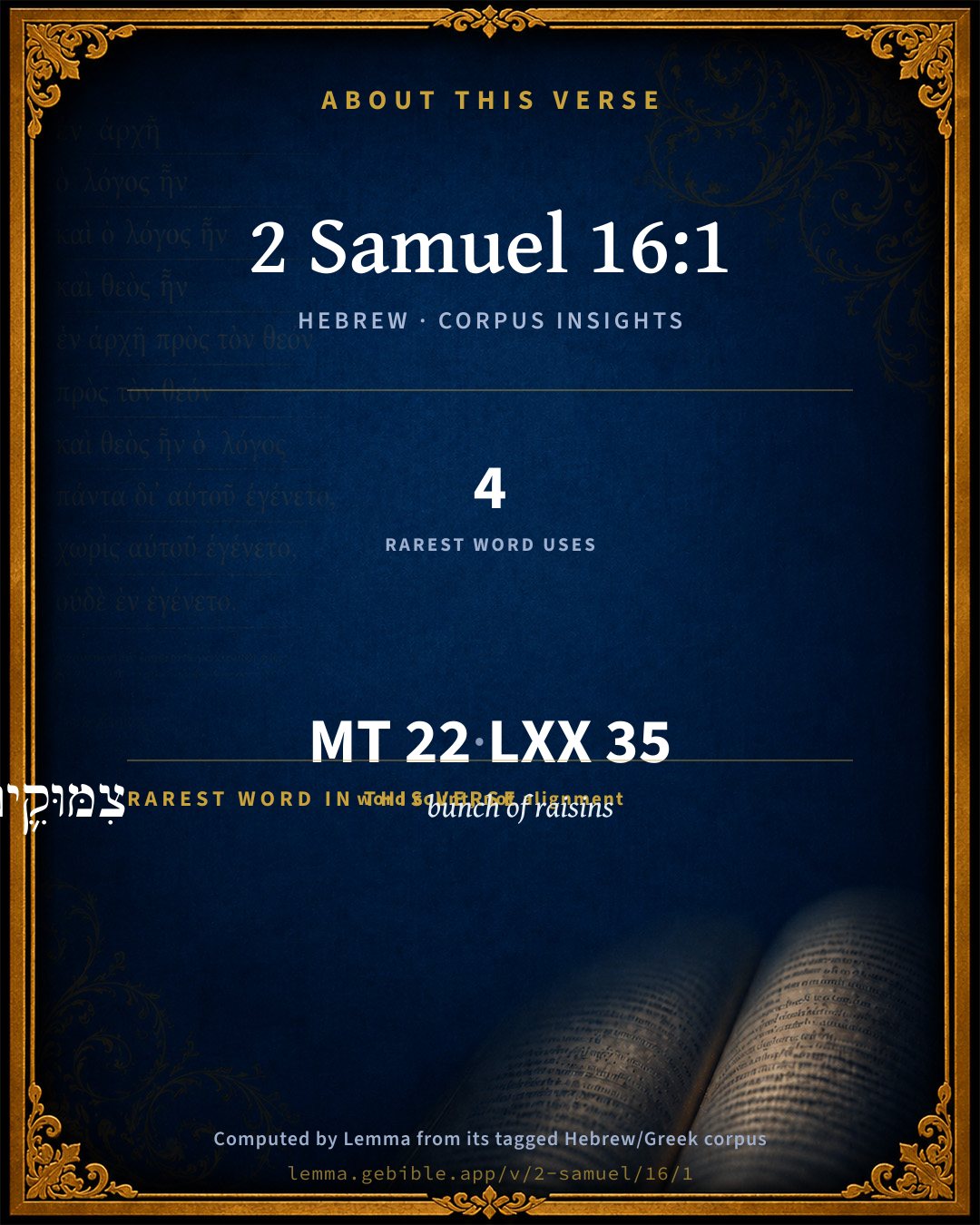
The rarest word here is צִמּוּקִ֛ים bunch of raisins H6778 — appearing just 4 times in the whole Hebrew Bible.

Shared distinctive vocabulary

צִמּוּקִ֛ים bunch of raisins H6778 occurs in 4 verses of the Hebrew Bible. Also found in:

Grammatical profile

  • 3 verbs
  • 14 nouns
  • 3 adjectives
  • 1 preposition
  • 1 particle

Verb forms

  • עָבַ֤ר Qal · Perfect
  • לִקְרָאת֑וֹ Qal · Infinitive Construct
  • חֲבֻשִׁ֗ים Qal · Participle Passive

Repetition

Words recur within this verse — often emphatic in Hebrew:

  • מָאתַ֨יִם hundred H3967 ×3
  • מְפִי Mephibosheth H4648 ×2

Hebrew & Septuagint length

In English translation the verse runs 49 words from the Hebrew and 50 from the Septuagint (LXX English) — closely comparable.

A rough comparison of the two English renderings, which tokenize alike — not a word-level alignment.

Word counts can differ between the Hebrew and the Greek without any difference in meaning — e.g. the Hebrew direct-object marker אֵת has no separate Greek word, and Greek often adds the article ὁ.

In the original languages it is 22 Hebrew tokens and 35 Greek tokens — but the two are counted differently (Hebrew bundles its prefixes and suffixes into one token; the Greek is in lemma form), so that isn’t a like-for-like length.

Cross-references

16

Topical passages linked to 2 Samuel 16:1 in the Treasury of Scripture Knowledge — connected by theme and wording, ordered by reader-vote popularity; previews shown in the World English Bible.

  • 1 Samuel 25:18 Then Abigail made haste, and took two hundred loaves, and two bottles of wine, and five sheep ready dressed, and five measures of parched grain, and one hundred clusters of raisins, and two hundred cakes of figs, and laid them on donkeys.
  • 2 Samuel 15:32 It happened that when David had come to the top [of the ascent], where God was worshiped, behold, Hushai the Archite came to meet him with his coat torn, and earth on his head.
  • 1 Samuel 10:3 Then shall you go on forward from there, and you shall come to the oak of Tabor; and there shall meet you there three men going up to God to Bethel, one carrying three kids, and another carrying three loaves of bread, and another carrying a bottle of wine:
  • 1 Samuel 16:20 Jesse took a donkey loaded with bread, and a bottle of wine, and a kid, and sent them by David his son to Saul.
  • 1 Samuel 17:17–18 Jesse said to David his son, Take now for your brothers an ephah of this parched grain, and these ten loaves, and carry [them] quickly to the camp to your brothers;
  • 2 Samuel 9:2–13 There was of the house of Saul a servant whose name was Ziba, and they called him to David; and the king said to him, Are you Ziba? He said, Your servant is he.
  • 2 Samuel 15:30 David went up by the ascent of the [Mount of] Olives, and wept as he went up; and he had his head covered, and went barefoot: and all the people who were with him covered every man his head, and they went up, weeping as they went up.
  • 2 Samuel 17:27–29 It happened, when David was come to Mahanaim, that Shobi the son of Nahash of Rabbah of the children of Ammon, and Machir the son of Ammiel of Lodebar, and Barzillai the Gileadite of Rogelim,
  • 2 Samuel 19:32 Now Barzillai was a very aged man, even eighty years old: and he had provided the king with sustenance while he lay at Mahanaim; for he was a very great man.
  • 1 Chronicles 12:40 Moreover those who were near to them, [even] as far as Issachar and Zebulun and Naphtali, brought bread on donkeys, and on camels, and on mules, and on oxen, food of meal, cakes of figs, and clusters of raisins, and wine, and oil, and oxen, and sheep in abundance: for there was joy in Israel.
  • Proverbs 29:4–5 The king by justice makes the land stable, But he who takes bribes tears it down.
  • Jeremiah 40:10 As for me, behold, I will dwell at Mizpah, to stand before the Chaldeans who shall come to us: but you, gather you wine and summer fruits and oil, and put them in your vessels, and dwell in your cities that you have taken.
  • Jeremiah 40:12 then all the Jews returned out of all places where they were driven, and came to the land of Judah, to Gedaliah, to Mizpah, and gathered wine and summer fruits very much.
  • Amos 8:1 Thus the Lord Yahweh showed me: behold, a basket of summer fruit.
  • Proverbs 18:16 A man's gift makes room for him, And brings him before great men.
  • Micah 7:1 Misery is mine! Indeed, I am like one who gathers the summer fruits, as gleanings of the vinyard: There is no cluster of grapes to eat. My soul desires to eat the early fig.

Cross-references courtesy of OpenBible.info (CC BY 4.0).

Hebrew and Greek witnesses Masoretic Hebrew ↔ Greek Septuagint

The same verse in the two great witnesses to the Old Testament, shown verse-for-verse.

These are two independent witnesses, not word-aligned to each other, and the Septuagint is shown in lemma (dictionary) form.

Hebrew 2 Samuel 16:1 Masoretic · Westminster Leningrad Codex

וְדָוִ֗ד עָבַ֤ר מְעַט֙ מֵֽהָרֹ֔אשׁ וְהִנֵּ֥ה צִיבָ֛א נַ֥עַר מְפִי בֹ֖שֶׁת לִקְרָאת֑וֹ וְצֶ֨מֶד חֲמֹרִ֜ים חֲבֻשִׁ֗ים וַעֲלֵיהֶם֩ מָאתַ֨יִם לֶ֜חֶם וּמֵאָ֧ה צִמּוּקִ֛ים וּמֵ֥אָה קַ֖יִץ וְנֵ֥בֶל יָֽיִן

When David was a little past the top [of the ascent], behold, Ziba the servant of Mephibosheth met him, with a couple of donkeys saddled, and on them two hundred loaves of bread, and one hundred clusters of raisins, and one hundred summer fruits, and a bottle of wine.

World English Bible · Public Domain

Greek LXX 2 Samuel 16:1 Septuagint · lemma form

καί δαυίδ παραἔρχομαι βραχύς τις ἀπό ὁ ροως καί ὁράω σιβα ὁ παιδάριον μεμφιβοσθε εἰς ἀπαντή αὐτός καί ζεῦγος ὄνος ἐπισάττω καί ἐπί αὐτός διακόσιοι ἄρτος καί ἑκατόν σταφίς καί ἑκατόν φοῖνιξ καί νεβελ οἶνος

And David passed on a little way from Ros; and, behold, Siba the servant of Memphibosthe came to meet him; and he had a couple of asses laden, and upon them two hundred loaves, and one hundred bunches of raisins, and one hundred cakes of dates, and bottle of wine.

LXX2012 (modern English Septuagint) · Public Domain

On this verse, Keil & Delitzsch discusses the Septuagint’s reading. Read the note in Commentary ↓

Hebrew: Westminster Leningrad Codex (CC BY 4.0). Greek: Septuagint (public domain); English from LXX2012 (modern English Septuagint) (Public Domain). How the Septuagint differs from the Hebrew →

Targum (Aramaic paraphrase)

1

The Targum is the ancient Jewish Aramaic paraphrase of the Hebrew Scriptures — an interpretive translation, not the Hebrew text itself. Onkelos (literal) and Pseudo-Jonathan (expansive) render the Torah, and Jonathan the Prophets. Coverage is partial: where no permissively-licensed English translation exists for a verse, only the Aramaic is shown. This is verse-level text, not a word-by-word alignment to the Hebrew.

  1. Targum Jonathan Prophets (Joshua–Malachi)
    וְדָוִד עֲבַר זְעֵיר מֵרֵישׁ טוּרָא וְהָא צִיבָא עוּלֵימָא דִמְפִיבֹשֶׁת לָקֳדָמוּתֵיהּ וְזוֹג חֲמָרִין חֲשִׁיקִין וַעֲלֵיהוֹן מָאתָן גְרִיצָן דִלְחֵם וּמְאָה אִתְכְּלִין דְעִנְבִין יְבֵשִׁין וּמְאָה מָנָן דְבֵילָתָא וּגְרַב דַחֲמָר:

    (no public-domain English translation for this verse)

    Targum Jonathan — Aramaic: “Mikraot Gedolot” (public domain). English: “Sefaria Community Translation” (CC0 1.0 (public-domain dedication)); “London "Chaldee Paraphrase," 1871” (public domain). Text via Sefaria.

Commentary

Notes on 2 Samuel 16:1 from classic Christian and Jewish commentators (each source and its license shown beneath its notes). The classic Christian expositions comment on the surrounding passage and are grouped to its opening verse, so a note may address several verses; the Jewish commentaries on the Tanakh (Rashi and others) are per-verse, so they appear only where the commentator wrote on this verse.

Lemma curates 59 commentaries, every one of them public domain or Creative Commons licensed, each selected and text-cleaned for this edition rather than reprinted as found. About our sources →

Matthew Henry's Commentary

We read before how kind David was to Mephibosheth the son of Jonathan, how he prudently entrusted his servant Ziba with the management of his estate, while he generously entertained him at his own table, Sa2 9:10. This matter was well settled; but, it seems, Ziba is not content to be manager, he longs to be master, of Mephibosheth's estate. Now, he thinks, is his time to make himself so; if he can procure a grant of it from the crown, whether David or Absalom get the better it is all one to him, he hopes he shall secure his prey, which he promises himself by fishing in troubled waters. In order hereunto, 1. He made David a handsome present of provisions, which was the more welcome because it came seasonably (Sa2 16:1), and with this he designed to incline him to himself; for a man's gift maketh room for him, and bringeth him before great men, Pro 18:16. Nay, Whithersoever it turneth, it prospereth, Pro 17:8. David inferred from this that Ziba was a very discreet and generous man, and well affected to him, when, in all, he designed nothing but to make his own market and to get Mephibosheth's estate settled upon himself. Shall the prospect of advantage in this world make men generous to the rich? and shall not the belief of an abundant recompence in the resurrection of the just make us charitable to the poor? Luk 14:14. Ziba was very considerate in the present he brought to David; it was what would do him some good in his present distress, Sa2 16:2. Observe, The wine was intended for those that were faint, not for the king's own drinking, or the courtiers; it seems, they did not commonly use it, but it was for cordials for those that were ready to perish, Pro 31:6. Blessed art thou, O land! when thy princes use wine for strength, as David did, and not for drunkenness, as Absalom did, ch. 13:28. See Ecc 10:17. Whatever Ziba intended in this present, God's providence sent it to David for his support very graciously. God makes use of bad men for good purposes to his people, and sends them meat by ravens. Having by his present insinuated himself into David's affection, and gained credit with him, the next thing he has to do for the compassing of his end is to incense him against Mephibosheth, which he does by a false accusation, representing him as ungratefully designing to raise himself by the present broils, and to recover the crown to his own head, now that David and his son were contending for it. David enquires for him as one of his family, which gives Ziba occasion to tell this false story of him, Sa2 16:3. What immense damages do masters often sustain by the lying tongues of their servants! David knew Mephibosheth not to be an ambitious man, but easy in his place, and well-affected to him and his government; nor could he be so weak as to expect with his lame legs to climb the ladder of preferment; yet David gives credit to the calumny, and, without further enquiry or consideration, convicts Mephibosheth of treason, seizes his lands as forfeited, and grants them to Ziba: Behold, thine are all that pertained to Mephibosheth (Sa2 16:4), a rash judgment, and which afterwards he was ashamed of, when the truth came to light, Sa2 19:29. Princes cannot help it, but they will be sometimes (as our law speaks) deceived in their grants; but they ought to use all means possible to discover the truth and to guard against malicious designing men, who would impose upon them, as Ziba did upon David. Having by his wiles gained his point, Ziba secretly laughed at the king's credulity, congratulated himself on his success, and departed, with a great compliment upon the king, that he valued his favour more than Mephibosheth's estate: "Let me find grace in thy sight, O king! and I have enough." Great men ought always to be jealous of flatterers, and remember that nature has given them two ears, that they may hear both sides.

Matthew Henry's Commentary on the Whole Bible (1708–1710) — public domain (CC PDM 1.0). Text via the HelloAO Bible API.

The Cambridge Bible for Schools and Colleges

gen. ed. J. J. S. Perowne

Ch. 2Sa_16:1-4. David met by Ziba with a present

1. the top of the hill] See note on ch. 2Sa_15:32.

two hundred loaves of bread, &c.] Compare Abigail’s present (1Sa_25:18). Ziba was shrewd enough to foresee the result of the rebellion, and wished to secure the king’s favour.

an hundred of summer fruits] Probably cakes of dried figs (so the Vulg.) or dates (so the Sept.). Cp. Amo_8:1.

a bottle of wine] A skin, holding a considerable quantity.

The Cambridge Bible for Schools and Colleges (gen. ed. J. J. S. Perowne; Cambridge University Press, 1878–1918) — public domain. Text from a community e-Sword module.

Trapp's Complete Commentary

John Trapp

2Sa 16:1 And when David was a little past the top [of the hill], behold, Ziba the servant of Mephibosheth met him, with a couple of asses saddled, and upon them two hundred [loaves] of bread, and an hundred bunches of raisins, and an hundred of summer fruits, and a bottle of wine.

Ver. 1. Met him with a couple of asses saddled.] His master Mephibosheth could not get him to saddle one ass for him to go along with David, {2Sa 19:26} for he had a design by false accusation, to wrest his land from him, as also he did; furnishing, meanwhile, this rich present out of Mephibosheth’s means; which it is likely he made bold with for his own advantage.

John Trapp, A Commentary or Exposition upon All the Books of the Old and New Testament (1647–1656) — public domain. Text from a community e-Sword module.

The Biblical Illustrator

Joseph S. Exell

2Sa_16:1-14

And when David was a little past the top of the hill.

Impatience and submission

Mephibosheth, it will be recollected, was the only son of Jonathan. Now, when David was a little past the top of the hill where he had worshipped God, he met Ziba coming towards him with two asses, laden with cakes of raisins and summer fruits, a skin-bottle of wine, and two hundred loaves of bread. Probably, when David first saw Ziba, he thought that Mephibosheth had sent this timely contribution, and the first thing that annoyed him was to find that this present did not come from him at all. No doubt there was a good deal more conversation between David and Ziba than is recorded; the crafty man made it very plain that it was he who had been so thoughtful for the kings wants; thus he led David on to suspect Mephibosheths loyalty; and when the king asked him plainly why his master was not with him, feigning probably great reluctance to speak against his employer, and pretending that only loyalty induced him to speak, he told the lie against Mephibosheth. David was very apt to judge hastily: he was a man of a very warm temperament, with strong affections, and passions that were easily excited. Here Ziba seemed faithful, and mindful of his sovereign, when Mephibosheth was said to be ungrateful; and thinking that he has found devotion where he expected nothing, and ingratitude where he looked for love, as it was in the case of Ittai and Ahithophel, and really forgetting in the moment of his flight, and when in danger of losing his own throne, that he has no power to enforce his sentence, he awards to the crafty Ziba all the lands of Mephibosheth. How many times we are warned in Scripture against pronouncing hasty judgments; and which of us has not had to confess more than once that the bad opinion we have formed of some person was altogether erroneous? Again and again we have listened to unjust calumnies; we have thought there must be some truth in the accusation, some foundation for the slander, and we have acted very much like David here. David had gone but a few steps further before he encountered Shimei, another of the tribe of Benjamin. Bahurim is but a little distance from Bethany, on the other side of the Mount of Olives; but tilt they reached that spot, faint and weary, Shimei followed them with bitter curses. Now David had recovered himself; probably his conscience blamed him for his hasty ebullition of temper against Mephibosheth: and he may have felt that he had believed Zibas story too easily. At least, when he spoke like that, he had forgotten his early friendship, and the beautiful and disinterested love of Jonathan. Now we are to see David in a better mood; grace has once more subdued nature. Now, Shimei was uttering unjust words: David of course knew that he did not deserve them for no one could have been more forbearing to the house of Saul: and perhaps Shimeis words reminded him, as well as Abishais impetuousness, of his own conduct to that family in times past; and hence his command of his temper at this moment. Perhaps, too, the unjust slanders of Shimei made him aware that Ziba might have been slandering his friend Mephibosheth and just because he felt he did not deserve it, and his conscience did not prick him in the matter, perhaps he was the more able to forgive the man. This man Shimei evidently had long hated David. He had been hoping there would be some reverse in his fortunes, and he rejoiced in his enemys downfall. But what does David do? He loses sight of Shimei altogether; he looks above the instrument to the Agent; he sees Gods hand in the matter, and to be angry, therefore, would be to be discontented with the providence of God. Oh that we could learn to follow David in this! There are numberless annoyances that happen to us all; and since we must through much tribulation enter into the kingdom of God, we must be prepared for trials that will peculiarly test our faith and patience. If you forget that the Lord reigneth, if you do not connect the providence of God with all that happens, the very smallest daily trouble may completely upset you, and you will be continually losing your temper. And then there was another great advantage to David in this circumstance, and, indeed, in the whole rebellion: it just showed him the value of human affection, and made him feel how fickle the populace is. And the bitter words of Shimei, perhaps more than anything else, would humble his pride and self-conceit. We are all too apt to flatter each other. Faithful are the wounds of a friend; but faithful friends are very few. Partly because we want to stand well with our friends, partly because we do not like to hurt their feelings, we never tell them of their faults. We repeat the good, but not the evil, that we hear about them; and as we do this to each other, and are naturally indulgent to our own failings, we are all too apt to have a good opinion of ourselves. The fact is that self-righteousness clings to us to the very last. We are apt to feel as if there was really something commendable in us. We use expressions about our sinfulness which too often have little meaning-in them; and strange as it may seem, we really forget our utter natural corruption. And lastly, observe that as, when David sent back the ark, he expressed a hope that God would bring him to see it again, so he is conscious of being in his Fathers hands; he believes that this chastening is sent for good; and he looks forward to a happy issue out of all his affliction. But let us never forget the end of it all: that if God begins, He will surely carry on the work of grace; that our light affliction, which is but for a moment, worketh for us a far more exceeding and eternal weight of glory. And in the midst of all the trials that may come upon us, possibly even the desertion of friends--as David bore them meekly,. a type of Him who prayed for His enemies--so let us ever keep the bright certainty of eternal glory before us; and we shall be meek and patient, as David was; and we, like the Master, for the joy set before us, shall endure the cross, despising the shame; and as there will be heaven for us hereafter, so there will be peace even now. (C. Bosanquet, M. A.)

The Biblical Illustrator, edited by Joseph S. Exell (c. 1880s–1900s) — public domain. Text from a community e-Sword module.

Joseph Benson's Commentary

2Sa 16:1. Behold Ziba, the servant of Mephibosheth, met him — This crafty man, being persuaded that God would in due time appear for the righteous cause of so good a king, and scatter the cloud which was now upon him, takes this occasion to make way for his own future advancement, by making David a handsome present of provisions, which was the more welcome, because it came seasonably. A hundred of summer fruits — These, the Seventy suppose, were dates, but the more common opinion is that they were figs, as the Chaldee paraphrast supposes them to have been; from whence Dr. Delaney infers that this flight of David was about the beginning of summer, when the early figs were wont to be gathered, and when a present of them must have been very seasonable and refreshing. A bottle of wine — Containing, no doubt, a quantity that was proportionable to the rest of the present. Their bottles, being made of skins, or leather, were some of them very large.

Joseph Benson's Commentary on the Old and New Testaments (1811–1818) — public domain. Text from a community e-Sword module.

Whedon's Commentary on the Bible

Daniel D. Whedon

ZIBA’S HYPOCRISY AND SLANDER, 2Sa_16:1-4.

1. Two hundred loaves — Ziba’s load very much resembled that of Abigail. Compare 1Sa_25:18.

Summer fruits — Fruits which were adapted only to immediate consumption, and not easily preserved for winter use. Harmer supposes that cucumbers are intended, and are so called from their adaptation to allay the summer heats.

Daniel D. Whedon (gen. ed.), Commentary on the Old and New Testaments (1874–1909) — public domain. Text from a community e-Sword module.

The Preacher's Complete Homiletical Commentary

Joseph S. Exell (gen. ed.)

CRITICAL AND EXPOSITORY NOTES.—

2Sa_16:1. “Met him.” “Ziba had therefore gone on in advance of the army (as Hushai did) in order more easily to secure David’s attention after the first disorder was over.” (Erdmann.) “Bunches of raisins,” i.e., raisin cakes. “Summer fruits,” probably fig-cakes, as in 1Sa_25:18. “A bottle,” a skin.

2Sa_16:2. “The asses,” etc. “The manner of Ziba’s trick was this (2Sa_19:26). Mephibosheth, learning of David’s flight, had ordered asses saddled for himself and his servants, in order to repair to the king in token of his faithful attachment. Ziba had taken the asses together with the presents intended by Mephibosheth for the king, come to the latter, and left the helpless Mephibosheth in the lurch.” (Erdmann.)

MAIN HOMILETICS OF THE PARAGRAPH.—2Sa_16:1-4

THE TREACHERY OF ZIBA

I. Benevolent acts are often performed from motives of policy and sometimes at another man’s expense. Although it is not our business at all times to inquire minutely into the sources whence men obtain the means of doing deeds of charity and apparent kindness, or to be severe in passing judgment upon them, the interests of truth and justice sometimes demand such an investigation and sentence. For instance, in olden times, the smuggler and the highwayman were sometimes lavish in giving of the fruits of their dishonesty to the poor and needy, but in doing so they gave what did not belong to them and therefore deserved blame, and not praise. And men now-a-days often give away what they have gotten by means quite as unlawful, though more outwardly respectable. We can hardly suppose that in any such case what is given is given from a right motive. In the case of Ziba, the motive for his liberality was evidently as corrupt as its source. We cannot believe that he was prompted by the same feelings as were David’s other benefactors. The character of the man forbids such a supposition, and we must conclude that he was farsighted enough to see that David would be victorious, and credulous enough to think that he would not discover his falsehood. Like the unjust steward of our Lord’s parable, he could well afford to be generous at his master’s expense, and although his selfishness might be less palpable, his dishonesty warrants us in concluding it was quite as real.

II. The best of men often err in their judgment of others. David here looks upon Ziba as his true friend, and upon Mephibosheth as a most ungrateful man. In this we know he was altogether mistaken, yet how entirely were appearances in favour of his opinion. In these days, in a civilized country, a man could not suffer such a wrong as Mephibosheth here suffered at the hand of David, for he would not be condemned without an opportunity of defending himself, but in other forms men often suffer much from the calumny and mistakes of others. A wicked and designing person, for his own selfish ends, falsely accuses a good man to his friend, the accused person is ignorant of the charge, circumstances seem against him, and the very esteem in which his friend has hitherto held him seems to increase his indignation at the supposed treachery. For, if David had not had so great a regard for Mephibosheth, he would not have been stung so keenly by his supposed desertion, and probably would not have so hastily passed so severe a sentence upon him. In view of his error let us learn to be slow in believing evil of any, especially of those whom we have hitherto had reason to regard as honest and true, and let us be thankful that above and over all human judges there is One who cannot err in His judgment, because “He shall not judge by the sight of His eyes, neither reprove (decide) after the hearing of His ears, but will judge with righteousness and reprove (decide) with equity.” (Isa_11:3-4).

OUTLINES AND SUGGESTIVE COMMENTS

2Sa_16:4. Flatterers are generally backbiters; for it is as easy to them to forge slanders of the absent as to pretend affection and respect for the present.… When much treachery and ingratitude have been experienced, men are apt to become too suspicious, and to listen to every plausible tale of calumny. The mind being greatly agitated, views everything through a false medium, and we are naturally most precipitate when least capable of judging aright.—Scott.

There is often more danger, and therefore more need of caution, with those who profess an especial regard for us, than with those who are avowed enemies. It is the remark of an old writer (Fuller), that “Ziba’s gifts did David more harm than Shimei’s curses, for those betrayed him into an act of injustice, whilst these reproved his patience.”—Lindsay.

The Preacher's Complete Homiletical Commentary (gen. ed. Joseph S. Exell; Funk & Wagnalls, c. 1892) — public domain (pre-1929). A full-Bible homiletical/sermon-outline anthology covering 65 of 66 books (2 John is absent from the source module). Text from a community e-Sword module.

Keil & Delitzsch

C. F. Keil & F. Delitzsch

Ziba's faithless conduct towards Mephibosheth. - Sa2 16:1. When David had gone a little over the height (of the Mount of Olives: הראשׁ points back to Sa2 15:32), Mephibosheth's servant Ziba came to meet him, with a couple of asses saddled, and laden with two hundred loaves, a hundred raisin-cakes, a hundred date or fig-cakes, and a skin of wine. The word קיץ corresponds to the Greek ὀπώρα, as the lxx have rendered it in Jer 40:10, Jer 40:12, and is used to signify summer fruits, both here and in Amo 8:1 (Symm.). The early translators rendered it lumps of figs in the present passage (παλάθαι; cf. Ges. Thes. p. 1209). The Septuagint only has ἑκατὸν φοίνικες. The latter is certainly the more correct, as the dried lumps of figs or fig-cakes were called דּבלים (Sa1 25:18); and even at the present day ripe dates, pressed together in lumps like cakes, are used in journeys through the desert, as a satisfying and refreshing food (vid., Winer, bibl. Realwrterbuch, i. 253).

Sa2 16:2

When the king asked him, "What are these for thee?" i.e., what art thou going to do with them? Ziba replied, "The asses are for the king's family to ride upon (to ride upon in turn), the bread and summer fruits for the young men (the king's servants) to eat, and the wine for those that are faint in the desert to drink" (see at Sa2 15:23). The Chethib ולהלחם is evidently a copyist's error for והלּחם.

Sa2 16:3

To the further question put by the king, "Where is thy lord (Mephibosheth)? Ziba replied, "Behold, he sits (is staying) in Jerusalem; for he said, To-day will the house of Israel restore the kingship (government) of my father." The "kingship of my father," inasmuch as the throne would have passed to Jonathan if he had outlived Saul. It is obvious enough, apart altogether from Sa2 19:25., the Ziba was calumniating his master Mephibosheth, in the hope of getting possession of the lands that he was farming for him. A cripple like Mephibosheth, lame in both feet, who had never put in any claim to the throne before, could not possibly have got the idea now that the people of Israel, who had just chosen Absalom as king, would give the throne of Saul to such a cripple as he was. It is true that Ziba's calumny was very improbable; nevertheless, in the general confusion of affairs, it was not altogether an inconceivable thing that the oppressed party of Saul might avail themselves of this opportunity to make an attempt to restore the power of that house, which many greatly preferred to that of David, under the name of Mephibosheth.

Sa2 16:4

And in the excited state in which David then was, he was weak enough to give credence to Ziba's words, and to commit the injustice of promising the calumniator all that belonged to Mephibosheth, - a promise for which he most politely thanked him. השׁתּחויתי, "I bow myself," equivalent to, I lay myself at thy feet. "May I find favour in the eyes of my lord the king!" i.e., may the king grant me his favour (vid., Sa1 1:18).

Keil & Delitzsch — Biblical Commentary on the Old Testament (1861–1891) — public domain (CC PDM 1.0). Text via the HelloAO Bible API. (Old Testament only.)

The Annotated Bible

Arno C. Gaebelein

6. The Sorrows and Testings of the King

CHAPTER 16

1. Lying Ziba (2Sa 16:1-4)

2. Shimei curses and stones David (2Sa 16:5-14)

3. Absalom enters Jerusalem (2Sa 16:15-19)

4. Ahitophel’s wicked counsel (2Sa 16:20-23)

Ziba in great craftiness meets the exiled king with provisions and acts as the false accuser of Mephibosheth. And David hastily puts all that belongs to Mephibosheth into his hands. Strange that David could believe in the falsehood of Ziba. How could one who was a helpless cripple aspire to possess a kingdom? Mephibosheth had been deceived (2Sa 19:26) by Ziba and David readily believed the lying story.

Shimei (my fame) appeared, cursing David, stoning him and his servants. His accusation that he was responsible for “all the blood of the house of Saul” was unfounded and unjust. He was not responsible for the death of Saul and Jonathan, and equally guiltless of the death of Abner and Ish-bosheth. And yet David saw something else in the curses of Shimei and in calling him a bloody man. The blood of Uriah which he had shed must have suddenly come to his mind. And when Abishai offers to kill Shimei, David rebuked him. (See Luk 9:52-56.) “Let him curse, because the LORD hath said to him, Curse David”--”Let him alone, and let him curse; for the LORD hath bidden him.” He realizes Shimei is but an instrument in the Lord’s hands; He had permitted it and David acknowledges thus that he had deserved the curses. “It may be that the LORD will look on mine affliction, and that the LORD will requite me good for his cursing this day.” His eyes now look to the Lord whose chastening hand rested so heavily upon him.

Absalom is now in Jerusalem and Hushai succeeds in his commission given to him by David. He deceives Absalom. Whom did Hushai mean, when he said, “Whom the LORD and this people, and all the men of Israel choose, his will I be, and with him will I be”? They can only be applied to David; most likely in his heart he meant David. But it was flattery which wicked Absalom gladly accepted. Absalom followed the vile counsel of Ahitophel and committed the unnatural crime to show to all Israel that the breach between him and his father David was beyond remedy. God’s predicted judgment upon David had come literally true. (See 2Sa 12:11-12.) The world will yet find out that God’s judgments, though long delayed, will find ultimately their literal fulfilment.

Arno C. Gaebelein, The Annotated Bible (1913–1922) — public domain. Text from a community e-Sword module.

The Expositor's Bible

CHAPTER X X I.

FROM JERUSALEM TO MAHANAIM.

2Sa_16:1-14; 2Sa_17:15-22 and 2Sa_17:24-26.

AS David proceeds on his painful journey, there flows from his heart a gentle current of humble contrite, gracious feeling. If recent events have thrown any doubt on the reality of his goodness, this fragrant narrative will restore the balance. Many a man would have been beside himself with rage at the treatment he had undergone. Many another man would have been restless with terror, looking behind him every other moment to see if the usurper's army was not hastening in pursuit of him. It is touching to see David, mild, self-possessed, thoroughly humble, and most considerate of others. Adversity is the element in which he shines; it is in prosperity he falls; in adversity he rises beautifully. After the humbling events in his life to which our attention has been lately called, it is a relief to witness the noble bearing of the venerable saint amid the pelting of this most pitiless storm.

It was when David was a little past the summit of Mount Olivet, and soon after he had sent back Hushai, that Ziba came after him, - that servant of Saul that had told him of Mephibosheth the son of Jonathan, and whom he had appointed to take charge of the property that had belonged to Saul, now made over to Mephibosheth. The young man himself was to be as one of the king's sons, and was to eat at the royal table. Ziba's account of him was, that when he heard of the insurrection he remained at Jerusalem, in the expectation that on that very day the kingdom of his father would be restored to him. It can hardly be imagined that Mephibosheth was so silly as to think or say anything of the kind. Either Ziba must have been slandering him now, or Mephibosheth must have slandered Ziba when David returned (see 2Sa_19:24-30). With that remarkable impartiality which distinguishes the history, the facts and the statements of the parties are recorded as they occurred, but we are left to form our own judgment regarding them. All things considered, it is likely that Ziba was the slanderer and Mephibosheth the injured man. Mephibosheth was too feeble a man, both in mind and in body, to be forming bold schemes by which he might benefit from the insurrection. We prefer to believe that the son of Jonathan had so much of his father's nobility as to cling to David in the hour of his trial, and be desirous of throwing in his lot with him. If, however, Ziba was a slanderer and a liar, the strange thing about him is that he should have taken this opportunity to give effect to his villainy. It is strange that, with a soul full of treachery, he should have taken the trouble to come after David at all, and still more that he should have made a contribution to his scanty stores. We should have expected such a man to remain with Absalom, and look to him for the reward of unrighteousness. He brought with him for David's use a couple of asses saddled, and two hundred loaves of bread, and an hundred clusters of raisins, and an hundred of summer fruits, and a bottle of wine. We get a vivid idea of the extreme haste with which David and his company must have left Jerusalem, and their destitution of the very necessaries of life as they fled, from this catalogue of Ziba's contributions. Not even were there beasts of burden "for the king's household" - even Bathsheba and Solomon may have been going on foot. David was evidently impressed by the gift, and his opinion of Mephibosheth was not so high as to prevent him from believing that he was capable of the course ascribed to him. Yet we cannot but think there was undue haste in his at once transferring to Ziba the whole of Mephibosheth's property. We can only say, in vindication of David, that his confidence even in those who had been most indebted to him had received so rude a shock in the conduct of Absalom, that he was ready to say in his haste, "All men are liars;" he was ready to suspect every man of deserting him, except those that gave palpable evidence that they were on his side. In this number it seemed at the moment that Ziba was, while Mephibosheth was not; and trusting to his first impression, and acting with the promptitude necessary in war, he made the transfer. It is true that afterwards he discovered his mistake; and some may think that when he did he did not make a sufficient rectification. He directed Ziba and Mephibosheth to divide the property between them; but in explanation it has been suggested that this was equivalent to the old arrangement, by which Ziba was to cultivate the land, and Mephibosheth to receive the fruits; and if half the produce went to the proprietor, and the other half to the cultivator, the arrangement may have been a just and satisfactory one after all.

But if Ziba sinned in the way of smooth treachery, Shimei, the next person with whom David came in contact, sinned not less in the opposite fashion, by his outrageous insolence and invective. It is said of this man that he was of the family of the house of Saul, and that fact goes far to account for his atrocious behaviour. We get a glimpse of that inveterate jealousy of David which during the long period of his reign slept in the bosom of the family of Saul, and which seemed now. like a volcano, to burst out all the more fiercely for its long suppression. When the throne passed from the family of Saul, Shimei would of course experience a great social fall. To be no longer connected with the royal family would be a great mortification to one who was vain of such distinctions. Outwardly, he was obliged to bear his fall with resignation, but inwardly the spirit of disappointment and jealousy raged in his breast. When the opportunity of revenge against David came, the rage and venom of his spirit poured out in a filthy torrent. There is no mistaking the mean nature of the man to take such an opportunity of venting his malignity on David. To trample on the fallen, to press a man when his back is at the wall, to pierce with fresh wounds the body of a stricken warrior, is the mean resource of ungenerous cowardice. But it is too much the way of the world. "If there be any quarrels, any exceptions," says Bishop Hall, "against a man, let him look to have them laid in his dish when he fares the hardest. This practice have wicked men learned of their master, to take the utmost advantage of their afflictions."

If Shimei had contented himself with denouncing the policy of David, the forbearance of his victim would not have been so remarkable. But Shimei was guilty of every form of offensive and provoking assault. He threw stones, he called abusive names, he hurled wicked charges against David; he declared that God was fighting against him, and fighting justly against such a man of blood, such a man of Belial. And, as if this were not enough, he stung him in the most sensitive part of his nature, reproaching him with the fact that it was his son that now reigned instead of him, because the Lord had delivered the kingdom into his hand But even all this accumulation of coarse and shameful abuse failed to ruffle David's equanimity. Abishai, Joab's brother, was enraged at the presumption of a fellow who had no right to take such an attitude, and whose insolence deserved a prompt and sharp castigation. But David never thirsted for the blood of foes. Even while the rocks were echoing Shimei's charges, David gave very remarkable evidence of the spirit of a chastened child of God. He showed the same forbearance that he had shown twice on former occasions in sparing the life of Saul. "Why," asked Abishai, ''should this dead dog curse my lord the king? Let me go, I pray thee, and take off his head." ''So let him curse," was David's answer, "because the Lord hath said unto him, Curse David." It was but partially true that the Lord had told him to do so. The Lord had only permitted him to do it; He had only placed David in circumstances which allowed Shimei to pour out his insolence. This use of the expression, "The Lord hath said unto him," may be a useful guide to its true meaning in some passages of Scripture where it has seemed at first as if God gave very strange directions. The pretext that Providence had afforded to Shimei was this, "Behold, my son, which came out of my bowels, seeketh my life; how much more then may this Benjamite do it? Let him alone, and let him curse, for the Lord hath bidden him. It may be that the Lord will requite me good for his cursing this day." It is touching to remark how keenly David felt this dreadful trial as coming from his own son.

"So the struck eagle stretched upon the plain,

No more through rolling clouds to soar again,

Viewed his own feather on the fatal dart

That winged the shaft that quivered in his heart;

Keen were his pangs, but keener far to feel

He nursed the pinion which impelled the steel;

While the same plumage that had warmed his nest

Drank the last life-drop of his bleeding breast."

But even the fact that it was his own son that was the author of all his present calamities would not have made David so meek under the outrage of Shimei if he had not felt that God was using such men as instruments to chastise him for his sins. For though God had never said to Shimei, "Curse David," He had let him become an instrument of chastisement and humiliation against him. It was the fact of his being such an instrument in God's hands that made the King so unwilling to interfere with him. David's reverence for God's appointment was like that which afterwards led our Lord to say, ''The cup which My Father hath given Me, shall I not drink of it?" Unlike though David and Jesus were in the cause of their sufferings, yet there is a remarkable resemblance in their bearing under them. The meek resignation of David as he went out from the holy city had a strong resemblance to the meek resignation of Jesus as He was being led from the same city to Calvary. The gentle consideration of David for the welfare of his people as he toiled up Mount Olivet was parallel to the same feeling of Jesus expressed to the daughters of Jerusalem as He toiled up to Calvary. The forbearance of David to Shimei was like the spirit of the prayer - "Father, forgive them: for they know not what they do." The overawing sense that God had ordained their sufferings was similar in both. David owed his sufferings solely to himself; Jesus owed His solely to the relation in which He had placed Himself to sinners as the Sin-bearer. It is beautiful to see David so meek and lowly under the sense of his sins - breathing the spirit of the prophet's words, "I will stand upon my watch, and set me upon the tower, and will watch to see what he will say unto me, and what I shall answer when I am reproved."

There was another thought in David's mind that helped him to bear his sufferings with meek submission. It is this that is expressed in the words, "It may be that the Lord will requite me good for his cursing this day." He felt that, as coming from the hand of God, all that he had suffered was just and righteous. He had done wickedly, and he deserved to be humbled and chastened by God, and by such instruments as God might appoint. But the particular words and acts of these instruments might be highly unjust to him: though Shimei was God's instrument for humiliating him, yet the curses of Shimei were alike unrighteous and outrageous; the charge that he had shed the blood of Saul's house, and seized Saul's kingdom by violence, was outrageously false; but it was better to bear the wrong, and leave the rectifying of it in God's hands; for God detests unfair dealing, and when His servants receive it He will look to it and redress it in His own time and way. And this is a very important and valuable consideration for those servants of God who are exposed to abusive language and treatment from scurrilous opponents, or, what is too common in our day, scurrilous newspapers. If injustice is done them, let them, like David, trust to God to redress the wrong; God is a God of justice, and God will not see them treated unjustly. And hence that remarkable statement which forms a sort of appendix to the seven beatitudes - "Blessed are ye when men shall revile you and persecute you, and speak all manner of evil against you falsely for My name's sake. Rejoice and be exceeding glad, for great is your reward in heaven; for so persecuted they the prophets that were before you."

Ere we return to Jerusalem to witness the progress of events in Absalom's camp and cabinet, let us accompany David to his resting-place beyond the Jordan. Through the counsel of Hushai, afterwards to be considered, he had reached the plains of Jordan in safety; had accomplished the passage of the river, and traversed the path on the other side as far as Mahanaim, somewhere to the south of the Lake of Gennesareth, the place where Ishbosheth had held his court. It was a singular mercy that he was able to accomplish this journey, which in the condition of his followers must have occupied several days, without opposition in front or molestation in his rear. Tokens of the Lord's loving care were not wanting to encourage him on the way. It must have been a great relief to him to learn that Ahithophel's proposal of an immediate pursuit had been arrested through the counsel of Hushai. It was a further token for good, that the lives of the priests' sons, Jonathan and Ahimaaz, which had been endangered as they bore tidings for him, had been mercifully preserved. After learning the result of Hushai's counsel, they proceeded, incautiously perhaps, to reach David, and were observed and pursued. But a friendly woman concealed them in a well, as Rahab the harlot had hid the spies in the roof of her house; and though they ran a great risk, they contrived to reach David's camp in peace.

And when David reached Mahanaim, where he halted to await the course of events, Shobi, the son of Nahash, king of Ammon, and Machir, the son of Ammiel of Lo-debar, and Barzillai the Gileadite of Rogelim, brought beds, and basons, and earthen vessels, and wheat, and barley, and flour, and parched corn, and beans, and lentils, and parched pulse, and honey, and butter, and sheep, and cheese of kine, for David and for the people that were with him to eat; for they said. The people is hungry, and weary, and thirsty in the wilderness." Some of those who thus befriended him were only requiting former favours. Shobi may be supposed to have been ashamed of his father's insulting conduct when David sent messengers to comfort him on his father's death. Machir, the son of Ammiel of Lo-debar, was the friend who had cared for Mephibosheth, and was doubtless thankful for David's generosity to him. Of Barzillai we know nothing more than is told us here. But David could not have reckoned on the friendship of these men, nor on its taking so useful and practical a turn. The Lord's hand was manifest in the turning of the hearts of these people to him. How hard bestead he and his followers were is but too apparent from the fact that these supplies were most welcome in their condition. And David must have derived no small measure of encouragement even from these trifling matters; they showed that God had not forgotten him, and they raised the expectation that further tokens of His love and care would not be withheld.

The district where David now was, "the other side of Jordan," lay far apart from Jerusalem and the more frequented places in the country, and, in all probability, it was but little affected by the arts of Absalom. The inhabitants lay under strong obligations to David; in former times they had suffered most from their neighbours, Moab, Ammon, and especially Syria; and now they enjoyed a very different lot, owing to the fact that those powerful nations had been brought under David's rule. It was a fertile district, abounding in all kinds of farm and garden produce, and therefore well adapted to support an army that had no regular means of supply. The people of this district seem to have been friendly to David's cause. The little force that had followed him from Jerusalem would now be largely recruited; and, even to the outward sense, he would be in a far better condition to receive the assault of Absalom than on the day when he left the city.

The third Psalm, according to the superscription - and in this case there seems no cause to dispute it - was composed ''when David fled from Absalom his son." It is a psalm of wonderful serenity and perfect trust. It begins with a touching reference to the multitude of the insurgents, and the rapidity with which they increased. Everything confirms the statement that "the conspiracy was strong, and that the people increased continually with Absalom." We seem to understand better why David fled from Jerusalem; even there the great bulk of the people were with the usurper. We see, too, how godless and unbelieving the conspirators were - "Many there be which say of my soul, There is no help for him in God." God was cast out of their reckoning as of no consideration in the case; it was all moonshine, his pretended trust in Him. Material forces were the only real power; the idea of God's favour was only cant, or at best but "a devout imagination." But the foundation of his trust was too firm to be shaken either by the multitude of the insurgents or the bitterness of their sneers. "Thou, Lord, art a shield unto me "-ever protecting me, "my glory," - ever honouring me, "and the lifter up of mine head," - ever setting me on high because I have known Thy name. No doubt he had felt some tumult of soul when the insurrection began. But prayer brought him tranquility. "I cried unto God with my voice, and He heard me out of His holy hill." How real the communion must have been that brought tranquility to him amid such a sea of trouble! Even in the midst of his agitation he can lie down and sleep, and awake refreshed in mind and body. "I will not be afraid of ten thousands of the people that have set themselves against me round about." Faith already sees his enemies defeated and receiving the doom of ungodly men. "Arise, O Lord; save me, O my God; for Thou hast smitten all mine enemies upon the cheek bone; Thou hast broken the teeth of the ungodly." And he closes as confidently and serenely as if victory had already come - "Salvation belongeth unto the Lord; Thy blessing is upon Thy people."

If, in this solemn crisis of his history, David is a pattern to us of meek submission, not less is he a pattern of perfect trust. He is strong in faith, giving glory to God, and feeling assured that what He has promised He is able also to perform. Deeply conscious of his own sin, he at the same time most cordially believes in the word and promise of God. He knows that, though chastened, he is not forsaken. He bows his head in meek acknowledgment of the righteousness of the chastisement; but he lays hold with unwavering trust on the mercy of God. This union of submission and trust, is one of priceless value, and much to be sought by every good man. Under the deepest sense of sin and unworthiness, you may rejoice and you ought to rejoice, in the provision of grace. And while rejoicing most cordially in the provision of grace, you ought to be contrite and humble for your sin. You are grievously defective if you want either of these elements. If the sense of sin weighs on you with unbroken pressure, if it keeps you from believing in forgiving mercy, if it hinders you from looking to the cross, to Him who taketh away the sin of the world, there is a grievous defect. If your joy in forgiving mercy has no element of contrition, no chastened sense of unworthiness, there is no less grievous a defect in the opposite direction. Let us try at once to feel our unworthiness, and to rejoice in the mercy that freely pardons and accepts. Let us look to the rock whence we are hewn, and to the hole of the pit whence we are digged; feeling that we are great sinners, but that the Lord Jesus Christ is a great Saviour; and finding our joy in that faithful saying, ever worthy of all acceptation, that "Jesus Christ came into the world to save sinners," even the chief.

William Robertson Nicoll, ed., The Expositor's Bible (London: Hodder & Stoughton, 1887–1910) — public domain. 65 of 66 books (1 Corinthians is not separately keyed, as that volume carries no machine-parseable verse references); section-level commentary keyed to the opening verse. Introductory and overview sections not keyed to a specific passage are excluded.

Tyndale Open Study Notes

Tyndale Open Resources

16:1 Ziba: See study note on 9:11; see also 9:1-13; 19:24-30. • As Saul’s grandson (16:3), Mephibosheth was a potential rival for the throne.

Tyndale Open Study Notes — © Tyndale Open Resources, licensed CC BY-SA 4.0. Text via the HelloAO Bible API.

Geneva Bible (1599)

Geneva Bible translators

Which was the hill of olives, 2 Sam. 15:30.

Or, fig cakes.

Geneva Bible (1599) marginal notes — public domain. Text via Bolls.life.

Adam Clarke's Commentary

CHAPTER XVI

Ziba, servant of Mephibosheth, meets David with provisions, and

by false insinuations obtains the grant of his masters

property, 1-4.

Shimei abuses and curses David, who restrains Abishai from

slaying him, 5-14.

Hushai makes a feigned tender of his services to Absalom, 15-19.

Absalom calls a council and Ahithophel advises him to go in to

his father's concubines, 20-22.

Character of Ahithophel as a counselor, 23.

NOTES ON CHAP. XVI

Verse 1. Two hundred loaves of bread] The word loaf gives us a false idea of the ancient Jewish bread; it was thin cakes, not yeasted and raised like ours.

Bunches of raisins] See on 1Sa 25:18.

Summer fruits] These were probably pumpions, cucumbers, or watermelons. The two latter are extensively used in those countries to refresh travellers in the burning heat of the summer. Mr. Harmer supposes they are called summer fruits on this very account.

A bottle of wine.] A goat's skin full of wine; this I have already shown was the general bottle in the Eastern countries; see on 1Sa 25:18.

Adam Clarke's Commentary on the Bible (1810–1826) — public domain. Text from a community e-Sword/MySword module.

Ellicott's Commentary for English Readers

XVI.

(1) Ziba . . . met him.—It is evident from the sequel of the story (2Sa_19:24-30) that Ziba grossly slandered his master, doubtless for the purpose (as appears from 2Sa_16:4) of personal gain. This story was, indeed, almost too improbable to be believed; for, quite independently of his obligations to David, Mephibosheth, a helpless cripple of the house of Saul, could hardly have hoped that Absalom’s rebellion would bring the throne to him; yet David, apt to be hasty in his judgments, was in a state to believe in any story of ingratitude, and to be deeply affected by Ziba’s large contribution to his necessities. Ziba shows entire want of principle, and could, therefore, have adhered to David’s cause only because he had the shrewdness to foresee its ultimate success.

A Bible Commentary for English Readers, edited by Charles John Ellicott (1878–1897) — public domain. Text from a community e-Sword module.

John Gill's Exposition

And when David was a little past the top of the hill,.... Of the mount of Olives, the ascent of which he is said to go up by, and to come to the top of it, Sa2 15:30,

behold, Ziba, the servant of Mephibosheth, met him; of whom see Sa2 9:2;

with a couple of asses saddled: and so fit to ride on, but for the present he used them to another purpose:

and upon them two hundred loaves of bread; an hundred on each ass very probably:

and an hundred bunches of raisins; or dried grapes, as the Targum:

and an hundred of summer fruits: not in number, but in weight, as apples, pears, plums, apricots, &c. so the Targum, an hundred pounds of figs:

and a bottle of wine: a cask or flagon of wine; for a bottle, such as is in use with us, would have signified nothing in such a company.

John Gill's Exposition of the Whole Bible (1746–1763) — public domain (CC PDM 1.0). Text via the HelloAO Bible API.

Albert Barnes' Notes on the Bible

A couple of donkeys saddled - Those that Mephibosheth and his servant should have ridden. See 2Sa 19:26 note.

Albert Barnes' Notes on the Bible (1834–1885) — public domain. Text from a community e-Sword/MySword module.

Haydock's Catholic Bible Commentary

Siba was a mean character, but of sufficient discernment to judge that David would gain the day. He came to calumniate his master; and David paid too much attention to him, though his testimony would not have been received in a court of judicature. (Calmet) --- We must reflect that the mind of David was full of trouble, and devoid of suspicion. (Haydock) --- But he did wrong (Worthington) in condemning Miphiboseth unheard. --- Raisins. See 1 Kings xxv. 18. (Calmet) --- Figs; (palatharum) which are often called caricarum. (Menochius) --- Hebrew mea kayits, "a hundred of summer" fruits, like fresh grapes, (Numbers xiii. 21.) and other fruits, gathered after harvest time, Micheas vii. 1.

George Leo Haydock (1774–1849), Haydock's Catholic Family Bible and Commentary, 1859 edition — public domain. Excludes Psalms (Douay-Rheims chapter numbering differs from Protestant) and Deuterocanonical books (Catholic canon only).

Matthew Poole's English Annotations

Ziba; a crafty man, who, being persuaded that God would in due time appear for the righteous cause of so good a king, and scatter the cloud which was now upon him, takes this occasion to make way for his future advancement. A bottle; a large bottle or vessel proportionable to the other provisions.

Matthew Poole's English Annotations on the Holy Bible (1683–1685) — public domain. Text from a community e-Sword/MySword module.

Dummelow's Commentary on the Holy Bible

J. R. Dummelow

Ziba, Shimei, and Ahithophel

David, during his flight, is assisted by Ziba, but is cursed by Shimei. The cause of Absalom is promoted by the wise counsel of Ahithophel.

1. An hundred of summer fruits] a hundred cakes into which summer fruits were compressed.

2. With true Oriental deference he does not venture to say they are for the king's own use,

8. All the blood of the house of Saul] The reference is probably to the incident recorded in 2Sa_21:1-14.

11. The lord hath bidden him] David recognised that all his misfortunes were the consequence of his sin. The Lord had punished him through his own son, whom he had forgiven and restored. Why not also through Shimei?

14. Came weary] RM 'came to Ayephim.'

23. Enquired at the oracle of God] i.e. consulted God by means of the Urim and Thummim.

J. R. Dummelow, A Commentary on the Holy Bible (Macmillan, 1909) — public domain. Text from a community e-Sword module.

The Pulpit Commentary

Ziba the servant of Mephibosheth. It is the misfortune of troubled times like those in which David found himself, that unscrupulous men use them for selfish purposes. For those in danger have no time for careful examination, nor are their minds sufficiently calm for impartial judgment, but they act on first impressions, and catch at every straw. Ziba"s present would naturally raise everybody"s spirits, and be taken as a good omen; for it showed that David had adherents in unlikely quarters, when thus a servant of the house of Saul of his own accord brought so timely an offering. The asses saddled for riding contradict the idea that Ziba met David by chance as he was bringing the produce of the farm for the use of Mephibosheth"s household. More probably the asses had been saddled for Mephibosheth"s own use, (comp. 2Sa_19:26) and the provisions had been prepared as a contribution to the king"s needs: but at the last moment the cunning Ziba managed to hurry away with his men, leaving his master in the lurch, and unable to get anything to ride upon in the short interval between David"s escape and Absalom"s entry. Moreover, possibly from being a cripple, and from the distressing circumStances of his early life, Mephibosheth always seems deficient in energy, and perhaps David"s conduct in mulcting him of half his property may not really have been so unjust as it looks, supposing that it was his dilatoriness which gave Ziba the chance of going away with the whole convoy while he was wasting time. It was this apparent desertion of him by one whom he had so befriended which may have made David say, "All men are liars", (Psa_116:11) though subsequently he learned that the lie was Ziba"s. The food consisted of two hundred leaves, or rather fiat cakes of bread, a hundred bunches of dried grapes, a hundred cakes of pressed dates, and a skin of wine. Instead of "date cakes," some of the versions render "fig cakes;" but for this there is a special Hebrew word. (see 1Sa_30:12)

HOMILETICS.

Vers. 1-14. The facts are:

1. David, passing on his way, is met by Ziba with a present for the king andhis servants.

2. On inquiring after Mephibosheth, David is told by Ziba that he wasstaying in Jerusalem in expectation that, as a result of the present revolt, the kingdom would be restored to him as representative of the house of Saul.

3. Accepting this statement as correct, David assigns Mephibosheth"s property (2Sa_9:9-12) to Ziba, who thereupon makes obeisance.

4. Proceeding to Bahurim, David is assailed by Shimei, who curses him, casts stones at him, reproaches him with deeds of evil, and avers that, as a punishment, God had taken the kingdom from him and given it to Absalom.

5. Astonished at the insolence, Abishai seeks permission to slay the man; but David, piously recognizing a providential chastisement in the event, will not have it so, and points out further to his people that this was but a small trouble in comparison with Absalom"s conduct, and that probably God would have compassion and vouchsafe a compensating blessing.

6. David and his company proceed on their way, still insulted by Shimei, till they come to a place where they can refresh themselves.

The cruelty of avarice.

In this chapter the historian elves us a foil to the loyalty and devotion of the men referred to hitherto. Ittai, Zadok, Abiathar, and Hushai have their opposites in Ziba and Shimei and Ahithophel. It is said that the beasts of prey and creeping things come forth in the night; and so in this dark and sad time for David, the foul creatures come forth and manifest their full strength. Good men are always encompassed by evils, but they are kept in cheek by the very force of the prosperity of the good. When once that begins to wane, they revive and put forth their destructive powers. The time had now come for their appearance. In the case of Ziba we see avarice in its most hideous form.

I IT CAREFULLY FRAMES ITS SCHEMES. An avaricious man is usually endowed with a good measure of prevision, and his success lies very much in the wicked perversion of this gift. The elaborate present of Ziba to David (vers. 1, 2), and the meeting with him just when a token of kindness would be most acceptable, was the result of hours and days of scheming. The end in view is so precious to the greedy soul that trouble and toil to attain to it go for nothing. There is a spontaneous avarice, as when men suddenly seek to grasp what is apparently within their reach, for the evil principle, like a slumbering hungry dog, is ever quick to discern and to act; but the great achievements of avarice, by which men become rich or gain some swift advantage, are the result of the prostitution of the gifts of foresight and skill in arrangement to low cunning and selfishness. There is many a scheme being concocted at this hour, in commercial and political circles, for the circumvention of others to the enrichment of self..

II IT CONFORMS ITS PLANS TO THE NATURE OF MEN AND CUSTOMS OF THE AGE. Ziba knew what David had done for Mephibosheth, (2Sa_9:1-10) how generous was the king"s heart, how he would appreciate fidelity in the time of trouble and scorn ungrateful conduct, how his associates in trial would approve any favour conferred on the loyal at the cost of the disloyal, and how it was within the prerogative of a monarch to confiscate the property of a traitor. Avarice is a careful student of human nature and of the usages of the world. Its success often depends on quickness of discernment, and a practical application of the knowledge of men and things to the purposes of a base, greedy heart. A good and generous man may be as quick in discernment, and may in the intercourse of life gather as much knowledge of human nature, but he differs from the avaricious man in that he scorns to turn all this to the sole promotion of purely selfish interests.

III IT TAKES SPECIAL ADVANTAGE OF THE TROUBLES AND WEAKNESS OF OTHERS. There is a fiendish sagacity in avarice. Ziba saw that the sorrows of David furnished a choice opportunity for making an impression on his generous sympathetic nature by a manifestation of loyal interest and kindly consideration for his comfort; and he saw also that the bodily infirmity of Mephibosheth (2Sa_9:13 2Sa_19:25, 2Sa_19:26) would prevent his going out to David to express his own loyalty. How splendid the opportunity of so representing matters as to secure the confiscation of Mephibosheth"s inheritance to himself as a reward for his personal faithfulness! How this is too often illustrated, in the eager rush after wealth, in the conduct of certain nations towards others, is well known. There are hard-hearted men who rejoice in the commercial calamities of others, because they see their chance of turning them to their own advantage, and not a few are willing to profit by the incapacity, physical, social, and intellectual, of others, by not providing them with the means by which they can rise above it, and act their own part in the world"s affairs. The curse of God surely rests on such evil doers.

IV IT IS HEEDLESS OF THE FAIN IT INFLICTS. David"s heart was sad enough. Trouble in most fearful form had come on him. His anguish is seen in the comfort he felt in the fidelity of the high priests and in the presence of the ark. But what though his heart was smitten! Avarice can rive it the more by concocting a lie most suited for such a purpose. Ziba knew that the story about Mephibosheth would rend further the sore wounds of the much-riven heart. What of that? Property would be acquired. What of blasting the reputation and scattering the fortunes of an innocent cripple? His property would become Ziba"s. Such things do occur still in the earth. There may be degrees in avarice, but in every case there is a heedless infliction of pain and a positive injury to the innocent. Is there a God to avenge wrong? Is there a future retribution? Seeing that many avaricious men escape positive punishment in this life, (Psa_49:16-20 Psa_73:1-17) a righteous moral order must either be denied or we must look on to the day when God shall give to every man according to the deeds done in the body. (2Co_5:10)

V IT ASSUMES THE FORM OF NOBLEST VIRTUES. Ziba comes to David as a kindly, faithful, generous subject, sorrowful for his affliction, ready to minister to his comfort, and even prepared to break the ties which for years had held him to Mephibosheth. Loyalty and religion are publicly professed. The assembled friends of the king are witnesses to his noble conduct. Wolves may come in sheep"s clothing, Satan may assume the appearance of an angel of light, and, in the same way, avarice may, if occasion requires it, hide its hateful form under the guise of the two most reputable of all qualities loyalty and religion. This is done in varying degrees. There is a conformity to prevalent political opinion, to social customs, to decency of bearing, and to the observances of the sanctuary, not because of a thorough conviction of right founded on knowledge and principle, but because it will contribute to swell the amount of one"s gains and elevate one"s position in the world. God desireth truth in the inward. (Psa_51:6) The whited sepulchre is no screen from his eye. (Mat_22:27; cf. Ps 139)

The reproaches of the wicked.

A more graphic account of insult and personal wrong than this is not found in the Bible. The language of the sixty-ninth psalm is fitly descriptive of the events of this sad day, as also of Psalm 3. and 4. The harsh voice of Shimei, it is to be feared, was but the index of a feeling in many hearts towards the unfortunate man of God. The political element enters into the attack (ver. 8), but there was a deeper sentiment of hostility in which the ungodly of Jerusalem would be predisposed to share. Everything seems intense in David"s life, as a consequence of the natural force of his character, the depth of his feelings, and the corresponding strength of emotion, whether of love or hate, which his conduct aroused. Except in seasons of fierce persecution, and most of all in the instance of our Redeemer, the reproaches of the wicked do not assume the violent form here indicated, but in every instance of their occurrence we may trace features in common with this.

I THEY PROCEED FROM RELIGIOUS AVERSION. David was a religious man. His kingly position was won by virtue of his being a man after God"s own heart. (1Sa_15:28 1Sa_16:7-13) In spite of his great fall, he was a lowly, devout servant of God, intent on the spiritual welfare of the people. When Shimei assailed David as a usurper (ver. 8), and so made a political allusion, he revealed his own intense aversion both to David"s piety and the religious reason for his elevation to the throne in the place of Saul. He evidently did not enter into the theocratic views of Samuel. (1Sa 15:, 1Sa_15:16) He was a man who preferred the unspiritual order of Saul"s government to the Divine order of David"s. Here lay the real secret of the reproaches heaped upon the unfortunate king. No godly man, no man of elevated views or of spiritual sympathies, could originate such malicious words. This was the secret also of the reproaches heaped on Christ. He was better than his haters liked him to be. Intense aversion to his superior spirituality was the spring of their conduct. They hated him without a cause, i.e. a valid reason. In looking at the reproaches against the persecuted Christians, we find the same to be true. The evil words spoken nowadays against good men have their root in a dislike of the holy life which, by contrast, is a reminder of sin and guilt.

II THEY ARE PROFESSEDLY BASED ON DEFECTS OF CHARACTER. It might be inferred from the words of Shimei (ver. 7) that he was a very righteous, peaceful, God-fearing man, for he comes forth as the accuser of the king, and pleader for what is just to man and God. But we know that this was only a cover for the real feeling. Those who are not holy are obliged, by compulsion of conscience, to find a plea for deeds of shame. The failure of David in one period of his life was most probably known to Shimei, and it is seized with eagerness and made the justification of a reproach bearing on his entire life, and imputing deeds of which David was innocent. Saving the case of Bathsheba and Uriah, David"s life was anything but one of blood and worthlessness (Belial). To Saul and his sons he had been unusually kind. The elevation of his character had given dignity and power to the kingdom. These tactics of wicked men are constant; the occasional weaknesses of life are laid hold of, and magnified so as to be representative of the entire life. The free and frank words of Christ, true as they were, not tong before his death, were laid hold of and used as though blasphemy and evil works were his general characteristics (Mat_12:24; Joh_10:32-36) Our failings in Christian life doubtless are a reproach to us, and give occasion to the enemy to blaspheme; but the malice of the wicked is seen in that they gladly lay hold of these as a plea for gratifying the feeling of aversion they cherish towards the religion we profess.

III THEY ARE ESPECIALLY DEVELOPED IN THE DAY OF ADVERSITY. The slumbering aversion of Shimei found expression in form of outrageous insult when David"s fortunes began to wane. Malice is associated with cowardice, and it is only when fear of punishment passes away that the malice puts forth its vigour. Malice is cruel, and therefore it adds wound to wound. The history of Christian persecution illustrates this. The very sorrows which ordinarily would draw forth sympathy only induce the feeling expressed in "There is no help for him in God." The natural tendency of the multitude to adhere to the prosperous and stand aloof from the failing cause, becomes intensified into active opposition when a lurking aversion to the individual and his cause has been cherished. (Psa_35:15 Psa_49:18) Even the patience and sorrow displayed in the season of providential trial are turned against the sufferer by the keenness of an evil ingenuity. So much freedom does the evil spirit find in the day of calamity that the whole life is charged with the faults that belong only to a portion of it. No consideration is given to repentance and amendment. To crush and ruin are the sole aim of the reproach.

IV THEY ARE CHARACTERIZED BY THE DARING ENCOURAGED BY A SENSE OF SECURITY. Shimei knew his victim well enough to believe that he would not have the heart to allow the sword to smite him down; for all the antecedents of David"s life were in the direction of leniency and gentleness towards those who sought his hurt, though he spared not the man who sought or professed to take away the life of Saul. He was shrewd enough to notice that the grief of the king was so intense, as barefooted and in silence he passed out of the city, as not to allow of his finding room for thoughts of vengeance, and thus, being secure, the reproaches poured forth. The same conclusion was arrived at by the vindictive Pharisees, who loaded the Saviour with reproach. They knew, from all they had seen and heard, that he would not use force against them, and would not avail himself of the Roman authority in self-defence, and hence, secure in these directions, they were very daring, and spared not words and deeds to crush still further the spirit of the illustrious Man of sorrows. In daily life young Christians are often loaded with reproaches by wicked young men, with a boldness that gains strength from the fact that there is no one present to rebuke them, and that the assailed youth is prohibited by the principles he professes from using reproach and violence in return. (Mat_5:39, Mat_5:43, Mat_5:44)

GENERAL LESSONS.

1. In the providential discipline of life, we may look for a combination ofsorrows from independent sources, but yet all subservient to good for the children of God.

2. We should be so careful of our life every day that we give no apparentoccasion for any one to bring charges against us when the failure of our earthly prosperity arouses attention.

3. The freedom exercised by wicked men in pouring forth their hatredagainst the good is of short duration, and cannot really hurt those who bear their reproaches in a right spirit.

4. We ought to discount largely the accusations brought against good menby those whose life and conduct reveal an absence of sympathy with the kingdom of God.

The waves and billows of God.

The events narrated in vers. 5-13 have an aspect towards man and towards God. The scene of a rejected monarch leaving his seat of government, and, while so doing, assailed by an enemy, is a vicissitude in human affairs which, though special in its colouring, is frequent in the annals of the world. It is a case of human ingratitude and violence on the one side, and human suffering on the other. But to the mind of David the sufferer, and to the sacred historian, the vicissitude is seen to stand in direct relation to the government of God, and is invested with its deepest interest in that aspect. The expression of the psalmist here finds exemplification: "All thy waves and thy billows are gone over me". (Psa_42:7) The troubles are earthly; they roll on according to fixed laws, and are raised by agencies that seem to act by virtue of their own nature; and yet they are God"s. The Hebrew discernment of the Divine element in the bitterest trials is clear and sure. We learn here the following truths.

I THERE ARE GRADATIONS OF TROUBLE IN THE EXPERIENCE OF THE GODLY. There are distinct troubles in David"s experience as here described, and they are graduated in weight. It was something to leave the city and worship he loved; it was more to break up a home; it was worse to lose regal authority; it was worse still to pass out in sight of the thousands of Israel, poor and powerless; it was a greater wave to have to listen to the reproaches and cursings of the wicked; but the greatest billow of all was the knowledge that his now eldest son, his former pride and delight, was in rebellion against him, and was seeking his life (ver. 11). Fathers, kind and loving, only can estimate the greatness of this swelling billow. Compared with this, all else in form of loss of property and home and friends, must be expressed by the inferior term "waves." And, as we shall see, the magnitude of this is the greater still, because perceived to be in some sort the consequent of the former errors of the sufferer. There are many tribulations for the righteous, in many instances arising out of their own conduct, and it may seem a truism to say that some are greater than others; but the fact deserves noting, inasmuch as material and social troubles, which to an observer seem to press most heavily, are often slight compared with others that enter more into the depths of the soul.

II THE REAL GRADATION OF TROUBLE IS OFTEN NOT DISCERNIBLE BY ANY BUT THE SUFFERER. To Joab and men of his character it would seem to be the climax of all calamity that a "dead dog" should curse and throw stones at a king. It was a climax in the sense of coming upon other calamities, but only David could perceive its relative weight in the storm then passing over him. His fatherly heart alone could feel the full crushing force of the son"s ingratitude and cruelty. He alone could discern with agonizing feeling the relation between his own sin and this dire evil. He only knew the rebound in this dreadful form of the recent alienation of his own heart from purity and God. We often spend our pity on suffering men and women when visible disasters fall, and perhaps fix on some loss of property, or health, or children, or some terrible blasting of a life"s hopes, as the item most oppressive to the smitten one. Possibly, in the unrevealed record of their own personal experience in relation to God, there is a fact which does more to bow down the spirit than all else beside. The heart of each man knoweth its own bitterness. There are secrets never to be unravelled here below, or, if made known in words, fully realized in their sorrow causing power only by those whose past experience is bound up with their existence.

III THEY ARE ASSOCIATED IN THE MIND OF THE SUFFERER WITH A SENSE OF PERSONAL DEMERIT. The connection of the events of this period of David"s life with his past life was not simply discerned to be organic, but in that discernment there was a distinct recognition of his own unworthiness in the sight of God, yea, of his richly deserving these troubles of varying gravity. Probably not one man in that strange procession, except Nathan, divined the real thoughts and feelings of David. The curses of Shimei were as the echo of his own conscience on that dark and dreadful day when love to God yielded to unchastity and design to slay. The horrible sin came forth, and, though truly forgiven, was now "ever before" him. (Psa_51:3) No curses of the wicked were too bad for him! No rebellion of cherished son was too severe a chastisement for him! The "waves and billows" rolled on. Were they not fitly framed to swallow up one so self-condemned, so unworthy of pity? Yes; here lies the meaning of those bared feet, that bowed head, that silence under the curse, that moral inability to raise a finger to stay the swelling flood of troubles. Nor are we to wonder that this should be so in the case of a forgiven and restored soul; (2Sa_12:13) for the more pure the heart of the restored one, the more blessed the sense of actual forgiveness, the keener will be the feeling of demerit when the old sin is brought to the memory by calamitous events which it set in train. It takes a very holy nature to appreciate properly what sin really is. In the instance of all who experience the "waves and billows" of God, there is, with a clearness more or less full, an association of the trouble with their own past demerit. Whether they can, as David did, actually trace the lines, they know that all trouble is in some way connected with the presence of sin in the world, and that their own past relation to God was at one time such that no earthly disaster could be too great as a chastisement. Irreligious men don"t know what this is; but it is a real fact in Christian life. "I am not worthy of the least of thy mercies;" "It is of the Lord"s mercies that we are not consumed" (Gen_32:10; Lam_3:22)

IV THERE IS A DISTINCT RECOGNITION OF THE WILL OF GOD IN THEM. There is an instructive difference in the conduct of Abishai and David. The man of the world saw the passion and heard the voice of Shimei, and his anger was roused accordingly; the sorrowing man of God saw only the will of God. He seemed deaf to the torrent of curses; with head bowed to the earth, he saw not the man, and the thud of the stones made no impression. "The Lord hath said unto him, Curse David." Yes; it was the Lord. The words of the prophet were true. (2Sa_12:10-14) Spiritual perception is spontaneous, and, to the godly man, infallible. It passes by the visible to the invisible. Second causes are lost in the efficient Cause. Speculative questions as to human freedom and consecution of events are left behind. The solution of the actual experience in the passing events is found. It is God. This is the significance of all to David. The "waves and billows" are his. They roll to do his will. The force of almightiness is in them. This spiritual discernment plays an important part in the lives of all true Christians. It is not ignorance, it is not a disregard of philosophy on their part, it is not a violation of the sequences of scientific law, when, with an intuition clear and irresistible, they see God in the troubles that fall upon themselves. For spiritual intuition is a higher faculty than logical judgment, and relates to a sphere above all physical sequences. There is no more possibility of men setting this aside by reasonings and discussions concerning physical laws, than the perception of an external world by vision can be set aside by the proof of the existence of a physiological structure of the eye. If commercial disaster falls, if health fails, if friends die, if children become rebellious, if the seeds of former sins bear their bitter fruit, in all God is seen. Nothing comes in form of trouble to his children but that he has a will in it. There may be a human, even physical side, but the child will discern the Father"s will. (Heb_12:5-10)

V THE SENSE OF PERSONAL DEMERIT AND DISCERNMENT OF THE WILL OF GOD TONE DOWN THE HARDER TENDENCIES OF HUMAN NATURE. Abishai was true to his nature in wishing to cut off the head of the "dead dog;" and David was true to the chastening effect on his nature of these terrible trials when he resisted the suggestion (ver. 10). The heart becomes tender and gentle when under the chastening hand of God, provided, as in David"s case, there is a due discernment of personal unworthiness, and of the gracious though just purpose of God in the trouble. We are reminded of One who also endured the contradiction of sinners against himself; who when reviled, reviled not again, and even when bearing more than David could here was pitiful and kind to his foes (Heb_12:2, Heb_12:3; 1Pe_2:23; Luk_23:34) It is the mark of a true endurance of the righteous will of God, and conformity of self to the scope of the Divine purpose, that there is in time of trouble no fretting and chafing against the instruments which he may use, be they men or things. Who can curse when the holy will is doing its work? Who can be in wrath and find time for antagonisms when the soul is absorbed in contrite recognition of sin and humble prostration before a storm designed to purify the heart? What gratitude is due to God for the softening influences of calamity I How much richer in meekness and gentleness and the milder and more Christly virtues are many for the poverty and pain they have experienced! The sons of Zeruiah, still so strong and fierce in the world, little know the blessedness of being like unto him who was "meek and lowly in heart.

VI WITH SILENT HOMAGE TO THE MAJESTY OF GOD THERE IS BLENDED TRUST IN HIS MERCY. David was not playing a part before the eye of man. There was nothing histrionic in his conduct. The profound homage to the Holy One which underlay his confession before Nathan, "I have sinned", (2Sa_12:13) was now again rendered in the secrecy of his own soul. The head bowed in submission to the fierceness of the storm indicated an acknowledgment of the righteousness of God. Much rather would the humbled king have been free from the necessity of speaking with the "sons of Zeruiah," and have borne the terrible storm without a thought of protest or feeling of complaint. It is in the most critical moments of life that the soul shrinks from the outward strife of tongues, and in the solemn silence of its own thoughts renders to God a sinful creature"s homage. But with this utter surrender to the rights and punitive appointments of the Eternal there is blended a quiet, modest trust in his great mercy. "It may be that the Lord will look on mine affliction" (ver. 12). "It may be." Note the content of the words: "He is merciful and gracious. It is inherent in the nature of the Author of the covenant with Israel to be so. The words of the past are evidence of this. I am undone and have no claim; all that comes to crush me comes justly; what he does he does for his Name"s sake. Other poor sinners have waited not in vain; the hour may come when he will see his glory to be one with my deliverance, and then the storm will cease. "He will requite me." Mercy will find a way of enriching my poor troubled soul out of the very ills which so justly have come upon me." The true heart in its deepest sorrows never loses faith in God"s goodness and care. It holds to the possibility of a turn in the tide. It rests not on its merits, not on speculations upon what is unknown, but upon the assured character of God as revealed in Christ. It assumes and presumes nothing, but leaves all with him, and so finds comfort in the hope that through his free unmerited grace all things shalt be found to work together for good. (Rom_8:28)

GENERAL LESSONS.

1. It is an illustration of the dreadful nature of sin that it deposits seeds oftrouble which may be inactive during a season of prosperity, but which put forth their strength when adversity falls upon us (vers. 5, 6).

2. The children of God may do well to remember that there are watchfulfoes, human and Satanic, ready to take advantage of any circumstance that may bring reproach on them as servants of the living God (vers. 5, 6).

3. Our faithful attachment to those bearing sorrow because of theirshortcomings is a duty, when they bear it in a submissive spirit, even though it cause us to be sharers in their sufferings (vers. 6, 13, 14).

4. In seeking to alleviate the sufferings of the oppressed, we should abstainfrom vindictive passions (ver. 10).

5. The most tender consideration and sympathy should be extendedtowards those whose hearts are crushed by the ingratitude and cruelty of their own children (ver. 11).

6. The most effective way of ministering to those whose spirits are brokendown by providential chastisements is to foster in their hearts simple trust in God"s great mercy (ver. 12). We obtain evidence of our being true children of God when, in the time of our calamity and amidst persecutions, we are followers to those who, when "reviled, reviled not again". (ver. 11; 1Pe_2:23)

HOMILIES BY B. DALE. Vers. 1-4. (OLIVET.)

The benefaction of Ziba.

References: (2Sa_9:3, 9-13 19:24-30) David had taken his last look at Jerusalem, and was "a little past the top" of Mount Olivet in his descent on the other side, when he was met by Ziba, the servant of Mephibesheth, with an apparently thoughtful and generous present. This man was originally a slave of the house of Saul; became a freed man at its downfall; made his fortune out of its ruins; and had fifteen sons and twenty slaves. About seventeen years before, when inquiry was made for "any of the house of Saul," he gave information concerning the son of Jonathan. By the restoration of Mephibosheth to his patrimony, Ziba was reduced to his former status, and thenceforward cultivated the land for his master. And now, foreseeing the issue of the conflict, he sought to ingratiate himself with the king, regain his position, and obtain his master"s estate. Such appears to be the key to his conduct. We have here an illustration of a benefaction:

1. Occurring at a seasonable moment; when most needed and least expected; valuable in itself, and still more for the faithfulness and kindness it seemed to manifest. A man of David"s generosity could not but be greatly affected by it. But an admirable gift does not always express a commendable purpose (Deu_16:19; Ecc_7:7) "Whatever Ziba intended in this present, God"s providence sent it to David for his support" (Matthew Henry).

2. Proceeding from unworthy motives: selfishness, covetousness, cunning craftiness, (2Sa_1:2-10) hidden under an ostentatious display of loyalty, sympathy, and benevolence. Ziba was well acquainted with the character of David, and shrewdly calculated upon the means of improving his present necessities to secure his own advantage. Impure motives often lurk, sometimes unconsciously, beneath imposing benefactions.

1. Conferred at another"s expense; and by the employment of deceit, treachery, and robbery. "The whole, though offered as Ziba"s, is the property of Mephibosheth: the asses are his, one of them his own riding

2. animal: the fruits are from his gardens and orchards" (Smith, "Dictionary"). Poor Mephibosheth! He was at this moment waiting for the return of his faithless and pitiless slave with the ass, to enable him to follow the king. His own account of his absence was consistent with his actions; (2Sa_19:24) and the treachery of Ziba could not be denied. "Treacherous servants are a curse to their masters." It is no uncommon thing for one man to seek the credit which is due to another, and obtain it by deceiving, disappointing, and injuring him.

3. Accompanied with a false accusation. "And Ziba said," etc. (ver. 3). It was not improbable that the adherents of the fallen dynasty might seize the opportunity to attempt its restoration (ver. 5; 2Sa_20:1) and already, perhaps, David entertained some suspicion of the loyalty of Mephibosheth. Hence Ziba might calculate on finding a ready hearing for his calumny. But "every tie, both of interest and gratitude, combined to keep Mephibosheth faithful to David"s cause. Innocent men are often suspected and accused groundlessly. "When much treachery and ingratitude have been experienced, men are apt to become too suspicious, and to listen to every plausible tale of calumny" (Scott). "I cannot but pity the condition of this good son of Jonathan; into ill hands did honest Mephibosheth fall, first of a careless nurse, then of a treacherous servant; she maimed his body, he would have overthrown his estate" (Hall). "A false witness will utter lies". (Pro_14:5)

1. Receiving an undeserved recompense. "Behold, thine is all that belonged to Mephibosheth" (ver. 4). "David, in the excitement of a momentary misfortune, is here guilty of a double wrong first in treating the faithful Mephibosheth as a traitor, and then in royally rewarding the false and slanderous Ziba" (Erdmann). "Hearsay is no safe ground of any judgment. Ziba slanders, David believes, and Mepbibosheth suffers" (Hall).

2. Followed by flattering servility. "I humbly beseech thee," etc. "He pretends to value the king"s favour more than the gift he had bestowed" (Patrick).

3. Revealed at length in its true character (ch. 19:27), as a selfish, deceitful, and base procedure; though even then the wrong done to the master is not fully repaired, nor the wickedness of the servant adequately punished.

APPLICATION.

1. Look beneath the outward appearance. (Joh_7:24)

2. Guard against plausible detractors 3 Avoid hasty judgments (Psa_116:11; Pro_14:15) and hear the other side.

3. Wait for the revelation of the righteous judgment of God. D.

The Pulpit Commentary (1880–1919), ed. H.D.M. Spence-Jones & Joseph S. Exell — public domain. Text from a community e-Sword module.

John Wesley's Explanatory Notes

David is deceived by Ziba, ver. 1-4. And cursed by Shemei, ver. 5-14. Absalom receives Hushai, ver. 15-19. Lies with his father's concubines, ver. 20-23.

Bottle - A large bottle, or vessel proportionable to the other provisions.

John Wesley, Explanatory Notes Upon the Whole Bible (1754–1765) — public domain. Text via the GEBible commentary corpus.

Kretzmann's Popular Commentary

Paul E. Kretzmann

Ziba and Shimei

v. 1. And when David was a little past the top of the hill, beyond the summit of Mount Olivet, behold, Ziba, the servant of Mephibosheth, met him, having gone on in advance of the army in order to approach David after the first disorder was over, with a couple of asses saddled and upon them two hundred loaves of bread and an hundred bunches, or cakes, of raisins, and an hundred of summer fruits, probably fig-cakes, and a bottle, a skin, of wine.

v. 2. And the king said unto Ziba, What meanest thou by these? literally, "What these to thee?" What object did he have in bringing them at this time? And Ziba said, The asses be for the king’s household to ride on, and the bread and the summer fruit for the young men, the servants of the king, to eat, and the wine, that such as be faint in the wilderness may drink. This act was, unfortunately, no unselfish thoughtfulness, but rather a shrewd move to gain the king’s favor, since Ziba felt sure that David would come out victor over his son.

v. 3. And the king said, And where is thy master’s son, Mephibosheth, the son of Jonathan? And Zibah, taking this opportunity to cast an unfounded suspicion upon his master, said unto the king, Behold, he abideth at Jerusalem; for he said, today shall the house of Israel restore me the kingdom of my father. Ziba intimated that Mephibosheth expected the present disorder to result in his being restored to royal dignity and power, this lie being told in order to obtain possession of the estate which he was now taking care of by the king’s order, 2Sa 9:9-11.

v. 4. Then said the king to Ziba, Behold, thine are all that pertained unto Mephibosheth; all the latter’s lands were to be transferred to Ziba for this supposed act of loyalty, whereas, in reality, Ziba was not only a liar, but also a thief and traitor, as the sequel shows, 2Sa 19:26-29. And Ziba said, still playing the part of a loyal friend of the king, though he was a hypocrite, I humbly beseech thee that I may find grace in thy sight, my lord, O king. He expressed the hope that David might continue to show himself a gracious sovereign to him. David, in the excitement of the flight and his consequent distracted state, became guilty of a double wrong, by treating the faithful Mephibosheth as a traitor without hearing his testimony and by rewarding the slander of the false Ziba without investigating the charges made by him.

v. 5. And when King David came to Bahurim, some little distance beyond Mount Olivet, behold, thence came out a man of the family of the house of Saul, a distant relative of Saul, whose name was Shimei, the son of Gera; he came forth, and cursed still as he came, literally, "Going forth he went forth, and cursed," that is, he cursed as he went along.

v. 6. And he cast stones at David and at all the servants of King David, those of his body-guard; and all the people and all the mighty men were on his right hand and on his left. In spite of this fact Shimei dared to offer this insult.

v. 7. And thus said Shimei when he cursed, Come out, come out, literally, "Out, out," namely, out of the kingdom and out of the land, thou bloody man, probably with reference to Ishbosheth and Abner, for he falsely connected David with these murders, and thou man of Belial, vain and good-for-nothing scoundrel!

v. 8. The Lord hath returned upon thee, as a just recompense, all the blood of the house of Saul, in whose stead thou hast reigned, the implication being that this was done contrary to right and justice; and the Lord hath delivered the kingdom into the hand of Absalom, thy son, as a just punishment for the misdeeds of the past; and, behold, thou art taken in thy mischief, literally, "Behold thee in thy evil," because thou art a bloody man, a man of blood art thou, rejoicing in murders. This vile talk was all the more reprehensible since Shimei used the name of the Lord and ascribed the present state of affairs to Jehovah.

v. 9. Then said Abishai, the son of Zeruiah, one of David’s generals and heroes, unto the king, Why should this dead dog, this despicable, vile cur, 2Sa 9:8, curse my lord the king? Let me go over, I pray thee, and take off his head, making Shimei atone for his reviling with his life.

v. 10. And the king said, What have I to do with you, ye sons of Zeruiah? Joab had probably agreed with his brother Abishai on the need of swift and drastic measures against Shimei, and David declared with great emphasis that he could not share their attitude. So let him curse, because the Lord hath said unto him, Curse David. In his humility David was willing to consider it a special dispensation on the part of God, permitting Shimei to cast such aspersions upon him. Who shall, then, say, Wherefore hast thou done so?

v. 11. And David said to Abishai and to all his servants, Behold, my son, which came forth of my bowels, whose true father he was, seeketh my life; how much more now may this Benjamite do it? It was far less surprising that a member of a hostile family should act in this manner. Let him alone, and let him curse; for the Lord hath bidden him.

v. 12. It may be that the Lord will look on mine affliction, on the guilt of sins which David really had, since he felt that he had deeply offended the Lord, though not in the matter mentioned by Shimei, and that the Lord will requite me good for his cursing this day. Note that David’s humility is again apparent in this "perhaps"; he will not be sure of the divine blessing even now, but leaves the matter in the hands of God.

v. 13. And as David and his men went by the way, Shimei went along on the hill’s side over against him, separated from the army of David by the valley, and cursed as he went, and threw stones at him, and cast dust. It seems, then, that David’s quiet behavior only enraged Shimei all the more, causing him to become ever more challenging in his vile conduct.

v. 14. And the king and all the people that were with him came weary, they arrived at Ajephim, a caravansary, or camping-place for travelers, and refreshed themselves there. Like David, all believers are obliged occasionally to endure the mockery, the scorn, the blasphemy of the world. But in such cases they do not revenge themselves, leaving the matter, instead, in the hands of Him who has said: "Vengeance is Mine, I will repay. "

Paul E. Kretzmann, Popular Commentary of the Bible (1921–1924) — public domain. Text from a community e-Sword module.

The Sermon Bible

William Robertson Nicoll (ed.)

2Sa 16:17

I. This inquiry rebukes all merely exclamatory loyalty.

II. It rebukes all cheap loyalty.

III. It calls us sharply to practical loyalty.

Parker, Fountain, April 21st, 1881.

References: 2Sa 17:1-3.—F.W. Krummacher, David King of Israel, p. 420. 2Sa 17:2.—Parker, vol. vii., p. 240. 2Sa 17:23.—Preacher’s Monthly, vol. vi., p. 181. 2Sa 17:27-29.—Spurgeon, Sermons, vol. xxvi., No. 1544; Homiletic Quarterly, vol. iv., p. 108. 2Sam 17-19.—Parker, vol. vii., p. 183. 2Sa 18:3.—Ibid., p. 241. 2Sa 18:14, 2Sa 18:15.—R. Tuck, Christian World Pulpit, vol. xvi., p. 4. 2Sa 18:17.—Preacher’s Monthly, vol. v., p. 313. 2Sa 18:23.—Spurgeon, Evening by Evening, p. 31. 2Sa 18:29.—Ibid., Sermons, vol. xxiv., No. 1433; Homiletic Magazine, vol. xiv., p. 108. 2Sa 18:31.—F. W. Krummacher, David the King of Israel, p. 434. 2Sa 18:33.—J. Van Oosterzee, Year of Salvation, vol. ii., p. 465; Clergyman’s Magazine, vol. xiv., p. 21. 2Sa 19:2.—Parker, vol. vii., p. 194. 2Sa 19:10.—Spurgeon, Sermons, vol. xiv., No. 808. 2Sa 19:14, 2Sa 19:15.—F. W. Krummacher, David the King of Israel, p. 434. 2Sa 19:15.—J. M. Neale, Sermons for the Church Year, vol. i., p. 260.

The Sermon Bible, ed. William Robertson Nicoll (1888–1900) — public domain. Text from a community e-Sword module.

unfoldingWord translationNotes

Door43 World Missions Community

Ziba

This is a man's name. (See: How to Translate Names)

Mephibosheth

See how you translated this man's name in 2 Samuel 4:4.

two hundred loaves ... one hundred clusters ... one hundred bunches

"200 loaves ... 100 clusters ... 100 bunches" (See: Numbers)

loaves of bread

"cakes of bread"

clusters of raisins ... bunches of figs

These phrases refer to raisins or figs pressed together.

raisins

dried grapes

a skin of wine

"a wineskin full of wine"

faint

tired and weak

translationWords

David

servant

donkey

bread

fig

wine

household

desert

unfoldingWord translationNotes — © Distant Shores Media and the Door43 World Missions Community, licensed CC BY-SA 4.0. Source: git.door43.org/Door43/en_tn.

Rashi

Rabbi Shlomo Yitzchaki (Rashi)

One hundred portions of dried figs. Yonoson translates: "One hundred portions of dried figs."

Rashi on the Tanakh — English translations: “The Judaica Press complete Tanach with Rashi, translated by A. J. Rosenberg” (CC BY 4.0); “Pentateuch with Rashi's commentary by M. Rosenbaum and A.M. Silbermann, 1929-1934” (public domain); “The Metsudah Tanach series, Lakewood, N.J” (CC BY 4.0); and “The Book of Joshua, Metsudah Publications, 1997” (CC BY 4.0). Text via Sefaria.

Lesson kit

Teaching starters — assembled from the data on this page, not authored interpretation. Every prompt links to the verse data it draws on. Edit before teaching.

2 Samuel, in the Historical, opens this verse with 22 words (19 distinct Hebrew lemmas). Its most distinctive word is tsammûwq (“bunch of raisins”). A historical commentator’s framing appears above. Read the whole chapter for the surrounding context.

Discussion questions

  1. The word tsammûwq carries the sense “bunch of raisins.” How does it shape the verse?
  2. How does 1 Samuel 25:18, which shares the word «bunch of raisins», read alongside this verse?
  3. What does the repetition of “hundred” (3× in this one verse) do in this verse?
  4. The translations on this page render this verse differently — a whole-verse word diff, not a word-by-word alignment. What might account for the different wordings?
  5. «עָבַ֤ר» is a Qal Perfect verb. How does that grammatical form shape the action described?
  6. Compare how Matthew Henry's Commentary and The Cambridge Bible for Schools and Colleges read this verse. Where do they agree or differ?

Things to notice

Reading settings

Reading text

Shown beneath each verse's original-language words.

Old Testament
Old Testament edition

Read the OT as the Masoretic Hebrew (MT) or the Greek Septuagint (LXX).

English shown for the Greek Septuagint (in the Hebrew ↔ Greek comparison).

Comparing translations? Open the Compare panel on any verse page to stack up to four side by side.