
Proverbs 12:9

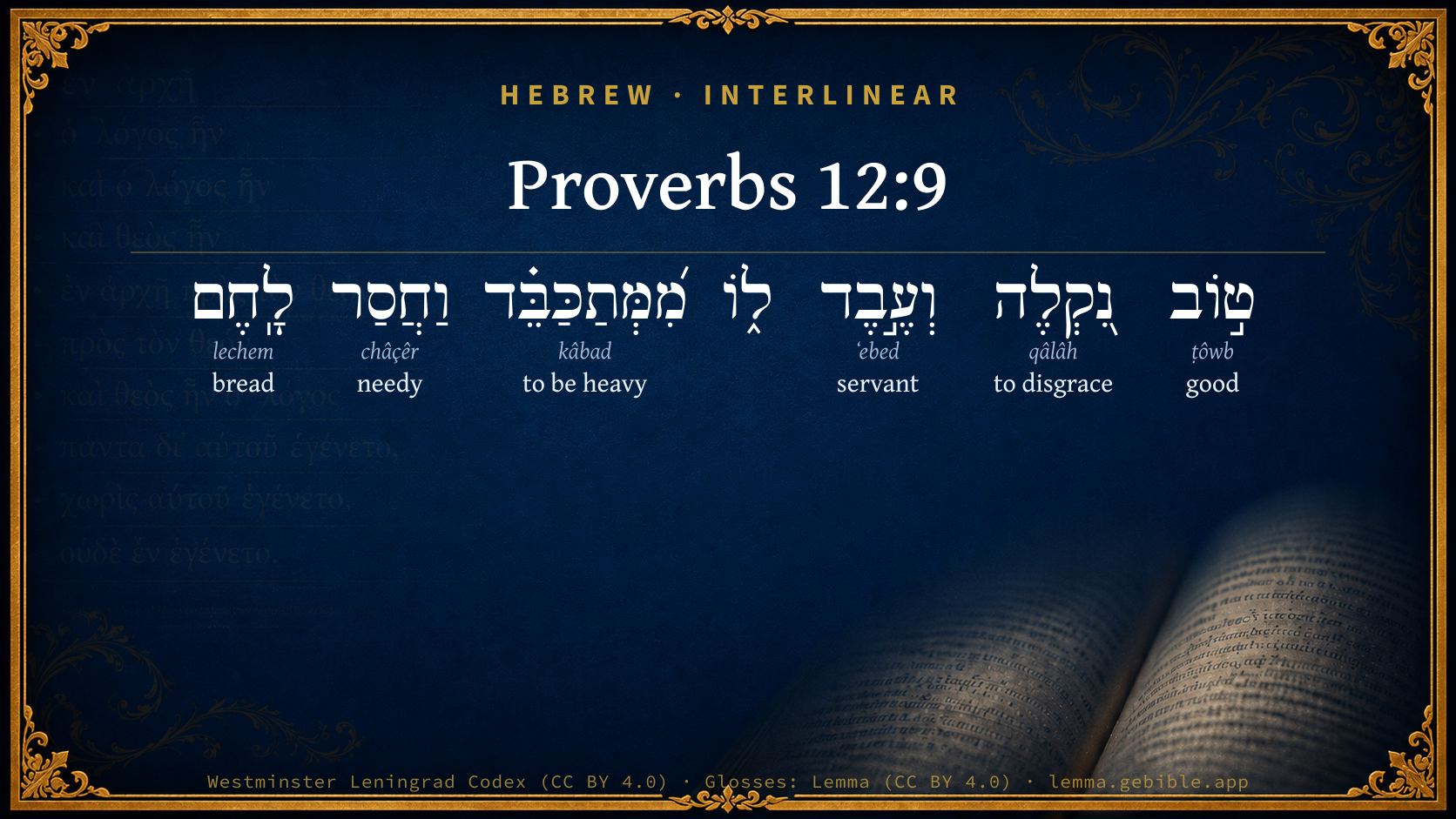
Hebrew (Westminster Leningrad Codex) Proverbs 12:9 appears in the Hebrew Old Testament. The text above is from the Westminster Leningrad Codex. Each word links to its Strong’s number, a concise gloss, and parsing drawn from the Open Scriptures Hebrew Bible morphology. Click any word for its full Brown-Driver-Briggs (BDB) entry.
Download image
Cite this verse

Proverbs 12:9 (World English Bible). Public Domain. Lemma interlinear Bible study tool, https://lemma.gebible.app/v/proverbs/12/9.

Show BibTeX & RIS
BibTeX
RIS
English Translation
Better is he who is lightly esteemed, and has a servant, Than he who honors himself, and lacks bread.
World English Bible · Public Domain
Download a study sheet

One document with this verse’s original text, its word-by-word gloss line, the meaning frame, cross-references with their text, attributed commentary, and full source and license credits — printable, and it pastes into notes with its structure intact.

This verse Autodidact and up

Study sheet (.html) Plain text (.txt)

A passage Seminary Student

Up to 50 verses in one chapter. A passage sheet keeps up to 6 commentary sources and 12 cross-references per verse, in the order this page ranks them, and says so on the sheet whenever that leaves anything out. Ask for a single verse and you get the Autodidact verse sheet above.

Everything on this page stays free to read, with no account — the sheet is a download of what is already on screen, not access to it.

Want to remove ads? Support Godless Engineer
Compare translations 3

The same verse in 3 English versions, stacked beneath the original-language interlinear above. Click any original word for its lexicon entry.

Each is an independent rendering of the whole verse — the interlinear is not word-aligned to these translations.

Highlighted words mark where these versions differ — a whole-verse word diff, not a word-by-word alignment.

  • World English Bible Public Domain
    Better is he who is lightly esteemed, and has a servant, Than he who honors himself, and lacks bread.
  • King James Version Public Domain
    He that is despised, and hath a servant, is better than he that honoureth himself, and lacketh bread.
  • unfoldingWord Literal Text CC BY-SA 4.0
    Better being disregarded and having a servant than honoring oneself and lacking bread.

unfoldingWord Literal Text — © unfoldingWord, licensed CC BY-SA 4.0. Word-aligned USFM3 via Door43 (git.door43.org/unfoldingWord/en_ult).

Versions to compare (up to 4)

3 of 4 selected

Show all 18 translations

Every available English version of this verse, each an independent rendering of the whole verse.

  • World English Bible Public Domain
    Better is he who is lightly esteemed, and has a servant, Than he who honors himself, and lacks bread.
  • Berean Standard Bible Public Domain
    Better to be lightly esteemed yet have a servant, than to be self-important but lack food.
  • Majority Standard Bible Public Domain
    Better to be lightly esteemed yet have a servant, than to be self-important but lack food.
  • King James Version Public Domain
    He that is despised, and hath a servant, is better than he that honoureth himself, and lacketh bread.
  • American Standard Version (1901) Public Domain
    Better is he that is lightly esteemed, and hath a servant, Than he that honoreth himself, and lacketh bread.
  • Revised Version (1885) Public Domain
    Better is he that is lightly esteemed, and hath a servant, than he that honoureth himself, and lacketh bread.
  • Geneva Bible (1599) Public Domain
    He that is despised, and is his owne seruant, is better then he that boasteth himselfe and lacketh bread.
  • Douay-Rheims (1899) Public Domain
    Better is the poor man that provideth for himself, than he that is glorious and wanteth bread.
  • Young's Literal Translation Public Domain
    Better `is' the lightly esteemed who hath a servant, Than the self-honoured who lacketh bread.
  • Literal Standard Version CC BY-SA 4.0
    Better [is] the lightly esteemed who has a servant, || Than the self-honored who lacks bread.
  • Unlocked Literal Bible CC BY-SA 4.0
    Better to have an unimportant position—only being a servant— than to brag about your importance but have no food.
  • unfoldingWord Literal Text CC BY-SA 4.0
    Better being disregarded and having a servant than honoring oneself and lacking bread.
  • Darby Bible Public Domain
    Better is he that is lightly esteemed, and hath a servant, than he that honoureth himself, and lacketh bread.
  • World Messianic Bible Public Domain
    Better is he who is little known, and has a servant, than he who honors himself and lacks bread.
  • Webster's Bible Public Domain
    He that is despised, and hath a servant, is better than he that honoreth himself, and is destitute of bread.
  • Free Bible Version CC BY-SA 4.0
    Better to be a humble man serving himself than a boastful man who has nothing to eat.
  • Bible in Basic English Public Domain
    He who is of low position and has a servant, is better than one who has a high opinion of himself and is in need of bread.
  • JPS Tanakh (1917) Public Domain
    Better is he that is lightly esteemed, and hath a servant, than he that playeth the man of rank, and lacketh bread.

Literal Standard Version (2020), Covenant Press — licensed CC BY-SA 4.0. Text via the HelloAO Bible API (eBible.org). Unlocked Literal Bible (unfoldingWord) — licensed CC BY-SA 4.0. Text via the HelloAO Bible API (eBible.org). unfoldingWord Literal Text — © unfoldingWord, licensed CC BY-SA 4.0. Word-aligned USFM3 via Door43 (git.door43.org/unfoldingWord/en_ult). Free Bible Version, Dr. Jonathan Gallagher — licensed CC BY-SA 4.0. Text via the HelloAO Bible API (eBible.org).

Word by word

More ways to search: Search by grammar → Find every occurrence → Compare this word →

Practice this passage: Drill this verse → Learn its vocabulary →

About this verse

These counts appear in no published source. They are computed here, from the morphology-tagged text and Lemma’s own curated glosses. What Lemma adds →

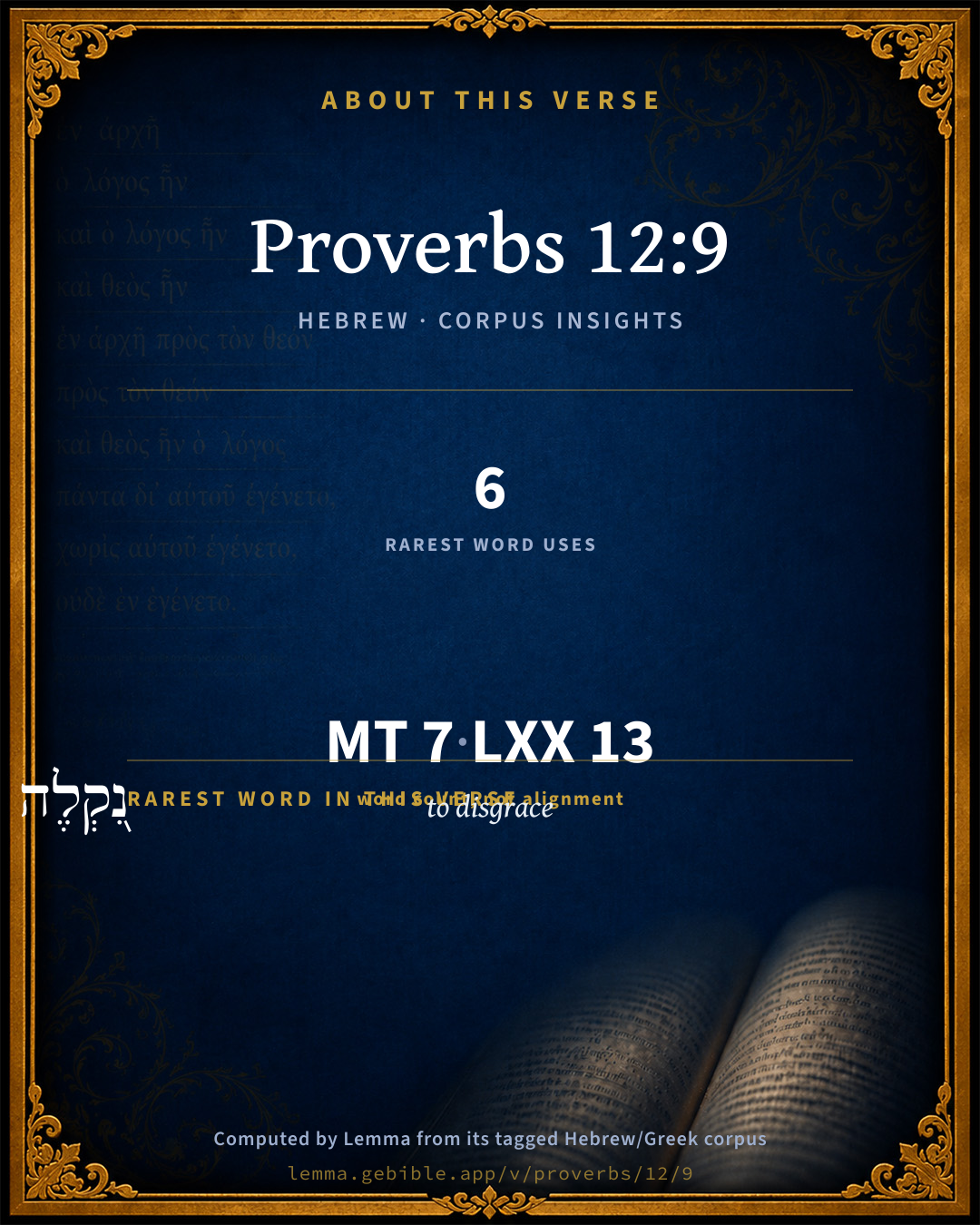
7
words
6
distinct lemmas
Wisdom
section

Notable vocabulary

The rarest word here is נִ֭קְלֶה to disgrace H7034 — appearing just 6 times in the whole Hebrew Bible.

Shared distinctive vocabulary

נִ֭קְלֶה to disgrace H7034 occurs in 6 verses of the Hebrew Bible. Also found in:

Grammatical profile

  • 2 verbs
  • 2 nouns
  • 2 adjectives
  • 1 preposition

Verb forms

  • נִ֭קְלֶה Niphal · Participle Active
  • מִ֝מְּתַכַּבֵּ֗ד Hithpael · Participle Active

Hebrew & Septuagint length

In English translation the verse runs 19 words from the Hebrew and 15 from the Septuagint (LXX English) — closely comparable.

A rough comparison of the two English renderings, which tokenize alike — not a word-level alignment.

Word counts can differ between the Hebrew and the Greek without any difference in meaning — e.g. the Hebrew direct-object marker אֵת has no separate Greek word, and Greek often adds the article ὁ.

In the original languages it is 7 Hebrew tokens and 13 Greek tokens — but the two are counted differently (Hebrew bundles its prefixes and suffixes into one token; the Greek is in lemma form), so that isn’t a like-for-like length.

Cross-references

2

Topical passages linked to Proverbs 12:9 in the Treasury of Scripture Knowledge — connected by theme and wording, ordered by reader-vote popularity; previews shown in the World English Bible.

  • Luke 14:11 For everyone who exalts himself will be humbled, and whoever humbles himself will be exalted."
  • Proverbs 13:7 There are some who pretend to be rich, yet have nothing. There are some who pretend to be poor, yet have great wealth.

Cross-references courtesy of OpenBible.info (CC BY 4.0).

Hebrew and Greek witnesses Masoretic Hebrew ↔ Greek Septuagint

The same verse in the two great witnesses to the Old Testament, shown verse-for-verse.

These are two independent witnesses, not word-aligned to each other, and the Septuagint is shown in lemma (dictionary) form.

Hebrew Proverbs 12:9 Masoretic · Westminster Leningrad Codex

ט֣וֹב נִ֭קְלֶה וְעֶ֣בֶד ל֑וֹ מִ֝מְּתַכַּבֵּ֗ד וַחֲסַר לָֽחֶם

Better is he who is lightly esteemed, and has a servant, Than he who honors himself, and lacks bread.

World English Bible · Public Domain

Greek LXX Proverbs 12:9 Septuagint · lemma form

κρείσσων ἀνήρ ἐν ἀτιμία δουλεύω ἑαυτοῦ ἤ τιμή ἑαυτοῦ περιτίθημι καί προςδέω ἄρτος

Better is a man in dishonor serving himself, than one honouring himself and lacking bread.

LXX2012 (modern English Septuagint) · Public Domain

On this verse, Joseph Benson's Commentary discusses the Septuagint’s reading. Read the note in Commentary ↓

Hebrew: Westminster Leningrad Codex (CC BY 4.0). Greek: Septuagint (public domain); English from LXX2012 (modern English Septuagint) (Public Domain). How the Septuagint differs from the Hebrew →

Commentary

Notes on Proverbs 12:9 from classic Christian and Jewish commentators (each source and its license shown beneath its notes). The classic Christian expositions comment on the surrounding passage and are grouped to its opening verse, so a note may address several verses; the Jewish commentaries on the Tanakh (Rashi and others) are per-verse, so they appear only where the commentator wrote on this verse.

Lemma curates 59 commentaries, every one of them public domain or Creative Commons licensed, each selected and text-cleaned for this edition rather than reprinted as found. About our sources →

Trapp's Complete Commentary

John Trapp

Pro 12:9 [He that is] despised, and hath a servant, [is] better than he that honoureth himself, and lacketh bread.

Ver. 9. Better is he that is despised.] Viz., Of others, and hath no extraordinary opinion of himself, but sticks close to his business, and hath help at hand when he pleases, a servant at his beck and check. This was the case of Galleacius Caracciolus, that noble marquis, in his exile at Geneva for conscience’ sake. See his life set forth in English by Mr Crashaw.

Than he that honoureth himself and lacketh bread.] That standing upon his slippers, and boasting of his gentility - as those Spanish Hidalgoes ruffle it out in brave apparel - but hath not a penny in his purse, yea, not sometime food sufficient to put in his belly. Spaniards are said to be impudent braggers, and extremely proud in the lowest ebb of fortune. If a Spaniard have but a capon, or the like good dish to his supper, you shall find the feathers scattered before his door the next morning. {a}

{a} Heyl., Geog.

John Trapp, A Commentary or Exposition upon All the Books of the Old and New Testament (1647–1656) — public domain. Text from a community e-Sword module.

The Biblical Illustrator

Joseph S. Exell

Pro_12:9

He that is despised, and hath a servant, is better than he that honoureth himself, and lacketh bread.

Domestic modesty and display

Vanity, or love of display, is one of the most contemptible and pernicious passions that can take possession of the human mind. Its roots are self-ignorance, its fruits are affectation and falsehood. The text refers to this in families, and when it takes possession of households it often destroys domestic comforts.

I. There are domestic comforts without display. In many an unpretending cottage there is more real domestic enjoyment than can be found in the most imposing mansions.

II. There is domestic display without comforts. Many sacrifice comforts for appearances. They all but starve their domestics to feed their vanity. They must be grand though they lack bread. This love of appearance, this desire for show, is making sad havoc with the homes of old England.

III. The condition of the former is preferable to that of the latter. It is better to have comforts without show than show without comforts.

1. It is more rational.

2. It is more moral.

3. It is more satisfying. (Homilist.)

Vain honouring of self

Amid the changes of this world, I have seen a man who, having known better days, had been nursed by luxury, and reared in the lap of fulness, outlive his good-fortune, and sink down into the baseness and meanness of the deepest poverty--in such a case it seems to be with men as with plants. Naturalists find it much less easy to teach a mountain flower to accommodate itself to a low locality than to persuade one which by birth belongs to the valleys to live and thrive at a lofty elevation; so there seems nothing more difficult to men than to descend gracefully . . . And thus I have seen such an one as I have described, when he had lost his wealth, retain his vanity, continuing proud in spirit when he had become poor in circumstances. (T. Guthrie, D. D.)

The Biblical Illustrator, edited by Joseph S. Exell (c. 1880s–1900s) — public domain. Text from a community e-Sword module.

Joseph Benson's Commentary

Pro 12:9. He that is despised — That lives in an obscure and mean condition in the world, such being commonly despised by persons of a higher rank; and hath a servant — Hath but one servant: or, as the LXX. render it, δουλευων εαυτω, serveth, or is servant to himself; that is, hath none to wait upon him, or work for him but himself; that supports himself by his own labours; is better than he that honoureth himself — Is happier, and in a better condition, than he that glories in his high birth and gay attire; and lacketh bread — Wants necessaries for his own sustenance.

Joseph Benson's Commentary on the Old and New Testaments (1811–1818) — public domain. Text from a community e-Sword module.

The Preacher's Complete Homiletical Commentary

Joseph S. Exell (gen. ed.)

CRITICAL NOTES.—

Pro_12:9. This verse is read in two ways. Zockler reads, “Better is the lowly that serveth himself than he that boasteth and lacketh bread.” Wordsworth agrees with this view. Delitzsch and Stuart render as the authorised version (see comments on the verse).

MAIN HOMILETICS OF Pro_12:9

Whichever rendering we adopt of this verse the subject is the same—that of one man’s allowing his vanity, his love for appearances, to rob him of all real comfort, and that of his wiser brother’s preference of comfort to outside show.

I. The wise man who is despised. Men who have the moral courage to live in a simple style, and to labour with their own hands, will certainly be regarded with contempt by some, but by whom? By those whose good opinion and honour is not worth having. Children are taken with what is showy on the surface—they have little regard for what lies underneath. They will be more delighted with a soap-bubble than with a diamond. But men look on things with different eyes. So it is only men and women of childish minds who estimate a man by his clothes, his house, or his establishment, and it is only such who will despise the first man mentioned in the text. If we take the common rendering of the verse, then this man is more useful to society than the other; for, instead of spending all his money on himself, he keeps a servant, and so gives another a means of living. For as it is implied that he does not lack bread himself, so he will not let those in his employ want the necessaries of life. Other things being equal, the man who, by a judicious use of his means, gives employment to others, is a greater benefactor to his race than he who spends his money in selfish luxury. At any rate, this man is a wiser man than the other, for he has the good sense to prefer the greater to the less. It is only obeying a natural instinct to satisfy the bodily wants, and to supply ourselves with all the substantial comforts of life before we spend money on things which do not, after all, add in the least to our real enjoyment, and yet the majority of men do sacrifice some of the former to the latter. He who has the moral courage not to do so shows his real wisdom. And by such a course of conduct he blesses others as well as himself—he does something to stem the tide of passion for keeping up appearances which in our age and country is the fruitful source of so much crime and misery—he, and he only, is the truly honest man, for he is content to pass for just what he is as to wealth.

II. The foolish and wicked man who “honours himself.”

1. He is a fool. Vanity is one of the most despicable passions that can possess a man—it often leads a man to the most childish actions. No man of modern times was more entirely under its dominion than Voltaire, whose only aim in life seemed to be to gain that unsubstantial homage which afforded his spirit at the last such an unsatisfying portion. He did not literally lack bread, but he did find himself in his old age without anything which could give him any real comfort. The man mentioned in our text is so bent upon obtaining this false honour that he will “lack bread”—suffer positive bodily discomfort—rather than not obtain it.

2. He is a sinner. He lies in action, if not in word. While he is resorting to the meanest shifts in secret he is trying to make people believe that he is much better off than he really is. By stinting himself in the common comforts of life he sins against his own body and against his Creator, for “the Lord is for the body” (1Co_6:13), and it is man’s duty to feed that house of the soul which is so “fearfully and wonderfully made” (Psa_139:14). He therefore sins against himself and against society. It is worth while to inquire whether anybody will honour him after all his foolish efforts. God cannot, for He hates all hypocrisy. Men may, for their own interest, flatter him, and feign to respect him, but he will obtain no real honour, either from men like him in character, or from those who are better and wiser. “I have read,” says Thomas Adams, “of Menecrates, a physician that would needs be counted a god, and took no other fee of his patients than their vow to worship him. Dionysius Syracusanus, hearing of this, invited him to a banquet, and, to honour him according to his desire, set before him nothing but a censer of frankincense, with the smoke whereof he was feasted till he starved, while others fed on good meat.” Such smoke as this is all the return such a man as the one pictured in this proverb will get for starving himself, and for sinning against his own body, against society, and against God.

OUTLINES AND SUGGESTIVE COMMENTS

We give a few of the many renderings of this verse:—

Better is he that laboureth and aboundeth in all things than he that boasteth himself and lacketh bread. Wordsworth.

This proverb, like Pro_15:17, commends the middle rank of life with its quiet excellencies. A man of lowly rank, who is, however, not so poor that he cannot support a slave, is better than one that boasts himself and is yet a beggar. The first necessity of an oriental in only moderate circumstances is a slave, just as was the case with the Greeks and Romans.—Delitzsch.

Better is the condition of the poor man, who has the means under his control of aiding his exertions for sustenance, than the nobleman, real or fancied, who is in a state of starvation. Stuart.

Each interpretation is tenable grammatically.

(1) He whom men despise, or who is “lowly” in his own eyes (the word is used by David himself, 1Sa_18:23), the trader, the peasant, if he has a slave, i.e., if he is one step above absolute poverty, and has someone to supply his wants, is better off than the man who boasts of rank or descent, and has nothing to eat. Respectable mediocrity is better than boastful poverty.

(2) He who, though despised, is a servant to himself, i.e. supplies his own wants, is better than the arrogant and helpless.—Plumptre.

Some do think it more miserable to be known to be miserable than to be so, and are more grieved to be disesteemed for it than to be pinched by it, wherefore they will feed the eyes of others with a show of plenty, although they have not bread to feed themselves. But he is better who, disesteeming the esteem of others and being servant to himself, does get his own bread, and is contented with it. For as lie is servant, so is he master also; and howbeit he serveth, yet it is at his own pleasure. And this is his comfort, that while he serveth himself he hath to serve his need and occasions, when he that honoureth himself is fain at last to live by others. Or else take the meaning thus: the ambitious itch of many is so great, and so disquieteth their hearts, that they can lack anything, even bread itself, rather than honour and preferment; so that when they are swollen big in greatness and dignity they are even starved in their estate, and have not of their own the next meal to feed themselves. But better is he, especially if he be a good man, who—having to keep himself and a servant—doth keep within his means; and though he be despised by them that overlook him, yet looks upon himself with thanks to God that it is so well with him. And, indeed, how can this man but be better than the other, when his servant is better than the other is. For as Chrysostom speaketh, it cannot be but that he who is the slave of glory should be servant of all, yea, more vile than all other servants. For there is no servant commanded to do such base things as the love of glory commandeth him.—Jermin.

The son of Sirach, who may well be called an interpreter of this book of the Proverbs, hath a very like saying to this where he speaketh thus, “Better is he that worketh and aboundeth with all things, than he that boasteth himself, and wanteth bread” (Sir_10:30). Muffet.

When men are such slaves to the opinion of the world, they rebel against Him who makes no mistake in His allotments and often appoints a descent from worldly elevation as a profitable discipline (Jas_1:10-11; Dan_4:32-37). Yet it is hard, even for the Christian, as Bunyan reminds us, “to go down the valley of humiliation and catch no slip by the way.” We need our Master’s unworldly elevated spirit (Joh_6:15) to make as safe descent … “Let our moderation be known unto all men,” under the constraining recollection, “The Lord is at hand (Php_4:5). How will the dazzling glory of man’s esteem fade away before the glory of His appearing!—Bridges.

Paul travelling on foot, and living on the wages of a tent-maker, was more respectable than the pretended successor of his brother apostle, with a triple crown upon his head.—Lawson.

The Preacher's Complete Homiletical Commentary (gen. ed. Joseph S. Exell; Funk & Wagnalls, c. 1892) — public domain (pre-1929). A full-Bible homiletical/sermon-outline anthology covering 65 of 66 books (2 John is absent from the source module). Text from a community e-Sword module.

Tyndale Open Study Notes

Tyndale Open Resources

12:9 Reality is more important than appearance.

Tyndale Open Study Notes — © Tyndale Open Resources, licensed CC BY-SA 4.0. Text via the HelloAO Bible API.

Geneva Bible (1599)

Geneva Bible translators

The poor man that is contemned and yet liveth of his own travail.

Geneva Bible (1599) marginal notes — public domain. Text via Bolls.life.

Matthew Henry's Commentary

Note, 1. It is the folly of some that they covet to make a great figure abroad, take place, and take state, as persons of quality, and yet want necessaries at home, and, if their debts were paid, would not be worth a morsel of bread, nay, perhaps, pinch their bellies to put it on their backs, that they may appear very gay, because fine feathers make fine birds. 2. The condition and character of those is every way better who content themselves in a lower sphere, where they are despised for the plainness of their dress and the meanness of their post, that they may be able to afford themselves, not only necessaries, but conveniences, in their own houses, not only bread, but a servant to attend them and take some of their work off their hands. Those that contrive to live plentifully and comfortably at home are to be preferred before those that affect nothing so much as to appear splendid abroad, though they have not wherewithal to maintain their appearance, whose hearts are unhumbled when their condition is low.

Matthew Henry's Commentary on the Whole Bible (1708–1710) — public domain (CC PDM 1.0). Text via the HelloAO Bible API.

Jamieson, Fausset & Brown

Robert Jamieson, A. R. Fausset & David Brown

despised--held in little repute, obscure (Sa1 18:23; Isa 3:5).

hath a servant--implying some means of honest living.

honoureth himself--is self-conceited.

Jamieson, Fausset & Brown — Commentary Critical and Explanatory on the Whole Bible (1871) — public domain (CC PDM 1.0). Text via the HelloAO Bible API.

Adam Clarke's Commentary

Verse 9. He that is despised, and hath a servant] I believe the Vulgate gives the true sense of this verse: Melior est pauper, et sufficiens sibi; quam gloriosus, et indigens pane.

"Better is the poor man who provides for himself, than the proud who is destitute of bread." The versions in general agree in this sense. This needs no comment. There are some who, through pride of birth, &c., would rather starve, than put their hands to menial labour. Though they may be lords, how much to be preferred is the simple peasant, who supports himself and family by the drudgery of life!

Adam Clarke's Commentary on the Bible (1810–1826) — public domain. Text from a community e-Sword/MySword module.

Ellicott's Commentary for English Readers

(9) He that is despised.—That is, lowly in his eyes and those of others, as David (1Sa_18:23); if “he hath a servant,” that is, if he be in easy circumstances. It has been remarked that “the first necessity of an Oriental in only moderate circumstances is a slave.”

He that honoureth himself.—Boasts of his pedigree, it may be, and is all the while starving.

A Bible Commentary for English Readers, edited by Charles John Ellicott (1878–1897) — public domain. Text from a community e-Sword module.

The Cambridge Bible for Schools and Colleges

gen. ed. J. J. S. Perowne

9. despised] Rather, lightly esteemed, R.V.; a person of no consequence, in the eyes of others, and perhaps (as in 1Sa_18:23, the word is used by David of himself) in his own eyes also, in contrast to him who honoureth himself.

hath a servant] Notwithstanding his lowly position he is well enough off to keep a slave. Zebedee, though only a fisherman, had hired servants (Mar_1:20).

Another rendering (with a change of Heb. vowel points), is a servant to himself, works for his own living, is adopted by the LXX. ἐν ἀτιμίᾳ δουλεύων ἑαυτῷ, and by the Vulg., pauper et subjiciens sibi. Comp. for the sentiment, Sir_10:27 :

“Better is he that laboureth and aboundeth in all things,

Than he that glorifieth himself and lacketh bread.”

The Cambridge Bible for Schools and Colleges (gen. ed. J. J. S. Perowne; Cambridge University Press, 1878–1918) — public domain. Text from a community e-Sword module.

John Gill's Exposition

He that is despised, and hath a servant,.... Meaning not the same person as before, but one in mean circumstances of life; and because he has not that substance as others have, at least does not make that show and figure in the world as some; and mean in his own eyes, as Jarchi; and does not affect grandeur, and to look greater than he is; has just sufficiency to keep a servant to wait upon him; or, as some render it, is "a servant to himself" (p); to this purpose the Septuagint; and so Jarchi and Gersom interpret it, who does his own work at home and abroad, in the house and in the field, and so gets himself a competent living. He

is better than he that honoureth himself, and lacketh bread; that boasts of his pedigree, and brags of his wealth; dresses out in fine clothes, keeps a fine equipage, makes a great figure abroad, and has scarce bread to eat at home, and would have none if his debts were paid; the former is much the better man on all accounts, and more to be commended; see Pro 13:7. And so, as Cocceius observes, the least shepherd (under Christ) that has ever so few sheep, one or two under his care, whom he brings to righteousness, and by whom he is loved, is preferable to the pope of Rome, who is adored by all; and yet neither has nor gives the bread of souls; and without the offerings of others has not anything to eat.

(p) "servus sibiipsi", Montanus; "suiipius", Vatablus; "sibimet", Schultens.

John Gill's Exposition of the Whole Bible (1746–1763) — public domain (CC PDM 1.0). Text via the HelloAO Bible API.

Albert Barnes' Notes on the Bible

Two interpretations are equally tenable;

(1) as in the King James Version, He whom men despise, or who is “lowly” in his own eyes (compare 1Sa 18:23), if he has a slave, i. e., if he is one step above absolute poverty, and has some one to supply his wants, is better off than the man who boasts of rank or descent and has nothing to eat. Respectable mediocrity is better than boastful poverty.

(2) he who, though despised, is a servant to himself, i. e., supplies his own wants, is better than the arrogant and helpless.

Albert Barnes' Notes on the Bible (1834–1885) — public domain. Text from a community e-Sword/MySword module.

Haydock's Catholic Bible Commentary

Glorious. Or a boaster, (Haydock) as many noblemen are, who are involved in debt, Ecclesiasticus x. 30. (Menochius) --- It is better to have a sufficiency, than to be of noble parentage; and starving through a stupid idea, that work would be disgraceful.

George Leo Haydock (1774–1849), Haydock's Catholic Family Bible and Commentary, 1859 edition — public domain. Excludes Psalms (Douay-Rheims chapter numbering differs from Protestant) and Deuterocanonical books (Catholic canon only).

Matthew Poole's English Annotations

That is despised; that liveth in a mean and obscure condition in the world, for such are commonly despised by men of a higher rank.

Hath a servant; hath but one servant. Or rather, is servant to himself; hath none to wait upon him or work for him but himself, that getteth bread by his own labours.

Is better, is happier, than he that honoureth himself, that glorieth in his high birth or gay attire, and lacketh bread, wants necessaries for his own sustenance.

Matthew Poole's English Annotations on the Holy Bible (1683–1685) — public domain. Text from a community e-Sword/MySword module.

Whedon's Commentary on the Bible

Daniel D. Whedon

9. He that is despised — Lowly, little noticed, or lightly esteemed. 1Sa_18:23. It is a different word from that rendered “despised” in Pro_12:8. Perhaps it (נקלה, nikleh) should be translated ignoble; that is, of birth or family — one of the common people.

And hath a servant — A sign of wealth and substance.

Is better — Better off than he that honoureth himself; affects honour, wealth, nobility, aristocracy, and lacketh bread. The general sentiment is, Better is a man in medium circumstances, who has the means of sustenance under his control, than a nobleman who is in a state of starvation. So Stuart. “Respectable mediocrity is better than boastful poverty.” — Speaker’s Commentary. The Septuagint reads the passage thus: “He that is despised and serveth himself;” that is, supports himself by his own labour; which makes a good sense, and is followed by the Vulgate, the Geneva Bible, Muenscher, Zockler, Conant, (“tills for himself,”) and others. The present pointing of the Hebrew does not allow of this reading; but a little alteration of the vowel points does permit it. The points give us the Masoretic or Jewish traditional interpretation — nothing more. It is respectable, but not infallible. If the sense of the Septuagint is to be followed, Miller’s form of the words is preferable — “is a servant to himself” — as being reconcilable with the present Hebrew pointing. The Douay reads: “Better is the poor man that provides for himself than he that is glorious and wanteth bread.”

Daniel D. Whedon (gen. ed.), Commentary on the Old and New Testaments (1874–1909) — public domain. Text from a community e-Sword module.

The Pulpit Commentary

This verse may be translated, Better is a man who is lightly esteemed and hath a slave, than he that boasts himself and lacketh bread; i.e. the man who is thought little of by his fellows, and is lowly in his own eyes, if he have a slave to minister to his wants (which all Orientals of even moderate wealth possess), is better off than one who boasts of his rank and family, and is all the while on the verge of starvation. "Respectful mediocrity is better than boastful poverty." Ecc 10:27, "Better is he that laboreth and aboundeth in all things, than he that boasteth himself, and wanteth bread." But the words rendered, hath a slave, are literally, a servant to himself. So the Vulgate has, sufficiens sibi, "sufficing himself," and the Septuagint, douleuwn eautw , "serving himself." And the expression implies attending to his own concerns, supplying his own wants. Hence the gnome means, "It is wiser to look after one"s own business and provide for one"s own necessities, even if thereby he meets with contempt and detraction, than to be in real want, and all the time assuming the airs of a rich and prosperous man." This latter explanation seems most suitable, as it is not at all clear that, at the time the book was written, the Israelites of moderate fortune kept slaves, and the proverb would lose its force if they did not do so. Says a mediaeval jingle"Nobilitas morum plus ornat quam genitorum.

Consideration or comfort?

It is worth remarking that we might obtain a very wholesome truth from the text, if we take the exact reverse of the proverb as worded in our version; for then we reach the wise conclusion

I THAT SELF-RESPECT, HOWEVER INDIGENT, is better than "being ministered unto" at the cost of reputation. It is better to lack bread, or even life itself, really honoring ourself, than it is to receive any amount of service from others, if we have forfeited the regard of the good, and are deservedly "despised." But taking the words as they are, and reaching the sense intended by the writer, we gather

II THAT DOMESTIC COMFORT AND SUFFICIENCY ARE MUCH TO BE PREFERRED TO THE GRATIFICATION OF PERSONAL VANITY. One man, in order that he may have consideration and deference from his neighbours, expends his resources on those outward appearances which will command that gratification; to do this he has to deny himself the attendance which he would like to have, and even the nourishment he needs. Another man disregards altogether the slights he may suffer from his meddlesome and intrusive neighbours, in order to supply his home with the food and the comforts which will benefit his family. It is the latter who is the wise man. For:

1. The gratification of vanity is a very paltry satisfaction; there is nothing honourable, but rather ignoble about it; it lowers rather than raises a man in the sight of wisdom.

2. The gratification thus gained is likely to prove very ephemeral, and to diminish constantly in its value; moreover, it is personal and, in that sense, selfish.

3. Domestic comfort is a daily advantage, lasting the whole year round, the whole life long.

4. Domestic comfort not only benefits the head of the household, but all the members of it, and he who makes a happy home is contributing to the good of his country and his kind. Using now the words of the text as suggestive of truths which they do not actually hold, we learn

III THAT THERE IS A VALUABLE SERVICE WHICH ALL MAY SECURE. "He that hath a servant." Men are divisible into those that are servants and those that have them. Some are the slaves of their evil habits; these are to be profoundly pitied, however many menservants or maidservants they may have at their call. But we may and should belong to those who hold their habits, whether of the mind or of the life, under their control and at their command. If that be so with us, then, though we should have no dependents at all in our employ, or though we ourselves should be dependents, living in honourable and useful service, we shall have the most valuable servants always at hand to minister to us, building up our character, strengthening our mind, enlarging our life.

IV THAT WE SHOULD SECURE NOURISHMENT AT ALL COSTS WHATEVER. We must never he "the man that lacketh bread." To attain to any honour, to receive any adulation, to indulge any tancy, and to "lack bread," is a great mistake. For nourishment is strength and fulness of life; it is so in

(1) the physical,

(2) the intellectual,

(3) the moral and spiritual realm.

With the regularity and earnestness with which we ask for "daily bread," we should labour and strive to secure it, for our whole nature. C.

The Pulpit Commentary (1880–1919), ed. H.D.M. Spence-Jones & Joseph S. Exell — public domain. Text from a community e-Sword module.

John Wesley's Explanatory Notes

Despised - That lives in a mean condition. honoureth - That glories in his high birth or gay attire.

John Wesley, Explanatory Notes Upon the Whole Bible (1754–1765) — public domain. Text via the GEBible commentary corpus.

Keil & Delitzsch

C. F. Keil & F. Delitzsch

9 Better is he who is lowly and has a servant,

Than he that makes himself mighty and is without bread.

This proverb, like Pro 15:17, commends the middle rank of life with its quiet excellences. נקלה (like Sa1 18:23), from קלה, cognate with קלל, Syr. 'kly, to despise, properly levi pendere, levem habere (whence קלון, scorn, disgrace), here of a man who lives in a humble position and does not seek to raise himself up. Many of the ancients (lxx, Symmachus, Jerome, Syr., Rashi, Luther, Schultens) explain ועבד לו by, and is a servant to himself, serves himself; but in that case the words would have been עבד לנפשׁו (Syr. דּמשׁמּשׁ נפשׁהּ), or rather ועבדּו הוּא. ועבד לו would be more appropriate, as thus pointed by Ziegler, Ewald, and Hitzig. But if one adheres to the traditional reading, and interprets this, as it must be interpreted: et cui servus (Targ., Graec. Venet.), then that supplies a better contrast to וחסר־לחם, for "the first necessity of an oriental in only moderate circumstances is a slave, just as was the case with the Greeks and Romans" (Fl.). A man of lowly rank, who is, however, not so poor that he cannot support a slave, is better than one who boasts himself and is yet a beggar (Sa2 3:29). The Hithpa. often expresses a striving to be, or to wish to appear to be, what the adj. corresponding to the verb states, e.g., התגּדּל, התעשּׁר; like the Greek middles, εζεσθαι, αζεσθαι, cf. התחכּם and σοφίζεσθαι. So here, where with Fleischer we have translated: who makes himself mighty, for כבד, gravem esse, is etymologically also the contrast of קלה. The proverb, Sirach 10:26: κρείσσων ἐργαζόμενος καὶ περισσεύων ἐν πᾶσιν, ἢ δοξαζόμενος καὶ ἀπορῶν ἄρτων (according to the text of Fritzsche), is a half remodelling, half translation of this before us.

Keil & Delitzsch — Biblical Commentary on the Old Testament (1861–1891) — public domain (CC PDM 1.0). Text via the HelloAO Bible API. (Old Testament only.)

Bridges on Proverbs

Charles Bridges

A man, who has only a competency, sufficient to have a servant (Pro 30:8-9 ), and making no appearance, may be despised by his richer neighbors. (1Sa 18:23 .) But his state is better than the proud show of rank, or family, without the means of sustaining it; or than one humbled by Providence, yet unhumbled in heart. (Pro 13:7 . Luk 14:11 .) Nothing is so despicable as to be proud, where there is nothing to be proud of. Sometimes from ’a shabby gentility’†1 — the foolish vanity of keeping up appearances — a man debars himself from the common comforts of life — honouring himself, and lacking bread. Such slaves are men to the opinion of the world! Principle is sacrificed to pride; and men rebel against Him, who makes no mistake in his allotments, and often appoints a descent from worldly elevation as a profitable discipline. (Jas 1:10-11 . Dan 4:32-37 .) Yet it is hard, even for the Christian, as Bunyan reminds us, ’to go down the Valley of Humiliation, and catch no slip by the way.’ We need our Master’s unworldly, elevated spirit (Joh 6:15 ) to make a safe descent. Remember — "the pride of life is not of the Father, but is of the world." (1Jn 2:16 .) "Let our moderation be known unto all men," under the constraining recollection — "The Lord is at hand." (Php 4:5 . Mar 13:1-2 .) How will the dazzling glare of man’s esteem fade away before the glory of his appearing!

Footnotes:

†1 Bp. Sanderson.

Charles Bridges, An Exposition of the Book of Proverbs (1846) — public domain. Text from a community e-Sword module.

Kretzmann's Popular Commentary

Paul E. Kretzmann

v. 9. He that is despised and hath a servant is better, rather, "Better is the lowly that serveth himself," being of small means and not too proud to be found engaged in performing the work of a servant about the house, than he that honoreth himself and lacketh bread, his pride of birth or caste keeping him from honest work.

Paul E. Kretzmann, Popular Commentary of the Bible (1921–1924) — public domain. Text from a community e-Sword module.

unfoldingWord translationNotes

Door43 World Missions Community

Better to have an unimportant position

"It is better to be an ordinary person"

is cruel

"causes suffering"

translationWords

servant

compassion

evil

unfoldingWord translationNotes — © Distant Shores Media and the Door43 World Missions Community, licensed CC BY-SA 4.0. Source: git.door43.org/Door43/en_tn.

Rashi

Rabbi Shlomo Yitzchaki (Rashi)

Better is he who is lightly esteemed in his own eyes and became a slave to himself

that one who is honored in his own eyes and says, “It is disgraceful for me to toil at labor, for I am one of the great men,”—he will ultimately lack bread.

Rashi on the Tanakh — English translations: “The Judaica Press complete Tanach with Rashi, translated by A. J. Rosenberg” (CC BY 4.0); “Pentateuch with Rashi's commentary by M. Rosenbaum and A.M. Silbermann, 1929-1934” (public domain); “The Metsudah Tanach series, Lakewood, N.J” (CC BY 4.0); and “The Book of Joshua, Metsudah Publications, 1997” (CC BY 4.0). Text via Sefaria.

Lesson kit

Teaching starters — assembled from the data on this page, not authored interpretation. Every prompt links to the verse data it draws on. Edit before teaching.

Proverbs, in the Wisdom, opens this verse with 7 words (6 distinct Hebrew lemmas). Its most distinctive word is qâlâh (“to disgrace”). A historical commentator’s framing appears above. Read the whole chapter for the surrounding context.

Discussion questions

  1. The word qâlâh carries the sense “to disgrace.” How does it shape the verse?
  2. How does Deuteronomy 25:3, which shares the word «to disgrace», read alongside this verse?
  3. These translations render this verse differently. What is at stake in choosing one wording over another?
  4. «נִ֭קְלֶה» is a Niphal Participle Active verb. How does that grammatical form shape the action described?
  5. Compare how Trapp's Complete Commentary and The Biblical Illustrator read this verse. Where do they agree or differ?

Things to notice

Reading settings

Reading text

Shown beneath each verse's original-language words.

Old Testament
Old Testament edition

Read the OT as the Masoretic Hebrew (MT) or the Greek Septuagint (LXX).

English shown for the Greek Septuagint (in the Hebrew ↔ Greek comparison).

Comparing translations? Open the Compare panel on any verse page to stack up to four side by side.