2 Kings 25:3

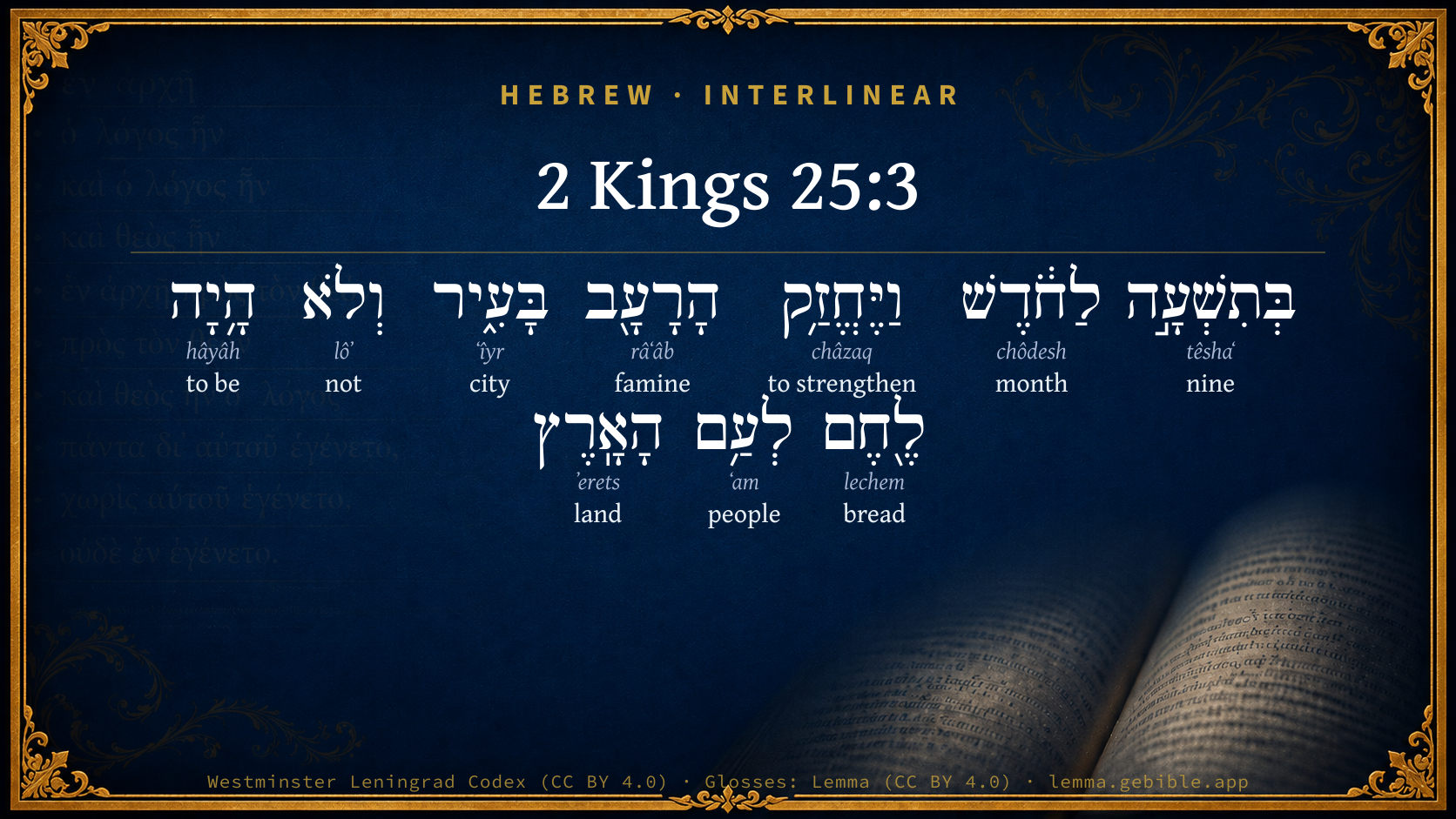
Hebrew (Westminster Leningrad Codex) 2 Kings 25:3 appears in the Hebrew Old Testament. The text above is from the Westminster Leningrad Codex. Each word links to its Strong’s number, a concise gloss, and parsing drawn from the Open Scriptures Hebrew Bible morphology. Click any word for its full Brown-Driver-Briggs (BDB) entry.
Download image
Cite this verse

2 Kings 25:3 (World English Bible). Public Domain. Lemma interlinear Bible study tool, https://lemma.gebible.app/v/2-kings/25/3.

Show BibTeX & RIS
BibTeX
RIS
English Translation
On the ninth day of the [fourth] month the famine was sore in the city, so that there was no bread for the people of the land.
World English Bible · Public Domain
Download a study sheet

One document with this verse’s original text, its word-by-word gloss line, the meaning frame, cross-references with their text, attributed commentary, and full source and license credits — printable, and it pastes into notes with its structure intact.

This verse Autodidact and up

Study sheet (.html) Plain text (.txt)

A passage Seminary Student

Up to 50 verses in one chapter. A passage sheet keeps up to 6 commentary sources and 12 cross-references per verse, in the order this page ranks them, and says so on the sheet whenever that leaves anything out. Ask for a single verse and you get the Autodidact verse sheet above.

Everything on this page stays free to read, with no account — the sheet is a download of what is already on screen, not access to it.

Want to remove ads? Support Godless Engineer
Compare translations 3

The same verse in 3 English versions, stacked beneath the original-language interlinear above. Click any original word for its lexicon entry.

Each is an independent rendering of the whole verse — the interlinear is not word-aligned to these translations.

Highlighted words mark where these versions differ — a whole-verse word diff, not a word-by-word alignment.

  • World English Bible Public Domain
    On the ninth day of the [fourth] month the famine was sore in the city, so that there was no bread for the people of the land.
  • King James Version Public Domain
    And on the ninth day of the fourth month the famine prevailed in the city, and there was no bread for the people of the land.
  • unfoldingWord Literal Text CC BY-SA 4.0
    On nine of the month, then famine seized the city, and was no bread for the people of the land.

unfoldingWord Literal Text — © unfoldingWord, licensed CC BY-SA 4.0. Word-aligned USFM3 via Door43 (git.door43.org/unfoldingWord/en_ult).

Versions to compare (up to 4)

3 of 4 selected

Show all 18 translations

Every available English version of this verse, each an independent rendering of the whole verse.

  • World English Bible Public Domain
    On the ninth day of the [fourth] month the famine was sore in the city, so that there was no bread for the people of the land.
  • Berean Standard Bible Public Domain
    By the ninth day of the fourth month, the famine in the city was so severe that the people of the land had no food.
  • Majority Standard Bible Public Domain
    By the ninth day of the fourth month, the famine in the city was so severe that the people of the land had no food.
  • King James Version Public Domain
    And on the ninth day of the fourth month the famine prevailed in the city, and there was no bread for the people of the land.
  • American Standard Version (1901) Public Domain
    On the ninth day of the `fourth' month the famine was sore in the city, so that there was no bread for the people of the land.
  • Revised Version (1885) Public Domain
    On the ninth day of the fourth month the famine was sore in the city, so that there was no bread for the people of the land.
  • Geneva Bible (1599) Public Domain
    And the ninth day of the moneth the famine was sore in the citie, so that there was no bread for the people of the lande.
  • Douay-Rheims (1899) Public Domain
    The ninth day of the month: and a famine prevailed in the city, and there was no bread for the people of the land.
  • Young's Literal Translation Public Domain
    on the ninth of the month -- when the famine is severe in the city, and there hath not been bread for the people of the land,
  • Literal Standard Version CC BY-SA 4.0
    On the ninth of the month, when the famine is severe in the city, then there has not been bread for the people of the land.
  • Unlocked Literal Bible CC BY-SA 4.0
    On the ninth day of the fourth month of that year, the famine was so severe in the city that there was no food for the people of the land.
  • unfoldingWord Literal Text CC BY-SA 4.0
    On nine of the month, then famine seized the city, and was no bread for the people of the land.
  • Darby Bible Public Domain
    On the ninth of the [fourth] month the famine prevailed in the city, and there was no bread for the people of the land.
  • World Messianic Bible Public Domain
    On the ninth day of the fourth month, the famine was severe in the city, so that there was no bread for the people of the land.
  • Webster's Bible Public Domain
    And on the ninth day of the fourth month the famine prevailed in the city, and there was no bread for the people of the land.
  • Free Bible Version CC BY-SA 4.0
    By the ninth day of the fourth month, the famine in the city was so bad that the people had nothing left to eat.
  • Bible in Basic English Public Domain
    Now on the ninth day of the fourth month, the store of food in the town was almost gone, so that there was no food for the people of the land.
  • JPS Tanakh (1917) Public Domain
    On the ninth day of the fourth month the famine was sore in the city, so that there was no bread for the people of the land.

Literal Standard Version (2020), Covenant Press — licensed CC BY-SA 4.0. Text via the HelloAO Bible API (eBible.org). Unlocked Literal Bible (unfoldingWord) — licensed CC BY-SA 4.0. Text via the HelloAO Bible API (eBible.org). unfoldingWord Literal Text — © unfoldingWord, licensed CC BY-SA 4.0. Word-aligned USFM3 via Door43 (git.door43.org/unfoldingWord/en_ult). Free Bible Version, Dr. Jonathan Gallagher — licensed CC BY-SA 4.0. Text via the HelloAO Bible API (eBible.org).

Word by word

More ways to search: Search by grammar → Find every occurrence → Compare this word →

Practice this passage: Drill this verse → Learn its vocabulary →

בְּתִשְׁעָ֣ה
têshaʻ
H8672
“in/at · nine”
Preposition + Adjective, Cardinal number, Masculine, Singular, Absolute
Part of Speech
Preposition + Adjective
Type
Cardinal number
Gender
Masculine
Number
Singular
State
Absolute
Full BDB Definition

Origin: perhaps from H8159 through the idea of a turn to the next or full number ten

TWOT: 2550

nine, nonad - nine (as cardinal number) - ninth (as ordinal number) - in combination with other numbers
  1. לַחֹ֔דֶשׁ chôdesh H2320 “to/for the · month” Preposition, Determined + Noun, Common, Masculine, Singular, Absolute
  2. וַיֶּחֱזַ֥ק châzaq H2388 “and · to strengthen” Conjunction + Verb, Qal, Sequential Imperfect, 3rd Person, Masculine, Singular
  3. הָרָעָ֖ב râʻâb H7458 “the · famine” Particle, Definite Article + Noun, Common, Masculine, Singular, Absolute
  4. בָּעִ֑יר ʻîyr H5892 “in/at the · city” Preposition, Determined + Noun, Common, Feminine, Singular, Absolute
  5. וְלֹא lôʼ H3808 “and · not” Conjunction + Particle, Negative
  6. הָ֥יָה hâyâh H1961 “to be” Verb, Qal, Perfect, 3rd Person, Masculine, Singular
  7. לֶ֖חֶם lechem H3899 “bread” Noun, Common, Both, Singular, Absolute
  8. לְעַ֥ם ʻam H5971 “to/for · people of” Preposition + Noun, Common, Masculine, Singular, Construct
  9. הָאָֽרֶץ ʼerets H776 “the · land” Particle, Definite Article + Noun, Common, Both, Singular, Absolute

About this verse

These counts appear in no published source. They are computed here, from the morphology-tagged text and Lemma’s own curated glosses. What Lemma adds →

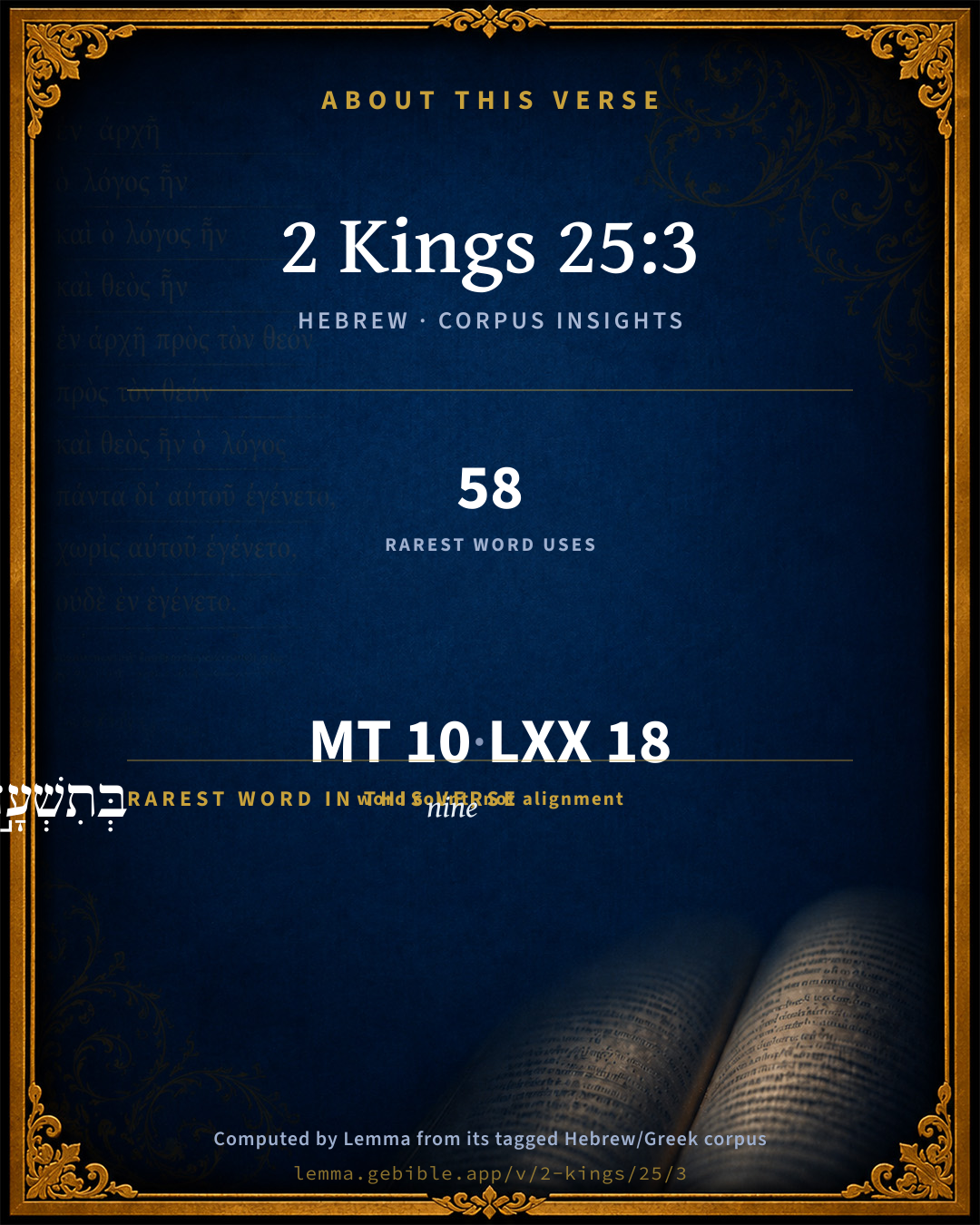
10
words
10
distinct lemmas
Historical
section

Shared distinctive vocabulary

בְּתִשְׁעָ֣ה nine H8672 occurs in 57 verses of the Hebrew Bible. Also found in:

Grammatical profile

  • 2 verbs
  • 6 nouns
  • 1 adjective
  • 1 particle

Verb forms

  • וַיֶּחֱזַ֥ק Qal · Sequential Imperfect
  • הָ֥יָה Qal · Perfect

Hebrew & Septuagint length

In English translation the verse runs 27 words from the Hebrew and 18 from the Septuagint (LXX English) — the Septuagint runs noticeably shorter here. See the side-by-side →

A rough comparison of the two English renderings, which tokenize alike — not a word-level alignment.

Word counts can differ between the Hebrew and the Greek without any difference in meaning — e.g. the Hebrew direct-object marker אֵת has no separate Greek word, and Greek often adds the article ὁ.

In the original languages it is 10 Hebrew tokens and 18 Greek tokens — but the two are counted differently (Hebrew bundles its prefixes and suffixes into one token; the Greek is in lemma form), so that isn’t a like-for-like length.

Cross-references

13

Topical passages linked to 2 Kings 25:3 in the Treasury of Scripture Knowledge — connected by theme and wording, ordered by reader-vote popularity; previews shown in the World English Bible.

  • Leviticus 26:26 When I break your staff of bread, ten women shall bake your bread in one oven, and they shall deliver your bread again by weight: and you shall eat, and not be satisfied.
  • Deuteronomy 28:52–53 They shall besiege you in all your gates, until your high and fortified walls come down, in which you trusted, throughout all your land; and they shall besiege you in all your gates throughout all your land, which Yahweh your God has given you.
  • Jeremiah 38:2 Thus says Yahweh, He who remains in this city shall die by the sword, by the famine, and by the pestilence; but he who goes forth to the Chaldeans shall live, and his life shall be to him for a prey, and he shall live.
  • Jeremiah 52:6 In the fourth month, in the ninth day of the month, the famine was sore in the city, so that there was no bread for the people of the land.
  • Lamentations 4:4–10 The tongue of the sucking child cleaves to the roof of his mouth for thirst: The young children ask bread, and no man breaks it to them.
  • Ezekiel 5:12 A third part of you shall die with the pestilence, and with famine shall they be consumed in the midst of you; and a third part shall fall by the sword round about you; and a third part I will scatter to all the winds, and will draw out a sword after them.
  • Ezekiel 7:15 The sword is outside, and the pestilence and the famine within: he who is in the field shall die with the sword: and he who is in the city, famine and pestilence shall devour him.
  • Ezekiel 14:21 For thus says the Lord Yahweh: How much more when I send my four sore judgments on Jerusalem, the sword, and the famine, and the evil animals, and the pestilence, to cut off from it man and animal!
  • Jeremiah 37:21 Then Zedekiah the king commanded, and they committed Jeremiah into the court of the guard; and they gave him daily a loaf of bread out of the bakers' street, until all the bread in the city was spent. Thus Jeremiah remained in the court of the guard.
  • Jeremiah 39:2 in the eleventh year of Zedekiah, in the fourth month, the ninth day of the month, a breach was made in the city),
  • Ezekiel 4:9–17 Take for yourself also wheat, and barley, and beans, and lentils, and millet, and spelt, and put them in one vessel, and make you bread of it; [according to] the number of the days that you shall lie on your side, even three hundred ninety days, shall you eat of it.
  • Ezekiel 5:10 Therefore the fathers shall eat the sons in the midst of you, and the sons shall eat their fathers; and I will execute judgments on you; and the whole remnant of you will I scatter to all the winds.
  • Zechariah 8:19 Thus says Yahweh of Hosts: "The fasts of the fourth fifth, seventh, and tenth months shall be for the house of Judah joy and gladness, and cheerful feasts. Therefore love truth and peace."

Cross-references courtesy of OpenBible.info (CC BY 4.0).

Hebrew and Greek witnesses Masoretic Hebrew ↔ Greek Septuagint

The same verse in the two great witnesses to the Old Testament, shown verse-for-verse.

Here the Septuagint runs noticeably shorter than the Hebrew — LXX2012 (modern English Septuagint) 18 words vs World English Bible 27. A rough length comparison of the two English translations, not a word-level alignment — read both below.

These are two independent witnesses, not word-aligned to each other, and the Septuagint is shown in lemma (dictionary) form.

Hebrew 2 Kings 25:3 Masoretic · Westminster Leningrad Codex

בְּתִשְׁעָ֣ה לַחֹ֔דֶשׁ וַיֶּחֱזַ֥ק הָרָעָ֖ב בָּעִ֑יר וְלֹא הָ֥יָה לֶ֖חֶם לְעַ֥ם הָאָֽרֶץ

On the ninth day of the [fourth] month the famine was sore in the city, so that there was no bread for the people of the land.

World English Bible · Public Domain

Greek LXX 2 Kings 25:3 Septuagint · lemma form

ἔνατος ὁ μήν καί ἐνἰσχύω ὁ λιμός ἐν ὁ πόλις καί οὐ εἰμί ἄρτος ὁ λαός ὁ γῆ

And the famine prevailed in the city, and there was no bread for the people of the land.

LXX2012 (modern English Septuagint) · Public Domain

Hebrew: Westminster Leningrad Codex (CC BY 4.0). Greek: Septuagint (public domain); English from LXX2012 (modern English Septuagint) (Public Domain). How the Septuagint differs from the Hebrew →

Targum (Aramaic paraphrase)

1

The Targum is the ancient Jewish Aramaic paraphrase of the Hebrew Scriptures — an interpretive translation, not the Hebrew text itself. Onkelos (literal) and Pseudo-Jonathan (expansive) render the Torah, and Jonathan the Prophets. Coverage is partial: where no permissively-licensed English translation exists for a verse, only the Aramaic is shown. This is verse-level text, not a word-by-word alignment to the Hebrew.

  1. Targum Jonathan Prophets (Joshua–Malachi)
    בְּתִשְׁעָא לְיַרְחָא וּתְקֵיף כַּפְנָא בְּקַרְתָּא וְלָא הֲוָה מֵיכַל לְעַמָא דְאַרְעָא:

    (no public-domain English translation for this verse)

    Targum Jonathan — Aramaic: “Mikraot Gedolot” (public domain). English: “Sefaria Community Translation” (CC0 1.0 (public-domain dedication)); “London "Chaldee Paraphrase," 1871” (public domain). Text via Sefaria.

Commentary

Notes on 2 Kings 25:3 from classic Christian and Jewish commentators (each source and its license shown beneath its notes). The classic Christian expositions comment on the surrounding passage and are grouped to its opening verse, so a note may address several verses; the Jewish commentaries on the Tanakh (Rashi and others) are per-verse, so they appear only where the commentator wrote on this verse.

Lemma curates 59 commentaries, every one of them public domain or Creative Commons licensed, each selected and text-cleaned for this edition rather than reprinted as found. About our sources →

Trapp's Complete Commentary

John Trapp

2Ki 25:3 And on the ninth [day] of the [fourth] month the famine prevailed in the city, and there was no bread for the people of the land.

Ver. 3. The famine prevailed in the city.] Insomuch as that the fathers did eat their sons, and the sons their fathers. {Eze 5:10 Lam 4:10} The pestilence also prevailed at the same time. {Jer 21:6-7; Jer 24:10}

John Trapp, A Commentary or Exposition upon All the Books of the Old and New Testament (1647–1656) — public domain. Text from a community e-Sword module.

Joseph Benson's Commentary

2Ki 25:3. The famine prevailed in the city — So that for a long time they ate their bread, as Ezekiel foretold they should do, (Eze 4:16,) by weight and with care, and drunk their water by measure and with astonishment, perceiving the quantity of it lessening fast every day, and having no hope of a fresh supply. Thus they were punished for their gluttony and excess, their fulness of bread, and feeding themselves without fear. At length there was no bread for the people of the land — For the common people, who, upon the approach of the Babylonian army, had flocked from all parts of the country, to secure themselves and their families, but only for the great men. Now they eat their own children for want of food, as had been foretold by one prophet, (Eze 5:10,) and is bewailed by another, Lam 4:3, &c. Jeremiah, in this extremity, earnestly persuaded the king to surrender, but his heart was hardened to his destruction.

Joseph Benson's Commentary on the Old and New Testaments (1811–1818) — public domain. Text from a community e-Sword module.

Geneva Bible (1599)

Geneva Bible translators

Insomuch that the mothers did eat their children, Lam. 4:10.

Geneva Bible (1599) marginal notes — public domain. Text via Bolls.life.

Jamieson, Fausset & Brown

Robert Jamieson, A. R. Fausset & David Brown

on the ninth day of the fourth month the famine prevailed--In consequence of the close and protracted blockade, the inhabitants were reduced to dreadful extremities; and under the maddening influence of hunger, the most inhuman atrocities were perpetrated (Lam 2:20, Lam 2:22; Lam 4:9-10; Eze 5:10). This was a fulfilment of the prophetic denunciations threatened on the apostasy of the chosen people (Lev 26:29; Deu 28:53-57; Jer 15:2; Jer 27:13; Eze 4:16).

Jamieson, Fausset & Brown — Commentary Critical and Explanatory on the Whole Bible (1871) — public domain (CC PDM 1.0). Text via the HelloAO Bible API.

Adam Clarke's Commentary

Verse 3. 2Kg 25:2.

Adam Clarke's Commentary on the Bible (1810–1826) — public domain. Text from a community e-Sword/MySword module.

Ellicott's Commentary for English Readers

(3) And on the ninth day of the fourth month.—The text is supplemented from Jer_39:2; Jer_52:6. The Syriac, however, has, “And in the eleventh year of King Zedekiah, in the fifth month, on the ninth day of the month, the famine prevailed,” &c.; which may be original. (Comp. 2Ki_25:1.)

The famine prevailed.—Not that the scarcity was first felt on that day, but that it then had reached a climax, so that defence was no longer possible. The horrors of the siege are referred to in Lam_2:11 seq., Lam_2:19 seq., Lam_4:3-10; Eze_5:10; Bar_2:3. As in the famine of Samaria and the last siege of Jerusalem, parents ate their own offspring. (Comp. the prophetic threats of Lev_26:29; Deu_28:53 seq.; Jer_15:2 seq., Jer_27:13; Eze_4:16 seq.)

The people of the land.—The population of the city, especially the families which had crowded into it from the country. Thenius, as usual, insists that the militia are meant. But these are the “men of war” (2Ki_25:4).

A Bible Commentary for English Readers, edited by Charles John Ellicott (1878–1897) — public domain. Text from a community e-Sword module.

The Cambridge Bible for Schools and Colleges

gen. ed. J. J. S. Perowne

3. And on the ninth day of the fourth month] The words in italic omitted here by the scribe, can be filled up from Jer_39:2; Jer_52:6.

the famine prevailed] R.V. was sore. The verb is that which is found used of famine in Gen_41:56-57, though we have a different word for a sore famine in Gen_43:1. The rendering of R.V. is from A.V. in Jer_39:6.

The Cambridge Bible for Schools and Colleges (gen. ed. J. J. S. Perowne; Cambridge University Press, 1878–1918) — public domain. Text from a community e-Sword module.

Haydock's Catholic Bible Commentary

Of the. Protestants supply, "fourth month," as it is in the parallel passage, Jeremias lii. 6., And in the fourth month, the ninth day of the month. In Jeremias xxxix. 2., we read, in the fourth month, the fifth day of the month, the city was broken up, or a breach was made in the outer wall. In the course of a few days, the princes of Babylon seized the middle gate; and the famine became so intolerable, that, on the 9th, it was judged expedient to abandon the city. (Haydock) --- During this siege it is thought, (Calmet) that mothers eat their children, (Lamentations iv. 10., and Baruch ii. 3.) and children their parents, Ezechiel v. 10. (Menochius)

George Leo Haydock (1774–1849), Haydock's Catholic Family Bible and Commentary, 1859 edition — public domain. Excludes Psalms (Douay-Rheims chapter numbering differs from Protestant) and Deuterocanonical books (Catholic canon only).

Matthew Poole's English Annotations

The fourth month; which word is easily understood, by comparing this and the first verse, and Jer 39:2; 52:6, where it is expressed.

For the people of the land, i.e. for the common sort of people, who flocked thither from all parts, upon the approach of the Babylonian army; but only for the great men and soldiers. See of the grievousness of this famine, Lam 4:10; Eze 5:10,12.

Matthew Poole's English Annotations on the Holy Bible (1683–1685) — public domain. Text from a community e-Sword/MySword module.

Whedon's Commentary on the Bible

Daniel D. Whedon

3. The fourth month — The word fourth has here been properly supplied by our translators from the parallel in Jer_52:6. It must have anciently fallen out of this text by the oversight of a copyist.

Famine prevailed — And its horrors are evidenced in Eze_5:10, and especially Lam_2:11-12; Lam_2:19; Lam_4:3-10. Not only in the city was there suffering from hunger, but the people of the land — that is, of the surrounding country, which was overrun by the Chaldean army — were destitute of bread.

Daniel D. Whedon (gen. ed.), Commentary on the Old and New Testaments (1874–1909) — public domain. Text from a community e-Sword module.

The Pulpit Commentary

And on the ninth day of the fourth month. The text of Kings is hero incomplete, and has to be restored from Jer_52:6. Ourtranslators have supplied the missing words. The famine prevailed in the city (see the comment on ver. 2). As I have elsewhere observed, "The intensity of the suffering endured may be gathered from Lamentations, Ezekiel, and Josephus. The complexions of the men grew black with famine; (Lam_4:8 Lam_5:10) their skin was shrunk and parched; (Lam_4:8) the rich and noble women searched the dunghills for setups of offal; (Lam_4:5) the children perished for want, or were even devoured by their parents (Lam_2:20 Lam_4:3, Lam_4:4, Lam_4:10; Eze_5:10) water was scarce, as well as food, and was sold at a; (Lam_5:4) third part of the inhabitants died of the famine, and the plague which grew out of it" (Eze_5:12) (see the "Speaker"s Commentary," vol. it. p. 147). And there was no bread for the people of the land. Bread commonly fails comparatively early in a siege. It was some time before the fall of the city that Ebed-Meleeh expressed his fear that Jeremiah would starve, since there was no more bread in the place. (see Jer_38:9)

The Pulpit Commentary (1880–1919), ed. H.D.M. Spence-Jones & Joseph S. Exell — public domain. Text from a community e-Sword module.

John Wesley's Explanatory Notes

The people - For the common people, but only for the great men. Now they eat their own children for want of food, Lam. iv, 3, &c. Jer. in this extremity, earnestly persuaded the king to surrender; but his heart was hardened to his destruction.

John Wesley, Explanatory Notes Upon the Whole Bible (1754–1765) — public domain. Text via the GEBible commentary corpus.

Scofield Reference Notes

C. I. Scofield

fourth month

i.e. July.

The Scofield Reference Bible (1917 edition), notes by C. I. Scofield — public domain. Text from a community e-Sword module.

Lesson kit

Teaching starters — assembled from the data on this page, not authored interpretation. Every prompt links to the verse data it draws on. Edit before teaching.

2 Kings, in the Historical, opens this verse with 10 words (10 distinct Hebrew lemmas). Its most distinctive word is têshaʻ (“nine”). The Greek Septuagint runs shorter here. A historical commentator’s framing appears above. Read the whole chapter for the surrounding context.

Discussion questions

  1. What does “nine” (têshaʻ) contribute to the verse as a whole?
  2. Genesis 5:5 shares the word «nine» with this verse. How do the two illuminate each other?
  3. Compared with the Hebrew, the Septuagint runs shorter here. What questions does that raise?
  4. These translations render this verse differently; the difference is in the English rendering, not the original. What questions does that raise?
  5. The verb «וַיֶּחֱזַ֥ק» is Qal Sequential Imperfect. How does its form color the action?
  6. Reading how Trapp's Complete Commentary and Joseph Benson's Commentary read this verse, where do the two commentators agree and where do they part?

Things to notice

Reading settings

Reading text

Shown beneath each verse's original-language words.

Old Testament
Old Testament edition

Read the OT as the Masoretic Hebrew (MT) or the Greek Septuagint (LXX).

English shown for the Greek Septuagint (in the Hebrew ↔ Greek comparison).

Comparing translations? Open the Compare panel on any verse page to stack up to four side by side.