
Proverbs 9:5

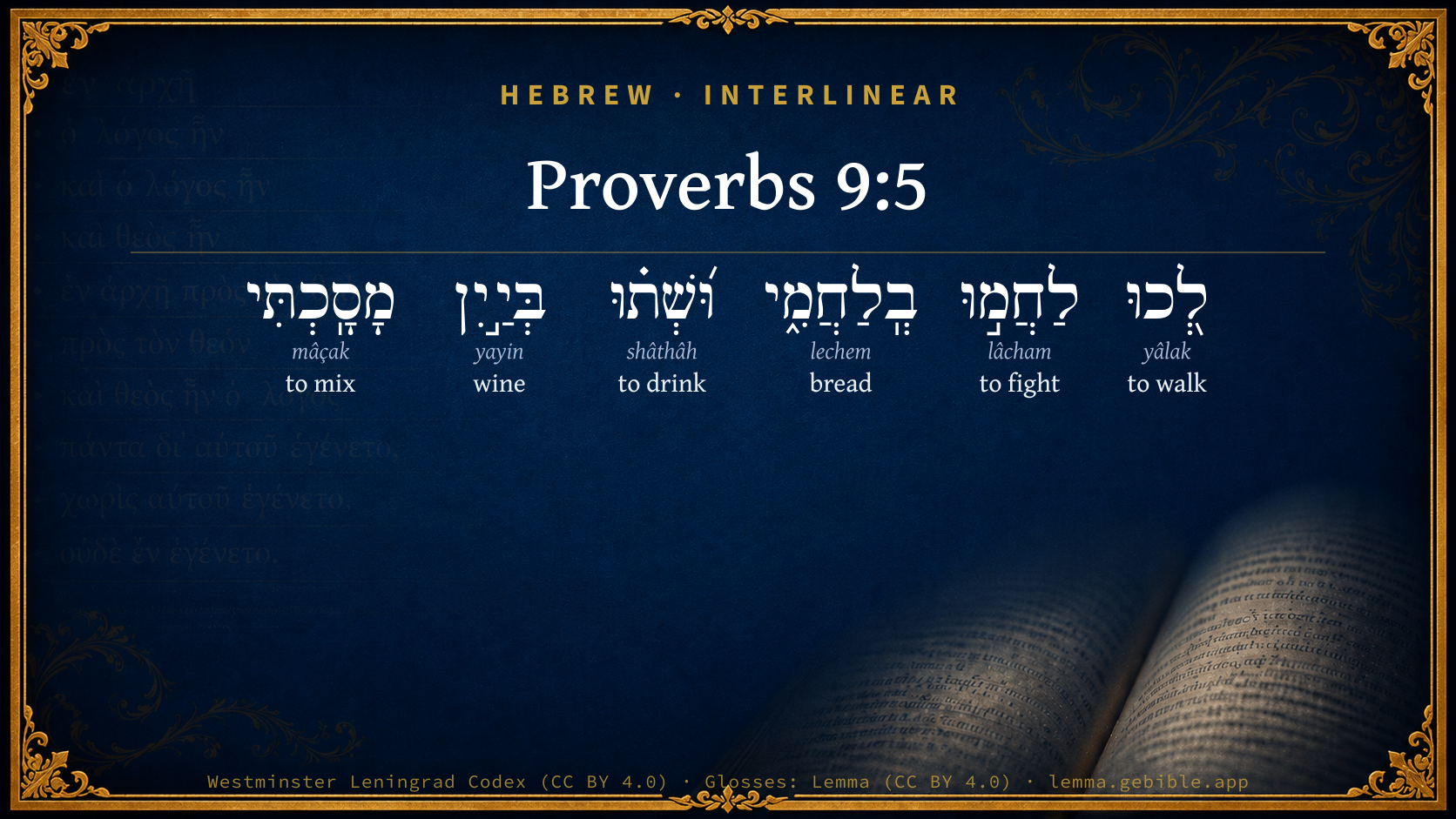
Hebrew (Westminster Leningrad Codex) Proverbs 9:5 appears in the Hebrew Old Testament. The text above is from the Westminster Leningrad Codex. Each word links to its Strong’s number, a concise gloss, and parsing drawn from the Open Scriptures Hebrew Bible morphology. Click any word for its full Brown-Driver-Briggs (BDB) entry.
Download image
Cite this verse

Proverbs 9:5 (World English Bible). Public Domain. Lemma interlinear Bible study tool, https://lemma.gebible.app/v/proverbs/9/5.

Show BibTeX & RIS
BibTeX
RIS
English Translation
"Come, eat some of my bread, Drink some of the wine which I have mixed!
World English Bible · Public Domain
Download a study sheet

One document with this verse’s original text, its word-by-word gloss line, the meaning frame, cross-references with their text, attributed commentary, and full source and license credits — printable, and it pastes into notes with its structure intact.

This verse Autodidact and up

Study sheet (.html) Plain text (.txt)

A passage Seminary Student

Up to 50 verses in one chapter. A passage sheet keeps up to 6 commentary sources and 12 cross-references per verse, in the order this page ranks them, and says so on the sheet whenever that leaves anything out. Ask for a single verse and you get the Autodidact verse sheet above.

Everything on this page stays free to read, with no account — the sheet is a download of what is already on screen, not access to it.

Want to remove ads? Support Godless Engineer
Compare translations 3

The same verse in 3 English versions, stacked beneath the original-language interlinear above. Click any original word for its lexicon entry.

Each is an independent rendering of the whole verse — the interlinear is not word-aligned to these translations.

Highlighted words mark where these versions differ — a whole-verse word diff, not a word-by-word alignment.

  • World English Bible Public Domain
    "Come, eat some of my bread, Drink some of the wine which I have mixed!
  • King James Version Public Domain
    Come, eat of my bread, and drink of the wine which I have mingled.
  • unfoldingWord Literal Text CC BY-SA 4.0
    “Come, eat my bread, and drink the wine I have mixed.

unfoldingWord Literal Text — © unfoldingWord, licensed CC BY-SA 4.0. Word-aligned USFM3 via Door43 (git.door43.org/unfoldingWord/en_ult).

Versions to compare (up to 4)

3 of 4 selected

Show all 18 translations

Every available English version of this verse, each an independent rendering of the whole verse.

  • World English Bible Public Domain
    "Come, eat some of my bread, Drink some of the wine which I have mixed!
  • Berean Standard Bible Public Domain
    “Come, eat my bread and drink the wine I have mixed.
  • Majority Standard Bible Public Domain
    “Come, eat my bread and drink the wine I have mixed.
  • King James Version Public Domain
    Come, eat of my bread, and drink of the wine which I have mingled.
  • American Standard Version (1901) Public Domain
    Come, eat ye of my bread, And drink of the wine which I have mingled.
  • Revised Version (1885) Public Domain
    Come, eat ye of my bread, and drink of the wine which I have mingled.
  • Geneva Bible (1599) Public Domain
    Come, and eate of my meate, and drinke of the wine that I haue drawen.
  • Douay-Rheims (1899) Public Domain
    Come, eat my bread, and drink the wine which I have mingled for you.
  • Young's Literal Translation Public Domain
    `Come, eat of my bread, And drink of the wine I have mingled.
  • Literal Standard Version CC BY-SA 4.0
    “Come, eat of my bread, || And drink of the wine I have mingled.
  • Unlocked Literal Bible CC BY-SA 4.0
    “Come, eat my food, and drink the wine I have mixed.
  • unfoldingWord Literal Text CC BY-SA 4.0
    “Come, eat my bread, and drink the wine I have mixed.
  • Darby Bible Public Domain
    Come, eat ye of my bread, and drink of the wine that I have mingled.
  • World Messianic Bible Public Domain
    “Come, eat some of my bread, Drink some of the wine which I have mixed!
  • Webster's Bible Public Domain
    Come, eat of my bread, and drink of the wine which I have mingled.
  • Free Bible Version CC BY-SA 4.0
    “Come, eat my food, and drink the wine I have mixed.
  • Bible in Basic English Public Domain
    Come, take of my bread, and of my wine which is mixed.
  • JPS Tanakh (1917) Public Domain
    'Come, eat of my bread, and drink of the wine which I have mingled.

Literal Standard Version (2020), Covenant Press — licensed CC BY-SA 4.0. Text via the HelloAO Bible API (eBible.org). Unlocked Literal Bible (unfoldingWord) — licensed CC BY-SA 4.0. Text via the HelloAO Bible API (eBible.org). unfoldingWord Literal Text — © unfoldingWord, licensed CC BY-SA 4.0. Word-aligned USFM3 via Door43 (git.door43.org/unfoldingWord/en_ult). Free Bible Version, Dr. Jonathan Gallagher — licensed CC BY-SA 4.0. Text via the HelloAO Bible API (eBible.org).

Word by word

More ways to search: Search by grammar → Find every occurrence → Compare this word →

Practice this passage: Drill this verse → Learn its vocabulary →

About this verse

These counts appear in no published source. They are computed here, from the morphology-tagged text and Lemma’s own curated glosses. What Lemma adds →

6
words
6
distinct lemmas
Wisdom
section

Notable vocabulary

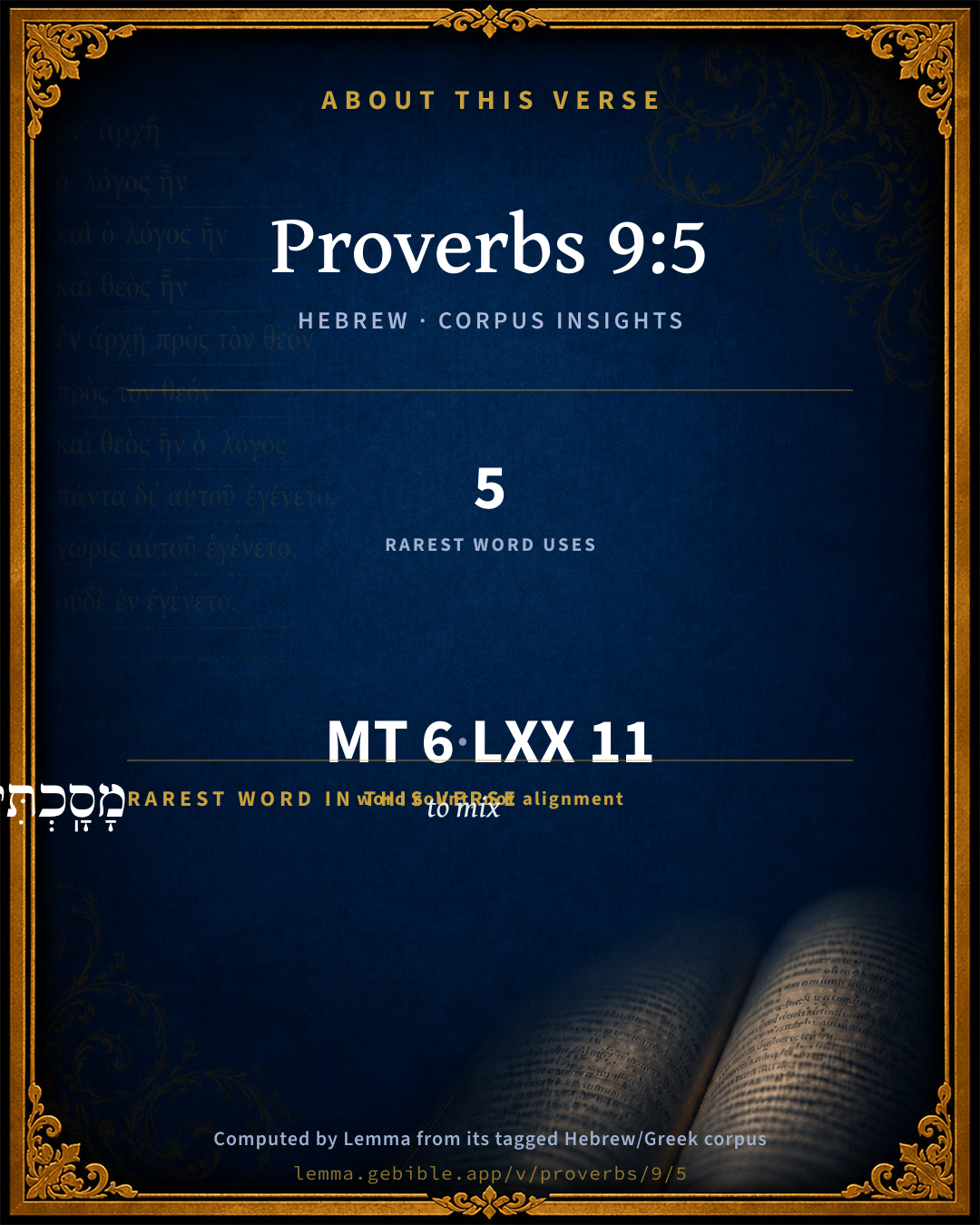
The rarest word here is מָסָֽכְתִּי to mix H4537 — appearing just 5 times in the whole Hebrew Bible.

Shared distinctive vocabulary

מָסָֽכְתִּי to mix H4537 occurs in 5 verses of the Hebrew Bible. Also found in:

Grammatical profile

  • 4 verbs
  • 2 nouns

Verb forms

  • לְ֭כוּ Qal · Imperative
  • לַחֲמ֣וּ Qal · Imperative
  • וּ֝שְׁת֗וּ Qal · Imperative
  • מָסָֽכְתִּי Qal · Perfect

Hebrew & Septuagint length

In English translation the verse runs 15 words from the Hebrew and 14 from the Septuagint (LXX English) — closely comparable.

A rough comparison of the two English renderings, which tokenize alike — not a word-level alignment.

Word counts can differ between the Hebrew and the Greek without any difference in meaning — e.g. the Hebrew direct-object marker אֵת has no separate Greek word, and Greek often adds the article ὁ.

In the original languages it is 6 Hebrew tokens and 11 Greek tokens — but the two are counted differently (Hebrew bundles its prefixes and suffixes into one token; the Greek is in lemma form), so that isn’t a like-for-like length.

Cross-references

10

Topical passages linked to Proverbs 9:5 in the Treasury of Scripture Knowledge — connected by theme and wording, ordered by reader-vote popularity; previews shown in the World English Bible.

  • John 6:27 Don't work for the food which perishes, but for the food which remains to eternal life, which the Son of Man will give to you. For God the Father has sealed him."
  • Song of Solomon 5:1 I have come into my garden, my sister, my bride. I have gathered my myrrh with my spice; I have eaten my honeycomb with my honey; I have drunk my wine with my milk. Friends Eat, friends! Drink, yes, drink abundantly, beloved. Beloved
  • Proverbs 9:17 "Stolen water is sweet. Food eaten in secret is pleasant."
  • Jeremiah 31:12–14 They shall come and sing in the height of Zion, and shall flow to the goodness of Yahweh, to the grain, and to the new wine, and to the oil, and to the young of the flock and of the herd: and their soul shall be as a watered garden; and they shall not sorrow any more at all.
  • Psalms 22:26 The humble shall eat and be satisfied. They shall praise Yahweh who seek after him. Let your hearts live forever.
  • Psalms 22:29 All the rich ones of the earth shall eat and worship. All those who go down to the dust shall bow before him, Even he who can't keep his soul alive.
  • Proverbs 9:2 She has prepared her meat. She has mixed her wine. She has also set her table.
  • Isaiah 55:1–3 Ho, everyone who thirsts, come you to the waters, and he who has no money; come you, buy, and eat; yes, come, buy wine and milk without money and without price.
  • Matthew 26:26–28 As they were eating, Jesus took bread, gave thanks for it, and broke it. He gave to the disciples, and said, "Take, eat; this is my body."
  • John 6:49–58 Your fathers ate the manna in the wilderness, and they died.

Cross-references courtesy of OpenBible.info (CC BY 4.0).

Hebrew and Greek witnesses Masoretic Hebrew ↔ Greek Septuagint

The same verse in the two great witnesses to the Old Testament, shown verse-for-verse.

These are two independent witnesses, not word-aligned to each other, and the Septuagint is shown in lemma (dictionary) form.

Hebrew Proverbs 9:5 Masoretic · Westminster Leningrad Codex

לְ֭כוּ לַחֲמ֣וּ בְֽלַחֲמִ֑י וּ֝שְׁת֗וּ בְּיַ֣יִן מָסָֽכְתִּי

"Come, eat some of my bread, Drink some of the wine which I have mixed!

World English Bible · Public Domain

Greek LXX Proverbs 9:5 Septuagint · lemma form

ἔρχομαι ἐσθίω ὁ ἐμός ἄρτος καί πίνω οἶνος ὅς κεραννύω σύ

Come, eat of my bread, and drink wine which I have mingled for you.

LXX2012 (modern English Septuagint) · Public Domain

On this verse, Whedon's Commentary on the Bible discusses the Septuagint’s reading. Read the note in Commentary ↓

Hebrew: Westminster Leningrad Codex (CC BY 4.0). Greek: Septuagint (public domain); English from LXX2012 (modern English Septuagint) (Public Domain). How the Septuagint differs from the Hebrew →

Commentary

Notes on Proverbs 9:5 from classic Christian and Jewish commentators (each source and its license shown beneath its notes). The classic Christian expositions comment on the surrounding passage and are grouped to its opening verse, so a note may address several verses; the Jewish commentaries on the Tanakh (Rashi and others) are per-verse, so they appear only where the commentator wrote on this verse.

Lemma curates 59 commentaries, every one of them public domain or Creative Commons licensed, each selected and text-cleaned for this edition rather than reprinted as found. About our sources →

Trapp's Complete Commentary

John Trapp

Pro 9:5 Come, eat of my bread, and drink of the wine [which] I have mingled.

Ver. 5. Come, eat of my bread.] Stand not off in a sinful modesty; say not, I am not worthy, &c., but "Come," for "the Master calls you," as they said to the blind man, who therefore came. And those recusant guests, by not coming when invited, might "not taste" of Christ’s supper; for they were unworthy. {Mat 22:1-7}

And drink of the wine which I have mingled.] Lo, here a full feast, not a dry feast! Lyrannus noteth on this chapter, that the Eucharist was anciently delivered in both kinds: but because of the danger of spilling the blood, the Church ordained that laymen should have the bread only. The Council of Constance comes in with a non obstante against Christ’s institution, withholding the cup from the sacrament. {a}

{a} Caranza.

John Trapp, A Commentary or Exposition upon All the Books of the Old and New Testament (1647–1656) — public domain. Text from a community e-Sword module.

The Biblical Illustrator

Joseph S. Exell

Pro_9:5

Come, eat of My bread.

Wisdoms invitation

I. The invitation. He who invites is the Son of God--in the Proverbs represented as Wisdom. Of His generous invitation we remark--

1. That its acceptance is open to every human being on the face of the earth. The God of the gospel is no respecter of persons.

2. This invitation is urged with affectionate earnestness. How are men to be compelled? Not by coercion or legal enactments--not by bribery or the civil power--but by the mercies of God, and the gentleness of Christ.

3. There is such a character in the invitations of the gospel as leaves those inexcusable who reject them. Some excuse themselves on the ground that a self-denial which is beyond them is required, others on the ground of previous engagements. Speculations, worldliness, even domestic relationships, are pleaded as excuses.

II. Inducements to the acceptance of the invitation. What would be inducements to accept an invitation to a feast?

1. Rank of the person inviting. Who, then, is it invites to the feast of the gospel?

2. The guests whom you were to meet. This company is select. It is composed of the wise and the good of every name: all are on a level at the feast of salvation.

3. The occasion of the entertainment. This is intended to supply you with immortal food, and to feed you with the meat that endureth unto everlasting life.

4. The consequences that may result from a refusal. Refusing this, you risk the favour of God. (J. R. Hibbard.)

The souls diet

The verse, most of it, metaphorical, setting out Wisdoms instructions under the similitude of a feast, to which persons invited come and comfortably refresh themselves with meat and drink.

I. The souls diet is of Christs providing. This was prefigured in the manna, and foreshadowed in the rock, that miraculously gave water to the people.

1. The Word is from Him which feeds the soul.

2. The Sacrament of the Lords Supper, whereby we are fed, was of His institution, yea, of His own administration the first time.

3. He hath authority from heaven to find diet for souls.

4. None but He can provide wholesome diet.

II. Men must come where Christs spiritual provisions are to be had.

1. We are invited to come, and it is discourtesy to refuse a friendly invitation.

2. We are commanded to come, and it is disobedience not to come.

3. The feast is prepared for us.

4. The benefits gotten by it may allure you to come for it.

III. We must make use of wisdoms provision as well as come. Coming to a feast doth no good if men be sullen, and will not eat or drink.

1. Our profitable use of Gods ordinances is required.

2. We are informed beforehand to what end we are invited.

3. The gift of this undeserved favour should make us ready to receive it.

4. No good will come to us by this spiritual food if we feed not on it. They who feed well get much good to their souls. (F. Taylor, B.D.)

Wisdoms invitations

It seems to me as if this moment were throbbing with the invitations of an all-compassionate God. I have been told that the Cathedral of St. Marks stands in a square in the centre of the city of Venice, and that when the clock strikes twelve at noon all the birds from the city and the regions round about the city fly to the square and settle down. It came in this wise: A large-hearted woman passing one noonday across the square saw some birds shivering in the cold, and she scattered some crumbs of bread among them, and so on from year to year until the day of her death. In her will she bequeathed a certain amount to keep up the same practice, and now, at the first stroke of the bell at noon, the birds begin to come here, and when the clock has struck twelve the square is covered with them. How beautifully suggestive! Christ comes out to feed thy soul to-day. The more hungry you feel yourselves to be, the better it is. It is noon, and the gospel clock strikes twelve. Come in flocks! Come as doves to the window! All the air is filled with the liquid chime: Come! come! come! (T. De Witt Talmage.)

The Biblical Illustrator, edited by Joseph S. Exell (c. 1880s–1900s) — public domain. Text from a community e-Sword module.

Geneva Bible (1599)

Geneva Bible translators

By the meat and drink, is meant the word of God, and the ministration of the Sacraments, whereby God nourisheth his servants in his house, which is the Church.

Geneva Bible (1599) marginal notes — public domain. Text via Bolls.life.

Adam Clarke's Commentary

Verse 5. Come, eat of my bread] Not only receive my instructions, but act according to my directions.

Drink of the wine - I have mingled.] Enter into my counsels; be not contented with superficial knowledge on any subject, where any thing deeper may be attained. Go by the streams to the fountain head. Look into the principles on which they were formed; investigate their nature, examine their properties, acquaint thyself with their relations, connections, influences, and various uses. See the skill, power, and goodness of God in their creation. And when thou hast learned all within thy reach, know that thou knowest but little of the manifold wisdom of God. Let what thou hast learned humble thee, by showing thee how very little thou dost know. Thou hast drunk of the provided wine; but that wine was mingled with water, for God will hide pride from man. He dwells only on the surface of religious and philosophical learning, who does not perceive and feel that he is yet but a child in knowledge; that he see through a glass darkly; that he perceives men like trees walking; and that there are lengths, breadths, depths, and heights, in the works and ways of God, which it will require an eternity to fathom. Here below the pure wine is mingled with water: but this is God's work. Yet there is enough; do not therefore be contented with a little. To this subject the words of the poet may be well applied: -

A little learning is a dangerous thing;

Drink deep, or taste not the Pierian spring:

For scanty draughts intoxicate the brain,

But drinking largely sobers us again.

POPE

Among the ancient Jews, Greeks, and Romans, wine was rarely drank without being mingled with water; and among ancient writers we find several ordinances for this. Some direct three parts of water to one of wine; some five parts; and Pliny mentions some wines that required twenty waters: but the most common proportions appear to have been three parts of water to two of wine. But probably the יין מסך yayin masach, mingled wine, was wine mingled, not with water, to make it weaker; but with spices and other ingredients to make it stronger. The ingredients were honey, myrrh, mandragora, opium, and such like, which gave it not only an intoxicating but stupifying quality also. Perhaps the mixed wine here may mean wine of the strongest and best quality, that which was good to cheer and refresh the heart of man.

If we consider the mixed wine as meaning this strong wine, then the import of the metaphor will be, a thorough investigation of the works of God will invigorate the soul, strengthen all the mental powers, enlarge their capacity, and enable the mind to take the most exalted views of the wonders of God's skill manifested in the operations of his hand.

Adam Clarke's Commentary on the Bible (1810–1826) — public domain. Text from a community e-Sword/MySword module.

Ellicott's Commentary for English Readers

(5) Come, eat of my bread . . .—Comp. the invitations of Isa_55:1 and Joh_6:35.

A Bible Commentary for English Readers, edited by Charles John Ellicott (1878–1897) — public domain. Text from a community e-Sword module.

The Cambridge Bible for Schools and Colleges

gen. ed. J. J. S. Perowne

5. eat] Rather, eat ye, R.V. The word is plural. The invitation though addressed to each (Pro_9:4) is extended to all. Comp. Isa_55:1.

The Cambridge Bible for Schools and Colleges (gen. ed. J. J. S. Perowne; Cambridge University Press, 1878–1918) — public domain. Text from a community e-Sword module.

John Gill's Exposition

Come, eat of my bread,.... Which stands for all the provisions of Christ's house; it designs the Gospel, which to a believer is more than his necessary food; and the ordinance of the supper, one of the symbols of which is bread; and more especially Christ himself, the bread of God, the living bread that came down from heaven, which is to be eaten by faith; and this only, for everything else is that which is not bread; and this daily, as the Israelites ate their manna; this is the believer's daily bread; and largely and freely, to which they are welcome by Christ; and with gladness and singleness of heart, joyfully and with sincerity;

and drink of the wine which I have mingled; of the love of Christ; or of the love of the Father, Son, and Spirit, which meet and mingle together: to "drink" of this is to partake of it by faith, and be persuaded of interest in it; this may be drank largely of, for there is enough, a river of it; and without danger, it is not intoxicating as wine, wherein is excess; and it may be had freely, without money and without price, Sol 1:2.

John Gill's Exposition of the Whole Bible (1746–1763) — public domain (CC PDM 1.0). Text via the HelloAO Bible API.

Albert Barnes' Notes on the Bible

A parallel to the higher teaching of the Gospels (compare Joh 6:27; Mat 26:26).

Albert Barnes' Notes on the Bible (1834–1885) — public domain. Text from a community e-Sword/MySword module.

Whedon's Commentary on the Bible

Daniel D. Whedon

5. Come — The sense is continued from the preceding verse. The sentiment, stripped of metaphor, is: Wise instructions, received with relish, will afford comfort, satisfaction, and pleasure of the highest and noblest kind. Comp. Isa_55:1, seq. “Not for the first time in John 6, or in the last supper, were bread and wine made the symbols of fellowship with eternal life and truth.” — Speaker’s Com.

The wine I have mingled — There is considerable diversity of opinion among commentators as to whether this mingling of wine was to make it stronger or weaker. In general, the Europeans — English, Scotch, and Germans — favour the idea of strengthening: and the Americans, of the later class especially, incline to the opinion of dilution: though Muenscher (American) says, The temperate nations of antiquity were not in the habit of drinking wine drugged, or even undiluted, except at feasts of drunkenness and debauchery, in which they sometimes indulged, when the wine was mixed with potent ingredients to increase its strength. Whether the greater or less progress of temperance principles has any thing to do with the exegesis in these two classes, we know not. The Hebrews were essentially a temperate people, and can hardly be supposed to have imposed less restraint on their appetites than did the Greeks and Romans. So also Dr. A. Clarke. Instead of “the wine I have mingled,” the Geneva has, “wine I have drawn.”

The Septuagint, Syriac, and Arabic add to this chapter the following: “But hasten away; delay not in the place; neither fix thine eye upon her: for thus thou shalt go through strange waters: and do thou return from strange waters, and drink not at a strange fountain, that thou mayest live long, and years of life be added to thee.” Very good advice, but not in the original Hebrew.

Daniel D. Whedon (gen. ed.), Commentary on the Old and New Testaments (1874–1909) — public domain. Text from a community e-Sword module.

The Pulpit Commentary

Come, eat ye of my bread. Wisdom now directly addresses the simple and the foolish. (comp. Rev_22:17) And drink of the wine which I have mingled (see on ver. 2). Bread and wine represent all needful nourishment, as flesh and wine in ver. 2. So Christ says, (Joh_6:51) "I am the living Bread which came down from heaven... and the bread that I will give is my flesh, which I will give for the life of the world." Compare the invitation in Isa_55:1, "He, every one that thirsteth!" etc. The Fathers see here a prophecy of the gospel feast, wherein Christ gave and gives bread and wine as symbols of his presence. (Mat_26:26, etc.)

The Pulpit Commentary (1880–1919), ed. H.D.M. Spence-Jones & Joseph S. Exell — public domain. Text from a community e-Sword module.

unfoldingWord translationNotes

Door43 World Missions Community

General Information:

These verses continue the message of Wisdom.

Come ... eat ... drink ... Leave ... live ... walk

All of these commands are plural; Wisdom is addressing many people at the same time.

the wine I have mixed

In ancient Israel, people often mixed wine with water. AT: "prepared her wine by mixing it with water" (See: Assumed Knowledge and Implicit Information)

Leave your naive actions

Here naive actions are spoken of as if they were a place that a person could leave. AT: "Stop your naive behavior" (See: Metaphor)

naive actions

"inexperienced, immature actions"

the path of understanding

Here the process of understanding wisdom is spoken of as if it were a path that a person could follow. AT: "the manner of living that a wise person has" (See: Metaphor)

translationWords

wine

life

unfoldingWord translationNotes — © Distant Shores Media and the Door43 World Missions Community, licensed CC BY-SA 4.0. Source: git.door43.org/Door43/en_tn.

Rashi

Rabbi Shlomo Yitzchaki (Rashi)

of the wine I have mingled Heb. מסכתי.

Rashi on the Tanakh — English translations: “The Judaica Press complete Tanach with Rashi, translated by A. J. Rosenberg” (CC BY 4.0); “Pentateuch with Rashi's commentary by M. Rosenbaum and A.M. Silbermann, 1929-1934” (public domain); “The Metsudah Tanach series, Lakewood, N.J” (CC BY 4.0); and “The Book of Joshua, Metsudah Publications, 1997” (CC BY 4.0). Text via Sefaria.

Lesson kit

Teaching starters — assembled from the data on this page, not authored interpretation. Every prompt links to the verse data it draws on. Edit before teaching.

Proverbs, in the Wisdom, opens this verse with 6 words (6 distinct Hebrew lemmas). Its most distinctive word is mâçak (“to mix”). A historical commentator’s framing appears above. Read the whole chapter for the surrounding context.

Discussion questions

  1. How does “to mix” (mâçak) shape what this verse is saying?
  2. How does Psalms 102:9, which shares the word «to mix», read alongside this verse?
  3. These translations render this verse differently; the difference is in the English rendering, not the original. What questions does that raise?
  4. «לְ֭כוּ» is a Qal Imperative verb. How does that grammatical form shape the action described?
  5. Compare how Trapp's Complete Commentary and The Biblical Illustrator read this verse. Where do they agree or differ?

Things to notice

Reading settings

Reading text

Shown beneath each verse's original-language words.

Old Testament
Old Testament edition

Read the OT as the Masoretic Hebrew (MT) or the Greek Septuagint (LXX).

English shown for the Greek Septuagint (in the Hebrew ↔ Greek comparison).

Comparing translations? Open the Compare panel on any verse page to stack up to four side by side.