
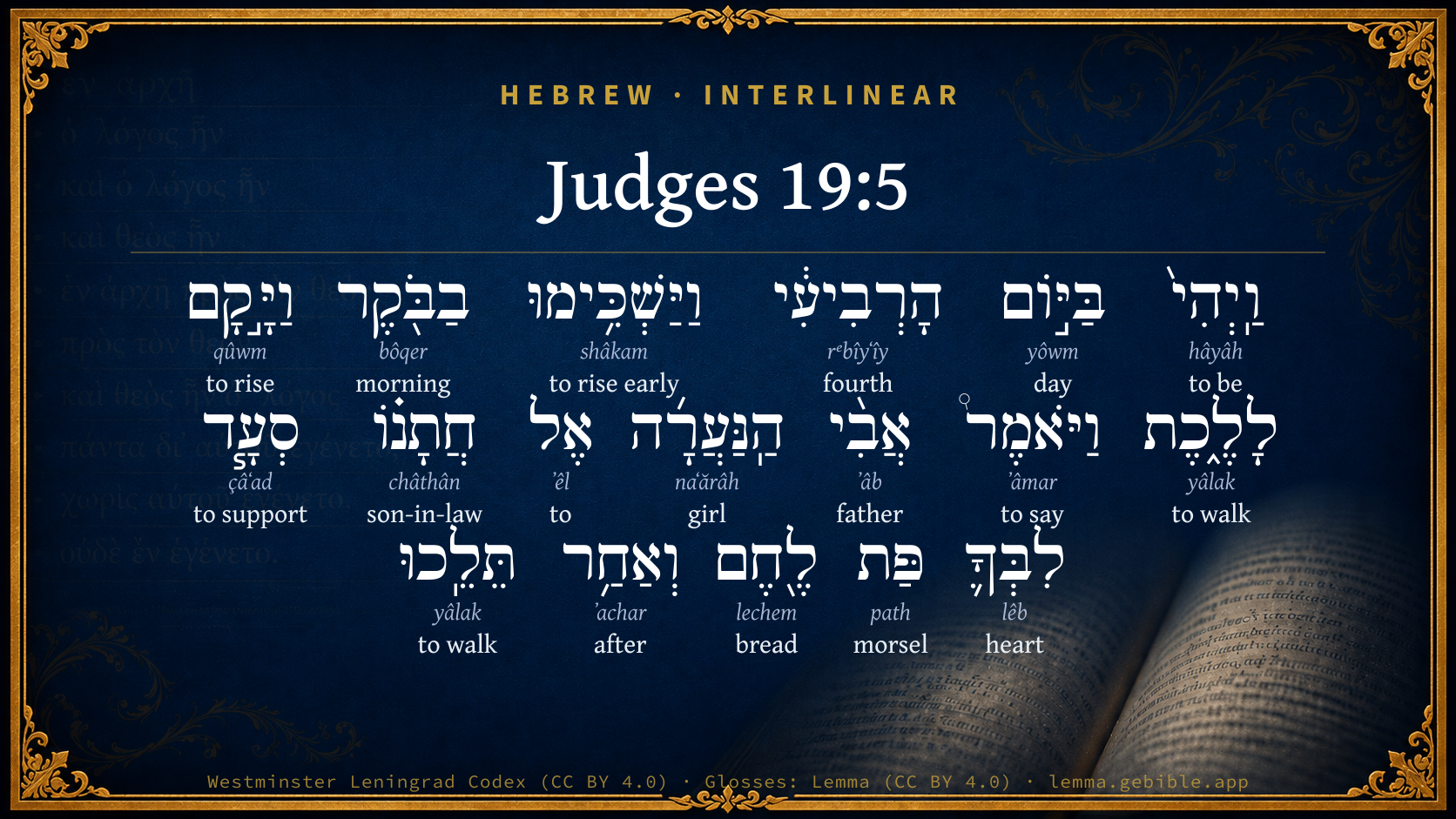
Judges 19:5

Hebrew (Westminster Leningrad Codex) Judges 19:5 appears in the Hebrew Old Testament. The text above is from the Westminster Leningrad Codex. Each word links to its Strong’s number, a concise gloss, and parsing drawn from the Open Scriptures Hebrew Bible morphology. Click any word for its full Brown-Driver-Briggs (BDB) entry.
Download image
Cite this verse

Judges 19:5 (World English Bible). Public Domain. Lemma interlinear Bible study tool, https://lemma.gebible.app/v/judges/19/5.

Show BibTeX & RIS
BibTeX
RIS
English Translation
It happened on the fourth day, that they arose early in the morning, and he rose up to depart: and the young lady's father said to his son-in-law, Strengthen your heart with a morsel of bread, and afterward you shall go your way.
World English Bible · Public Domain
Download a study sheet

One document with this verse’s original text, its word-by-word gloss line, the meaning frame, cross-references with their text, attributed commentary, and full source and license credits — printable, and it pastes into notes with its structure intact.

This verse Autodidact and up

Study sheet (.html) Plain text (.txt)

A passage Seminary Student

Up to 50 verses in one chapter. A passage sheet keeps up to 6 commentary sources and 12 cross-references per verse, in the order this page ranks them, and says so on the sheet whenever that leaves anything out. Ask for a single verse and you get the Autodidact verse sheet above.

Everything on this page stays free to read, with no account — the sheet is a download of what is already on screen, not access to it.

Want to remove ads? Support Godless Engineer
Compare translations 3

The same verse in 3 English versions, stacked beneath the original-language interlinear above. Click any original word for its lexicon entry.

Each is an independent rendering of the whole verse — the interlinear is not word-aligned to these translations.

Highlighted words mark where these versions differ — a whole-verse word diff, not a word-by-word alignment.

  • World English Bible Public Domain
    It happened on the fourth day, that they arose early in the morning, and he rose up to depart: and the young lady's father said to his son-in-law, Strengthen your heart with a morsel of bread, and afterward you shall go your way.
  • King James Version Public Domain
    And it came to pass on the fourth day, when they arose early in the morning, that he rose up to depart: and the damsel's father said unto his son in law, Comfort thine heart with a morsel of bread, and afterward go your way.
  • unfoldingWord Literal Text CC BY-SA 4.0
    And it happened on the fourth day that they got up early in the morning and he arose to go, but the father of the young woman said to his son-in-law, “Strengthen your heart a piece of bread, and afterward you shall go.”

unfoldingWord Literal Text — © unfoldingWord, licensed CC BY-SA 4.0. Word-aligned USFM3 via Door43 (git.door43.org/unfoldingWord/en_ult).

Versions to compare (up to 4)

3 of 4 selected

Show all 18 translations

Every available English version of this verse, each an independent rendering of the whole verse.

  • World English Bible Public Domain
    It happened on the fourth day, that they arose early in the morning, and he rose up to depart: and the young lady's father said to his son-in-law, Strengthen your heart with a morsel of bread, and afterward you shall go your way.
  • Berean Standard Bible Public Domain
    On the fourth day, they got up early in the morning and prepared to depart, but the girl’s father said to his son-in-law, “Refresh your heart with a morsel of bread, and then you can go.”
  • Majority Standard Bible Public Domain
    On the fourth day, they got up early in the morning and prepared to depart, but the girl’s father said to his son-in-law, “Refresh your heart with a morsel of bread, and then you can go.”
  • King James Version Public Domain
    And it came to pass on the fourth day, when they arose early in the morning, that he rose up to depart: and the damsel's father said unto his son in law, Comfort thine heart with a morsel of bread, and afterward go your way.
  • American Standard Version (1901) Public Domain
    And it came to pass on the fourth day, that they arose early in the morning, and he rose up to depart: and the damsel's father said unto his son-in-law, Strengthen thy heart with a morsel of bread, and afterward ye shall go your way.
  • Revised Version (1885) Public Domain
    And it came to pass on the fourth day, that they arose early in the morning, and he rose up to depart: and the damsel’s father said unto his son in law, Comfort thine heart with a morsel of bread, and afterward ye shall go your way.
  • Geneva Bible (1599) Public Domain
    And when the fourth day came, they arose earely in the morning, and he prepared to depart: then the yong womans father said vnto his sonne in lawe, Comfort thine heart with a morsel of bread, and then go your way.
  • Douay-Rheims (1899) Public Domain
    But on the fourth day arising early in the morning he desired to depart. But his father in law kept him, and said to him: Taste first a little bread, and strengthen thy stomach, and so thou shalt depart.
  • Young's Literal Translation Public Domain
    And it cometh to pass, on the fourth day, that they rise early in the morning, and he riseth to go, and the father of the young woman saith unto his son-in-law, `Support thy heart with a morsel of bread, and afterward ye go on.'
  • Literal Standard Version CC BY-SA 4.0
    And it comes to pass, on the fourth day, that they rise early in the morning, and he rises to go, and the father of the young woman says to his son-in-law, “Support your heart with a morsel of bread, and afterward you go on.”
  • Unlocked Literal Bible CC BY-SA 4.0
    On the fourth day they got up early and he prepared to go, but the girl's father said to his son-in-law, “Strengthen yourself with a bit of bread, then you may go.”
  • unfoldingWord Literal Text CC BY-SA 4.0
    And it happened on the fourth day that they got up early in the morning and he arose to go, but the father of the young woman said to his son-in-law, “Strengthen your heart a piece of bread, and afterward you shall go.”
  • Darby Bible Public Domain
    And on the fourth day they arose early in the morning, and he prepared to go; but the girl's father said to his son-in-law, "Strengthen your heart with a morsel of bread, and after that you may go."
  • World Messianic Bible Public Domain
    On the fourth day, they got up early in the morning, and he rose up to depart. The young lady’s father said to his son-in-law, “Strengthen your heart with a morsel of bread, and afterward you shall go your way.”
  • Webster's Bible Public Domain
    And it came to pass on the fourth day, when they arose early in the morning, that he arose to depart: and the damsel's father said to his son-in-law, Comfort thy heart with a morsel of bread, and afterward depart.
  • Free Bible Version CC BY-SA 4.0
    On the fourth day he and his concubine got up early in the morning and prepared to leave, but her father said to his son-in-law, “You'll feel better if you have something to eat before you go.”
  • Bible in Basic English Public Domain
    Now on the fourth day they got up early in the morning and he made ready to go away; but the girl's father said to his son-in-law, Take a little food to keep up your strength, and then go on your way.
  • JPS Tanakh (1917) Public Domain
    And it came to pass on the fourth day, that they arose early in the morning, and he rose up to depart; and the damsel's father said unto his son-in-law: 'Stay thy heart with a morsel of bread, and afterward ye shall go your way.'

Literal Standard Version (2020), Covenant Press — licensed CC BY-SA 4.0. Text via the HelloAO Bible API (eBible.org). Unlocked Literal Bible (unfoldingWord) — licensed CC BY-SA 4.0. Text via the HelloAO Bible API (eBible.org). unfoldingWord Literal Text — © unfoldingWord, licensed CC BY-SA 4.0. Word-aligned USFM3 via Door43 (git.door43.org/unfoldingWord/en_ult). Free Bible Version, Dr. Jonathan Gallagher — licensed CC BY-SA 4.0. Text via the HelloAO Bible API (eBible.org).

Word by word

More ways to search: Search by grammar → Find every occurrence → Compare this word →

Practice this passage: Drill this verse → Learn its vocabulary →

סְעָ֧ד
çâʻad
H5582
“support”
Verb, Qal, Imperative, 2nd Person, Masculine, Singular
Part of Speech
Verb
Stem
Qal
Form
Imperative
Person
2nd Person
Gender
Masculine
Number
Singular
Full BDB Definition

Origin: a primitive root

TWOT: 1525

to support, sustain, stay, establish, strengthen, comfort - (Qal) to support, sustain - to sustain, stay (of heart) - to support, uphold (of throne)
  1. וַֽיְהִי֙ hâyâh H1961 “and · to be” Conjunction + Verb, Qal, Sequential Imperfect, 3rd Person, Masculine, Singular
  2. בַּיּ֣וֹם yôwm H3117 “in/at the · day” Preposition, Determined + Noun, Common, Masculine, Singular, Absolute
  3. הָרְבִיעִ֔י rᵉbîyʻîy H7243 “the · fourth” Particle, Definite Article + Adjective, Ordinal number, Masculine, Singular, Absolute
  4. וַיַּשְׁכִּ֥ימוּ shâkam H7925 “and · to rise early” Conjunction + Verb, Hiphil, Sequential Imperfect, 3rd Person, Masculine, Plural
  5. בַבֹּ֖קֶר bôqer H1242 “in/at the · morning” Preposition, Determined + Noun, Common, Masculine, Singular, Absolute
  6. וַיָּ֣קָם qûwm H6965 “and · to rise” Conjunction + Verb, Qal, Sequential Imperfect, 3rd Person, Masculine, Singular
  7. לָלֶ֑כֶת yâlak H3212 “to walk” Preposition + Verb, Qal, Infinitive Construct
  8. וַיֹּאמֶר֩ ʼâmar H559 “and · to say” Conjunction + Verb, Qal, Sequential Imperfect, 3rd Person, Masculine, Singular
  9. אֲבִ֨י ʼâb H1 “father of” Noun, Common, Masculine, Singular, Construct
  10. הַֽנַּעֲרָ֜ה naʻărâh H5291 “the · girl” Particle, Definite Article + Noun, Common, Feminine, Singular, Absolute
  11. אֶל ʼêl H413 “to” Preposition
  12. חֲתָנ֗וֹ châthân H2860 “son-in-law · his” Noun, Common, Masculine, Singular, Construct + Suffix, Personal, 3rd Person, Masculine, Singular
  13. לִבְּךָ֛ lêb H3820 “heart · your” Noun, Common, Masculine, Singular, Construct + Suffix, Personal, 2nd Person, Masculine, Singular
  14. פַּת path H6595 “morsel of” Noun, Common, Feminine, Singular, Construct
  15. לֶ֖חֶם lechem H3899 “bread” Noun, Common, Both, Singular, Absolute
  16. וְאַחַ֥ר ʼachar H310 “and · after” Conjunction + Adverb
  17. תֵּלֵֽכוּ yâlak H3212 “to walk” Verb, Qal, Imperfect, 2nd Person, Masculine, Plural

About this verse

These counts appear in no published source. They are computed here, from the morphology-tagged text and Lemma’s own curated glosses. What Lemma adds →

18
words
17
distinct lemmas
Historical
section

Notable vocabulary

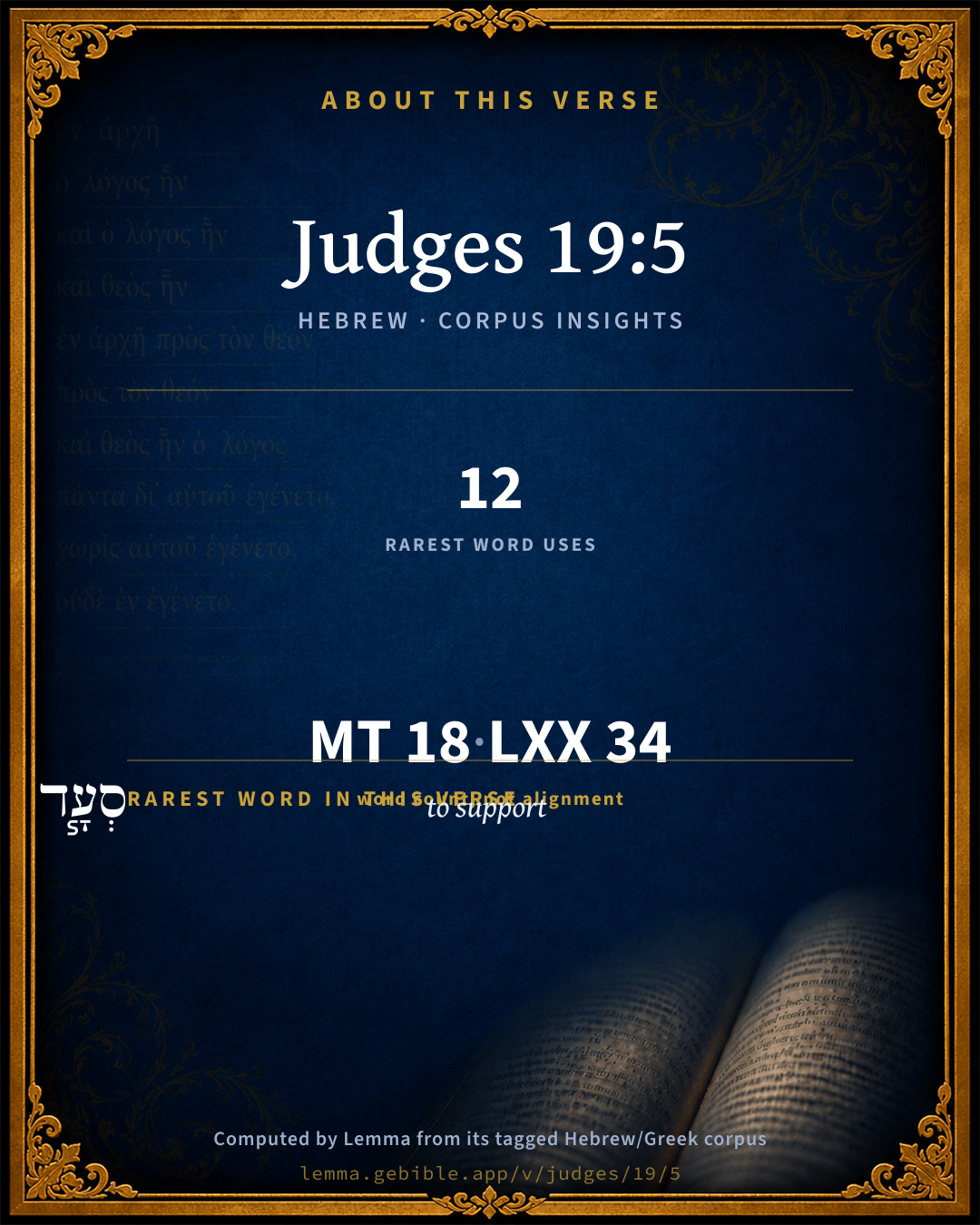
The rarest word here is סְעָ֧ד to support H5582 — appearing just 12 times in the whole Hebrew Bible.

Shared distinctive vocabulary

סְעָ֧ד to support H5582 occurs in 12 verses of the Hebrew Bible. Also found in:

Grammatical profile

  • 7 verbs
  • 8 nouns
  • 1 adjective
  • 1 preposition
  • 1 adverb

Verb forms

  • וַֽיְהִי֙ Qal · Sequential Imperfect
  • וַיַּשְׁכִּ֥ימוּ Hiphil · Sequential Imperfect
  • וַיָּ֣קָם Qal · Sequential Imperfect
  • לָלֶ֑כֶת Qal · Infinitive Construct
  • וַיֹּאמֶר֩ Qal · Sequential Imperfect
  • סְעָ֧ד Qal · Imperative
  • תֵּלֵֽכוּ Qal · Imperfect

Repetition

A word recurs within this verse — often emphatic in Hebrew:

  • לָלֶ֑כֶת to walk H3212 ×2

Hebrew & Septuagint length

In English translation the verse runs 43 words from the Hebrew and 42 from the Septuagint (LXX English) — closely comparable.

A rough comparison of the two English renderings, which tokenize alike — not a word-level alignment.

Word counts can differ between the Hebrew and the Greek without any difference in meaning — e.g. the Hebrew direct-object marker אֵת has no separate Greek word, and Greek often adds the article ὁ.

In the original languages it is 18 Hebrew tokens and 34 Greek tokens — but the two are counted differently (Hebrew bundles its prefixes and suffixes into one token; the Greek is in lemma form), so that isn’t a like-for-like length.

Cross-references

8

Topical passages linked to Judges 19:5 in the Treasury of Scripture Knowledge — connected by theme and wording, ordered by reader-vote popularity; previews shown in the World English Bible.

  • Genesis 18:5 I will get a morsel of bread so you can refresh your heart. After that you may go your way, now that you have come to your servant." They said, "Very well, do as you have said."
  • Judges 19:8 He arose early in the morning on the fifth day to depart; and the young lady's father said, Please strengthen your heart and stay until the day declines; and they ate, both of them.
  • John 4:34 Jesus said to them, "My food is to do the will of him who sent me, and to accomplish his work.
  • 1 Samuel 14:27–29 But Jonathan didn't hear when his father charged the people with the oath: therefore he put forth the end of the rod who was in his hand, and dipped it in the honeycomb, and put his hand to his mouth; and his eyes were enlightened.
  • 1 Samuel 30:12 They gave him a piece of a cake of figs, and two clusters of raisins: and when he had eaten, his spirit came again to him; for he had eaten no bread, nor drunk any water, three days and three nights.
  • 1 Kings 13:7 The king said to the man of God, Come home with me, and refresh yourself, and I will give you a reward.
  • Psalms 104:15 Wine that makes glad the heart of man, Oil to make his face to shine, And bread that strengthens man's heart.
  • Acts 9:19 He took food and was strengthened. Saul stayed several days with the disciples who were at Damascus.

Cross-references courtesy of OpenBible.info (CC BY 4.0).

Hebrew and Greek witnesses Masoretic Hebrew ↔ Greek Septuagint

The same verse in the two great witnesses to the Old Testament, shown verse-for-verse.

These are two independent witnesses, not word-aligned to each other, and the Septuagint is shown in lemma (dictionary) form.

Hebrew Judges 19:5 Masoretic · Westminster Leningrad Codex

וַֽיְהִי֙ בַּיּ֣וֹם הָרְבִיעִ֔י וַיַּשְׁכִּ֥ימוּ בַבֹּ֖קֶר וַיָּ֣קָם לָלֶ֑כֶת וַיֹּאמֶר֩ אֲבִ֨י הַֽנַּעֲרָ֜ה אֶל חֲתָנ֗וֹ סְעָ֧ד לִבְּךָ֛ פַּת לֶ֖חֶם וְאַחַ֥ר תֵּלֵֽכוּ

It happened on the fourth day, that they arose early in the morning, and he rose up to depart: and the young lady's father said to his son-in-law, Strengthen your heart with a morsel of bread, and afterward you shall go your way.

World English Bible · Public Domain

Greek LXX Judges 19:5 Septuagint · lemma form

καί γίγνομαι ὁ ἡμέρα ὁ τέταρτος καί ὀρθρίζω ὁ πρωΐ καί ἀναἵστημι ὁ πορεύομαι καί εἶπον ὁ πατήρ ὁ νεᾶνις πρός ὁ νυμφίος αὐτός στηρίζω σύ ὁ καρδία ψωμός ἄρτος καί μετά οὗτος πορεύομαι

And it came to pass on the fourth day that they rose early, and he stood up to depart; and the father of the damsel said to his son-in-law, Strengthen your heart with a morsel of bread, and afterwards you⌃ shall go.

LXX2012 (modern English Septuagint) · Public Domain

Hebrew: Westminster Leningrad Codex (CC BY 4.0). Greek: Septuagint (public domain); English from LXX2012 (modern English Septuagint) (Public Domain). How the Septuagint differs from the Hebrew →

Targum (Aramaic paraphrase)

1

The Targum is the ancient Jewish Aramaic paraphrase of the Hebrew Scriptures — an interpretive translation, not the Hebrew text itself. Onkelos (literal) and Pseudo-Jonathan (expansive) render the Torah, and Jonathan the Prophets. Coverage is partial: where no permissively-licensed English translation exists for a verse, only the Aramaic is shown. This is verse-level text, not a word-by-word alignment to the Hebrew.

  1. Targum Jonathan Prophets (Joshua–Malachi)
    וַהֲוָה בְּיוֹמָא רְבִיעָאָה וְאַקְדִימוּ בְּצַפְרָא וְקָם לְמֵיזַל וַאֲמַר אֲבוּהָא דְעוּלֶמְתָּא לַחֲתָנֵיהּ סְעֵיד לִבָּךְ פִּתָא דְלַחְמָא וּבָתַר כֵּן תֵּיזְלוּן:

    (no public-domain English translation for this verse)

    Targum Jonathan — Aramaic: “Mikraot Gedolot” (public domain). English: “Sefaria Community Translation” (CC0 1.0 (public-domain dedication)); “London "Chaldee Paraphrase," 1871” (public domain). Text via Sefaria.

Commentary

Notes on Judges 19:5 from classic Christian and Jewish commentators (each source and its license shown beneath its notes). The classic Christian expositions comment on the surrounding passage and are grouped to its opening verse, so a note may address several verses; the Jewish commentaries on the Tanakh (Rashi and others) are per-verse, so they appear only where the commentator wrote on this verse.

Lemma curates 59 commentaries, every one of them public domain or Creative Commons licensed, each selected and text-cleaned for this edition rather than reprinted as found. About our sources →

The Cambridge Bible for Schools and Colleges

gen. ed. J. J. S. Perowne

5. The doublets and repetitions in this and the following verses may at first sight appear to be due to the carelessness of a narrator who did not pay much attention to literary correctness; more probably, however, they are to be accounted for, as in similar cases elsewhere, by the combination of two sources. Although other parts of this chapter seem to be fairly homogeneous, yet at this point indications of fusion become apparent. Thus the same request is repeated four times Jdg_19:5-6; Jdg_19:8-9; father of the damsel (Jdg_19:3; Jdg_19:6; Jdg_19:8) seems to be a duplicate of his father in law (Jdg_19:7), both being combined in Jdg_19:4; a similar doubling of phraseology appears in comfort thine heart (Jdg_19:5; Jdg_19:8) and let thine heart be merry (Jdg_19:6; Jdg_19:9); in they did eat and drink (Jdg_19:4) and they did eat, both of them (Jdg_19:8), combined in Jdg_19:6; in Behold, now the day draweth toward evening and behold, the day groweth to an end in Jdg_19:9. This last verse, the text of which is open to question here and there, shews a curious alternation of singular and plural, not always apparent in English; tarry all night is plural, lodge here, the same word in Hebrew, is singular; get you early on your way and that thou mayest go to thy tents; the one account seems to have used singular verbs and pronouns, the other plural; similarly here, Jdg_19:5, they arose early and he rose up. Again, it would appear that according to one version the Levite was persuaded to stay for three days (Jdg_19:4) and then for a fourth (Jdg_19:5), while the other version seems to imply that he intended to leave on the day of his arrival, but remained for one night as his father in law urged him (Jdg_19:6 b, 7); on the fifth day (Jdg_19:8) may then be due to the editor who united the documents (Moore). Fortunately these redundancies do not obscure the purpose of this part of the story, which is to explain how it happened that the Levite and his belongings arrived at Gibeah so late in the day.

Comfort thine heart with a morsel of bread] The same expressions as in Gen_18:5 J; comfort in the old English sense of strengthen, as the verb is rendered in Psa_104:15.

The Cambridge Bible for Schools and Colleges (gen. ed. J. J. S. Perowne; Cambridge University Press, 1878–1918) — public domain. Text from a community e-Sword module.

Trapp's Complete Commentary

John Trapp

Jdg 19:5 And it came to pass on the fourth day, when they arose early in the morning, that he rose up to depart: and the damsel’s father said unto his son in law, Comfort thine heart with a morsel of bread, and afterward go your way.

Ver. 5. That he rose up to depart.] It is good hearing, saith a reverend man, {a} when the Levite maketh haste home. An honest man’s heart is the place of his calling. Such a one, when he is abroad, is like a fish in the air; whereinto if it leap for recreation or necessity, yet it soon returneth to to its own element. This charge by how much more sacred it is, so much the more attendance it expecteth. Even a day breaketh square with the conscionable.

{a} Bp. Hall.

John Trapp, A Commentary or Exposition upon All the Books of the Old and New Testament (1647–1656) — public domain. Text from a community e-Sword module.

Geneva Bible (1599)

Geneva Bible translators

Or, strengthen.

Hebrew, rose up.

Geneva Bible (1599) marginal notes — public domain. Text via Bolls.life.

Ellicott's Commentary for English Readers

(5) Early in the morning.—Except in winter, most journeys are performed in the early morning or late evening, in order to avoid the burning heat.

Comfort thine heart.—Literally, Prop up thy heart, as in Gen_18:5. This resembles the Latin expression cor fulcire.

A Bible Commentary for English Readers, edited by Charles John Ellicott (1878–1897) — public domain. Text from a community e-Sword module.

John Gill's Exposition

And it came to pass on the fourth day,.... The time the Levite had agreed to stay being up:

when they arose early in the morning the Levite, his concubine and servant, in order to set out on their journey: that he arose to depart; the Levite rose up from his seat to take his leave of his father-in-law, and depart from his house, and proceed on his way homeward; for rising out of his bed is before expressed:

and the damsel's father said to his son in law, comfort thy heart with a morsel of bread; take a breakfast first, that he might be fitter for his journey, for bread comforts or strengthens men's hearts, Psa 104:15 though here it may be put for any and all sorts of provisions, whatever might be proper to take early in a morning, and before setting out on a journey: and afterwards go your way; he seemed as if he was willing he should set forward, after he had refreshed him with a meal.

John Gill's Exposition of the Whole Bible (1746–1763) — public domain (CC PDM 1.0). Text via the HelloAO Bible API.

The Pulpit Commentary

Comfort thine heart, etc. Compare Gen_18:5.

The Pulpit Commentary (1880–1919), ed. H.D.M. Spence-Jones & Joseph S. Exell — public domain. Text from a community e-Sword module.

Keil & Delitzsch

C. F. Keil & F. Delitzsch

Also on the fourth day, when he was about to depart in the morning, the Levite yielded to the persuasion of his father-in-law, that he would first of all strengthen his heart again with a bit of bread (לב סעד as in Gen 18:5; the imperative form with ŏ is unusual); and then afterwards, whilst they were eating and drinking, he consented to stay another night.

Keil & Delitzsch — Biblical Commentary on the Old Testament (1861–1891) — public domain (CC PDM 1.0). Text via the HelloAO Bible API. (Old Testament only.)

unfoldingWord translationNotes

Door43 World Missions Community

he prepared

the Levite prepared

Strengthen yourself with a bit of bread

Here "bread" refers to "food." AT: "Eat some food so you will be strong enough to travel" (See: Synecdoche)

Please be willing to spend the night

"Please stay another night"

translationWords

bread

unfoldingWord translationNotes — © Distant Shores Media and the Door43 World Missions Community, licensed CC BY-SA 4.0. Source: git.door43.org/Door43/en_tn.

Lesson kit

Teaching starters — assembled from the data on this page, not authored interpretation. Every prompt links to the verse data it draws on. Edit before teaching.

Judges, in the Historical, opens this verse with 18 words (17 distinct Hebrew lemmas). Its most distinctive word is çâʻad (“to support”). A historical commentator’s framing appears above. Read the whole chapter for the surrounding context.

Discussion questions

  1. How does “to support” (çâʻad) shape what this verse is saying?
  2. How does Genesis 18:5, which shares the word «to support», read alongside this verse?
  3. What does the repetition of “to walk” (2× in this one verse) do in this verse?
  4. These translations render this verse differently. What is at stake in choosing one wording over another?
  5. «וַֽיְהִי֙» is a Qal Sequential Imperfect verb. How does that grammatical form shape the action described?
  6. Compare how The Cambridge Bible for Schools and Colleges and Trapp's Complete Commentary read this verse. Where do they agree or differ?

Things to notice

Reading settings

Reading text

Shown beneath each verse's original-language words.

Old Testament
Old Testament edition

Read the OT as the Masoretic Hebrew (MT) or the Greek Septuagint (LXX).

English shown for the Greek Septuagint (in the Hebrew ↔ Greek comparison).

Comparing translations? Open the Compare panel on any verse page to stack up to four side by side.