
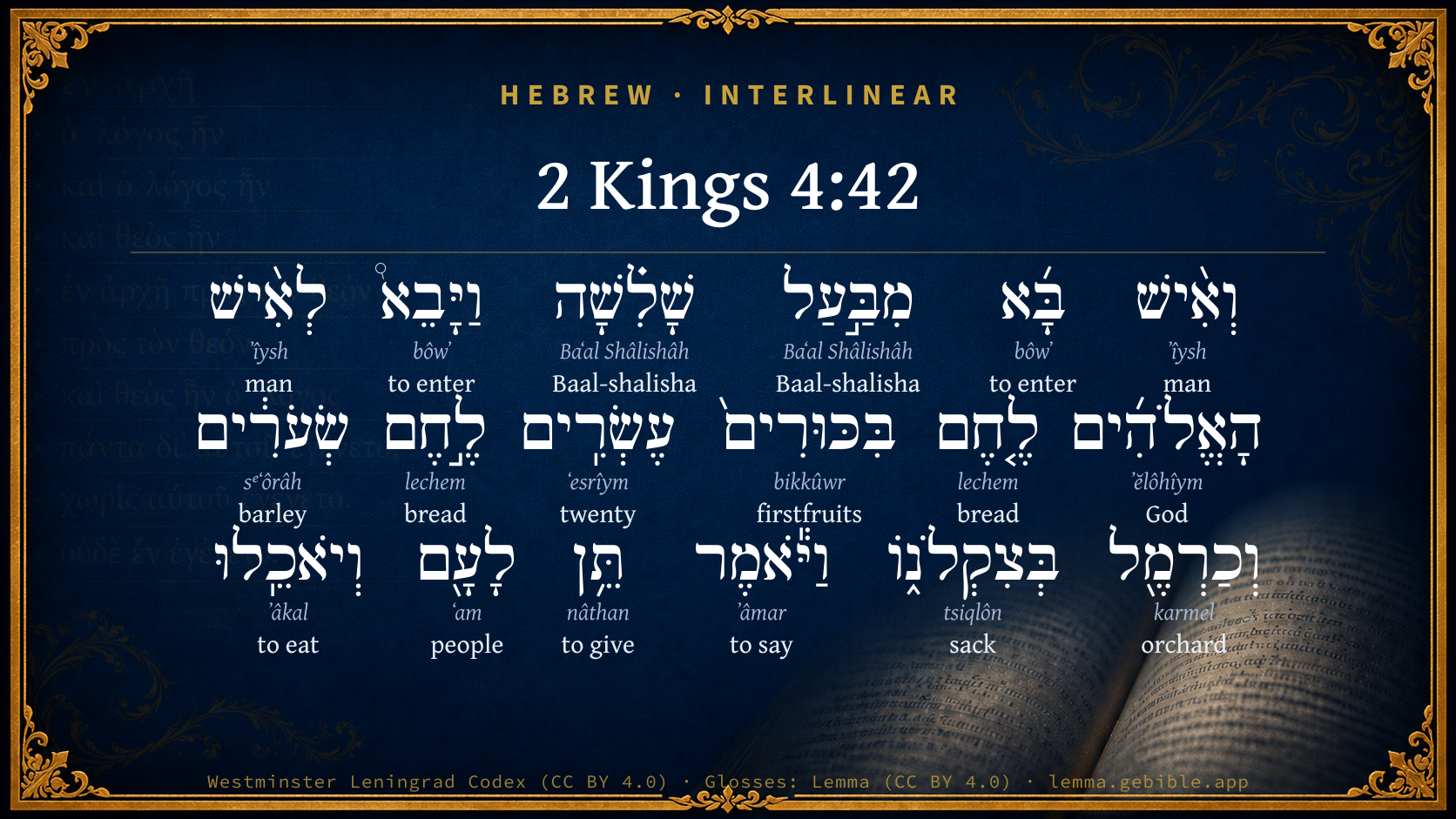
2 Kings 4:42

Hebrew (Westminster Leningrad Codex) 2 Kings 4:42 appears in the Hebrew Old Testament. The text above is from the Westminster Leningrad Codex. Each word links to its Strong’s number, a concise gloss, and parsing drawn from the Open Scriptures Hebrew Bible morphology. Click any word for its full Brown-Driver-Briggs (BDB) entry.
Download image
Cite this verse

2 Kings 4:42 (World English Bible). Public Domain. Lemma interlinear Bible study tool, https://lemma.gebible.app/v/2-kings/4/42.

Show BibTeX & RIS
BibTeX
RIS
English Translation
There came a man from Baal Shalishah, and brought the man of God bread of the first fruits, twenty loaves of barley, and fresh ears of grain in his sack. He said, Give to the people, that they may eat.
World English Bible · Public Domain
Highlights
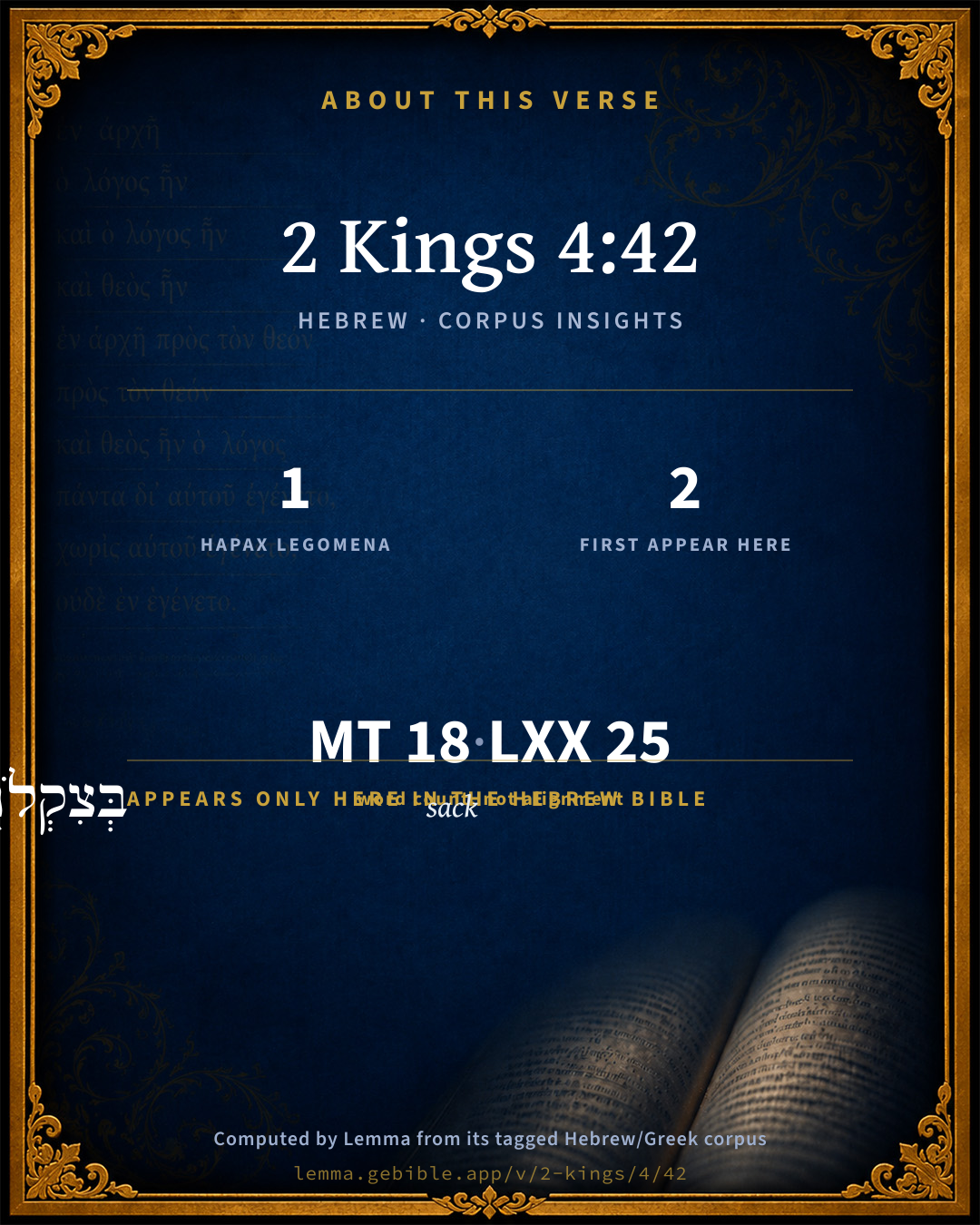
  • 1 hapax legomenon — only here in the Hebrew Bible
  • 2 first appearances in the Hebrew Bible
Full analysis ↓
Download a study sheet

One document with this verse’s original text, its word-by-word gloss line, the meaning frame, cross-references with their text, attributed commentary, and full source and license credits — printable, and it pastes into notes with its structure intact.

This verse Autodidact and up

Study sheet (.html) Plain text (.txt)

A passage Seminary Student

Up to 50 verses in one chapter. A passage sheet keeps up to 6 commentary sources and 12 cross-references per verse, in the order this page ranks them, and says so on the sheet whenever that leaves anything out. Ask for a single verse and you get the Autodidact verse sheet above.

Everything on this page stays free to read, with no account — the sheet is a download of what is already on screen, not access to it.

Want to remove ads? Support Godless Engineer
Compare translations 3

The same verse in 3 English versions, stacked beneath the original-language interlinear above. Click any original word for its lexicon entry.

Each is an independent rendering of the whole verse — the interlinear is not word-aligned to these translations.

Highlighted words mark where these versions differ — a whole-verse word diff, not a word-by-word alignment.

  • World English Bible Public Domain
    There came a man from Baal Shalishah, and brought the man of God bread of the first fruits, twenty loaves of barley, and fresh ears of grain in his sack. He said, Give to the people, that they may eat.
  • King James Version Public Domain
    And there came a man from Baalshalisha, and brought the man of God bread of the firstfruits, twenty loaves of barley, and full ears of corn in the husk thereof. And he said, Give unto the people, that they may eat.
  • unfoldingWord Literal Text CC BY-SA 4.0
    And a man came from Baal Shalishah, and he brought to the man of God bread of firstfruits, 20 bread of barley and fresh grain in his sack. And he said, “Give to the people, that they may eat.”

unfoldingWord Literal Text — © unfoldingWord, licensed CC BY-SA 4.0. Word-aligned USFM3 via Door43 (git.door43.org/unfoldingWord/en_ult).

Versions to compare (up to 4)

3 of 4 selected

Show all 18 translations

Every available English version of this verse, each an independent rendering of the whole verse.

  • World English Bible Public Domain
    There came a man from Baal Shalishah, and brought the man of God bread of the first fruits, twenty loaves of barley, and fresh ears of grain in his sack. He said, Give to the people, that they may eat.
  • Berean Standard Bible Public Domain
    Now a man from Baal-shalishah came to the man of God with a sack of twenty loaves of barley bread from the first ripe grain. “Give it to the people to eat,” said Elisha.
  • Majority Standard Bible Public Domain
    Now a man from Baal-shalishah came to the man of God with a sack of twenty loaves of barley bread from the first ripe grain. “Give it to the people to eat,” said Elisha.
  • King James Version Public Domain
    And there came a man from Baalshalisha, and brought the man of God bread of the firstfruits, twenty loaves of barley, and full ears of corn in the husk thereof. And he said, Give unto the people, that they may eat.
  • American Standard Version (1901) Public Domain
    And there came a man from Baal-shalishah, and brought the man of God bread of the first-fruits, twenty loaves of barley, and fresh ears of grain in his sack. And he said, Give unto the people, that they may eat.
  • Revised Version (1885) Public Domain
    And there came a man from Baal-shalishah, and brought the man of God bread of the firstfruits, twenty loaves of barley, and fresh ears of corn in his sack. And he said, Give unto the people, that they may eat.
  • Geneva Bible (1599) Public Domain
    Then came a man from Baal-shalisha, and brought the man of God bread of the first fruits, euen twenty loaues of barley, and full eares of corne in the huske. And hee saide, Giue vnto the people, that they may eate.
  • Douay-Rheims (1899) Public Domain
    And a certain man came from Baalsalisa bringing to the man of God bread of the firstfruits, twenty leaves of barley, and new corn in his scrip. And he said: Give to the people, that they may eat.
  • Young's Literal Translation Public Domain
    And a man hath come from Baal-Shalishah, and bringeth in to the man of God bread of first-fruits, twenty loaves of barley, and full ears of corn in its husk, and he saith, `Give to the people, and they eat.'
  • Literal Standard Version CC BY-SA 4.0
    And a man has come from Ba‘al-Shalishah, and brings to the man of God bread of first-fruits, twenty loaves of barley, and full ears of grain in its husk, and he says, “Give to the people, and they eat.”
  • Unlocked Literal Bible CC BY-SA 4.0
    A man came from Baal Shalishah to the man of God and brought twenty loaves of barley bread in his sack from the new harvest, and fresh ears of grain. He said, “Give this to the people so they can eat.”
  • unfoldingWord Literal Text CC BY-SA 4.0
    And a man came from Baal Shalishah, and he brought to the man of God bread of firstfruits, 20 bread of barley and fresh grain in his sack. And he said, “Give to the people, that they may eat.”
  • Darby Bible Public Domain
    And there came a man from Baal-shalishah, and brought the man of God bread of the first-fruits, twenty loaves of barley, and fresh ears of corn in his sack. And he said, Give to the people that they may eat.
  • World Messianic Bible Public Domain
    A man from Baal Shalishah came, and brought the man of God some bread of the first fruits: twenty loaves of barley and fresh ears of grain in his sack. Elisha said, “Give to the people, that they may eat.”
  • Webster's Bible Public Domain
    And there came a man from Baal-shalisha, and brought the man of God bread of the first fruits, twenty loaves of barley, and full ears of corn in its husk. And he said, Give to the people, that they may eat.
  • Free Bible Version CC BY-SA 4.0
    A man from Baal-shalishah came to the man of God with a sack of firstfruits—the first grain of the year, along with twenty loaves of barley bread. “Give it to the people to eat,” said Elisha.
  • Bible in Basic English Public Domain
    Now a man came from Baal-shalishah with an offering of first-fruits for the man of God, twenty barley cakes and garden fruit in his bag. And he said, Give these to the people for food.
  • JPS Tanakh (1917) Public Domain
    And there came a man from Baal-shalishah, and brought the man of God bread of the first-fruits, twenty loaves of barley, and fresh ears of corn in his sack. And he said: 'Give unto the people, that they may eat.'

Literal Standard Version (2020), Covenant Press — licensed CC BY-SA 4.0. Text via the HelloAO Bible API (eBible.org). Unlocked Literal Bible (unfoldingWord) — licensed CC BY-SA 4.0. Text via the HelloAO Bible API (eBible.org). unfoldingWord Literal Text — © unfoldingWord, licensed CC BY-SA 4.0. Word-aligned USFM3 via Door43 (git.door43.org/unfoldingWord/en_ult). Free Bible Version, Dr. Jonathan Gallagher — licensed CC BY-SA 4.0. Text via the HelloAO Bible API (eBible.org).

Word by word

More ways to search: Search by grammar → Find every occurrence → Compare this word →

Practice this passage: Drill this verse → Learn its vocabulary →

בְּצִקְלֹנ֑וֹ
tsiqlôn
H6861
“in/at · sack · his”
Preposition + Noun, Common, Masculine, Singular, Construct + Suffix, Personal, 3rd Person, Masculine, Singular
Part of Speech
Preposition + Noun
Type
Common
Gender
Masculine
Number
Singular
State
Construct
Full BDB Definition

Origin: from an unused root meaning to wind

TWOT: 1964

sack, bag - meaning dubious
  1. וְאִ֨ישׁ ʼîysh H376 “and · man” Conjunction + Noun, Common, Masculine, Singular, Absolute
  2. בָּ֜א bôwʼ H935 “to enter” Verb, Qal, Perfect, 3rd Person, Masculine, Singular
  3. מִבַּ֣עַל Baʻal Shâlishâh H1190 “from · Baal-shalisha” Preposition + Noun, Proper
  4. שָׁלִ֗שָׁה Baʻal Shâlishâh H1190 “Baal-shalisha” Noun, Proper
  5. וַיָּבֵא֩ bôwʼ H935 “and · to enter” Conjunction + Verb, Hiphil, Sequential Imperfect, 3rd Person, Masculine, Singular
  6. לְאִ֨ישׁ ʼîysh H376 “to/for · man of” Preposition + Noun, Common, Masculine, Singular, Construct
  7. הָאֱלֹהִ֜ים ʼĕlôhîym H430 “the · God(s)” Particle, Definite Article + Noun, Common, Masculine, Plural, Absolute
  8. לֶ֤חֶם lechem H3899 “bread of” Noun, Common, Both, Singular, Construct
  9. בִּכּוּרִים֙ bikkûwr H1061 “firstfruits” Noun, Common, Both, Plural, Absolute
  10. עֶשְׂרִֽים ʻesrîym H6242 “twenty” Adjective, Cardinal number, Both, Plural, Absolute
  11. לֶ֣חֶם lechem H3899 “bread” Noun, Common, Both, Singular, Absolute
  12. שְׂעֹרִ֔ים sᵉʻôrâh H8184 “barley” Noun, Common, Feminine, Plural, Absolute
  13. וְכַרְמֶ֖ל karmel H3759 “and · orchard” Conjunction + Noun, Common, Masculine, Singular, Absolute
  14. וַיֹּ֕אמֶר ʼâmar H559 “and · to say” Conjunction + Verb, Qal, Sequential Imperfect, 3rd Person, Masculine, Singular
  15. תֵּ֥ן nâthan H5414 “give” Verb, Qal, Imperative, 2nd Person, Masculine, Singular
  16. לָעָ֖ם ʻam H5971 “to/for the · people” Preposition, Determined + Noun, Common, Masculine, Singular, Absolute
  17. וְיֹאכֵֽלוּ ʼâkal H398 “and · to eat” Conjunction + Verb, Qal, Imperfect, 3rd Person, Masculine, Plural

About this verse

These counts appear in no published source. They are computed here, from the morphology-tagged text and Lemma’s own curated glosses. What Lemma adds →

18
words
14
distinct lemmas
Historical
section

Notable vocabulary

1 hapax legomenon — a word that appears only here in the entire Hebrew Bible:

  • בְּצִקְלֹנ֑וֹ sack H6861

First appearance in Scripture

These words make their first canonical appearance in the Hebrew Bible here:

  • מִבַּ֣עַל Baal-shalisha H1190
  • בְּצִקְלֹנ֑וֹ sack H6861

Grammatical profile

  • 5 verbs
  • 12 nouns
  • 1 adjective

Verb forms

  • בָּ֜א Qal · Perfect
  • וַיָּבֵא֩ Hiphil · Sequential Imperfect
  • וַיֹּ֕אמֶר Qal · Sequential Imperfect
  • תֵּ֥ן Qal · Imperative
  • וְיֹאכֵֽלוּ Qal · Imperfect

Repetition

Words recur within this verse — often emphatic in Hebrew:

  • וְאִ֨ישׁ man H376 ×2
  • בָּ֜א to enter H935 ×2
  • מִבַּ֣עַל Baal-shalisha H1190 ×2
  • לֶ֤חֶם bread H3899 ×2

Hebrew & Septuagint length

In English translation the verse runs 40 words from the Hebrew and 37 from the Septuagint (LXX English) — closely comparable.

A rough comparison of the two English renderings, which tokenize alike — not a word-level alignment.

Word counts can differ between the Hebrew and the Greek without any difference in meaning — e.g. the Hebrew direct-object marker אֵת has no separate Greek word, and Greek often adds the article ὁ.

In the original languages it is 18 Hebrew tokens and 25 Greek tokens — but the two are counted differently (Hebrew bundles its prefixes and suffixes into one token; the Greek is in lemma form), so that isn’t a like-for-like length.

Cross-references

18

Topical passages linked to 2 Kings 4:42 in the Treasury of Scripture Knowledge — connected by theme and wording, ordered by reader-vote popularity; previews shown in the World English Bible.

  • 1 Samuel 9:7 Then said Saul to his servant, But, behold, if we go, what shall we bring the man? for the bread is spent in our vessels, and there is not a present to bring to the man of God: what have we?
  • Matthew 14:16–21 But Jesus said to them, "They don't need to go away. You give them something to eat."
  • John 6:9 "There is a boy here who has five barley loaves and two fish, but what are these among so many?"
  • John 6:13 So they gathered them up, and filled twelve baskets with broken pieces from the five barley loaves, which were left over by those who had eaten.
  • 1 Samuel 9:4 He passed through the hill-country of Ephraim, and passed through the land of Shalishah, but they didn't find them: then they passed through the land of Shaalim, and there they weren't there: and he passed through the land of the Benjamites, but they didn't find them.
  • 2 Kings 7:1 Elisha said, Hear you the word of Yahweh: thus says Yahweh, Tomorrow about this time shall a measure of fine flour be [sold] for a shekel, and two measures of barley for a shekel, in the gate of Samaria.
  • Matthew 15:32–38 Jesus summoned his disciples and said, "I have compassion on the multitude, because they continue with me now three days and have nothing to eat. I don't want to send them away fasting, or they might faint on the way."
  • Exodus 23:16 And the feast of harvest, the first fruits of your labors, which you sow in the field: and the feast of harvest, at the end of the year, when you gather in your labors out of the field.
  • Deuteronomy 8:8 a land of wheat and barley, and vines and fig trees and pomegranates; a land of olive trees and honey;
  • Deuteronomy 12:6 and there you shall bring your burnt offerings, and your sacrifices, and your tithes, and the heave-offering of your hand, and your vows, and your freewill-offerings, and the firstborn of your herd and of your flock:
  • Deuteronomy 26:2–10 that you shall take of the first of all the fruit of the ground, which you shall bring in from your land that Yahweh your God gives you; and you shall put it in a basket, and shall go to the place which Yahweh your God shall choose, to cause his name to dwell there.
  • Deuteronomy 32:14 Butter of the herd, and milk of the flock, With fat of lambs, Rams of the breed of Bashan, and goats, With the finest of the wheat; Of the blood of the grape you drank wine.
  • 2 Kings 4:38 Elisha came again to Gilgal. There was a dearth in the land; and the sons of the prophets were sitting before him; and he said to his servant, Set on the great pot, and boil stew for the sons of the prophets.
  • 2 Kings 7:16–18 The people went out, and plundered the camp of the Syrians. So a measure of fine flour was [sold] for a shekel, and two measures of barley for a shekel, according to the word of Yahweh.
  • 2 Chronicles 11:13–14 The priests and the Levites who were in all Israel resorted to him out of all their border.
  • Proverbs 3:9–10 Honor Yahweh with your substance, With the first fruits of all your increase:
  • 1 Corinthians 9:11 If we sowed to you spiritual things, is it a great thing if we reap your fleshly things?
  • Galatians 6:6 But let him who is taught in the word share all good things with him who teaches.

Cross-references courtesy of OpenBible.info (CC BY 4.0).

Hebrew and Greek witnesses Masoretic Hebrew ↔ Greek Septuagint

The same verse in the two great witnesses to the Old Testament, shown verse-for-verse.

These are two independent witnesses, not word-aligned to each other, and the Septuagint is shown in lemma (dictionary) form.

Hebrew 2 Kings 4:42 Masoretic · Westminster Leningrad Codex

וְאִ֨ישׁ בָּ֜א מִבַּ֣עַל שָׁלִ֗שָׁה וַיָּבֵא֩ לְאִ֨ישׁ הָאֱלֹהִ֜ים לֶ֤חֶם בִּכּוּרִים֙ עֶשְׂרִֽים לֶ֣חֶם שְׂעֹרִ֔ים וְכַרְמֶ֖ל בְּצִקְלֹנ֑וֹ וַיֹּ֕אמֶר תֵּ֥ן לָעָ֖ם וְיֹאכֵֽלוּ

There came a man from Baal Shalishah, and brought the man of God bread of the first fruits, twenty loaves of barley, and fresh ears of grain in his sack. He said, Give to the people, that they may eat.

World English Bible · Public Domain

Greek LXX 2 Kings 4:42 Septuagint · lemma form

καί ἀνήρ διαἔρχομαι ἐκ βαιθσαρισα καί φέρω πρός ὁ ἄνθρωπος ὁ θεός πρωτογένημα εἴκοσι ἄρτος κρίθινος καί παλάθης καί εἶπον δίδωμι ὁ λαός καί ἐσθίω

And there came a man over from Baetharisa, and brought to the man of God twenty barley loaves and cakes of figs, of the first fruits. And he said, Give to the people, and let them eat.

LXX2012 (modern English Septuagint) · Public Domain

On this verse, Ellicott's Commentary for English Readers discusses the Septuagint’s reading. Read the note in Commentary ↓

Hebrew: Westminster Leningrad Codex (CC BY 4.0). Greek: Septuagint (public domain); English from LXX2012 (modern English Septuagint) (Public Domain). How the Septuagint differs from the Hebrew →

Targum (Aramaic paraphrase)

1

The Targum is the ancient Jewish Aramaic paraphrase of the Hebrew Scriptures — an interpretive translation, not the Hebrew text itself. Onkelos (literal) and Pseudo-Jonathan (expansive) render the Torah, and Jonathan the Prophets. Coverage is partial: where no permissively-licensed English translation exists for a verse, only the Aramaic is shown. This is verse-level text, not a word-by-word alignment to the Hebrew.

  1. Targum Jonathan Prophets (Joshua–Malachi)
    וְגַבְרָא אָתָא מֵאֲרַע דָרוֹמָא וְאַיְתֵי לִנְבִיָא דַייָ לְחֵם בִּכּוּרִין עַסְרִין טוּלְמִין דִלְחֵם סְעוֹרִין וּפֵירוּכִן בִּלְבוּשֵׁיהּ וַאֲמַר הַב לְעַמָא וְיֵיכְלוּן:

    (no public-domain English translation for this verse)

    Targum Jonathan — Aramaic: “Mikraot Gedolot” (public domain). English: “Sefaria Community Translation” (CC0 1.0 (public-domain dedication)); “London "Chaldee Paraphrase," 1871” (public domain). Text via Sefaria.

Commentary

Notes on 2 Kings 4:42 from classic Christian and Jewish commentators (each source and its license shown beneath its notes). The classic Christian expositions comment on the surrounding passage and are grouped to its opening verse, so a note may address several verses; the Jewish commentaries on the Tanakh (Rashi and others) are per-verse, so they appear only where the commentator wrote on this verse.

Lemma curates 59 commentaries, every one of them public domain or Creative Commons licensed, each selected and text-cleaned for this edition rather than reprinted as found. About our sources →

Ellicott's Commentary for English Readers

(42) Baal-shalisha.—Probably the same as Bethshalisha, mentioned by Jerome and Eusebius, fifteen Roman miles north of Lydda-Diospolis, and not far west of Gilgal and Bethel. (Comp. “the land of Shalisha,” 1Sa_9:4. Its name, Shalisha—as if Three-land—seems to allude to the three wadies, which there meet in the Wâdy Qurâwâ.)

Bread of the firstfruits.—Comp. Num_18:13; Deu_18:4, according to which all firstfruits of grain were to be given to the priests and Levites. Such presents to prophets appear to have been usual in ordinary times. On the present occasion, which was “a time of dearth” (2Ki_4:42 is connected by the construction with the preceding narrative), one pious person brought his opportune gift to Elisha.

And full ears of corn in the husk thereof.—Heb., and karmel in his wallet. The word karmel occurs besides in Lev_2:14; Lev_23:14. The Targum and Syriac render “bruised grain;” the Jewish expositors “tender and fresh ears of corn.” In some parts of England unripe corn is made into a dish called “frumenty.” The word çiqlôn only occurs in this place. The Vulg. renders it by pera (“wallet”). The LXX. (Alex.) repeats the Hebrew in Greek letters. The Vatican omits the word. It reads: “twenty barley loaves and cakes of pressed fruit” (παλάθας). The Syriac gives “garment.”

And he said—i.e., Elisha said.

Give unto the people.—Comp. Mat_14:16.

A Bible Commentary for English Readers, edited by Charles John Ellicott (1878–1897) — public domain. Text from a community e-Sword module.

Trapp's Complete Commentary

John Trapp

2Ki 4:42 And there came a man from Baalshalisha, and brought the man of God bread of the firstfruits, twenty loaves of barley, and full ears of corn in the husk thereof. And he said, Give unto the people, that they may eat.

Ver. 42. And brought the man of God.] The prophets, in the fail of priests, who were now not to be found in Israel, taught the people, and took up their dues from such pious persons as brought them in out of conscience.

Twenty loaves of barley.] Little ones, likely.

John Trapp, A Commentary or Exposition upon All the Books of the Old and New Testament (1647–1656) — public domain. Text from a community e-Sword module.

The Biblical Illustrator

Joseph S. Exell

2Ki_4:42-44

And there came a man from Baal-shalisha.

The farmers gift

I. A lesson on providence. This dearth came in consequence of sin. The proud and wicked people would never yield, except they were obliged by Gods strong hand. And when He punishes, He makes men know how powerful He is. Some men nowadays would not be touched in any other way. When God takes to preaching, His voice is heard outside the churches and chapels. You cannot have retributive providences, and only the wicked suffer; the godly have their share of want. Elisha was in need. But the godly have some one to look up to. The God of to-day is the God of the Old Testament:--the manna God,--the barrel of meal God,--the God who has said, Call upon Me in the day of trouble, and I will deliver thee.

II. There is here a beautiful example of benevolence. We dont know the farmers name who relieved the prophet. He was one of a noble band of nameless ones. We know where he came from,--the village has got into the Bible, through the mans goodness. It is possible to make our birthplace famous by living for Jesus. We sometimes say, he gives twice who gives quickly. The farmer gave as soon as he could. Dont wait till you have churned, and give God the buttermilk. For many wait to be rich before they will be generous, only to find that their heart is too sour to give anything. First fruits 1 Give God the best part of your life, that which has the sunshine. If you will care for God with your May and June, He will care for you in November.

1. He came himself. He did not send it. If you want a thing well done, do it yourself. Especially is this true of acts of benevolence. Be your own almoner. Pure religion, and undefiled, before God the Father, is to visit the fatherless and widow.

2. This farmer increased Gods capital. The rule is, that God works by means. He does not usually act without the assistance of His creatures. Many of His plans are unfinished because the men are on strike! Let it be said, with all reverence, this miracle could not have been performed if the man had not come from Baal-shalisha with the corn and cakes. The prophet might have been fed, but not in this way.

III. The good farmer accomplished a great deal more than he intended. He meant feeding the prophet, and he fed a hundred others! And is not this the ease nowadays? When Robert Raikes began his Sunday School he only thought of the poor ignorant children of Gloucester; he little thought that he would be imitated, and that there would be thousands of Sunday Schools. When Charles Wesley asked Bohler if he must tell of his joy in Christ, the answer was, If you had a thousand tongues, tell it with them all. He little thought that the idea would be set to rhyme, but Wesley wrote--

O for a thousand tongues to sing

My great Redeemers praise!

and that has been sung by millions of happy Christians in all parts of the world. The fact is, God can make a much better use of our talents than any one else can. You cannot get so much interest for your money anywhere else. Lord Byron was a much greater poet than Isaac Watts, but they will be singing Watts hymns when Byrons name is forgotten. Elisha would not have had the chance of feeding his students if the farmer had not brought the corn. And the good man was equal to his opportunities. In spite of the sneer of his wretched servitor, who was then in training for leprosy, he would have the cakes divided. Give unto the people that they may eat. How like God! He does not sell, but gives, and so it is with the bread of life. It is given to whoever will come. Are you hungry? Does your soul need satisfying? His mercy can do it. (T. Champness.)

Love to our neighbour

It is love to our neighbour which has purged the slum, and built the orphanage, and gathered the children into schools. It has had compassion on the poor; it has given bread to the hungry and covered the naked with a garment; it has given the Bible to the nations; it has launched the lifeboat to the perishing; it has taken the prodigal by the right hand, and opened the door of repentance to the harlot and the thief. It was love to our neighbour, burning like a fire of God in the hearts of a Carey, a Livingstone, a Romilly, a Howard, a Clarkson, which sent missionaries to the heathen; modified the ferocity of penal laws; purified the prisons; set free the slaves. It was love to our neighbour which, enriching even an age of torpor and of mammon worship, sent Wesley to fan a flame amid the dying embers of religion; and Gordon to toil among his ragged boys; and Coleridge Patteson to die at Nukapu by the poisoned arrows of savages; and Father Damien to waste away at loathly Molokai, a leper among the lepers. It is a dim reflection of the love of Him who lived and died to redeem a guilty world. It differentiates the worldly life with its low aims from the noble and the Christian life, which is ready to do good to men that despitefully use it and persecute it. Every true life is nearest the life of Christ in love to its neighbour; and this love is the essence and epitome of all pure religion; it is the end of the commandment and the fulfilling of the law. (F. W. Farrar, D. D.)

Give unto the people that they may eat.--

Punctual love

We wonder at the smooth working of the machinery for feeding a great city; and how, day by day, the provisions come at the right time, and are parted out among hundreds of thousands of homes. But we seldom think of the punctual love, the perfect knowledge, the profound wisdom which cares for us all, and is always in time with its gifts. (A. Maclaren, D. D.)

Beneficence

The great ocean is in a constant state of evaporation. It gives back what it receives, and sends up its waters in mists to gather into clouds; and so there is rain for the earth, and greenness and beauty everywhere. But there are many men who do not believe in evaporation. They get all they can, and keep all they get, and so are not fertilisers, but only stagnant, miasmatic pools.

The peoples needs provided

Oh, we are so glad when one seeks and finds the Bread of Life; when there is an Elisha to bring meal, sound and healthy, and life-giving, and when the meal is put into the pot, we are so glad when the hungry eat and go satisfied; there is joy in seeing the hungry feed. Away on the Marylebone Road, in London, there is a place where the hungry get free food, and those who supply it get their return for the money they give for the food in seeing the hungry eat. There was a wealthy young fellow who devoted a large sum to feeding the hungry, and he was always there. When he was asked why he was always among the poor, he replied, It does me good to see them eat. Ay, and gospel preachers, when the Lord sometimes does not as much as give us a bite for ourselves, when we see the crowd hungry for Jesus, when we see one step forth into the hall where the feast is spread, we rejoice as much as the soul that is saved, (J. Robertson.)

.

The Biblical Illustrator, edited by Joseph S. Exell (c. 1880s–1900s) — public domain. Text from a community e-Sword module.

Joseph Benson's Commentary

2Ki 4:42. A man — brought — bread of the first fruits, &c. — This was a seasonable present, it being a time of dearth, when bread was very scarce. The first-fruits were due to the priests, but these, and probably the rest of the priests’ dues, were usually brought by the pious Israelites, according to their ability and opportunity, to the Lord’s prophets, because they were not permitted to carry them to Jerusalem. Twenty loaves of barley — Of what weight is not said, but it is likely they were but small, being intended only for the prophet’s own eating. And full ears of corn in the husk thereof — Which, being parched, they were wont to eat, Rth 2:15. But Dr. Hammond thinks these words should be rendered, They brought ears of corn in a satchel, or scrip. Give unto the people that they may eat — That is, to the sons of the prophets, with whom he then was, when this present was brought to him.

Joseph Benson's Commentary on the Old and New Testaments (1811–1818) — public domain. Text from a community e-Sword module.

Whedon's Commentary on the Bible

Daniel D. Whedon

THE MIRACULOUS FEEDING OF A HUNDRED MEN, 2Ki_4:42-44.

From the miracle of the healing of the bitter pottage it is appropriate to pass immediately to one by which a few barley loaves and ears of corn are made to supply the wants of many. As the one suggests the power of Divine truth to counteract the evils of heresy, the other may represent that not only must heresy in the Church be offset with truth, but, to keep out heresy, the Church must be abundantly fed with the true bread from heaven, which giveth life unto the world. This miracle makes us think of that of Christ in feeding the thousands that gathered round him; but in this case Elisha’s agency, unlike Christ’s, is noticeably in the background.

42. There came a man — Probably while Elisha still abode at Gilgal, and very soon after the last-mentioned miracle. This man was one of the pious in Israel who did not acknowledge the priests of the calf-worship at Beth-el and Dan.

Baal-shalisha — This was either identical with “the land of Shalisha,” mentioned in 1Sa_9:4, or else a city of that district. According to Eusebius and Jerome, it lay some fifteen miles north of Lydda, or Diospolis, the modern Ludd, and hence somewhere near, if not at, the site of the present ruins Khurbet Hatta, and therefore about twenty miles west of Gilgal. Near this spot three watercourses unite in the large Wady Kurawa, and hence Thenius conjectures the origin of the name Shalisha, land of three. It was also, perhaps, a seat of the Baal-worship instituted by Jezebel.

Brought the man of God bread of the firstfruits — The law ordained that the firstfruits should be given to the priests, (Num_18:13; Deu_18:4;) why, then, are these now brought to Elisha? Doubtless because the legal priesthood had been abolished in the northern kingdom, (see 2Ch_11:14,) and the Lord had raised up the prophetical office to such a religious power and importance as virtually to take its place.

Full ears of corn in the husk thereof — Rather, Garden fruits in his sack. That is, says Gesenius, “the produce of gardens, as earlier and more valued than those of the fields; just as with us the finer species of fruits and herbs are cultivated in gardens, and are superior to those growing in the fields. We may perhaps understand grits, or groats, made from the new and earliest grain, in preparing which, as an offering to God, the best and earliest ears were selected from garden wheat or other grain.”

Daniel D. Whedon (gen. ed.), Commentary on the Old and New Testaments (1874–1909) — public domain. Text from a community e-Sword module.

The Preacher's Complete Homiletical Commentary

Joseph S. Exell (gen. ed.)

HOMILETICS OF 2Ki_4:42-44

THE SUPERABUNDANT GOODNESS OF GOD

I. Provides for the daily wants of man. “Give unto the people that they may eat” (2Ki_4:42). How enormous are the thought and toil involved in supplying the daily wants of a simple city—e.g., London! How unremitting the care, how affluent the goodness, of that God who supplies the multifarious and incessant demands of the world! Vast as is the consumption, the supply never fails. “The eyes of all wait upon thee; and thou givest them their meat in due season. Thou openest Thy hand, and satisfiest the desire of every living thing” (Psa_145:15-16).

II. Difficult for the unbelieving to appreciate. “What, shall I set this before an hundred men?” (2Ki_4:43). The selfish and unbelieving mind is blinded to the infinite resources of the Divine goodness: the limitation of the means is inadequate to the greatness of the need. But the eye only sees what it brings with it the power to see. The eye of faith sees what is invisible to the ordinary vision. True faith is undaunted, even when it sees only the last crust, and the last pot of oil. Necessity is a great test, and a great strengthener of faith.

III. Multiplies the little to supply the needs of the many. “And they did eat and left thereof, according to the word of the Lord” (2Ki_4:44). What seemed humanly insufficient, was so Divinely blessed as to be more than enough. A contented mind needs but little to ensure its happiness, while the abundance of the rich may fail to give satisfaction and peace. “Too much wealth is very frequently the occasion of poverty. He whom the wantonness of abundance has once softened, easily sinks into neglect of his affairs, and he that thinks he can afford to be negligent, is not far from being poor. He will soon be involved in perplexities which his inexperience will render insurmountable; he will fly for help to those whose interest it is that he should be more distressed, and will be at last torn to pieces by the vultures that always hover over fortunes in decay.” It is the blessing of heaven that makes the little more, and teaches man when be has enough.

LESSONS:—

1. The goodness of God is most evident in times of need.

2. Should be unhesitatingly trusted.

3. Should be gratefully adored.

GERM NOTES ON THE VERSES

2Ki_4:42-44. The grandeur and minuteness of Divine Providence. I. So blesses the earth that it provides for the wants of all. II. The scarcity of one locality is counterbalanced by the abundance of another. III. Does not overlook the commonest needs of man. IV. Makes a little go a great way.

—Jehovah ordered it so that a strange man, uncalled and unexpected, should bring to the prophet in a time of famine the first fruits which belong to Jehovah according to law (Num_15:19-20; Deu_26:2); and He blessed this gift so that it sufficed to satisfy the entire community of the prophets. The Lord himself, at the feeding of the five thousand, makes reference, not to this narrative, but to the feeding of the people with manna in the wilderness, and He gives to His miracle an express object and significance (Joh_6:32) such as we cannot at all think of in this case. Besides that, the historical connection, the occasion, the persons, all are utterly different, and the asserted similarity is reduced simply to this, that through the Divine influence a little suffices for many—an altogether ordinary truth which pierces through many other incidents in the history of redemption which are entirely different from this one.—Lange.

—From the miracle of the healing of the bitter pottage it is appropriate to pass immediately to one by which a few barley loaves and ears of corn are made to supply the wants of many. As the one suggests the power of Divine truth to counteract the evils of heresy, the other may represent that not only must heresy in the church be offset with truth, but, to keep out heresy, the church must be abundantly fed with the true bread from heaven, which giveth life unto the world.—Whedon.

2Ki_4:43. A covetous spirit. I. Would withhold from others even the necessaries of life. II. Has no faith in an abundance it cannot see; or in the axiom—“There is that scattereth and yet increaseth.” III. Is often rebuked by acts of Divine generosity.

2Ki_4:44. Here is a specimen of the work of Christ in apostolic churches, receiving the alms of the faithful at God’s altar, and seeking for true riches by bestowing those offerings, blessed by God with increase, to the benefit of His people.—Wordsworth.

The Preacher's Complete Homiletical Commentary (gen. ed. Joseph S. Exell; Funk & Wagnalls, c. 1892) — public domain (pre-1929). A full-Bible homiletical/sermon-outline anthology covering 65 of 66 books (2 John is absent from the source module). Text from a community e-Sword module.

Tyndale Open Study Notes

Tyndale Open Resources

4:42-44 grain . . . loaves of barley . . . first grain: This offering was similar to the first of the crops that were normally presented to God (Lev 23:20) and to the priests (Deut 18:4-5) as their portion. Because of the famine, Elisha shared the offering with all the people. • Elisha’s feeding a hundred people with a sack of fresh grain and twenty loaves of barley bread anticipated the miraculous ministry of Jesus (Matt 14:15-21; 15:32-38). Nothing is impossible for God (Matt 19:26; Luke 1:37; 18:27).

Tyndale Open Study Notes — © Tyndale Open Resources, licensed CC BY-SA 4.0. Text via the HelloAO Bible API.

Adam Clarke's Commentary

Verse 42. Bread of the first-fruits] This was an offering to the prophet, as the first-fruits themselves were an offering to God.

Corn in the husk] Probably parched corn or corn to be parched, a very frequent food in the East; full ears, before they are ripe, parched on the fire.

Adam Clarke's Commentary on the Bible (1810–1826) — public domain. Text from a community e-Sword/MySword module.

John Gill's Exposition

And there came a man from Baalshalisha,.... Of which place See Gill on Sa1 9:4, the Targum is, from the south country:

and brought the man of God bread of the firstfruits, twenty loaves of barley; so that it was now barley harvest, and this the first fruits of it, which, according to the law, Lev 23:10, was to be brought to the priest; but being forbid in the land of Israel going up to Jerusalem, religious men brought their firstfruits to the prophets, and here to Elisha, the father of them; believing it would be dispensed with, and acceptable, since they were not allowed to carry them to the proper person; and in this time of famine was very agreeable to the man of God, supposing it only a present:

and full ears of corn in the husk thereof; these were green ears of corn, which they used to parch; but might not be eaten until the firstfruits were offered, and then they might, Lev 23:14, the Targum renders it, "in his garment", in the skirt of his clothes; and to the same purpose are the Syriac and Arabic versions; and so Jarchi interprets it; and Ben Gersom says, it signifies some vessel in which he brought them:

and he said, give unto the people, that they may eat; Elisha did not reserve this offering or present for himself, but, as he had freely received, he freely gave.

John Gill's Exposition of the Whole Bible (1746–1763) — public domain (CC PDM 1.0). Text via the HelloAO Bible API.

Albert Barnes' Notes on the Bible

Baal-shalisha - Fifteen Roman miles north of Lydda, in the Sharon plain to the west of the highlands of Ephraim. It was, apparently, the chief city of the “land of Shalisha” (marginal reference).

Bread of the first fruits - It appears by this that the Levitical priests having withdrawn from the land of Israel (see 2Ch 11:13-14), pious Israelites transferred to the prophets, whom God raised up, the offerings required by the Law to be given to the priests Num 18:13; Deu 18:4.

In the husk thereof - “In his bag.” The word does not occur elsewhere in Scripture.

Albert Barnes' Notes on the Bible (1834–1885) — public domain. Text from a community e-Sword/MySword module.

Haydock's Catholic Bible Commentary

Baalsalisa, 15 miles south of Diospolis, and to the north of Jerusalem. (Calmet) --- His scrip. Hebrew bctsiklono. Protestants, "in the husk thereof." Carmel, means a greenish ear of corn, (Haydock) which might be rubbed in the hand, and so eaten. (Calmet)

George Leo Haydock (1774–1849), Haydock's Catholic Family Bible and Commentary, 1859 edition — public domain. Excludes Psalms (Douay-Rheims chapter numbering differs from Protestant) and Deuterocanonical books (Catholic canon only).

Matthew Poole's English Annotations

Bread of the first-fruits, which were the priest’s due, Num 18:12; but these, and probably the rest of the priest’s dues, were usually brought by the pious Israelites, according to their ability and opportunity, to the Lord’s prophets; partly because they did a great part of the priest’s office, and partly because they were not permitted to carry them to Jerusalem; and they might reasonably think that their circumstances, being extraordinary, would warrant their giving of them to extraordinary persons; and that those ceremonial institutions ought to give place to the greater laws of necessity and mercy to the Lord’s prophets. And this passage seems to be noted here, not only on occasion of the following miracle; but also that by this one instance we might understand how so many schools of the prophets were supported.

Twenty loaves; small loaves, as appears, both because one man brought them all so far, and because otherwise there had been no miracle here. Give unto the people, to wit, the sons of the prophets, who were then present with him, 2Ki 4:38.

Matthew Poole's English Annotations on the Holy Bible (1683–1685) — public domain. Text from a community e-Sword/MySword module.

The Pulpit Commentary

Vers. 42-44. 4. The feeding of a hundred men on twenty loaves.

And there came a man from Baal-shalisha. "Baal-shalisha" is reasonably identified with the "Beth-shalisha" of Eusebius and Jerome, which they place twelve Roman miles north of Diospolis, or Lydda (now Ludd). By "north" we must probably understand "northeast," since the "land of Shalisha" lay between the territories of Ephraim and Benjamin. (1Sa_9:4) The position thus indicated would not be very far from the Gilgal (Jiljileh) of 2Ki 2. and 4:38. And brought the man of God bread of the firstfruits. It is clear that the more pious among the Israelites not only looked to the prophets for religious instruction (ver. 23), but regarded them as having inherited the position of the Levitical priests whom Jeroboam"s innovations had driven from the country. The firstfruits of corn, wine, and oil were assigned by the Law (Num_18:13; Deu_18:4, Deu_18:5) to the priests. Twenty loaves of barley. The "loaves" of the Israelites were cakes or rolls, rather than "loaves" in the modem sense of the word. Each partaker of a meal usually had one for himself. Naturally, twenty "loaves" would be barely sufficient for twenty men. And full ears of corn; i.e. a few ripe ears of the same corn as that whereof the bread was made. Ears of corn were offered as firstfruits at the Passover, (Lev_23:10) and were regarded as the most natural and becoming tokens of gratitude for God"s harvest mercies. In the husk thereof; rather, in his bag, or in his sack (see the Revised Version). And he said, Give unto the peoplei.e. , to the sons of the prophets who dwelt at Gilgalthat they may eat.

Vers. 42-44.

The loaves multiplied.

I THE PROPHET PROVIDED FOE. It was a time of famine. "But they that fear the Lord shall, not want any good thing." Elisha received a thank offering from the people bread of the firstfruits, twenty loaves of barley, and full ears of corn. The objection to a paid ministry has no warrant in the Word of God. Old Testament and New alike encourage provision for the wants of God"s ministers. Jesus said, "The laborer is worthy of his hire." Paul said, "They that preach the gospel should live of the gospel." It is impracticable and inconvenient that men should be preachers of the gospel, with all the preparation which that work requires, and pastors of the flock, with all the attention which this requires, and at the same time be burdened with the toil and anxiety of providing for their own temporal support and that of their families, if they have them.

II THE PEOPLE FED. We see here:

1. Elishas unselfishness. He had freely received; now he freely gives. In that time of famine he might have thought it prudent to store up for himself the supply of food he had received. But no. He trusts God for the future. His first thought is of others who were hungry round about him. "Give unto the people, that they may eat." There is need for more of this unselfishness, considerateness, thoughtfulness. How many of those who have abundance forget to think of those who are in want?

2. The Divine power exercised. God owns his servants, not only by supplying their wants, but by giving power to their word. Oh that every minister of Christ would realize this! What a new power it would give to his work! what a new stimulus to his earnestness! When we think of the greatness and responsibility of our work, we may well ask, "Who is sufficient for these things?" But when, on the other hand, we think of the Divine power which works along with the faithful minister, we may well say, "I can do all things through Christ which strengtheneth me." He can help us to break among our people the bread of life, and bless it abundantly in the breaking. C.H.I.

Vers. 42-44.

The twenty barley loaves.

This miracle foreshadows Christ"s acts of multiplying the loaves. (Mat_14:15-21 Mat_15:32-39, etc.)

I THE GIFT OF LOAVES. In a time of great need in the little society, there came a man from Baal-shalisha, bringing with him twenty barley loaves and a quantity of fresh corn. This welcome gift was:

1. Prompted by a religious motive. It was "bread of the firstfruits." The religious dues were ordinarily paid to priests and Levites, but in the state of religion in Israel, this good man thought that he kept the spirit of the Law best by bringing his loaves and corn to Elisha and his pupils. The act is proof

(1) of his genuine piety;

(2) of his religious good sense;

(3) of his habitual conscientiousness in discharge of duty.

He did not conceive that "dearth in the land" freed him from the obligation of the firstfruits. Would that every Christian had as high and conscientious a standard in religious giving! We may suppose that the man was further moved in part by a benevolent desire to be of service to Elisha and the prophets. In that case he would be no loser by his kindness.

2. Providentially timed to meet a pressing necessity. Prom the point of view of Elisha and his friends, the visit of the man of Baal-shalisha was a signal interposition of Providence for their relief. Their supplies were exhausted, and they had been praying and hoping for a door of help to be opened to them. Just then this anonymous donor from Baal-shalisha comes in with his bread. It was as direct a case of Divine provision as when the ravens brought bread and flesh to Elijah at the brook Cherith. (1Ki_17:6) God"s ways of providing for his people are endless in their variety Many instances are on record of help sent m just as wonderful a way to those in need as this passage exhibits.

II THE MIRACULOUS INCREASE. Precious as these twenty barley loaves were, they formed, after all, but scant provision for a hundred hungry men. The prophet had, however, warrant from God to convert them into the sufficiency required.

1. Thus saith the Lord." "Give unto the people" said Elisha, "that they may eat," When Gehazi objected that there was not enough for all the company, the prophet repeated his command, adding, "For thus saith the Lord, They shall eat, and shall leave thereof." A "thus saith the Lord" suffices to overcome all objections. What can it not accomplish? It made the worlds at first; it gave the Israelites manna in the wilderness; it brought water from the rock; it had but a little before multiplied the widow"s oil. If we have this warrant for anything we are told to do, we need not hesitate to attempt it.

2. The people fed. Accordingly, when the bread was served out, it was found to be sufficient for all. It is curiously supposed by some that the miracle was not in the multiplication of the bread, but in causing the portions received to satisfy hunger. The analogy of the other miracles by multiplication, not in the Gospels alone, but in these very histories (1Ki_17:12-16; 2Ki_4:1-7) is against this. We see in the provision made

(1) a blending of providence and miracle. An appreciable quantity of the bread provided was furnished by the man of Baal-shalisha; God made this sufficient by a direct act of power. Another illustration of the variety of the Divine methods. The one thing certain is that those who trust him will be provided for. (Psa_34:9, Psa_34:10) We do well to see in it also

(2) an image of the true, God-given, spiritual bread, which God brings to us in our spiritual need, and by which he satisfies our spiritual hunger. J.O. (Joh_6:26-58)

The Pulpit Commentary (1880–1919), ed. H.D.M. Spence-Jones & Joseph S. Exell — public domain. Text from a community e-Sword module.

John Wesley's Explanatory Notes

First fruits - Which were the priests due, Num. xviii, 12, but these, and probably the rest of the priests dues, were usually brought by the pious Israelites, according to their ability and opportunity, to the Lord's prophets, because they were not permitted to carry them to Jerusalem.

John Wesley, Explanatory Notes Upon the Whole Bible (1754–1765) — public domain. Text via the GEBible commentary corpus.

Keil & Delitzsch

C. F. Keil & F. Delitzsch

Feeding of a Hundred Pupils of the Prophets with Twenty Barley Loaves. - A man of Baal-Shalisha (a place in the land of Shalisha, the country to the west of Gilgal, Jiljilia; see at Sa1 9:4) brought the prophet as first-fruits twenty barley loaves and כּרמל = כּרמל גּרשׂ, i.e., roasted ears of corn (see the Comm. on Lev 2:14), in his sack (צקלון, ἁπ. λεγ., sack or pocket). Elisha ordered this present to be given to the people, i.e., to the pupils of the prophets who dwelt in one common home, for them to eat; and when his servant made this objection: "How shall I set this (this little) before a hundred men?" he repeated his command, "Give it to the people, that they may eat; for thus hath the Lord spoken: They will eat and leave" (והותר אכול, infin. absol.; see Ewald, 328, a.); which actually was the case. That twenty barley loaves and a portion of roasted grains of corn were not a sufficient quantity to satisfy a hundred men, is evident from the fact that one man was able to carry the whole of this gift in a sack, and still more so from the remark of the servant, which shows that there was no proportion between the whole of this quantity and the food required by a hundred persons. In this respect the food, which was so blessed by the word of the Lord that a hundred men were satisfied by so small a quantity and left some over, forms a type of the miraculous feeding of the people by Christ (Mat 14:16., Kg2 15:36-37; Joh 6:11-12); though there was this distinction between them, that the prophet Elisha did not produce the miraculous increase of the food, but merely predicted it. The object, therefore, in communicating this account is not to relate another miracle of Elisha, but to show how the Lord cared for His servants, and assigned to them that which had been appropriated in the law to the Levitical priests, who were to receive, according to Deu 18:4-5, and Num 18:13, the first-fruits of corn, new wine, and oil. This account therefore furnishes fresh evidence that the godly men in Israel did not regard the worship introduced by Jeroboam (his state-church) as legitimate worship, but sought and found in the schools of the prophets a substitute for the lawful worship of God (vid., Hengstenberg, Beitrr. ii. S. 136f.).

Keil & Delitzsch — Biblical Commentary on the Old Testament (1861–1891) — public domain (CC PDM 1.0). Text via the HelloAO Bible API. (Old Testament only.)

unfoldingWord translationNotes

Door43 World Missions Community

Baal Shalishah

This is the name of a city. (See: How to Translate Names)

twenty loaves

"20 loaves" (See: Numbers)

from the new harvest

"made from the grain from the new harvest"

fresh ears of grain

"fresh heads of grain." This refers to grain from the new harvest.

What, should I set this before a hundred men?

The man uses this rhetorical question to imply that this is not enough bread to feed 100 men. This can be written as a statement. AT: "That is not enough to feed a hundred men!" (See: Rhetorical Question)

a hundred men

"100 men" (See: Numbers)

the word of Yahweh

Here Yahweh is referred to by what he said. This phrase is a metonym for Yahweh himself. AT: "Yahweh" (See: Metonymy)

translationWords

Baal

bread

harvest

grain

word of God

unfoldingWord translationNotes — © Distant Shores Media and the Door43 World Missions Community, licensed CC BY-SA 4.0. Source: git.door43.org/Door43/en_tn.

Rashi

Rabbi Shlomo Yitzchaki (Rashi)

From Ba’al-Shalishah. The name of a province. But [Targum] Yonoson rendered, “from the land toward the south.” “בַּעַל” is an expression meaning “a plain.” There are many [such expressions] in Scripture.

Bread from the first crop. It was during Pesach, when the grain ripens.

In their shells. In its wrapper.

To the people. To the disciples [of the prophets] whom he sustained.

Rashi on the Tanakh — English translations: “The Judaica Press complete Tanach with Rashi, translated by A. J. Rosenberg” (CC BY 4.0); “Pentateuch with Rashi's commentary by M. Rosenbaum and A.M. Silbermann, 1929-1934” (public domain); “The Metsudah Tanach series, Lakewood, N.J” (CC BY 4.0); and “The Book of Joshua, Metsudah Publications, 1997” (CC BY 4.0). Text via Sefaria.

Lesson kit

Teaching starters — assembled from the data on this page, not authored interpretation. Every prompt links to the verse data it draws on. Edit before teaching.

2 Kings, in the Historical, opens this verse with 18 words (14 distinct Hebrew lemmas). Its most distinctive word is tsiqlôn (“sack”). A historical commentator’s framing appears above. Read the whole chapter for the surrounding context.

Discussion questions

  1. The word tsiqlôn carries the sense “sack.” How does it shape the verse?
  2. This verse holds 1 word here found nowhere else in the Hebrew Bible. What might the rare word draw attention to?
  3. 2 words here appear for the first time in Scripture. What is being introduced at this debut?
  4. 1 Samuel 9:7 shares this passage’s theme. How do the two illuminate each other?
  5. “man” occurs 2× in this one verse. What is the effect of the repetition?
  6. The translations on this page render this verse differently — a whole-verse word diff, not a word-by-word alignment. What might account for the different wordings?
  7. The verb «בָּ֜א» is Qal Perfect. How does its form color the action?
  8. Reading how Ellicott's Commentary for English Readers and Trapp's Complete Commentary read this verse, where do the two commentators agree and where do they part?

Things to notice

  • 1 word in this verse appears nowhere else in the Hebrew Bible.
  • 2 words make their first canonical appearance in Scripture here.
  • This verse counts 18 Hebrew ↔ 25 Greek words.
  • These translations choose different wording for 18 words in this verse.
  • “man” occurs 2× in this single verse.

Reading settings

Reading text

Shown beneath each verse's original-language words.

Old Testament
Old Testament edition

Read the OT as the Masoretic Hebrew (MT) or the Greek Septuagint (LXX).

English shown for the Greek Septuagint (in the Hebrew ↔ Greek comparison).

Comparing translations? Open the Compare panel on any verse page to stack up to four side by side.