Ecclesiastes 9:7

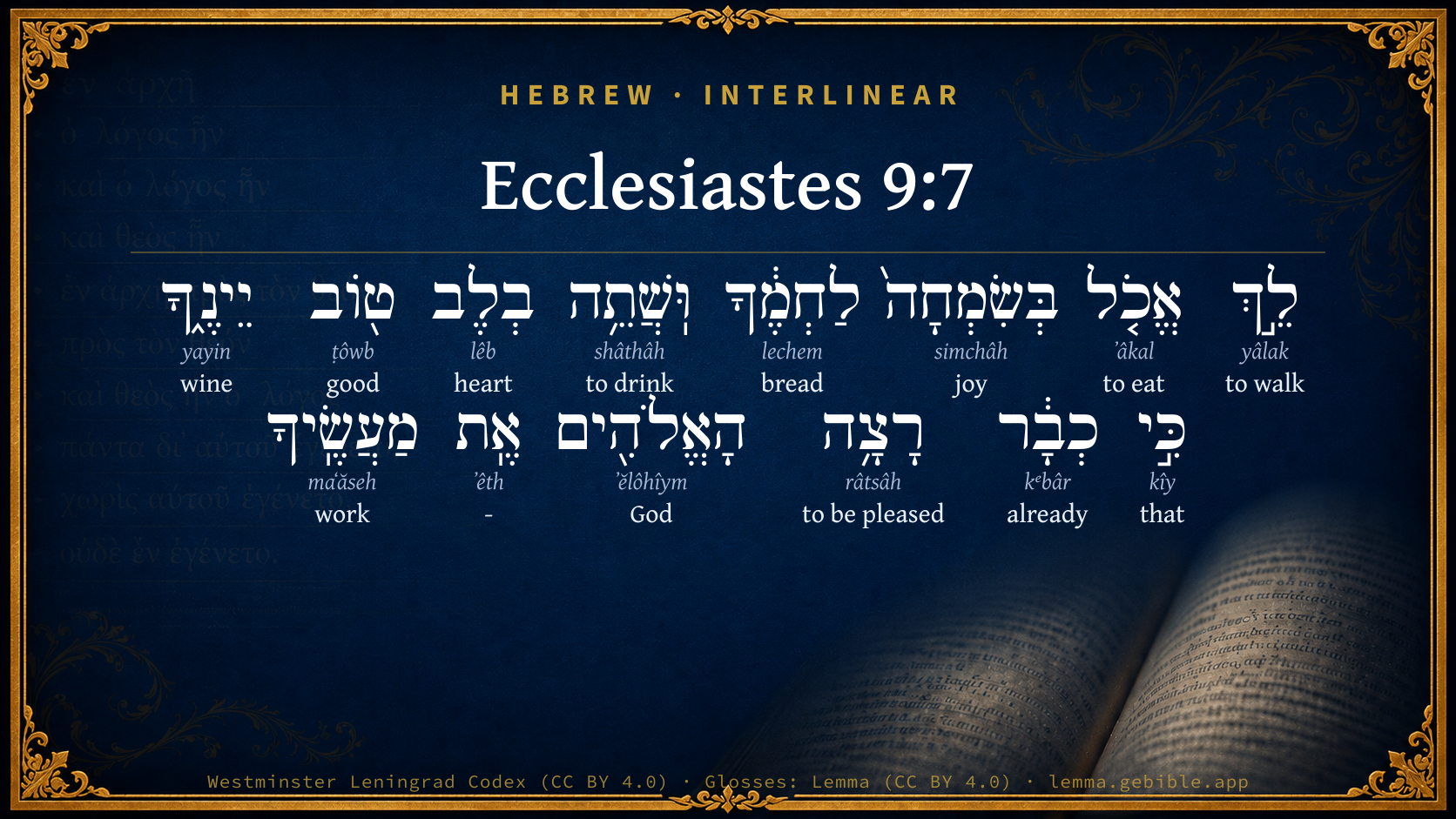
Hebrew (Westminster Leningrad Codex) Ecclesiastes 9:7 appears in the Hebrew Old Testament. The text above is from the Westminster Leningrad Codex. Each word links to its Strong’s number, a concise gloss, and parsing drawn from the Open Scriptures Hebrew Bible morphology. Click any word for its full Brown-Driver-Briggs (BDB) entry.
Download image
Cite this verse

Ecclesiastes 9:7 (World English Bible). Public Domain. Lemma interlinear Bible study tool, https://lemma.gebible.app/v/ecclesiastes/9/7.

Show BibTeX & RIS
BibTeX
RIS
English Translation
Go your way--eat your bread with joy, and drink your wine with a merry heart; for God has already accepted your works.
World English Bible · Public Domain
Download a study sheet

One document with this verse’s original text, its word-by-word gloss line, the meaning frame, cross-references with their text, attributed commentary, and full source and license credits — printable, and it pastes into notes with its structure intact.

This verse Autodidact and up

Study sheet (.html) Plain text (.txt)

A passage Seminary Student

Up to 50 verses in one chapter. A passage sheet keeps up to 6 commentary sources and 12 cross-references per verse, in the order this page ranks them, and says so on the sheet whenever that leaves anything out. Ask for a single verse and you get the Autodidact verse sheet above.

Everything on this page stays free to read, with no account — the sheet is a download of what is already on screen, not access to it.

Want to remove ads? Support Godless Engineer
Compare translations 3

The same verse in 3 English versions, stacked beneath the original-language interlinear above. Click any original word for its lexicon entry.

Each is an independent rendering of the whole verse — the interlinear is not word-aligned to these translations.

Highlighted words mark where these versions differ — a whole-verse word diff, not a word-by-word alignment.

  • World English Bible Public Domain
    Go your way--eat your bread with joy, and drink your wine with a merry heart; for God has already accepted your works.
  • King James Version Public Domain
    Go thy way, eat thy bread with joy, and drink thy wine with a merry heart; for God now accepteth thy works.
  • unfoldingWord Literal Text CC BY-SA 4.0
    Go! Eat your bread with joy, and drink your wine with a good heart, because the God has already accepted your deeds.

unfoldingWord Literal Text — © unfoldingWord, licensed CC BY-SA 4.0. Word-aligned USFM3 via Door43 (git.door43.org/unfoldingWord/en_ult).

Versions to compare (up to 4)

3 of 4 selected

Show all 18 translations

Every available English version of this verse, each an independent rendering of the whole verse.

  • World English Bible Public Domain
    Go your way--eat your bread with joy, and drink your wine with a merry heart; for God has already accepted your works.
  • Berean Standard Bible Public Domain
    Go, eat your bread with joy, and drink your wine with a cheerful heart, for God has already approved your works:
  • Majority Standard Bible Public Domain
    Go, eat your bread with joy, and drink your wine with a cheerful heart, for God has already approved your works:
  • King James Version Public Domain
    Go thy way, eat thy bread with joy, and drink thy wine with a merry heart; for God now accepteth thy works.
  • American Standard Version (1901) Public Domain
    Go thy way, eat thy bread with joy, and drink thy wine with a merry heart; for God hath already accepted thy works.
  • Revised Version (1885) Public Domain
    Go thy way, eat thy bread with joy, and drink thy wine with a merry heart; for God hath already accepted thy works.
  • Geneva Bible (1599) Public Domain
    Goe, eate thy bread with ioy, and drinke thy wine with a cheerefull heart: for God nowe accepteth thy workes.
  • Douay-Rheims (1899) Public Domain
    Go then, and eat thy bread with joy, and drink thy wine with gladness: because thy works please God.
  • Young's Literal Translation Public Domain
    Go, eat with joy thy bread, and drink with a glad heart thy wine, for already hath God been pleased with thy works.
  • Literal Standard Version CC BY-SA 4.0
    Go, eat your bread with joy, and drink your wine with a glad heart, for already has God been pleased with your works.
  • Unlocked Literal Bible CC BY-SA 4.0
    Go your way, eat your bread with joy, and drink your wine with a happy heart, for God approves of celebrating good works.
  • unfoldingWord Literal Text CC BY-SA 4.0
    Go! Eat your bread with joy, and drink your wine with a good heart, because the God has already accepted your deeds.
  • Darby Bible Public Domain
    Go, eat thy bread with joy, and drink thy wine with a merry heart; for God hath already accepted thy works.
  • World Messianic Bible Public Domain
    Go your way—eat your bread with joy, and drink your wine with a merry heart; for God has already accepted your works.
  • Webster's Bible Public Domain
    Go thy way, eat thy bread with joy, and drink thy wine with a merry heart; for God now accepteth thy works.
  • Free Bible Version CC BY-SA 4.0
    So go ahead and eat your food, and enjoy it. Drink your wine with a happy heart. That's what God intends that you should do.
  • Bible in Basic English Public Domain
    Come, take your bread with joy, and your wine with a glad heart. God has taken pleasure in your works.
  • JPS Tanakh (1917) Public Domain
    Go thy way, eat thy bread with joy, and drink thy wine with a merry heart; for God hath already accepted thy works.

Literal Standard Version (2020), Covenant Press — licensed CC BY-SA 4.0. Text via the HelloAO Bible API (eBible.org). Unlocked Literal Bible (unfoldingWord) — licensed CC BY-SA 4.0. Text via the HelloAO Bible API (eBible.org). unfoldingWord Literal Text — © unfoldingWord, licensed CC BY-SA 4.0. Word-aligned USFM3 via Door43 (git.door43.org/unfoldingWord/en_ult). Free Bible Version, Dr. Jonathan Gallagher — licensed CC BY-SA 4.0. Text via the HelloAO Bible API (eBible.org).

Word by word

More ways to search: Search by grammar → Find every occurrence → Compare this word →

Practice this passage: Drill this verse → Learn its vocabulary →

כְבָ֔ר
kᵉbâr
H3528
“already”
Adverb
Part of Speech
Adverb
Full BDB Definition

Origin: from H3527

TWOT: 947c

already, long ago, a great while
  1. לֵ֣ךְ yâlak H3212 “walk” Verb, Qal, Imperative, 2nd Person, Masculine, Singular
  2. אֱכֹ֤ל ʼâkal H398 “eat” Verb, Qal, Imperative, 2nd Person, Masculine, Singular
  3. בְּשִׂמְחָה֙ simchâh H8057 “in/at · joy” Preposition + Noun, Common, Feminine, Singular, Absolute
  4. לַחְמֶ֔ךָ lechem H3899 “bread · your” Noun, Common, Both, Singular, Construct + Suffix, Personal, 2nd Person, Masculine, Singular
  5. וּֽשֲׁתֵ֥ה shâthâh H8354 “and · drink” Conjunction + Verb, Qal, Imperative, 2nd Person, Masculine, Singular
  6. בְלֶב lêb H3820 “in/at · heart of” Preposition + Noun, Common, Masculine, Singular, Construct
  7. ט֖וֹב ṭôwb H2896 “good” Adjective, Adjective, Masculine, Singular, Absolute
  8. יֵינֶ֑ךָ yayin H3196 “wine · your” Noun, Common, Masculine, Singular, Construct + Suffix, Personal, 2nd Person, Masculine, Singular
  9. כִּ֣י kîy H3588 “that” Conjunction
  10. רָצָ֥ה râtsâh H7521 “to be pleased” Verb, Qal, Perfect, 3rd Person, Masculine, Singular
  11. הָאֱלֹהִ֖ים ʼĕlôhîym H430 “the · God(s)” Particle, Definite Article + Noun, Common, Masculine, Plural, Absolute
  12. אֶֽת ʼêth H853 “-” Particle, Direct Object
  13. מַעֲשֶֽׂיךָ maʻăseh H4639 “works · your” Noun, Common, Masculine, Plural, Construct + Suffix, Personal, 2nd Person, Masculine, Singular

About this verse

These counts appear in no published source. They are computed here, from the morphology-tagged text and Lemma’s own curated glosses. What Lemma adds →

14
words
14
distinct lemmas
Wisdom
section

Notable vocabulary

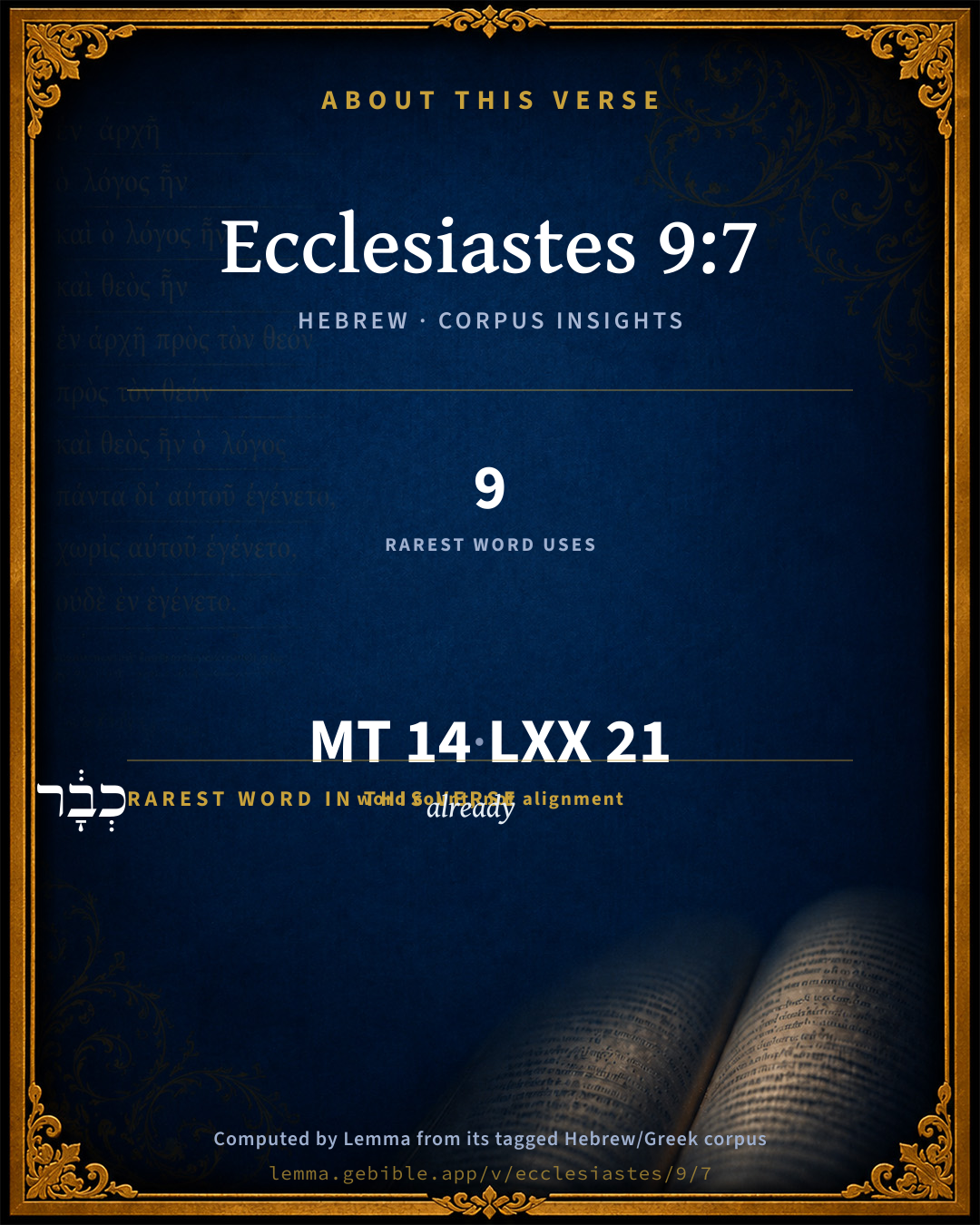
The rarest word here is כְבָ֔ר already H3528 — appearing just 9 times in the whole Hebrew Bible.

Shared distinctive vocabulary

כְבָ֔ר already H3528 occurs in 8 verses of the Hebrew Bible. Also found in:

Grammatical profile

  • 4 verbs
  • 6 nouns
  • 1 adjective
  • 1 conjunction
  • 1 adverb
  • 1 particle

Verb forms

  • לֵ֣ךְ Qal · Imperative
  • אֱכֹ֤ל Qal · Imperative
  • וּֽשֲׁתֵ֥ה Qal · Imperative
  • רָצָ֥ה Qal · Perfect

Hebrew & Septuagint length

In English translation the verse runs 22 words from the Hebrew and 22 from the Septuagint (LXX English) — the same length.

A rough comparison of the two English renderings, which tokenize alike — not a word-level alignment.

Word counts can differ between the Hebrew and the Greek without any difference in meaning — e.g. the Hebrew direct-object marker אֵת has no separate Greek word, and Greek often adds the article ὁ.

In the original languages it is 14 Hebrew tokens and 21 Greek tokens — but the two are counted differently (Hebrew bundles its prefixes and suffixes into one token; the Greek is in lemma form), so that isn’t a like-for-like length.

Cross-references

20

Topical passages linked to Ecclesiastes 9:7 in the Treasury of Scripture Knowledge — connected by theme and wording, ordered by reader-vote popularity; previews shown in the World English Bible.

  • Ecclesiastes 3:12–13 I know that there is nothing better for them than to rejoice, and to do good as long as they live.
  • Deuteronomy 12:7 and there you shall eat before Yahweh your God, and you shall rejoice in all that you put your hand to, you and your households, in which Yahweh your God has blessed you.
  • Ecclesiastes 8:15 Then I commended mirth, because a man has no better thing under the sun, than to eat, and to drink, and to be joyful: for that will accompany him in his labor all the days of his life which God has given him under the sun.
  • Ecclesiastes 10:19 A feast is made for laughter, And wine makes the life glad; And money is the answer for all things.
  • Ecclesiastes 2:24–26 There is nothing better for a man than that he should eat and drink, and make his soul enjoy good in his labor. This also I saw, that it is from the hand of God.
  • Nehemiah 8:10–12 Then he said to them, Go your way, eat the fat, and drink the sweet, and send portions to him for whom nothing is prepared; for this day is holy to our Lord: neither be you grieved; for the joy of Yahweh is your strength.
  • 1 Chronicles 16:1–3 They brought in the ark of God, and set it in the midst of the tent that David had pitched for it: and they offered burnt offerings and peace-offerings before God.
  • Ecclesiastes 5:18 Behold, that which I have seen to be good and proper is for one to eat and to drink, and to enjoy good in all his labor, in which he labors under the sun, all the days of his life which God has given him; for this is his portion.
  • Deuteronomy 16:14–15 and you shall rejoice in your feast, you, and your son, and your daughter, and your man-servant, and your maid-servant, and the Levite, and the foreigner, and the fatherless, and the widow, who are within your gates.
  • 1 Chronicles 29:21–23 They sacrificed sacrifices to Yahweh, and offered burnt offerings to Yahweh, on the next day after that day, even one thousand bulls, one thousand rams, and one thousand lambs, with their drink-offerings, and sacrifices in abundance for all Israel,
  • Genesis 4:4–5 Abel also brought some of the firstborn of his flock and of the fat of it. Yahweh respected Abel and his offering,
  • Deuteronomy 12:12 You shall rejoice before Yahweh your God, you, and your sons, and your daughters, and your men-servants, and your maid-servants, and the Levite who is within your gates, because he has no portion nor inheritance with you.
  • 1 Kings 8:66 On the eighth day he sent the people away; and they blessed the king, and went to their tents joyful and glad of heart for all the goodness that Yahweh had shown to David his servant, and to Israel his people.
  • Acts 10:35 but in every nation he who fears him and works righteousness is acceptable to him.
  • Genesis 12:19 Why did you say, 'She is my sister,' so that I took her to be my wife? Now therefore, see your wife, take her, and go your way."
  • Exodus 24:8–11 Moses took the blood, and sprinkled it on the people, and said, "Look, this is the blood of the covenant, which Yahweh has made with you concerning all these words."
  • Mark 7:29 He said to her, "For this saying, go your way. The demon has gone out of your daughter."
  • Luke 11:41 But give for gifts to the needy those things which are within, and behold, all things will be clean to you.
  • John 4:50 Jesus said to him, "Go your way. Your son lives." The man believed the word that Jesus spoke to him, and he went his way.
  • 2 Chronicles 30:23–27 The whole assembly took counsel to keep other seven days; and they kept [other] seven days with gladness.

Cross-references courtesy of OpenBible.info (CC BY 4.0).

Hebrew and Greek witnesses Masoretic Hebrew ↔ Greek Septuagint

The same verse in the two great witnesses to the Old Testament, shown verse-for-verse.

These are two independent witnesses, not word-aligned to each other, and the Septuagint is shown in lemma (dictionary) form.

Hebrew Ecclesiastes 9:7 Masoretic · Westminster Leningrad Codex

לֵ֣ךְ אֱכֹ֤ל בְּשִׂמְחָה֙ לַחְמֶ֔ךָ וּֽשֲׁתֵ֥ה בְלֶב ט֖וֹב יֵינֶ֑ךָ כִּ֣י כְבָ֔ר רָצָ֥ה הָאֱלֹהִ֖ים אֶֽת מַעֲשֶֽׂיךָ

Go your way--eat your bread with joy, and drink your wine with a merry heart; for God has already accepted your works.

World English Bible · Public Domain

Greek LXX Ecclesiastes 9:7 Septuagint · lemma form

δεῦρο ἐσθίω ἐν εὐφροσύνη ἄρτος σύ καί πίνω ἐν καρδία ἀγαθός οἶνος σύ ὅτι ἤδη εὐδοκέω ὁ θεός ὁ ποίημα σύ

Go, eat your bread with mirth, and drink your wine with a joyful heart; for now God has favourably accepted your works.

LXX2012 (modern English Septuagint) · Public Domain

On this verse, Keil & Delitzsch discusses the Septuagint’s reading. Read the note in Commentary ↓

Hebrew: Westminster Leningrad Codex (CC BY 4.0). Greek: Septuagint (public domain); English from LXX2012 (modern English Septuagint) (Public Domain). How the Septuagint differs from the Hebrew →

Commentary

Notes on Ecclesiastes 9:7 from classic Christian and Jewish commentators (each source and its license shown beneath its notes). The classic Christian expositions comment on the surrounding passage and are grouped to its opening verse, so a note may address several verses; the Jewish commentaries on the Tanakh (Rashi and others) are per-verse, so they appear only where the commentator wrote on this verse.

Lemma curates 59 commentaries, every one of them public domain or Creative Commons licensed, each selected and text-cleaned for this edition rather than reprinted as found. About our sources →

Trapp's Complete Commentary

John Trapp

Ecc 9:7 Go thy way, eat thy bread with joy, and drink thy wine with a merry heart; for God now accepteth thy works.

Ver. 7. Go thy way, eat thy bread with joy.] Vade, iuste, go thy way, thou righteous man; live in cheerfulness of mind, proceeding from the testimony of a good conscience: so Lyra senseth the words. God’s grace and favour turned brown bread and water into manchet and wine to the martyrs in prison. "Rejoice not thou, O Israel, for joy, as other people, for thou hast gone a whoring from thy God." {Hos 9:1} Thou cutest thy bane, thou drinkest thy poison, because "to the impure all things are impure," and "without faith it is impossible to please God." "In the transgression of an evil man there is a snare (or a cord to strangle his joy with), but the righteous doth sing and rejoice." {Pro 29:6} He may do so; he must do so. What should hinder him? He hath made his peace with God, and is rectus in curia. Let him be merry at his meals, lightsome and spruce in his clothes, cheerful with his wife and children, &c. "Is any man merry at heart?" saith St James; {Jas 5:13} is he right set, and hath he a right frame of soul (ευθυμει)? is all well within? "Let him sing psalms"; yea, as a traveller rides on merrily, and wears out the tediousness of the way by singing sweet songs unto himself; so should the saints. "Thy statutes have been my songs in the house of my pilgrimage." {Psa 119:54}

John Trapp, A Commentary or Exposition upon All the Books of the Old and New Testament (1647–1656) — public domain. Text from a community e-Sword module.

Albert Barnes' Notes on the Bible

Read these six verses connectedly, in order to arrive at the meaning of the writer; and compare Ecc 2:1-12.

After the description Ecc 9:5-6 of the portionless condition of the dead, the next thought which occurs is that the man who is prosperous and active should simply enjoy his portion all through this life Ecc 9:7-10; and then Ecc 9:11-12 follows the correcting thought (see Ecc 3:1-15 note), introduced as usual Ecc 2:12; Ecc 4:1, Ecc 4:7 by “I returned,” namely, that the course of events is disposed and regulated by another will than that of man.

The person addressed is one whose life of labor is already pleasing to God, and who bears visible tokens of God’s favor.

Ecc 9:7

Now accepteth - Rather: “already has pleasure in.” Joy (the marginal reference note) is regarded as a sign of the approbation and favor of God.

Ecc 9:8

White garments and perfume are simply an expressive sign of joy.

Ecc 9:10

The works which we carry on here with the combined energies of body and soul come to an end in the hour of death, when the soul enters a new sphere of existence, and body and soul cease to act together. Compare Joh 9:4.

Device - See Ecc 7:25 note.

Ecc 9:11

Chance - Or, “incident,” that which comes to us from without, one of the external events described in Eccl. 3. Compare Ecc 2:14 note.

Ecc 9:12

Time - See Ecc 3:1 ff.

Albert Barnes' Notes on the Bible (1834–1885) — public domain. Text from a community e-Sword/MySword module.

The Biblical Illustrator

Joseph S. Exell

Ecc_9:7-8

Go thy way, eat thy bread with joy, and drink thy wine with a merry heart; for God now aceepteth thy works.

Festival joy

This is one of those passages, so remarkable in the writings of Solomon, in which the words of sinful men in the world are taken up by the Holy Ghost, to be applied in a Christian sense. As they stand in Ecclesiastes, they are intended to represent the sayings of sensual, careless people, indulging themselves in their profane ways, their utter neglect of God and goodness, with the notion that this world is all. It is much the same as the unbelievers saying, Let us eat and drink, for to-morrow we die. But see the ever-watchful goodness and mercy of God. The words which the dissolute, wild-hearted sinner uses to encourage himself in his evil, inconsiderate ways, He teaches us to take up, and use them in a very different sense; to express the inward joy and comfort which Gods people may find in obeying Him. As thus: suppose a person giving himself up, with his whole heart, to the service and obedience of God; suppose him really Withdrawing himself from the sins which had most easily beset him; suppose him making some great sacrifice, parting with what he held very dear, or submitting to pain or grief for Christs sake: then the holy and merciful Comforter seems to say to him in the words of the text, Go thy way now, thank God, and take courage; the blessing of God is now restored to thee, and will be upon all thou hast, and upon thine ordinary employments and refreshments: now thou mayest eat thy bread with joy, and drink thy wine with a merry heart, for God now accepteth thy works. What a heavenly light it would throw over our ordinary works and refreshments, if, being always careful to set about them with a good conscience, we could seriously bring it home to ourselves, that they are so many tokens of heavenly and eternal love; so many reasonable grounds of hope, that God really accepteth our works. But there is yet a higher, a Christian sense of these words. The bread and wine, the white garments, the ointment for the head, are figures and types of our Christian privileges, the blessings and favours of the kingdom of heaven. It is, then, as if the Holy Word had said to us, being, as we are, Christian men, members of the mystical Body of our Lord and Saviour, Now you have been brought into the communion of saints; now God has set His seal upon you; now you are washed, sanctified, justified, in the name of the Lord Jesus, and by the Spirit of our God. Go your way, then; use your privileges with all reverence, joy, and fear. And it would seem that if Christians were at all such as they ought to be, the words might be well and profitably understood with a particular reference to this sacred season of Whitsuntide. This is the last of the holy seasons; it represents to us the full completion of Gods unspeakable plan for the salvation of the world. The words have a sound most comfortable to penitents, as well as to those who, by Gods help, have kept themselves from wilful, deadly sin. They sound like words of absolution: Go thy way, return again to that holy Table, from which thy transgressions had for a time separated thee: eat thy Bread and drink thy Wine with a courageous and hopeful heart; for now there is hope that God accepteth thy works; that He hears thee, since thou hast left off inclining unto wickedness with thine heart. Thy case indeed is alarming, from the continual danger of a relapse; and thy loss at best is great, penitency instead of innoceney being thy portion; yet go on steadily and cheerfully. Observe, however, the words which follow, which to the hearing of a thoughtful Christian convey a very serious admonition, telling us on what these unspeakable privileges depend, so far as our own conduct is concerned: Let thy garments be always white, and let thine head lack no ointment. To say, therefore, to Christians at Whitsuntide, Let thy garments be always white, was the same as saying, Take care that at no time you stain or sully the bright and clear robe of your Saviours righteousness, which has just been thrown over you: according to the apostles saying, As many as have been baptized into Christ have put on Christ. As much as possible keep it clear from all spot of wilful sin. Again, says the wise man, Let thine head lack no ointment; and this again is an allusion which would come with a particular meaning in early times to the new-baptized Christians, and those who had been present at their baptism And oil is in Scripture the constant token of the gifts and graces of the Holy Spirit. Therefore, to say, Let thy head lack no ointment, would mean, Take care that thou stir up, cherish, and improve the unspeakable gift of which thou art now made partaker. Use diligently all the means of grace which Christ has provided for thee in His kingdom, whereof thou art now come to be an inheritor. (Plain Sermons by Contributors to the Tracts for the Times.)

Let thy garments be always white.--

White robes

One of the most common beliefs of men concerning heaven is that all are to be robed in white; and it is no idle fancy, for the Bible warrants such a belief. The priestly robes worn in the temple service were white; the apocalyptic vision was filled with the white-robed; the poetry of the Bible teaches that purity and joy in life are symbolized by snowy raiments--Let thy garments be always white. Thy garments. This is a personal matter. The command is to the end that each is to see that his own dress is clean. The neighbour will take care of his own. And now the emphasis comes on always. There must not be a single careless moment. Why is the colour of our garments to be white? Why? Because everybody looks well in white. All complexions can stand white. The plainest are adorned and the most beautiful are made more angelic by wearing it. We love white garments because they are so pure. No impure dyes have disfigured the cloth, and all of Natures tints the bleachers have taken away. So white robes remind us constantly of purity. And did you ever think how important it is? The springs that furnish the thirsty with water must be in their fountain-heads pure, or who will dare to use it? The usefulness of anything depends upon its purity. The white garment is an object lesson, then, teaching the vital importance of purity in heart and life. To be able to look God in the face with steady eye and unblanched cheek. O, that is worth all the sacrifice that it may demand! But it is so hard to keep pure and sweet, they say. I may be tempted by the allurements of the world. Money, with its shining sunbeams, may twine its fingers about my heart to woo it. Ambition, with her lofty and imposing mien, may awe me to obey her. Shall I give up the white raiment of my soul? I would not dare to soil my raiment now, for the spots in such a light the whole world could see, and how could I ever again look up and cry Abba, Father, if on my heart was the stain of evil? But white raiment is the symbol of another quality in the true life. It is joy. Always dependent upon purity for its life, yet a separate quality. No impure life is ever a truly happy life. We put on our clean raiment to honour the joyful occasion. Children, I believe that pure heart is always happy. Then there is a duty attached, the duty to be joyful in being and doing good. How different the world would be to-day if the command about our spiritual toilet were heeded! Let us try hereafter to live in such a way as to teach our friends how blessed it is to have pure, and, therefore, happy hearts. White robes bring great responsibility. They soil so easily. The clean garment shows the dirt at the slightest contact. Keep your hearts clean, for they will soil as easily as the white dress. The little girl who went home from a visit to a neighbours by far the longest way, in order to keep her dress from the mud of a certain street, on being asked why she did it since it made her very tired, said: It kept my dwess tean. How much better children of our Heavenly Father we should be if we were as particular to keep the raiment of our hearts free from the mud-stains of sin, even though the extra toil makes us very weary. Better be tired, even to death, than soil the raiment of the soul. (G. F. Prentiss.)

The Biblical Illustrator, edited by Joseph S. Exell (c. 1880s–1900s) — public domain. Text from a community e-Sword module.

Joseph Benson's Commentary

Ecc 9:7-9. Go thy way — Make this use of what I have said. Eat thy bread — Thy necessary and convenient food; with joy, &c. — Cheerfully enjoy thy comforts, avoiding all distracting care and grief for the occurrences of this world. For God now accepteth thy works — Whosoever thou art, that art truly pious and upright before him, he is gracious unto thee, accepts thy services for his honour, and allows thee a comfortable enjoyment of his blessings. Let thy garments be always white — In all convenient times and circumstances; for there are times of mourning. The eastern people of the best sort used white garments, especially in times of rejoicing. But by this whiteness of garments he seems to intend a pleasant and cheerful conversation. And let thy head lack no ointment — Which, upon joyful occasions, was poured upon men’s heads. Live joyfully with thy wife — The one wife, whom thou lovest. Love her, and keep thyself only to her, avoiding all improper intercourse and familiarity with all other women, and thou wilt live comfortably with her; all the days of thy vanity — Of this vain and frail life: which expression he uses to moderate men’s affections even toward lawful pleasures, and to admonish them of their duty and interest in making sure of a better life, and more solid comforts. For that is thy portion — Allowed thee by God; and the best part of worldly enjoyments; in this life — By which addition he again reminds him of the duty of seeking another and better portion in a future life.

Joseph Benson's Commentary on the Old and New Testaments (1811–1818) — public domain. Text from a community e-Sword module.

The Preacher's Complete Homiletical Commentary

Joseph S. Exell (gen. ed.)

CRITICAL NOTES.—

Ecc_9:8. Let thy garments be always white; and let thy head lack no ointment] No literal observance of these circumstances of external appearance is intended; but rather an exhortation to indulge those calm and pure emotions of joy, of which white garments and a face which oil causes to shine are the well-known symbols.

Ecc_9:10. For there is no work, nor device, nor knowledge, nor wisdom, in the grave whither thou goest.] This may be compared with the saying of our Lord in Joh_9:4. The grave.] The unseen state to which thou art hastening.

MAIN HOMILETICS OF THE PARAGRAPH.—Ecc_9:7-10

THE UNSATISFACTORY CONDITIONS OF THE PRESENT LIFE IN THEIR BEARING UPON DUTY

The Preacher had shown that the ways of God to man are full of dark mystery. This has been a terrible oppression to many—to some even a fatal one. We must admit that man’s present condition is unsatisfactory; for it is rudimentary. It is on the way to perfection. The dark enigma of life, however, should not be a fatal obstacle to duty. Of the unsatisfactory conditions of the present life, we affirm—

I. They do not Forbid a Joyful Acceptance and Use of the Blessings of Providence. (Ecc_9:7-9.) The habit of dwelling exclusively upon the dark side of things is hurtful to the soul. We are either driven to melancholy and despair, or else to the mad pursuit of pleasure by which we seek to drown all anxiety and care. There is a safe middle way between these two extremes, by which we avoid gloom and despair, on the one hand, and a reckless pursuit of pleasure, on the other hand. We should thankfully accept the blessings of Providence, and use them with sobriety. The consciousness that God “accepteth” our “works” should be at once the impulse and the director of our joy (Ecc_9:7). The constant reference to God, and the intention of pleasing Him, will sanctify all life. There are three sources of enjoyment referred to here, which we may soberly and thankfully use.

1. The satisfaction of the appetites. (Ecc_9:7.) Our physical wants are a fact of our nature which we must accept. They crave for satisfaction. These natural endowments, as they arise from the appointment of the Creator, are not sinful in themselves. They only become the occasion of sin by unlawful indulgence. The bounty of the Great Giver has furnished means for the satisfaction of our common wants, even ministering to the most delicate perceptions of taste and gladdening the heart of man.

2. The taste for outward beauty. (Ecc_9:8.) There are outward forms, the contemplation of which gives an exquisite and refined pleasure. Thus the ornaments of dress minister to the instinct of beauty and harmony. The Creator, in His works, has not only studied utility, but has even prepared those graces and ornaments which wait upon our perception of elegance. He has placed this instinct in the human breast. We may indulge it if we only do so with moderation, remembering that outward beauty has no infinite capacity to please. It is a joy which is bounded, and God alone is the soul’s pure and permanent delight.

3. Domestic joys. (Ecc_9:9.) The various relations of life, whether we are born to their possession, or enter them by choice, minister to our social enjoyments. They tend to abate the natural selfishness of the human heart and to multiply and exalt our pleasures. These are the gifts of God—they are our “portion” here. They serve for awhile to lift our minds above the overwhelming sense of the vanity of life. We can use such joys if we remember that they too are fleeting, and that the only sure and abiding portion for the soul is God. “The fashion”—the outward form, scheme, or arrangement—“of this world passeth away.” (1Co_7:31.)

II. They do not Forbid proper Zeal and Diligence in the Work of Life. (Ecc_9:10.) We may dwell upon the dark things of life until we are driven to despair, and despair paralyses effort. Weak hands and feeble knees accompany melancholy. Whatever be the tendencies and issues of things—the ultimate solution of this mystery—we have great practical duties to perform.

1. We should accept the task and duty lying nearest to us. It is in vain to sit still and wait for some congenial task to fall in our way. There are duties enough lying to our hand. No man has need to be idle for lack of a task.

2. We should be earnest in our work. The most exalted natures are distinguished by the highest activity—God, who works in and through all—the angels, who are quick and strong to do His will. Throughout the whole course of nature we observe unwearied activity. Creation preaches to us, saying, be earnest. The illustrious names of history who have won a distinction that will never die exhort us to industry. Such is the price we have to pay for all possessions that are of true and abiding worth.

3. We have a strong motive for such earnestness. Whatever may lie before us in the future, there are certain kinds of work which can only be done in this world. While the work is before us and our faculty is fresh, all is fluent to our hands; but when our life’s day is ended, all becomes rigid—fixed in the solemn stillness of eternity! There are forms of work and of knowledge which are only possible here. If we disregard them, there will be no chance afforded us to repair the omission. Even Christ himself, during his earthly sojourn, came under this law. There was a work which even He could do only in this world. (Joh_9:4.) He felt that in His mortal day His allotted task must be accomplished. The grave is the dark terminus of our earthly work.

III. They do not Destroy our Hope of Reward. From the appearances of this life we may draw the hasty conclusion that there is no reward for goodness hereafter, no vindication of suffering innocence. It seems as if this troubled drama of human history must repeat itself endlessly throughout the ages. But we have to reflect,

1. That we stand in a present relation to God. If we are good in His sight, He accepts our works now. He receives them as the homage of our gratitude, and pieces out our imperfections with His goodness. We may well hope that that goodness has provided for us the larger gift of immortality. God will not permit us to know Him and work for Him through the brief space of life, and then blot us out of existence for ever.

2. We have reason to hope that we shall stand in a future relation to Him. If we can say with the Psalmist, “O God, Thou art my God” (Psa_63:1), we may well hope that He shall be our portion for ever, that He shall redeem us from the power of the grave. The majesty of God requires that He shall make His servants rich, not only by the bestowal of gifts by which they serve Him, but also in the heritage of eternal life, so that they may serve Him for ever. Therefore, though the way be dark, we can have light enough for duty; and unfading hope to assure us that there is for us a higher service in other worlds.

SUGGESTIVE COMMENTS ON THE VERSES

Ecc_9:7. The mystery of God’s moral Government should not render our sight insensible to the impressions of His goodness, the proofs of which are full and manifest.

The Almighty Maker of all things intended that the beauty of His works should make an appeal to mind and heart. In like manner, He intends that the gifts of His hand should awaken in us the emotions of gratitude and joy.

When God accepts our works, the commonest actions of our life become sanctified.

Though faith be sorely tried by appearances, yet God is on the side of the righteous, giving them tokens of acceptance and reserving greater things for them.

We must learn to live before we can live rightly and well. With us, “that which is natural” forces itself upon us as our first care. Afterwards that which is spiritual. Wherefore those ordinary gifts of Providence by which we are constantly delivered from death deserve the instant tribute of our praise and joy.

Moses putting his hand into his bosom took it out leprous, putting it again into his bosom, he took it out clean. The hand is the instrument of working, and the works of man are sometimes leprous and unsound, sometimes healthy and good. If they proceed from a sincere and honest heart, which God approveth, then they are sound and healthy; but if they come from a corrupt heart, and be done for the pleasing of men, then they are leprous and unsound. Now it is a healthy and sound body that is fittest for mirth and freest in mirth, it is a healthy and sound body that eateth and drinketh most cheerfully. Wherefore seeing where God accepteth thy works, there is health and soundness, let there also be freeness of joy and mirth [Jermin].

Ecc_9:8. Cheerfulness should be the soul’s habit, and joy the prevailing expression of the soul’s countenance.

God gives His people the oil of joy to assuage their grief, and fits them for the feast of His pleasures by the garments of praise.

The notion of pleasure seems invariably associated with the practice; and it was aptly indicated by the richness and freshness, and, in many cases, by the aromatic fragrance, of the balsamic unguents. “Let thy head lack no ointment” is equivalent to—Rejoice in the bounty and loving-kindness of the Lord; “let not thy heart be troubled, neither let it be afraid.” And the expression “let thy garments be always white” is of the same account with the Apostolic exhortation, “Rejoice evermore!” Take the enjoyment of whatever the hand of a kind Providence bestows, with a grateful and cheerful spirit; not with selfishness or extravagance, or thoughtless mirth; but with benevolence and sobriety, and with that true joy which is independent of the possessions of time, which, coming from above, infuses into the things of earth a relish of heaven, and would continue to be the inmate of the pious soul, though they were all removed [Wardlaw].

Christ was anointed with the oil of joy, although he lived under the shadow of a great calamity. All noble souls have a deep and intimate joy which no disasters can dislodge.

Ecc_9:9. The disciples of wisdom affect no refinement beyond the ordinances of God.

We should joyfully use those solaces which God’s Providence has provided for us as a peaceful retreat from the tumultuous scenes of life.

“Here love his golden shafts employs, here lights

His constant lamp, and waves his purple wings—

Here reigns and revels” [Paradise Lost].

The moral character of nations is determined by the purity and integrity of domestic life. The home is the support, the forerunner, the very material of the State and Church. The righteous man, by beautifying and sanctifying home, is the real safety and hope of his country.

We should look upon the joys of domestic life as the earthly reward of our labour, our measured portion of happiness here, and the gift of God.

The sense of time fast speeding on to eternity hangs over the most endearing scenes of life, and at times touches thoughtful minds with overwhelming emotion.

By the repetition of the last words we are expressly taught that, in the midst of the vanity and travail with which human existence is burdened, we are pressingly summoned not to seal up the sources of enjoyment which still remain open to us [Hengstenberg].

The consideration of the vanity and shortness of their life, and of the miseries incident to it, though it should not provoke them to excess of sensual delights, yet it should incite them to a more cheerful use of these comforts, that, seeing their time is short, they may have the more strength and encouragement to serve the Lord cheerfully. For while Solomon is pressing upon men a cheerful and free use of outward comforts, he minds them twice of the vanity of their life, which, in the midst of these things, they are ready to forget, and makes the same a reason pressing the cheerful use of their allowance [Nisbet].

Ecc_9:10. The melancholy and gloom which deep thought awakens is dissipated by the active exertion of our powers in duty.

Whatever is dark and mysterious in man’s present state, his work, and the obligation to perform it, are quite clear and evident. It is better to spend his energy upon what is certain than to torment himself with the pain of speculation.

That the opportunity is short is a motive for diligent exertion in our work, but not the strongest motive; which the notion of our state hereafter, depending upon our work here, alone supplies. Therefore this exhortation requires, though it does not formally state, the doctrine of a future life.

Death is truly an unclothing of man, who, though his being is continuous, must put aside what he cannot resume again. There are duties to be performed, talents and powers to be used, which are peculiar to the present state; they must altogether be put off with our mortal life.

Though sustained by immortal hope, it is salutary to reflect upon the physical side of death, and learn from thence diligence in the duty of the moment, or even console ourselves by the melancholy prospect of its long repose. Whatever the state of the dead may be, it is certain that it is night to us, as far as some kinds of work and modes of knowledge are concerned.

Nothing that has been neglected here can be attended to there. If we fail to perform a duty in this life, there will be no opportunity of performing it in the place of the dead. If we have errors to confess, or wrongs to repair—if we have any bad influence to undo, or any good influence to employ—if we have any evil habits to unlearn, or any gracious tendencies to cultivate, now is the time [Buchanan].

Man’s characteristic is restlessness; restlessness foretells his immortality; and a sluggard by his apathy seems to destroy the mark, and silence the prophecy. But if confined to other things, indolence may not be absolutely fatal; the indolent man may have wealth which secures him against want; and by the occasional exercise of rare talents he may, in spite of habitual sluggishness, even attain to some measure of distinction. But an indolent Christian—it is a sort of contradiction—Christianity is industry spiritualised [Melvill].

Diligence in our earthly and heavenly callings is the surest way through mystery and darkness up to God.

The Preacher's Complete Homiletical Commentary (gen. ed. Joseph S. Exell; Funk & Wagnalls, c. 1892) — public domain (pre-1929). A full-Bible homiletical/sermon-outline anthology covering 65 of 66 books (2 John is absent from the source module). Text from a community e-Sword module.

Keil & Delitzsch

C. F. Keil & F. Delitzsch

"Go, eat thy bread with joy, and drink thy wine with a merry heart; for long ago hath God accepted thy work. Let thy garments be always white; and let not oil be wanting to thy head. Enjoy life with a wife whom thou lovest through all the days of thy vain life, which He hath given thee under the sun - through all thy vain days: for that is thy portion in life, and in thy labour wherewith thou weariest thyself under the sun. All that thy hand may find to do with thy might, that do; for there is not work, and calculation, and knowledge, and wisdom, in the under world, whither thou shalt go." Hengstenberg perceives here the counterpart of the spirit; on the contrary, Oetinger, Mendelssohn, and others, discover also here, and here for the first time rightly, the utterance of an epicurean thought. But, in fact, this לך down to שׁ הולך is the most distinct personal utterance of the author, his ceterum censeo which pervades the whole book, and here forms a particularly copious conclusion of a long series of thoughts. We recapitulate this series of thoughts: One fate, at last the same final event, happens to all men, without making any distinction according to their moral condition, - an evil matter, so much the more evil, as it encourages to wickedness and light-mindedness; the way of man, without exception, leads to the dead, and all further prospect is cut off; for only he who belongs to the class of living beings has a joyful spirit, has a spirit of enterprise: even the lowest being, if it live, stands higher in worth, and is better, than the highest if it be dead; for death is the end of all knowledge and feeling, the being cut off from the living under the sun. From this, that there is only one life, one life on this side of eternity, he deduces the exhortation to enjoy the one as much as possible; God Himself, to whom we owe it, will have it so that we enjoy it, within the moral limits prescribed by Himself indeed, for this limitation is certainly given with His approbation. Incorrectly, the Targ., Rashi, Hengst. Ginsb., and Zckl. explain: For thy moral conduct and effort have pleased Him long ago - the person addressed is some one, not a definite person, who could be thus set forth as such a witness to be commended. Rather with Grotius and others: Quia Deus favet laboribus tuis h. e. eos ita prosperavit, ut cuncta quae vitam delectant abunde tibi suppetant. The thought is wholly in the spirit of the Book of Koheleth; for the fruit of labour and the enjoyment of this fruit of labour, as at Ecc 2:24; Ecc 3:13, etc., is a gift from above; and besides, this may be said to the person addressed, since 7a presupposes that he has at his disposal heart-strengthening bread and heart-refreshing wine. But in these two explanations the meaning of כּבר is not comprehended. It was left untranslated by the old translators, from their not understanding it. Rightly, Aben Ezra: For God wills that thou shouldst thus to [indulge in these enjoyments]; more correctly, Hitzig: Long ago God has beforehand permitted this thy conduct, so that thou hast no room for scruples about it. How significant כבר is for the thought, is indicated by the accentuation which gives to it Zakef: from aforetime God has impressed the seal of His approbation on this thy eating with joy, this thy drinking with a merry heart. - The assigning of the reason gives courage to the enjoyment, but at the same time gives to it a consecration; for it is the will of God that we should enjoy life, thus it is self-evident that we have to enjoy it as He wills it to be enjoyed.

Ecc 9:8

The white garments, לבּנים, are in contrast to the black robes of mourning, and thus are an expression of festal joy, of a happy mood; black and white are, according to the ancients, colour-symbols, the colours respectively of sorrow and joy, to which light and darkness correspond.

(Note: Cf. Shabbath 114a: "Bury me neither in white nor in black garments: not in white, because perhaps I may not be one of the blessed, and am like a bridegroom among mourners; not in black, because perhaps I may be one of the blessed, and am like a mourner among bridegrooms." Semachoth ii. 10: Him who is outside the congregation, they do not bury with solemnity; the brothers and relatives of such must clothe and veil themselves in white; cf. Joma 39b. Elsewhere white is the colour of innocence, Shabbath 153a, Midrash under Pro 16:11; and black the colour of guilt, Kiddushin 40a, etc.)

Fragrant oil is also, according to Pro 27:9, one of the heart-refreshing things. Sorrow and anointing exclude one another, Sa2 14:2; joy and oil stand in closest mutual relation, Psa 45:8; Isa 61:3; oil which smooths the hair and makes the face shine (vid., under Psa 104:15). This oil ought not to be wanting to the head, and thus the perpetuity of a happy life should suffer no interruption.

Ecc 9:9

In Ecc 9:9 most translators render: Enjoy life with the wife whom thou lovest; but the author purposely does not use the word האשּׁה, but אשּׁה; and also that he uses חיּים, and not החיּים, is not without significance. He means: Bring into experience what life, what happiness, is (cf. the indetermin. ideas, Psa 34:13) with a wife whom thou hast loved (Jerome: quaecunque tibi placuerit feminarum), in which there lies indirectly the call to choose such an one; whereby the pessimistic criticism of the female sex, Ecc 7:26-28, so far as the author is concerned, falls into the background, since eudaemonism, the other side of his view of the world, predominates. The accus. designation of time, "through all the days of the life of thy vanity (i.e., of thy transient vain life)," is like Ecc 6:12, cf. Ecc 7:15. It is repeated in "all the days of thy vanity;" the repetition is heavy and unnecessary (therefore omitted by the lxx, Targ., and Syr.); probably like והדרך, Psa 45:5, a ditto; Hitzig, however, finds also here great emphasis. The relative clause standing after the first designation of time refers to "the days which He (האלהים, Ecc 9:7) has granted under the sun." Hu in Ecc 9:9 refers attractionally to חלקך (Jerome: haec est enim parts), as at Ecc 3:22; Ecc 5:17, cf. Ecc 7:2; היא of the Babyl. is therefore to be rejected; this enjoyment, particularly of marriage joys, is thy part in life, and in thy work which thou accomplishest under the sun, i.e., the real portion of gain allotted to thee which thou mayest and oughtest to enjoy here below.

Ecc 9:10

The author, however, recommends no continual dolce far niente, no idle, useless sluggard-life devoted to pleasure, but he gives to his exhortation to joy the converse side: "All that thy hand may reach (i.e., what thou canst accomplish and is possible to thee, Sa1 10:7; Lev 12:8) to accomplish it with thy might, that do." The accentuation is ingenious. If the author meant: That do with all might (Jerome: instanter operare), then he would have said bechol-kohhacha (Gen 31:6). As the words lie before us, they call on him who is addressed to come not short in his work of any possibility according to the measure of his strength, thus to a work straining his capacity to the uttermost. The reason for the call, 10b, turns back to the clause from which it was inferred: in Hades, whither thou must go (iturus es), there is no work, and reckoning (vid., Ecc 7:25), and knowledge (דּעתו)

(Note: Not ודעת, because the word has the conjunctive, not the disjunctive accent, vid., under Psa 55:10. The punctuation, as we have already several times remarked, is not consistent in this; cf. דּעתו, Ecc 2:26, and וערב, Psa 65:9, both of which are contrary to the rule (vid., Baer in Abulwald's Rikma, p. 119, note 2).)

and no wisdom. Practice and theory have then an end. Thus: Enjoy, but not without working, ere the night cometh when no man can work. Thus spake Jesus (Joh 9:4), but in a different sense indeed from Koheleth. The night which He meant is the termination of this present life, which for Him, as for every man, has its particular work, which is either accomplished within the limits of this life, or is not accomplished at all.

Keil & Delitzsch — Biblical Commentary on the Old Testament (1861–1891) — public domain (CC PDM 1.0). Text via the HelloAO Bible API. (Old Testament only.)

Tyndale Open Study Notes

Tyndale Open Resources

9:7-10 Though death is inevitable, enjoying life is beneficial.

Tyndale Open Study Notes — © Tyndale Open Resources, licensed CC BY-SA 4.0. Text via the HelloAO Bible API.

Geneva Bible (1599)

Geneva Bible translators

They flatter themselves to be in God’s favor, because they have all things in abundance.

Geneva Bible (1599) marginal notes — public domain. Text via Bolls.life.

Jamieson, Fausset & Brown

Robert Jamieson, A. R. Fausset & David Brown

Addressed to the "righteous wise," spoken of in Ecc 9:1. Being "in the hand of God," who now accepteth "thy works" in His service, as He has previously accepted thy person (Gen 4:4), thou mayest "eat . . . with a cheerful (not sensually 'merry') heart" (Ecc 3:13; Ecc 5:18; Act 2:46).

Jamieson, Fausset & Brown — Commentary Critical and Explanatory on the Whole Bible (1871) — public domain (CC PDM 1.0). Text via the HelloAO Bible API.

Adam Clarke's Commentary

Verse 7. Go thy way, eat thy bread with joy] Do not vex and perplex yourselves with the dispensations and mysteries of Providence; enjoy the blessings which God has given you, and live to his glory; and then God will accept your works.

Adam Clarke's Commentary on the Bible (1810–1826) — public domain. Text from a community e-Sword/MySword module.

Ellicott's Commentary for English Readers

(7) Accepteth.—The thought has been expressed before (Ecc_2:24; Ecc_8:15), that earthly enjoyment is to be received as given by God’s favour.

A Bible Commentary for English Readers, edited by Charles John Ellicott (1878–1897) — public domain. Text from a community e-Sword module.

The Cambridge Bible for Schools and Colleges

gen. ed. J. J. S. Perowne

7. Go thy way, eat thy bread with joy] The Debater falls back, as before, on the Epicurean rule of tranquil regulated enjoyment, as in chs. Ecc_2:24, Ecc_3:12; Ecc_3:22, Ecc_5:18. Life was after all liveable, if a man would but set himself to look at its brighter side. The specific mention of “wine” for the first time in this connexion does not imply anything more than the moderate use of it commended in Pro_31:6; Psa_104:15. What is asserted, is that asceticism is not the right remedy for pessimism. Experience indeed seems to shew that too often it does but intensify it. Whatever else might be doubtful, if such a life were accepted as God’s gift (chs. Ecc_2:24, Ecc_8:15), He approved of the deeds of the man who so lived. The “other, and more cheerful, voice” utters a protest against the mere gloom of despair. We have oscillations of thought, but not, as some have supposed, the maxims of a sensualist introduced only to be condemned.

The Cambridge Bible for Schools and Colleges (gen. ed. J. J. S. Perowne; Cambridge University Press, 1878–1918) — public domain. Text from a community e-Sword module.

John Gill's Exposition

Go thy way,.... Thou righteous man, as Jarchi paraphrases it; and indeed epicures and voluptuous persons have no need of the following exhortation, and the reason annexed is not suitable to them; but the whole agrees better with religious persons, who under distressing views of Providence, and from gloomy and melancholy apprehensions of things, and mistaken notions of mortification, deny themselves the free and lawful use of the good things of life; and seeing there is no enjoyment of them in the grave, and after death, therefore let the following advice be taken, than which of worldly things nothing is better for a man to do;

eat thy bread with joy, and drink thy wine with a merry heart; which includes all things necessary and convenient, and which should be used and enjoyed freely and cheerfully; not barely for refreshment, but recreation; not for necessity only, but for pleasure; yet with moderation, not to excess; and with thankfulness to God; and the rather joy and mirth should mix with these things, since to a good man they are in love. It may be observed that it is said "thy bread and thy wine", thine own and not another's; what is got by labour, and in an honest way, and not by rapine and oppression, as Alshech observes; what God in his providence gives, our daily food, what is convenient for us, or is our portion and allotment. The Targum interprets it figuratively of the joys of heaven;

"Solomon said, by a spirit of prophecy from the Lord, the Lord of the world will say to all the righteous, in the face of everyone, eat thy bread with joy, which is laid up for thee, for thy bread which thou hast given to the poor and needy that were hungry; and drink thy wine with a good heart, which is laid up for thee in paradise, for the wine which thou hast mingled for the poor and needy that were thirsty;''

see Mat 25:34;

for God now accepteth thy works; both the persons of righteous and good men are accepted of God in Christ, and their works done in faith and love, and with a view to his glory; and since they are acceptable in his sight, as appears by his blessing on their labours, and bestowing the good things of life upon them, so it is well pleasing in his sight to make a free and cheerful use of them.

John Gill's Exposition of the Whole Bible (1746–1763) — public domain (CC PDM 1.0). Text via the HelloAO Bible API.

Haydock's Catholic Bible Commentary

God. Be grateful to him, and make a good use of his benefits, (St. Jerome, exp. 2.) or these are the words of libertines. (Bossuet) (St. Jerome, 1. explicat.) (Calmet)

George Leo Haydock (1774–1849), Haydock's Catholic Family Bible and Commentary, 1859 edition — public domain. Excludes Psalms (Douay-Rheims chapter numbering differs from Protestant) and Deuterocanonical books (Catholic canon only).

Matthew Poole's English Annotations

Go thy way, make this use of what I have said,

eat thy bread; thine own, the fruit of thy own labours, not what thou takest unjustly from others. Bread; necessary and convenient food; by which he excludes excess.

With a merry heart; cheerfully and thankfully enjoy thy comforts, avoiding all distracting care and grief for the occurrences of this world.

God now accepteth thy works; is gracious to thee, hath blessed thy labours with success, and alloweth thee a comfortable enjoyment of his blessings.

Matthew Poole's English Annotations on the Holy Bible (1683–1685) — public domain. Text from a community e-Sword/MySword module.

Whedon's Commentary on the Bible

Daniel D. Whedon

7. Eat… drink — This verse is an inference. If death be such, then life is of the nature of a holiday. Let us rejoice and be glad in it. The sentiment is not exactly Epicurean, (let us eat and drink, for to-morrow we die,) but, “Our living to-day is proof of God’s merciful favour, and that he is pleased, not angry, with us.” Therefore let us enjoy the bread and wine, the good which he gives, with grateful and joyous temper.

Daniel D. Whedon (gen. ed.), Commentary on the Old and New Testaments (1874–1909) — public domain. Text from a community e-Sword module.

The Pulpit Commentary

Vers. 7-12. These verses give the application of the facts just mentioned. The inscrutability of the moral government of the world, the uncertainty of life, the condition of the dead, lead to the conclusion again that one should use one"s life to the best advantage; and Koheleth repeats his caution concerning the issues and duration of life.

Go thy way, eat thy bread with joy. This is not an injunction to lead a selfish life of Epicurean pleasure; but taking the limited view to which he here confines himself, the Preacher inculcates the practical wisdom of looking at the bright side of things; he says in effect (though he takes care afterwards to correct a wrong impression which might be given)," Let us eat and drink; for to-morrow we die". (1Co_15:32) We have had the same counsel in Ecc_2:24 Ecc_3:12, Ecc_3:13, 22 5:18 8:15. Drink thy wine with a merry heart. Wine was not an accompaniment of meals usually; it -was reserved for feasts and solemn occasions. Bread and wine are here regarded as the necessary means of support and comfort. (comp. Ecc_10:19; Gen_14:18; 1Sa_16:20, etc.) The moderate use of wine is nowhere forbidden; there is no law in the Old Testament against the use of intoxicating drinks; the employment of such fluids as cordials, exhilarating, strengthening and comforting, is often referred to. (comp. Jud_1:9:13; Psa_104:15; Pro_31:6, Pro_31:7; Ecc 31:27, Ecc 31:28) Thus Koheleth"s advice, taken even literally, is not contrary to the spirit of his religion. For God now (long ago) accepteth thy works. The "works" are not moral or religious doings, in reward of which God gives temporal blessings, which is plainly opposed to Koheleth"s chief contention in all this passage. The works are the eating and drinking just mentioned. By the constitution of man"s nature, and by the ordering of Providence, such capacity of enjoyment is allowable, and there need be no scruple in using it. Such things are God"s good gifts, and to be received with reverence and thanksgiving; and he who thus employs them is well-pleasing unto the Lord. (Ecc_2:24 Ecc_8:15)

Vers. 7-10.

The picture of an ideal life.

I A LIFE OF PERENNIAL JOY. The joy should be fourfold.

1. Material enjoyment. "Go thy way, eat thy bread with joy, and drink thy wine with a merry heart" (ver. 7). The permission herein granted to make a pleasurable use of the good things of this world, of its meats and its drinks, has not been revoked by Christianity. Not only did the Son of man by his example (Mat_11:19; Luk_7:34; Joh_2:1-11) show that religion did not require men to be ascetics or monks, Rechabites or Nazarites, but the apostolic writers have made it clear that Christianity is not meats or drinks (Rom_14:17; 1Ti_4:3; Heb_9:10) and that while no one has a right to over-indulge himself in either, thereby becoming gluttonous and a wine-bibber, on the other hand no one is warranted in the name of Christianity to impose on believers such ordinances as not, taste not, handle not". (Col_2:21)

2. Domestic happiness. "Live joyfully with the wife whom thou lovest all the days of the life of thy vanity" (ver. 9). Marriage is not only honorable and innocent (Heb_13:4) as being a Divine institution, (Mat_19:4-6) but is one of the purest sources of felicity open to man on earth, provided it be contracted in the fear of God, and cemented with mutual love. As woman was made for man, (1Co_11:9) to be his helpmeet, (Gen_2:20) i.e. his counterpart and complement, companion and counsellor, equal and friend; so he that findeth a with findeth a good thing, and obtaineth favor of the Lord (Pro_18:22) findeth one in whose love he may indulge himself, in whose sympathyhe may refresh himself, in whose grace he may sun himself without fear of sin. The notion that a higher phase of the religious life is attained by celibates than by married persons is against both reason and revelation, and is contradicted by the fruits which in practical experience it usually bears. 1\ the Preacher nor the great Teacher grants permission to men to live joyfully with unmarried females or with other people"s wives, but only with their own partners; and neither Old Testament nor New favors the idea that men should take as wives any women but those they love, or should treat otherwise than with affection those they marry. (Eph_5:28)

3. Religious felicity. Arising from two things.

(1) The cultivation of personal purity. "Let thy garments be always white." Though "white garments" were most probably intended by the Preacher to be a symbol of joy and gladness, they may be used as an emblem of purity, since they are so explained in the Talmud and Midrash.

(2) The realization of Divine favor. "God now aceepteth thy works," or "God hath already accepted thy works." Here again the Preacher"s intention was no doubt to say that such enjoyment as he recommended was not discommended, but rather distinctly approved of by God; that God did not reject, but from long ago had accepted, such works as eating and drinking, etc., and had shown his mind concerning them by furnishing in abundance the materials for them. Yet with greater emphasis the Preacher"s words will apply to the works of the Christian believer, who with all his activities is accepted in the Beloved, (Eph_1:6) and entitled to derive therefrom an argument, not for sinful indulgence, but for the cultivation of a joyous and holy life.

II A LIFE OF UNWEARIED ACTIVITY. The work of a good man ought to be:

1. Deliberately chosen. Voluntarily undertaken, not reluctantly endured; the work of one whose hands have been stretched out in search of occupation. "Whatsoever thy hand findeth to do.

2. Widely extended. A good man"s labors should not be too restricted either as to number, character, or sphere. "This one thing I do" (Php_3:13) does not signify that never more than one business at a time should engage a good man"s attention. The ideal good man should put his hand to every sort of good work that Providence may place in his (Gal_6:9, Gal_6:10) at least so far as time and ability allow.

1. Energetically performed. Whatsoever the hands of a good man find to do, he should do with his might. Earnestness an indispensable condition of acceptable service. Fitful and intermittent, half-hearted and indifferent, labor especially in good work, to be condemned. (1Co_15:58)

2. Religiously inspired. A good man should have sufficient reasons for his constant activity. The argument to which the Preacher alludes, though not the highest, but the lowest, is nevertheless powerful, viz. that this life is the only working season a man has. "There is no work, nor device, nor knowledge, nor wisdom, in the grave, whither thou goest" (ver. 10). The inhabitants of the under-world are forever done with the activities of earth. The good man no more than the wicked can pursue his schemes when he has vanished from this mundane scene. Hence the urgency of working while it is called today. (Joh_9:4) Though the Christian has loftier and clearer conceptions of the after-life of the good than Old Testament saints had, the Preacher"s argument is not possessed of less, but rather of more, force as an incitement to Christian work, seeing that the "now" of the present life is the only accepted time, and the only day of salvation. (2Co_6:2)

Learn:

1. The twofold aspect of every true life as one of receiving and giving, of enjoying and working.

2. The essential connection between these two departments of life the joy being a necessary condition as well as natural result of all true work, and the work being a necessary expression and invaluable sustainer of the joy.

3. The true way of redeeming life to consecrate its days and years to serving the Lord with gladness, or to rejoicing in God and doing his will.

Vers. 7-9.

The joy of human life.

Optimists and pessimists are both wrong, for they both proceed upon the radically false principle that life is to be valued according to the preponderance of pleasure over pain; the optimist asserting and the pessimist denying such preponderance. It is a base theory of life which represents it as to be prized as an opportunity of enjoyment. And the hedonism which is common to optimist and to pessimist is the delusive basis upon which their visionary fabrics are reared. Pleasure is neither the proper standard nor the proper motive of right conduct. Yet, as the text points out, enjoyment is a real factor in human life, not to be depreciated and despised, though not to be exaggerated and overvalued.

I ENJOYMENT IS A DIVINELY APPOINTED ELEMENT IN OUR HUMAN EXISTENCE. Man"s bodily and mental constitution, taken in connection with the circumstances of the human lot, are a sufficient proof of this. We drink by turns the sweet and the bitter cup; and the one is as real as the other, although individuals partake of the two in different proportions.

II MANY PROVISIONS ARE MADE FOR HUMAN ENJOYMENT. Several are alluded to in this passage, more especially

(1) the satisfaction of natural appetite;

(2) the pleasures of society and festivity,

(3) the happiness of the married state, when the Divine idea concerning it is realized. These are doubtless mentioned as specimens of the whole.

III THE RELATION OF ENJOYMENT TO LABOR. The Preacher clearly saw that those who toil are those who enjoy. It is by work that most men must win the means of bodily and physical enjoyment; and the very labor becomes a means of blessing, and sweetens the daily meals. Nay, "the labor we delight in physics pain." The primeval curse was by God"s mercy transformed into a blessing.

IV THE PARTIAL AND DISAPPOINTING VIEW OF HUMAN LIFE WHICH CONSIDERS ONLY ITS ENJOYMENTS.

1. Pain, suffering, and distress are as real as happiness, and must come, sooner or later, to all whose life is prolonged.

2. Neither pleasure nor pain is of value apart from the moral discipline both may aid in promoting, apart from the moral progress, the moral aim, towards which both may lead.

3. It is, therefore, the part of the wise to use the good things of this life as not abusing them; to be ready to part with them at the call of Heaven, and to turn them to golden profit, so that occasion may never arise to remember them with regret and remorse. T.

Vers. 7-10.

Enjoyment of the present.

No one who is at all familiar with the Preacher"s thoughts can be surprised with the advice here given, following so closely as it does upon the gloomy reflections on death to which he has just given expression. He for the sixth time urges upon his hearers or readers the practical wisdom of enjoying the present, of cheerfully accepting the boons which God puts within our reach, and the mere thought that he is the Giver, will of itself rebuke all vicious indulgence. He permits enjoyment; nay, it is by his appointment that the means for it exist. "Go thy way, eat thy bread with joy, and. drink thy wine with a merry heart; for God now accepteth thy works" (ver. 7). That is, God approves of these works a cheerful, thankful enjoyment of food and drink. The white garment symbolical of a glad heart, the perfume sprinkled upon the head, are not to be slighted as frivolous or as inappropriate for those who are so soon to pass from life unto death (ver. 8). Asceticism, self-imposed scruples, halfhearted participations in the good things that lawfully fall to us, mean loss of the present, and are not in themselves a preparation for the future. The ascetic may have his heart set upon the very pleasures he denies himself, may value them more highly, than he who takes them as they come, and exhausts them of all the satisfaction they contain. The happiness, too, which marriage yields is commended by him. He speaks elsewhere of the wretchedness and shame into which sensuality leads, and of the hateful types of womanhood with which it brings the sensualist into contact; (Ecc_2:8 Ecc_7:26) but here he alludes to the cairn peacefulness of a happy home, which, though it cannot remove the sense of the vanity and transitoriness of life, at least makes it endurable (Plumptre). A happy life, a useful life, a life filled by a wholesome activity, may be lived by all or by most, and the fact that the end is near, the grave in which there is neither "work, nor device, nor wisdom," should be a stimulus to such activity (ver. 10). Honest, earnest labor, together with whatever enjoyments God"s providence brings within our reach, and not an indifference to all sublunary concerns because of their transitoriness, is asserted to be our bounden duty. Had he recommended mere sensuous indulgence, we should turn from him contemptuously. Had he recommended an ascetic severity, we might have felt that only some could follow his advice. But as it is, his ideal is within the reach of us all, and is worthy of us all. And those who speak censoriously of the conclusion he reaches and expresses in these words, would find it a very hard task to frame a higher ideal of life. Zealous performance of practical duties, a reasonable and whole-hearted enjoyment of all innocent pleasures, and mindfulness of judgment to come, are commended to us by the Preacher, and only a stupid fanatic could object to the counsel he gives. J.W.

The Pulpit Commentary (1880–1919), ed. H.D.M. Spence-Jones & Joseph S. Exell — public domain. Text from a community e-Sword module.

John Wesley's Explanatory Notes

Go - Make this use of what I have said. Eat - Chearfully and thankfully enjoy thy comforts. Accepteth - Allows thee a comfortable enjoyment of his blessings.

John Wesley, Explanatory Notes Upon the Whole Bible (1754–1765) — public domain. Text via the GEBible commentary corpus.

Rashi

Rabbi Shlomo Yitzchaki (Rashi)

Go, eat your bread joyfully But you, the righteous man, whose good deeds the Holy One, blessed be He, has accepted, and who will merit the World to Come, go, eat, joyfully.

Rashi on the Tanakh — English translations: “The Judaica Press complete Tanach with Rashi, translated by A. J. Rosenberg” (CC BY 4.0); “Pentateuch with Rashi's commentary by M. Rosenbaum and A.M. Silbermann, 1929-1934” (public domain); “The Metsudah Tanach series, Lakewood, N.J” (CC BY 4.0); and “The Book of Joshua, Metsudah Publications, 1997” (CC BY 4.0). Text via Sefaria.

Lesson kit

Teaching starters — assembled from the data on this page, not authored interpretation. Every prompt links to the verse data it draws on. Edit before teaching.

Ecclesiastes, in the Wisdom, opens this verse with 14 words (14 distinct Hebrew lemmas). Its most distinctive word is kᵉbâr (“already”). A historical commentator’s framing appears above. Read the whole chapter for the surrounding context.

Discussion questions

  1. The word kᵉbâr carries the sense “already.” How does it shape the verse?
  2. Ecclesiastes 1:10 shares the word «already» with this verse. How do the two illuminate each other?
  3. These translations render this verse differently. What is at stake in choosing one wording over another?
  4. The verb «לֵ֣ךְ» is Qal Imperative. How does its form color the action?
  5. Reading how Trapp's Complete Commentary and Albert Barnes' Notes on the Bible read this verse, where do the two commentators agree and where do they part?

Things to notice

Reading settings

Reading text

Shown beneath each verse's original-language words.

Old Testament
Old Testament edition

Read the OT as the Masoretic Hebrew (MT) or the Greek Septuagint (LXX).

English shown for the Greek Septuagint (in the Hebrew ↔ Greek comparison).

Comparing translations? Open the Compare panel on any verse page to stack up to four side by side.