
Exodus 34:28

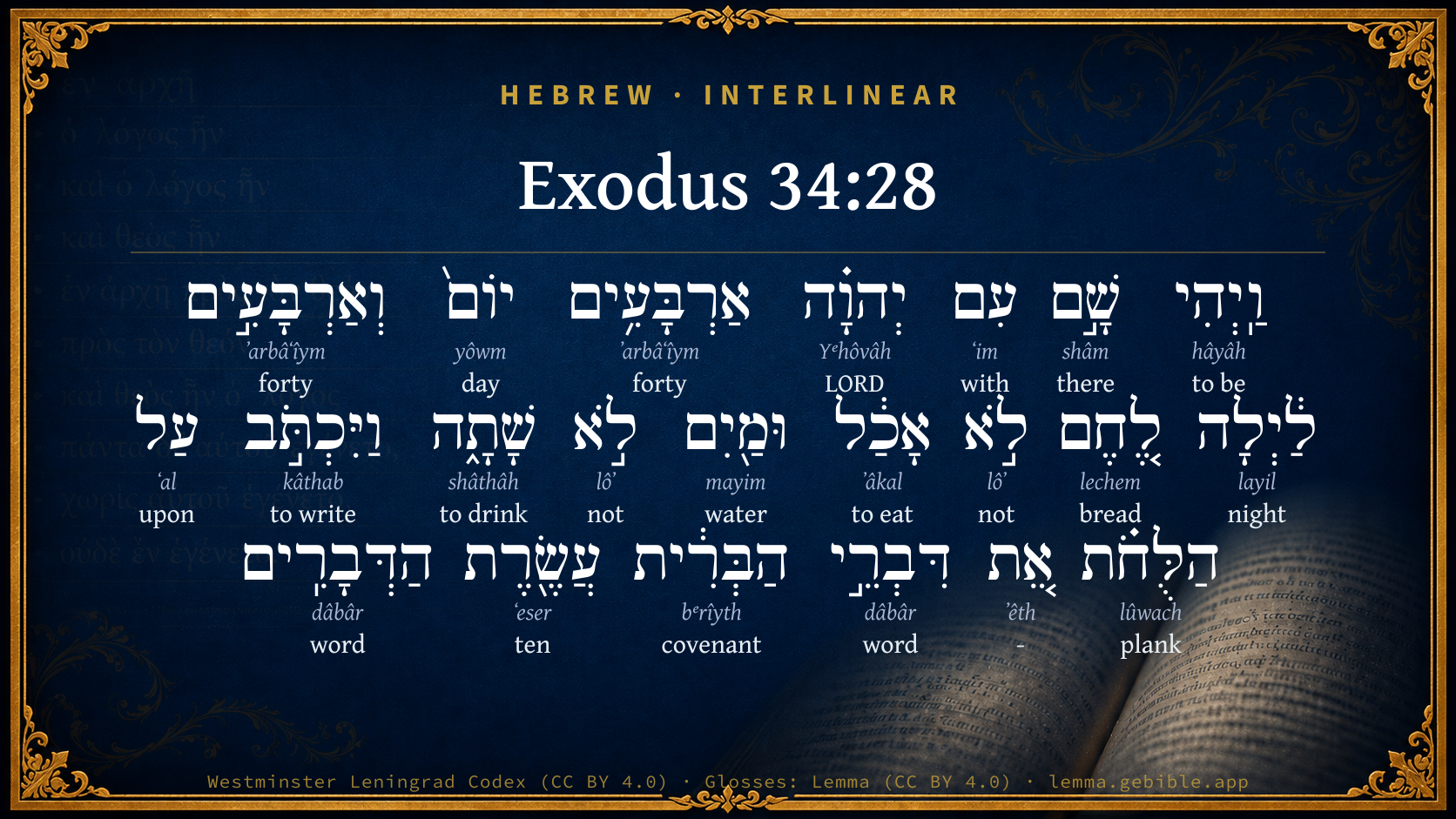
Hebrew (Westminster Leningrad Codex) Exodus 34:28 appears in the Hebrew Old Testament. The text above is from the Westminster Leningrad Codex. Each word links to its Strong’s number, a concise gloss, and parsing drawn from the Open Scriptures Hebrew Bible morphology. Click any word for its full Brown-Driver-Briggs (BDB) entry.
Download image
Cite this verse

Exodus 34:28 (World English Bible). Public Domain. Lemma interlinear Bible study tool, https://lemma.gebible.app/v/exodus/34/28.

Show BibTeX & RIS
BibTeX
RIS
English Translation
He was there with Yahweh forty days and forty nights; he neither ate bread, nor drank water. He wrote on the tablets the words of the covenant, the ten commandments.
World English Bible · Public Domain
Download a study sheet

One document with this verse’s original text, its word-by-word gloss line, the meaning frame, cross-references with their text, attributed commentary, and full source and license credits — printable, and it pastes into notes with its structure intact.

This verse Autodidact and up

Study sheet (.html) Plain text (.txt)

A passage Seminary Student

Up to 50 verses in one chapter. A passage sheet keeps up to 6 commentary sources and 12 cross-references per verse, in the order this page ranks them, and says so on the sheet whenever that leaves anything out. Ask for a single verse and you get the Autodidact verse sheet above.

Everything on this page stays free to read, with no account — the sheet is a download of what is already on screen, not access to it.

Want to remove ads? Support Godless Engineer
Compare translations 3

The same verse in 3 English versions, stacked beneath the original-language interlinear above. Click any original word for its lexicon entry.

Each is an independent rendering of the whole verse — the interlinear is not word-aligned to these translations.

Highlighted words mark where these versions differ — a whole-verse word diff, not a word-by-word alignment.

  • World English Bible Public Domain
    He was there with Yahweh forty days and forty nights; he neither ate bread, nor drank water. He wrote on the tablets the words of the covenant, the ten commandments.
  • King James Version Public Domain
    And he was there with the LORD forty days and forty nights; he did neither eat bread, nor drink water. And he wrote upon the tables the words of the covenant, the ten commandments.
  • unfoldingWord Literal Text CC BY-SA 4.0
    And he was there with Yahweh 40 days and 40 nights; bread he did not eat and water he did not drink. And he wrote on the tablets the words of the covenant, the Ten Words.

unfoldingWord Literal Text — © unfoldingWord, licensed CC BY-SA 4.0. Word-aligned USFM3 via Door43 (git.door43.org/unfoldingWord/en_ult).

Versions to compare (up to 4)

3 of 4 selected

Show all 18 translations

Every available English version of this verse, each an independent rendering of the whole verse.

  • World English Bible Public Domain
    He was there with Yahweh forty days and forty nights; he neither ate bread, nor drank water. He wrote on the tablets the words of the covenant, the ten commandments.
  • Berean Standard Bible Public Domain
    So Moses was there with the LORD forty days and forty nights without eating bread or drinking water. He wrote on the tablets the words of the covenant—the Ten Commandments.
  • Majority Standard Bible Public Domain
    So Moses was there with the LORD forty days and forty nights without eating bread or drinking water. He wrote on the tablets the words of the covenant—the Ten Commandments.
  • King James Version Public Domain
    And he was there with the LORD forty days and forty nights; he did neither eat bread, nor drink water. And he wrote upon the tables the words of the covenant, the ten commandments.
  • American Standard Version (1901) Public Domain
    And he was there with Jehovah forty days and forty nights; he did neither eat bread, nor drink water. And he wrote upon the tables the words of the covenant, the ten commandments.
  • Revised Version (1885) Public Domain
    And he was there with the LORD forty days and forty nights; he did neither eat bread, nor drink water. And he wrote upon the tables the words of the covenant, the ten commandments.
  • Geneva Bible (1599) Public Domain
    So hee was there with the Lord fourtie dayes and fourtie nights, and did neither eat bread nor drinke water: and hee wrote in the Tables the wordes of the couenant, euen the tenne commandements.
  • Douay-Rheims (1899) Public Domain
    And he was there with the Lord forty days and forty nights: he neither ate bread nor drank water, and he wrote upon the tables the ten words of the covenant.
  • Young's Literal Translation Public Domain
    And he is there with Jehovah forty days and forty nights; bread he hath not eaten, and water he hath not drunk; and he writeth on the tables the matters of the covenant -- the ten matters.
  • Literal Standard Version CC BY-SA 4.0
    And he is there with YHWH forty days and forty nights; he has not eaten bread, and he has not drunk water; and he writes on the tablets the matters of the covenant—the Ten Commandments.
  • Unlocked Literal Bible CC BY-SA 4.0
    Moses was there with Yahweh for forty days and nights; he did not eat any food nor drink any water. He wrote on the tablets the words of the covenant, the Ten Commandments.
  • unfoldingWord Literal Text CC BY-SA 4.0
    And he was there with Yahweh 40 days and 40 nights; bread he did not eat and water he did not drink. And he wrote on the tablets the words of the covenant, the Ten Words.
  • Darby Bible Public Domain
    -- And he was there with Jehovah forty days and forty nights; he ate no bread, and drank no water. -- And he wrote on the tables the words of the covenant, the ten words.
  • World Messianic Bible Public Domain
    He was there with the LORD forty days and forty nights; he neither ate bread, nor drank water. He wrote on the tablets the words of the covenant, the ten commandments.
  • Webster's Bible Public Domain
    And he was there with the LORD forty days and forty nights; he neither ate bread nor drank water: and he wrote upon the tables the words of the covenant, the ten commandments.
  • Free Bible Version CC BY-SA 4.0
    Moses spent forty days and forty nights there with the Lord without eating bread or drinking water. He wrote down on the tablets the words of the agreement, the Ten Commandments.
  • Bible in Basic English Public Domain
    And for forty days and forty nights Moses was there with the Lord, and in that time he had no food or drink. And he put in writing on the stones the words of the agreement, the ten rules of the law.
  • JPS Tanakh (1917) Public Domain
    And he was there with the LORD forty days and forty nights; he did neither eat bread, nor drink water. And he wrote upon the tables the words of the covenant, the ten words.

Literal Standard Version (2020), Covenant Press — licensed CC BY-SA 4.0. Text via the HelloAO Bible API (eBible.org). Unlocked Literal Bible (unfoldingWord) — licensed CC BY-SA 4.0. Text via the HelloAO Bible API (eBible.org). unfoldingWord Literal Text — © unfoldingWord, licensed CC BY-SA 4.0. Word-aligned USFM3 via Door43 (git.door43.org/unfoldingWord/en_ult). Free Bible Version, Dr. Jonathan Gallagher — licensed CC BY-SA 4.0. Text via the HelloAO Bible API (eBible.org).

Word by word

More ways to search: Search by grammar → Find every occurrence → Compare this word →

Practice this passage: Drill this verse → Learn its vocabulary →

הַלֻּחֹ֗ת
lûwach
H3871
“the · planks”
Particle, Definite Article + Noun, Common, Masculine, Plural, Absolute
Part of Speech
Particle + Noun
Type
Common
Gender
Masculine
Number
Plural
State
Absolute
Full BDB Definition

Origin: from a primitive root

TWOT: 1091a

board, slab, tablet, plank - tablets (of stone) - boards (of wood) - plate (of metal)
  1. וַֽיְהִי hâyâh H1961 “and · to be” Conjunction + Verb, Qal, Sequential Imperfect, 3rd Person, Masculine, Singular
  2. שָׁ֣ם shâm H8033 “there” Adverb
  3. עִם ʻim H5973 “with” Preposition
  4. יְהוָ֗ה Yᵉhôvâh H3068 “LORD” Noun, Proper
  5. אַרְבָּעִ֥ים ʼarbâʻîym H705 “forty” Adjective, Cardinal number, Both, Plural, Absolute
  6. יוֹם֙ yôwm H3117 “day” Noun, Common, Masculine, Singular, Absolute
  7. וְאַרְבָּעִ֣ים ʼarbâʻîym H705 “and · forty” Conjunction + Adjective, Cardinal number, Both, Plural, Absolute
  8. לַ֔יְלָה layil H3915 “night” Noun, Common, Masculine, Singular, Absolute
  9. לֶ֚חֶם lechem H3899 “bread” Noun, Common, Both, Singular, Absolute
  10. לֹ֣א lôʼ H3808 “not” Particle, Negative
  11. אָכַ֔ל ʼâkal H398 “to eat” Verb, Qal, Perfect, 3rd Person, Masculine, Singular
  12. וּמַ֖יִם mayim H4325 “and · water(s)” Conjunction + Noun, Common, Masculine, Plural, Absolute
  13. לֹ֣א lôʼ H3808 “not” Particle, Negative
  14. שָׁתָ֑ה shâthâh H8354 “to drink” Verb, Qal, Perfect, 3rd Person, Masculine, Singular
  15. וַיִּכְתֹּ֣ב kâthab H3789 “and · to write” Conjunction + Verb, Qal, Sequential Imperfect, 3rd Person, Masculine, Singular
  16. עַל ʻal H5921 “upon” Preposition
  17. אֵ֚ת ʼêth H853 “-” Particle, Direct Object
  18. דִּבְרֵ֣י dâbâr H1697 “words of” Noun, Common, Masculine, Plural, Construct
  19. הַבְּרִ֔ית bᵉrîyth H1285 “the · covenant” Particle, Definite Article + Noun, Common, Feminine, Singular, Absolute
  20. עֲשֶׂ֖רֶת ʻeser H6235 “ten” Adjective, Cardinal number, Masculine, Singular, Construct
  21. הַדְּבָרִֽים dâbâr H1697 “the · words” Particle, Definite Article + Noun, Common, Masculine, Plural, Absolute

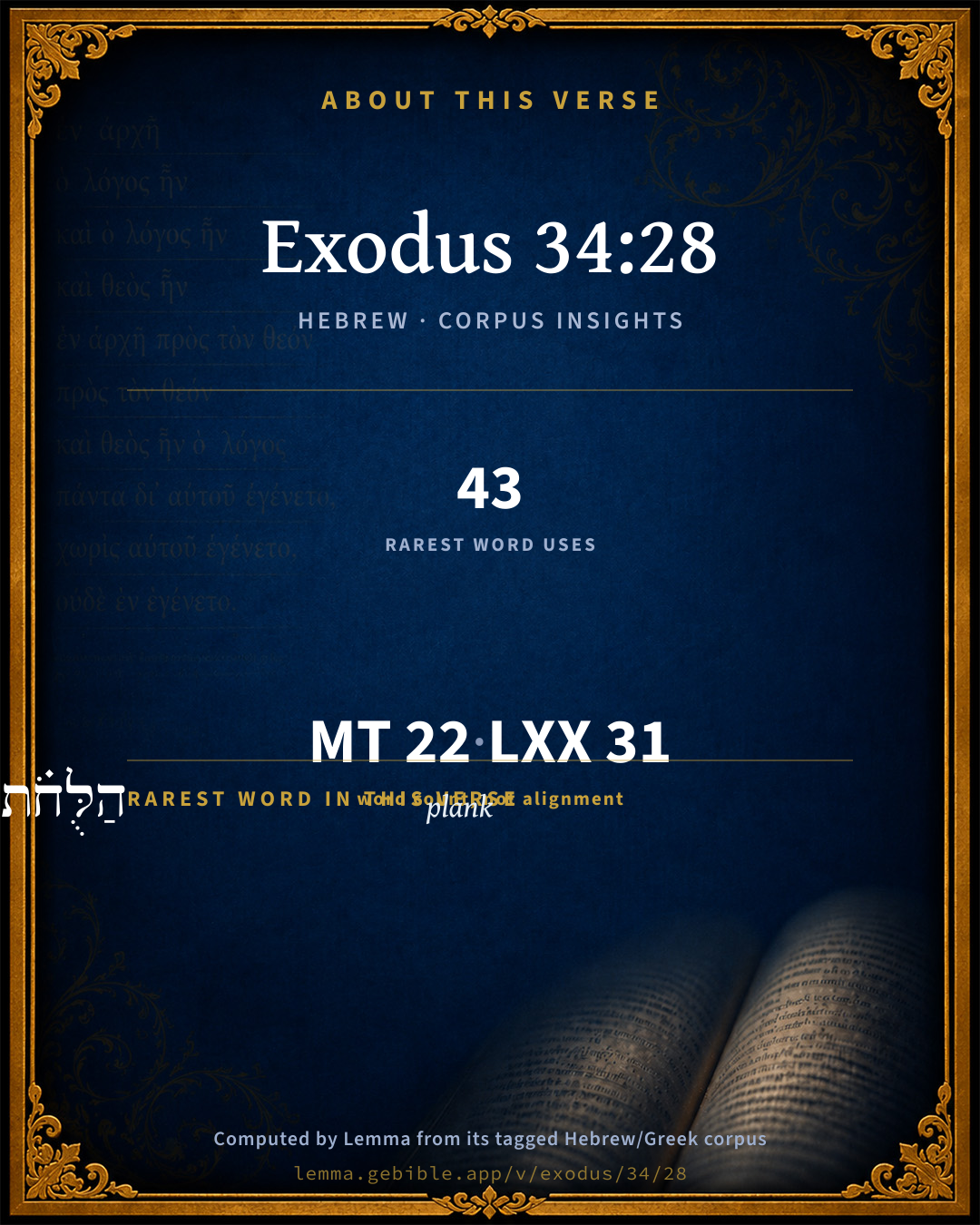
About this verse

These counts appear in no published source. They are computed here, from the morphology-tagged text and Lemma’s own curated glosses. What Lemma adds →

22
words
19
distinct lemmas
Pentateuch
section

Shared distinctive vocabulary

הַלֻּחֹ֗ת plank H3871 occurs in 33 verses of the Hebrew Bible. Also found in:

Grammatical profile

  • 4 verbs
  • 9 nouns
  • 3 adjectives
  • 2 prepositions
  • 1 adverb
  • 3 particles

Verb forms

  • וַֽיְהִי Qal · Sequential Imperfect
  • אָכַ֔ל Qal · Perfect
  • שָׁתָ֑ה Qal · Perfect
  • וַיִּכְתֹּ֣ב Qal · Sequential Imperfect

Repetition

Words recur within this verse — often emphatic in Hebrew:

  • אַרְבָּעִ֥ים forty H705 ×2
  • דִּבְרֵ֣י word H1697 ×2
  • לֹ֣א not H3808 ×2

Hebrew & Septuagint length

In English translation the verse runs 30 words from the Hebrew and 37 from the Septuagint (LXX English) — closely comparable.

A rough comparison of the two English renderings, which tokenize alike — not a word-level alignment.

Word counts can differ between the Hebrew and the Greek without any difference in meaning — e.g. the Hebrew direct-object marker אֵת has no separate Greek word, and Greek often adds the article ὁ.

In the original languages it is 22 Hebrew tokens and 31 Greek tokens — but the two are counted differently (Hebrew bundles its prefixes and suffixes into one token; the Greek is in lemma form), so that isn’t a like-for-like length.

Cross-references

10

Topical passages linked to Exodus 34:28 in the Treasury of Scripture Knowledge — connected by theme and wording, ordered by reader-vote popularity; previews shown in the World English Bible.

  • Exodus 34:1 Yahweh said to Moses, "Chisel two stone tablets like the first: and I will write on the tablets the words that were on the first tablets, which you broke.
  • Exodus 24:18 Moses entered into the midst of the cloud, and went up on the mountain; and Moses was on the mountain forty days and forty nights.
  • Deuteronomy 4:13 He declared to you his covenant, which he commanded you to perform, even the ten commandments; and he wrote them on two tables of stone.
  • Deuteronomy 9:18 I fell down before Yahweh, as at the first, forty days and forty nights; I did neither eat bread nor drink water; because of all your sin which you sinned, in doing that which was evil in the sight of Yahweh, to provoke him to anger.
  • Deuteronomy 9:25 So I fell down before Yahweh the forty days and forty nights that I fell down, because Yahweh had said he would destroy you.
  • Exodus 31:18 He gave to Moses, when he finished speaking with him on Mount Sinai, the two tablets of the testimony, stone tablets, written with God's finger.
  • Exodus 32:16 The tablets were the work of God, and the writing was the writing of God, engraved on the tables.
  • 2 Corinthians 3:7 But if the service of death, written engraved on stones, came with glory, so that the children of Israel could not look steadfastly on the face of Moses for the glory of his face; which was passing away:
  • Deuteronomy 9:9 When I was gone up onto the mountain to receive the tables of stone, even the tables of the covenant which Yahweh made with you, then I stayed on the mountain forty days and forty nights; I did neither eat bread nor drink water.
  • Deuteronomy 10:2–4 I will write on the tables the words that were on the first tables which you broke, and you shall put them in the ark.

Cross-references courtesy of OpenBible.info (CC BY 4.0).

Hebrew and Greek witnesses Masoretic Hebrew ↔ Greek Septuagint

The same verse in the two great witnesses to the Old Testament, shown verse-for-verse.

These are two independent witnesses, not word-aligned to each other, and the Septuagint is shown in lemma (dictionary) form.

Hebrew Exodus 34:28 Masoretic · Westminster Leningrad Codex

וַֽיְהִי שָׁ֣ם עִם יְהוָ֗ה אַרְבָּעִ֥ים יוֹם֙ וְאַרְבָּעִ֣ים לַ֔יְלָה לֶ֚חֶם לֹ֣א אָכַ֔ל וּמַ֖יִם לֹ֣א שָׁתָ֑ה וַיִּכְתֹּ֣ב עַל הַלֻּחֹ֗ת אֵ֚ת דִּבְרֵ֣י הַבְּרִ֔ית עֲשֶׂ֖רֶת הַדְּבָרִֽים

He was there with Yahweh forty days and forty nights; he neither ate bread, nor drank water. He wrote on the tablets the words of the covenant, the ten commandments.

World English Bible · Public Domain

Greek LXX Exodus 34:28 Septuagint · lemma form

καί εἰμί ἐκεῖ μωυσῆς ἐναντίον κύριος τεσσαράκοντα ἡμέρα καί τεσσαράκοντα νύξ ἄρτος οὐ ἐσθίω καί ὕδωρ οὐ πίνω καί γράφω ὁ ῥῆμα οὗτος ἐπί ὁ πλάξ ὁ διαθήκη ὁ δέκα λόγος

And Moses was there before the Lord forty days, and forty nights; he did not eat bread, and he did not drink water; and he wrote upon the tables these words of the covenant, the ten sayings.

LXX2012 (modern English Septuagint) · Public Domain

Hebrew: Westminster Leningrad Codex (CC BY 4.0). Greek: Septuagint (public domain); English from LXX2012 (modern English Septuagint) (Public Domain). How the Septuagint differs from the Hebrew →

Targum (Aramaic paraphrase)

2

The Targum is the ancient Jewish Aramaic paraphrase of the Hebrew Scriptures — an interpretive translation, not the Hebrew text itself. Onkelos (literal) and Pseudo-Jonathan (expansive) render the Torah, and Jonathan the Prophets. Coverage is partial: where no permissively-licensed English translation exists for a verse, only the Aramaic is shown. This is verse-level text, not a word-by-word alignment to the Hebrew.

  1. Targum Onkelos Torah (Genesis–Deuteronomy)
    וַהֲוָה תַמָן קֳדָם יְיָ אַרְבְּעִין יְמָמִין וְאַרְבְּעִין לֵילָוָן לַחְמָא לָא אֲכַל וּמַיָא לָא שְׁתֵי וּכְתַב עַל לוּחַיָא יָת פִּתְגָמֵי קְיָמָא עַשְׂרָא פִּתְגָמִין:

    (no public-domain English translation for this verse)

    Targum Onkelos — Aramaic: “Onkelos Genesis” (public domain); “Onkelos Exodus” (public domain); “Onkelos Leviticus” (public domain); “Onkelos Numbers” (public domain); “Onkelos Deuteronomy” (public domain). English: “Sefaria Community Translation” (CC0 1.0 (public-domain dedication)); “J.W. Etheridge. The Targums of Onkelos and Jonathan Ben Uzziel on the Pentateuch. London: Longmans, Green, 1862” (public domain). Text via Sefaria.

  2. Targum Pseudo-Jonathan Torah (Genesis–Deuteronomy)
    וַהֲוָה תַּמָּן קֳדָם יְיָ אַרְבְּעִין יְמָמִין וְאַרְבְּעִין לֵילַוָן לַחֲמָא לָא אָכַל וּמוֹי לָא אִשְׁתֵּי וּכְתַב עַל לוּחַיָא חוֹרַנְיָיתָא יַת פִּתְגָמֵי קַיְימָא עֲשַרְתֵּי דִבּוּרַיָא דַהֲווֹ כְתִיבִין עַל לוּחַיָא קַדְמָאֵי

    And he was there before the Lord forty days and forty nights; he ate no bread nor did he drink water; and he wrote upon the other tables the words of the covenant, the Ten Words which had been written upon the former tables.

    Targum Pseudo-Jonathan — Aramaic: “Targum Jonathan on Genesis” (public domain); “Targum Jonathan on Exodus” (public domain); “Targum Jonathan on Leviticus” (public domain); “Targum Jonathan on Numbers” (public domain); “Targum Jonathan on Deuteronomy” (public domain). English: “The Targum of Jonathan ben Uzziel, trans. J. W. Etheridge, London, 1862” (public domain). Text via Sefaria.

Commentary

Notes on Exodus 34:28 from classic Christian and Jewish commentators (each source and its license shown beneath its notes). The classic Christian expositions comment on the surrounding passage and are grouped to its opening verse, so a note may address several verses; the Jewish commentaries on the Tanakh (Rashi and others) are per-verse, so they appear only where the commentator wrote on this verse.

Lemma curates 59 commentaries, every one of them public domain or Creative Commons licensed, each selected and text-cleaned for this edition rather than reprinted as found. About our sources →

Matthew Henry's Commentary

Here is, I. The continuance of Moses in the mount, where he was miraculously sustained, Exo 34:28. He was there in very intimate communion with God, without interruption, forty days and forty nights, and did not think it long. When we are weary of an hour or two spent in attendance upon God and adoration of him, we should think how many days and nights Moses spent with him, and of the eternal day we hope to spend in praising him. During all this time Moses did neither eat nor drink. Though he had before been kept so long fasting, yet he did not, this second time, take up so many days' provision along with him, but believed that man lives not by bread alone, and encouraged himself with the experience he had of the truth of it. So long he continued without meat and drink (and probably without sleep too), for, 1. The power of God supported him, that he did not need it. He who made the body can nourish it without ordinary means, which he uses, but is not tied to. The life is more than meat. 2. His communion with God entertained him, so that he did not desire it. He had meat to eat which the world knew not of, for it was his meat and drink to hear the word of God and pray. The abundant satisfaction his soul had in the word of God and the visions of the Almighty made him forget the body and the pleasures of it. When God would treat his favourite Moses, it was not with meat and drink, but with his light, law, and love, with the knowledge of himself and his will; then man did indeed eat angels' food. See what we should value as the truest pleasure. The kingdom of God is not meat and drink, neither the abundance nor delicacy of food, but righteousness and peace and joy in the Holy Ghost. As Moses, so Elijah and Christ, fasted forty days and forty nights. The more dead we are to the delights of sense the better prepared we are for the pleasures of heaven.

II. The coming down of Moses from the mount, greatly enriched and miraculously adorned.

1. He came down enriched with the best treasure; for he brought in his hands the two tables of the law, written with the finger of God, Exo 34:28, Exo 34:29. It is a great favour to have the law given us; this favour was shown to Israel, Psa 147:19, Psa 147:20. It is a great honour to be employed in delivering God's law to others; this honour was done to Moses.

2. He came down adorned with the best beauty; for the skin of his face shone, Exo 34:29. This time of his being in the mount he heard only what he had heard before, but he saw more of the glory of God, which having with open face beheld, he was in some measure changed into the same image from glory to glory, Co2 3:18. The last time he came down from the mount with the glory of a magistrate, to frown upon and chastise Israel's idolatry; now with the glory of an angel, with tidings of peace and reconciliation. Then he came with a rod, now with the spirit of meekness. Now,

(1.) This may be looked upon, [1.] As a great honour done to Moses, that the people might never again question his mission nor think nor speak lightly of him. He carried his credentials in his very countenance, which, some think, retained, as long as he lived, some remainders of this glory, which perhaps contributed to the vigour of his old age; that eye could not wax dim which had seen God, nor that face become wrinkled which had shone with his glory. The Israelites could not look him in the face but they must there read his commission. Thus it was done to the man whom the King of kings did delight to honour. Yet, after this, they murmured against him; for the most sensible proofs will not of themselves conquer an obstinate infidelity. The shining of Moses's face was a great honour to him; yet that was no glory, in comparison with the glory which excelled. We read of our Lord Jesus, not only that his face shone as the sun, but his whole body also, for his raiment was white and glistering, Luk 9:29. But, when he came down from the mount, he quite laid aside that glory, it being his will that we should walk by faith, not by sight. [2.] It was also a great favour to the people, and an encouragement to them, that God put this glory upon him, who was their intercessor, thereby giving them assurance that he was accepted, and they through him. Thus the advancement of Christ, our advocate with the Father, is the great support of our faith. [3.] It was the effect of his sight of God. Communion with God, First, Makes the face to shine in true honour. Serious godliness puts a lustre upon a man's countenance, such as commands esteem and affection. Secondly, It should make the face to shine in universal holiness. When we have been in the mount with God, we should let our light shine before men, in humility, meekness, and all the instances of a heavenly conversation; thus must the beauty of the Lord our God be upon us, even the beauty of holiness, that all we converse with may take knowledge of us that we have been with Jesus, Act 4:13.

(2.) Concerning the shining of Moses's face observe here, [1.] Moses was not aware of it himself: He wist not that the skin of his face shone, Exo 34:29. Thus, First, It is the infelicity of some that, though their faces shine in true grace, yet they do not know it, to take the comfort of it. Their friends see much of God in them, but they themselves are ready to think they have no grace. Secondly, It is the humility of others that, though their faces shine in eminent gifts and usefulness, yet they do not know it, to be puffed up with it. Whatever beauty God puts upon us, we should still be filled with a humble sense of our own unworthiness, and manifold infirmities, as will make us even overlook and forget that which makes our faces shine. [2.] Aaron and the children of Israel saw it, and were afraid, Exo 34:30. The truth of it was attested by a multitude of witnesses, who were also conscious of the terror of it. It not only dazzled their eyes, but struck such an awe upon them as obliged them to retire. Probably they doubted whether it were a token of God's favour or of his displeasure; and, though it seemed most likely to be a good omen, yet, being conscious of guilt, they feared the worst, especially remembering the posture Moses found them in when he came last down from the mount. Holiness will command reverence; but the sense of sin makes men afraid of their friends, and even of that which really is a favour to them. [3.] Moses put a veil upon his face, when he perceived that it shone, Exo 34:33, Exo 34:35. First, This teaches us all a lesson of modesty and humility. We must be content to have our excellences obscured, and a veil drawn over them, not coveting to make a fair show in the flesh. Those that are truly desirous to be owned and accepted of God will likewise desire not to be taken notice of nor applauded by men. Qui bene latuit, bene vixit - There is a laudable concealment. Secondly, It teaches ministers to accommodate themselves to the capacities of people, and to preach to them as they are able to bear it. Let all that art and all that learning be veiled which tend to amusement rather than edification, and let the strong condescend to the infirmities of the weak. Thirdly, This veil signified the darkness of that dispensation. The ceremonial institutions had in them much of Christ, much of the grace of the gospel, but a veil was drawn over it, so that the children of Israel could not distinctly and stedfastly see those good things to come which the law had the shadow of. It was beauty veiled, gold in the mine, a pearl in the shell; but, thanks be to God, by the gospel life and immortality are brought to light, the veil is taken away from off the Old Testament; yet still it remains upon the hearts of those who shut their eyes against the light. Thus the apostle expounds this passage, Co2 3:13-15. [4.] When Moses went in before the Lord, to speak with him in the tabernacle of meeting, he put off the veil, Exo 34:34. Then there was no occasion for it, and, before God, every man does and must appear unveiled; for all things are naked and open before the eyes of him with whom we have to do, and it is folly for us to think of concealing or disguising any thing. Every veil must be thrown aside when we come to present ourselves unto the Lord. This signified also, as it is explained (Co2 3:16), that when a soul turns to the Lord the veil shall be taken away, and with open face it may behold his glory. And when we shall come before the Lord in heaven, to be there for ever speaking with him, the veil shall not only be taken off from the divine glory, but from our hearts and eyes, that we may see as we are seen, and know as we are known.

Matthew Henry's Commentary on the Whole Bible (1708–1710) — public domain (CC PDM 1.0). Text via the HelloAO Bible API.

Trapp's Complete Commentary

John Trapp

Exo 34:28 And he was there with the LORD forty days and forty nights; he did neither eat bread, nor drink water. And he wrote upon the tables the words of the covenant, the ten commandments.

Ver. 28. Forty days and forty nights.] Moses, Elias, and Christ - those three great fathers met glorious in mount Tabor. Abstinence merits not, but prepares the best for good duties.

He wrote.] That is, God wrote, as some will have it. {a}

{a} Weems. Exer.

John Trapp, A Commentary or Exposition upon All the Books of the Old and New Testament (1647–1656) — public domain. Text from a community e-Sword module.

Joseph Benson's Commentary

Exo 34:28. He, God, wrote.

Joseph Benson's Commentary on the Old and New Testaments (1811–1818) — public domain. Text from a community e-Sword module.

Geneva Bible (1599)

Geneva Bible translators

Or, words.

This miracle was to confirm the authority of the law, and ought no more to be followed than other miracles.

Geneva Bible (1599) marginal notes — public domain. Text via Bolls.life.

Jamieson, Fausset & Brown

Robert Jamieson, A. R. Fausset & David Brown

he was there with the Lord forty days and forty nights--as long as formerly [Exo 24:18], being sustained for the execution of his special duties by the miraculous power of God. A special cause is assigned for his protracted fast on this second occasion (Deu 9:18).

Jamieson, Fausset & Brown — Commentary Critical and Explanatory on the Whole Bible (1871) — public domain (CC PDM 1.0). Text via the HelloAO Bible API.

Adam Clarke's Commentary

Verse 28. Forty days and forty nights] See Clarke on Ex 24:18.

Adam Clarke's Commentary on the Bible (1810–1826) — public domain. Text from a community e-Sword/MySword module.

Ellicott's Commentary for English Readers

(28) He was there with the Lord forty days and forty nights.—As on his former ascent (Exo_24:18). The long time is, at first sight, surprising, since there were now no instructions to be given. But we learn from Deuteronomy (Exo_9:18-19) that it was required for an earnest and prolonged intercession by Moses on behalf of his nation, which ultimately prevailed with God, and induced Him to put away His “anger and hot displeasure.”

He did neither eat bread, nor drink water.—A similar fast had been kept on the previous occasion (Deu_9:9), though it is not mentioned in Exodus. Fasts of this extraordinary duration are only recorded of Moses, of Elijah (1Ki_19:8), and of our Lord (Mat_4:2). They are absolutely miraculous, and modern attempts to rival them are viewed by scientific men as deriving such apparent success as may have attended them from imposture.

He wrote upon the tables.—It has been concluded from this statement that Moses engraved the words upon the second tables; and the passage, if it stood alone, would certainly admit, and, indeed, naturally suggest, this meaning. But the Hebrew idiom allows us to regard Jehovah as the nominative to the verb “wrote;” and it is necessary so to do in order to bring the passage into agreement with Exo_34:1. and with Deu_10:2; Deu_10:4. Thus the second tables are to be viewed as “written with the finger of God” no less than the first (Exo_31:18; Exo_32:16).

A Bible Commentary for English Readers, edited by Charles John Ellicott (1878–1897) — public domain. Text from a community e-Sword module.

John Gill's Exposition

And Moses called unto them,.... Who, as it appears by what follows, on sight of him were so terrified, that they did not proceed on to meet him, but went back, and therefore he called unto them to return and come forward:

and Aaron and all the rulers of the congregation returned unto him; knowing him by his voice, and encouraged by his call of them, who before might take him to be something more than human, some glorious form, one of the heavenly angels appearing in this manner:

and Moses talked with them; after he had put a vail on his face, of which there is an account in the following verses. He talked with them friendly, and told them all that had happened to him in the mount; what a glorious sight he had been indulged with; what a proclamation of the grace and goodness of God had been made to him; and what laws and ordinances God had enjoined him and them the observance of.

John Gill's Exposition of the Whole Bible (1746–1763) — public domain (CC PDM 1.0). Text via the HelloAO Bible API.

Albert Barnes' Notes on the Bible

He wrote - i. e. Yahweh wrote Exo 34:1.

Albert Barnes' Notes on the Bible (1834–1885) — public domain. Text from a community e-Sword/MySword module.

Haydock's Catholic Bible Commentary

Wrote. God wrote on the tables, as he had promised, ver. 1. (Calmet) --- Moses recorded all in this book, as he was ordered, ver. 27. St. Cyprian (de Sp. S.) and St. Augustine (q. 186,) infer, however, from this text, that the second tables had not the same honour as the first. The contrary appears from Deuteronomy x. 4, He (God) wrote....as before. Estius, Calmet, and Menochius think the forty days here mentioned, were those which Moses spent with God to obtain the people’s pardon, and the law, at the same time. See chap. xxxii. 35. He continued all that time without meat or sleep, by the power of God, who supports Enoch and Elias in the vigour of health without corporal sustenance. Salien., A. 2544, in which year of the world he fixes the death of Job, the great prophet of the Gentiles.

George Leo Haydock (1774–1849), Haydock's Catholic Family Bible and Commentary, 1859 edition — public domain. Excludes Psalms (Douay-Rheims chapter numbering differs from Protestant) and Deuterocanonical books (Catholic canon only).

Matthew Poole's English Annotations

He was there forty days and forty nights; as he had been before, being now to renew the broken covenant. This forty days’ fast of his is mentioned four times, Exo 24:18, and here, and Deu 9:18; 10:10, but it is evident it was performed but twice, as the occasion of it happened only twice.

He wrote, not Moses, but the Lord, as appears from Exo 24:1, and from Deu 10, the relative pronoun being here referred to the remoter antecedent, of which there are many instances, as Gen 10:12; 1Sa 21:14; 27:8; Psa 99:6.

Matthew Poole's English Annotations on the Holy Bible (1683–1685) — public domain. Text from a community e-Sword/MySword module.

Whedon's Commentary on the Bible

Daniel D. Whedon

28. Forty days and forty nights — Comp. Exo_24:18. So that Moses passed two periods of this length with the Lord in the mount.

He wrote — According to Exo_34:1, the writer was God himself, so that these second tables, though hewn by Moses, were, like the first, “written with the finger of God.” Compare Exo_31:18, with 32:16.

Daniel D. Whedon (gen. ed.), Commentary on the Old and New Testaments (1874–1909) — public domain. Text from a community e-Sword module.

The Pulpit Commentary

He was there with the Lord forty days and forty nights. As on the former occasion. (Exo_24:18) The patience and faith of the people was tested by this second long delay. Happily, they stood the test; and on Moses" final descent from Sinai the Israelites were found expectant and obedient (vers. 30-32). He did neither eat bread nor drink water. This was so also on the former occasion, (Deu_9:9) though it is not mentioned in Exodus. The near presence of God sustained the vital powers and made food unnecessary. Moses, Elijah, (1Ki_19:8) and our Lord have alone accomplished a fast of this duration. Modern parodies are not held by scientific men to belong to the category of established facts. He wrote upon the tables. It has been argued from this expression that Moses wrote the words on the second tables; and it would be natural so to understand the passage, had nothing else been said on the subject. But in ver. 1 we are told that "God said, I will write upon these tables;" and the same is repeated in Deu_10:2. Moreover in Deu_10:4, it is distinctly declared "He" (i.e. God) "wrote on the tables according to the first writing." We must therefore regard "he" in this passage as meaning "the Lord," which is quite possible according to the Hebrew idiom.

HOMILIES BY J. URQUHART Vers. 28-35. Fellowship with God and its fruits.

I COMMUNION WITH GOD.

1. The length of his sojourn forty days and forty nights. Time spedunmarked in the presence and fellowship of God. The future glory an untiring joy. The redeemed serve him day and night in his temple.

2. Lower wants were forgotten: "he did neither eat bread nor drink water."The need of the body was unfelt in the satisfying of the desires of the spirit. "In thy presence is fulness of joy." To escape from temptation we have only to enter into the presence of God and to let the eye rest upon his glory.

II MAN GLORIFIED THROUGH COMMUNION.

1. The descent of Moses, radiant with the glory of God, the type of Jesusin his coming again the second time without sin unto salvation.

2. A prophecy of the after glory of them who believe. "They that be wiseshall shine as the brightness of the firmament, and they that turn many to righteousness as the stars for ever and ever." "We shall be like him, for we shall see him as he is.

3. An example of the present glory of those who have fellowship with himwho is light. We are "light in the Lord.

4. Its effect upon the worldly and the sinful. They were afraid to comenigh. It awakens conscience. It proves the reality of the Unseen. It reveals the distance between the soul and God.

III THE VEILING OF MOSES" FACE. He was unconscious of the glory: "he wist not that his face shone." The vision of God is ever accompanied with lowly self-judgment.

1. It was not worn ostentatiously. We may not boast of our nearness toGod. Vanity in the Divine life is an impossibility.

2. The glory was veiled in accordance with the dispensation which alonethese men were able to receive. The whole law with its types and shadows was a veiling of the sun of righteousness, and the redemption glory. We must meet men where they are that they may be led to God. The Apostle who spoke "wisdom among them that were perfect" knew how to give milk also to babes in Christ and to speak to the carnal. U.

The Pulpit Commentary (1880–1919), ed. H.D.M. Spence-Jones & Joseph S. Exell — public domain. Text from a community e-Sword module.

John Wesley's Explanatory Notes

He wrote - God.

John Wesley, Explanatory Notes Upon the Whole Bible (1754–1765) — public domain. Text via the GEBible commentary corpus.

Ramban (Nachmanides)

Rabbi Moshe ben Nachman (Ramban / Nachmanides)

AND HE WAS THERE WITH THE ETERNAL FORTY DAYS AND FORTY NIGHTS… AND HE WROTE UPON THE TABLETS THE WORDS OF THE COVENANT, THE TEN WORDS. The verse is stating that Moses was on top of the mountain for forty days and forty nights, and he wrote there upon the Tablets. And in the opinion of our Rabbis the meaning of the verse is that Moses was there with G-d for forty days and forty nights, during which time He wrote on the Tablets the words of this second covenant. But he had stayed there for another forty days prior to these to pray for all his requests, as is narrated in the section beginning, See, Thou sayest unto me: Bring up this people; and with reference to these days it is said in the Book of Deuteronomy, So I fell down before the Eternal the forty days and forty nights that I fell down; because the Eternal had said He would destroy you. Here, however, Scripture did not explain how many days were the duration of this period of supplication and prayer, for it is known that it was from the time he went up to the mountain until he came down to hew the second Tablets. But it said that the matter of the second Tablets was like that of the first in every respect — the writing of G-d, and the number of days he stood before G-d, so that he should not think that he had already learned the Torah during the first time, and that therefore it would not be necessary for him to stay there many days.

‘Va’yichtov’ upon the Tablets — this means that G-d wrote, and does not refer back to Moses [mentioned in the preceding phrase, he did neither eat bread, nor drink water], for so He said, and I will write upon the Tablets. Similarly, in the Book of Deuteronomy it says, and I hewed two Tablets of stone like unto the first, and went up into the mount, having the two Tablets in my hand. And He wrote on the Tablets, according to the first writing. And since it says according to the first writing, we know that they were written with the finger of G-d. Thus the meaning of the expression, and I will write means “with the finger,” and you know [already] the meaning of “finger” from that of “the hand.”, 14:31. See Ramban there.

Ramban (Nachmanides) on the Tanakh — English translation: “Commentary on the Torah by Ramban (Nachmanides). Translated and annotated by Charles B. Chavel. New York, Shilo Pub. House, 1971-1976” (CC BY 4.0). Text via Sefaria.

Lesson kit

Teaching starters — assembled from the data on this page, not authored interpretation. Every prompt links to the verse data it draws on. Edit before teaching.

Exodus, in the Pentateuch, opens this verse with 22 words (19 distinct Hebrew lemmas). Its most distinctive word is lûwach (“plank”). A historical commentator’s framing appears above. Read the whole chapter for the surrounding context.

Discussion questions

  1. The word lûwach carries the sense “plank.” How does it shape the verse?
  2. How does Exodus 24:12, which shares the word «plank», read alongside this verse?
  3. What does the repetition of “forty” (2× in this one verse) do in this verse?
  4. These translations render this verse differently; the difference is in the English rendering, not the original. What questions does that raise?
  5. «וַֽיְהִי» is a Qal Sequential Imperfect verb. How does that grammatical form shape the action described?
  6. Compare how Matthew Henry's Commentary and Trapp's Complete Commentary read this verse. Where do they agree or differ?

Things to notice

Reading settings

Reading text

Shown beneath each verse's original-language words.

Old Testament
Old Testament edition

Read the OT as the Masoretic Hebrew (MT) or the Greek Septuagint (LXX).

English shown for the Greek Septuagint (in the Hebrew ↔ Greek comparison).

Comparing translations? Open the Compare panel on any verse page to stack up to four side by side.