1 Chronicles 16:3

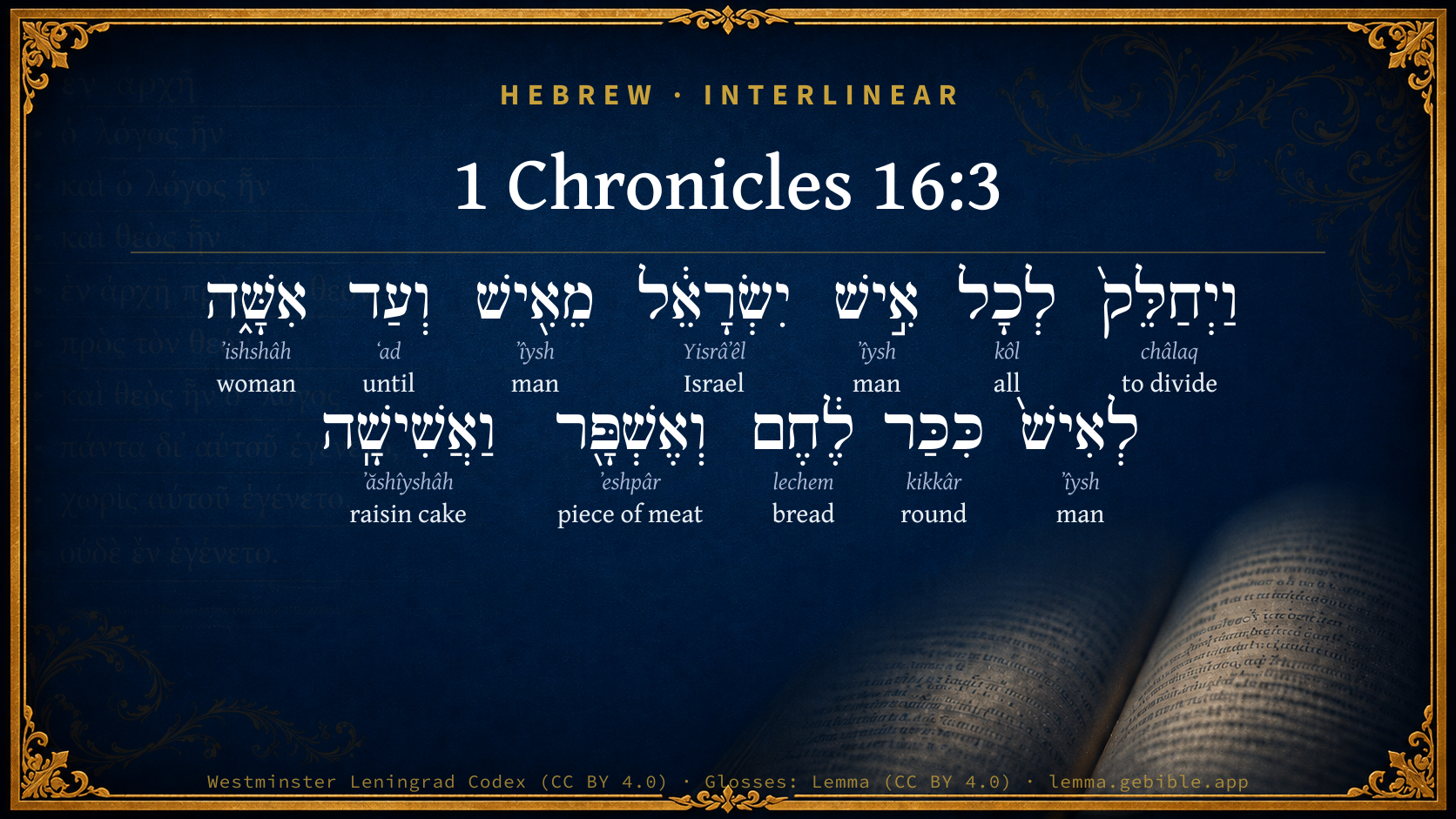
Hebrew (Westminster Leningrad Codex) 1 Chronicles 16:3 appears in the Hebrew Old Testament. The text above is from the Westminster Leningrad Codex. Each word links to its Strong’s number, a concise gloss, and parsing drawn from the Open Scriptures Hebrew Bible morphology. Click any word for its full Brown-Driver-Briggs (BDB) entry.
Download image
Cite this verse

1 Chronicles 16:3 (World English Bible). Public Domain. Lemma interlinear Bible study tool, https://lemma.gebible.app/v/1-chronicles/16/3.

Show BibTeX & RIS
BibTeX
RIS
English Translation
He dealt to everyone of Israel, both man and woman, to every one a loaf of bread, and a portion [of flesh], and a cake of raisins.
World English Bible · Public Domain
Download a study sheet

One document with this verse’s original text, its word-by-word gloss line, the meaning frame, cross-references with their text, attributed commentary, and full source and license credits — printable, and it pastes into notes with its structure intact.

This verse Autodidact and up

Study sheet (.html) Plain text (.txt)

A passage Seminary Student

Up to 50 verses in one chapter. A passage sheet keeps up to 6 commentary sources and 12 cross-references per verse, in the order this page ranks them, and says so on the sheet whenever that leaves anything out. Ask for a single verse and you get the Autodidact verse sheet above.

Everything on this page stays free to read, with no account — the sheet is a download of what is already on screen, not access to it.

Want to remove ads? Support Godless Engineer
Compare translations 3

The same verse in 3 English versions, stacked beneath the original-language interlinear above. Click any original word for its lexicon entry.

Each is an independent rendering of the whole verse — the interlinear is not word-aligned to these translations.

Highlighted words mark where these versions differ — a whole-verse word diff, not a word-by-word alignment.

  • World English Bible Public Domain
    He dealt to everyone of Israel, both man and woman, to every one a loaf of bread, and a portion [of flesh], and a cake of raisins.
  • King James Version Public Domain
    And he dealt to every one of Israel, both man and woman, to every one a loaf of bread, and a good piece of flesh, and a flagon of wine.
  • unfoldingWord Literal Text CC BY-SA 4.0
    And he distributed to each man of Israel, from man and to woman, to a man a loaf of bread and a date cake and a raisin cake.

unfoldingWord Literal Text — © unfoldingWord, licensed CC BY-SA 4.0. Word-aligned USFM3 via Door43 (git.door43.org/unfoldingWord/en_ult).

Versions to compare (up to 4)

3 of 4 selected

Show all 18 translations

Every available English version of this verse, each an independent rendering of the whole verse.

  • World English Bible Public Domain
    He dealt to everyone of Israel, both man and woman, to every one a loaf of bread, and a portion [of flesh], and a cake of raisins.
  • Berean Standard Bible Public Domain
    Then he distributed to every man and woman of Israel a loaf of bread, a date cake, and a raisin cake.
  • Majority Standard Bible Public Domain
    Then he distributed to every man and woman of Israel a loaf of bread, a date cake, and a raisin cake.
  • King James Version Public Domain
    And he dealt to every one of Israel, both man and woman, to every one a loaf of bread, and a good piece of flesh, and a flagon of wine.
  • American Standard Version (1901) Public Domain
    And he dealt to every one of Israel, both man and woman, to every one a loaf of bread, and a portion `of flesh', and a cake of raisins.
  • Revised Version (1885) Public Domain
    And he dealt to every one of Israel, both man and woman, to every one a loaf of bread, and a portion of flesh, and a cake of raisins.
  • Geneva Bible (1599) Public Domain
    And he dealt to euery one of Israel both man and woman, to euery one a cake of breade, and a piece of flesh, and a bottel of wine.
  • Douay-Rheims (1899) Public Domain
    And he divided to all and every one, both men and women, a loaf of bread, and a piece of roasted beef, and flour fried with oil.
  • Young's Literal Translation Public Domain
    and giveth a portion to every man of Israel, both man and woman: to each a cake of bread, and a measure of wine, and a grape-cake.
  • Literal Standard Version CC BY-SA 4.0
    and gives a portion to every man of Israel, both man and woman: to each a cake of bread, and a measure of wine, and a grape-cake.
  • Unlocked Literal Bible CC BY-SA 4.0
    He distributed to every Israelite, both to men and women, a loaf of bread, and a piece of meat, and a cake of raisins.
  • unfoldingWord Literal Text CC BY-SA 4.0
    And he distributed to each man of Israel, from man and to woman, to a man a loaf of bread and a date cake and a raisin cake.
  • Darby Bible Public Domain
    And he dealt to every one of Israel, both man and woman, to every one a loaf of bread and a measure [of wine] and a raisin-cake.
  • World Messianic Bible Public Domain
    He gave to everyone of Israel, both man and woman, to everyone a loaf of bread, a portion of meat, and a cake of raisins.
  • Webster's Bible Public Domain
    And he dealt to every one of Israel, both man and woman, to every one a loaf of bread, and a good piece of flesh, and a flagon of wine.
  • Free Bible Version CC BY-SA 4.0
    Then he shared out to every Israelite, to every man and woman, a loaf of bread, a date cake, and a raisin cake.
  • Bible in Basic English Public Domain
    And he gave to everyone, every man and woman of Israel, a cake of bread, some meat, and a cake of dry grapes.
  • JPS Tanakh (1917) Public Domain
    And he dealt to every one of Israel, both man and woman, to every one a loaf of bread, and a cake made in a pan, and a sweet cake.

Literal Standard Version (2020), Covenant Press — licensed CC BY-SA 4.0. Text via the HelloAO Bible API (eBible.org). Unlocked Literal Bible (unfoldingWord) — licensed CC BY-SA 4.0. Text via the HelloAO Bible API (eBible.org). unfoldingWord Literal Text — © unfoldingWord, licensed CC BY-SA 4.0. Word-aligned USFM3 via Door43 (git.door43.org/unfoldingWord/en_ult). Free Bible Version, Dr. Jonathan Gallagher — licensed CC BY-SA 4.0. Text via the HelloAO Bible API (eBible.org).

Word by word

More ways to search: Search by grammar → Find every occurrence → Compare this word →

Practice this passage: Drill this verse → Learn its vocabulary →

וְאֶשְׁפָּ֖ר
ʼeshpâr
H829
“and · piece of meat”
Conjunction + Noun, Common, Masculine, Singular, Absolute
Part of Speech
Conjunction + Noun
Type
Common
Gender
Masculine
Number
Singular
State
Absolute
Full BDB Definition

Origin: of uncertain derivation

TWOT: 182 . 1

piece of meat, measured portion, date-cake (meaning and significance obscure)
  1. וַיְחַלֵּק֙ châlaq H2505 “and · to divide” Conjunction + Verb, Piel, Sequential Imperfect, 3rd Person, Masculine, Singular
  2. לְכָל kôl H3605 “to/for · all of” Preposition + Noun, Common, Masculine, Singular, Construct
  3. אִ֣ישׁ ʼîysh H376 “man of” Noun, Common, Masculine, Singular, Construct
  4. יִשְׂרָאֵ֔ל Yisrâʼêl H3478 “Israel” Noun, Proper
  5. מֵאִ֖ישׁ ʼîysh H376 “from · man” Preposition + Noun, Common, Masculine, Singular, Absolute
  6. וְעַד ʻad H5704 “and · until” Conjunction + Preposition
  7. אִשָּׁ֑ה ʼishshâh H802 “woman” Noun, Common, Feminine, Singular, Absolute
  8. לְאִישׁ֙ ʼîysh H376 “to/for · man” Preposition + Noun, Common, Masculine, Singular, Absolute
  9. כִּכַּר kikkâr H3603 “round of” Noun, Common, Both, Singular, Construct
  10. לֶ֔חֶם lechem H3899 “bread” Noun, Common, Both, Singular, Absolute
  11. וַאֲשִׁישָֽׁה ʼăshîyshâh H809 “and · raisin cake” Conjunction + Noun, Common, Feminine, Singular, Absolute

About this verse

These counts appear in no published source. They are computed here, from the morphology-tagged text and Lemma’s own curated glosses. What Lemma adds →

12
words
10
distinct lemmas
Historical
section

Notable vocabulary

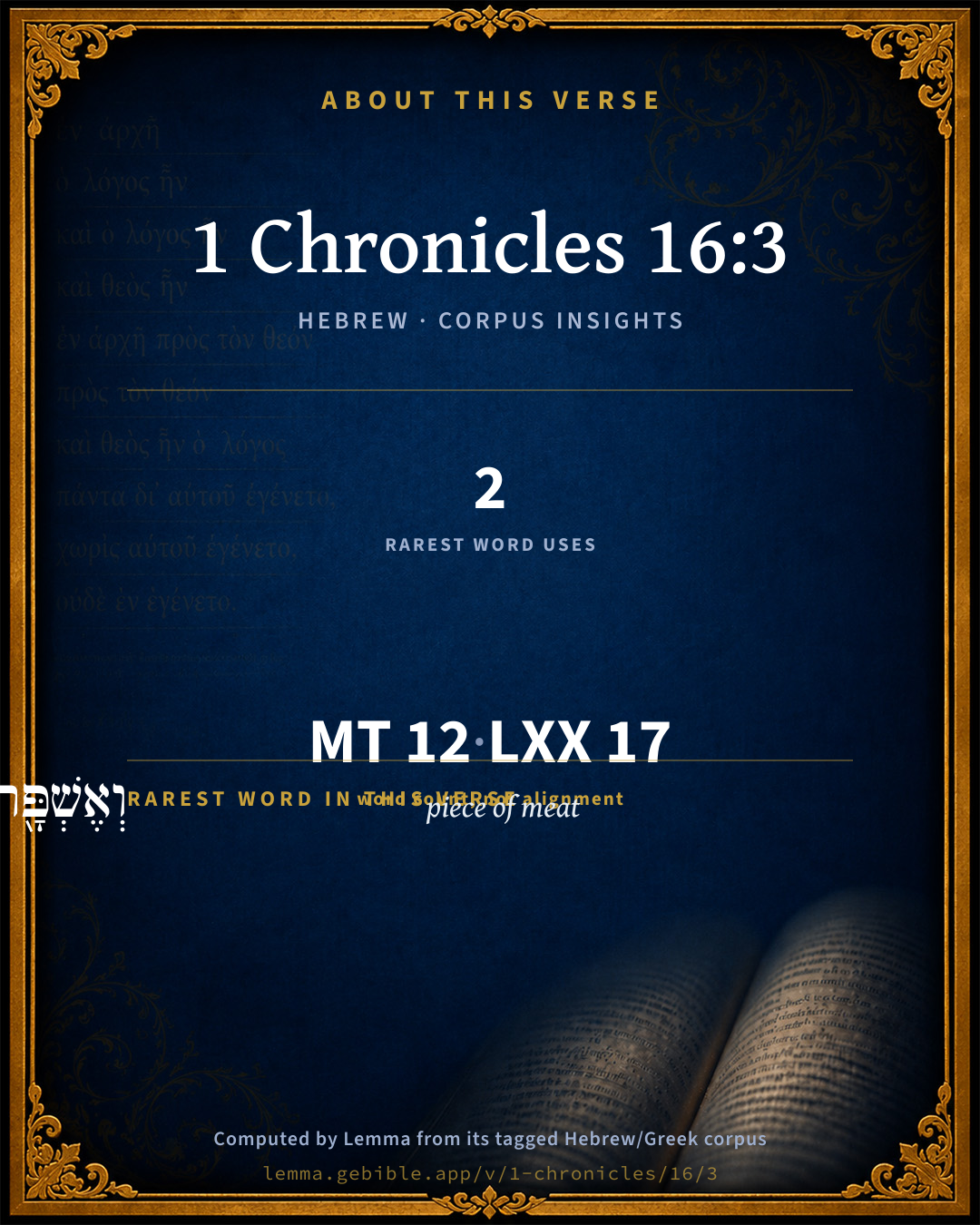
The rarest word here is וְאֶשְׁפָּ֖ר piece of meat H829 — appearing just 2 times in the whole Hebrew Bible.

Shared distinctive vocabulary

וְאֶשְׁפָּ֖ר piece of meat H829 occurs in 2 verses of the Hebrew Bible. Also found in:

Grammatical profile

  • 1 verb
  • 10 nouns
  • 1 preposition

Verb forms

  • וַיְחַלֵּק֙ Piel · Sequential Imperfect

Repetition

A word recurs within this verse — often emphatic in Hebrew:

  • אִ֣ישׁ man H376 ×3

Hebrew & Septuagint length

In English translation the verse runs 27 words from the Hebrew and 21 from the Septuagint (LXX English) — closely comparable.

A rough comparison of the two English renderings, which tokenize alike — not a word-level alignment.

Word counts can differ between the Hebrew and the Greek without any difference in meaning — e.g. the Hebrew direct-object marker אֵת has no separate Greek word, and Greek often adds the article ὁ.

In the original languages it is 12 Hebrew tokens and 17 Greek tokens — but the two are counted differently (Hebrew bundles its prefixes and suffixes into one token; the Greek is in lemma form), so that isn’t a like-for-like length.

Cross-references

5

Topical passages linked to 1 Chronicles 16:3 in the Treasury of Scripture Knowledge — connected by theme and wording, ordered by reader-vote popularity; previews shown in the World English Bible.

  • Ezekiel 45:17 It shall be the prince's part to give the burnt offerings, and the meal-offerings, and the drink-offerings, in the feasts, and on the new moons, and on the Sabbaths, in all the appointed feasts of the house of Israel: he shall prepare the sin-offering, and the meal-offering, and the burnt offering, and the peace-offerings, to make atonement for the house of Israel.
  • Nehemiah 8:10 Then he said to them, Go your way, eat the fat, and drink the sweet, and send portions to him for whom nothing is prepared; for this day is holy to our Lord: neither be you grieved; for the joy of Yahweh is your strength.
  • 1 Peter 4:9 Be hospitable one to another without grumbling.
  • 2 Chronicles 30:24 For Hezekiah king of Judah did give to the assembly for offerings one thousand bulls and seven thousand sheep; and the princes gave to the assembly a thousand bulls and ten thousand sheep: and a great number of priests sanctified themselves.
  • 2 Chronicles 35:7–8 Josiah gave to the children of the people, of the flock, lambs and kids, all of them for the Passover offerings, to all who were present, to the number of thirty thousand, and three thousand bulls: these were of the king's substance.

Cross-references courtesy of OpenBible.info (CC BY 4.0).

Hebrew and Greek witnesses Masoretic Hebrew ↔ Greek Septuagint

The same verse in the two great witnesses to the Old Testament, shown verse-for-verse.

These are two independent witnesses, not word-aligned to each other, and the Septuagint is shown in lemma (dictionary) form.

Hebrew 1 Chronicles 16:3 Masoretic · Westminster Leningrad Codex

וַיְחַלֵּק֙ לְכָל אִ֣ישׁ יִשְׂרָאֵ֔ל מֵאִ֖ישׁ וְעַד אִשָּׁ֑ה לְאִישׁ֙ כִּכַּר לֶ֔חֶם וְאֶשְׁפָּ֖ר וַאֲשִׁישָֽׁה

He dealt to everyone of Israel, both man and woman, to every one a loaf of bread, and a portion [of flesh], and a cake of raisins.

World English Bible · Public Domain

Greek LXX 1 Chronicles 16:3 Septuagint · lemma form

καί διαμερίζω πᾶς ἀνήρ ἰσραήλ ἀπό ἀνήρ καί ἕως γυνή ὁ ἀνήρ ἄρτος εἷς ἀρτοκοπικός καί ἀμορίτη

And he divided to every man of Israel (both men and women), to every man one baker's loaf, and a cake.

LXX2012 (modern English Septuagint) · Public Domain

On this verse, Jamieson, Fausset & Brown discusses the Septuagint’s reading. Read the note in Commentary ↓

Hebrew: Westminster Leningrad Codex (CC BY 4.0). Greek: Septuagint (public domain); English from LXX2012 (modern English Septuagint) (Public Domain). How the Septuagint differs from the Hebrew →

Commentary

Notes on 1 Chronicles 16:3 from classic Christian and Jewish commentators (each source and its license shown beneath its notes). The classic Christian expositions comment on the surrounding passage and are grouped to its opening verse, so a note may address several verses; the Jewish commentaries on the Tanakh (Rashi and others) are per-verse, so they appear only where the commentator wrote on this verse.

Lemma curates 59 commentaries, every one of them public domain or Creative Commons licensed, each selected and text-cleaned for this edition rather than reprinted as found. About our sources →

Trapp's Complete Commentary

John Trapp

1Ch 16:3 And he dealt to every one of Israel, both man and woman, to every one a loaf of bread, and a good piece of flesh, and a flagon [of wine].

Ver. 3. And he dealt to every one of Israel.] Clemency and liberality are kingly virtues. See 2Sa 6:19.

A good piece of flesh.] Of roast beef, as some gather from the notation of the word here used.

John Trapp, A Commentary or Exposition upon All the Books of the Old and New Testament (1647–1656) — public domain. Text from a community e-Sword module.

The Biblical Illustrator

Joseph S. Exell

1Ch_16:3

And He dealt to every one of Israel, both man and woman.

Individuality

I. The great event itself does not absorb all. We can easily understand how the bringing of the ark to Jerusalem would have absorbed all minor considerations, but it does not. Israel is not generalised into simply the male heads of the families; the bread and flesh are distributed to both man and woman. God was being glorified, and simultaneously the people blessed. Diffusion is what God delights in; He connects the blessing of many with His own glory.

II. There was a special provision here for personal enjoyment. The placing of the ark in its tent of rest was not to be a mere historical fact, involving no personal enjoyments. It is not in bare abstractions that God delights, but in their bearing upon individuals. Perhaps one reason why the future glory of Christ is so unsubstantial to many, and operates so little on their feelings, and raises so few thoughts of joyousness in them, is the fact that they see so little of its bearing upon themselves. The beams of this glory are to light up every individual; every believer has actually a personal interest in them. Each man has his own independent existence with its longings and aspirations, and no generality will satisfy them. He must have for his own very self. This is not selfishness; it is a law grounded on the very constitution of our nature. No future lies before Gods people in which God Himself absorbs everything. He will pervade all, which is a very different thing.

III. We are struck with the distinct individuality of each. We cannot be too particular in preserving our individuality. It is the foundation of our responsibility, of His closest dealings with us, of all our capacity for happiness or sorrow in the time to come. Every man is to give account of himself to God; every man is to receive according to his works.

IV. The consciousness of individual life is the foundation of individual effort. Let us be encouraged, then, to have individual expectations. Let us link ourselves individually with the great events of God. Both man and woman triumphed in the bringing up of the ark; and both had the portion of bread and flesh and wine. (P. B. Power, M. A.)

The Biblical Illustrator, edited by Joseph S. Exell (c. 1880s–1900s) — public domain. Text from a community e-Sword module.

Jamieson, Fausset & Brown

Robert Jamieson, A. R. Fausset & David Brown

flagon of wine--The two latter words are a supplement by our translators, and the former is, in other versions, rendered not a "flagon," but a "cake," a confection, as the Septuagint renders it, made of flour and honey.

Jamieson, Fausset & Brown — Commentary Critical and Explanatory on the Whole Bible (1871) — public domain (CC PDM 1.0). Text via the HelloAO Bible API.

Adam Clarke's Commentary

Verse 3. To every one a loaf of bread] A whole cake. A good piece of flesh; "the sixth part of an ox, and the sixth part of a hin of wine." - T. See 2Sa 6:18-20; see Jarchi also.

Adam Clarke's Commentary on the Bible (1810–1826) — public domain. Text from a community e-Sword/MySword module.

Ellicott's Commentary for English Readers

(3) To every one . . .—Literally, to every man of Israel from man unto woman. Samuel has, “to all the people, to all the multitude of Israel, from man,” &c.

A loaf (kikkar).—A round cake (1Sa_2:36). The parallel in Samuel has a less common word (hallath), meaning a sacrificial cake punctured all over. (Comp. Exo_29:23.)

A good piece of flesh.—A single Hebrew term, found only here and in Samuel (’eshpâr). It seems to mean “a portion,” i.e., of the victims slain for the “peace offerings.” (The “burnt offerings” were wholly consumed on the altar.) Syriac, “a portion.” Arabic, “a slice of flesh.” Others interpret, “a measure of wine.”

A flagon of wine.—Rather, a raisin-cake—i.e., a mass of dried grapes (Hos_3:1); Isa_16:7, “raisin-cakes of Kir-hareseth.”

A Bible Commentary for English Readers, edited by Charles John Ellicott (1878–1897) — public domain. Text from a community e-Sword module.

The Cambridge Bible for Schools and Colleges

gen. ed. J. J. S. Perowne

3. a loaf of bread] A flat round cake such as is still made in Egypt is meant.

a good piece of flesh] R.V. a portion of flesh (mg. “of wine”). The meaning of the Heb. word is unknown. Of flesh is rightly in italics here as in 2Sa_6:19.

a flagon of wine] R.V. a cake of raisins. Cp. Isa_16:7 (R.V.) where the same Heb. word is used.

The Cambridge Bible for Schools and Colleges (gen. ed. J. J. S. Perowne; Cambridge University Press, 1878–1918) — public domain. Text from a community e-Sword module.

Haydock's Catholic Bible Commentary

Oil. The precise signification of the Hebrew Ashisha, is not known. (Calmet) --- Protestants, "a flagon of wine." (Haydock) --- It denotes any thing "exhilarating." (Tirinus) (Du Hamel)

George Leo Haydock (1774–1849), Haydock's Catholic Family Bible and Commentary, 1859 edition — public domain. Excludes Psalms (Douay-Rheims chapter numbering differs from Protestant) and Deuterocanonical books (Catholic canon only).

The Pulpit Commentary

Each little clause of this verse is replete with interest. The royal giver, who now dealt to every one of Israel, was, after all, but a channel; yes, and only one channel, through which the fulness and the bounty of the royal Giver of every good and perfect gift, of all good whatsoever, of all things necessary to life and godliness, are supplied to every one of his creature-subjects. But it is highest honour, as servant and instrument alone, to figure forth him in any way. The second little clause tells us either that women took a recognized place on occasion of this joyous festival, or that the hospitality of such an occasion did not forget them and their homes. And the following three little clauses require closer examination. The word here translated "loaf" in the expression loaf of bread is rK"ki, for which in this sense we may turn to Exo_29:23; Jud_1:8:5; 1Sa_2:36 1Sa_10:3; Pro_6:26; j Jer_37:21. The corresponding word, however, in the parallel place is jl (for which see Exo_29:2, Exo_29:23; Lev_2:4 Lev_7:12, 13 8:26 24:5; Num_6:15, 19 15:20) The essential meaning of the former word is a circle, hence applied to the cake because of its shape, and of the latter word perforation, hence applied to the cake because it was perforated. A good piece of flesh. This is the Authorized Version rendering of rP; v]a, which occurs only in the parallel place and here. The Vulgate translates assatura bubulae carnis; the Septuagint, ejscarith. The imagined derivation of the word from rP (ox) and vae (fire), or from dpv (to burn), seems to be what has led to these translations, helped, perhaps, by the apparent convenience of adapting meat from the sacrifice to the bread. But Gesenius, Rodiger, Keil, and others prefer the derivation rpv (to measure), and they would render "a measure" of wine. And a flagon. This is the Authorized Version rendering of the original hvyvia found in the parallel place as well as here, and also in the only other places (two in number, and in the plural) where it occurs Song of Son_2:5; Hos_3:1). But there is no doubt, or but little, that the rendering should rather be "dried, pressed cakes of raisins or grapes." It is then to be derived from the root vva (to press). The substantive has both masculine and feminine form in plural. The Vulgate translates similam frixam oleo, which means a "baked cake of flour and oil;" and the Septuagint, la>ganon ajponou in the parallel places.

But here the Septuagint reads a]rton ena ajrtokopikoas the whole account of the loaf, the good piece of flesh, and the flagon.

The Pulpit Commentary (1880–1919), ed. H.D.M. Spence-Jones & Joseph S. Exell — public domain. Text from a community e-Sword module.

Rashi

Rabbi Shlomo Yitzchaki (Rashi)

and a portion of meat - Heb. אֶשְּׁפָּר, one sixth of a bull.

and a flask of wine - Heb. וַאֲשִּׁישָּׁה one sixth of a “hin,” similar to (Hos. 3:1): “goblets (אֲשִּׁישֵּׁי) of grapes,” a flask.

Rashi on the Tanakh — English translations: “The Judaica Press complete Tanach with Rashi, translated by A. J. Rosenberg” (CC BY 4.0); “Pentateuch with Rashi's commentary by M. Rosenbaum and A.M. Silbermann, 1929-1934” (public domain); “The Metsudah Tanach series, Lakewood, N.J” (CC BY 4.0); and “The Book of Joshua, Metsudah Publications, 1997” (CC BY 4.0). Text via Sefaria.

Lesson kit

Teaching starters — assembled from the data on this page, not authored interpretation. Every prompt links to the verse data it draws on. Edit before teaching.

1 Chronicles, in the Historical, opens this verse with 12 words (10 distinct Hebrew lemmas). Its most distinctive word is ʼeshpâr (“piece of meat”). A historical commentator’s framing appears above. Read the whole chapter for the surrounding context.

Discussion questions

  1. How does “piece of meat” (ʼeshpâr) shape what this verse is saying?
  2. How does 2 Samuel 6:19, which shares the word «piece of meat», read alongside this verse?
  3. What does the repetition of “man” (3× in this one verse) do in this verse?
  4. These translations render this verse differently; the difference is in the English rendering, not the original. What questions does that raise?
  5. «וַיְחַלֵּק֙» is a Piel Sequential Imperfect verb. How does that grammatical form shape the action described?
  6. Compare how Trapp's Complete Commentary and The Biblical Illustrator read this verse. Where do they agree or differ?

Things to notice

Reading settings

Reading text

Shown beneath each verse's original-language words.

Old Testament
Old Testament edition

Read the OT as the Masoretic Hebrew (MT) or the Greek Septuagint (LXX).

English shown for the Greek Septuagint (in the Hebrew ↔ Greek comparison).

Comparing translations? Open the Compare panel on any verse page to stack up to four side by side.