
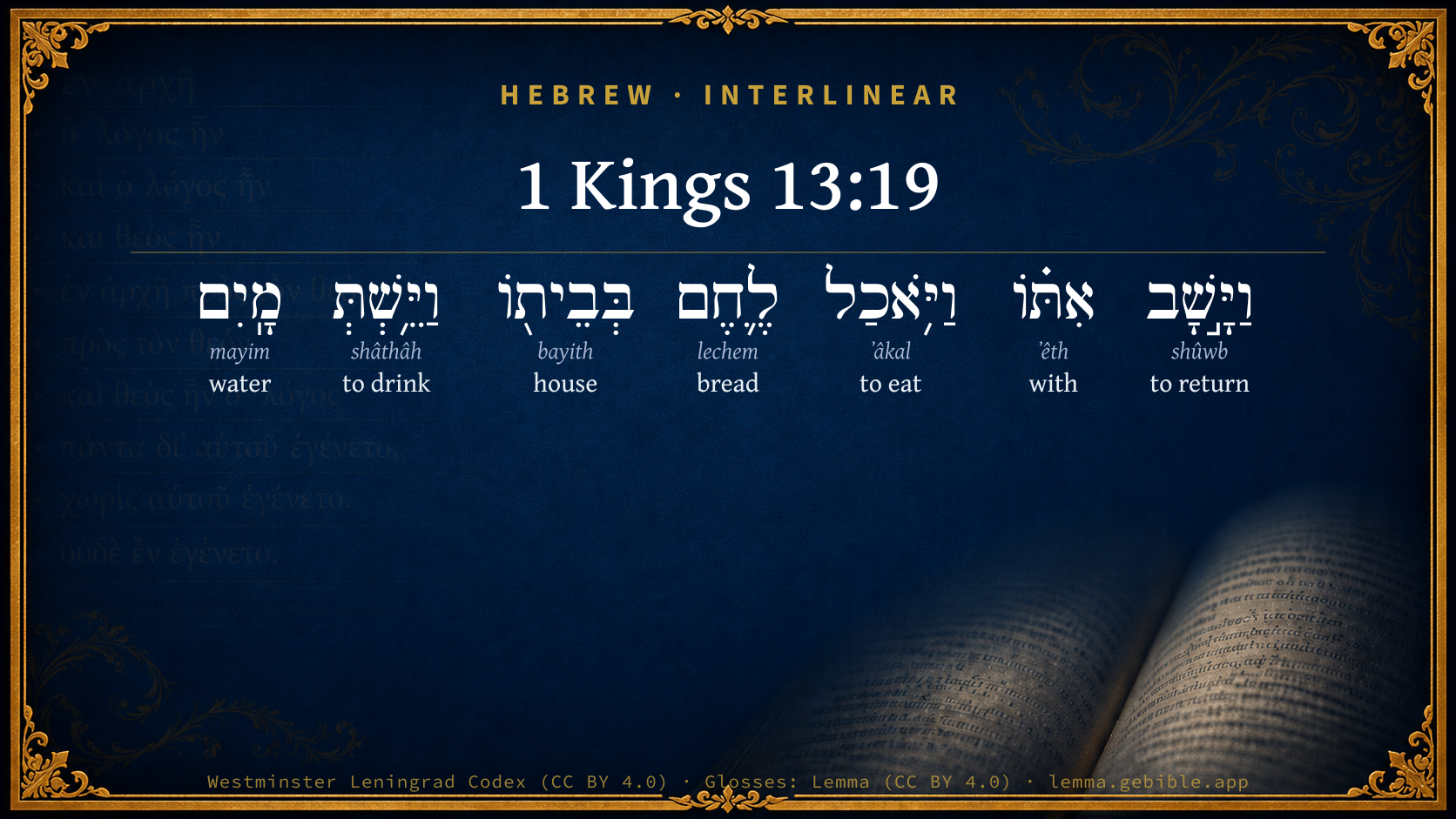
1 Kings 13:19

Hebrew (Westminster Leningrad Codex) 1 Kings 13:19 appears in the Hebrew Old Testament. The text above is from the Westminster Leningrad Codex. Each word links to its Strong’s number, a concise gloss, and parsing drawn from the Open Scriptures Hebrew Bible morphology. Click any word for its full Brown-Driver-Briggs (BDB) entry.
Download image
Cite this verse

1 Kings 13:19 (World English Bible). Public Domain. Lemma interlinear Bible study tool, https://lemma.gebible.app/v/1-kings/13/19.

Show BibTeX & RIS
BibTeX
RIS
English Translation
So he went back with him, and ate bread in his house, and drank water.
World English Bible · Public Domain
Download a study sheet

One document with this verse’s original text, its word-by-word gloss line, the meaning frame, cross-references with their text, attributed commentary, and full source and license credits — printable, and it pastes into notes with its structure intact.

This verse Autodidact and up

Study sheet (.html) Plain text (.txt)

A passage Seminary Student

Up to 50 verses in one chapter. A passage sheet keeps up to 6 commentary sources and 12 cross-references per verse, in the order this page ranks them, and says so on the sheet whenever that leaves anything out. Ask for a single verse and you get the Autodidact verse sheet above.

Everything on this page stays free to read, with no account — the sheet is a download of what is already on screen, not access to it.

Want to remove ads? Support Godless Engineer
Compare translations 3

The same verse in 3 English versions, stacked beneath the original-language interlinear above. Click any original word for its lexicon entry.

Each is an independent rendering of the whole verse — the interlinear is not word-aligned to these translations.

Highlighted words mark where these versions differ — a whole-verse word diff, not a word-by-word alignment.

  • World English Bible Public Domain
    So he went back with him, and ate bread in his house, and drank water.
  • King James Version Public Domain
    So he went back with him, and did eat bread in his house, and drank water.
  • unfoldingWord Literal Text CC BY-SA 4.0
    And he returned with him, and he ate bread in his house and drank water.

unfoldingWord Literal Text — © unfoldingWord, licensed CC BY-SA 4.0. Word-aligned USFM3 via Door43 (git.door43.org/unfoldingWord/en_ult).

Versions to compare (up to 4)

3 of 4 selected

Show all 18 translations

Every available English version of this verse, each an independent rendering of the whole verse.

  • World English Bible Public Domain
    So he went back with him, and ate bread in his house, and drank water.
  • Berean Standard Bible Public Domain
    but the man of God went back with him, ate bread in his house, and drank water.
  • Majority Standard Bible Public Domain
    but the man of God went back with him, ate bread in his house, and drank water.
  • King James Version Public Domain
    So he went back with him, and did eat bread in his house, and drank water.
  • American Standard Version (1901) Public Domain
    So he went back with him, and did eat bread in his house, and drank water.
  • Revised Version (1885) Public Domain
    So he went back with him, and did eat bread in his house, and drank water.
  • Geneva Bible (1599) Public Domain
    So he went againe with him, and did eate bread in his house, and dranke water.
  • Douay-Rheims (1899) Public Domain
    And brought him back with him: so he ate bread and drank water in his house.
  • Young's Literal Translation Public Domain
    And he turneth back with him, and eateth bread in his house, and drinketh water.
  • Literal Standard Version CC BY-SA 4.0
    And he turns back with him, and eats bread in his house, and drinks water.
  • Unlocked Literal Bible CC BY-SA 4.0
    So the man of God went back with the old prophet and ate food in his house and drank water.
  • unfoldingWord Literal Text CC BY-SA 4.0
    And he returned with him, and he ate bread in his house and drank water.
  • Darby Bible Public Domain
    Then he went back with him, and ate bread in his house, and drank water.
  • World Messianic Bible Public Domain
    So he went back with him, ate bread in his house, and drank water.
  • Webster's Bible Public Domain
    So he went back with him, and ate bread in his house, and drank water.
  • Free Bible Version CC BY-SA 4.0
    So the man of God went back with him, and ate and drank in his house.
  • Bible in Basic English Public Domain
    So he went back with him, and had a meal in his house and a drink of water.
  • JPS Tanakh (1917) Public Domain
    So he went back with him, and did eat bread in his house, and drank water.

Literal Standard Version (2020), Covenant Press — licensed CC BY-SA 4.0. Text via the HelloAO Bible API (eBible.org). Unlocked Literal Bible (unfoldingWord) — licensed CC BY-SA 4.0. Text via the HelloAO Bible API (eBible.org). unfoldingWord Literal Text — © unfoldingWord, licensed CC BY-SA 4.0. Word-aligned USFM3 via Door43 (git.door43.org/unfoldingWord/en_ult). Free Bible Version, Dr. Jonathan Gallagher — licensed CC BY-SA 4.0. Text via the HelloAO Bible API (eBible.org).

Word by word

More ways to search: Search by grammar → Find every occurrence → Compare this word →

Practice this passage: Drill this verse → Learn its vocabulary →

וַיֵּ֥שְׁתְּ
shâthâh
H8354
“and · to drink”
Conjunction + Verb, Qal, Sequential Imperfect, 3rd Person, Masculine, Singular
Part of Speech
Conjunction + Verb
Stem
Qal
Form
Sequential Imperfect
Person
3rd Person
Gender
Masculine
Number
Singular
Full BDB Definition

Origin: a primitive root

TWOT: 2477

to drink - (Qal) - to drink - of drinking cup of God's wrath, of slaughter, of wicked deeds (figuratively) - to feast - (Niphal) to be drunk
  1. וַיָּ֣שָׁב shûwb H7725 “and · to return” Conjunction + Verb, Qal, Sequential Imperfect, 3rd Person, Masculine, Singular
  2. אִתּ֗וֹ ʼêth H854 “with · him” Preposition + Suffix, Personal, 3rd Person, Masculine, Singular
  3. וַיֹּ֥אכַל ʼâkal H398 “and · to eat” Conjunction + Verb, Qal, Sequential Imperfect, 3rd Person, Masculine, Singular
  4. לֶ֛חֶם lechem H3899 “bread” Noun, Common, Both, Singular, Absolute
  5. בְּבֵית֖וֹ bayith H1004 “in/at · house · his” Preposition + Noun, Common, Masculine, Singular, Construct + Suffix, Personal, 3rd Person, Masculine, Singular
  6. מָֽיִם mayim H4325 “water(s)” Noun, Common, Masculine, Plural, Absolute

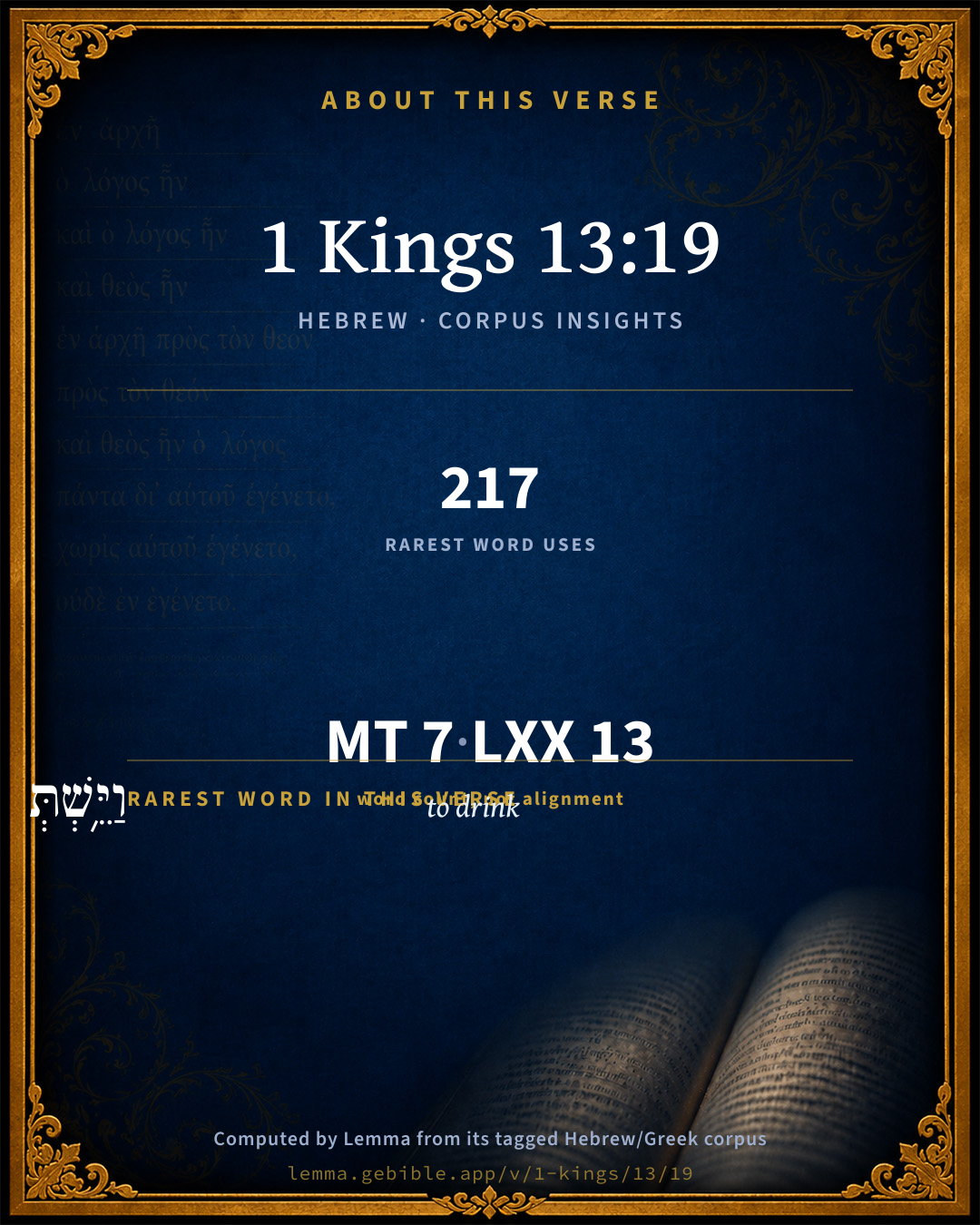
About this verse

These counts appear in no published source. They are computed here, from the morphology-tagged text and Lemma’s own curated glosses. What Lemma adds →

7
words
7
distinct lemmas
Historical
section

Grammatical profile

  • 3 verbs
  • 3 nouns
  • 1 preposition

Verb forms

  • וַיָּ֣שָׁב Qal · Sequential Imperfect
  • וַיֹּ֥אכַל Qal · Sequential Imperfect
  • וַיֵּ֥שְׁתְּ Qal · Sequential Imperfect

Hebrew & Septuagint length

In English translation the verse runs 15 words from the Hebrew and 15 from the Septuagint (LXX English) — the same length.

A rough comparison of the two English renderings, which tokenize alike — not a word-level alignment.

Word counts can differ between the Hebrew and the Greek without any difference in meaning — e.g. the Hebrew direct-object marker אֵת has no separate Greek word, and Greek often adds the article ὁ.

In the original languages it is 7 Hebrew tokens and 13 Greek tokens — but the two are counted differently (Hebrew bundles its prefixes and suffixes into one token; the Greek is in lemma form), so that isn’t a like-for-like length.

Cross-references

8

Topical passages linked to 1 Kings 13:19 in the Treasury of Scripture Knowledge — connected by theme and wording, ordered by reader-vote popularity; previews shown in the World English Bible.

  • Genesis 3:6 When the woman saw that the tree was good for food, and that it was a delight to the eyes, and that the tree was to be desired to make one wise, she took of the fruit of it, and ate; and she gave some to her husband with her, and he ate.
  • Deuteronomy 13:1 If there arise in the midst of you a prophet, or a dreamer of dreams, and he give you a sign or a wonder,
  • Deuteronomy 13:3 you shall not listen to the words of that prophet, or to that dreamer of dreams: for Yahweh your God proves you, to know whether you love Yahweh your God with all your heart and with all your soul.
  • Deuteronomy 13:5 That prophet, or that dreamer of dreams, shall be put to death, because he has spoken rebellion against Yahweh your God, who brought you out of the land of Egypt, and redeemed you out of the house of bondage, to draw you aside out of the way which Yahweh your God commanded you to walk in. So shall you put away the evil from the midst of you.
  • Deuteronomy 18:20 But the prophet, who shall speak a word presumptuously in my name, which I have not commanded him to speak, or who shall speak in the name of other gods, that same prophet shall die.
  • 1 Kings 13:9 for so was it charged me by the word of Yahweh, saying, You shall eat no bread, nor drink water, neither return by the way that you came.
  • Acts 4:19 But Peter and John answered them, "Whether it is right in the sight of God to listen to you rather than to God, judge for yourselves,
  • 2 Peter 2:18–19 For, uttering great swelling words of emptiness, they entice in the lusts of the flesh, by licentiousness, those who are indeed escaping from those who live in error;

Cross-references courtesy of OpenBible.info (CC BY 4.0).

Hebrew and Greek witnesses Masoretic Hebrew ↔ Greek Septuagint

The same verse in the two great witnesses to the Old Testament, shown verse-for-verse.

These are two independent witnesses, not word-aligned to each other, and the Septuagint is shown in lemma (dictionary) form.

Hebrew 1 Kings 13:19 Masoretic · Westminster Leningrad Codex

וַיָּ֣שָׁב אִתּ֗וֹ וַיֹּ֥אכַל לֶ֛חֶם בְּבֵית֖וֹ וַיֵּ֥שְׁתְּ מָֽיִם

So he went back with him, and ate bread in his house, and drank water.

World English Bible · Public Domain

Greek LXX 1 Kings 13:19 Septuagint · lemma form

καί ἐπιστρέφω αὐτός καί ἐσθίω ἄρτος καί πίνω ὕδωρ ἐν ὁ οἶκος αὐτός

And he brought him back, and he ate bread and drank water in his house.

LXX2012 (modern English Septuagint) · Public Domain

On this verse, The Cambridge Bible for Schools and Colleges discusses the Septuagint’s reading. Read the note in Commentary ↓

Hebrew: Westminster Leningrad Codex (CC BY 4.0). Greek: Septuagint (public domain); English from LXX2012 (modern English Septuagint) (Public Domain). How the Septuagint differs from the Hebrew →

Targum (Aramaic paraphrase)

1

The Targum is the ancient Jewish Aramaic paraphrase of the Hebrew Scriptures — an interpretive translation, not the Hebrew text itself. Onkelos (literal) and Pseudo-Jonathan (expansive) render the Torah, and Jonathan the Prophets. Coverage is partial: where no permissively-licensed English translation exists for a verse, only the Aramaic is shown. This is verse-level text, not a word-by-word alignment to the Hebrew.

  1. Targum Jonathan Prophets (Joshua–Malachi)
    וְתַב עִמֵיהּ וַאֲכַל לַחְמָא בְּבֵיתֵיהּ וּשְׁתֵי מַיָא:

    (no public-domain English translation for this verse)

    Targum Jonathan — Aramaic: “Mikraot Gedolot” (public domain). English: “Sefaria Community Translation” (CC0 1.0 (public-domain dedication)); “London "Chaldee Paraphrase," 1871” (public domain). Text via Sefaria.

Commentary

Notes on 1 Kings 13:19 from classic Christian and Jewish commentators (each source and its license shown beneath its notes). The classic Christian expositions comment on the surrounding passage and are grouped to its opening verse, so a note may address several verses; the Jewish commentaries on the Tanakh (Rashi and others) are per-verse, so they appear only where the commentator wrote on this verse.

Lemma curates 59 commentaries, every one of them public domain or Creative Commons licensed, each selected and text-cleaned for this edition rather than reprinted as found. About our sources →

Trapp's Complete Commentary

John Trapp

1Ki 13:19 So he went back with him, and did eat bread in his house, and drank water.

Ver. 19. So he went back with him.] He was too light of belief, and too easily entreated; his male suada fames might prompt him thereunto. Gregory thinks he might be self-conceited at his precedent doings and good success: to humble him, therefore, he is thus suffered to fall. Or it may be, saith Martyr, God was offended with him because he stayed by the way, and made no more haste back again. If he had prayed for direction, and paused a while upon this pretended countermand, he had not, likely, so miscarried.

John Trapp, A Commentary or Exposition upon All the Books of the Old and New Testament (1647–1656) — public domain. Text from a community e-Sword module.

Joseph Benson's Commentary

1Ki 13:19. So he went back with him — Too readily hearkening to his words, and not considering that what God himself had expressly commanded, nothing but the express command of the same God could set aside: otherwise the commands of God might be made of none effect by any one who should feign to have a divine commission.

Joseph Benson's Commentary on the Old and New Testaments (1811–1818) — public domain. Text from a community e-Sword module.

Adam Clarke's Commentary

Verse 19. So he went back with him] He permitted himself to be imposed on; he might have thought, as he had accomplished every purpose for which God sent him, and had actually begun to return by another way, God, who had given him the charge, had authority to say, "As thy purpose was to obey every injunction, even to the letter, I now permit thee to go with this old prophet, and take some refreshment." Now God might as well have dispensed with this part of the injunction, as he did in the case of Abraham: Take thy son Isaac, thy only son, whom thou lovest-and offer him for a burnt-offering; but, when he saw his perfect readiness, he dispensed with the actual offering, and accepted a ram in his stead. Thus much may be said in vindication of the man of God: but if this be so, why should he be punished with death, for doing what he had reason and precedent to believe might be the will of God? I answer: He should not have taken a step back, till he had remission of the clause from the same authority which gave him the general message. He should have had it from the word of the Lord to himself, in both cases, as Abraham had; and not taken an apparent contradiction of what was before delivered unto him, from the mouth of a stranger, who only professed to have it from an angel, who pretended to speak unto him by the word of the Lord. In this, and in this alone, lay the sinfulness of the act of the man of God, who came out of Judah.

Adam Clarke's Commentary on the Bible (1810–1826) — public domain. Text from a community e-Sword/MySword module.

The Cambridge Bible for Schools and Colleges

gen. ed. J. J. S. Perowne

19. So he went back with him] The LXX., by reading slightly different vowel points, renders ‘So he turned him back’. Josephus thinks these things were from God as in the case of the hardening of Pharaoh’s heart. ‘These things happened, I think, according to the will of God, that Jeroboam might give no heed to the words of Jadon, as he had been convicted of falsehood’, i.e. he had said he would not return, and then had done so.

The Cambridge Bible for Schools and Colleges (gen. ed. J. J. S. Perowne; Cambridge University Press, 1878–1918) — public domain. Text from a community e-Sword module.

John Gill's Exposition

And he cried unto the man of God that came from Judah,.... His mind being greatly affected with the word brought to him, partly on his own account, who, by a lie his conscience must accuse him of, had been the means of seducing the man of God, and partly on his account, who was threatened with death for complying with him:

saying, thus saith the Lord; being obliged to deliver, in the name of the Lord, what was said unto him:

forasmuch as thou hast disobeyed the mouth of the Lord; the order that came out of his mouth, as follows:

and hast not kept the commandment which the Lord thy God commanded thee; not to eat nor drink in Bethel.

John Gill's Exposition of the Whole Bible (1746–1763) — public domain (CC PDM 1.0). Text via the HelloAO Bible API.

The Pulpit Commentary

So he went back with him, and did eat bread in his house, and drank water cf. ver. 10.

The Pulpit Commentary (1880–1919), ed. H.D.M. Spence-Jones & Joseph S. Exell — public domain. Text from a community e-Sword module.

Lesson kit

Teaching starters — assembled from the data on this page, not authored interpretation. Every prompt links to the verse data it draws on. Edit before teaching.

1 Kings, in the Historical, opens this verse with 7 words (7 distinct Hebrew lemmas). Its most distinctive word is shâthâh (“to drink”). A historical commentator’s framing appears above. Read the whole chapter for the surrounding context.

Discussion questions

  1. What does “to drink” (shâthâh) contribute to the verse as a whole?
  2. How does Genesis 3:6, which shares this passage’s theme, read alongside this verse?
  3. These translations render this verse differently. What is at stake in choosing one wording over another?
  4. «וַיָּ֣שָׁב» is a Qal Sequential Imperfect verb. How does that grammatical form shape the action described?
  5. Compare how Trapp's Complete Commentary and Joseph Benson's Commentary read this verse. Where do they agree or differ?

Things to notice

Reading settings

Reading text

Shown beneath each verse's original-language words.

Old Testament
Old Testament edition

Read the OT as the Masoretic Hebrew (MT) or the Greek Septuagint (LXX).

English shown for the Greek Septuagint (in the Hebrew ↔ Greek comparison).

Comparing translations? Open the Compare panel on any verse page to stack up to four side by side.